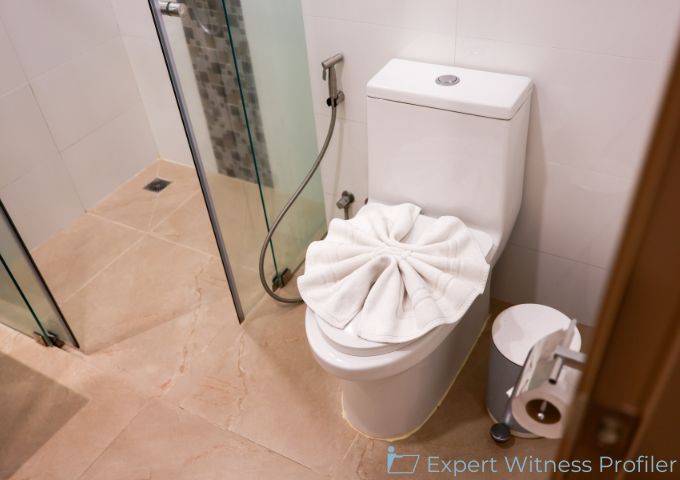
Plaintiff Tony Joyner alleged that on January 19, 2024, he went to a Walmart store located at 8730 Liberty Road, Randallstown, Maryland. While Joyner “was in the process of utilizing the customer restroom facilities . . . the toilet seat disconnected from the toilet bowl, causing him to fall from the toilet, hit his head, and suffer personal injuries.”
Plaintiff designated licensed architect Sylvia B. Deyé as a liability expert to opine on whether the water closet where Plaintiff’s fall occurred was dangerous in a manner that caused Plaintiff’s fall, and whether Walmart created the dangerous condition.
Walmart filed a motion to exclude the testimony of Deyé on the grounds that her opinions were not based on scientific, technical, or specialized knowledge; lacked a sufficient factual basis; intruded upon the ultimate issue to be decided by the jury; and encompassed legal conclusions.
Architecture Expert Witness
Sylvia Beatrice Deyé has a master’s degree in architecture and is a registered architect in Maryland and other states. She is a member of several professional associations for architects and has over 30 years’ experience working as an architect.
In connection with her work as an architect, Deyé has selected plumbing fixtures, specified plumbing fixtures on drawings, and inspected plumbing fixtures after installation. Since 2018, Deyé has also served as an expert consultant in commercial and personal injury litigation.
Deyé’s report consisted of four findings. Deyé opined that: (1) “the unsecured toilet seat was unreasonably dangerous”; (2) “Walmart should have known through adequate inspections and cleaning procedures that the incident toilet seat was not secured to the toilet bowl”; (3) Walmart’s “failure to identify that the incident toilet seat was not secure created the unreasonably dangerous condition that was the cause of Joyner’s injury”; and (4) “Walmart’s failure to have replaced the incident toilet seat and identify that the seat was not stable failed to comply with nationally recognized and accepted industry standards for safe plumbing fixtures and created the unreasonably dangerous condition that was the cause of Joyner’s injury.”
Following a January 15, 2026 site visit to the Walmart store in question, Deyé supplemented her original report. In her supplemental report, Deyé discussed her inspection of the incident toilet, other toilets, and the conclusions of Walmart’s expert, and concluded that the opinions stated in her original report remain unchanged.
Analysis
Although Walmart argued that Deyé lacked expertise regarding commercial toilets, her deposition testimony reflected that she had experience inspecting toilets installed in both residential and commercial settings.
First, Deyé’s observations regarding the method of installing the toilet seat at issue and the fact that an unstable toilet seat can be dangerous are matters of common knowledge.
Second, the fact that Deyé’s proposed testimony was not based on scientific, technical, or specialized knowledge, rendered it unreliable and thus inadmissible. Deyé offered no more than her own ipse dixit to support her four proffered opinions, which is “the hallmark of an unreliable opinion.”
The Court held that Deyé’s opinions were not based on specialized or technical knowledge, which detrimentally affected both the relevance and reliability of her proposed testimony.
The opinions offered in Deyé’s supplemental report were also excluded. Because Deyé’s supplemental report sought to “add information that is missing from the original report” and does “not attempt to correct the original report because it is misleading,” it is untimely.
In her supplemental report, Deyé noted that during her site inspection—which occurred nearly two years after the incident in question—she observed that toilet seats in the men’s and women’s restrooms were not secured. The condition of the restrooms, one of which is not at issue in this case, nearly two years after the fact has no bearing on whether Walmart had actual or constructive notice of the defective condition at the time Joyner was injured.
Held
The Court granted Defendants’ motion to exclude the testimony of Sylvia B. Deyé.
Key Takeaway
Installing a toilet seat does not require specialized or technical knowledge. Accordingly, Deyé’s testimony on this issue was not helpful to the jury and warranted exclusion.
Case Details:
Case Caption:
Joyner V. Walmart, Inc.
Docket Number:
1:25cv1300
Court Name:
United States District Court for the District of Maryland
This action arises from a claim for property damage brought by Plaintiff because of damage allegedly caused by a storm in May 2024.
Plaintiff retained Anna Kangas of Boulder Construction as its expert to support its claim for damages against Church Mutual.
Church Mutual filed a motion to exclude the testimony of Kangas because: (1) her cost estimate to repair the property is unreliable and speculative because it admittedly fails to consider the actual damage caused by the Storm and assumes the entire property must be repaired; and, (2) she used flawed and unreliable methodologies to calculate the repair estimate.
Architecture Expert Witness
Anna Kangas has a bachelor degree in architecture and a masters degree in public administration. She has been involved in architectural and construction work, including as a building and code enforcement manager, a construction project specialist, ADA Title II coordinator, and community development director.
Opinion 1 – The damage caused by the tree falling on the church building caused extensive damage to the building structure.
Opinion 2 – Being open to the elements and animals since the storm has caused additional damage.
Opinion 3 – The costs of repairing the building to its condition prior to the storm.
Analysis
Beginning with the first part of the Daubert test, the Court is persuaded that Kangas possesses specialized knowledge or skill in the areas of building structures and all aspects of repair and replacement and general commercial contracting work. She has fifteen years of experience in these areas including not only the architect and preconstruction aspect, but also in the building and code enforcement aspect. Plaintiff has shown that Kangas is sufficiently qualified to assess the alleged storm damage and aftermath, as well as to the estimate for the cost of repairs or replacement.
With respect to the second part of the test, the Court found that Kangas is qualified to assist the trier of fact. It is undisputed that Kangas personally inspected Plaintiff’s roof and building on two occasions, took photographs, and reviewed a “visual structural assessment” prepared by Ms. Alayna Nordstrom, PE, of Strickland Engineering and a report from the City of Dexter, Missouri. Kangas’ opinions are reflected preliminarily in her reports, but she also provided further explanations and clarifications for her opinions in her deposition testimony.
Finally, as for the third part of the test, the Court found that Kangas’ testimony is reliable or trustworthy in an evidentiary sense. While Church Mutual made numerous arguments alleging that Kangas’ opinions and estimates are not sufficiently reliable and lack foundation or support, the factual basis of an expert opinion goes to the credibility of the testimony, not the admissibility, and it is up to the opposing party to examine the factual basis for the opinion in cross-examination.” Church Mutual may cross-examine Kangas regarding her methodology and factual bases.
Held
The Court denied Church Mutual’s motion to exclude the testimony of Anna Kangas.
Key Takeaway
An expert need not have specialized education to qualify as an expert and may be qualified on experience alone. Very few jurors are architects, preconstruction managers, or construction estimators, so Kangas’ testimony on these matters will be useful in helping them judge the relevant facts.
Case Details:
Case Caption:
Dimension Church V. Church Mutual Insurance Company
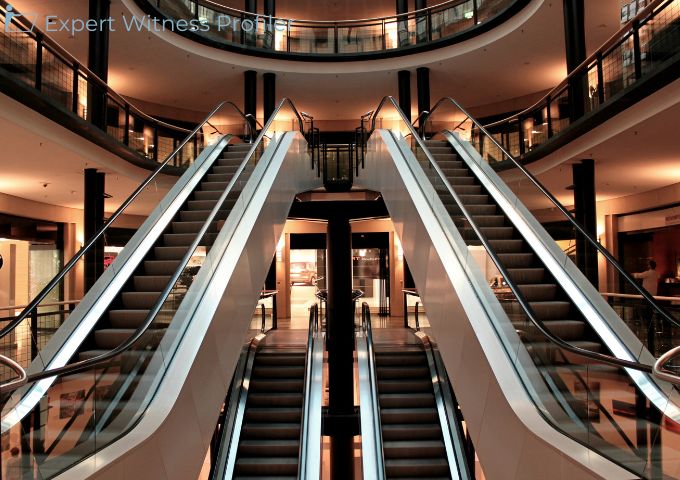
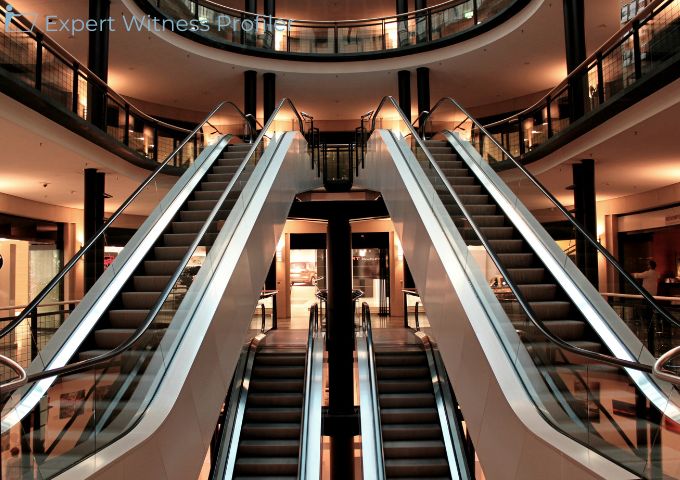
Dick’s Sporting Goods, Inc. (“DSG”) operated a retail location in Lyndhurst, Ohio. After the lone up-down escalator in the Lyndhurst Store stopped working, it was not barricaded though the escalator remained non-operational and stationery.
Tiffiney Jones contended that she felt a sharp pain in her toe while climbing the stationary escalator and had stepped on a metal wire located on the escalator steps, which punctured her sandal and sock.
Architecture Expert Witness
Richard L. Zimmerman is currently a licensed, registered professional architect in the State of Ohio, and has been so continuously from 1977 to the present.
He has reviewed and assessed compliance of a wide variety of buildings and sites with local and state building codes and ordinances, and the norms of accepted and reliable architectural, human factors, engineering, construction, maintenance, and safety industry principles, methods and practices.
A. Zimmerman is not Qualified to Give Expert Testimony
DSG argued that Zimmerman’s education and experience demonstrated that he is a qualified architect, but an expert’s status as a qualified architect does not necessarily mean that he can testify on the “retail maintenance of escalators, which is the issue in this case.” DSG asserted that Zimmerman’s conclusions that DSG violated the Ohio Revised Code, Ohio Building Code, Elevator Code, and Escalator Code cannot be made without knowledge of the retail standards for maintaining escalators.
The Court agreed with DSG and found that Zimmerman is not qualified to testify on commercial escalator maintenance and safety. Zimmerman’s qualifications are related to his status as a registered architect and his experience with Ohio Codes, retail locations of escalators, and pedestrian traffic flow.
His experiences as an architect did not provide a foundation for specialized knowledge on the safety, maintenance, and structural integrity of retail escalators. So, without technical or specialized knowledge of the appropriate and relevant standards to maintain escalators, Zimmerman was unqualified to opine on DSG’s adherence to the standard of care to maintain the escalator.
B. Zimmerman’s Conclusions Are not a Product of Reliable Methods
In the methodology’s first step, Zimmerman conducted a fact-finding inquiry by reading the incident report, depositions, and DSG’s internal policies. Zimmerman also reviewed photographs and video surveillance. Notably absent from this factual basis examination are visits to the Lyndhurst Store, inspections of the disputed escalator, modeling, or testing of the escalator. In his second step, Zimmerman reviewed and identified relevant safety standards and provisions of the Ohio Code, which required no data collection, testing, or analysis. Finally, the last step in Zimmerman’s methodology simply applied the facts established in the first step to the various Code provisions identified in the second step. From this application, Zimmerman arrived at the conclusion that DSG failed to maintain a safe premises because Plaintiff attests that there was a sharp object on the escalator. This is a significant analytical jump for Zimmerman to make, and he did not stick the landing.
DSG contended that Zimmerman’s failure to inspect the Lyndhurst Store, examine the escalator, or test Plaintiff’s footwear resulted in untested and unsupported conclusions.
The Court agreed with DSG and found that Zimmerman’s testimony is not based on reliable procedures.
C. Zimmerman’s Opinions Will Not Assist the Trier of Fact
DSG contended that Zimmerman’s testimony contains no new perspectives to assist the jury because his testimony was based on a simple identification of relevant code language and application to readily available documents, which the jury could do themselves.
Consistent with the above analysis, the Court found that Zimmerman’s testimony would not assist the trier of fact in resolving this litigation.
Held
The Court granted DSG’s motion to exclude the testimony of Richard L. Zimmerman.
Key Takeaway
Expert opinions that are not based on site-specific data or a generally accepted modeling but are based on anecdotal evidence with improper extrapolations do not comply with Rule 702 requirements.
Aside from gathering facts and identifying relevant Code provisions, Zimmerman failed to provide a basis for his conclusions that address where the sharp object was located on the escalator, if the object was caused by DSG’s malfeasance, and whether the sharp object caused Plaintiff’s injuries.
This action arises out of a March 18, 2019 trip-and-fall accident (the “Accident”) that occurred in the lobby of the Suffolk County Supreme Court Courthouse located at 1 Court Street, Riverhead, New York (the “Courthouse”).
Plaintiff Carole Gutterman was using a cane as she went through the Courthouse’s security checkpoint due to a prior, unrelated, motor vehicle accident. Gutterman sustained injuries as a result of stepping onto a platform.
Defendant Suffolk County sought to preclude the Court from admitting the report of Plaintiff’s expert, Richard J. Robbins, R.A.
The County asserted that Robbins’ “entire report is based upon the false premises that Plaintiff either stepped up onto the security platform, or attempted to step onto the platform, and that she was reaching for her belongings or attempted to reach for he belongings at the time that her accident occurred.”
Architecture Expert Witness
Richard James Robbins, R.A is a professional with over thirty years of experience in the administration and supervision of multi-million dollar design & construction contracts in the public & private sector.
Robbins is an architect who inspected the Courthouse and provided an expert opinion regarding the conditions of its safety screening area.
Robbins opined that the platform from which Plaintiff sought to retrieve her cane presented three dangerous conditions:
At a height of 6 3/8 inches, the platform adjacent to the conveyer belt is inaccessible to people with a disability;
The color of the floor adjacent to the conveyer belt and the presence of a black-colored mat “makes it difficult for pedestrians to discern the presence of the significant change in level which exists in their immediate path of travel . . . .”; and
The barrier reduced the clear width of the platform to 26 inches, whereas 36 inches of clearance is required.
Regardless of whether Plaintiff stepped on to the platform, the Robbins Report still reached several relevant conclusions, namely that the platform at 6 3/8 inches was too high, that the color of the floor and platform made it difficult to discern the change in height, and that the width to clear the barrier was too narrow. All of these conclusions could be relevant to determine the cause of the accident, and, therefore, be helpful to the trier of fact in determining whether the County was negligent.
Held
The Court denied the motion to preclude Richard Robbins’ expert report.
Key Takeaway
The proponent of the expert testimony has the burden of establishing, by a preponderance of the evidence, that the testimony is competent, relevant, and reliable. In evaluating the admissibility of expert testimony, the trial court must consider whether: (i) the witness is qualified as an expert on the topic at issue; (ii) the expert’s opinion is based on reliable data and methodology; and (iii) the expert’s opinion will assist the trier of fact.
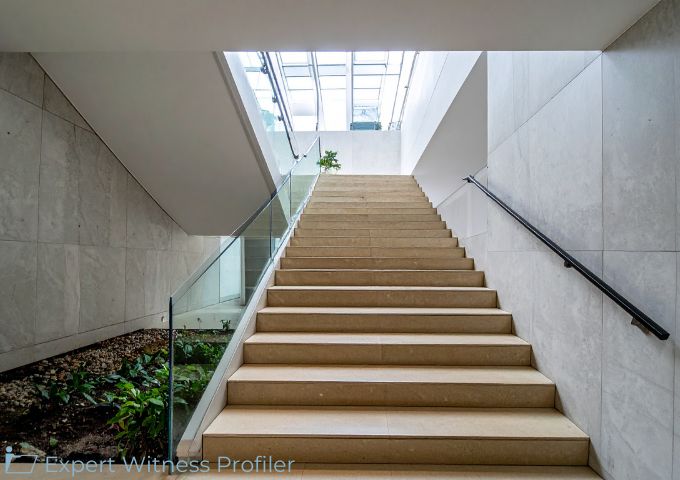
On the morning of November 21, 2023, Plaintiff Marie Iddriss (“Plaintiff”) fell down a flight of stairs in a building located at 123 West 20th Street in Manhattan after she exited the elevator on the second floor. Hong Diep Realty Incorporated (“Hong Diep”) was the landlord of the building with contractual responsibility for repairs in common areas and Kids At Work (“KAW”) was a tenant of space on the second floor. Plaintiff claimed that Hong Diep and KAW are responsible in negligence for her injuries. In particular, she claimed that Defendants failed to maintain handrails on the stairs which could have broken, and thereby prevented, her fall.
Plaintiff expected to call Douglas W. Peden as an expert at trial. Peden is a registered architect. Hong Diep filed a motion to preclude Plaintiff from offering Peden’s testimony “about the mechanism of Plaintiff’s fall and whether a handrail would have prevented it.”
Architecture Expert Witness
Douglas W. Peden provides expert analysis of construction and construction material defects, walkway construction, vertical misalignments, maintenance and safety, identification and delineation of hazards in stairs, ramps, corridors, platforms and level changes both outdoors and inside buildings and other structures.
Among other things, he has training and experience in the analysis and testimony for failure analysis and towards the resolution of personal injury litigation involving trip and fall injuries and code compliance issues.
According to Peden, the unprotected stair landing was unreasonably dangerous and that the failure to provide required handrails on the stair violated the standard of care and applicable building codes.
Hong Diep claimed that these opinions implicate issues of biomechanics and causation, outside of Peden’s expertise, are not supported by a reliable methodology, and would mislead the jury and therefore not be helpful to it.
Plaintiff admitted that Peden cannot offer evidence regarding “the force of Plaintiff’s fall, her body position at the time of her fall, or the impact the absence of handrails had on Plaintiff’s body or injuries.” Plaintiff further offered no evidence of Peden’s qualifications to opine on the mechanism of injury in this case.
Peden will be able to testify regarding the function of handrails along stairs in preventing people from falling off elevated surfaces, preventing people from falling over the edge of a landing, and providing a point of anchorage. Those opinions fall within Peden’s area of expertise. He can also testify that a handrail would provide a person who was falling off the second floor landing and into the stair case “with an opportunity to arrest her fall and injury.” That general testimony too falls within Peden’s expertise and is supported by a reliable methodology.
However, because he lacked the expertise to opine on what caused Plaintiff’s injury or what would have prevented it, and because he identified no methodology supporting such opinions, he may not testify regarding Plaintiff’s particular mechanism of injury.
Held
The Court granted Hong Diep’s motion to exclude the testimony of Douglas Peden.
Key Takeaway
The district court must ensure that an expert, whether basing testimony on professional studies or personal experience, employs in the courtroom the same level of intellectual rigor that characterizes the practice of experts in the relevant field.
Peden lacked the qualifications to opine on the mechanism of injury in this case and failed to identify any methodology supporting such opinions.
In December 2022, Carole Daniel (“Ms. Daniel”) tripped on a floor mat and fell inside a Phenix City, Alabama Dollar General retail store (“Dollar General”). Ms. Daniel suffered injuries and later sued Dolgencorp, LLC (“Dolgencorp”), the corporate entity operating the Dollar General. On June 15, 2024, Ms. Daniel passed away. Ms. Daniel’s husband, Ralph Daniel (“Mr. Daniel”), as Personal Representative of the Estate of Carole Daniel, was substituted as the proper Plaintiff in this action.
Dolgencorp filed a motion to exclude the expert testimony of Mark E. Williams, which is opposed by Mr. Daniel.
Architecture Expert Witness
Mark Elan Williams is an Alabama licensed architect, with more than thirty years of experience. He is licensed in multiple states throughout the Southeast and is certified by the National Council of Architectural Registration Boards.
To begin with, Williams reviewed several pieces of evidence, in forming his expert opinion, including: (1) December 2, 2022 surveillance footage of Ms. Daniel’s fall; (2) the pertinent Customer Incident Report; (3) Dolgencorp’s “Safety Orientation Training Module” ; (4) industry standards; (5) Dolgencorp’s Standard Operating Procedure (“SOP”) Manual; and (6) five January 31, 2023 photographs taken by Ms. Daniel’s sister, Becky Coreno (“Ms. Coreno”). He did not personally examine the specific mat involved in Daniel’s fall, but noted he was familiar with the mat’s manufacturer and its “‘waffle’ pattern of raised squares.”
Williams concluded, among other things, that the floor mat was a dangerous tripping hazard because: (1) it was “loose-laid” and had raised edges, which caused Ms. Daniel to trip and (2) it was improperly “secured down.” Moreover. Williams added that the “hazards associated with loose-laid floor mats are well documented and have been widely known for many years.”
In other words, his affidavit concluded that Dolgencorp “violated the standard of care for property maintenance, and created the dangerous condition that caused Ms. Daniel’s fall and injury.”
Basically, Williams offered expert testimony that Dolgencorp’s floor mat was a dangerous tripping hazard that ultimately caused Daniel to trip and fall.
Assist the Trier of Fact
In its role as gatekeeper, the Court is not convinced that Williams’ expert testimony regarding the mat’s condition will assist the jury, considering that his testimony relied on the video footage of Ms. Daniel’s fall.
The Court found “after reviewing the record evidence, especially the surveillance video . . . that a genuine dispute of material fact exists regarding the condition of the mat, such that a reasonable jury could find in Mr. Daniel’s favor.” However, the Court reached this conclusion without considering Williams’ expert report.
Moreover, Williams’ opinions could confuse the jury. His expert report found “the failure of Dollar General to provide a floor mat heavy enough not to move or properly secure the mat in place, violates the standard of care for property maintenance, and created the dangerous condition that caused Ms. Daniel’s fall and injury.” The Court held that Williams’ discussion of “standard of care” would at the very least confuse the jury, as “a witness may not testify to the legal implications of conduct; the Court must be the jury’s only source of law.”
Held
The Court granted Dolgencorp’s motion to exclude Mark Williams’ testimony.
Key Takeaway:
Daniel failed to show that Williams’ testimony would satisfy Daubert‘s helpfulness prong. The parties’ dispute in this case while important—is simple—whether Ms. Daniel fell because the floor mat “was in a worn condition.” Jurors are capable of using common sense when it evaluates the floor mat’s condition and placement in the surveillance video.
Case Details:
Case Caption:
Daniel V. Dolgencorp, LLC
Docket Number:
3:23cv135
Court Name:
United States District Court for the Middle District of Alabama, Eastern Division
Plaintiffs Michael Gerstman and Marie Webster, the insureds, sued Defendant Crestbrook Insurance Company (“Crestbrook”), their insurer, to recover on contractual and extracontractual theories arising from Crestbrook’s denial of their claim in this storm damage insurance coverage dispute.
Crestbrook filed a motion to strike the testimony of Plaintiffs’ experts, Dr. Neil Hall and Kevin Funsch.
Architecture Expert Witness
Neil B. Hall is the owner and principal of Groundtruth Forensics, a consulting firm specializing in building performance, failure analysis and damage assessment.
Hall is a member of the American Institute of Architects, American Society of Civil Engineers, Structural Engineering Institute, Construction Specifications Institute, International Institute of Building Enclosure Consultants, American Society of Safety Professionals and Association of State Floodplain Managers.
Kevin C. Funsch is an insurance adjuster and engineer with a solid background in claims handling and estimating. He has experience in adjusting property losses, performing appraisals, and writing expert reports.
Crestbrook filed a motion to strike Hall’s opinions on the basis that they are irrelevant, and it contended that his opinion regarding the full replacement of the roof should be excluded because it is unreliable and lacked a clear or verifiable methodology.
Crestbrook first contended that Hall’s opinions should be excluded as irrelevant because there is no dispute as to the scope of the damages at issue in this case. Plaintiffs countered that Hall’s opinions on causation and damages will certainly help the trier of fact understand the cause and extent of the damages at issue in this case.
Hall’s expert opinions suggested that there may be more damages at issue than Crestbrook is willing to acknowledge when it maintained that it was only obligated to pay the cost of replacing the individual damaged tiles.
Therefore, the Court declared that Hall’s opinions regarding the cause of the damage would assist the jury in understanding the evidence and in determining a fact in issue.
Crestbrook also contended that Hall’s opinions regarding the necessity of replacing the entire roof in the absence of available matching tiles are unreliable and not based on any clear or verifiable methodology. However, Hall’s report and CV plainly showed that his reliance on his experience makes his opinions on the repairs required to bring the Property back to pre-loss condition sufficiently reliable for purposes of Rule 702.
And to the extent that Crestbrook maintained that Hall did not make “any effort to determine whether ‘matching’ tiles were available,” the Court held that this fact, if true, would not undermine the reliability of his opinion that the entire roof would need to be replaced if matching tiles were unavailable in sufficient quantity.
Kevin Funsch
Crestbrook contended that Funsch’s estimate and opinions related to the full replacement of the roof are irrelevant because they will not assist the jury in determining whether Crestbrook underpaid the claim.
It maintained that they are unreliable insofar as they rely on Hall’s opinion that the roof may need to be completely replaced if there are not sufficient matching tiles with which to replace the damaged tiles.
The Court disagreed with Crestbrook’s assertion that Funsch’s opinions and estimate are irrelevant because they will not assist the jury in determining whether Crestbrook underpaid the claim. This contention is based on Crestbrook’s position that it is not required to replace the entire roof under the Policy and that the estimated cost of replacing the roof is not relevant.
Because there remains a genuine issue of fact as to whether Crestbrook was required to pay the cost of replacing the entire roof in the absence of the availability of matching tiles, the Court held that Funsch’s estimate regarding the cost of replacing the roof is relevant.
Crestbrook contended that Funsch’s estimate and opinions related to the full replacement of the roof are unreliable insofar as they rely on Hall’s opinion that the entire roof may need to be replaced if there are insufficient matching tiles to replace the damaged tiles. However, Crestbrook did not maintain that Funsch has relied on unreliable sources in determining the cost to replace the roof.
Instead, the objection seemed to be that Funsch included in his damages calculation the cost of replacing the roof based on Hall’s opinion that the entire roof may need to be replaced. However, the Court held that this does not make Funsch’s calculation unreliable for purposes of Rule 702.
Held
The Court denied Crestbrook’s motions to strike the testimony of Plaintiffs’ testifying experts Dr. Neil Hall and Kevin Funsch.
Key Takeaway:
Hall relied on his own inspection of the property, as well as weather data. His attached CV demonstrates his extensive education and professional experience in engineering and architecture.
By extension, Funsch’s estimate and opinions are reliable because they are based on Hall’s recommendations, which, in turn, are grounded in reliable weather data and decades of experience. The opinions are also relevant, as they help determine the cost of the repairs.
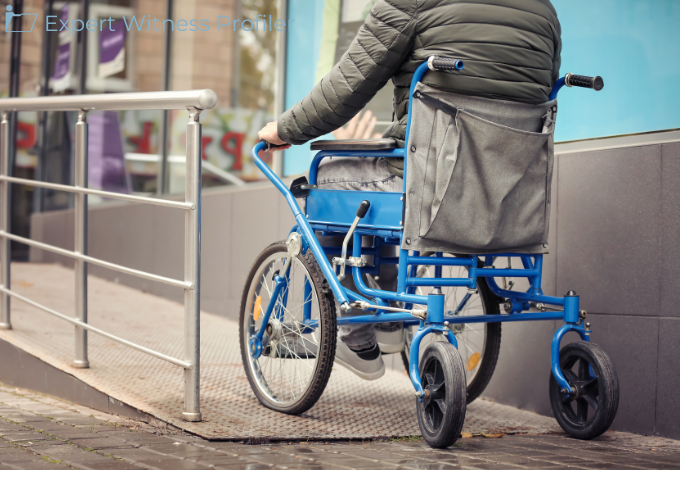
On March 19, 2018, Ralph Monte (“Monte”) visited the Defendant Sherwin-Williams Development Corporation’s store at 4473 South Semoran Boulevard in Orlando, Florida. While attempting to negotiate the ramp from the parking lot to the sidewalk, a wheelchair-bound Monte fell and sustained injuries. He claimed that the fall occurred because Defendant negligently maintained the premises and/or failed to warn him of a dangerous condition. Subsequently, Ralph Monte and his wife, Amarillis Monte filed this premises liability lawsuit under Florida law.
The Plaintiffs retained Robert Henry Burke, a forensic architect, as an expert witness to assess whether the conditions of the Defendant’s premises contributed to Monte’s accident. Burke visited the accident site twice, reviewed photographs taken by Monte and the Plaintiffs’ counsel, analyzed images pulled from the Internet in May 2019, and spoke with Monte on May 19, 2021. Burke produced his final expert report on May 30, 2024, a few days before the June 4, 2024 deadline to disclose expert reports.
In response, Defendant filed a motion to exclude Burke’s testimony regarding the slope and cross-slope of the ramp and whether or not the slope or cross-slope contributed to Monte’s accident. The Defendant argued that:
Burke’s opinions were not timely disclosed
He is unqualified to render these opinions
His opinions are not reliable or helpful
Architecture Expert Witness
Robert H. Burke Jr., AIA, served as NCARB president in 1992 and holds the distinction of being the only Florida architect to serve as both chairman of the Florida Board of Architecture and Interior Design and president of NCARB. A graduate of the University of Florida, Burke has received the Distinguished Alumnus and Distinguished Service Awards from the School of Architecture. In 1974, he co-founded his architectural firm, now known as BHM Architecture, which grew into one of central Florida’s most respected architectural practices. In 2013, he established RHBj Consulting to provide litigation support services for design and construction matters across Florida.
After assessing the premises’ conditions with regard to the relevant building codes, Burke opined that:
The ramp was improperly placed in an access aisle.
A one-inch change in level at the top of the ramp and sidewalk violated relevant code provisions.
The slope of the ramp was measured to be between 12.1% and 12.8%, while the relevant code allows a maximum slope of 8.33%.
After the ramp was removed following Monte’s accident, Burke calculated the slope by holding a twelve-inch digital level to the “clean concrete surface along the adjacent concrete curb” that was created by the ramp’s removal. In his view, these opinions “portray hazardous conditions and caused or contributed to Monte’s wheelchair fall accident.” He added that the premises were subject to other code violations.
When Defendant deposed Burke on August 2, 2024, he admitted that the methodology used to determine the slope of the ramp was inaccurate and could not be relied upon. Rather, a new calculation that he prepared the day before his deposition was “more accurate.” Accordingly, Burke stated that he was formally withdrawing his opinion regarding the slope of the ramp. Similarly, while Burke testified at his deposition that he had, since preparing his expert report, determined that the ramp was subject to a cross-slope that also contributed to Monte’s injury, he conceded that his report did not contain any opinion regarding cross-slope. Defendant reports that as of September 30, 2024, Burke had “not issued an updated report to reflect these new opinions and the opinions that were withdrawn.”
Analysis
When the Defendants moved to exclude some of Burke’s testimony, the Plaintiffs filed an untimely response. The Defendant moved to strike the Plaintiffs’ untimely response, and the Court granted the motion. Essentially, the Defendant’s motion to exclude is unopposed. Furthermore, the Court noted that the Plaintiffs failed to meet their burden of demonstrating the admissibility of Burke’s opinions.
Opinions Were Not TimelyDisclosed
The Court noted that the Plaintiffs failed to provide a supplemental expert report updating Burke’s opinions as to the slope and cross-slope. In other words, Plaintiffs failed to file a supplemental report detailing the new methodology employed by Burke to calculate the slope of the ramp and discussing how he determined that the ramp was subject to cross-slope. The case management and scheduling order required Plaintiffs’ expert report to be disclosed by June 4, 2024. Indeed, even if Plaintiffs had filed a supplemental expert report immediately after Burke’s deposition—which they did not—the Court would have had the discretion to exclude that supplemental report because the date to file expert disclosures had passed.
Reliability of Opinions
Even if the Court were to consider the untimely response, it found that Burke’s opinions were not reliable as per the Daubert standard. Initially, Burke calculated the slope of the ramp using a methodology that he later admitted was unreliable. Despite recognizing the error in his initial approach, Burke did not provide an updated report to correct or clarify his revised opinion. As a result, the Court concluded that the Plaintiffs failed to establish the reliability of Burke’s opinions regarding the slope.
The Court also noted that Burke did not explain how he determined that the ramp was subject to a cross-slope contributing to Monte’s injury, rendering his opinion on the cross-slope unreliable as well.
Held
The Court granted the Defendant’s motion to exclude certain testimony provided by the Plaintiff’s architecture expert witness, Robert Henry Burke.
Key Takeaways:
The Court granted Defendant’s motion to exclude Burke’s testimony due to the Plaintiff’s failure to timely disclose revised opinions. Additionally, the Court found that Burke’s opinions were unreliable. His opinion regarding the ramp’s slope relied on an inaccurate methodology, and no supplemental report was provided after he withdrew his initial opinion. Furthermore, Burke did not adequately explain the cross-slope issue or its contribution to the accident, leading the Court to exclude his testimony for lack of reliability and untimely disclosure.
Please refer to the blog previously published about this case:
On November 30, 2022, Plaintiff, Cynthia Burgett, was at the Hy-Vee Fast & Fresh convenience store in Prairie Village, Kansas, to purchase gas. The gas station’s fuel pump islands are shaped like an “H” and also referred to by the parties as a “dog bone” shape. The fuel pump islands are elevated above the parking lot pavement. While at Defendant’s gas station, Plaintiff tripped over a fuel pump island and suffered serious injuries. Plaintiff’s alleged injuries are extensive and she asserts that she will need lifetime medical care as a result.
Plaintiff asserted a claim of negligence against Defendant. Plaintiff contended that the fuel pump island was an unreasonably dangerous tripping hazard, that Defendant had knowledge or should have known that it was dangerous, that the design was not in accordance with industry standards, and it lacked safety features of Defendant’s standard pump and the industry standards. Both parties will present expert testimony at trial. Plaintiff has identified two experts that will testify as to the dangerousness of the fuel pump island: Lila Laux, a human factors expert, and Albert Kerelis, a licensed architect. Defendant has identified Richard Serignese as a non-retained expert to testify about the design and maintenance of fuel pumps. The parties have filed motions to exclude the opinions of these experts.
Human Factors Expert Witness
Lila Laux has a doctorate in Industrial/Organizational Psychology with a specialization in Human Factors Engineering from Rice University. She has worked as a human factors engineer for more than 30 years. She now works as a Principal Human Engineer for a firm that provides human factors research and consultative services to the military, NASA, the Nuclear Regulatory Commission, public service organizations, and private businesses.
Albert Kerelis has a master’s degree in architecture and is licensed in several jurisdictions, including Kansas. He has over 27 years’ experience in architecture. For the past five years, Kerelis has worked for Robson Forensic providing expert analysis. He also continues to work as an architect for Facilities Design Group and has done so for twenty years by providing architectural services for residential, commercial, and industrial projects. This includes site analysis, code review, code compliance, schematic design, structural design, mechanical, electrical and fire suppression design.
Laux’s opinions include the following: Plaintiff behaved how most people would behave at a gas station; the fuel pump created a hazard because Plaintiff’s attention was not attracted to the “extended lobe in her path” and she was unlikely to see it; the extended lobe of the fuel pump created an unexpected trip hazard that caused Plaintiff to trip; it is unreasonable to expect that people walking between the store and the fuel pump would expect or detect the unmarked and undifferentiated pump pedestal protruding into their path; and it was foreseeable that customers could fail to detect the raised pedestal and trip as they walked to their vehicle.
Qualifications
Defendant made a cursory attempt to exclude Lila Laux’s testimony on the basis that she is not qualified.
A review of Laux’s resume shows that she has decades of experience on human factors and her opinions largely relate to how individuals and Plaintiff would navigate the obstacle of the fuel pump and whether they would be aware of the elevated fuel pump in their path based on her experience. The Court finds that she is qualified to offer such opinions based on her education and experience.
Helpfulness
Defendant argued that Laux’s opinions would not assist the jury in understanding the evidence or facts in this case because what ordinary people see in situations and how they understand their surroundings are within the common understating of a juror.
Here, the Court found that Laux’s opinions and testimony would not be helpful to the jury. Laux offers opinions regarding the types of customers that would go to a gas station, how customers would walk from the fuel pump to the convenience store, whether customers would expect to see or detect the raised fuel pump, and whether it was foreseeable that someone would trip on the raised fuel pump. Such opinions are not helpful here because the average juror has experience getting gas at a gas station. An average juror also has experience walking from a fuel pump to the convenience store to either pay for the gas or to go inside and purchase additional items.
Albert Kerelis
Kerelis is a licensed architect and will provide the following opinions at trial: 1) the edge of the fuel pump island was dangerous and caused Plaintiff to fall; 2) the edge of the fuel pump island was a low obstruction in a foreseeable pedestrian path that violated the standard of care for safe walkways; 3) the property owners should have known it was dangerous and provided warnings to pedestrians; 4) the failure to eliminate the hazardous condition or provide warnings was a violation of the standard of care for safe walkways and created the hazardous condition that caused Plaintiff’s injury; and 5) the owner violated nationally recognized standards of care and the city’s codes and ordinances.
Qualifications
Defendant asserted that Kerelis is not qualified to provide expert testimony on the fuel pump island because he has not prepared design drawings in the past five years, has not designed any projects in Kansas, and has not prepared a design with a fuel pump island in at least 15 years. Kerelis is a licensed architect with decades of experience who has designed hundreds of sites. He testified extensively regarding his experiences in site design and the related considerations of safety for pedestrians and users of sites when designing sites. The Court held that Defendant’s arguments called into question the weight of his testimony rather than his qualifications.
Reliability
Essentially, Defendant argued that the expert’s opinions are not reliable because he fails to cite any publications regarding the design and maintenance of fuel pump islands. Defendant took issue with Kerelis’ reliance on several national publications which he has identified as standards of care in the industry because they are not publications regarding the design and maintenance of fuel pump islands. Kerelis’ opinions, however, clearly stated that Defendant violated the standards of care regarding safe walkways and warnings regarding obstructions. His expert report cites to various publications, including a publication by ASTM International, formerly the American Society for Testing and Materials (ASTM), which is a “globally recognized leader in the development and delivery of professional consensus standards.”
In the report, Kerelis states that ASTM’s publication, “Standard Practice for Safe Walking Surfaces, is a nationally recognized standard of care for the safe construction and maintenance of walkways to prevent pedestrian falls.” That publication states that “in situations where a short flight stair or single step transition exists or cannot be avoided, obvious visual cues shall be provided to facilitate step identification.”
The Court held that Defendant’s arguments claiming Kerelis failed to cite publications on fuel pump islands are unpersuasive. The standards cited by Kerelis relate to obstructions in a walkway and based on the facts in this case and the expert opinions, a jury could conclude that the fuel pump island extended into the walkway.
Richard Serignese
Defendant identified Richard Serignese as a non-retained expert that will “testify that the shape, size, color, and condition of the fuel pump island is within industry standards and that Hy-Vee did not violate any standard of care in regard to the maintenance of the fuel pump islands.”
Serignese is the Vice Presicent and General Manager of Simon Surfaces and will testify based on his “knowledge, education, training, and experience in the fuel island industry.”
With respect to his opinions, Serignese testified that he actually doesn’t “know the exact industry standard” for fuel pump island designs and that his “understanding has always been people pick what they want to pick. It’s a matter of preference. I don’t know that — I don’t know what the — anybody could tell you what the exact industry standard is.” He then reiterated that he did not know the industry standard for fuel islands and admitted that he could not say that this particular design is or is not industry standard.
Defendant argued that Serignese’s inability to articulate an industry standard should not preclude him from testifying because his testimony is that he doesn’t think there is an industry standard. Defendant, however, offered Serignese as an expert who will testify as to the industry standard and that Defendant’s fuel pump island is within that standard. The Court held that Serignese is not qualified to opine as to these issues and his deposition makes clear that he has no opinion on these issues.
Defendant designated Serignese as an expert who will testify that Defendant met the standard of care for maintaining the fuel pump island. The Court held that his deposition testimony, however, made it clear that he has no expertise in that area.
Held
1. The Court granted the Defendant’s motion to exclude the testimony of Lila Laux.
2. The Court denied the Defendant’s motion to exclude the testimony of Albert Kerelis.
3. The Court granted the Plaintiff’s motion to exclude the testimony of Richard Serignese.
Key Takeaways:
Laux offers opinions regarding the types of customers that would go to a gas station, how customers would walk from the fuel pump to the convenience store, whether customers would expect to see or detect the raised fuel pump, and whether it was foreseeable that someone would trip on the raised fuel pump. Such opinions are not helpful here because the average juror has experience getting gas at a gas station.
Kerelis’ opinions, however, clearly stated that Defendant violated the standards of care regarding safe walkways and warnings regarding obstructions. His expert report cites to various publications, including a publication by ASTM International, formerly the American Society for Testing and Materials (ASTM), which is a “globally recognized leader in the development and delivery of professional consensus standards.” The Court held that Defendant’s arguments claiming Kerelis failed to cite publications on fuel pump islands are unpersuasive.
Case Details:
Case Caption:
Burgett V. Hy-Vee, Inc. Et Al
Docket Number:
2:23cv2173
Court:
United States District Court for the District of Kansas
In 2015, Defendant/Counter-Plaintiff C70 Builders, Inc. contracted with Plaintiff Mid-South Outlet Shops, LLC c/o Tanger Management, LLC for the construction of the Tanger Outlets Southaven, an open-air mall in Southaven, Mississippi. The Mall opened in November 2015. According to C70, the first design modifications were subsequently installed at several buildings on the Project by C70 pursuant change orders under the Original Contract, and at other buildings by a different contractor retained separately by Tanger (these first modifications were named the “VF Fix”). Beginning in 2019, other agencies and consultants were retained by both Tanger and C70 to help identify the source and propose remedial action for ongoing water intrusion issues. These remediation efforts also included the execution of a second contract in February 2020 between C70 and Tanger for C70 to install additional modified waterproofing designs (the “Pier Replacement Contract”).
Façade Due Diligence Report
In August 2021, Tanger retained Jeffrey Mason, and his company, WGI, Inc. (“WGI”), to review all pertinent documents related to the construction for the project including subsequent reviews, repairs and drawings created after the retail buildings were completed. This review was to be done to provide ownership with WGI’s evaluation of these documents and to direct ownership on next steps based on the findings. In connection with this review, WGI was to prepare a written report summarizing its findings of the construction documents, initial construction of the buildings, subsequent reviews, tests, and previous repairs with photographs of representative conditions, an estimate of probable construction costs, and recommendation of how to proceed concerning warranties and deadlines for litigation. WGI generated a “Façade Due Diligence Report” bearing Mason’s name on November 16, 2021 (the “First WGI Report).
Shortly thereafter, Tanger advanced claims for breach of contract and negligence, alleging that there have been “numerous incidents of defective construction, some of which have caused substantial water infiltration” throughout the Site. According to C70, these allegations are taken almost verbatim from the executive summary of the First WGI Report.
C70 filed a motion to strike reports and testimony of Jeffrey Mason, the designated expert of Tanger for the reason that his disclosures as an expert witness are insufficient under Rule 26 of the Federal Rules of Civil Procedure and on the basis of “… the prejudicial impact of allowing him to testify without C70 having had an opportunity to depose him prior to the September 13, 2024 deadline for the filing of Daubert and dispositive motions.”
Architecture Expert Witness
Jeffrey Mason has extensive experience managing a wide range of architectural projects and the production of construction documentation. His areas of expertise include exterior facade restoration and rehabilitation, several types of construction projects including, but not limited to the following: large mixed-use commercial developments, adaptive re-use projects, historic restoration projects, retail developments, and multi-family developments.
Discovery in this long pending, multi-party construction case has no doubt resulted in extensive and complicated reports of experts.
The Court held that the rule is quite clear, as Local Rule 26(a)(3) states: Failure to Disclose. If a party fails to make a disclosure required by [Local Rule 26], any other party must move to compel disclosure and for appropriate sanctions under Fed. R. Civ. P. 37(a) …. Challenges as to inadequate disclosure of expert witness(es) must be made no later than thirty days before the discovery deadline or will be deemed waived.
Moreover, not only is the rule plain, but the reason for its having been adopted in the Northern and Southern District Courts of Mississippi is due to its inherent fairness. The Court found C70’s counsel’s failure to have addressed the rule in its lengthy recitation of both rule Fed. R. Civ. P. 26 and L.U. Civ. R. 26(a)(3) in its 27-page memorandum or by way of reply brief concerning.
Whether C70 has waived its challenges to the sufficiency of Tanger’s multiple expert disclosures of Mason under Fed. R. Civ. P. 26 due to its failure to timely raise them
C70 correctly pointed out that in evaluating whether a violation of Rule 26 is harmless, the Fifth Circuit has held that district courts are to consider: (1) the importance of the evidence; (2) the prejudice to the opposing party of allowing the witness to testify; (3) the possibility for curing such prejudice by granting a continuance; and (4) the explanation, if any, for the party’s failure to comply with the disclosure requirements. C70 insisted that these factors mandate an exclusion of Mason as an expert witness, retained or otherwise. Tanger argued that C70 never made any suggestion that Tanger’s multiple expert disclosures were insufficient under either Fed. R. Civ. P. 26(a) or L.U. Civ. R. 26 until well after the discovery deadline and just two days before the dispositive and Daubert motions deadline. As such, Tanger argued that its challenges to the adequacy of the disclosures have been waived.
The Court found that C70 has not demonstrated any actual prejudice from any claimed inadequacy of the disclosure of Mason since a denial of its motion to strike based thereon due to its waiver does not make those expert disclosures any more comprehensive or capable of withstanding a Daubert challenge than they actually are. In other words, unless the district judge finds otherwise, Mason, as an expert, will be limited at trial to offering those facts and opinions that have actually been disclosed and which withstand any Daubert challenge.
Held
The Court denied Defendant/Counter-Plaintiff C70 Builders, Inc.’s (“C70”) motion to strike reports and testimony of Jeffrey Mason, for insufficient disclosure.
Key Takeaways:
When C70 contented that Tanger’s multiple expert disclosures were insufficient under either Fed. R. Civ. P. 26(a) or L.U. Civ. R. 26, the Court noted C70’s failure to timely raise challenges to the sufficiency of Tanger’s multiple expert disclosures.
The Court found that C70 has not demonstrated any actual prejudice from any claimed inadequacy of the disclosure of Mason since a denial of its motion to strike based thereon due to its waiver does not make those expert disclosures any more comprehensive or capable of withstanding a Daubert challenge than they actually are.
Case Details:
Case Caption:
Mid-South Outlet Shops, Llc V. C70 Builders, Inc.
Docket Number:
3:21cv256
Court:
United States District Court, Mississippi Northern