Category: Aviation Expert Witness

  • Aviation Expert Was Allowed to Opine on Wing Repairs

    Aviation Expert Was Allowed to Opine on Wing Repairs

    The claims in this action for negligence, gross negligence, and vicarious liability arise out of damage caused to The Jones Company’s (“TJC”) 2024 Embraer Phenom 300E aircraft (“the aircraft”). On December 30, 2024, the aircraft was flown to New Orleans Lakefront Airport, where Signature Flight Support, LLC was providing fixed-base operator services, including ground handling operations.

    According to TJC, on that same day, while Defendant Phillip Everett was towing the unpowered aircraft, the leading edge of the aircraft’s left wing struck a fire hydrant, damaging the underside of the wing.

    TJC retained Keith M. Bransky as an aircraft appraisal expert to provide an opinion with respect to the aircraft’s “pre-damage market value and post-repair diminution in value.”

    Signature sought to exclude Bransky as an expert witness on three grounds: (1) that Bransky is not qualified as an expert to opine on the aircraft’s diminution in value, (2) that his opinions are “neither reliable nor relevant,” and (3) that his “testimony will not aid the trier of fact.

    Aviation Expert Witness

    Keith M. Bransky has thirty-four years of aircraft appraisal experience, including experience “working as a licensed aircraft mechanic, professional pilot, and aircraft broker.”

    Bransky is certified as an “Accredited Senior Appraiser with the American Society of Appraisers” (“ASA”), has authored and published articles and textbook chapters on the topic of diminution of value for damaged aircraft, and is currently authorized as a Federal Aviation Administration (“FAA”) inspector.

    He obtained a bachelor’s degree in aviation management from Southern Illinois University in 1980 and an associate of applied science degree, also from Southern Illinois University in 1980.

    Get the full story on challenges to Keith Bransky ’s expert opinions and testimony with an in-depth Challenge Study.

    Discussion by the Court

    A. Bransky is Qualified

    Signature contended that Bransky is not qualified to testify as an expert in this matter because he “lacks ‘specialized knowledge’ of the type of aircraft at issue.”

    With more than three decades of experience in aircraft maintenance
    and appraisals, the Court found that Bransky is suitably qualified to advance an expert opinion on the aircraft’s pre-damage market value and post-repair diminution in value.

    B. Bransky’s Opinion is Reliable

    Signature challenged the reliability of Bransky’s opinion on two grounds: his general methodology, and his consideration of information concerning the potential impact of corrosion on the aircraft’s value.

    First, Signature argued that Bransky’s opinions are unreliable because they
    are subjective and lack a validated methodology. As TJC correctly noted, Signature’s own expert utilized a nearly identical test for assessing diminution in value.

    The Daubert inquiry is “flexible,” particularly where the expert relies on
    professional experience rather than strictly scientific analysis. Considering the near identical methodologies that the Signature and TJC experts advance, the Court can hardly conclude that Bransky’s methodology is wholly unreliable.

    Moreover, Signature’s only challenge to the factual information upon which Bransky relies concerned the impact of corrosion in his diminution of value analysis.

    Signature’s core complaint with Bransky’s opinion is the uncertainty surrounding whether there is an increased risk of corrosion that will negatively impact a buyer’s perception of the aircraft’s value. Whether future damage to property is certain to result is not determinative of an expert opinion’s admissibility.

    To the extent Signature disagreed with Bransky’s methodology or consideration of potential corrosion in rending his opinion, such issues go to the weight of his testimony.

    C. Bransky’s Testimony is Relevant and Will Assist the Trier of Fact

    Signature asserted that Bransky’s testimony is irrelevant or “its probative value is substantially outweighed by risks of prejudice, confusion of the issues, or waste of time,” on two specific grounds. To begin with, Signature challenged Bransky’s classification of the damage to the aircraft as “moderate” because FAA regulations only define “major” and “minor” repairs and thus his “subjective” use of “moderate” is confusing. Also, Signature argued that any testimony from Bransky with respect to whether the wing repairs were “permanent” or “temporary” are outside his expertise and risk “confusing the trier of fact.”

    The Court found that there is a low, and easily remedied, risk of confusion should Bransky describe the damage as “moderate” in the context of his appraisal. Regardless, describing the damage history of an aircraft is obviously relevant for appraising its value and Bransky’s testimony will “provide insight on a topic which the jury could not itself assess with common knowledge and experience.”

    Second, Bransky’s report indicated that he was not offering his own opinion
    that the repair was permanent, rather that the repair itself would impact the value of the aircraft.

    Signature has not specifically identified in what respect it would object to the relevance of Bransky’s testimony regarding the permanence of repairs—i.e., whether it takes issue with a particular use of the words “temporary” and “permanent” or with respect to his analysis of the potential future need for additional repairs. The Court has already concluded that Bransky may testify to the market perception that the repaired wing is more susceptible to future damage and that his testimony must be limited to the analysis in his report.

    Held

    The Court denied Signature’s motion to exclude testimony from TJC’s expert witness, Keith M. Bransky.

    Key Takeaway

    Perceived flaws in an expert’s valuation methodology are matters properly to be tested in the crucible of adversarial proceedings; they are not the basis for truncating that process.

    Case Details:

    Case Caption: Jones Company V. Signature Flight Support, LLC
    Docket Number: 2:25cv1645
    Court Name: United States District Court, Louisiana Eastern
    Order Date: June 15, 2026
  • Aviation Expert’s Testimony on Flight Attendant Conduct Excluded

    Aviation Expert’s Testimony on Flight Attendant Conduct Excluded

    In this personal injury case, Plaintiff Ana Maria Marcela Tavantzis (“Tavantzis”), individually and on behalf of her husband, Jesus Plascencia (“Plasencia”), alleged Defendant American Airlines, Inc. (“American”) was responsible for a stroke Plasencia suffered just prior to landing on an international flight from Miami to Madrid, Spain.

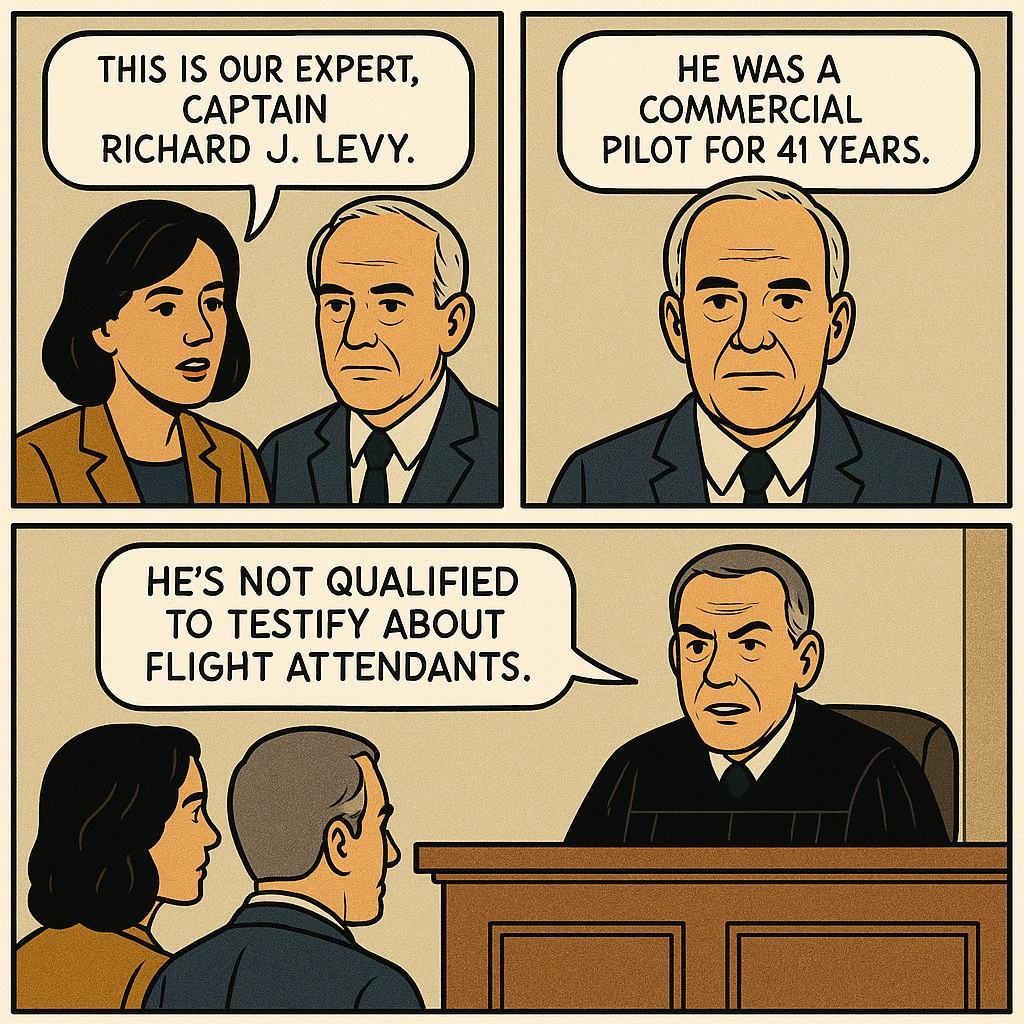
    Plaintiff’s expert Captain Richard J. Levy advanced three opinions related to three critical periods before and during the flight at issue: (1) just before takeoff when the pilot spoke with Plaintiffs; (2) when Plasencia presented stroke symptoms an hour and a half into the flight; and (3) when the pilot landed in Madrid.

    American argued that the Court should exclude Levy’s opinions because the opinions (1) are unreliable under the Daubert standard; (2) exceed the scope of his aviation expertise; (3) rely on destroyed data; and (4) supplant the jury’s function by opining on the ultimate facts. 

    Aviation Expert Witness

    Captain Richard J. Levy flew forty-one years at a major international airline, American Airlines, until the mandatory retirement age of 65 in June of 2018.

    He has decades of flight experience in both the commercial and military field. Since his retirement, he has been conducting simulator and classroom training as a Flight Crew Training Instructor at another major airline, Southwest Airlines.

    Get the full story on challenges to Richard Levy’s expert opinions and testimony with an in-depth Challenge Study. 

    Discussion by the Court

    Reliability

    American disputed the reliability of Levy’s experience as the basis for his opinions. 

    To support this contention, American advanced three reasons:

    • First, American argued that Levy’s testimony is unreliable because it does not explicitly “set forth what Levy was asked to opine on.”
    • Second, American argued that Levy’s opinions are unreliable because his opinions did not cite directly to the record or engage in sufficient “analysis.”
    • Finally, American contended that Levy’s opinions are irrelevant because they did not have “any tendency to make a fact more or less probable than it would be without the evidence.”

    Analysis

    American never explains why the imprecision surrounding the scope of Levy’s engagement renders his opinions unreliable. What Levy thought the contours of his assignment were has no bearing on his qualifications or experience; the Court held that he is still a flight training instructor who for 41 years served as a commercial pilot for Defendant American Airlines. 

    Moreover, the facts of this case are not so complicated that it requires citations to the record to understand the context of Levy’s opinions. His opinions reflect the application of his specialized knowledge and experience to the straightforward facts of this case, which he describes at the outset of his report. Because Plaintiffs submitted Levy as an expert for his experience, Levy need not have conducted any “analysis” in the manner American insisted he must. 

    Besides, the Court determined that Levy’s opinions make some facts more or less probable, if the American flight in this case had sufficient fuel for the pilot to turn the plane around if Plasencia presented stroke symptoms an hour and a half into the flight (a fact that is disputed by the parties). 

    Scope

    American specifically challenged Levy’s statements regarding the proper conduct of American employees, other than the pilot, who were working on the aircraft during Plaintiffs’ flight. As an expert, Levy is allowed to make certain factual assumptions within his opinions.

    However, considering Levy’s experience was as a pilot, not a flight attendant, the Court held that he is not qualified to opine on whether the flight attendants on board contravened policy or acted negligently. 

    The Court excluded all portions of Levy’s testimony that opine on the behavior, conduct, or propriety of any American employee other than the pilot.

    Origin of Flight Track Data

    The flight data that Levy used in his report is reliable. American argued otherwise, suggesting that the flight data was suspect because it was obtained from third party FlightRadar24 and is now no longer available on that site. 

    Plaintiffs responded that the limited data that Levy relied upon—a cropped rendering of the flight path after an hour and a half of flight time—was provided to American. The Court deemed it sufficient under Civil Procedure Rule 26.

    Ultimate Issue

    In this case, American conflates factual issues and legal issues; experts are only proscribed from opining on the latter when it goes to the ultimate issue in the case.

    The Court held that Levy does not opine on any legal issues, so there is no reason to exclude Levy’s proffered testimony on those grounds.

    Held

    The Court granted in part and denied in part American’s Daubert motion to exclude the opinions of Plaintiffs’ expert, Ret. Captain Richard J. Levy. 

    Key Takeaway:

    Levy goes beyond the scope of his expertise to opine on the proper conduct of American employees, other than the pilot, who were working on the aircraft during Plaintiffs’ flight. After all, Levy’s experience was as a pilot, not a flight attendant. 

    Case Details:

    Case Caption: Tavantzis V. American Airlines, Inc.
    Docket Number: 5:23cv5607
    Court Name: United States District Court, California Northern
    Order Date: 5:23cv5607
  • Film and Movie Production Expert Witness’ Opinion Assists Court by Clarifying Article’s Factual Elements

    Film and Movie Production Expert Witness’ Opinion Assists Court by Clarifying Article’s Factual Elements

    Plaintiffs Shosh Yonay and Yuval Yonay (collectively “Plaintiffs”) are the widow and son of Ehud Yonay (“Yonay”), the author of a magazine article “Top Guns” (the “Article”) published in California Magazine on April 21, 1983. The Article is an account of the experiences of F-14 pilots and radio intercept officers as they undergo training at the Navy’s Fighter Weapons School (known as “Top Gun”). After the Article’s publication, Defendant Paramount Pictures Corporation (“Defendant”) and Yonay executed an Assignment of Rights, dated May 18, 1983, assigning to Defendant the motion picture rights to the Article. The Assignment of Rights also required Defendant to credit Yonay on the film of any motion picture photoplay that is produced under the Assignment of Rights and substantially based upon or adapted from the Article or any version or adaptation thereof.

    In 1986, Defendant released the motion picture “Top Gun” (the “Original Film”). Yonay received a “suggested by” credit. The story follows fictional characters Pete (“Maverick”) Mitchell and Nick (“Goose”) Bradshaw as they train at the Top Gun Naval Fighter Weapons School.

    On January 23, 2018, after Yonay’s death, Plaintiffs sent Defendant a Notice of Termination (“Notice”) terminating Defendant’s rights to the Article pursuant to 17 U.S.C. § 203(a), effective January 24, 2020. On May 27, 2022, Defendant released the sequel to the Original Film, “Top Gun: Maverick” (the “Sequel”) without crediting Yonay. The film grossed $1.496 billion worldwide, making it the second-highest-grossing film of 2022. It also won Best Film from the National Board of Review and was also named one of the top-ten films of 2022 by the American Film Institute.

    Plaintiffs commenced this action on June 6, 2022, and pursued claims of breach of contract, declaratory relief, and copyright infringement against the Defendants.

    Motions to exclude

    Plaintiffs alleged that Defendant breached the Assignment of Rights by not crediting Yonay in the Sequel. They also alleged that the Sequel infringed Plaintiffs’ copyright because “key elements” in the Sequel were substantially similar to the Article. Plaintiffs also sought a declaration that the Sequel was a “derivative” of the Article and that Defendant “did not have any rights to make, exploit, or distribute” the Sequel.

    Plaintiffs relied on the expert testimony of Henry Bean to support their contention that the Article and Sequel were substantially similar. Defendant relied on the expert testimony of Andrew Craig and James McDonald to support its contention that the two works were not substantially similar. The parties moved to exclude the testimony of their respective expert witnesses pursuant to Rule 702 of the Federal Rules of Evidence.

    Film and Movie Production Expert Witnesses

    Henry Bean has significant teaching experience relating to writing, including writing for the motion picture and television industries. He is a former adjunct professor at Columbia University’s graduate film school and New York University’s Tisch School of the Arts. He has been been writing as a writer of novels, stories and of theatrical film and television productions for the past five decades.

    James McDonald is a story analyst and consultant on screenwriting and writer-credit issues for motion pictures. He holds a Bachelor of Arts in Communications from Stanford University and an M.F.A. in Directing for Film & TV from the UCLA Film School. Over the last five decades, he has worked for every major studio and several other studios and production companies. In that time, he has read and analyzed more than 10,000 submissions for feature film development. He spent two years as vice president in charge of development for an independent production company. As a producer, with partners, he put three feature film projects into development at studios and production companies.

    Get the full story on challenges to James McDonald’s expert opinions and testimony with an in-depth Challenge Study.

    Aviation Expert Witness

    Andrew Craig is a Commanding Officer in the Navy Reserve, as well as a former Top Gun instructor. In January 2022, he qualified as the Navy Reserve’s first Commanding Officer of the Virtual Adversary Replication Modeling and Intelligence Translation Team (VARMITT). VARMITT analyzes intelligence collected on threat countries and replicates the behaviors of their pilots during large scale simulation exercises.

    In his civilian life, he holds an FAA Airline Transport Rating and is a 737NG pilot for Delta Air Lines, flying international and domestic routes.

    Discussion by the Court

    Plaintiff’s Expert Henry Bean

    Henry Bean opined that there were numerous similarities between the Article and the Sequel. However, the Court observed that Bean failed to filter out the elements of the Article and Sequel that were not protected by copyright law (i.e., facts), which rendered his opinions unhelpful and inadmissible.

    Therefore, Bean’s opinions were also unhelpful to the extent he provided a subjective, rather than objective, comparison of the Article and Sequel.

    To sum it up, subjective comparison of two works — referred to as the “intrinsic test” – is done with “no expert assistance. For example, when comparing the dialogue in the Sequel to that in the Article, Bean cited excerpts from the Article and wrote: “Those exact words may not have appeared in [the Original Film or the Sequel], yet one felt them informing a lot of the dizzying and dazzling aerial footage of both films, especially in the Sequel . . . .”

    Moreover, Bean admitted that his report did not identify a single instance in which any of the words or spoken language appearing in the Article also appeared in Maverick.

    To conclude, the Court held that Bean’s opinions were unhelpful and did not meet the standards for admissibility set forth in Rule 702.

    Defendant’s Expert Andrew Craig

    Craig expressed two main opinions about the accuracy of the Article. First, he opined that Yonay factually and accurately described the Top Gun program, including: (a) “training that TOPGUN students received,” (b) the “personalities and characteristics of TOPGUN students and graduates,” (c) the “process of becoming a TOPGUN instructor” and “the instructors’ limited combat experience,” (d) the “camaraderie and close connections that formed at TOPGUN,” (e) the “social life at TOPGUN,” (f) the “occasional tension between Navy leadership and TOPGUN instructors.” Second, he opined that the Article accurately and factually described the experience of flying a fighter jet, mechanical components and characteristics of fighter jets, and physics concepts that applied to fighter jets.

    Craig also referenced facts that were confirmed to him by other naval aviators, and facts that he learned from viewing historical photographs and conducting research in the Navy’s Archives. Plaintiffs took issue with these references, arguing that Craig’s reports should be excluded because they contained hearsay.

    Plaintiffs claimed infringement of a journalistic Article describing a highly-specialized, elite Navy training program about which few members of the military, let alone civilians, had personal knowledge. Craig’s opinions would assist the Court by clarifying the factual elements of the Article by filtering out any substantial similarity analysis between the Article and Top Gun: Maverick (“Maverick”).

    Plaintiffs also contended that Craig’s opinions were unhelpful, and that Craig was not qualified to opine on literary similarities between the Article and Sequel. The Court was unpersuaded by these arguments. As an initial matter, Craig did not opine on literary similarities; rather, he opined on the factual elements of the Article as historical facts. The Court refused to exclude his opinions because they helped the Court filter out the unprotected, factual elements of the Article and Sequel to assess whether they were substantially similar.

    Defendant’s Rebuttal Expert James McDonald

    Plaintiffs and Defendant each sought summary judgment on all three of Plaintiffs’ claims: copyright infringement, declaratory relief, and breach of contract. The Court affirmed Defendant’s entitlement to summary judgment on Plaintiffs Shosh Yonay and Yuval Yonay’s (collectively, “Plaintiffs”) claims for breach of contract, declaratory relief, and copyright infringement.

    As a matter of fact, the Court did not rely on James McDonald’s rebuttal expert report or testimony in ruling on the parties’ cross-motions for summary judgment.

    Held

    To conclude, the Court granted the Defendant’s motion to exclude the testimony of Plaintiff’s expert Henry Bean but denied the Plaintiff’s motion to exclude the testimony of Defendant’s expert Andrew Craig. Moreover, the Court declared the Plaintiff’s motion to exclude the expert report and testimony of James McDonald moot.

    The Court entered the final decision on April 5, 2024, ruling in favor of the Defendants.

    Key Takeaways:

    1. Subjective Comparison: The Court held that Bean’s opinions were also unhelpful to the extent he provided a subjective, rather than objective, comparison of the Article and Sequel. Subjective comparison of two works — referred to as the “intrinsic test” – is done with “no expert assistance.
    2. Helpfulness: Expert Andrew Craig viewed historical photographs and conducted research in the Navy’s Archives. He opined on the factual elements of the Article as historical facts which helped the Court filter out the unprotected, factual elements of the Article and Sequel to assess whether they were substantially similar.
    3. Copyright Infringement: Henry Bean himself admitted that his report did not identify a single instance in which any of the words or spoken language appearing in the Article also appeared in Maverick. It did not help the Court in filtering out elements of the Article and Sequel that copyright law protected.

    Case Details:

    Case Caption: Shosh Yonay Et Al V. Paramount Pictures Corporation Et Al
    Docket Number: 2:22cv3846
    Court: United States District Court, California Central
    Order Date: April 5, 2024
  • Legal Assertions made by Aviation Expert Witness Rejected Despite his Experience as a Pilot

    Legal Assertions made by Aviation Expert Witness Rejected Despite his Experience as a Pilot

    On June 24, 2023, at approximately 3:08 PM, Colter Bay Rangers were notified “of an illegally landed helicopter at the base of Moran Creek in Moran Bay.” According to the probable cause statement, Rangers G’Sell and Cardenas responded and found “a Eurocopter Helicopter (N708SD) . . . [with] two individuals outside the helicopter.” After contacting the Defendant, the Rangers informed him that he had landed within Grand Teton National Park.

    Peter Smith, pilot in command of the white Eurocopter (N708SD) aircraft determined that he landed the flight to avoid further exposure to high-risk weather conditions.

    Defendant was charged with two separate violations of the Code of Federal Regulations under 36 C.F.R. 2.17 for operating an aircraft on lands/waters other than designated areas and failure to comply with Federal Aviation Administration [FAA] regulations (i.e. having physical possession of a pilot certificate or making it readily accessible in the aircraft).

    On October 16, 2023, Defendant filed his notice of intent to offer the expert testimony of Mark Warren, (Designation), “an airline pilot flying for American Airlines”.

    On the other hand, the government sought to preclude any testimony or evidence presented regarding Warren’s statements “related to legal assertions or analysis of domestic law and providing testimony related to the credibility or veracity of any party or to vouch for the credibility of . . . Defendant or any witness.”

    Aviation Expert Witness

    Mark Warren is currently an airline pilot flying for American Airlines. During his tenure with American Airlines’ predecessor, Mark Warren served as Flight Operations Regulatory Compliance officer.

    Warren has over 45 years of experience as a general aviation pilot flying the Colorado Rockies and other mountain regions in the United States.

    Start your due diligence on Mark Warren quickly and affordably by first reviewing key insights in our Preliminary Screening Report.  

    Discussion by the Court

    The government pointed to the expert witness Notice provided by Defendant for Warren, the statements within the Notice focused on bolstering Defendant’s version of facts, dictated how the Court should interpret FAA regulations in relation to Defendant’s version of facts, and highlighted the lack of proper disclosure of expert opinions or reports. To sum it up,the government argued that the Court should not permit any testimony offered regarding FAA regulations based on the role the Court holds in judicial proceedings.

    Defendant asserted that Warren had an extensive background in FAA regulations. Defendant argued that there was no basis for limiting Warren’s testimony since he will only be “stating [what FAA regulations] exist and what they are.”

    The Court noted that Warren was not present in the Park when Rangers contacted Defendant, nor was he in the aircraft when Defendant flew his helicopter on June 24, 2023.

    The Court agreed when the government stated that the insufficiency of Defendant’s disclosure was apparent on the face of [the expert witness] Notice—it contained few details of Warren’s opinions to be elicited, no facts [or] data relied upon, and it was devoid of the principles and methods used to reach the undisclosed conclusions.  In other words, the Notice was lacking and failed to provide adherence to Rule 16(b)(1)(C).

    The Court noted that if the conclusory statements in the Notice were indicative of Warren’s testimony, then his testimony would be improper.

    The Court limited Warren’s testimony to the hypothetical scenario, his expertise as a pilot. It did not allow him to testify about the application of the FAA regulations in this case. The Court also did not permit him to testify about facts he had not witnessed.

    Held

    The Court granted in part and denied in part the testimony of Mark Warren.

    Key Takeaways:

    1. Insufficiency of Disclosure: The Court agreed when the government stated that the insufficiency of Defendant’s disclosure was apparent on the face of [the expert witness] Notice—it contained few details of Warren’s opinions to be elicited, no facts [or] data relied upon, and it was devoid of the principles and methods used to reach the undisclosed conclusions.  In other words, the Notice was lacking and failed to provide adherence to Rule 16(b)(1)(C). It was insufficient to have put the government on notice of what the witness would testify to, the opinions he held, and whether such were the product of true expertise and reliable application of principles used in the field.
    2. Legal Assertions: It is not an expert’s role to tell the Court what federal regulations apply, or how they are interpreted, rather that is the role of the Court.

    Case Details:

    Case Caption: USA V. Smith
    Docket Number: L:23po382
    Court: United States District Court for the District of Wyoming
    Order Date: April 03, 2024