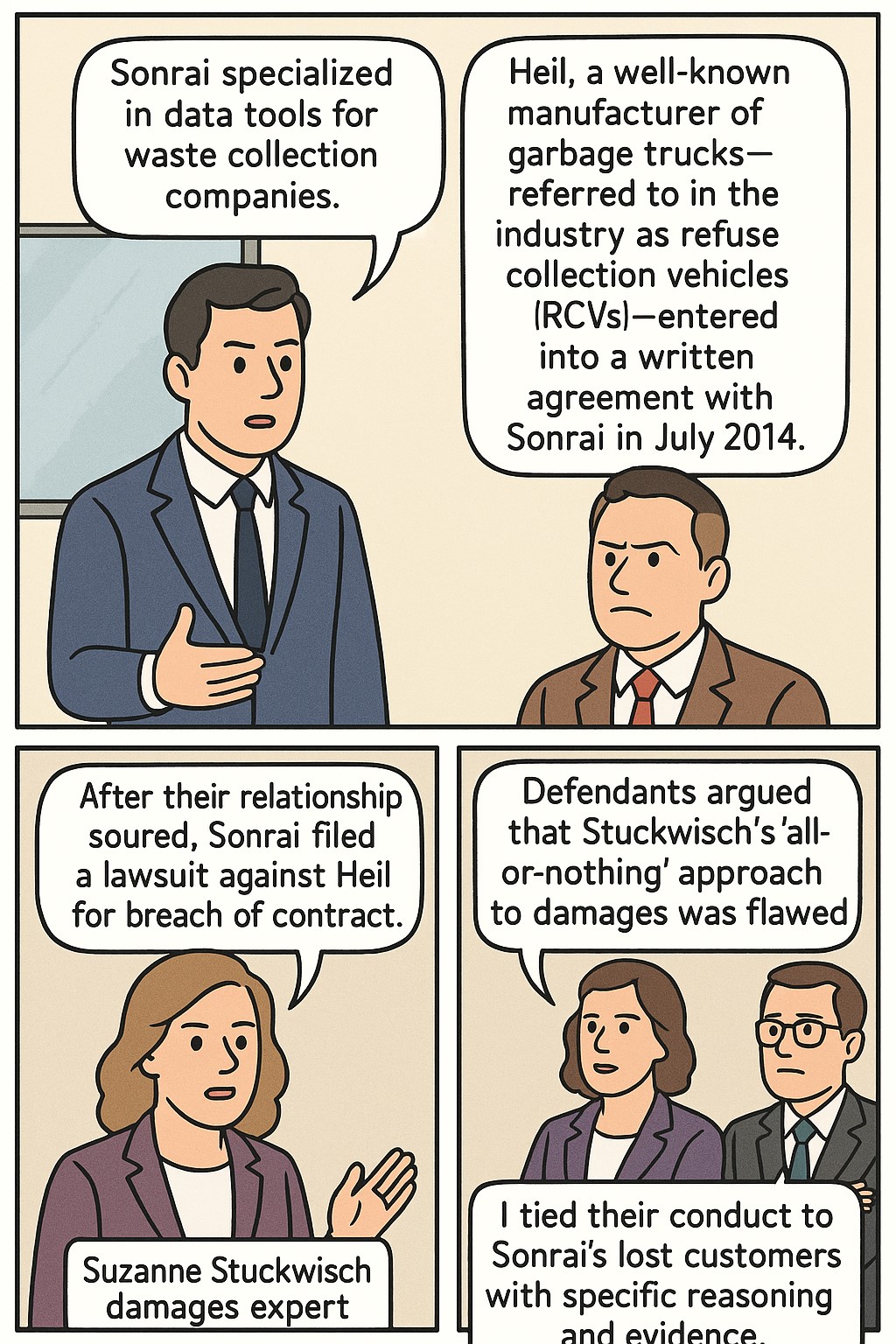
Sonrai specialized in data tools for waste collection companies. Heil, a well-known manufacturer of garbage trucks—referred to in the industry as refuse collection vehicles (RCVs)—entered into a written agreement with Sonrai in July 2014. The purpose was to facilitate the exchange of confidential information and explore a potential partnership, where Sonrai’s data product, “Vector,” could be integrated with Heil’s RCVs.
Over the next year, both companies shared proprietary information and operated under the terms of the agreement. In May 2015, Heil made an offer to acquire Sonrai, but Sonrai declined. The relationship began to deteriorate, and by September 2016, Heil chose a different path. It acquired a company called 3rd Eye, opting to use 3rd Eye’s competing data product, “Enhance,” instead of continuing with Sonrai.
Following this turn of events, Sonrai filed a lawsuit against Heil for breach of contract. Sonrai also accused Anthony Romano of breaching his fiduciary duties to Sonrai. Sonrai also alleged that Anthony Romano had breached his fiduciary duties owed to the company. Heil, in turn, countersued, also alleging a breach of contract.
Defendants raised certain arguments about the reliability of Sonrai’s damages expert Suzanne Stuckwisch‘s testimony.
Economic Damages Expert Witness
Suzanne M. Stuckwisch has more than 30 years of experience in economic and financial analysis and engineering consulting. She holds a B.S. in Mechanical Engineering, an M.B.A., and an M.S. in Economics.
Stuckwisch has experience across a wide range of industries, including but not limited to waste and recycling.
The Defendants first challenged Stuckwisch’s expert report by arguing that she failed to follow any recognized methodology in calculating Sonrai’s alleged lost profits. The Court disagreed. It found that her report clearly laid out how she determined the length of Sonrai’s relationships with each customer, projected potential sales, and accounted for the costs of producing Vector units. She analyzed damages on a customer-by-customer basis—an approach the Court had previously deemed acceptable. As a result, the Court concluded that her methodology was valid and properly applied.
Damages Model
Next, the Defendants claimed that Stuckwisch’s damages model relied too heavily on a single, speculative assumption: that all five waste haulers would have adopted Vector across their entire fleets. But the Court had already addressed this point in its summary judgment ruling. It noted that Stuckwisch had explained the rationale behind her assumption and emphasized that it was up to the jury to weigh the credibility of that assumption. Her report referenced evidence from the waste industry showing that third-party companies had made commitments to install Vector fleetwide.
All-or-Nothing Approach
Lastly, the Defendants contended that Stuckwisch’s “all-or-nothing” approach to damages was flawed because she failed to consider other possible causes for Sonrai’s lost profits—something they argued was required under AICPA standards. In response, Stuckwisch clarified that her analysis again followed a customer-by-customer model: once a customer was lost, the associated revenue was lost entirely. The Court found this approach reasonable. It emphasized that Stuckwisch did not simply assume the Defendants caused the losses—she tied their conduct to Sonrai’s lost customers with specific reasoning and evidence.
Additional Incremental Operation Costs
Fourth, Defendants argued that Stuckwisch’s testimony was unreliable because her calculation of additional incremental operation costs, which are a necessary component of lost profits, was previously stricken and never included in any amended reports.
The Court agreed that Stuckwisch’s testimony would be unreliable without the deduction of additional incremental operation costs. But precluding Stuckwisch from testifying about those additional incremental operation costs was not the appropriate remedy. Instead, the proper path forward was to allow Stuckwisch to supplement her report and allow Defendants to depose her on the new report, and supplement their own rebuttal report if they wished.
Alternative Explanations
Finally, the Court issued this opinion following a hearing held on June 9, 2025, during which it preliminarily denied the Daubert motion. After that hearing, Stuckwisch submitted a supplemental report and sat for a deposition. On the first day of trial, the Defendants raised three new arguments to exclude her testimony.
First, they challenged Stuckwisch’s assumption that Sonrai would incur no cost for working capital. According to her, Chris Flood—Sonrai’s CEO—told her that his family’s business, which generated over $100 million in annual revenue, would cover Sonrai’s working capital needs. Defendants claimed this assumption was unfounded. However, the Court noted that the same assumption appeared in her 2021 report under the section on incremental operational costs. For the reasons already discussed, the Court declined to exclude her testimony on this basis.
Second, Defendants argued that Stuckwisch failed to consider an alternative cause: that Romano had the right to leave Sonrai at any time. But they did not explain how this constituted an “obvious alternative explanation” undermining the reliability of her analysis. The Court held that such arguments were better suited for cross-examination.
Third, the Defendants contended that Stuckwisch wrongly assumed that Vector faced no competition in the but-for world, effectively treating it as a monopoly product. She based this assumption on her understanding that no comparable product existed in the marketplace. The Court found this assumption to be reasonable, though it acknowledged that Defendants were free to challenge it during trial.
Held
The Court denied the Defendants’ Rule 702 motion to exclude the testimony of Suzanne Stuckwisch.
Key Takeaways:
An expert need not rule out every alternative cause. Arguments about alternative explanations can be explored on cross-examination.
Stuckwisch’s opinion reliably applies the lost profits principles and methodology to the facts of the case and the Court will not prejudge the ultimate correctness of her conclusions. Her reasoning satisfies Rule 702’s reliability standard. Defendants’ criticisms can be explored on cross-examination.
Case Details:
Case Caption:
Sonrai Systems, LLC Et Al V. Anthony M. Romano Et Al
This case stems from a vehicle collision that happened in July 2022 in Gallup, New Mexico.
The Plaintiff, Jimmy Woodall claimed the crash caused severe and disabling injuries, including physical and emotional pain, permanent impairment, and reduced enjoyment of life. He sought compensation for medical costs, lost wages, and long-term care.
Woodall retained an expert, Mr. Justin Blok, MBA, CFE, CLP, to provide an opinion regarding Woodall’s lost earning potential, the present value of his life care plan, and other pecuniary matters. Blok relied on Todd Capielano‘s life care plan in determining Woodall’s alternative earnings and damages. Capielano, in turn, relied on the opinions of Woodall’s treating physicians, to form his own assessment of the costs Woodall was likely to face. Defendants challenged Blok’s qualifications, reasoning, and methodology, as well as his reliance on the opinions of Woodall’s treating physicians vis a vis Capielano’s life care plan.
Economic Damages Expert Witness
Justin Blok is a Certified Licensing Professional and Certified Fraud Examiner. He serves as a Partner at Whitley Penn LLP. He is also a Managing Director in its Forensic, Litigation & Valuation Services practice.
Blok specializes in economic, accounting, valuation, and strategy issues related to intellectual property, complex commercial disputes, and general business transactions. He has testified in private arbitration, Federal and State Courts.
Blok is consistently named to the IAM Patent 1000 list of top patent experts. He has lectured on damages topics at several universities. These include the University of Houston Law Center, Baylor University School of Law, and South Texas College of Law.
Blok has an undergraduate degree in risk management and finance, a master’s degree in business administration, and a master’s degree in accounting—all financial and business-related credentials—and he has been called as an expert to discuss financial matters.
While Defendants argued that Blok is not a physician and is not qualified to diagnose Woodall’s conditions, the Court held that Blok will not opine on whether Woodall can work, nor will he opine on the causation of Woodall’s injuries. He therefore does not need to have a medical background. To the extent his valuations may rely on medical opinions regarding the work Woodall is capable of doing, such reliance is appropriate and typical for economists.
Methodology
The Defendants claimed that Blok’s projections were flawed because they included the full financial ramifications of Woodall’s medical conditions without accounting for the fact that Defendants can be held liable only for the portion attributable to the vehicle collision.
The Court disagreed. It explained that these kinds of critiques go to the weight of the testimony, not its admissibility. Questions about the assumptions underlying an expert’s economic projections are best addressed through cross-examination, not exclusion.
As for the concern about jury confusion, the Court noted that jurors would already be tasked with deciding how much of the Plaintiff’s current condition was caused by the collision. That same reasoning would naturally extend to financial damages.
Finally, the Court emphasized that if Blok performed his calculations assuming a certain fraction of the expenses were attributable to Defendants, he might have overstepped his role and strayed into medical territory. By presenting neutral calculations and leaving the apportionment to the jury, Blok stayed within proper bounds. The Court concluded that the Defendants could challenge his assumptions during cross-examination and denied the motion to exclude his testimony.
Held
The Court denied the Defendants’ motion to exclude the opinions of Justin Blok.
Key Takeaway:
The alleged shortcomings in the underlying medical opinions used to create the life care plan and, in turn, the economic projections by Blok are properly addressed on cross-examination, not by excluding Block as an expert entirely.
Please refer to the blog previously published about this case:
Maker’s Mark entered into a Licensing Agreement with Spalding Group gransting an exclusive license to use its trademarks to create and sell cigars seasoned with its bourbon (the “Licensed Cigars”). After renewing the agreement a few times, in 2013, Maker’s Mark notified Spalding that it was terminating the license effective December 31, 2015. Spalding Group had until June 28, 2016, to dispose of its remaining inventory of Licensed Cigars.
Following the termination of the license, Spalding Group began selling a cigar also seasoned with Maker’s Mark bourbon (the “Bourbon Cigar”). Maker’s Mark alleged the packaging of the Bourbon Cigar was intentionally designed to “evoke an association by customers between [t]he Bourbon Cigar on the one hand and Maker’s Mark and the prior Licensed Cigars on the other.”
Maker’s Mark further claimed Spalding Group advertised the Bourbon Cigar in a variety of ways to associate it with Maker’s Mark and the Licensed Cigars, despite Maker’s Mark’s demand that Spalding Group cease and desist.
Maker’s Mark brought this action against Defendants, asserting claims of trademark infringement; false designations, descriptions, and representations; and trademark dilution in violation of the Lanham Act.
It also brought breach of contract, trademark infringement, and false designation and unfair competition claims under Kentucky common law.
Defendants filed a counterclaim alleging various state law claims related to the licensing agreement and seeking to cancel some of Maker’s Mark’s trademark registrations.
To support its trademark infringement claims, Maker’s Mark retained Ran Kivetz (“Dr. Kivetz”), a professor at Columbia University Business School with experience in consumer psychology and surveys. Dr. Kivetz conducted a survey to estimate the likelihood that consumers would mistake the Bourbon Cigars for a Maker’s Mark product.
To rebut Maker’s Mark’s trademark dilution claims, Defendants retained Hal Poret (“Poret”), a public opinion researcher with a master’s degree in mathematics and a law degree from Harvard Law School. Poret conducted surveys to evaluate whether the words “Marker’s Mark” and the red wax design are famous. Defendants later asked Poret to review Kivetz’s likelihood-of-confusion survey and conduct his own.
Neither party challenged the qualifications of the other’s expert; they each argued that the opposing party’s expert’s likelihood-of-confusion surveys were unreliable. Because the challenges were similar, the Court addressed both Daubert challenges together.
Maker’s Mark also retained Michael A. Einhorn (“Dr. Einhorn”) to calculate Defendants’ profits that may be recoverable under 15 U.S.C. § 1117(a). Defendants moved to exclude Einhorn’s testimony regarding the deductions and resulting net profits calculation; they did not challenge his gross profits or royalties calculations, contending that Einhorn was unqualified to calculate Defendants’ deductions and that his testimony was unreliable.
Survey Research Expert Witness
Hal Poret (“Poret”) is a public opinion researcher with a master’s degree in mathematics and a law degree from Harvard Law School. Since 2004, Poret has personally designed, supervised, and implemented over 350 consumer surveys concerning consumer perception, opinion, and behavior, including surveys relating to false advertising, claim substantiation, and trademark/trade dress matters. He has personally designed numerous studies that have been admitted as evidence in legal proceedings and has testified as an expert in over 50 proceedings before U.S. District Courts, the Trademark Trial and Appeal Board, and NAD.
Marketing Expert Witness
Ran Kivetz is the Philip H. Geier Professor of Marketing at Columbia University Business School. He earned a Ph.D. in Business from Stanford University, Graduate School of Business; a Master’s degree in Psychology from the Stanford University Psychology Department; and a Bachelor’s degree from Tel Aviv University with majors in Economics and Psychology. His field of expertise encompasses consumer psychology and behavior; survey methods; marketing management; behavioral economics; human judgment, perception, and decision making; consumer and sales incentives; and branding. Professor Kivetz’s research has won many prestigious awards, including multiple “Best Paper” awards, being a recipient of the New York Times annual “Best Idea” award, and being ranked as the third most prolific scholar in his field during 1982–2006.
Economic Damages Expert Witness
Michael A. Einhorn has a Bachelor of Arts in Economics from Dartmouth College (summa cum laude) and a Ph.D. in Economics from Yale University. Since receiving his Ph.D. in 1981, he has worked as a Member of Technical Staff at Bell Telephone Laboratories, an economist at the United States Department of Justice (Antitrust Division), and a staff economist at Broadcast Music Inc., a collection agency that licenses performance rights in music to major broadcasters, including television networks, local stations, cable companies, and radio stations. He has worked as a testifying expert since 2001. He is also a former professor of economics at Rutgers University (Newark), where he taught courses on macroeconomics, microeconomics, industrial organization, and corporate finance. He is the author of Media, Technology and Copyright: Integrating Law and Economics (2004), which applies economic reasoning to a number of issues in American copyright law with regard to media, entertainment, and technology.
Discussion by the Court
With regard to Defendants’ motion to exclude certain testimony and opinions of Ran Kivetz, the Court analysed Kivetz’s likelihood-of-confusion survey in depth.
Kivetz’s survey was divided into a test group and a control group. The test group participants saw three-dimensional, 360-degree viewable graphics of Defendants’ Bourbon Cigars, first the box, then an individual cigar. The control group participants saw three-dimensional, 360-degree viewable graphics of the box, then an individual cigar, all with the words “Seasoned with Maker’s Mark” on the cigar band replaced with “Seasoned with Bourbon” and the red wax-dipped caps replaced with red plastic caps. Participants could manipulate the images until they were ready, then they proceeded to answer question sets about the product’s source, affiliation, and sponsorship. The first question set was on the product’s source and was open-ended, with participants instructed to write what company they think made the product in a text box below the question (the “source question”), followed by other open-ended questions asking participants to explain their answers. At the beginning of the survey, participants read instructions not to guess and that “don’t know” was an acceptable answer that they could select or type. The other questions asked participants to name companies, products, or brands that the participants thought were affiliated with or sponsored the cigars. Each of those questions had an explicit “don’t know” option, except the open-ended questions asking participants to explain their answers if they provided one. Throughout the survey, an image of the single cigar, either the test or control version depending on the group, remained on the page for participants to view. This image was of the front of the cigar, was not rotatable, and displayed only half of the cigar band, with the test group cigar displaying the words “Seasoned” and “Maker’s,” while “with” and “Mark” on the band and the “ted’s” on the red seal were cut off. Poret conducted likelihood-of-confusion surveys intended to rebut Kivetz’s survey, and it replicated it in all but three ways. First, the participants could view the images, which Poret took from Kivetz’s report, from several angles of the side, top, and bottom, but not a 360-degree view. Second, Poret removed the image of the single cigar from the question pages. Third, Poret provided an express “don’t know” option to the otherwise open-ended source question.
Both the parties filed motions to exclude based on how the opposing party’s expert used images in his likelihood-of-confusion survey and whether it accurately simulated marketplace conditions.
Defendants argued that repeatedly showing participants the single cigar turned Kivetz’s survey into a “reading test,” where they would answer based on the words “Seasoned” and “Maker’s” visible in the repeated image instead of the Ted’s Cigars branding they saw on the cigar box or the branding that was not visible on the single cigar because of the angle. Kivetz’s survey was accused of creating demand effects, or suggesting a “correct” answer to the participants, by leaving an image of the single cigar for participants to view as they answered questions.
Maker’s Mark responded that Poret’s first likelihood-of-confusion survey was an unreliable “memory test” where participants were not continually exposed to the product while they evaluated it like they would have been in the marketplace. Maker’s Mark demanded exclusion of Poret’s survey since the memory test was based on blurry images from limited angles that did not show “Maker’s Mark.”
The Court held that such challenges amounted to little more than professional disagreement about methodology, which concerned the weight and not the admissibility of the surveys considering neither Maker’s Mark nor Defendants cited any authority suggesting either method was uniformly unreliable and instead each cited articles supporting its expert’s method, which indicated that the disagreement existed within the field and the choice was within the expert’s discretion.
Further, the parties’ more specific concerns about the images appeared unfounded. Defendants argued that 33% of Kivetz’s respondents wrote that “Seasoned Maker’s” produced the cigar because it was all that was visible on the individual cigar image, which showed that Kivetz’s survey inflated the level of confusion. Kivetz, however, did not include the “Seasoned Maker’s” responses as evidence of confusion in his calculations. Maker’s Mark argued that because Poret’s survey did not use 360-degree viewable images, participants could not see the words “Maker’s Mark,” but participants could rotate the individual cigar and see “Maker’s” in one image then “er’s Mark” in the next. Defendants similarly asserted that Kivetz’s survey was flawed because no Ted’s Cigars branding was visible in the single cigar image which remained on the page during the survey, but Maker’s Mark’s name was not visible on the cigar either, only “Seasoned” and “Maker’s”. Moreover, before entering the question portion, participants examined the cigar box and single cigar from 360 degrees for at least 30 seconds each until indicating that they could clearly see the images. Respondents who could not clearly see the image were removed from the survey. Accordingly, the Court found that none of these concerns warranted exclusion and the parties were allowed to explain to the factfinder how each expert used images and whether, in their views, those images accurately replicated marketplace conditions and produced accurate results.
One of the other reasons the parties moved to exclude the other’s likelihood-of-confusion surveys was whether or not the initial source question included a “don’t know” answer option. Defendants insisted on the unreliability of Kivetz’s survey because it did not include a “don’t know” answer option for the source question like it did for the other questions. Maker’s Mark conversely argued that an explicit “don’t know” option was inappropriate for an open-ended question, so Poret’s survey, which had an explicit “don’t know” option, artificially increased the number of participants who selected it, thus erroneously reducing the net confusion rate.
The Court noted that Diamond’s article appeared to be discussing a “don’t know” option in the context of closed-ended questions, so Poret’s survey may have been less accurate, but his choice did not mean the entire survey was so informally designed and conducted that it failed key tests of professionalism and reliability. Henceforth, the Court refused to exclude not only Kivetz’s likelihood-of-confusion survey but also Poret’s rebuttal survey.
Poret conducted a second likelihood-of-confusion survey that tested whether the red wax seal itself and not the “Seasoned with Maker’s Mark” label on the Bourbon Cigars was likely to cause confusion. The second survey again replicated the Kivetz Survey with some exceptions: the images were viewable from several angles but not 360 degrees, and the control cigars and the test cigars kept the “Seasoned with Maker’s Mark” band instead of a “Seasoned with Bourbon” band. Maker’s Mark contended that the survey should be excluded because controls must not be infringing and because the survey results could not explain whether participants were confused by the band or the wax seal. The purpose of avoiding infringing or allegedly infringing controls was to be able to tell whether any reported confusion was the result of actual confusion or the flawed control and the fact that the parties highly disputed whether the use of “Maker’s Mark” on the cigar band was likely to cause confusion made it all the more crucial. Defendants did not adequately respond to this concern with Poret’s survey, noting that “Maker’s Mark” on the cigar band may have been non-infringing or a fair use, actively ignoring the fact that even an allegedly infringing element was problematic in the process besides waiving the fair use defense. They cited only Poret’s explanation that his purpose was to isolate the red wax element. The Court noted that Defendants did not carry their burden to prove that Poret’s wax confusion survey was reliable.
Coming to Defendants’ motion to exclude certain opinions and testimony of Michael A. Einhorn, it was noted that Einhorn submitted a report and two supplemental reports in which he calculated Defendants’ gross revenue and deducted Defendants’ costs to arrive at their net profits from the sale of the Bourbon Cigar, besides calculating what royalties would have been due under the licensing agreement. Defendants targeted Einhorn’s testimony regarding the deductions and resulting net profits calculation instead of his gross profits or royalties calculations. Defendants stated that Einhorn was no expert in cost accounting and highlighted his lack of relevant experience in accounting.
The Court, citing Mannino v. Int’l Mfg. Co., 650 F.2d 846, 851 (6th Cir. 1981), held that Einhorn met the minimal qualifications requirement based on his Ph.D. in economics from Yale University as well as decades of experience calculating damages in intellectual property cases. Even though much of his experience has been related to copyright, trademark damages estimations were well-represented on his resume.
When Defendant argued that Einhorn was not qualified to perform the specific calculations in this case, which involved determining which of Defendants’ costs should be deducted from the gross profits to reach the net profits, the Court noted that Einhorn has been admitted to testify regarding essentially the same calculation in copyright cases. The Court deemed Einhorn qualified to express opinions regarding Defendants’ net profits.
Defendants objected to Einhorn’s use of the “incremental approach” in his calculations as opposed to their expert’s use of the “full absorption” approach. The incremental approach subtracts only direct production costs from a Defendant’s gross profits, while the full absorption approach also subtracts the proportion of overhead costs attributable to the product.
While some courts have adopted one method or the other, the Sixth Circuit appears to have not. In a patent case, the Sixth Circuit declined to adopt a uniform rule about whether overhead costs should be deducted from profits because it depends on the facts of each case. The Court observed that trademark remedies authority suggested that the incremental approach is an acceptable method. The Court declined Defendant’s request to exclude Einhorn’s testimony on that basis.
Defendants moved to seal their motion to exclude Einhorn and the attached Exhibits 1-5, 8, and Maker’s Mark moved to seal its response to the motion and Exhibit 1, which included Einhorn’s report and supplemental reports. The documents contained Defendants’ profit margins, sales data, and other financial information. The Court denied the motions filed by both parties.
Held
The Court issued the following rulings:
1. Defendants’ motion to exclude certain testimony and opinions of Ran Kivetz was denied.
2. Plaintiff’s motion to exclude certain expert testimony of Hal Poret was granted in part and denied in part.
3. Defendants’ motion to exclude certain opinions and testimony of Michael A. Einhorn was denied.
4. Defendants’ motion for leave to file under seal was denied.
5. Plaintiff’s motion for leave to file under seal was denied.
The Court has not arrived on an outcome for this case since the remaining issues involved in this case still await resolution.
Key Takeaways:
The Court emphasized that challenges to expert testimony often revolve around methodological differences rather than the admissibility of the evidence itself. Disagreements within the field are common and do not necessarily render expert testimony unreliable.
Regarding the use of images in likelihood-of-confusion surveys, concerns about methodology and the simulation of marketplace conditions were raised by both parties. However, the Court determined that these concerns did not warrant exclusion of the surveys, allowing the parties to present their arguments about the validity of the methodology to the factfinder.
The absence of a “don’t know” option in certain survey questions was debated, with one party arguing that its inclusion artificially affected the results. The Court noted that the survey in question did not fail key tests of professionalism and reliability and refused to exclude the surveys based solely on this issue.
Expert qualifications were also scrutinized, particularly regarding calculations of net profits. Despite challenges to the expert’s qualifications and methodology, the Court deemed the expert sufficiently qualified based on relevant experience and education.
Differences in calculation methods, such as the incremental approach versus the full absorption approach, were considered by the Court. While some courts may have preferences for certain methods, the Court in this case declined to adopt a uniform rule, emphasizing that the appropriateness of a method depends on the specific circumstances of each case.
Case Details:
Case Caption:
Maker’s Mark Distillery, Pbc V. Spalding Group, Inc. Et Al
Plaintiff Brand Design Company, Inc., d/b/a House Industries (“House”), a design studio and typeface foundry is in the business of developing and marketing proprietary fonts. House accused Defendant Rite Aid Corporation of appropriating one of these proprietary fonts and its corresponding font software—Neutraface—in the pharmacy chain’s rebranding effort, with the assistance of Defendants GA Communications, Inc., d/b/a PureRED Creative, LLC (“PureRED”), Burns Group, NYC, LLC (“Burns Group”), and Sway Creative Labs, LLC (“Sway”) (collectively, “Defendants”), violating licensing agreements that prohibited them from using Neutraface for this purpose in this breach of contract, unfair competition, and unjust enrichment lawsuit. House alleged that Defendants obtained access to Neutraface by purchasing a “standard form ‘desktop’ license” from House. House contended that certain uses of the Licensed Software and Fonts and glyphs generated were expressly prohibited.
House hired Graham D. Rogers, an economic consultant, to identify damages resulting from Defendants’ alleged actions. His report calculated damages in two general categories: (1) actual damages sustained by House, and (2) disgorgement of each Defendants’ profits.
Defendants Burns Group and PureRED filed a Daubert motion to exclude the testimony of Rogers. The parties also sought to seal various portions of Rogers’ report and their Daubert motion briefing.
Economic Damages Expert Witnesses
Graham D. Rogers’ professional career spans more than 35 years. For more than 25 of these years, Rogers has been assisting clients with their intellectual property needs. He has been retained as an expert to determine economic damages in a variety of litigation matters including patent infringement, trademark infringement, theft of trade secrets, and copyright infringement disputes. He has quantified economic damages that include the calculation of lost profits, the determination of reasonable royalties including hypothetical negotiation scenarios, the quantification of unjust enrichment, the identification and quantification of actual damages for both trademark and trade secret matters, and the assessment of the economic value of intellectual property. Rogers has testified in several federal jurisdictions as well as various state courts.
Discussion by the Court
While calculating actual damages sustained by House, Rogers explained in his report that the “commonly accepted remedy of actual damages” in a licensing dispute is “lost profits in the form of lost licensing profits”—in other words, the value of the hypothetical license that Defendants were obligated to, but did not, obtain.
In order to determine the value of this hypothetical license, Rogers utilized the methodology set forth in Georgia-Pacific Corp. v. U.S. Plywood Corp., 318 F.Supp. 1116 (S.D.N.Y. 1970) which listed evidentiary factors which helped determine a reasonable royalty for a patent license, such as “the rates paid by the licensee for the use of other patents comparable to the patent in suit”; “the commercial relationship between the licensor and licensee”; “the duration of the patent and the term of the license”; and “the extent to which the infringer has made use of the invention; and any evidence probative of the value of that use.” Roger stated that this methodology provided helpful guidance to experts and the parties when determining a hypothetical license value in non-patent license disputes before concluding that “House [would be] in a strong bargaining position during the hypothetical negotiation” with Defendants. And, extrapolating from prior licensing agreements negotiated by House considering those factors, he ultimately concluded that the total lost profit from Defendants’ hypothetical license was approximately $7.5 million.
In the alternative, Rogers utilized the “income approach,” to calculate the lost profits if Defendants had sought to purchase (rather than license) House’s font—something his report acknowledged “is not common practice in the industry.” The “income approach,” values an intangible asset based on the present value of the future income streams expected from the asset under consideration. Rogers testified that following hypothetical negotiations, Defendants would have agreed to purchase, and House would have agreed to sell, Neutraface for approximately $7.7 million.
With regards to disgorgement of profits, Rogers’ report aimed to identify the percentage of Defendants’ revenue that could be reasonably attributed to their improper use of Neutraface. As to the advertising agencies, he opined that their “profits were directly tied to either their alleged breach of the licensing agreements or alleged unjust enrichment.” After totaling the invoices related to the Rite Aid rebranding, and offsetting this sum by his estimation of deductible costs, Rogers concluded that the profit subject to disgorgement from PureRED, Burns Group, and Sway was approximately $6 million, $775,000, and $41,000, respectively.
Both Burns Group and PureRED challenged the fit of Rogers’ expert opinions, arguing (albeit for somewhat different reasons) that his report would not assist the trier of fact. PureRED objected to Rogers computing House’s lost licensing profits by evaluating a hypothetical negotiation between House and Rite Aid, rather than a hypothetical negotiation between House and the other Defendants because it rendered the opinions in his report irrelevant as to any damages caused by PureRED’s alleged breach of contract. Rogers responded by stating that his damages’ estimate reflected the lost value of a license that would have been utilized by all four Defendants to this action, not just the damages resulting from Rite Aid’s own alleged breach of contract.
The Court observed that even though PureRED attacked Rogers’ views about the likelihood of a sublicense, as well as his conclusion that an analysis of a hypothetical negotiation between House and Rite Aid accurately incorporates the damages that are attributable to the other Defendants, such disagreements went to the correctness of Rogers’ opinions making it a question for the trier of fact to decide when the expert is subjected to cross-examination.
Second and relatedly, PureRED argued that Rogers’ testimony would be unhelpful to a jury citing his failure to connect his damages estimate to the specific actions of each Defendant. By way of background, Pennsylvania requires Plaintiffs claiming breach of contract to “show a causal connection between the breach and the loss” to recover damages. PureRED contended that Rogers did not provide any evidence that the alleged damages were proximately caused by PureRED’s alleged wrongful act. The Court held that the burden of establishing causation lies with House as part of its case-in-chief— not with the expert it hired to opine on damages. In other words, even if Rogers’ report was entirely silent with regards to causation, that would still not be a basis to exclude his testimony.
Rogers’ report relied on an assumption about causation that if Rite Aid would have obtained a single Neutraface license that could have also been utilized by its advertising agencies, it would make all four Defendants jointly liable for the lost value of that license. Thus, as his report put it, “Lost Licensing Profits would encompass all Defendants.” The Court held that an assumption about causation was not an objective fact, and Rogers was not allowed to present it as such in his trial testimony. But even if Rogers relied on an assumption about causation as a starting point, it was not a basis to exclude his conclusions.
Third, Burns Group attacked Rogers’ opinions concerning House’s lost opportunity to sell Neutraface. It did not object to the methodology itself—i.e., Rogers’ “income approach” for valuing an intangible asset—but rather homed in on the caveat that selling fonts “was not a common practice in the industry and that in the normal course of business House would not sell Neutraface.” Thus, Burns Group argues, because Rogers’ opinions regarding lost opportunity to sell damages were premised on an admittedly improbable scenario, they qualified for exclusion on account of their lack of bearing on this dispute. But again, the Court held that it is axiomatic that “a qualified expert may answer hypothetical questions.” And that is exactly what Rogers’ report did. The credibility of this scenario as a realistic measure of damages in this case is a question for the trier of fact.
Finally, both PureRED and Burns Group sought to exclude Rogers’ opinions regarding profits subject to disgorgement, highlighting significant gaps in his accounting of the income and expenses associated with the Rite Aid rebranding efforts in his report. But during discovery, House’s interrogatories specifically requested that each Defendant disclose all payments made by Rite Aid to each agency in connection with the New Rite Aid Logo or Rite Aid’s Rebranding and as Rogers’ report explained, he based his calculations on the records Defendants provided in their responses. The Court held that Defendants had every opportunity to examine discrepancies between Rogers’ opinions and these records as they sought to undermine his credibility at trial. But, particularly since Defendants were specifically asked to produce a complete accounting of their profits, the Court dismissed their complaints about Rogers’ report’s alleged failure to reflect documents that were not made a part of the record.
Burns Group also challenged the reliability of Rogers’ testimony. The question of “reliability” goes to the reliability of an expert’s methods. Courts must assess whether a particular methodology is scientifically valid, considering factors like whether it “has been subjected to peer review and publication, the frequency by which the methodology leads to erroneous results, the existence and maintenance of standards controlling the technique’s operation, and whether the methodology has been generally accepted in the scientific community.” As with the question of fit, the proponent of expert testimony bears the ultimate burden of establishing its reliability by a preponderance of evidence. With regards to House’s alleged lost licensing profits, Burns Group first objected to Rogers utilizing the Georgia-Pacific framework, arguing that that case involved a claim for patent infringement, not breach of contract.
The Court held that regardless of the change in context, the measure of damages in Georgia-Pacific—i.e., the value of a hypothetical license that “the parties would have agreed upon, if both were reasonably trying to reach an agreement,” was precisely the same as the “lost licensing profits” Rogers sought to estimate. Burns Group never explained why that case’s methodology for determining the value of such a hypothetical license was an inappropriate tool for the question Rogers was attempting to answer, nor did it cite any authority for its claim that the Georgia-Pacific factors were unreliable considerations outside patent royalty disputes. Next, Burns Group attacked how Rogers evaluated and weighted several of the Georgia-Pacific factors, arguing that his analysis relied on “nonsensical” assumptions, improper analogies, and ultimately produced a “grossly inflated” damages estimate. The Court observed that its briefing spends considerable time setting fire to straw men, casting doubt on opinions that Rogers did not actually render. It was established that Rogers’ report included an estimation of profits associated with Neutraface (as part of his computation of profits subject to disgorgement) despite the Burns Group contending that Rogers “made no attempt to isolate the profit associated with the Neutraface font” while evaluating the thirteenth GeorgiaPacific factor (“The portion of the realizable profit that should be credited to the [font] as distinguished from [non-font] elements, the manufacturing process, business risks, or significant features or improvements added by the infringer”)
As for the opinions that Rogers did offer, Burns Group did not sufficiently demonstrate that Rogers’ conclusions regarding the Georgia-Pacific factors methods were erroneous or otherwise unreliable. At most, it demonstrated that reasonable experts might disagree regarding some of his assumptions. For example, when evaluating the first Georgia-Pacific factor (“The royalties received by the patentee for the licensing of the patent in suit, proving or tending to prove an established royalty”), Rogers identified a license negotiated between House and Baskin-Robbins as “a starting point for assessing a likely licensing fee between House and Rite Aid.” An expert hired by Burns Group, in contrast, opined that the “desktop licenses” actually obtained by several Defendants in this case were a more reasonable starting assumption. The Court held that this kind of battle-of-the-experts constituted a quintessential example of a dispute that a Daubert motion could not resolve.
Burns Group alleged that Rogers’ followed “speculative and unreliable” methods to calculate Defendants’ profits subject to disgorgement since the company “had no profits” and that Rogers “overstated the profitability of Burns.” The Court once again held it to be a a dispute of fact, not an issue of reliability under Daubert. And while Burns Group further claimed that Rogers “failed to consider the impact of the relationship between Burns and Rite Aid on Burns’ profits,” it offered no explanation for why this supposed omission affected the reliability of Rogers’ expert opinions.
PureRED briefly argued that Rogers’ testimony must be excluded because its probative value was substantially outweighed by a danger of unfair prejudice as per the Federal Rule of Evidence 403. The Court observed that the only explanation it offered for why this evidence would be unfairly prejudicial was that “Rogers’ opinions on actual damages were solely based on considerations relating to Rite Aid, not PureRED. The Court held that it fell well short of the threshold for excluding evidence under Rule 403.
The parties had also moved to seal portions of their Daubert briefing and accompanying exhibits. House had sought leave to redact the portions of the parties’ Daubert briefing and its attachments (including Rogers’ report) containing three categories of information: (1) information regarding House’s proprietary pricing structure; (2) details of confidential contract terms and negotiations with non-parties; and, (3) details regarding House’s historical revenues. As its motion explained, public disclosure of this information would have caused House to suffer a competitive disadvantage in the marketplace by undermining its negotiating position in future licensing ventures. In addition, and for much the same reason, Burns Group and PureRED had sought redactions relating to non-public financial data of each Defendant, such as their historic revenues. The Court, having reviewed the documents in question and the parties’ proposed redactions, had agreed that release of this information had the strong potential to result in financial injury, warranting its sealing.
In addition to its proposed redactions to the parties’ briefing, PureRED had also moved to seal Rogers’ report in its entirety, arguing that it contained “specific confidential data.” The Court had noted that PureRED offered no explanation for why sealing Rogers’ report in toto (as opposed to redacting portions of it) was necessary to prevent a clearly defined and serious injury and had denied that portion of PureRED’s motion.
Held
The Defendants’ motions to exclude the testimony of Graham D. Rogers was denied, and the parties’ respective motions to seal was granted in part and denied in part.
Key Takeaways:
In the case, key takeaways regarding expert testimony included the necessity for experts to provide relevant and helpful opinions to the trier of fact, with disagreements over the correctness of the expert’s opinions typically considered issues for the trier of fact to resolve rather than grounds for exclusion. The burden of establishing causation rested with the Plaintiff, not with the expert hired to opine on damages, requiring transparency regarding any assumptions about causation and precluding the presentation of such assumptions as objective facts. Courts assessed the reliability of an expert’s methodology by considering factors such as peer review, frequency of erroneous results, maintenance of standards, and acceptance in the relevant scientific community, with disagreements about methodology typically resolved through cross-examination and presentation of opposing expert testimony. Experts were permitted to calculate profits subject to disgorgement based on available records provided by Defendants during discovery, with challenges to the accuracy or completeness of such calculations addressed through cross-examination. Arguments that the probative value of expert testimony was outweighed by the danger of unfair prejudice under Rule 403 of the Federal Rules of Evidence required meeting a high threshold for exclusion, with mere differences in opinion regarding relevance or scope generally insufficient to warrant exclusion under Rule 403.
Case Details:
Case Caption:
Brand Design Company, Inc. V. Rite Aid Corporation Et Al
Docket Number:
2:22cv1174
Court:
United States District Court, Pennsylvania Eastern
Plaintiff Rose Kochka had brought claims against West Penn Allegheny Health System Inc. (“WPAHS”) under the Age Discrimination in Employment Act of 1967 (“ADEA”), 29 U.S.C. §§ 621, et seq., Pennsylvania Human Relations Act (“PHRA”), 43 P.S. §§ 951, et seq., and the Pittsburgh City Code, Article 5 §§ 651.01 et seq. These claims arose from Kochka’s past employment with WPAHS. In summary, Kochka contended that WPAHS had discriminated against her based on her age and had retaliated against her by terminating her for reporting alleged discrimination. The Court addressed seven motions in limine (six filed by Kochka and one filed by WPAHS), including Kochka’s Daubert motion to Preclude and/or Limit the testimony of WPAHS’ damages and mitigation expert Chad Staller.
Economic Damages Expert Witness
Chad L. Staller JD, MBA, MAC, CVA serves as the president of the Center for Forensic Economic Studies and holds extensive experience collaborating with both plaintiff and defense counsel across various civil cases. His expertise involves quantifying losses sustained by diverse plaintiff profiles, including union members, government employees, business proprietors, and injured children. Staller specializes in evaluating claims related to employment discrimination, encompassing calculations of back-pay, front-pay damages, and lost benefits. Additionally, he frequently provides consultation on commercial issues, analyzing claims associated with lost profits and business interruptions. Staller has a substantial record of testifying in jury trials, bench trials, and arbitrations within state and federal court settings.
Discussion by the Court
Kochka attempted to limit Andrea Campbell and Morgan Henderson’s testimony about their interactions with her and Beverly Feragotti, Kochka’s direct supervisor, claiming their involvement wasn’t relevant to her termination. However, the Court deemed their testimony crucial in understanding the reasons behind Kochka’s dismissal.
Kochka also tried to prevent Michael Weber, a Workforce Relations Consultant, from testifying, citing his testimony as hearsay based on a complaint from Campbell. The Court agreed, barring Weber’s testimony due to its hearsay nature.
Regarding Beverly Feragotti’s termination, Kochka argued against comparing her case to Feragotti’s, stating they were terminated by different decision-makers. WPAHS disagreed, asserting that despite differing roles, both faced similar performance standards and improvement plans. The Court confirmed their distinct positions and noted differences in their terminations, emphasizing separate decision-making groups involved in each case.
Ultimately, the Court highlighted the dissimilarities in roles, termination circumstances, and decision-makers, ruling Feragotti an unsuitable comparison for Kochka’s case.
Kochka filed a motion to preclude Chad Staller’s opinions, citing Rule 702 and the Daubert standard, alleging Staller’s methodology and data were unreliable. Specifically, Kochka objected to Staller’s use of Department of Labor statistics for calculating economic damages, his omission of adverse tax consequences, his qualifications and method for identifying employment opportunities for Kochka, and his reliance on the Pennsylvania Office of Unemployment Compensation to assess Kochka’s mitigation of damages. WPAHS defended Staller’s opinions, asserting their appropriateness in each aspect contested by Kochka.
The Court had agreed with Kochka regarding the unreliability of Chad Staller’s reliance on Bureau of Labor statistics to determine the duration of loss, thus rendering his calculation of economic damages based solely on these statistics unreliable as well. Staller’s reliance on the “Worker Displacement: 2019-2021” survey from the U.S. Census Bureau, which defined “Displaced Workers” as those affected by specific job loss scenarios, was found problematic.
Although Staller acknowledged the dissimilarity between Kochka’s employment separation and the survey’s definition of “Displaced Worker,” he justified the use of this data as a proxy due to the lack of a specific dataset for terminated employees like Kochka. The Court concurred with Kochka’s argument that as Kochka was terminated and did not align with the definition of a “Displaced Worker,” Staller’s reliance on data regarding non-terminated workers was inappropriate for determining the duration of loss for a terminated employee. Staller failed to provide a basis for using data applicable to non-terminated workers to assess a worker terminated for cause.
WPAHS attempted to argue for Staller’s opinion by asserting a seven-year mitigation period for Kochka from her separation in November 2019, suggesting that Staller’s analysis applied a three-year period from the time of his report. However, the Court rejected WPAHS’s argument, noting the misinterpretation of Kochka’s position and the lack of support for WPAHS’s claim in Staller’s report.
Staller’s reliance on Bureau of Labor statistics projecting a three-year period for displaced workers to achieve prior earnings parity contradicted WPAHS’s claim of a seven-year mitigation period. Staller’s report explicitly calculated the three-year period not from the May 2023 report date, as WPAHS asserted, but from January 1, 2024, the presumed date when Kochka would secure mitigation employment.
Consequently, the Court excluded Staller’s opinion on the duration of loss based on the “Worker Displacement: 2019-2021” survey and a three-year period. Staller’s economic damages calculation relying solely on Bureau of Labor statistics was also deemed unreliable. However, if Staller’s opinion on the duration of loss was supported by the human capital model (uncontested by Kochka), he could testify regarding his damages calculation during the trial.
The Court disagreed with Kochka’s contention that Chad Staller’s decision not to calculate potential adverse tax implications affected the clarity of his damages opinion or prejudiced Kochka. The Court clarified that it’s the responsibility of the district court, not the jury, to determine any additional compensation to offset the increased tax burden resulting from a back-pay award.
Given that the jury wouldn’t deliberate on this issue, the Court ruled that Staller’s omission of adverse tax calculations wouldn’t confuse the jury or cause prejudice to Kochka. As a result, this aspect of Kochka’s motion was denied by the Court.
The Court dismissed Kochka’s objection regarding Chad Staller’s qualifications and methodology for assessing available employment opportunities for Kochka. Despite Kochka’s challenge to Staller’s qualifications by highlighting his lack of vocational expertise and certification, a review of Staller’s curriculum vitae affirmed his qualification to provide an opinion in this regard.
Moreover, the Court found Staller’s methodology, utilizing employment listings from Forensic JobStats, to be reliable. Staller’s methodology was outlined in detail in his report, involving specific criteria such as keyword searches for relevant job titles and locations, along with subsequent exclusions based on these results after his deposition. The Court determined that Kochka’s objections were more related to the results of the methodology and Staller’s analysis rather than the methodology itself.
As WPAHS argued, the Court believed that Kochka’s concerns could be appropriately addressed through cross-examination and did not serve as grounds to exclude Staller’s opinions.
The Court agreed with Kochka’s objection concerning Chad Staller’s reliance on Pennsylvania’s unemployment compensation standards to assess Kochka’s mitigation efforts, deeming it confusing and inapplicable to this case. Staller’s reference to the Pennsylvania Office of Unemployment Compensation’s criteria for assessing job search diligence was found irrelevant as Kochka wasn’t seeking unemployment compensation in this lawsuit.
Despite WPAHS attempting to minimize Staller’s reliance on these standards, the Court found that Staller explicitly referenced and applied these standards to Kochka in his assessment. Staller’s report indicated that Kochka had not met the standard outlined by the Pennsylvania Office of Unemployment Compensation, forming the basis of Staller’s opinion that Kochka failed to conduct a reasonable job search and mitigate her damages.
As a result, the Court excluded aspects of Staller’s opinion that linked Kochka’s job search and mitigation efforts to the requirements of the Pennsylvania Office of Unemployment Compensation. However, Staller was permitted to testify about Kochka’s job search endeavors and the available employment opportunities.
In Kochka’s motion to exclude evidence of her failure to mitigate damages, her main contention was the exclusion of Chad Staller’s opinion testimony, the sole evidence, according to Kochka, that WPAHS possessed regarding mitigation. Kochka argued that since Staller’s testimony should be excluded, WPAHS lacked sufficient evidence to meet its burden, thus should be barred from arguing that Kochka failed to mitigate damages.
However, the Court denied Kochka’s motion, finding her reasoning insufficient. The Court concluded that Kochka hadn’t provided compelling reasons to prevent WPAHS from presenting evidence concerning her efforts to mitigate damages. Consequently, WPAHS was not precluded from introducing such evidence or making arguments regarding Kochka’s mitigation efforts.
Kochka moved to preclude deposition testimony that had been designated by WPAHS, specifically related to Andrea Campbell, who was listed as witness to be called on both Kochka’s and WPAHS’ witness lists. Since Campbell was set to provide live testimony, the Court granted Kochka’s motion to preclude the deposition testimony without prejudice.
WPAHS moved to exclude evidence and testimony involving Julie Stuck, a Labor Relations Consultant, and drafts of Kochka’s termination letter. Stuck was consulted for an HR perspective on the termination. WPAHS argued that these pieces of evidence held limited probative value since Stuck wasn’t a decision-maker and the initial and final termination letters aligned. Additionally, WPAHS expressed concern about potential unfair prejudice due to a statement by Stuck mentioning an EEOC claim.
However, the Court disagreed with WPAHS, affirming the significant probative value of the draft termination letters and communications involving Stuck. The Court ruled that the EEOC reference by Stuck, while potentially prejudicial, didn’t substantially outweigh its probative value concerning the termination process. Therefore, the Court allowed the inclusion of this evidence and testimony.
WPAHS requested permission to amend the Joint Exhibit List, adding Exhibits 2, 4, 5, 6, and 7, previously attached to its Motion in Limine. WPAHS sought admission of all communications related to the topic, not initially included in the parties’ Joint Exhibit List. Kochka didn’t oppose the inclusion of Exhibits 2, 5, 6, and 7 but objected to Exhibit 4.
Kochka argued against Exhibit 4’s relevance, stating that the email text was duplicated in other emails, and the 27 pages of attachments lacked independent relevance. Kochka also pointed out the absence of evidence showing Stuck’s review or reliance on the attachment contents.
The Court approved the motion partially, allowing admission of Exhibits 2, 5, 6, and 7, unopposed by Kochka. However, the Court deferred its ruling on Exhibit 4, which was opposed, pending further consideration.
To sum it up, the Court granted in part and denied in part WPAS’ motion to exclude evidence and testimony involving Julie Stuck.
Held
Plaintiff’s Motion in Limine #1 – To Limit the Testimony of Andrea Campbell and Morgan Henderson was denied by the Court.
Plaintiff’s Motion in Limine #2 – To Preclude the Testimony of Michael Weber was granted by the Court.
Plaintiff’s Motion in Limine #3 – To Preclude Evidence or Argument Regarding Beverly Feragotti’s Termination was granted by the Court.
The Plaintiff’s Daubert Motion aimed at limiting or precluding Chad Staller’s testimony has been partially granted and partially denied. Firstly, Staller is barred from testifying regarding his opinion on the duration of loss if it relies on the “Worker Displacement: 2019-2021” survey. Additionally, if Staller’s calculation of economic damages is solely based on Bureau of Labor statistics, it is deemed unreliable and excluded. However, if his opinion on the duration of loss aligns with support from the human capital model (not challenged by Kochka), Staller is permitted to testify about his damages calculation during the trial. Secondly, Staller is not allowed to testify that the job search requirements set by the Pennsylvania Office of Unemployment Compensation represent the standard for Kochka’s reasonable and diligent job search or mitigation of damages. Nor can he testify that Kochka lacked reasonable diligence by failing to meet these requirements. Nonetheless, Staller retains the ability to testify regarding Ms. Kochka’s job search efforts and the available employment opportunities.
Plaintiff’s Motion in Limine #4 – To Preclude Evidence or Argument that Plaintiff Failed to Mitigate Her Damages was denied by the Court.
Plaintiffs’ Motion in Limine #5 – To Preclude Defendant’s Discovery Designations was granted without prejudice by the Court.
Defendant’s Motion in Limine #1 – To Exclude Evidence and Testimony Relating to Julie Stuck and Drafts of Plaintiff’s Termination Letter was granted in part and denied in part by the Court.
Key Takeaways
The Court excluded testimony from the Defendant’s expert witness Chad Staller regarding the duration of the Plaintiff’s loss of earnings, to the extent it relied solely on Bureau of Labor statistics about displaced workers. The Court found that since the Plaintiff was terminated for cause, rather than displaced, the statistics were not sufficiently reliable. The Court also excluded Staller’s opinions applying the standard for unemployment compensation in Pennsylvania to determine if the Plaintiff failed to mitigate damages. The Court found this would confuse the jury since the Plaintiff was not actually seeking unemployment compensation. However, the Court allowed Staller to testify about the Plaintiff’s job search efforts and employment opportunities available to her. Additionally, the Court rejected a challenge to Staller’s failure to provide calculations for adverse tax consequences, finding this issue was not for the jury. Overall, the Court demonstrated a willingness to closely scrutinize the reliability of the Defendant’s expert’s methodology and data underpinning his opinions about mitigation and damages, while still allowing him to testify on certain relevant issues like job search efforts. The Court applied the Daubert principles to ensure the expert’s testimony would assist rather than confuse or mislead the jury.
This case involved a product liability lawsuit filed by Harvey Mahler against The Vitamin Shoppe Industries, Inc. in the United States District Court for the Northern District of Illinois. Mahler alleged that he developed peripheral neuropathy after taking a multivitamin manufactured by The Vitamin Shoppe that contained arsenic and lead.
Mahler purchased two bottles of The Vitamin Shoppe’s One Daily Men’s 50+ vitamin supplement on June 25, 2017. He took one tablet per day from June 25 to August 16, 2017, for a total of 51 days. In mid-August 2017, Mahler began experiencing symptoms including peripheral and ulnar neuropathy, bilateral foot numbness, hypertension and renal artery thrombosis. He saw several physicians, including his primary care doctor, a nephrologist and a hematologist. None of them diagnosed Mahler with heavy metal poisoning or ordered tests to screen for heavy metals.
Nonetheless, Mahler sent the vitamin supplement to an independent laboratory, Eurofins, which detected arsenic and lead in the product. Eurofins sent back a report that showed the Vitamin Supplement contained a detectable amount of arsenic and lead—two types of heavy metals. Although his physicians did not link his symptoms to the vitamins, Mahler believed based on his own research that the arsenic and lead caused his health issues.
On June 5, 2018, Mahler visited Octavia Kincaid, a neurologist. He reported neuropathy in his feet and left hand fingers. Kincaid reviewed prior electromyography (EMG) tests and examined Mahler. She diagnosed him with peripheral neuropathy. Mahler told Kincaid about the vitamins containing heavy metals and gave her the Eurofins report. Kincaid said arsenic and lead could cause his symptoms. Her blood tests for other potential causes came back normal. She clinically diagnosed Mahler with peripheral neuropathy likely from heavy metal toxicity.
In his lawsuit, Mahler alleged that the arsenic and lead in the vitamin supplement caused his peripheral neuropathy. He asserted claims for strict liability, negligence, breach of warranty, negligent misrepresentation, and violation of the Illinois Consumer Fraud and Deceptive Business Practices Act (“ICFA”)
The Vitamin Shoppe moved for summary judgment, arguing that Mahler lacked evidence that the small amounts of arsenic and lead in its product could have caused his alleged injury. Mahler relied on neurologist Octavia Kincaid and pharmacist James O’Donnell to provide pharmacology and neurology expert opinions on causation. The Vitamin Shoppe moved to exclude them under Daubert, asserting their opinions were unreliable. Defendant also filed a Daubert motion to exclude the testimony of Plaintiff’s other two experts- Jon Edward Clark and Stanley Vladimir “Stan” Smith.
Causation and Damages Expert Witnesses
James Thomas O’Donnell, PharmD, M.S., F.C.P., is highly qualified as an expert in pharmacology, toxicology, and pharmacy. He has over 30 years of experience in teaching, research, and consulting in these fields. O’Donnell holds a Doctor of Pharmacy degree from the University of Michigan and a Master of Science in Clinical Nutrition from Rush University. He is an Associate Professor of Pharmacology at Rush University Medical Center.
O’Donnell has authored numerous books related to pharmacology, toxicology, and pharmacy law. He has also published articles in peer-reviewed journals and consulted with pharmaceutical companies.
His qualifications include being board certified as a Diplomate in the American Board of Clinical Pharmacology. He is a Fellow of the American College of Clinical Pharmacology and the American College of Nutrition.
In summary, O’Donnell’s extensive education, teaching and research experience, publications, and board certifications in pharmacology, toxicology, and pharmacy make him highly qualified to provide expert testimony on the topics relevant to this case.
Octavia B. Kincaid, M.D.is a Neurologist who provided medical care to Harvey Mahler from June 5, 2018 to the present. She is an adult neurologist who specializes in neuromuscular neurology. She holds board certification in adult neurology, clinical neurophysiology, and neuromuscular medicine through the American Board of Psychiatry and Neurology. She received her medical degree from The University of Texas Health Science Center at San Antonio and has been in practice for more than 20 years.
Octavia Kincaid is currently working as a Neurologist at NorthShore University HealthSystem. Before her current position, she served as the Assistant Dean for Curriculum in the College of Medicine at the University of Illinois, Chicago. Additionally, she held a previous role as a Neurologist at the University of Illinois Hospital & Health Sciences System.System.
Jon Edward Clark, M.S., has over 35 years of experience in the pharmaceutical industry, including extensive expertise with FDA regulations and practices. He holds Bachelor’s and Master’s degrees in Chemistry. He worked for 21 years at the FDA, serving in leadership roles developing and implementing policy. After the FDA, he served as an executive in the U.S. Pharmacopeia, involved with setting standards for medicines and dietary supplements. He now runs an independent consulting firm focused on FDA regulatory requirements and compliance.
Stanley Vladimir Smith,Ph.D. is a nationally renowned economist who received his Ph.D. from the University of Chicago.
Discussions by the Court
The Vitamin Shoppe moved to exclude the causation opinions of Kincaid and O’Donnell under Daubert and Rule 702. The Court granted both motions, finding their methodologies unreliable.
Plaintiff relied upon Octavia Kincaid to establish both general and specific causation—that is, that the lead and arsenic contained in the Vitamin Supplement Plaintiff took could and did cause his peripheral neuropathy.
However, the Court first found Mahler failed to properly disclose Kincaid as a non-retained expert under Rule 26(a)(2)(C). He did not provide a summary of the facts and opinions to which she would testify on causation. However, the Court excluded Kincaid based on unreliability even if she had been properly disclosed.
Kincaid testified there were likely thousands of potential causes of peripheral neuropathy, with heavy metal exposure being rare. She said Mahler told her he took vitamins containing heavy metals and provided the Eurofins report. Although Kincaid ordered blood tests for more common neuropathies, they came back normal. With no other apparent cause, she clinically diagnosed Mahler with heavy metal induced peripheral neuropathy.
The Court found this process unreliable under Daubert. Kincaid agreed dose and duration of exposure were relevant to causation. But she could not recall investigating the levels of arsenic/lead in the vitamins or how long Mahler took them. She speculated she probably looked up reference levels but had no notes documenting so. The Court also did not express an opinion on Kincaid’s clinical or treatment methods. Kincaid herself clarified that her conclusion was a “clinical diagnosis” made based on the available information at the time. It’s important to note that her intent was not to establish “proof” of causation in a legal sense.
The Court cited cases requiring experts to consider dose-response in toxic tort cases. As Kincaid failed to evaluate dosage, the Court deemed her opinions inadmissible.
The Defendant made three main arguments for excluding O’Donnell’s expert testimony. First, it contended he lacked qualifications for some opinions. Second, it argued his opinions about raw ingredients were irrelevant. Third, it asserted O’Donnell did not use a reliable methodology for his general causation conclusions, as he failed to analyze the dose-response relationship between the levels of arsenic and lead in the Vitamin Supplement and the onset of peripheral neuropathy. Defendant argued that the factual assumptions made by O’Donnell did not support the record.
The Court found multiple reliability issues rendering O’Donnell’s opinions inadmissible. First, O’Donnell incorrectly assumed Mahler took the vitamins for four years rather than the 51 days supported by the record. He speculated all of Mahler’s vitamins contained arsenic/lead based merely on other products from China having contamination, not evidence specific to The Vitamin Shoppe’s products. The Court held this undue speculation did not satisfy Daubert.
Additionally, like Kincaid, O’Donnell failed to reliably consider dosage. He agreed dose response was relevant to toxicity. He knew there were acceptable daily intake levels of arsenic/lead under which toxicity would not be expected. Yet he conducted no analysis of the dose levels in the vitamins Mahler took or whether they exceeded acceptable thresholds. Instead, he reasoned that because Mahler developed neuropathy and his vitamins contained some level of arsenic/lead, they must have contained enough toxins to cause the neuropathy. The Court found this circular reasoning evidenced no reliable methodology under Daubert which rendered his opinions both unreliable and irrelevant.
Held
In sum, the Court held that neither Kincaid nor O’Donnell employed reliable methods in reaching their causation opinions. Their failures to account for dosage of toxins in the vitamins rendered their testimony inadmissible under Rule 702. With no other evidence of causation, Mahler could not withstand summary judgment. Thus, the Court granted The Vitamin Shoppe’s motions to exclude Octavia Kincaid and James T. O’Donnell, and its motion for summary judgment. The Court denied as moot the motions to exclude Mahler’s other experts, Jon Clark and Stan Smith and subsequently terminated the case.
Key Takeaways
This product liability case illustrates the importance of ensuring expert witnesses employ reliable principles and methods under Daubert and Rule 702. The Court excluded both of Plaintiff Mahler’s causation experts because their opinions lacked sound methodology.
In toxic tort cases, experts must carefully consider dose and duration of exposure when rendering an opinion on causation. Both Kincaid and O’Donnell acknowledged this principle, yet failed to analyze or account for the levels of toxins in the vitamins Mahler consumed, it rendered their testimony unreliable.
Experts should not rely on unfounded assumptions or speculation. For example, O’Donnell unreasonably assumed that because Plaintiff was diagnosed with heavy metal-induced neuropathy and because the Vitamin Supplement that Plaintiff took contained lead and arsenic, it meant the Vitamin Supplement must have contained enough lead and/or arsenic to cause neuropathy. Expert opinions must be grounded in the facts of the specific case.
Additionally, Experts should avoid circular reasoning that uses the injury itself as proof of causation. The Court found O’Donnell employed this flawed logic.
In excluding the experts, the Court demonstrated its critical gatekeeping role in vetting unreliable expert opinions before admission. Attorneys offering expert testimony must ensure their experts adhere to sound scientific principles and methods that can withstand Daubert scrutiny.