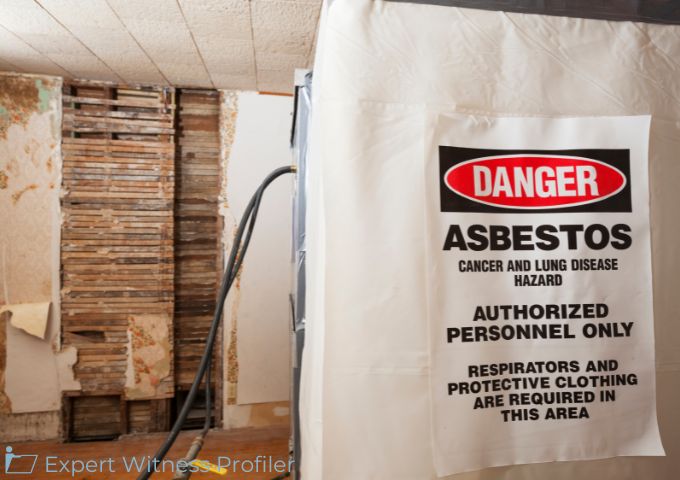
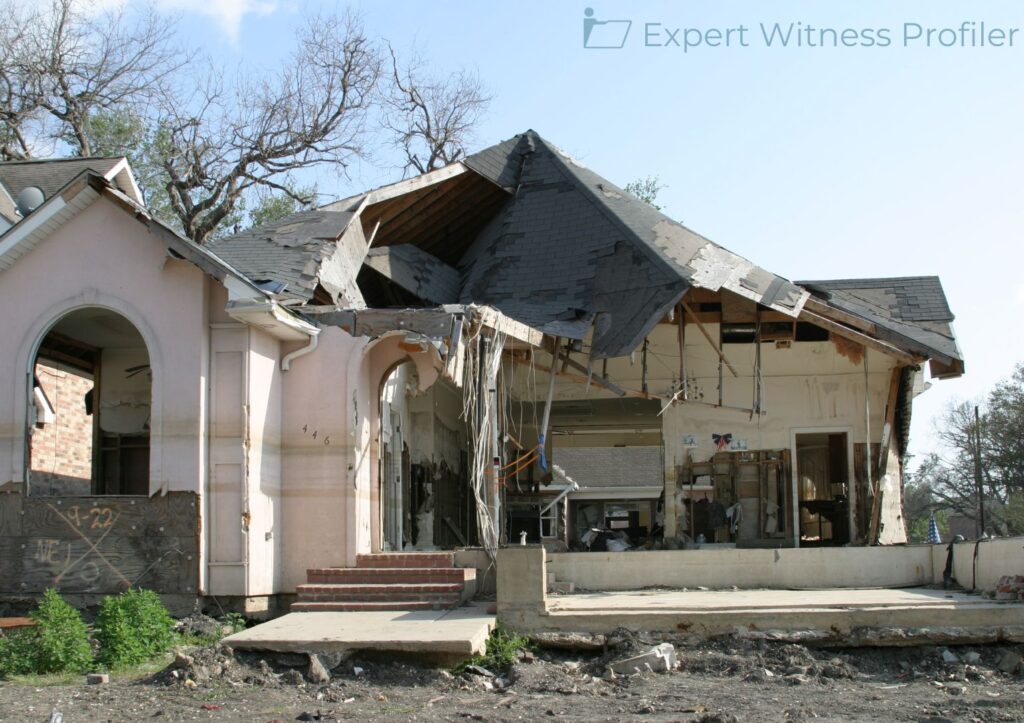
Plaintiff, Edward Montelongo, alleged that he has developed asbestosis due to exposure to asbestos through his work at various facilities, including Avondale Shipyards, Kaiser Aluminum & Chemical Corp., and Shell Oil Company’s Norco and Yscloskey facilities.
Defendant Huntington Ingalls Incorporated’s (formerly, “Avondale”) asked the Court to preclude Plaintiff’s industrial hygiene expert, Gerard Baril, from opining at trial that Plaintiff’s work with and around asbestos-containing products contaminated his home because Plaintiff carried asbestos fibers home with him on his clothing, leading to continued asbestos exposure long after Plaintiff ceased that work.
Industrial Hygiene Expert Witness
Gerard L. Baril has worked in the field of occupational safety, industrial hygiene, and environmental health since 1978. Baril has practiced industrial hygiene (starting as an industrial hygiene technician) since 1982.
Over the decades, he has conducted hundreds of industrial hygiene surveys qualifying and quantifying workers’ exposures to a wide array of airborne contaminants including asbestos.
In this case, Avondale did not contest that Baril was qualified to testify as an expert. Rather, Avondale challenged the reliability of Baril’s “contaminated house” opinions, arguing that they were “scientifically unreliable, methodologically unsupported, and inadmissible because they do not follow any accepted procedure, standard, or analytical framework recognized in industrial hygiene for determining whether a residence is contaminated with asbestos.” However, as Plaintiff argued, Baril “cited numerous references that support his opinions, including published, peer-reviewed literature, publications by governmental and scientific organizations, as well as occupational exposure standards and regulations.”
Therefore, Baril’s testimony is sufficiently reliable to satisfy the Court’s gatekeeping function under Daubert.
Held
The Court denied Avondale’s motion to partially exclude the testimony of Plaintiff Edward Montelongo’s retained industrial hygiene expert Gerard Baril.
Key Takeaway
It is the role of the adversarial system, not the Court, to highlight weak evidence. The fact that opposing parties do not agree with the facts relied upon by an expert, or with the expert’s interpretation of those facts, does not render the expert’s opinions unreliable. Challenges related to the basis of an expert’s opinions are thus best suited for cross-examination, not exclusion.
Please refer to the blog previously published about this case:
Plaintiff Douglas Looney, Evergreen’s employee, was standing behind a vacuum truck to wash its interior when a chunk of ash flew out, injuring him.
Defendant intended to present the expert testimony of Jason Henthorn at trial. Plaintiffs asked the Court to exclude Henthorn’s testimony pursuant to Federal Rule of Evidence 702.
Industrial Hygiene Expert Witness
Jason E. Henthorn has a bachelor’s degree in industrial hygiene. He also has experience creating and maintaining work safety programs, training employees on workplace safety, and investigating workplace accidents.
The first opinion that Plaintiffs attacked is that “Looney placed himself in an area of increased risk when he positioned himself in between the half door and the truck’s debris body.” Plaintiffs argued that this opinion should be excluded because it is not based on “any identifiable hazard analysis” and because Henthorn never explained his methodology in reaching this conclusion.
During his deposition, Henthorn testified he had experience with vacuum trucks similar to the one involved in Looney’s accident. Henthorn also suggested there were “materials in the operator’s manual of the truck” and “stickers or placards on the truck” alerting employees to the danger of standing behind the truck.
Because Henthorn’s experience is sufficient to render the opinion reliable and helpful to a jury, the Court will not exclude this opinion.
B. Opinion 2
Henthorn’s second opinion is that Defendant “possessed policies and procedures, including the Vacuum Truck Safety Program, which originated in 2019 and had been revised a number of times.” As Plaintiff’s pointed out, this is simply a factual statement.
Still, the Court decided that Henthorn’s perspective would be helpful to the jury; his experience will allow him to explain whether these policies and procedures apply to the work Looney was doing when he was injured.
C. Opinion 3
The third opinion at issue is that Defendant “did not possess knowledge of a dangerous condition or practice involving its vacuum trucks.” Plaintiffs argued that this opinion “is pure speculation.”
The Court agreed. As Plaintiffs pointed out, “in his deposition, Henthorn could not identify the field supervisor who ordered Looney and his crew to decontaminate the vacuum truck on the day in question.”
Further, Defendant’s own report on Looney’s accident contradicted Henthorn’s conclusion that Defendant lacked knowledge.
D. Opinion 4
Henthorn’s fourth opinion is that “the struck-by hazard of falling debris should have been obvious and apparent to Looney as he relocated himself during his work due to the ash not coming out of the truck as he had previously experienced.”
During his deposition, Henthorn acknowledged that he had no experience with the type of material in the truck Looney was cleaning. He testified that he did not know what type of ash was in the truck, nor how long the ash had been sitting in the truck before Looney began cleaning it, but he explained that both the type of ash and the amount of time it had been sitting would affect its density. Given Henthorn’s lack of knowledge about the material in the truck, the Court held that he cannot reliably testify whether the hazard of falling debris should have been obvious to Looney.
E. Opinion 5
Finally, Henthorn opined that Defendant “did not violate a specific industry standard which caused Looney’s incident.”
Henthorn’s experience in industrial hygiene made him qualified to explain which industry standards may or may not apply to a particular work activity and whether certain employer conduct violates an industry standard. In his deposition, he discussed specific industry standards and explained why, in his view, they did not apply on the day of the accident. As a result, the Court admitted this opinion.
Held
The Court granted in part and denied in part Plaintiffs’ motion to exclude the testimony of Jason Henthorn under Federal Rule of Evidence 702.
Key Takeaway
Some expert opinions are only reliable when supported by scientific testing. Henthorn’s conclusion that Looney placed himself in an area of increased risk is one such opinion.
Case Details:
Case Caption:
Looney V. North American Services Group, LLC
Docket Number:
3:24cv467
Court Name:
United States District Court, West Virginia Southern
Plaintiffs Erica Dandry Constanza and Monica Dandry Hallner alleged that Decedent Michael P. Dandry, Jr., while an employee for Huntington Ingalls Incorporated’s (“Avondale”), was exposed to asbestos and asbestos-containing products manufactured, distributed, sold, and/or handled by Avondale and other parties.
Decedent was born in 1953, and the family home at the time of his birth was located at 407 Meyers Boulevard in Marrero, Louisiana, where he lived until he was two years old. Decedent also worked at a shoe repair shop located at 409 Meyers Boulevard. Both of these properties were part of a larger property located in the 400 block of Myers Boulevard at the intersection of Fourth Street, which was owned by Decedent’s grandfather.
Decedent’s sisters and daughters testified that the Dandry family property located in the 400 block of Meyers Boulevard at the intersection of Fourth Street in Marrero was one property owned by Michael Dandry, Jr.’s grandfather, Randolph Dandry. The testimony of Decedent’s sisters confirms that Decedent played in the driveway/courtyard area, they played in a galvanized tub of water in the driveway area, they were always “in and out” of the various Dandry businesses, and they continued to visit the family property even after moving to Oak Street.
Plaintiffs filed a motion to exclude certain opinions of Defendant Bayer CropScience, Inc.’s expert in industrial hygiene, Michael Holton.
Industrial Hygiene Expert Witness
Michael Holton is a Board-Certified Industrial Hygienist (CIH), a Board-Certified Safety Professional (CSP), and a Registered Environmental Health Specialist (REHS) in the state of New Jersey (inactive status) and has comprehensive industrial hygiene experience involving exposure assessment, ventilation system design, regulatory compliance auditing, and program development and training.
Holton concluded there is “reasonably significant potential for community asbestos exposures to residents of Marrero, LA” and Decedent “more likely than not had exposure to amphibole forms of asbestos, including crocidolite, from living his entire life in the Westbank, LA area.”
Reagan Maloney was hired by Avondale to take soil samples from the property. The Court, however, excluded Maloney’s testimony about the testing performed on those soil samples.
While Holton relied wholly on Maloney’s report to establish that the soil at Decedent’s childhood family property contains asbestos, he did offer one alternative theory for Decedent’s potential environmental exposure. Holton opined that Decedent may have had environmental exposure to asbestos due to the close proximity of various properties he frequented while living and working on the Westbank, and those properties which were found to have soil contaminated with asbestos in the 90s and 2005 reports.
With Maloney’s report excluded, Holton’s opinions about Decedent’s possible environmental exposures are based solely on the proximity theory and the circumstantial evidence of nearby asbestos-contaminated properties. Testing confirming the presence of asbestos in multiple locations surrounding areas where Decedent frequented on the Westbank is enough to support an opinion regarding what exposure to asbestos Decedent might have had living on the Westbank. However, Holton was not allowed to rely on Maloney’s report or opinions.
Held
The Court granted in part and denied in part Plaintiffs’ motion to preclude certain opinions of Michael Holton.
Key Takeaway
Although in some cases, “the source upon which an expert opinion relies is of such little weight that the jury should not be permitted to receive that opinion,” Plaintiffs have not demonstrated that this is such a case.
Please refer to the blog previously published about this case:
In this litigation, Plaintiffs Erica Dandry Constanza and Monica Dandry Hallner (collectively, “Plaintiffs”) alleged that Decedent Michael P. Dandry, Jr. (“Decedent”), while an employee for Defendant Huntington Ingalls Incorporated (“Avondale”), was exposed to asbestos and asbestos-containing products manufactured, distributed, sold, and/or handled by Avondale and other parties.
Avondale filed a Daubert motion to exclude the testimony of Plaintiff’s expert in industrial hygiene, Gerard Baril.
Baril offered opinions that these exposures sustained by Dandry at Avondale significantly increased his risk for mesothelioma, that these exposures exceeded current and historical exposure limits, and that Avondale failed to implement appropriate industrial hygiene safeguards to protect workers from asbestos.
Industrial Hygiene Expert Witness
Gerard L. Baril has worked in the field of occupational safety, industrial hygiene, and environmental health since 1978. Baril has practiced industrial hygiene (starting as an industrial hygiene technician) since 1982.
Over the decades, he has conducted hundreds of industrial hygiene surveys qualifying and quantifying workers’ exposures to a wide array of airborne contaminants including asbestos.
Avondale argued that Baril’s opinions are inadmissible because they rest entirely on counsel-supplied, Avondale-only materials and ignore critical alternative exposures. Avondale has not demonstrated that Baril’s methodology was unreliable. The alleged alternative exposures are part of Avondale’s defense. Avondale is free to cross-examine Baril about these exposures and whether they impact his conclusions.
The Court held that outright exclusion of Baril’s testimony is not warranted.
Held
The Court denied Avondale’s Daubert motion to exclude the testimony of Gerard Baril.
Key Takeaway
As a general rule, questions relating to the bases and sources of an expert’s opinion affect the weight to be assigned that opinion rather than its admissibility and should be left for the jury’s consideration.
Please refer to the blog previously published about this case:
Plaintiffs Josepha Austin, Robin Cruz, Gordana Pobric, and Jennifer Haselman brought this action claiming physical, cognitive, and emotional harm resulting from their exposure to polychlorinated biphenyls (“PCBs”).
Defendants Monsanto Company, Bayer CropScience, L.P., Solutia, Inc., and Pharmacia L.L.C. (collectively “Monsanto”) filed a motion to exclude the testimony of Kevin Coghlan.
Plaintiffs intended to call Coghlan to testify as an expert about PCB levels at Burlington High School.
Industrial Hygiene Expert Witness
Kevin Coghlan is an industrial hygienist with 35 years of experience assessing environmental issues in workplaces. That experience has included work with PCBs.
He has personally been involved in, or directed, over thirty projects involving the identification, assessment, remediation, risk assessment, and mitigation of PCBs.
Plaintiffs were exposed to PCBs while at Burlington High School in Burlington, Vermont, and have suffered adverse consequences as a result. Plaintiffs have retained Coghlan as an expert to testify about their indoor exposure to PCBs at the high school.
In this case, Coghlan reviewed test results gathered by Fuss & O’Neill (“F&O”), the Burlington School District’s environmental consultant. Those tests reportedly revealed PCBs “above the Screening Level of 15 nanograms per cubic meter (ng/m3) established by the Vermont Department of Health (VTDH).
Based on his review of the available data, Coghlan concluded that Plaintiffs were exposed to PCB levels that approached or exceeded the Vermont School Action Level for adults, and in some cases exceeded the higher threshold Vermont Immediate Action Level, as well as the EPA’s Evaluation Level for adults.
Analysis
Incomplete Sampling Data
Monsanto argued that Coghlan’s methodology was flawed because the sampling data he used was allegedly incomplete. An expert report submitted by Monsanto states that the air sampling locations chosen by F&O “were selected based on potential worst-case air concentration scenarios (i.e. locations were based on rooms with or adjacent to rooms with building components containing >50 mg/kg PCBs).” Monsanto thus claimed that the samples were non-random and likely overstated the PCB air concentration in any given building.
Plaintiffs conceded that F&O’s testing was performed to address concerns about existing PCB levels. They also noted that the testing was conducted in consultation with the EPA Region 1 PCB Coordinator, the Vermont Department of Health, and the Vermont Department of Conservation. While coordination with those agencies dispels any concern about intentional sampling bias, the method of sampling (collecting samples near known sources of PCBs) did suggest that the results might overstate the level of contamination. That possibility, however, can be raised and explored during cross-examination, and went to the weight of Coghlan’s testimony rather than its reliability.
Use of Data Samples
Monsanto next criticized Coghlan’s use of data samples to extrapolate values for entire buildings. Monsanto argued that, for example, there is no evidence that Plaintiff Austin spent any time in the rooms where PCB levels were measured.
Plaintiffs submitted that the practice of averaging PCB concentrations within a school is endorsed by the EPA, which itself has conducted building studies employing averages and medians. Plaintiffs also contend that there is no mandatory guidance for “a certain amount or location of air or dust sampling” in school buildings. While Monsanto and its experts may argue that the use of averages is not adequate to prove individual exposure levels, those arguments again concerned to the weight of Coghlan’s analysis rather than its admissibility.
Body Burden of PCBs
Monsanto’s final issue is that Coghlan’s report discusses “body burden” of PCBs resulting from exposure but offers no “body burden” calculations. Monsanto also contended that Coghlan, as an industrial hygienist, lacked the expertise to offer any “body burden” opinions. It appeared from Coghlan’s report, however, that he is using the term “body burden” in a nontechnical way. As Monsanto pointed out, Coghlan offered no calculations of either dose or impact. His report instead made the assertion that increased exposure to PCBs could heighten a person’s chances of being negatively impacted. The Court held that Coghlan is qualified to make that assertion, and Monsanto will be allowed to question the extent of his knowledge, and the limitations of his opinion, with respect to PCB “body burden.”
Held
The Court denied the Defendants’ motion to exclude the testimony of Kevin Coghlan.
Key Takeaway:
Monsanto is critical of Coghlan’s methodologies and data. Monsanto noted that for the individual assessments, Coghlan used building averages rather than results from the rooms in which Plaintiffs actually spent their time. Also, Monsanto submitted that F&O tested areas where there were already concerns about PCB levels, thus rendering the testing non-random and unrepresentative of PCB levels generally. Finally, Monsanto argued that Coghlan is not a toxicologist and is therefore not qualified to testify about PCB “body burden.”
However, the data is representative of their PCB exposures and Coghlan’s use of the term “body burden” is merely referencing the level of contact with PCBs. In other words, Monsanto’s criticisms pertain to the weight of Coghlan’s conclusions rather than their admissibility.
Case Details:
Case Caption:
Austin V. Monsanto Co.
Docket Number:
2:23cv272
Court Name:
United States District Court for the District of Vermont
Over sixty Plaintiffs alleged that Defendant Lockheed Martin Corporation’s weapons manufacturing facility in Orlando released toxic chemicals that contaminated the air, soil, and groundwater, leading to various injuries among the Plaintiffs. The instant case formed a part of a group of related toxic tort cases.
Following a complex history during the dispositive motion stage, the Court resolved the general causation issues. It then shifted focus to specific causation for the limited number of remaining Plaintiffs.
Michael Ballenger began his career with Trinity in Maryland, where he gained significant experience navigating the stringent environmental requirements of the Mid-Atlantic and Northeast. He has developed a specialty in air permitting and compliance by working with both industry and government to implement business objectives while conforming to complex environmental regulations such as MACT and Nonattainment New Source Review.
P. Kristine Davies is a Principal Consultant in Trinity’s Salt Lake City Office. She specializes in regulatory applicability analysis, preparation of emission inventories, Nonattainment New Source Review (NNSR)/Prevention of Significant Deterioration (PSD) permit applications, Title V operating permit applications, and Maximum Achievable Control Technology (MACT) compliance. Since joining Trinity, she has assisted in permitting and compliance projects for facilities in every state and U.S. territory.
Rene’ Salazar holds an undergraduate degree in Microbiology, and Master’s and Doctor of Philosophy degrees in Public Health, both with specialization in the discipline of Industrial Hygiene and has 30+ years of experience in the field of industrial hygiene, both academically and professionally.
Stephen Emsbo-Mattingly possesses more than 30 years of applied chemistry experience. He specializes in the source identification of chlorinated organics, solvents, surfactants, petrochemicals, carbonization byproducts, paper mill wastes, heavy metals, metallurgical wastes, petroleum, fuels, tar, combustion byproducts, soot, ash, slag, dusts, emissions, coke, coal, radiological materials, hydraulic oils, lubricants, asphalts, pesticides, petrochemicals, dielectric fluids, Askarels, and other industrial products in various environmental media.
Shahrokh Rouhani is an environmental scientist and professional engineer, a tenured university professor, and a consultant in environmental statistics, modeling, and data analysis. He holds a Ph.D. in Environmental Sciences (1983) and an S.M. in Environmental Engineering (1980), both from Harvard University, as well as a B.S. in Civil Engineering and B.A. in Economics from the University of California, Berkeley (1978).
First, Ballenger, an air quality engineer, is one of Lockheed’s rebuttal experts to Ranajit Sahu. Plaintiffs filed a motion to exclude his testimony, arguing essentially that Ballenger merely challenges the reliability of Sahu’s testimony rather than using reliable methodology of his own. But Ballenger’s opinions are admissible for the same reasons Sahu’s are: both sides disagree about the correctness of Sahu’s inputs on the air model and the accuracy of the emissions data provided by Lockheed, a classic clash of two qualified expert views the jury will have to weigh and decide.
Kristine Davies
Davies is another air quality engineer rebutting Sahu’s and other testimony. Plaintiffs filed a motion to exclude her testimony largely for the same reasons as Ballenger—and for the same reasons, her rebuttal testimony is largely admissible.
That said, the Court held that Davies’ report raises some red flags that can only be addressed fully in context at trial. As an expert, Davies may not testify that facts she was instructed to assume are true—she may only testify that she relied on certain facts as true in forming her conclusions.
To the extent that certain sections of her report purport to introduce fact testimony, she will not be allowed to give improper lay testimony about facts for which she lacks personal knowledge, nor will she be allowed to indiscriminately merge together fact and expert testimony.
If Davies did garner personal knowledge of information from Lockheed employees, that information (and the source of the information, including from whom and when it was received) either must have been fully disclosed in her report or must have been provided to Plaintiffs through discovery for her to be permitted to testify to those facts.
This trial will not devolve into a game of gotcha: the facts are the facts and they must be known to both sides, and the experts can then interpret them as they may. To the extent Plaintiffs are concerned that Davies’ opinions lack support or stray beyond the scope of her expertise, the Court held that they can cross her on those grounds or present contrary evidence.
But to the extent Davies begins giving improper undisclosed fact testimony, Plaintiffs should contemporaneously object and the Court will be on guard to limit it.
Rene Salazar
Plaintiffs later filed a motion to exclude his testimony because he criticized Plaintiffs’ experts for not performing real-time exposure monitoring—which he purportedly later acknowledged to be impossible.
The Court held that Salazar may properly point out what he perceives to be flaws in Sahu’s methodology; beyond that, holes in his own conclusions are material for Plaintiffs’ cross.
Stephen Emsbo-Mattingly
Plaintiffs filed a motion to exclude his testimony on several grounds. First, they complain about several issues with sampling data he took from a pilot study, arguing that he did not sample deep enough for subsurface soil and sampled from present day but extrapolated to historical conditions. But Emsbo-Mattingly sufficiently explained how he was using the current data to analyze historical emissions and why he sampled the way he did.
The Court held that Plaintiffs’ other arguments against Emsbo-Mattingly are similarly unpersuasive—they simply disagree with his presumptions and the premise of his study, but a dispute about the correctness of his conclusions does not make his methodology unreliable.
Dr. Shahrokh Rouhani
Plaintiffs filed a motion to exclude Rouhani’s testimony purportedly for unreliable methodology—focusing on their competing theory of the case pertaining to historical emissions—but again, the Court held that their attacks amount to nothing more than disagreement with his conclusions and the bases therefore rather than Daubert challenges.
Held
Plaintiffs’ Daubert motions to exclude Michael Ballenger, Kristine Davies, Dr. Rene Salazar, Stephen Emsbo-Mattingly, and Dr. Shahrokh Rouhani are denied.
Key Takeaway:
Expert testimony may be admitted only if: (1) the expert is qualified; (2) the methodology is reliable; and (3) the testimony is helpful. The proponent of the expert must establish the opinion is admissible, but need not prove it is correct.
The different experts in this case have different methods of trying to get at historical exposure data, and the perceived flaws in each approach are fodder for cross, not exclusion.
Please refer to the blog previously published about this case:
On October 27, 2020, Plaintiff Robert Stephen Sentilles was diagnosed with mesothelioma. He filed a lawsuit against several Defendants, including Defendant Huntington Ingalls Incorporated (“Avondale”), claiming that his disease resulted from asbestos exposure that occurred from the 1950s to the 1980s.
With respect to Avondale, Sentilles asserted that he was personally exposed to asbestos when he worked at the shipyard in 1969 and that he was secondarily exposed from his brother Tom Sentilles’s clothing. At his deposition, Sentilles testified that he was exposed to asbestos when he worked in Avondale’s insulation shop from May 28, 1969, to June 24, 1969, sewing asbestos blankets that were installed on vessels under construction in Avondale shipyard.
Avondale retained industrial hygiene expert witness James Shea to counter Sentilles’ testimony. Shea produced two reports on March 8, 2022, and September 3, 2024. He was deposed on September 26, 2024.
However, Sentilles filed a motion to exclude some of Shea’s testimony and calculations from trial because they were not explicitly explained in his reports and would be confusing to the jury.
Industrial Hygiene Expert Witness
James Vick Shea Jr., CIH, CSP, specializes in industrial hygiene, occupational safety, environmental health, ergonomics, and occupational medicine administration for general industry. He is the founder of SheaSolutions, an occupational health and safety consulting firm. He received his Master of Science in industrial hygiene from the Central Missouri State University.
Sentilles challenged Shea’s calculations of Sentilles’ dosage exposure to asbestos, that Shea handwrote the night before the deposition, contending these calculations should have been included in Shea’s original reports. Plaintiff argued that both the calculations and related testimony should be excluded because they include analysis related to take-home exposures that have been dismissed and are based on assumptions not supported by the facts, specifically that Sentilles washed his brother Tom’s clothes.
Analysis
The Court held that Shea’s calculations and his testimony regarding Sentilles’s total dose of asbestos attributable to Avondale comply with Rule 26 and will not be excluded. As Avondale points out, the basis for Shea’s calculations is included in his report and all he did for the deposition was write out the arithmetic. Thus, there is no undue surprise to Sentilles in this regard. Sentilles could have had his experts perform the same math with the information provided in Shea’s report.
Moreover, Sentilles can address Shea’s calculations at trial through vigorous cross-examination and the presentation of countervailing expert testimony. Further, Shea’s testimony regarding Sentilles’s take-home exposure is neither confusing nor inadmissible. Shea candidly admits that, for the purposes of his report, he made the assumption that, although the facts are otherwise, Sentilles’s laundered his brother Tom’s clothes because no epidemiological data exists for the scenario of simply being around a person wearing asbestos-containing work clothes. However, this discrepancy is easily explained to, and understood by, the jury and, again, can be addressed through vigorous cross-examination and the presentation of countervailing expert testimony.
Held
The Court denied Sentilles’ motion in limine to exclude Avondale’s industrial hygiene expert witness James Shea’s testimony.
Key Takeaway:
Shea’s calculations were clearly based on data provided in his reports. His testimony regarding Sentilles’ take-home exposure is neither confusing nor inadmissible.
However, Shea candidly admits that, for the purposes of his report, he made the assumption that, although the facts are otherwise, Sentilles’s laundered his brother Tom’s clothes but certain discrepancies are easily explained to, and understood by, the jury and, again, can be addressed through vigorous cross-examination and the presentation of countervailing expert testimony.
Case Details:
Case caption:
Sentilles v. Huntington Ingalls Inc.
Docket Number:
2:21cv958
Court:
United States District Court for the Eastern District of Louisiana
Plaintiff, MacNair, owned the immovable property located at 526-528 Belleville Street, New Orleans, Louisiana 70114 which she insured through Chubb. MacNair lived on one side of her home and rented out the other side. On August 29, 2021, Hurricane Ida caused severe damage to MacNair’s property including the roof, all elevations and all rooms in the interior. MacNair immediately reported the claim to Chubb.
Chubb, through its agents, sent adjuster, Mike Weaver (hereinafter referred to as “Weaver”), to the property to inspect the home for damages. Weaver took photos of MacNair’s property during his inspection. Despite the open and obvious damages, Weaver’s estimate totaled $13,988.97 (RCV) and $13,048.27 (ACV). After the $5,820.00 deductible, the amount for repairs totaled $7,228.27. As part of his adjustment of MacNair’s claim, Weaver eventually issued a report and estimate. Nonetheless, Chubb refused to reinspect the property, despite MacNair’s numerous requests.
Plaintiff alleged she continued to contact Chubb and Minuteman; eventually, she and the tenant moved out. She retained an attorney in November 2021 and sought a reinspection, among other things. Believing her home to be quickly deteriorating, despite a tarp on the roof, Plaintiff hired 911 Restoration to perform gutting and water mitigation services at the home. 911 Restoration took some 116 photographs of the damages before commencing work. Between December 22, 2021, and March 9, 2022, 911 Restoration performed mitigation and gutting services.
MacNair invoked appraisal. Chubb responded through its attorney that it would participate in appraisal, but after the appraisers conducted a joint inspection in May 2022, Chubb withdrew from the appraisal process and requested MacNair’s examination under oath. MacNair filed her petition for damages against Chubb on January 9, 2023.
Both parties later filed motions to exclude each other’s expert testimony.
Industrial Hygiene Expert Witness
George F. Coto is a Senior Industrial Hygienist at EFI Global, Inc. Coto’s expertise is water and mold damage assessment, asbestos investigation and management, environmental site assessments, and industrial hygiene assessments.
He holds a Bachelor of Science in Environmental Science with a Minor in Chemistry from McNeese State University. Coto has worked as an environmental consultant for the past twenty-two (22) years, conducting environmental and personnel exposure assessments for state governments, insurance carriers, and private industry.
Jeremy Belk has been a Louisiana-licensed adjuster since 2005. He has completed adjustments and appraisals for carriers, clients, and attorneys since 2005 in the state of Louisiana as well as other states. Since 2017 Belk has worked daily claims for various carriers, both residential and commercial. He is I.I.C.R.C. WTR certified (#70143683). He has also completed adjustments for various third-party administrators and carriers during this period in the states of Arkansas, Colorado, Georgia, Florida, Illinois, Indiana, Minnesota, Mississippi, Nebraska, North Carolina, South Carolina, Tennessee, Texas, and Utah. These included fires, floods, hail, tornadoes, and hurricanes claims.
Plaintiff filed a motion to exclude the testimony of George Coto, an expert witness to be called by Defendant Chubb European Group, SE. In response, Defendant submitted a motion to exclude the testimony of Jeremy Belk, an expert witness to be called by Plaintiff. Both parties subsequently filed responses opposing each other’s motions.
A. Plaintiff’s Motion to Exclude George Coto
The purpose of Coto’s Report, produced in January 2024, is “to determine if the assessment and remediation conducted [by 911 Restoration] was reasonable and appropriate according to industry guidelines and standards and would support the work performed by 911 Restoration at the residence.”
Plaintiff contended Coto’s testimony should be excluded as unreliable. She asserted Chubb limited Coto’s access to relevant information to obtain a skewed report by not providing him with their own independent adjuster’s report and the 132 photographs he had produced, as well as other information Coto admitted would have been relevant, such as interviews with witnesses who had first-hand knowledge of the damages.
Plaintiff also asserted Chubb was given information that 911 Restoration had performed its mitigation work based solely on the inspection and the photographs of Glenn Willis, which she asserted was not true. Plaintiff next asserted that Coto had omitted a reference to wind-driven rain resulting from hurricane and tropical storms in his definition of Category 3 water infiltration. Thus, she contended that Coto’s report makes it appear that such infiltration can occur only from flooding due to rising water from rivers and streams and seawater or groundwater, when it can also arise from wind-driven rain.
The Court held that Plaintiff’s challenge to the admissibility of Coto’s report and testimony is based on her belief that Coto should have considered other evidence and failed to do so, suggesting he may have been restricted intentionally by Chubb. The Court believed that her concerns regarding the evidence upon which Coto’s opinions are based can be addressed through cross-examination and the presentation of countervailing expert testimony.
B. Defendant’s Motion to Exclude Jeremy Belk
According to Defendant, one year after Hurricane Ida had struck New Orleans, after Plaintiff had devised architectural plans to convert her double to a single, and after she had gutted the property, Plaintiff’s attorney contacted Jeremy Belk, a claims adjuster, to inspect the property and “to review the documents they sent [him] and give an assessment on the damages and write an estimate to go back as a single and a double.”
Belk’s inspection occurred in November of 2022, according to Defendant, and his report, dated December 18, 2023, provides an estimate to convert the property to a single, which had already commenced, and an estimate to return it to a double. Belk’s report necessarily included total interior renovations of the property because it had already been gutted to the studs. Both estimates were of replacement costs rather than actual cash value, as required under the policy. Nothing in Belk’s report, Chubb asserted, attempted to connect the rebuild to damage from the hurricane.
Defendant asserted that Belk’s opinions are unreliable, not based on a reliable methodology, and will not assist the jury. Defendant argued that the estimates are only of replacement value and do not account for depreciation and that Belk’s opinions as to converting the property to a single are based on what others told him, mainly Plaintiff.
The Court held that Defendant’s assertions of unreliability in Belk’s methodology are more properly attacks on the weight to give his opinions, based as they are on evidence and materials provided by others. The Court also held that Belk’s testimony as an adjuster is not scientific in nature. In other words, Belk’s testimony is related to his area of expertise.
Held
The Court denied Plaintiff’s motion to exclude Defendant’s industrial hygiene expert witness George Coto.
The Court also denied Defendant’s motion to exclude Plaintiff’s appraisal and valuation expert witness, Jeremy Belk.
Key Takeaway:
So long as the expert’s testimony is restricted to his area of expertise, “questions relating to the bases and sources of an expert’s opinion affect the weight to be assigned to that opinion rather than its admissibility and should be left for the jury’s consideration.”
Plaintiff’s concerns regarding the evidence upon which Coto’s opinions are based can be addressed through cross-examination and the presentation of countervailing expert testimony.
Case Details:
Case Caption:
Macnair V. Chubb European Group Se
Docket Number:
2:23cv761
Court:
United States District Court for the Eastern District of Louisiana
A district judge in California admitted the testimony of an industrial hygienist despite the legitimacy of her method being attacked.
Plaintiffs, former employees of Defendant, Bay Area Rapid Transit District (“BART”) brought First Amendment, Title VII, and FEHA claims against BART after losing their jobs due to their refusal to comply with BART’s COVID-19 vaccine mandate.
BART disclosed, inter alia, the expert report of Nancy McClellan, an industrial hygienist. The McClellan report concluded, based on the above, that “BART worksites were moderate to high in their COVID-19 transmission risk, warranting a vaccine mandate [and the expectation of] 100% compliance,” and that “BART’s interpretation of the feasibility of the less effective administrative and PPE controls as secondary to vaccination was correct according to the classic hierarchy of controls.”
Plaintiffs filed a Daubert motion seeking to exclude, or in the alternative limit, the testimony of McClellan.
Industrial Hygiene Expert Witness
Nancy McClellan holds a B.S. in Medical Technology from Michigan State University and a Master of Public Health with a focus on Industrial Hygiene from the University of Michigan. She has worked as an industrial hygienist for some 25 years and is certified by the American Board of Industrial Hygiene. She has served as the Chair of the American Industrial Hygiene Association, among other professional organizations, and currently serves on its Executive Board of Directors. McClellan has worked as an industrial hygiene consultant or testifying expert in several industries, including car manufacturing, pharmaceuticals, ordinance storage and testing, agriculture, and others. Expert McClellan has also worked on COVID-19. She provided guidance on controls for COVID-19 transmission in airports and other facilities, as well as the efficacy of air filtration systems on airplanes.
The Court held that the McClellan report was relevant to issues central to BART’s burden under both Title VII and FEHA. To meet its burden under Title VII, BART must show that accommodating unvaccinated employees would have imposed an undue hardship on BART.
The McClellan report ultimately concluded that engineering controls, such as vaccination, constituted the best feasible controls during the pandemic and that, in light of her worksite risk assessment, “BART’s interpretation of the feasibility of the less effective administrative and PPE controls as secondary to vaccination was correct.”
The Court also held the contents of both the McClellan report and the sources cited therein suggest that the methods underpinning McClellan’s analysis — namely the hierarchy of controls and worksite risk assessment — are common to the field of industrial hygiene. In other words, McClellan’s testimony was based on sufficient facts and data.
McClellan is not an Expert in a Cognizable Field
When Plaintiffs argued that McClellan is not an expert in a cognizable field: she is, instead, an “all-purpose expert” “market[ed] . . . in many divergent areas loosely categorized as industrial health,” the Court held that Plaintiffs’ characterization of McClellan’s experience omitted key details. McClellan had significant prior experience with COVID-19 and in any event, Plaintiffs’ assertion that industrial hygienists are so finely specialized as to require a “transit industrial hygienist” as opposed to an “ordinance testing industrial hygienist” was unsupported.
TheLegitimacy of McClellan’s Method was Questioned
Plaintiffs attacked the legitimacy of McClellan’s method: ” McClellan claims that . . . the hierarchy of controls, is the same regardless of whether pickles are being made, bombs are being blown up, automotive parts [are] being made or pharmaceuticals [are] being manufactured. . . . This proves too much.”
The Court held that the hierarchy of controls is “an ingrained part of OSHA’s regulatory framework” for air contaminants in the workplace, and has been codified in Title 29’s Occupational Safety and Health Standards. Henceforth, McClellan’s assertion that the hierarchy of controls is “the fundamental principle for how [industrial hygienists] go about any biological chemical or physical exposure [and] how to address it” is supported.
McClellan Lacked Firsthand Knowledge
Plaintiffs advanced a number of arguments attacking McClellan’s “lack of firsthand knowledge.” The Court held that an expert is permitted wide latitude to offer opinions, including those that are not based on firsthand knowledge or observation. Moreover, Plaintiffs’ suggestion that McClellan should have contacted each Individual Plaintiff prior to preparing her report cuts against the norms of expert practice.
Held
The Court denied Plaintiffs’ motion to exclude Defendant’s expert Nancy McClellan.
Key Takeaway:
When Plaintiffs contended that McClellan lacked expertise in COVID-19, vaccines, or transit agencies, the Court held that there is no requirement that an expert be a specialist in a given field.
Also, the Court deemed McClellan’s assertion that the hierarchy of controls is “the fundamental principle for how [industrial hygienists] go about any biological chemical or physical exposure [and] how to address it” fully supported. According to the Court, Plaintiffs have identified various grounds for “vigorous cross-examination,” not exclusion.
Case Details:
Case Caption:
Chavez Et Al V. San Francisco Bay Area Rapid Transit District