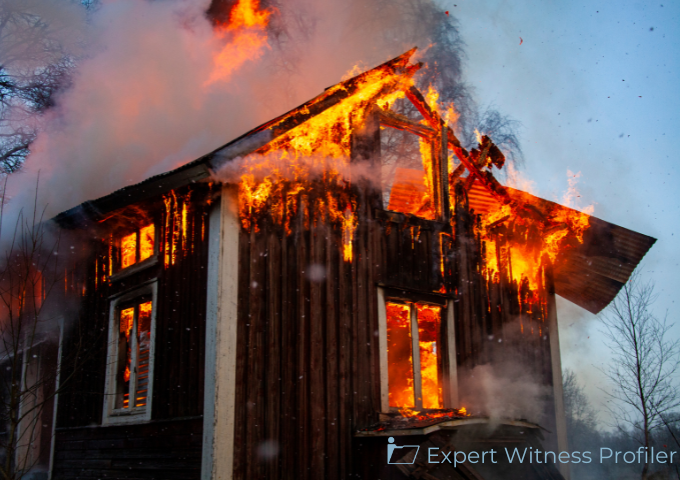
A fire took place overnight at Tiffany Keen and Trevor Wogrin’s newly-purchased residence at 45100 County Road 1 in Parker (the “Home”), on June 5-6, 2022 (the “Fire”), causing damage. The Home was insured by a homeowner’s insurance policy issued by Allstate (the “Policy”). The Insureds submitted a claim to Allstate on June 6, 2022 for the payment of covered benefits under the Policy (the “Claim”).
Allstate refused to pay Dwelling benefits under the Policy. Almost ten (10) months after the Claim was submitted, Allstate filed this action against the Insureds seeking a declaration that the intentional acts exclusion applies to the Claim to bar coverage.
Defendants designated an insurance industry expert in support of their counterclaims for breach of insurance contract and bad faith. However, Allstate did not designate an affirmative insurance industry standards expert; instead, it designated its industry standards expert, Keith Olivera as a rebuttal expert.
To begin with, Defendants sought to strike Olivera on the ground that he was not a proper rebuttal expert. Alternatively, they claimed that he was unqualified to offer certain opinions asserted in his expert report and sought to limit other aspects of his testimony as unnecessary, irrelevant, confusing, or usurping the Court’s prerogative to instruct the jury on the law.
Insurance Law Expert Witness
Keith R. Olivera has been an attorney practicing in the field of insurance law for 30 years. Much of his practice involves advising insurers on claim handling practices and claims decisions.
He advises insurers on claim handling decisions involving both first- and third-party claims. Moreover, he has represented or assisted insurers in hundreds of cases or claims where the insurer has been alleged to have engaged in unreasonable claim handling.
As per Fed. R. Civ. P. 26(a)(2)(D)(ii), a rebuttal expert opinion is one “intended solely to contradict or rebut evidence on the same subject matter identified by another party.”
The Court found that, superficially, this is what Olivera’s opinion appeared to do. In other words, Olivera contradicted the opinions of the Defendants’ industry standards expert witness, Douglas Meier, who asserted that Allstate’s handling of the Defendants’ insurance claim was unreasonable.
However, where the subject matter of the expert’s testimony concerns a matter the designating party knew or should have known would be part of its opponent’s case-in-chief, that expert is an affirmative expert.
To prove their substantive claim, Defendants perforce will be required to show Allstate “acted unreasonably and with knowledge of or reckless disregard for the fact that no reasonable basis existed for denying [Defendants’] claim.” Accordingly, Allstate absolutely should have predicted Defendants would offer an industry standards expert. They could not lay behind the log and only designate their own industry standards expert in rebuttal. Accordingly, the Court held that Olivera is not a proper rebuttal witness.
Under Rule 37, a party is required to show that the violation of the discovery obligations was substantially justified or harmless.
Allstate has failed to even acknowledge Rule 37 standards, must less attempt to show how they might be satisfied in this case.
Held
The Court granted the Defendants/Counterclaim Plaintiff’smotion to strike or limit the opinions and testimony of Plaintiff’s retained insurance law expert witness, Keith Olivera.
Key Takeaway
A rebuttal expert addresses “new unforeseen facts” that emerge in the opposing side’s case. Basically, Allstate tried to present Olivera as a rebuttal expert to counter the Defendants’ expert testimony about insurance industry standards. However, where the subject matter of the expert’s testimony concerns a matter the designating party knew or should have known would be part of its opponent’s case-in-chief, that expert is an affirmative expert.
When given the chance to justify the violation of its discovery obligations under Rule 37(c)(1), Allstate failed to address any of the required factors for showing their violation was either substantially justified or harmless. Allowing Olivera to testify would have prejudiced Defendants and disrupted the trial. This failure further cemented the Court’s decision to strike his opinions and bar him from testifying.
Case Details:
Case caption:
Allstate Vehicle And Property Insurance Company V. Wogrin Et Al
Docket Number:
1:23cv803
Court:
United States District Court for the District of Colorado
A district judge in Ohio barred an expert in insurance law from testifying because he lacked sufficient expertise in insurance litigation despite his long and distinguished career.
This action arises out of a material breach of insurance policies by Defendant Nancy Caraballo, who entered an unreasonable and collusive $36 million settlement with the Estate of Jordan Rodriguez (“Jordan”), a 5-year-old Cleveland boy who died tragically in late 2017, and whose body was discovered buried in his mother’s backyard. In connection with that tragic death, Caraballo pleaded guilty to four felonies concerning a benefits-fraud scheme she entered into with Jordan’s mother, which she tried to cover up by falsifying records related to her work purporting to provide Jordan’s mother with services as a parent educator.
Prior to Caraballo’s breach, Princeton Excess and Surplus Lines Insurance Company (“PESLIC”), as the insurer of Caraballo’s former employer, Catholic Charities Corporation (“Catholic Charities”), was supporting good faith settlement discussions for a reasonable resolution with the Estate on behalf of both Caraballo and Catholic Charities. PESLIC had also agreed to reimburse Caraballo’s covered defense costs despite several policy defenses asserted under a reservation of rights.
Caraballo was informed repeatedly that any settlement with the Estate in excess of the policies’ $1 million retained limit required the consent of PESLIC. Rather than honor her obligations to PESLIC, Caraballo agreed to a $36 million settlement, an amount that no independent rational actor would agree to pay. Caraballo’s material breach of the obligations imposed by the policies prevented both her and the Estate from obtaining indemnification or any other benefits from PESLIC.
The Estate retained Judge William Taylor to render an opinion regarding whether PESLIC (1) “maintained control of” the underlying State Court litigation; and/or (2) engaged in “bad faith” towards Caraballo.
Plaintiff Princeton Excess and Surplus Lines Insurance Company (“PESLIC”) filed a motion to exclude the report and testimony of Judge William Taylor, submitted by Defendant Michelle Rodriguez, as the Administrator of the Estate of Jordan Rodriguez (“the Estate”).
Insurance Law Expert Witness
Judge William Taylor graduated from Northwestern University School of Law in 1979. He worked as an associate at the law firm of Peterson Ross from 1979 to 1982. While employed at Peterson Ross, Judge Taylor practiced insurance litigation, including representing Lloyd’s of London. Judge Taylor left Peterson Ross in 1982, and moved to Cuyahoga County, Ohio where he helped run a gubernatorial political campaign for Jerry Springer. After that, he moved to California and worked on another political campaign. In 1983, Judge Taylor joined the law firm of Sachnoff Weaver, where he practiced “business litigation.”
Judge Taylor then worked as the Chief of Litigation of Revenue for the Illinois Attorney General’s Office from 1985 to 1987. He testified that, in this position, he was a “tax collector,” supervised 30 people, and appeared in court occasionally. From 1987 until approximately 1989 or 1990, Judge Taylor worked on several political campaigns, including those of Walter Mondale, Michael Dukakis, Harold Washington, and Carole Mosley Braun. In 1990 or 1991, Judge Taylor went into private practice, where he did “litigation, real estate, wills, divorces” and “whatever came in the door.”
The Estate retained Judge William Taylor to render an opinion regarding (1) PESLIC’s supposed control of “the litigation in the underlying case” in state court; and whether PESLIC (2) engaged in “bad faith” towards Caraballo.
Judge Taylor opined that “it was apparent that PESLIC refused to agree to indemnify Caraballo.” PESLIC argued that not only did Judge Taylor lack the requisite qualifications to testify, but also that his opinions were irrelevant and unreliable.
Qualifications
The Court held that Judge Taylor was unqualified to provide expert opinion regarding PESLIC’s control of the state court litigation and for PESLIC acting in bad faith in its control of the litigation regarding Caraballo. While Judge Taylor has a long and distinguished career as a lawyer, jurist, and campaign manager, the Court found that he did not have sufficient expertise in insurance litigation to provide a proper foundation for him to testify about whether PESLIC “maintained control of” the underlying state court litigation or engaged in bad faith under Ohio law.
Reliability
The Court found that neither Judge Taylor’s three years of experience at an insurance defense firm in the 1980’s nor his tenure as a state trial and appellate judge were sufficient to demonstrate that he had specialized knowledge and experience regarding whether an insurance company “maintains control of” litigation and/or engages in bad faith. To sum it up, Judge Taylor’s reliance on his experience and some ill-defined concept of “logic” to form his opinions did not constitute a reliable methodology.
Legal Conclusions
The Court found that several of Judge Taylor’s opinions crossed the line into inappropriate legal conclusions. For example, Judge Taylor opined that: (1) PESLIC’s alleged conduct “constituted legal maneuvering which at a minimum is a constructive refusal to indemnify;” (2) “PESLIC’s refusal to make any offer of settlement within their policy was arbitrary, capricious, and in bad faith;” and (3) “the decision of Caraballo to settle the claim despite the insurer refusing to give written consent was not arbitrary or unreasonable.”
Held
The Court granted PELSIC’s motion to exclude the testimony of Judge William Taylor.
Key Takeaways:
Caraballo and the Estate entered into a $36 million settlement agreement without PESLIC’s consent—an obvious breach of the PESLIC insurance policies’ consent-to-settle provisions. Defendant’s expert, Judge Taylor was highly accomplished but his background and experience simply did not relate sufficiently to the subject matter on which he opined in the instant case. The Court held that several of Judge Taylor’s opinions about PESLIC’s alleged conduct crossed the line into inappropriate legal conclusions.
Expert testimony should not constitute legal conclusions regarding the ultimate legal issues.
Expert witness’ knowledge and experience should be such that his opinions will likely be helpful to or otherwise assist the trier of fact.
Judge Taylor’s reliance on his experience and some ill-defined concept of “logic” to form his opinions did not constitute a reliable methodology.
Case Details:
Case Caption:
Princeton Excess And Surplus Lines Insurance Company V. Caraballo Et Al
In an underinsured motorist (“UIM”) bad faith action stemming from a car accident, Todd Cope presented at the emergency room after his vehicle was rear-ended on November 6, 2013, citing complaints of occipital headache, pain behind his right eye, and cervical spine pain. Medical records at that time indicated no acute traumatic injuries to the skull, brain, cervical, or thoracic spine. Cope was discharged without medication and advised self-care. Subsequently, a lumbar MRI conducted two months post-accident revealed a disc herniation at L5-S1.
Before the accident, in March 2011, Cope experienced a back injury from a fall through a flight of stairs. This incident caused low back pain radiating down his extremities. A lumbar spine MRI in May 2011 showed disc bulges at L4-5 and L5-S1. Even two years later, in April 2013, Cope continued treatment for low back and right leg pain attributed to the 2011 fall.
Within this UIM bad faith action, Todd Cope disclosed several medical providers as non-retained expert witnesses, including Dr. Bryan Castro, his former treating spine surgeon, and Dr. Roberta Anderson-Oeser, his treating physical medicine and rehabilitation physician. Additionally, Cope disclosed Aubrey Corwin as a life care planning “expert” and Brad Levin as an insurance standard-of-care expert. Auto-Owners Insurance Company seeks to exclude opinions they deem improperly disclosed, unsupported, unreliable, or unhelpful.
Life Care Planning Expert Witness
Aubrey A. Corwin M.S., L.P.C., C.R.C., C.LC.P. is a vocational rehabilitation and life care planning expert. She testifies as an expert in cases involving both loss of earning capacity and life care planning nationwide. She is a Licensed Professional Counselor (LPC); a Certified Rehabilitation Counselor (CRC); a Certified Life Care Planner (CLCP); and a former Certified Guidance Counselor. She is past Co-Chair of the Forensic Section of the International Association of Rehabilitation Professionals (IARP) and past Forensic Representative to the IARP International Board of Directors. She is also a member of the American Board of Vocational Experts (ABVE).
Insurance Law Expert Witness
Bradley A. Levin focuses his practice on tort and commercial litigation, especially insurance bad faith and insurance coverage disputes. He has significant litigation and trial experience.
Levin received his undergraduate degree from Stanford University, with distinction, where he was elected Phi Beta Kappa. He graduated from the University of California, Hastings College of Law, and served as editor-in-chief of the Hastings Constitutional Law Quarterly.
In addition to teaching legal writing and research at Hastings College of Law, Levin has lectured frequently in the areas of insurance coverage and bad faith law. He is licensed to practice in California and Colorado. He is a member of the Denver, Colorado and American Bar Associations.
Discussion by the Court
The Defendant sought to prevent Castro and Anderson-Oeser from presenting causation opinions during the trial. Both doctors were non-retained experts who had not submitted formal expert reports. The Defendant argued that their opinions on causation lacked reliability for various reasons. Proving injury causation necessitates demonstrating both general and specific causation. “Specific causation” pertains to whether a particular incident directly caused the specific injury, while “General causation” concerns whether the incident could theoretically lead to the type of injury suffered.
According to the ruling in Hollander v. Sandoz Pharmaceuticals Corp. (289 F.3d 1193, 10th Cir. 2002), general causation could be established through means like epidemiological evidence. The Court highlighted that an expert was not obligated to reference published studies to reliably conclude that a specific object caused a particular illness.
In the Defendant’s Motion, it was outlined that based on the Plaintiff’s Rule 26(a)(2) expert disclosures, Castro intended to testify about several key points:
Cope’s persistent back and leg pain, attributing it to a substantial herniation on the right side at L5-S1, asserting it was caused by the November 6, 2013, collision.
Denial that Cope suffered any disc herniation due to a 2011 worker’s compensation fall at any spinal level.
Confirmation that Cope underwent a corrective surgery on May 8, 2014, not for impingement but explicitly linked to the November 6, 2013, crash.
Affirmation that subsequent surgeries, including a revision on November 19, 2015, were deemed necessary and reasonable consequences of the November 6, 2013, collision.
Assertion that Cope’s symptoms preceding the specific collision did not necessitate a subsequent lumbar MRI and that the pain experienced was notably distinct.
Examination and reference to all physical therapy records preceding the collision and all records pertinent to Cope’s 2011 worker’s compensation claim, encompassing impairment ratings and work restrictions.
Expressing the potential for the third herniation to self-heal but highlighting the possibility of future fusion surgery if self-healing doesn’t occur.
Affirmation of the reasonableness of bills for services rendered by Castro.
The Defendant sought to prevent Castro from expressing opinions on causation related to whether the car accident caused the Plaintiff’s reported injuries or pain, specifically disputing Castro’s assertion that the accident led to the disc herniation or the subsequent lumbar surgeries he performed.
Initially, the Defendant argued that Castro’s statement didn’t constitute a causation opinion as it didn’t assert that the accident was more likely than not the cause of the Plaintiff’s current symptoms, pointing to a June 02, 2017 statement in Plaintiff’s medical records. The Defendant further contended that Castro’s language was too vague and incomplete to be considered a definitive opinion on causation, especially concerning the surgeries he conducted in 2014 and 2015.
The Defendant stressed that the medical records by Castro contained no explicit causation opinions, highlighting a supposed violation of Rule 26 disclosure requirements. The Plaintiff, however, argued that any such violation was harmless since the Defendant had elicited opinions from Castro during a deposition in 2018 before the expert disclosure deadline. The Plaintiff also contended that the Defendant’s objection was based on Castro not being paid to document his causation opinions expressed during the 2018 deposition.
Ultimately, despite Castro discussing causation in his deposition testimony, the Court ruled that his deposition didn’t suffice as an expert report as required by Rule 26. The Court emphasized that even for retained experts who usually submit expert reports, deposition testimony couldn’t substitute for Rule 26’s explicit disclosure requirements. Consequently, the Court decided to preclude Castro from offering causation opinions during the trial.
The Court emphasized that based on the absence of general or specific causation opinions from Castro, Rule 26(a)(2) doesn’t permit curing deficient expert reports through subsequent deposition testimony. With the accident having occurred over a decade ago and the litigation spanning several years, the Court noted the ample time available for the Plaintiff to disclose an expert report containing Castro’s causation opinions.
In line with the rule’s requirements, the Court outlined that a treating physician who previously provided a causation opinion during treatment (in compliance with specific standards) without submitting a formal report could only testify to the historical fact that such an opinion was part of the treatment. However, the physician couldn’t testify that this remains their current opinion, emphasizing the need for strict compliance with the Federal Rules. Consequently, the Court granted this part of the Motion, precluding Castro from offering causation opinions during the trial.
Nevertheless, the Court acknowledged the existence of a statement in Plaintiff’s medical records that could potentially be construed as a causation opinion formed during treatment by Castro. Thus, while barring Castro from presenting this as a current opinion under oath, the Court allowed Plaintiff to present this fact at trial. Castro could testify solely to the historical aspect that this opinion was part of the treatment, adhering to the Court’s directive.
Given this ruling, the Court instructed the parties to submit proposed instructions for the jury at trial, aiming to clarify in simple terms the distinction drawn by the Court regarding Castro’s testimony about the historical treatment-based opinion versus a current opinion.
The Defendant requested the Court to prevent Anderson-Oeser from testifying about the necessity of a future spinal fusion resulting from the injuries sustained in the accident. In response, the Plaintiff didn’t address the Defendant’s causation arguments regarding Anderson-Oeser, except to assert that the Defendant hadn’t specified which causation opinions it aimed to exclude, focusing solely on the future surgery opinion. Plaintiff did not argue that any failure to properly disclose Anderson-Oeser’s causation opinions was harmless or substantially justified.
The Court deemed Plaintiff’s argument disingenuous, emphasizing that the Defendant’s intention was clear—to exclude Anderson-Oeser’s testimony regarding the accident’s role in necessitating future spinal fusion. Similar to Castro, Anderson-Oeser, a non-retained treating physician who hadn’t submitted an expert report, was the subject of this exclusion request. The Defendant highlighted that Anderson-Oeser endorsed a statement in a letter, prepared for litigation and drafted by Corwin’s office staff, stating, “Cope will likely require a lumbar spine fusion at L5-S1 at some point.” The Defendant contended that Anderson-Oeser aimed to testify regarding the future surgery recommendation outlined in Corwin’s report/letter. However, the Defendant argued that this evidence should be excluded as the recommendation in the letter lacked any opinion regarding whether the accident caused the necessity for this future surgery.
The Plaintiff, however, clarified that Castro’s testimony would focus on the standard of care for third herniations, asserting that the typical practice doesn’t involve a third laminectomy but leans towards spinal fusion. Plaintiff argued that both doctors were qualified to discuss the clinical standards pertaining to the type of surgery and the conditions influencing the decision-making process for surgery, such as pain tolerance and neurological deficits.
Plaintiff contended that there was no obligation to present expert testimony specifically establishing the probability of future surgery to seek damages for such potential procedures. However, Plaintiff failed to acknowledge that neither Castro nor Anderson-Oeser’s medical records contained any prognosis or explicit recommendations for future surgery. Additionally, Plaintiff didn’t address the concerns raised by the Defendant regarding Rule 26 and Rule 37 compliance.
Consequently, the Court granted the Defendant’s motion, barring Anderson-Oeser from presenting any causation opinions and from testifying about the necessity of a spinal fusion resulting from the injuries sustained by the Plaintiff in the accident.
The Court determined that Castro and Anderson-Oeser’s opinions regarding the Plaintiff’s future medical treatment and potential surgery were not derived from their observations, actions, or reasons during their treatment of the Plaintiff. Instead, the Court noted that these opinions seemed to be shaped primarily due to the existence of the lawsuit.
Given that the opinions sought to be introduced through Castro and Anderson-Oeser concerned potential future treatments and associated medical costs, the Court held that Rule 26(a)(2)(B) necessitated an expert report—which neither physician had prepared.
Consequently, the Court precluded Castro from testifying on several points: 1) the assertion regarding the standard of care for third herniations favoring spinal fusion over a third laminectomy; 2) opinions about the Plaintiff’s potential future surgery needs based on factors like pain tolerance and future neurological deficits; and 3) any testimony related to clinical standards governing the type of surgery and factors influencing the Plaintiff’s future decisions about surgery, as proposed through Castro and Anderson-Oeser.
The Defendant had requested the Court to prevent Castro from testifying about the Plaintiff’s pre-accident physical therapy and medical treatments stemming from a 2011 workers’ compensation fall. After deliberation, the Court granted this aspect of the Motion.
The Court noted that Castro commenced treating the Plaintiff on March 21, 2014—four months subsequent to the accident and three years following the Plaintiff’s fall down a flight of stairs. As Castro hadn’t administered the physical therapy or medical treatment associated with the earlier fall, the Court excluded Castro from offering any testimony regarding those pre-accident treatments.
The Defendant had sought to exclude Anderson-Oeser’s opinion predicting the necessity of a future spinal fusion resulting from the injuries sustained in the accident. The Defendant reiterated that this opinion, akin to her causation opinion, was inadmissible due to Plaintiff designating her as a non-retained expert without a formal report under Rule 26. The Defendant emphasized that Anderson-Oeser’s opinion pertained not to her direct treatment but rather to potential future treatment for the Plaintiff, which she wouldn’t perform as she wasn’t a surgeon. Additionally, the Defendant argued that Anderson-Oeser’s qualification as a non-spine surgeon rendered her unqualified to opine on hypothetical future lumbar spinal fusion surgeries.
However, since the Court had previously excluded Anderson-Oeser’s opinions about the Plaintiff’s future spine surgeries and medical treatment, the Court denied this aspect of the Defendant’s Motion as moot.
The Defendant argued that the Plaintiff hadn’t disclosed any retained expert or report addressing the reasonableness of his medical bills. Instead, Plaintiff’s disclosures indicated the intent to rely on testimony from non-retained treating physicians on this matter. However, the Court excluded the opinions of Plaintiff’s non-retained treating physicians concerning the reasonableness and necessity of his medical bills.
The Defendant moved to exclude testimony regarding surgery-related treatments in Aubrey Corwin’s May 2021 life care plan, arguing that Corwin failed to reliably apply her stated methodology in forming opinions about the cost of future surgical treatment and related care.
In response, the Plaintiff acknowledged that introducing expert testimony indicating the need for future surgical care was necessary to seek future surgical costs. However, as the Court had excluded the testimonies of Castro and Anderson-Oeser regarding future surgery, and the Plaintiff hadn’t disclosed any other experts to testify about his future surgical needs, the Court granted the Defendant’s motion. Consequently, the Court excluded Corwin’s opinions regarding future medical expenses for surgical treatment and related care.
The Defendant moved to exclude attorney Bradley Levin’s opinions, contending that they lacked an objective basis and were solely derived from his experience. In response, the Plaintiff highlighted that Levin’s opinions were rooted in ten insurance industry standards outlined in his report, several of which were based on direct language of the Colorado Unfair Competition-Deceptive Claims Practices Act.
After reviewing Levin’s report, the Court acknowledged the Defendant’s contention that Levin could have more precisely linked his opinions to the specific standards purportedly violated by the Defendant. However, the Court noted that Levin explicitly stated in his opinion that the Defendant had contravened relevant portions of Colorado’s Unfair Competition-Deceptive Claims Practices Act. Levin also cited Regulation 5-1-14 promulgated by the Colorado Division of Insurance. The Court concluded that while the Defendant’s arguments might challenge the strength of Levin’s opinions, they did not render his opinions inadmissible. As a result, the Court denied the Defendant’s motion, allowing Levin’s opinions to stand, but stated that the Defendant could address these concerns during cross-examination.
Held
Defendant Auto-Owners Insurance Company’s Omnibus Motion to Exclude Certain Opinions of Dr. Bryan Castro, Dr. Roberta Anderson-Oeser, Aubrey Corwin and Bradley Levin was granted in part and denied in part by the Court.
The Court has not arrived on an outcome for this case since the remaining issues involved in this case still await resolution.
Key Takeaway
In a legal dispute over an underinsured motorist (“UIM”) claim, various motions were filed by the Defendant seeking to exclude certain expert testimonies and opinions from the trial. The Defendant aimed to preclude causation opinions from non-retained experts, Dr. Bryan Castro and Dr. Roberta Anderson-Oeser, alleging lack of reliability, improper disclosure, and absence of expert reports. Despite some arguments put forth by the Plaintiff, the Court precluded Castro from providing causation opinions, emphasizing the inadequacy of deposition testimony as a substitute for the required expert report under Rule 26.
The Court highlighted strict adherence to the Federal Rules and barred Castro and Anderson-Oeser from testifying on future surgical needs. This ruling stemmed from their opinions not being formed during treatment but apparently due to the ongoing litigation.
Additionally, the Court excluded discussions on pre-accident medical treatments and future surgical needs as neither expert had prepared an expert report as mandated by Rule 26. Despite the absence of specific expert reports, the Court allowed some opinions rooted in Colorado law from attorney Bradley Levin, indicating that the Defendant breached certain sections of the Colorado Unfair Competition-Deceptive Claims Practices Act.
In a similar vein, Aubrey Corwin’s opinions regarding future medical expenses for surgical treatment were excluded due to the lack of supporting expert testimony after the Court had previously precluded discussions on future surgery from other witnesses.
Overall, the Court enforced strict compliance with expert disclosure rules, precluding opinions lacking proper reports while permitting those supported by established legal standards. The Defendant’s objections and challenges were taken into account, but the Court emphasized the distinction between admissibility and weight of opinions, allowing certain expert testimonies to proceed while offering the opportunity to contest their strength during cross-examination.