In 2018, Rock Fuel Media pitched its concept for a sports-gaming platform called “VSports Live” to Resorts World Las Vegas LLC during the development stage of Resorts World’s casino and resort on the Las Vegas Strip. Resorts World did not end up contracting with Rock Fuel, and Rock Fuel never built the VSports Live platform. When Resorts World opened its doors several years later, it instead partnered with third parties to create two apps from which visitors could engage in sports betting, connect to the casino’s loyalty program, make dining reservations, engage in cashless gambling, and more.
Rock Fuel, believing that Resorts World cribbed its app ideas from the 2018 presentation, alleged trade-secret misappropriation, breach of the nondisclosure agreement (NDA) the parties signed before the 2018 presentation, and unjust enrichment.
Resorts World filed a motion to exclude the opinions of Rock Fuel’s purported expert witness, James Martin.
Intellectual Property Expert Witness
James Patrick Martin has more than 25 years of experience representing high-tech companies and their employees in intellectual property matters and technology-based transactions.
He earned his Juris Doctor degree, cum laude, from the University of Michigan Law School.
Martin reviewed Rock Fuel’s presentation materials concerning its app concept and “extracted” an eight-element set of features that Rock Fuel now presents as its trade secret. He opined that the combination of features he identified is protectable and was misappropriated by Resorts World.
Resorts World challenged Martin’s qualifications and accused him of conjuring up this trade secret only after examining Resorts World’s app and highlighting elements that overlap while ignoring those that don’t.
It also moved to exclude Martin’s misappropriation opinion because it isn’t based on any specialized knowledge that would be helpful to a jury.
Rock Fuel relied on Martin’s opinion to contend that the similarities between Rock Fuel’s eight elements and Resorts World’s apps at launch are sufficient circumstantial evidence from which a jury could conclude that Resorts World used Rock Fuel’s presentation materials to create its mobile products.
However, Rock Fuel has not established that he has specialized expertise or knowledge in app development, casino or hotel management software, sports gaming software, or any other field that would give him the specialized knowledge to compare app functionalities. He merely downloaded the Resorts World apps, compared what he saw to the 2018 presentation materials, and concluded that they have some overlap.
Even if Martin’s qualifications sufficed, his opinions are excludable because they do not rely on any specialized knowledge or expertise. He merely reviewed Resorts World’s products, compared them to the combination of elements he identified as Rock Fuel’s trade secret, and concluded that Resorts World “has a system that looks a lot like” Rock Fuel’s concept.
As a result, the Court held that Martin’s opinion on whether Resorts World misappropriated Rock Fuel’s trade secret is not admissible.
Held
The Court granted in part Resorts World’s motion to exclude James Martin’s expert testimony.
Key Takeaway
While experts are generally allowed to opine on whether a product has been misappropriated, Martin lacks specialized experience that would permit him to glean anything more than a layperson could.
Case Details:
Case Caption:
Resorts World Las Vegas LLC V. Rock Fuel Media, Inc.
The Volga German people are individuals of German origin who moved to the Volga region of Russia in the eighteenth century. Many of the descendants of the Volga German people have moved to other parts of the world after persecution of Germans in Russia. There is a sizable Volga German diaspora in the American Midwest. Plaintiff Margreatha Hein and Defendant Dr. Brent Mai are both genealogy researchers on the Volga German people. Their research is the subject of this lawsuit.
This case centers on whether Mai committed copyright infringement on Hein’s alleged work and whether there are damages due to the alleged infringement.
Defendant filed a motion to exclude the testimony of Plaintiffs’ expert, Dr. Kenneth D. Crews.
Intellectual Property Expert Witness
Kenneth Donald Crews is a law professor with substantial professional expertise in copyright law. Crews has been a scholar of intellectual property law since at least 2000. He possesses a PhD in Library and Information Science; he published his dissertation on copyright law and policy.
He has published five books on copyright and a great number of other publications.
Crews’ report contended that Hein’s photographs and textual compilations are the proper subject of copyright and have been infringed upon by Mai. His report compared Mai’s reproductions of Hein’s textual compilations to the originals. Crews also opined that Plaintiffs have had their Lanham Act and unfair competition rights violated by Mai’s listing of Hein as a “researcher” or “contributor.” Crews also provided background on the Copyright Act, the process of registering copyrights, and the remedies that are available to injured holders of copyrighted material. Finally, Crews provided a supplemental declaration expressing his opinion that none of Mai’s usage of Hein’s work is protected by the defense of “fair use.”
Mai sought to exclude Crews’ testimony for several reasons including: (1) that Crews did not have the necessary genealogy experience to qualify as an expert; (2) that Crews’ testimony failed all of the Daubert factors; (3) Crews’ testimony offers improper legal conclusions and legal interpretations and thus intrudes on the province of the Court and the jury; and (4) that part of Crews’ testimony was not timely disclosed.
Analysis
Defendant first argued that Crews is not trained as a genealogist and therefore lacked the expertise necessary for him to testify in this matter. However, copyright law is what Crews sought to testify about, not the specifics of genealogy research, which are not at issue in this case.
At the very beginning of the report Crews informed the reader that his work will “follow the basic structure of a copyright infringement case.” His report’s methodology is apparently just the three elements of copyright infringement. It is hard to see how this is not “discoursing broadly over the entire range of applicable law.”
While the Court does not doubt Crews’ familiarity with copyright law, ultimate issues of law are for the judge to instruct on and the jury to decide upon. An expert witness, even a law professor, cannot be a substitute teacher for the Court.
Crews did not aid the Court in understanding a disputed question of fact but instead his report indicates he “states legal conclusions drawn by applying the law to the facts.” That said, some of Crews’ report is helpful background on the process of obtaining and defending a copyright.
Finally, Defendant contended that Crews’ opinion on “fair use,” added through his supplemental declaration, was not timely disclosed. The prejudice was largely self-curing as Defendant has been in possession of Crews’ fair use opinion several months before trial and there was no evidence the delayed disclosure will disrupt the trial. As a result, the Court found it unlikely that Defendant was prejudiced by the late disclosure of Crews’ fair use opinion.
Held
The Court granted in part and denied in part the Defendant’s motion to exclude the testimony of Kenneth Crews.
Key Takeaway
The Court will permit Crews to testify at trial but noted that he will not be allowed to testify on matters relating to ultimate legal issues in the case. Defendant may raise objections at trial to testimony he believes strays into legal conclusions. This balance cautiously tracks the line of Rule 702(a), that expert testimony is primarily intended to “help the trier of fact to understand the evidence or to determine a fact in issue.”
X Social Media LLC (“X Social Media”) and X Corp. both use the letter “X” in association with closely related advertising services. Put simply, X Corp. is an online and app-based social-media platform that allows users to create and share a wide range of digital content, including advertisements. X Social Media is an advertising agency that designs and runs social-media advertising campaigns for mass-tort and class-action law firms.
This is a case for trademark infringement and related claims concerning the parties’ respective use of the letter “X” in connection with distinct product and service offerings.
Both parties retained experts to advance their respective theories of the case. Defendant offered (1) marketing scholar Peter Golder and (2) survey practitioner Hal Poret. Professor Golder analyzed the product markets in which the parties operate and opines that reverse confusion is improbable. Poret conducted an Eveready consumer-perception survey to test for the likelihood of reverse confusion and found minimal confusion.
Plaintiff offered Professor David J. Franklyn, a trademark-law scholar, to rebut both Golder and Poret. Professor David J. Franklyn disputed Golder’s market-structure analysis and critiques Poret for limiting his survey universe to representatives of law firms and advertising agencies, contending that Poret should also have surveyed the consumers who view Plaintiff’s ads on social media.
Professor Peter N. Golder is a Professor of Marketing at the Tuck School of Business at Dartmouth College in Hanover, New Hampshire.
His background includes a Ph.D. in. marketing from the University of Southern California, decades of academic appointments in marketing, and prior experience providing expert marketing testimony in litigation.
Hal Poret is a public opinion researcher with a master’s degree in mathematics and a law degree from Harvard Law School. Poret has personally designed, supervised, and implemented well over 1,000 surveys regarding the perceptions and opinions of consumers.
He has been accepted as an expert in survey research on numerous occasions by U.S. District Courts, the Trademark Trial and Appeal Board, the ITC, the FCC, the FTC, and the National Advertising Division of the Council of Better Business Bureaus (NAD).
David Joel Franklyn is currently a law professor at Arizona State University, with an appointment in the Sandra Day O’Connor College of Law. He is also the Executive Director of the McCarthy Institute at ASU Law, which is focused on scholarship and research in intellectual property law, with particular emphasis in the areas of trademark law, branding and consumer perceptions related to brands.
Franklyn has published extensively on issues relating to intellectual property law and is editor-in-chief and co-author of McCarthy’s Desk Encyclopedia of Intellectual Property Law. Between 2018 and 2021, Franklyn also held a joint appointment at Golden Gate University’s law school and business school.
The Court discussed the challenged opinions of Professor Golder, Poret, and Professor Franklyn in turn.
A. Professor Peter Golder
Defendant retained Golder to analyze the structure of the parties’ product markets, the sophistication of Plaintiffs’ consumers, and the nature of Plaintiffs’ sales process and to “[d]iscuss whether [these] assessments” are “consistent or inconsistent with Plaintiff’s theory of reverse confusion.”
Plaintiff filed a motion to exclude Golder under Rules 702 and 403, contending that he is unqualified, offers improper legal conclusions, ignores the Eleventh Circuit pattern jury instructions for trademark-infringement cases, disregards evidence of actual confusion, relies on irrelevant third-party marks, and “cherry-picks” facts.
1. Summary of Golder’s Opinions
Golder opined that similar brand names can coexist without consumer confusion when they operate in distinct ‘product categories,’ which he illustrated with third-party examples such as “Delta”—the brand-name of an airline, a faucet company, and a dental insurer.
He further noted that Defendant’s public SEC filings identify technology companies such as Meta, Alphabet, Microsoft, and TikTok—not advertising agencies like Plaintiff—as competitors.
He opines that the Plaintiffs’ theory of reverse confusion is “inconsistent with both the documentary record and marketing literature” given the parties’ distinct product categories, the sophistication of Plaintiffs’ customers, and the nature of Plaintiffs’ sales process.
2. Plaintiff’s Daubert Challenges to Professor Golder
Plaintiff first argued that Golder is “not qualified as a trademark law expert” because he is neither a “trademark attorney nor former-USPTO commissioner.” However, Defendant has proffered Golder as a marketing expert, not a legal expert. Evaluated in his proffered field, the Court finds him qualified under Rule 702.
Plaintiff next contended that Golder impermissibly offered legal conclusions, citing his statement that “Plaintiff’s theory of reverse confusion is not consistent with the documentary evidence in this matter or with the marketing literature.” Considered in context, the challenged statements are tied to marketing concepts and record evidence, and Golder expressly disclaimed offering a “legal opinion on confusion.” As a result, the Court rejected Plaintiffs’ argument.
Plaintiff also sought exclusion because Golder did not consider evidence of actual confusion. Since this matter is set for a bench trial, where concerns about the “jury’s expectations” carry no weight, the Court will evaluate evidence of actual confusion independently and consider Golder’s testimony only for its permissible purpose.
Plaintiff next challenged as “irrelevant and misleading” Golder’s reliance on third-party brand examples such as Delta, Dove, Morningstar, Pandora, and Tiffany. To the extent Golder’s examples do not correspond perfectly to this case, the Court held that “objections to the inadequacies of a study are more appropriately considered an objection going to the weight of the evidence rather than its admissibility.”
Finally, Plaintiff argued that Golder “cherry-picked” evidence by declining to evaluate evidence of actual confusion and by emphasizing factors favorable to Defendant. In this case, Golder disclosed the materials he considered and applied recognized marketing principles to the facts of this case.
The Court overruled the Plaintiffs’ cherry-picking objection under Rule 702 because it does not establish unreliability.
B. Hal Poret
Defendant retained Hal Poret, a consumer-survey expert, “to design and conduct a scientific survey” assessing whether “Defendant’s use of its X mark creates a likelihood of reverse confusion with Plaintiff.”
Poret did so and concluded that “Defendant’s use of its X mark does not create a likelihood of confusion with Plaintiff.” Plaintiff filed a motion to exclude his testimony, contending that his survey is unreliable because: (1) it lacked a control group; (2) it used the Eveready format rather than Squirt (3) it relied on flawed coding assumptions; and (4) it tested an underinclusive universe.
1. Summary of Poret’s Opinions
Poret conducted an Eveready survey, in which respondents are shown only the senior user’s mark (here, Plaintiffs “X SocialMedia”) and asked questions to assess whether the respondents associate that mark with the junior user’s mark (here, Defendant’s “X”).
Poret administered the survey online to 200 respondents who had been screened to ensure they worked for law firms or marketing firms that had used or planned to use social media advertising services—the population he identified as Plaintiffs’ customer base.
According to Poret, only 4.0% of respondents provided answers that “suggest reverse confusion” between Plaintiff and Defendant.
2. Plaintiff’s Daubert Challenges to Poret
Plaintiff first argued that Poret’s survey is unreliable because it lacked a control group. Plaintiff argued that without a control, the survey cannot distinguish between genuine confusion and background “noise.” Poret acknowledged the omission but explained that controls are most useful where the initial confusion rate is high enough that noise could materially affect the result. Here, however, “the test group rate of confusion was already so low that it shows a lack of confusion even without taking any potential noise into consideration.”
The Court held that the absence of a control group does not render a survey inadmissible under Rule 702.
Plaintiff next challenged Poret’s use of the Eveready format, arguing it is inappropriate here because it presumes that Defendant’s mark is top-of-mind. The dispute over whether Eveready or Squirt is more probative here is for the trier of fact to decide; it does not implicate methodological reliability under Rule 702.
The Court held that Poret’s survey will not be excluded merely because Plaintiff believes a Squirt survey would be more probative since both Eveready and Squirt formats are accepted in the industry.
Plaintiff also argued Poret’s coding decisions artificially lowered the measured confusion rate. But Plaintiffs’ objections boil down to the assertion that Poret misused a survey method that “in the abstract, is reliable.” It is well-established that “the identification of such flaws in generally reliable scientific evidence is precisely the role of cross-examination.”
Finally, Plaintiff argued that the survey universe was underinclusive because it did not include consumers who merely view Plaintiffs’ ads on Facebook and instead exclusively sampled representatives of legal and marketing firms. However, when assessing reverse confusion, limiting the universe to the senior user’s customers is a generally accepted approach.
C. David J. Franklyn
Defendant filed a motion to exclude two categories of Franklyn’s opinions: (1) all of his critiques of Golder, on the grounds that Franklyn is not qualified to offer marketing opinions and, in any event, his critiques lack reliable methods and sufficient factual support; and (2) his opinion that Poret’s survey used an underinclusive universe.
1. Summary of Franklyn’s Opinions
a. Critiques of Golder
Franklyn disputed Golder’s claim that the parties operate in distinct product categories, opining that the parties “operate in highly overlapping product categories and often provide nearly identical services.”
He criticized Golder’s reliance on third-party brand analogies such as “Delta,” contending that those examples are inapposite because here “the product category of [Defendant] is the brand name of [Plaintiff].”
b. Critiques of Poret
Franklyn criticized Poret’s reverse-confusion survey for, among other things, using an “underinclusive universe” that “fails to account for consumers” who encounter the advertisements Plaintiff creates for its law-firm clients. Poret surveyed only “representatives of legal practices and advertising/marketing firm[s],” and Franklyn opined that the perceptions of consumers exposed to Plaintiffs ads may negatively influence the “viability of the advertising services being provided by [Plaintiff].”
2. Defendant’s Daubert Challenge to Professor Franklyn’s Critiques of Professor Golder
Defendant first argued that Franklyn is unqualified to rebut Golder. Franklyn considers himself an expert in “marketing as it relates to trademark law.” But his academic training is in history, philosophy, religion, and law, and his curriculum vitae identified no degrees, work experience, or professional memberships in marketing or advertising disciplines. He has never practiced marketing, has never attended a marketing conference, and did not review the literature on which Golder relied.
Accordingly, the Court concluded that Plaintiff has not met its burden under Rule 702 to establish that Franklyn is qualified to rebut Golder’s marketing opinions.
Setting aside his qualifications, the Court held that Franklyn’s critiques of Golder failed under Rule 702 because they are not based on reliable principles and methods.
Franklyn admitted that he “didn’t use marketing principles” at all, did not review the marketing literature Golder cited—calling it “mumbo jumbo”—and did not conduct empirical consumer research.
3.Defendant‘sDaubertChallenge to Franklyn’s Critiques of Poret
Franklyn contended that Poret’s survey universe was “underinclusive” because it “failed to account for consumers who will encounter [Plaintiff’s] marks in the form of the advertisements that [Plaintiff] produces on behalf of [its] direct clients.”
The Court found Franklyn’s view that a reverse-confusion survey must include individuals beyond the senior user’s actual customer base is methodologically unsound. The Eleventh Circuit has made clear that the relevant universe in a reverse-confusion case consists of the senior user’s customers.
Moreover, Franklyn’s critique that consumers might view advertisements containing Plaintiff’s name and logo is also predicated on a factual assumption that is unsupported by the record—that members of the general public exposed to Plaintiff’s clients’ Facebook ads actually see Plaintiff’s mark. He identifies no example of a consumer-facing advertisement containing Plaintiff’s name or logo.
Held
The Court denied the Plaintiff’s motion to exclude the opinions of Peter Golder and Hal Poret but granted the Defendant’s motion to exclude the testimony of David J. Franklyn.
Key Takeaway:
Rule 702, however, requires only that an expert be qualified “by knowledge, skill, experience, training, or education” to testify competently “regarding the matters he intends to address.” Nothing in Rule 702 demands experts to have legal credentials.
Please refer to the blog previously published about this case:
EcoFactor, Inc. (EcoFactor) owns U.S. Patent No. 8,738,327, which relates to the operation of smart thermostats in computer-networked heating and cooling systems.
In January 2020, EcoFactor sued Google in the Western District of Texas, alleging Google’s Nest thermostats infringed claims of the ‘327 patent, among other patents.
Before trial, Google filed a motion to exclude the testimony from EcoFactor’s damages expert, David Kennedy, under Federal Rule of Evidence 702 and Daubert. The district court, however, held that Kennedy’s testimony that $X is an established royalty for the patented technology was indeed supported by reliable methodology.
Google appealed the district court’s denial of the motion to exclude Kennedy’s testimony. Google argued that the district court abused its discretion in denying a new trial on damages because Kennedy’s expert opinion was unreliable.
Intellectual Property Expert Witness
David A. Kennedy is an expert in intellectual property valuation and negotiating the economics of patent sales and licensing agreements. He has been acknowledged as one of the World’s Leading IP Strategist by Intellectual Asset Management for each of the last 11 years.
Kennedy has bought and sold patent portfolios and negotiated license agreements in commercial transactions and helped clients establish royalty rates for individual patents and large portfolios of implementation and standard essential patents.
As part of his analysis, Kennedy considered lumpsum settlement licenses between EcoFactor and three licensees: Daikin Industries, Ltd. (Daikin); Schneider Electric USA, Inc. (Schneider); and Johnson Controls Inc. (Johnson).
Kennedy offered his expert opinion on “the amount of patent damages in this case,” and ultimately concluded that Google LLC (“Google”) should pay damages based on a royalty rate of $X per unit. Kennedy’s testimony is also supported by license agreements between EcoFactor, Inc. (“EcoFactor”) and Johnson Controls, Inc. (“Johnson”), Daikin Industries, Ltd. (“Daikin”), and Schneider Electric, USA (“Schneider”).
Apart from the licenses themselves, the only evidence upon which Kennedy relied was the testimony of Eco-Factor’s CEO, Shayan Habib. Habib testified that the lump-sum payments for each of the three licenses was calculated by multiplying the licensee’s past and future projected sales by the $X per unit rate. Habib also testified about Google’s sales compared to the sales of Johnson, Daikin, and Schneider, and he concluded that “as it relates to the smart thermostat business, they’re actually either quite new or very small in our space specifically.”
Kennedy’s Opinion that the Licenses Showed Industry Acceptance of an $X per unit Royalty Rate was not Based on Sufficient Facts or Data
To estimate a reasonable royalty in this case, Kennedy’s damages opinion employed the hypothetical negotiation or “willing licensor-willing licensee” framework, which “attempts to ascertain the royalty upon which the parties would have agreed had they successfully negotiated an agreement just before infringement began.”
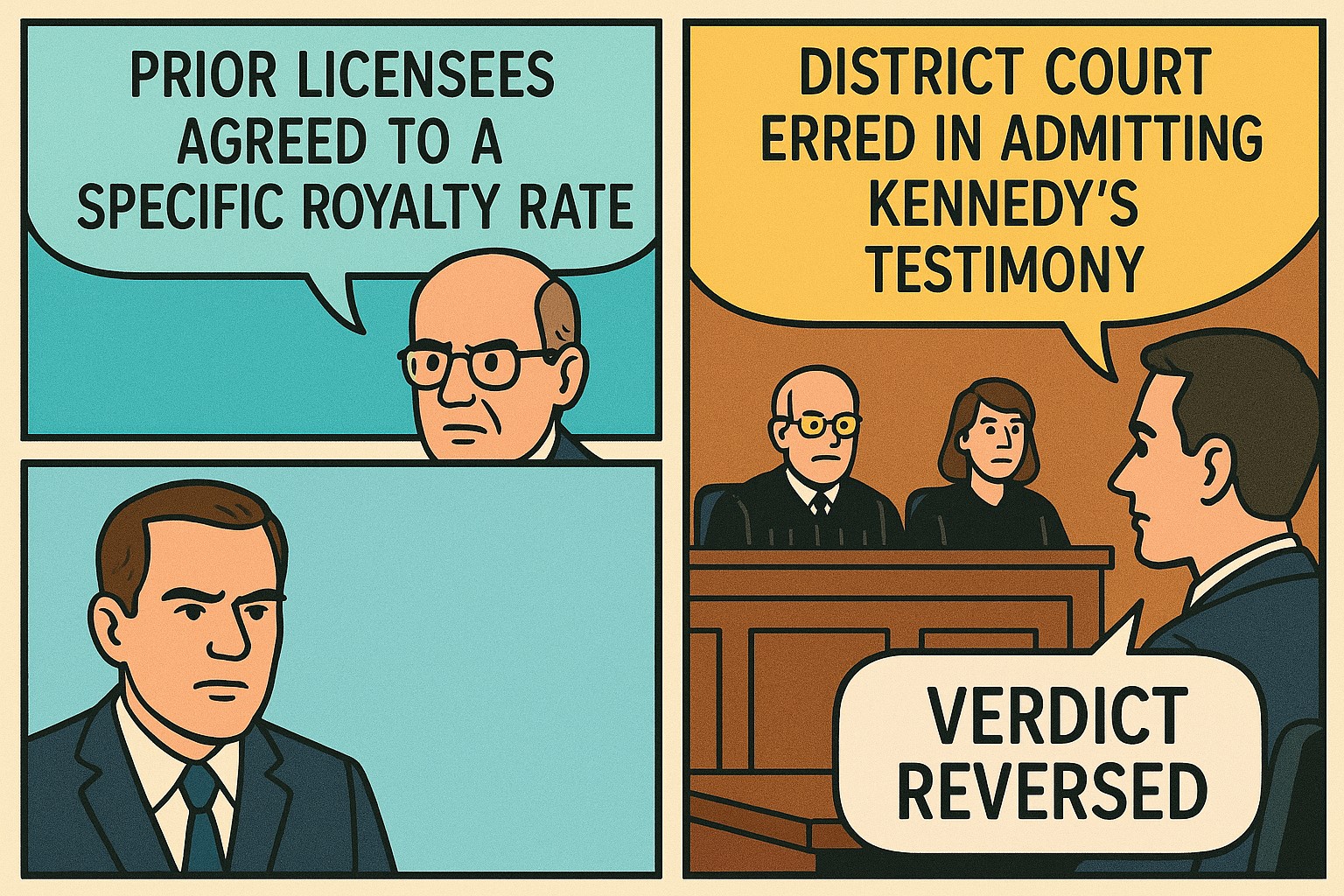
The Federal Circuit held that the existing licenses upon which Kennedy relied were insufficient, individually or in combination, to support his conclusion that prior licensees agreed to the $X royalty rate and therefore the district court abused its discretion in failing to exclude this testimony.
There is also evidence in the record supporting Google’s contrasting belief that none of Schneider, Daikin, or Johnson ever agreed to an $X rate. For example, the Schneider and Daikin agreements (though not the Johnson agreement) provided that the “[lump-sum] amount [paid by each licensee] is not based upon sales and did not reflect or constitute a royalty.”
In other words, the plain language of the Daikin, Schneider, and Johnson license agreements did not support Kennedy’s testimony that the licensees agreed to pay the $X per unit royalty rate.
The “whereas” recital of the Schneider license indicated that EcoFactor believes $X is a reasonable royalty, but it made it equally clear that Schneider did not agree that $X per unit is a reasonable royalty. Also, the “whereas” recital of the Johnson license indicated EcoFactor’s representation of its unilateral belief that $X constituted a reasonable royalty and did not provide a basis for Kennedy to testify that Johnson agreed to the $X rate. Same with Daikin.
Moreover, the federal circuit stated that Habib’s testimony did not provide a sufficient basis for Kennedy’s testimony that Daikin, Schneider, and Johnson agreed to pay a royalty of $X per unit.
Held
The Federal Circuit ruled that the district court should have granted Google a new damages trial because David A. Kennedy’s expert testimony—claiming the licenses proved the industry accepted an $X-per-unit royalty rate—lacked the solid facts and data that Rule 702 requires.
Key Takeaway:
The Court found that David Kennedy’s testimony that the licensees agreed to the $X per unit royalty rate was not supported by sufficient facts or data as required by Rule 702, rendering his opinion unreliable and inadmissible. The plain language of the licenses contradicted Kennedy’s assertion, and Habib’s testimony did not provide a sufficient factual basis. The Court held that the district court failed in its gatekeeping role under Daubert by allowing Kennedy to testify despite the lack of factual support for a critical premise of his opinion.
Plaintiff Alfwear, Inc. (“Alfwear”) is an outdoor clothing company that sells products under the KÜHL mark. Ibkul is a clothing company specializing in athleisure wear.
In November 2021, Alfwear initiated this lawsuit against Ibkul, alleging trademark infringement, unfair competition, and dilution. Alfwear, Inc. has alleged that the sales of apparel using the IBKÜL trademark infringed Plaintiff’s rights in its KÜHL trademark.
Alfwear disclosed that it intended for Rhonda Harper to serve as an expert “regarding research surveys, consumer confusion, and likelihood of confusion. Such evidence may also be offered in support of damages issues in the case.”
Ibkul disclosed that Krista Holt would “serve as an expert in response to Plaintiff’s Expert Disclosures, including the general subject matter of ‘research surveys, consumer confusion, and likelihood of confusion’ and ‘damages issues,’ including any deductions and apportionment.”
The parties moved to exclude each other’s expert under Rule 702.
MarketingExpert Witness
Rhonda J. Harper has over 30 years of experience at the highest levels of marketing, research, and branding. She has been the top marketing executive for several Fortune 100 corporations, served as an adjunct marketing professor at two universities, held national and international board positions in leading brand and marketing associations, led a leading global agency division, and founded an organic growth strategic consultancy. Harper has also provided and rebutted hundreds of trademark and trade dress infringement surveys for litigation purposes.
Krista Holt is a Managing Director at Econ One Research, Inc. (“Econ One”). Holt is an active member of the American Bar Association, Intellectual Property Owners Association, International Trademark Association, National Association of Certified Valuators and Analysts and Licensing Executives Society. She was the Chair of the LES Valuation and Taxation Committee. Holt is also a Certified Licensing Professional and an Accredited Valuation Analyst, and is an instructor for the Certified Licensing Professional program.
She has lectured on a variety of intellectual property topics for the American Bar Association, Licensing Executives Society, IPI, DRI, Harvard Law, George Washington Law and various other organizations and universities.
Holt was asked by IBKUL to serve as an expert in response to Alfwear’s expert, including the general subject matter of research surveys, consumer confusion, and the likelihood of confusion. Holt was also asked to serve as an expert on damages issues “including any deductions and apportionment.”
Alfwear contended that portions of Holt’s expert report should be excluded on three bases. First, it argued that Ibkul failed to disclose Holt at the deadline for affirmative experts, so the portions of her report that go beyond the scope of the Harper Report should be excluded. Next, it argued that Holt was not qualified to offer opinions on marketing. Finally, Alfwear argued that Holt used the wrong standard to critique Harper’s methodology. The Court considers each argument in turn.
Rule 26
Holt was previously retained by another defendant in a different case to assess the fame of the KÜHL mark (the “Fame Survey”). Holt conducted an online survey of 394 respondents from the general public in 2020, which indicated that consumers do not consider KÜHL to be famous.
Alfwear argued that two portions of the Holt Report should be excluded for failure to comply with the Rules of Civil Procedure. First, it argued that the Fame Study in the Holt Report should be excluded because Holt was designated as a rebuttal expert on topics that did not include the fame of any of Alfwear’s marks.
Second, it argued that Holt’s opinions about damages should be excluded because Holt was not timely disclosed as a damages expert and because the Harper Report does not address damages.
The Court held that the Fame Study is not responsive to the Harper Report and Alfwear does not have the ability to find another expert to conduct a responsive study at this stage in the litigation. Morover, Ibkul’s failure to disclose Holt was prejudicial to Alfwear. The deadline for expert discovery had passed and Alfwear did not have the opportunity to retain a responsive damages expert. In conclusion, the Court held that it would be highly prejudicial to allow this damages testimony into trial without giving Alfwear an opportunity to respond with its own expert.
Qualifications
Alfwear next argued that Holt is not qualified to offer an opinion on whether the parties sell in different product categories.
However, Alfwear did not challenge Holt’s qualifications to offer the other rebuttal opinions presented in her report. Holt’s experience and education qualify her to offer a rebuttal opinion on Harper’s Confusion Survey. Holt has a master’s in business administration and has over ten years of experience in accounting and marketing. Holt has provided survey services in trademark disputes for over fifteen years, including designing and rebutting trademark surveys. She also has also presented on survey design and brand valuation. Accordingly, the Court evaluated Holt’s rebuttal testimony to determine whether it is reliable.
Critique of Confusion Survey
Alfwear argued that Holt’s critique of the Confusion Survey should be excluded because Holt used an incorrect standard to evaluate the data.
Ibkul relied on a supplemental declaration by Holt. The Holt Declaration stated that it sought to “clarify and supplement” the report “in light of Plaintiff’s challenges.”
Because the Rules prohibit preparing a declaration solely to strengthen and deepen Holt’s existing opinions, the Court has not considered the Holt Declaration or Ibkul’s arguments relying on it.
As for Holt’s critique of the standard used to evaluate the survey in the Harper Report, the experts’ competing opinions about which standard should be used present the classic battle of the experts and it is up to a jury to evaluate what weight and credibility each expert opinion deserves.
If Holt’s rebuttal opinion uses an outdated standard, Alfwear may seek to present that information to the jury at trial. However, the Court held that it is not a sufficient basis to exclude Holt’s opinions at this stage.
Rhonda Harper
As part of its litigation strategy, Alfwear hired Rhonda Harper to determine whether consumers would confuse the IBKÜL mark with the KÜHL mark. Harper was asked “to conduct a forward likelihood of confusion survey among the relevant population and provide [her] opinions.” Harper utilized a Squirt-style sequential line-up study to evaluate whether consumers would confuse the KÜHL and IBKÜL marks (the “Confusion Survey”).
The Court first addresses whether the Confusion Survey uses reliable methodology. Then, it turns to whether Harper reliably applied this methodology and addresses Ibkul’s arguments against the Report’s admission.
Methodology
The Court held that Harper used an accepted method for measuring consumer confusion in trademark disputes and applied recognized standards as per the Daubert factors.
Application
Confusion Survey Universe
The Court first considered the Confusion Survey’s universe and whether the sample it considered was representative.
Ibkul first argued that the Harper Report should be excluded because the relevant universe it surveyed is not accurate.
The Harper Report states that “the relevant universe was defined as past and potential purchasers of Defendants’ products.”
Ibkul argued that there should be a far more limited universe, arguing that the survey should be excluded because its respondents are outside Ibkul’s typical shopper, a woman in Florida with an income around $150,000 who is willing to pay around $100 for apparel and shops at golf, tennis, and country clubs.
The Court held that the consumers represented in the Confusion Survey reasonably approximate Ibkul’s potential customers; therefore, the survey universe is not so broad that the Survey should be excluded.
Ibkul contended that the survey universe is too broad because it contains individuals interested in athleisure wear, which it argues is a “very general class of products.” However, Ibkul sells athleisure wear. It does not explain why the survey universe should not consider individuals interested in athleisure wear, which includes its product line. Therefore, the Court held that Ibkul has not shown that the survey is so broad that it does not represent potential Ibkul customers, and the Confusion Survey should not be excluded on this basis.
Confusion Survey Conditions
Ibkul challenged the Survey’s use of hang tags without showing the parties’ clothing, arguing that showing only the hang tags fails to recreate marketplace conditions. Ibkul also argued that survey conditions do not match real world condition because IBKÜL is in a different product category than KÜHL. Moreover, Ibkul contended that the Confusion Survey does not accurately reflect market conditions.
However, the Court held that although Ibkul has pointed out issues with the survey that may diminish its evidentiary value, none of these flaws are so serious and pervasive that the entirety of the Confusion Survey should be excluded.
Confusion Survey Methodological Errors
Finally, Ibkul argued that the Confusion Survey’s methodology was unreliable. It argued that the questions included were leading and suggestive, that different control hang tags should have been used, and that there were errors in the report’s calculations.
However, the Court held that Ibkul has not shown that any survey questions were so leading that the Confusion Survey should be excluded. It did not explain why any questions used in the survey were so leading that they cause serious and pervasive flaws in the Harper Report. Moreover, the survey’s use of a control group provides assurances of its reliability.
Held
The Court granted in part and denied in part Alfwear’s motion to exclude Krista F. Holt’s expert report.
The Court denied Ibkul’s motion to exclude testimony and opinions of Plaintiff’s survey expert Rhonda Harper.
Key Takeaways:
Ibkul has introduced criticisms of the Confusion Survey that may ultimately show that the Survey, and Harper’s opinions based on it, have little evidentiary value. But that is a decision for the jury. Ibkul has not established that the Survey has such serious and pervasive flaws that the Court should exclude it altogether.
Alfwear has demonstrated that the Fame Survey and damages calculations should be excluded. It has also established that Holt cannot offer testimony about whether the parties sell in different product categories.
Case Details:
Case Caption:
Alfwear V. Ibkul Ubhot
Docket Number:
2:21cv698
Court Name:
United States District Court for the District of Utah
Plaintiffs’ claim for breach of contract is based on a 2001 licensing agreement (“the 2001 License” or “the License”) between Plaintiffs and Defendant Extreme Networks, Inc. (“Extreme”).
Plaintiffs retained Mark Chandler to issue an opinion about “agreements and negotiations related to the licensing, development and commercial use of software, copyrights, and other intellectual property.”
According to Chandler, Plaintiffs’ previous settlement agreements with third parties are “relevant because they demonstrate [Plaintiffs’] licensing practices under conditions that are similar to their current dispute with [Defendant].”
Intellectual Property Expert Witness
Mark Chandler is the founder of Upstream Partners and a recognized expert in commercializing intellectual property (IP) and technology.
Chandler completed his undergraduate studies in electrical engineering (BSEE, Bucknell University), and continued his technical education in physics while working at the Johns Hopkins Applied Physics Lab. He practiced as a researcher building the world’s most accurate atomic clocks and implantable medical devices, and obtained his MBA from the Wharton School of the University of Pennsylvania.
He has testified as a financial damages expert and as a licensing expert, on behalf of both Plaintiffs and Defendants, for patent litigation and contract dispute matters in U.S. District Court, state courts and arbitration proceedings.
The primary issue is whether Chandler’s opinions about Plaintiffs’ settlement history fit the facts of this case such that they will be helpful to the jury.
Plaintiffs have not sufficiently explained why Chandler’s analysis of previous settlement agreements are related to Defendant’s liability for breach of contract, copyright infringement, or fraud. Nor have they explained how Chandler’s opinions are relevant to their damages.
The Court held that Chandler generally discusses the circumstances of Plaintiffs’ previous settlements and his opinions on why Plaintiffs and the third parties arrived at the settlement amount. But he “does not even purport to analyze Plaintiffs’ previous settlements for the purposes of extracting licensing rates that might inform the value of its copyrighted software.” Nor did he connect his summary of Plaintiffs’ three previous settlements to any standard practices and customs.
Held
The Court granted Defendant’s motion to exclude the opinions of Mark J. Chandler.
Key Takeaway:
Under the circumstances, Plaintiffs did not sufficiently explain why Chandler’s analysis of their previous settlement agreements will assist the jury to understand the evidence or to determine a fact in issue.
Case Details:
Case Caption:
SNMP Research, Inc. v. Extreme Networks, Inc.
Docket Number:
3:20cv451
Court Name:
United States District Court for the Eastern District of Tennessee
X Social Media LLC (“X Social Media”) and X Corp. both use the letter “X” in association with closely related advertising services. Put simply, X Corp. is a social media company that offers tools and services for advertising and generates the majority of its revenue from ads. X Social Media is an advertising agency that offers services for advertising on social media.
This is a case for trademark infringement and related claims concerning the parties’ respective use of the letter “X” in connection with distinct product and service offerings.
On its rebuttal report deadline, Plaintiff X Social Media served the rebuttal report of David Franklyn. Defendant X Corp. argued that Professor Franklyn advanced a host of “affirmative opinions” that rebutted nothing in either of Defendant’s expert reports.
Intellectual Property Expert Witness
David Franklyn is currently a law professor at Arizona State University, with an appointment in the Sandra Day O’Connor College of Law. He is also the Executive Director of the McCarthy Institute at ASU Law, which is focused on scholarship and research in intellectual property law, with particular emphasis in the areas of trademark law, branding and consumer perceptions related to brands.
Franklyn has published extensively on issues relating to intellectual property law and is editor-in-chief and co-author of McCarthy’s Desk Encyclopedia of Intellectual Property Law.
The Franklyn Surveys included:(1) a reverse-confusion survey and (2) an initial-interest-confusion survey. Defendant argued that the Franklyn Surveys are not responsive to its experts’ opinions and improperly advanced new theories of the case beyond the deadline to submit affirmative expert opinions.
A. Untimely Affirmative Opinions
Defendant argued that the Franklyn Surveys are untimely affirmative opinions required to be served by the affirmative expert report deadline, and not the rebuttal report deadline. Nonetheless, the Court will consider whether the Franklyn Surveys constitute proper rebuttal opinion despite their designation in the Franklyn Report as affirmative opinions.
Furthermore, Defendant argued that the initial-interest-confusion survey was improper because “initial interest confusion” is an entirely new theory that was set forth for the first time in this litigation within the Franklyn Report. In fact, Defendant contended that Plaintiff had only asserted a theory of “reverse confusion” prior to serving the Franklyn Report.
Thus, the Defendant argued that Professor Franklyn’s initial-interest-confusion survey was not plausibly within the scope of proper rebuttal to Defendant’s experts.
The Court found that the Franklyn Surveys constituted untimely affirmative opinions. Basically, the concept of initial-interest confusion was not the subject of Defendant’s experts’ opinions and was introduced for the first time in this litigation within the Franklyn Report. Even if the results of Professor Franklyn’s initial-interest confusion survey could be used to undermine Defendant’s position, the initial-interest confusion survey nevertheless constituted an improper affirmative opinion.
B.Substantially Justified or Harmless
Now that the Court has determined that the Franklyn Surveys are untimely affirmative opinions, the subsequent question is whether Plaintiff may rely on them anyway.
The Defendant contended that permitting the Plaintiff to use the Franklyn Surveys would unfairly prejudice its case. Defendant noted that it exchanged thousands of documents, took many depositions, and selected expert witnesses strategically in response to how Plaintiff litigated its case. Therefore, the Defendant maintained that it would have been unjust to allow the significant affirmative opinions presented in the Franklyn Surveys to be introduced belatedly in a rebuttal report.
Plaintiff did not address Defendant’s claim that Defendant might have materially changed its strategy over the course of the extensive discovery in this case if Defendant had been timely advised of the Franklyn Surveys.
Since the Plaintiff was unable to establish that its failure to timely disclose the Franklyn Surveys was substantially justified or harmless, the Court found that Plaintiff has failed to assuage the concern of potential prejudice to Defendant in this case. Thus, the Court exercised its discretion to preclude the use of the Franklyn Surveys.
Held
The Court granted the motion to strike portions of Plaintiff’s rebuttal report of David J. Franklyn.
Key Takeaway:
In determining whether the failure to disclose under Rule 26 was substantially justified or harmless, courts consider “(1) “the surprise to the party against whom the evidence would be offered; (2) the ability of that party to cure the surprise; (3) the extent to which allowing the evidence would disrupt the trial; (4) the importance of the evidence; and (5) the nondisclosing party’s explanation for its failure to disclose the evidence.
Basically, the burden of establishing that a failure to disclose was substantially justified or harmless rests on the nondisclosing party.
Plaintiff, Joseph Ferlito purchased a splitting maul (an axe specially designed for splitting wood) from Defendant, Harbor Freight Tools USA, Inc. in 2017. Several months later, while the Plaintiff was hanging the maul to store it, the head of the tool detached and struck Plaintiff, causing injuries to his nose and left eye. Plaintiff initiated this product liability lawsuit in 2020, alleging that the head detached due to a design defect.
To support his defective design claim, Plaintiff sought to offer expert testimony by Mark Lehnert, who identifies himself as a “consultant with products and liability history, extensive knowledge and experience in manufacturing and assembly, [and] mechanical and electrical engineering management.”
Defendant filed a motion to preclude Lehnert’s testimony, arguing that he is unqualified as an expert because he lacks engineering degrees, and his experience is limited to designing power tools rather than manual tools. Moreover, the Defendant contended that Lehnert’s opinion is unreliable because (i) he did not rely on any scientific, technical, or trade articles in preparing his report, and (ii) after completing the report, he entered a query into ChatGPT about the best way to secure a hammer head to a handle, which produced a response consistent with his expert opinion.
Intellectual Property Expert Witness
Mark Lehnert is an independent consultant with P&L history, extensive knowledge and experience in M&A, mechanical and electrical engineering management, and Intellectual Property processes. He is currently certified by the Supreme Court in Florida as a Mediator and Arbitrator in the 5th District.
The Court held that Lehnert met the modest standards to qualify as an expert. Based on Lehnert’s experience designing products and supervising engineering teams, his opinion as to a safer design for a splitting maul will likely be helpful to a jury of laypeople. Lehnert’s lack of engineering degrees or professional licenses did not necessitate exclusion of his testimony; opposing counsel can address on cross-examination. Furthermore, the fact that Lehnert’s professional experience is limited to power tools did not preclude his testimony here.
Reliability of Lehnert’s Testimony
Initially, Lehnert’s report focuses almost exclusively on potential flaws in the design of Defendant’s maul and proposes an alternative design—specifically, incorporating a metal pin to better secure the maul’s head to its handle—that he asserted would be safer and cost-effective.
Although Lehnert conceded he did not test his proposed design, he identified existing products, including other splitting mauls, that use such a pin, meaning that, testing is not required to establish the reliability of Lehnert’s testimony.
Finally, the fact that Lehnert did not rely on any peer-reviewed articles in preparing his report is appropriately addressed via cross-examination rather than by exclusion.
As a result, the Court determined that Lehnert’s proposed testimony satisfied the reliability standard.
Lehnert’s Use of ChatGPT
There is little risk that Lehnert’s use of ChatGPT impaired his judgment regarding proper methods for securing the maul’s head to its handle. The record from the hearing reflects that Lehnert used ChatGPT after he had written his report to confirm his findings, which were based on his decades of experience joining dissimilar materials.
Since there is no indication that Lehnert used ChatGPT to generate a report with false authority or that his testimony’s reliability was diminished by AI, the Court finds no issue with his use of it here.
Use of Hyperbole
Defense counsel raised concerns at the hearing regarding Lehnert’s apparent inclination towards hyperbole, a view the Court is inclined to accept. Several instances occurred where Lehnert presented information in an overly broad manner, raising questions about its precision. Although these verbal embellishments, in themselves, do not warrant exclusion of the witness’s testimony, the Court advised Plaintiff’s counsel to ensure Lehnert is instructed to refrain from exaggeration when presenting his testimony to the jury.
Held
The Court denied Defendant’s motion to exclude Plaintiff’s expert witness, Mark Lehnert.
Key Takeaway:
The Court emphasized that experts can use “AI for research purposes” given its “potential to revolutionize legal practice for the better.” Daubertissues arise only “when attorneys and experts abdicate their independent judgment and critical thinking skills in favor of ready-made AI-generated answers.”
Plaintiffs manufacture, market, and sell premium, luxury, and sports eyewear products, including Ray-Ban, Oakley, and Costa. Plaintiffs own several trademarks for these various brands in the United States.
Defendants own and operate the Beach Blvd. Flea Market (the “Flea Market”), in Jacksonville.
This is a contributory trademark infringement case involving the repeated display and sale of products bearing counterfeits of Plaintiffs registered trademarks by Defendants’ vendors at the Beach Blvd. Flea Market.
Initially, Defendants enlisted Kal Raustiala to provide an expert report and opinions regarding the legal and factual contours of harm caused by consumer confusion and how such harm is, or is not, likely to arise.
Subsequently, Plaintiffs moved to exclude Raustiala’s report and testimony in their entirety on the basis that he is unqualified and his opinions (1) contain improper legal conclusions; (2) do not assist the trier of fact; and (3) mislead the jury.
Specifically, Raustiala offers three primary opinions: (1) this case, unlike many trademark disputes, does not involve “standard point of sale” consumer confusion, (2) harm from post-sale confusion, which requires a special set of circumstances, “exists but is rare,” and can, in some cases, benefit the intellectual property holder, and (3) in this case, there is no evidence that Plaintiffs have been harmed by post-sale confusion. Furthermore, also embedded in his report are several ancillary or supplemental opinions regarding the goals of trademark law and how harm is caused by consumer confusion, the sequence of events necessary for post-sale confusion to occur, the potential outcomes of such confusion, and how harm to exclusivity should not be protected because it is contrary to the aims of trademark law.
Intellectual Property Expert Witness
Kal Raustiala has taught intellectual property and international law at UCLA, Harvard, Yale, Columbia, Chicago, Princeton, Melbourne University in Australia, Hebrew University in Israel, and the National University of Singapore, where he was the Yong Shook Lin Visiting Professor of Intellectual Property Law. He holds a JD from Harvard Law School (1999) and a PhD from the University of California, San Diego (1996), and he attended Duke University (1988).
Raustiala has taught at UCLA Law School since 2000 and has researched and published widely on intellectual property issues in the realm of fashion, apparel, and luxury goods.
Kal Raustiala possesses substantial academic credentials, including a PhD and Juris Doctor. His expertise in intellectual property law is further demonstrated by his teaching experience at numerous prominent universities and his publications on intellectual property and fashion design, one of which has been cited by the United States Supreme Court.
Notably, he has authored an article specifically addressing post-sale confusion in the trademark context and has consulted with firms on intellectual property issues. These accomplishments underscore Raustiala’s extensive knowledge, skill, experience, and education in the field. Recognizing that an expert’s qualifications need not perfectly align with the specific subject matter, the Court concluded that Raustiala is a qualified expert witness in this case.
Legal Conclusions
The Plaintiffs contend that Raustiala’s expert opinions are fundamentally flawed because they repeatedly present legal conclusions regarding the definition and application of trademark infringement law to the specific facts of this case. In contrast, the Defendants argue that Raustiala’s analysis merely describes the factual progression of events in the real world that can lead to post-sale consumer confusion.
The Court finds that many of Raustiala’s opinions, specifically those describing different types of consumer confusion and the sequence of real-world events that can cause one particular form of post-sale confusion, do not constitute inadmissible legal conclusions. In particular, concerning Raustiala’s views on point-of-sale confusion and the existence of one method to establish post-sale confusion, the Court determines that Raustiala does not offer testimony on the legal ramifications of specific conduct or instruct the jury on the ultimate verdict.
However, the Court will exclude any of Raustiala’s opinions that address whether post-sale confusion or harm to exclusivity are or should be recognized as valid legal theories of harm in trademark law, as these constitute impermissible legal testimony.
Additionally, the Court notes that Raustiala draws comparisons between real-world confusion scenarios and existing case law to promote a specific argument, namely the absence of harm. The Court deems these statements to be the type of arguments properly presented in legal briefs by counsel and will therefore exclude them as inappropriate expert opinion.
Raustiala Exceeds the Scope of Proper Expert Witness Testimony
Furthermore, the Court will exclude Raustiala’s assertions that there is no likelihood of confusion in this case, as this impermissibly concludes that the Plaintiffs have failed to meet a legal standard. Likelihood of confusion is a central element in infringement cases, and by stating that the Plaintiffs have not satisfied this element, Raustiala oversteps the permissible bounds of expert witness testimony.
Given that binding legal precedent establishes post-sale confusion as a basis for finding a likelihood of confusion, the Court will similarly exclude Raustiala’s opinions stating that no post-sale confusion existed or was demonstrated in this particular case.
Moreover, the Court observes that Raustiala frequently intertwines his opinion that there was no harm with his ultimate conclusion that there was no likelihood of confusion. Consequently, to the extent that Raustiala’s opinions regarding harm to the Plaintiffs are based on and inseparable from his ultimate conclusion on confusion, this testimony is also inadmissible and will be excluded.
Helpfulness to the Trier of Fact
The Plaintiffs next argued that Raustiala’s opinions lack relevance and would therefore not assist the jury in deciding a factual issue in the case. Conversely, the Defendants contended that Raustiala’s opinions are relevant to the matter of standing, the Court’s decision regarding the adoption of a presumption of confusion, and the determination of statutory damages.
The Court will not consider the relevance of Raustiala’s opinions concerning the Court’s decision to adopt a presumption of confusion, as expert testimony is not used to inform the Court on matters of law.
In other respects, the Defendants asserted that Raustiala’s expert opinions on post-sale confusion and its potential economic consequences would help the jury in assessing the need to deter other potential infringers and in evaluating the Plaintiffs’ lost revenues when determining the appropriate statutory damages.
However, the Court did not find a clear connection between Raustiala’s opinions on the sequence of events in one type of post-sale confusion and whether it can lead to economic loss, and the calculation of a damages award intended to deter future infringers.
Nevertheless, the Court found Raustiala’s opinions to be marginally relevant to the Plaintiffs’ lost revenues. Although statutory damages are available due to the difficulty in calculating actual damages, legal precedent indicates that “[s]tatutory damages are not intended to provide a Plaintiff with a windfall recovery; they should bear some relationship to the actual damages suffered.” Therefore, Raustiala’s insights into how post-sale confusion can or cannot result in economic loss may be helpful to the jury in its consideration of actual damages, specifically the Plaintiffs’ lost revenues. Consequently, the Defendants have demonstrated that Raustiala’s remaining opinions could potentially assist the jury in its determination of statutory damages.
Rule 403
The Plaintiffs asserted that Raustiala’s opinions would mislead the jury in several key areas by contradicting established legal precedent. Specifically, they argued that his opinions conflict with binding case law regarding the application of the seven-factor test for determining likelihood of confusion, the existence of a presumption of confusion, and the legal principle that post-sale confusion is sufficient to establish liability under the Lanham Act. Furthermore, the Plaintiffs contended that the jury would be improperly led to believe that Raustiala’s opinions on whether the Plaintiffs suffered a loss of economic revenue are definitive in determining both the likelihood of confusion and the appropriateness of statutory damages.
Regarding the Plaintiffs’ initial argument as it pertains to Raustiala’s remaining opinions, the Court finds no contradiction between Raustiala’s testimony on the real-world progression of one type of post-sale confusion and the established seven factors used to assess likelihood of confusion. Turning to the presumption of confusion, while courts have applied this presumption when trademarks are identical, no binding legal precedent compels this Court to do so.
As the Court has already determined that Raustiala’s opinions asserting the absence of post-sale confusion in this case are inadmissible legal conclusions, it is unnecessary to further evaluate their admissibility under Rule 403 concerning the potential for prejudice or confusion.
Finally, concerning the Plaintiffs’ contention that the jury might be misled into believing that the economic consequences of post-sale confusion are determinative of liability, the Court concludes that any such potential for misinterpretation can be adequately addressed through other procedural means, including cross-examination of the witness, the issuance of limiting instructions to the jury during the trial, and comprehensive jury instructions at the close of evidence.
Held
The Court granted in part and denied in part the Plaintiffs’ motion in limine to exclude the proffered opinions of Kal Raustiala.
Key Takeaway:
The Court partially excluded the expert testimony of Kal Raustiala. Despite his extensive background in intellectual property law, the Court determined that many of his opinions constituted impermissible legal conclusions (Raustiala’s opinions as to whether post-sale confusion or harm to exclusivity have been or should be recognized as legal theories of harm in trademark cases), exceeded the scope of proper expert testimony, and would potentially mislead the jury. However, the Court allowed some of his testimony regarding how post-sale confusion can or cannot result in economic loss because it may help the jury in its consideration of actual damages, and specifically, Plaintiffs’ lost revenues.
Although there remains a possibility that Raustiala’s expert opinions could lead to some juror confusion or a less efficient use of trial time, the Court does not find that this risk substantially outweighs the probative value of the remaining testimony, especially considering the exclusion of several other aspects of Raustiala’s original opinions.
Case Details:
Case Caption:
Luxottica Group S.P.A. Et Al V. Beemer & Associates III, Llc
Docket Number:
3:23cv551
Court:
United States District Court for the Middle District of Florida, Jacksonville Division
This is a trademark infringement case involving the trademarked phrase “Freedom Pop”. Plaintiff Proccor Pharmaceuticals, Inc. (“Proccor”) contended that Defendant GAT Sports infringed upon its alleged trademark for a “Freedom Pop” flavored Pre-Rx pre-workout supplement. GAT Sports essentially argued that the phrase was used in a non-trademark, descriptive, way to describe the flavor of its product.
The Plaintiff has retained Neil Smith as an expert to testify to various matters. Smith proposed to testify about the following:
1. The Freedom Pop trademark application was not for a flavor;
2. The specimen submitted for the Freedom Pop trademark application was filed in a procedurally proper manner;
3. Proccor’s use of the trademark on the product was a legitimate trademark use;
4. The requirements for trademarking Freedom Pop were met and the USPTO did not object to the specimen of use;
5. The Freedom Pop trademark is not a flavor trademark; and
6. The use of trademark in a list of flavors for “marketing purposes” “does not a flavor trademark make”.
Defendants requested that this Court enter an order precluding Plaintiff from offering at trial the testimony and opinions proffered by Neil Smith.
Intellectual Property Expert Witness
A former judge with the Patent Trial and Appeal Board of the U.S. Patent and Trademark Office, Neil Smith has been an officer in many legal organizations, including President of the San Francisco Patent and Trademark Law Association, a member of the Board of Directors of the American Intellectual Property Law Association, and a founder and President of the Bay Area Intellectual Property American Inn of Court. He served on several ADR panels and is trained in arbitration, mediation, and early neutral evaluation.
He brings a wealth of expertise across a wide spectrum of intellectual property matters.
Defendants argued that Smith’s opinions are not helpful to the trier of fact in resolving a fact in dispute, that the opinions are inadmissible legal conclusions, that the opinions stand athwart the factual record, and that the opinions attempt to speculate about a state of mind.
Plaintiff observed that the Defendants’ motion is “difficult to follow because it does not cite to or quote the portions of Smith’s expert report that contain the opinions Defendants seek to exclude. Instead, it sweeps with a very broad, vague brush leaving the Court and Plaintiff guessing exactly what is sought to be excluded.”
Qualifications
A review of Smith’s background and the substance of his report reveals that he is a lawyer admirably trained in intellectual property law; thoroughly experienced in trademark practice and procedure; and familiar with both intellectual property disputes and the customs and practices prevalent in applying for, and granting, trademarks for a variety of products, including words, flavors, and smells. Further, Smith’s report reveals that his opinions address practice, procedure, custom, usage, and results common and accepted in the pertinent industry. Therefore, the Court held that his opinions are based directly on his training, experience, and observation and evince the necessary attributes of reliability.
Legal Conclusions
Especially because jurors are unfamiliar with the language, the procedure, and the practice of protecting a trademark, a properly qualified expert can testify about practice, procedure, custom, and usage in the industry, for which Smith is amply qualified. Of course, whenever a lawyer testifies about matters touching the law, the examiner must properly phrase the questions and the witness must properly constrain his responses to avoid offering an improper legal conclusion; instructing the jury on the law is the exclusive province of the judge. But providing orientation to the topic of, and the context for, the dispute, even though both occur within confines described by the law, is most helpful to a jury. The Court held that describing custom and usage in a pertinent industry and describing typical means and methods (that is, practice and procedure) is not the illicit offering of a legal opinion or conclusion.
Speculation
As to the objection about Smith’s opinions allegedly conflicting with the record, an expert may assume facts stated by the examiner and offer an opinion based on the assumed facts; if the assumed facts are disproven and rejected by the jury, the expert’s opinion likely suffers rejection. In other words, the Court held that the issue is the weight of the opinion and the likely success of the opinion but not the admissibility of the opinion.
The Court observed that the Defendants’ objection that Smith’s opinions address a “state of mind” and are therefore inadmissible receives only perfunctory treatment in the motion and remains ambiguous. But an accusation that an opinion is “untethered to reality,” although gratifying to the accuser, is not easily comprehensible when directed to the opinions offered by Smith in his report. For example, Smith observes that certain holders of certain marks advertise and sell their products using terms in the sense of ordinary usage to convey a message to the market and that the usage is not controlling over the legality of a trademark or whether something is, for trademark purposes, for example, a flavor or a distinct product, regardless of flavor.
In all events, the Court decided that Smith neither proposes to, nor will the law permit him to, speculate about someone else’s state of mind, but he may testify about trademark custom and usage in the industry, for which he is at least sufficiently qualified.
Held
The Court denied the Defendants’ motion in limine to exclude the testimony of Plaintiff’s expert Neil Smith.
Key Takeaways:
Describing custom and usage in a pertinent industry and describing typical means and methods (that is, practice and procedure) is not the illicit offering of a legal opinion or conclusion.
Moreover, Smith’s opinions are based directly on his training, experience, and observation and evince the necessary attributes of reliability.
Case Details:
Case Caption:
Proccor Pharmaceuticals, Inc. V. World Health Products, Llc Et Al