Category: Maritime Expert Witness

  • Maritime Expert’s Testimony on Security Staff Excluded

    Maritime Expert’s Testimony on Security Staff Excluded

    On January 10, 2025, Plaintiffs filed their First Amended Complaint against Defendant, alleging they suffered injuries when a wholly unprovoked group of highly intoxicated passengers (“the Aden Family”) physically assaulted and battered them while attending a “White Party” on the Defendant’s Vessel. The Plaintiffs, other than Daniella Dos Santos Vieira (“Plaintiff”), settled their claims with Defendant. As a result, the First Amended Complaint’s three remaining claims are: general negligence (Count I), negligent failure to warn (Count V), and premises liability (Count IX).

    Defendant sought to strike the proposed testimony of Plaintiff’s expert, Ronald J. Thomason.

    Maritime Expert Witness

    Ronald J. Thomason has over 25 years of experience in providing security assessment, planning, and training services to commercial maritime industry, government, and law enforcement personnel responsible for oversight and enforcement of regulatory compliance of security standards and practices.

    Discover more cases with Ronald Thomason as an expert witness by ordering her comprehensive Expert Witness Profile report.

    Discussion by the Court

    In preparing his report, Thomason reviewed the Cruise Vessel Security and Safety Act of 2010 (“CVSSA”), the International Ship and Port Facility Security (ISPS) Code, as well as various case documents.

    First, Thomason opined that Defendant did not have enough security staff dedicated to provide a presence for deterrence and appropriate response at the “White Party”. Second, Thomason opined that Defendant did not comply with the requirements of the CVSSA. Third, Thomason opined that the Plaintiffs acted reasonably in response to a foreseeable and preventable unprovoked attack. Fourth, Thomason opined that Defendant failed to follow its own published policy, and the “White Party” bar staff failed to follow the established procedures for identifying inebriated guests, terminating their consumption of alcohol, and notifying security of their possible threat to the safety and enjoyment of other event attendees. Fifth, Thomason opined that had Defendant complied with the requirements of the CVSSA, this incident could have been detected and deterred before escalating into a physical assault.

    I. Methodology and Helpfulness

    First Opinion

    First, Thomason opined that based on his years of training, education, and experience Defendant did not have enough security staff present for deterrence. He opined that all of Defendant’s security staff are required to be trained in the CVSSA, which provides specific instruction on the detection, prevention, evidence collection, and reporting of specific criminal threats.

    However, the Court found that Thomason’s opinion improperly relied upon regulations that are inapplicable based on the facts of this case.

    As to Thomason’s suggestion that more security would have prevented the altercation, Thomason did not explain how additional security would have prevented the sudden punch in this case. To the contrary, the CCTV camera shows at least two employees in the vicinity of Plaintiff and her assailant at the time of the punch.

    Second Opinion

    Thomason’s second opinion is that Defendant failed to comply with the requirements of the CVSSA. As the Court previously determined, the CVSSA is not implicated because the incident does not involve a homicide, kidnapping, sexual assault, suspicious death, theft of money over $10,000, or a physical assault with serious bodily injury.

    Third Opinion

    Thomason’s third opinion is that, based on his experience, Plaintiff acted reasonably in response to a foreseeable and preventable unprovoked physical attack. Thomason’s opinion relied only on his experience. Moreover, his opinion did not explain how his experience led to that conclusion, why his experience is a sufficient basis for the “reasonable” actions of the Plaintiff or the “foreseeability” of the assault.

    Fourth Opinion

    Thomason’s fourth opinion argued Defendant failed to follow its own published policy. However, Thomason failed to articulate what these established procedures are, how the bar staff failed to follow them, or how the unreferenced procedures would have prevented the sudden punch thrown at Plaintiff.

    Fifth Opinion

    Fifth, Thomason opined that had Defendant complied with the CVSSA and Defendant’s published policies for dealing with the intoxicated guests, this incident would have been detected and deterred prior to ever escalating into a fight. However, this summation of Thomason’s prior opinions is entirely speculative and not rooted in a methodology that relies on anything other than his experience.

    The Court found that Thomason’s analysis lacked a reliable methodology and would not be helpful. 

    Held

    The Court granted Defendant’s Daubert motion to strike the testimony of Ronald J. Thomason.

    Key Takeaway

    The trial court’s gatekeeping function requires more than simply taking the expert’s word for it. Moreover, Thomason’s first opinion pivots from security measures to the suggestion that the ship staff was improperly trained on how to detect intoxicated guests. Thomason provided no support for this assertion either in his experience or an applicable regulation.

    Case Details:

    Case Caption: Vieira v. MSC Cruises S.A.
    Docket Number: 1:24cv24991
    Court Name: United States District Court, Florida Southern
    Order Date: July 15, 2026
  • Maritime Expert Allowed to Opine on the Barge’s Condition

    Maritime Expert Allowed to Opine on the Barge’s Condition

    On September 28, 2020, HC&D and Cashman Equipment entered into a purchase and sale agreement for the offshore deck barge JMC 254, a 250-foot by 72-foot by 16-foot welded steel offshore deck barge.

    HC&D alleged that it was induced to purchase the barge and sustained damages as a result of Cashman Equipment’s fraudulent misrepresentations.

    Defendant filed a motion to exclude or limit the expert testimony of one of Plaintiff’s experts, Fred Rodolf.

    Maritime Expert Witness

    Fred Rodolf Jr. has worked in the commercial maritime industry since 1990. He holds a United States Coast Guard 500-Ton Master’s License and a 4,000 Horsepower Engineer’s License.

    His professional experience includes vessel acquisition, brokerage, structural evaluation, interpretation of ultrasonic thickness surveys, coordination with classification societies, and oversight of structural steel renewal projects.

    Get the full story on challenges to Fred Rodolf ’s expert opinions and testimony with an in-depth Challenge Study.

    Discussion by the Court

    Rodolf relied on a repair quote from a Mexican shipyard, ISP, referred to as the “ISP Quote,” which was a prominent and sometimes exclusive source for formulating his opinions on the condition, value, utility, and repair costs of the barge. Defendant sought to exclude Rodolf’s anticipated testimony to the extent that it relied on the third-party repair quote.

    However, the Court was satisfied that the ISP Quote possessed at least the minimal reliability required to form the basis of Rodolf’s expert opinion.

    Held

    The Court denied Defendant’s motion to exclude or limit the expert testimony of Fred Rodolf.

    Key Takeaway

    Experts do not need to independently validate data upon which they rely if reliance on its accuracy is reasonable for experts in that field. Any expert retained to determine the condition and value of a vessel would certainly reasonably rely on a repair quote in forming an opinion on those topics.

    Case Details:

    Case Caption: Hc&D V. Cashman Equipment Corp.
    Docket Number: 1:22cv10224
    Court Name: United States District Court for the District of Massachusetts
    Order Date: May 08, 2026
  • Maritime Expert Allowed to Opine on Safety Standards

    Maritime Expert Allowed to Opine on Safety Standards

    Plaintiff Jonathan Conner is a Jones Act seaman who worked for REC Marine aboard the M/V GOL Warrior. While working aboard the vessel, he suffered what was later diagnosed as a heart attack at some point in the day on January 27, 2024.

    Conner alleged that REC Marine was negligent in its handling of his medical emergency and that the vessel was unseaworthy because the crew lacked the training and preparation required to respond appropriately to the medical emergency.

    REC Marine filed motions to exclude and/or limit the testimony of two of Plaintiff’s designated experts—Captain Christine Hafen, Plaintiff’s marine liability expert, and Dr. Xianfeng Wen, one of Plaintiff’s treating physicians who is presently designated as a non-retained medical expert pursuant to Rule 26(a)(2)(C) of the Federal Rules of Civil Procedure.

    Maritime Expert Witness

    Captain Christine Hafen possesses over 25 years of experience in maritime and offshore drilling, including roles as a ballast control operator, dynamic positioning operator, captain and chief mate.

    Discover more cases with Christine Hafen as an expert witness by ordering her comprehensive Expert Witness Profile report.

    Cardiovascular Diseases Expert Witness

    Xianfeng Wen earned his medical degree from Shanghai Medical College of Fudan University in Shanghai, China. To begin with, he completed his residency in internal medicine and fellowship in cardiovascular disease at the University of Texas Medical Branch at Galveston where he served as chief fellow.

    Board certified in cardiovascular disease and comprehensive echocardiography, Wen has practiced medicine since 2007. Moreover, he has extensive training in different aspects of cardiovascular care including non-invasive and invasive cardiovascular evaluation, advanced cardiovascular imaging and peripheral arterial and venous diseases.

    Want to know more about the challenges Xianfeng Wen has faced? Get the full details with our Challenge Study report.

    Discussion by the Court

    a. Marine Liability Expert—Captain Hafen

    REC Marine wished to exclude Hafen’s expert report and untimely report
    supplement. Defendant’s principal argument is that the first two sections of Hafen’s report are inadmissible because she based those opinions on REC Marine’s alleged lack of compliance with the International Safety Management Code (“ISM Code”), a set of regulations that arguably does not apply as a matter of law to the vessel Conner worked on.

    Because the M/V GOL Warrior did not fall into the category of vessels that are required to be in compliance with the ISM Code, REC Marine argued that the ISM Code is wholly inapplicable to this matter and thus rendered Hafen’s opinions unreliable since they rested on irrelevant safety standards as applied to this vessel. Additionally, REC Marine wished to exclude the third section of Hafen’s report because it inappropriately provided legal opinions on the Receipt & Release Agreement, which REC Marine argued went outside of the bounds of appropriate testimony for a marine liability expert. It also sought exclusion of her supplemental report that was untimely submitted on March 31, 2026—just over two months after the deadline for Plaintiff to produce his expert reports.

    Analysis

    1. Opinions Based on the ISM Code Are Permissible.

    The Court found that her expert testimony, reliant upon a seemingly widely accepted set of safety standards, provided the kind of specialized analysis that will assist the trier of fact in understanding the evidence in this case. REC Marine may challenge Hafen’s reliance on the ISM Code in cross-examination. And of course, the Court retained the ability to limit or control the scope of her testimony at trial. Overall, the Court will not limit or exclude Hafen’s testimony insofar as she pointed to the ISM Code in support of her conclusions.

    2. Opinions About the Receipt & Release Are Inadmissible

    REC Marine presses that the third section of Hafen’s expert report, which addressed the Jones Act, should be excluded both because it impermissibly reaches conclusions of law and because it goes beyond the scope of her expertise as a marine liability expert. The Court agreed. Moreover, Plaintiff “did not contest REC Marine’s motion to the extent it sought to prevent Hafen from opining concerning whether Conner’s release was consistent with the Jones Act.”

    3. The Supplemental Report Is Excluded, Unless Used for Rebuttal

    REC Marine asked the Court to exclude Hafen’s supplemental report because it is not a true supplement and instead contained new opinions and analyzed new data; thus, it should be excluded because it was disclosed over two months after Plaintiff’s deadline to provide his reports.

    The Court reviewed the report and found that it went beyond the scope of Hafen’s initial report and is not a mere supplementation to her timely-disclosed expert report. Importantly, the data analyzed in the supplemental report is publicly available and thus was not “unavailable to” Plaintiff nor Hafen at the time of her initial report.

    However, the Court noted that Hafen’s supplemental report was issued on March 31, 2026—within the 30-day rebuttal report deadline provided for in Rule 26(a)(2)(D)(ii). That rule provided that an expert disclosure must be made “within 30 days after the other party’s disclosure” so long as “the evidence is intended solely to contradict or rebut evidence on the same subject matter identified by another party under Rule 26(a)(2)(B) or (C).” To the extent Hafen’s report operates as a rebuttal report to Defendant’s marine liability expert’s report concerning the interpretation of AIS data, the Court will exercise its discretion at trial to allow Hafen to testify as to her supplemental report in this limited way, i.e., as a rebuttal report, if Defendant’s expert’s testimony addresses these issues.

    B. Wen’s Testimony Will Be Limited

    Wen is properly designated as a non-retained expert and therefore falls within the parameters of Rule 26(a)(2)(C), absolving him of the written report requirement of Rule 26(a)(2)(B). The only question this Court considers is the appropriate scope of his testimony.

    1. Compliance With Rule 26(a)(2)(C)

    While the disclosed topics are the sorts of subject matters district courts tend to allow treating physicians to testify about, the disclosure is completely silent as to the facts relied upon by Wen in forming his opinions, except for reference to his records.

    The Court agreed that mere reference to the medical records, without more, is insufficient to satisfy Rule 26(a)(2)(C)’s disclosure requirement because “ the question is not the level of specificity required in the summary, because Plaintiff has failed to produce any summary of the facts and opinions to which Wen is expected to testify.”

    Testimony from a treating physician is certainly important evidence. However, considering that Plaintiff has a retained medical expert who has seemingly issued a timely report that touches on causation and future treatment, it is less important for Plaintiff’s treating physician to testify about causation and future treatment. Prejudice to REC Marine is most likely minimal, and REC Marine raised no prejudice arguments in its briefing. Furthermore, Defendant had the opportunity to take Wen’s deposition and, if it did, glean his perspective on causation and future medicals from his vantage point as a treating physician.

    Overall, the Court will not exclude the defect in Plaintiff’s Rule 26 disclosures
    for Wen because such defect is most likely harmless to REC Marine.

    2. Duplicative Expert Testimony Under Rule 403

    Defendant cited no case wherein a district court has excluded a second medical causation or future medical treatment opinion as cumulative pursuant to Rule 403. As such, the Court will not, at this time, restrict Plaintiff from calling both a retained expert who specifically produced a report on causation and a non-retained expert who may be able to testify as to causation if his opinions are based on his personal treatment of Conner and nothing more.

    Held

    The Court granted in part and denied in part the motions to exclude and/or limit the testimony of Captain Christine Hafen and Dr. Xianfeng Wen.

    Basically, the motions were granted to the extent that Hafen (1) may only testify as to her supplemental report if it can be properly considered a rebuttal report under Rule 26(e), and (2) may not testify as to the Receipt & Release Agreement. The motions were denied with prejudice as to Hafen’s opinions based upon the ISM Code.

    Also, the motions were denied without prejudice as to Xianfeng Wen’s testimony as a non-retained expert.

    Key Takeaway

    Rule 26(e) allowed the supplementation of a disclosure, such as an expert report, “in a timely manner if the party learns that in some material respect the disclosure or response is incomplete or incorrect.” But supplementation is not limitless; courts have found that “expert reports may only be supplemented in limited circumstances, specifically where supplementation ‘means correcting inaccuracies, or filling the interstices of an incomplete report based on information that was not available at the time of the initial disclosure.’”

    Case Details:

    Case Caption: Conner V. Rec. Marine Logistics, Llc
    Docket Number: 2:25cv458
    Court Name: United States District Court, Louisiana Eastern
    Order Date: April 21, 2026
  • Maritime Expert’s Testimony Admitted Despite the Possible Existence of an Alleged Information Gap 

    Maritime Expert’s Testimony Admitted Despite the Possible Existence of an Alleged Information Gap 

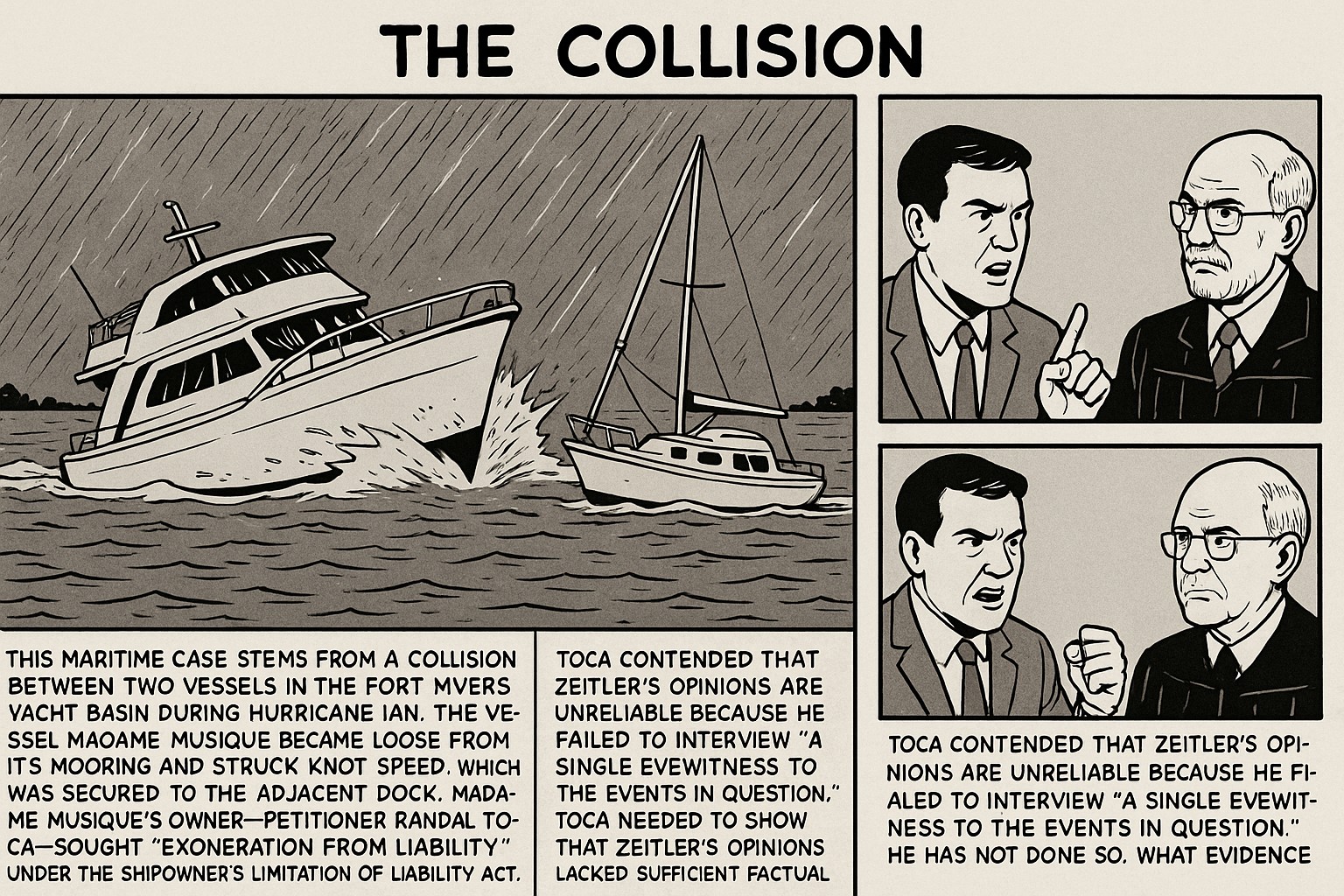
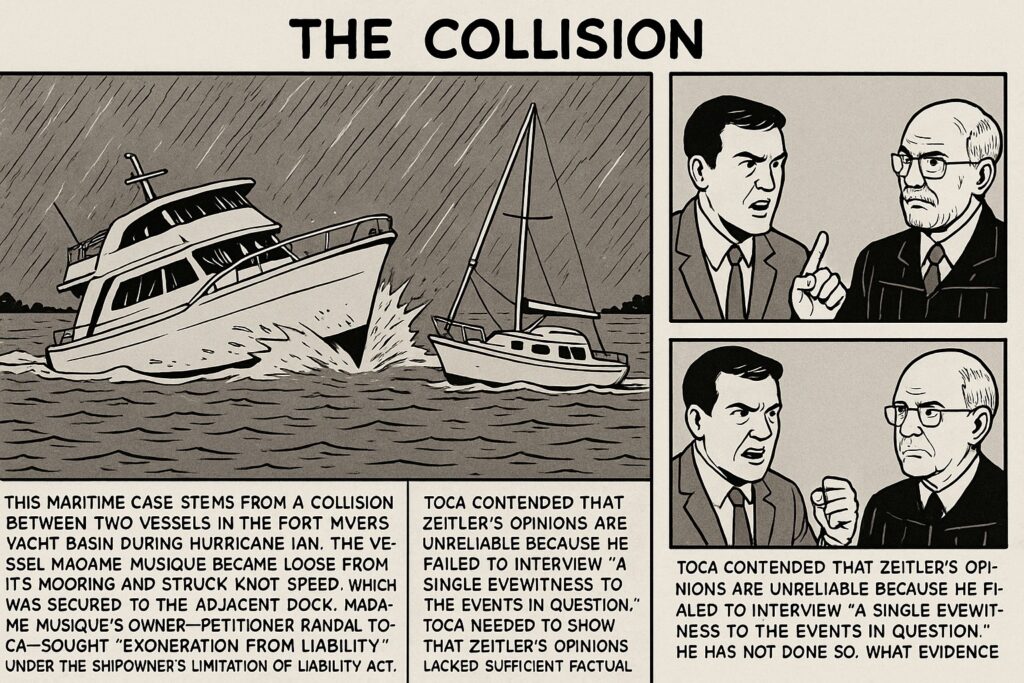
    This maritime case stems from a collision between two vessels in the Fort Myers Yacht Basin during Hurricane Ian. The vessel Madame Musique became loose from its mooring and struck Knot Speed, which was secured to the adjacent dock. Madam Musique’s owner—Petitioner Randal Toca—sought “exoneration from liability” under the Shipowner’s Limitation of Liability Act.

    Knot Speed’s owner Ted Hobson retained George M. Zeitler, a retired Coast Guardsman who spent most of his service conducting “commercial vessel safety inspections and casualty investigations.” 

    Zeitler inspected Knot Speed, the Yacht Basin, and reviewed the documentary evidence. He concluded that Madame Musique “was not adequately moored,” and as a result, it broke free from the dock, drifted across the yacht basin, and hit Knot Speed. According to him, the force of the collision, “combined with the prevailing winds and storm surge,” pressed Madame Musique against Knot Speed and caused it to “heel over” atop “multiple wood pilings,” which “penetrated [its] hull” and ultimately caused it to sink. 

    Toca filed a motion to exclude Zeitler’s testimony. Toca contended that Zeitler’s opinions are unreliable because he failed to interview “a single eyewitness to the events in question.” 

    Maritime Expert Witness

    George M. Zeitler is a graduate of the United States Coast Guard Academy. He spent twenty years in the service, primarily conducting the kinds of inspections and investigations performed here. He also spent a year “overseeing the pre-storm preparations for vessels in multiple South Florida ports.”

    Upon completing his service, Zeitler continued performing inspections and investigations as a consultant and started teaching courses on related subjects at the Chapman School of Seamanship.

    Want to know more about the challenges George Zeitler has faced? Get the full details with our Challenge Study report

    Discussion by the Court

    Toca contended that Zeitler’s opinions “lacked a sufficient factual foundation,” rendering them unreliable, since they were formed “without interviewing any individuals who were actually present when the damage to the Knot Speed occurred.”

    It is not clear to the Court that the alleged information gap exists, as Zeitler reviewed—and considered—the summaries of the opposing expert’s interviews with the relevant witnesses.

    While Zeitler perhaps should have interviewed the witnesses, the Court found that his failure to do so did not warrant excluding his testimony in this case.

    Held

    The Court denied Toca’s Daubert motion in limine to exclude the testimony of George M. Zeitler.

    Key Takeaway:

    Toca needed to show that Zeitler’s opinions lacked sufficient factual foundation. He has not done so. What evidence an expert did, or did not, consider generally affects the weight of their testimony, not its admissibility. 

    Case Details:

    Case Caption: Toca V. Debonair Properties LLC
    Docket Number: 2:23cv303
    Court Name: United States District Court, Florida Middle
    Order Date: July 28, 2025
  • Maritime Expert’s Opinion on the Preferred Engine Manufacturer is Based on Hearsay Statements

    Maritime Expert’s Opinion on the Preferred Engine Manufacturer is Based on Hearsay Statements

    This case concerns naval architecture, marine engineering, and a motor vessel called the “Pickle” or the “Pickle Rick.” Plaintiffs Intrepid Oceans Marine, LLC (“IOM”), Intracoastal Marine Fuel, LLC (“IMF”), and Intrepid Tankers, LLC (“IT”) (collectively, “Plaintiffs”) are retailers of marine petroleum in Palm Beach County, Florida. Defendant JMS Naval Architects, LLC (“Defendant”) is a licensed naval architect and marine engineering firm.

    Plaintiffs planned to own and operate a tank barge in furtherance of IOM’s marine petroleum business. On March 27, 2019, IOM contracted with Defendant to design and construct a 10,000 Gallon Double Hull Tank Barge (the “Pickle”). On June 18, 2020, IMF contracted with St. John’s Ship Building, Inc. (“SJSB”) to construct the Pickle. The Pickle was completed on or about February 21, 2022. 

    Plaintiffs alleged that after they took possession of the Pickle, they discovered significant problems with the performance of the propulsion system. 

    The Plaintiffs sued the Defendant for breach of contract and professional negligence, claiming the Defendant’s errors and omissions in naval design, engineering, and owner’s representation caused them significant financial losses.

    Defendant sought to introduce the opinions of its two experts, Captain Christopher Karentz, a senior maritime consultant, and Bryan E. Strawbridge, P.E., CFEI, CVFI, a senior mechanical engineer. Plaintiffs have moved to exclude portions of both experts’ testimony.

    Maritime Expert Witness

    Captain Christopher Karentz has over forty (40) years of experience within the marine industry, including evaluation of collisions, allisions, ship, yacht, and small vessel systems failures, human factors related to losses, and incidents involving proper or improper observance of best marine practices.

    Karentz has been qualified in both State and Federal courts to testify in areas of expertise including but not limited to marine navigation, vessel operations, crewing, management, vessel cargo, and charter operations.

    Get the full story on challenges to Captain Christopher Karentz’s expert opinions and testimony with an in-depth Challenge Study.

    Mechanical Engineering Expert Witness

    Bryan E. Strawbridge, P.E. is a senior mechanical engineer whose experience covers mechanical system failures, including marine engines and vessels; marine propulsion and auxiliary power; marine diesel engines; and more.

    Want to know more about the challenges Bryan Strawbridge has faced? Get the full details with our Challenge Study report.

    Discussion by the Court

    A. Captain Christopher Karentz

    Whether IOM selected the engines under the advice of Cox and Peterson

    Plaintiffs first moved to preclude Captain Karentz from offering his opinion that IOM selected the engines under the advice of Cox (the engine manufacturer), and Peterson Fuels.

    Captain Karentz formed this opinion from his review of email communications between the parties and from his discussions with Defendant.

    According to the Court, whether Plaintiffs selected the engines under the advice of Cox and Peterson Fuels is an issue of fact for the jury to determine after considering the evidence presented. This evidence includes the emails between Plaintiffs and Defendant. Karentz was not a party to these communications. And deciding whether these emails show that Plaintiffs selected the engines under the advice of third parties does not require specialized knowledge. 

    For these reasons, the Court held that Defendant has not met its burden to establish that allowing Captain Karentz to opine on this disputed fact would be helpful to the jury.

    Whether IOM communicated with Cox and presented Cox to JMS as its preferred engine manufacturer

    Plaintiffs moved to exclude Captain Karentz from offering his opinion that IOM communicated with Cox and presented Cox to Defendant as Plaintiffs’ preferred engine manufacturer.

    Again, however, the Court held that these statements are not expert opinions. These are findings of fact that invade the province of the jury. Captain Karentz stated at his deposition that he formed his opinion based on his impression from his discussions with Defendant. Captain Karentz’s proffered expert testimony is not based on specialized knowledge; it is based on hearsay statements from Defendant.

    The jury can weigh the trial evidence, including any admissible testimony from Defendant, to determine whether Plaintiffs communicated with Cox and whether Plaintiffs presented Cox to Defendant as the preferred engine manufacturer. 

    Whether Cox and/or SJSB had any responsibility to determine the suitability of the engines for application on the propulsion system of the Pickle

    Plaintiffs next sought to exclude Captain Karentz from opining that Cox or SJSB had any responsibility to determine the suitability of the engines for the Pickle’s propulsion system.

    In the expert report, Captain Karentz opined that “[a]s the designer and manufacturer of the subject motors, COX is the most knowledgeable entity to know if their motors were suitable.”

    Plaintiff argued that Captain Karentz’s opinion should be excluded because Captain Karentz “is not a naval architect or marine engineer” and because his opinion “is pure speculation that is contradicted by the record evidence.”

    During his testimony, Captain Karentz demonstrated his extensive expertise operating marine vessels and managing fleets; retaining and interacting with naval architects and shipbuilders; and helping to draft specifications for building and refitting vessels, as well as overseeing the related contracts.

    The Court held that Captain Karentz’s testimony on this topic is neither speculative nor unreliable because his testimony is grounded in his relevant technical and specialized experience. His testimony assisted the jury in understanding the evidence to determine a fact in issue: who—Defendant, engine manufacturer, or vessel builder—bore responsibility to ensure that the engine would work as applied on the Pickle Rick.

    The Standard of Care of JMS as a Naval Architect and Marine Engineering Firm

    Plaintiffs next sought to exclude Captain Karentz from testifying as to Defendant’s standard of care as a naval architect and marine engineering firm, and to preclude Captain Karentz from rebutting Plaintiffs’ expert’s opinion that Defendant breached the applicable standard of care in this matter.

    Plaintiff argued that Captain Karentz is unqualified to testify on this issue because he is not a naval architect or marine engineer. Plaintiff also argued that Captain Karentz did not apply “any reasonably accepted standard of care in the naval architect and marine engineering industries.”

    Based on Captain Karentz’s testimony at the hearing on this motion, the Court held that his opinions on this issue are primarily about industry norms, contractual duties, and business obligations. Captain Karentz’s testimony concerned the typical role and behavior of a naval architect and marine engineering firm in the process of designing, building, and testing a vessel—that is, whether Defendant, as the naval architect and marine engineer, bore any responsibility to ensure the engines were suitable for the Pickle Rick.

    The Court found Captain Karentz qualified to testify about Defendant’s responsibility on this issue.

    Regarding whether either party can offer expert testimony as to the legal standard of care in this matter, the Court reserved its ruling.

    Bryan E. Strawbridge, P.E., CFEI, CVFI

    Plaintiffs moved to exclude Strawbridge from offering opinions about the Cox CXO300 engines themselves, including Strawbridge’s opinion that it should have been possible to tune the engines to operate on a displacement hull such as the Pickle Rick. Plaintiffs argued that Strawbridge is not qualified to opine on these particular engines, and that Strawbridge’s opinion on the “tunability” of the engines is purely speculative.

    The Court found Strawbridge qualified when he testified at the hearing about the different ways that engines can be tuned or fitted to a vessel, such as through the engine’s software or making certain physical adjustments. Furthermore, Strawbridge spoke at length about the scientific methodology he applied—explaining, for example, how conducting sea trials results in a wealth of data for experts to review.

    That said, Strawbridge himself stated during the hearing that he did not have access to enough data to support the conclusion that it should have been possible to tune the Cox engines to operate on a displacement hull such as the Pickle Rick. Strawbridge stated that although he applied the scientific method to analyze the situation, he did not personally have prior experience assessing dual diesel outboard engines, he was not permitted to join in troubleshooting the engines, and he did not have access to data from the vessel’s sea trials.

    Without sufficient data, the conclusion that it should have been possible to tune the CXO300 engines is speculative. Because this lack of information has resulted in an unreliable methodology, the Court held that the Defendant has not met its burden of proof to establish the reliability of this expert opinion.

    Held

    The Court granted in part, denied in part and reserved in part Plaintiffs’ motion in limine to exclude certain opinions of Defendant’s experts, Captain Christopher Karentz and Bryan E. Strawbridge, P.E.

    Key Takeaway:

    While Strawbridge spoke at length about the scientific methodology he applies, he did not personally have prior experience assessing dual diesel outboard engines, he was not permitted to join in troubleshooting the engines, and he did not have access to data from the vessel’s sea trials.

    Case Details:

    Case Caption: Intrepid Oceans Marine, LLC V. JMS Naval Architects, LLC
    Docket Number: 9:22cv81964
    Court: United States District Court, Florida Southern
    Order Date: February 24, 2025
  • Claimants’ Arguments Address the Weight of the Government’s Experts’ Statements

    Claimants’ Arguments Address the Weight of the Government’s Experts’ Statements

    On March 2, 2022, President Biden instructed the Department of Justice (“DOJ”) to seize the assets of wealthy Russians as part of his administration’s response to the Russian operations in Ukraine. Specifically, the Government sought forfeiture of the M/Y Amadea, International Maritime Organization (“IMO”) No. 1012531, including all fixtures, fittings, manuals, stocks, stores, inventories, and each lifeboat, tender, and other appurtenance thereto (the “Amadea”).

    Eduard Yurievich Khudainatov commissioned the building of the Amadea in or about 2012. Khudainatov put the Amadea on the market in 2018, but due to its unique style and the Covid pandemic, it never sold. In addition, Khudainatov received and rejected offers to buy the Amadea at prices he considered too low. In a civil in rem forfeiture action, the moving party—here, the government—has the burden of proof to show why the Court should order the property sold.

    The government retained Captain Sean P. Meagher to opine on the M/Y Amadea and practices aboard the Amadea while Anders Åslund was engaged to shed light on the “the estimated historical and current net worth of Russian businessman Eduard Khudainatov and the business activities that generated his wealth.”

    Eduard Khudainatov and Millemarin Investments, Ltd. (collectively, ‘Claimants’) sought to exclude the testimony of Anders Åslund and Sean P. Meagher. Claimants put forth arguments attacking, inter alia, the experts’ qualifications, the evidentiary basis for their opinions, and the propriety and usefulness of those opinions.

    Economics Expert Witness

    Anders Åslund is a leading specialist on Eastern European economies, especially Russia and Ukraine. He was a Professor of International Economics and the founding Director of the Stockholm Institute of Transition Economics at the Stockholm School of Economics from 1989-94.

    Want to know more about the challenges Anders Åslund has faced? Get the full details with our Challenge Study report. 

    Maritime Expert Witness

    Sean P. Meagher is a managing partner of Marinus Vectors, a company founded by senior professionals in maritime, intelligence, special operations, and international industries. He attended the Naval honors school Tabor Academy, pursued his undergraduate studies at the University of Massachusetts Boston, and continued his education at Massachusetts Maritime Academy.

    Discover more cases with Sean Meagher as an expert witness by ordering his comprehensive Expert Witness Profile report.

    Discussion by the Court

    Here, Claimants asked this Court to perform its “gatekeeping role,” by excluding the Government’s experts’ testimony. However, upon careful review of Claimants’ submissions, the Court found that Claimants’ arguments go to the weight, and not the admissibility, of the Government’s experts’ statements. 

    To the extent that Claimants wish to challenge the reliability of the Government’s experts, the Court held that they may do so via, inter alia, “vigorous cross-examination” and by “presenting contrary evidence.”

    The proceeding for which Claimants sought to exclude these experts’ testimony is an evidentiary hearing to resolve the Government’s motion to strike for lack of standing. In this proceeding, the Court will be the factfinder; there is no jury. It is well established that, in such a proceeding, the trial court’s gatekeeping role is relaxed, and expert evidence should generally be admitted subject to a later finding by the Court that the evidence is not reliable under Rule 702

    At this point, however, the Court will reserve judgment on the substance of the arguments raised in Claimants’ motions in limine with respect to the Government’s experts.

    Held

    The Court denied without prejudice Claimants’ motions in limine with respect to Anders Åslund and Sean Meagher.

    Key Takeaway: 

    Disagreements over the strength of an expert’s credentials, faults in the expert’s methodology, or the “lack of textual authority” for the expert’s opinion, “go to the weight, not the admissibility, of his testimony.” Claimants make arguments of this nature in their motions in limine. And such arguments are not enough to overcome the fact that the Government’s experts’ testimony facially meets the criteria outlined in Rule 702. 

    Case Details:

    Case Caption: United States V. Amadea
    Docket Number: 1:23cv9304
    Court: United States District Court, New York Southern
    Order Date: January 15, 2025
  • Maritime Expert Witness’ Testimony About the Historic Practices of the Navy Admitted

    Maritime Expert Witness’ Testimony About the Historic Practices of the Navy Admitted

    In October 2020, Sentilles (Plaintiff) was diagnosed with mesothelioma and subsequently filed a case asserting negligence and strict liability claims against multiple defendants, including Avondale (Defendant). He claimed that his asbestos exposure from the 1950s to the 1980s caused his illness. Sentilles stated that he was personally exposed to asbestos while working at Avondale’s shipyard in 1969. He also alleged secondary exposure from his brother, Tom Sentilles. Tom’s work clothes contained asbestos while they lived and commuted together during his employment at Avondale.

    In his deposition, Sentilles testified that during May and June 1969, he worked in Avondale’s insulation shop sewing asbestos blankets for ships under construction. At that time, Avondale was building vessels under contract with the U.S. Navy, Coast Guard, and the United States Maritime Administration (MARAD), and he recalled that some of the asbestos blankets were installed on Navy ships.

    Avondale’s Compliance with Federal Inspection Standards

     Avondale was constructing vessels for the U.S. government, it raised affirmative defenses, including derivative sovereign immunity and government contractor immunity. To support these defenses, Avondale hired marine engineer and former Navy officer Herfel as an expert witness. Herfel issued two reports analyzing the specifications, policies, and knowledge of the Navy, Coast Guard, and MARAD regarding the use of asbestos materials on their ships.

    Herfel’s reports began by outlining his qualifications. He then described the case-specific evidence he reviewed, including various depositions, Sentilles’s Avondale employment records, and vessel construction contracts and specifications. He also researched records pertaining to the government ships constructed and repaired at Avondale before, during, and after Sentilles’s employment at the shipyard.

    Herfel essentially rendered two opinions. First, he opined that the government, as stated in its contracts and vessel specifications, required asbestos-containing materials to be used on its vessels, and Avondale was required to act in “strict compliance” with that requirement. Federal inspectors regularly inspected Avondale to ensure compliance. Second, Herfel explained that the government’s research on the health hazards posed by asbestos dates back to the 1940s and concluded that a private-sector shipyard, such as Avondale, could not have had greater knowledge of those hazards than the federal government.

    Maritime Expert Witness

    Christopher P. Herfel earned a Bachelor of Science degree in marine engineering, with a minor in shipyard engineering management. He served eight years as a commissioned officer in the United States Naval Reserve. He held a Coast Guard-issued third assistant engineer’s license for steam and diesel propulsion, with unlimited horsepower. Herfel worked as a shipyard superintendent, managing the repair and overhaul of various military and merchant vessels. This work included asbestos abatement projects. He later served as the president and chief executive officer of McCaffery & Associates, Inc. This company specialized in researching and analyzing Navy, Coast Guard, and other government documents related to ship design, construction, maintenance, and repair. For the past 21 years, Herfel has researched and interpreted contracts, specifications, and records concerning materials used in the construction, maintenance, and repair of federal vessels.

    Get the full story on challenges to Christopher P. Herfel’s expert opinions and testimony with an in-depth Challenge Study.  

    Discussion by the Court

    Qualifications and Methodology

    Sentilles argued that Herfel’s testimony and opinions should be excluded from trial, citing a lack of qualifications and improper methodology. He claimed that Herfel was unqualified because he was not an industrial hygienist and lacked a degree in naval or maritime history or policy. Additionally, Sentilles criticized Herfel’s methodology, arguing that he had not reviewed relevant documents about Avondale’s asbestos history, that his references to OSHA and safety standards were irrelevant, and that he had no experience interpreting contracts. Sentilles also contended that Herfel’s former status as a Navy officer might mislead the jury into believing he spoke on behalf of the government.

    In response, Avondale defended Herfel’s qualifications, emphasizing his education, work experience, and research. They stated that Herfel’s training and experience made him uniquely qualified to explain the historic policies and practices of the Navy, Coast Guard, and MARAD concerning asbestos-containing materials. Avondale clarified that it did not present Herfel as an industrial hygienist or shipyard historian. It argued that his lack of a history degree was irrelevant since his expertise stemmed from years of research and experience. Furthermore, Avondale contended that Herfel’s methodology was sound and did not require peer review because his field was not scientific. They asserted that Herfel’s testimony would help the jury understand complex government records related to shipbuilding.

    Helpfulness to the Jury

    The Court, considering both sides’ arguments and Herfel’s qualifications, ruled that he was qualified to testify. It found his opinions relevant and reliable. The Court noted that Herfel’s experience as a marine engineer and Navy officer, along with his two decades of research, made him well-suited to explain the government’s shipbuilding practices and asbestos policies. The Court concluded that Herfel’s testimony would assist the jury in understanding the government’s role in requiring asbestos on vessels. It also highlighted Avondale’s compliance and the historical information about asbestos hazards.

    Held

    The Court ordered that Sentilles’s motion in limine to exclude Christopher Herfel be denied.

    Key Takeaway:

    The Court ruled that the expert’s qualifications and the reliability of their testimony were sufficient for admissibility. It highlighted the necessity for the district court to serve as a gatekeeper. This role ensures that expert opinions assist the jury and are based on reliable methodologies. The Court noted that the factors for assessing the reliability of expert testimony, as established in precedent, should be flexible and tailored to the specifics of each case. Furthermore, the Court pointed out that challenges to an expert’s opinions should be addressed through cross-examination rather than exclusion. It emphasized the need for jurors to consider the expert’s insights alongside the arguments presented by attorneys.

    Case Details:

    Case Caption: Sentilles v. Huntington Ingalls Inc.
    Docket Number: 2:21cv958
    Court: United States District Court for the Eastern District of Louisiana
    Order Date: October 4, 2024
  • Testimony of Maritime Expert Witness Helps the Court Determine Disputed Facts

    Testimony of Maritime Expert Witness Helps the Court Determine Disputed Facts

    On May 5, 2021, Timothy Shannon allegedly sustained personal injuries while he was a passenger aboard M/V MR LLOYD. The vessel traveled from a dock in Fourchon, Louisiana to a Talos Oil & Gas LLC production platform in the Gulf of Mexico. Rodi Marine, LLC owned and operated M/V MR. LLOYD while Talos was the time charterer of the vessel pursuant to a Master Service Contract (“Talos-Rodi Contract”). Plaintiff filed a lawsuit on account of the injuries he allegedly sustained when the vessel encountered rough seas during the Voyage.

    Plaintiff hired Captain Gregg Daley to opine about the supposed legal duties that Talos owed to Plaintiff. Daley served as the marine operations and marine safety expert. Daley stated that Talos breached his duty to prevent the Rodi captain from leaving the dock considering the forecasted sea conditions were extremely rough.

    Talos moved to exclude Captain Daley’s opinions regarding Talos’
    alleged liability to Plaintiff arguing that they consisted of legal conclusions, were unreliable under Federal Rule of Evidence 702 and Daubert, and lacked factual support. The Court denied the motion to strike Daley’s opinions.

    Maritime Expert Witness

    Gregory Daley has extensive experience as a captain of oilfield offshore supply vessels spanning ten years. In addition to his practical experience, he holds a Bachelor’s and Master’s degree in Mechanical Engineering, as well as a Master’s degree in Nuclear Engineering from the Massachusetts Institute of Technology (MIT). Moreover, he has earned an MBA from Oklahoma State University.

    Discussion by the Court

    Daley submitted a 116-page Expert Report on August 11, 2023 consisting of four separate opinions. He claimed to have hands on experience with regard to similar vessels in adverse weather conditions. He assessed the vessel’s responses to various weather conditions, including the adverse conditions of this incident.

    Daley opined that the actual weather encountered by the M/V MR LLOYD during the voyage on the morning of May 5, 2021, was six-foot significant wave height seas, which produced twelve-foot maximum wave height waves approximately once per hour. He added that a speed of 20 knots was too fast for the M/V MR LLOYD to be traveling when there were six-foot significant wave heights. He argued that Rodi should have had access to the DTN WeatherOps forecasts received by Talos, which were more informative than the Advanced Logistics forecasts received by Rodi, either by direct subscription, forwarding from Talos, or by reviewing them with the Talos dispatcher prior to departure. Moreover, Talos should not have dispatched the M/V MR LLOYD into seas with a six-to-nine-foot significant wave height and a twelve-to-eighteen-foot maximum wave height.

    Daley’s Opinions Constituted Inadmissible Legal Conclusions

    Talos did not direct the Court to any portion of Daley’s report that offered a legal conclusion.

    Talos contested the foundation of Daley’s opinions concerning the supposed legal duties owed by Talos to Plaintiff which allegedly constituted legal conclusions. Plaintiff argued that Daley’s opinions are the type of testimony Federal Rule of Evidence 704 permits.

    Daley testified that Talos, as time charterer, should have prevented Captain Jordan from making this Voyage because Talos was aware of the forecasted sea conditions on May 5, 2021. Talos responded by asserting that the captain of the vessel decided whether to begin or complete a voyage, not the time charterer. The Court found the testimony of Daley was helpful to determine facts in dispute, which were:

    • Whether Talos exercised control over the timing and the means by which a crew change is accomplished
    • Whether Talos was negligent in failing to postpone the crew change or conduct the crew change via helicopter

    Daley’s Opinion Regarding Talos’ Liability Lacked Factual Basis

    Talos argued that there was no evidence to prove Daley’s assertion that Talos was liable for dispatching M/V MR. LLOYD to the GC-18 Platform. The Court rejected Talos’ argument and held that cross-examination served as an adequate safeguard against Daley’s testimony.

    Daley’s Opinions are Inadmissible Because they are Ipse Dixit

    The Court rejected Talos’ assertion that Daley’s opinions concerning Talos’ alleged duties as the time-charterer of the M/V MR LLOYD should be excluded as ipse dixit. The Court noted, however, that Talos’ Reply
    brief did not mention the phrase “ipse dixit.”

    The Court found Daley’s report to be based upon his maritime training and experience.

    Held

    The Court denied Talos Oil and Gas LLC’s Motion to Strike the Testimony of Plaintiff’s Liability Expert, Gregg Daley.

    The Court has not arrived on an outcome for this case since the remaining issues involved in this case still await resolution.

    Key Takeaways:

    1. Expertise and Experience: Expert witnesses, such as Gregg Daley, are expected to possess hands-on experience and specialized knowledge relevant to the subject matter of the case. In this instance, Daley’s expertise in maritime operations was highlighted.
    2. Opinions Based upon Assessment of Facts: Daley’s opinions were based upon his assessment of factual information, including the actual weather conditions encountered during the voyage and the appropriateness of the vessel’s speed given those conditions.
    3. Challenges to Opinions: The opposing party may challenge the admissibility or credibility of expert opinions. Talos challenged Daley’s opinions on grounds such as constituting legal conclusions, lacking factual basis, and being mere assertions (“ipse dixit“).
    4. Role of Expert Testimony in Determining Facts: Expert testimony can help the Court determine disputed facts, particularly when it comes to technical or specialized matters. Daley’s testimony assisted the Court in assessing whether Talos exercised control over certain aspects of the voyage and whether it was negligent in its actions.
    5. Cross-Examination and Safeguarding: Cross-examination serves as a mechanism for testing the credibility and reliability of expert testimony. While Talos argued against the admissibility of Daley’s opinions, the Court found that cross-examination provided an adequate safeguard against any potential shortcomings in Daley’s testimony.
    6. Basis for Opinions: Expert opinions should be grounded in the expert’s training, experience, and the available evidence. The Court found Daley’s opinions to be based upon his maritime training and experience, which bolstered their admissibility.

    Case Details:

    Case Caption: Shannon v. Rodi Marine, LLC
    Docket Number: 2:22cv1222
    Court: United States District Court, Louisiana Eastern
    Citation: 2024 U.S. Dist. LEXIS 39871
    Order Date: March 7, 2024