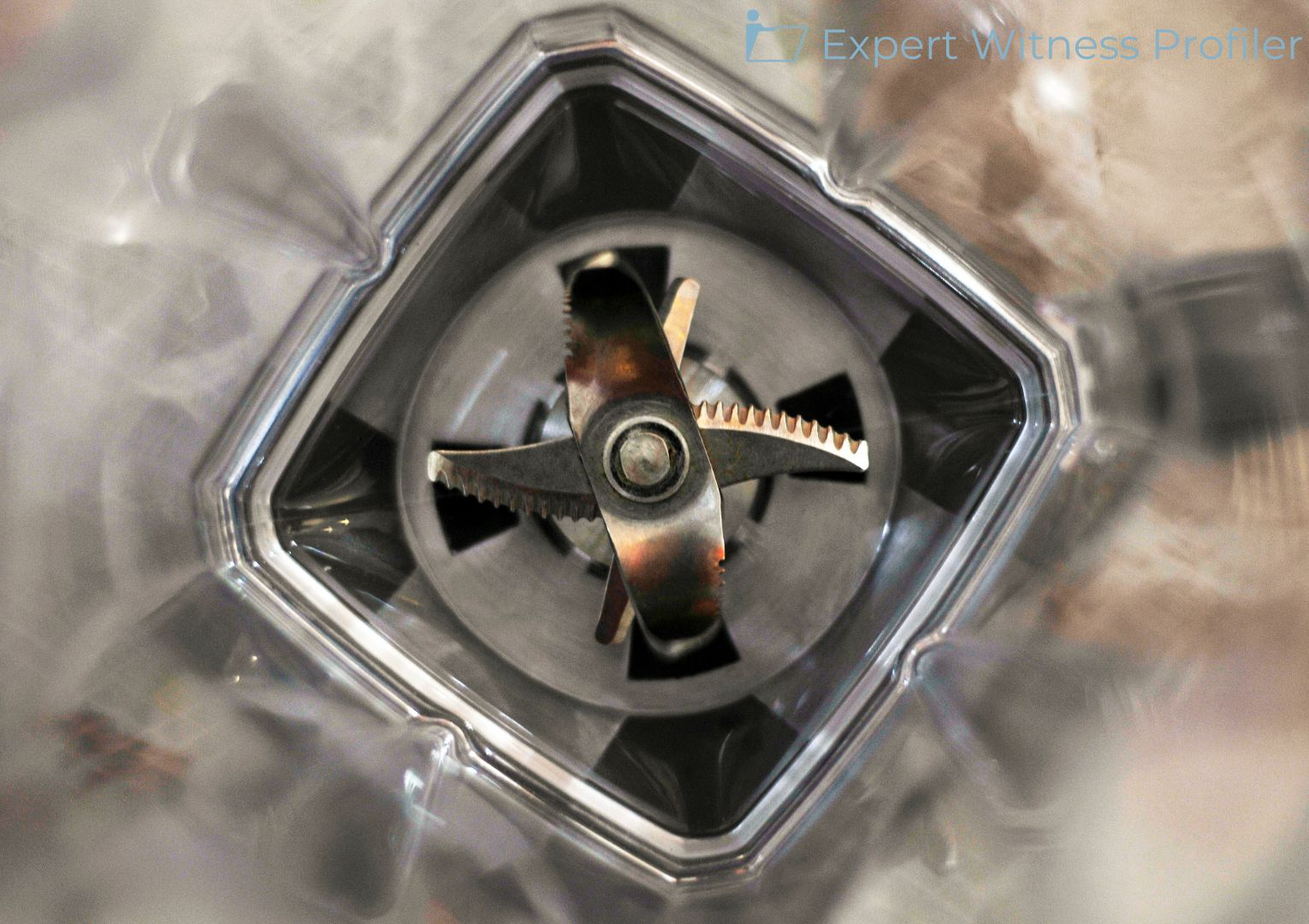
Plaintiff Lori Lynne Hoff brought a product liability claim against Defendants Capital Brands, LLC and NutriBullet, LLC under the New Jersey Products Liability Act, alleging a design defect in the NutriBullet 600 blender.
On February 17, 2020, Hoff used the blender to make celery juice, combining water and chopped celery below the max fill line. After sealing and inserting the blender cup into the power base, the unit began operating. As Hoff reached out to stop the machine around the ten-second mark, the blender exploded. The contents splashed onto her face and eyes, and she suffered a cut to her pinky finger, dizziness, and a temporary loss of vision. She later received emergency room treatment.
Hoff’s expert, Derek King, inspected the blender and concluded that over pressurization caused the cup to separate from the base. Defendants later filed a motion to exclude Hoff’s expert.
Mechanical Engineering Expert Witness
Derek A. King holds an M.S. degree in Electrical Engineering from Ohio University, and a B.S. degree in Mechanical Engineering from the University of California, Berkeley. He is also a registered professional engineer in the State of California. From 2009 to the present, he has worked as an engineer for Berkeley Engineering and Research in the areas of failure analysis, design, and risk assessment of consumer and industrial equipment, including consumer blenders.
The Court addressed Defendants’ motion to exclude Plaintiff’s expert, Derek King, under Daubert and Federal Rule of Evidence 702. Defendants argued that King’s opinions were both irrelevant and unreliable. Because Plaintiff’s design defect claim hinged on King’s expert testimony, Defendants also moved for summary judgment, asserting that without admissible expert evidence, Plaintiff could not prove causation or a feasible alternative design.
Plaintiff’s Claim Required a Reasonable Alternative Design
Under the New Jersey Products Liability Act (NJPLA), a design defect claim requires the plaintiff to show that a practical and safer alternative design existed. Plaintiffs often rely on expert testimony to establish this point. King proposed two such alternatives: an automatic timer and a pressure relief mechanism. The Court reviewed whether these opinions met the requirements of relevance and reliability under Daubert.
Automatic Timer Deemed Irrelevant
King suggested that a one-minute automatic timer could have mitigated pressure buildup in cases involving excessive run time. However, Plaintiff testified that she ran the blender for fewer than ten seconds, far below the threshold King’s design targeted. King himself acknowledged that a timer would not have been necessary in Hoff’s situation. The Court therefore found that King’s timer proposal did not “fit” the facts of the case and would not assist the jury in understanding what happened. As such, the Court ruled the timer design irrelevant.
Pressure Relief Design Found Unreliable and Unhelpful
King also proposed that a pressure relief mechanism, such as a blowout plug or pressure valve, could have prevented the incident. He based this design on general engineering knowledge and prior use of similar mechanisms in pressure cookers. However, King did not test this design in a blender or with carbonated ingredients, which were suspected to be the cause of the overpressurization. Defendants argued, and the Court agreed, that the lack of testing made the methodology weak and speculative.
Further, the Court emphasized that none of King’s identified causes of overpressurization, heat, carbonation, or prolonged blending, were clearly present in the incident. His opinion asked the jury to consider hypotheticals and possibilities beyond the scope of the actual case. The Court concluded that this opinion would confuse rather than clarify the central issues and thus failed the relevancy (fit) requirement under Daubert.
Held
The Court granted the Defendant’s motion to exclude the testimony of Derek King.
Key Takeaway:
Expert testimony must be both reliable and directly relevant to the facts of the case. In Hoff v. Capital Brands, the Court excluded Plaintiff’s expert, Derek King, finding that his proposed alternative designs, an automatic timer and a pressure relief mechanism, either didn’t apply to the incident or lacked testing to support their feasibility. Without admissible expert evidence, Plaintiff could not proceed with her design defect claim under the New Jersey Products Liability Act.
Plaintiff Deavrin Sneed (“Sneed”) filed this products liability case against Defendant Crown Equipment Corporation (“Crown”) after a workplace incident involving a Crown RC5500 Series stand-up rider forklift (the “subject forklift”).
Crown’s RC5500 stand-up, side-stance forklifts are used to move palleted materials in warehouse facilities. When operating the forklift, the driver stands sideways with their hands on the controls while leaning against a backrest. And they use their feet to operate the service brake and “power-on pedal.” The operator compartment is open (i.e., there is no door). Operators use the multi-function handle to control travel direction and speed. And they can stop the forklift by braking or using a technique called “plugging,” in which the operator pulls or pushes the multi-function handle in the opposite direction of the direction of travel to slow and stop the forklift.
Plaintiff Deavrin Sneed alleged that, while he was loading and unloading pallets with the subject forklift at a Target Distribution Center, it malfunctioned. The forklift accelerated unexpectedly at a high rate of speed, the brake mechanism failed, and Sneed crashed into a pole, resulting in severe injuries, including a partial leg amputation.
Sneed asserted the following claims against Crown:
(1) product liability – design defect
(2) product liability – manufacturing defect
(3) general negligence (including premises liability, failure to warn, improper supervision, and improper maintenance/inspection)
(4) negligent/faulty maintenance
(5) negligent/faulty repair work.
Sneed retained Dr. Jason Kerrigan and Robert Bullen as mechanical engineering expert witnesses to testify regarding purported design defects concerning the subject forklift.
Crown moved to exclude both opinions, claiming the experts were unqualified to render opinions regarding proposed design alternatives and that their opinions were unreliable.
Mechanical Engineering Expert Witnesses
Jason Kerrigan
Jason Kerrigan is the Commonwealth Professor of mechanical and aerospace engineering and the Director of University of Virginia’s Center for Applied Biomechanics (CAB).
Kerrigan’s research focuses on studying the epidemiology of public health problems related to human injury, characterizing the mechanical response of human tissues, identifying their thresholds for failure (injury), developing and improving mechanical and computational surrogates to study the risks of injury, and exploring countermeasures to mitigate human injury risk and severity.
Robert Bullen, P.E., J.D. is a licensed Professional Engineer with more than 25 years of experience in both the biomedical and mechanical engineering fields His experience includes machine design and industrial plant design, as well as experience as a manufacturing engineer in production environments. In addition to his engineering background, he also holds a Juris Doctor degree.
Kerrigan opined that the subject forklift was defective in design because of the forklift’s open operator compartment and the lack of an operator backrest sensor. He recommended that the subject forklift should be equipped with a door or enclosure and a backrest sensor for safety.
A. Kerrigan is Qualified
Crown asserted that Kerrigan has “little to no experience in the actual field of design or in the field of forklifts in general.”
It contended that Kerrigan admitted at his deposition that he “has never worked for a company that designs, builds, or manufactures stand-up rider forklifts,” “has never designed any component part of a stand-up rider forklift,” “has never published any articles that deal with forklift operation, safety, or design issues,” and “has never been responsible for making design decisions regarding the design of a stand-up rider forklift.”
Kerrigan stated that he began studying forklift designs in April of 2016 when he was retained in his first case involving a left lower extremity injury to the operator of a stand-up forklift. Since then, and over the last 8+ years, he has reviewed and studied deposition testimony, Defense and Plaintiff’s expert reports, and other materials produced during discovery in a total of 13 different civil litigation matters involving left lower extremity injuries sustained by operators of stand-up forklifts similar to the subject forklift in this matter.
Considering Kerrigan’s background and experience in engineering and mechanical design, and specifically his work concerning occupant protection and the impact of crash events in the automobile industry, the Court held that he is qualified to opine regarding the subject forklift’s design.
B. Kerrigan’s Opinions are Unreliable
Crown’s Arguments
Crown contended that Kerrigan’s opinions regarding the subject forklift’s design and specifically, the purportedly safer alternative designs that he proffers, should be excluded because they were unreliable.
Kerrigan proposed the addition of a physical enclosure or door to the operator compartment of the forklift and the inclusion of a backrest sensor.
Crown asserted that it was “fatal to Kerrigan’s proposed alternative design ‘concepts’ that he has provided nothing beyond speculation as to what type of operator compartment door or backrest sensor should be implemented on the Crown RC5500 and how they would be manufactured and implemented on the RC5500.” And he “has not and cannot provide any design details or show any reliable methodology regarding its untested and unengineered ‘concepts.’”
i) Untested and Unengineered Concepts
a)Backrest Sensor
Crown stated that Kerrigan “admitted that he has not developed any design drawings regarding where he would place a backrest sensor or what type of backrest sensor he would add to the Crown RC5500. Specifically, he testified that “I didn’t try to come up with a specific design of anything [regarding the backrest sensor].” He has not developed any prototypes or mockups, nor performed any testing whatsoever regarding his backrest sensor “concept.” In proffering his backrest sensor “concept,” Kerrigan did not apply a reliable—or indeed any—methodology as required by Daubert. Accordingly, his backrest sensor alternative design opinions must be excluded.”
b)Operator Compartment Door
Crown asserted that Kerrigan “also admitted that he has “not created any drawings of any designs [regarding compartment doors].” He further testified that he has not conducted any testing on a forklift equipped with a door. Specifically, he testified that “I haven’t done any testing of any doors at all in this scenario here.” Kerrigan further admitted that:
He has not determined the weight of the door he would add to the Crown RC5500;
He has not determined whether the door would be spring-loaded or latched; and
He has not determined the tension of the spring that would be required to keep the door shut.
Crown also pointed out that Kerrigan admitted that he had “performed no testing” for this case. Kerrigan stated that he had “not formed a specific opinion about all the factors that would need to be considered to implement design changes.”
ii) Failure to Establish Causation and Feasibility
Crown further contended that Kerrigan had not reliably established that an operator compartment door or a backrest sensor were safer alternative designs that would have prevented or significantly reduced the risk of Sneed’s injury under the specific circumstances of this accident.
In support of its contention, Crown stated that Kerrigan “admitted that he has no sketches, calculations, or measurements of the accident scene or the subject forklift and, in fact, has never even been to the accident scene. Further, he did not conduct a reconstruction of Plaintiff’s accident, nor did he even attempt to calculate the accelerations or speed of the forklift prior to the accident.”
Further, Kerrigan admitted that his backrest sensor “concept” would not have prevented Plaintiff’s injuries in this accident: “if the backrest sensor was there, I still think that some way that prevents the occupant from placing their extremities outside the running lines of the forklift while it’s moving would be required.” And regarding his operator compartment door “concept”, when asked whether, if a manufacturer added a door to a stand-up rider forklift, lower left leg injuries would still occur, he testified, “sure. Anything could happen.”
Analysis
When it became clear that Kerrigan’s advocacy for the addition of a physical door or enclosure to the operator compartment and a backrest sensor as feasible design alternatives lacked support from appropriate engineering work, product development, or testing, the Court held that his proposed alternatives were speculative concepts, insufficient to constitute an admissible expert opinion.
Also, it was noted that Kerrigan did not show that his proposed alternatives would have changed the outcome of this accident. And, while Kerrigan may have reviewed Crown’s accident data, the Court held that it is “not evidence of the alternative design’s superior safety because it did not involve similar forces and factors” as involved in Sneed’s accident.
Kerrigan has not met his obligation under Daubert to identify data supporting his opinions that an operator compartment door or a backrest sensor were feasible or that either would have changed the outcome of the incident at issue.
And, because Kerrigan has not connected his opinions to existing data, the Court agreed that Kerrigan’s proposed design alternatives are untested, based on unsupported speculation, and amount to ipse dixit.
II. Expert Robert Bullen, P.E., J.D.,
Bullen opined that the subject forklift’s design was defective and unreasonably dangerous because of the optical switch’s design for the multifunction control handle and the control module programming’s response to an event where there is an accelerator sensor error. Bullen suggested that the subject forklift should be equipped with a “more robust” optical switch and that the control module should be reprogrammed to respond to a hypothetical accelerator sensor error by automatically braking.
A. Bullen is Qualified
Crown contended that Bullen was not qualified by education or experience to render opinions regarding the subject forklift’s design.
It should be noted that Bullen’s experience has primarily concerned “biomedical engineering (both research and primary care) and consulting engineering for the design and construction of industrial manufacturing plants and code compliance issues.”
But Crown asserted that Bullen’s work has never “involved the consideration of how a forklift should be designed or how the electrical component within a forklift should be designed.” And it contended that Bullen admitted at his deposition that he “is not an electrical engineer and does not hold himself out” as one.
However, Sneed asserted that Bullen has dedicated a significant amount of time and study into Crown forklifts safety, safety design, and safety compliance.
Considering Bullen’s background and experience in engineering and work involving forklifts, the Court held that he is qualified to provide opinions regarding the subject forklift’s design.
B. Bullen’s Opinions are Unreliable
Crown’s Arguments
Crown contended that Bullen’s opinions regarding the subject forklift’s design and, specifically, the purportedly safer alternative designs that he proffers should be excluded because they were unreliable.
As discussed above, Bullen proposed incorporating a “more robust” optical switch and reprogramming the control module to respond to a hypothetical accelerator sensor error by automatically braking.
Crown asserted that it was “fatal to Bullen’s proposed alternative design ‘concepts’ that he provided nothing beyond speculation regarding whether the electrical optical switch he proposed was actually a safer design.” Additionally, “his opinion that Crown should modify the programming of the control module such that, in the event of an erroneous signal from the optical switches, the machine could be made to automatically brake, is entirely speculative because he has never installed this type of program or coding sequence in a forklift before, and never tested the ‘concept.’”
As to the “More Robust” Optical Switch
Crown stated that “Bullen admitted that he has never installed his proposed “more robust” optical switch on any forklift and tested the feasibility or application of his “concept”. In fact, he testified that he “would not recommend going through trying to redesign an entire feature around a different switch”. Most importantly, he testified that he does not even know what exactly caused the optical switch to allegedly malfunction in this accident. Bullen has not and cannot identify what the alleged “foreign body” was that allegedly caused the optical switch to malfunction. His use of the magic words “more likely than not” does not cure the purely speculative nature of that opinion. In proffering his “more robust” optical switch “concept”, Bullen does not apply reliable methodology as required by Daubert and, thus his conceptual alternative design opinion must be excluded.”
As to Reprogramming the Control Module
Crown asserted that “Bullen testified that he has not personally developed any program or revised coding to implement his proposed “concept”. He admitted that he has never implemented his proposed control module reprogramming on any stand-up rider forklift. His testimony that he has never reprogrammed any control module on a forklift, let alone a Crown RC5500, or tested any reprogrammed control module, is fatal to his proposed “concept”. Ultimately, Bullen’s optical switch and control module reprogramming “concepts” are completely speculative because he has provided no evidence that his alternative “concepts” would be safer.”
Crown further contended that Bullen did not reliably establish that a “more robust” optical switch or control module reprogramming would have prevented or significantly reduced the risk of Sneed’s injury under the specific circumstances of this accident.
Regarding Bullen’s Investigation of the Subject Accident
Crown stated that “Bullen admitted that he did not perform an accident reconstruction. He testified that he did not prepare any accident site survey. He further testifies that “the video didn’t have sufficient clarity for [him] to be able to look at specific movement. Ultimately, Bullen stated that he “didn’t feel that [the video] had enough clarity to specify any particular motion…”.
Bullen testified that he does not intend to offer any opinions regarding the specific accelerations that Plaintiff experienced during the accident sequence. He also has no opinion assessing how Plaintiff’s foot exited the operator compartment. Bullen also has no opinion regarding whether the brakes failed at the time of Plaintiff’s accident. Bullen testified that he has no opinion when Plaintiff began to “plug” or when Plaintiff first applied the service brake. He has no opinion regarding the speeds that the Crown RC5500 was traveling during the accident sequence.”
Support for Crown’s Contention that Bullen Could Not Opine on Preventing Sneed’s Injuries
In support of its contention that Bullen could not opine that his proposed design alternatives would have prevented Sneed’s injuries, Crown contended that “Bullen testified that he has not done a full analysis of whether or not the optical switch was receiving an electrical signal at the time of the accident. In trying to replicate what he believes caused the accident, Bullen performed ten tests at a post-accident inspection of the subject Crown RC5500 to determine if the signal in the optical switch was occluded or interfered with, and all ten tests showed that the optical switch signal worked properly as expected.
When asked if the type of accident Plaintiff experienced could still occur with his proposed optical switch “concept”, Bullen admitted that there is “absolutely” the potential for dust or debris buildup which could interfere with the electrical signal even if his proposed “more robust” optical switch “concept” was implemented into the subject RC5500.
He admits that even his “more robust” optical switch would not have prevented this accident as required under Texas law. Moreover, Bullen testified that he does not know what exactly caused the optical switch to allegedly malfunction. Because Bullen cannot even identify the foreign body, he has not attempted to replicate that alleged foreign body to test whether it would have made any difference in this accident sequence. Bullen’s “more robust” optical switch “concept” is completely speculative and he categorically cannot opine that this “concept” would have prevented Plaintiff’s injuries here.”
Regarding the Control Module Reprogramming Concept
Defendant also stated that regarding his control module reprogramming “concept”, “Bullen opines that the control module should be reprogrammed so that when an accelerator sensor error is displayed on the RC5500, the full brakes should be immediately engaged. But, as stated above, he has not personally developed any program or revised coding or implemented his proposed control module reprogramming on any stand-up rider forklift.”
Crown argued that “Because he has conducted no analysis of the accident sequence, Bullen cannot articulate how the accident occurred, let alone how reprogramming the control module to immediately apply full braking in response to an alleged accelerator sensor error would have prevented this accident.”
Analysis
Bullen’s opinions are unreliable for reasons similar to the reasons that the Court determined that Kerrigan’s are unreliable.
Bullen admitted that he did not install his “more robust” optical switch on an actual forklift to test its feasibility or application. And he did not implement his proposed control module reprogramming in a stand-up rider forklift.
And, so, without support (such as product development or testing) that the “more robust” optical switch or control module reprogramming would have been feasible with respect to the Crown RC5500 forklift, the Court held that Bullen’s proposals cannot be classified as safer alternative designs but are rather speculative concepts.
Moreover, Bullen also did not show that his proposed alternatives would have changed the outcome of this accident.
As Crown pointed out, he admitted that there is “absolutely” the potential for dust or debris buildup that could interfere with the electrical signal even if the “more robust” optical switch was implemented. And, because Bullen’s analysis of the sequence of events leading up to the accident is, at best, incomplete, and he cannot identify with certainty how the accident occurred, he is unable to show that reprogramming the control module to automatically brake in the event of an accelerator sensor error would have prevented it.
The Court held that Bullen’s proposed design alternatives are untested and based on unsupported speculation. And he has not met his obligation under Daubert to identify data supporting his opinions that a “more robust” optical switch or reprogramming the control module would have changed the outcome of this accident.
Held
The Court granted the Defendant Crown’s motions to exclude the proposed opinions of Plaintiff’s mechanical engineering expert witnesses, Jason Kerrigan and Robert Bullen.
Key Takeaway:
While both mechanical engineering expert witnesses, Jason Kerrigan and Robert Bullen were deemed qualified, their opinions were unreliable under the Daubert standard because their proposed design alternatives lacked the support of actual engineering work and testing.
It was not established exactly how Kerrigan’s suggested operator compartment door or backrest sensor theory, and Bullen’s proposed ‘more robust’ optical switch and control module reprogramming theories, would have changed the outcome of this accident.
Case Details:
Case caption:
Sneed V. Crown Equipment Corporation Et Al
Docket Number:
3:23cv743
Court:
United States District Court for the Northern District of Texas, Dallas Division
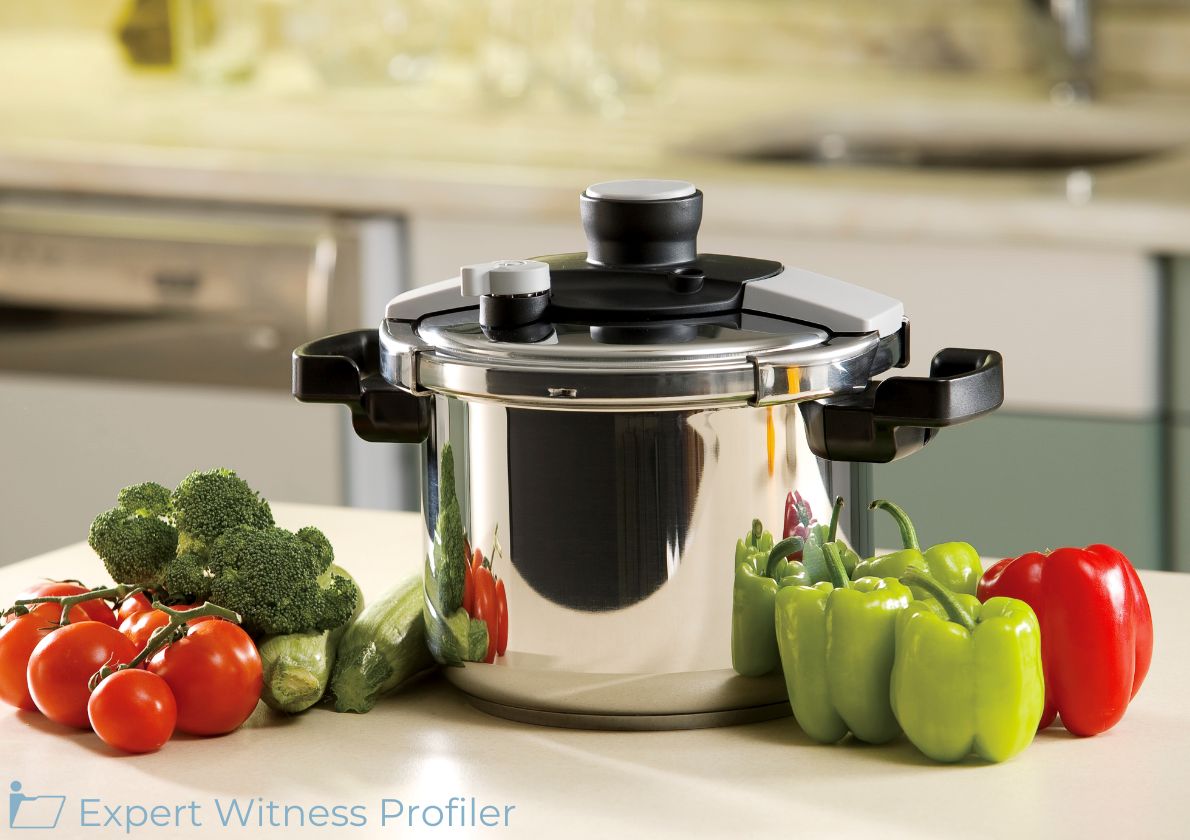
Plaintiff India Smith (“Plaintiff”) filed this product liability lawsuit against Tabletops Unlimited, Inc. d/b/a TTU’s (“TTU”) on August 1, 2022. Plaintiff sought to recover damages from an August 24, 2020 incident in which she sustained burns on her chest, upper abdomen, and legs after her Pressure Cooker ejected hot contents on her when she tried to open the device after cooking. The subject cooker was a Phillippe Richard 6-Quart Stovetop Pressure Cooker, Model Number YPC-1301, marketed, imported, distributed and sold by Defendant Tabletops.
Smith alleged that her Pressure Cooker contained a manufacturing and/or design defect that allowed the lid to be removed before the Pressure Cooker de-pressurized.
Motion to strike and exclude
Plaintiff retained Dr. David Rondinone, Ph.D., P.E. and Derek King, M.S., P.E., of Berkeley Engineering and Research (“BEAR”) in Berkeley, California. They testified that the subject pressure cooker was defectively manufactured and designed. The defective manufacture allowed for misalignment of the lid handle in a way that reduced the effectiveness of the lid interlock, part of which was incorporated into the lid handle. Moreover, the pressure cooker was also defectively designed in that it was not equipped with a baffle or screen to prevent food material in the cooker from potentially clogging the float valve for the lid interlock.
They also insisted that Tabletops’ lack of risk assessment contributed to the failure experienced during Smith’s incident.
Tabletops filed a motion to strike and exclude the testimony of both experts under Rule 702 due to the unreliability of the principles and methods of their testing that formed the basis of their opinions.
TTU also asserted that Rondinone and King’s reports should be stricken and excluded because their reports failed to meet the requirements of Federal Rule of Civil Procedure 26(a)(2)(B). In addition, TTU maintained that Rondinone and King should not be permitted to supplement their expert report or to correct their report after receiving TTU’s expert disclosures prior to the deadline for rebuttal disclosures.
Mechanical Engineering Expert Witnesses
David Rondinone holds an M.S. degree and a Ph.D. degree in Mechanical Engineering from the University of California, Berkeley, majoring in material behavior and design and minoring in structures and dynamics and electronic controls. He also holds a B.S. degree in Engineering Physics and a B.A. degree in Astrophysics from the University of California, Berkeley. From 1993 to the present, he has worked as a Mechanical Engineering Consultant, and is a principal of Berkeley Engineering And Research, Inc. (referred to herein as “BEAR”). He has worked for more than 30 years in the areas of failure analysis, design, and risk assessment of consumer and industrial equipment, including pressure cookers.
Derek King holds an M.S. degree in Electrical Engineering from Ohio University, and a B.S. degree in Mechanical Engineering from the University of California, Berkeley. He is also a registered professional engineer in the State of California. From 2009 to the present, he has worked as an engineer for Berkeley Engineering and Research in the areas of failure analysis, design, and risk assessment of consumer and industrial equipment, including pressure cookers.
Discussion by the Court
Rondinone and King’s Opinions are Admissible under 702
The Court held that both Rondinone and King are qualified engineers with experience in the analysis of pressure cookers.
The record demonstrated that Smith’s experts reviewed the subject pressure cooker and an exemplar cooker and performed testing based on their review. Having examined the record in this case, the parties’ arguments, and the controlling authorities, this Court concluded that Rondinone and King’s opinions and anticipated testimony regarding the interlock feature were admissible.
To the extent TTU claimed that Smith failed to disclose sufficient detail regarding the testing to make these opinions and the anticipated testimony admissible, the Court rejected that argument.
Further, the Court concluded that Smith’s expert opinions and testimony on clogging were reliable and relevant based on the experts’ prior experience with pressure cookers and clogging events and the facts of this case, including but not limited to Smith’s deposition testimony and TTU’s statements and warnings. TTU argued that this issue “had no relationship to causation in this matter and was merely fault finding.” The Court rejected TTU’s arguments that these opinions and this proposed testimony were irrelevant or inadmissible, given the facts of this case and TTU’s anticipated arguments regarding what it contended was Smith’s alleged “misuse of the product.” The Court also acknowledged that the parties disputed any purported misuse by Smith.
The parties disputed the facts and circumstances surrounding the issue of TTU not conducting a proper risk assessment, which is why the Court took this portion of TTU’s Daubert motion against both experts under advisement.
Plaintiff Has Met Her Disclosure And Supplementation Burdens Under The Federal Rules Of Civil Procedure
TTU contended that, if Smith’s experts relied on any information contained in Exhibits G, H, I, and M in her response to the Daubert motion, those exhibits were not identified in the expert reports. Further, TTU claimed that Smith failed to disclose her experts’ prior testing of other pressure cookers as a basis for their opinions in their reports. For these reasons, TTU sought to strike Rondinone and King’s reports and to exclude them as experts.
Smith maintained that Exhibit G was a user manual for one of TTU’s own pressure cookers and that Exhibit M was the deposition transcript of TTU’s own corporate designee from a prior case. Smith also maintained that Exhibits H and I were user manuals for other types of pressure cookers and that these documents were publicly available documents that Smith located online for use in defending against TTU’s Daubert motion.
TTU filed a separate motion to strike Exhibits G, H, I, and M from Smith’s response in opposition to TTU’s initial motion to strike which was denied by the Court.
The Court observed that Rondinone’s report stated in pertinent part under “Qualifications” that “he has worked for more than 30 years in the areas of failure analysis, design, and risk assessment of consumer and industrial equipment, including pressure cookers.” As to King, the report under “Qualifications” states that “from 2009 to the present, he has worked as an engineer. . . in the areas of failure analysis, design, and risk assessment of consumer and industrial equipment, including pressure cookers.” The Court held that Smith’s experts sufficiently disclosed their prior experience with pressure cookers as a basis for their opinions.
The Court declared that there was no requirement for a supplemental report.
Held
The Court denied, in part, and took under advisement, in part, Tabletops’ motion to strike and exclude David Rondinone and Derek King’s proposed expert opinions and testimony. The Court also denied Tabletops’ motion to strike Smith’s Exhibits G, H, I, and M to her response to Tabletops’ motion to strike and exclude David Rondinone and Derek King.
Key Takeaways:
Admissibility of Opinions under Rule 702: The Court deemed Rondinone and King’s opinions regarding the interlock feature admissible, considering their qualifications as engineers and their thorough review and testing of the subject pressure cooker.
Fulfillment of Disclosure and Supplementation Burdens: The Court ruled that Smith met her disclosure and supplementation burdens under the Federal Rules of Civil Procedure, despite TTU’s contentions regarding Rondinone and King’s reliance on certain exhibits and failure to disclose their prior testing of pressure cookers.
Reliability and Relevance of Expert Opinions on Clogging: The Court concluded that Smith’s expert opinions and testimony on clogging were reliable and relevant, based on the experts’ extensive experience with pressure cookers and clogging events.