This case concerns a motor vehicle collision that occurred between Plaintiff Bryan Russell Arnett (“Plaintiff”) and Defendant Larry Tyrone Fairell, II (“Fairell”) on December 14, 2022.
Fairell filed a motion to partially strike the testimony of Arnett’s retained transportation safety expert, David Hedgpeth.
Transportation Safety Expert Witness
David Hedgpeth is the principal owner of Hill Country Transportation Resources, LLC and has over 35 years of experience in the commercial transportation industry.
Hedgpeth has a comprehensive understanding of commercial transportation industry standards, best practices, and regulatory guidelines, and in particular, what would be considered usual and customary, with employees, commercial drivers, delivery services and company management.
Arnett designated Hedgpeth, of Hill Country Transportation Resources, LLC, in his First Supplemental Expert Designations on March 24, 2025. The designation stated that Hedgpeth “will testify about transportation safety, regulatory compliance, fleet management, commercial motor vehicle accident investigation, and industry standards of care.”
On May 06, 2025, Arnett served his Eleventh Supplemental Rule 26 Disclosures, which included Hedgpeth’s supplemental report.
The parties did not dispute that Arnett’s original designation of Hedgpeth was timely. But the Defendants took issue with the service of Hedgpeth’s supplemental report, which they asserted “addresses new topics and offers new opinions not addressed in Hedgpeth’s original report not disclosed in Plaintiff’s Designations.”
And, so, Defendants contended that Hedgpeth’s supplemental report should be stricken because it is untimely and fails to comply with Rule 26’s disclosure requirements and because the opinions contained in it are unreliable and, consequently, inadmissible under Rule 702 and Daubert.
Rule 26
Defendants argued that Hedgpeth’s supplemental report is untimely because it consisted of “new” opinions about whether speeding was a contributing factor to the incident at issue, which were not contained in his original report.
Arnett stated that the original report analyzed compliance with Federal Motor Carrier Safety Regulations (“FMCSR”) and, specifically, section 395.8(2)(i), which requires drivers to record their duty status. And the supplemental report “builds on this” by analyzing newly produced bills of lading, which “provide additional data regarding the driving hours and mileage of Defendant Fairell [and] directly relate to the original opinion about FMCSR compliance and safety concerns.”
Arnett contended that the supplemental report bolsters Hedgpeth’s original conclusions about FMCSR compliance and safety concerns but did not exceed the scope of his original report.
Based on its review of Hedgpeth’s original and supplemental reports, the Court agreed with Arnett.
Hedgpeth’s supplemental report serves to elaborate – more generally – on his original opinions about compliance with federal safety regulations. And, so, it does not depart from his original report in material respects.
As to timeliness, the documents (bills of lading) that formed the basis of Hedgpeth’s supplemental report were purportedly produced on March 12, 2025, which was before Arnett’s expert designation deadline.
Arnett asserted that Hedgpeth reviewed the materials and produced the supplement “as quickly as practicable,” which allowed Arnett to serve the supplemental report on Defendants on May 6, 2025 – ten days after the discovery deadline.
Rule 702 and Daubert
Defendants also contended that Hedgpeth’s opinions in his supplemental report are unreliable under Rule 702 and Daubert because they are facially speculative. Specifically, Defendants pointed to Hedgpeth’s statements that he “is unable to come to an accurate conclusion as to speed and hours of service” and that the “information and data is inconclusive.”
But Arnett’s response persuasively addressed Hedgpeth’s qualifications, methodologies, materials reviewed, and summary of his opinions as it relates to his supplemental report. And, so, the Court found that Hedgpeth’s supplemental report satisfied Rule 702 and Daubert and that it should not be excluded on that basis.
Held
The Court denied the Defendants’ motion to partially strike the testimony of transportation safety expert, David Hedgpeth.
Key Takeaway:
Insofar as Arnett’s supplemental disclosure fell short of Rule 26’s requirements, the Court found that such non-compliance – on considering the arguments that Arnett persuasively lays out in his response – was harmless.
Plaintiff, Luvelle James alleged that during a winter storm on January 6, 2022, his car was struck on Interstate 55 by an Aramark truck being driven by Steven Moore. As a result of this crash, Plaintiff alleged injuries to his back, neck, and head. He sought damages for past and future medical bills, past and future mental and physical pain and suffering, past and future lost wages, the loss of earning capacity, and loss of enjoyment of life.
James alleged claims of negligence (Count I), negligence per se (Count II) and negligent hiring, training and supervision against Defendants Steven Moore and Aramark Uniform & Career Apparel, LLC. He also sought punitive damages against both Defendants.
Plaintiff’s expert Michael Connelly testified that Defendant Moore failed to meet industry standards of care for a commercial driver in his operation of the Aramark truck on the day of the accident. Second, that Defendant Aramark failed to meet industry standards of care for a motor carrier with respect to Aramark’s training, supervision, and monitoring practices over its employee, Steven Moore. Defendants filed a motion to exclude Connelly’s testimony.
Transportation Safety Expert Witness
Michael Connelly is the president of Transhield, Inc. He and the Company specialize in providing third party safety and compliance solutions to transportation, distribution, and logistics companies nationwide.
A graduate of Clemson University, Connelly has been in the transportation industry for over 20 years. A licensed CDL driver, he has served many operational roles in both the Truckload and LTL industry sectors. Upon entering the field of transportation safety, he quickly rose to the top of an industry leading fleet in Western Maryland.
Defendants did not challenge Connelly’s qualifications. Instead, Defendants argued that Connelly’s opinions were not based on sufficient facts to be reliable and helpful to the jury.
Failure to Consider Deposition Testimony
First, Defendants contended that Connelly’s opinions were unreliable because Connelly did not consider or even review the testimony of Plaintiff James, and that Connelly therefore inaccurately stated that the road conditions were disputed at the time of the accident. Defendants maintained that James admitted the road was not snow-covered until he stopped on the interstate immediately before the accident. Similarly, Defendants pointed out, Defendant Moore testified there was no snow or ice on the road until just before the accident.
Both parties therefore appeared to agree that there was no snow on the roadway until just before the accident; however, what they mean by those statements could be different. Plaintiff James’s actual testimony is that “when I got to the major incident and stopped the car, the road was snow covered because there wasn’t – wasn’t nothing moving.”
Defendants also asserted that Connelly improperly relied on a Missouri Highway Patrol officer’s testimony regarding the severity of the road conditions. Defendants argued that the officer could not have known the road conditions at the time of the accident because he did not arrive at the scene until sometime later.
Because Connelly based his opinions on this allegedly incomplete or misleading information, Defendants said that his testimony should be excluded. However, the Court held that Connelly’s opinion was not fundamentally unsupported and that the Defendants’ concerns about any “cherry-picked” facts may be addressed through cross-examination.
Other Accidents on the Interstate
Next, Connelly’s opinion stated that Defendant Moore would have passed at least four accidents prior to the collision with Plaintiff.
However, Connelly admitted he was mistaken, and the four accidents to which he referred actually happened after the parties’ collision.
The Court held that Connelly may therefore not testify as to the existence of the four accidents.
Opinion Regarding when to Slow Vehicle
Next, Defendants addressed Connelly’s opinion that Defendant Moore waited too long to slow his vehicle. Defendants complained that Connelly improperly “assumed that Moore encountered hazardous weather conditions well before” the time and location of the accident. Defendants quibble again with the testimony from the Plaintiff, Defendant, and the highway patrol officer. Again, as with the question of when the roads became snow-covered, the Court held that the factual basis for Connelly’s opinion was subject to cross-examination.
Citation for driving too fast
Defendant objected to Connelly’s report stating that Defendant Moore was ‘cited’ for driving too fast. Connelly now admits that Defendant Moore received no citation or ‘ticket’ for driving too fast for conditions. The Court held that Connelly may not testify that such a citation exists.
Held
The Court granted in part and denied in part the Defendants’ motion to exclude the testimony of Michael Connelly.
Key Takeaway:
Because Connelly’s opinion is not fundamentally unsupported, Defendants’ concerns about any “cherry-picked” facts may be addressed through cross-examination. After all, the factual basis of an expert opinion goes to the credibility of the testimony, not the admissibility, and it is up to the opposing party to examine the factual basis for the opinion in cross-examination.
James E. Lewis, a seasoned transportation safety expert, faced an unfortunate twist in his professional journey. Despite his extensive experience and deep insight into the trucking industry, he found himself disqualified from providing testimony in a significant personal injury case—not due to his lack of expertise, but because of an unnoticed procedural misstep. In the case of Rodney Bibbs v. Molson Coors, Lewis had been retained to testify on the safety of load securement, a critical factor in the accident. However, after the Plaintiff’s attorney withdrew, a motion was filed to strike Lewis’ testimony, a motion he was unaware of.
The case that led to James E. Lewis’ disqualification stemmed from a tragic tractor-trailer accident involving Rodney Bibbs, an independent contractor truck driver. Bibbs had been hired to transport a pre-loaded trailer of beer from Molson Coors’ Shenandoah Brewery in Virginia to a distributor in Ohio. During his journey, while driving through West Virginia, the load allegedly shifted, causing Bibbs to lose control of the truck, leading to a serious accident. Bibbs claimed that the load had been improperly packed and secured by Molson Coors, resulting in his injuries and significant damage to the truck.
In the aftermath, Bibbs filed a lawsuit against Molson Coors, alleging negligence in the packing and loading of the beer pallets. Central to his case was the assertion that the company had failed to properly secure the load, which led to the accident. With load securement being a key factor, the Plaintiff needed expert testimony to substantiate these claims. That’s where James E. Lewis, a transportation safety expert with experience in Department of Transportation (DOT) compliance, was brought in to serve as the Plaintiff’s sole liability expert.
Initially, Lewis was disclosed as an expert under Federal Rules of Civil Procedure 26(a)(2), allowing Bibbs to put forth expert testimony about the alleged improper load securement. However, procedural delays in the case, coupled with the withdrawal of Bibbs’ legal counsel, resulted in Lewis being unaware of Molson Coors’ motion to exclude his testimony. Despite his extensive experience and background in transportation safety, Lewis’ testimony was challenged on the grounds that his qualifications and methodology did not align with the specific issue of load packing at a brewery. Unopposed due to the procedural lapse, Molson Coors successfully argued for the exclusion of Lewis’ testimony.
The Disqualification: A Procedural Setback
James E. Lewis’ disqualification from the Bibbs v. Molson Coors case was not due to a lack of expertise, but rather the result of unfortunate procedural circumstances. After the Plaintiff’s attorney withdrew from the case, a motion was filed by Molson Coors to exclude Lewis’ testimony. Due to the absence of opposition—because the attorney had left the case and the pro se Plaintiff did not respond to the motion, the Court had little choice but to strike his testimony.
Lewis concluded that—based on his industry experience—Defendant’s workers poorly wrapped the pallets of beer at issue, negligently loaded Plaintiff’s trailer, and therefore “increaseed the probability and magnitude of the potential harm to the victim of the crash.”
Although Lewis had significant experience in transportation safety and held a master’s degree in education, Molson Coors argued that his subjective industry experience could not be the sole basis for his conclusion.
The Court subsequently granted summary judgment in favor of Molson Coors, dismissing the case with prejudice.
Lewis discovered his exclusion not through the Court or the attorney directly, but from another opposing counsel who asked him about it after reading our blog. Our blog post detailed the Court’s decision to strike his testimony and highlighted the reasons behind it. Realizing what had happened, Lewis was able to spring into action.
The Motion for Reconsideration: A Step Toward Vindication
James E. Lewis filed a motion for reconsideration, seeking to correct the Court’s prior ruling. This was his chance to clarify the situation and ensure that the Court recognized his expertise, despite the unfortunate circumstances surrounding the motion to strike.
In his motion, Lewis argued that his testimony should not have been excluded, particularly because the disqualification had nothing to do with the merits of his qualifications. Instead, it was the result of a procedural misstep.
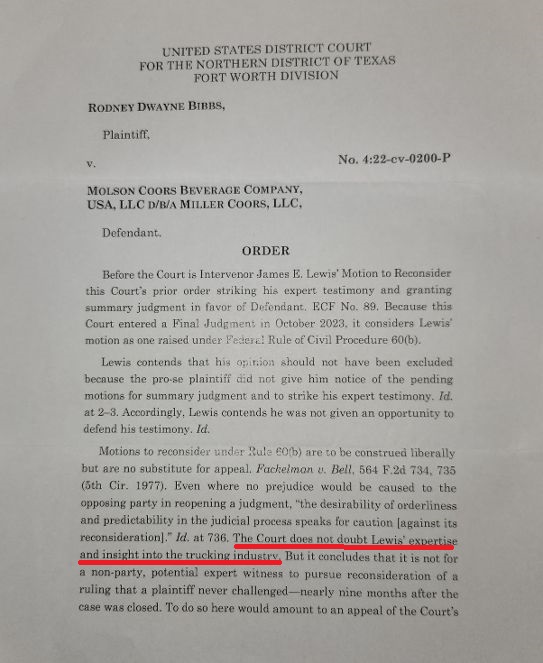
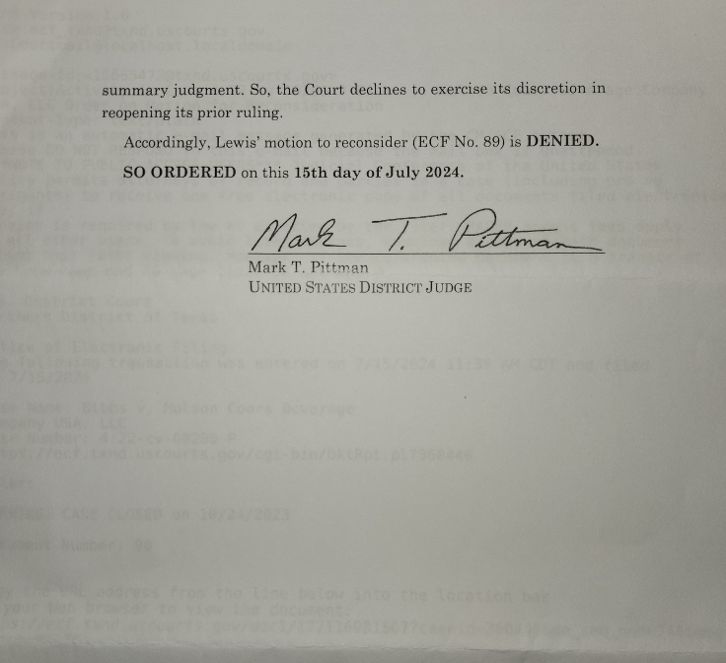
The Court, in its response, acknowledged Lewis’ expertise and insight into the trucking industry. Judge Pittman specifically stated that the Court did not doubt Lewis’ qualifications. This was an important moment of vindication for Lewis, as it confirmed that his exclusion was not due to any shortcomings in his professional abilities.
However, the judge ultimately denied the motion to reconsider, noting that nearly nine months had passed since the case was closed. Despite the Court’s recognition of Lewis’ expertise, the procedural rules did not allow for the case to be reopened. Nevertheless, the written acknowledgment from the Court provided a crucial document that cleared Lewis’ name, proving that the exclusion was not a reflection of his professional capabilities.
While Lewis was unable to reverse the ruling, his effort ensured that his reputation remained intact, and the Court’s clarification helped to restore his professional standing.
Lessons for Expert Witnesses: Why Tracking Your Cases Matters
James E. Lewis’ experience serves as a cautionary tale for expert witnesses everywhere. His disqualification didn’t come from a lack of knowledge or expertise, but from a procedural error that could have been avoided if he had been aware of the motion in time. This incident highlights the critical importance of tracking the cases you’re involved in, even after you’ve submitted your expert report or given your testimony.
Many experts think their role ends after they provide testimony or submit their report, but cases are living processes. Motions are filed, decisions are made, and developments happen, sometimes months after the expert has been retained. Keeping a close eye on these developments is vital to protecting your reputation and ensuring your involvement doesn’t get lost in the shuffle.
So, what can experts do to stay on top of their cases? Regular communication with the legal team is a start, but it’s also important to set up alerts or follow case-monitoring tools. And of course, keeping an eye on industry blogs like ours can provide key updates that you might not get elsewhere. Staying informed ensures that you remain an active participant in your cases, even when things seem quiet.
This case stems from a very minor rear-end motor vehicle accident on March 26, 2021, which resulted in slight bumper damage to Plaintiffs’ truck. Defendant Ryan Transport employed Defendant Cummings and was under dispatch for Defendant Lenk Express at the time of the subject accident.
To begin with, Plaintiffs retained and identified Linda Day to testify, in essence, that Defendant Cummings did not follow trucking industry standards in the operation of his vehicle and that Defendants Lenk Express and Ryan Transport did not follow trucking industry standards in their training of Defendant Cummings.
Linda Day has been involved in various aspects of the transportation and warehousing industry since 1984. She has a master’s degree in Organizational Management with a specialization in Leadership. She has 30 years of experience working in various positions within the transportation industry.
First, the Court held that a jury does not need to be told by an expert witness that a driver should look for traffic or not follow too closely and jurors do not need an expert to tell them that by failing to stop and rear-ending the Plaintiffs that Defendant Cummins was not observing the standard of care required by the driver of a motor vehicle on Georgia’s public road.
Second, the Court added that her opinions consist of abstract propositions applicable to any accident but just not applicable to the particular facts of this case other than the fact that the accident happened, which is undisputed. Her opinions rely solely on the information contained in the police report for the subject accident. She has no opinions on the particular facts involved in the subject accident or why Defendant Cummings failed to stop.
Held
The Court granted Defendants’ motion to exclude the opinions of Plaintiffs’ expert Linda Day under Federal Rule of Evidence 702.
Key Takeaway:
The Court found that Linda Day’s opinions consisted of abstract propositions and were based on facts contained in the police report for the subject accident.
A district judge in Pennsylvania limited the Transportation Safety Expert’s testimony about the Defendant’s failure to review safety and compliance data.
Defendant Gateway Freight Systems, Inc., on behalf of Defendant Tempel Steel, retained Defendant Foxway Transportation, Inc. to transport a shipment of Tempel’s product from Tempel’s Canadian location to two locations in Pennsylvania.
On October 20, 2019, Darlene L. Allen was driving her Mitsubishi Mirage on SR-17 in Tioga County, New York, when she hit a deer. At the time of the accident, Allen had her minor children T.G.A. and Z.D.A. as passengers in the rear seats. Volodymyr Frolyak, an employee of Foxway driving a Foxway-owned Freightliner, was traveling behind Allen and collided with her Mitsubishi. As a result of these accidents, Allen’s children, T.G.A. and Z.D.A. tragically lost their lives.
Plaintiff Robert C. Allen, co-administrator of the estates of T.G.A and Z.D.A, disclosed Kenneth Lacey for the first time attempting to support his partial motion for summary judgment concerning claims of direct negligence, including negligent entrustment, against Gateway.
According to the Report, Plaintiff engaged Lacey to specifically determine the following:
Did Foxway’s programs comply with both Federal and State regulations and were otherwise consistent with the transportation industry safety, operational, and compliance program and practice standards
If the motor carriers’ programs safety, compliance programs were deficient did these failures contribute, or otherwise directly result in this crash
Did Gateway fail to properly screen, entrust and supervise any party moving product on its behalf
Where there were failures by Gateway to properly screen and supervise motor carriers’ and did these failures contribute, or otherwise directly result in this crash
Defendant Gateway filed a motion to exclude Kenneth Lacey’s opinion as per the grounds of Rule 702 and the Daubert standard.
Transportation Safety Expert Witness
Kenneth Lacey is a safety and operational consultant at KJL Safety and Claims Services LLC, Collegeville, PA.
As a safety consultant, his job entails working with transportation companies of varying degrees of sizes having commercial motor vehicles operating on highways within the United States and Canada, to establish and improve their safety programs and overall safety performance.
He had been retained in this case as a transportation safety expert witness to use his education, experience, and expertise with Motor Carriers, Transportation Brokerage, and Transportation Logistics operations and services, his previous experience as the person responsible for negotiating and education, experience, and expertise with the application of the Federal Motor Carrier Safety Regulations (“FMCSRs”), Uniform Commercial Drivers Manual (“UCDM”) and Safe Commercial Motor Vehicle Operations.
Kenneth Lacey criticized Gateway for neglecting to ensure Foxway’s compliance with safety regulations. He pointed out that Gateway didn’t conduct adequate checks on Foxway’s safety record, including crashes and violations. Despite entrusting Foxway with numerous shipments, Gateway didn’t follow customary vetting procedures. Lacey highlighted that Frolyak, the driver, had previous speeding violations unknown to Gateway. He faulted Gateway for not utilizing monitoring services like Carrier 411, which could have alerted them to to crashes, moving violations, and disqualified driver violations involving Foxway. Lacey recommended Gateway should have implemented a corrective plan or terminated Foxway’s services due to their history of crashes and violations. He concluded that Gateway’s failure to review safety and compliance data directly caused the crash.
A. Qualification
Defendant Gateway argued that Lacey lacked the qualifications to testify on liability, causation, or negligence, especially regarding brokers.
The Court held that Lacey’s background as a safety and operational consultant in both motor carriers and brokerages qualified him. The Court asserted that Lacey’s broader experience in the transportation industry met the Third Circuit’s criteria for expertise. Gateway’s argument was that extensive experience in the transportation industry regarding driver safety, training, and compliance initiatives was insufficient unless Lacey had worked with brokers specifically. Put into the context of the facts of this case, an individual in such a role at Foxway, a motor carrier, would necessarily have experience regarding the practices and customs of Gateway, a broker, in the selection of motor carriers.
B. Reliability
Gateway argued that Lacey, despite possessing requisite qualifications, offered opinions which were unclear, conclusory, speculative, and unreliable, thereby warranting exclusion.
In his report, Lacey refrained from determining whether specific safety rules were violated in causing the crash, a point Gateway emphasized as a flaw in his methodology. Allen countered that Lacey’s expertise in brokerage industry standards justified his testimony, even without identifying statutory violations. The Court acknowledged the relevance of industry practices in determining negligence standards but upheld the requirement to avoid interpreting statutes.
However, the Court shared Gateway’s concern about Lacey’s methodology, considering the disconnect between Lacey’s methodology—which included identifying violations—and his conclusion—which did not mention any such violations—rendered those conclusions unreliable. For instance, Lacey suggested that Foxway “likely had to reduce its insurance due to being denied loads from shippers actually checking Foxway’s safety rating and refusing to use them.” The Court held that there was nothing in Lacey’s report to support this logical leap. Moreover, Lacey did not explain why, even if Gateway had been more closely monitoring Foxway, it would have been inappropriate for Gateway to continue to retain Foxway to deliver shipments. Lacey did not offer any context for any of the prior Foxway violations or accidents.
Ultimately, the Court found that Lacey’s report lacked specificity and failed to demonstrate how Gateway’s actions directly caused the crash.
C. Fit
Gateway argued that Lacey’s opinion should be excluded because it is unduly prejudicial and not tied to the facts of the case.
The Court focused on the only possibly admissible opinion from Lacey, which stated that it is consistent with industry standards for brokers to continually monitor the safety records of motor carriers. The Court found that Lacey’s opinion that it is common practice in the transportation industry to continually monitor safety records using third-party vendors, safety scores, and other sources is plainly relevant, and helpful to a jury tasked with determining what Gateway should have known about Foxway’s safety record.
Held:
The Court granted Gateway’s motion to exclude Kenneth Lacey, except as to his opinion that industry standards imposed upon Gateway a continuing obligation to conduct ongoing “safety and compliance data reviews.”
Key Takeaway:
Defendant’s motion to exclude Lacey was partially granted, allowing his testimony only with regard to the industry standard of ongoing safety and compliance reviews, which was deemed crucial for assessing Gateway’s obligations regarding Foxway’s safety record. Thus, while recognizing Lacey’s qualifications, the Court concluded that his broader assertions lacked the necessary specificity and evidentiary support to be admissible in their entirety
Case Details:
Case Caption:
Allen V. Foxway Transportation, Inc. Et Al
Docket Number:
4:21cv156
Court:
United States District Court, Pennsylvania Middle (Williamsport)
In a recent update, the Court has vindicated James E. Lewis by noting that it did not doubt Lewis’ experience and insights into the trucking industry. Read our updated coverage here:
In response to our coverage of this court opinion, we received the following response from James Lewis, the expert witness referenced in this case. Given the unusual circumstances of this challenge, we believe it is important to put forth the expert’s perspective.
The motion was filed after Plaintiff’s counsel had withdrawn from the case. James Lewis was unaware of the motion and it therefore went unchallenged. The disqualification was not on the merits, it was simply unopposed and he is working to have it reconsidered. When the judge was contacted about this matter, he specifically responded that “The Court does not doubt Lewis’ expertise and insight into the trucking industry.”
This case arises from a tractor-trailer truck accident in which the Plaintiff Rodney Bibbs, an independent contractor truck driver, was injured when the load in his trailer allegedly shifted, causing him to lose control and overturn his truck. Bibbs was hired to transport a pre-loaded trailer of packaged beer from the defendant Molson Coors’ brewery in Virginia to Ohio. While passing through West Virginia, Bibbs claims the load suddenly shifted, causing the accident and his injuries. After initially failing to timely disclose any liability expert to support his claims, the Court allowed the Plaintiff to disclose a single liability expert, James E. Lewis, under Federal Rules of Civil Procedure 26(a)2.
Bibbs sued Molson Coors for negligence in packing and loading the beer pallets onto the trailer, alleging this caused the load shift and subsequent accident. Molson Coors filed a motion for summary judgment.
In the legal matter at hand, the Plaintiff is a commercial truck driver who worked as an independent contractor for a trucking company named High Horse Logistics. High Horse Logistics was hired by J.B. Hunt, a well-known freight and logistics company, to transport a pre-loaded trailer of packaged beer. The journey began at Molson Coors’ Shenandoah Brewery, which is located in Elkton, Virginia, with the destination being a beer distributor located north of Columbus, Ohio. The date of the incident was May 19, 2020. The truck driver in question, Bibbs, had embarked on this particular transportation task.
While in transit, and specifically while passing through Ritchie County, West Virginia, on a four-lane divided highway, an unfortunate event occurred. The trailer’s beer load, which Bibbs was responsible for transporting, allegedly shifted spontaneously. This shift in the load led to Bibbs losing control of the truck and trailer, ultimately resulting in the truck and trailer overturning in the highway’s median. Consequently, this accident led to Bibbs claiming that he sustained multiple injuries as a result of the incident and the record does not indicate the number of libations tragically lost.
Defendant, Molson Coors, filed a motion to exclude the testimony of the Plaintiff’s liability expert witness, James E. Lewis. Molson Coors raised objections to Lewis’ qualifications, methodology, and the reliability of his opinions. Molson Coors argued that Lewis was not sufficiently qualified to offer expert opinions in the relevant fields.
Transportation Safety Expert Witness
James E. Lewis holds a Masters of Education degree with a specialty in Curriculum Development from the University of Maryland as well as a Bachelors of Applied Science in Criminal Justice and a Bachelors of Applied Medical Science in Psychology/Sociology, also from the University of Maryland. He is currently employed as a Transportation Safety Expert for Evidence Solutions, Inc. He also works as the owner of Total Transportation Training, providing training and consulting services related to Department of Transportation (DOT) compliance and safety standards in the trucking and towing industries.
Discussions by the Court
The Court first set forth the legal standard for admitting expert testimony under Federal Rule of Evidence 702. Experts may testify if their knowledge will help the trier of fact, the testimony is based on sufficient facts, it is the product of reliable methods, and those methods were reliably applied to the facts. Proffered expert opinions that fail to meet this standard are inadmissible under Daubert. Courts have broad discretion to determine if the facts relied upon by an expert are sufficient to support their opinion. While experts have latitude, the existence of sufficient facts and a reliable methodology are mandatory for admissibility. A key factor in assessing reliability is whether the methodology can be tested or subjected to peer review. But credentials and subjective opinion alone, without more, are insufficient for admissibility, as was held in Viterbo v. Dow Chemical Company.
Turning to Lewis’ testimony, the Court noted his conclusion that Molson Coors was negligent in packing the pallets, causing the load shift and Bibbs’ accident. To support this, Lewis cited an interview with Bibbs, impressions from Molson Coors’ counsel, personal anecdote, and his review of some photos.
Molson Coors argued that Lewis was not sufficiently qualified to offer expert opinions in the relevant fields. Despite Lewis’ self-identification as a “Transportation Safety Expert,” Molson Coors contended that his educational and professional background did not align with the specific subject matter of the case. Lewis held degrees in psychology/sociology, criminal justice, and a Master of Education with a specialty in curriculum development. Importantly, Lewis had no experience teaching courses or holding professorial positions in cargo loading, accident reconstruction, or related fields. He is also not an accident reconstructionist and had no engineering or similar background.
Molson Coors highlighted that Lewis had never worked for a brewer, had no experience loading or securing products at a brewery, and had no relevant degrees or certifications. Additionally, Lewis had never testified as a packaging, cargo loading, or accident reconstruction expert in any prior case. Molson Coors emphasized that the case in question was concerned with Lewis’ first-hand involvement, or lack thereof, of offering expert opinions related to load securement, loading methodology, and the role of cargo in a tractor-trailer accident. All of these factors called into question Lewis’s qualifications to provide expert testimony in this case.
The Court inferred that Lewis’ expert report can be characterized as no more than a highly informed opinion. While Lewis’ industry experience makes him an “expert” in the colloquial sense, he did not demonstrate the reliable methodology required to be considered an expert under Rule 702. Without evidence that Lewis used a reliable methodology, rather than just his credentials and subjective opinion, he could not be qualified as an expert witness.
Bibbs’ liability expert, James E. Lewis, had opined that Molson Coors poorly wrapped and secured the beer load without pallets and had prohibited Bibbs from checking the load securement on the loaded trailer, which he believed caused Bibbs’ accident. He did not deny that pallets were wrapped but contended that they were wrapped improperly and failed to provide any specific criteria for adequate pallet wrapping. Additionally, he lacked knowledge about the type of wrap Molson used or their typical pallet-wrapping methods for this case.
Regarding the absence of pallets, Lewis had surmised, based on a single photograph, that Molson did not use pallets, without having any context or details about the photograph. This opinion contradicted the information on the bill of lading, which had indicated that the beer was loaded on pallets.
Lewis’ opinion about Molson prohibiting Bibbs from checking the load was also noted. However, he did not provide any details about what Bibbs would have done differently or whether such an action would have made any difference in preventing the accident.
Lewis conducted an interview with the Plaintiff, Bibbs, during which he did not record notes or create a verifiable record. This interview forms a significant basis for his opinions. However, Lewis was unaware of Bibbs’ contradictory deposition testimony, and his failure to consider this sworn testimony raises questions about the reliability of his methodology.
During the Defendant’s deposition, Lewis revealed several key points about his involvement in the case. First, he acknowledged that he was unaware of any formal standards that could guide shippers in selecting suitable pallet wrapping and had not assessed whether such standards existed. Additionally, he stated that he did not physically inspect the vehicle or the crash site related to the accident. Lewis also emphasized that the only photos he analyzed were those provided to him, and he did not conduct any independent investigation or testing of items relevant to the case, including the tractor-trailer involved in the accident. Furthermore, he confirmed that he had never conducted any form of accident reconstruction to identify potential causes of the accident. His conclusion that the wrapping was faulty was solely based on examining the pallets after the accident and reviewing the photos provided to him.
The Defendant argued that Lewis’ opinions have not been subjected to any independent testing or validation. Without conducting any accident reconstruction, testing, or analysis in this case, Lewis’ conclusions are deemed to be unsupported speculation. His opinions are not grounded in the scientific or analytical rigor that characterizes expert testimony in relevant fields.
Because Lewis could not be qualified as an expert witness, his testimony—insofar as it is offered as expert testimony—was held to be inadmissible by the Court.
Held
The Court granted Molson Coors’ motion to strike Lewis as an expert witness. Without the necessary expert testimony, Bibbs could not maintain his negligence claim, entitling Molson Coors to summary judgment as a matter of law. The Court granted Molson Coors’ motion for summary judgment and subsequently dismissed the case with prejudice.
Key Takeaways
This case illustrates several important requirements for expert witness testimony to be admissible under Rule 702 and Daubert. First, extensive credentials and subjective opinion alone are insufficient – the expert must employ a reliable, testable methodology applied to the facts of the case. Second, the expert cannot simply rely on limited facts like interviews and documents provided by counsel. Independent testing, investigation, and evaluation of the evidence is required. Third, the expert must actually inspect and analyze the physical evidence firsthand if possible, rather than just reviewing photos and summaries. Fourth, the expert must rule out alternative causes and engage in some accident reconstruction or testing of their theories – speculative subjective opinions are inadequate. Finally, the expert must be able to identify standards or research in their field supporting their conclusions. In summary, admissibility requires the expert use an objective, verifiable methodology on sufficient facts, not merely credentials and subjective impressions.