Blog

  • Florida Court admits construction expert’s testimony assessing negligence claims in personal injury action 

    Florida Court admits construction expert’s testimony assessing negligence claims in personal injury action 

    Image depicting a construction site cap of workers, representing the context of the expert testimony in the construction industry

    Expert Testimony on Workers’ Compensation Insurance Practices

    Plaintiff Dennis Scott initiated a personal injury lawsuit against Defendant Paychex Insurance Agency, Inc. The case revolves around a Certificate of Insurance (COI) that Paychex Insurance Agency issued to James A. Jones, a general contractor. The situation arose in connection with a construction project for which Jones engaged Central Florida Siding Pros, LLC (CFSP) as a subcontractor.

    Jones required proof of workers’ compensation insurance from subcontractors, and CFSP obtained its policy through Paychex Insurance Agency, with a coverage period of April 29, 2017, to April 29, 2018.

    On February 6, 2018, the Paychex Insurance Agency issued the COI to Jones, stating CFSP’s coverage period as April 29, 2017, to April 29, 2018. However, at this time, CFSP’s workers’ compensation insurance policy was facing potential jeopardy due to non-payment of premiums.

    Paychex Insurance Agency had an obligation to notify NorGuard, the insurer, if CFSP failed to pay premiums, which could lead to the loss or non-renewal of coverage. Paychex Insurance Agency knew that notifying NorGuard of CFSP’s noncompliance might result in the policy’s cancellation. 

    By January 16, 2018, CFSP had not paid premiums, and on January 23, 2018, Paychex Insurance Agency informed NorGuard of CFSP’s noncompliance. Subsequently, on January 24, 2018, NorGuard issued a Notice of Cancellation, with the policy set to expire on February 10, 2018. The exact point at which Paychex Insurance Agency learned of this impending cancellation is disputed. 

    Despite the looming cancellation, the COI falsely indicated that CFSP’s insurance would continue until April 29, 2018. However, the policy was actually cancelled on February 10, 2018. On April 24, 2018, Plaintiff Dennis Scott sustained injuries while working on the Project. 

    During the ensuing workers’ compensation proceedings, the Judges of Compensation Claims (JCC) determined that CFSP was Scott’s employer at the time of the injury, despite lacking workers’ compensation insurance.

    Additionally, Jones was considered the employer and was deemed liable for Scott’s injuries since he didn’t have the necessary workers’ compensation coverage for non-lease employees. Following this determination, Jones and Scott reached a settlement agreement, and Jones assigned to Scott any potential claims against Paychex Insurance Agency, Inc. 

    Overall, the lawsuit revolves around the allegedly fraudulent or misleading COI issued by Paychex Insurance Agency to James A. Jones, which falsely indicated insurance coverage for CFSP beyond the actual policy cancellation date. This misinformation played a role in the subsequent workers’ compensation proceedings and the determination of liability for Scott’s injuries. 

     
    Construction Industry Expert Witness

    Paychex Insurance Agency, Inc. offered the expert testimony of Eric Todd Alford at trial “to testify as to the best practices for general contractors in obtaining proof of workers compensation insurance from subcontractors, and verification of coverage, pursuant to industry standards.”  Alford reviewed documentary evidence from this case to offer opinions on the likely identity of Scott’s employer at the time of the accident; the responsibilities of general contractors regarding obtaining and verifying workers’ compensation insurance; and the interactions between insurers, insurance agents, and contractors. Alford also provided expert opinions about the “best practices and applicable standard of care for general contractors.” 

    Alford is a state of Florida Certified General Contractor, and past president and member of the Board of Directors for Association of Subcontractors. He has worked in the construction industry for almost four decades and holds numerous construction and contracting certifications. 

    Dennis Scott demanded exclusion of Alford’s testimony contending it was inadmissible as per the Daubert standards since it consisted of unreliable, unqualified, improper lay opinions which were also impermissible legal conclusions. 

    Discussion by the Court  

    The Court observed Plaintiff’s argument that Alford was offering unqualified, improper lay opinions basically involved two separate questions: One question was whether Alford was a qualified expert; the other was whether Alford’s opinions were helpful enough to be of assistance to the jury, rather than improper lay testimony.

    Plaintiff argued that Alford was not qualified as an expert in employment law, taxation principles, or statutory analysis. The Court held that Alford’s testimony was limited to matters within the scope of his expertise such as the best practices for general contractors in obtaining proof of workers’ compensation insurance from subcontractors and verification of coverage, pursuant to industry standards considering he had worked in the construction industry for almost four decades and held numerous construction and contracting certifications.

    The Court concluded that neither the Defendant nor Alford’s expert report consisted of any opinions from the topics the Plaintiff identified. The Court rejected the Plaintiff’s argument that Alford was only qualified to offer opinions on “highly technical construction issues” as opposed to opinions otherwise resulting from the expertise he gained in a lifetime of work as a general contractor 

    Plaintiff was free to take up his concerns regarding the scope of Alford’s expertise with the jury but no ground was found to warrant the Court’s disqualification of Alford’s testimony. 

    Usually the expert testimony must be of assistance to the Court and the jury when it comes to deciding matters beyond the understanding of the average lay person in order to be admissible. 

    The Court found that Alford’s opinions were crucial to analyse the claims critical to the Plaintiff’s case and the Defendant’s defense. For instance, when the Plaintiff accused the Defendant of negligent misrepresentation and the negligent-supply-of-information, Alford addressed the issue of whether or not Jones exercised the necessary reasonable diligence regarding his reliance on the COI by looking into whether it was appropriate for Jones, as a seemingly experienced general contractor, to take no further action once he obtained the COI through his expert opinions which could be relevant to Defendant’s comparative negligence defense. As previously established, Alford’s understanding of contractors and workers’ compensation insurance qualified him to opine on such issues and hence his testimony was very helpful to the trier of fact. 

    When an expert is retained, his opinion is generally sought regarding the ultimate issue of fact and he is supposed to refrain from testifying as to the legal implications of the conduct. The Court noted that even though Alford had referenced certain Florida statutes so as to apply the facts and evidence in order to provide an opinion, his testimony did not consist of impermissible legal conclusions since he was not providing opinions as to the official interpretation of the sections concerned. 

    Plaintiff insisted that Alford’s opinions were unreliable because they rested “on a flawed and incomplete analysis” and “jumped to conclusions based upon misconstrued and incomplete evidence.” When the Plaintiff attacked Alford’s methodology, the Court felt it was partially justified considering the substance of Alford’s opinions left something to be desired since he based some of his opinions on disputed facts. But the Court also held that it was the jury’s place to assess the persuasiveness of Alford’s proffered opinions. Even though the Plaintiff listed multiple flaws in Alford’s methodology, the Court held that it could only be effectively addressed through means of cross examination instead of a motion to exclude.

    Held 

    The Court held that Alford’s opinions were reliable as per the Daubert standards since his opinions were sufficiently based on the application of his expertise and denied the Plaintiff’s motion to exclude the testimony of Defendant’s expert witness, Todd Alford. Since the proceedings of the case are ongoing, the outcome of the case is unknown. 

    Key Takeaways: 

    1. Qualification: If an expert testifies within the scope of his expertise, the Court deems him qualified to provide opinions that shed light on the issues being addressed based on his experience and training. 
    1. Lay Testimony vs Expert Testimony: If the expert is providing testimony on matters beyond the understanding of the average lay person and such testimony is found to be helpful to the trier of fact, it qualifies as expert testimony instead of lay testimony. 
    1. Persuasiveness vs Admissibility: Usually the testimony is found to be admissible if it is premised on the application of the expert’s training and experience hence if the jury finds that the testimony is not persuasive enough or if the opposing party finds the expert’s methodology error-prone, it may not always necessarily affect the admissibility of the expert’s testimony if those errors are found to concern the persuasiveness of the expert’s testimony. Only if the expert’s opinion is so fundamentally unsupported that it can offer no assistance to the jury must such testimony be excluded. 
    1. Legal Conclusion: The expert is allowed to refer to and mention legal sections as long as he is not testifying about the official interpretations of the legal sections or the legal implications of the conduct. 

  • Texas Court admits medical expert testimony in prenatal care medical malpractice case 

    Texas Court admits medical expert testimony in prenatal care medical malpractice case 

    Legal Experts Discuss Admissibility of Medical Testimony in Healthcare Case

    Medical Expert Witness Admissibility in Healthcare Case

    Plaintiff Irene Rodriguez (“Rodriguez”) brought this lawsuit on behalf of herself and as parent and legal guardian of her surviving prematurely born twin, A.R. Plaintiff Maria Antonia Santos (“Santos”) brought this lawsuit as representative of the estate of B.R., Rodriguez’s other prematurely born twin, who is now deceased. Rodriguez and Santos (collectively, “plaintiffs”) alleged that Defendants Southern Health Partners, Inc. (“SHP”), Grady Shaw, M.D. (“Dr. Shaw”), and Linda Hullett, R.N. (“Hullett”) failed to provide proper prenatal care to Rodriguez while she was incarcerated as a pretrial detainee at the Navarro County Jail (the “Jail”). Defendants moved for summary judgment and to strike Plaintiffs’ designated medical experts. 

    Medical Expert Witness

    Defendants first contended that they were entitled to summary judgment on the grounds that Plaintiffs’ claims against Dr. Shaw were time-barred. 

    Defendants also moved for summary judgment on the ground that Plaintiffs had failed to designate expert witnesses qualified under Federal Rules of Evidence 702 and Texas Civil Practice and Remedies Code § 74.401 (West 2003) to testify to the standard of care that Dr. Shaw and Hullett should have provided to Rodriguez and her twins. 

    Robert James Carpenter, Jr., M.D. (“Dr. Carpenter”) is board certified in obstetrics and gynecology, has taught courses in obstetrics and gynecology, and has published several articles on topics related to obstetrics and gynecology. He is a reviewer for several relevant academic journals, has served on several related committees, and currently practices medicine in obstetrics and gynecology. 

    Donald F. Meyn, Jr., M.D. (“Dr. Meyn”) is board certified in general pediatrics and in neonatal-perinatal medicine. He also completed several post-doctoral training programs in pediatrics and neonatology, and he has published and presented research in these fields. He has practiced neonatology since 2006 and presently practices with a company that provides neonatology services. 

    Dr. Carpenter and Dr. Meyn were retained by the Plaintiff to testify about the applicable standards of care, deviation from those standards, causation, and damages.  

    Defendant argued that Dr. Carpenter and Dr. Meyn were not qualified considering they lacked the training to practice medicine in a correctional setting. Moreover, they practiced in different specialties from Dr. Shaw and they lacked the background to testify to Hullett’s obligations as a nurse.  

    Plaintiff replied that it was not necessary for the expert to practice in the same specialty or setting to be familiar with and adequately testify regarding the standards of care applicable. 

    Discussion by the Court 

    According to Federal Rules of Evidence 702, “the court may admit proffered expert testimony only if the proponent, who bears the burden of proof, demonstrates that (1) the expert is qualified, (2) the evidence is relevant to the suit, and (3) the evidence is reliable.”  

    The Court found both Dr. Carpenter, board certified in obstetrics and gynecology, and Dr. Meyn, board certified in general pediatrics and in neonatal-perinatal medicine qualified to opine on the issues involved in this case, such as the standard of care that should be exercised when treating a patient who is pregnant with twins and displaying signs of imminent labor. Their testimony was also relevant since they were testifying regarding the standard of care applicable, which was a critical issue in this case. The Court also held that the methodology employed by Dr. Carpenter and Dr. Meyn was indeed reliable despite being of a kind repeatedly used in medical malpractice cases so long as the medical records of the Plaintiff were reviewed and certain conclusions regarding the treatment that Defendants administered were reached based on their training and experience as insisted by Dr. Carpenter and Dr. Meyn on their deposition testimony. The Court held that even though the deposition testimony of both these doctors were considered conclusive proof of the admissibility of their testimony, Defendants were still permitted to challenge the weight of their testimony through vigorous cross-examination, presentation of contrary evidence, and careful instruction on the burden of proof. 

    Defendants did not challenge the general medical qualification of Dr. Carpenter and Dr. Meyn but argue that their testimony is inadmissible as per Texas Civil Practice and Remedies Code § 74.401 (West 2003) owing to their lack of specialized expertise and experience in a correctional setting. The Court once again held that this argument calls into question the weight to be assigned to instead of the admissibility of the testimony which the Defendants are free to take up through cross examination. Both the experts specialize in a relevant field and hence are familiar with twin pregnancies and imminent preterm labor, which are the medical conditions involved in this case. Texas law clearly provides that the critical factor is the expert’s familiarity with the medical condition involved. Moreover, Dr. Carpenter and Dr. Meyn have relevant experience working with and overseeing the work of nurses as well as contributing to some extent to the training of nurses and hence are qualified to opine on the standards of care applicable to nurses in their respective fields of medicine. The Court found them qualified to opine on the standard of care which Hullett was expected to adhere to in the instant case.  

    Held 

    The Court decided that Defendants established beyond peradventure that Rodriguez’s individual claims against Dr. Shaw were time-barred. The Court granted Defendants’ motion for summary judgment in this respect. Defendants failed, however, to show that the claims against Dr. Shaw brought on behalf of A.R. and B.R. were likewise time-barred. Thus, the motion for summary judgment was denied by the Court as to those claims. The Court denied the Defendants’ motion to strike the testimony of Robert James Carpenter, Jr. and Donald F. Meyn, Jr., M.D.  

    Since the proceedings in the instant case are ongoing, the outcome of the case remains to be seen. 

    Key Takeaways:

    1. Lack of Specialized Expertise–> Both federal and state law standards of admissibility insist on the medical expert being familiar with the medical conditions involved in a medical malpractice case. Specialized Expertise is not needed to generate admissible opinions as long as the expert demonstrates sufficient understanding of the medical conditions involved. 
    1. Weight vs. Admissibility–> If the Court declares that the opposing party’s arguments calls into question the weight to be assigned to instead of the admissibility of the expert’s testimony, the opposing party is free to pursue the challenge by cross-examining the expert instead of demanding an exclusion on grounds of inadmissibility. 
    1. Relevance of the testimony–> Dr. Carpenter and Dr. Meyn’s testimony regarding the applicable standards of care, deviation from those standards, causation, and damages was relevant to assess applicable standard of care and determine alleged negligence in the instant case. 
    1. Reliability of the testimony–> The Court found the deposition testimony of Dr. Carpenter and Dr. Meyn reliable as long they were sufficiently based on their training and experience since bases and sources of the expert’s testimony being called into question affect the weight to be assigned to the testimony rather than its admissibility. 
  • The Daubert Standard

    The Daubert Standard

    Image depicting the Daubert Standard and its criteria for evaluating the admissibility of expert testimony in legal cases.

    The Daubert Standard, often referred to as the Daubert Trilogy, serves as the criterion by which a trial judge evaluates the admissibility of expert testimony. This standard establishes the criteria for expert witnesses to meet to be able to provide testimony: 

    1. Qualification of the Expert Witness: The expert must possess the requisite knowledge, skills, experience, training, or education. This expertise should enable the expert to present scientific, technical, or other specialized knowledge in a manner that aids the trier of fact in comprehending the evidence or reaching a factual determination. 
    1. Foundation in Facts and Data: The expert’s testimony must be founded on substantial and pertinent facts and data related to the case. 
    1. Reliability of Principles and Methods: The testimony should stem from reliable principles and methodologies that have gained acceptance within the relevant scientific or professional community. 
    1. Application of Principles and Methods: The expert must have consistently and dependably applied the aforementioned principles and methods to the specific facts of the case. 

    In essence, the Daubert Standard functions as a litmus test to ascertain the reliability of a particular technique or theory, its acknowledgement within the relevant scientific community, and assesses the likelihood of error when assessing the credibility of expert testimony. 

    The Daubert Trilogy comprises three pivotal United States Supreme Court cases that enunciated and elaborated upon the Daubert standard: 

    1. Daubert v. Merrell Dow Pharmaceuticals, Inc. (1993): This landmark case gave rise to the Daubert standard which was a flexible reliability standard incorporated by Rule 702 of the Federal Rules of Evidence, insisting on the role of judges as gatekeepers. It mandates that expert witnesses must present testimony supported by substantial scientific evidence. This criterion extends to both civil and criminal proceedings. 
    1. General Electric Co. v. Joiner (1997): In instances where a District Court determines that an expert’s conclusions lack a satisfactory foundation in the evidence they relied upon, exclusion of the testimony is justifiable. When an appellate court reviews a trial court’s decision regarding the admission of expert testimony, the proper standard for assessment is the abuse-of-discretion standard of review. 
    1. Kumho Tire Co. v. Carmichael (1999): This case underscores that the Daubert gatekeeping requirement seeks to ensure the reliability and relevance of all expert testimony, regardless of its scientific underpinning or lack thereof. 

    In summary, the Daubert Standard, encapsulated within the Daubert Trilogy, establishes the criteria for the evaluation of the admissibility of expert testimony. It underscores the need for expert witnesses to possess relevant qualifications and generate sound testimony based on reliable facts and data. 

    To read more such articles and cases click here.

  • Arizona District Court finds Railroad expert witness testimony inadmissible in wrongful termination suit; dismisses case 

    Arizona District Court finds Railroad expert witness testimony inadmissible in wrongful termination suit; dismisses case 

    A railroad expert witness was recently excluded in a wrongful termination suit in Arizona. Image depicts a rail engine.

    Plaintiff Matthew Thomas was formerly employed by the Defendant, BNSF Railway Company (“BNSF”) as an engineer. Thomas filed this wrongful termination suit against BNSF claiming it was a retaliatory measure on account of his whistleblower status under the Federal Railway Safety Act (“FRSA”) due to his engagement in protected activities such as reporting concerns regarding BNSF’s hours of service violations to the Federal Railroad Administration (“FRA”) and voicing safety and mistreatment concerns to his supervisors. BNSF alleged that Thomas’ termination was caused by his handling of a train which derailed under his control and caused $2.2 million in damages. According to the report generated by Technical Research and Development (“TR&D”) group, train handling was deemed to be the cause of the derailment, specifically the use of excessive dynamic braking by Thomas. 

    The Railroad Expert Witness Testimony 

    BNSF moved to exclude two of Thomas’s purported experts: (1) George Robert Newman, MSME, PE, AMS and (2) Robert T. McCarthy as per Federal Rule of Civil Procedure 26(a)(2), Federal Rule of Civil Procedure 37(c)(1) and Daubert standards

    Newman, a Mechanical Engineer by profession is also a Railroad Track Consultant and Railroad Expert Witness who was retained by Thomas to opine on the train derailment incident that occurred during his employment at BNSF.  

    McCarthy is a Railroad Consultant who has worked on several high-profile cases involving rail equipment and severe injury to employees. He was retained by Thomas to opine on the policies and procedures of BNSF besides the derailment incident in question. 

    BNSF also moved for summary judgment on Thomas’ FRSA retaliation claim. 

    Discussion by the Court 

    As per Rule 26(a)(2)(A)-(C) of the Federal Rules of Civil Procedure, Thomas was expected to disclose his experts by September 16, 2022, BNSF was required to disclose experts by  October 17, 2022 and the rebuttal expert disclosures were expected to be submitted by November 17, 2022. The discovery deadline, including expert depositions, was originally scheduled for December 16, 2022, and was continued for an additional 30 days until January 15, 2023.

    Months after his expert disclosure deadline, Thomas (Whistleblower) submitted an amended expert disclosure statement disclosing Newman and McCarthy as retained expert witnesses on November 18, 2022 claiming that instead of seeking an extension from the Court, an agreement was reached with BNSF regarding the submission of expert disclosures by November 18, 2022. The November 18 Disclosure, however, only included Newman’s report. Thomas did not submit another amended expert disclosure report or provide McCarthy’s report till December 9, 2022. 

    Except for arguing that his initial disclosure of McCarthy was identical to BNSF’s disclosure of one of its witnesses, Thomas provided no sufficient explanation regarding his failure to timely disclose McCarthy. The Court decided that McCarthy’s report warranted exclusion on account of Thomas’ failure to prove that his late disclosure was substantially justified or harmless. 

    But the Court found Robert Newman’s late disclosure harmless based on Thomas’ agreement with BNSF to submit his expert disclosures by November 18, 2022 and because BNSF had over a month to review Newman’s deposition transcript considering  his deposition took place on December 15, 2022. 

    BNSF nevertheless sought the exclusion of Newman’s testimony arguing that it failed to meet the Daubert standards. BNSF argued that it was based on speculation and also added that the methodology used by Newman was unreliable. Thomas, heavily relying on Arizona and New Hampshire law, argued that Newman’s report could be “shaky” yet permissible and that the jury should “exercise its fact-finding function.” 

    Newman testified regarding possible rail defects that could have existed, and how such a hypothetical rail defect could lead to a derailment. When Newman explained that a sunkink could have contributed to the derailment while he was being questioned, it was found that Newman never examined the actual site or the track of the derailment at issue, and only looked at a few pictures taken from a distance by someone else which is why he was not certain of a rail defect existing on the July 25, 2020 train derailment or that any such hypothetical defect caused that derailment.

    It was also found that he did not take into consideration facts as fundamental as the location of the derailment or the temperature of the location when he said he did not know the exact location of the derailment incident in Arizona except for the fact that it was “nearby” and went on to rely on the temperature in Phoenix, Arizona despite the derailment occurring in the mountains, near Prescott, Arizona. 

    The Court observed that Newman needed to be able to point to some objective source to be able to justify his conclusions and his research had to be described in sufficient detail for the Court to assess its scientific validity yet no such showing was made by Thomas with regard to Newman in this case. 

    Held 

    The Court held that however well-qualified an expert may be, it was necessary for him to take substantial as well as fundamental facts such as where the derailment occurred and the temperature of the location into consideration in order to generate a sound opinion which Newman had failed to take into consideration in this case. 

    The Court excluded the testimony of both experts, Robert McCarthy and Robert Newman. McCarthy’s testimony was excluded as per Federal Rule of Civil Procedure 26(a)(2) as well as Federal Rule of Civil Procedure 37(c)(1) and Newman’s testimony was excluded on Daubert grounds. The Court granted BNSF’s motion for summary judgment on Thomas’ Federal Railway Safety Act (“FRSA”) retaliation claim and entered judgment in favor of Defendant, BNSF Railway Company and against Plaintiff, Matthew Thomas prior to dismissing the case. 

    Key Takeaways 
    1. Regardless of an expert’s qualifications, their arguments are only convincing to the Court if their testimony is premised on substantial as well as fundamental facts and if the methodology employed by them is reliable. 
    1. Both parties have to stick to the expert disclosure deadline although an exception may be made if an agreement is reached with the opposing party regarding the disclosure of the expert witness in question. In any case, it is important for the opposing party to have enough time to be able to review the transcript of the expert in question’s deposition. If an expert witness is disclosed late, the party retaining them has to provide a sufficient explanation that proves that the delay was justifiable or harmless. 
  • South Carolina Court of Appeals affirms admission of nursing expert witness testimony 

    South Carolina Court of Appeals affirms admission of nursing expert witness testimony 

    A set up where law meets medicine, it often happens in cases where the lawyers need an expert to testify in court to prove his points.

    On October 25, 2014, a five-week-old child, Robert Lee M., Jr. (Minor), was admitted to Regional Medical Center (“Regional”) for a high fever. Jamie Downing worked at Regional as a nurse and treated Minor during his hospital stay. Medical personnel at Regional did not initially know the cause of Minor’s fever but on the day of his admission, they started him on IV antibiotic therapy in case he had an infection.

    On the morning of October 28, 2014, Downing administered an antibiotic, Ampicillin, into Minor’s IV. Shortly thereafter, Minor’s hand became swollen with a dark spot and his mother, Tekayah Hamilton, called the nurses’ station because Minor was “really crying.” The antibiotic Downing gave Minor through the IV caused a third-degree burn to his hand because it infiltrated outside of his vein. On October 30, 2014, Minor was discharged from Regional. 

    On October 7, 2015, Hamilton, individually and as parent and guardian ad litem for Minor, sued Regional on charges of negligence and malpractice. Regional denied any liability and wrongdoing on its part and asserted numerous affirmative defenses. Minor was awarded damages worth $300,000 at trial and Regional appealed. 

    Monica Stobbs, a nursing expert witness for the Plaintiff, testified at trial that before administering medication through an IV, a nurse must flush the IV with saline to ensure the IV is actually going into the vein and not instead into the skin. She explained saline would not harm the area and cause a burn type of injury if it went into the surrounding tissue of the vein, unlike an antibiotic which could if it did not go directly into the vein.

    Stobbs further noted that Regional’s policies and procedures for IV therapy require a saline flush to be given. Stobbs testified that Minor’s medical chart indicated his IV was flushed on several occasions before the medication was administered but that on the occasion when the injury occurred, the chart did not indicate the IV was flushed. Stobbs noted Regional’s policies and procedures state that the flush should be documented on the medication record and opined that the IV was not flushed if it was not documented concluding that Regional’s conduct constituted breach of care by not documenting the saline flush and by not staying with Minor for at least five minutes after starting medication. 

    In her defense, Downing testified that at the time she treated Minor, she had worked as a nurse at Regional for less than three months and had been allowed to work on her own for about two weeks. Downing stated Regional’s policies and procedures “are direct instructions” and there is “not room for interpretation” of them. Downing testified that Regional’s policies require a saline flush before putting medication into an IV.

    She believed the policies required flushing to be documented on the electronic medical record only when not associated with giving a medication. Downing testified she could not specifically remember administering a saline flush prior to ampicillin that morning but testified her practice was to flush prior to giving medication. Downing stated Minor’s medical records indicated a saline flush was given every four hours but Regional’s system provided no way to document giving a saline flush before an antibiotic. 

    Discussion by the court 

    Regional challenged Stobbs’ testimony contending she was lacked expertise since she had not administered IV therapy to a pediatric patient and did not review literature specifically about IV therapy for pediatric patients. Hamilton replied the administration and monitoring of an IV is the same for a pediatric patient as it is for an adult patient and that Regional’s argument went to the credibility of Monica Stobbs rather than her expertise, citing McMillan v. Durant, 312 S.C. 200 . The Court declined the Defendant, Regional Medical Center’s request to exclude the testimony of Monica Stobbs and held that Monica Stobbs was qualified to testify as a nursing care expert at trial. The Appellate Court affirmed the Trial Court’s qualification of her as an expert witness. 

    Regional alleged that the Trial Court erred by not admitting the testimony of Regional’s nursing expert Cindy Hurley but the Trial Court held and the Appellate Court affirmed that considering Hurley was retained to determine whether the conduct of Regional amounted to negligence or gross negligence, her testimony would have only amounted to a legal conclusion and since expert testimony on issues of law is inadmissible, it would most likely confuse the jury, citing Dawkins v. Fields, 354 S.C. 58

    Held 

    The Appellate Court held that it did not constitute abuse of discretion when the Trial Court admitted the testimony of Monica Stobbs regarding the standard of care, prohibited the testimony of Cindy Hurley as to whether Regional’s conduct constituted gross negligence or negligence, or admitted the photographs of the Minor’s hand. The Appellate Court affirmed the determinations of the Trial Court. 

    Key Takeaway 

    1. General vs. Specialized Expertise – The court found that Stobbs had extensive overall expertise in nursing care, even though she lacked specialized experience in pediatric IV therapy specifically. The rules for expert testimony do not require a witness to be a specialist in the exact area at issue. General expertise can be sufficient if it is relevant to the facts of the case 
    1. Credibility vs. Admissibility – The court determined that Stobbs’ lack of pediatric specialization went to the credibility and weight of her testimony, not its admissibility. She could not be completely excluded on this basis, though the defense was permitted to highlight the issue. 
    1. Relevance of Testimony – Stobbs’ testimony about proper nursing care for IV line flushes and documentation was relevant to the alleged negligence in this case, despite involving a pediatric patient. The standards did not necessarily differ between adult and pediatric IV administration. 
    1. Discretion of Trial Court – The decision to qualify an expert witness is within the trial court’s discretion. Appellate courts give this significant deference if the trial court has applied the proper legal standards.

    Experts generally cannot offer legal opinions or conclusions, as this usurps the role of the judge and jury. The terms “negligence” and “gross negligence” have specific legal definitions that witnesses should not testify to. As a nurse, Hurley was not qualified to offer legal opinions. Her expertise was in nursing care, not application of legal standards. Asking her legal questions went beyond her area of expertise. Whether negligence occurred was an ultimate issue of fact for the jury to decide, not an expert witness. Hurley could not tell the jury what outcome to reach on this key issue. 

  • South Dakota Supreme Court affirms exclusion of polygraph evidence in the absence of agreement between the parties 

    South Dakota Supreme Court affirms exclusion of polygraph evidence in the absence of agreement between the parties 

    A polygraph examination is conducted by an expert polygraph examiner to make a polygraph evidence

    Background 

    The case examines the admission of polygraph evidence in criminal and civil cases. Banks pled guilty to first-degree manslaughter and prior to his sentencing hearing sought to introduce polygraph analysis as evidence to prove that he was not the shooter. The Circuit Court decided to preclude the polygraph examination from the evidence, which subsequently led to Bank’s appeal, where he pursued the issue of whether the Circuit Court erred in excluding the polygraph evidence in its sentencing consideration. This case basically examines the Court’s stance in examining the use of and admission of polygraph evidence. 

    Facts 

    On 26th February 2020, Casey Bonhorst succumbed to his death from a gunshot wound, when he was out delivering a pizza to a home in Sioux Falls. Raymond Banks and Jahennessy Bryant were charged as co-defendants on August 12, 2020, in a five-count superseding indictment that included two counts of first-degree murder, one count of second-degree murder, one count of first-degree manslaughter, and one count of attempted first-degree robbery based on the subsequent investigation by the law enforcement. 

    Both Raymond Banks and Jahennessy Bryant stuck to varied accounts of the events leading to Bonhorst’s death throughout the proceedings. Byrant claimed that he was on the lookout and Banks was the shooter, whereas Banks made opposite claims in his version of events. During the change of plea hearing of Banks, the State demonstrated its support for Bryant’s version of events while describing the factual basis for the plea and held Banks to be the shooter. The factual basis for the plea provided by the Court was initially contested by Banks, but he eventually agreed to aiding and abetting the situation after the Court interrogated him.

    Banks’s guilty plea was accepted by the Circuit Court before sentencing Banks to eighty years in prison, with twenty years suspended. When Banks urged the Circuit Court to admit the results of the polygraph examination, the Circuit Court refused, and the Appellate Court upheld the Circuit Court’s refusal. 

    Discussion by the court 

    Banks appealed against the ruling of the Circuit Court regarding the admission of polygraph evidence. The Appellate Court held that Banks failed to demonstrate error on the Circuit Court’s part when it precluded the results from the polygraph examination as evidence. Before going through with the sentencing hearing, Banks established the results of a polygraph examination as evidence from an examiner named Mike Webb (W. Michael Webb). Webb was a trained and licensed polygraph examiner with over 25 years of investigation and interview experience.  

    The polygraph result showed that there was “no significant reaction that indicates deception” when he answered “no” to questions regarding whether he had shot Bonhorst on the date in question. However, the State was opposed to admitting any testimony regarding the polygraph examination as evidence, stating that polygraph examination results cannot be admitted in the absence of an agreement between both parties, citing State of South Dakota V. Janice Stevenson

    The Circuit Court upheld the State’s argument because of reliability concerns which were exacerbated in the absence of an agreement between both parties and because the polygraph here was commissioned by Banks alone and the State did not find out about it until after it had been administered. The Circuit Court cited significant state and federal Appellate Court decisions which refused to weigh in polygraph evidence because of reliability concerns associated with the accuracy of polygraph examinations. Moreover, Banks has failed to show how the Circuit Court’s ruling would be “clearly against reason and evidence,” or “outside the range of permissible choices.” Based on these grounds that the Appellate Court affirmed the decision of the Circuit Court. 

    Held 

    The Appellate Court affirmed the Circuit Court’s ruling. It was held that the Circuit Court did not abuse its discretion by excluding the polygraph examination.  

    Key Takeaways 

    This case debated the grounds for the Court to preclude the admission of the results of a polygraph examination.  

    Banks was tried for and subsequently pleaded guilty to first-degree manslaughter. Prior to his sentencing hearing, Banks insisted on admitting the results of a polygraph examination as evidence from an examiner named W. Michael Webb regarding his role in the crime. Despite the Court admitting to having relied on police reports, prior testimony, forensic evidence reports, and the additional information contained in the presentence investigation reports due to the lack factual clarity regarding the events of the case, the Court noted the absence of an agreement or stipulation between the parties as to the use of polygraph evidence to be a part of its admissibility criteria.

    Moreover, considering the polygraph here was commissioned by Banks alone and the State did not find out about it until after it had been administered, the Court cited precedent setting cases to state that polygraph evidence have not been admitted by the Courts especially if the reliability is called into question before precluding the results of the polygraph examination.

    The Court sentenced Banks to eighty years in the penitentiary with twenty years suspended and the Appellate court held that the Circuit Court did not commit an error by precluding the admission of the results of the polygraph examination before affirming the Circuit Court’s sentence.

    Despite W. Michael Webb’s investigation and interview experience of over 25 years, had there been an agreement or stipulation between the parties as to the use of polygraph evidence, the Court would have been likelier to consider the results of the polygraph examination and if it confirmed anything substantial about Banks’ version of events, he might have been awarded a reduced sentence. 

    Case State v. Banks
    Court Supreme Court of South Dakota
    Judgment Date July 26, 2023
  • South Carolina Court Grants Motion to Exclude Materials Engineering Expert in Product Liability Case

    South Carolina Court Grants Motion to Exclude Materials Engineering Expert in Product Liability Case

    Olan Dubois was employed in the maintenance department of E.D.F. Renewable Energy, Inc. On June 28, 2017, he was instructed to investigate a reported fluid leak from a loader. While attempting to fix the problem, a sensor from the loader was expelled from its fitting towards his face and right eye due to the force of hydraulic pressure. As a result of the accident, Dubois sustained fractures to his right eye orbit, and his right eye ultimately had to be removed, among other injuries. Olan Dubois filed a claim against Flint Equipment Company, Deere Credit Services, Inc., John Deere Financial, Deere & Company, d/b/a John Deere Construction & Forestry (Defendants) for damages due to the accident.

    Plaintiffs’ sole liability expert witness, Bryan Durig, a materials and metallurgical engineer, offered two liability opinions in this case to support his conclusion that the subject product was defective and unreasonably dangerous. First, Durig opined that the subject Loader suffered from a “manufacturing defect” based on the fact it developed a hydraulic fluid leak so early in its service life. Second, Durig asserted that the Loader lacked adequate warnings on the product itself, and offered an opinion that the Loader needed an additional warning sticker on the side of the Loader warning that the accumulator may be under pressure even when the machine is turned off. However, Durig could not offer an opinion as to what such a warning should say in order to be effective. He also could  not opine that either of these defects were the proximate cause of Mr. Dubois’s injuries. Further, Durig agreed Mr. Dubois’s attempted repair efforts were unsafe, dangerous and contributed to his injuries. 

    Defendants challenged Durig’s warning opinions contending: (1) he was not qualified to render expert testimony regarding the adequacy of the Loader’s warnings; and (2) his expert warning opinion was not based on scientifically valid methodology or reasoning under the Daubert standard. Defendants contended Durig was not qualified to opine “regarding the inadequacy of the Loader’s warnings, and his opinion that the inadequate warnings were a proximate cause of Mr. Dubois'[s] injuries. To that end, Defendants argued Durig lacked the requisite knowledge, skill, expertise, training or education in the field of warnings and human factors. The Court agreed.

    The Court held that Durig’s training and experience as a mechanical engineer and his general experience as an expert witness were insufficient to establish he was qualified to offer opinion testimony regarding the adequacy or the need for additional warning on the Loader given his own admissions denoting his lacking qualifications in this field.

    Nevertheless, Plaintiffs asserted that Durig was not expected to testify as to the ‘adequacy’ of the warnings that accompanied the Loader, but rather the need for an additional warning on the Loader. However, the Court held, in order to offer an opinion that the Loader needed an additional warning placard, Plaintiffs must present evidence that the existing warnings which accompanied the Loader were inadequate. Plaintiffs did not present any such evidence. Thus, the Court held that the Plaintiffs failed to carry their burden to establish by a preponderance of the evidence that Mr. Durig was qualified to testify as an expert on a proposed warning opinion.

    Case Caption Dubois v. Flint Equip. Co.
    Docket Number 8:21-cv-01668-JVS
    Lexis Citation 2022 U.S. Dist. LEXIS 231307
    Judgment/ Order Date Nov 9, 2022
    Court United States District Court for the District of South Carolina, Charleston Division
  • California Court Denies Motion to Exclude Expert Witness Testimony in Cryptocurrency Case

    California Court Denies Motion to Exclude Expert Witness Testimony in Cryptocurrency Case

    In a recent (ongoing) case in California, a senior couple, Robin Denker and Jerry Klein  sued Michael Ricchio, the ex-husband of Denker’s daughter, claiming elder financial abuse, unjust enrichment, negligence and breach of contract. 

    Denker and Klein (Plaintiffs) invested $13,000 into an initial coin offering for ICN (Iconomi) at Ricchio’s suggestion. Ricchio purchased the cryptocurrency and held it in accounts under his name. Plaintiffs were unable to access these accounts or their cryptocurrency without Ricchio’s assistance. Eventually, when Plaintiffs asked Ricchio to return access to their cryptocurrency holdings, Richhio not only refused to do so, but also informed them that he had sold the cryptocurrencies long ago and offered to return $40,000. The Plaintiffs did not believe him and sued, bringing nine causes of action and sought up to $2 million in damages, along with double and treble damages and punitive damages. 

    The Plaintiffs retained Dorothy Haraminac, a forensic accountant and the founder of Greenvets LLC, as their expert witness while the Defendant retained Harry G. Lee Jr., a blockchain expert who did a blockchain analysis on the investments made by the Plaintiffs through the Defendant. Both parties moved to exclude the other’s expert. 

    Harry G. Lee Jr. (Defendant’s blockchain expert witness)

    Issue 1: Untimely disclosure

    Denker sought an order to exclude the testimony of expert Lee on procedural grounds of untimely disclosure. Lee’s report was disclosed two weeks after the date for initial expert disclosures. The court held that Lee was deposed, and Denker had full opportunity to examine the witness. Assuming that the report should have been disclosed as an initial report, the two-week delay was harmless. 

    Issue 2: Failure to disclose basis for opinion

    Denker alleged that Lee failed to disclose the basis for his opinions. A schedule of assets upon which Lee relied was never produced. The Court noted that Denker’s expert Dorothy Haraminac used the same schedule in her work, so the shortcoming of not receiving the schedule was neutralized. Also, Lee used a proprietary tool to conduct his block chain analysis to which Denker never had access. However, Denker had an opportunity to examine Lee about his core analysis at deposition. The court held this to be sufficient and denied the motion.

    Issue 3: Daubert challenge

    Lee had given a valuation opinion and had also opined that Ricchio was a mere hobbyist when it came to cryptocurrency trading. Denker challenged both these opinions under Daubert. 

    Regarding the valuation opinion, the Court held that:

    1. the use of an incorrect conversion for Iconomi coins, which Lee subsequently corrected, could be addressed on cross examination and only went to the weight of his opinion
    2. he used a “consulting” standard rather than an audit standard again went to weight 
    3. there was nothing improper about experts assuming one version of disputed facts 
    4. the challenge to various inputs to Lee’s analysis went to weight rather than admissibility.

    The court held that these factors called for a forceful cross examination that would not be cause for exclusion.

    With respect to the “hobbyist” opinion, the Court noted that Lee tied his analysis to a dictionary definition of hobbyist in which area he conceded he had no expertise. The court allowed Lee to present his frequency analysis, and let the jury draw its own conclusions. The judge also stated that frequency analysis is a legitimate, repeatable methodology.

    The motion to strike Lee’s testimony was denied.

    Dorothy Haraminac (Plaintiff’s Witness)

    Issue 1: Calculation of damages

    In calculating damages, Haraminac used a “Demand Date,” the date on which Denker requested the return of funds, and “Date of Refusal,” the date on which Ricchio refused to return the funds. She used these benchmarks in making her calculations. An expert is not required to vouch for each assumption that goes into a calculation. Others can be cross-examined as to the accuracy of  these benchmarks.

    The motion was denied.

    Issue 2: Additional considerations

    In her opinion concerning Denker’s losses, she included a section entitled “Additional Considerations.” These included surmises about Ricchio’s possible use of Denker’s funds for his own transactions and details Ricchio’s other unrelated trading activities in the period.

    The Court excluded this paragraph as irrelevant.

    Issue 3: “Hobbyist” opinion

    Haraminac relied on an IRS standard to form her opinion that Ricchio was not a “hobbyist” trade. Haraminac made three points:

    1. she does not know whether the IRS uses the factors for cryptocurrency;
    2. she never previously applied these factors to cryptocurrency; and
    3. she offers no opinion with regard to the applicability of these factors to cryptocurrency.

    The court held Haraminac to be simply incorrect as to the third point. The other issues were decided to go to weight, and to be tested on cross-examination. The court declined to exclude this opinion.

  • Motion to Exclude Granted

    How to Avoid It and What to Do When it Happens?

    A Daubert motion is like Zeus’ thunderbolt – one of the most effective and devastating weapons in the armory of an attorney which can be used against an expert witness. When the Court pronounces, “Motion to exclude expert testimony is granted”, the pain is no less than being struck by lightning. “Did the Court just put an end to my career as an expert witness”, it’s natural to have this question clog your mind! Can I appeal my exclusion? Can I get a chance to rectify my position? It wasn’t even my fault – can I sue the attorney for failing to protect my testimony properly? These are the questions that can trouble any expert witness following exclusion. You can hope for an appellate court to overrule the exclusion, but if that doesn’t happen or till the time it happens, you need to prepare an answer as to why your testimony was excluded in a previous case and why you should not be disqualified /excluded in the next case for the same reason. If you can prepare a convincing answer to this question, you have nothing to worry about for all practical purposes!

    I have attempted to provide a starting point for finding the answer to this question and while I
    sincerely hope that none of readers have to put this to use, it could be of certain help if the unfortunate exclusion happens.

    Understanding Why It Happened!

    1. Your Rule 26 Filing (includes your CV, Preliminary or Final Expert Report, Fee
      Schedule and List of Cases for the Last Four Years).
    2. A court filed copy of your expert report.
    3. The Motion to exclude.
    4. The Memorandum in Support of the Motion to exclude and Any Exhibits that may have been filed with it.
    5. Your attorney’s response to the Motion to exclude.
    6. Your deposition transcript.
    7. The Court’s order granting the motion.
    8. Any other document that may have been referred to in the documents listed above.

    You must understand the chain of events that led to the exclusion of your testimony. Ask your attorney for the following documents:

    The first thing to check is whether your expert report, CV, Fee Schedule and list of cases were filed in exactly the same format in which you submitted it to your attorney. In the past, experts have found that their report was modified and have landed in trouble because of that.

    Next, read the Motion to exclude and the Memorandum in Support to determine the grounds on which your testimony was challenged. If you cannot understand any of the legalese, ask your attorney! The next step would be to go through your attorney’s response to the Motion to exclude. See if the attorney’s responses resonate with your own responses to the motion to exclude. Take a note of any arguments that you believe may have helped defeat the motion and weren’t used. Once you have thoroughly read the motion and your attorney’s response, read the Court’s order. If it is a reasoned decision, you will be able to see exactly why the Court thought that your testimony did not meet the standards set under Daubert. If it’s a one line order saying Motion to exclude expert testimony is hereby granted, you will need to figure out the reason for exclusion from the motion to exclude. More often than not, a motion to exclude will challenge your testimony on qualification, methodology as well as relevance.

    Let’s explore what are the options for some of the common grounds for challenging an expert witness:

    Lack of Qualifications:

    If your testimony has been excluded on the grounds of inadequate qualification, consider if the case really fell within the four corners of your area of expertise? For example, Medical experts who tend to opine on the future employability of the Plaintiff in a personal injury case are more likely to get excluded because they are not vocational experts ! Such exclusion only means that the expert should be wary of testifying on employability issues in the future. As a medical expert, she is still qualified to testify on issues such as extent of injury or the standard of care. So while you may think that the opinion you are giving is within your area of expertise or based on your opinion, a certain inference makes perfect sense; tread the boundaries of your expertise very carefully!

    Many a times, attorneys fail to present your qualifications sufficiently enough for it to survive a motion to exclude. There have been instances when experts have been qualified after a reconsideration motion was filed and more facts about the expert’s qualifications were presented. Remember, the burden of proof to establish that an expert is qualified lies with the party who is offering the expert’s testimony. Experts should ensure that their attorneys know exactly how the expert is qualified to testify in a particular case and on all the issues he/she is testifying about.

    Unreliable Methodology:

    Most expert challenges (both successful and otherwise) are based on this criterion – more than qualification, relevance or any other ground. And if this is where you have been hit, you need to look at your methodology through a microscope!

    There have been several instances where experts have only relied upon the data/information provided by the retaining party and have found themselves excluded because they did not conduct an independent analysis of the issues involved in the case. Again, if this has happened, one can always overcome this by ensuring that only the expert witness is for hire and not the opinions onerenders.

    It always helps to check if a particular scientific principle or methodology being used has been accepted by Courts in the past. Though Courts always have the guidance from Daubert, Kumho and Rule 702, whether a proposed expert should be permitted to testify is case, and fact, specific.

    There have been instances where renowned and excellently credentialed experts have been excluded for using an unreliable methodology but it certainly doesn’t mean the end of the world for them!

    Stating Legal Conclusions:

    Federal Rule of Evidence 704 states, “An opinion is not objectionable just because it embraces an ultimate issue.” However, Rule 704 was not intended to allow experts to offer opinions embodying legal conclusions. [See United States v. Scop, 846 F.2d 135, 2nd Circuit]. Appellate Courts have held that [Expert witness] statements embodying legal conclusions exceed the permissible scope of opinion testimony under the Federal Rules of Evidence. [DiBella v. Hopkins, 403 F.3d 142].

    An expert should always remember that the ultimate trier of fact is the jury and the expert’s role is to assist the jury in reaching a logical conclusion. By reaching legal conclusions, an expert usurps the role of the Court in instructing the jury, and usurps the role of the jury in interpreting the case. In Hygh v. Jacobs, the 6nd Circuit noted, “Whereas an expert may be uniquely qualified by experience to assist the trier of fact, he is not qualified to compete with the judge in the function of instructing the jury.”
    Hence, no matter how obvious it appears that the defendant infringed the patent, the accused was guilty of murder, the insurer breached the insurance agreement, the store owner was negligent in causing an injury or any other outcome which comes close to something that the jury or the judge should decide, an expert must always ensure that such opinions do not find their way into the expert report or the testimony.

    Expert Witnesses are considered to be one of the best in their business and juries give a lot of weight to admissible expert testimony. By taking small precautions, an expert can ensure that no matter
    how many challenges the opposing counsel raises against her testimony, the Court’s ruling is always: MOTION TO EXCLUDE DENIED.

  • Expert Witness Research Survey:: 2017-18

    Expert Witness Research Methods and Data Sources

    Whether you are an attorney, paralegal, law librarian or legal researcher, any legal professional who works in the expert search and research arena must surely notice that the space is highly fluid, dynamic and evolving at a near dizzying pace.

    Almost weekly, a new product, service, company emerges and each touts the latest and greatest approach for solving the expert location and research conundrum. It’s really no surprise. The old adage, “litigation in the United States is a battle of experts” is arguably still largely true. Interestingly, however, expert witness research and retention techniques continue to be highly variable and fragmented and even vary widely among legal professionals in the same firm.

    With these phenomena as a backdrop, we decided that a comprehensive survey would be of great utility to better understand how legal professionals actually now identify and research experts.

    The survey was completed by 580 legal professionals with varying roles in their firms and representing firms of varying sizes and orientation. The survey respondents have one thing in common: all are deeply involved in the day in and day out practice of litigation.

    Index

    1. Demographics of Survey Respondents
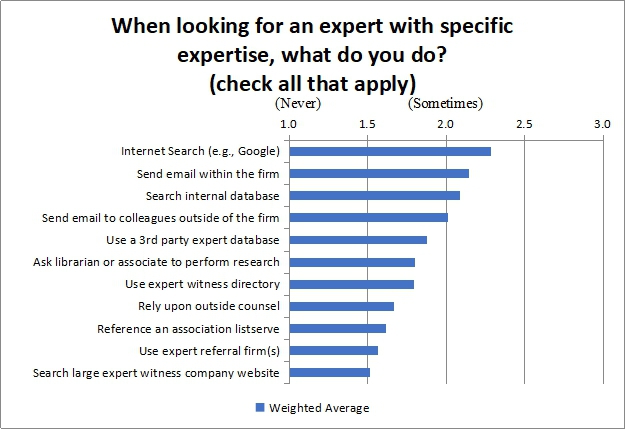
    2. When looking for an expert with specific expertise, what do you do?
    3. Have you ever used any of the following Expert Witness Referral firms?
    4. Do you plan to use any of the following expert witness referral firms during the next 12 months?
    5. Have you ever used any of the following Expert Witness directories?
    6. When researching experts, how important are the following sources/research items?
    7. Which outside sources have you used to locate information about an expert witness previously?
    8. What issues present the most difficulty for effective expert witness research?
    9. At the conslusion of a case, what happens to collected information regarding a hired, opposed or researched expert?
    10. Have you ever been in a work situation where you were unprepared/surprised by something about an expert’s background or experience?
    11. Has lack of sufficient knowledge/research about an expert involved in a case ever materially impacted a case outcome for a case in which you were personally involved?
    12. About the Authors

    Demographics of Survey Respondents

    A total of 580 people responded to the survey. Of those, 65.3% personally conduct research on expert witnesses and 20.0% supervise research conducted by others. 11.4% of the respondents request others to perform research for them. The majority (81.5%) of the respondents are attorneys. The remainder list themselves as librarians/information professionals, claims or knowledge management professionals.

    Many respondents (48.6%) are from small firms (2-49 attorneys) and 18.0% are from medium firms (50-199 attorneys). Members of large firms (200+ attorneys) make up 16.9% of the respondents. The remaining respondents are solo practitioners or work for corporate law departments or insurance companies.

    Survey respondents are primarily based in the United States. Respondents reside in the South (31.4%), the Midwest (27.0%), the Northeast (20.0%) and the West (19.8%). There were 7 international professionals that completed the survey.

    [↑] Top

    When looking for an expert with specific expertise, what do you do?

    Performing a Google search is the most common approach used to locate an expert with specific expertise. Other top methods include sending inquiries to colleagues either inside or outside the firm, as well as searching internal databases. The majority of respondents prefer to perform search themselves, as opposed to using an outside search firm. Other write-in answers include searching Amazon for authors of books on the needed expert subject matter, seeking referrals from other experts and researching trial transcripts.

    [↑] Top

    Have you ever used any of the following Expert Witness Referral firms?

    Have you ever used any of the following Expert Witness Referral firms?

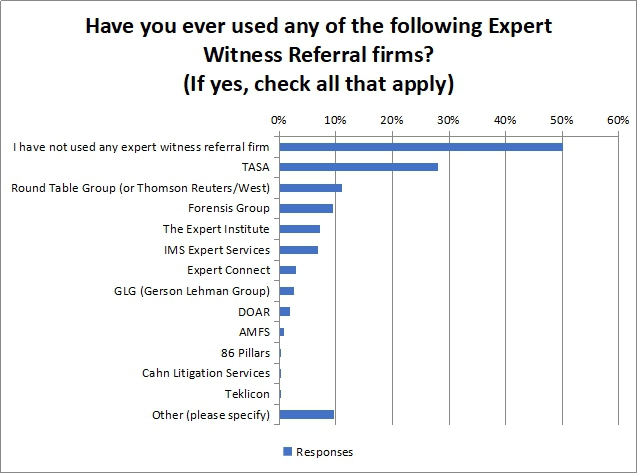
    Over half of the respondents to this question (50.1 %) have never used an Expert Witness Referral firm to acquire an expert witness. Of those that have used such a service, 28.1% have used TASA for their referrals. The Round Table Group (Thomson Reuters Expert Witness Services) is the only other firm to have been used by more than 10% of the respondents.

    One response typifies an overall sentiment expressed by many respondents: “I use such outfits only if I cannot come up with a local/regional expert from my own experience or referral from other counsel. Word of mouth (is) a much more reliable source.” Other respondents indicate that they have located experts by turning to an independent firm that employs a team of experts, such as Robson, Charles River Associates and others.

    [↑] Top

    Do you plan to use any of the following expert witness referral firms during the next 12 months?

    Do you plan to use any of the following expert witness referral firms during the next 12 months?

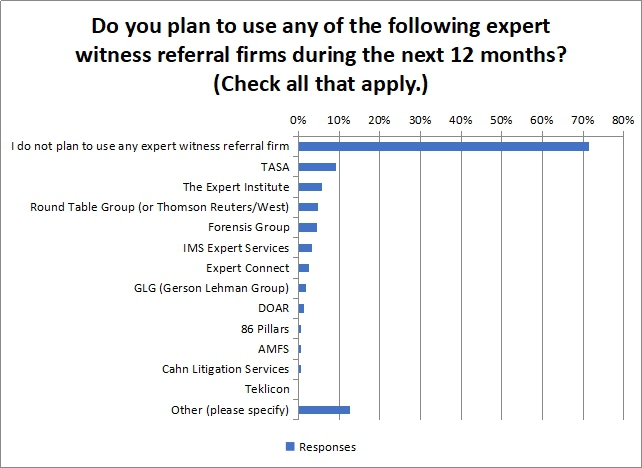
    Consistent with the last question, 71.4% of respondents do not plan to use any expert witness search service provider during the next 12 months. The three most mentioned providers for those respondents planning to use one were TASA, the Expert Institute and Round Table Group (Thomson Reuters Expert Witness Services).

    One respondent noted concerns about using experts obtained via an expert witness referral firm—”I have always had a hard time using referral firms on the defense side particularly. After one jury trial where the plaintiff used a service, and we brought that out on cross, one of the jurors commented that ‘once we heard they got their expert from Experts R Us, they lost a lot of credibility.’ So, until there is some sort of a work around where the service perhaps finds the expert, but is not directly involved, I will have a difficult time getting too enthusiastic.”

    [↑] Top

    Have you ever used any of the following Expert Witness directories?

    Have you ever used any of the following Expert Witness directories?

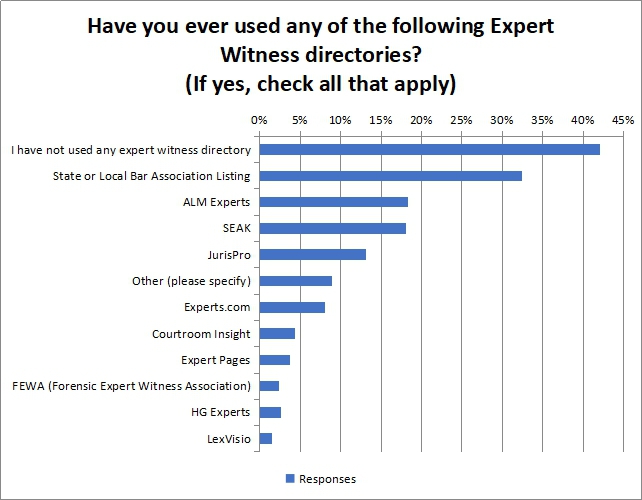
    42.1% of respondents have never used an expert witness directory. Of those that have, nearly one-third prefer to use a state or local bar association listing. Only three of the listed firms: ALM Experts, SEAK and JurisPro were used by more than 10% of those taking the survey. The most popular “Other” mentions include the DRI list server and state defense bar association database.

    [↑] Top

    When researching experts, how important are the following sources / research items?


    When researching experts how important are the following sources/research items?

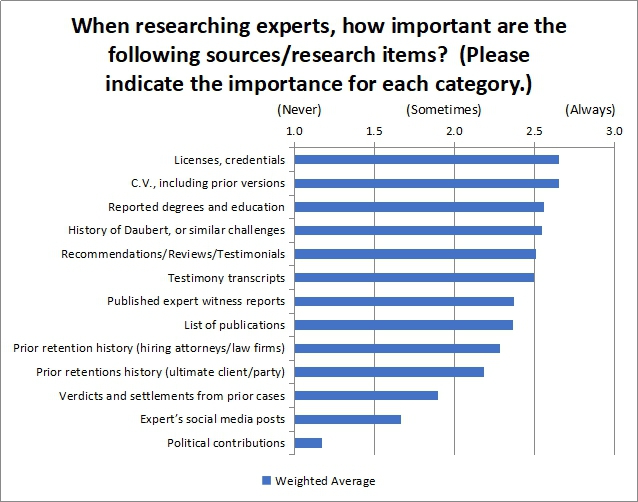
    There are many important evaluation criteria outlined by expert witness researchers. Verifying licenses and credentials is the top priority, followed closely by confirming details found on curriculum vitae. Authenticating degrees and education ranked third in importance, followed by vetting of Daubert or similar challenge outcomes, when available. Recommendations, reviews and testimonials from other attorneys who have direct experience working with the expert are the next most valuable piece of information followed closely by testimony transcripts.

    [↑] Top

    Which outside sources have you used to locate information about an expert witness previously?

    Which outside sources have you used to locate information about an expert witness previously?

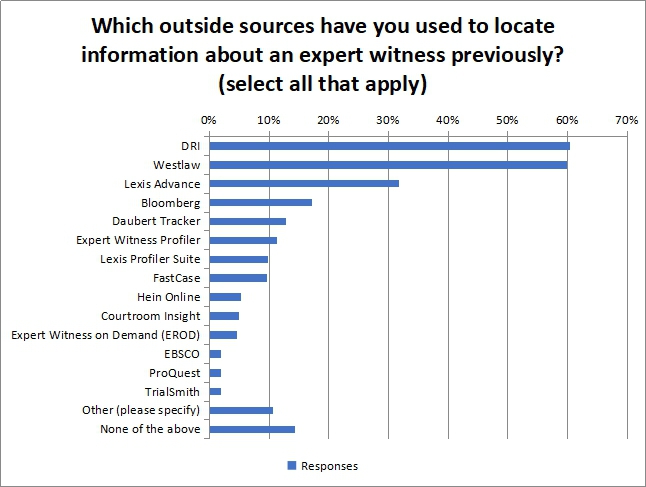
    When searching for information on expert witnesses, the majority of those taking the survey turned to DRI (60.3%) and Westlaw (59.9%) to research experts. Lexis Advance was the third most popular resource with 31.8% of respondents using its service. Bloomberg was used by 17.3% of respondents and Daubert Tracker data was relied upon by 12.8% of respondents. Expert Witness Profiler, Lexis Profiler Suite and Fastcase were all used by approximately 10% of those taking the survey. Those that indicated they used “Other” sources mainly utilized a state or regional defense association database.

    [↑] Top

    What issues present the most difficulty for effective expert witness research?

    What issues present the most difficulty for effective expert witness research?

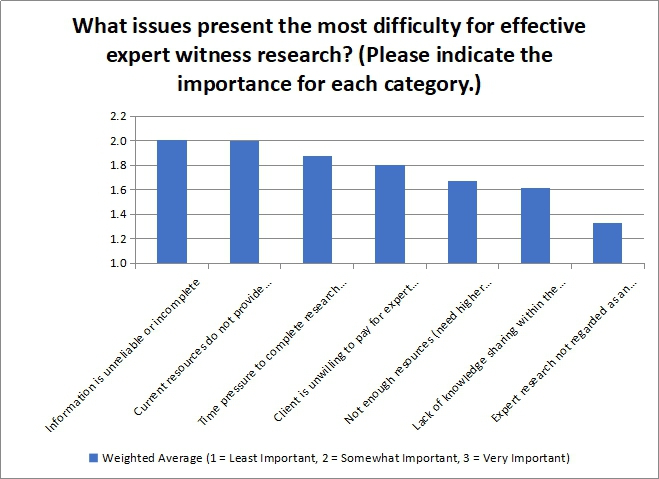
    Issues that present the most difficulty during effective expert witness research are unreliable or incomplete information and a lack of sufficient research tools. One popular mention includes difficulty in assessing an expert’s level of experience in testifying. Time pressures to complete the research and client’s unwillingness to pay for expert witness research are the next two biggest roadblocks facing respondents. Challenges to effective research can be summed up by one respondent who stated “there is no best place to go for all experts.”

    [↑] Top

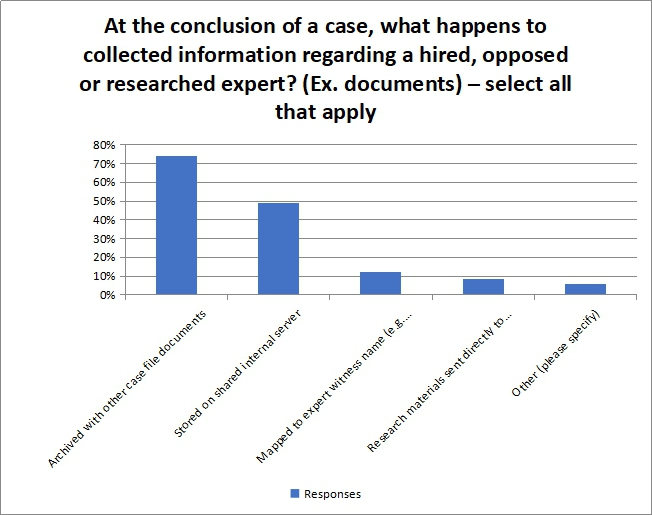
    At the conslusion of a case, what happens to collected information regarding a hired, opposed or researched expert?

    At the conslusion of a case what happens to collected information regarding a hired opposed or researched expert?

    At the conclusion of a case, the majority of respondents file all expert witness information away, along with the case file. The problem with this approach is that, often, no one else knows which experts have been researched, which files contain the information and the extent of the research. In many cases, research may end up being repeated for subsequent matters. In others, attorneys may not be aware that an expert has already been retained or vetted. Other respondents collect their expert witness research information in an internal electronic database, thereby making it available to others in the future.

    [↑] Top

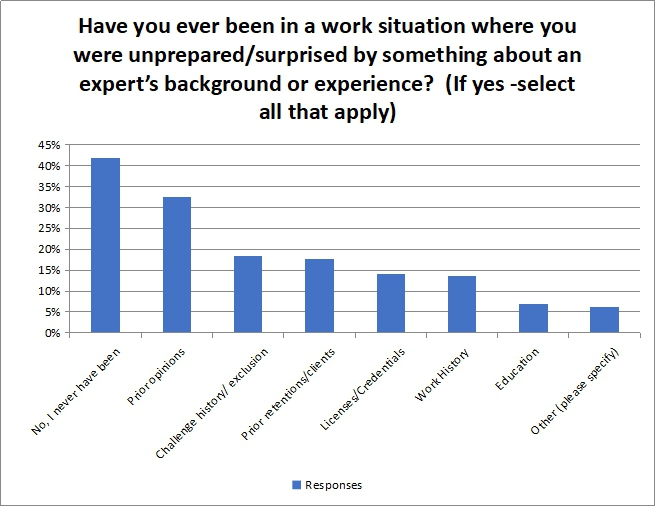
    Have you ever been in a work situation where you were unprepared / surprised by something about an expert’s background or experience?

    Have you ever been in a work situation where you were unprepared/surprised by something about an expert background or experience?

    Almost 60% of respondents have been surprised by at least one aspect of an expert’s background or expertise. 32.5% of those taking the survey have been surprised by prior opinions and 18.5% have been surprised by the expert’s challenge history or exclusions. Attorneys also have been surprised during trial with discrepancies involving other seemingly straightforward, easy to obtain information such as an expert’s work history and education.

    Further, several respondents reported being surprised by an expert’s criminal history, lawsuits involving the expert, malpractice suits, plagiarism and falsified curricula vitae. These findings reiterate the critical importance of thoroughly vetting an expert witness.

    [↑] Top

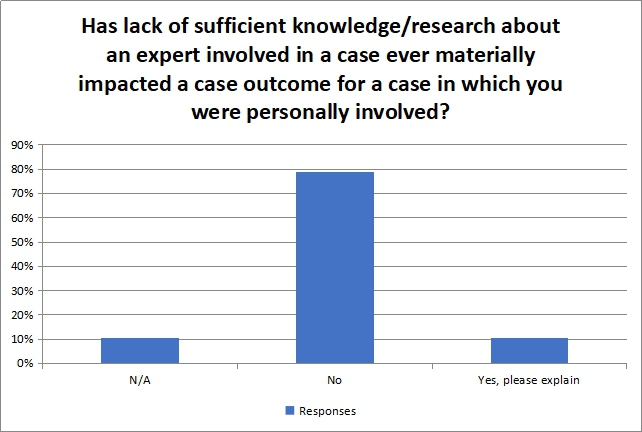
    Has lack of sufficient knowledge / research about an expert involved in a case ever materially impacted a case outcome for a case in which you were personally involved?

    Has lack of sufficient knowledge research about an expert involved in a case ever materially impacted a case outcome for a case in which you were personally involved?

    Fortunately, only 10.4% of respondents report being involved in cases that were directly impacted by insufficient knowledge about expert witnesses. The two most commonly reported situations involve prior testimony containing conflicting opinions and misstated licenses or credentials. Specific examples include the following:

    • An expert’s credentials had been restricted between the time he was retained/deposed and the date of trial.
    • An unlicensed expert who claimed his license was valid was impeached.
    • An expert misled counsel about his experience as an expert witness and completely folded during his deposition.
    • An expert published several articles that contained opinions which contradicted his opinion in the case.
    • An expert let his engineering license lapse prior to testifying at trial.
    • Opposing counsel had not vetted its expert and was unaware of several troubling Daubert challenges and testimony exclusions.
    • A purported nurse providing medical bill review was not licensed.
    • A highly regarded and recommended expert did not testify well before the jury, although he performed fine during his deposition.

    [↑] Top

    About the Authors

    Mark Torchiana is co-founder and CEO of Courtroom Insight, which offers an expert witness knowledge management solution to law firms and legal organizations. The platform provides a systematic, organized approach to managing an organization’s knowledge about expert witnesses. In addition to founding Courtroom Insight, he has over 20 years of experience providing forensic accounting litigation support and expert witness services.

    Myles Levin is founder and CEO of the Daubert Tracker and Principal of Expert Witness Profiler. Since it’s launch in 2002, Daubert Tracker’s collection of “evidentiary gatekeeping” cases has received significant attention in the legal community. Expert Witness Profiler offers custom research services using advanced tools and techniques to locate difficult to find information about expert witnesses. He is a former testifying vocational expert and principal in a litigation consulting company.

    Article Reproduced from: https://www.courtroominsight.com/expert-witness-research-survey

    [↑] Top