Tag: Calculate

  • Economic Damages Expert’s Customer-by-Customer Lost Profits Method Upheld

    Economic Damages Expert’s Customer-by-Customer Lost Profits Method Upheld

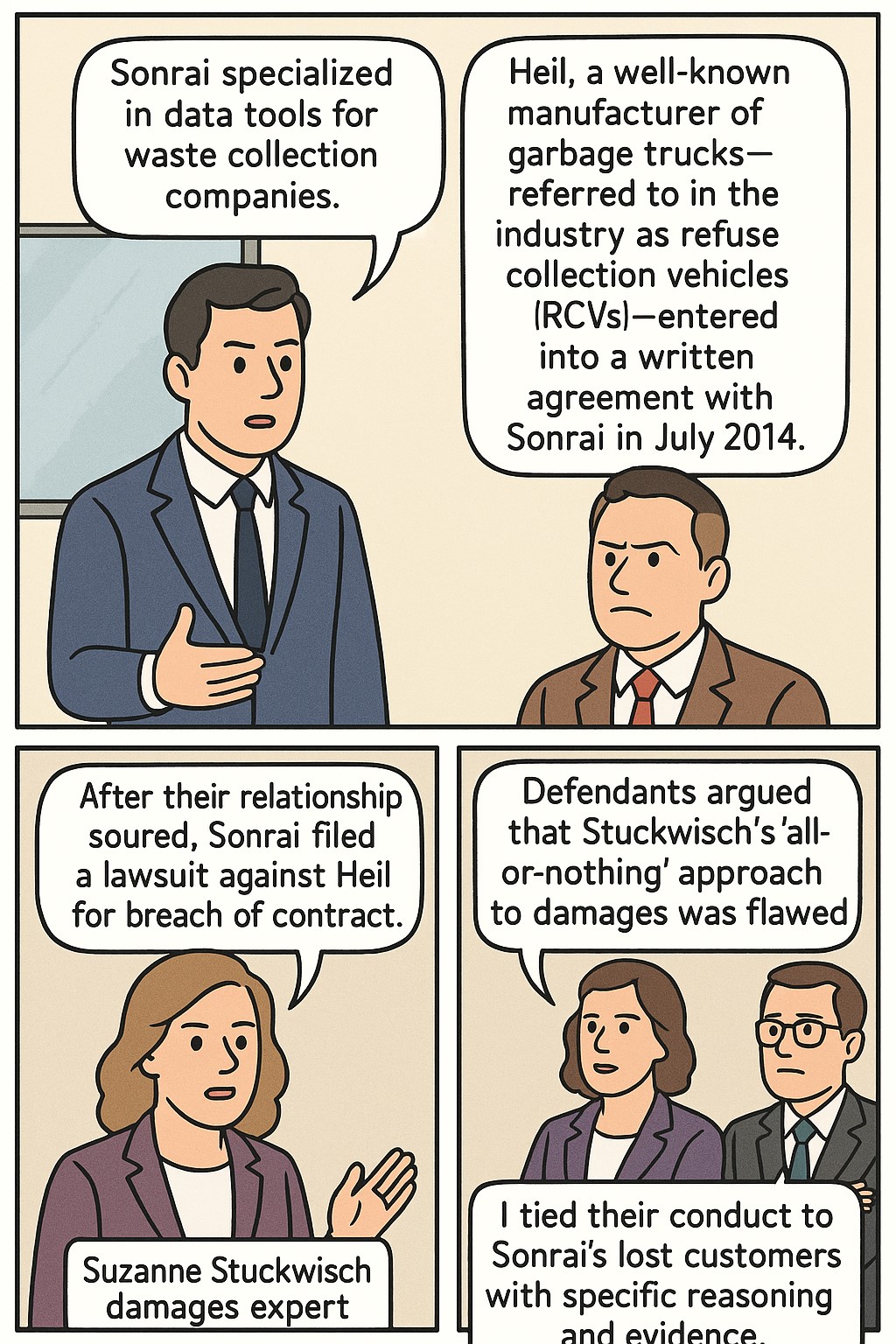
    Sonrai specialized in data tools for waste collection companies. Heil, a well-known manufacturer of garbage trucks—referred to in the industry as refuse collection vehicles (RCVs)—entered into a written agreement with Sonrai in July 2014. The purpose was to facilitate the exchange of confidential information and explore a potential partnership, where Sonrai’s data product, “Vector,” could be integrated with Heil’s RCVs.

    Over the next year, both companies shared proprietary information and operated under the terms of the agreement. In May 2015, Heil made an offer to acquire Sonrai, but Sonrai declined. The relationship began to deteriorate, and by September 2016, Heil chose a different path. It acquired a company called 3rd Eye, opting to use 3rd Eye’s competing data product, “Enhance,” instead of continuing with Sonrai.

    Following this turn of events, Sonrai filed a lawsuit against Heil for breach of contract. Sonrai also accused Anthony Romano of breaching his fiduciary duties to Sonrai. Sonrai also alleged that Anthony Romano had breached his fiduciary duties owed to the company. Heil, in turn, countersued, also alleging a breach of contract.

    Defendants raised certain arguments about the reliability of Sonrai’s damages expert Suzanne Stuckwisch‘s testimony.
     

    Economic Damages Expert Witness

    Suzanne M. Stuckwisch has more than 30 years of experience in economic and financial analysis and engineering consulting. She holds a B.S. in Mechanical Engineering, an M.B.A., and an M.S. in Economics.

    Stuckwisch has experience across a wide range of industries, including but not limited to waste and recycling.

    Get the full story on challenges to Suzanne Stuckwisch’s expert opinions and testimony with an in-depth Challenge Study

    Discussion by the Court

    Recognized Methodology

    The Defendants first challenged Stuckwisch’s expert report by arguing that she failed to follow any recognized methodology in calculating Sonrai’s alleged lost profits. The Court disagreed. It found that her report clearly laid out how she determined the length of Sonrai’s relationships with each customer, projected potential sales, and accounted for the costs of producing Vector units. She analyzed damages on a customer-by-customer basis—an approach the Court had previously deemed acceptable. As a result, the Court concluded that her methodology was valid and properly applied.

    Damages Model

    Next, the Defendants claimed that Stuckwisch’s damages model relied too heavily on a single, speculative assumption: that all five waste haulers would have adopted Vector across their entire fleets. But the Court had already addressed this point in its summary judgment ruling. It noted that Stuckwisch had explained the rationale behind her assumption and emphasized that it was up to the jury to weigh the credibility of that assumption. Her report referenced evidence from the waste industry showing that third-party companies had made commitments to install Vector fleetwide.

    All-or-Nothing Approach

    Lastly, the Defendants contended that Stuckwisch’s “all-or-nothing” approach to damages was flawed because she failed to consider other possible causes for Sonrai’s lost profits—something they argued was required under AICPA standards. In response, Stuckwisch clarified that her analysis again followed a customer-by-customer model: once a customer was lost, the associated revenue was lost entirely. The Court found this approach reasonable. It emphasized that Stuckwisch did not simply assume the Defendants caused the losses—she tied their conduct to Sonrai’s lost customers with specific reasoning and evidence.

    Additional Incremental Operation Costs

    Fourth, Defendants argued that Stuckwisch’s testimony was unreliable because her calculation of additional incremental operation costs, which are a necessary component of lost profits, was previously stricken and never included in any amended reports.

    The Court agreed that Stuckwisch’s testimony would be unreliable without the deduction of additional incremental operation costs. But precluding Stuckwisch from testifying about those additional incremental operation costs was not the appropriate remedy. Instead, the proper path forward was to allow Stuckwisch to supplement her report and allow Defendants to depose her on the new report, and supplement their own rebuttal report if they wished.

    Alternative Explanations 

    Finally, the Court issued this opinion following a hearing held on June 9, 2025, during which it preliminarily denied the Daubert motion. After that hearing, Stuckwisch submitted a supplemental report and sat for a deposition. On the first day of trial, the Defendants raised three new arguments to exclude her testimony.

    First, they challenged Stuckwisch’s assumption that Sonrai would incur no cost for working capital. According to her, Chris Flood—Sonrai’s CEO—told her that his family’s business, which generated over $100 million in annual revenue, would cover Sonrai’s working capital needs. Defendants claimed this assumption was unfounded. However, the Court noted that the same assumption appeared in her 2021 report under the section on incremental operational costs. For the reasons already discussed, the Court declined to exclude her testimony on this basis.

    Second, Defendants argued that Stuckwisch failed to consider an alternative cause: that Romano had the right to leave Sonrai at any time. But they did not explain how this constituted an “obvious alternative explanation” undermining the reliability of her analysis. The Court held that such arguments were better suited for cross-examination.

    Third, the Defendants contended that Stuckwisch wrongly assumed that Vector faced no competition in the but-for world, effectively treating it as a monopoly product. She based this assumption on her understanding that no comparable product existed in the marketplace. The Court found this assumption to be reasonable, though it acknowledged that Defendants were free to challenge it during trial.

    Held

    The Court denied the Defendants’ Rule 702 motion to exclude the testimony of Suzanne Stuckwisch.

    Key Takeaways:

    • An expert need not rule out every alternative cause. Arguments about alternative explanations can be explored on cross-examination. 
    • Stuckwisch’s opinion reliably applies the lost profits principles and methodology to the facts of the case and the Court will not prejudge the ultimate correctness of her conclusions. Her reasoning satisfies Rule 702’s reliability standard. Defendants’ criticisms can be explored on cross-examination.

    Case Details:

    Case Caption: Sonrai Systems, LLC Et Al V. Anthony M. Romano Et Al
    Docket Number: 1:16cv3371
    Court Name: United States District Court, Illinois Northern
    Order Date: June 20, 2025
  • Lost Wages Expert’s Commission Calculations Admitted

    Lost Wages Expert’s Commission Calculations Admitted

    Jenessa Dubey was employed by Concentric Healthcare Solutions, LLC from August 2016 until her termination on December 2, 2021. She has filed a lawsuit against Concentric and Robert Bales, alleging sex-based discrimination, sexual harassment, and unpaid wages.

    The case focuses on Dubey’s claims that, over several years, Bales engaged in conduct that created a hostile work environment during her time at the company.

    Plaintiff retained a damages expert, Mr. Nathaniel Curtis, to calculate her lost earnings resulting from Defendants’ actions. As a result, Concentric and Robert Bales filed a motion to exclude Curtis under Federal Rule of Evidence 702 and Daubert V. Merrell Dow Pharm., Inc., 509 U.S. 579 (1993).

    Lost Wages Expert Witness

    Nathaniel Curtis is typically engaged to analyze lost earnings related to complex labor discrimination and wrongful termination disputes.

    He holds an MBA, a Master’s Degree in Business Administration, and a Bachelor’s in “Business Ecology.” He serves as the Chief Financial Officer of a private engineering firm with over 150 employees based in Arizona.

    Get the full story on challenges to Nathaniel Curtis’ expert opinions and testimony with an in-depth Challenge Study. 

    Discussion by the Court

    Curtis opined that the present value of Plaintiff’s lost earnings resulting from Defendants’ conduct is approximately $5.4 million as of January 1, 2024, based on documents produced by the parties, and information obtained from research efforts.

    Curtis is Qualified under Rule 702

    The Court found that Curtis is qualified to testify as an economics expert based on his education and professional experience. He holds an MBA in Business Administration and a Bachelor’s degree in Business Ecology, which satisfy the educational requirements under Rule 702. In addition, he has over ten years of experience providing expert analysis in similar cases. Therefore, the Court concluded that Curtis met the threshold qualifications to testify as an expert and will not exclude him at this pretrial stage.

    Whether Curtis’ Testimony Will Assist the Jury

    Defendants next argued that Curtis’ opinions about lost earning capacity are not helpful to the jury because the Plaintiff does not claim that her earning capacity was harmed. In response, Plaintiff contended that Curtis intends to testify only about the amount of her lost future earnings due to her wrongful termination by Concentric.

    There appeared to be a misunderstanding between the parties regarding the scope of Curtis’ intended testimony. In his report, Curtis stated that he was engaged to “calculate [Plaintiff’s] lost earnings resulting from Defendants’ actions as described in [her] complaint.” During his deposition, he was asked about the following statement: “[t]he relevant issue is [Plaintiff’s] earning capacity as a professional, not her earning capacity at Concentric.” When asked why her earning capacity at Concentric was not considered relevant, Curtis explained: “It’s not that it’s not relevant. It’s not the goal. The goal isn’t to say what she would have earned at Concentric. It’s to understand what her earnings capacity was.”

    The Court found that Curtis’ testimony will assist the jury because he will provide “knowledge beyond the trier of fact’s common knowledge.” The Defendants’ objections go to the weight of Curtis’ testimony and the evidence supporting it—not to its admissibility.

    Sufficient Facts and Data

    Defendant next argued that Curtis’ testimony relied on insufficient facts and data in violation of Rule 702(b). However, the Court found that Curtis’ opinions are drawn from sufficient factual grounds. Curtis stated in his report that, in developing his opinions, he reviewed documents produced by the parties, and information obtained from research efforts related to this report.

    Curtis has also included an exhibit detailing the documents he relied upon which includes check stubs and an offer letter. Plaintiff also noted in her response that Curtis relied upon records of Plaintiff’s historical compensation and commissions and data regarding compensation conditions in the specific industry at the relevant time. She also argued that Defendant’s expert also relied upon these same documents to reach his opinion.

    Defendants argued in their Reply that Curtis “only reviewed two commission payments to predict Plaintiff’s commissions for the remainder of her career” and that this limited review of two commission payments “is insufficient to predict almost 25 years of commissions.”

    Defendant essentially argued that Plaintiff’s commission payments and wage data were reviewed in a vacuum. Yet, according to Curtis, they were reviewed in conjunction with other documents, evidence and statistics from the Bureau of Labor. Cutis then utilized these facts, data and assumptions to reach a conclusion as to Plaintiff’s lost wages. These facts and data, reviewed in the aggregate, establish sufficient factual grounds from which Curtis could form an opinion and draw conclusions from.

    Reliable Principals and Methods

    Defendant argued that Curtis’ opinions regarding Plaintiff’s future earning capacity and expected growth rate in the “Actual Scenario” employed an unreliable methodology.

    Curtis employed a But-For Scenario and an Actual Scenario to calculate Plaintiff’s damages. He states that “the Actual Scenario differs from the But-For Scenario by assuming that [Plaintiff] will experience abnormal wage increases and commission increases in her new position because workers commonly experience several years of above average earnings increases when they pursue long-term and stable employment.”

    Curtis also stated that that “with respect to the Plaintiff’s lost commissions, I reviewed Plaintiff’s pay stubs, which revealed commissions in September 2021 of $16,308 and in October 2021 of $18,011. Using historical earnings, and specifically recent historical earnings, is a generally accepted and testable data source used by experts to calculate lost earnings in wrongful termination disputes.”

    Defendants objected to Curtis’ calculations regarding earning capacity growth and commissions. They also argued that he failed to explain the basis for his assumption of a 10% annual commission. However, an expert “may, in appropriate circumstances, rely on assumptions when formulating opinions.”

    While Defendants argued that Curtis did not take Plaintiff’s specific job into consideration in determining what rate was appropriate, the Court held that Curtis’ opinions are indeed the product of reliable principles and methods such that he can testify under Rule 702. It should be attacked by cross examination at trial—not exclusion beforehand.

    Held

    The Court denied the Defendants’ Daubert motion to exclude Plaintiff Jenessa Dubey’s expert, Nathaniel Curtis, MBA.

    Key Takeaway:

    Curtis has applied reliable principles to form his hypothesis. It is not for the Court to gauge whether that hypothesis is ultimately correct, so long as his opinion stays “within the bounds of what can be concluded from a reliable application of the expert’s basis and methodology.”

    Case Details:

    Case Caption: Dubey V. Concentric Healthcare Solutions LLC Et Al
    Docket Number: 2:22cv2044
    Court Name: United States District Court, Arizona
    Order Date: June 12, 2025
  • Pediatrics Expert’s Opinion Regarding a Target 95% Vaccination Rate Met the Daubert Bar

    Pediatrics Expert’s Opinion Regarding a Target 95% Vaccination Rate Met the Daubert Bar

    On July 22, 2022, Dr. Gregory Fox, individually and as parent of C.F., and Rita Fox, individually and as parent of C.F. (jointly, the Plaintiffs), filed a lawsuit challenging the state of Maine’s public school vaccination requirements.

    Dr. Laura Blaisdell, a pediatrician with extensive qualifications in medicine and public health, was presented as an expert witness by Department of Education Commissioner Pender Makin. Fox’s challenge centered on Blaisdell’s opinion regarding a 95% vaccination rate target. He argued that her reliance on the R0 variable, which assumes a “totally susceptible” population, was unreliable and unsupported by scientific methodology when applied to the case’s specific facts. He claimed her assumption was erroneous because the population in question was only “partially susceptible”.

    Furthermore, Fox contested the scientific support for the 95% vaccination coverage goal, asserting that Blaisdell erred in inferring its necessity to protect susceptible individuals or halt disease transmission.

    Pediatrics Expert Witness

    Laura L. Blaisdell, MD, MPH, FAAP, CPE is a board-certified pediatrician, public health consultant, and researcher with expertise in vaccine hesitancy, infectious disease control, and camp medicine. She holds a Doctor of Medicine (MD) from the University of Minnesota Medical School and a Master of Public Health (MPH) from the University of Minnesota School of Public Health. She is also a Certified Physician Executive (CPE) and a Fellow of the American Academy of Pediatrics (FAAP).

    Blaisdell has served as an Attending Physician in the Department of Pediatrics at Maine Medical Center since 2008 and is an Assistant Professor at Tufts University School of Medicine. Her research and clinical work focus on vaccine decision-making, public health policy, and disease prevention in communal settings, particularly youth camps. She has been a key figure in vaccine advocacy and has contributed to legislative efforts to promote immunization policies.

    Want to know more about the challenges Laura Blaisdell has faced? Get the full details with our Challenge Study report. 

    Discussion by the Court

    Commissioner Makin countered that Fox conflated herd immunity threshold rates with public health vaccination targets for schools. They argued that Blaisdell’s use of R0 was a generally accepted practice for determining herd immunity thresholds.

    Regarding the 95% target, the Commissioner emphasized that it was a public health goal, not a herd immunity threshold, aligning with targets set by the United States Centers for Disease Control and Prevention (U.S. CDC) and the Maine Center for Disease Control and Prevention (Maine CDC). Blaisdell, in her deposition, clarified the distinction, stating that the 95% figure represents a public health recommendation for school vaccination levels.

    Analysis

    The Court acknowledged that Blaisdell’s use of R0 to calculate herd immunity thresholds was supported by scientific literature, including articles cited by both parties. While the use of this methodology in other scientific literature is not conclusive, it did demonstrate a measure of acceptance within the scientific community.

    The Court ruled that Fox’s challenge regarding the “partially susceptible” population goes to the weight and credibility of Blaisdell’s testimony, not its admissibility. The Court also recognized the distinction between herd immunity thresholds and public health vaccination goals.

    Blaisdell’s reliance on sources like the CDC and state health reports, as well as her clear explanation during deposition, provided sufficient support for the 95% target as a public health goal. Moreover, Blaisdell sufficiently distinguished herd immunity threshold calculations from the public health goal of 95% vaccination coverage. Therefore, challenges to the weight and credibility of the 95% goal did not prevent the testimony from being admissible.

    Held

    The Court dismissed without prejudice Gregory Fox’s motion to partially exclude the testimony of Dr. Laura Blaisdell.

    Key Takeaway:

    This case highlights the importance of distinguishing between different types of scientific targets, such as herd immunity thresholds and public health goals. It also demonstrates the Court’s role in evaluating the reliability and relevance of expert testimony under the Daubert standard. The Court’s decision emphasizes that challenges to the factual underpinnings of expert opinions primarily affect their weight and credibility, not necessarily their admissibility.

    Case Details:

    Case Caption: Fox Et Al V. Makin Et Al
    Docket Number: 2:22cv251
    Court: United States District Court, Maine
    Order Date: March 10, 2025