Plaintiffs The Avon Company and LG H&H Company, Ltd. (“Avon,” or Plaintiffs) brought this suit against Fareva Morton Grove, Inc. and Fareva S.A. (collectively “Fareva,” or Defendants) for a breach of their long-term Manufacturing and Supply Agreement (the “MSA”).
Fareva filed a motion to exclude the testimony of Avon’s two experts, Anthony J. Campanelli and Brent K. Bersin on the grounds that their testimony is based on unreliable data.
Accounting Expert Witnesses
Anthony J. Campanelli is a Certified Public Accountant with more than 25 years of experience at Deloitte, one of the world’s largest and most respected accounting and consulting firms.
Brent Kevin Bersin is a Senior Managing Director at FTI Consulting with 30 years of experience as an expert witness and consultant on valuation, financial and forensic accounting, and economic damages.
Campanelli will testify about the calculation of the Net Service Level Payments (“NSLPs”). The NSLPs are calculated based on Schedule D of the MSA, which sets out a formula that, put simply, considers when Fareva fulfilled Avon’s orders and when Avon placed those orders. The formula in Schedule D required a somewhat complex set of calculations, given the delivery and order timing inputs and different multipliers per product. In drafting his expert report and reaching his opinion, Campanelli relied on data provided by Avon regarding forecasts, orders, and delivery data from the relevant time period. Fareva argued that Campanelli’s opinion is not based on reliable data, that his calculations are inconsistent with the Schedule D formulas, and that the opinion improperly introduced contractual interpretations.
Analysis
First, the data relied upon by Campanelli are sufficiently reliable. The discrepancies that Fareva pointed to do not rise to the level of being “speculative or conjectural or based on assumptions that are so unrealistic.” Further, it was permissible for Campanelli to rely on the data provided by Avon. Even if Fareva’s “claims as to factual inaccuracies” in the underlying data and assumptions used by Campanelli were assumed true, Campanelli “at most had a few faulty inputs to an otherwise topical opinion on [the NSLPs]—this is thus not a case in which ‘there is simply too great an analytical gap between the data and the opinion proffered.’”
Second, Fareva argued that Campanelli’s calculations are inconsistent with the MSA because they differ from calculations performed by PwC, Avon’s former expert. The discrepancy is explained by a reasoned choice in how Campanelli calculated the NSLPs, a choice which conformed with Fareva’s position on calculations and resulted in a lower damages claim. This is not a basis for rejecting Campanelli’s opinion.
Third, Campanelli did not rely on improper assumptions or legal interpretations of the MSA in his calculations. While Fareva is correct that an expert may not make legal determinations interpreting a contract, Campanelli’s assumptions regarding the completeness of the data did not rise to the level of an impermissible contract interpretation.
As a result, the Court denied Fareva’s motion to exclude the expert testimony of Campanelli.
Brent Bersin
Bersin will testify about Avon’s lost profits attributable to the lost sales of products that Fareva failed to produce or timely deliver. Bersin’s opinion is based on comparisons between Avon’s performance before and after the breach and on a benchmark comparison of the performance of the broader industry. Bersin relied on a subset of Avon’s North American sales data that captured the products produced by Fareva. Fareva argued that Bersin relied on unreliable and inaccurate data in his calculations, that he failed to disaggregate compounding factors, and his basis of benchmark comparison was unreliable.
Analysis
First, Fareva argued that the sales data relied upon by Bersin included products that Fareva did not produce, that there were other indicia of unreliability, and that Bersin failed to independently verify the data. As with Campanelli, any inconsistencies, which Avon also disputes factually, did not rise to the level of being “speculative or conjectural or based on assumptions that are so unrealistic.” And Bersin permissibly relied on the data provided by Avon in the ordinary course of business.
Second, Fareva argued that Bersin improperly attributed all of Avon’s losses to Fareva, without disaggregating alternative sources of harm. This is insufficient to bar Bersin’s testimony. Bersin’s report acknowledged alternatives, noting that Avon’s oversales were declining and distinguishing between sales data in different product categories.
Third, Fareva argued that Bersin relied on an insufficiently comparable benchmark for its benchmark analysis. Bersin relied upon the Statista data for the “Beauty & Personal Care market” in making his comparison. Fareva contended that using this market, without further analysis of the comparison between the companies within it, was improper, and that the market selected did not compare to Avon because the companies within did not use the same sales model as Avon. The Court disagreed. Bersin acknowledged that he considered the brands within the personal care market to be comparable when deciding to use them. It is reasonable to conceive of Avon as a beauty and personal care brand selling similar products to those in the comparison group. Bersin was not required, as Fareva suggests, to draw a comparison to groups based solely on distribution model that offer entirely different products from Avon.
Therefore, the Court denied Fareva’s motion to exclude the testimony of Bersin.
Held
The Court denied Fareva’s motion to exclude the testimony of Anthony Campanelli and Brent Bersin.
Key Takeaway
Disputes as to the strength of an expert’s credentials, faults in his use of a particular methodology, or lack of textual authority for his opinion, go to the weight, not the admissibility of his testimony.
EcoFactor, Inc. (EcoFactor) owns U.S. Patent No. 8,738,327, which relates to the operation of smart thermostats in computer-networked heating and cooling systems.
In January 2020, EcoFactor sued Google in the Western District of Texas, alleging Google’s Nest thermostats infringed claims of the ‘327 patent, among other patents.
Before trial, Google filed a motion to exclude the testimony from EcoFactor’s damages expert, David Kennedy, under Federal Rule of Evidence 702 and Daubert. The district court, however, held that Kennedy’s testimony that $X is an established royalty for the patented technology was indeed supported by reliable methodology.
Google appealed the district court’s denial of the motion to exclude Kennedy’s testimony. Google argued that the district court abused its discretion in denying a new trial on damages because Kennedy’s expert opinion was unreliable.
Intellectual Property Expert Witness
David A. Kennedy is an expert in intellectual property valuation and negotiating the economics of patent sales and licensing agreements. He has been acknowledged as one of the World’s Leading IP Strategist by Intellectual Asset Management for each of the last 11 years.
Kennedy has bought and sold patent portfolios and negotiated license agreements in commercial transactions and helped clients establish royalty rates for individual patents and large portfolios of implementation and standard essential patents.
As part of his analysis, Kennedy considered lumpsum settlement licenses between EcoFactor and three licensees: Daikin Industries, Ltd. (Daikin); Schneider Electric USA, Inc. (Schneider); and Johnson Controls Inc. (Johnson).
Kennedy offered his expert opinion on “the amount of patent damages in this case,” and ultimately concluded that Google LLC (“Google”) should pay damages based on a royalty rate of $X per unit. Kennedy’s testimony is also supported by license agreements between EcoFactor, Inc. (“EcoFactor”) and Johnson Controls, Inc. (“Johnson”), Daikin Industries, Ltd. (“Daikin”), and Schneider Electric, USA (“Schneider”).
Apart from the licenses themselves, the only evidence upon which Kennedy relied was the testimony of Eco-Factor’s CEO, Shayan Habib. Habib testified that the lump-sum payments for each of the three licenses was calculated by multiplying the licensee’s past and future projected sales by the $X per unit rate. Habib also testified about Google’s sales compared to the sales of Johnson, Daikin, and Schneider, and he concluded that “as it relates to the smart thermostat business, they’re actually either quite new or very small in our space specifically.”
Kennedy’s Opinion that the Licenses Showed Industry Acceptance of an $X per unit Royalty Rate was not Based on Sufficient Facts or Data
To estimate a reasonable royalty in this case, Kennedy’s damages opinion employed the hypothetical negotiation or “willing licensor-willing licensee” framework, which “attempts to ascertain the royalty upon which the parties would have agreed had they successfully negotiated an agreement just before infringement began.”
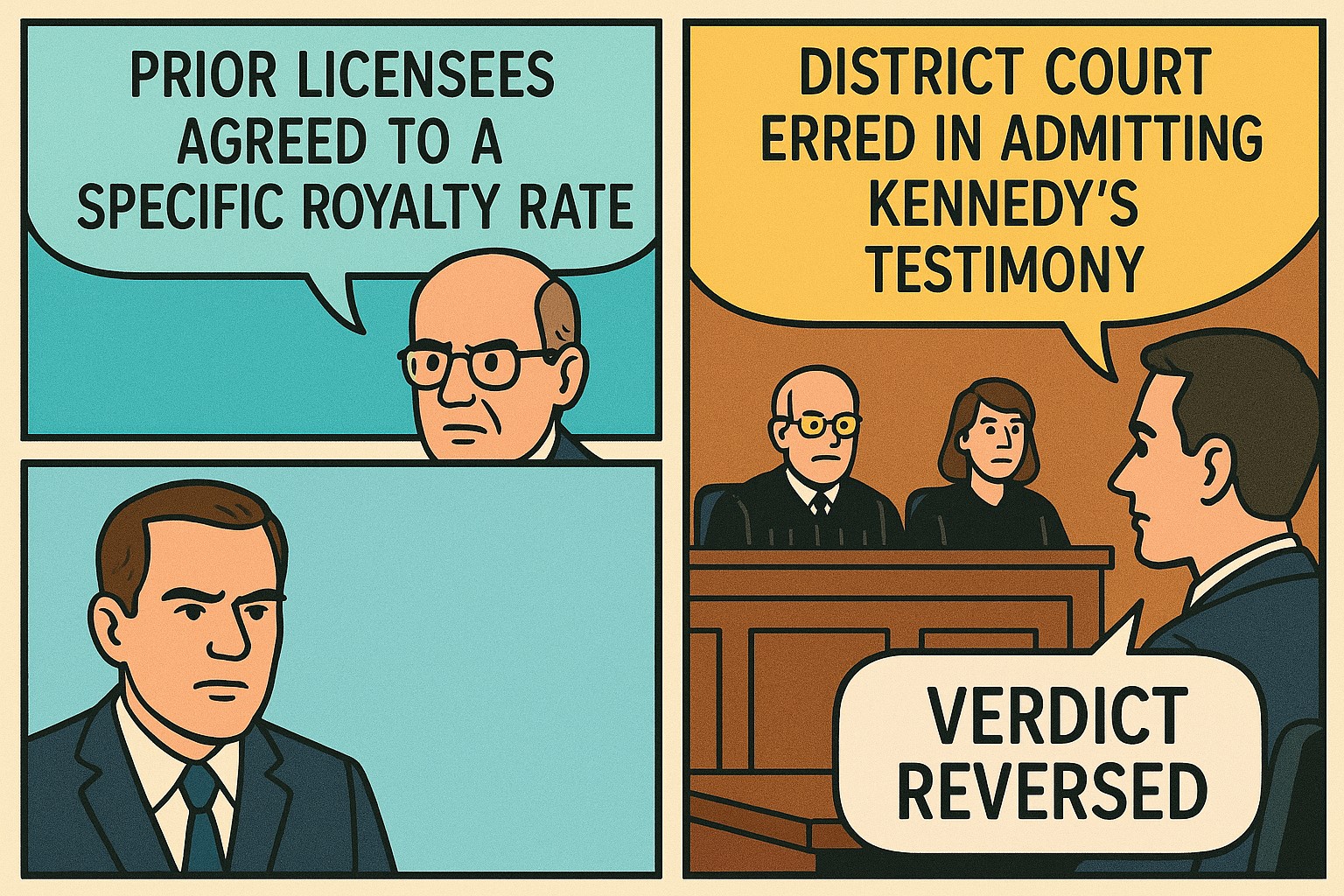
The Federal Circuit held that the existing licenses upon which Kennedy relied were insufficient, individually or in combination, to support his conclusion that prior licensees agreed to the $X royalty rate and therefore the district court abused its discretion in failing to exclude this testimony.
There is also evidence in the record supporting Google’s contrasting belief that none of Schneider, Daikin, or Johnson ever agreed to an $X rate. For example, the Schneider and Daikin agreements (though not the Johnson agreement) provided that the “[lump-sum] amount [paid by each licensee] is not based upon sales and did not reflect or constitute a royalty.”
In other words, the plain language of the Daikin, Schneider, and Johnson license agreements did not support Kennedy’s testimony that the licensees agreed to pay the $X per unit royalty rate.
The “whereas” recital of the Schneider license indicated that EcoFactor believes $X is a reasonable royalty, but it made it equally clear that Schneider did not agree that $X per unit is a reasonable royalty. Also, the “whereas” recital of the Johnson license indicated EcoFactor’s representation of its unilateral belief that $X constituted a reasonable royalty and did not provide a basis for Kennedy to testify that Johnson agreed to the $X rate. Same with Daikin.
Moreover, the federal circuit stated that Habib’s testimony did not provide a sufficient basis for Kennedy’s testimony that Daikin, Schneider, and Johnson agreed to pay a royalty of $X per unit.
Held
The Federal Circuit ruled that the district court should have granted Google a new damages trial because David A. Kennedy’s expert testimony—claiming the licenses proved the industry accepted an $X-per-unit royalty rate—lacked the solid facts and data that Rule 702 requires.
Key Takeaway:
The Court found that David Kennedy’s testimony that the licensees agreed to the $X per unit royalty rate was not supported by sufficient facts or data as required by Rule 702, rendering his opinion unreliable and inadmissible. The plain language of the licenses contradicted Kennedy’s assertion, and Habib’s testimony did not provide a sufficient factual basis. The Court held that the district court failed in its gatekeeping role under Daubert by allowing Kennedy to testify despite the lack of factual support for a critical premise of his opinion.
On March 12, 2021, Linda Maraldo was waiting at a red light in her 2017 Chevrolet Sonic. Behind her, Cynthia O’Hara was operating a United States Postal Service (“USPS”) box truck. When the light turned green, O’Hara took her foot off the brake, causing the truck to move forward and collide with Maraldo’s vehicle. Maraldo claims to have suffered neck and back pain as a result.
Expert Opinion
Government expert Dr. Jennifer Yaek conducted accident reconstruction and biomechanical analyses of the rear-end collision between Maraldo’s vehicle and the USPS box truck.
In preparing her expert report, Yaek reviewed several sources of information, including: (1) information about the accident, (2) eight photographs of the vehicles involved in the crash and the site of the crash, (3) repair and maintenance records for both vehicles, and (4) Maraldo’s medical records.
Yaek’s assessment of vehicle damage was solely based on the documents and photographs supplied by the government, as she did not conduct a physical inspection of either vehicle.
1. Accident Reconstruction Analysis
Yaek’s accident reconstruction analysis led her to conclude that the maximum change in velocity, or delta-V, of Maraldo’s vehicle was approximately 5 miles per hour, that the closing/impact speed of the USPS truck was approximately 6-6.5 miles per hour, and that the principal direction of force applied to Maraldo’s vehicle was 6 o’clock “with 12 o’clock being straight ahead on the vehicle.”
Yaek’s crush analysis began with calculating how much force acted on the rear of Maraldo’s vehicle and, similarly, on the front of the USPS truck. To calculate the force that acted on the rear of Maraldo’s vehicle, Yaek used photos of the vehicle’s “undeformed rear bumper and publicly available, peer-reviewed engineering and scientific literature.”
Yaek next used the Crash Investigation Sampling System from the National Highway Traffic Safety Administration to evaluate her delta-V calculation relative to the delta-V values in two other accidents where a vehicle rear-ended a Chevy Sonic.
2. Biomechanical Analysis
Yaek’s biomechanical analysis led her to conclude that the accident “did not provide sufficient forces to cause motion of Maraldo’s cervical or lumbar spine beyond the physiological range of motion, and would most likely not provide the type or magnitude of loading consistent with mechanisms for acute spinal injury beyond transient spinal strain.”
Yaek used the laws of physics to determine that Maraldo would have moved initially rearward and then rebound forward during the collision. She compared the loads that Maraldo’s spine would have experienced during the accident to “injury tolerances” and “loading experienced in physical tasks and activities of daily living.”
Yaek further drew on biomechanical and peer-reviewed studies in finding that Maraldo’s accident could not have resulted in disc herniation, protrusion, or bulging absent damage to adjacent bony structures.
Daubert Motion
Maraldo contended that Yaek’s accident reconstruction opinions are unreliable and based on speculation. Specifically, Maraldo asserted that Yaek did not perform a crush analysis and instead based her conclusions on a limited review of only one photograph of each vehicle. Furthermore, Maraldo argues that Yaek lacked crucial information regarding the distance traveled by the USPS truck until impact, the speed of the USPS truck, the starting positions of the vehicles pre-impact, or the resting positions of the vehicles post-impact.
Accident Reconstruction ExpertWitness
Jennifer L. Yaek has more than 25 years of extensive experience in accident reconstruction, vehicle dynamics, and data analysis.
She received her Master’s degree and PhD in biomechanical engineering with a concentration in impact biomechanics and has provided expertise in human injury tolerance, occupant kinematics, and rigid body dynamics associated with transportation related impacts, inter alia, since 2012.
In addition, Yaek has co-authored numerous publications, including a 2020 article on rear impact.
First, Yaek’s crush analysis consisted of three parts: (1) calculating how much force acted on the rear of Maraldo’s vehicle, (2) calculating how much force acted on the front of the USPS truck, and (3) calculating the total crush that both vehicles dissipated. In performing the crush analysis, Yaek reviewed multiple photos of both vehicles and relied on “publicly available, peer-reviewed engineering and scientific literature” as well as the laws of physics.
The Court concluded that Maraldo did not adequately support her contention that a physical inspection of the vehicles was required for Yaek’s analysis. Specifically, Maraldo did not clarify the necessity of a physical inspection, the additional insights Yaek would have gained, or the specific information Yaek overlooked by not conducting one. This failure to provide a clear explanation weakened Maraldo’s position.
In conducting her accident reconstruction analysis, Yaek reviewed a traffic crash report from Michigan, a USPS accident investigation worksheet, and the deposition testimonies of both Linda Maraldo and Cynthia O’Hara. Notably, Maraldo does not contest the foundation of Yaek’s delta-V calculation and principal direction of force determination. Consequently, the Court finds no apparent issues with Yaek’s accident reconstruction analysis that would render her opinions inadmissible. Furthermore, Maraldo argues that Yaek’s report lacked the expected level of intellectual rigor for an accident reconstruction expert.
Yaek compared the current accident to two other rear-end collisions involving Chevy Sonics to evaluate her delta-V calculation against other delta-V calculations, utilizing details and calculations sourced from the National Highway Traffic Safety Administration’s Crash Investigation Sampling System. However, Maraldo has not provided any explanation as to why this sampling system is unreliable such that Yaek should have confirmed the details of the accidents in the system herself.
B.Challenges to the Biomechanics Opinions
Maraldo argues that Yaek’s biomechanical analysis is grounded on an unreliable accident reconstruction analysis and is unsupported by the literature that Yaek cited in her report.
Maraldo claims that the peer-reviewed literature that Yaek cites does not address injury tolerance and the effect of forces on an aged spine like Maraldo’s.
First, as discussed above, Yaek performed a reliable accident reconstruction analysis. To perform her biomechanical analysis, Yaek applied her delta-V calculation, principal direction of force determination, and the circumstances of the collision to describe how Maraldo’s body would have moved during the collision.
Yaek also compared the forces that Maraldo’s neck and back would have experienced during the accident to the forces that one’s neck and back might experience in accidents of similar or greater severity and in activities of daily living.
The Court finds that this analysis and the resulting opinions are reliable.
Second, Maraldo’s criticisms of the literature that Yaek cites are immaterial to any of the Daubert factors. At best, Maraldo’s critiques of the literature go to the weight of Yaek’s opinion, not its admissibility.
Held
Because Dr. Jennifer Yaek’s opinions meet the admissibility standards of Federal Rule of Evidence 702, the Court will not exclude them. The the Court, therefore, denied Maraldo’s motion to exclude the government’s expert opinions and testimony.
Key Takeaway:
The Court affirmed Yaek’s methodologies, including her crush analysis, delta-V calculations, and comparisons to similar accidents and reliance on biomechanical studies, despite the Plaintiff’s challenges regarding the lack of physical inspection and the cited literature. The Court determined that the Plaintiff’s criticisms primarily went to the weight, not the admissibility, of the expert’s opinions.
Polypack sued Nestlé for breach of contract and breach of implied covenant of good faith, claiming Nestlé failed to make final payments for equipment and service fees. Nestlé counterclaimed, alleging defective equipment and failure to meet performance requirements, resulting in significant financial losses, including lost profits, additional labor costs, and storage fees.
Nestlé retained David R. Tantlinger, Jr., a Certified Public Accountant (CPA), to provide expert testimony on the damages incurred due to Polypack’s alleged equipment failures. Polypack challenged Tantlinger’s qualifications, the reliability of his methodologies, and the relevance of his opinions, seeking to exclude his testimony.
Accounting Expert Witness
David R. Tantlinger, Jr. has been a CPA for 39 years and is “experienced in performing accounting services, including forensic accounting services and the computation of damages to commercial and other enterprises.”
He has experience in accounting, taxation, finance and business management with a variety of industries.
Polypack argued that Nestlé failed to adequately define Tantlinger’s specific field of expertise. They claimed this lack of clarity made it impossible to properly assess his qualifications, suggesting Nestlé was trying to pass off company information as expert opinion.
Nestlé asserted that they clearly identified Tantlinger as an expert on damages. They emphasized his long-standing experience as a CPA and his specific experience in forensic accounting and damages calculations. They also pointed out that Polypack had the opportunity to question Tantlinger’s qualifications during his deposition.
The Court found Tantlinger qualified, noting his 39 years as a CPA and experience in forensic accounting and damages computation. The Court also noted that Polypack had opportunity to question the expert at deposition, and failed to do so.
Reliability
Polypack’s Objection
Polypack attacked the reliability of Tantlinger’s methodologies. They alleged he:
Failed to identify or apply established methodologies for calculating lost profits.
Did not conduct independent research or analysis.
Ignored other potential causation factors that could have contributed to Nestlé’s losses.
Nestlé’s Opposition:
Providing detailed explanations of his calculations, demonstrating that they were not arbitrary.
Stating that damages experts are allowed to rely on information provided by the client.
Arguing that questions about other potential causes of losses go to the weight of the evidence, not its admissibility.
Court Observation:
The Court rejected Polypack’s arguments, emphasizing that Tantlinger explained his calculations and that a damages expert can rely on client-provided data. The Court stated that questioning the causation factors goes to the weight of the evidence, not its admissibility.
Relevancy:
Polypack argued that many of Tantlinger’s calculations were simple mathematical operations that required no specialized expertise. They contended that his testimony would not “assist the trier of fact” because it was within the understanding of a layperson.
Nestlé acknowledged that some calculations were mathematical but emphasized that Tantlinger’s work involved extensive data analysis, document review, and the application of accounting principles. They argued that this level of analysis went beyond the capabilities of a layperson and would assist the jury.
Tantlinger calculated Nestlé’s total damages—including lost profits and plow-down costs resulting from production delays allegedly caused by the equipment, which are clearly beyond simple arithmetic. While acknowledging that simple math is not typically considered expert testimony, the Court found that Tantlinger’s analysis of extensive data and complex calculations, including lost profits, made his testimony helpful to the jury. Tantlinger compiled and analyzed a large amount of data to perform the challenged calculations.
Held
The Court denied the Plaintiff Polypack, Inc.’s motion to exclude Nestlé USA, Inc.’s expert witness David R. Tantlinger, Jr.
Key Takeaway:
This case serves as a valuable example of the challenges involved in admitting expert testimony. The Court’s meticulous application of the Daubert standard and Rule 702 highlights the importance of thorough preparation and clear articulation of expert opinions. This case also shows the importance of proper deposition preparation, and how those depositions can be used in motions to exclude expert witnesses.
Plaintiff Aaron Edwards filed this lawsuit against his former employer, Defendant First Trust, alleging that he was terminated in retaliation for engaging in purported whistleblowing activities. He asserted claims under the anti-retaliation and whistleblower protection provisions provide under the Sarbanes-Oxley Act (“SOX”), the Dodd-Frank Wall Street Reform and Consumer Protection Act (“Dodd-Frank”), and the Consumer Financial Protection Act (“CFPA”).
Michael Spindler is Plaintiff Aaron Edwards’ retained damages expert. He was designated on August 22, 2024, and produced his expert report on October 3, 2024 (the “Original Report”), which was the deadline for Edwards to serve his expert reports.
The Court set a November 14, 2024, deadline for the parties to complete discovery. And this case is set for trial on February 24, 2025.
In his original report, Spindler opined that Edwards was entitled to $5,920,897 in lost earnings (after subtracting the value of his mitigating earnings). Spindler forecasted the value of Edwards’ lost earnings through his projected retirement at age 67 using a “conservative” compound annual growth rate (“CAGR”) of one percent.
Edwards provided First Trust with an addendum to Spindler’s original report for mediation purposes on October 25, 2024 (the “Mediation Report”). In his Mediation Report, Spindler opined that Edwards was entitled to $15,133,349 using a 7.6 percent CAGR.
First Trust timely served its rebuttal expert report on November 13, 2024.
On February 11, 2025, Edwards produced Spindler’s supplemental report. The supplemental report provided an “alternative damages calculation,” which opined that Edwards is entitled to $11,052,917 using a 5.4 percent CAGR.
Michael Spindler is a CPA and Certified Fraud Examiner who brings over 40 years of experience to complex disputes including matters related to forensic accounting and business fraud investigations across a wide range of industries. He has provided expert testimony on dozens of occasions in bench trials, jury trials and arbitration proceedings. He has provided Foreign Corrupt Practices Act investigations and training services in various countries around the world, including China, Russia, India and Saudi Arabia.
Specifically, First Trust objected to Spindler’s opinion regarding Edwards’ alleged entitlement to monies from First Trust’s discretionary bonus program known as the “Jerries Bonus,” which served as a basis for applying a 5.4 percent CAGR to calculate Edwards’ lost earnings of $11,052,917 (after subtracting the value of his mitigating earnings).
Spindler’s original report opined that Edwards was entitled to $5,920,897 using a CAGR of one percent. Edwards contended that the methodology applied in the original report and supplemental report was the same. And, Edwards said, “for all practical purposes, the only difference in the damages calculation set forth in the original report and the alternative damages calculation set forth in the supplemental report is changing one number (i.e., the CAGR percentage) in the same equation.”
However, the Court disagreed with this characterization of Spindler’s supplemental report. Moreover, Edwards’ distinction between a “methodology” and “calculation” in attempting to justify the contents of his supplemental report was not persuasive.
The result is materially different, regardless of how CAGR is classified, considering that the increase in CAGR from one to 5.4 percent almost doubles Spindler’s damages approximation in his original report. And Edwards did not point to any newly produced information that Spindler relied on to develop his supplemental report calculation. And, so, Spindler’s supplemental report consisted of an untimely expert opinion that is based on information available before the deadline for expert disclosures and that departs from his original report in material respects.
Basically, Edwards offers no explanation regarding the timing of his supplemental disclosure – less than two weeks before the start of trial. But he contended that First Trust is not prejudiced by the supplemental report.
Mediation Report
Edwards asserts that any alleged surprise or prejudice was belied by Spindler’s mediation report, which was provided to First Trust on October 24, 2024, before First Trust’s rebuttal expert disclosed his report.
In his mediation report, Spindler opined that Edwards was entitled to $15,133,349 using a 7.6 percent CAGR. And, so, Edwards asserted that “First Trust and its rebuttal expert knew Spindler developed an alternative damages calculation using a higher CAGR percentage months ago.”
The mediation report may have provided First Trust with notice of Edwards’ intent to use a greater CAGR percentage to calculate damages. But, when Edwards did not timely supplement Spindler’s expert report for Rule 26 purposes, First Trust had reason to believe that Edwards would not rely on this “alternative damages calculation” for trial. Also, Edwards himself characterized the mediation report as “for mediation purposes only.”
And he further admitted that the CAGR used in the supplemental report (5.4%) lies between the original report (1%) and the mediation report (7.6%).
Therefore, the Court is not persuaded by Edwards’ argument that the “alternative damages calculation” disclosed in the mediation report – prepared only for mediation – absolves him of his failure to timely disclose the Supplemental Report.
And, even insofar as First Trust provided the mediation report to its rebuttal expert, it would still be prejudicial to allow a new damages calculation two weeks before the start of trial.
As noted above, the Court is not persuaded by Edwards’ argument that the supplemental report uses the same “methodology” generally – especially because the “methodology” involving a higher CAGR is based on the mediation-only report of several months ago. Edwards could have disclosed the supplemental expert report for purposes of trial at that time but did not.
Held
In conclusion, the Court granted Defendant First Trust’s motion to strike the supplemental report of Plaintiff’s retained expert Michael Spindler.
Key Takeaway:
Even if an allegedly supplemental report is untimely, to assess whether to permit testimony based on an untimely supplemental expert report, the Court, in exercising its discretion, considers (1) the explanation for making the supplemental disclosure at the time it is made; (2) the importance of the supplemental information to the proposed testimony of the expert, and the expert’s importance to the litigation; (3) potential prejudice to an opposing party; and (4) the availability of a continuance to mitigate any prejudice.
However, Edwards offers no explanation regarding the timing of his supplemental disclosure – less than two weeks before the start of trial.
The present lawsuit involves a tort dispute arising from an incident in which Andrés González-Pérez (“Plaintiff” or “González”) was allegedly injured after he fell from a poorly maintained ladder that provided access to a vessel owned and operated by Harley Marine Financing LLC (“HMF”) and Harley Marine NY, Inc. (“HMNY,” collectively “Defendants” or “Harley Marine”).
In the course of the legal proceedings, the Defendants filed the following three motions:
Motion to exclude portions of the Life Care Plan prepared by the Plaintiff’s physical medicine expert witness Gloydian Cruz-Gomez.
Motion to exclude the testimony of Plaintiff’s economics expert witness Kenneth McCoin.
Motion to exclude the testimony of the Plaintiff’s vocational rehabilitation expert witness Ashley G. Lastrapes.
Physical Medicine Expert Witness
Gloydian Cruz-Gomez is a Physical Medicine & Rehabilitation and Pain Medicine specialist who has practiced medicine in Florida since 2011.
Cruz is a licensed physician in the state of Florida, and she is certified by the American Board of Physical Medicine & Rehabilitation and the American Board of Pain Medicine. Cruz is also a Certified Life Care Planner, as designated by the International Commission on Health Care Certification.
Kenneth G. McCoin is a consulting economist and a chartered financial analyst. He holds a Ph.D. in Economics from the University of Houston. His professional experience includes serving as Chief Economist at American General Capital Management. He also taught investments and corporate finance at Houston Baptist University.
Ashley G. Lastrapes has worked in rehabilitation counseling since 2011. She holds a Ph.D. in Counselor Education and Supervision from the University of Holy Cross, a Master of Health Science in Rehabilitation Counseling from Louisiana State University Health Sciences Center, and a Bachelor of Science in Psychology from the University of New Orleans.
The Defendants sought to exclude portions of the life care plan prepared by Gloydian Cruz-Gomez. They argued that her calculation of the cost of medications that González will incur for future use is unreliable. Specifically, they contended that her estimates, which included the cost of NSAIDs, opioids, antidepressants, and Zanaflex for the next 25 years of his life, lacked a reliable foundation.
ii) Plaintiff’s Counter-Argument
In response, the Plaintiff defended the reliability of Cruz-Gomez’s Life Care Plan by pointing out that her estimates were grounded in Plaintiff’s medical records, consultations with treating physicians, and established medical guidelines. Additionally, he argued that she applied well-recognized principles in life care planning and offered a rational basis for her cost estimates.
iii) Analysis
While Harley Marine agreed that Cruz-Gómez is qualified to render the opinions included in her report and that the methodology used in reaching said opinions met the standards of Rule 702, Daubert and its progeny, the Court was still required to examine whether the experts’ opinions on future medications was based on reliable foundations.
In her life care plan, Cruz-Gomez explained that she relied on all past medical, social, psychological, educational, vocational, and rehabilitation data to the extent they are available and applicable. This included records of medications prescribed by González’s treating physician. She used this information, in addition to her education, training, and experience as a board-certified physical medicine and rehabilitation specialist and certified life care planner to determine González’s future medication needs. She based her conclusions on a “reasonable degree of medical probability,” indicating it was more likely than not that González would require the medications outlined in the plan. The Court held that her analysis followed reliable principles and methods and relied on sufficient facts and data, meeting the requirements of Rule 702.
Conclusion
Consequently, it should be noted that Harley Marine objected only to the section of Cruz Gómez’s report addressing the costs of Plaintiff’s future medications. Defendants’ experts’ competing opinion was the sole basis for their challenge to the factual basis of Cruz Gómez’s opinions on Plaintiff’s future medications. Citing United States V. Vargas, 471 F.3d 255 (1st Cir. 2006), the Court held that when the factual underpinning of an expert is weak, it is a matter affecting the weight and credibility of the testimony— a question to be resolved by the jury. Thus, their challenge goes to credibility of the expert, not the reliability of her opinions.
B. Kenneth McCoin
i) Defendants’ Argument
To begin with, Harley Marine sought to exclude Kenneth McCoin’s opinion on González’s earning capacity, arguing that his analysis lacked sufficient facts and data, making it unreliable. Specifically, the Defendants contended that McCoin failed to consider González’s post-injury earnings and relied on an unsupported assumption that wages increase over time when the record did not provide evidence of such a conclusion.
ii) Plaintiff’s Counter-Argument
In response, the Plaintiff defended McCoin’s methodology, asserting that he based his calculations on González’s tax returns and employment contract. These, according to the Plaintiff, provided a valid and reasonable foundation for estimating his earning capacity in the absence of his injuries. The Plaintiff also argued that any income earned by González after his injury was irrelevant to McCoin’s analysis. Moreover, McCoin’s use of a “societal wage growth” factor is a recognized method of forecasting future earning capacity.
iii) Analysis
First, the Court observed that Harley Marine appeared to confuse “earning capacity” with “lost earning capacity.” McCoin was tasked with estimating González’s postinjury economic capacity in the absence of the incident. The jury would then determine the actual loss of income based on this estimate. However, the Court found that Harley Marine incorrectly argued that McCoin’s failure to consider medical information, vocational data, and post-employment history undermined the reliability of his analysis. The Court clarified that McCoin’s role was to provide an estimate of what his earning capacity would have been, but for the accident, from which the jury can make a lost earning capacity determination.
Second, the Court found that McCoin’s assumption that González was not working after the injury did not affect his analysis of his earning capacity. His task was to evaluate earning capacity absent the injury, making post-injury employment irrelevant to this assessment. McCoin relied on González’s tax returns from 2019–2021 and an independent contractor agreement with PETROCARE Marine Consultants, Inc., which provided a sufficient and reliable basis for his calculations.
The Court found that McCoin’s application of a “societal wage growth factor” in his earning capacity analysis does not make his conclusions unreliable. McCoin explained at deposition what a “societal wage growth factor” is and the purpose for including it in his analysis: “Those are wage growth that redounds to employees due to the increase in general labor productivity.” Courts are instructed to consider “societal factors” which contributes to “wages of workers increase over time.” Therefore, the Court held that McCoin’s implementation of a “societal wage factor” in his earning capacity calculation was well-reasoned, not overly speculative.
Conclusion
The Court also rejected Harley Marine’s claim that fluctuations in González’s earnings from 2019–2021 proscribe McCoin from having a reliable basis to apply a societal wage growth factor to the earnings capacity analysis. In other words, variations in income over three years did not undermine the reliability of McCoin’s methodology. As McCoin explained in his deposition, even self-employed individuals experience market changes in wages. For the Court, a fluctuation of earnings over three years does not seem to be sufficient basis to discredit the expert’s methodologies.
C. Ashley G. Lastrapes
i) Defendants’ Argument
Harley Marine sought to exclude Ashley Lastrapes’ vocational assessment for González, claiming it lacked a sufficient factual basis to evaluate his earning capacity under Rule 702.
ii) Plaintiff’s Counter-Argument
González countered that despite Lastrapes issuing a “guarded” assessment of his post-injury earning capacity, her report offered valuable insights with regard to his capacity to work which are relevant to the case, including the following:
a) Lastrapes provided opinions on the Life Care Plan developed by Gloydian Cruz-Gomez. She also assessed González’s physical limitations, decreased ability to perform daily activities, and the resulting loss of vocational opportunities.
b) She analyzed the potential impact of a future surgery, as predicted by Cruz Gómez, on González’s ability to earn income.
c) Lastrapes evaluated González’s inability to travel for work-related tasks, as well as the economic losses stemming from this limitation.
iii) Analysis
Lastrapes was retained to conduct a vocational assessment evaluating the factors affecting González’s post-injury earning capacity following his May 2022 injury. She relied on medical and employment records, litigation case materials, and expert reports from Cruz-Gomez and McCoin, and conducted a clinical interview with González.
Regarding vocational prognosis, Lastrapes concluded it was “guarded,” explaining that she needed additional information to provide a definitive opinion on future wage loss. However, the Court noted this was only one aspect of her report because Lastrapes also addressed other critical issues, including the Life Care Plan by Cruz-Gomez, González’s physical limitations, and his diminished ability to perform daily activities, which reduced his vocational opportunities. She further analyzed how a potential future surgery would impact his earning capacity and highlighted economic losses tied to his inability to travel for work-related tasks.
Harley Marine argued that the absence of a conclusive vocational prognosis warranted the exclusion of all of Lastrapes’ testimony. The Court disagreed, emphasizing that her opinions were grounded in reliable data and aligned with the scope of her assignment.
Therefore, the Court observed that the parties could address any challenges to Lastrapes’ credibility or conclusions through cross-examination and the presentation of contrary evidence, as outlined in Daubert. It refused to penalize González because his expert presented sound opinions within the scope of her task only where a reliable basis existed.
Held
Accordingly, the Court issued the following orders:
Motion in limine to exclude portions of the Life Care Plan prepared by Plaintiff’s physical medicine expert witness Gloydian Cruz-Gomez was denied
Motion in limine to exclude the testimony of Plaintiff’s economics expert witness Kenneth McCoin was denied
Motion in limine to exclude the testimony of Plaintiff’s vocational rehabilitation expert witness Ashley G. Lastrapes was denied.
Key Takeaway:
First, physical medicine expert witness Gloydian Cruz-Gomez’s Life Care Plan, based on medical records and professional expertise, was deemed grounded in sufficient data, despite conflicting opinions from the Defendants’ expert.
Moreover, economics expert witness Kenneth McCoin’s analysis of the Plaintiff’s postinjury economic capacity in the absence of the incident was supported by tax returns and an independent contractor agreement, with the Court affirming that his use of a societal wage growth factor was a valid and recognized method.
Lastly, vocational rehabilitation expert witness Ashley Lastrapes’ vocational assessment was upheld as it was based on comprehensive medical and employment records, despite her “guarded” prognosis, as the Court noted that such conclusions could be addressed during cross-examination.
Case Details:
Case caption:
González-Pérez v. Harley Marine Fin. LLC
Docket Number:
3:22cv1519
Court:
United States District Court for the District of Puerto Rico
Plaintiff Dick’s Sporting Goods, Inc. (“DSG”) filed a lawsuit against Defendants Forbes/Cohen Florida Properties, L.P. (“Forbes”) and The Gardens Venture LLC (“Gardens Venture”) (collectively “Defendants”).
DSG claimed that Forbes tortiously interfered with its business and contractual relationships, which involved Sears, Roebuck, and Co. (“Sears”) and Transform Operating Stores LLC (“Transform”), specifically regarding the sublease of the second floor of the Sears store at the Gardens Mall (the “Palm Beach Gardens location”). Forbes allegedly refused to sign necessary forms for development applications submitted to the City of Palm Beach Gardens. DSG filed a lawsuit seeking compensatory and punitive damages, including out-of-pocket costs and net cash flows from operations.
To support its claim for damages, DSG presented the opinion and reports of accounting expert witness Louis G. Dudney. In response, Forbes retained accounting expert witness James S. Feltman to counter Dudney’s assertions.
Defendants filed a Daubert motion to exclude Dudney’s testimony. Meanwhile, DSG filed a motion to exclude specific parts of Feltman’s testimony.
Accounting Expert Witnesses
Louis G. Dudney, CPA, CFF, has extensive experience across various areas, including operational, financial, valuation, litigation, bankruptcy, and management consulting. His work encompasses financing, mergers and acquisitions, damages analysis, lost profit assessments, business valuations, solvency evaluations, debtor and credit advisory services, as well as corporate investigations.
He serves on the Management Committee at AlixPartners and is the Global Leader of the Investigations, Disputes, and Risk practice. Before joining AlixPartners, Dudney was a partner in the Financial Advisory Services Group at PricewaterhouseCoopers. He earned a Bachelor of Business Administration in accounting from The College of William & Mary and is a Certified Public Accountant. Additionally, he holds a certification in Financial Forensics from the American Institute of Certified Public Accountants.
James S. Feltman is a Managing Director in the Global Restructuring practice at Kroll, LLC. Kroll operates as a global advisor in valuation, corporate finance, investigations, disputes, cybersecurity, compliance, regulatory matters, and other governance-related issues. The firm employs nearly 3,500 professionals across 28 countries.
Feltman has qualified and testified as an expert witness in various federal and state courts. He focuses on forensic accounting and fraud investigations, bankruptcy, and solvency. Additionally, he provides expertise in commercial damages, business valuations, investment theory, and federal and state income taxation. He also addresses issues related to abusive tax shelters, accounting ethics and standards, and accounting malpractice. Furthermore, he deals with investment advisory matters and a range of other accounting, financial, and tax-related topics.
A. Defendants’ Motion to Exclude DSG’s Expert, Louis G. Dudney
DSG identified Louis G. Dudney as an expert witness on causation. He assessed the damages reasonably attributed to the Defendants’ tortious interference. Dudney submitted an initial expert report in 2021 and a supplemental report in 2024.
1. Defendants’ Arguments
Defendants contended that Dudney should not testify due to unreliable methodology. They cited several reasons:
He relied on outdated data.
He altered the corporate allocation rate in his 2024 report.
He failed to consider the proper cannibalization rate.
He used “skewed or ‘cherry-picked’ ex-post data.”
Dudney reduced the projected corporate allocation expenses in the damages analysis. Dudney says this was done in “accordance with DSG’s updated corporate practice for cost allocation in its pro formas.” Dudney also adopted the cannibalization rate that DSG calculated in his damages model. In his deposition testimony Dudney says he “[used the cannibalization rate] as one of the inputs to evaluate what is the impact and what the best estimate of the impact to Dick’s as a result of [Defendants’] behavior.”
Defendants argued the reduction in allocation expenses inflated DSG’s alleged damages. They claimed Dudney improperly relied on information from DSG, making the damages calculation unreliable.
2. Plaintiff’s Counter-Argument
DSG countered that Defendants had not adequately challenged Dudney’s methodology. Instead, they only criticized certain inputs in his calculations. The Court agreed, noting that the Defendants’ arguments questioned the weight of Dudney’s testimony rather than its admissibility.
3. Analysis
The Court reviewed Dudney’s deposition and expert reports and determined that he met the Daubert standard.
Defendants did not sufficiently challenge the reliability factors required for evaluation. For instance, they argued that he relied on a construction budget from 2015 and that his damages calculation assumed DSG would generate revenue during the COVID-19 pandemic. However, Defendants did not dispute the general acceptance of Dudney’s methodology within the scientific community.
Defendants argued that the reduction in allocation expenses “artificially inflates DSG’s alleged damages…and the damages calculation is unreliable because Dudney improperly relied on information provided to him by DSG.” The Court held that Defendants did not challenge the principles and methodologies Dudney applied to get to his conclusions. And it is not improper for an expert to rely on information given to him or made available to him “if experts in the particular field would reasonably rely on those kinds of fact or data.”
Also, the Court held that Dudney’s approach to calculating lost profits is accepted in the relevant scientific field.
Defendants did not otherwise challenge whether other experts in the field would not have reasonably relied on the facts and or data Dudney relied on. Their remaining objections primarily targeted his conclusions, alleging bias. The Court emphasized that perceived weaknesses in expert testimony should be addressed through vigorous cross-examination, not exclusion.
B. DSG’s Motion to Exclude Certain Opinions Offered by Defendants’ Expert, James S. Feltman
Defendants identified James S. Feltman as a rebuttal expert. He provided an initial report in 2022 and a supplement in 2024. DSG moved to exclude Feltman’s opinions on mitigating damages. Additionally, DSG sought to preclude Feltman from testifying about third-party demographic data or offering any undisclosed opinions under the Federal Rule of Civil Procedure 26.
1. The Third-Party Demographic Data
Feltman’s 2024 report included a section on “Target Market Data.” This discussion consisted of data collected from two third-party software systems. DSG argued that Feltman did not analyze the data to establish a cannibalization rate. They pointed out that he admitted he was not an expert in demographic analysis and lacked formal training. DSG asserted that Feltman possessed no specialized knowledge to apply the demographic data in a way that would assist the trier of fact.
Defendants countered that Feltman did not need to be a demographer to serve as a rebuttal expert on damages. The Court partially agreed.
Feltman was a global advisor in areas such as valuation and corporate finance. He had previously been qualified and testified as an expert in commercial damages. He stated that he had training in analyzing databases and applying them to specific cases. Feltman used resources from two databases, ArcGis and Placer.ai, and applied that information to the facts of this case to reach a conclusion on mitigation of damages.
It was acceptable for Feltman to rely on otherwise inadmissible hearsay when forming his opinion, according to Rule 703. However, he could not serve as a conduit for hearsay. Rule 703 specified that if the facts or data were inadmissible, the proponent of the opinion could only disclose them to the jury if their probative value significantly outweighed their prejudicial effect. Defendants did not sufficiently demonstrate how the third-party demographic data met this requirement.
Therefore, DSG’s motion regarding the third-party demographic data was granted in part and denied in part. Feltman would be allowed to testify about the conclusions he reached using the data, but the data itself was deemed inadmissible hearsay.
2. Feltman’s Opinions on the Mitigation of Damages
DSG claimed that Feltman’s opinions on mitigation were based on unreliable methods. Defendants responded that Feltman was a rebuttal expert who relied on publicly available facts and conducted a comparative analysis. The Court agreed with Defendants. DSG did not challenge the methodology used by Feltman; instead, it suggested additional analyses that could have been performed.
The Court held that DSG’s objections focused on the weight of the evidence rather than its admissibility.
3. Feltman’s Opinions Related to the Sears Bankruptcy and New Opinions at Trial
Given the Court’s Supplemental Order on the bankruptcy issue, DSG’s motion regarding Feltman’s opinions on the bankruptcy was denied as moot. The Court resolved the legal implications of the Sears bankruptcy, and no evidence to the contrary would be allowed.
DSG’s motion to exclude any new or additional opinions was granted. Defendants were prohibited from presenting new opinions through Feltman’s testimony that DSG had not previously been informed of under Federal Rule of Civil Procedure 26.
Held
The Court denied the Defendants’ motion to exclude Plaintiff’s accounting expert witness, Louis Dudney’s testimony.
The Court granted in part and denied in part the Plaintiff’s motion to exclude certain opinions from Defendants’ accounting expert witness, James Feltman.
1. Feltman was prohibited from discussing the legal implications of the bankruptcy as it had already been resolved.
2. Feltman was barred from presenting any new opinions that had not been previously disclosed under Rule 26.
3. Feltman could provide opinions on the mitigation of damages, but he could not testify to otherwise inadmissible hearsay that he relied
Key Takeaway:
Plaintiff did not challenge the methodology that Feltman used; instead, it pointed to additional analyses that could have been done. A methodology is not rendered excludable under Daubert if it fails to include every possible test that could have been conducted.
Moreover, Rule 702 and Daubert are instructive that the Court’s analysis on a Daubert motion is not of the conclusions, rather the principles and methodologies applied to get to those conclusions. Defendants did not challenge the principles and methodologies Dudney applied to get to his conclusions. And it is not improper for an expert to rely on information given to him or made available to him “if experts in the particular field would reasonably rely on those kinds of fact or data.”
Case Details:
Case caption:
Dick’s Sporting Goods, Inc. V. Forbes/Cohen Florida Properties, L.P. Et Al
Docket Number:
9:20cv80157
Court:
United States District Court for the Southern District of Florida
Plaintiffs are a group of current and former KCS employees working as conductors and engineers, collectively referred to as Train, Engine & Yard (“TE&Y”) employees by the parties. They alleged an FMLA (Family and Medical Leave Act) discrimination claim based on KCS’s practice of placing on-call employees at the bottom of job boards (i.e., at the bottom of the list to be called to work) after returning from FMLA leave.
Plaintiffs alleged that certain policies violate the FMLA because they reduce the hours of work—and thus the ultimate take-home pay—of TE&Y employees who take FMLA leave.
TE&Y employees who work on-call schedules may be assigned to one of a few types of job boards. The basic functioning of the board types is the same: TE&Y employees assigned to a board are placed on a rotating list based on when they last worked and are generally called to work in that order.
Plaintiffs retained Andrew D. Schwarz, an economist, to provide expert testimony as to a class-wide, formulaic methodology to assess the damages arising from the bottom-of-the-board policy. At the core of Schwarz’s expert testimony is the assumption that, by being placed at the bottom of a job board upon returning from FMLA leave, TE&Y employees are harmed because of the additional waiting time before being called to a job.
Economics Expert Witness
Andrew D. Schwarz is an economist specializing in antitrust, class actions, and damages analysis, and has served as an economic expert in a variety of state and federal litigation. Schwarz’s primary practice is as a consulting expert, providing privileged advice to counsel and working with experts in very large, complex litigation matters in antitrust, intellectual property, sports and entertainment, and banking and insurance. He has extensive experience in class action litigation, providing assistance to counsel for Defendants and for Plaintiffs.
Schwarz identified two ways waiting-time damages present themselves: Schwarz called damages arising from the time an employee spends waiting on a board prior to taking leave, and losing the spot gained by that waiting, “Lost Priority Damages.” He referred to damages arising from an employee being placed on OK Hole Status, even after being marked up, as “Off-the-Board Damages.”
KCS moved to exclude Schwarz’s testimony on the bases that it is legally irrelevant and unreliable.
Timing
Plaintiffs seek class certification in this action. In doing so, they cite Schwarz’s expert testimony as support for the existence of a class-wide, formulaic methodology to assess damages arising from the Defendant’s “bottom-of-the-board” policy. Plaintiffs also contend that the class-certification stage is not the proper time for resolution of the admissibility of expert testimony.
The Court held that the admissibility of Schwarz’s expert opinion is relevant to the pending motion for class certification. In their class certification briefing, Plaintiffs point to Schwarz’s testimony as evidence that there is a “class-wide, formulaic methodology to assess the damages each Class member suffered” in relation to their bottom-of-the-board claim. Before a Court may certify a Rule 23(b)(3) “damages class,” the Plaintiff must show that “the questions of law or fact common to class members predominate over any questions affecting only individual members, and that a class action is superior to other available methods for fairly and efficiently adjudicating the controversy.”
Relevancy
KCS first argued that Schwarz’s testimony is not legally relevant because it does not calculate a type of damages recognized by the FMLA. Under the FMLA, an employee—upon proving a violation—may recover “damages equal to the amount of any wages, salary, employment benefits, or other compensation denied or lost to such employee by reason of the violation.” The Court, however, held that Schwarz has provided a method with relevant insight to the question of damages.
Plaintiffs claimed actual monetary loss in the form of lost pay as a result of the alleged FMLA discrimination. Schwarz has attempted to articulate a method to capture the actual monetary damage employees suffered as a result of KCS’s “bottom-of-the-board” policy. Schwarz calculates “the expected earnings per marked-up timeslot.” Then he multiplies this number by the “number of timeslots each Class member was denied the benefit of being marked up.” The result is one potential calculation for earnings expected, but not received. In other words, lost wages, or at least a reasonable proxy for them.
KCS argued that the measure of damages must be the exact “pay that the employee would have received but for the challenged policy.” Admittedly, Schwarz does not calculate the exact difference between any particular employee’s pay and what they would have received had they not been moved to the bottom of the board upon returning from FMLA leave. However, his method, which considers time marked up, time worked, and take-home pay, arguably makes more or less probable Plaintiffs’ allegations of lost wages.
The Court does not relieve Plaintiffs of their burden to prove damages. However, Schwarz’s method provides insight into the damages calculation by serving as a proxy for a highly difficult, if not impossible, calculation of exact wages lost as a result of the FMLA discrimination allegation.
Reliability
KCS asserts Schwarz does not reliably apply the ex ante principles he relies on to the facts of the case. KCS’s argument is premised on alleging that (1) Schwarz relies on incorrect factual assumptions, and (2) he does not consider clearly known or knowable later circumstances apparent in the facts of the case in his model, as is required by an ex ante approach.
The Court finds that Schwarz’s discussion of Plaintiff Scott Carter’s experience shows that employees returned to the bottom of the board may face longer waits for work, and that these longer waits may even compound into the future.
Schwarz properly accounts for this “knowable” event in his ex ante method
The Court noted that Schwarz accounts for a number of knowable events— including that some employees will receive minimum compensation regardless of taking leave. Schwarz provides three examples, only one of which he attributes harm to the employee upon taking FMLA leave, marking up, and going back on FMLA leave prior to working a job (this is the case where the employee is returned to the board at a lower spot each time they return from FMLA leave).
In other words, it seems KCS believes no harm accrues from the wait time between the first and second leave, even if the employee loses spots upon returning from leave both times, because the employee did not expect to work in the time between the first and second leave. However, the Court acknowledged Schwarz’s point that if an employee loses their spot on the job board both times, this would put the employee further away from work after each leave (a sort of compounding effect). This then correlates to a longer wait for work and less take-home pay than if the employee had taken only one leave.
The Court also finds Schwarz’s opinion is based on sufficient data. Schwarz’s opinion reflects and relies on the best data available to him—KCS’s own records of employees’ time spent marked up, time spent working, and ultimate take-home pay.
Held
The Court denied KCS’ motion in limine to exclude the testimony of Plaintiffs’ economist Andrew Schwarz.
Key Takeaways:
Schwarz’s ultimate method is an ex ante approach to damages calculation, which is a well-established calculation in economic literature.
Schwarz’s method provides insight into the damages calculation by serving as a proxy for a highly difficult, if not impossible, calculation of exact wages lost as a result of the FMLA discrimination allegation.
Case Details:
Case Caption:
Roberson Et Al V. The Kansas City Southern Railway Co.
In March 2021, United States Department of Health and Human Services (“DHHS”) awarded Airboss Defense Group (“ADG”) a contract to supply 18,200,000 boxes of nitrile gloves by March 15, 2022. Under the contract, the government would pay ADG $12.98 per box of gloves and transportation costs of $2.85 per box. The total contract price was $288,106,000. Shortly after the contract award, Hutchins & Hutchins, Inc. (“H&H”), which represented various glove manufacturers, contacted ADG, and offered to assist ADG in meeting its obligations under the contract. Specifically, H&H arranged meetings between ADG and the glove manufacturer, Halyard.
On April 29, 2021, the two parties entered into an Non-Disclosure Agreement prepared by ADG. The negotiations which H&H facilitated between Halyard and ADG were initially unsuccessful and ADG purchased nitrile gloves from two other companies. But, in March 2022, ADG and Halyard entered into a contract for the purchase of nitrile gloves to fill a gap in deliveries from one of ADG’s other vendors. The company did not include H&H in its March 2022 deal with Halyard or obtain H&H’s permission to conclude any purchase of nitrile gloves. Because H&H “introduced” Halyard to ADG, and because ADG contracted with Halyard without first obtaining H&H’s written consent, the company alleges ADG violated the NDA’s non-circumvention provision and deprived H&H of profits it would have otherwise received through a finder’s fee or a resale.
Airboss Defense Group, LLC, filed a motion in limine to exclude expert testimony relating to (1) the total amount of damages and the calculation of such damages resulting from the alleged breach, (2) the opinions set forth in expert witness Roland Davis’ (“Davis”) supplemental report using the “Lehman Formula,” and (3) Davis’ testimony on the applicable gross profit margin.
Roland Davis’ Expert Reports
Davis opined that an 11.4%-13.4% gross margin from the ADG and Halyard transaction would have been “reasonable by the relevant industry standards” because the Waterstone Transaction gross margin “is well below Industry Standard Gross Margins.” In Davis’ second opinion, he opined that ADG would have expected that H&H would have benefited from the transaction between ADG and Halyard given the NDA, either through a resale of the product or through a finder’s fee.
On February 7, 2024, Davis supplemented his first expert report with a second report, rebutting ADG’s expert. In this supplemental report, Davis “opine[d] on accepted industry standards for calculating finder’s fees paid to intermediaries who bring businesses together and/or facilitate multimillion dollar commercial transactions between them.” Specifically, Davis opined that the “Lehman Formula” represents a standard method for calculating finder’s fees, although it is “often used in the mergers and acquisitions context.
Finally, Davis submitted two surrebuttal reports dated October 13, 2023, and June 25, 2024. These reports did not modify any of Davis’ prior opinions but responded to issues previously raised by ADG’s expert. Davis clarified the scope of his testimony in deposition, expressly stating that he would not be applying his gross profit margin opinion to any final calculation of damages. He also stated that his use of the Lehman Formula to determine an alternate value for the finder’s fee was urged on him by counsel and not something he independently would apply to a wholesale transaction like ADG’s glove purchase from Halyard.
Current Motion
ADG moved to exclude Davis’ testimony in its entirety. The company first argues that Davis should be precluded from opining on an amount of damages because Davis’ expert report does not include an opinion as to the total dollar amount of damages, and because Davis admitted in his deposition that he was not retained to provide a complete damages analysis. ADG also moved to exclude Davis’ opinions in his supplemental report, namely his use of the Lehman Formula.
ADG also moved to exclude testimony on the applicable gross profit margin, claiming that Davis’ opinion is not based on sufficient facts or data, is not the product of reliable principles and methods, and is based on cherry-picked data.
Business Valuation Expert Witness
Roland Davis serves as President of Davis Business Appraisers, Inc., where the company provides consulting services, business valuations, and machinery and equipment appraisals. Davis has decades of experience selling products to government agencies and appraising and valuing businesses engaged in similar government contract work.
He previously owned a company that sold products to the federal government as a wholesaler, and has twenty years of experience of M&A sales with experience selling federal government contractors and nine years of experience valuing private corporations, including government contractors and wholesalers.
I.Davis is Precluded from Opining on the Calculation of Damages or the Total Amount of Damages
H&H conceded that “H&H did not retain Davis to offer an opinion as to what H&H’s ‘total dollar amounts of damages’ are or the calculation of those amounts.” Further, H&H stated that Davis “has not offered and will not offer an opinion as to what H&H’s total damages are or any calculations of those total damages.”
Given H&H’s assertions both in writing and at the hearing, the Court granted ADG’s motion, precluding Davis from providing any opinion as to the total calculation of damages or the precise calculation of what H&H’s damages would be. However, the Court permitted Davis to testify as to certain gross profit margin percentages, which—depending on other evidence—may be relevant to H&H’s claimed damages.
II. Davis is Precluded from Opining About Finder’s Fees Using the Lehman Formula
ADG argued that Davis’ use of the Lehman Formula to calculate a finder’s fee must be excluded because Davis disavowed this opinion at his deposition. ADG also argued that Davis’ Lehman Formula testimony should be excluded because the formula is most often used in the mergers and acquisitions context, not in transactions concerning the sale of personal protective equipment.
The Court held that Davis did not reach this conclusion by his own independent analysis. If his testimony were admitted solely on the basis of a lawyer’s instruction, it would leave ADG without any ability to test the reliability of his opinion before the jury. Because Davis testified that the Lehman Formula was an inappropriate measure of damages, his expert opinion that the Lehman Formula could be used to calculate a finder’s fee must be excluded.
III. Davis’ Opinions on the Gross Profit Margin as it Applies to an Intermediary in the Sale of Goods are Sufficiently Reliable under Federal Rule of Evidence 702
ADG took issue with several aspects of Davis’ gross profit margin testimony as it applies to both a resale transaction and a transaction including a finder’s fee, arguing that the testimony should be excluded as to both types of transactions. ADG also argued that Davis should be precluded from testifying about ADG’s expectations surrounding the transaction in entering into the NDA with H&H.
The Court held that Davis is permitted to opine as to what an applicable, reasonable, and below industry standard gross profit margin would be with respect to a resale transaction. However, Davis is precluded from testifying as to how this same gross profit margin calculation would apply to a transaction including a finder’s fee. Finally, Davis is precluded from opining on ADG’s expectations in entering into the NDA with H&H.
A. Testimony About the Gross Profit Margin as it Relates to a Resale Transaction
Regarding Davis’ resale transaction conclusion, ADG broadly asserted that Davis’ testimony on the applicable gross profit margin must be excluded because Davis is not a qualified expert, his opinion is not based on sufficient facts or data, his opinion is based on both cherry-picked and overbroad data, and his testimony is not the product of reliable principles and methods.
First, ADG claimed that Davis is not qualified to testify to the applicable gross profit margin as he lacks experience in the area of government contracts or the sale of medical supplies. Davis has significant experience as a business owner and appraiser. He evaluated, sold, and appraised wholesalers and became familiar with the terms of transactions similar to the present case over a period of many years.
Davis examined many transactions but selected the Waterstone Transaction as his closest comparator
Davis properly cited this experience in support of his opinions. At the outset, his report explained that the following opinions were “based on [his] review of the documents above, literature, financial data given to [him] by H&H, and his education and experience.” Davis relied on his experience several times throughout his deposition, backing his responses to questions ranging from pricing to financial data.
Further, Davis did not produce the 11.4%-13.4% gross profit margin range based on the Waterstone Transaction alone. In fact, as outlined in his report, Davis explained that his opinion about the gross profit margin range “is justified by two different sources.” He cited a higher average gross profit margin percentage from companies comparable in size to H&H of 27.15% in 2021 and 26.46% in 2022 as revealed from the Bizminer’s financial report to inform his opinion.
Additionally, he relied on the DealStats financial report to inform his conclusion. This financial report examined wholesalers within NAICS code 423450, the same code H&H falls within, compiling data from December 4, 1998, to December 28, 2018.
Davis singled out the Waterstone Transaction in his analysis because he believed it was the “most credible comparator available from H&H’s resale history.”
This Court recognized that Davis’ testimony is not perfect. But these flaws do not render otherwise admissible expert testimony inadmissible.
B. Testimony About the Gross Profit Margin as it Relates to a Finder’s Fee and ADG’s Expectations in Entering into the NDA
Regarding Davis’ finder’s fee conclusion, ADG asserted that this opinion should be excluded because it is based on an improper and unsupported assumption that the 11.4%-13.4% gross profit margin would be applicable to two different types of transactions, “whether the ultimate transaction was (a) a resale transaction in which H&H purchased nitrile gloves from Halyard and resold them to ADG or (b) if ADG purchased nitrile gloves directly from Halyard and H&H would have received some sort of finder’s fee.”
ADG also argued that this Court should exclude any testimony Davis provided speculating as to what ADG’s expectations would have been or were concerning the NDA because Davis provided no analysis or independent basis in reaching this conclusion.
After arriving at his opinion on gross margin and without any reliable explanation, Davis equated the gross profit margin for a resale transaction and for a transaction involving a finder’s fee, failing to distinguish between each type of transaction. The Court held that Davis did not have any cited basis to conclude that a finder’s fee would have been calculated in the same way as a resale gross profit margin estimate. Further, Davis cannot testify that in entering the NDA, ADG would have expected to pay H&H any finder’s fee, much less what that finder’s fee would have been.
Held
The Court granted in part and denied in part Defendant’s motion in limine to exclude the testimony of Plaintiff’s damages expert Roland Davis.
Key Takeaway:
The Court held that Davis’ gross profit margin opinion is rooted in data from H&H’s business practices and industry sources, and is therefore admissible.
The Court held that because of Davis’ reliance on financial reports, H&H’s financials, and his own experience, the reasoning underlying his proffered opinion is reliable, and his opinion as to the gross profit margin of a resale transaction may be relevant to facts at issue.
However, Davis cannot testify that in entering the NDA, ADG would have expected to pay H&H any finder’s fee, much less what that finder’s fee would have been.
The Court held that this testimony is unsupported by data or Davis’ relevant experience. Because Davis put forth such assertions with no independent analysis and with insufficient support, Davis is precluded from testifying that a 11.4%-13.4% gross profit margin would apply to a finder’s fee, or that ADG would have expected to pay H&H a finder’s fee of any kind in entering into the NDA.
Case Details:
Case Caption:
Hutchins & Hutchins, Inc. V. Airboss Defense Group, LLC
This case arises out of a fee dispute between Defendant, CMR Construction & Roofing, LLC and Plaintiff, Crescent City Remodeling, LLC. CMR contracted Crescent to perform remediation work at Tangipahoa Parish School Board buildings following Hurricane Ida. Crescent later alleged that CMR breached the parties’ Joint Work Agreement by failing to compensate Crescent for its work.
On May 22, 2023, CMR impleaded Third-Party Defendant, Castle, arguing that CMR had paid Castle the full amount due to both Castle and Crescent, but that Castle had failed to pay Crescent its share.
John Theriot is a Certified Public Accountant, Certified Forensic Accountant, and Certified in Financial Forensics. He is a member of the American Institute of Certified Public Accountants, the Louisiana Society of Certified Public Accountants, and the American College of Forensic Examiners. He received his Bachelor of Science in Accounting from Nicholls State University in 1983, and he received his Masters in Accounting from Tulane University in 2004. Theriot began his career in public accounting upon graduating from Nicholls in 1983 as a staff accountant at Malcolm M. Dienes. He is now the managing partner of the firm and has over 30 years of experience in the field of public accounting.
Jason R. Schellhaas is a Partner at Malcolm M. Dienes, LLC. He primarily practices in the areas of tax compliance and tax planning for individuals, entities and estates; forensic accounting and litigation support services; business valuations; and audits, reviews, compilations and preparation of financial statements of small businesses.
To begin with, CMR argued that the experts’ testimony is not reliable, arguing that the assumptions, provided by Crescent’s counsel, informed the experts as to what conclusion they should reach and caused the experts to render legal opinions. Specifically, CMR took issue with the second assumption, which stated: “The project manager fee and sales commissions should not impact the payment due to CCR, as these amounts should be based on CMR’s 50% of the profit, rather than the entire profit which was to be allocated between CCR and CMR 50% / 50%.”
Reliability
First, both individuals are certified public accountants; the Court believes they used reliable methods and have satisfactory skills and training. Second, the Court is not persuaded that this assumption renders the opinion unreliable; the calculations in CMR’s report applied the commission to the profit of the entire job—before the 50-50 split between CMR and Crescent. This report merely assumes a different form of calculation. To the extent that the assumption affects the experts’ reliability, that issue goes to the weight of the evidence, not to its admissibility.
Relevance
CMR also moved to exclude the experts’ report on the basis that it is not relevant. In support, it cited cases in which the trial court barred testimony because it was speculative. CMR also challenged this report based on an allegation that the opinions “are the product of incomplete and inaccurate information, as well as based on incorrect assumptions and the blanket adoption of [Crescent’s] legal position.” The Court found the opinions relevant. First, the opinions are based on data in discovery and from the report it rebuts. Second, the opinions detail what the profit would be if the commission were calculated differently than it was in CMR’s expert report. This challenge goes to the weight of the evidence, not to its admissibility. The opinions expressed by Crescent’s experts satisfy the requirements of Daubert.
Finally, the Court noted that CMR’s report has not been challenged, despite its application of a different interpretation of the underlying contract. The underlying legal issue—the interpretation of the contract—is an issue upon which the Court has not yet ruled. It would be premature to exclude only one expert’s testimony related to damages merely because it assumes a possible interpretation, absent a ruling on the proper interpretation of the contract’s language.
Held
In conclusion, the Court denied CMR’s motion to exclude the opinions of John W. Theriot and Jason R. Schellhaas.
Key Takeaway:
The opinions of Theriot and Schellhaas meet the Daubert standards as they are based on data in discovery and from the report it rebuts. Moreover, the opinions detail what the profit would be if the commission were calculated differently than it was in CMR’s expert report.
Case Details:
Case Caption:
Crescent City Remodeling,Llc V. Cmr Construction & Roofing, Llc