Tag: Commercial

  • Architecture Expert Was Not Allowed to Opine on Toilet Seats

    Architecture Expert Was Not Allowed to Opine on Toilet Seats

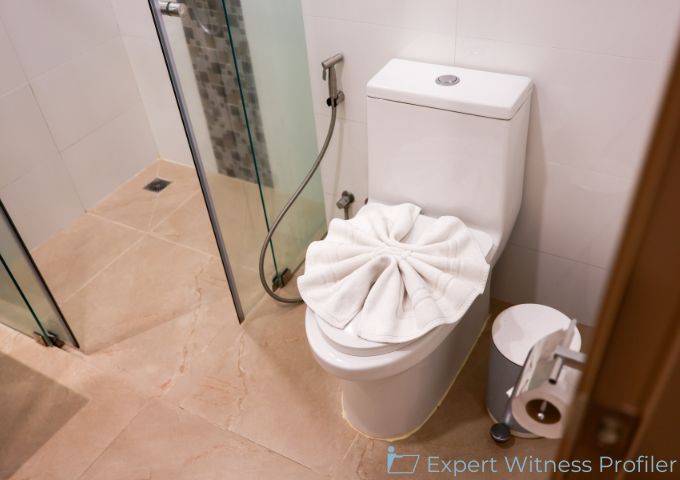
    Plaintiff Tony Joyner alleged that on January 19, 2024, he went to a Walmart store located at 8730 Liberty Road, Randallstown, Maryland. While Joyner “was in the process of utilizing the customer restroom facilities . . . the toilet seat disconnected from the toilet bowl, causing him to fall from the toilet, hit his head, and suffer personal injuries.”

    Plaintiff designated licensed architect Sylvia B. Deyé as a liability expert to opine on whether the water closet where Plaintiff’s fall occurred was dangerous in a manner that caused Plaintiff’s fall, and whether Walmart created the dangerous condition.

    Walmart filed a motion to exclude the testimony of Deyé on the grounds that her opinions were not based on scientific, technical, or specialized knowledge; lacked a sufficient factual basis; intruded upon the ultimate issue to be decided by the jury; and encompassed legal conclusions.
    Architecture Expert Witness

    Sylvia Beatrice Deyé has a master’s degree in architecture and is a registered architect in Maryland and other states. She is a member of several professional associations for architects and has over 30 years’ experience working as an architect.

    In connection with her work as an architect, Deyé has selected plumbing fixtures, specified plumbing fixtures on drawings, and inspected plumbing fixtures after installation. Since 2018, Deyé has also served as an expert consultant in commercial and personal injury litigation. 

    Get the full story on challenges to Sylvia Deyé’s expert opinions and testimony with an in-depth Challenge Study.

    Discussion by the Court

    Deyé’s report consisted of four findings. Deyé opined that: (1) “the unsecured toilet seat was unreasonably dangerous”; (2) “Walmart should have known through adequate inspections and cleaning procedures that the incident toilet seat was not secured to the toilet bowl”; (3) Walmart’s “failure to identify that the incident toilet seat was not secure created the unreasonably dangerous condition that was the cause of Joyner’s injury”; and (4) “Walmart’s failure to have replaced the incident toilet seat and identify that the seat was not stable failed to comply with nationally recognized and accepted industry standards for safe plumbing fixtures and created the unreasonably dangerous condition that was the cause of Joyner’s injury.”

    Following a January 15, 2026 site visit to the Walmart store in question, Deyé supplemented her original report. In her supplemental report, Deyé discussed her inspection of the incident toilet, other toilets, and the conclusions of Walmart’s expert, and concluded that the opinions stated in her original report remain unchanged.

    Analysis

    Although Walmart argued that Deyé lacked expertise regarding commercial toilets, her deposition testimony reflected that she had experience inspecting toilets installed in both residential and commercial settings.

    First, Deyé’s observations regarding the method of installing the toilet seat at issue and the fact that an unstable toilet seat can be dangerous are matters of common knowledge.

    Second, the fact that Deyé’s proposed testimony was not based on scientific, technical, or specialized knowledge, rendered it unreliable and thus inadmissible. Deyé offered no more than her own ipse dixit to support her four proffered opinions, which is “the hallmark of an unreliable opinion.”

    The Court held that Deyé’s opinions were not based on specialized or technical knowledge, which detrimentally affected both the relevance and reliability of her proposed testimony.

    The opinions offered in Deyé’s supplemental report were also excluded. Because Deyé’s supplemental report sought to “add information that is missing from the original report” and does “not attempt to correct the original report because it is misleading,” it is untimely.

    In her supplemental report, Deyé noted that during her site inspection—which occurred nearly two years after the incident in question—she observed that toilet seats in the men’s and women’s restrooms were not secured. The condition of the restrooms, one of which is not at issue in this case, nearly two years after the fact has no bearing on whether Walmart had actual or constructive notice of the defective condition at the time Joyner was injured.

    Held

    The Court granted Defendants’ motion to exclude the testimony of Sylvia B. Deyé.

    Key Takeaway

    Installing a toilet seat does not require specialized or technical knowledge. Accordingly, Deyé’s testimony on this issue was not helpful to the jury and warranted exclusion.

    Case Details:

    Case Caption: Joyner V. Walmart, Inc.
    Docket Number: 1:25cv1300
    Court Name: United States District Court for the District of Maryland
    Order Date: June 03, 2026
  • Testimony of Geology Expert Witnesses about the Environmental Remediation of the Property Admitted

    Testimony of Geology Expert Witnesses about the Environmental Remediation of the Property Admitted

    This breach of contract action arises from a series of agreements relating to real property located at 2497 Adam Clayton Powell Jr. Boulevard in Manhattan (the “Property”) that was contaminated by an oil spill (the “Spill”) originating from non-party ExxonMobil’s adjacent gas station.

    In February 2010, the Plaintiff, 2497 Realty Corp., executed the Contract of Sale of Membership Interests in 2497 Holding LLC, the no-party entity that owns the property, the buyer being Defendant, 2497 Partner LLC (the “Contract”).The parties thereafter amended the Contract to give Defendants sole control over remediation of the Property and settlement negotiations with ExxonMobil. The amendments also created a distribution plan (the “Waterfall”) for any proceeds received from a settlement agreement with ExxonMobil. In June 2011, ExxonMobil settled with 2497 Holding LLC for $1,500,000 (the “Settlement Agreement”).

    In the instant action, commenced in 2014, the Plaintiff alleged that the Defendants breached the Contract by failing to make distributions pursuant to the Waterfall. The key issue in dispute is whether, per the Contract, the Property has been remediated to “its highest and best use under applicable zoning laws, as the Purchaser shall determine in its sole and absolute discretion.” Both parties have commissioned expert reports that document the remediation of the Property.

    The Defendants filed a motion to preclude environmental experts, Andrew Lockwood and Derek Ersbak from testifying at trial. The Defendants argued that (i) the subject reports contain impermissible legal conclusions that reach the ultimate issue in the case; (ii) the Plaintiff’s experts are not qualified to opine on the “highest and best use” of the Property; and (iii) the subject reports fail to satisfy the disclosure requirements of Commercial Division Rule 13(c). 

    Geology Expert Witnesses

    Andrew Lockwood is a graduate of SUNY Potsdam, where he studied geology. He is a licensed Professional Geologist in New York and a licensed Environmental Professional in Connecticut. Moreover, he has over thirty (30) years of experience managing environmental remediation, including the investigation and remediation of land contaminated by gasoline, radiation, and poly fluoroalkyl substances (PFAS).

    Get the full story on challenges to Andrew Lockwood’s expert opinions and testimony with an in-depth Challenge Study

    Derek Ersbak is a graduate of SUNY Binghamton, where he studied biology. He is a licensed Professional Geologist in New York with twenty (20) years of experience in environmental due diligence, environmental compliance and state and federal remedial programs, including the federal Superfund cleanup law, New York’s Brownfield Cleanup Program, and regulations promulgated by New York City’s Office of Environmental Remediation.

    Want to know more about the challenges Derek Ersbak has faced? Get the full details with our Challenge Study report 

    Discussion by the Court

    The necessity of expert testimony in this case is beyond dispute as the subject matter—involving a technical analysis of environmental remediation efforts—is clearly beyond the ken of the typical juror. Moreover, the Court found unavailing the Defendants’ arguments that the Plaintiff’s expert geologists are not qualified to opine on the real estate development concept of “highest and best use,” and that the Contract grants the Defendants sole discretion to determine the highest and best use of the Property.

    The Defendants accurately observed, however, that the Plaintiff’s Reports also includes opinions that veer into contract interpretation and other legal conclusions. Since no expert witness is permitted to testify on matters of contract interpretation or other purely legal issues, the Court held that questions put to Lockwood and Ersbak at trial should be limited to the environmental condition of the Property without requesting opinions on particular legal obligations of the parties under the Contract.

    The Defendants further contended that the Plaintiff’s Reports and the testimony of Lockwood and Ersbak should be precluded because the expert disclosure provided by the Plaintiff did not comply with Commercial Division Rule 13(c) in that the Plaintiff’s Reports fail to list Ersbak and Lockwood’s recent publications and experience as expert witnesses. Moreover, the Defendants also took issue with Ersbak and Lockwood’s joint authorship of the Reply Report. The Court held that these arguments are without merit because there is no bar to jointly authored reports and preclusion of expert testimony based on noncompliance with Commercial Division Rule 13(c) is a question of judicial discretion.

    Held

    The Court denied Defendants’ motion to preclude the testimony and reports of the Plaintiff’s environmental experts, Andrew Lockwood and Derek Ersbak.

    Key Takeaway:

    The Plaintiff’s experts’ opinions are in keeping with the First Department’s reading of the contract language. They do not opine on the issue of what is or is not the theoretical highest and best use of the Property. Rather, they opine on the environmental remediation of the Property—an appropriate issue for expert testimony that is within their area of expertise—taking as their starting point the First Department’s aforementioned analysis of the Contract’s terms, the Property’s current zoning for commercial use, and the Defendants’ current use of the land for commercial purposes.

    Case Details:

    Case Caption: 2497 Realty Corp. V. Fuertes
    Docket Number: 151947/2014
    Court: Supreme Court of New York, New York County
    Order Date: August 21, 2024