Tag: Conduct

  • Law Enforcement Expert Not Allowed to Opine on Training And Supervision

    Law Enforcement Expert Not Allowed to Opine on Training And Supervision

    Plaintiff Fernando Villanueva-Galvez claimed that Officer Eliseo Anaya’s use of a police canine to locate and arrest him constituted excessive force in violation of the Fourth Amendment.

    Villanueva-Galvez proposed to present Ernest Burwell‘s testimony regarding police canine practices. Defendants did not challenge Burwell’s qualifications. Nor did the Defendants seek to preclude Burwell from testifying entirely. Rather, Defendants argued that Burwell should not be permitted to testify about legal conclusions regarding the severity and reasonableness about the use of force in this case, how disputed factual issues should be resolved by the jury, police canine practices for which he cites no reliable data or other support, and purported deficiencies in the City’s canine training and supervision practices for which he cites no relevant professional standards or reliable principles.
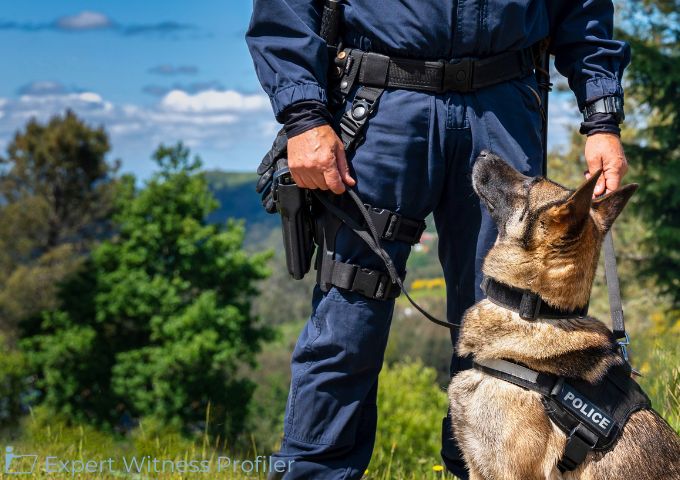
    Law Enforcement Expert Witness

    Ernest Burwell has decades of experience as a police officer, including twenty years of K9 handling and tactical training to K9 units. Burwell holds a POST Advanced Certification and even worked as a canine unit statistical data manager, keeping track of bite ratios, injuries, length of time the dog bit the suspect, and other information required by supervision, about the search, handler, dog, and suspect.

    Discover more cases with Ernest Burwell as an expert witness by ordering his comprehensive Expert Witness Profile report.

    Discussion by the Court

    A. Legal Conclusions Regarding Use of Force

    Defendants sought to exclude Burwell’s opinions regarding the lawfulness and reasonableness of the force used, specifically that Anaya’s deployment of a police dog here constituted “deadly force,” that the “type, degree, and duration of the force were unreasonable and excessive,” and that Anaya’s release of the dog was “unwarranted” and “excessive.”

    Whether Anaya’s actions were “objectively reasonable” in light of the facts and circumstances confronting him is a question for the jury.

    The Court has carefully reviewed Burwell’s expert report, and while the report did recite standards and best practices, the challenged opinions are not tied to those standards and practices. Instead, Burwell proposed to testify, categorically, that Anaya used “deadly,” “excessive,” “unreasonable,” and “unwarranted” force, without explaining what a particular standard requires and how such standard applies to a specific assumed or hypothetical factual scenario.

    B. Interpretation of Disputed Facts

    Defendants sought to exclude Burwell’s opinions regarding his interpretation of Anaya’s body-worn camera (“BWC”) video and other evidence in the record, arguing that such testimony usurps the fact-finding role of the jury.

    As explained above, while it is generally permissible for an expert to testify about whether a specific set of assumed or hypothetical facts does or does not meet relevant standards, the challenged opinions are not tied to any such standards or set of facts. While Burwell included excerpts of different standards in his expert report, he did not link his opinions with any such standards or explain why particular assumed or hypothetical facts did not meet those standards.

    C. Police Canine Practices

    Defendants sought to exclude Burwell’s opinions that “many agencies are not using the police dog as it was intended” and that the “average length of time” of a police canine bite is “10 seconds or less” as “unsupported by any reliable methodology and untethered to the facts of this case.” Villanueva-Galvez initially opposed Defendants’ motion and argued that Burwell’s opinions are based on “decades of law enforcement experience, advanced knowledge of POST standards, and specific work with K9 tactics.”

    However, at the hearing, Villanueva-Galvez conceded that Burwell should not be permitted to testify that “many agencies are not using the police dog as it was intended” and that the “average length of time” of a police canine bite is “10 seconds or less.”

    D. Severity of Force

    Defendants sought to exclude Burwell’s opinion that the use of a police canine “is the most severe use of force of all the less lethal tools/options,” arguing that such testimony is not grounded in identifiable professional standards or reliable analysis.

    The Court agreed. Burwell’s expertise on police-canine practices does not entitle him to tell the jury, as an expert, which non-lethal force is the greatest.

    E. Training and Supervision

    Defendants sought to exclude Burwell’s opinion criticizing the practice of using police canines generally and, in particular, his opinion that the City failed to properly train and supervise its canine handlers and ensure that handlers maintain control of their dogs.

    The Court has carefully reviewed Burwell’s expert report. While the report excerpts certain standards from the SJPD Manual, the challenged opinion is not tied to those standards or explained. Instead, Burwell proposes to testify, categorically, that Ronin was not properly trained.

    Held

    The Court granted the Defendants’ motion to exclude the challenged testimony offered by Ernest Burwell.

    Key Takeaway

    It is generally permissible for an expert to testify regarding best practices and standards and whether an officer’s conduct complies with those best practices and standards. Such testimony could include whether deployment and handling of the police canine here did or did not comply with such practices or standards. The problem here is that it is not clear to the Court whether such an opinion is actually disclosed or on what basis Burwell intended to provide such testimony.

    Case Details:

    Case Caption: Villanueva-Galvez V. City Of San Jose
    Docket Number: 5:24cv9055
    Court Name: United States District Court, California Northern
    Order Date: June 04, 2026
  • Economics Expert Allowed to Opine on Constant Inflation 

    Economics Expert Allowed to Opine on Constant Inflation 

    This is a consolidated action for securities fraud brought by Lead Plaintiff Los Angeles County Employees Retirement Association on behalf of a putative class of investors in the Ohio-based electrical utility company FirstEnergy Corporation. Plaintiffs alleged violations of the Securities Exchange Act of 1934 and the Securities Act of 1933 by FirstEnergy, its named officers and directors, and a group of underwriters, in connection with the Ohio House Bill 6 scandal.

    W. Scott Dalrymple was retained as an expert witness on behalf of Plaintiffs, and submitted an expert report in June 2022 analyzing whether FirstEnergy’s common stock traded in an efficient market and addressing whether damages could be calculated using a common methodology. Defendants filed a motion to exclude Dalrymple as an expert.

    Defendants did not challenge Dalrymple’s qualifications, nor did they challenge the reliability of an event study methodology generally. Instead, the issue advanced by Defendants is whether Dalrymple has sufficiently explained how he would or could apply his proposed methodology to the facts as alleged in the Complaint.

    Plaintiffs argued that Dalrymple has reliably applied his proposed technique to the facts of the case and has offered a reasonable view of constant inflation that could, at any rate, rest on assumptions of liability at this stage in the case.

    Economics Expert Witness

    William Scott Dalrymple is an economist and a CFA charter holder with extensive experience in economic, financial, and statistical analyses. During his career, he has worked on issues relating to the analysis of economic damages involving securities litigation, business valuation, structured finance, financial derivatives, antitrust, intellectual property, and breach of contract.

    Moreover, Dalrymple holds a Master of Science in Economics from the London School of Economics and Political Science and a Bachelor of Business Administration in Finance and Business Honors from the University of Texas at Austin. 

    Get the full story on challenges to W. Scott Dalrymple’s expert opinions and testimony with an in-depth Challenge Study

    Discussion by the Court

    To begin with, Defendants did not contest the testing, peer review and publication, or acceptance of event study methodologies generally; instead, they attempt to undermine the possible accuracy of Dalrymple’s proposed methodology in this particular instance. But Defendants advance this argument by misconstruing Dalrymple’s testimony and recharacterizing Plaintiffs’ theory of the case.

    Plaintiffs have presented a viable, consistent, and classwide approach to damages. Their theory is that Defendants “concealed corrupt conduct,” causing “FirstEnergy’s stock to trade at an inflated price throughout the Class Period” such that “revelations of Defendants’ corruption, beginning in July 202, caused this inflation to dissipate, damaging investors.” Under Plaintiffs’ theory, it may be the case that inflation is constant, or it may be variable. The Court need not reach that argument, or Defendants’ concern about Plaintiffs’ supposedly new criminal enterprise theory. Even if the inflation is time-varying, the fact that a damages model does not account for such variation is not a reason to discount the damages model at this stage.

    In sum, the Court is satisfied by Dalrymple’s testimony that any potential time variation in inflation could be accounted for under his proposed event study (or out-of-pocket) damages methodology. Overall, Defendants’ challenges to the accuracy of Dalrymple’s proposed methodology go to the weight of the evidence, not to its admissibility.

    To the extent that Defendants challenge Dalrymple’s testimony as inconsistent with his earlier expert reports or violative of Rules 26 or 37, neither argument is availing.

    Rule 26 “contemplates that the expert will supplement, elaborate upon, explain and subject himself to cross-examination upon his report.” That is what Dalrymple did, at Defendants’ request.

    Held

    The Court denied the Defendants’ motion to exclude the testimony of W. Scott Dalrymple.

    Key Takeaway

    Experts are permitted wide latitude in their opinions, including those not based on firsthand knowledge, so long as the expert’s opinion has a reliable basis in the knowledge and experience of the discipline.

    Case Details:

    Case Caption: In re Firstenergy Corp. Securities Litigation
    Docket Number: 2:20cv3785
    Court Name: United States District Court for the Southern District of Ohio, Eastern Division
    Order Date: April 30, 2026
  • Crisis Management Expert Allowed to Opine on Corporate Behavior

    Crisis Management Expert Allowed to Opine on Corporate Behavior

    In this certified class action, the Plaintiffs-Christopher Degroot, Steven Showalter, and all others similarly situated-alleged that their former employer violated the federal Worker Adjustment and Retraining Notification Act (“WARN Act”) and the Nebraska Wage Payment and Collection Act (“NWPCA”) when it terminated them without notice and without paying accrued but unused paid time off.

    The Defendants are the Plaintiffs’ former employer, Nebraska Book Company, Inc., and Nebraska Book’s parent company, Nebraska Book Holdings, Inc. (collectively, “Nebraska Book”). The Plaintiffs also asserted that two other companies, AB Lending SPV I d/b/a Mountain Ridge Capital (“Mountain Ridge”) and Concise Capital Management (“Concise”), are liable based on their financial relationships with Nebraska Book.

    Concise acquired 100 percent of the equity in Nebraska Book by 2021, becoming the company’s “accidental owner.” After 2018, Concise did not take “a penny” from Nebraska Book to pay its investors. As owner, Concise had the power to appoint all of the directors on Nebraska Book’s board. During the relevant time, there were three board members, all appointed by Concise. They were Grossman; Gary Shapiro, Nebraska Book’s CEO; and Thomas Krasner, a principal, cofounder, and minority owner of Concise.

    The Plaintiffs filed a motion to exclude Concise’s expert, Daniel Dooley, under the Daubert standard.

    Crisis Management Expert Witness

    Daniel F. Dooley has a strong national reputation in crisis management, operational improvement, debt refinancing & restructuring, and C-level positions. He is a frequent speaker at industry conferences and a regular author for industry periodicals. Dooley has served on the Board of Directors of both the American Bankruptcy Institute (ABI) and the Turnaround Management Association (TMA).

    Dooley holds a Bachelor’s degree in Business Administration and a Master’s degree in Business Administration with a focus on Finance from the Carlson School of Management at the University of Minnesota in Minneapolis.

    Want to know more about the challenges Daniel Dooley has faced? Get the full details with our Challenge Study report.

    Discussion by the Court

    The Plaintiffs argued that Dooley’s opinions would not be helpful to a factfinder, and that some of his opinions are inadmissible legal conclusions or factual narratives. 

    The Plaintiffs also argued that Dooley’s testimony failed to account for contrary evidence. Concise conceded that Dooley’s opinion—that Concise was not a “joint employer”—is an inadmissible legal conclusion.

    But Dooley’s opinions about whether Krasner’s conduct was “appropriate”-that is, whether his behavior was “perfectly consistent with the norms of corporate behavior”-is a key issue in this case, if not dispositive. While the Plaintiffs complained that Dooley testified as to what is “appropriate” or “proper” without articulating precise definitions or standards, Dooley’s opinions lie in his professional experience, which is a proper foundation.

    The Plaintiffs’ next argument is that Dooley’s testimony, after “stripping away his ‘appropriateness’ opinions and legal conclusions left only his recitation of the facts and his inferences from them.”

    Because the Court is not “stripping away” the “appropriateness” opinions, this argument appears to be moot. But nothing in this order precluded the Plaintiffs from objecting to the extent Dooley’s testimony at trial becomes a factual narrative, rather than an explanation of his expert opinion.

    Finally, the Plaintiffs asserted that exclusion is proper because Dooley failed to account for contrary evidence. But such a failure is not a basis to exclude. Rather, these arguments go to weight, not admissibility.

    Held

    The Court granted in part and denied in part the Plaintiffs’ motion to exclude the testimony of Daniel Dooley.

    Key Takeaway

    An expert may, and often must, assume that the party for which he is testifying can prove the facts upon which he relies. The method for testing those assumptions lies in “vigorous cross-examination, presentation of contrary evidence, and careful instruction on the burden of proof.”

    Case Details:

    Case Caption: Degroot V. Nebraska Book Company, Inc.
    Docket Number: 4:23cv3041
    Court Name: United States District Court, Nebraska
    Order Date: April 23, 2026
  • Emergency Medicine Expert’s Standard of Care Testimony Excluded

    Emergency Medicine Expert’s Standard of Care Testimony Excluded

    Plaintiff Chanada Robinson (“Plaintiff Robinson”) is the mother of Anthony J. Thompson, Jr., who was involved in an incident at East Austin Magnet High School (“Austin East”) that ended his life on April 12, 2021.

    Plaintiff Robinson alleged violations of the Fourth Amendment, deliberate indifference to Thompson’s medical needs, assault and battery, and intentional infliction of emotional distress.

    Plaintiff filed the expert witness report of James A. Wilson, M.D. According to Wilson, “the purpose of [his] report is to assess the physical and psychological impact upon Thompson when he was denied medical care following being shot in the chest at close range by [Defendant] Clabough.”

    Defendants filed a joint Daubert motion to exclude Wilson’s opinions pursuant to Rule 702 of the Federal Rules of Evidence.

    Emergency Medicine Expert Witness

    James Andrew Wilson, M.D. is a recent member of US Acute Care Solutions. From 2018-2023 he worked for Envision Physician Services, where he was an Assistant Medical Director of an Emergency Department and an EMS Medical Director for several local agencies.

    Wilson received an MD and MBA in one of the first joint degree programs in the country. He completed a residency in emergency medicine at Christ Hospital and Medical Center (also in the Chicago area).

    Want to know more about the challenges James Wilson has faced? Get the full details with our Challenge Study report.

    Discussion by the Court

    Defendants contended that Wilson cannot offer an opinion about any breach of standard of care because (1) it is a legal conclusion, (2) he is not qualified to offer an opinion about the conduct of law enforcement officers, and (3) his opinion is not reliable.

    A. Qualifications

    Defendants argued that Wilson cannot offer any opinion about the breach of standard of care because he is not qualified to provide an opinion about the conduct of law enforcement officers.

    Wilson opined that the individual Defendants “failed to meet the standard of care for first responders interacting with a gunshot victim.”

    Plaintiff outlined Wilson’s educational and experience, which includes experience with first responder triage and teaching about the standard of care for first responders. But Plaintiff has not provided any evidence that Wilson is qualified to testify about the standard of care as it relates to a law enforcement officer.

    B. Legal Conclusion

    Defendants asserted that Wilson cannot offer an opinion that they breached the standard of care because that is a legal conclusion.

    Plaintiff did not respond to this argument. Given that, the Court found it unopposed and the proposition conceded.

    C. Reliability

    Defendants argued that Wilson’s opinion that they “breached the standard of care by not providing pain medication or by not ensuring that the paramedics (allegedly at the scene) gave pain medications to Thomspon” is unreliable.

    Plaintiff, once again, did not respond to Defendants’ argument. Therefore, it too is unopposed and the proposition conceded.

    But the Court would also exclude the opinion because it is unreliable. Wilson stated that a person must be conscious to feel pain and that Thompson was conscious between 3:15:28 and 3:19:22.

    Defendants have submitted evidence showing that EMS personnel were not at the scene until about 3:20:30, after Thompson became unconscious, and that Officer Willson left with the assistance of KPD officers at 3:18:20.

    Held

    The Court granted Defendants’ joint Daubert motion as to Plaintiff’s expert Dr. James Wilson, M.D.

    Key Takeaway

    An expert’s opinion must be supported by ‘more than subjective belief and unsupported speculation’ and should be supported by ‘good grounds,’ based on what is known.

    Case Details:

    Case Caption: Robinson V. Baldwin
    Docket Number: 3:22cv125
    Court Name: United States District Court, Tennessee Eastern
    Order Date: December 29, 2025
  • Civil Rights Expert Witness’ Opinions About Defendant’s Conduct Limited

    Civil Rights Expert Witness’ Opinions About Defendant’s Conduct Limited

    Plaintiff, Erika Pogorzelska filed this action in August 2019. She alleged in her remaining claims that VanderCook, a school she attended, violated Title IX of the Education Amendments of 1972 (“Title IX”) and the Illinois Civil Rights Remedies Restoration Act by its deliberate indifference to her allegations that she was sexually assaulted and battered by a classmate, former Defendant Eric Ballenger, and subsequently harassed.

    Defendant retained Saundra Schuster to testify as an expert on industry standards for Title IX compliance, investigations, and responses.

    Plaintiff sought an order barring Schuster from offering the following five opinions that are contained in her Amended Confidential Expert Report: (a) Schuster “cannot see any basis in the record to conclude that [Defendant’s] actions were clearly unreasonable or exposed [Plaintiff] to an ongoing hostile environment on the basis of sex.” (b) “Rather than being discriminated against, it appears from the record that [Plaintiff] was exceptionally well-accommodated and cared for by [Defendant] in ways that met or exceeded industry standards for supportive measures.” (c) Defendant “responded promptly and equitably to allegations of sexual assault made by” Plaintiff. (d) Defendant “responded promptly and diligently to [Plaintiff’s] complaints of violations of the No Contact Directive.” (e) Defendant’s “decision on the evidence was reasonable.”

    Plaintiff maintained that Schuster’s opinions about Defendant’s conduct should be barred because they consisted of legal conclusions equivalent to testimony that Defendant acted in compliance with Title IX and they impermissibly tell the jury how to decide the issues.

    Civil Rights Expert Witness

    Saunie Schuster is a recognized expert in preventive and civil rights law for education, notably in the fields of harassment, discrimination and sexual misconduct and violence, ADA and disability issues and the First Amendment, Schuster has extensive experience and expertise in, and routinely advises clients on, the First Amendment and campus access issues; risk management and liability; behavior intervention and threat assessment; student discipline and campus conduct; intellectual property and employment issues. 

    Get the full story on challenges to Saundra Schuster’s expert opinions and testimony with an in-depth Challenge Study. 

    Discussion by the Court

    It should be noted that Plaintiff previously moved to exclude Schuster’s opinions in their entirety under Federal Rule of Evidence 702 and Daubert
    v. Merrell Dow Pharmaceuticals, Inc
    ., 509 U.S. 579 (1993)
    .

    Although Plaintiff previously objected to most of the opinions she now seeks to exclude, she challenged Schuster’s testimony only generally as consisting of improper legal conclusions and did not raise that ground in relation to the specific statements now at issue.

    The Court excluded Schuster’s testimony with respect to a certain section of her amended report but declined to preclude her from testifying entirely.

    The parties remained free to raise appropriate objections to specific aspects of expert testimony and proceeded to address in turn the five statements identified by Plaintiff.

    The Court held that Schuster’s opinions that there is no basis to conclude that Defendant acted unreasonably or exposed Plaintiff to a hostile environment are obvious conclusions of law inappropriate for expert testimony. It also permitted Schuster to testify that Plaintiff was “exceptionally well-accommodated and cared for,” as long as that opinion is tied to industry standards. But the first portion of the statement (“rather than being discriminated against”) is a legal conclusion that Plaintiff was not discriminated against and is therefore inadmissible.

    The Court held that Plaintiff’s motions in limine are denied as to testimony that Defendant responded “promptly” and “diligently.” It, however, added that Schuster, may not testify that Defendant responded “equitably.”

    When Schuster expressed two points: one, that Defendant’s decision was “reasonable,” and two, that it comported with industry standards, the Court permitted Schuster to testify as to the latter point, but not the former.

    Held

    The Court granted in part and denied in part the Plaintiff’s motion in limine to bar the testimony of Defendant’s expert, Saundra Schuster.

    Key Takeaway:

    The Court allowed Schuster to provide testimony as to whether Defendant’s responses and investigation comported with industry standards and practice on Title IX responses and investigations but not as to whether Defendant violated Title IX or whether Plaintiff has proven the elements of a Title IX claim, including whether Defendant acted unreasonably.

    Case Details:

    Case Caption: Pogorzelska V. Vandercook College Of Music
    Docket Number: 1:19cv5683
    Court: United States District Court, Illinois Northern
    Order Date: June 26, 2024