On July 30, 2022, Plaintiff Gary Stanhope attended a Luke Bryan concert at the Xfinity Theatre in Hartford, Connecticut with friends. The group stood on the asphalt walkway in the general admission area, between Sections 500 and 600, behind the railing separating the lawn from the reserved seating. At approximately 10:00 P.M., Stanhope was assaulted and sustained serious injuries.
Russell Kolins, Stanhope’s liability expert, opined that Live Nation failed to adequately deploy security, failed to conduct a written risk assessment, and failed to implement adequate security policies and procedures.
Defendant Live Nation Worldwide, Inc. d/b/a Xfinity Theatre filed this motion to preclude the testimony of Kolins due to his alleged lack of qualification as an expert for (1) large concert venue security; (2) the alleged unreliability of Kolins’ analyses; (3) and the claimed lack of “fit” of his opinions to the facts of the case.
Security Expert Witness
Russell David Kolins is a practicing Licensed Private Detective and Security Consultant/Practitioner. He celebrated his 55th year in private practice in August 2024. He is a Board-Certified Criminal Defense Investigator and holds a specialized Bachelor of Science Degree in Security Management. Kolins served three terms as the elected Chairman of the ASIS International Hospitality, Entertainment and Tourism Council.
Kolins possesses years of experience as a security consultant, holds a certification and bachelor’s degree in Security Management, and served as leadership at the ASIS International Hospitality, Entertainment, and Tourism Security Council. He has been admitted to testify as a security expert in other courts and has spoken on premises security and crowd management.
Live Nation argued that Kolins has never managed a 22,000-person venue and thus lacked the necessary qualifications. However, the Court held that Kolins does not need to match the exact subtype of security venue.
B. Kolins’ Methodology is Reliable
Live Nation argued that Kolins’ expert testimony is not based on an identifiable methodology. It asserted that Kolins’ report and depositions reveal no identifiable methodology for his conclusions and that he did not review any history of prior incidents, did not review crime data, did not read witness depositions, or conduct a site visit.
The Court found that Kolins explained how his analysis, methodology, and sources met the standard required for him to testify.
Kolins details his methodology and application to the facts of this case. He utilized authorities such as the American National Standards Institute on Crowd Management and the International Association of Venue Managers. Kolins then details how he took the various factors from the methodology and applied them to the facts at hand. He discussed the foreseeability of crowd density and congestion, as well as alcohol sales. Kolins analyzed the deployment of security personnel and cameras. Kolins also discussed the security planning and protective measures utilized by Live Nation. Finally, he addressed the response of security personnel to crises and incidents. In each section, Kolins references the standards of the security community and analyzes how Live Nation met or did not meet those standards.
C. Kolins’ Opinions Fit the Facts of the Case
Live Nation argued that Kolins’ testimony did not fit the facts of the case. Live Nation asserted that the literature cited is dated, and the opinions are boilerplate or general.
Kolins offered testimony that is important to the issues of negligence. First, he provided an overview of the responsibility of venue managers such as Live Nation and the duties of the facility supervisors regarding security policy and procedures. Additionally, Kolins offered his expert testimony as to the crowd management plans for concert events speaking on the seating arrangement, crowd flow, density of concertgoers, and prior incidents at the concert. Finally, Kolins offered his opinions as to why the security was inadequate including how no security appears to have witnessed the assault itself, the lack of video camera surveillance, and the venue’s responsibility to identify and correct those issues. The Court found that Kolins provided testimony that fits the facts of the case. He described the responsibilities, standards, and alleged failings of Live Nation in connection with the assault on Stanhope.
Held
The court denied Live Nation’s motion to preclude the testimony of Russell Kolins.
Key Takeaway
An expert’s credentials do not need to be unassailable in order for their testimony to be admissible. Federal Rule of Evidence 702 stated that “if scientific, technical, or other specialized knowledge will assist the trier of fact to understand the evidence or to determine a fact in issue, a witness qualified as an expert by knowledge, skill, experience, training, or education, may testify thereto in the form of an opinion or otherwise.”
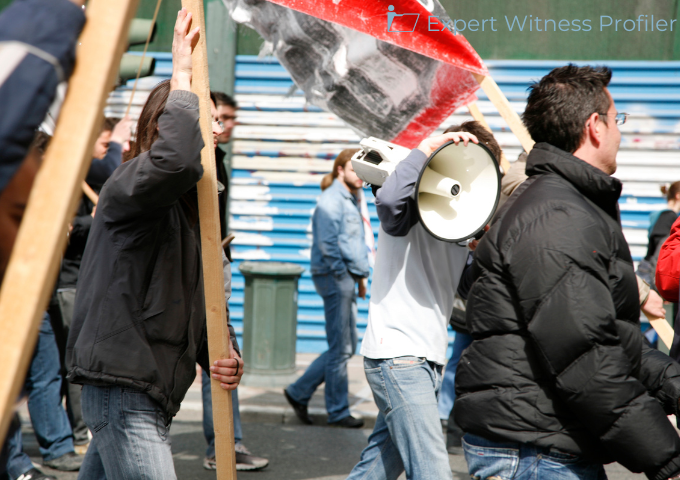
This matter involves an incident that occurred on May 29, 2020, while Plaintiff, David Zuniga was present during the George Floyd protests in Grand Park, Downtown Los Angeles. During this time, Zuniga and his experts contended that he was struck with a nonlethal projectile to his head by Defendant Officer Aaron Green. Officer Green, and the other named officer Defendants were assisting in controlling a crowd of protestors who were unlawfully protesting in the Grand Park area, after an unlawful assembly was declared and a dispersal order had been given.
Defendant filed a motion to preclude Plaintiffs’ Law enforcement expert, Roger Clark‘s report and opinions on the grounds that such evidence is irrelevant, is improper and misstates the law, is speculative, and would unduly prejudice Defendants. Plaintiff opposed Defendants’ motion.
Law Enforcement Expert Witness
Roger Clark is a retired law enforcement professional with 27 years of experience in the Los Angeles County Sheriff’s Department (LASD). He was hired on December 1, 1965, and served until his retirement on March 31, 1993. Throughout his distinguished career, he held several key positions, including six years as a Deputy Sheriff, six years as a Sergeant, and 15 years as a Lieutenant. Roger retired with a California Peace Officer Standards and Training (POST) Advanced Certificate and is a graduate of the POST Command College, class #5, 1988.
Defendants argued that Clark’s first opinion should be excluded because it contains improper legal conclusions. The Court agreed. Clark’s first opinion stated that the LAPD was obligated to protect the protestors’ First Amendment rights and that per the video recordings, protestors had exercised these rights peacefully and lawfully. An expert cannot testify to a matter of law amounting to a legal conclusion. Clark’s opinion that the LAPD was obligated to protect protestors’ First Amendment rights and that protestors were peaceful and lawful constitute impermissible legal conclusions that invaded the province of the jury. Accordingly, the Court granted Defendants’ motion as to the exclusion of Opinion 1.
Opinion 2
Defendants argued that Clark’s second opinion, specifically that the LAPD deliberately inflicted significant indiscriminate force on the many persons in the crowd, including Zuniga, who was lawfully and innocently present, also improperly asserts a legal conclusion. They further argued that this opinion improperly opines on the mental state of the LAPD officers when Clark states that officers deliberately inflicted indiscriminate force on the crowd. Defendants offer no argument as to why the remaining statements in the second opinion should be excluded. The Court found that this portion of Clark’s second opinion both improperly states a legal conclusion that the LAPD used indiscriminate force and that Zuniga was lawfully present and improperly opined on the mental state and intent of the LAPD officers that officers deliberately inflicted indiscriminate force. Accordingly, the Court granted Defendants’ motion as to the exclusion of this portion of Opinion 2.
Opinion 3
Defendants argued that Clark’s third opinion that the LAPD’s use of impact weapons against the crowd was improper and in violation of well-known law enforcement tactics is irrelevant because any use of force against others besides Plaintiff is wholly irrelevant to this action. Defendants are incorrect. Plaintiff brings three Monell claims alleging that the LAPD maintains an unconstitutional policy, custom, or practice, including of using excessive force in crowd control situations including but not limited to engaging with peacefully protesting individuals. Clark’s opinion regarding the circumstances under which Defendants’ actions were taken and the LAPD’s use of weapons in a crowd control situation are relevant to Plaintiff’s claims. Accordingly, the Court denies Defendants’ motion as to Opinion 3 on this ground.
Opinion 4
Defendants argued that Clark’s fourth opinion should be precluded because there was no arrest in this case, and whether or not the other protestors were in violation of the law such that arrest of protestors was lawful is irrelevant to Plaintiff’s claims. As stated above, Defendants’ conduct towards the crowd of protestors is relevant to Plaintiff’s Monell claims. The LAPD’s policies, customs, and practices related to when persons are subject to use of police force and whether crowds are given the opportunity to disperse voluntarily before any arrests take place is relevant to these claims. Defendants further argue that this testimony is irrelevant, immaterial, and not helpful to the jury for the same reasons they contend Opinion 3 is similarly irrelevant. For the same reasons, the Court found that testimony regarding the LAPD’s procedures and policies are relevant and admissible. Accordingly, the Court denied Defendants’ motion as to Opinion 4.
Opinion 6
Defendants argued that Clark’s sixth opinion should be excluded because the opinion does not explain how the LAPD’s policy is insufficient or how the LAPD lacks an adequate policy regarding dispersal orders. Contrary to Defendants’ contentions, Clark did substantiate his opinion by explaining what the LAPD failed to communicate and what police training and policies equip officers to sufficiently announce crowd dispersal orders. Clark also stated that in reviewing documents indicating LAPD made a public announcement via Twitter, in his opinion this was inadequate notice because it was not announced verbally and assumed that persons present had access to electronic announcements. Clark is qualified to testify about police training standards and policies given his experience in this area. Accordingly, the Court denied Defendants’ motion as to Opinion 6.
Opinion 7
Defendants argued that Clark’s seventh opinion that LAPD engaged in a number of tactical errors that would or should have eliminated the need for the use of force and thus were a causative factor in the police’s use of force is speculative and unsubstantiated. Defendants argued that the opinion does not explain how the LAPD’s policy is insufficient, and that his conclusions as to what actions LAPD failed to take lack foundation and are misleading and conclusory therefore not helpful to the jury. Opinion 7 did not mention LAPD policies, rather, it states that LAPD made tactical errors and identifies the errors LAPD made during the events at issue. However, Clark failed to explain how he deduced that LAPD committed these errors or what materials inform his opinion. Therefore, the Court agreed that this opinion lacks foundation. Accordingly, the Court granted Defendants’ motion as to Opinion 7.
Opinion 8
Defendants argued that Clark’s eighth opinion that LAPD failed to use well-known law enforcement methods that they were, or should have been, trained on for addressing the small group of unlawful individuals within the much larger group of lawful protestors—is not sufficiently helpful to the jury to be admissible. Defendants argue that Clark does not explain how the LAPD’s policy is insufficient. Clark’s opinion identified methods of control that LAPD should have used and states that he reviewed the video recordings at the time of Zuniga injuries, that the methods LAPD used instead dispersed specific persons with intent to change the peaceful demonstration to a violent encounter into the larger crowd of lawful protestors. Thus, Clark identified the bases for his opinion. Accordingly, the Court denied Defendants’ motion as to Opinion 8.
Testimony regarding LAPD’s policies and procedures
Defendants further argue that Opinions 3, 4, 5, 6, 7, 8, and 9 are irrelevant, immaterial, not helpful to the jury because an alleged violation of Sheriff’s Department policy does not equate to a violation of the United States Constitution. Clark’s opinion regarding whether Defendants’ conduct comported with applicable procedures and policies on the day of the incident does not constitute a legal opinion or conclusion. Further, the testimony is relevant to the subject of Defendants’ conduct, including the use of force and crowd dispersal methods, during the events giving rise to this action. Accordingly, the Court denies Defendants’ motion to exclude these opinions on this ground.
Testimony regarding the mechanism of Plaintiff’s alleged injury and the alleged medical issues
Defendants argued that Clark’s testimony about issues such as the mechanism of injury and the source of injury should be excluded because Clark is not qualified as a medical doctor. Defendants argued that Clark was retained as a police expert and as such, his testimony should be limited only to areas involving police tactics. Plaintiff has not offered Clark as a ballistics expert or medical expert, and nothing in Clark’s report indicates that he is qualified to testify about what caused Plaintiff’s injury. Accordingly, the Court granted Defendants’ motion to exclude testimony from Clark regarding the mechanism or source of Plaintiff’s injury.
Held
The Court granted Defendant’s motion to exclude Clark’s first opinion that the LAPD was obligated to protect the protestors’ First Amendment rights and that the protestors were peaceful and lawful.
The Court granted Defendant’s motion to exclude Clark’s second opinion that the LAPD deliberately inflicted indiscriminate force on the crowd and that Mr. Zuniga was lawfully present.
The Court denied Defendant’s motion to exclude Clark’s third opinion regarding the LAPD’s improper use of impact weapons and violation of law enforcement tactics.
The Court denied Defendant’s motion to exclude Clark’s fourth opinion regarding the LAPD’s failure to provide an opportunity for protestors to disperse voluntarily.
The Court denied Defendant’s motion to exclude Clark’s sixth opinion regarding the inadequacy of the LAPD’s dispersal order policy.
The Court granted Defendant’s motion to exclude Clark’s seventh opinion that the LAPD’s tactical errors were a causative factor in the use of force.
The Court denied Defendant’s motion to exclude Clark’s eighth opinion regarding the LAPD’s failure to use appropriate law enforcement methods to address unlawful individuals within the crowd.
The Court denied Defendant’s motion to exclude Clark’s opinions regarding LAPD’s policies and procedures, finding that they were relevant to the conduct of the officers and the claims made by Plaintiff.
The Court denied Defendant’s motion to exclude testimony regarding the mechanism of Plaintiff’s alleged injury and the alleged medical issues.
Key Takeaways:
Defendant challenged Clark’s methodology and opinions in several areas. The Court excluded Clark’s opinion on the LAPD’s obligation to protect protestors’ First Amendment rights and its conduct during the protest because it constituted a legal conclusion. The Court also struck Clark’s opinion on the LAPD’s use of indiscriminate force because it improperly opined on the mental state and intent of the LAPD officers.
The Court also denied the motion to exclude Clark’s opinions on LAPD’s policies and procedures, as well as testimony regarding the mechanism of Plaintiff’s injury, finding them relevant to the case.
Clark’s opinion on LAPD’s tactical errors was excluded due to lack of foundation.
Please refer to the blog previously published about this case: