Tag: Customer

  • Survey Research Expert Was Allowed to Opine on Customer Experience

    Survey Research Expert Was Allowed to Opine on Customer Experience

    State of Connecticut and Federal Trade Commission, sued Chase Nissan LLC, d/b/a Manchester City Nissan (“MCN) and multiple individuals, alleging that MCN, along with others, acted together to defraud thousands of consumers. The Plaintiffs alleged that the Defendants charged consumers for additional products or services (“addons”) that consumers never agreed to purchase. The Plaintiffs claimed that the Defendants effected unauthorized charges in multiple ways, including add-ons inserted into unaware consumers’ closing documents or charging consumers for add-ons that MCN told consumers were free.

    Plaintiffs’ expert, Dr. Jessica Broome, conducted a customer experience survey about add-on products or services offered at MCN (the “Broome Survey”).

    The Defendants argued that the methodology Broome applied to her survey was significantly flawed, and therefore, the results and conclusions were insufficiently probative.

    Survey Research Expert Witness

    Dr. Jessica Broome received a PhD in Survey Methodology from the University of Michigan, an MS in Applied Social Research from Hunter College of the City University of New York, and a BA in Sociology from Connecticut College. She has worked as a primary researcher for the past 24 years, designing and conducting quantitative (survey) and qualitative (focus groups, ethnographies, interviews) research for clients in a range of sectors.

    Get the full story on challenges to Jessica Broome’s expert opinions and testimony with an in-depth Challenge Study.

    Discussion by the Court

    Specifically, the Defendants argued that (1) the Broome Survey included misleading questions; (2) the Survey disclosed the FTC as the sponsor and the purpose of the survey; (3) that respondents were able to change their previous answers; and (4) that the population selected was underinclusive.

    A. Question A1 is Clear and Unambiguous

    Question A1 stated: “Did you agree to pay extra for any of the following add-on products or services when purchasing this vehicle?” Respondents were then presented with a list of eleven possible add-on products and services and, for each, asked to answer “Yes,” “No,” or “Not Sure.”

    Based upon the responses received to Question A1, Broome concluded that “Manchester City Nissan charged the vast majority of customers surveyed (88%) for at least one add-on that they did not agree to pay extra for or led customers to believe that the add-on was required rather than optional.”

    Broome further concluded, based upon respondents’ answers to Question A1, that “Manchester City charged a substantial percentage of customers surveyed (42%) for multiple add-ons that they did not agree to pay extra for or led customers to believe that the add-ons were required rather than optional.”

    The Defendants asserted that this is an ambiguous question and unclear about the very thing that the survey was trying to measure: whether consumers paid for an add-on product or service without agreeing to do so.

    When an unclear question is included in a survey, it may threaten the validity of the survey by distorting the responses or by error if the respondents do not understand. However, there is no indication that the questions were misleading or that the respondents did not understand the question.

    As explained by Broome, her team conducted two rounds of cognitive interviews to check the understanding of the questions. After a pretest respondent completed each survey question online or over the phone, the interviewer posed a series of follow-up questions, called “probes”, aimed at determining whether the survey questions were understood by respondents as intended.

    Additionally, small ambiguities in surveys go to the weight of the survey as evidence, not to its admissibility.

    B. Disclosure of the FTC as Sponsor is Consistent with Reliable Survey Methodology

    Second, the Defendants argued that the survey disclosed the FTC as the sponsor and thus is unreliable. The Defendants asserted that all the individuals who made up Broome’s survey population knew that the FTC sought the information regarding car purchases. The Defendants claimed that identifying the FTC as a sponsor injects potential bias into the survey by suggesting certain preferred responses.

    Courts from across the country have repeatedly accepted as reliable consumer surveys that disclose the FTC as a sponsor where the surveyor has taken steps to hide the purpose of the survey. Broome asserted that she took steps to hide the purpose of the survey. The invitation included no references to litigation against MCN and stated that the purpose was to learn about general car purchases over the past five years.

    The survey did not focus on MCN but showed a randomized list of four local dealerships. Additionally, the FTC may bring litigation before a consumer survey is published.

    C. Backwards Navigation is Consistent with Reliable Survey Methodology

    Third, the Defendants argued that the backward navigation allowed consumers to change their answers and thus is unreliable. The
    Defendants claimed that later questions could suggest certain conclusions regarding whether the consumer agreed to pay extra for the add-ons. Because the consumers had the ability to navigate backwards on the survey, the responses potentially could be skewed.

    The defense, however, presented no evidence that the backward navigation is a design flaw. The defense retained a survey expert to prepare a rebuttal of Broome’s work, yet they did not use their expert’s opinion in their motion. Plaintiffs argued that Broome utilized standardized and approved methodology.

    The Court held that Broome’s work is consistent with reliable methodology. Further, issues raised by the Defendant would go to weight rather than admissibility.

    D. The Survey Population Selected is Consistent with Reliable Survey Methodology

    Fourth, the Defendants argued that the consumer population was underinclusive; thus, the survey is unreliable.

    The Defendants asserted that the target population was adults who purchased a vehicle from MCN between January 2019 and December 2023 and were charged for at least one add-on. The defense claimed that Broome pulled potential participants from lists provided to her by the FTC for all add-on transactions at MCN, and this population excludes all customers who purchased a vehicle and did not purchase an add-on. They asserted that this population, by design, intentionally excluded customers who, if included, would have greatly decreased Broome’s numbers.

    Broome’s survey was not intended to represent consumers who were not charged for add-ons so there is no reason to include such consumers in the target population. Even if Plaintiffs were to expand the target population as suggested the methodology would find similar results. The Defendants’ argument that Broome should have surveyed all consumers is, therefore, without basis.

    The Court held that Broome’s survey is designed with methodology consistent with the Reference Guide on Survey Research and legal precedent regarding FTC surveys. In other words, Broome’s technique used reliable survey methodology.

    Held

    The Court denied the Defendants’ motion to preclude the testimony of Jessica Broome.

    Key Takeaway

    Broome’s survey followed correct methodology and legal best
    practices. Sponsorship by a governmental third party may not automatically suggest a certain kind of preferred response. Moreover, courts have repeatedly accepted consumer surveys that disclose the FTC as the sponsor.

    Case Details:

    Case Caption: Federal Trade Commission V. Chase Nissan LLC
    Docket Number: 3:24cv12
    Court Name: United States District Court, Connecticut
    Order Date: March 16, 2026
  • Accounting Expert Was Not Fully Allowed to Opine on Calculated Future Lost Profits 

    Accounting Expert Was Not Fully Allowed to Opine on Calculated Future Lost Profits 

    Plaintiff Barrett Business Services, Inc. (“BBSI”) is a human resources management company that contracts with small and medium-sized businesses to provide human resource management solutions, including temporary staffing and professional services. It provided these services to employers throughout the Yakima area and particularly to fruit growers and other agricultural companies.

    On April 23, 2014, BBSI hired Defendant Charles Colmenero (“Colmenero”) as an area manager to start on May 12, 2014. Colmenero quit BBSI on July 12, 2022. On July 17, 2015, BBSI hired Defendant Santiago Alejo (“Alejo”) as a Recruitment Specialist to start on July 27, 2015. Alejo quit BBSI on July 8, 2022. Colmenero and Alejo set up their own business, Repsel Associates, Inc., d/b/a/ Personna Employment Solutions (Personna).

    Plaintiff brought this suit against Defendants alleging various claims including violation of the Washington Uniform Trade Secrets Act (“UTSA”) and the Federal Defend Trade Secrets Act (“DTSA”) through misappropriation of trade secrets. Defendants also asserted several counterclaims against Plaintiff.

    Plaintiff has submitted an expert report and declaration by William E. Partin (“Partin”) pertaining to Plaintiff’s alleged damages. Defendants have filed a Daubert motion to exclude Partin’s testimony.

    Accounting Expert Witness

    William E. Partin is the President of the accounting firm of Mueller & Partin Forensic Accountants and Forensic Economists where his practice is the economic analysis of damage claims in disputes involving personal injury, wrongful death, business income losses and business valuations. He is a member of the American Institute of Certified Public Accountants, the National Association of Forensic Economists, the Washington Society of Certified Public Accountants and the American Society of Appraisers.

    Partin has been qualified as an expert witness in the fields of economics, business valuation and accounting. He has testified in numerous states regarding damage measurement issues. Partin has provided seminars to the insurance industry on measurement of economic damages as well as published articles concerning the framework for the measurement of business income losses. He received his Bachelor’s Degree in Business Administration. from Washington State University and has been practicing since 1976.

    Want to know more about the challenges William Partin has faced? Get the full details with our Challenge Study report.

    Discussion by the Court

    Defendants did not challenge Partin’s qualifications as an accountant but rather contended Partin’s testimony is unreliable because it is based on false assumptions and conclusory methods.

    To begin with, Partin summarized all of Personna’s invoices issued to its clients from July 2022 through August 2023. He then identified nine of those clients invoiced as having been clients of BBSI within one year prior to Defendants’ end of employment with BBSI and that were directly managed by Colmenero and Alejo while they were employed by BBSI.

    Partin also compared BBSI’s contribution margins realized for its Yakima, Moses Lake, and Hermiston branches from January 1, 2021 through July 31, 2022, prior to Defendants leaving BBSI, to those contribution margins realized for the same branches August 1, 2022 through September 30, 2023, after Defendants left BBSI. Partin found that BBSI incurred a decline in gross revenue and contribution margins for the year after Defendants left BBSI and attributed the total lost contribution margin to Defendants’ misappropriation which totaled $1,254,960.

    Finally, Partin calculated the total estimated lost contribution to BBSI’s profit and overhead for the next ten years, based on anticipated BBSI testimony that the average customer retention is approximately ten years, by combining the $801,840 allegedly already realized the first year with the $1,254,960 that BBSI would have realized each year for the next nine years but for Defendants’ misappropriation.

    Analysis

    To the extent Partin’s testimony contains legal conclusions, those must be excluded. However, the Court found that Partin’s methodology behind his first calculation of BBSI’s estimated damages from the actual revenue realized by Personna over the fourteen-month period from nine previous clients of BBSI that were directly managed by Defendants to be sufficiently reliable to avoid exclusion.

    Partin’s testimony as to calculated future loss profits based on the decline in revenue across BBSI’s geographically adjacent branches in the year after Defendants’ departure from BBSI is however too speculative. Partin was told by BBSI to assume that the decline in revenue across all branches was a result of Defendants’ misappropriation of trade secrets. Now that the Court has dismissed Plaintiff’s trade secret claim as to its temporary-employee list, BBSI’s list of its clients’ pricing and needs is the only remaining possible trade secret misappropriation claim that is at issue in this case. As such, Partin’s damages calculations stemming from BBSI’s lost revenue is overly broad.

    First, Partin’s calculations of lost revenue from 2022 to 2023 include many customers that contributed no revenue to BBSI from August 2022 through September 2023 but nor were they invoiced by Personna between July 2022 and August 2023. Partin’s damages calculation based on an assumption that all of BBSI’s loss in revenue across all three branches between 2022 and 2023, a total of $1,254,960, was attributed to Defendants’ misappropriation of BBSI’s clients’ pricing and needs is not calculated with reasonable certainty.

    Therefore, by extension, Partin’s assumption that that $1,254,960 loss in revenue would have been realized each year for nine years thereafter if not for Defendants’ misappropriation was also not calculated with reasonable certainty and was excluded by the Court.

    Held

    The Court granted in part Defendants’ motion to exclude the testimony of William Partin.

    Key Takeaway

    While an expert cannot testify to a matter of law amounting to a legal conclusion, the Court found that Partin’s report sufficiently raises an issue of fact as to the damages element of Plaintiff’s misappropriation claim. It should be noted that Partin’s testimony was not fully excluded by the Court.

    Case Details:

    Case Caption: Barrett Business Services Inc V. Colmenero
    Docket Number: 1:22cv3122
    Court Name: United States District Court, Washington Eastern
    Order Date: February 05, 2026
  • Economics Expert’s Testimony on Operating System Failures Excluded

    Economics Expert’s Testimony on Operating System Failures Excluded

    It all started when the Plaintiffs, Lance and Kevin McCulloch, purchased Chandler Gas and Store on May 27, 2021. They alleged that the Marathon’s mandated point-of-sale, back-office management system, and computer system (collectively, the “Required Operations System’), which controlled both the gas pumps and registers in the C-store, frequently malfunctioned.

    The Plaintiffs claimed that they have lost profit in several areas due to the malfunctioning of the Marathon operations system.

    Both sides filed expert-exclusion motions: Chandler Gas filed a motion to exclude the opinions of John Umbeck and Marathon filed a motion to exclude the opinions of Max McDevitt.

    Economics Expert Witnesses

    John R. Umbeck is a professor of economics at Purdue University who has more than 40 years of experience researching the petroleum industry and the marketing of petroleum products.

    Discover more cases with John Umbeck as an expert witness by ordering his comprehensive Expert Witness Profile report.

    Max J. McDevitt is an economist at the consulting firm, The Fontana Group, Inc., and has “assisted with” over two dozen cases related to franchisee issues, generally in the automotive industry. He has a doctorate in economics from Boston University.

    Want to know more about the challenges Max McDevitt has faced? Get the full details with our Challenge Study report.

    Discussion by the Court

    I. Chandler Gas’s Motion to Exclude Umbeck

    a. Umbeck’s Opinions

    Umbeck explained that he was retained by Marathon to determine whether Chandler Gas was profitable and the amount of damages the business might have incurred due to the alleged point-of-sale problems. Based on his review of “all of the available information,” Umbeck drew eight “conclusions,” which the Court will treat as the opinions Umbeck hopes to offer at trial:

    1. The Chandler station was profitable when operated by Prima Investments.
    2. The Chandler station was profitable when operated by the McCullochs.
    3. The financial data shows no evidence of any significant financial harm to the station during the time of the alleged failure of the operating system.
    4. The actual computer problems, using Verifone data, shows no evidence of any significant loss of gasoline sales.
    5. The customer reviews show no evidence of customers being upset about any inconvenience caused by the computer problems.
    6. Based on opinions 3–5, the alleged failure of the operating system would have no significant negative impact on the expected future revenues or the market value of the business when sold.
    7. The business experienced a significant decrease in the volume of fuel it sold, compared to the sales when operated by Prima. However, these lost fuel sales were caused by the new retail pricing policy implemented by the McCullochs and not the alleged problems with the operating system.
    8. Any loss in value the business might have incurred during this time period was caused by the Plaintiffs.

    b. Analysis

    Opinions 1 and 2 Regarding Profitability

    Chandler Gas argued Umbeck’s first two opinions should be excluded because they are not relevant.

    Those opinions addressed the profitability of the station under its prior owner (Prima) and then after Chandler Gas took over. Chandler Gas claimed hundreds of thousands of dollars in damages based on alleged lost sales volume. Umbeck’s opinion that the station was profitable during the relevant period and that observed volume declines were more consistent with pricing decisions than computer outages bore directly on causation and damages.

    Evidence of profitability is relevant because it provides economic context against which the jury can assess the plausibility and magnitude of Chandler Gas’s claimed losses. A central issue to this case is whether any alleged operating system outages actually caused a measurable financial impact. Evidence showing the operations before Chandler Gas assumed control and that the business remained profitable during the relevant period will assist the jury in understanding the evidence or determining a fact in issue. And although profitability alone does not disprove damages, it is probative of whether the alleged operating system issues caused significant economic harm, and the weight to be given to that evidence is a matter for the jury, not a basis for exclusion.

    The Court found that Umbeck’s testimony provided relevant background and probative evidence that may assist the jury in evaluating the scale of Chandler Gas’ claimed damages.

    Opinions 3 and 4 Regarding Operating System Failures

    Chandler Gas contended that Umbeck failed to consider relevant evidence about the frequency and severity of operating system failures or outages, making his opinions unreliable.

    To determine the impact the operating system had on sales, Umbeck looked exclusively to “a Verifone log” that included 75 problems each assigned a unique case number. He did not explain why he only looked at Verifone logs and did not consider other sources that could have demonstrated system outages.

    The majority of Verifone problems were, according to Umbeck, “resolved in 5 minutes or less.” Apparently based solely on his personal experience with computer problems, Umbeck contended that customers did not leave a station and go elsewhere if a problem can be resolved within five minutes. Umbeck provided no evidentiary basis for this five-minute view of consumer behavior. Umbeck then identified the problems that “took more than 15 minutes to resolve.”

    As a result, the Court refused to admit Umbeck’s opinions based on his “analysis of the actual computer problems.”

    Even if Umbeck were qualified to analyze computer problems—which he is not—he has neither demonstrated any expertise in consumer behavior nor provided a basis for his assumption that a delay of less than five minutes would have no effect.

    Finally, Umbeck seemed to expect the Court and factfinders to draw meaningful conclusions from a chart containing gross fuel sales revenue, C-store revenue, and total sales revenue. Umbeck presented a chart with these figures and blankly states “the table shows no significant decline in revenues from fuel sales or store sales.”

    Yet there is zero explanation or analysis to show why differences the chart shows in revenue should be considered insignificant. Umbeck thus provided no reliable reasoning supporting his conclusion that no significant loss of revenues occurred over the relevant time period.

    Opinion 5 Regarding Customer Reviews

    Umbeck obtained 36 customer reviews through Google Maps from the relevant period and concluded that there is no evidence of customers being upset about the computer problems, and thus “no evidence of a significant loss of business due to the alleged computer problems.”

    The Court found that Umbeck’s conclusion did not meet the Daubert standard. Even assuming the accuracy of the customer reviews, the Court determined that Umbeck had provided no reliable method for extrapolating economic harm from qualitative anecdotal feedback. His methodology appeared to consist of reviewing a relatively arbitrary collection of consumer reviews of Chandler Gas, and nothing more. The Court further found that nothing in Umbeck’s background qualified him to perform a qualitative analysis of customer reviews obtained through his own unexplained research on Google Maps.

    Opinion 6

    Opinion 6 relied entirely on excluded Opinions 3 through 5, and therefore depends on unreliable and inadmissible testimony. Although inadmissible evidence may be considered in formulating expert opinions, Umbeck may not rely on evidence that itself is unreliable.

    Umbeck’s conclusion depends substantially on Opinions 3-5, which have been excluded as methodologically unreliable. Because the foundation for Opinion 6 is unreliable and that opinion is otherwise broad and unsupported by independent valuation methodology, the Court excluded it.

    Opinion 7 Regarding the Causation of Lost Profits

    Umbeck’s opinion 7 concluded that any decrease in fuel sales volume during the relevant period was caused by Chandler Gas’s pricing decisions and not the alleged operating system failures. Chandler Gas argued that this opinion—which is based primarily on price differentials between Chandler Gas and the nearby Circle K station—should be excluded because it is “flawed and unreliable” and prejudicial.

    To provide support for Opinion 7, Umbeck used data on the station’s average monthly retail prices before, during, and after Chandler Gas’s ownership. Umbeck first compared Chandler Gas’s prices with those of its eight closest competitors, which seems to show nearly identical pricing between 2018 and 2024. But then Umbeck provided stronger support for his conclusions. He demonstrated a gradual decline in monthly average gasoline sales for Chandler Gas and a gradual increase in the differential between the retail price offered by Chandler Gas and the wholesale price at which it purchased the gasoline.

    Finally, Umbeck compared the monthly price of Chandler Gas with a competitor Circle K station just under one mile away. Umbeck’s data showed that Chandler Gas’s average monthly retail price was often a few cents below Circle K’s price for the last half of 2021, but several cents higher than Circle K’s in 2022 (and even up to more than fifteen cents higher in November 2022). In the same chart, Umbeck also showed a mostly-gradual decline in the average monthly volume of gasoline sold by Chandler Gas.

    From this data, Umbeck concluded the retail prices set by Chandler Gas—and not the computer problems—caused the volume of gasoline sales to drop. This testimony is relevant to causation and damages because it offers an alternative explanation for the decline in sales volume, which is a key contested issue in the case.

    Opinion 8 Regarding Plaintiffs Having Caused All Loss in Value

    Umbeck’s opinion 8 stated that “any loss in value the business might have
    incurred during this time period was caused by the Plaintiffs.”

    Unlike Umbeck’s pricing analysis in opinion 7, Umbeck did not identify a valuation methodology or provide an evidentiary basis for this opinion. Umbeck did not perform a discounted cash flow analysis, comparable sales analysis, or any other recognized valuation technique. Nor did he provide an economic model linking the alleged causes (e.g., pricing decisions) to any measurable diminution in business value. In fact, Umbeck’s report included essentially no discussion or reasoning to support this opinion; there was not a single sentence about the business value or how Chandler Gas might have caused any loss in value.

    The Court found this opinion too unreliable to satisfy the necessary standard because it did not have an adequate analytical or methodological basis.

    Rebuttal Report

    Chandler Gas also objected to portions of Umbeck’s rebuttal report, arguing that Umbeck impermissibly exceeded the scope of proper rebuttal. Accordingly, the Court declared that Umbeck would be permitted to offer rebuttal testimony only to the extent it directly responded to or contradicted McDevitt’s opinions.

    II. Marathon’s Motion to Exclude McDevitt

    McDevitt intended to introduce the following opinions at trial:

    1. Chandler Gas lost an estimated 907,708 gallons of fuel sales between June 2021 and July 2024
    2. Chandler Gas lost an estimated $1,731,972 in C-Store sales between June 2021 and July 2024
    3. Chandler Gas lost an estimated $333,040 in fuel profits between June 2021 and July 2024
    4. Chandler Gas lost an estimated $388,532 in C-Store profits between June 2021 and July 2024
    5. Chandler Gas lost an estimated $721,572 in total profits (combined fuel and CStore) between June 2021 and July 2024
    6. Chandler Gas’s estimated loss of value on the sale of business assets was $784,604

    b. Analysis

    Marathon challenged McDevitt’s qualifications on the basis he lacked specialized experience in retail gasoline markets and the petroleum industry.

    However, the Court found that McDevitt is not going beyond his specialized field of applied economics. Though he did not appear to have extensive experience in the petroleum industry, he did have the necessary background to conduct damages modeling and offer opinions on lost profits, sales, and value.

    Marathon also challenged McDevitt’s methodology. Marathon contended that McDevitt’s damages opinions were based on biased assumptions, particularly that all lost sales were caused by operating system glitches rather than price increases or competition. The Court found, however, that McDevitt’s clearly stated assumptions did not extend into territory that would warrant excluding his testimony. McDevitt had reviewed historical data, incorporated alternative pricing scenarios, and based his damage calculations on the station’s actual financial records.

    The record indicated at least some basis for McDevitt’s assumptions that the operating system malfunctions resulted in declined sales and values.

    Marathon further asserted that McDevitt ignored basic principles of economics like the law of demand. Though Marathon may contend that McDevitt’s analyses were flawed because Chandler Gas raised its prices above competitors, this argument did not render McDevitt’s testimony inadmissible. He did not rely on unsupported speculation and the fact that he did not conduct independent causation analysis is no issue.

    Lastly, Marathon argued that McDevitt’s opinions should be excluded because the opinions would mislead the jury and cause unfair prejudice.

    The Court held that McDevitt’s calculation of damages has probative value given the issues at hand, and any risk of prejudice or confusion can be mitigated through cross-examination, the presentation of Umbeck’s competing analysis, and appropriate jury instructions.

    Held

    • The Court granted in part and denied in part Chandler Gas’ motion to exclude the opinions of John Umbeck.
    • The Court denied Marathon’s motion to exclude the opinions of Max McDevitt.

    Key Takeaway:

    Expert testimony that helps the jury evaluate competing causal explanations for damages claims is within the scope of Rule 702.

    Economic experts like Umbeck may rely on historical price data and market comparisons to form opinions about the effect of pricing on sales. Here, Umbeck presents data showing evidence of patterns between price changes and volume shifts. Since the analysis is informed by Umbeck’s background as an economist and relevant experience within the petroleum industry, it sufficiently satisfies the Daubert standard.

    Case Details:

    Case Caption: Chandler Gas & Store Inc. V. Treasure Franchise Co. LLC
    Docket Number: 2:23cv400
    Court Name: United States District Court for the District of Arizona
    Order Date: October 29, 2025
  • Forensic Accounting Expert Allowed to Testify Despite Lack of SQL Expertise

    Forensic Accounting Expert Allowed to Testify Despite Lack of SQL Expertise

    Plaintiff Pietoso, Inc. operates Café Napoli restaurant in Clayton, Missouri. It has a Service Agreement for waste removal from the restaurant with Defendant Allied Services, LLC—a subsidiary of Defendant Republic Services, Inc. The Service Agreement sets a basic-service rate of $323 per month, but it allows Allied to unilaterally increase this rate for certain enumerated reasons. All other rate increases require Pietoso’s consent.

    Pietoso’s service rate increased incrementally from $323 per month in 2011 to $870.25 per month in 2018. Discovery revealed that Defendants increase their prices every 10-12 months through a Yield Management Process (YMP) whereby parent company RSI generates budget guidance for its subsidiaries using an algorithm that incorporates local division budgets, costs, and historical average price increases as well as individual customer histories, including prior increases, responses thereto, and profitability.

    Plaintiff Pietoso centrally asserted that Defendants’ YMP price increase
    practice violated the Customer Service Agreement (CSA) Rate Adjustment clause. Pietoso engaged Patrick Kilbourne to calculate damages for the class.

    Defendants filed a motion to exclude Kilbourne’s expert testimony because his methodology is insufficiently precise to satisfy the legal standards for admissibility of expert testimony.

    Forensic Accounting Expert Witness

    Patrick J. Kilbourne is a Managing Director at Berkeley Research Group, a business consulting firm. He has an MBA from the University of Pennsylvania Wharton School of Business.

    Kilbourne is a Certified Public Accountant, Certified Management Accountant, and Certified Fraud Examiner. He is also Certified in Financial Forensics and Accredited in Business Valuation by the American Institute of Certified Public Accountants.

    Want to know more about the challenges Patrick Kilbourne has faced? Get the full details with our Challenge Study report.

    Discussion by the Court

    Accounting for YMP increases in excess of actual operating cost increases, plus the average fuel recovery fee (FRF) as a percentage of the service price, plus the average environmental recovery fee (ERF) as a percentage of both, Kilbourne estimated total damages for the class at $75.1 million. While his report provided averages beyond the class period, it demonstrated the feasibility of extracting more specific data for each year and customer.

    Kilbourne indicated that he was able to calculate damages for each class member by site and service. His report shows several examples calculating damages for specific customers based on YMP price increases within a certain date range. Between 2017 and 2019, Pietoso paid $2,526 over the contractually permissible increases (i.e., operating costs plus CPI). Based on the service rate for each month during that period, Pietoso paid $2,546 in FRF and $3,240 in ERF.

    Application of Contract Terms

    Defendants challenged Kilbourne’s methodology in several respects. First, the CSA defined the “Company” as a specific local division, but Kilbourne didn’t analyze division-level costs, which vary widely between urban and rural areas. Instead, he combined statewide costs to yield an average.

    Further, Kilbourne didn’t isolate disposal or transportation cost increases or those attributable to changes in the law, as the Rate Adjustment clause contemplates. He also didn’t isolate the additional category related to recyclable waste contained in some contracts. Rather, he combined all operating costs, thus diluting the contractual categories such that the result is inaccurate.

    Defendants contended that they produced division-level financial data sufficiently specific to facilitate more accurate calculations.

    Given the data available in the format produced, the Court held that Kilbourne’s inability to isolate costs corresponding to contractual categories is understandable. This is not a defect in methodology warranting exclusion but rather a limitation due to Defendants’ accounting – one that actually
    favors Defendants by overstating cost increases and potentially understating damages.

    In related points, Defendants criticized Kilbourne’s calculations for failing to account for negotiated credits and rollbacks or customer consent. But whether customers consented to increases is a central fact issue beyond Kilbourne’s assignment here.

    CAGR for Average Increase in Operating Costs

    Because Defendants’ financial statements don’t separate costs categories as between commercial, industrial, and residential customers or between small and large containers, and also because multiple divisions were combined into one financial statement prior to 2018, Kilbourne examined Defendants’ total operating costs of $152.9 million in 2016 to $203.2 million in 2022 to arrive at an average annual cost increase rate, or compounded annual growth rate (CAGR), of 4.9%.

    He compared this with the average annual price increases for customers to estimate damages as the difference between cost increases and price increases.

    In their motion to exclude, Defendants argued that Kilbourne’s methodology is flawed in that the time period Kilbourne used (2016-2022) doesn’t match the class period, and the annual average of 4.9%, while perhaps useful to predict future growth, is imprecise and factually inaccurate to calculate damages from historical data.

    The Court found Kilbourne’s general approach of calculating damages as the difference between customers’ actual rate hikes and contractually “allowable” increases as a percentage increase in annual operating costs plus CPI logical. While CAGR for 2016-2022 may not be the applicable variable if or when damages are calculated in this case, Kilbourne offered a feasible model using the data available, and his report demonstrates that operating cost increases are ascertainable for any given year and also by local division after 2017, as may be required.

    YMP Recommendation

    Next, Defendants argued that Kilbourne’s methodology is defective because he erroneously relied on “reason code 64” to identify YMP increases, when in reality local divisions use the code differently, according to some witness testimony. But that same evidence and other testimony in the record confirms that code 64 is indeed the correct code for YMP increases, and any other use of code 64 is viewed as misuse or unintended use.

    The Court found Kilbourne’s reliance on Defendants’ own coding system entirely reasonable. Any margin of error in this respect is attributable to flaws in Defendants’ data, not in Kilbourne’s methodology.

    Defendants also argued here that Kilbourne’s method is unreliable because he ignored the fact that local divisions often depart from YMP recommendations. But Kilbourne expressly acknowledged this fact and noted that it would be possible to exclude YMP increases that were different from the algorithm amount if needed. The data captured every invoice and corresponding payment. Again, the Court is not persuaded that Kilbourne’s model couldn’t accommodate those adjustments, and error-free perfection is not the standard.

    SQL Qualifications

    As the Court understands it, Kilbourne and his staff used a computer code called structured query language (SQL, or “sequel”) to identify the characteristics of the Plaintiff class and extract their invoicing and payment records from the voluminous data produced by Defendants. Kilbourne relied on technical staff to perform the query to identify class members, then he verified it for accuracy using a quality control test process. Defendants asserted that Kilbourne’s methodology is unreliable because he isn’t qualified in SQL; rather he adopted a methodology of non-experts that he can’t independently opine on because he lacks the necessary expertise.

    Kilbourne is, however, an expert in accounting and financial analysis, not computer science. The Court finds it reasonable that his examination of voluminous financial data might require technical assistance to manipulate, sort, and extract the characteristics and figures relevant to this case.

    Staff with SQL expertise assisted Kilbourne, and he tested the accuracy of SQL queries through quality control processes. The Court is satisfied that his method is reliable.

    Moreover, even accepting Defendants’ tenuous premise here, expertise with SQL is collateral to Kilbourne’s essential qualifications as a CPA and financial analyst. The Court therefore finds that any arguable deficiency goes only to the weight of his testimony, not its admissibility.

    Fuel and Environmental Recovery Fees

    Defendants’ financial records showed that fuel and environmental costs are included in Defendants’ annual operating costs incorporated in their price increases under the Rate Adjustment clause. However, Defendants also charged additional fuel and environmental recovery fees (FRF and ERF, respectively) as a percentage of the amount invoiced for the underlying services. Kilbourne was asked to calculate the total amount of these surcharges for each class member during the class period. The data enabled him to isolate amounts specific to these fees and calculate average annual increases for each year.

    Defendants asserted that Pietoso has failed to plead a viable theory of damages with respect to these fees, leading Kilbourne to merely perform simple math without any meaningful analysis.

    The Court will not exclude Kilbourne’s testimony on these fees. Defendants offered no argument that Kilbourne’s methodology is unreliable; they only dispute the applicability of these fees to a damages calculation. Kilbourne has demonstrated his ability to isolate these fees in the data and calculate them in relation to underlying price increases. If the jury deems some portion of the fees recoverable, Kilbourne’s methodology is reliable, and his testimony is relevant and likely to assist the trier of fact

    Held

    The Court denied the Defendants’ motion to exclude the testimony of
    Plaintiff’s damages expert, Patrick Kilbourne.

    Key Takeaway:

    While individual credits and rollbacks may require further examination, the Court is not persuaded that Kilbourne’s model cannot accommodate such adjustments, as the data captures every customer transaction. In the Court’s view, this doesn’t render Kilbourne’s methodology preclusively unreliable. Nothing in Rule 702 “requires the court to nitpick an expert’s opinion in order to reach a perfect expression of what the basis and methodology can support.”

    Even viewing Kilbourne’s technical staff as independent experts, the Court found no basis to exclude his opinions, as experts frequently rely on the expertise of others outside their field.

    Case Details:

    Case Caption: Pietoso, Inc. V. Republic Services, Inc. Et Al
    Docket Number: 4:19cv397
    Court Name: United States District Court, Missouri Eastern
    Order Date: September 15, 2025
  • Economics Expert’s Testimony on Prime Enrollments and Cancellations Admitted

    Economics Expert’s Testimony on Prime Enrollments and Cancellations Admitted

    The Federal Trade Commission contended that Amazon tricked, coerced, and manipulated consumers into subscribing to Amazon Prime. According to the FTC, this was accomplished by failing to disclose the material terms of the subscription clearly and conspicuously and by failing to obtain the consumers’ informed consent before enrolling them. The FTC also alleged that Amazon did not provide simple mechanisms for subscribers to cancel their Prime memberships. As a result, the FTC sued Amazon.com, Inc. and three of the company’s executives, Neil Lindsay, Russell Grandinetti, and Jamil Ghani.

    The FTC requested that Dr. Neale Mahoney, Ph.D. provide an expert opinion on (1) “Whether Amazon’s Cancellation Survey provides a reliable basis from which to draw inferences regarding the behavior of its customers”; (2) “The extent to which customers were unintentionally enrolled in Amazon Prime, and how much such consumers paid to Amazon in Prime membership fees during their memberships”; and (3) “The extent to which customers attempted to cancel their Amazon Prime memberships and believed that they had done so but did not in fact complete the cancellation process, as well as how much such customers subsequently paid to Amazon in Prime membership fees.”

    The Defendants filed a motion to exclude Mahoney’s expert testimony. They contended that his testimony on unintentional Prime enrollments and cancellations is neither relevant nor reliable.

    Economics Expert Witness

    Dr. Neale Ashok Mahoney, Ph.D. is a Professor of Economics at Stanford University. He received a Ph.D. and M.A. in Economics from Stanford University. And he has taught economics courses at both Stanford University and the University of Chicago’s Booth School of Business.

    Want to know more about the challenges Neale Mahoney has faced? Get the full details with our Challenge Study report

    Discussion by the Court

    Mahoney’s report offered five opinions: First, Amazon’s Cancellation Survey provided a reliable basis to conclude that a significant number of Prime enrollees unintentionally enrolled in Amazon Prime. Second, unintentional enrollments in Amazon Prime through the at-issue “upsells” led to millions of dollars in harm. Third, a significant number of Prime customers who entered Amazon’s cancellation process did not complete the process and continued to pay Prime subscription fees to Amazon. Fourth, Prime benefit usage patterns showed that a significant number of Prime subscribers exited the cancellation process with the mistaken belief that they had cancelled their Prime subscription. Fifth, Prime subscribers who exited the cancellation process with the mistaken belief that they had cancelled their Prime subscriptions led to millions of dollars in harm. 

    Unintentional Enrollment Harm

    Defendants contended that Mahoney’s report is unreliable because it “assumes that the 99.998 percent of customers who intended to enroll in Prime nevertheless suffered some compensable harm because a very small fraction of other customers enrolled unintentionally.” But this argument is based on the misplaced premise that “[t]he FTC must prove its case by a preponderance of the evidence,” so only the 49 out of 2.7 million customers with a prediction score greater than 50 were likely harmed.

    Defendants next argued that “intent to subscribe is a binary choice; a consumer either meant to sign up or they did not.” Yet Defendants provided no evidence or caselaw to support this conclusory assertion.

    Defendants further criticized Mahoney’s analysis because he assumed “all subscribers who answered [the Amazon Cancellation Survey] by choosing ‘did not intend (DNI)’ are unintentional enrollments.” Even though Defendants have conjured up a hypothetical scenario where a subscriber might have selected DNI when they actually intended to sign up for Prime, that does not make Mahoney’s inference unreasonable.

    Defendants’ final argument is that Mahoney failed to consider the benefits that consumers gained from having a Prime subscription.

    Analysis

    However, Mahoney’s analysis logically advances the FTC’s argument that consumers were harmed by unintentional enrollment in Amazon Prime. This analysis will similarly help the factfinder determine facts that are in dispute. Mahoney also used techniques that enjoy wide acceptance in the field of economics and he shows that he appropriately applied these techniques to facts of this case. As a result, the Court found that the FTC has met its burden to establish by a preponderance of the evidence that Mahoney’s unintentional enrollment analysis is both relevant and reliable. The FTC has also met its burden of showing that Mahoney’s analysis is reliable even though it does not account for any potential benefits that a consumer gained from having a Prime subscription.

    Unintentional Cancellation Harm

    Defendants contended that Mahoney’s unintentional cancellation analysis is flawed too. They fault Mahoney for failing to failing to “separate lawful from unlawful conduct.” But the FTC alleged “all Prime subscriptions involve unlawful conduct as Amazon never had Restore Online Shoppers’ Confidence Act-compliant cancellation.” The hypothetical scenarios envisioned by Defendants did not render Mahoney’s analysis unreliable, nor did they show he cannot separate lawful from unlawful conduct. 

    Defendants’ final argument is that Mahoney’s unintentional cancellation analysis is unreliable because it failed to consider the benefits Prime subscribers received when they failed to cancel their memberships. This argument failed for the same reasons it failed for Mahoney’s unintentional enrollment analysis. The FTC alleged that the fraud was in Prime’s cancellation mechanisms, not the value of Prime. Thus, it was appropriate for Mahoney to include the full value of subscribers’ Prime subscription in his analysis.

    Much like his analysis of harm from unintentional enrollments, Mahoney’s unintentional cancellation analysis logically advances the FTC’s argument that consumers were harmed when they mistakenly believed they cancelled their Amazon Prime subscription. This analysis will also help the factfinder determine facts that are in dispute. Mahoney used techniques that enjoy wide acceptance in the field of economics and he shows that he appropriately applied these technique to the facts of this case. As a result, the Court found the FTC met its burden to establish by a preponderance of the evidence that Mahoney’s unintentional cancellation analysis is both relevant and reliable.

    Held

    The Court denied the Defendants’ motion to exclude Neale Mahoney’s testimony.

    Key Takeaway:

    Mahoney used techniques that enjoy wide acceptance in the field of economics and he showed that he appropriately applied these techniques to facts of this case.

    The Court found that the FTC met its burden to establish by a preponderance of the evidence that Mahoney’s unintentional cancellation and enrollment analyses are both relevant and reliable.

    Case Details:

    Case Caption: Federal Trade Commission V. Amazon.Com, Inc., Et Al.
    Docket Number: 2:23cv932
    Court Name: United States District Court for the Western District of Washington
    Order Date: August 22, 2025
  • Numismatics Expert’s Testimony on the Proper Classification of the Coins Admitted

    Numismatics Expert’s Testimony on the Proper Classification of the Coins Admitted

    This is a fraud action the Commodity Futures Trading Commission (CFTC) and thirty States (collectively, the “government”) brought against Lucas Asher and Simon Batashvili (Individual Defendants) and the entities through which they operated.

    This case deals with Metals.com and the precious metals it sold to consumers from approximately 2017 to 2020. Through Metals.com, TMTE, Inc., Chase Metals, LLC, and Chase Metals, Inc. (collectively, “Metals”), and later through Barrick Capital, Inc. (Barrick), Individual Defendants sold gold and silver bullion to consumers on their website and over the phone—some as retail sales delivered straight to the buyer and some as investments delivered to third-party depositories.

    The Individual Defendants filed a motion to exclude the testimony of the government’s expert, Dana Samuelson, and the government, in turn, filed a motion to exclude the testimony of the Individual Defendants’ expert, Armen Moloian.

    Numismatics Expert Witnesses

    Dana S. Samuelson is a professional numismatist and expert in the precious metals and rare coins markets with more than 42 years of experience. He is the Founder and President of American Gold Exchange, Inc., a leading national precious metals and rare coin company specializing in dealer-to-dealer trading and direct sales to the public.
    Samuelson is also a member of the American Numismatic Association (since 1983), a nonprofit dedicated to the study of numismatics and the hobby of coin collecting, and the Certified Coin Exchange (since 1998), a national precious metals and rare coin online trading platform.

    Get the full story on challenges to Dana Samuelson’s expert opinions and testimony with an in-depth Challenge Study

    Armen Moloian is a respected Numismatic Dealer in Southern California. He is currently the president of Moloian Enterprises, a California Corporation. Moloian has been a professional collectibles dealer since 2006, and has been a coin collector since 1970.

    Moloian has been trained in Error and Counterfeit Detection.

    Want to know more about the challenges Armen Moloian has faced? Get the full details with our Challenge Study report

    Discussion by the Court

    Dana Samuelson

    The government designated Dana Samuelson as an expert on coin classifications, precious metal valuations for the coins Individual Defendants sold, the spread between the prices Individual Defendants paid suppliers for the coins and the price they charged to customers, and the economic impacts of the pricing.

    The Individual Defendants argued that his methodology failed to account for certain factors—such as market prices, exclusivity, and the uniqueness of certain ‘Exclusive Coins’—and was subjective rather than based on industry-accepted or scientific approaches to price analysis.

    The Court had no doubt that Samuelson’s testimony was relevant, since it addressed how the coins should be classified and what they were worth. And he has years of experience buying and selling precious metals like the ones at issue in this case, including a quarter decade acting as the president of a national exchange specializing in dealer-to-dealer trading and retail sales to the public.

    Individual Defendants attacked the reliability, not the relevance of Samuelson’s testimony. They argued that his approach is untested, but Samuelson estimated that nine out of ten dealers would use the same method he did. And while Individual Defendants call that method an economic model, the government counters that it is merely simple math that does not require error calculations. It is, after all, the jury’s role to weigh conflicting opinions such as this.

    Armen Moloian

    Individual Defendants designated Armen Moloian to testify on Samuelson’s valuation methodology, the appropriate methodology for valuing the relevant precious metals, and the current valuation of their products.

    The government sought to exclude Moloian’s testimony on the grounds that it is not the product of reliable methodology, is not based on sufficient facts or data, and is not a reliable application of his methodology to the facts of this case.

    The Court found Moloian’s testimony clearly relevant—just like Samuelson’s—and noted that he has substantial industry experience, even if not as extensive as Samuelson’s. It also observed that the criticisms of Moloian’s methods closely mirror those raised against Samuelson’s.

    Held

    • The Court denied the Individual Defendants’ motion to exclude the testimony of Government’s expert, Dana S. Samuelson.
    • The Court denied the Government’s motion to exclude the testimony of Individual Defendants’ expert Armen Moloian.

    Key Takeaway:

    Both experts appealed to their experience in the industry to confirm that their approaches aligned with the normal approach, even if there is no technical standard for calculating the market value of precious metal coins. 

    Case Details:

    Case Caption: Commodity Futures Trading Commission Et Al V. TMTE, Inc
    Docket Number: 3:20cv2910
    Court Name: United States District Court, Texas Northern
    Order Date; July 21, 2025

  • Economic Damages Expert’s Customer-by-Customer Lost Profits Method Upheld

    Economic Damages Expert’s Customer-by-Customer Lost Profits Method Upheld

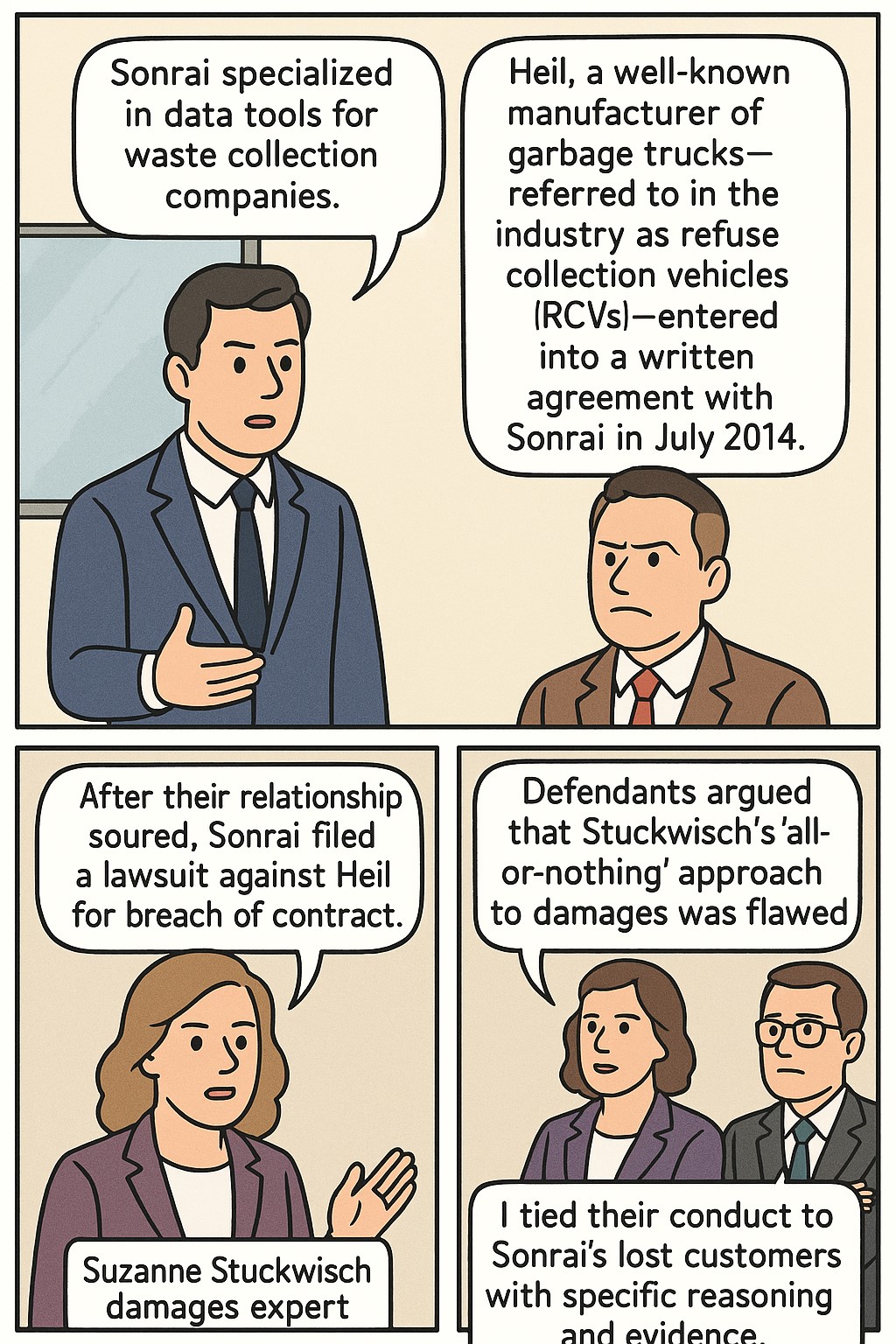
    Sonrai specialized in data tools for waste collection companies. Heil, a well-known manufacturer of garbage trucks—referred to in the industry as refuse collection vehicles (RCVs)—entered into a written agreement with Sonrai in July 2014. The purpose was to facilitate the exchange of confidential information and explore a potential partnership, where Sonrai’s data product, “Vector,” could be integrated with Heil’s RCVs.

    Over the next year, both companies shared proprietary information and operated under the terms of the agreement. In May 2015, Heil made an offer to acquire Sonrai, but Sonrai declined. The relationship began to deteriorate, and by September 2016, Heil chose a different path. It acquired a company called 3rd Eye, opting to use 3rd Eye’s competing data product, “Enhance,” instead of continuing with Sonrai.

    Following this turn of events, Sonrai filed a lawsuit against Heil for breach of contract. Sonrai also accused Anthony Romano of breaching his fiduciary duties to Sonrai. Sonrai also alleged that Anthony Romano had breached his fiduciary duties owed to the company. Heil, in turn, countersued, also alleging a breach of contract.

    Defendants raised certain arguments about the reliability of Sonrai’s damages expert Suzanne Stuckwisch‘s testimony.


    Economic Damages Expert Witness

    Suzanne M. Stuckwisch has more than 30 years of experience in economic and financial analysis and engineering consulting. She holds a B.S. in Mechanical Engineering, an M.B.A., and an M.S. in Economics.

    Stuckwisch has experience across a wide range of industries, including but not limited to waste and recycling.

    Get the full story on challenges to Suzanne Stuckwisch’s expert opinions and testimony with an in-depth Challenge Study

    Discussion by the Court

    Recognized Methodology

    The Defendants first challenged Stuckwisch’s expert report by arguing that she failed to follow any recognized methodology in calculating Sonrai’s alleged lost profits. The Court disagreed. It found that her report clearly laid out how she determined the length of Sonrai’s relationships with each customer, projected potential sales, and accounted for the costs of producing Vector units. She analyzed damages on a customer-by-customer basis—an approach the Court had previously deemed acceptable. As a result, the Court concluded that her methodology was valid and properly applied.

    Damages Model

    Next, the Defendants claimed that Stuckwisch’s damages model relied too heavily on a single, speculative assumption: that all five waste haulers would have adopted Vector across their entire fleets. But the Court had already addressed this point in its summary judgment ruling. It noted that Stuckwisch had explained the rationale behind her assumption and emphasized that it was up to the jury to weigh the credibility of that assumption. Her report referenced evidence from the waste industry showing that third-party companies had made commitments to install Vector fleetwide.

    All-or-Nothing Approach

    Lastly, the Defendants contended that Stuckwisch’s “all-or-nothing” approach to damages was flawed because she failed to consider other possible causes for Sonrai’s lost profits—something they argued was required under AICPA standards. In response, Stuckwisch clarified that her analysis again followed a customer-by-customer model: once a customer was lost, the associated revenue was lost entirely. The Court found this approach reasonable. It emphasized that Stuckwisch did not simply assume the Defendants caused the losses—she tied their conduct to Sonrai’s lost customers with specific reasoning and evidence.

    Additional Incremental Operation Costs

    Fourth, Defendants argued that Stuckwisch’s testimony was unreliable because her calculation of additional incremental operation costs, which are a necessary component of lost profits, was previously stricken and never included in any amended reports.

    The Court agreed that Stuckwisch’s testimony would be unreliable without the deduction of additional incremental operation costs. But precluding Stuckwisch from testifying about those additional incremental operation costs was not the appropriate remedy. Instead, the proper path forward was to allow Stuckwisch to supplement her report and allow Defendants to depose her on the new report, and supplement their own rebuttal report if they wished.

    Alternative Explanations 

    Finally, the Court issued this opinion following a hearing held on June 9, 2025, during which it preliminarily denied the Daubert motion. After that hearing, Stuckwisch submitted a supplemental report and sat for a deposition. On the first day of trial, the Defendants raised three new arguments to exclude her testimony.

    First, they challenged Stuckwisch’s assumption that Sonrai would incur no cost for working capital. According to her, Chris Flood—Sonrai’s CEO—told her that his family’s business, which generated over $100 million in annual revenue, would cover Sonrai’s working capital needs. Defendants claimed this assumption was unfounded. However, the Court noted that the same assumption appeared in her 2021 report under the section on incremental operational costs. For the reasons already discussed, the Court declined to exclude her testimony on this basis.

    Second, Defendants argued that Stuckwisch failed to consider an alternative cause: that Romano had the right to leave Sonrai at any time. But they did not explain how this constituted an “obvious alternative explanation” undermining the reliability of her analysis. The Court held that such arguments were better suited for cross-examination.

    Third, the Defendants contended that Stuckwisch wrongly assumed that Vector faced no competition in the but-for world, effectively treating it as a monopoly product. She based this assumption on her understanding that no comparable product existed in the marketplace. The Court found this assumption to be reasonable, though it acknowledged that Defendants were free to challenge it during trial.

    Held

    The Court denied the Defendants’ Rule 702 motion to exclude the testimony of Suzanne Stuckwisch.

    Key Takeaways:

    • An expert need not rule out every alternative cause. Arguments about alternative explanations can be explored on cross-examination. 
    • Stuckwisch’s opinion reliably applies the lost profits principles and methodology to the facts of the case and the Court will not prejudge the ultimate correctness of her conclusions. Her reasoning satisfies Rule 702’s reliability standard. Defendants’ criticisms can be explored on cross-examination.

    Case Details:

    Case Caption: Sonrai Systems, LLC Et Al V. Anthony M. Romano Et Al
    Docket Number: 1:16cv3371
    Court Name: United States District Court, Illinois Northern
    Order Date: June 20, 2025