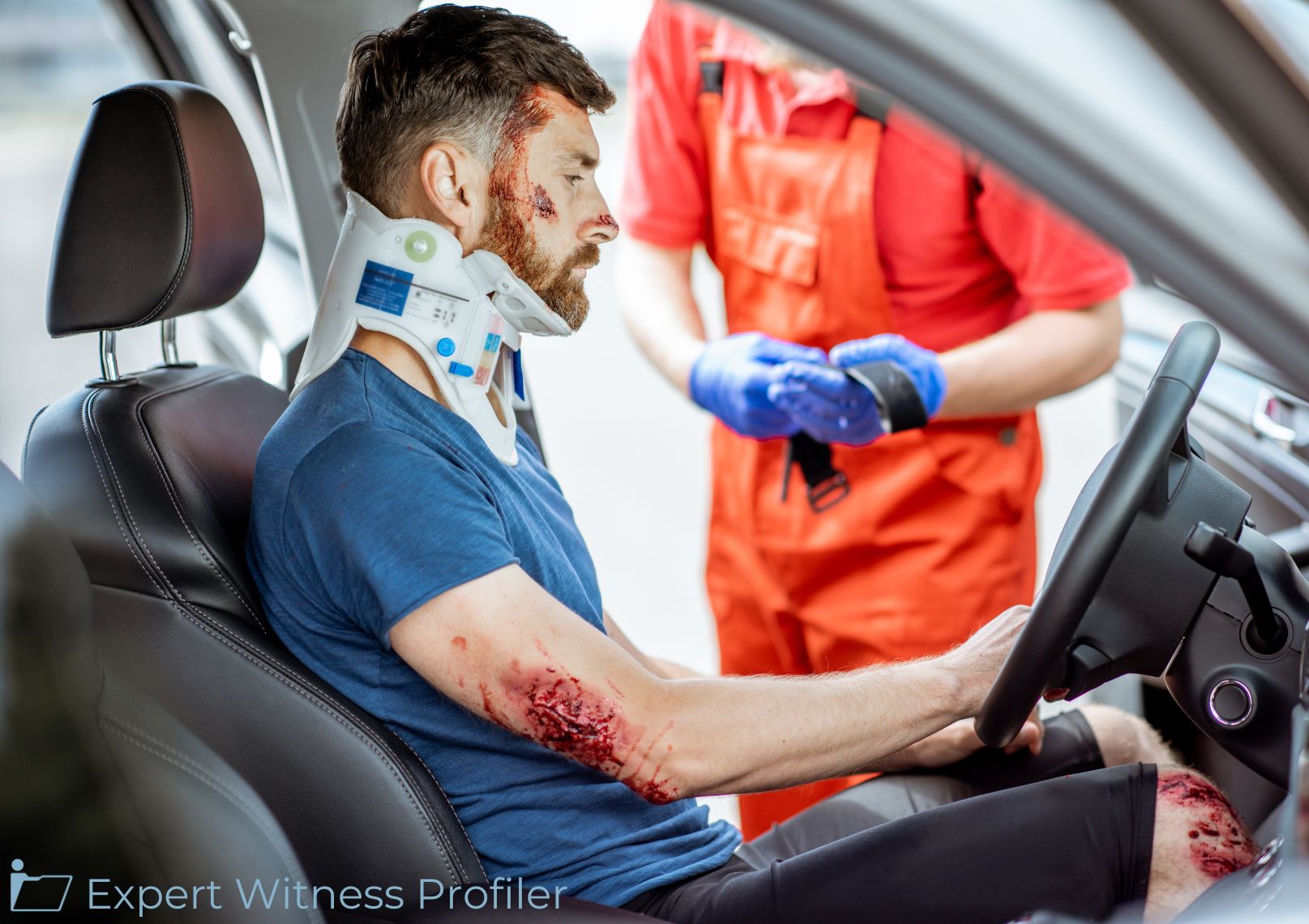
Plaintiff Brooke Mann suffered serious injuries at a music festival in September 2021 when a shuttle tram on which she was riding tipped over on a sloped roadway.
The Lost Lands Music Festival takes place each September at Legend Valley, a large outdoor venue near Buckeye Lake and Thornville, Ohio. The multi-day festival is dinosaur-themed and features electronic dance music. About 30,000 people attended the festival in 2021.
Defendant Apex Event Management LLC is a Delaware company with its principle place of business in California. It promoted the festival in 2021, as it had previously. To present the festival, Apex contracted with other entities and individuals to acquire the necessary rights, to book talent, to market and sell tickets, and to obtain the goods and services needed for putting on the festival.
Apex acquired the right to use Legend Valley through Defendant Trickle Productions LLC, an Ohio business.
Plaintiff sued Apex Event Management, LLC and Trickle Productions, LLC whom she alleges are responsible for the accident under Ohio’s legal standards governing negligence.
Plaintiff’s expert, James Crawford, has issued three separate reports. Apex and Trickle moved to strike the third report, dated December 12, 2024.
Accident Reconstruction Expert Witness
James B. Crawford is a forensic engineer and accident reconstructionist. He provides vehicular accident reconstruction services and has reconstructed over 750 accidents. He has provided expert testimony in Federal, State, and Municipal Courts.
Defendants contended that Plaintiff improperly produced the third report after the Court’s August 26, 2024 deadline for the production of primary expert reports and even after the October 26, 2024 deadline for fact discovery.
Whether the Third Report Qualifies as a Supplemental Disclosure
Crawford’s third report is presented as a complete, stand-alone report. Even so, Plaintiff characterizes it as a supplemental disclosure under Rule 26(e)(2). She argued that disclosure of the third report was required because of new information she learned after Crawford prepared his second report.
Zemba’s corporate representative, Bryan Paisley’s deposition did reveal a new fact – that in the course of creating the reconfigured section, Zemba placed dirt on top of the section of the road where the accident occurred. Had Crawford’s third report incorporated additional material to address that possibly new fact, then the Court would be inclined to agree with Plaintiff’s characterization of the third report as a supplemental disclosure. However, the third report did not even acknowledge, let alone discuss, the fact that dirt had been placed on top of the section of road where the accident occurred.
The new “fact” which the third report instead addresses does not relate to the physical changes to the road but rather to Zemba’s motive in creating the new section of road. Paisley testified that Zemba built the new section – straighter and not as steep as the old section – because it would be easier for its dump trucks to use.
The third report treated Paisley’s testimony as an admission that the old road was “unsafe.” Not only has Crawford mischaracterized Paisley’s testimony – insofar as Paisley testified that the new section was safer, not that the old section was unsafe – but the third report did not include any reconsideration of the conditions of the accident-scene road in light of Paisley’s testimony about dirt being placed on top of it during the 2022 reconfiguration. The Court thus found that the third report is not responsive to “information that was not available at the time” of the second report.
Whether the Untimely Disclosure is Substantially Justified or Harmless
The third report was indeed a surprise. Following the grant of prior extensions, the Court set a strict deadline of August 26, 2024 for the production of primary expert reports. It also set a dispositive motion deadline of December 20, 2024, and advised the parties that no further extensions would be granted. Plaintiff waited until after these deadlines to disclose the third report, and she did so only once Defendants’ motions for summary judgment were filed.
The Court noted that the additional scope of Crawford’s third report (as compared to the second report) went beyond addressing Paisley’s purported admission that the accident-scene road was unsafe. Crawford added content discussing the Federal Highway Administration’s standards for the design and maintenance of gravel roads, the classification of the tram as a “commercial vehicle,” and the resulting implications under federal and state law.
Because all of this additional material was first disclosed in the third report, Defendants did not have notice of Crawford’s new opinions until after the close of expert and fact discovery and after Defendants had moved for summary judgment.
Held
The Court granted the Defendants’ motion to strike the third report of Plaintiff’s expert James Crawford.
Key Takeaway:
While Defendants acknowledged that the new matters addressed in the third report have importance, Plaintiff has not provided a satisfactory explanation for the late disclosure of the third report. The reconfiguration of the accident road was known to Plaintiff several months in advance of the deadline for primary expert reports. To the extent Paisley’s deposition revealed a new fact (the placing of dirt on the old section of road) the third report does not address that fact.
This case arises from a skiing accident that occurred at Mountain Creek’s ski resort (“the Resort”). On February 21, 2021, Pierino Perciballi and his sixteen-year-old son Matteo Perciballi chose to ski down the Matchmaker trail, an intermediate difficulty terrain park course contained within the Resort. The Matchmaker trail is adjacent to the Resort’s “learning area.”
Mountain Creek uses blue, mesh fencing to separate Matchmaker trail from the learning area. In his descent down Matchmaker trail, Perciballi collided with this blue fencing, tangling his legs and violently falling to the ground. This collision caused him to sustain significant injuries, requiring four days of hospitalization and leaving him with an ongoing disability.
Plaintiffs filed this case on February 17, 2023, alleging two causes of action: (1) negligent management and design of the Resort resulting in Mr. Perciballi’s injuries, and (2) loss of consortium on behalf of his wife Brigida R. Perciballi.
Defendants filed a motion to preclude Plaintiffs’ expert witness, Richard Penniman.
Ski Safety Expert Witness
Richard C. Penniman has been a consultant to the ski industry since 1983, and has been qualified as an expert on, inter alia, slope design, snowmaking and impact mitigation in numerous state and federal courts across the United States. He is a member of numerous ski organizations and has lectured extensively on the topic of ski safety. Penniman has served as an Adjunct Instructor at Sierra Nevada College where he taught Ski Area Mountain Operations and Safety for nine (9) years. Penniman has also published numerous peer-reviewed articles on ski safety
A. Penniman’s unannounced inspection of the Mountain Creek Resort does not justify barring his testimony
Mountain Creek’s first argument against the admissibility of Penniman’s decision does not challenge the sufficiency or applicability of his expertise; rather, it asked the Court to exclude Penniman’s opinion as a sanction for failing to follow Fed. R. Civ. P. 34(a)(2).
In his deposition, Penniman admitted to taking an unannounced trip to the Resort in March 2023, where he conducted an examination of the Resort’s grounds to assess the site of the accident and the Resort’s safety procedures in general.
When determining whether to impose a discovery sanction, the movant must first show that there has been a violation of the rules of discovery or the orders of the Court. Plaintiffs argued that there was no need for Penniman to get special permission from Mountain Creek to investigate a publicly accessible location, even if that location was owned by Mountain Creek.
The Court held that where the premises are open to the public and the inspecting party has permission to enter (and does not deviate from the parameters of the permission), parties are not required to seek approval prior to inspection under Rule 34, unless the inspection poses a greater, articulable danger or burden to the business, employees, or other visitors than is expected of a typical visitor.
Applying this rule, Penniman acted in almost every way as an ordinary skier. Even if Penniman’s inspection was a discovery violation, Mountain Creek did not sufficiently argue that exclusion was warranted. Though Mountain Creek claims it is “severely prejudiced” by the unannounced inspection, the only prejudice it cited is that it was “not present to observe the inspection,” or able “to document the conditions observed or observable on that date.”
B. The Penniman Report is sufficiently reliable to assist the jury and will not be excluded
Mountain Creek’s second argument for precluding Penniman’s testimony and report from the jury is that he lacks a reliable foundation for his opinion. Mountain Creek sought to exclude the following topics from Penniman’s opinion: (1) the “use of blue fencing” in the skiing industry; (2) the role, if any, shadows played in causing the accident; (3) how most North American ski resorts organize their ski trails; and (4) whether the “progression area” used to train new skiers is a hazard when placed next to a trail for more experienced skiers.
1. Penniman is permitted to testify to the relative advantages of fence coloring at different ski resorts
In his expert report, Penniman discussed the significance of fencing colors on the safety of skiing trails. According to Penniman, “blue fabric fencing such as that with which Mr. Perciballi became entangled can be very difficult to discern from shadows on the snow surface later in the day,” and for that reason the industry standard is that “any fencing, hazard marking or safety signs be brightly colored and highly visible so as to attract attention.”
However, Mountain Creek believed that this testimony lacked “factual evidence from the record in this case,” and is instead “based solely on his personal experience and limited discussions with ski patrollers.”
The Court disagreed. Penniman’s report and testimony contain sufficient foundation. It is uncontested that: (1) Mountain Creek used blue fencing at the time of the accident; (2) Plaintiffs’ accident happened in the afternoon; (3) Penniman made an inspection of the site of the accident and observed the shadow cover of the area in the afternoon; (4) at least some ski resorts in North America use brightly-colored fencing; and (5) Penniman claimed, in his professional experience, use of brightly-colored fencing is standard. This is a sufficient factual foundation whereby a reasonable jury could find that such a standard exists, should they credit Penniman’s testimony.
2. Penniman may not testify that the shadows ’caused’ Plaintiffs’ accident
The Penniman Report also assesses the role that shadows play in terms of hazardous course conditions while skiing, both in general and in how it contributed to Plaintiffs’ accident in particular.
Mountain Creek challenged the admissibility of these claims on two grounds. First, it argued that Penniman improperly opined on the cause of an accident he was not present to witness and of which has no personal knowledge. Second, Mountain Creek interpreted Penniman’s opinion as contradicting the fact witnesses in this case without cause and believed the contradiction is severe enough to warrant precluding his testimony.
Mountain Creek specifically objected to a line in the Penniman Report claiming “the shadows appear to have caused Mr. Perciballi not to discern the difference between the long tree and pole shadows across his path and the blue fence.” In making this conclusion, Penniman did not quote Perciballi or his son, and by his own testimony has not personally spoken to either fact witness. The Court held that Penniman’s inspection of the site on a different day, without personally witnessing or reviewing the accident, is not sufficient personal knowledge to testify about its cause.
To the extent Mountain Creek challenged the admissibility of any opinion offered by Penniman pertaining to shadows on the ski track, the Court found this opinion admissible. Perciballi may believe the lack of visibility was caused by snow cover, rather than shadows, but this is consistent with the Penniman Report which states that shadows and snow make blue mesh fencing less visible.
3. Testimony about an alleged generally-applicable standard for ski course design is admissible, even when based on personal experience
Finally, Mountain Creek objected to the sections of Penniman’s report and testimony that claimed the “standard custom and best practice” of ski resorts is to have “learning areas . . . separated geographically from the other trails,” to avoid conflict with other skiers.
However, Mountain Creek did not provide a legal basis for its assertion that Penniman must have a “written . . . industry standard,” to support his opinion that the placement of the learning area at the Mountain Creek resort was not best practice.
Plaintiffs argued that Penniman is not testifying that Mountain Creek failed by not living up to his personal standard. Instead, they contended he is testifying that there is an unwritten industry standard and—as an expert—he is in a position to know it. To support their interpretation of Penniman’s opinion, Plaintiffs offered several surveys and reports on the safety protocols of ski resorts authored by Penniman, most notably The California Mountain Resort Safety Report: Survey Methodology and Scoring Criteria (the “California Mountain Report”), as evidence of his knowledge of ski safety standards. For his part, Penniman also testified in his deposition about this study and the research he performed for that study alongside his personal observation of the practices at “over 300 ski areas in the U.S.,” which formed the basis for his opinion that it is an industry standard for resorts to separate learning areas “geographically.”
This may be a “shallow basis as to any industry standard,” as Mountain Creek says, but it is nonetheless sufficient for the “liberal policy of admissibility,” for expert opinions.
C. Experience as a professional ski instructor and ski resort safety consultant are sufficient to testify as an expert
Mountain Creek also challenged Penniman’s qualifications to give his opinion on how skiers typically act, and how they navigate a trail because he is “not trained in human factors, human behavior, biomechanics, engineering, or psychology.”
Mountain Creek’s assertion that Penniman’s decades of experience as a trainer, ski patrol member, and ski trail safety designer “does not constitute superior knowledge, education, experience or skill on the subject matter of skier’s behavior,” to a jury who may have never skied before, because he does not have an unrelated degree in “human factors, human behavior, biomechanics, engineering, or psychology,” is not credible.
The Court found that Penniman is sufficiently qualified to serve as an expert on skier behavior and expectations.
Held
The Court granted in part and denied in part Mountain Creek’s motion to preclude Richard Penniman’s testimony.
Key Takeaway
An expert may testify as to his or her opinion on the ultimate cause of an injury, even “in the absence of complete information,” so long as the expert has sufficient direct knowledge to ground his or her opinion.
But when an expert opinion “is not based on any direct or circumstantial evidence,” it is inadmissible conjecture, even if the safety measures the expert advocates for would have made the injury “less likely.”
Plaintiffs Laura Kotelman and Paul Kotelman (the Kotelmans) filed a Complaint against Defendant Farm Bureau Financial Services (Farm Bureau) following a dispute over insurance coverage for residential property roof damage.
Farm Bureau moved to exclude the expert testimony of the Kotelmans’ structural engineering expert, Keith Stroh and to strike the rebuttal report of Stroh.
Structural Engineering Expert Witness
Keith M. Stroh holds three degrees from South Dakota State University: two bachelor’s degrees in agricultural and civil engineering, and a master’s degree in structural engineering. He has worked as an engineer since 1986, a structural engineer since 1996, and an engineering consultant, including doing forensic engineer work, since 2003. Stroh has completed at least twenty-one forensic engineering analyses to date.
Farm Bureau argued that the Kotelmans have failed to demonstrate that Stroh has the qualifications to render the proposed testimony or that the proposed testimony of Stroh met the requirements of Rule 702.
The Kotelmans argued that (1) it is premature for this Court to decide whether to exclude this expert, (2) Stroh has the appropriate qualifications to render his opinion whether the roof met applicable construction standard and what caused damage to the roof, and (3) Stroh’s analysis followed engineering industry standards.
Discovery, as mentioned earlier, is still ongoing in this case. As of now, it appears “more likely than not” that Stroh’s testimony could aid a fact finder in understanding issues within the expertise of a structural engineer with forensic engineering experience relating to design, construction and causes of the failure of the Kotelmans’ roof. Once discovery is done, this Court anticipates Farm Bureau will renew its motion for summary judgment and perhaps challenge Stroh’s expertise then or later in a motion in limine. At this time, the Court denied Farm Bureau’s motion to exclude the expert testimony of Stroh.
B. Motion to Strike Rebuttal Report
Farm Bureau also requested that this Court strike Stroh’s rebuttal report. Stroh’s expert report and opinions were disclosed on March 31, 2025. Farm Bureau’s experts and expert reports were disclosed on June 30. On August 26, Farm Bureau moved for summary judgment. On August 28, the Kotelmans disclosed Stroh’s rebuttal report, which was fifty-nine days after Farm Bureau disclosed its expert reports.
Farm Bureau argued that the rebuttal report should be struck because (1) the scheduling order does not expressly permit rebuttal reports; (2) Federal Rule of Civil Procedure 26(a)(2)(D)(ii) requires that rebuttal reports be disclosed thirty days after the opposing parties’ expert reports; and (3) Farm Bureau is prejudiced by the Kotelmans’ ambushing of Farm Bureau “with this untimely disclosure.”
Considering the particular circumstances of this case, the Court found that this is not one of the rare cases where the “harsh penalty” of excluding the report is appropriate.
First, Stroh’s rebuttal testimony is important for the Kotelmans to respond to Farm Bureau’s experts. Second, the Kotelmans have explained their reasoning for not disclosing the rebuttal report earlier. In addition, at the time the rebuttal expert report was filed, the most recent scheduling order had extended the discovery deadline, “including expert discovery,” to October 15, 2025, without specifying a rebuttal expert report deadline. Third, allowing the Kotelmans to use Stroh’s rebuttal report would not unfairly prejudice Farm Bureau. Farm Bureau has its own engineering expert who can address and refute Stroh’s rebuttal report. Fourth, the discovery deadline in the case effectively has been extended until at least January 2, 2026.
Held
The Court denied Farm Bureau’s motion to exclude the testimony of Keith Stroh.
The Court denied Farm Bureau’s motion to strike the rebuttal report of Keith Stroh.
Key Takeaway:
The exclusion of evidence is a harsh penalty and should be used sparingly. When a party does not fully comply with the expert-disclosure rules, the district court has wide discretion to fashion a remedy or sanction as appropriate for the particular circumstances of the case.
Plaintiff Mary Spates (“Plaintiff”) as parent and natural guardian of her minor son, C.M., filed a suit against Defendant Horry County School District (“Defendant” or “School District”), alleging violations of C.M.’s Fourteenth Amendment due process rights.
Defendant Horry County School District filed a motion in limine seeking to exclude or limit the testimony of Plaintiff’s treating mental health providers, Jessica Greene, LPC, and Jameion Blanton Fowler, MSW, LISW-CP, as well as a written report authored by Fowler.
Psychology Expert Witness
Jessica Greene, LPC holds a PhD in General Psychology from Northcentral University (2020), a master’s degree in Counseling with an emphasis in clinical mental health counseling (2006), and a Bachelor of Arts degree in Sociology from Coastal Carolina University (2003).
She is known for her passion in advocating for her clients and fighting to educate about trauma-informed and cognitive behavioral therapy treatment.
Jameion Blanton Fowler, MSW, LISW-CP (SC), LCSW (NC) is currently working as an Independently Licensed Social Work Clinician with A Place To Start Counseling. He is also the founder of Blanton Clinical Consulting Group (BCCG).
He has worked with a variety of different populations throughout his career. These include Mental Health, Substance Abuse and work with Children and families.
Defendant argued that Plaintiff failed to designate these witnesses as experts under Rule 26(a)(2), failed to provide the required disclosures under the Court’s scheduling orders, and now seeks to introduce opinions on diagnosis and causation that qualify as expert testimony.
The Court recognized that Rule 26 distinguishes between retained experts, who must provide a written report under Rule 26(a)(2)(B), and treating providers, who may testify as hybrid fact/expert witnesses without such a report.
Motion to Exclude or Limit
Here, Plaintiff did not timely disclose Greene or Fowler under Rule 26(a)(2). Her initial interrogatory responses confirmed no experts would be offered, and only on the final day of discovery in April 2024 did Plaintiff identify these providers and produce Fowler’s report. Such a late disclosure deprived Defendant of the opportunity to depose the providers or prepare rebuttal expert testimony before the close of discovery. The absence of a Rule 26(a)(2)(C) summary compounds this deficiency.
Allowing the evidence would disrupt the trial, requiring the Court to reopen discovery and delay a consolidated trial already scheduled. While the Court acknowledges the importance of treating providers’ testimony to Plaintiff’s claims, Rule 26 and Rule 37 require balancing that importance against fairness to the opposing party. Finally, Plaintiff offered no persuasive explanation for her failure to comply with the disclosure deadlines. On balance, these factors show that exclusion is warranted under Rule 37(c)(1).
At the same time, it is undisputed that Greene and Fowler are treating providers. Courts have permitted treating providers to testify about observations and diagnoses made during treatment, even absent a Rule 26(a)(2)(B) report. But they may not provide litigation-driven causation opinions prepared for trial. Fowler’s December 2023 report does just that-it expressly attributed C.M.’s depression to his “current legal situation and the family’s case against his former school district.” That opinion fell within Rule 702 and requires proper disclosure.
Plaintiff’s non-disclosure also meant that Greene’s and Fowler’s proposed opinions have never been scrutinized under the Court’s gatekeeping function pursuant to Federal Rule of Evidence 702 and the Daubert standard.
Held
The Court granted in part and denied in part the Defendant Horry County School District’s motion in limine to exclude or limit the testimony of Plaintiff’s treating mental health providers, Jessica Greene, LPC, and Jameion Blanton Fowler, MSW, LISW-CP.
Plaintiff’s treating providers, Jessica Greene, LPC, and Jameion Fowler, MSW, LISW-CP, may testify as fact witnesses regarding their treatment of C.M., including observations and diagnoses formed in the ordinary course of care. However, because Plaintiff failed to comply with Rule 26(a)(2) and has not shown substantial justification or harmlessness under Rule 37(c)(1), the providers may not offer undisclosed expert opinions on the causation of C.M.’s conditions or on the adequacy of the School District’s conduct. For the same reasons, Plaintiff may not introduce the December 16, 2023, written report by Fowler, which constitutes litigation-driven expert opinion.
The Court also noted that Plaintiff’s proffered opinions have not undergone the reliability screening required by Federal Rule of Evidence 702 and Daubert, further supporting their exclusion.
Key Takeaway:
Treating providers are often assumed to fall outside Rule 26’s disclosure requirements because they are not retained experts. But Rule 26(a)(2)(C) expressly requires a summary disclosure when a treating provider’s testimony implicates Rules 702-705. Counsel who conflate treatment testimony with litigation-driven expert opinions risk exclusion under Rule 37(c)(1).
Plaintiff, Pearl R. Kline was driving her vehicle eastbound on Interstate 70, near the Clear Springs exit in Washington County, Maryland. At the same time, a vehicle owned by Defendant Road Range Express and operated by Defendant Sukhjinder Singh was traveling directly behind Plaintiff’s vehicle. When Plaintiff stopped for traffic, Singh’s vehicle struck the rear of her vehicle. This incident led Plaintiff to file a negligence action against Road Range Express and Singh.
On June 19, 2025, Defendants filed a motion to strike Plaintiff’s Rule 26(a)(2) disclosure of Dr. Ira M. Garonzik. In their motion, Defendants argued that Plaintiff’s Rule 26(a)(2) expert disclosure should be stricken because it is (1) untimely and (2) insufficient, in violation of Rule 26(a)(2) of the Federal Rules of Civil Procedure.
Neurosurgery Expert Witness
Dr. Ira M. Garonzik is the founder and president of the Baltimore Neurosurgery and Spine Center which began in 2005. The Baltimore Neurosurgery and Spine Center specializes in the comprehensive treatment of a wide variety of intracranial and spinal disorders. Garonzik is widely published, having authored more than fifty peer reviewed articles, book chapters and abstracts.
He completed his neurosurgical residency at the Johns Hopkins Hospital after earning his medical degree from the Emory University School of Medicine Summa Cum Laude and his undergraduate degree with highest honors from Johns Hopkins University. During his training, Garonzik completed specialized fellowships in complex spinal surgery and functional neurosurgery.
Defendants argued that they would be severely prejudiced if the Court were to permit the untimely disclosure of Plaintiff’s expert because discovery had closed and the deadlines for their own disclosures had elapsed, leaving them with no opportunity to rebut or respond to Garonzik’s opinions.
Plaintiff’s disclosure included the expert’s curriculum vitae and fee schedule, but omitted the expert’s report and did not otherwise summarize the expert’s opinions. There is no dispute that Plaintiff’s disclosure of Garonzik was untimely. And because the disclosure lacked the required written report when Plaintiff served it on Defendants, it was plainly insufficient.
There is no dispute that Plaintiff’s disclosure of Garonzik was untimely. And because the disclosure lacked the required written report when Plaintiff served it on Defendants, it was plainly insufficient under Rule 26(a)(2) of the Federal Rules of Civil Procedure. Moreover, as Plaintiff’s own opposition admitted, the untimely disclosure was not substantially justified. Consequently, the real inquiry is whether the error was harmless.
In determining whether a party’s failure to disclose was substantially justified or harmless so as to exclude a witness pursuant to Rule 37(c)(1), this Court has broad discretion and is guided by consideration of five factors: “(1) the surprise to the party against whom the evidence would be offered; (2) the ability of that party to cure the surprise; (3) the extent to which allowing the evidence would disrupt the trial; (4) the importance of the evidence; and (5) the non-disclosing party’s explanation for its failure to disclose the evidence.”
Analysis
The first factor, surprise, weighed in Defendants’ favor, as the disclosure came more than two months after the disclosure deadline and without advance notice.
The second factor—the ability to cure—cuts both ways. Because the discovery period has closed, Defendants’ ability to identify a rebuttal expert is limited. However, reopening discovery for the narrow purpose of allowing Defendants to serve their own expert disclosures provides an adequate cure. Indeed, there are several cases in this District that have permitted limited extensions of discovery to mitigate the prejudice from untimely expert disclosures.
The third factor, disruption of trial, did not weigh heavily against Plaintiff, as no trial date has been set, and a modest extension of expert discovery will not substantially disrupt proceedings. The fourth factor, the importance of the evidence, strongly favored Plaintiff, as Garonzik is Plaintiff’s sole expert on damages, which is the only remaining issue in this case. Finally, the fifth factor, the explanation for the delay, weighed against Plaintiff, as no justification has been provided for failing to comply with the Scheduling Order.
Given the broad discretion afforded to district courts in weighing these factors and fashioning appropriate sanctions, the Court will treat Plaintiff’s disclosure of Garonzik as an untimely Rule 26(a)(2) disclosure that can be rendered harmless by modifying deadlines in the Scheduling Order.
Held
The Court denied the Defendants’ motion to strike Plaintiff’s Rule 26(a)(2) disclosure of Dr. Ira M. Garonzik.
Key Takeaway:
On balance, although Plaintiff’s disclosure was untimely, insufficient, and unjustified, precluding Plaintiff’s expert from testifying altogether in this damages-only case would be an extreme result.
The Court can adequately minimize the prejudice to Defendants through a limited reopening of expert discovery. The Court will re-open discovery for a 45-day period for the sole purpose of allowing Defendants to conduct discovery related to Garonzik’s report (including a deposition of Garonzik) and to designate rebuttal witnesses.
Plaintiffs Michael Sutherland and Comfy Materials LLC sued Defendant Wellshow Machining Parts, Inc. for copyright infringement and false advertising relating to Defendant Wellshow’s Amazon listings of its competing products.
Per the Amended Case Management and Scheduling Order, Plaintiffs disclosed one expert witness, Charleen Purdy, on March 14, 2025, who will “opine on Plaintiffs’ economic losses in connection with their claims brought against Defendant, and to prepare any rebuttal analysis and report related to any alleged damages incurred by Wellshow as to its tortious interference claim.”
In her report, Purdy disclosed that discovery was ongoing at the time of her expert report, and therefore, she could not form an opinion on damages due to the outstanding requested discovery. Specifically, Plaintiffs’ expert report indicated that she had only received incomplete and insufficient documents from Defendant on March 7, 2025, and requested a list of additional documentation from Defendant “in order to determine, if any, the economic loss suffered by the Plaintiffs” and Defendant. Plaintiffs’ expert report also reserved the right to supplement her report following full and complete discovery.
Therefore, Defendant, Wellshow Machining Parts, Inc., sought an order precluding Plaintiffs from offering undisclosed expert testimony and precluding Plaintiff Michael Sutherland, corporate representatives, or employees of Defendant Comfy Materials, LLC from providing expert testimony under Federal Rule of Evidence 702.
Accounting Expert Witness
Charleen E. Purdy is a principal at Perzel & Purdy Forensic CPA’s, LLC. She is licensed as a Certified Public Accountant (CPA), credentialed as a Certified Valuation Analyst (CVA), Master Analyst in Financial Forensics (MAFF), and trained in Collaborative Divorce. Her experience includes services in the areas of forensic accounting, damage claims, business valuations, economic loss analysis, money laundering, shareholder disputes, trust and estate litigation, Ponzi schemes, personal injury claims, litigation support, and expert witness services.
Plaintiffs conceded that its expert witness disclosure is noncompliant with Rule 26(a)(2)(B) and Federal Rule of Evidence 702. As such, Plaintiffs’ expert report has no “facts or data” under Rule 26(a)(2)(B)(i)-(ii) because she could not properly form an opinion. Nevertheless, to comply with the Amended CMSO, Plaintiff’s timely disclosed Purdy to meet “the requirements of Rule 26(a)(2)(B) to the extent possible.”
Here, the Court found that even if Purdy’s expert report is insufficient under Rule 26(a)(2)(B), Plaintiffs still have time to supplement Purdy’s expert report within a timely manner under Rule 26(e).
As for the timing of the supplement, Rule 26(e)(2) states that for a Rule 26(a)(2)(B) expert (i.e., a retained expert), “any additions or changes to this information must be disclosed by the time the party’s pretrial disclosures under Rule 26(a)(3) are due.” Rule 26(a)(3)(B) provided that “these disclosures must be made at least 30 days before trial.” The CMSO has set the trial on November 3, 2025, and directs the parties to “meet the pretrial disclosure requirements and deadlines in Fed. R. Civ. P. 26(a)(3).” Thus, the Plaintiffs still have until October 4, 2025, to supplement Purdy’s expert report.
Analysis
To begin with, the Court found that any Rule 26(a)(2)(B) violation in Purdy’s disclosure on March 14, 2025, was substantially justified. First, Defendant’s motion did not make any argument about potential prejudice or surprise. Nor could Defendant make such arguments since, following Plaintiff’s timely expert witness disclosure on March 14, 2025, Defendant had the opportunity to provide the documents requested by Purdy and/or depose her before the discovery cut-off on April 28, 2025.
Additionally, Plaintiffs’ failure to provide a sufficient disclosure was harmless under Rule 37 because (1) Defendant has been on notice as to the subject matter of Purdy’s testimony since the expert witness disclosure deadline, and (2) any prejudice resulting from Plaintiffs’ insufficient disclosure can be cured by a supplemental disclosure.
Held
The Court denied Defendant Wellshow’s motion in limine to preclude the testimony Plaintiff’s expert Charleen Purdy.
Key Takeaway:
Substantial justification exists if there is justification to a degree that could satisfy a reasonable person that parties differ as to whether the party was required to comply with the disclosure request.
The Court found any violation of Rule 26(a)(2)(B) in Charleen Purdy’s disclosure was substantially justified.
Case Details:
Case Caption:
Sutherland V. Wellshow Machining Parts, Inc. Et Al
This case stems from a rear-end, chain-reaction accident. Plaintiffs alleged that, on or about June 16, 2019, Plaintiff Miranda Allen was driving northbound on Interstate 5 in Skagit County, Washington, with Plaintiff J.M. as a passenger in her vehicle.
While Plaintiff Allen’s vehicle was stopped in traffic, Defendant Martin Barratt, also driving northbound on Interstate 5, rear-ended Plaintiff Allen’s vehicle, “caus[ing] Plaintiff Allen’s vehicle to crash into the rear of the vehicle directly in front of them.” As a result of the accident, Plaintiff Allen allegedly sustained substantial and permanent injuries.
On February 3, 2025, the Parties timely filed respective motions to exclude expert testimony. First, Plaintiffs filed a motion to exclude the expert testimony of Dr. Michael Hatzakis, Defendants’ physiatrist expert. Later that day, Defendants filed a motion to exclude the expert testimony of Dr. Leah Keylard, Plaintiffs’ audiologist expert.
Physical Medicine And RehabilitationExpert Witness
Dr. Michael Hatzakis has been board certified in Physical Medicine and Rehabilitation for the last 20 years.
Hatzakis worked as an engineer for almost a decade before entering medical school at Stanford University School of Medicine in California. While attending medical school, he also worked in the department of Electrical Engineering at Stanford, Neurosurgery and Interventional Radiology. Among other projects, he developed neural prosthetic devices under a joint program between Stanford medical school and the Department of Electrical Engineering. He did his residency training in Physical Medicine and Rehabilitation at Thomas Jefferson University Hospital in Philadelphia, PA.
Over the last five years, through his leadership in the American Academy of Physical Medicine and Rehabilitation (AAPM&R), he has spearheaded one of the most ambitious “big- data” projects to improve the quality of care for individuals with low back pain, and, with neurological disorders.
She has a strong background in diagnostic and rehabilitative audiologic techniques. She holds a Doctor of Audiology (Au.D.) from the Arizona School of Health Sciences.
Plaintiffs sought to exclude the expert testimony of Michael Hatzakis as insufficient under Federal Rule of Evidence 702.
Plaintiffs represented that Hatzakis produced an initial expert report in November 2023 where he opined, inter alia, that Plaintiff Allen’s injuries had been proximately caused by the motor vehicle collision at issue in this case.
According to Plaintiffs, Hatzakis’ opinions in the November 2023 report concurred with other expert testimony in the case: Hatzakis agreed that Allen suffered from the injuries and damages the other expert and independent medical examiners had found.” On November 26, 2024, however, Hatzakis provided Plaintiffs with an addendum to his original report. In the addendum, Hatzakis diverged from his original findings, opining that “none of Allen’s injuries or damages were caused by the collision, in direct contrast to his first report.”
Plaintiffs’ Grounds for Exclusion
First, Plaintiffs asserted that “Hatzakis has rendered opinions and conclusions which are contrary to scientifically accepted principles, and are based upon inaccurate and incomplete information.” Second, Plaintiffs asserted that Hatzakis’ opinions and conclusions “are . . . in direct contrast to the one other matter [Plaintiffs’ counsel] could find.”
a. Opinions “Contrary to Scientifically Accepted Principles”
Opinions and conclusions are intellectual constructs that are dissimilar from, and incomparable to, scientific principles. In and of itself, an opinion or conclusion cannot contradict a scientific principle, unless it is an opinion or conclusion that specifically addresses the merits of that principle.
A sum, for example, cannot be “contrary” to, say, arithmetic; an x-ray impression cannot be “contrary” to radiology. To the extent that Plaintiffs intended to assert that Hatzakis’ opinions and conclusions are based on or derived from non-scientific principles—or, alternatively, are incorrectly based on or improperly derived from scientific principles—Plaintiffs do not sufficiently demonstrate that this is so. The Court held that the Plaintiffs relied on conclusory statements and did not connect their lengthy recitation of the rules of evidence to their cursory discussion of how Hatzakis’ testimony transgresses those rules.
Moreover, Plaintiffs’ argument that Hatzakis’ opinions and conclusions are based upon inaccurate and incomplete information also failed. Plaintiffs did not provide any indication that Hatzakis reviewed any data that were factually wrong or otherwise erroneous. Plaintiffs suggested that Hatzakis might have based his opinions on an incomplete set of records, but not that those records were, however scant, faulty. According to the Court, the fact that an expert might have based their opinion on incomplete records is not sufficient grounds for exclusion under the Daubert standard. Rather, such a critique “goes to the weight of his opinions rather than their admissibility.”
b. Opinions “in Direct Contrast” with Other Opinions
As to Plaintiffs’ second basis for excluding Hatzakis’ testimony, it simply did not make sense. Plaintiffs asserted that Hatzakis’ opinions and conclusions are “in direct contrast to the one other matter [Plaintiffs’ counsel] could find, absent providing an adequate testimony list.” Taking Plaintiffs’ argument at face value, the Court is at a loss to see how Hatzakis’ opinions in an unrelated case have anything to do with his opinions in this one. Unless the facts, circumstances, and damages that were the subject of Hatzakis’ opinions in the other matter are directly comparable to Plaintiff Allen’s injuries and damages here—and Plaintiff does not provide any evidence indicating that they were—then it is not clear how those opinions and conclusions could logically be “in direct contrast” to the opinions and conclusions at issue in this case.
To the extent Plaintiffs asserted that Defendants should have provided more robust disclosure with respect to Hatzakis’ testimony either before or after his deposition, the Court noted that Plaintiffs had Hatzakis’ list of testimony as early as November 20, 2023, yet waited more than a year—until December 5, 2024, one day after discovery motions were due and just 11 days before Hatzakis’ scheduled deposition on December 16, 2024—to raise the issue of the adequacy of the list of testimony.
c. Opinions Based on “Erroneous Assumptions”
Finally, as to Plaintiffs’ third basis for excluding Hatzakis’ testimony, Plaintiffs did not identify any of the purported “erroneous assumptions” not in the record upon which Hatzakis’ opinions are based. As discussed above, it appears that Plaintiffs objected to the size of the body of evidence that Hatzakis reviewed when forming his opinions, not the evidence itself. The Court ruled that such a deficiency can be borne out in cross examination and need not form the basis for exclusion.
Leah Keylard
Plaintiffs chose to list Dr. Leah Keylard, an audiologist, as a retained expert witness under Rule 26(a)(2)(B), meaning she was required to provide a written report.
Defendants sought to exclude the testimony of Keylard. Keylard opined on Plaintiff Allen’s alleged injuries. Unlike Plaintiffs’ other expert reports disclosed under Rule 26(a)(2)(B), Keylard’s report is captioned as a “chart note,” not an expert report, and it is only three pages long.
Although Keylard’s report refers to a “[r]eview of medical records as well as described history of noise provided by the patient,” the report does not discuss any specific documents or medical records that informed Keylard’s opinion and provides only a cursory summary of the results of three diagnostic tests. Indeed, the “report” reads much like it is labeled: as a healthcare provider’s note prepared subsequent to a patient encounter, not a studied synthesis and analysis of diagnoses and data from multiple sources. Defendants argued that the brevity of Keylard’s report, as well as its lack of specific detail, particularly with respect to the sources upon which Keylard has based her conclusions, leaves the report short of the requirements that Rule 26(a)(2)(B) prescribes for an expert report.
Defendants’ Grounds for Exclusion
a. Rule 26(a)(2)(B)
As Defendants pointed out, Keylard’s report is a “‘chart note’ and not a full report.” The Court held that a “chart note” is not a proper expert report under Rule 26(a)(2).
Indeed, when presented with expert reports similar to that of Keylard, courts have excluded the testimony as having been insufficiently disclosed under Rule 26(a)(2)(B).
Keylard’s report refers to “records relating to [her] independent medical evaluation but d[oes] not provide records of that evaluation,” leaving Defendants “[without] the necessary records to counter-designate a rebuttal expert.”
For their part, Plaintiffs argued, inappositely, that Keylard’s Rule 26(a)(2)(B) report was sufficient because “Defendant[s] had an opportunity to depose Keylard and chose not to.” This is beside the point. The relative sufficiency of a Rule 26(a)(2)(B) report is not enhanced by the opposing party’s decision not to depose its author—in fact, the rule contemplates the exact opposite relationship between disclosures and depositions.
b.Rule 37(c)(1)
Plaintiffs argued that Keylard’s testimony should not be excluded, because “[e]xclusionary sanction based on discovery violations are [sic] generally improper absent undue prejudice to the opposing side.”
This misstates the law, which provides that “information may be introduced if the parties’ failure to disclose the required information was substantially justified or harmless.”
Plaintiffs relied on “Defendant[s’] fail[ure] to depose Keylard” as demonstrative that the deficiencies in Keylard’s report were substantially justified or harmless.
As discussed above, this is not a germane argument with respect to violations under Rule 26 and exclusion under Rule 37. As the Seventh Circuit has held, “the [expert] report must be complete such that opposing counsel is not forced to depose an expert in order to avoid ambush at trial; and moreover the report must be sufficiently complete so as to shorten or decrease the need for expert depositions and thus to conserve resources.”
The Court thus found that Plaintiff’s deficient Rule 26(a)(2)(B) disclosure with respect to Keylard was neither substantially justified nor harmless. Moreover, given that discovery is closed, the deadline for dispositive motions has lapsed, and trial begins in approximately two months, the deficiencies cannot be easily remedied without radically reworking this case’s longstanding schedule.
Held
The Court denied Plaintiff’s motion to exclude defense expert Michael Hatzakis.
The Court granted Defendants’ motion to exclude Dr. Leah Keylard.
Key Takeaways:
Opinions and conclusions are intellectual constructs that are dissimilar from, and incomparable to, scientific principles. In and of itself, an opinion or conclusion cannot contradict a scientific principle, unless it is an opinion or conclusion that specifically addresses the merits of that principle.
Plaintiffs had plenty of time between the issuance of the most recent scheduling order and the lapsing of deadline for discovery motions to try to resolve the issue with Defendants and, if necessary, file an appropriate motion with the Court to obtain any needed information prior to Hatzakis’ deposition.
Ink 477, LLC and Grove Ink, LLC, operating the Miami restaurant and bar “Amal” and “Level 6,” are accused by former employee Jose Petersen of violating the Fair Labor Standards Act (FLSA). Petersen, who worked as waitstaff at Amal from June to September 2022 and then at Level 6 from May to September 2023, claims the companies failed to pay him proper overtime, withheld agreed-upon service charges, and illegally confiscated portions of his earned tips.
As mandated by the Court’s scheduling order, the Defendants submitted their expert disclosures on October 18, 2024, identifying Christopher Nadeau as a forensic accounting and valuation expert. Nadeau’s report, which included an appendix listing the documents he reviewed, was provided. However, the actual documents themselves were not attached.
A week later, on October 25, 2024, the Plaintiff filed a motion arguing that the Defendants’ disclosure was insufficient. The Plaintiff claimed that Nadeau’s report vaguely referenced the reviewed documents, making them difficult to locate within the Defendants’ existing document production. They asserted that Rule 26 of the Federal Rules of Civil Procedure does not require the opposing party to search for the data used by the expert. Consequently, the Plaintiff argued that the Defendants failed to comply with the scheduling order because Nadeau’s report did not include the “facts or data” he analyzed.
Prior to the Defendants’ response, the Court held a discovery hearing on November 4, where the Plaintiff demanded the “31 documents” Nadeau reviewed. The Court rejected this interpretation of Rule 26, stating that it does not require experts to attach all underlying documents to their reports. The Court subsequently issued a written order confirming that listing the reviewed documents in an appendix, as Nadeau did, is standard litigation practice.
Accounting Expert Witness
Christopher M. Nadeau, CPA, CMA, CVA, is a forensic accounting professional and valuation analyst with experience supporting litigation across a range of commercial disputes. His work primarily focuses on economic damages analysis and business valuation for various industries including automobile dealerships, manufacturing, restaurants, and real estate.
He specializes in calculations related to personal injury and wrongful termination cases.
Nadeau is a licensed Certified Public Accountant in the State of Massachusetts. He also holds credentials as a Certified Management Accountant (CMA) from the Institute of Management Accountants and as a Certified Valuation Analyst (CVA) from the National Association of Certified Valuators and Analysts.
In their response to the Plaintiff’s motion, the Defendants cited the Court’s ruling, emphasizing that Rule 26(a)(2) only requires identification of the reviewed items, not their production. The Plaintiff, in their reply, countered by stating that the Defendants did not produce the relevant discovery documents until November 1, after the initial discovery deadline, the expert disclosure deadline, and the filing of their motion.
The Plaintiff’s central claim is that the Defendants’ expert disclosure was deficient because it lacked the underlying “facts or data” used by the expert. However, the Court maintained that Rule 26 did not mandate attaching all supporting documents to an expert report. While not required to provide all raw data, the Defendants did furnish a link to the documents listed in the expert’s appendix. Furthermore, the Plaintiff received this link well in advance of the discovery deadline and trial, ensuring sufficient notice of the expert’s opinions and supporting data. The Court ruled that Nadeau’s report provided the correct kind of appendix, and that was all he needed to do to satisfy Rule 26.
Held
The Court denied the Plaintiff’s motion to strike Defendants’ expert disclosures.
Key Takeaway:
While the language of Rule 26 could be construed to support the Plaintiff’s argument, the courts have consistently interpreted it otherwise. Rule 26 requires a statement of the data considered by the expert, but does not require the expert to include the data itself.
William Harrison Sims was injured when his BMW’s airbag deployed improperly, sending shrapnel into his face. He sued BMW, alleging negligence and strict liability. To prove the extent of his injuries and future medical needs, Sims presented expert testimony from Dr. Craig Lichtblau, a board-certified physician specializing in physical medicine and rehabilitation and brain injury medicine.
Physical Medicine & Rehabilitation Expert Witness
Craig Lichtblau is board certified in physical medicine & rehabilitation and board certified in brain injury medicine through the American Academy of Physical Medicine & Rehabilitation. He has a robust clinical practice, maintains staff privileges at five hospitals, and has impressive credentials in both leadership and academic roles.
The Defendants launched two main challenges, both substantive and procedural, aiming to exclude Lichtblau’s crucial evidence:
Substantive Challenge:
BMW argued Lichtblau’s report merely “parroted” the opinions of other experts, particularly regarding future medical needs. They pointed to a chart in his report that referenced other doctors’ recommendations. Their argument was that Lichtblau was simply compiling and repeating the opinions of these other experts, rather than providing his own independent medical assessment.
Plaintiff emphasized that life care planners, like Lichtblau, routinely rely on physicians’ recommendations to project future medical needs. Excluding such reliance would make the expert’s opinion unreliable.
They highlighted that Lichtblau’s report was based on a comprehensive rehabilitation evaluation, including physical examinations, medical record reviews, and detailed analyses, demonstrating independent judgment.
The Court found BMW’s arguments underdeveloped and lacking in relevant legal support. It acknowledged that experts in this field legitimately rely on other medical professionals. The Court reviewed the extensive work done by Lichtblau and determined that his opinions were well grounded, and not simply parroted.
Procedural Challenge:
BMW also objected to Lichtblau’s testimony on the grounds that he failed to appear for a scheduled deposition. This objection was a procedural one, arguing that the expert had not cooperated with the discovery process, potentially prejudicing the defense’s ability to prepare its case.
Sims’ team responded that the scheduled deposition was set after the discovery deadline. They pointed out that BMW had not made any attempt to compel the deposition before the deadline. They argued that BMW was attempting to use a procedural technicality to exclude valid expert testimony.
The Court emphasized that BMW failed to adhere to procedural rules by scheduling a deposition after the discovery deadline and not seeking to compel the deposition earlier.
The Court stated that they would not allow the Defendant to seek sanctions for a deposition that they scheduled outside of the discovery window.
Held
The Court denied the Defendants’ motion to exclude the testimony of Dr. Craig Lichtblau or, in the alternative, for sanctions regarding Plaintiff’s failure to present Lichtblau for deposition.
Key Takeaways:
Experts, particularly in fields like life care planning, are often allowed to rely on the opinions and findings of other experts (like treating physicians) as a foundation for their own analyses.
Parties must adhere to procedural rules, such as discovery deadlines, when seeking to challenge expert testimony. Failure to follow these rules can result in the Court rejecting objections.
Please refer to the blogs previously published about this case:
Plaintiff Matthew Iwaskow was injured in a car accident on December 4, 2015. Iwaskow sought insurance proceeds that he alleged he is entitled to under his policy’s underinsured motorist bodily injury coverage.
On November 27, 2023, Safeco filed a Federal Rule of Evidence 702 motion seeking to exclude three opinions of Iwaskow’s retained medical expert, Jeffery Petersohn, namely, (1) that Iwaskow is suffering from radicular nerve pain that is caused by a herniated disc and by a damaged vertebral endplate; (2) that Iwaskow should have fusion surgery to ameliorate his pain; and (3) that a herniated disc in Iwaskow’s back causes nerve impingement.
On February 2, 2024, the Court granted in part and denied in part Safeco’s motion. The Court concluded that Petersohn could testify that Iwaskow had a herniated disc, but that he could not testify that the herniated disc was impinging a nerve or that Iwaskow’s pain was caused by damage to his endplate. However, the Court found admissible Petersohn’s opinions that Iwaskow’s accident caused his injuries and that a fusion surgery could ameliorate Iwaskow’s pain.
On December 20, 2023, Iwaskow filed a motion asking the Court to allow Iwaskow to disclose recent medical records concerning Iwaskow’s pending back surgery. The Court denied the motion, finding that the disclosure of this evidence so close to the February 12, 2024 trial would prejudice Safeco. The trial was later vacated due to a criminal trial set on the same day and was reset for December 16, 2024. Iwaskow then renewed his motion seeking to reopen discovery.
Given the continuance of the trial, the Court found that Safeco now had sufficient time to complete the additional discovery necessary to cure any prejudice to it from Iwaskow’s new disclosures and therefore granted Iwaskow’s motion to reopen discovery.
Supplemental Expert Report
In its order reopening discovery, the Court ordered Iwaskow to “produce to defendant all previously undisclosed medical records, documents concerning plaintiff’s surgery, and records from plaintiff’s treating providers.”
The Court required the parties to “submit to Magistrate Judge Susan Prose proposed amendments to the final pretrial order in the form of suggested deadlines to complete additional discovery, to file additional discovery objections or motions, and to file any Rule 702 challenges based on the new discovery and supplemental expert reports.”
On July 22, 2024, Judge Prose granted Safeco’s request for it to conduct a second Independent Medical Exam (“IME”) of Iwaskow and set deadlines for the parties to file Rule 702 motions.
On October 14, 2024, Petersohn wrote a supplemental expert report responding to Safeco’s retained medical expert’s report on Iwaskow’s second IME.
Safeco filed its motion to exclude three opinions in Petersohn’s supplemental report and mentioned in Petersohn’s deposition regarding the second IME. First, Safeco asks the Court to exclude Petersohn’s opinion that Iwaskow has endplate fractures on the grounds that the Court has already excluded this opinion.
Safeco also sought to exclude Petersohn’s opinions that (1) Iwaskow has a painful radial annular tear caused by trauma and (2) Iwaskow’s surgery was necessitated by the injuries that were caused by the 2015 accident.
Pain Management Expert Witness
Jeffery Petersohn has run a private interventional pain medicine practice in New Jersey and Colorado.
His specialty is “diagnostic discography, interventions for discogenic pain, kyphoplasty, spinal cord and DRG stimulation, interspinous spacers, sacroiliac joint fusion, lumbar transforaminal and interlaminar full-endoscopic discectomy/foraminotomy/facetectomy.
Safeco did not challenge Petersohn’s qualifications to provide the expert medical opinions contained in his October 14, 2024 report. Safeco challenged whether three opinions in Petersohn’s October 14, 2024 expert report are based on sufficient facts and data, are the products of reliable principles and methods, and reflect a reliable application of those methods to the facts of this case. Therefore, the Court will determine whether the opinions found in Petersohn’s October 14, 2024 report are sufficiently reliable.
Opinion that Plaintiff has Endplate Damage
The Court previously excluded Petersohn’s opinion that Iwaskow has endplate damage because Iwaskow failed to demonstrate that this opinion was based on sufficient evidence and a reliable methodology. Petersohn’s reference to Modic changes, which could be consistent with a “possible endplate fracture,” was insufficient to demonstrate that Petersohn’s opinion regarding endplate damage is based on sufficient data and a reliable diagnostic method.
The Court found that “Petersohn’s reports assert only that an endplate fracture is possible and do not discuss the likelihood of this possibility.”
Petersohn’s report does not define “HNP.” The Court takes judicial notice of the fact that HNP stands for herniated nucleus pulposus, which “is a condition in which part or all of the soft, gelatinous central portion of an intervertebral disk is forced through a weakened part of the disk, resulting in back pain and nerve root irritation.”
In his June 9, 2024 report, Petersohn’s only reference to endplate damage is his statement that the “vertebral bodies at the vertebral endplates adjacent to the HNP continue to demonstrate endplate fractures.”
In his October 14, 2024 report, Petersohn stated that Iwaskow has “small vertebral endplate fractures noted in the adjacent vertebral body endplates” and that this could be a source “of pain and symptomatic injury to Iwaskow’s Lumbar intervertebral disc and vertebral bodies.”
Analysis
The Court held that Petersohn’s opinions regarding Iwaskow’s endplate fractures in his October 14, 2024 report are outside the scope of the order permitting disclosure of expert opinions on Iwaskow’s second IME and will be excluded on this basis.
Turning to Petersohn’s statement in his June 9, 2024 report that Iwaskow’s “vertebral bodies at the vertebral endplates adjacent to the HNP continue to demonstrate endplate fractures,” the Court held that Iwaskow provides no support for the proposition that his obligation under Rule 26(e) to supplement incomplete or incorrect information in an expert report somehow exempts him from the Court’s prior ruling that Petersohn’s opinion is inadmissible.
In the Court’s order reopening discovery, the Court permitted Iwaskow to “supplement his expert disclosures with any opinions related to recent recommendations by Iwaskow’s treating physicians that he undergoes disc arthroplasty or fusion surgery.” Nothing in that order permits Petersohn to supplement opinions that have been excluded by the Court.
Petersohn’s statement that Iwaskow’s “vertebral bodies at the vertebral endplates adjacent to the HNP continue to demonstrate endplate fractures” is an apparent reference to Petersohn’s reading of a December 4, 2023 MRI taken of Iwaskow’s back. This MRI was unavailable to Petersohn when he wrote his initial expert reports in this case.
Petersohn’s June 9, 2024 report did not address how his opinion that Iwaskow has endplate damage is “related to recent recommendations by Iwaskow’s treating physicians that he undergoes disc arthroplasty or fusion surgery” and is therefore beyond the scope of the Court’s order permitting Petersohn to supplement his opinions. Therefore, the Court ended up excluding Petersohn’s opinion that Iwaskow has endplate damage.
Opinion that Plaintiff has a Radial Annular Tear Caused by Trauma
Safeco argued that, “[b]ecause Petersohn cannot establish that the annular tear he claims Plaintiff suffered in the 2015 car crash has been the longstanding, and recent, source of Plaintiff’s pain, he should not be permitted to opine that Plaintiff’s 2024 spinal surgery was necessitated by the 2015 Accident.”
In his October 14, 2024 report, Petersohn distinguishes between two types of annular tears. Petersohn states that annular tears of individual collagen fibrils or delamination that “transverse within the posterior disc annulus” are “rarely and infrequently symptomatic.”
Petersohn asserted that an “annular tear that extends from the inside of the disc (the nucleus) and extends through multiple sheets of collagen into or through the outer wall of the disc is called a radial tear and this is more likely the result of trauma. This is frequently associated with neovascularization and neoinnervation of the annular fissure, causing pain.”
First, Safeco argued that Petersohn provides no support for the proposition that radial tears are most often the result of trauma. Next, Safeco argued that Petersohn’s opinion that Iwaskow has a radial annular tear is not supported by sufficient data because Petersohn’s opinion that Iwaskow’s MRIs show a High-Intensity Zone (“HIZ”) is not supported by the rest of Iwaskow’s medical records.
Safeco contended that Petersohn’s method of diagnosing Iwaskow’s annular tear is unreliable because, at Petersohn’s deposition, he stated that an MRI was insufficient to show that Iwaskow has a radial annular tear.
Analysis
The Court finds that Iwaskow has failed to demonstrate that Petersohn’s opinion that Iwaskow has a radial annular tear is based on a reliable method. Even if the Court were to find that Petersohn’s method of diagnosing Iwaskow’s annular tear as radial based on Modic changes was sufficiently reliable, Iwaskow has failed to show that Petersohn’s opinion fits the facts of the case.
Finally, the Court considers Petersohn’s opinion that “Iwaskow’s surgery was necessitated to treat the painful HNP, the annular tear, the endplate fractures and resulting nerve pain that were caused by the MVC.”
Petersohn’s report states that (1) Iwaskow’s annular tear is shown as an HIZ on his MRIs, (2) HIZs correspond to a high likelihood of a positive surgical outcome, and (3) Iwaskow’s annular tear was caused by the 2015 accident.
The Court excluded Petersohn’s opinion that Iwaskow’s annular tear is more likely the result of trauma but found Petersohn’s opinion that Iwaskow has an HIZ on his MRI imaging was based on sufficient facts and data.
Since Petersohn’s report cites authority for the proposition that the presence of an HIZ in an individual with an annular tear indicates a 70% likelihood that a patient would have a “positive surgical outcome,” and that further studies indicate the probability of a positive surgical outcome is increased when certain other diagnostic factors are present, the Court held that Petersohn will be allowed to testify that Iwaskow’s surgery was necessitated, in part, as a means of treating his annular tear.
Opinion that Plaintiff’s Surgery was Necessitated by the December 15, 2015 Car Accident
Safeco argued that Petersohn should not be permitted to opine that the December 15, 2015 car accident caused the injuries and pain for which Iwaskow underwent surgery.
First, Safeco argued that Petersohn’s opinion that the 2015 car accident necessitated Iwaskow’s back surgery to treat his disc herniation and annular tear should be excluded because Petersohn does not rule out the possibility that Iwaskow’s pain is caused by his Bertolotti’s syndrome.
In his October 14, 2024 report, Petersohn stated that
1) Iwaskow has an anatomic abnormality of the spine called “Bertolotti’s syndrome” that is present in 4-8% of the population,
2) Bertolotti’s syndrome is a spinal developmental defect present before birth that makes injury to the spine following a vehicular collision more likely than in a patient who does not have this abnormality. These injuries include disc herniation, painful annular tears, and vertebral, endplate fractures
3) Iwaskow suffered injury to the lumbar disc and to the vertebral endplate regions at the level adjacent to the Bertolotti’s abnormality that were the original sources of his pain,
4) Iwaskow’s surgery was necessitated to treat the painful HNP, the annular tear, the endplate fractures and resulting nerve pain that were caused by the MVC.
5) Surgery was not necessitated to treat the Bertolotti’s syndrome.
Analysis
The Court held that Petersohn’s opinions regarding Iwaskow’s Bertolotti’s syndrome are within the scope of the order limiting the scope of Petersohn’s response to Sabin’s second IME, given that Sabin raises the issue of Iwaskow’s potential Bertolotti’s syndrome.
Safeco argued that Petersohn’s opinion that “[s]urgery was not necessitated to treat the Bertolotti’s syndrome” is not reliable because medical literature indicated that individuals with Bertolotti’s syndrome are more likely to experience disc herniation and that Bertolotti’s syndrome can cause chronic back pain.
No party disputes that Iwaskow first began reporting pain after the car accident. Safeco did not explain why the presence of Iwaskow’s Bertolotti’s syndrome throughout his life but the absence of pain until the accident is insufficient to show that Iwaskow’s Bertolotti’s syndrome did not cause Iwaskow’s back pain. Therefore, the Court finds that Petersohn may testify that Iwaskow’s surgery was not necessitated by his Bertolotti’s syndrome.
The Court also finds that Petersohn’s opinion that Iwaskow’s surgery was necessitated to treat the herniated disc, the annular tear, and the resulting nerve pain caused by the 2015 accident is admissible.
Petersohn’s opinion, in full, is that “Iwaskow’s surgery was necessitated to treat the painful HNP, the annular tear, the endplate fractures and resulting nerve pain that were caused by the MVC.” The Court has excluded Petersohn’s opinion that Iwaskow’s herniated disc is impinging a nerve. Therefore, to the extent that Petersohn’s statements regarding a “painful HNP” and “resulting nerve pain” is in reference to a herniated disc impinging a nerve, that opinion is excluded. Moreover, for the reasons discussed above, Petersohn will not be permitted to testify that Iwaskow has endplate fractures and cannot testify that such fractures are causing Iwaskow’s pain.
Held
The Court granted in part and denied in part the Defendant Safeco Insurance Company of America’s Rule 702 motion to exclude and/or limit testimony of Plaintiff’s expert witness Dr. Jeffery D. Petersohn.
Key Takeaway:
It should be noted that since Iwaskow first began reporting pain after the accident and has done so consistently since 2015, Iwaskow’s medical reports are consistent with Petersohn’s opinion that the accident caused Iwaskow’s injuries. Therefore, Petersohn’s opinion that the accident caused the herniated disc, annular tear, and back pain that was treated by the back surgery is sufficiently reliable.
However, when Safeco sought to exclude Petersohn’s opinion that Iwaskow’s herniated disc is impinging a nerve, the Court held that Petersohn’s October 14, 2024 report only discusses Iwaskow’s herniated disc and does not mention that the disc is pinching a nerve. Moreover, the Court has already excluded this opinion while Iwaskow states that he “is not seeking to resuscitate the opinion on nerve impingement.”