Tag: Failure

  • Architecture Expert Was Not Allowed to Opine on the Mechanism of Injury

    Architecture Expert Was Not Allowed to Opine on the Mechanism of Injury

    On the morning of November 21, 2023, Plaintiff Marie Iddriss (“Plaintiff”) fell down a flight of stairs in a building located at 123 West 20th Street in Manhattan after she exited the elevator on the second floor. Hong Diep Realty Incorporated (“Hong Diep”) was the landlord of the building with contractual responsibility for repairs in common areas and Kids At Work (“KAW”) was a tenant of space on the second floor. Plaintiff claimed that Hong Diep and KAW are responsible in negligence for her injuries. In particular, she claimed that Defendants failed to maintain handrails on the stairs which could have broken, and thereby prevented, her fall.

    Plaintiff expected to call Douglas W. Peden as an expert at trial. Peden is a registered architect. Hong Diep filed a motion to preclude Plaintiff from offering Peden’s testimony “about the mechanism of Plaintiff’s fall and whether a handrail would have prevented it.”
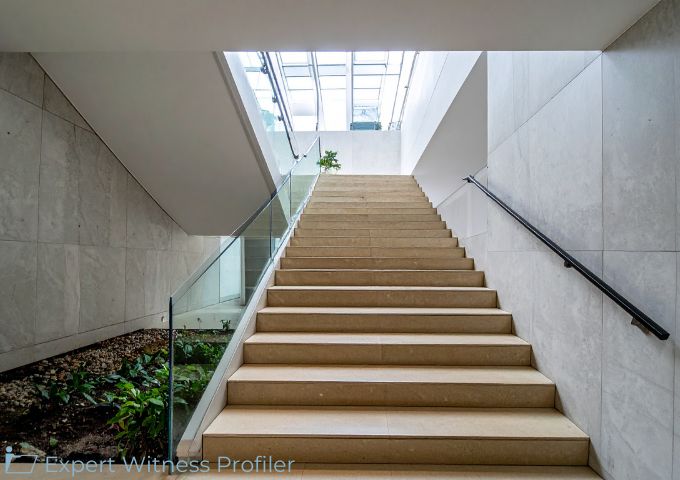
    Architecture Expert Witness

    Douglas W. Peden provides expert analysis of construction and construction material defects, walkway construction, vertical misalignments, maintenance and safety, identification and delineation of hazards in stairs, ramps, corridors, platforms and level changes both outdoors and inside buildings and other structures.

    Among other things, he has training and experience in the analysis and testimony for failure analysis and towards the resolution of personal injury litigation involving trip and fall injuries and code compliance issues.

    Want to know more about the challenges Douglas Peden has faced? Get the full details with our Challenge Study report.

    Discussion by the Court

    According to Peden, the unprotected stair landing was unreasonably dangerous and that the failure to provide required handrails on the stair violated the standard of care and applicable building codes.

    Hong Diep claimed that these opinions implicate issues of biomechanics and causation, outside of Peden’s expertise, are not supported by a reliable methodology, and would mislead the jury and therefore not be helpful to it.

    Plaintiff admitted that Peden cannot offer evidence regarding “the force of Plaintiff’s fall, her body position at the time of her fall, or the impact the absence of handrails had on Plaintiff’s body or injuries.” Plaintiff further offered no evidence of Peden’s qualifications to opine on the mechanism of injury in this case.

    Peden will be able to testify regarding the function of handrails along stairs in preventing people from falling off elevated surfaces, preventing people from falling over the edge of a landing, and providing a point of anchorage. Those opinions fall within Peden’s area of expertise. He can also testify that a handrail would provide a person who was falling off the second floor landing and into the stair case “with an opportunity to arrest her fall and injury.” That general testimony too falls within Peden’s expertise and is supported by a reliable methodology.

    However, because he lacked the expertise to opine on what caused Plaintiff’s injury or what would have prevented it, and because he identified no methodology supporting such opinions, he may not testify regarding Plaintiff’s particular mechanism of injury.

    Held

    The Court granted Hong Diep’s motion to exclude the testimony of Douglas Peden.

    Key Takeaway

    The district court must ensure that an expert, whether basing testimony on professional studies or personal experience, employs in the courtroom the same level of intellectual rigor that characterizes the practice of experts in the relevant field.

    Peden lacked the qualifications to opine on the mechanism of injury in this case and failed to identify any methodology supporting such opinions.

    Case Details:

    Case Caption: Iddriss V. Hong Diep Realty Incorporated
    Docket Number: 1:25cv2799
    Court Name: United States District Court, New York Southern
    Order Date: February 17, 2026
  • Avionics Expert Allowed to Opine on Engine Failure

    Avionics Expert Allowed to Opine on Engine Failure

    This case arises from an accident involving a Robinson R44 II helicopter, registration N442VB (“Helicopter”), that occurred on the evening of December 30, 2021, in Levy County, Florida. The Helicopter was being flown at night by the owner-pilot, Ronald Hicks (“Pilot Hicks”), from a local friend’s residence to his private property. At the time of the accident, Pilot Hicks had less than ten hours of night flight experience in helicopters and was not certified under Instrument Flight Rules (“IFR”). Mr. Hicks, Shelly Kate Hicks, and their two children sustained fatal injuries.

    Defendant filed a Daubert motion to limit the testimony of Plaintiffs’ accident reconstruction expert John Bloomfield.

    Avionics Expert Witness

    John W. Bloomfield is the President and owner of Bloomfield Research and Development and am the holder of twelve United States patents in the disciplines of electronics, robotics, avionics, medical electronics, ultrasonics, precision spread spectrum radio ranging, battlefield communications, cellular digital software, and electronic toys.

    He holds an engineering degree in systems engineering and has 35 years of experience in aircraft electrical and avionics system. He has also been involved in the investigation of hundreds of aircraft accidents.

    Want to know more about the challenges John Bloomfield has faced? Get the full details with our Challenge Study report.

    Discussion by the Court

    Qualification

    First, the Defendant argued that Bloomfield opined regarding “metallurgical issues,” namely, that steel debris caused engine failure, despite being unqualified to do so. However, the Court has reviewed Bloomfield’s qualifications and is satisfied that, based on his extensive experience, which includes investigating numerous aircraft accidents and examining component parts, he is qualified to opine that steel debris caused the engine failure.

    Reliability

    Second, the Defendant argued that Bloomfield’s opinion that steel debris caused a loss of torque is untested and entirely speculative and therefore unreliable. Plaintiffs responded that Bloomfield explained he could not test the debris because it was not preserved, and testing could not be performed under substantially similar circumstances. He instead based his opinion regarding the presence and size of steel debris on the gouges left on the crankshaft.

    Bloomfield explained that any debris that was between the gear and the crankshaft was lost when the engine was taken apart and wiped during the inspection. And he testified that it was not possible to replicate his theory of the crash in a testing environment.

    Though Bloomfield’s failure to test his contamination theory is not determinative, this Court is not absolved of its gatekeeping function.

    The Court found that Bloomfield met the Daubert standard. Bloomfield explained why, based on a variety of evidence including key indicators used by other accident investigators, he concluded that the helicopter’s engine was not under power when the helicopter crashed.

    He then explained, using other case studies for reference, why he believed the dowel pin in the engine fractured not upon impact but during flight, causing a cessation of engine power.

    Finally, he discussed how the fractured dowel pin was caused by the loose gear bolt found in the engine, which could in turn be caused by a loss of torque from debris on the crankshaft, and how the presence of such debris was evinced by score marks on the gear face and crankshaft face.

    Helpfulness

    Defendant argued that Bloomfield’s criticism of the National Transportation and Safety Board’s investigation, particularly his discussion of the NTSB’s failure to preserve alleged contaminants, is neither reliable nor helpful.

    Defendant is concerned that Plaintiffs are trying to backdoor in a spoliation claim at trial. The Court previously denied Plaintiffs’ motion for a finding of spoliation and sanctions based upon Defendant’s alleged failure to preserve contaminants on the engine. The Court is prepared to sustain objections to any attempts to circumvent this Court’s ruling, including any argument that Defendant intentionally destroyed evidence. However, Plaintiffs’ experts may, of course, discuss the lack of physical evidence of contamination and their inability to perform certain tests on the engine because it was cleaned during the investigation.

    To that end, this Court is satisfied that Bloomfield can also reliably opine as to the way the engine was handled after the crash. Bloomfield either personally observed the instances he described, or he explained how, based on his training and experience, these parts are typically handled during the inspection process.

    Held

    The Court denied the Defendant’s Daubert motion to limit the testimony of Plaintiffs’ accident reconstruction expert John Bloomfield.

    Key Takeaway

    The Court is satisfied that Bloomfield has demonstrated his opinion is reliable. To the extent Defendant wishes to challenge Bloomfield’s conclusions and their bases, vigorous cross-examination, presentation of contrary evidence, and careful instruction on the burden of proof are the traditional and appropriate means of attacking shaky but admissible evidence.

    Case Details:

    Case Caption: Law V. Avco Corporation
    Docket Number: 1:24cv3
    Court Name: United States District Court for the Northern District of Florida, Gainesville Division
    Order Date: November 04, 2025
  • Accounting Expert’s Financial Testimony on Mitigation Admitted

    Accounting Expert’s Financial Testimony on Mitigation Admitted

    Plaintiffs sought to develop affordable housing in Brevard County. The Venue at Heritage Oaks Partners, Ltd. was the contract purchaser of the property. They, along with Atlantic Housing Partners L.L.L.P., intended to develop as “The Venue at Heritage Oaks,” a development comprised of multi-family dwelling units.

    Canton Construction, LLC was to construct the development, and once completed, Concord Management, Ltd. was to manage it. The project did not come to fruition, however, because in December 2023, Defendant’s board of commissioners rejected Plaintiffs’ bond financing application. 

    Plaintiffs brought this action against Defendant for damages under the Fair Housing Act and the Florida Fair Housing Act, alleging that Defendant’s rejection discriminated against racial minorities.

    Defendant affirmatively alleged that Plaintiffs must mitigate their damages and have failed to do so,” and as such, argues that “Plaintiffs’ claims should either be barred, or in the alternative, comparatively reduced in accordance with Plaintiffs’ failure to mitigate damages.

    Defendant retained Patrick Kelleher as an expert to demonstrate that “Plaintiffs’ damages model does not consider mitigation and that reasonable possibilities likely existed with respect to mitigation.”

    Plaintiffs filed a motion to exclude Kelleher’s opinions pursuant to Daubert v. Merrell Dow Pharms., Inc., 509 U.S. 579, 113 S. Ct. 2786, 125 L. Ed. 2d 469 (1993).

    Accounting Expert Witness

    Patrick F. Kelleher is a Certified Public Accountant (CPA) and Certified in Financial Forensics (CFF) with both a Bachelor of Science in accounting and a Master of Business Administration focused on finance, and he has more than twenty years of experience in forensic and investigative accounting. Kelleher submitted a twenty-page report that stated his opinions, included the documents he considered, and explained the analysis he performed, among other things.

    Get the full story on challenges to Patrick Kelleher’s expert opinions and testimony with an in-depth Challenge Study.

    Discussion by the Court

    Kelleher opined that “Plaintiffs have not demonstrated any economic damages with reasonable certainty, but rather have provided a model that does not reflect the timing and accuracy of the cash flows associated with the housing] project.” Kelleher also identified alleged errors and deficiencies with Plaintiffs’ model and with testimony from two of Plaintiffs’ witnesses. With respect to his methodology, Kelleher reviewed Plaintiffs’ documents and used them to render accounting and financial testimony related to mitigation. In doing so, he used calculations and analysis in accordance with the American Institute of Certified Public Accountants (AICPA) Statement on Standards for Forensic Services. He also used AICPA prescribed methods for calculating damages.

    Analysis

    Plaintiffs stated, without citations to the record or supporting caselaw, that Kelleher’s opinion was unreliable as it was not based in accounting—Kelleher’s area of expertise—but is based on a qualitative analysis. Plaintiffs also asserted that Kelleher’s opinion cannot be tested and did not use a generally accepted methodology. However, Kelleher noted that he performed his analysis in accordance with AICPA standards and followed AICPA prescribed methods for calculating damages. Courts have consistently found that such methodologies are generally accepted and thus reliable.

    Plaintiffs further challenged Kelleher’s opinions as unhelpful because they are “not beyond the understanding of the average lay person.” Plaintiffs also contended that Kelleher’s opinions offered just what Defendant’s attorney could argue in closing arguments. However, Kelleher’s testimony can assist the jury with financial and accounting principles.

    Even if Kelleher’s opinion “boils down to at its essence,” something a layperson may understand, the purpose of an expert is to help simplify complex concepts, boiling them down—as Plaintiffs point out—so that laypersons can comprehend them. 

    Although Kelleher’s conclusions may be simple, the mathematical calculations leading to such conclusions are beyond the understanding of the average layperson, so his opinions would help the jury.

    Kelleher can explain field-specific information that the average layperson does not know, including, but not limited to, the capital forces specific to Plaintiffs’ business model, the ownership structure of the entities at issue, and how these topics affect the ability to redeploy capital.

     Given the “liberal standard for relevance to whether expert testimony will aid the jury in resolving the facts,” the Court declined to exclude Kelleher’s testimony under Daubert. 

    Held

    The Court denied the Plaintiffs’ motion to exclude the opinions offered by Patrick Kelleher.

    Key Takeaway:

    If Plaintiffs wish to undermine Kelleher’s opinions, “vigorous cross-examination, presentation of contrary evidence, and careful instruction on the burden of proof are the traditional and appropriate means of attacking shaky but admissible evidence.”

    Case Details:

    Case Caption: Atlantic Housing Partners L.L.L.P. Et Al V. Brevard County
    Docket Number: 6:23cv2473
    Court Name: United States District Court, Florida Middle
    Order Date: November 07, 2025
  • Law Enforcement Expert Was Barred From Testifying Because His Report Was Not Produced on Time

    Law Enforcement Expert Was Barred From Testifying Because His Report Was Not Produced on Time

    Plaintiff Tonya Armstead Miller brought five claims on behalf of herself and the estate of Roderick Marcell Inge relating to the fatal shooting of Mr. Inge. 

    Specifically, Miller alleged that Defendant Chief Brent Blankley “maintained a system of grossly inadequate training” that caused officers to violate Inge’s Fourth and Fourteenth Amendment rights (“Count One”); that Defendant Officers John Beasley and Elijah Rodriguez unlawfully seized Inge by shooting and killing him in violation of his Fourth and Fourteenth Amendment rights (“Counts Two and Three”); and that Officers Beasley and Rodriguez negligently caused the death of Inge in violation of Alabama law. 

    Defendants filed a motion to strike the report and affidavit of Plaintiff’s expert Daniel Busken.

    Law Enforcement Expert Witness

    Daniel Busken served as a municipal police officer for 35 years including 25 years as a chief of police. This service included responsibility for development of and compliance with progressive law enforcement policies and procedures. Chief Busken served on the Board of Directors for the Texas Police Chiefs Recognition Program. This program sets the standards for progressive and professional law enforcement practices throughout the State of Texas.

    He earned his BS in Business and Economics from Culver-Stockton College, his MPA from Saint Louis University, and his MBA in Criminal Justice from Northcentral University. 

    Want to know more about the challenges Daniel Busken has faced? Get the full details with our Challenge Study report

    Discussion by the Court

    Defendants contended (1) Miller did not timely produce the report to them, and (2) it is not in the appropriate form. 

    The Court ordered Miller to disclose any experts and their reports by April 29, 2024. No extensions of any deadlines affected this deadline. The parties agreed that Miller did not provide any notice that Busken had been retained as an expert witness for Miller until May 3, 2025 and did not produce Busken’s report until she responded to the motion for summary judgment on October 24, 2024.  The notice provided on May 3, 2025 identified Busken and provided his curriculum vitae, but it did not include his expert report, his affidavit, or any of the conclusions he drew in his report. 

    Miller did not argue that her failure to comply with the deadline set by the Court’s order was harmless or substantially justified. Instead, she argued that Defendants did not object to her late notice of Busken or seek to depose him.

    But Defendants’ failure to object or seek to depose Busken did not make Miller’s non-compliance with the deadline harmless or substantially justified. To the contrary, her late disclosure prejudiced Defendants by denying them access to the substance of his opinion until after they had already moved for summary judgment.

    Held

    The Court granted the Defendants’ motion to strike Daniel Busken’s report and affidavit.

    Key Takeaway:

    A party’s failure to provide information or identify a witness as required by Rule 26(a) precludes the party from using “that information or witness to supply evidence on a motion unless that failure was substantially justified or harmless.

    Case Details:

    Case Caption: Miller V. Burton
    Docket Number: 7:23cv436
    Court Name: United States District Court, Alabama Northern
    Order Date: September 09, 2025
  • Testimony of Economics Expert Witness Excluded Because of his Inability To Produce a Coherent Model

    Testimony of Economics Expert Witness Excluded Because of his Inability To Produce a Coherent Model

    Plaintiffs brought an antitrust lawsuit against Defendants, asserting that Defendants entered a set of agreements with each other and their broadcast partners that suppressed the output of telecasts of out-of-market professional football games, resulting in higher prices for Sunday Ticket.

    Since Judge Philip Gutierrez decided the opinions provided by the Plaintiffs’ expert witnesses regarding financial damages were not reliable, the Sunday Ticket Plaintiffs won’t be getting a mulligan on damages, at least not for now.

    Daniel Rascher, one of the expert witnesses whose testimony was allowed until it wasn’t, crafted a model based on the NFL ditching Sunday Ticket and selling the out-of-market games to various networks that would broadcast the feeds from CBS and Fox.

    Economics Expert Witness

    Daniel Rascher has taught sports economics and finance, business research methods, and master’s project. As President of SportsEconomics, his clients have included organizations involved in the NBA, NFL, MLB, NHL, NCAA, NASCAR, MLS, PGA, WTA, media, sporting goods and apparel, professional boxing, mixed martial arts, minor league baseball, NHRA, AHL, Formula 1. He has authored articles for academic and professional journals, book chapters, and a text book in the sport management and economics fields, has been interviewed hundreds of times by the media for his opinion on various aspects of the business of sports, and has given over fifty presentations at professional and academic conferences.

    Get the full story on challenges to Daniel Rascher’s expert opinions and testimony with an in-depth Challenge Study. 

    Discussion by the Court

    Rascher used college football as his model of what would happen in the absence of the competitive restraints at issue in the case (“college football but-for world”). He opined that if the NFL Teams stopped “colluding and selling” their out-of-market games through the NFL, but sold them either independently or in divisions, the result would be like college football as the games would “become available, just like on Saturday, on over-the-air channels and . . . basic sport cable channels” and customers would not “pay anything extra above what they were already paying for their TV package.”

    Judge Gutierrez held that Rascher’s failure to produce a coherent model is particularly problematic as there are significant differences between college football and the outcome in his college football but-for world. Unlike Rascher’s college but-for world, not all college football games are available on over-the-air networks and on the major cable stations as some college football games—including games of top 25 ranked teams—were available only by purchasing premium offerings like the Pac 12, SEC, or ACC network packages or viewable only on local regional networks.

    The judge upheld the finding that Sunday Ticket, as constructed, violated federal antitrust laws. 

    From June 5, 2024 to June 26, 2024, a trial took place, where the jury found that Defendants’ conduct violated § 1 and § 2 of the Sherman Act. The jury awarded the Commercial Class $96,928,272.90 and the Residential Class $4,610,331,671.74 in damages.

    Judge Gutierrez specifically found that there was enough evidence to justify the verdict as to the issue of liability. He threw the verdict out because he determined that the expert witnesses he allowed to testify weren’t reliable.

    Held

    The Court excluded Daniel Rascher’s testimony under FRE 702 because it relied on a college football model that was developed based on speculation and ipse dixit opinion.

    Key Takeaway:

    After review of Rascher’s testimony, the Court finds that his college but-for world was not based on a reliable methodology but rather ipse dixit opinion untethered to an economic analysis of what would have likely occurred in the but-for world and must be excluded. Rascher had to present a but-for world grounded in economic rationality.

    Case Details:

    Case Caption: In re: NFL “Sunday Ticket” Antitrust Litigation
    Docket Number: 2:15ml2668
    Court: United States District Court for the Central District of California
    Order Date: August 01, 2024
  • Construction Expert Witness’ Deposition Testimony deemed “Incomplete and Inconclusive”

    Construction Expert Witness’ Deposition Testimony deemed “Incomplete and Inconclusive”

    This action stems from a trip and fall incident that occurred on July 19, 2019, while Plaintiff, Carolyn Simmons was walking and tripped along a dangerous and defective sidewalk located in front of Rite Aid in Ridgeland, South Carolina. The Defendant, Rite Aid of South Carolina, Inc., Walgreens, and Sitaras and Tzioros Properties, Inc., (hereafter referred to as “Defendant”), is a national drug store chain located in Ridgeland, State of South Carolina.

    Defendant Sitaras and Tzioros Properties, Inc.’s (hereafter “Defendant”) filed a motion to exclude the testimony of Plaintiff’s expert Gerald Neal.

    Construction Expert Witness

    Gerald Neal is licensed general contractor with eighteen years of experience in project management and facilities engineering. Moreover, he has extensive experience constructing and renovating homes, offices, apartments, restaurants, and churches.

    Want to know more about the challenges Gerald Neal has faced? Get the full details with our Challenge Study report. 

    Discussion by the Court

    While the case was still pending in state court, Plaintiff identified Neal as an expert witness and indicated, in response to Defendants’ interrogatories, that Neal was “compiling” documents and would forward these upon receipt.

    After the case was removed to United States District Court, the Plaintiff’s expert report was due by March 26, 2024. According to Defendant’s motion, no expert report meeting Rule 26(a)(2)(B) requirements had been produced by Plaintiff under the Court’s scheduling order.

    Also, Neal was deposed while the case was still pending in state court. Besides, he stated in his deposition that he lacked certain important information that was necessary to finalize his opinions. Specifically, Neal testified that he needed the date of the building’s certificate of occupancy because that would determine the specific building code that was applicable to this incident.

    Subsequently, Defendant filed its motion to exclude more than two months after the deadline in the scheduling order for the production of expert reports. Defendant’s assertions that it has never been provided an expert report from Neal and that his deposition testimony was “incomplete and inconclusive” have gone unchallenged by Plaintiff since no response to the motion to exclude was filed.

    Ultimately, the Court found that no good cause or substantial justification has been shown for the failure to timely produce an expert report and the failure to comply has not been shown to be harmless.

    Held

    To conclude, the Court granted Defendant’s motion to exclude the testimony of Gerald Neal as an expert witness at trial.

    Key Takeaway:

    To conclude, the Court found that no good cause or substantial justification had been shown for the failure to timely produce an expert report. Furthermore, the failure to comply has not been shown to be harmless.

    In short, when considering a motion to exclude an expert witness for failure to produce a required expert report, the Court must address two applicable rules. First, Fed. R. Civ. P. 16(b)(4) provides that a scheduling order may be modified only “for good cause and with the judge’s consent.” Second, even where a timely expert report has not been produced, an expert will not be excluded so long as the failure to timely produce the report is “substantially justified or is harmless,” as per Fed. R. Civ. P. 37(c)(1).

    Case Details:

    Case Caption: Simmons V. Rite Aid Of South Carolina, Inc. Et Al
    Docket Number: 9:23cv2290
    Court: United States District Court, South Carolina
    Order Date: July 03, 2024