Tag: Lid

  • Mechanical Engineering Expert’s Testimony on the Mechanical Interlock Design Admitted

    Mechanical Engineering Expert’s Testimony on the Mechanical Interlock Design Admitted

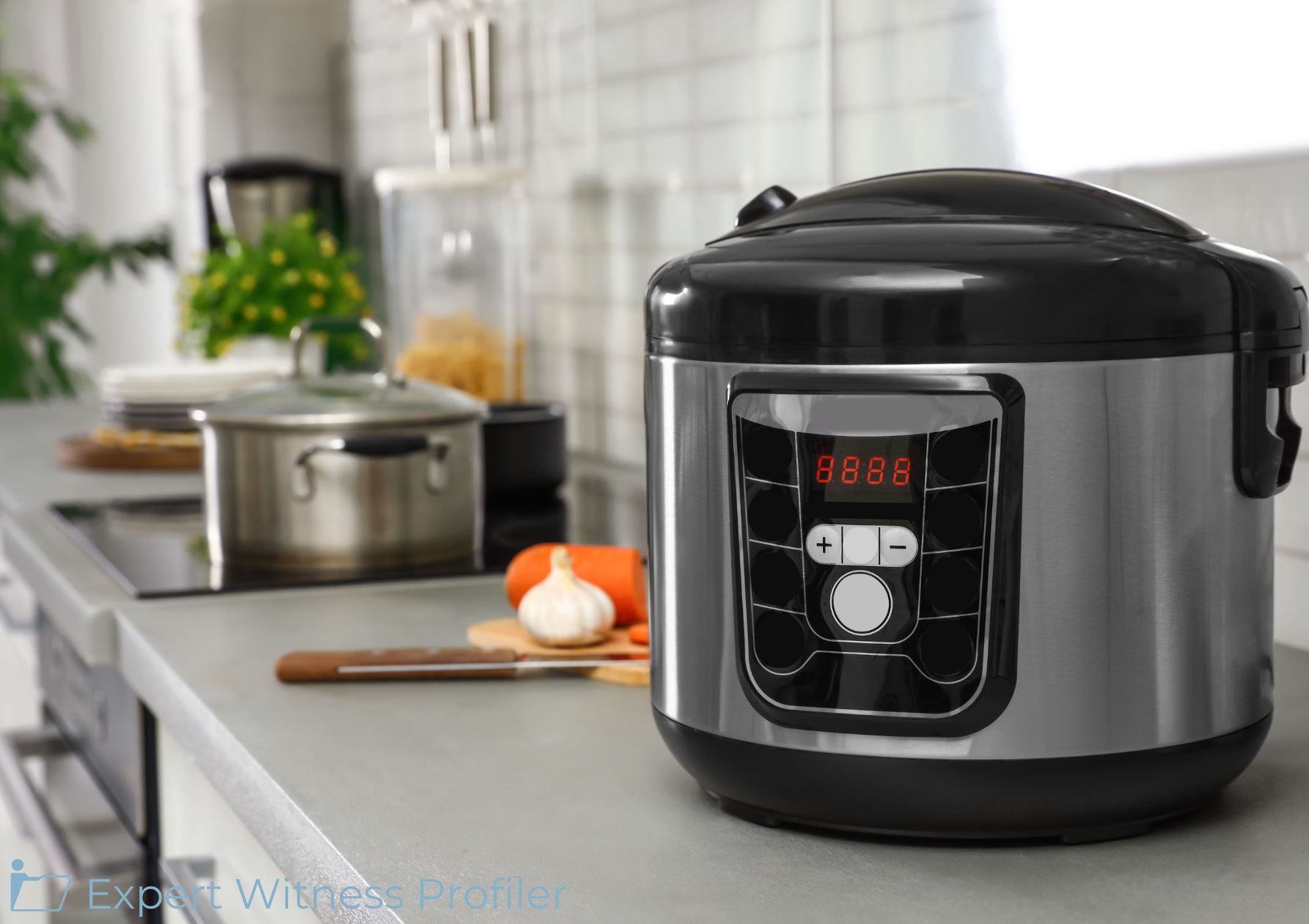
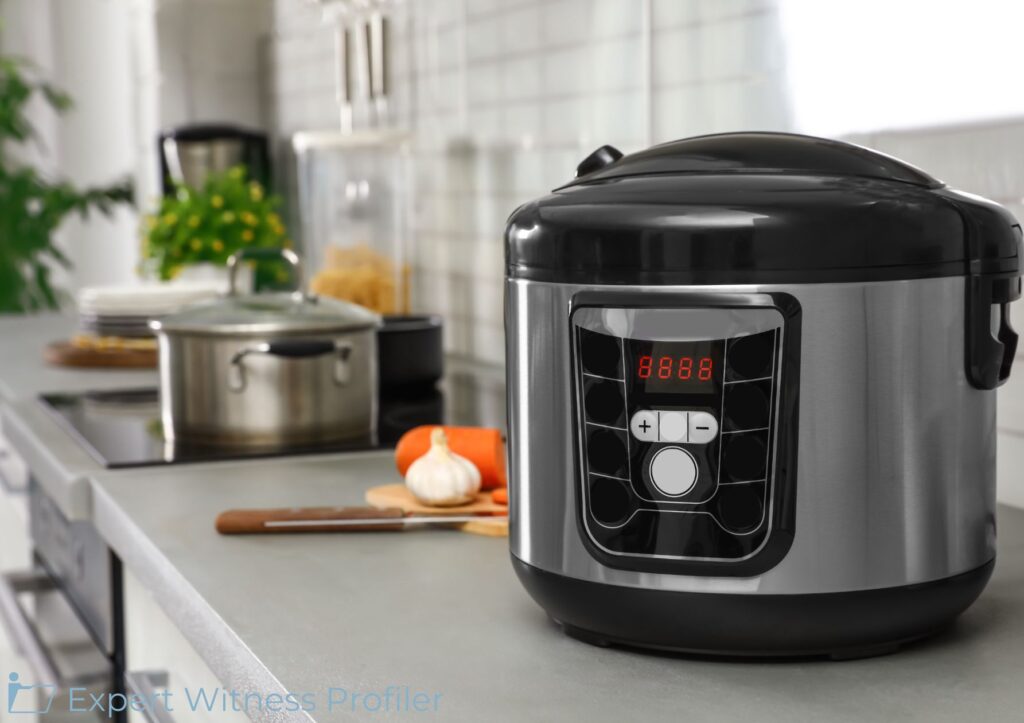
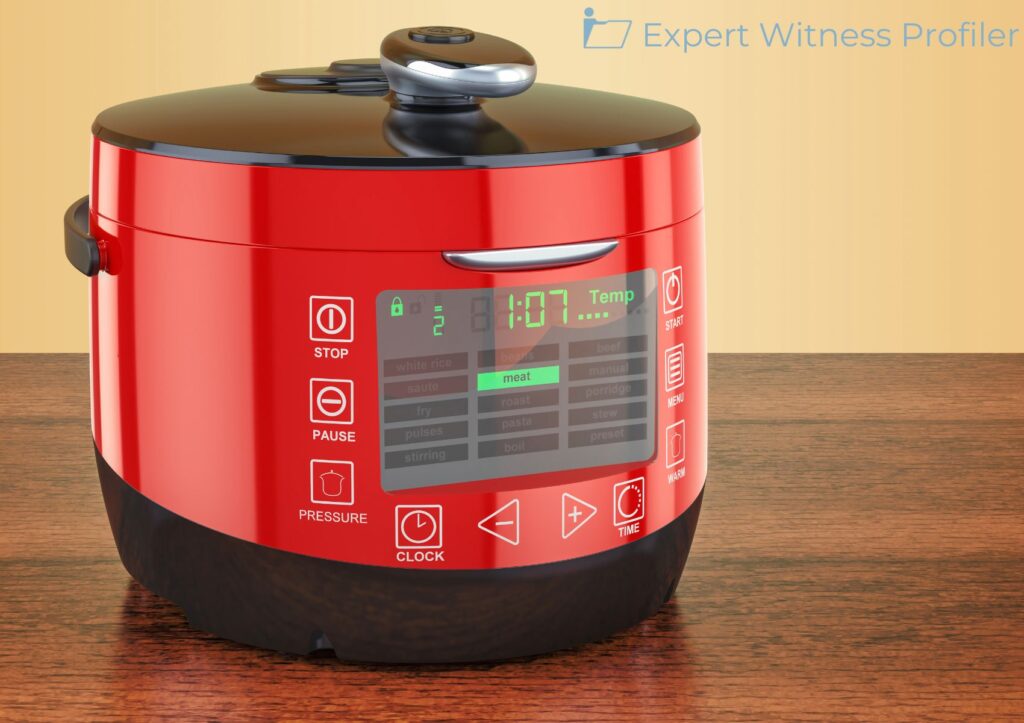
    While preparing a roast in her Magic Chef 7-in-1 Multicooker, Tarsha Allgood was injured when the device’s lid opened causing its “scalding hot contents to be forcefully ejected from the pressure cooker.”

    Allgood filed this lawsuit against CNA International, Inc. d/b/a MC Appliance Corporation raising claims under North Carolina law for inadequate warning, inadequate design, common law negligence, breach of express warranty, and breach of implied warranty.

    CNA filed a motion to exclude the testimony of Allgood’s expert witness, David M. Rondinone, an engineer with Berkeley Engineering and Research, Inc.

    Rondinone examined exemplars and other documents and materials, and concluded, among other things, that: (a) the mechanical interlock design intended to lock the lid is defective in that it fails to perform its function. This conclusion is based on, among other things, the geometric dimensions of the pin, lid, and cooker, which results in the interlock “providing very little resistance to the user;” and (b) “the presence of a defective pressure interlock increases the likelihood of the lid being opened and the cooker contents being expelled under pressure.” The touchstone of CNA’s argument is that Allgood threw away the device’s lid, so Rondinone could not test the actual multicooker Allgood used.
    Mechanical Engineering Expert Witness

    David Michael Rondinone has over 20 years of experience in mechanical engineering including design and failure analysis, fire suppression, explosions, flammability, flame arrestors, ignition, finite element analysis, accident reconstruction and crashworthiness, mechanical testing, failure of mechanical connections, dynamic stability of equipment and structures, pressure vessels and pipelines, medical implants and equipment, automotive component analysis and design.

    Rondinone has a Masters and Ph.D in Mechanical Engineering from the University of California, Berkeley, where he previously received his B.S. in Engineering Physics and B.A. in Astrophysics.

    Want to know more about the challenges David Rondinone has faced? Get the full details with our Challenge Study report.  

    Discussion by the Court

    The exemplar multicooker that Rondinone examined was used when it was purchased such that its prior history is unknown. CNA noted that the exemplar’s lid had a pre-existing scratch that Rondinone concluded means the lid was “force[d] open while under pressure by a prior user (an interlock override event).” CNA challenged the reliability of Rondinone’s opinion that the device was defectively designed because the mechanical interlock system could not meet the Underwriters Laboratories Cover Opening Standard.

    According to CNA, Rondinone’s methodology relied on broad generalizations and failed to account for whether the exemplar met relevant Underwriters Laboratories’ standards before the exemplar was damaged. 

    Allgood countered that Rondinone set forth his methodology in his report. He explained how he examined and measured the exemplar, including its interlock features, and considered relevant Underwriters Laboratories standards. He then concluded that the mechanical interlock design that is intended to lock the lid of the device is defective in that it fails to perform its intended function.

    The Court agreed with Allgood that Rondinone’s conclusions are sufficiently reliable. Among other things, he explained how the exemplar he examined showed “linear defects in the coating which are consistent with wear from the lid locking pin sliding over the tab,” and that the pre-existing scratch on the lid he examined could be the result of the lid being opened under pressure despite the sliding pin lock being held in place by the float valve.

    CNA’s remaining arguments failed to persuade the Court. That Rondinone did not take measurements that CNA deems critical, failed to perform a statistical or comparative analysis, or reached his conclusions based on a “single nonrepresentative data point,” are fair points for cross-examination.

    Held

    The Court denied the Defendant’s motion to exclude the testimony of David Rondinone.

    Key Takeaway:

    The Court held that Rondinone’s opinions are appropriately based on sufficient data, an examination of an exemplar, and a reliable application to the facts of this case. His testimony would also assist the fact finder with determining whether a defect existed at the relevant time, and the methodology underlying his conclusions is sound and sufficiently reliable for trial.

    To the extent CNA wishes to challenge the facts forming the basis of Rondinone’s opinions, including the impact, if any, that examining an exemplar had on his conclusions, it may do so on cross-examination. Although the facts on which an expert bases his opinion must have some basis in the record, there is no requirement that the basis must consist of undisputed evidence.

    Case Details:

    Case Caption: Allgood V. CNA International, Inc.
    Docket Number: 1:23cv462
    Court Name: United States District Court, Illinois Northern
    Order Date: September 3, 2025
  • Accident Reconstruction Expert’s Testimony About the Lid Locking Mechanism Admitted

    Accident Reconstruction Expert’s Testimony About the Lid Locking Mechanism Admitted

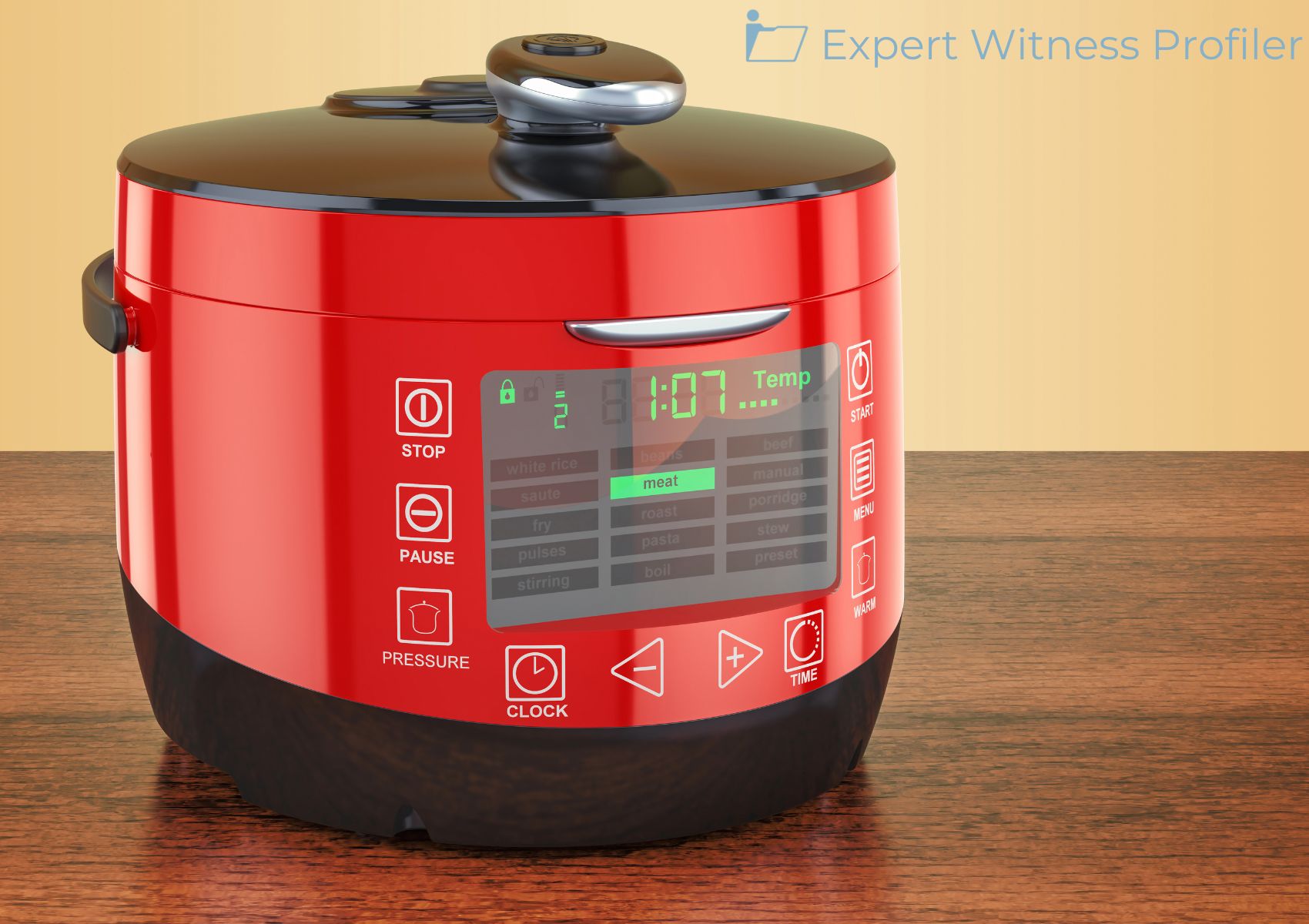
    This is a product liability case involving a Breville BPR600XL pressure cooker (the “Pressure Cooker”). Plaintiff, Hannah Frazier, claimed that suffered permanent injuries to her abdomen when the Pressure Cooker exploded, spraying super-heated liquid and steam across her body.

    The Plaintiff retained Jeffrey D. Hyatt of Specialized Testing & Forensic Laboratory to inspect and test the Pressure Cooker and provide an expert report (“Hyatt Report” or “Report”). Hyatt inspected and tested the Pressure Cooker using the UL (for “Underwriters Laboratory”) 136 “Standard for Pressure Cookers.” The Defendant, Breville USA, Inc., filed a motion to exclude Hyatt’s testimony under Rule 702 and Daubert.

    Accident Reconstruction Expert Witness

    Jeffrey D. Hyatt specializes in conducting mechanical component and system testing engineering, mechanical system failure analysis, identification of materials failure mechanisms and scientific accident reconstruction.

    Want to know more about the challenges Jeffrey Hyatt has faced? Get the full details with our Challenge Study report

    Discussion by the Court

    Breville did not challenge Hyatt’s qualifications as an expert; instead, it challenged the reliability of his principles and methodology.

    UL 136

    Breville contended that Hyatt’s testimony must be excluded in its entirety because Hyatt failed to establish that UL 136 applies or should apply to electrical pressure cookers, as opposed to stovetop pressure cookers.

    However, the Court held that Hyatt’s testimony is sufficient to create, at a minimum, a question of fact as to whether it is appropriate to apply UL 136 standards to electric pressure cookers.

    The Prescribed Testing Methodology

    Breville next argued that, even assuming UL 136 applies, Hyatt did not utilize the prescribed testing methodology set out in UL 136. Hyatt, however, acknowledged as much during his deposition and explained why he intentionally chose not to follow precisely some of the procedures recommended in UL 136. It is clear that this was no oversight on his part.

    Torque vs. Pounds Force

    Breville contended that, “even using the wrong standard and applying that standard’s principles and methodology incorrectly, Hyatt demonstrated that the Pressure Cooker required more force to open than can be exerted by an average male or female.” According to Breville’s expert, the 26.3 pounds of force measured by Hyatt is equivalent to 131.5 “inch-pounds of torque, which is well in excess of what an average [person] has been observed to exert.” However, UL 136 prescribed the method for testing the force necessary to open a pressurized lid, and it speaks in terms of pounds of force, not torque.

    The Measurement of the Locking Pin

    Breville took issue with Hyatt’s purported failure to measure the lid locking pin while it was under pressure. Breville also contended that “Hyatt does not provide any support for his claim that Breville intended to use all .291 [inches] of the lid locking pin while under pressure” or “include any facts or data to support his conclusion that the Pressure Cooker was designed to use the entire .291 [inches] of the lid locking pin.”

    Hyatt, however, explained that he made that assumption because he was not in possession of actual design documents from Breville to show what its intended design was, and he reserved the right to change his opinion if documents produced by Breville showed that, in fact, the manufacturer intended for the compressed pin to extend only .168 inches. In that event, Hyatt would modify his opinion to state that the compressed length of the locking pin was a design defect rather than a manufacturing defect that affected only the plaintiff’s Pressure Cooker.

    Hyatt’s opinion, in any event, is that the length of the pin in the case of this particular pot was insufficient to prevent it from opening under pressure. The Court held that Breville’s objections did not make his opinion unreliable or inadmissible.

    The Reliability of the Data in Figure 13

    Breville pointed out an error on a data chart in Hyatt’s Report purporting to show that the internal pressure of the Pressure Cooker was negative for the majority of the test. It asserted that Hyatt “fails to account for any condition that would make the internal pressure of the cooker less than zero for the majority of the test,” thus making the “data he offers in the chart . . . unreliable and insufficient.” As set forth above, Hyatt did explain this discrepancy in his deposition and accounted for it. It appeared that the only difference this error would have made would be to shift the maximum internal pressure of the Pressure Cooker by .5 psig, but it did not appear to have had any effect on Hyatt’s other calculations.

    Although this error might detract from Hyatt’s credibility before the jury, the Court held that it does not render his opinions unreliable or inadmissible.

    Breville’s Intentions

    Finally, Breville took issue with Hyatt’s finding that Breville intended for the Pressure Cooker to “meet the automatic locking requirements of UL 136” on the basis that this finding is not supported by sufficient evidence, given that the Pressure Cooker itself states that it was intended to comply with US 1026 and UL 1083.

    Hyatt made it clear in his deposition that UL 136 is the locking mechanism standard and that the “industry requires” any pressure cooker lid to remain locked while the contents are under sufficient pressure that liquid could be ejected if it were opened.

    The fact that the Pressure Cooker here has a locking mechanism that engaged below 0.25 psig of pressure indicated to him that Breville intended to comply with industry safety standards, irrespective of whether it identified UL 136 on the Pressure Cooker’s label. In other words, according to Hyatt, the design of Breville’s locking mechanism itself demonstrated Breville’s intent that its pressure cookers be safe and in compliance with industry standard.

    Whether Hyatt’s Testimony Will Assist the Jury

    Breville asserted that, for all of the reasons addressed above, Hyatt’s testimony would not assist the jury in understanding the evidence or determining a fact at issue in this case. The Court finds, as set forth above, that Breville’s arguments are more properly directed to the weight to be accorded Hyatt’s testimony by the jury rather than to its admissibility.

    Breville contended that Hyatt’s hypothesis—that the lid opened without resistance—contradicted his finding that it took 26.3 pounds of force to open while under pressure and that Hyatt “fails to explain how his conclusion that the Pressure Cooker required 26.3 pounds of force to open while under pressure has any bearing on whether a defect caused Plaintiff to be able to open the Pressure Cooker lid ‘easily’ and ‘with no resistance’ as she has testified to.

    But Hyatt addressed this purported inconsistency in his deposition as well. He testified that consumers whose pressure cookers he has tested frequently describe the lid as opening “with “no resistance” or as being “easy to open,” and he did not understand Frazier to mean literally that the lid had no resistance when she opened it.

    Held

    The Court denied Breville’s motion to exclude the testimony of Jeffrey D. Hyatt.

    Key Takeaway:

    Hyatt’s opinions are based on sufficient facts and data, are the product of reliable principles and methods, and reflect a reliable application of the principles and methods to the facts of this case.

    The Court denied Breville’s motion, insofar as it sought the exclusion of Hyatt’s testimony.

    Case Details:

    Case Caption: Frazier V. Breville USA, Inc.
    Docket Number: 3:23cv563
    Court Name: United States District Court, Tennessee Middle
    Order Date: July 24, 2025
  • Ninja’s Silent Danger: Court Admits Expert’s Warning Claim

    Ninja’s Silent Danger: Court Admits Expert’s Warning Claim

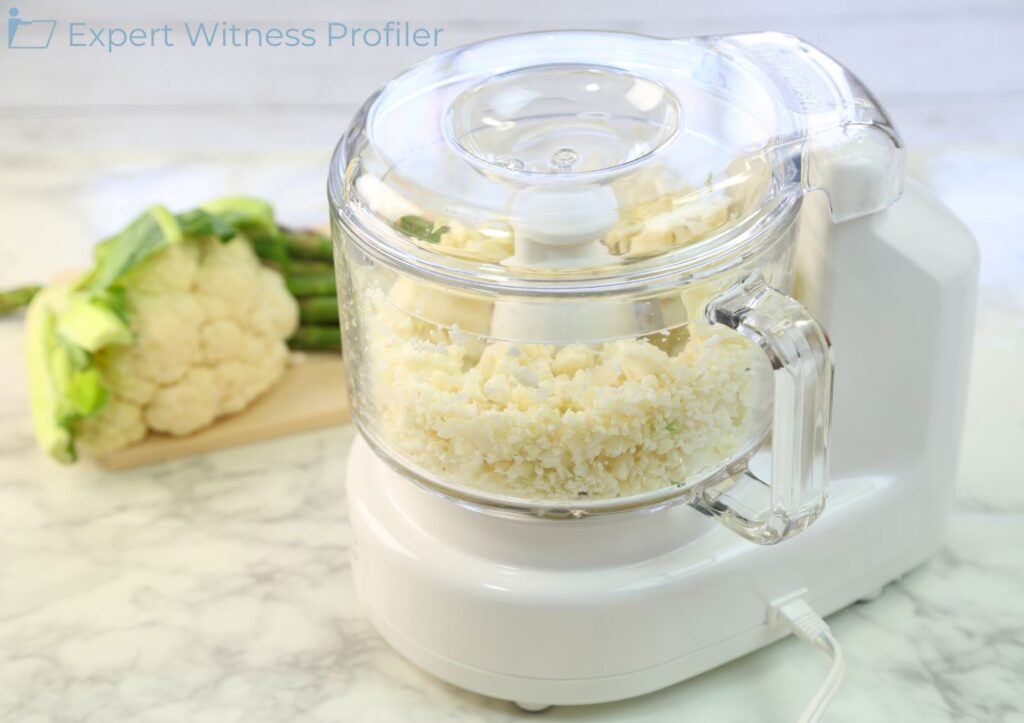
    Allyson Bolden sued SharkNinja after sustaining injuries while using their Intellisense Kitchen System food processor. Bolden claimed a design defect led to the lid jamming, resulting in her injury when trying to remove it. Defendant SharkNinja challenged the admissibility of Plaintiff’s expert, Dr. Wade Lanning‘s, testimony, arguing his qualifications, reliability, and relevance were lacking.

    Lanning, a materials scientist and safety engineer, conducted a thorough analysis of the food processor. His key findings included:  

    • Design Flaw: The lid could be attached in a misaligned manner, locking into place without engaging the safety mechanism, leading to jamming.
    • Jamming Mechanism: Testing revealed the lid could jam due to this misalignment, consistent with Bolden’s experience. Scratches on Bolden’s bowl supported this conclusion.
    • Lack of Warnings: The product manual lacked warnings about lid jamming.
    • Ineffective Engineering Controls: The flexible bowl and shallow lug/notch design failed to prevent misalignment.
    • Alternative Designs: Lanning suggested safer alternatives, like a square lid or twist-to-lock mechanism, already used in other products.
    • Causation: He concluded the jammed lid, lack of warnings, and inadequate safeguards proximately caused Bolden’s injuries.

    Materials Science Expert Witness

    Wade Lanning is a forensic investigator who uses his expertise in materials science and engineering to determine how and why a failure or accident occurred. Lanning is also a safety engineer and analyzes how product design, manufacturing, instructions and warnings, and consumer behavior relate to an accident. Lanning investigates incidents of any scope, from minor property damage to major accidents involving loss of life. He also works as a consultant in material processing, failure analysis, and risk management, and conducts research in forensic investigation and accident prevention.

    Get the full story on challenges to Wade Lanning’s expert opinions and testimony with an in-depth Challenge Study. 

    Discussion by the Court

    Qualifications

    SharkNinja argued Lanning, a materials scientist, was unqualified to opine on warnings.

    The Court found Lanning’s experience in safety engineering and assessing warnings in consumer products, including food processing machinery, sufficient. Lack of specialization impacts weight, not admissibility.

    Reliability

    SharkNinja claimed Lanning’s force testing was inadequate and his opinions on alternative designs and causation were unreliable.

    Force Testing of Jamming

    Sharkninja claimed he did not test the force required to assemble the lid in a jamming fashion. The Court found that this was incorrect, and that Lanning had indeed performed force testing. Sharkninja then tried to change their argument, which the Court deemed waived. The Court also stated that even if the argument was not waived, that Lanning’s testing was sufficient.

    Force Testing of Lid Removal

    Sharkninja claimed that Lanning should have tested the force required to remove a jammed lid. The Court determined that his testing on the force of jamming, and the analysis of the damaged food processor was sufficient.

    Alternative Designs

    The Court deemed that testing of alternative designs was not always required, especially when certain of the alternative designs already exist in the industry. Moreover, the alternative designs are not complex.

    Warning Opinions

    Plaintiff did not allege that Bolden was injured because she did not know how to remove the lid under ordinary circumstances but instead that she was unable to remove the lid normally due to the jam which stopped the handle from raising fully and that no warnings were provided regarding risks associated with the lid jamming. 

    The Court ruled that Lanning’s warning opinions were not contrary to the record, as claimed by the Defendant.

    Relevance

    SharkNinja argued Lanning’s causation opinion was irrelevant as his test didn’t perfectly replicate Bolden’s experience.

    The Court found Lanning’s test replicated the core of Bolden’s experience: the lid not releasing fully through the use of the release button, requiring removal of the lid through other means.

    Held

    The Court held that Wade Lanning is qualified, has employed a reliable methodology, and his opinions are relevant, and accordingly denied Defendant’s motion to exclude Lanning.

    Key Takeaways:

    The Court emphasized that:

    1. Daubert doesn’t require specific credentials; relevant expertise is sufficient.

    2. Reliability can be established through scientific methods or professional experience.

    3. Lack of specialization impacts weight, not admissibility.

    4. Testing is one measure of reliability, but not always required.

    5. Imperfect testing is a matter for cross examination.

    Case Details:

    Case Caption: Haigler V. Sharkninja Operating LLC
    Docket Number: 1:23cv326
    Court: United States District Court, Illinois Northern
    Order Date: March 3, 2025