Tag: Lost Profits

  • Accounting Expert Allowed to Opine on Net Service Level Payments

    Accounting Expert Allowed to Opine on Net Service Level Payments

    Plaintiffs The Avon Company and LG H&H Company, Ltd. (“Avon,” or Plaintiffs) brought this suit against Fareva Morton Grove, Inc. and Fareva S.A. (collectively “Fareva,” or Defendants) for a breach of their long-term Manufacturing and Supply Agreement (the “MSA”).

    Fareva filed a motion to exclude the testimony of Avon’s two experts, Anthony J. Campanelli and Brent K. Bersin on the grounds that their testimony is based on unreliable data.

    Accounting Expert Witnesses

    Anthony J. Campanelli is a Certified Public Accountant with more than 25 years of experience at Deloitte, one of the world’s largest and most respected accounting and consulting firms.

    Want to know more about the challenges Anthony Campanelli has faced? Get the full details with our Challenge Study report.

    Brent Kevin Bersin is a Senior Managing Director at FTI Consulting with 30 years of experience as an expert witness and consultant on valuation, financial and forensic accounting, and economic damages.

    Get the full story on challenges to Brent Bersin’s expert opinions and testimony with an in-depth Challenge Study.

    Discussion by the Court

    Anthony Campanelli

    Campanelli will testify about the calculation of the Net Service Level Payments (“NSLPs”). The NSLPs are calculated based on Schedule D of the MSA, which sets out a formula that, put simply, considers when Fareva fulfilled Avon’s orders and when Avon placed those orders. The formula in Schedule D required a somewhat complex set of calculations, given the delivery and order timing inputs and different multipliers per product. In drafting his expert report and reaching his opinion, Campanelli relied on data provided by Avon regarding forecasts, orders, and delivery data from the relevant time period. Fareva argued that Campanelli’s opinion is not based on reliable data, that his calculations are inconsistent with the Schedule D formulas, and that the opinion improperly introduced contractual interpretations.

    Analysis

    First, the data relied upon by Campanelli are sufficiently reliable. The discrepancies that Fareva pointed to do not rise to the level of being “speculative or conjectural or based on assumptions that are so unrealistic.” Further, it was permissible for Campanelli to rely on the data provided by Avon. Even if Fareva’s “claims as to factual inaccuracies” in the underlying data and assumptions used by Campanelli were assumed true, Campanelli “at most had a few faulty inputs to an otherwise topical opinion on [the NSLPs]—this is thus not a case in which ‘there is simply too great an analytical gap between the data and the opinion proffered.’”

    Second, Fareva argued that Campanelli’s calculations are inconsistent with the MSA because they differ from calculations performed by PwC, Avon’s former expert. The discrepancy is explained by a reasoned choice in how Campanelli calculated the NSLPs, a choice which conformed with Fareva’s position on calculations and resulted in a lower damages claim. This is not a basis for rejecting Campanelli’s opinion.

    Third, Campanelli did not rely on improper assumptions or legal interpretations of the MSA in his calculations. While Fareva is correct that an expert may not make legal determinations interpreting a contract, Campanelli’s assumptions regarding the completeness of the data did not rise to the level of an impermissible contract interpretation.

    As a result, the Court denied Fareva’s motion to exclude the expert testimony of Campanelli.

    Brent Bersin

    Bersin will testify about Avon’s lost profits attributable to the lost sales of products that Fareva failed to produce or timely deliver. Bersin’s opinion is based on comparisons between Avon’s performance before and after the breach and on a benchmark comparison of the performance of the broader industry. Bersin relied on a subset of Avon’s North American sales data that captured the products produced by Fareva. Fareva argued that Bersin relied on unreliable and inaccurate data in his calculations, that he failed to disaggregate compounding factors, and his basis of benchmark comparison was unreliable.

    Analysis

    First, Fareva argued that the sales data relied upon by Bersin included products that Fareva did not produce, that there were other indicia of unreliability, and that Bersin failed to independently verify the data. As with Campanelli, any inconsistencies, which Avon also disputes factually, did not rise to the level of being “speculative or conjectural or based on assumptions that are so unrealistic.” And Bersin permissibly relied on the data provided by Avon in the ordinary course of business.

    Second, Fareva argued that Bersin improperly attributed all of Avon’s losses to Fareva, without disaggregating alternative sources of harm. This is insufficient to bar Bersin’s testimony. Bersin’s report acknowledged alternatives, noting that Avon’s oversales were declining and distinguishing between sales data in different product categories.

    Third, Fareva argued that Bersin relied on an insufficiently comparable benchmark for its benchmark analysis. Bersin relied upon the Statista data for the “Beauty & Personal Care market” in making his comparison. Fareva contended that using this market, without further analysis of the comparison between the companies within it, was improper, and that the market selected did not compare to Avon because the companies within did not use the same sales model as Avon. The Court disagreed. Bersin acknowledged that he considered the brands within the personal care market to be comparable when deciding to use them. It is reasonable to conceive of Avon as a beauty and personal care brand selling similar products to those in the comparison group. Bersin was not required, as Fareva suggests, to draw a comparison to groups based solely on distribution model that offer entirely different products from Avon.

    Therefore, the Court denied Fareva’s motion to exclude the testimony of Bersin.

    Held

    The Court denied Fareva’s motion to exclude the testimony of Anthony Campanelli and Brent Bersin.

    Key Takeaway

    Disputes as to the strength of an expert’s credentials, faults in his use of a particular methodology, or lack of textual authority for his opinion, go to the weight, not the admissibility of his testimony.

    Case Details:

    Case Caption: The Avon Company V. Fareva Morton Grove, Inc.
    Docket Number: 1:22cv4724
    Court Name: United States District Court, New York Southern
    Order Date: July 07, 2026
  • Accounting Expert Not Allowed to Opine on Transition Period

    Accounting Expert Not Allowed to Opine on Transition Period

    Robert Webster allegedly owed fiduciary duties, including duties of loyalty and honesty, to his employer, CellMark. He was also subject to contractual obligations restricting him from competing with CellMark or soliciting its customers or employees on behalf of himself or others. According to CellMark, Webster began breaching these duties in 2023 after deciding to leave the company and allegedly taking steps to move certain customers away from CellMark.

    CellMark claimed that, before Webster’s departure in June 2024, he had either diverted or prepared to divert several customers to CellMark’s competitors. The company further alleged that Göran Sohl, Fortex Americas, LLC, and DRC Industries, Inc., a supplier that later became a competitor, assisted or encouraged Webster’s conduct because they stood to benefit from the resulting business opportunities. CellMark also alleged that these entities were aware of Webster’s fiduciary and contractual obligations but proceeded despite those obligations.

    Based on these allegations, CellMark brought several claims, including breach of fiduciary duty, breach of restrictive covenants, violations of the Kentucky Uniform Trade Secrets Act and the Defend Trade Secrets Act, and civil conspiracy.

    CellMark retained Jay R. Cunningham to offer expert testimony on its damages. Defendant Rob Webster and the Fortex Defendants (Fortex Americas, LLC, Dinah Bowman, and Göran Sohl) filed respective motions to exclude the testimony of testimony of Cunningham.

    Accounting Expert Witness

    Jay Ryan Cunningham has more than 20 years of accounting and finance experience as a consultant in litigation, investigative and other business dispute matters.

    He has managed or assisted on engagements providing advisory services to clients in a wide variety of disputes and performing a variety of damage analyses. He has also managed or assisted in special investigations related to accounting restatements, fraud, and other inappropriate business practices.

    Cunningham is a graduate of Murray State University, Kentucky, with a B.S.B. degree in accounting and an M.P.Acc. degree.

    Want to know more about the challenges Jay Cunningham has faced? Get the full details with our Challenge Study report.

    Discussion by the Court

    A. Cunningham’s disgorgement analysis must be excluded because it is unhelpful

    CellMark believed it was entitled to disgorgement as a remedy for Webster’s alleged misconduct. To quantify this remedy, CellMark had Cunningham analyze the amount Webster should allegedly disgorge. To do so, Cunningham added up figures from a CellMark payroll spreadsheet.

    Webster argued that Cunningham’s disgorgement analysis was merely “basic math” and should be excluded because it was not beyond the ken of common knowledge.

    The parties agreed that Cunningham performed basic math to analyze the amount of disgorgement allegedly available. The Court therefore concluded that Cunningham’s opinions on disgorgement “should be excluded on such grounds.”

    B. Cunningham’s overall lost-profits methodology is not fatally flawed

    Webster contended that Cunningham failed to follow “a reliable methodology” because Cunningham “did not consider the other factors that could have caused CellMark’s losses, making his opinion unreliable and inadmissible.” The Fortex Defendants primarily contended that Cunningham’s methodology relied too much on CellMark’s “management’s belief, not on an analysis of CellMark’s” financial data, and also failed to consider “whether industry trends or market conditions could have impacted sales.”

    While these may be reasons to criticize Cunningham’s analysis, they are not valid grounds for excluding all of Cunningham’s lost-profits testimony.

    It is also true that Cunningham adopted a particularly rosy view of how things would have supposedly turned out for CellMark had the alleged misconduct not occurred—and did so based primarily on information provided to him by CellMark. But Cunningham is entitled to that optimistic perspective so long as it is based on evidence and not clearly contradicted by the evidence.

    The Court cannot say that Cunningham’s entire lost-profits analysis is so “clearly contradicted” by the evidence in this case that it must be excluded merely because he believed that CellMark’s historical performance would have continued undisturbed but for the alleged conduct of Webster and the Fortex Defendants.

    In sum, Cunningham’s overall methodology is not so defective or unreliable as to render all of his testimony about lost profits completely excludable.

    C. Cunningham’s invention of an unsupported seven-month “transition period” is improper and should be excluded

    While Cunningham’s overall methodology is not fatally flawed, one element of his analysis is. Webster and the Fortex Defendants asserted that when Cunningham tacked on a seven-month “transition period” to the damages period for each CellMark customer, he impermissibly relied on baseless speculation.

    When Cunningham’s report discussed the time period he used to analyze lost profits, he noted that he “included an additional seven-month transition period” for every customer because he believed Webster’s year-long non-compete period would, in turn, cause an additional “reasonable delay” before Webster could successfully solicit customers. Cunningham’s choice of a seven-month period, he asserted, was “based upon an estimated average time to solicit and onboard customers, as well as order and receive associated product.”

    But Cunningham cited no evidence in support of this “estimated average”—he did not, for example, consult industry data to establish a range for how long it might reasonably take a player in the market to develop a relationship with a customer currently being serviced by another supplier or how long it would generally take to build up an inventory to service such clients.

    Cunningham’s seven-month transition period is the product of bare speculation. Cunningham himself tacitly acknowledged this: When questioned at his deposition about his basis for the transition period, Cunningham testified that the “seven-month period is an assumption,” that he did not “have data that suggests . . . how long does it take to get that customer,” and that there was no other data point that he could point to that would back up his choice to assume a seven-month transition period—or any other quantified time period, for that matter.

    D. The Court will not exclude Cunningham’s opinions on lost profits related to Camelot / Integrity

    Webster and the Fortex Defendants next argued that Cunningham’s analysis of lost profits relating to Camelot / Integrity is fatally defective because it is likewise too speculative.

    CellMark responded by citing documentary evidence indicating that CellMark sold products to Camelot before its bankruptcy and sold products to Integrity in 2024 through a former Camelot representative that Integrity retained after Camelot was acquired by Integrity, thereby laying a foundation for Cunningham’s assumption of CellMark’s continued sales.

    This is a close call. On the one hand, it seems tenuous to assume a company that acquired a CellMark customer after its bankruptcy would continue to purchase products from CellMark as though nothing had changed. Indeed, the document Cunningham cites for the proposition that CellMark expected future business with Integrity via Webster plainly did not reflect any firm purchasing commitment from Integrity. On the other hand, there is evidence that Integrity continued to purchase products from CellMark via the relationship Webster fostered with Camelot’s representative (whom Integrity kept on board) after Integrity acquired Camelot and that there was an ongoing relationship with CellMark. And there is evidence that Fortex made large volumes of sales shortly thereafter. Bearing in mind that there is thumb on the scale in favor of admitting expert testimony, the Court is reluctant to exclude Cunningham’s testimony about lost profits relating to Camelot / Integrity.

    Therefore, the Court will not exclude Cunningham’s testimony relating to Camelot / Integrity.

    E. No other theories that would justify partial exclusion

    Webster and the Fortex Defendants raised a series of additional arguments for partial exclusion of Cunningham’s opinions.

    First, the Defendants took issue with Cunningham’s unique damages period for Multi-Color Corporation. There is a factual dispute about whether CellMark would, in fact, have renewed its exclusivity agreement with Asia Pulp and Paper and continued on as an exclusive supplier for Multi-Color Corporation’s needs for months after Webster’s departure. Cunningham is therefore allowed to assume that CellMark would have done so. But the Defendants are equally allowed to contest the veracity of the facts underlying his assumption and to vigorously cross-examine Cunningham to determine the effect on his analysis if the jury does not credit CellMark’s evidence.

    Second, Webster raised the issue of inflation, suggesting that Cunningham’s assumption of a 3.5% yearly price increase benefitting CellMark was unsupportable in light of “market data showing an industry in decline.” The Court concluded that the issue of whether Cunningham’s assumptions about inflation and market conditions were too optimistic is better addressed through cross-examination than outright exclusion.

    Third, Webster contended that “Cunningham attributes customer sales declines to Webster” even though “CellMark’s corporate representative admitted there is no evidence implicating Webster.” Of course, this entire dispute is about whether Webster diverted business away from CellMark. Arguments rooted in factual disputes over what the evidence does and does not show and the related effects on an expert’s output are properly resolved through cross-examination—not wholesale exclusion.

    Finally, Webster contended that Cunningham went beyond the scope of his expertise by offering certain statements about “industry customs and standards” in the paper industry. The Court did not find this argument convincing.

    The Court concluded that Cunningham should be allowed to testify about what he understands are paper industry norms and how they inform his analysis of CellMark’s lost profits.

    Held

    • The Court granted in part and denied in part Webster’s motion to exclude the testimony of Jay Cunningham.
    • The Court granted in part and denied in part the Fortex Defendants’ motion to exclude the testimony of Jay Cunningham.

    Key Takeaway

    Expert testimony “should be excluded if it is based on ‘unrealistic assumptions’” or “unsupported speculation.” Cunningham’s arbitrary seven-month “transition period” relied on both. This is a prime example of the sort of baseless testimony that courts may properly exclude. Cunningham may not testify at trial as to any “transition period” following the term of Webster’s non-compete period.

    Please refer to the blog previously published about this case:

    Accounting Experts’ Testimony on Exclusivity Agreement Limited

    Case Details:

    Case Caption: Cellmark, Inc. V. Webster
    Docket Number: 2:24cv181
    Court Name: United States District Court, Kentucky Eastern
    Order Date: May 29, 2026
  • Economics Expert’s Testimony on Lost Productivity Excluded 

    Economics Expert’s Testimony on Lost Productivity Excluded 

    This case involves alleged damage to a plasma cutter that was to be used for a welding business. Plaintiff Giger Welding and Fabrication, LLC (“Giger”), purchased a plasma cutter from an auction in Texas to assist with its welding business in Missouri. To get the plasma cutter to Missouri, Giger contracted with Defendants DFW Movers & Erectors, Inc. (“DFW”), and AFC Transportation, Inc. (“AFC”), to load and transport it on a semitruck. The plasma cutter was allegedly damaged during shipment.

    Giger then sued DFW to recoup damages for the repair of the plasma cutter as well as lost profits.

    Giger’s expert, Dr. William Rogers, has submitted a report on economic damages. DFW sought to exclude Giger’s testimony that potential customers did not accept his bids because of the lead time and cost required due to Giger not having use of the damaged plasma cutter.

    Economics Expert Witness

    Dr. William Harris Rogers is an economist and owner of John Ward Economics focused on providing economic testimony in the Kansas City and St. Louis metro areas and beyond. He is a former associate professor of economics at the University of Missouri-Saint Louis (2004-2016) with a Ph.D. in Economics. Rogers has worked as a forensic economic consultant and expert witness estimating financial losses for litigation purposes since 2015.

    Get the full story on challenges to William Rogers’ expert opinions and testimony with an in-depth Challenge Study.

    Discussion by the Court

    Rogers is an economist whose expertise is limited, in this litigation, to calculations of damages based on information provided to him by Giger. To begin with, the Court did not allow Giger to introduce otherwise inadmissible hearsay through its expert, when that expert’s expertise is unrelated to the welding trade or the reliability of the alleged statements of potential customers.

    Also, Rogers may not opine, as he does in his report, that he “believes it is appropriate to identify Giger’s losses through the lens of lost productivity while awaiting the plasma cutter’s replacement or repair.” This is, after all, an ultimate question of fact for the jury. Once Rogers explains how lost productivity and profits are calculated, the jury will be in a position to assess the appropriateness of lost profits as a measure of damages and apply Roger’s testimony to Giger’s claims.

    Giger testified under oath that he gave bids to multiple potential customers in response to requests from those customers. While Giger and its expert witness shall not testify about the reasons purportedly given by potential customers for their denials of Plaintiff’s work bids, the Court held that Giger and its expert may offer evidence of the bids themselves.

    Held

    The Court limited the testimony of Giger’s expert, Dr. William Rogers.

    Key Takeaway

    Expert witnesses are not allowed to to give an opinion on an ultimate question of fact. The experts are only permitted to explain the criteria by which they would form such an opinion.

    Case Details:

    Case Caption: Giger Welding And Fabrication, LLC V. Tranzact Technologies, Inc.
    Docket Number: 4:21cv741
    Court Name: United States District Court, Missouri Western
    Order Date: February 10, 2026
  • Hospitality Expert’s Testimony on Lost Investments Excluded

    Hospitality Expert’s Testimony on Lost Investments Excluded

    In this landlord-tenant dispute, Defendant Gator Flower Mound, LLC (“Gator”) asked the Court to exclude the damages testimony of Alan Someck, the expert witness designated by Plaintiff Arch & Eng, LLC (“Z Grill” or “Plaintiff”), as irrelevant and unreliable.

    Z Grill alleged economic injury due to problems with the premises it leased from Gator, the landlord. In December 2003, Plaintiff’s and Gator’s predecessors entered into a lease for a commercial premises located at the Marketplace at Flower Mound shopping center (the “2003 Lease” for the “Premises”). On March 02, 2016, Gator and Plaintiff executed an Assignment and Assumption of Lease, through which Plaintiff became the tenant at, and occupied, the Premises (the “2016 Assignment”).

    In 2019, despite Plaintiff having complained of problems with the Premises since 2016, Plaintiff elected to enter into a Third Amendment to Lease, extending the 2003 Lease through January 31, 2025. Plaintiff abandoned the Premises in or around January 2024, and brought suit that same month, alleging that roof leaks and an odor had persisted through the entirety of its tenancy, and had caused Plaintiff to suffer economic harm.

    Hospitality Expert Witness

    Alan Someck has decades of experience in the hospitality industry as an owner, operator, consultant, and teacher. He has also served as a full-time Management Instructor at the Institute of Culinary Education in New York City and previously served as an Adjunct Professor of Hospitality Management at the New York Institute of Technology.

    Want to know more about the challenges Alan Someck has faced? Get the full details with our Challenge Study report.

    Discussion by the Court

    In his expert report, Someck posits that the presence of bad odors in and around Defendant’s leased property contributed significantly to Plaintiff’s purported loss of profits and investment capital.

    I. Lost Profits

    Defendant raised two arguments against Someck’s interpretation of Plaintiff’s proposed lost profits damages. First, Defendant averred that the leasing agreement between the parties prohibited recovery of consequential lost profits, rendering Someck’s opinion on the subject irrelevant. Second, Defendant claimed that Someck failed to deduct actual profits from claimed lost profits, rendering his opinion unreliable.

    The Court previously held that Plaintiff may potentially recover its lost profits under the Contract if it proves those profits are a “direct,” as opposed to a “consequential,” result of Defendant’s wrongful acts. The Court also held that Plaintiff may potentially recover its lost profits under certain tort causes of action. Thus, Someck’s opinion is not irrelevant on these grounds. On the contrary, Someck’s opinion will likely be crucial in helping Plaintiff carry its burden at trial.

    Defendant’s second argument is unpersuasive, as its claim that “Someck fails to deduct actual profits from claimed lost profits” is directly countered by the fact that Someck has since revised and reduced the applicable projected profits by $150,730.00 “based on the correct assumption . . . that actual profits needed to be subtracted from projected profits to get the corrected lost profits.” Because Someck has fixed the alleged “foundational flaw” in his methodology, the Court found that Someck’s testimony on Plaintiff’s recovery for lost profits is not unreliable.

    II. Lost Investments

    Defendant argued that Someck’s proposed testimony on Plaintiff’s “lost investments” should be excluded because of its irrelevance and unreliability.

    Defendant argued that Someck has failed to connect any damage amount to any act or omission taken by Defendant and has instead merely combined all of Plaintiff’s business expenses over the years and offered it as proof of “lost investments.” The Court agreed, and found that Someck’s opinion on “lost investments” is impermissibly general under the facts of this case.

    Someck did not offer any reasoning or methodology to explain how his definition of lost investments constitutes a compensable injury as opposed to an unrelated expense. Nor did Someck offer insight as to the source of these expenses. For instance, he did not identify which portions of the “lost investments” arose as a pecuniary loss from Defendant’s alleged negligent misrepresentation as opposed to Defendant’s alleged fraudulent inducement.

    Second, Someck’s opinion is unreliable. Defendant has argued and provided sufficient evidence that Plaintiff’s “lost investment” damages constitute an impermissible attempt to recover for expenses borne by third parties. Someck’s testimony simply does not permit the Court to accurately distinguish between injuries incurred by Plaintiff and the injuries incurred by illusory “plaintiffs.” Neither Someck nor Plaintiff have clarified their interpretation of “lost investment” damages on this issue.

    The Court excluded Someck’s expert opinion testimony as to Plaintiff’s lost investments.

    Held

    The Court granted in part and denied in part Defendant Gator Flower Mound, LLC’s motion to exclude the testimony of Alan Someck.

    Key Takeaway

    Relevance depends upon whether the expert’s reasoning or methodology properly can be applied to the facts in issue. The Court does not need help to add up numbers on a page. As a result, Someck’s bare assumption, combined with a receipt of gross expenses, is not sufficiently relevant to render his opinion admissible at trial.

    Case Details:

    Case Caption: Arch & Eng, LLC V. Gator Flower Mound, LLC
    Docket Number: 4:24cv1068
    Court Name: United States District Court, Texas Eastern
    Order Date: February 05, 2026
  • Accounting Expert’s Lost-Opportunity Testimony Admitted

    Accounting Expert’s Lost-Opportunity Testimony Admitted

    Plaintiffs Joshua Cane Jellison and Jessica Marie Jellison (collectively “Plaintiffs”) alleged violations of the Pennsylvania Unfair Trade Practices and Consumer Protection Law, against PHH Mortgage Corporation, the assignee and servicer of their mortgage loan.

    Plaintiffs claimed that they entered into a COVID-19 forbearance, which caused them to accrue past due payments. According to Plaintiffs, PHH offered to resolve the past due payments by way of a Federal Housing Administration (“FHA”) COVID-19 Recovery Standalone Partial Claim Mortgage (“PCM”), through which the FHA would have purchased Plaintiffs’ outstanding debt and secured it with a second position mortgage. Plaintiffs contended the PCM would have paused any monthly payments until the mortgaged property was sold or the mortgage serviced by PHH was paid in full or refinanced. They alleged that PHH did not timely approve Plaintiffs’ entry into the PCM and instead threatened foreclosure. PHH believed it properly rejected Plaintiffs’ applications for the PCM because Plaintiffs did not meet all of the requirements. Plaintiffs were eventually approved for the PCM and did not lose their home through foreclosure.

    Plaintiffs alleged generally that they incurred damages because their credit score was substantially reduced which severely affected their ability to run their business.

    When Plaintiffs produced the report of their economic expert, Key Coleman, Defendant PHH Mortgage Corp. filed a motion in limine to exclude the testimony of Coleman.

    Accounting Expert Witness

    Arthur Key Foster Coleman, CPA, CFA is Executive Director and Founder of Litigation Economic & Forensic Consulting Group LLC. Coleman has more than 30 years of experience providing business and financial analysis. His focus is on forensic accounting, commercial disputes, damages and expert testimony.

    Coleman serves full-time as Assistant Professor of Business at Rosemont College.

    Discover more cases with Key Coleman as an expert witness by ordering his comprehensive Expert Witness Profile report.

    Discussion by the Court

    Relying entirely on Jellison’s statements regarding his existing and future business ventures, Coleman concluded that Plaintiffs suffered economic damages in the amount of $322,608 from the alleged loss of the opportunity to expand Plaintiffs’ business by purchasing additional equipment.

    In its challenge to strike Coleman’s testimony at trial, PHH argued that his opinions are “inherently unreliable” because “his economic damages calculations are predicated entirely on speculative and unverified information provided to him by Mr. Jellison.”

    More specifically, PHH argued that Coleman’s opinions are based upon Joshua’s unsupported and unverified statements regarding (1) his future business plans; (2) the market conditions implicated by those plans; and (3) the viability and potential profits of those “purported plans.” PHH stressed that Coleman bases his opinion solely on what Jellison told him about demand for expanding his business.

    Analysis

    This Court and others, however, have noted that an owner of a business who participates in day-to-day operations is qualified to offer an opinion as to lost profits based on the company’s actual operating history.

    The historical business information supplied by Jellison and relied upon by Coleman is based upon Jellison’s personal knowledge acquired from the day-to-day operations of East Coast.

    As such, Coleman was justified in relying upon his discussions with Jellison, in conjunction with tax returns and other documents which corroborated Jellison’s representations concerning lost profits relating to expansion of his business.

    Moreover, because Coleman’s report relies upon data from tax returns for years 2021 through 2023, which reveals not only sales revenue but also depreciation and amortization of equipment needed for the addition of new crews in 2022 and 2023, the data is relevant to the facts of the case.

    Here, the information provided by Joshua Jellison is corroborated by East Coast’s tax returns.

    Other documents Coleman relied upon include those reflecting the dramatic drop in Jellison’s credit score; 2022 Depreciation and Amortization Report; Automobile Schedule for East Coast Equipment; Refusal for Small Business Line of Credit from PNC Bank; Delinquent Tax Reminder from Westmoreland County Tax Claim Bureau; 2019-2023 Tax Returns of Partnership Income with supporting documentation; and other documents.

    Tax records include information relating to equipment costs when adding the second and third crews in 2022 and 2023. Coleman outlined the methodology he used based on information he received from Jellison and supported by this documentation. Thus, there is an adequate factual foundation for Coleman’s opinions.

    This factual foundation establishes a clear “fit” connecting Plaintiffs’ alleged damages with Coleman’s opinion. The cases relied upon by PHH simply do not carry the day.

    Held

    The Court denied PHH Mortgage Corp.’s motion in limine to exclude the testimony of expert witness Key Coleman.

    Key Takeaway

    In its discretion and considering all facts and circumstances, the Court found by preponderance of the evidence that Coleman’s report was supported by “good grounds,” and relevant such that it will assist the trier of fact. Coleman relied upon business tax returns, which were prepared by an outside accountant, and reviewed by the IRS. Coleman was able to corroborate Joshua Jellison’s representations from these documents. PHH, however, may conduct a thorough and vigorous cross examination of Coleman and Joshua Jellison at trial concerning future business plans and the market conditions supporting those plans.

    Case Details:

    Case Caption: Jellison V. PHH Mortgage Corporation
    Docket Number: 2:23cv739
    Court Name: United States District Court, Pennsylvania Western
    Order Date: January 20, 2026

  • Accounting Expert’s Opinions on Lost Profits Admitted

    Accounting Expert’s Opinions on Lost Profits Admitted

    Plaintiffs Hadek Protective Systems B.V. and Hadek Protective Systems, Inc. (collectively “Hadek”) asserted in this action that Defendant Ergon Asphalt & Emulsions, Inc. (“Ergon”) breached a Master Agreement between the parties regarding the sale and distribution of PENNGUARD® Block Lining System Products made by Ergon (the “Master Agreement”).

    By its choice, Hadek’s sales were limited to PENNGUARD® Block 55 with a 1.5 or 2.0-inch thickness. The parties disputed the nature and timing of the termination of the Master Agreement.Thereafter, Hadek sued Ergon for breach of contract and tortious interference. Hadek claimed that Ergon’s conduct caused it to lose certain sales opportunities of PENNGUARD® products.

    In connection with its damages claims, Hadek retained Melissa Bizyak as an expert witness. Her report, and the opinions expressed therein, are at issue here. In short, Ergon asserted that she must be excluded as an expert because she is unqualified to render the opinions she has expressed, that her opinions are unreliable and that her opinions do not fit the facts of this case.

    Accounting Expert Witness

    Melissa Bizyak, CPA, ABV, CFF, CVA who joined Grossman Yanak & Ford, LLP in 1997, has practiced in public accounting for nearly 20 years. She has significant experience in providing services for privately held concerns and their owners.

    Bizyak’s business valuation experience is diverse, with clients including both private and publicly held companies in a wide variety of industries. She has performed valuations for various purposes such as financial reporting, equitable distribution, buy/sell transactions and dissenting shareholder disputes, employee stock ownership plans (ESOPs), value enhancement, and gift and estate tax strategies.

    Want to know more about the challenges Melissa Bizyak has faced? Get the full details with our Challenge Study report.  

    Discussion by the Court

    Ergon argued that Bizyak is not qualified to render opinions in this case. Its contention is based on several factors. First, Ergon argued that Bizyak’s report and deposition testimony include impermissible legal conclusions on issues of contract interpretation and performance, matters that are beyond her expertise as an auditor. By way of example, Ergon noted that Bizyak makes certain representations regarding the exclusive territory of the Master Agreement, Hadek’s exclusivity and first right to pursue opportunities in its territory, Ergon’s obligations under the Master Agreement and the Agreement’s term more generally.

    Ergon also argued that Bizyak is unqualified to provide opinions on sales and marketing of the at-issue glass block lining products in Asia. Ergon bases this contention on the fact that Bizyak has no relevant experience in this realm, did no independent research on this industry and merely accepted the information that was provided by Hadek. 

    However, the Court found that Bizyak is qualified to render the opinions expressed in her report. Specifically, Bizyak possesses the required “specialized knowledge” through her education, background and experience to render opinions about lost profits. Moreover, she is not being offered as an expert on the glass block lining industry, but on the calculation of Hadek’s damages. Hadek is correct that as an expert, Bizyak is free to make certain assumptions regarding liability issues for purposes of expressing opinions on damages and may rely on information supplied by Hadek in doing so.

    As it relates to the issues of reliability and fit, the Court concluded that despite the parties’ extensive and well-done briefing, a Daubert hearing is necessary to resolve these issues.

    Held

    The Court denied in part Ergon’s motion to exclude the testimony of Hadek’s expert Melissa Bizyak.The Court defers ruling on the remainder of Ergon’s motion pending the completion of a Daubert hearing.

    Key Takeaway:

    Bizyak possessed the requisite specialized knowledge to offer expert opinions in this case. As reflected on her resume, she is a certified public accountant a certified valuation analyst, and is certified in financial forensics. She has been qualified as an expert in a number of cases and several of her prior expert engagements have involved the calculation of lost profits. 

    Thus, Ergon’s arguments are misplaced and if anything, Ergon is actually raising a reliability issue, not challenging Bizyak’s qualifications.

    Case Details:

    Case Caption: Hadek Protective Systems B.V. Et Al V. Ergon Asphalt & Emulsions, Inc.
    Docket Number: 2:22cv1421
    Court Name: United States District Court for the Western District of Pennsylvania
    Order Date: September 29, 2025
  • Marketing Expert’s Use of the Market Approach Methodology Affirmed

    Marketing Expert’s Use of the Market Approach Methodology Affirmed

    Plaintiff FireBlok IP Holdings LLC (“FireBlok”) sued Defendants Hilti, Inc. (“Hilti”) and RectorSeal LLC (“RectorSeal”) (together, “Defendants”) and asserted two separate causes of action under the Lanham Act, False Advertising and False Association, based upon Defendants’ use of the UL Certification mark and FM Approval mark on Hilti’s Firestop Box Insert.

    The Firestop Insert is a fire suppression product that is an intumescent box insert designed to help protect electrical outlet boxes in case of a fire. FireBlok’s alleged competing produce is the FireBlok fire suppression gasket.

    FireBlok retained Dr. Alexander V. Krasnikov to testify to damages allegedly sustained by the Defendants’ false advertising and false association.

    Hilti, Inc. and RectorSeal, LLC filed a motion to exclude the testimony of Krasnikov.

    Marketing Expert Witness

    Dr. Alexander V. Krasnikov is a professor at the Quinlan School of Business at Loyola University Chicago, specializing in marketing strategy, analytics, and intellectual property. Since receiving his Ph.D. in marketing in 2007, Krasnikov has continuously researched, published articles, and given lectures on consumer goods marketing and IP strategy.
    Krasnikov has nearly twenty years of experience as a business school professor, teaching undergraduate, graduate, and Ph.D. students about “data analytics, marketing metrics, customer analytics, marketing research, and strategy.”

    Want to know more about the challenges Alexander Krasnikov has faced? Get the full details with our Challenge Study report.

    Discussion by the Court

    Based on his education, experience, and review of the documents produced in litigation, Krasnikov reached three opinions:

    (1) Hilti and RectorSeal’s Profits: From 2008 to 2019, the Defendants’ sales for Firestop Box Inserts reached over $316 million. According to industry- standard profit margins, the Defendants likely net about 31% of this figure ($98 million dollars).

    (2) FireBlok’s Market Share: Without the Defendants’ presence in the market, FireBlok would’ve held 3.82% of the market share for intumescent inserts for electrical outlets and switchboxes. Alternatively, those sales may have evenly split between three major competitors, making FireBlok’s relative market share about 33.3%.

    (3) FireBlok’s Lost Profits: From 2012 to 2019, but now adjusted for inflation, FireBlok lost between $4.2 million and $37 million in profits to the Defendants.

    Qualification

    While it is true that Krasnikov isn’t specifically versed in the fire suppression industry and that he’s never personally prepared a profit/loss statement, the Defendants, however, never explain why those facts matter. Krasnikov commonly analyzes profit/loss statements prepared by third parties and, to the extent necessary, filled gaps in his industry-specific knowledge by relying on FireBlok’s fire suppression expert. If anything, estimating lost profits for fire suppression products is easier than most other industries. An average consumer upset by the (now shocking) price of eggs may choose a cheaper grocery store, use an alternative product, or go without; whereas, professionals in the fire suppression industry must purchase a switchbox and insert to comply with building codes. Therefore, the Court found Krasnikov generally qualified to opine on damages.

    Reliability

    First, in estimating the Defendants’ profits, Krasnikov multiplied their self-reported unit sales by the price per unit (calculating total revenue), then subtracted industry-standard costs as reported in financial and economic databases.

    Second, Krasnikov compared FireBlok’s self-reported 2017–2019 sales to its competitors’ publicly reported annual revenue data for the same timeframe. Finding that two competitors make about thirty-five times FireBlok’s annual revenue for one product category, Krasnikov estimated that FireBlok’s relative market share for intumescent inserts for electrical outlet and switch boxes is roughly 4%.

    Finally, Krasnikov calculated FireBlok’s lost profits by multiplying the Defendants’ unit sales of uncertified products by FireBlok’s market share. So, the Defendants wrongly asserted that Krasnikov relied on insufficient data, “blindly relied” on client information, and failed to support his methodology.

    For one, the Defendants challenged the relevance of their own profitability before FireBlok entered the market in 2016. But without some reason to believe this calculation makes Krasnikov’s conclusions unreliable, the argument does not concern Krasnikov’s methodology. Likewise, to group the remaining arguments by their primary themes, the Defendants maintained that Krasnikov made implausible assumptions and failed to consider key variables.

    It’s true that Krasnikov didn’t consider every variable conceivably affecting market share—such as FireBlok’s manufacturing capacity, profit-sharing agreements, and any promotional discounts in the relevant timeframe. But every analysis makes some assumptions. In this case, the assumptions are supported by reason.

    Krasnikov’s lost profit analysis turns on FireBlok’s past performance in the market. After analyzing manufacturer market power, product offerings and prices over time—and further discussing the market with FireBlok—Krasnikov applied that data to a series of calculations plausibly based on market realities.

    Held

    The Court denied the Defendants’ Daubert motion to exclude the testimony of Plaintiff’s expert Dr. Alexander V. Krasnikov

    Key Takeaway:

    The Defendants objected to Krasnikov’s use of the market approach methodology. The Defendants contended that Krasnikov was required to use either the yardstick or the before-and-after methodology. But the yardstick and the before-and-after methodologies are not the exclusive ways that experts can determine damages. And courts have found the market approach an acceptable methodology.

    Case Details:

    Case Caption: Fireblok IP Holdings, Llc V. Hilti, Inc.
    Docket Number: 3:19cv50122
    Court Name: United States District Court, Illinois Northern
    Order Date: August 04, 2025
  • Economic Damages Expert’s Customer-by-Customer Lost Profits Method Upheld

    Economic Damages Expert’s Customer-by-Customer Lost Profits Method Upheld

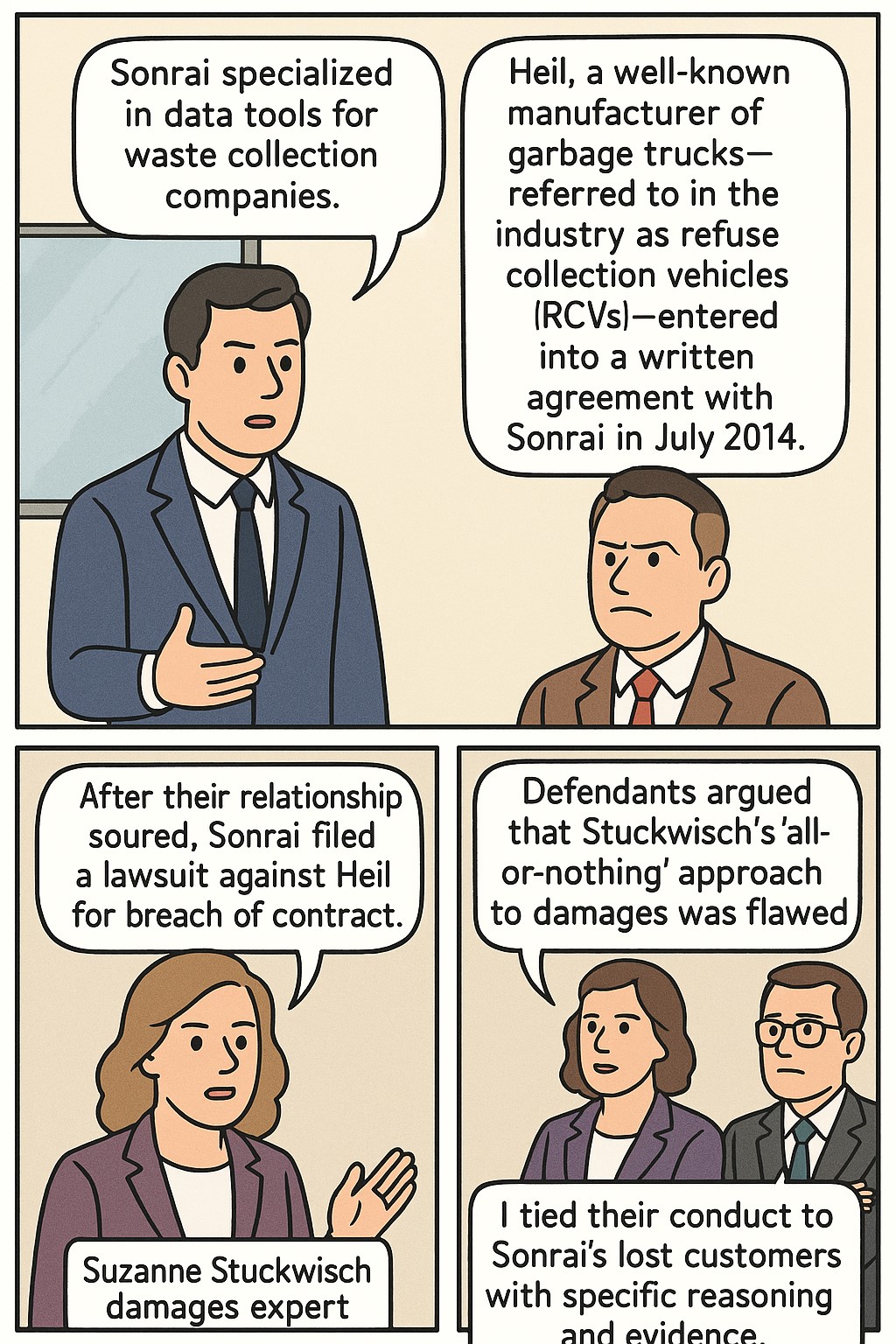
    Sonrai specialized in data tools for waste collection companies. Heil, a well-known manufacturer of garbage trucks—referred to in the industry as refuse collection vehicles (RCVs)—entered into a written agreement with Sonrai in July 2014. The purpose was to facilitate the exchange of confidential information and explore a potential partnership, where Sonrai’s data product, “Vector,” could be integrated with Heil’s RCVs.

    Over the next year, both companies shared proprietary information and operated under the terms of the agreement. In May 2015, Heil made an offer to acquire Sonrai, but Sonrai declined. The relationship began to deteriorate, and by September 2016, Heil chose a different path. It acquired a company called 3rd Eye, opting to use 3rd Eye’s competing data product, “Enhance,” instead of continuing with Sonrai.

    Following this turn of events, Sonrai filed a lawsuit against Heil for breach of contract. Sonrai also accused Anthony Romano of breaching his fiduciary duties to Sonrai. Sonrai also alleged that Anthony Romano had breached his fiduciary duties owed to the company. Heil, in turn, countersued, also alleging a breach of contract.

    Defendants raised certain arguments about the reliability of Sonrai’s damages expert Suzanne Stuckwisch‘s testimony.


    Economic Damages Expert Witness

    Suzanne M. Stuckwisch has more than 30 years of experience in economic and financial analysis and engineering consulting. She holds a B.S. in Mechanical Engineering, an M.B.A., and an M.S. in Economics.

    Stuckwisch has experience across a wide range of industries, including but not limited to waste and recycling.

    Get the full story on challenges to Suzanne Stuckwisch’s expert opinions and testimony with an in-depth Challenge Study

    Discussion by the Court

    Recognized Methodology

    The Defendants first challenged Stuckwisch’s expert report by arguing that she failed to follow any recognized methodology in calculating Sonrai’s alleged lost profits. The Court disagreed. It found that her report clearly laid out how she determined the length of Sonrai’s relationships with each customer, projected potential sales, and accounted for the costs of producing Vector units. She analyzed damages on a customer-by-customer basis—an approach the Court had previously deemed acceptable. As a result, the Court concluded that her methodology was valid and properly applied.

    Damages Model

    Next, the Defendants claimed that Stuckwisch’s damages model relied too heavily on a single, speculative assumption: that all five waste haulers would have adopted Vector across their entire fleets. But the Court had already addressed this point in its summary judgment ruling. It noted that Stuckwisch had explained the rationale behind her assumption and emphasized that it was up to the jury to weigh the credibility of that assumption. Her report referenced evidence from the waste industry showing that third-party companies had made commitments to install Vector fleetwide.

    All-or-Nothing Approach

    Lastly, the Defendants contended that Stuckwisch’s “all-or-nothing” approach to damages was flawed because she failed to consider other possible causes for Sonrai’s lost profits—something they argued was required under AICPA standards. In response, Stuckwisch clarified that her analysis again followed a customer-by-customer model: once a customer was lost, the associated revenue was lost entirely. The Court found this approach reasonable. It emphasized that Stuckwisch did not simply assume the Defendants caused the losses—she tied their conduct to Sonrai’s lost customers with specific reasoning and evidence.

    Additional Incremental Operation Costs

    Fourth, Defendants argued that Stuckwisch’s testimony was unreliable because her calculation of additional incremental operation costs, which are a necessary component of lost profits, was previously stricken and never included in any amended reports.

    The Court agreed that Stuckwisch’s testimony would be unreliable without the deduction of additional incremental operation costs. But precluding Stuckwisch from testifying about those additional incremental operation costs was not the appropriate remedy. Instead, the proper path forward was to allow Stuckwisch to supplement her report and allow Defendants to depose her on the new report, and supplement their own rebuttal report if they wished.

    Alternative Explanations 

    Finally, the Court issued this opinion following a hearing held on June 9, 2025, during which it preliminarily denied the Daubert motion. After that hearing, Stuckwisch submitted a supplemental report and sat for a deposition. On the first day of trial, the Defendants raised three new arguments to exclude her testimony.

    First, they challenged Stuckwisch’s assumption that Sonrai would incur no cost for working capital. According to her, Chris Flood—Sonrai’s CEO—told her that his family’s business, which generated over $100 million in annual revenue, would cover Sonrai’s working capital needs. Defendants claimed this assumption was unfounded. However, the Court noted that the same assumption appeared in her 2021 report under the section on incremental operational costs. For the reasons already discussed, the Court declined to exclude her testimony on this basis.

    Second, Defendants argued that Stuckwisch failed to consider an alternative cause: that Romano had the right to leave Sonrai at any time. But they did not explain how this constituted an “obvious alternative explanation” undermining the reliability of her analysis. The Court held that such arguments were better suited for cross-examination.

    Third, the Defendants contended that Stuckwisch wrongly assumed that Vector faced no competition in the but-for world, effectively treating it as a monopoly product. She based this assumption on her understanding that no comparable product existed in the marketplace. The Court found this assumption to be reasonable, though it acknowledged that Defendants were free to challenge it during trial.

    Held

    The Court denied the Defendants’ Rule 702 motion to exclude the testimony of Suzanne Stuckwisch.

    Key Takeaways:

    • An expert need not rule out every alternative cause. Arguments about alternative explanations can be explored on cross-examination. 
    • Stuckwisch’s opinion reliably applies the lost profits principles and methodology to the facts of the case and the Court will not prejudge the ultimate correctness of her conclusions. Her reasoning satisfies Rule 702’s reliability standard. Defendants’ criticisms can be explored on cross-examination.

    Case Details:

    Case Caption: Sonrai Systems, LLC Et Al V. Anthony M. Romano Et Al
    Docket Number: 1:16cv3371
    Court Name: United States District Court, Illinois Northern
    Order Date: June 20, 2025
  • Accounting Expert’s Reliance upon a Disputed Fact does not Equate to Insufficient Facts

    Accounting Expert’s Reliance upon a Disputed Fact does not Equate to Insufficient Facts

    In a recent legal battle between Mo Pow and Crypto, the spotlight has fallen sharply on expert testimony, specifically the lost profits analysis provided by Mo Pow 4’s expert, David A. Hall. This case, fundamentally about two failed digital currency mining agreements, has turned into a fascinating examination of expert witness reliability and the challenges to their methodologies.

    Firstly, to set the stage, the Court initially found breaches of contract by both parties and requested further expert opinions to quantify damages. Mo Pow 4 subsequently engaged Hall, who presented a report claiming $5,374,000 in lost profits. However, Crypto immediately raised concerns, focusing on Hall’s decision to use Odessa, Texas, as the hosting site for his calculations, rather than Strafford, Missouri, as stipulated in the second agreement.

    Consequently, Crypto filed a motion to strike Hall’s opinions, arguing that this substitution was a deliberate attempt to inflate damages, and further claimed that Hall’s methodology was unreliable, based on undisclosed documents, and failed to account for crucial contractual terms. Conversely, Mo Pow 4 contended that Crypto was merely challenging Hall’s assumptions, not his methodology, and asserted their right to relocate the mining site.

    Accounting Expert Witness

    David Hall is a Managing Director with Alvarez & Marsal Disputes and Investigations in Denver. He has more than 30 years of experience providing expert consulting and testimony services to clients on accounting, economic, financial and damages issues.

    Hall earned a bachelor’s degree from the University of Michigan and an MBA (highest honors) from the University of Texas at Austin. A Certified Management Accountant (CMA), Certified Valuation Analyst (CVA) and a Certified Fraud Examiner (CFE), he is also a member of the Institute of Management Accountants, the National Association of Certified Valuators and Analysts, the National Contract Management Association and the Association of Certified Fraud Examiners.

    Get the full story on challenges to David Hall’s expert opinions and testimony with an in-depth Challenge Study. 

    Discussion by the Court

    Defendant’s Objections

    Crypto’s primary objection centered on Hall’s use of Odessa, Texas, as the location for calculating lost profits, instead of Strafford, Missouri, as specified in the second agreement. They argued that this substitution was a deliberate attempt to inflate the lost profits figure, implying that the Texas site was chosen precisely because it would yield a higher damage calculation. In essence, they accused Hall of manipulating his analysis to favor Mo Pow 4. Crypto broadly claimed that Hall’s entire calculation was based on an unreliable methodology.

    This objection encompassed concerns about the assumptions Hall made, the variables he included or excluded, and the overall approach he took to calculating lost profits. Further, Crypto asserted that Hall relied on documents and information related to the Texas site that were not timely disclosed during the discovery process, arguing that this constituted a violation of discovery rules and prejudiced their ability to effectively challenge Hall’s opinions. Finally, Crypto argued that Hall’s opinions failed to consider various terms of the Second Agreement, additional costs, and rate variances that would significantly impact his calculations, pointing to specific omissions, such as the use of inappropriate electrical rates, failure to account for “uptime” variations, and neglecting adverse market conditions.

    Plaintiff’s Counterarguments

    In opposition, Mo Pow 4 countered that Crypto’s objections were fundamentally challenges to the assumptions and variables that Hall chose to consider, rather than to the underlying methodology itself. They argued that Hall’s use of the AICPA-approved incremental profit method was sound, and that Crypto’s concerns were simply disagreements about the inputs used in that method. Mo Pow 4 asserted that they had the authority to unilaterally relocate the cryptocurrency mining site to Texas after Crypto failed to perform under the Second Agreement, providing an explanation as to why the relocation would have occured, and that even though the notice was not sent, it was still a valid assumption.

    Mo Pow 4 explained that the documents in question did not become relevant until Hall performed his expert work, which occurred after the initial discovery period. They also pointed to the fact that the Court had reopened expert discovery, and that they provided the documents as soon as possible, arguing that their supplemental disclosure was substantially justified, given the circumstances and the Court’s prior orders. Finally, Mo Pow 4 argued that many of Crypto’s concerns, such as the use of specific electrical rates and the omission of certain variables, were matters of weight that could be addressed through cross-examination, rather than grounds for excluding Hall’s testimony altogether, emphasizing that the Court’s role as a gatekeeper was not to determine the accuracy of Hall’s opinions, but rather to ensure that his methodology was reliable.

    Analysis

    The Court found Hall’s expert report to meet the reliability standards of Rule 702, despite the challenges raised by Crypto. Thus, while the use of the Texas site and other assumptions were subject to scrutiny, they did not render the report fundamentally unreliable. Therefore, the Court emphasized that vigorous cross-examination and the presentation of contrary evidence were the appropriate remedies for any perceived weaknesses in the expert testimony.

    Since the motion was referred to a magistrate judge, a final determination was not made as to whether Mo Pow’s supplemental disclosures were substantially justified or harmless out of an abundance of caution, and only a recommendation was provided to the assigned district court judge. The magistrate judge recommended that the Court find Mo Pow’s failure to provide certain documents Hall relied upon in his report until after his report issued, was substantially justified. 

    Held

    The Court found that Mo Pow’s expert, Mr. David A. Hall, and the opinions presented in his expert report, met the requirements of Federal Rule of Civil Procedure 26(a)(2)(B) and Federal Rule of Evidence 702. Moreover, the magistrate judge recommended that the presiding judge determine that Mo Pow’s failure to provide certain documents relied upon by Hall to support his lost profits damage opinion until after the close of discovery had been substantially justified.

    Key Takeaway:

    The Court, acting as a gatekeeper under federal rules, found Hall’s qualifications and methodology met reliability standards, distinguishing between disputed assumptions affecting evidence weight and fundamental flaws impacting admissibility. Ultimately, the Court emphasized that vigorous cross-examination, rather than exclusion, was the appropriate remedy for perceived weaknesses in the expert’s analysis.

    Case Details:

    Case Caption: Mo Pow 3 Llc Et Al V. Crypto Infiniti LLC
    Docket Number: 1:22cv155
    Court: United States District Court, Wyoming
    Order Date: March 11, 2025
  • Accounting Expert Witness’ Calculations of Lost Profits and Plow-Down Costs Survives Daubert Challenge

    Accounting Expert Witness’ Calculations of Lost Profits and Plow-Down Costs Survives Daubert Challenge

    Polypack sued Nestlé for breach of contract and breach of implied covenant of good faith, claiming Nestlé failed to make final payments for equipment and service fees. Nestlé counterclaimed, alleging defective equipment and failure to meet performance requirements, resulting in significant financial losses, including lost profits, additional labor costs, and storage fees.

    Nestlé retained David R. Tantlinger, Jr., a Certified Public Accountant (CPA), to provide expert testimony on the damages incurred due to Polypack’s alleged equipment failures. Polypack challenged Tantlinger’s qualifications, the reliability of his methodologies, and the relevance of his opinions, seeking to exclude his testimony.

    Accounting Expert Witness

    David R. Tantlinger, Jr. has been a CPA for 39 years and is “experienced in performing accounting services, including forensic accounting services and the computation of damages to commercial and other enterprises.” 

    He has experience in accounting, taxation, finance and business management with a variety of industries.

    Get the full story on challenges to David Tantlinger, Jr.’s expert opinions and testimony with an in-depth Challenge Study. 

    Discussion by the Court

    Qualification

    Polypack argued that Nestlé failed to adequately define Tantlinger’s specific field of expertise. They claimed this lack of clarity made it impossible to properly assess his qualifications, suggesting Nestlé was trying to pass off company information as expert opinion.

    Nestlé asserted that they clearly identified Tantlinger as an expert on damages. They emphasized his long-standing experience as a CPA and his specific experience in forensic accounting and damages calculations. They also pointed out that Polypack had the opportunity to question Tantlinger’s qualifications during his deposition.

    The Court found Tantlinger qualified, noting his 39 years as a CPA and experience in forensic accounting and damages computation. The Court also noted that Polypack had opportunity to question the expert at deposition, and failed to do so.

    Reliability

    Polypack’s Objection

    Polypack attacked the reliability of Tantlinger’s methodologies. They alleged he:

    • Failed to identify or apply established methodologies for calculating lost profits.
    • Did not conduct independent research or analysis.
    • Ignored other potential causation factors that could have contributed to Nestlé’s losses.

    Nestlé’s Opposition:

    • Providing detailed explanations of his calculations, demonstrating that they were not arbitrary.
    • Stating that damages experts are allowed to rely on information provided by the client.
    • Arguing that questions about other potential causes of losses go to the weight of the evidence, not its admissibility.

    Court Observation:

    The Court rejected Polypack’s arguments, emphasizing that Tantlinger explained his calculations and that a damages expert can rely on client-provided data. The Court stated that questioning the causation factors goes to the weight of the evidence, not its admissibility.

    Relevancy:

    Polypack argued that many of Tantlinger’s calculations were simple mathematical operations that required no specialized expertise. They contended that his testimony would not “assist the trier of fact” because it was within the understanding of a layperson.

    Nestlé acknowledged that some calculations were mathematical but emphasized that Tantlinger’s work involved extensive data analysis, document review, and the application of accounting principles. They argued that this level of analysis went beyond the capabilities of a layperson and would assist the jury.

    Tantlinger calculated Nestlé’s total damages—including lost profits and plow-down costs resulting from production delays allegedly caused by the equipment, which are clearly beyond simple arithmetic. While acknowledging that simple math is not typically considered expert testimony, the Court found that Tantlinger’s analysis of extensive data and complex calculations, including lost profits, made his testimony helpful to the jury. Tantlinger compiled and analyzed a large amount of data to perform the challenged calculations.

    Held

    The Court denied the Plaintiff Polypack, Inc.’s motion to exclude Nestlé USA, Inc.’s expert witness David R. Tantlinger, Jr.

    Key Takeaway:

    This case serves as a valuable example of the challenges involved in admitting expert testimony. The Court’s meticulous application of the Daubert standard and Rule 702 highlights the importance of thorough preparation and clear articulation of expert opinions. This case also shows the importance of proper deposition preparation, and how those depositions can be used in motions to exclude expert witnesses.

    Case Details:

    Case Caption: Polypack, Inc. V. Nestle USA, Inc.
    Docket Number: 8:23cv318
    Court: United States District Court, Florida Middle
    Order Date: March 7, 2025