Plaintiff Andrew Christensen alleged that he was injured while working at Plaintiff Jessica Lawrence’s home, using an aluminum stepladder, Model W-2112-065, which was manufactured by Defendant Louisville Ladder, Inc. Plaintiff Lawrence had purchased the Ladder from Walmart, Inc.
Christensen asserted products liability claims against Louisville Ladder based on the alleged injury.
Louisville Ladder filed a motion to exclude the testimony of Plaintiff Christensen’s expert, Frank L. Burg.
Safety Engineering Expert Witness
Frank Lewis Burg is an expert in various domains, particularly general industry and construction safety and health, alongside expertise in ergonomics. His investigative experience spans injuries related to cranes, rigging, road construction accidents, falls, railroad incidents, electrical mishaps, machine guarding, gas and oil well incidents, hazardous chemicals, and cases involving human factors engineering and FELA (Federal Employees Liability Act). Beyond investigations, Burg conducts training seminars, OSHA-style audits, and offers expert testimony in his field of expertise.
Defendant argued, among other things, that Burg should be excluded because he is not qualified to render an opinion on a manufacturing defect. Defendant also argued that his opinions have insufficient factual foundation, are not founded in proper methodology, and only provide bottom-line conclusions without sufficient support. Finally, Defendant argued that his testimony should be excluded because he has disclosed a preliminary report only.
Burg, a registered professional safety engineer with Accident Prevention Corporation concluded his report by writing that Christensen’s injuries were “caused by a structural failure of the Louisville Ladder. There is no indication that Christensen did anything that would cause the catastrophic failure seen in the photographs.”
Burg characterized his report as preliminary, and at his deposition, he testified that his opinions were not final. He further admitted during his deposition that he added a statement to the report that he normally does not, reserving the right to have the Ladder examined further and potentially change his opinions because he “wrote [the] report with very limited information.” He also stated that should this case go to trial, he would want to have the Ladder tested and obtain testimony from a metallurgist or structural engineer.
Analysis
Burg is a qualified expert in safety practices and hazard prevention, but he is not a design expert or metallurgist. He lacked the education, training, and experience to offer an opinion that there was a construction defect in the Ladder that caused the accident.
Moreover, Burg did not visit the scene of the accident. He did not perform any testing or complete his own investigation. In fact, he did not even inspect the Ladder. Instead, he talked to Plaintiff Christensen and relied on materials provided to him. In other words, Burg’s opinions that the Ladder had a construction defect and the defect caused Plaintiff Christensen’s injuries are based on photographs and interviews
The Court found that in forming his opinions, Burg did not employ a proper methodology, and the opinions lacked sufficient support.
Held
The Court granted Defendant Louisville Ladder, Inc.’s motion to exclude the testimony of Frank Burg.
Key Takeaway:
Burg did not apply a methodology, and he failed to provide any explanation of the analysis he used in forming his opinions that the Ladder had a construction defect, and the defect caused the Ladder to collapse, other than to state that there is no other possible cause.
In short, there is nothing within his report that relies upon any specific method or scientific principles that would be otherwise unavailable to the trier of fact. Burg is being offered to give the opinions that the damage to the Ladder was not merely from a fall, but rather that the Ladder collapsed, and the collapse was caused by a construction defect.
Case Details:
Case Caption:
Christensen Et Al V. Louisville Ladder, Inc. Et Al
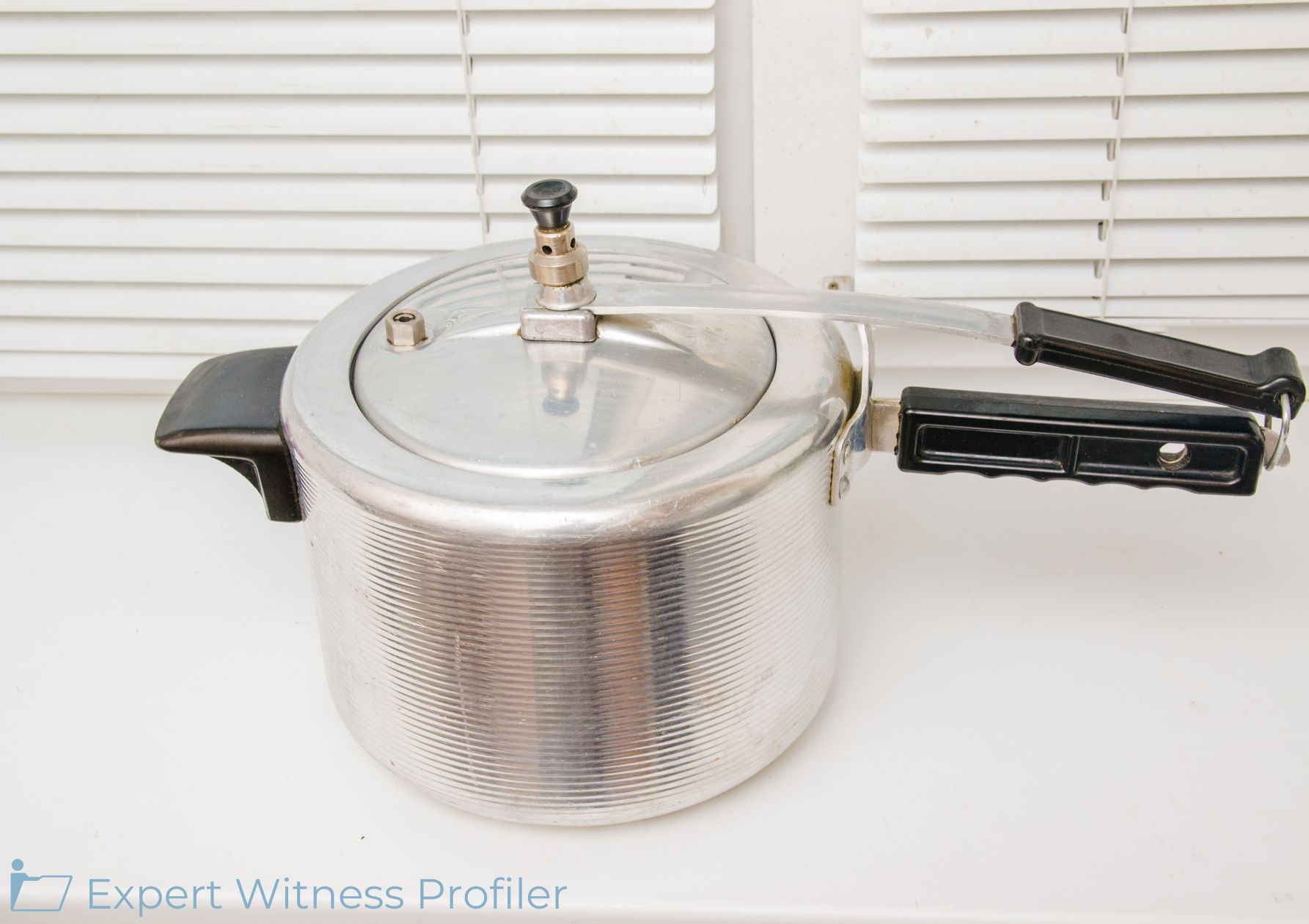
This is a product liability case involving Walmart’s sale of a pressure cooker that Plaintiff Vanessa Loftis claims injured her when the lid was able to be removed while the pressure cooker was—unbeknownst to her—still pressurized.
During the depressurization process, pressure cookers release steam; according to Loftis, the steam on that night “lasted forever,” around thirty to forty-five minutes. Loftis testified that she “kept checking on it, and then, when [the steam] finally did stop, that’s when [she] opened it and it kind of blew up.”
The contents of the cooker were ejected onto Loftis, causing burns to approximately 12% of her body, mostly on her abdomen, that later required debridement.
Walmart filed a motion to exclude Loftis’ expert, Dr. David Rondinone, arguing that his opinions are speculative, unreliable, and not tied to any applicable methodology.
Walmart appeared to make three specific challenges to Rondinone’s opinion: (1) that he proposed only “possible” causes of the incident with no basis in evidence; (2) that he did not physically test the subject cooker or an exemplar; and (3) that he did not rule out alternative causes.
Mechanical Engineering Expert Witness
David Rondinone holds an M.S. degree and a Ph.D. degree in Mechanical Engineering from the University of California, Berkeley, majoring in material behavior and design and minoring in structures and dynamics and electronic controls.
He also holds a B.S. degree in Engineering Physics and a B.A. degree in Astrophysics from the University of California, Berkeley. From 1993 to the present, he has worked as a Mechanical Engineering Consultant, and is a principal of Berkeley Engineering And Research, Inc. (referred to herein as “BEAR”).
He has worked for more than 30 years in the areas of failure analysis, design, and risk assessment of consumer and industrial equipment, including pressure cookers.
Rondinone proposed three potential causes of the accident: (1) a float valve clog, resulting from an inadequately designed float valve, that caused the lid to remain unlocked while under pressure; (2) a boil-over event that was not properly warned against; or (3) a failure of the interlocking sliding mechanism.
Possible Causes
Walmart contended that Rondinone posits only “possible,” rather than “probable” causes of the accident and failed to ground these in facts.
However, Rondinone identified a float valve clog as the “most likely scenario” and “would say to a degree of reasonable engineering certainty it’s more likely a clogged or insufficient float valve interlock event” caused Loftis’ injuries “than . . . a boil-over event.”
Since Rondinone intended to testify that the incident was most likely caused by a clogged float valve, as supported by his expertise, prior testing of pressure cookers, examination of Instant Pots, and Loftis’ description of the incident, the Court refused to exclude his testimony on that basis.
Physical Testing
While Walmart conceded that it was not possible for Rondinone to test the subject pressure cooker in this case, as it was not available, it argued that his failure to conduct tests using an exemplar model is unjustified and rendered his testimony inadmissible.
However, Rondinone explained that in order to help him gain a more precise determination on probability as to whether this was a float valve incident, he would have had to run “an extensive statistical study, probably hundreds of tests,” and he has not “know[n] anybody who ever has” done that.
Further, he explained that it is “difficult to repeat” a clogged float valve, but his lab has “done tests for clogging on other models of pressure cooker” and shown that a user “can with a single use clog the vent,” which he reports “present[s] a risk of pressurization with the lid in an unlocked state.”
However, the Court held that Rondinone’s opinion that the float valve was clogged is supported by Loftis’ description of the incident and his prior testing of pressure cookers, not “unfounded assumptions.”
While Rondinone is “unable to recreate” the incident, the Court held that his opinion is “based on known facts and his expertise.”
Alternatives
Walmart challenged the admissibility of Rondinone’s opinion on the argument that he failed to rule out other possible causes.
In this case, Rondinone did engage with alternative explanations, including a boil-over event, a failed sliding mechanism, or some other accident like a spill. He then applied his expertise in the mechanics of pressure cookers to the facts in this case to deduce that a float valve clog was the most likely mechanical scenario here.
As for the possibility of a spill, he stated that “physically it’s probably possible,” but he would “have to disregard Loftis’ entire testimony, though, from start to finish for that to be true,” including “disbelieving her explanation of the removal of the lid and how the contents came out.”
Rondinone refused to say with absolute certainty that a float valve clog occurred here, but he did conclude the most likely cause within a “degree of reasonable engineering certainty.”
The Court held that Rondinone’s refusal to completely rule out other alternatives goes to the weight of his testimony, not its admissibility.
Held
The Court denied Walmart’s motion to exclude Dr. David Rondinone.
Key Takeaway:
Despite the fact that Rondinone did not test the subject pressure cooker or an exemplar model in this case, there is no single requirement for admissibility as long as the proffer indicates that the expert evidence is reliable and relevant.
The Court held that Rondinone’s conclusions are based on his experience and expertise [in pressure cooker cases], general engineering principles, information from Loftis about the accident, examination of an exemplar cooker, its design and specifications, competitors’ cookers, and photos of the accident, including of the subject pressure cooker and Loftis’ burns.
This case stems from a tire blowout that occurred while Plaintiff Kenneth Harris was at work driving his employer’s truck, which was outfitted with tires manufactured by Defendant Michelin North America. That tire blowout caused Harris’s truck to flip multiple times, resulting in injuries to his “neck, back, hip, arm, elbow, and head.”
Causation is a central issue. The parties disagree about what—and who—caused the blowout. Harris contended that the blowout was caused by a manufacturing defect attributable to MNA.
To support his theory, Harris relies on expected testimony from expert Brian Darr, who in his report presented three possible theories to explain the tire blowout: (1) the “Trapped Air” theory, positing that the blowout was caused by air trapped between the belts of the tire, which could only be caused by a manufacturing defect (2) the “Open Inner Liner Splice” theory, positing that an open inner-liner splice caused the blowout, and that the tire must have left the manufacturing facility with the open splice and (3) the “Thin Inner Liner” theory, positing that the tire’s inner liner was too thin when it left the manufacturing facility, which caused Harris’s accident. MNA argued that Brian Darr’s proposed testimony did not satisfy Daubert and Federal Rule of Evidence 702.
MNA also filed a Motion for Summary Judgment, which argued Harris has failed to point to sufficient evidence, expert or otherwise, “to create a fact issue regarding any claim asserted against MNA.”
Mechanical Engineering Expert Witness
Brian Darr has over 25 years of extensive experience with tires including failure analysis, design, development, manufacturing, quality investigation, race tire preparation, and testing of tires at numerous testing facilities. He worked in a tire manufacturing facility as a plant technical engineer where he investigated quality related issues, and in a Research & Development (R & D) center where he designed, developed, tested, and analyzed tires. Darr has visited numerous tire production plants such as Goodyear, Bridgestone, Michelin, and Continental tire.
Darr is a graduate of The Ohio State University with a Bachelor of Science Degree in Mechanical Engineering.
The Court held a hearing on April 30, 2024, where Darr testified regarding his three theories. At that hearing, Harris withdrew Darr’s Thin Inner Liner theory (theory number three), and the Court ordered supplemental briefing on Darr’s remaining Trapped Air and Open Inner Liner theories. The parties filed their supplemental briefs and Darr submitted a supplemental report. However, in response to Harris’s supplemental filings, MNA filed its Objection and Motion to Strike Darr’s Second Report, arguing that Darr had impermissibly updated his sources and expert theories.
Finally, on June 26, 2024, the Court held a hearing regarding Darr’s testimony and the status of the case, which all parties attended through counsel. All currently pending motions have been thoroughly briefed and discussed; they are ripe for adjudication. The central motion at this juncture is MNA’s Motion to Exclude Brian Darr under Daubert and Rule of Evidence 702, because MNA’s Motion for Summary Judgment rests on an argument regarding Harris’s expert evidence.
The Parties’ Motions to File Supplemental Briefs are Granted, and Defendant’s Motion to Exclude the Expert Testimony of Brian Darr is Granted in Part and Denied in Part
Defendant MNA’s Motion to Strike is granted as to Darr’s Open Inner Liner Splice theory because Plaintiff Harris has failed to establish this theory’s reliability
The Court held that the Open Inner Liner Splice theory fails the fourth Daubert factor—general acceptance within the relevant scientific community. This is because Darr failed to sufficiently consider or rule out that a prior impact, rather than a manufacturing defect, might have caused the opening in the tire’s inner liner over time.
Darr invoked the process of elimination to reach his conclusion that a manufacturing defect caused the open inner-liner splice. Thus, because he “determined that the open inner liner splice was not as a result of impact or over deflection,” “a manufacturing defect [w]as the only possible explanation for why there was an open inner liner splice.” But there is a problem with Darr’s premise that excludes an impact as a possible cause of the splice.
Here, there is evidence of a prior impact, specifically a “V” shaped area on the tire carcass. Darr summarily discounted this as evidence of a possible impact because the “V” shaped area “is not consistent with real-world impact testing results so as to be considered evidence of an actual impact that could cause an inner liner splice to open.” The real-world impact test Darr cited to support this conclusion, however, is a single impact-analysis study at odds with the consensus of experts within the tire industry.
Darr, in other words, ruled out and failed to otherwise consider an impact as a possible cause of the open inner-liner splice based on this lone eight-tire study that runs against the expert consensus.
Darr’s Trapped Air theory, on the other hand, fares better for Harris because Darr sufficiently explained the basis for the theory
Darr cited the existence of trapped air in the subject vehicle’s companion tires, compared the “trapped air in the subject tires to peer reviewed documents containing images of trapped air,” and examined the structure and wear patterns of the tires to conclude that the subject tire contained trapped air. The Court found this analysis sufficiently reliable.
Defendant MNA’s Motion for Summary Judgment and Motion to Strike the Declaration and Second Supplemental Report of Brian Darr are Moot
Because MNA’s motion for summary judgment invokes the asserted insufficiency of Harris’ expert evidence, the Motion was effectively declared moot in light of this order. The Court cannot parse the motion to determine which portions of it remain at issue. The Court, however, allowed MNA to file an amended motion within thirty (30) days of the date of this order, if desired. Likewise, Defendant MNA’s objection to post hearing evidence and motion to strike declaration and second supplemental report of Brian Darr were also declared moot. As discussed at the June 26 hearing, the Court held that MNA may redepose Darr for up to three hours via videoconference regarding any of Darr’s Trapped Air Theory sources or conclusions that MNA feels were improperly used in Darr’s supplemental report.
Held
The Court granted in part and denied in part the Defendant MNA’s motion to exclude the testimony of Brian Darr.
Key Takeaways:
Darr should’ve considered that a potential impact might cause the open inner-liner splice over time, or he should have further explained why an impact could not the type of blow out seen here. Instead, he dismissed a potential impact as a possible cause based on a lone study at odds with the industry-expert consensus. The Court held that his failure to further engage with a potential impact as a possible cause required, at a minimum, more discussion.
Defendant MNA contended that the trapped air theory did not meet the requisite standard because the subject tire was missing a steel band, trapped air could develop over time, and the published literature contradicted Darr’s theories. The Court held that these arguments did not carry the day because Darr’s report pointed to evidence sufficient to credit his trapped air theory at that stage.
Pamela Ahmed has a history of back problems dating back to a traffic accident in approximately 1988. By 2020, Ahmed had a litany of “bad orthopedic issues,” leading her doctor to deem her an “orthopedic disaster.”
She began to experience significant hip arthritis, and her doctor diagnosed her with end-stage osteoarthritis. Ahmed underwent a right total hip arthroplasty on November 4, 2020, during which her doctor implanted her with a Pinnacle Altrx polyethylene liner, Pinnacle cup, and Biolox ceramic femoral head.
On February 25, 2021, Ahmed reported to her doctor that her hip was popping and that she had fallen. Ahmed underwent a revision hip arthroplasty in March 2021, and received a new femoral head and acetabular liner. On March 19, 2021, Ahmed underwent an additional surgery as a result of an infection. In June and August 2021, Ahmed experienced two incidences of hip dislocation.
Ahmed filed this lawsuit alleging that she was injured when her polyethylene hip implant (the Pinnacle Altrx) became dislocated. She retained two expert witnesses Richard Edwards and Dr. Kenneth Sands.
Defendants have since moved to exclude all opinions of Plaintiff’s expert, Edwards, and Plaintiff’s rebuttal expert, Sands.
Materials Science Expert Witness
Richard Edwards held a Bachelor’s degree in materials science and engineering and had studied in a mechanical engineering graduate program. He had extensive experience conducting failure analyses on various materials, including medical device implants and hip replacement systems. Edwards had analyzed plastics, including polyethylene used in the hip implant liner. He examined the failed hip implant components, reviewed relevant literature, and conducted non-destructive testing. However, he had not previously analyzed a polyethylene hip implant liner prior to this product liability case.
Dr. Kenneth Sands M.D. is an orthopedic surgery expert witness from Florida. He is certified by the American Board of Orthopaedic Surgery. Dr. Sands completed his BS in 1992 from Duke University. He completed his MD in 1996 from Tulane University School of Medicine. He also completed his residencies in 2002 from SUNY Downstate Health Sciences University. Currently, Dr. Sands is an Orthopedist at Melbourne Regional Medical Center.
The Court held that Edwards’ design defect opinions are generally reliable, but he may not testify as to alternative design theory.
1. Edwards Is Qualified to Testify as an Expert Regarding the Hip Implant
The Court held that Defendants’ attempts to narrow the subject matter about which Edwards must be qualified to testify are unavailing. His mechanical engineering background and decades of experience conducting failure analyses, including of medical devices and of hip implants specifically, meant that this subject matter was “sufficiently within his expertise.”
2.Edwards’ Design Defect Opinions are Generally Reliable, but he may not Testify as to Alternative Design Theory
Defendants argued that Edwards’ design defect opinions should be excluded because they are not the product of objective scientific testing or methodology. The Court found that Edwards’ design defect opinions are scientifically reliable despite his lack of destructive testing of the incident product. Defendants also attacked Edwards’ opinions as unscientific resting on a “selective and incomplete review of the literature.” Yet, Edwards’ report cited the 25 sources that he reviewed while investigating the product failure, including a variety of academic papers and published industry reports. Defendants argued that that Edwards’ conclusions amounted to “unauthorized conclusions from limited data” because “none of the papers he considered actually concluded that the Pinnacle hip replacement device or any component parts (including the Altryx liner at issue) were defective. The Court held that Edwards’ literature review was part of a wider technical process, which also included examining and measuring the Hip Implant’s ball and liner; conducting an infrared spectrograph of the liner material; and creating a replica to better visualize some of the liner’s characteristics.
3.Edwards may not Reliably Testify as to Alternative Design Theory
Edwards’ expert report consisted of multiple alternative design proposals. The Court disagreed as to Edwards’ ability to testify regarding a theoretical alternative design when applicable case law suggests that the failure to test a proposed alternative design or cite another’s testing of the design is fatal to the admissibility of said testimony.
4.Edwards’ Manufacturing Defect Opinions are not Impermissible Ipse Dixit
According to Defendants, Edwards’ manufacturing defect opinions are pure ipse dixit, “based on speculation, conjecture and inference, rather than reliable principles and methods.” The Court held that while Edwards may not reliably testify as to alternative design theory, his defect opinions are “the product of reliable principles and methods” and reflect “a reliable application of the principles and methods to the facts of the case.” Like many (if not most) scientists, Edwards did not have direct evidence of a manufacturing or design flaw in the Hip Implant but instead employed inductive reasoning to reach the hypothesis that the product was defective in either manufacturing or design.
5.Edwards’ Non-Medical Causation Opinions Are Not Excludable
Defendants also asked that the Court exclude Edwards’ causation opinions because he is not qualified to offer medical causation opinions, and even if he were qualified to offer medical causation opinions, “his opinions would still be inadmissible because he failed to meaningfully account for far more likely factors and causes of Ahmed’s alleged injuries.” Edwards concluded that the Hip Implant malfunctioned because the locking mechanism between the Altrx liner and Pinnacle cup was inadequate to hold the liner in place after impingement occurred. The Court held that this is a product defect opinion from a materials scientist and engineer with over forty years’ experience in failure analysis of various materials. It is not a medical causation opinion. And, as explained infra, an expert opinion regarding medical causation is not necessary under the facts/allegations of this case.
6.Opinions that Edwards Revealed for the First Time at his Deposition May Come In
Edwards discussed at his deposition the following that were not included in his expert report: (1) his opinion that “the plastic in the liner is too deformable,” and (2) a free body diagram to calculate the forces exerted on the Hip Implant. As to both, the Court cannot see how Defendants’ objections hold water. For Rule 26(a)(2)(B) experts, the party’s duty to supplement extends to both to information in that expert’s report and information given during the expert’s deposition. The Court held that no supplementation was needed for merely explaining an opinion that Edwards already detailed in his report. Rule 26(e) envisions supplementation when a party’s discovery disclosures happen to be defective in some way so that the disclosure was incorrect and incomplete, and therefore, misleading. To conclude, Plaintiff had no duty to supplement Edwards’ expert report.
Kenneth Sands
The Court held that Sands may not testify in Plaintiff’s case-in-chief to establish medical causation. He may only testify to rebut the Defendant’s expert. Nonetheless, as discussed infra, expert medical causation testimony is not necessary in this case because the Record does not reveal a genuine dispute that the Hip Implant’s failure caused Plaintiff’s injuries — only whether there was a defect in the Hip Implant that caused it to fail. The Plaintiff tendered Edwards’ testimony in aid of the latter purpose.
1.Sands Reliably “Ruled In” Defect as a Cause of Ahmed’s Injuries
Sands based his opinion that the cause of the failed Hip Implant was multifactorial on his review of Ahmed’s medical records, depositions of relevant parties, medical case reports, Edwards’ expert report, and his own experience with total hip arthroplasty.
Defendants attacked Sands’ reliance on case reports as impermissible because “they are not the kind of scientific materials on which experts would rely outside the courtroom.”
The Court held that Sands’ rebuttal report cannot properly and did not prove causation — that’s Edwards’ job. All the same, given that the Court already held supra that Edwards’ design defect opinions were generally reliable, Sands was allowed to rule on them in support of his refusal to rule out the Hip Implant itself as a major contributing factor for Ahmed’s failed total hip replacement.
2. Sands Did Not “Rule Out” Any of the Three Variable as Potential Causes for the Hip Implant’s Failure and Was Not Obligated to Do So
An expert’s differential diagnosis testimony is unreliable when it fails to sufficiently explain why other potential causes have been ruled out. Yet a differential diagnosis is not an absolute requirement to survive a Daubert challenge.
The Court held that Sands did not conduct a differential diagnosis in this case and was not required to do so.
Both Sands and Defendants’ expert Barrington agreed that a successful arthroplasty necessitated the alignment of three variables: the surgeon, the implant, and patient-specific factors. Sands did not rule out any of these as potential causes; rather, his detailed concerns with respect to each factor undergird his conclusion that Ahmed’s failed total hip replacement was multifactorial. Nor did he find that all possible causes were causes.
Held
The Court granted Defendants’ motion to exclude opinions of Richard Edwards to the extent that Edwards was prohibited from testifying as to any alternative design for the Hip Implant but denied it as to every other respect.
The Court denied Defendants’ motion to exclude opinions of Kenneth Sands.
Key Takeaways:
Rebuttal experts can address the same subject matter as opposing experts and arrive at contradicting conclusions, provided they directly respond to the opposing expert’s opinions.
Experts may rely on case reports to support their opinions, acknowledging the limitations of such reports and using them in conjunction with other evidence.
A formal differential diagnosis is not always required for expert testimony on causation to be admissible.
Expert qualifications are assessed liberally, with experience in a related field qualifying an expert to testify on specific issues.
Alternative design theories must undergo testing or validation to be admissible as expert testimony.
Opinions first disclosed during an expert’s deposition may be admissible if they do not materially differ from the expert’s report and are disclosed before the pretrial deadline.
Case Details:
Case Caption:
Ahmed v. Johnson & Johnson Healthcare Sys.
Docket Number:
1:22cv190
Court:
United States District Court for the Southern District of Alabama
This case involves a lawsuit filed by Donald F. Greene and Nicole F. Greene (“Plaintiffs”) against Ledvance LLC (“Defendant”) regarding injuries Donald Greene sustained when a fluorescent light bulb he was changing allegedly exploded. The incident occurred on June 11, 2020 at Donald Greene’s workplace.
According to the allegations, On June 11, 2020, Donald Greene, employed as a site manager for Waste Connections, was in the process of changing a fluorescent light bulb located on a wall in the garage of his workplace when the light bulb suddenly and abruptly exploded without warning. Donald Greene sustained severe injuries, primarily to his left arm. He was taken by ambulance to the hospital where his left bicep wound was treated and closed surgically. He later underwent two additional surgeries on his left bicep performed by orthopedic surgeon Joshua P. Moss, who continued treating Donald Greene’s injuries.
Plaintiffs brought suit against Defendant, the alleged designer, manufacturer, seller and distributor of the subject fluorescent light bulb, under the Tennessee Product Liability Acts. Plaintiffs alleged that because a fluorescent light bulb does not normally “violently explode” during normal handling, Defendant was also liable under the common law doctrine of res ipsa loquitur, contending that the nature of the incident itself implies negligence.
In the course of expert disclosures, Plaintiffs identified Moss as the treating physician for Plaintiff Greene. Moss intended to testify on causation, medical necessity, and details of Greene’s treatment, along with the impact of the injury on Greene’s physical abilities. His opinions emphasized that on June 11, 2020, Greene suffered a serious injury to his left arm when a fluorescent light bulb exploded during a change, causing immediate tissue disruption and bleeding in the left biceps area. Moss, drawing on his experience as an orthopedic surgeon for military personnel, asserted that the traumatic laceration of tissue in Greene’s left arm resulted from a force comparable to that experienced by military personnel injured by explosive ordnance of fragmentation devices. This distinction was crucial, indicating a highly violent force, as opposed to the type of injury that would typically result from a simple fall onto the bulb.
The Defendant sought to exclude specific testimony from Moss, specifically objecting to any opinions related to the fluorescent lamp at issue and the manner in which broken glass from the lamp might have caused Greene’s injury. The motion specifically aimed at precluding Moss from asserting that Greene’s injury resulted from an explosion or, based on his military experience, that the traumatic laceration was due to a highly violent force comparable to injuries sustained by soldiers exposed to explosive ordnance or fragmentation devices.
On May 26, 2023, the Plaintiffs revealed Thomas Kelly as their expert in the case. Kelly, a licensed electrical engineer employed by the Warrant Group, Inc. since 2017, specialized in consulting on property damage and injuries related to electrical equipment.
As part of his investigation, Kelly conducted three key activities: (1) examined the clothing worn by Plaintiff Greene on the day of the incident, (2) scrutinized lamps retrieved from adjacent fixtures at the facility, and (3) conducted a meeting with Plaintiff Greene to inspect, document, and photograph the light fixture and facility in question. In addition to these on-site activities, Kelly also reviewed various documents, including Plaintiff Greene’s deposition transcript, the emergency medical services and police reports from June 11, 2020, an invoice from Lloyd’s Electrical Service dated December 31, 2013, Safety Data Sheets for Sylvania fluorescent light bulbs, and photographs taken at the scene of the incident.
In his analysis, 1) The lamp’s power was cut off via the circuit breaker panel before the lamp-changing process, disconnecting the energy source for the fixture. The incident was not a result of an electrical failure in the building’s electrical system.
2) The light fixture in question contained a single electronic ballast, with no battery backup or stored energy. Power to the fixture had been deactivated by opening the related circuit breaker before the process began. Plaintiff Greene showed no observable burn marks on his hands, indicating no contact with an energized source. The light fixture was returned to service after replacing the lamps post-incident, and the issue was not caused by an electrical failure in the fixture.
3) Fluorescent lamps are constructed with thin glass tubing, coated with phosphorus on the inside. Glass end caps, tungsten filaments, and mercury vapor are components added during the assembly process, with stress accumulating during these steps. A defect in any component, influenced by these stresses, can act as a trigger. Kelly’s analysis concludes that the failure of the lamp resulted from a defect in the fluorescent lamp assembly, to a reasonable degree of engineering certainty.
On May 26, 2023, the same day Plaintiffs revealed Kelly as their expert, Defendant initiated a motion for summary judgment. In support of this motion, Defendant submitted declarations from its experts: David W. Powell, a mechanical engineer, and Erick H. Knox, Ph.D., P.E., a biomedical engineer. Additionally, Defendant filed a declaration from its corporate representative, Danielle Sohl. In response, Plaintiffs submitted Kelly’s Declaration:
It clarifies discrepancies in Plaintiff Greene’s initial description of the lamp removal process. He reaffirms his opinions on the lamp failure despite the correction in the direction of movement. Kelly discusses the ladder’s specifications, noting that the fly section’s load-bearing capacity is contingent on the entire assembly supporting the rated weight. He addresses marks on the walls, attributing them to various tools and parts rather than the ladder. Refuting Defendant’s hypothesis on the ladder’s position during the incident, Kelly highlights inconsistencies with the broken cover plate and plastic piece. He mentions challenges in evaluating debris due to safety concerns during the pandemic, emphasizing Greene’s account and post-incident photographs as primary evidence. Kelly references NFPA 921, asserting that while the lay term “explosion” was used, the circumstances don’t align with the standard’s definition. He applied NFPA 921 guidelines considering witness statements and photographic evidence. Regarding the SDS for the lamp, Kelly contends that the lack of warnings left Greene unaware of the hazard’s severity, leading to Defendant’s failure in providing adequate warnings.
Defendant filed two motions seeking to exclude certain expert testimony from Plaintiffs’ expert Thomas Kelly, an electrical engineer, as well as a motion to strike Kelly’s subsequent declaration.
Electrical Engineering Expert Witness
Thomas J. Kelly has substantial educational background including a Bachelor of Science in Electrical Engineering and a Master of Science in Electrical Engineering from Florida Atlantic University. He further completed Master of Business Administration from Winthrop University. He investigates the cause and scope of damage for fire, explosion, and property loss incidents. He is certified as a Fire and Explosion Investigator. He is employed with The Warren Group, Inc., as a senior consulting engineer
Orthopedic Surgery Expert Witness
Dr. Joshua P. Moss has an educational background consisting of a Bachelor of Science from the University of Notre Dame and a Doctor of Medicine from Vanderbilt University School of Medicine. His residency was in Orthopaedic Surgery at the University of North Carolina, Chapel Hill School of Medicine. He then completed a fellowship in Mary S. Stern Hand Surgery at the University of Cincinnati. Moss is board certified by the American Board of Orthopaedic Surgery . His specialties include orthopedics and hand surgery. He began his practice at University Orthopaedic Surgeons in 2016.
Discussions by the Court
The Defendant put forth several grounds in support of its motion to exclude specific aspects of Moss’s testimony. Firstly, the Defendant contended that Moss lacked sufficient knowledge concerning fluorescent light bulbs, emphasizing his absence of experiments to determine whether Greene’s injury could have resulted from impaling an arm on the broken end of a fluorescent lamp. Additionally, the Defendant asserted that Moss lacked experience in designing or manufacturing fluorescent light bulbs. Citing Moss’s deposition testimony, the Defendant argued that he conceded the existence of a viable alternative cause for Plaintiff Greene’s injury. Ultimately, the Defendant sought the Court’s intervention to exclude these opinions from Moss as unreliable.
Plaintiffs responded by asserting that Moss’s anticipated testimony was well within the scope of his expertise. They emphasized his background as an orthopedic surgeon for military personnel and his direct involvement in treating Plaintiff Greene. Plaintiffs argued that Moss’s opinions, rooted in his relevant experience, were reliable. While acknowledging that Moss is not an expert on light bulbs, Plaintiffs contended that the Defendant failed to provide a valid basis for excluding his opinions. They further asserted that the Defendant misrepresented Moss’s deposition testimony and contended that the challenges to his opinions were more appropriately addressed through cross-examination during the legal proceedings.
The Defendant, in its reply, maintained that Moss should not be permitted to present causation opinions during the trial. The Defendant argued that Moss had not personally conducted any testing to determine if Plaintiff Greene’s injuries could have resulted from an allegedly exploding fluorescent lamp. The Defendant emphasized that Moss had not undertaken any investigation into the accident beyond examining Plaintiff Greene’s wounds. Additionally, the Defendant highlighted Moss’s lack of experience in the manufacturing of fluorescent light bulbs. Based on these points, the Defendant asserted that excluding Moss’s causation opinion was justified.
During the hearing, the Defendant clarified its stance, indicating that it did not contest Moss’s opinions regarding the similarity of Plaintiff Greene’s injury to battlefield injuries or the assertion that the injuries resulted from glass. The Defendant also expressed lesser concern about Moss’s testimony characterizing the injuries as consistent with a “highly violative force.” However, the Defendant argued that Moss should be prevented from asserting that Plaintiff Greene’s injury specifically resulted from an exploding or imploding light bulb. In response, the Plaintiffs contended that the challenges raised by the Defendant pertained more to the weight of Moss’s opinions rather than their admissibility.
Citing relevant cases such as In re Aredia & Zometa Prods. Liab. Litig., 754 F. Supp. 2d 934, 937 (M.D. Tenn. 2010), there is a fundamental distinction between a treating physician’s ability to diagnose a medical condition based on clinical experience and their capacity to offer an opinion on the causation of the patient’s injuries. The case emphasizes that while a treating physician can provide a diagnosis, their opinions on the source or causation of the diagnosed condition may be restricted. It underscores the principle that a treating physician, without an expert report, is not allowed to go beyond information acquired during the treatment to offer opinions on the causation of injuries.
Plaintiffs argued that Moss had experience treating individuals with injuries related to glass. However, Moss admitted that, apart from installing them in his garage, he lacked familiarity with fluorescent light bulbs and did not consider himself an expert on them. Federal Rule of Evidence 702 was referenced to underscore the requirement that expert testimony should be based on an accepted body of learning or experience in the expert’s field. Moreover, Moss, aside from relying on Plaintiff Greene’s account, had not conducted an independent investigation into the accident to verify that the light bulb had indeed exploded.
Additionally, Moss acknowledged an inability to rule out alternative causes for Plaintiff’s injuries. Citing the case, Wilson v. Taser Int’l, Inc., 303 F. App’x 708 (11th Cir. 2008), where a treating physician’s testimony attributing an injury to a taser gun was deemed unreliable, the Court concluded that Moss was not permitted to provide opinions concerning the fluorescent lamp in question or how broken glass from that lamp may have caused injury to the Plaintiff.
During the Daubert hearing on November 16, 2023, Kelly provided testimony about his professional background, detailing his fifteen years in facilities management with formal training on equipment such as ladders and fire extinguishers. In his current role, he specializes in fire, shock, and electrical investigations. Kelly asserted that the incident resulted from the fluorescent light bulb imploding and expelling glass material. He clarified the distinction between “implosion” and “explosion” based on NFPA definitions, highlighting that an implosion, as observed in this case, may be colloquially perceived as an explosion. To reach his conclusions, Kelly examined the building’s use, assessed the electrical circuit and wiring, disassembled the light fixture, and met with Plaintiff Greene to understand his perspective. Confirming the functionality of the fixture and finding no defects, Kelly ruled out electrical failure. He utilized his knowledge and experience to hypothesize, evaluate potential causes, and ultimately concluded that a manufacturing defect in the light bulb caused the incident.
During the testimony, Kelly affirmed his familiarity with the light bulb in question, citing his experience using and purchasing it during his tenure as a facilities manager. He also acquired knowledge of the bulb’s manufacturing process from a documentary. Kelly supported his opinion that the incident was not caused by improper handling by referencing Plaintiff Greene’s demonstration and noting the absence of trauma to Greene’s hands.
Kelly clarified that his opinions in the Declaration were responsive to the declarations of Defendant’s experts supporting the summary judgment motion. Regarding paragraph 6 of his Declaration, Kelly explained his interpretation of ladder weight limits based on his experience and training. The opinions in paragraph 8 stemmed from his review of photographs and professional experience, where he observed no scuff marks on the floor, indicating the ladder did not slide down the wall.
In his Declaration, Kelly mentioned concerns about bloodborne pathogens and pandemic-related cleanup. During testimony, he emphasized his knowledge of injuries involving bleeding, his multiple bloodborne pathogens training sessions, and his participation in a medical emergency response team with a previous employer.
During the Daubert hearing, Kelly testified to his extensive experience in facilities management, emphasizing his training in ladders, fire safety, and electrical investigations. He explained his conclusion that the incident resulted from the fluorescent light bulb imploding and ejecting glass, clarifying the technical definition of “explosion” and detailing his examination of the building’s usage, electrical circuit, and the light fixture’s components.
Kelly affirmed his familiarity with the specific light bulb through prior usage and purchases, as well as viewing a documentary on its manufacturing process. He defended his opinions in response to Defendant’s expert declarations, providing context for his interpretations. On cross-examination, Kelly acknowledged his lack of expertise as a ladder specialist or accident reconstructionist but defended his hypothesis about the light bulb’s spontaneous failure due to a manufacturing defect.
Kelly admitted to not having investigated the manufacturing process, quality control, or conducting specific tests on exemplar bulbs. He highlighted his reliance on Plaintiff Greene’s account and dismissed alternative causes, emphasizing his inability to test the actual subject light bulb. The defense questioned his analysis of marks on the wall and ladder placement, challenging the adequacy of his investigation. Kelly defended his lack of testing, citing unavailability of the subject light bulb and reliance on Plaintiff Greene’s account.
In re-direct examination, Kelly maintained that something caused the light bulb to implode, stressing factors like temperature changes. He admitted to the absence of testing records due to the closure of the manufacturing plant. Kelly clarified that his failure-to-warn opinion was a facilities manager’s perspective, not an engineering standpoint, responding to Powell’s description of implosion in his testimony.
Defendant seeks to exclude Kelly’s testimony, contending it lacks relevance and is based on insufficient facts or unreliable methodology under Rule 702 and Daubert. Defendant moves to strike Kelly’s opinions expressed in his Declaration, claiming they are untimely under the Scheduling Order and inadmissible. Plaintiffs argue that Kelly is qualified, and his opinions are based on thorough review, utilizing a valid process of elimination. Plaintiffs assert that Sohl’s deposition undermines Powell’s theory. Defendant’s reply insists on Kelly’s failure to identify a product defect, lack of proper testing, and presents new opinions beyond his expertise. The debate also touches on the timeliness of Kelly’s Declaration and the potential for a supplemental deposition.
The Court emphasized the flexibility of the Daubert test, acknowledging various factors in assessing reliability. The burden of proving admissibility lies with the party offering the expert. In this case, the Court determined that Kelly’s opinion on the cause of the incident lacked reliability, leading to its inadmissibility. The Court also questioned Kelly’s qualifications regarding warnings and considered his opinion on the cleanup process as speculative.
The Court, in assessing Kelly’s qualification to opine on Plaintiff Greene’s handling of the light bulb, found the opinion lacked reliability due to insufficient facts and data. Kelly’s reliance on Plaintiff Greene’s reenactment, without proper testing or verification of key aspects, raised concerns about the accuracy of the conclusion. The Court highlighted discrepancies in the reenactment, such as the ladder type used, rung spacing, and the attempt to change the bulb using the ladder’s top fly section. Additionally, Kelly’s speculative opinions on wall marks, scuff marks, electrical conduct, and debris investigation were deemed unreliable and unsupported. The Court referenced the analytical gap between data and opinion, emphasizing the need for a valid scientific basis.
The Court contested Kelly’s qualifications to assert a manufacturing defect in the light bulb assembly, challenging his expertise as a licensed professional engineer and facilities manager. Despite his background, the Court found Kelly lacked the necessary qualifications to testify on a manufacturing defect in a fluorescent light bulb. His limited familiarity, derived from watching a video, and the absence of experience in designing or manufacturing such bulbs were deemed insufficient. Moreover, the Court critiqued Kelly’s methodology, citing the Pride v. BIC Corp., 218 F.3d 566, 578 (6th Cir. 2000) case and emphasizing the failure to conduct reliable laboratory testing to validate his hypotheses. Kelly’s reliance on Plaintiff’s statements without proper testing and failure to verify key aspects rendered his opinion on manufacturing defects inadmissible.
The Court contested Kelly’s qualifications to opine on warnings, as Plaintiffs failed to establish his expertise in the field relevant to warnings. While Plaintiffs argued Kelly’s experience as a facilities manager and familiarity with Occupational Safety and Health Administration (“OSHA”) standards rendered him capable, the Court found this insufficient, emphasizing the absence of qualifications in the adequacy of warnings based on Kelly’s curriculum vitae. Therefore, the Court deemed Kelly unqualified to offer an opinion on warnings. Additionally, the Court addressed Kelly’s opinion about the cleanup process, finding it speculative and inadmissible due to the lack of factual foundation for his statement about the disposal of debris.
Rule 26(a)(2) of the Federal Rules of Civil Procedure governs expert disclosures, requiring parties to disclose witnesses and provide a written report for retained experts. The Scheduling Order sets deadlines for expert disclosures and permits rebuttal opinions within 30 days after the other party’s disclosure. Rule 26(a)(2)(D)(ii) defines rebuttal evidence as intended to contradict or rebut evidence on the same subject matter. Plaintiffs, in this case, disclosed expert opinions within the specified deadlines, and Defendant contested certain opinions in Kelly’s Declaration as untimely. Defendant challenged four opinions in Kelly’s Declaration: “(1) certain black marks on the wall are as likely to be from other sources from the ladder [Plaintiff] Greene was using, (2) a plastic piece on the floor does not match the missing portion of an electrical outlet cover, (3) certain NFPA guidelines do not apply to this case, and (4) [Defendant] failed to warn that if broken, a fluorescent lamp can implode, dispersing glass fragments.” The Court ruled against striking most opinions but found one regarding failure to warn untimely, excluding it under Rule 37.
Defendant contends that Kelly is introducing new information in his analysis, which could have been considered earlier. Plaintiffs argue that Kelly’s opinions are valid rebuttals to Knox, responding to inconsistencies in Plaintiff Greene’s account of certain black marks on the wall and a plastic piece on the floor highlighted by Knox. The Court deems Kelly’s opinions on these matters as appropriate rebuttal testimony and rejects the motion to strike them.
Defendant claims that Kelly’s statement in his declaration about the lamp failure not fitting the NFPA 921 standard is an attempt to alter his previous deposition testimony. Plaintiffs argue that their response to Defendant’s summary judgment motion required Kelly to review and address new information provided by the Defendant. The Court determines that Kelly’s statement is not an effort to change his deposition testimony, and as a result, declines to strike it.
The Court determines that regardless of whether Kelly’s opinion introduces a new theory of liability, it is not a proper rebuttal opinion. Defendant’s experts did not provide opinions on warnings, as acknowledged by Kelly during the Daubert hearing. Since failure to warn is alleged in the Amended Complaint and Kelly disclosed in his initial disclosure that the light bulb exploded, the Court concludes that Plaintiffs should have initially disclosed an opinion from an expert with the requisite qualifications regarding warnings. As they disclosed Kelly’s new opinions that he is not qualified to render, the Court finds that these opinions are not genuine rebuttal evidence and may be excluded.
The Court cites Rule 37(c)(1) of the Federal Rules of Civil Procedure, stating that if a party fails to provide required information or identify a witness as per Rule 26(a), they cannot use that information or witness unless the failure was substantially justified or harmless. The burden to show substantial justification or harmlessness lies with the potentially sanctioned party. The Court references the Sixth Circuit’s five factors for assessing whether a party’s omitted or late disclosure is “substantially justified” or “harmless,” including the surprise to the opposing party, the ability to cure the surprise, the extent of trial disruption, the importance of the evidence, and the nondisclosing party’s explanation for the failure to disclose the evidence. The Court refers to Howe v. City of Akron, 801 F.3d 718, 747-48 (6th Cir. 2015) for these factors.
The Court concludes that a majority of the factors favor the exclusion of Kelly’s opinions. Despite the Plaintiffs’ assertion that the Defendant cannot be surprised because Kelly’s original report allowed for supplementation with additional opinions, the Court emphasizes that such allowance does not permit the introduction of entirely new opinions in violation of the Scheduling Order. It notes that the Defendant lacks the ability to cure the surprise, even with the Plaintiffs’ offer to provide Kelly for a second deposition, as the Defendant would need to potentially retain its own warnings expert and prepare a rebuttal report. The Court underscores that there will be no trial disruption, but the discovery deadline has already expired. The Court also deems the importance of the evidence as favoring exclusion, pointing out that Kelly is not qualified under Rule 702 and Daubert to render the opinion on warnings. Finally, in terms of explanation, the Court rejects the Plaintiffs’ argument that Kelly’s opinion is a rebuttal, determining that it is not, and notes that the Plaintiffs were aware of the Defendant’s intention to submit evidence related to glass tube dispersion. The Court concludes that the Howe factors lean towards excluding Kelly’s opinions on warnings.
Held
The Court ultimately granted Defendant’s motion to exclude the testimony of Thomas J. Kelly in its entirety. The Court also granted in part and denied in part Defendant’s motion to strike the declaration of Thomas J. Kelly. The Court granted the Defendant’s motion to exclude specific testimony from Plaintiff’s expert witness, Joshua Moss.
The Court has not arrived on an outcome for this case since the remaining issues involved in this case still await resolution.
Key Takeaways
This case involved an injury allegedly caused by an exploding fluorescent light bulb. The Plaintiff disclosed his treating orthopedic surgeon, Joshua Moss, as an expert witness to testify about the cause of the injury, the details of treatment provided, the impact on the Plaintiff’s abilities, and the reasonableness of medical expenses. However, the Court granted the Defendant’s motion to exclude certain aspects of Moss’s proposed testimony.
Specifically, the Court found that while Moss could testify to his diagnosis and treatment of the Plaintiff’s injuries, he lacked sufficient knowledge and investigation to reliably opine on the cause of the injuries being an exploding light bulb. Moss admitted he was not an expert on fluorescent bulbs, did not investigate the accident scene, and could not rule out alternative causes. Thus, the key takeaways are that treating physicians can testify to diagnosis/treatment but cannot reliably testify to causation without proper expertise in the injury mechanism at issue and investigation excluding alternative causes. Lacking such foundation, the Court will exclude unreliable causation opinions even from an otherwise qualified expert.
The Court also excluded all opinions from Plaintiffs’ proffered electrical engineering expert Thomas Kelly after finding him generally unqualified and his methodology unreliable. Specifically, Kelly lacked specific qualifications and expertise to opine on alleged manufacturing defects in fluorescent light bulbs or the adequacy of product warnings. His opinions were also not grounded in sufficient facts, data, or testing to validate his hypotheses. He failed to properly test or investigate alternative theories. This reliability gap proved fatal to the admissibility of his causation opinions.
The case shows that practical experience alone may not qualify someone to provide expert opinions if that experience does not directly correlate to the specific issues in the case. It also demonstrates that while an expert can rely on a hypothesis and process of elimination, testing and factual data are still required to establish opinions as reliable and admissible. Failing to follow reliable principles and methods consistent with the facts renders expert testimony unreliable and subject to exclusion no matter the expert’s qualifications. Parties must vet experts thoroughly regarding qualifications and methodology before disclosure.