Tag: Patent

  • Marketing Expert’s Testimony on Patent-Related Barriers Admitted

    Marketing Expert’s Testimony on Patent-Related Barriers Admitted

    This is an antitrust action filed by Plaintiffs CareFirst of Maryland, Inc., Group Hospitalization and Medical Services Inc., and CareFirst Bluechoice Inc. (collectively, “CareFirst”) alleging that Defendants Johnson & Johnson and Janssen Biotech, Inc. (collectively, “J&J”) used monopoly power to unlawfully delay the introduction of biosimilar competitors for their drug ustekinumab (sold under the brand name “Stelara”).

    CareFirst proffered Todd Clark as a pharmaceutical business expert. However, J&J filed a motion to exclude the testimony of Clark.

    Marketing Expert Witness

    Todd D. Clark has over thirty years of experience in the pharmaceutical industry. Before founding his own advisory firm, Clark served as Vice President of Business Development and Director of Media Services for Medicus NY, then the world’s largest pharmaceutical marketing firm.

    Want to know more about the challenges Todd Clark has faced? Get the full details with our Challenge Study report.

    Discussion by the Court

    Clark’s expert report provided four opinions related to causation, all of which are premised on the assumption that the jury finds J&J’s challenged conduct was unlawful under antitrust law.

    A. Clark’s “Reasonable Company” Framework

    To begin with, J&J’s first objection applies to all four of Clark’s opinions. J&J argued that Clark’s opinions should be excluded on the ground that they are all predicated on an unreliable framework that Clark utilized in his opinions: what a “reasonable” pharmaceutical company could have done.

    However, the Court rejected J&J’s overarching argument that Clark’s “reasonable” pharmaceutical company is unreliable. Basically, Clark’s focus on the conduct of a “reasonable” company reflects a well-established approach in the antitrust context for evaluating corporate decision making.

    Clark drew on his more than thirty years of experience to offer a range of business options through the lens of industry practice. This approach falls within the province of acceptable testimony from an experiential expert, and it provides a reliable framework for assisting the jury in understanding the options available to companies in J&J’s position.

    That Clark applied this framework to the facts of this case did not render it unreliable, especially since Clark did not purport to give an opinion on what J&J actually knew or would have actually done absent the challenged misconduct.

    B. Clark’s First Opinion

    Clark’s first opinion is that “[a] reasonable company in J&J’s position had options other than asserting the biosimilar manufacturing patents” that “therefore would have avoided the allegedly anticompetitive actions associated with the Momenta biosimilar patents.”

    In his first opinion, Clark offers five alternative options “available to J&J or a reasonable company in the same position that would not have involved asserting the biosimilar manufacturing patents against biosimilar manufacturers and therefore would have avoided the allegedly anticompetitive actions associated with the Momenta biosimilar patents.” The five options that Clark offers are:

    1) “a reasonable company in J&J’s position could have chosen not to take possession of the biosimilar manufacturing patents at the time of the Momenta acquisition or to divest them upon completing the acquisition”;

    2) “a reasonable company in J&J’s position could have chosen not to maintain rights to the biosimilar manufacturing patents”;

    3) “a reasonable company in J&J’s position could have chosen not to assert the biosimilar manufacturing patents”;

    4) “a reasonable company in J&J’s position could have licensed the biosimilar manufacturing patents to ustekinumab biosimilar makers without also negotiating delayed market entry”; and

    5) “J&J could have chosen to license or divest the biosimilar manufacturing patents to another party.”

    J&J argued that each option provided by Clark should be excluded because, generally, they “amount to nothing more than conclusory assertions,” are “unsupported by any methodology,” and would not help the jury because Clark provided options other than “asserting” the Momenta patents yet Plaintiffs have expressly disavowed any challenge to J&J’s assertion of these patents.

    The Court is unpersuaded by J&J’s arguments for excluding Clark’s first opinion and the five options he provides therein. Clark is an experiential expert, so his over thirty years of experience provides a foundation for understanding the business incentives around patent ownership and divestiture.

    C. Clark’s Second Opinion

    As for his second opinion, Clark opined that “biosimilar manufacturers could have obtained FDA approval and launched with labels that carved out ulcerative colitis treatment as covered by the ‘307 patent.”

    J&J challenges Clark’s second opinion on the following two grounds: (1) because Clark is not a lawyer, he is unqualified to opine the legal risks of using a labeling carve-out, thereby making his opinion mere speculation; and (2) Clark utilized no specific methodology to conclude that skinny labels could avoid infringement, instead basing his opinion on the fact that the FDA has approved biosimilars with labeling carve-outs in the past.

    According to the Court, Clark applied a reasoned, experience-based methodology to answer a business and regulatory question, not a legal one. Any concern that J&J has with his conclusions goes to weight, not admissibility.

    J&J’s arguments for the exclusion of Clark’s second opinion mischaracterize the nature of the opinion as well as the methodology applied. First, Clark did not purport to offer a legal opinion about patent infringement or to assess the ultimate “legal risks” of labeling carve-outs, an issue he appropriately acknowledged during his deposition would be addressed by patent counsel.

    Here, Clark offers an opinion squarely within his expertise: whether, as a matter of regulatory practice and business risk, reasonable biosimilar manufacturers would have viewed a launch under a labeling carve-out as a viable strategy notwithstanding the ‘307 patent.

    Second, Clark’s opinion rests on a sufficiently reliable methodology. His report devotes substantial analysis to the history and mechanics of labeling carve-outs, the FDA’s guidance encouraging such practices, and the real-world experience of biosimilar and generic manufacturers launching under a labeling carve-out.

    D. Clark’s Third Opinion

    As for his third opinion, Clark opined that “absent the allegedly anticompetitive behavior, there would have been no patent-related barrier to earlier availability of ustekinumab biosimilars.”

    J&J challenged Clark’s third opinion as conclusory, arguing that it should be excluded because (1) Clark is not an expert in the pertinent art of biosimilar manufacturing and thus is unqualified, and (2) Clark did not conduct any analysis that would allow him to conclude whether biosimilar manufacturers faced patent-related barriers to entry.

    The Court held that Clark’s third opinion concerning patent-related barriers to biosimilar entry is appropriate expert testimony because it does not purport to resolve questions of patent infringement but instead offers an industry-based assessment of the patent landscape absent the alleged misconduct. First, Clark does not opine whether any biosimilar would infringe particular patent claims or analyze biosimilar manufacturing methods—tasks that would require the legal or technical expertise he does not claim to possess. Rather, his opinion is limited to whether, during the relevant period, any patents other than those challenged here would have presented a practical barrier to biosimilar entry once FDA licensure was obtained. Where the record shows that no other unexpired Stelara patents could have delayed competition, Clark’s expertise in pharmaceutical markets is sufficient to support that conclusion.

    Second, Clark’s opinion is reliable and is not, contrary to J&J’s argument, unsupported ipse dixit. He grounds his analysis in contemporaneous evidence, including J&J’s own statements, litigation positions, and employee testimony describing the scope and significance of the relevant patents.

    E. Clark’s Fourth Opinion

    As for his fourth opinion, Clark opined that a “reasonable company in J&J’s position would have launched an ‘authorized biologic’ if only one biosimilar had entered the market following expiration of the ‘734 patent.”

    J&J argued Clark’s fourth opinion is (1) not reliable because Clark merely recites record evidence in concluding that J&J would have launched an authorized biologic version of Stelara, and (2) not helpful for the jury because reciting the facts of a case without any analysis does nothing to assist the jury.

    Regarding reliability, Clark does not merely summarize J&J’s internal materials. Rather, he synthesizes those materials with his extensive experience in pharmaceutical markets and his review of industry literature to explain why, under well-understood competitive dynamics, a reasonable company in J&J’s position would have had strong incentives to launch an authorized biologic if only a single biosimilar entered the market in September 2023.

    Accordingly, because Clark explained the rationale behind his conclusions and applied his specialized knowledge to interpret complex business records and competitive incentives, the Court held that his testimony will help the jury understand when and why companies launch authorized biologics.

    F. Due Diligence Process

    Finally, the parties disagree over whether the opinions Clark offers in his rebuttal expert report concerning the Momenta acquisition due diligence process are supported. In his rebuttal report, Clark opined that, through its pre-acquisition diligence process, “J&J could draw a connection between [the Momenta manufacturing patents] and the potential to delay follow-on versions of Stelara from reaching the market” at the time it acquired Momenta.

    J&J challenged Clark’s opinions about the Momenta acquisition due diligence process as speculative and unsupported.

    In response, CareFirst argued that Clark’s opinions on the Momenta acquisition due diligence process are admissible because they are grounded in extensive contemporaneous evidence showing that a reasonable company in J&J’s position could have been prompted to investigate these patents during due diligence.

    The Court agreed with CareFirst: J&J’s objections to Clark’s opinions regarding the Momenta acquisition due diligence process go to weight, not admissibility, and are therefore appropriate for cross-examination rather than exclusion. Clark’s rebuttal opinions are grounded in record evidence, and they address what a reasonable company in J&J’s position could have discerned or investigated during the pre-acquisition due diligence process.

    Held

    The Court denied J&J’s motion to exclude the testimony of Todd Clark.

    Key Takeaway:

    By explaining what a reasonable company could have done instead of the challenged conduct, Clark’s testimony helps the jury understand the competitive landscape and the range of options available to companies in J&J’s position. As CareFirst notes, Clark does not opine whether a reasonable company in J&J’s position “would choose a particular option, but rather that there were multiple rational business options available” and that “none of those options would unlawfully delay biosimilar entry.”

    Thus, Clark’s testimony provided helpful context for the jury to evaluate whether the challenged conduct was exclusionary, and any risk of confusion can be addressed through cross-examination rather than exclusion.

    Case Details:

    Case Caption: Carefirst Of Maryland, Inc., Et Al. V. Johnson & Johnson, Et Al
    Docket Number: 2:23cv629
    Court Name: United States District Court, Virginia Eastern
    Order Date: December 23, 2025
  • Mechanical Engineering Expert Was Allowed to Opine on Slide Design

    Mechanical Engineering Expert Was Allowed to Opine on Slide Design

    Plaintiff Slick Slide LLC (“Plaintiff” or “Slick Slide”) brought claims of direct and indirect patent infringement, as well as copyright infringement against the Defendants Edwin L. Reed, Trampoline Park Gurus, LLC, and Adventure Park Contractors, LLC (collectively, the “Reed Defendants”).

    Slick Slide filed a motion to exclude the testimony of Defendants’ expert Nathan J. Macdonald.

    Mechanical Engineering Expert Witness

    Nathan James Macdonald is a registered Professional Engineer in the State of Utah. He is also a Certified Safety Professional in comprehensive practice. MacDonald is also a certified commercial building inspector. He received his Bachelor of Science degree in Mechanical Engineering from Brigham Young University in 2014. He has worked as a mechanical engineering consultant for Alpine Engineering & Design, Inc. for over 12 years.

    Want to know more about the challenges Nathan Macdonald has faced? Get the full details with our Challenge Study report.

    Discussion by the Court

    Slick Slide challenged only Mcdonald’s qualifications, arguing that MacDonald is unqualified to serve as an expert.

    Basically, Slick Slide argued that “Macdonald is not qualified to offer an opinion regarding obviousness” because he “has never designed a slide, the subject matter of the ‘821 patent, as well as the subject matter of both references that he suggests could be combined.” Slick Slide further argued that MacDonald is only a “general engineering consultant,” with limited engineering experience that fundamentally—and, from Slick Slide’s perspective, fatally—lacks slide design.

    The Court agreed with Defendants that the record made it clear that MacDonald has the “necessary qualifications to testify as an ‘ordinary designer’” in this case. MacDonald is a registered Professional Engineer, with over twelve years of mechanical engineering consultant experience, and who has numerous relevant certifications and licenses. His professional experience includes “taking part in the design, manufacture, and review of numerous products, including ziplines, drop rides, slingshot rides, alpine slides, alpine coasters, roller coasters, water slides, rope swing slides, pendulum swing rides, and more.” He has served as the lead engineer on numerous projects, including “ziplines, exercise equipment . . . aerial lifts, and other hydraulic pneumatic, and electronic equipment,” and has extensive experience with amusement rides and devices.

    Finally, to the extent that the exclusion motion challenged MacDonald’s specialized knowledge “with respect to the subject matter of this particular case—slides,” or the obviousness of the ‘821 patent, the Court held that questions regarding the extent of an expert’s specialized knowledge in a field go to the weight of the expert’s testimony, not to its admissibility.

    Held

    The Court denied Slick Slide’s motion to exclude the testimony of Defendants’ expert Nathan J. MacDonald.

    Key Takeaway

    As long as an expert stays within the reasonable confines of his subject area, a lack of specialization does not affect the admissibility of the expert opinion, but only its weight.

    Case Details:

    Case Caption: Slick Slide Llc V. Reed
    Docket Number: 1:23cv1649
    Court Name: United States District Court, Colorado
    Order Date: December 17, 2025
  • Mechanical Engineering Expert’s Testimony on Patents Admitted

    Mechanical Engineering Expert’s Testimony on Patents Admitted

    Plaintiffs Spartan Composites, LLC d/b/a FODS and Spartan Mat, LLC accused Defendant Signature Systems Group, LLC of misappropriating trade secrets after Signature allegedly obtained FODS’ trade secret on how to design, manufacture, market and distribute the FODS trackout mat.

    Plaintiffs retained Dr. William S. Howard (“Dr. Howard”), a mechanical and electrical engineer and the owner and president of Stability Technology, Inc., to opine on the existence of two trade secrets: (a) the manner in which Plaintiffs’ FODS Trackout mat is constructed; and (b) the combination of the shape, size, structure, composition, and placement of certain mechanisms in Plaintiffs’ FODS Trackout mat.

    Plaintiffs responded that Howard presented a sufficient analysis of available patents and of the potential public exposure of Plaintiffs’ alleged trade secrets.

    Defendant filed a motion to strike and exclude Howard’s statements contained in his expert report under Federal Rule of Evidence 702.

    Mechanical Engineering Expert Witness

    Dr. William Stamps Howard holds multiple reputable degrees in and related to the subject of mechanical engineering, is a practicing design engineer specializing in industrial machinery, and is a seasoned mechanical and electrical engineer with decades of experience.

    Get the full story on challenges to William Howard’s expert opinions and testimony with an in-depth Challenge Study.

    Discussion by the Court

    I. Admissibility under Rule 702

    A. Howard is qualified.

    Defendant did not challenge Howard’s credentials directly but argued that the expert incorrectly applied his experience by ignoring and selectively utilizing pieces of evidence to arrive at his conclusions. The Court concluded that Howard’s background, certifications, and current practices establish that he is qualified under Rule 702 to provide opinions on trade secrets relating to mechanical engineering.

    B. Howard’s specialized knowledge will help the trier of fact.

    The Court found that Howard’s testimony may assist the jury by explaining why he believes Plaintiffs are in possession of multiple “trade secrets.”

    This issue involves consideration of a variety of technical and legal factors extending far beyond one’s innate “common sense and knowledge,” and Howard’s opinion is admissible under Rule 702 because it attempted to bridge that gap with his unique specialization.

    C. Howard’s testimony is based on sufficient facts or data.

    Howard relied upon in-person analysis, interviews with designers, consideration of the mechanical engineering design of the relevant equipment, and review of patents and legal literature on trade secrets to arrive at his conclusions.

    Defendant argued that Howard’s testimony is critically flawed because it failed to analyze the effect that certain patents have on the existence of Plaintiffs’ alleged trade secrets.

    Plaintiffs responded that Howard reviewed a sufficient number of patents and addressed the issue of public exposure at various points in his report.

    The Court found that Defendant’s challenge to the depth or scope of Howard’s consideration spoke to the weight of the testimony, not its admissibility. In this context, the Court was convinced that Howard’s testimony was admissible at trial, as it is sufficiently grounded in: (a) his consideration of the problem of public disclosure; (b) his specialized experience; and (c) his varied interactions with the “trade secrets” and their related legal documentation.

    D. Howard’s testimony is the product of reliable principles and methods reliably applied to the facts of the case.

    Defendant believed that Howard inadequately explained how certain patents or products have not critically jeopardized the potential “secret” status of Plaintiffs’ alleged trade secrets. Plaintiffs, on the other hand, highlighted Howard’s comprehensive analysis of a relevant patent and his repeated consideration of the issue of public disclosure.

    The Court found that the existence of certain patents and alternative products have not precluded Howard’s expert opinion. Nor has the personal interpretation of a patent by Plaintiffs’ corporate representative rendered Howard’s conclusions inadmissible at trial. Rather, Howard’s methodology is reliable and suitable for the purpose it serves. Moreover, the Court found that Howard applied his methodology consistently and transparently to all the facts he examined.

    II. Admissibility under Rule 403

    Defendant argued that Howard’s “counterfactual opinion” should not be permitted to reach the ears of the jury.

    The Court found that Howard’s testimony is the result of purposeful and
    diligent action, imbuing it with probative value wherever Plaintiffs’ alleged “trade secrets” are concerned. As noted above, concerns about Howard’s due diligence or the extent of his analysis should be addressed at trial, not exclusion under Rule 403.

    Held

    The Court denied Defendant Signature Systems Group, LLC’s Daubert motion to exclude the expert opinions of Dr. William Howard.

    Key Takeaway:

    While Howard did not specifically address a wide array of patents or products that might have undermined his analysis, the Court is confident that counsel will, by skillful cross-examination, illuminate for the jury each error and omission in his analysis.

    The factual bases and considerations of Howard’s opinions are issues of credibility, not admissibility, and to the extent Defendant believes Howard should have conducted a more thorough or complete analysis, those criticisms should be raised at trial.

    Case Details:

    Case Caption: Spartan Composites LLC, Et Al. V. Signature Systems Group, LLC
    Docket Number: 4:24cv609
    Court Name: United States District Court, Texas Eastern
    Order Date: November 10, 2025
  • Intellectual Property Expert’s Opinion on Specific Royalty Rate Deemed Unreliable

    Intellectual Property Expert’s Opinion on Specific Royalty Rate Deemed Unreliable

    EcoFactor, Inc. (EcoFactor) owns U.S. Patent No. 8,738,327, which relates to the operation of smart thermostats in computer-networked heating and cooling systems. 

     In January 2020, EcoFactor sued Google in the Western District of Texas, alleging Google’s Nest thermostats infringed claims of the ‘327 patent, among other patents.

    Before trial, Google filed a motion to exclude the testimony from EcoFactor’s damages expert, David Kennedy, under Federal Rule of Evidence 702 and Daubert. The district court, however, held that Kennedy’s testimony that $X is an established royalty for the patented technology was indeed supported by reliable methodology.

    Google appealed the district court’s denial of the motion to exclude Kennedy’s testimony. Google argued that the district court abused its discretion in denying a new trial on damages because Kennedy’s expert opinion was unreliable.

    Intellectual Property Expert Witness

    David A. Kennedy is an expert in intellectual property valuation and negotiating the economics of patent sales and licensing agreements. He has been acknowledged as one of the World’s Leading IP Strategist by Intellectual
    Asset Management for each of the last 11 years.

    Kennedy has bought and sold patent portfolios and negotiated license agreements in commercial transactions and helped clients establish royalty rates for individual patents and large portfolios of implementation and standard essential patents.

    Get the full story on challenges to David Kennedy’s expert opinions and testimony with an in-depth Challenge Study. 

    Discussion by the Court

    As part of his analysis, Kennedy considered lumpsum settlement licenses between EcoFactor and three licensees: Daikin Industries, Ltd. (Daikin); Schneider Electric USA, Inc. (Schneider); and Johnson Controls Inc. (Johnson).

    Kennedy offered his expert opinion on “the amount of patent damages in this case,” and ultimately concluded that Google LLC (“Google”) should pay damages based on a royalty rate of $X per unit. Kennedy’s testimony is also supported by license agreements between EcoFactor, Inc. (“EcoFactor”) and Johnson Controls, Inc. (“Johnson”), Daikin Industries, Ltd. (“Daikin”), and Schneider Electric, USA (“Schneider”).

    Apart from the licenses themselves, the only evidence upon which Kennedy relied was the testimony of Eco-Factor’s CEO, Shayan Habib. Habib testified that the lump-sum payments for each of the three licenses was calculated by multiplying the licensee’s past and future projected sales by the $X per unit rate. Habib also testified about Google’s sales compared to the sales of Johnson, Daikin, and Schneider, and he concluded that “as it relates to the smart thermostat business, they’re actually either quite new or very small in our space specifically.”

    Kennedy’s Opinion that the Licenses Showed Industry Acceptance of an $X per unit Royalty Rate was not Based on Sufficient Facts or Data

    To estimate a reasonable royalty in this case, Kennedy’s damages opinion employed the hypothetical negotiation or “willing licensor-willing licensee” framework, which “attempts to ascertain the royalty upon which the parties would have agreed had they successfully negotiated an agreement just before infringement began.”

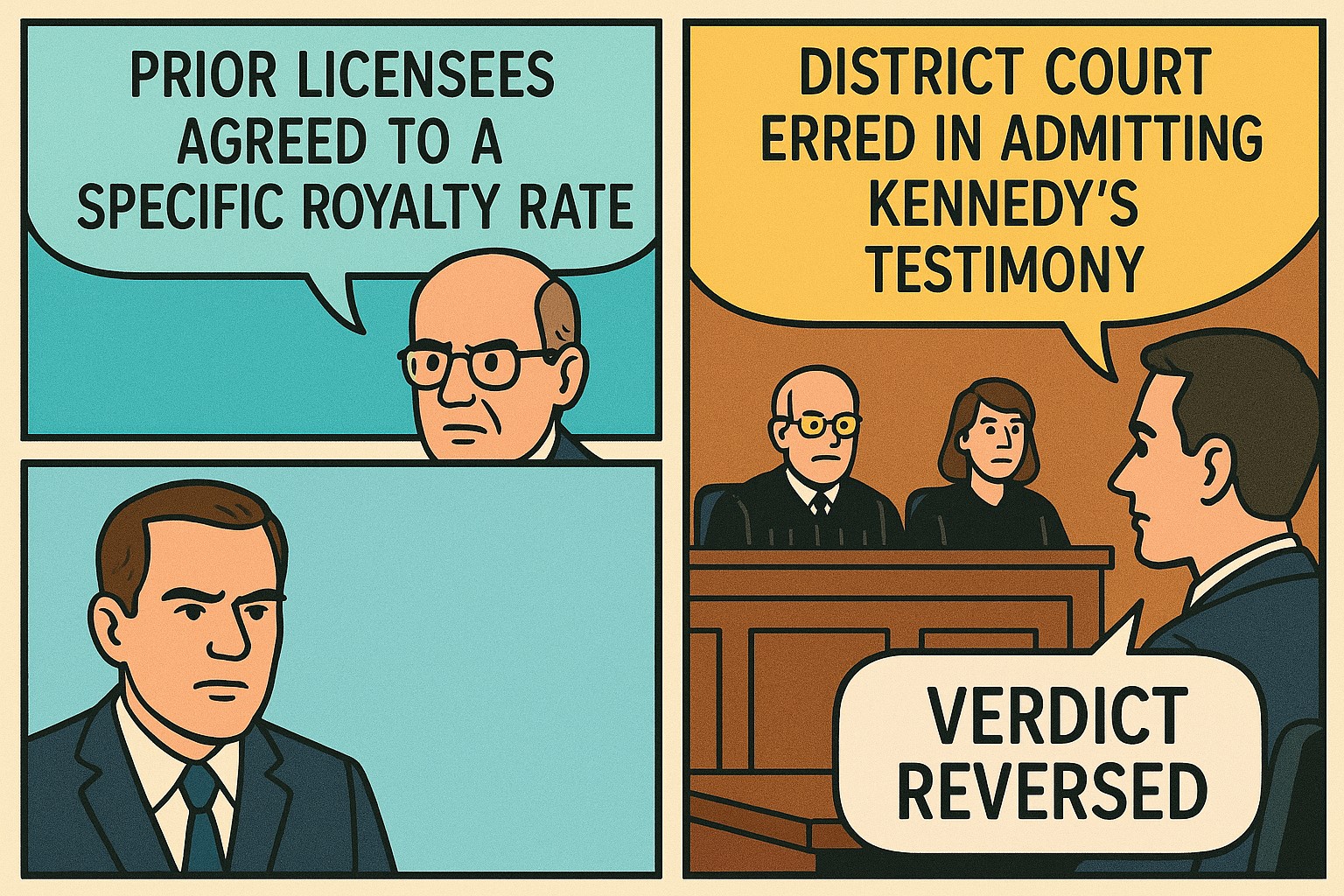
    The Federal Circuit held that the existing licenses upon which Kennedy relied were insufficient, individually or in combination, to support his conclusion that prior licensees agreed to the $X royalty rate and therefore the district court abused its discretion in failing to exclude this testimony.

    There is also evidence in the record supporting Google’s contrasting belief that none of Schneider, Daikin, or Johnson ever agreed to an $X rate. For example, the Schneider and Daikin agreements (though not the Johnson agreement) provided that the “[lump-sum] amount [paid by each licensee] is not based upon sales and did not reflect or constitute a royalty.”

    In other words, the plain language of the Daikin, Schneider, and Johnson license agreements did not support Kennedy’s testimony that the licensees agreed to pay the $X per unit royalty rate.

    The “whereas” recital of the Schneider license indicated that EcoFactor believes $X is a reasonable royalty, but it made it equally clear that Schneider did not agree that $X per unit is a reasonable royalty. Also, the “whereas” recital of the Johnson license indicated EcoFactor’s representation of its unilateral belief that $X constituted a reasonable royalty and did not provide a basis for Kennedy to testify that Johnson agreed to the $X rate. Same with Daikin.

    Moreover, the federal circuit stated that Habib’s testimony did not provide a sufficient basis for Kennedy’s testimony that Daikin, Schneider, and Johnson agreed to pay a royalty of $X per unit.

    Held

    The Federal Circuit ruled that the district court should have granted Google a new damages trial because David A. Kennedy’s expert testimony—claiming the licenses proved the industry accepted an $X-per-unit royalty rate—lacked the solid facts and data that Rule 702 requires.

    Key Takeaway:

    The Court found that David Kennedy’s testimony that the licensees agreed to the $X per unit royalty rate was not supported by sufficient facts or data as required by Rule 702, rendering his opinion unreliable and inadmissible. The plain language of the licenses contradicted Kennedy’s assertion, and Habib’s testimony did not provide a sufficient factual basis. The Court held that the district court failed in its gatekeeping role under Daubert by allowing Kennedy to testify despite the lack of factual support for a critical premise of his opinion.

    Case Details:

    Case Caption: Ecofactor, Inc. V. Google LLC
    Docket Number: 6:20cv75
    Court Name: United States District Court, Texas Western
    Order Date: May 21, 2025
  • Intellectual Property Expert Witness’ Testimony Admitted Because it Does Not Invoke the Entire Market Value Rule

    Intellectual Property Expert Witness’ Testimony Admitted Because it Does Not Invoke the Entire Market Value Rule

    Plaintiff Wireless Alliance, LLC (“Plaintiff” or “Wireless Alliance”) brought allegations against Defendants AT&T Mobility LLC, AT&T Services, Inc., and AT&T Corp. (“Defendants” or “AT&T”). Wireless Alliance asserted that AT&T infringed on several United States patents concerning enhancements to cellular networking systems. The patents in question include United States Patent No. 9,144,106 (the “‘106 patent”), Patent No. 9,565,662 (the “‘662 patent”), and Patent No. 10,045,383 (the “‘383 patent”), collectively referred to as the “Asserted Patents.” Wireless Alliance holds exclusive licensing rights for the ‘106 and ‘662 patents and owns the ‘383 patent through assignment.

    Defendants filed a motion to strike the testimony of Wireless Alliance’s damages expert, Jim W. Bergman.

    Intellectual Property Expert Witness

    Jim W. Bergman, the Founder and President of Bergman Consulting, held a B.A. in Economics and an M.B.A. from the University of California at Irvine, along with a Chartered Financial Analyst (CFA) designation. He pursued a Master of Computer Science degree from the Georgia Institute of Technology.

    Before establishing Bergman Consulting in 2017, he led Conway MacKenzie’s national intellectual property litigation group and worked as an in-house economic consultant for various national law firms for over a decade. With nearly ten years of experience in the information technology sector, Bergman obtained multiple industry-recognized certifications in hardware, software, and networking.

    He specialized in intellectual property, commercial, and bankruptcy litigation, serving as a testifying or consulting expert in areas such as business litigation, patent and technology issues, trade secrets, trademarks, securities litigation, business valuation, bankruptcy reorganization, solvency, and general damages.

    Want to know more about the challenges Jim W. Bergman has faced? Get the full details with our Challenge Study report. 

    Discussion by the Court

    A. Switiching Royalty Bases

    Defendants contended that Bergman improperly switched royalty bases by deriving a per-patent family device rate for Ericsson’s portfolio and applying it to the service revenues of the carriers. They argued that this methodology contradicted Federal Circuit precedent, as the royalty should depend on whether the Defendant manufactured the device or was the end user. The carriers maintained that no carrier would pay a royalty based on Ericsson’s cellphone or infrastructure rates based on the carrier subscriber revenue. However, the Court found that Defendants did not provide sufficient grounds to strike Bergman’s report under Rule 702 and Daubert. The Court determined that Defendants’ concerns highlighted credibility disputes rather than issues of reliability.

    B. Entire Market Value Rule and Apportionment

    Defendants further sought to strike Bergman’s report, alleging that he improperly used the entirety of their subscriber revenue, raising concerns that the Plaintiff aimed to present large revenue numbers to influence the jury’s perception of damages. However, the Parties had already agreed to a motion in limine addressing this concern. Defendants also argued that Bergman misapplied the Entire Market Value Rule (EMVR) without adequate support. In response, the Plaintiff asserted that Bergman conducted multiple patent- and Defendant-specific analyses, supported by technical opinions, to calculate apportionment factors for the incremental value of the infringing features over non-infringing features. And based on that, apportioned the revenue from the allegedly infringing features and thus did not implicate the EMVR. The Court was satisfied that Bergman’s approach did not invoke the EMVR. What remains is a fact issue.

    C. Unreliable Patent Rates

    Additionally, Defendants argued that Bergman made two methodological errors: first, by improperly applying essentiality studies of declared patents to charted patent families, and second, by basing his reliance on a certain claim that the top 10% of patents in a portfolio drive 84% of the value. They also pointed out inconsistent statements from the Plaintiff’s other expert. In contrast, Plaintiff contested Defendants’ view, asserting that Bergman used the claim in question only in the final step to differentiate apportionment rates between high-value and lower-value patents. The Court allowed Defendants to cross-examine Bergman regarding potentially inconsistent statements but found no basis to strike his testimony.

    Legal Standards

    An expert witness may provide opinion testimony if “(a) the expert’s scientific, technical, or other specialized knowledge will help the trier of fact to understand the evidence or to determine a fact in issue; (b) the testimony is based on sufficient facts or data; (c) the testimony is the product of reliable principles and methods; and (d) the expert has reliably applied the principles and methods to the facts of the case.”

     Importantly, in a jury trial setting, the Court’s role under Daubert is not to weigh the expert testimony to the point of supplanting the jury’s fact-finding role; instead, the Court’s role is limited to that of a gatekeeper, ensuring that the evidence in dispute is at least sufficiently reliable and relevant to the issue before the jury that it is appropriate for the jury’s consideration

    Held

    The Court denied Defendants’ motion to strike the testimony of Plaintiff Wireless Alliance LLC’s damages expert, Jim W. Bergman.

    Key Takeaways:

    The Court upheld Bergman’s methodology when Defendants argued he improperly switched royalty bases, declaring it to be insufficient grounds for exclusion. It rejected concerns that his use of subscriber revenue aimed to unduly influence the jury’s perception of damages, noting this issue had been addressed in a prior motion in limine. While Defendants claimed Bergman misapplied the Entire Market Value Rule (EMVR), the Court determined he conducted adequate analyses to support his calculation of the apportionment factors.

    Please refer to the blog previously published about this case:

    Telecommunications Expert Witness’ Opinions Regarding 3GPP Availability Admitted

    Case Details:

    Case Caption: Wireless All., LLC v. AT&T Mobility LLC
    Docket Number: 2:23cv95
    Court: United States District Court, Texas Eastern
    Order date: October 24, 2024
  • Intellectual Property Expert Witness Cannot Cloak her  Testimony on Validity with her Experience

    Intellectual Property Expert Witness Cannot Cloak her Testimony on Validity with her Experience

    EPP and Paveloc both construct and sell “erosion prevention” systems that are used in retaining walls. The systems are made up of interlocking hiocks. EPP has a patent on its “Channel Lock II block” (US Patent No. 8,123,435) (“the 435 patent”).

    At some point the business relationship soured. Paveloc stopped making the EPP product and began manufacturing a competing product, the ARP block. EPP alleges that the ARP block is a “knock off” of the Channel Lock II block and that Paveloc was making the ARP blocks using the same molds that FPP had provided to Paveloc to make the Channel Lock II product.

    In 2020, Fort Bend County Levee Improvement District No. 2 opened a new project for bidding. It awarded the contract for the project to TLC, a general contractor for construction projects. TLC took bids from subcontractors for erosion prevention blocks. Both Paveloc and EPP submitted hids. TLC accepted Paveloc’s bid. According to EPP, Paveloc got the project by using the ARP block, the alleged knockoff of EPP’s Channel Lock II block. 

    With the trial just a week away, Plaintiff supplemented its expert Evans’ report, offering opinions on the USPTO patent process and the validity of the ‘435 Patent as a rebuttal to Defendants’ claim of invalidity. 

    Defendants argued that this supplementation is untimely and circumvented this Court’s ruling that Evans is not a person of ordinary skill in the art, unqualified to give opinions on invalidity.

    At this point, the Court is faced with several evidentiary motions, including the Defendants’ motion to strike Andrea H. Evans’ supplemental report and Plaintiff’s omnibus motion in limine to exclude the testimony of Defendants’ expert—Dan Bullock.

    Intellectual Property Expert Witness

    Andrea Evans is a former patent and trademark examiner, has a civil and environmental engineering degree from Georgia Tech, and worked at an engineering company between college and law school. 

    She has been a licensed attorney in good standing by the State of Texas since 2003. Evans has been a member of the USPTO Patent Bar since 2007. She has been a member of the U.S. Supreme Court Bar since 2009.

    Get the full story on challenges to Andrea Evans’ expert opinions and testimony with an in-depth Challenge Study. 

    Engineering Expert Witness

    Daniel B. Bullock is a principal at Bullock, Bennett & Associates, LLC, an engineering and geoscience firm. He is a licensed professional engineer in Texas and also holds inactive professional engineer licenses in Arkansas, New Jersey, and Louisiana. He has over thirty years of professional experience working in the field of water resources and geotechnical engineering.

    Want to know more about the challenges Dan Bullock has faced? Get the full details with our Challenge Study report.

    Discussion by the Court

    Andrea Evans

    As a patent examiner, however, Evans did not work in the field of erosion prevention or cement block manufacturing, but instead, examined time-measuring devices, keyboards, and press printing systems. Consequently, this Court held that she is not a person of ordinary skill in the relevant art, and thus, she cannot opine on invalidity of the patent.

    The question then becomes whether Evans can offer substantially similar expert opinions regarding the validity or invalidity of the ‘435 Patent as she did in the excluded report simply by couching it in her patent-examiner experience.

    Evans is a patent attorney with extensive experience in patent law and procedure. As this Court has held, however, she is not a qualified technical expert on the issues of infringement or validity. Thus, she is not qualified to give opinions on issues that are “exclusively determined from the perspective of ordinary skill in the art.” To hold otherwise would be to convert every former patent examiner into a person of ordinary skill in every art, regardless of how tenuous their patent-examination experience is to the patent dispute at hand. 

    EPP may argue, Evans can testify to what a patent examiner may determine. The Court held that Evans cannot establish any similar connection between her experience in time-measuring devices, keyboards, and press-printing systems and the claimed invention of certain concrete revetment blocks. Thus, Evans cannot cloak her expert testimony on validity with her experience as patent examiner. That would amount to a circumvention of this Court’s order that she is not qualified as a person of ordinary skill in the art.

    Dan Bullock

    Plaintiff asserts in parts of its Omnibus Motion in Limine that the testimony of Defendants’ expert—Dan Bullock—should be excluded. The Court observed that the two subparts regarding Bullock are verbatim duplicates of Plaintiff’s earlier motion to strike the declaration of Dan Bullock.

    This Court has already ruled on the motion to strike. The Court denied the motions in limine because the Plaintiff has not provided any new facts, reasons, or authority for it to deviate from its earlier ruling.

    Held

    The Court granted Defendants’ motion to strike Andrea Evans to the extent the report purports to discuss invalidity and/or what a reasonable patent examiner would or would not conclude regarding the 435 Patent.

    Moreover, the Court denied Plaintiff’s motions in limine regarding the testimony of Defendants’ expert—Dan Bullock.

    Key Takeaway:

    Evans is not a qualified technical expert on the issues of infringement or validity. Thus, she is not qualified to give opinions on issues that are “exclusively determined from the perspective of ordinary skill in the art.” To hold otherwise would be to convert every former patent examiner into a person of ordinary skill in every art, regardless of how tenuous their patent-examination experience is to the patent dispute at hand. 

    Case Details:

    Case Caption: Pave/Lock/Plus Ii Llc V. Erosion Prevention Products Llc Et Al
    Docket Number: 4:20cv3557
    Court: United States District Court, Texas Southern
    Order Date: October 8, 2024
  • Testimony of Music Engineering Expert Witness held to be based on Adequate Testing of Accused Products

    Testimony of Music Engineering Expert Witness held to be based on Adequate Testing of Accused Products

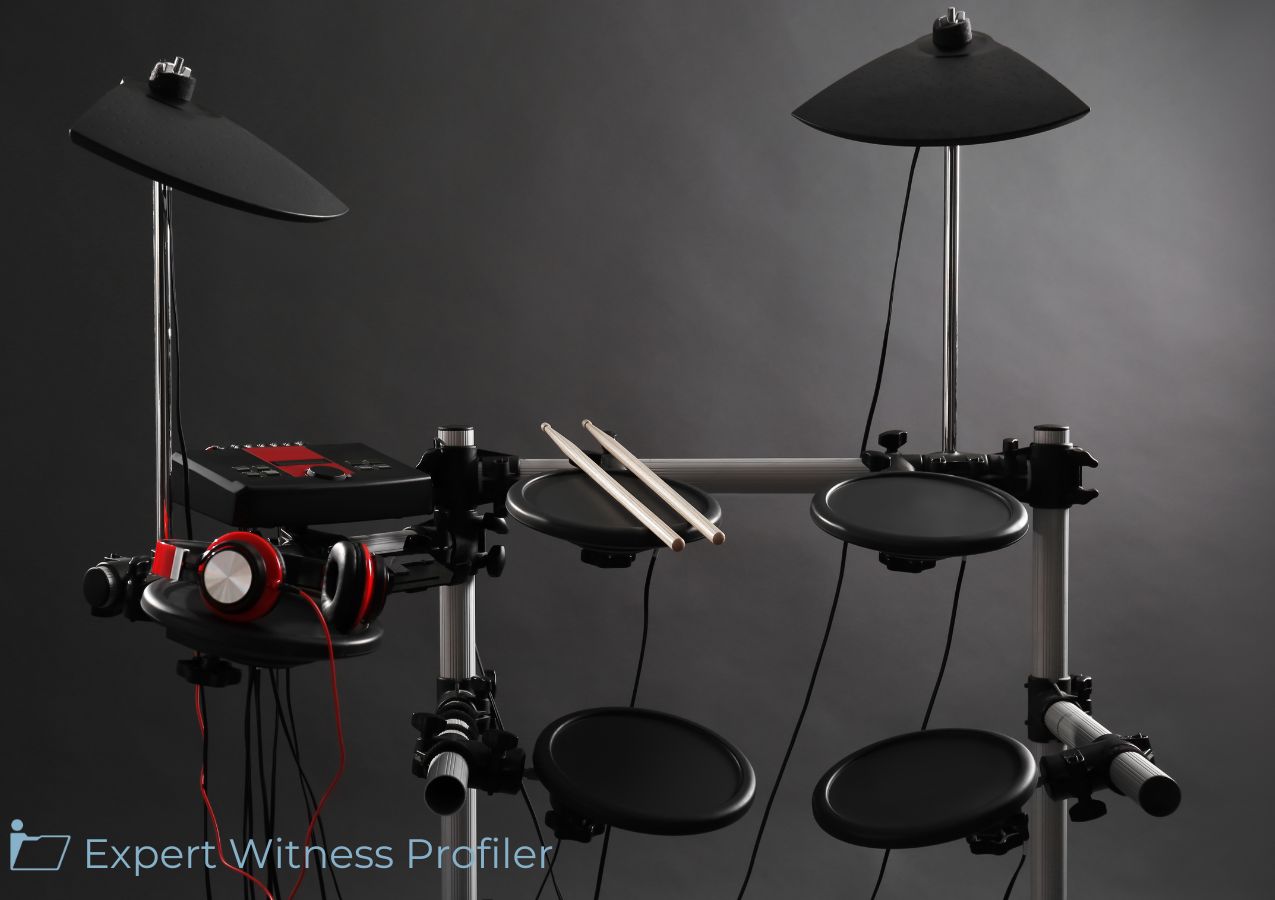
    This case was a patent dispute about electronic drum kits. The patents at issue involved technology that allowed electronic drums and cymbals to mimic the material and sensation of the drums and cymbals on an acoustic drum kit. The Plaintiff, inMusic Brands, Inc. (“inMusic”), sued the Defendant, Roland Corporation (“Roland”), alleging infringement of three of its drum and cymbal patents: the ‘827 Patent for an Electronic Percussion Instrument with Enhanced Playing Area; the ‘758 Patent for an Electronic Hi-Hat Cymbal Controller; and the ‘724 Patent for a Removable Electronic Drumhead for an Acoustic Drum. inMusic claimed that Roland’s PD-140DS V-Pad infringed the ‘827 Patent; that its VH-13-MG Hi-Hat infringed the ‘758 Patent; and that its KD-A22 Kick Drum Converter infringed the ‘724 Patent.

    inMusic also filed a motion to exclude the non-infringement opinion of Roland’s expert witness, Dr. Paul D. Lehrman

    Plaintiff argued that Roland’s lawyers had prepared Lehrman’s Non-infringement Expert Report. Lehrman had merely “proofread” and signed what the lawyers had ghost-written for him. A lawyer-prepared expert report was improper under Daubert and warranted exclusion. As a result, Lehrman’s non-infringement opinion evidence was unreliable, unhelpful to the trier of fact, and improperly disclosed.

    Music Engineering Expert Witness

    Paul D. Lehrman has been a Member of the Music faculty at Tufts University since 2000. He has been teaching music technology at the college level since 1987. He was responsible for designing and building iMac-based music/multimedia lab with 12 student stations in Tufts University. He has authored six books and over 600 articles on music and audio technology.

    Discussion by the Court

    The Plaintiff’s primary argument required the Court to identify the line between legitimate attorney assistance in drafting an expert report and improper attorney preparation of an expert report. The starting point was Rule 26(a)(2)(B), which required a written expert report “prepared and signed by the witness.”

    The Court, after reviewing the expert report and Lehrman’s deposition testimony, held that, in forming his opinions, he had participated in the process far more than just reading and signing the expert report. Moreover, Lehrman testified (as also reflected in the report) that he personally conducted testing in his lab regarding certain of the accused products, was involved in designing those tests, and examined and/or disassembled certain of the products in issue. While it would have been preferable if Lehrman had had more direct involvement in the final drafting process, this was not the case of an expert simply rubber-stamping a report ghostwritten by counsel as suggested by Plaintiff. Consequently, the Court noted Lehrman’s involvement in the process complied with the dictates of Rule 26(a)(2)(B). Moreover, Plaintiff did not make a sufficient showing to warrant exclusion.

    Held

    The Court denied inMusic’s motion to exclude the non-infringement opinion of Roland’s expert witness, Dr. Paul Lehrman because Roland met the dictates of both Rule 26 and Rule 702.

    Key Takeaway:

    The Court deemed Paul Lehrman’s testimony admissible because his participation in the preparation of his expert report was adequate. He personally conducted testing in his lab regarding certain of the accused products. Lehrman designed those tests and examined and/or disassembled certain of the products in issue.

    Case Details:

    Case Caption: Inmusic Brands, Inc. V. Roland Corporation
    Docket Number: 1:17cv10
    Court: United States District Court for the District of Rhode Island
    Order Date: March 29, 2024
  • Royalty Analysis Conducted by Finance Expert Witness Deemed Reasonable

    Royalty Analysis Conducted by Finance Expert Witness Deemed Reasonable

    On June 11, 2021, Utherverse filed a patent infringement complaint against Epic, alleging that four Fortnite events (the “Accused Events”) violated the ‘071 Patent and the ‘605 Patent, collectively known as the “Asserted Patents.” These patents relate to enabling numerous participants to connect in a virtual computer-generated environment for shared virtual experiences. The current issue before the Court involves Epic’s Daubert motion to exclude Utherverse’s damages expert, Michele Riley. Judge Theresa L. Fricke, United States Magistrate Judge, issued a Report and Recommendation, which pushed for denying the motion to exclude the testimony of Michele Riley.

    Finance Expert Witness

    Michele Riley is a Managing Director at Stout, specializing in complex litigation consulting for breach of contract, unfair competition, investigations, and compliance. She holds certifications as a Certified Public Accountant, Certified Fraud Examiner, and is Certified in Financial Forensics.
    Riley specializes in assessing intellectual property damages and valuation. She has testified in cases involving patent, trademark, and copyright infringement, as well as trade secret misappropriation.

    Discussion by the Court

    According to the Court’s decision in Exmark Mfg. Co. v. Briggs & Stratton Power Prods. Grp., LLC, 879 F.3d 1332, 1347 (Fed. Cir. 2018), it was established that when reviewing damages in patent cases, the Federal Circuit applies regional circuit law to procedural issues and Federal Circuit law to substantive and procedural issues related to patent law. In reviewing motions to exclude expert testimony related to patent royalties, the Federal Circuit has applied its own law.

    Judge Fricke, citing Lucent Techs., Inc. v. Gateway, Inc., 580 F.3d 1301, 1324 (Fed.Cir.2009), observed that two alternative methods exist for calculating damages in a patent case; they “are the patentee’s lost profits and the reasonable royalty he would have received through arms-length bargaining.” To calculate the reasonable royalty, patentees generally consider a hypothetical negotiation, in which the asserted patent claims are assumed valid, enforceable, and infringed, and attempt “to ascertain the royalty upon which the parties would have agreed had they successfully negotiated an agreement just before infringement began.” This hypothetical negotiation “necessarily involves an element of approximation and uncertainty.” In determining the reasonable royalty that would have been agreed to at the hypothetical negotiation, parties in patent cases frequently utilize the fifteen factors enunciated in Georgia-Pacific Corp. v. U.S. Plywood Corp., 318 F.Supp. 1116, 1120 (S.D.N.Y.1970).

    In Lucent Technologies Inc. v. Microsoft Corporation, 580 F.3d at 1326, it was established that a hypothetical negotiation can result in either a lump-sum license or a running royalty license. A lump-sum license is an up-front payment in full for the invention that involves uncertainty about “whether the technology is commercially successful or even used.” In contrast, a running royalty license is directly tied to how often the invention is incorporated into products by the licensee and is calculated by multiplying the proposed royalty rate by the proposed royalty base. The burden of proving damages falls on the patentee.” To properly carry this burden, the patentee must sufficiently tie the expert testimony on damages to the facts of the case. 

    Judge Fricke stated that Riley’s analysis began with a general overview of the parties’ industries, the parties themselves, and the Accused Events. She explained that, based on her discussions with Craig Rosenberg, Utherverse’s technical expert, she understood that the Asserted Patents involved enabling a large number of participants to connect in a virtual computer-generated environment for shared virtual experiences. She calculated the royalty base by determining the revenue attributable to the Accused Events, including microtransaction purchases made by Fortnite users through the in-game currency. This encompassed items specifically available for the Accused Events in the Fortnite Item Shop, incremental revenue from microtransaction purchases related to the Accused Events, and the value to Epic of new and returning users due to the Accused Events.

    For determining the royalty rate, Riley analyzed Utherverse Digital agreements, explaining their relevance in a hypothetical negotiation. After reviewing various data points and assessing their significance in a hypothetical negotiation, Riley made her conclusions about the royalty rate range known. She partially relied on the 2020 Royalty Rate Industry Summary from IPSCIO Reports.

    Georgia-Pacific factor 1 considers: “The royalties received by the patentee for the licensing of the patent in suit, proving or tending to prove an established royalty.” Judge Fricke citing Wordtech Sys. v. Integrated Networks Solutions, Inc., 609 F.3d 1308, 1320 (Fed.Cir. 2010), held that a patentee may not rely on license agreements that are ” ‘radically different from the hypothetical agreement under consideration’ to determine a reasonable royalty.” Further, “comparisons of past patent licenses to the infringement must account for ‘the technological and economic differences’ between them.”

    Ephere was engaged in computer graphics and software development, specializing in designing and implementing software solutions for computer graphics, film, and games, extending existing software for new functions, and providing consulting and support in the film and games industry. Epic argued that Riley inappropriately used the Ephere license as a substitute for apportionment, as she did not demonstrate sufficient comparability. Specifically, Epic contended that Riley failed to analyze the technological comparability between the ‘962 Patent from the Ephere license and the Asserted Patents. The Court was urged to conclude that Riley had not established a baseline comparability between the technology in the Ephere License and the Asserted Patents.

    But Judge Fricke observed that in addition to providing a summary of the ‘962 Patent and the background of the invention itself, Riley also discussed the relationship between the patent from the Ephere license and the Asserted Patents. Judge Fricke determined that, according to Federal Circuit precedent, Riley needed to demonstrate baseline comparability between the ‘962 Patent and the Asserted Patents. It was noted that she had fulfilled this requirement in her report. Any further examination of the similarities and differences between the two was considered a factual matter rather than a methodological one and could be addressed during cross-examination.

    Epic asserted that Riley couldn’t rely on Epic’s internal document about payment to an artist of one of the Accused Events, Epic’s merchandise agreements, a published industry report, and a Utherverse Digital license agreement to establish her royalty base. Judge Fricke, referencing Microsoft Corp. v. Motorola, 904 F.Supp.2d 1109, 1118 (W.D. Wash. 2012), found that these documents provided some indication of the appropriate initial royalty rate, making Riley’s testimony admissible. For instance, the merchandise agreements involved Epic and certain artists linked to the Accused Events, while the Utherverse Digital agreement supported Riley’s opinion on a suitable royalty rate.

    Regarding Epic’s internal document and the IPSCIO industry report, these were among various data points Riley used in her royalty rate analysis. Judge Fricke asserted that she clarified the relevance of these documents and their connection to her analysis, leaving the degree of comparability for cross-examination rather than a Daubert motion.

    Defendant Epic Games, Inc. (“Epic”) respectfully objected to the Report and
    Recommendation concerning the motion to exclude the testimony of Riley on the following grounds:

    1. The R&R had erroneously recommended that the Court find Riley demonstrated the required baseline technological comparability between the license agreement she relied on and the technology at issue in this case. The record did not support such a finding, and holding otherwise on this record would have been contrary to binding Federal Circuit precedent.
    2. The R&R had not addressed Epic’s motion to exclude Riley’s royalty rate opinion for failing to apportion damages. Adopting the R&R and allowing Riley to present a damages theory that failed to apportion damages would have been contrary to established Federal Circuit law.
    3. The R&R’s finding that certain “comparable transactions” would inform the starting point of a royalty rate was clearly erroneous because those transactions were not patent licenses and were in no way economically or technologically comparable to the facts of this case.

    After reviewing the Report and Recommendation of Judge Fricke as well as the objections to the Report and Recommendation, the Court adopted the Report and Recommendation.

    Held

    The Court denied Epic Games, Inc.’s motion to exclude Utherverse Gaming, LLC’s damages expert, Michele Riley. The Court has not arrived on an outcome for this case since the remaining issues involved in this case still await resolution.

    Key Takeaways:

    The Court scrutinized Riley’s analysis, noting her thorough examination of industry, parties, and events involved. The analysis included determining the royalty base and rate, involving a hypothetical negotiation and reliance on Utherverse Digital agreements. The Court acknowledged the inherent approximation and uncertainty in such assessments but deemed Riley’s methodology admissible. This demonstrates the Court’s consideration of the application of established principles in patent cases.

    Concerns were raised by Epic regarding Riley’s use of the Ephere license and other documents for establishing the royalty base. The Court, citing Federal Circuit precedent, required Riley to demonstrate baseline technological comparability, which was found to be fulfilled in her report. The Court acknowledged that further exploration of similarities and differences could be addressed during cross-examination, highlighting the importance of factual matters in such evaluations.

    Epic’s objection to the use of certain documents, including an internal document, merchandise agreements, and industry reports, was addressed by the Court. The Court, referencing relevant legal precedent, found these documents provided indications of an appropriate initial royalty rate, supporting the admissibility of Riley’s testimony. The Court emphasized the role of cross-examination in assessing the degree of comparability, showcasing a balanced approach to the admissibility of evidence.

    In summary, the Court’s decision underscores the importance of adherence to established legal principles in patent cases, including the use of regional circuit law and Federal Circuit law, the consideration of two primary methods for calculating damages, and the scrutiny of expert testimony methodologies. The decision reflects a nuanced approach, allowing for cross-examination to address factual matters while ensuring the admissibility of expert opinions based on sound methodology.

    Case Details:

    Case Caption: Utherverse Gaming Llc V. Epic Games Inc
    Docket Number: 2:21cv799
    Court: United States District Court, Washington Western
    Citation: 2023 U.S. Dist. LEXIS 232999
    Order Date: January 12, 2024