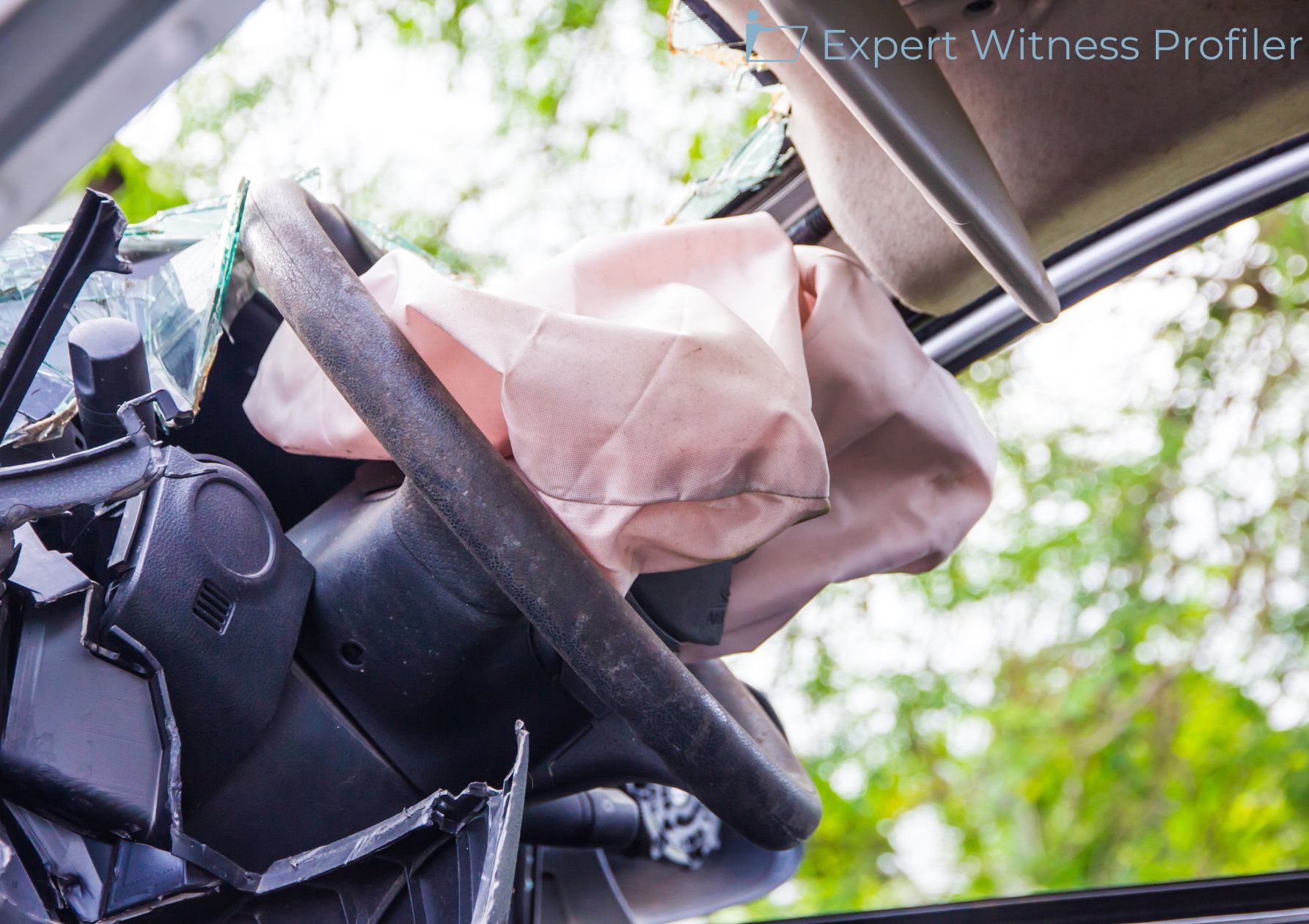
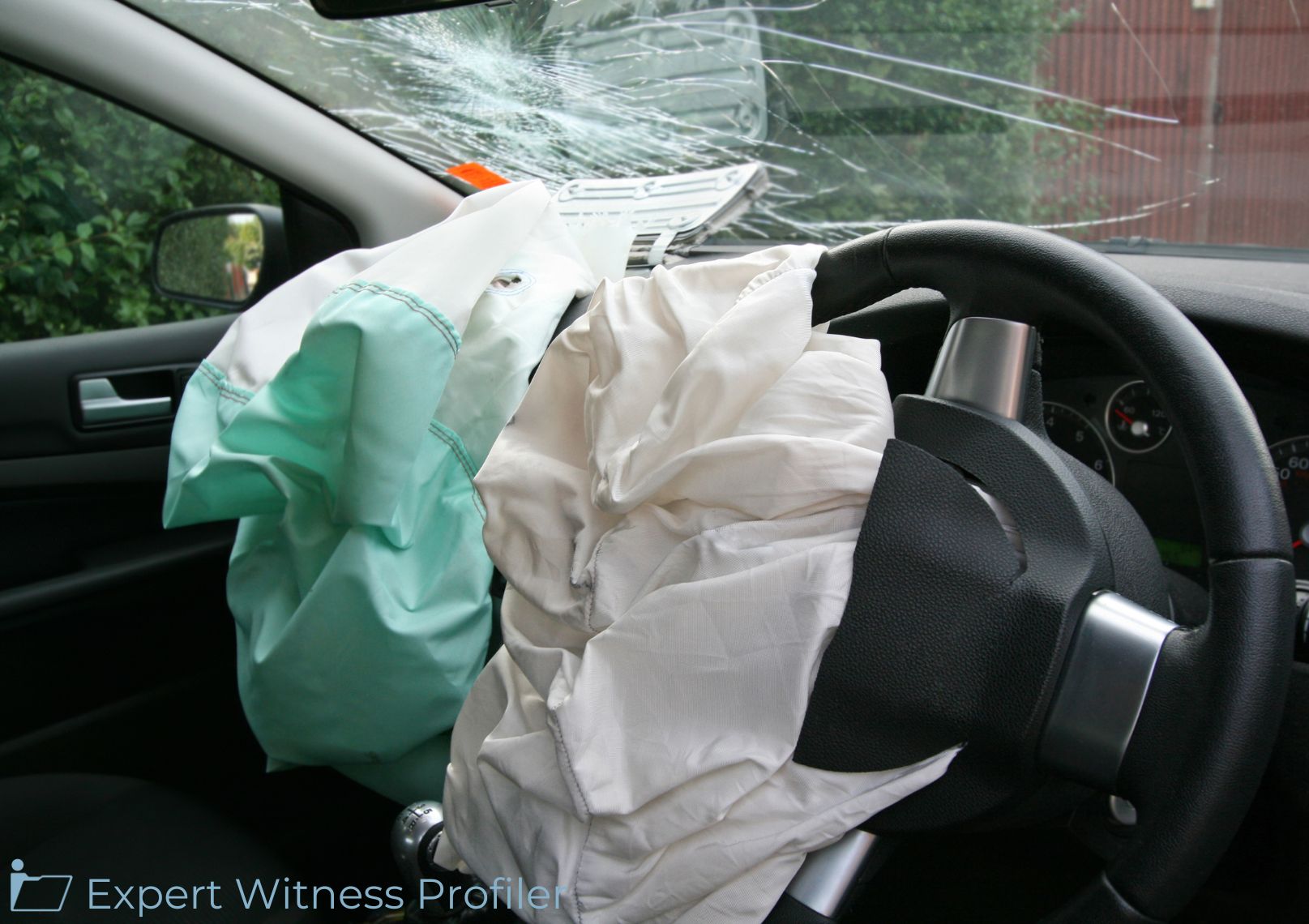
William Harrison Sims sustained facial injuries from shrapnel when his BMW’s airbag malfunctioned. He subsequently filed a lawsuit against BMW, claiming negligence and strict product liability.
In the legal proceedings, BMW’s accident reconstruction expert, Amanda Duran, P.E., was accused by the Plaintiff of selectively endorsing a defense-favorable theory of the accident without sufficient justification.
Amanda Duran, P.E. is an automotive engineer specializing in motor vehicle crash investigation and reconstruction. Since 2003, she has worked at Carr Engineering, Inc. To date, she has been involved in analyzing over 600 crashes, including more than 500 vehicle inspections and 400 scene inspections.
Amanda Duran, P.E., was presented as the defense’s accident reconstruction expert. The Court partially granted the Plaintiff’s Daubert challenge, excluding Duran’s opinion on who failed to yield the right of way. The Court found this opinion unhelpful, as Duran couldn’t identify the responsible party, and the basic fact that someone failed to yield the right of way was deemed common knowledge.
The defense’s motion for reconsideration, which simply reiterated prior arguments, was denied. The Court emphasized that reconsideration is not a platform for disputing rulings. Furthermore, the Court rejected the defense’s argument that because their challenge to the Plaintiff’s expert was denied, Duran should be allowed to offer unhelpful opinions.
The Court also struck Duran’s opinion regarding the BMW’s lane of travel, again rejecting the defense’s rehashed arguments. The Court found Duran’s methodology flawed, as she disregarded physical evidence and relied excessively on Harris-Jackson’s testimony. The defense’s disagreement with this ruling was deemed insufficient for reconsideration.
Finally, the defense argued that it was unfair for the Plaintiff’s expert, Perry Ponder, to testify when his conclusions differed from the crash report prepared by the Trooper. It should be noted that the Court refused to admit Duran’s testimony about the Plaintiff’s lane of travel because she prioritized Harris-Jackson’s account over concrete physical evidence. The Court rejected this argument, highlighting the difference in methodology: Ponder considered the Trooper’s crash report but reached a different, reasoned conclusion, while Duran disregarded physical evidence. The Court concluded that the experts’ approaches were not comparable and denied the motion for reconsideration.
Held
The Court denied the Defendants’ motion for reconsideration of the Court’s order to exclude the testimony of Amanda Duran, P.E.
Key Takeaway:
The Court emphasized the importance of sound methodology and reliance on evidence in expert testimony. After all, a motion for reconsideration is not a platform to reargue previous arguments.
Please refer to the blogs previously published about this case:
Plaintiff, William Harrison Sims’ claims arise out of an October 24, 2019, two-vehicle collision involving Plaintiff, who was operating the 2004 BMW (“Subject BMW”). Tameca Harris-Jackson (“Harris-Jackson”) was operating the Hyundai that collided with the Subject BMW. Plaintiff alleges he sustained “severe, permanent, and life-altering injuries” due to the driver-side Takata airbag unexpectedly rupturing and shooting “metal shrapnel into his face and body.”
Defendants procured and installed the airbag inflator during the process of “designing, manufacturing, assembling, and producing” the vehicle. Plaintiff brought this action for damages against both Defendants BMW of North America (“BMW NA”) and Bayerische Motoren Werke AG (“BMW AG”), alleging strict liability and negligence from procuring and installing the airbag.
Amanda Duran, P.E. is the Defendants’ accident reconstruction expert. Plaintiff argued that Duran postulated several scenarios regarding how Harris-Jackson was driving and elected, without a rational basis, to endorse the theory that best suited the defense.
Accident Reconstruction Expert Witness
Amanda Duran, P.E. has been working in the automotive engineering field, primarily focusing on the investigation and reconstruction of motor vehicle crashes.
From 2003 until the present, she has been an Engineer at Carr Engineering, Inc. In this role, she performed investigations to determine the causes, conditions, and circumstances of motor vehicle crashes. To date, she has personally been involved in analyzing the various aspects of more than 600 crashes, including more than 500 vehicle inspections and more than 400 scene inspections.
Plaintiff sought to exclude Duran’s opinion that someone failed to yield the right of way because she cannot determine who that someone is. Next, Plaintiff moved to exclude Duran’s opinion that he was driving in the southbound right-hand lane when the crash occurred, as opposed to the left-hand lane. Plaintiff argued Duran ignored the physical evidence that contradicts her opinion, rendering it unreliable, unhelpful, and irrelevant. Plaintiff also sought to eliminate Duran’s opinion that the driver of the Sonata, Harris-Jackson, accelerated from a stop at a slow or moderate rate before the collision.
A. Someone Failed to Yield the Right of Way
The defense conceded that Duran did not determine whether Plaintiff or Harris-Jackson failed to yield the right of way before the two vehicles collided. The defense added that Duran did conclude that “the impact speed of Harris-Jackson’s vehicle [is] consistent with her testimony that her vehicle was stationary before proceeding into the intersection.”
The Court was tasked with determining whether her testimony that somebody failed to yield the right of way survives the rigors of Daubertbut Duran’s opinion that Harris-Jackson’s vehicle was stationary before she turned to enter the highway was of little assistance.
Duran’s inability to determine which driver failed to yield the right of way failed the helpfulness prong of Daubert. The accident only occurred because one of the driver’s failed to yield the right of way. A jury does not need an expert to explain this fact. A collision at an intersection controlled by a traffic light occurs when one of the driver’s fails to yield the right of way. Accordingly, the Court held that Duran’s testimony did not concern a matter that is beyond the understanding of the average lay person.
The defense argued that Duran’s testimony that she was unable to determine which driver failed to yield the right of way is helpful simply because the parties disagree on who is at fault. The Court held that Duran’s testimony that she does not know who failed to yield the right of way does not have a tendency to make a fact more or less probable than it would be without the evidence. In other words, Duran has no opinion as to which driver is at fault.
B. Lane of Travel
Plaintiff challenged Duran’s opinion that he was driving in the southbound right-hand lane when the accident occurred, contrary to Trooper Ndoumbe’s assessment that Plaintiff was traveling in the left-hand lane.
Plaintiff argued that Duran’s opinion was not only unreliable, but also unhelpful because she conceded that Harris-Jackson could have accelerated from a stop at the stop bar with light or moderate acceleration rates and impacted Plaintiff’s BMW in either the right-hand or left-hand lanes.
Duran’s Methodology is Unreliable because She Failed to Account for Physical Evidence Placing the Plaintiff’s Vehicle in the Right Lane
Duran stated in her report that she did not identify any remaining evidence at the crash site relating to this accident. She did, however, review the accident report prepared by law enforcement. Duran also noted in her bullet-point summary of deposition testimony that Trooper Ndoumbe determined the area of impact by a “gouge on the roadway,” but the roadway has since been repaved. It should be noted that Duran did not factor the gouge mark and fluid identified by Trooper Ndoumbe into her analysis. It was never mentioned again in her expert report.
Duran Offered No Explanation for her Decision to Ignore Physical Evidence and the Troopers’ Testimony in Favor of Harris-Jackson’s Version of Events
Trooper Ndoumbe testified that the gouge mark and fluid were consistent with Plaintiff’s vehicle in the left lane at the moment of impact, as documented on his crash diagram.
While the parties did not explain the significance of Plaintiff traveling in the right lane versus the left, it appears from the above that if Plaintiff’s vehicle was in the left lane, this would support Harris-Jackson’s testimony that she proceeded from a stopped position and proceeded slowly. Hence, Duran’s observation that “[r]epeating the above analysis with lower separation speeds and the adjusted post-impact trajectories, the speeds were more consistent [if Plaintiff was in the right lane] with witness testimony and typical driving behavior.” Duran ignored the gouge marks and fluid identified by Trooper Ndoumbe.
Duran emphasized Harris-Jackson’s version of the events over physical evidence, thereby violating her working premise that “[t]he first step in reconstructing the subject crash and performing appropriate calculations to determine the speeds and Delta-Vs is to reconcile the physical evidence on the roadway, the photographs, and the vehicles.” Moreover, Duran offered no explanation for her decision to ignore physical evidence and the Troopers’ testimony in favor of Harris-Jackson’s version of events.
Analysis
The Court held that Duran failed to consider or account for contradictory data, which consisted of a gouge mark and fluid placing the initial point of impact in the left lane. Duran acknowledged in her report that “the first step” in reconstructing the accident and calculating the Delta-Vs is to reconcile the physical evidence with the analysis. She failed to do so, rending her analysis flawed.
Duran stated in her report that “if the Hyundai accelerated from a stop at the stop bar to the area of impact in either lane, with either light or moderate acceleration rates, it could have reached the range of both of our [Ponder and Duran’s] calculated speeds (13 to 24 MPH).” Whether Plaintiff was traveling in the left lane or right was of no consequence to Duran’s speed calculations.
C. Vehicle Speed
Plaintiff challenged Duran’s methodology in calculating the speed of the Hyundai and whether that speed was reached from a stopped position.
It was noted that Duran measured the radius of the typical path for a left turn onto the entrance ramp to be a radius of about 80 feet. Next, Duran calculated the force exerted on Harris-Jackson if she employed Plaintiff’s speed calculation as .05 G and ruled out this aggressive maneuver based on the forces and Harris-Jackson’s testimony.
Duran then used her speed calculation (13 to 25 MPH) and concluded that o.255 G would be applied if Harris-Jackson made the turn without stopping and the maximum speed would be approximately 18 MPH. Similarly, if Harris-Jackson proceeded to turn from a stopped position, applying light or moderate acceleration rates, the speed would be between 13 to 24 MPH.
Plaintiff was correct that Duran offered two competing opinions: either Harris-Jackson proceeded into the intersection from a stop or drove through. In both scenarios, Harris-Jackson would reach speeds within Duran’s calculated range and below the speed calculated by Ponder. The Court held that Duran’s opinion is helpful to the jury tasked with evaluating Harris-Jackson’s credibility. If Harris-Jackson testified she came to a stop before entering the intersection, Duran’s calculations support that testimony. Secondly, Duran’s calculations and opinions countered those of Plaintiff’s expert and went to the weight the jury will accord Ponder’s testimony. Alternative opinions are not per se unreliable or unhelpful.
Held
The Court granted in part and denied in part the Plaintiff’s motion to exclude the testimony of Amanda Duran.
Key Takeaway:
Duran committed the sin of omitting data—the gouge mark, fluid spill, the Trooper’s testimony, and cherry-picking data—giving undue weight to Harris-Jackson’s version of the events. Additionally, as Plaintiff noted, Duran’s opinion was unhelpful. Whether Plaintiff was traveling in the left lane or right was of no consequence to Duran’s speed calculations.
While Duran’s opinion regarding Plaintiff’s lane of travel ignored physical evidence, the opinion that Harris-Jackson proceeded into the intersection from a stopped position was, however, supported by a reliable methodology.
Plaintiff is correct that Duran offered two competing opinions: either Harris-Jackson proceeded into the intersection from a stop or drove through. However, Duran’s opinion is helpful to the jury tasked with evaluating Harris-Jackson’s credibility.
Please refer to the blogs previously published about this case: