Tag: Pilot

  • Piloting Expert Was Allowed to Opine on Spatial Disorientation

    Piloting Expert Was Allowed to Opine on Spatial Disorientation

    This case arises from an accident involving a Robinson R44 II helicopter, registration N442VB (“Helicopter”), that occurred on the evening of December 30, 2021, in Levy County, Florida. The Helicopter was being flown at night by the owner-pilot, Ronald Hicks (“Pilot Hicks”), from a local friend’s residence to his private property. At the time of the accident, Pilot Hicks had less than ten hours of night flight experience in helicopters and was not certified under Instrument Flight Rules (“IFR”). Mr. Hicks, Shelly Kate Hicks, and their two children sustained fatal injuries.

    Plaintiffs filed a Daubert motion to exclude and/or limit the testimony of Defendant’s piloting expert Timothy Tucker.

    Piloting Expert Witness

    Timothy C. Tucker has 55 years’ experience as a military and civilian helicopter pilot, instructor and evaluator in both visual and instrument flight
    techniques.

    Get the full story on challenges to Timothy Tucker’s expert opinions and testimony with an in-depth Challenge Study.

    Discussion by the Court

    Qualification

    Plaintiffs argud that Tucker opined regarding “meteorology, engine failure, accident reconstruction, and human factors issues” despite being unqualified to do so.

    The Court has reviewed Tucker’s expert report and found that he is qualified as a “piloting” expert and may opine from the piloting perspective. However, Tucker was not qualified as a metallurgist or accident reconstructionist, and his report did not indicate that he relied upon Defendant’s metallurgy or accident reconstruction experts when forming his conclusions.

    While Tucker may offer his “piloting” opinions, he may neither (1) repeat the conclusions of Defendant’s metallurgy and accident reconstruction experts, nor (2) say they are consistent with his opinions. Moreover, Tucker is strictly limited to offering only the “piloting” opinions outlined in his report. Defendant represented that Tucker will testify to two main opinions, that Hicks “experienced spatial disorientation and lost control” of the helicopter, and that the evidence in this case is inconsistent with an attempted autorotation.

    Methodology

    Second, Plaintiffs argued that Tucker’s methodology was unreliable. Plaintiffs took issue with Tucker’s reliance on flight path ADS-B data for his analysis and the fact that his opinion purportedly conflicts with other witness testimony regarding the crash.

    While Plaintiffs are free to cross-examine Tucker regarding perceived deficiencies in his data or conclusions, they have not demonstrated exclusion is warranted.

    Third, Plaintiffs argued that Tucker’s opinion will be cumulative. As explained above, the Court found that Tucker is a qualified “piloting” expert and may opine from that unique perspective. To the extent Tucker is offering the “piloting” opinions in his report, his testimony is not cumulative. However, the Court reiterates that it will not tolerate Tucker offering other experts’ testimony or saying it comports with his own. This will be strictly enforced.

    Finally, Plaintiffs requested that Tucker be bound to the opinions contained within his expert report. The Court absolutely agreed that no expert may offer opinions not within their expert report.

    Held

    The Court denied the Plaintiffs’ Daubert motion to exclude and/or limit the testimony of Defendant’s expert Timothy Tucker.

    Key Takeaway

    Whether an expert selected the best data set to use is a question for the jury, not the judge. Vigorous cross-examination, presentation of contrary evidence, and careful instruction on the burden of proof are the traditional and appropriate means of attacking shaky but admissible evidence.

    Please refer to the blogs previously published about this case:

    Accident Reconstruction Expert’s Meteorological Opinions Excluded

    Avionics Expert Allowed to Opine on Engine Failure

    Case Details:

    Case Caption: Law V. Avco Corporation
    Docket Number: 1:24cv3
    Court Name: United States District Court for the Northern District of Florida, Gainesville Division
    Order Date: November 05, 2025
  • Aviation Expert’s Testimony on Flight Attendant Conduct Excluded

    Aviation Expert’s Testimony on Flight Attendant Conduct Excluded

    In this personal injury case, Plaintiff Ana Maria Marcela Tavantzis (“Tavantzis”), individually and on behalf of her husband, Jesus Plascencia (“Plasencia”), alleged Defendant American Airlines, Inc. (“American”) was responsible for a stroke Plasencia suffered just prior to landing on an international flight from Miami to Madrid, Spain.

    Plaintiff’s expert Captain Richard J. Levy advanced three opinions related to three critical periods before and during the flight at issue: (1) just before takeoff when the pilot spoke with Plaintiffs; (2) when Plasencia presented stroke symptoms an hour and a half into the flight; and (3) when the pilot landed in Madrid.

    American argued that the Court should exclude Levy’s opinions because the opinions (1) are unreliable under the Daubert standard; (2) exceed the scope of his aviation expertise; (3) rely on destroyed data; and (4) supplant the jury’s function by opining on the ultimate facts. 

    Aviation Expert Witness

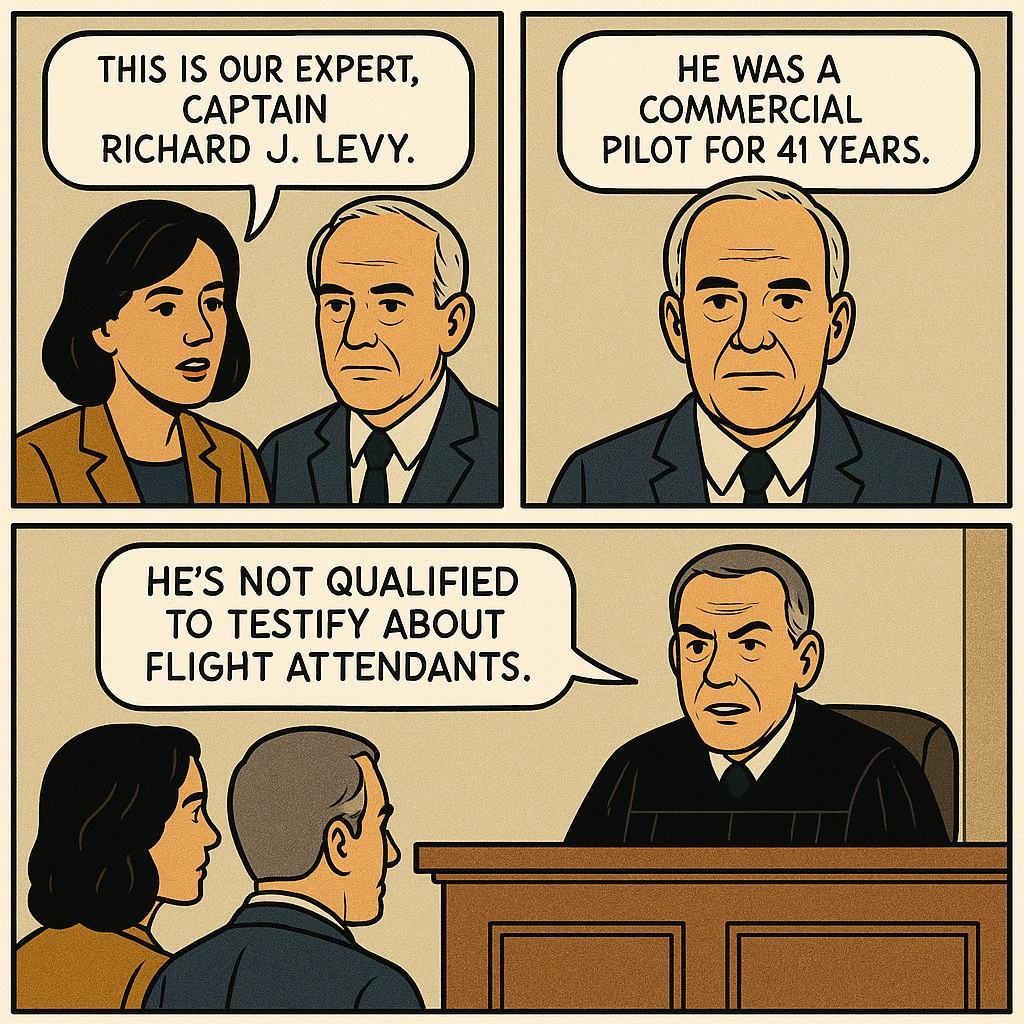
    Captain Richard J. Levy flew forty-one years at a major international airline, American Airlines, until the mandatory retirement age of 65 in June of 2018.

    He has decades of flight experience in both the commercial and military field. Since his retirement, he has been conducting simulator and classroom training as a Flight Crew Training Instructor at another major airline, Southwest Airlines.

    Get the full story on challenges to Richard Levy’s expert opinions and testimony with an in-depth Challenge Study. 

    Discussion by the Court

    Reliability

    American disputed the reliability of Levy’s experience as the basis for his opinions. 

    To support this contention, American advanced three reasons:

    • First, American argued that Levy’s testimony is unreliable because it does not explicitly “set forth what Levy was asked to opine on.”
    • Second, American argued that Levy’s opinions are unreliable because his opinions did not cite directly to the record or engage in sufficient “analysis.”
    • Finally, American contended that Levy’s opinions are irrelevant because they did not have “any tendency to make a fact more or less probable than it would be without the evidence.”

    Analysis

    American never explains why the imprecision surrounding the scope of Levy’s engagement renders his opinions unreliable. What Levy thought the contours of his assignment were has no bearing on his qualifications or experience; the Court held that he is still a flight training instructor who for 41 years served as a commercial pilot for Defendant American Airlines. 

    Moreover, the facts of this case are not so complicated that it requires citations to the record to understand the context of Levy’s opinions. His opinions reflect the application of his specialized knowledge and experience to the straightforward facts of this case, which he describes at the outset of his report. Because Plaintiffs submitted Levy as an expert for his experience, Levy need not have conducted any “analysis” in the manner American insisted he must. 

    Besides, the Court determined that Levy’s opinions make some facts more or less probable, if the American flight in this case had sufficient fuel for the pilot to turn the plane around if Plasencia presented stroke symptoms an hour and a half into the flight (a fact that is disputed by the parties). 

    Scope

    American specifically challenged Levy’s statements regarding the proper conduct of American employees, other than the pilot, who were working on the aircraft during Plaintiffs’ flight. As an expert, Levy is allowed to make certain factual assumptions within his opinions.

    However, considering Levy’s experience was as a pilot, not a flight attendant, the Court held that he is not qualified to opine on whether the flight attendants on board contravened policy or acted negligently. 

    The Court excluded all portions of Levy’s testimony that opine on the behavior, conduct, or propriety of any American employee other than the pilot.

    Origin of Flight Track Data

    The flight data that Levy used in his report is reliable. American argued otherwise, suggesting that the flight data was suspect because it was obtained from third party FlightRadar24 and is now no longer available on that site. 

    Plaintiffs responded that the limited data that Levy relied upon—a cropped rendering of the flight path after an hour and a half of flight time—was provided to American. The Court deemed it sufficient under Civil Procedure Rule 26.

    Ultimate Issue

    In this case, American conflates factual issues and legal issues; experts are only proscribed from opining on the latter when it goes to the ultimate issue in the case.

    The Court held that Levy does not opine on any legal issues, so there is no reason to exclude Levy’s proffered testimony on those grounds.

    Held

    The Court granted in part and denied in part American’s Daubert motion to exclude the opinions of Plaintiffs’ expert, Ret. Captain Richard J. Levy. 

    Key Takeaway:

    Levy goes beyond the scope of his expertise to opine on the proper conduct of American employees, other than the pilot, who were working on the aircraft during Plaintiffs’ flight. After all, Levy’s experience was as a pilot, not a flight attendant. 

    Case Details:

    Case Caption: Tavantzis V. American Airlines, Inc.
    Docket Number: 5:23cv5607
    Court Name: United States District Court, California Northern
    Order Date: 5:23cv5607