Tag: Pressure Cooker

  • Mechanical Engineering Expert Allowed to Opine on Hand Placement

    Mechanical Engineering Expert Allowed to Opine on Hand Placement

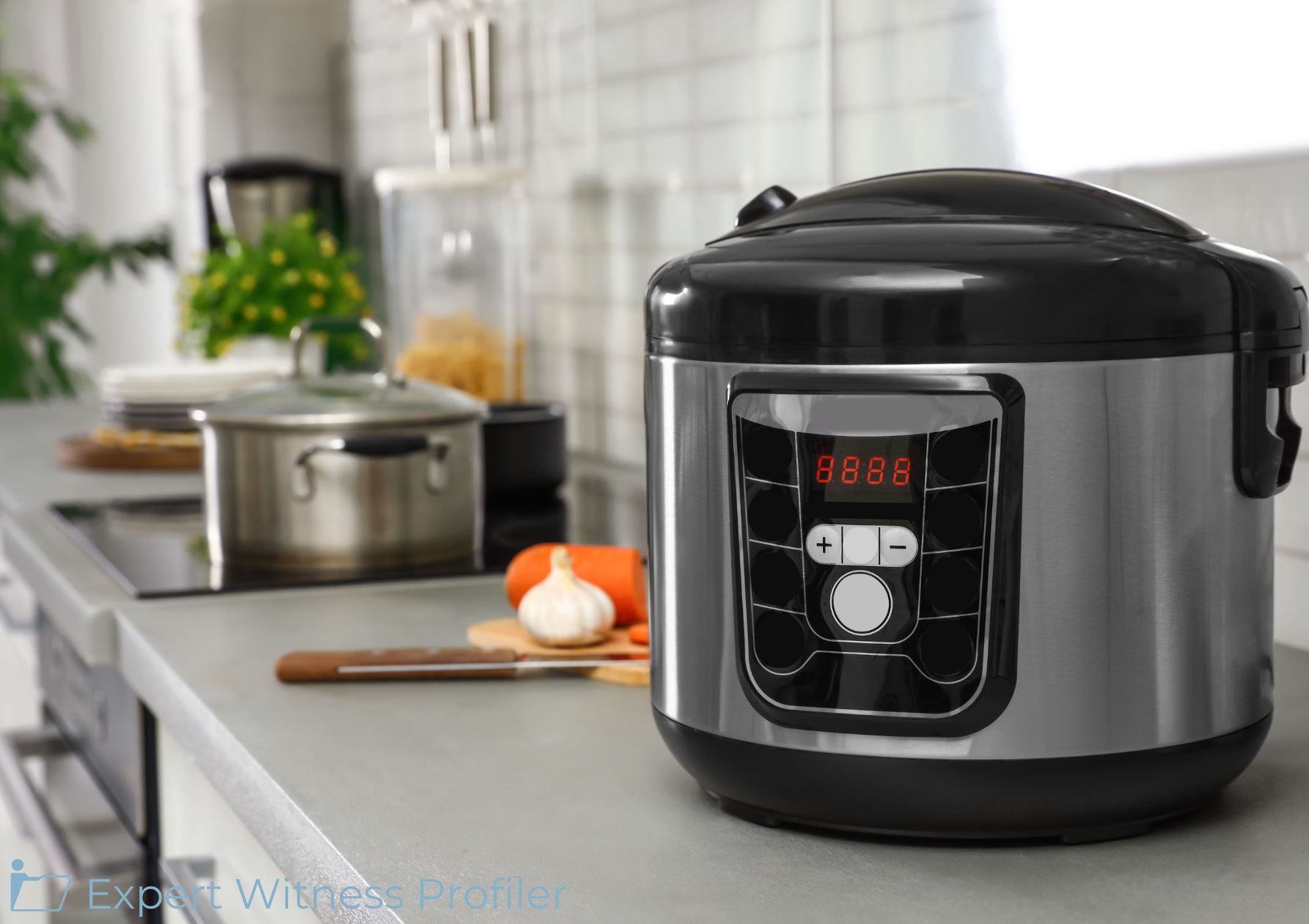
    This action arises from an explosion and resulting injuries Dawn Clary incurred while using a Power Quick Pot model Y6D-36 pressure cooker (the “pressure cooker”), marketed and distributed by Defendant Tristar Products, Inc. (“Tristar”).

    Clary brought this action against Tristar for her injuries from the explosion, alleging defective design, negligence, breach of express warranty, breach of implied warranty of merchantability, and failure to warn.

    Also, Clary filed a motion to exclude Tristar’s expert witness, Robert S. Giachetti’s “opinions as to the placement of Plaintiff’s arms at the time of the explosion.”
    Mechanical Engineering Expert Witness

    Robert Salvatore Giachetti is a licensed professional engineer who holds a Ph.D., M.S. and B.S. in Mechanical Engineering. He has participated in numerous joint examinations of pressure cookers and performed independent research on the trajectory of expulsed contents from a pressurized pressure cooker and its potential for scald injuries, which was published in the Journal of Burns.

    Get the full story on challenges to Robert Giachetti’s expert opinions and testimony with an in-depth Challenge Study.

    Discussion by the Court

    Based on his analysis and the materials provided to him, Giachetti opined at his deposition that Clary “should have substantial burns on both forearms, which are not recorded in the medical records” if Clary had her hands on the lid as she claims.

    However, Clary asserted that Giachetti’s expertise as a biomechanical engineer and his methodology did not enable him to render a reliable opinion on burn injuries or a derivative opinion on the placement of Clary’s hands based on her burn injuries.

    The issue before the Court was not whether Giachetti is qualified to testify as an expert generally, but whether his proffered opinion on Clary’s hand placement is within his expertise.

    First, Clary contended that Giachetti relied on inconsistent evidence to develop his opinion because the photograph of Clary’s injuries “clearly demonstrates” Clary had burns on her forearms. Second, Clary contended that Giachetti failed to adequately consider or test the effect of Clary’s clothing at the time of the incident on the severity of her burns. Finally, Clary contended that the Giachetti conducted did not account for the trajectory of the lid and the pressure cooker’s contents when the user had her hands on the lid, like Clary has repeatedly testified.

    Analysis

    The Court agreed that Giachetti was qualified to testify as to the trajectory of the pressure cooker’s expulsed contents based on burn placement. His analysis based on burn placement is based on sufficiently reliable methodology. As Giachetti outlined, his analysis was premised on two scientific facts (1) hot fluids burn skin, and (2) fluids cannot permeate the solid walls of a pressure cooker. Based on his scientific study, which was peer-reviewed, Giachetti determined the trajectory of the expulsed fluids would have contacted Clary’s hands had they been on the lid at the time of the explosion. Because Clary’s shirt was not protective of other areas of skin, whether the shirt was long-sleeved or short-sleeved was irrelevant to Giachetti’s analysis.

    Giachetti premised his opinion on the placement of Clary’s hands during the incident on the location of “severe burns” on her body.

    As a result, the Court found that Defendant has shown that it is more likely than not that Giachetti’s expert knowledge will help the jury understand the evidence and help them determine how this accident happened.

    However, the Court is not satisfied that Giachetti’s expertise in biomechanical engineering enables him to make any burn diagnoses additional to those made by the medical professionals at University of Nebraska Medical Center, even if to diagnose the burns to Clary’s forearms as minor. In sum, Giachetti’s background and experience does not indicate that he has the qualifications or experience to diagnose burns.

    Held

    The Court granted in part and denied in part the Plaintiff’s motion to exclude the testimony of Robert Giachetti, Ph.D.

    Key Takeaway:

    Any testimony about Giachetti’s diagnosis of Clary’s injuries was excluded because Giachetti’s background and experience did not indicate that he had the qualifications or experience to diagnose burns.

    Case Details:

    Case Caption: Clary V. Tristar Products, Inc.
    Docket Number: 4:22cv3230
    Court Name: United States District Court, Nebraska
    Order Date: November 05, 2025
  • Accident Reconstruction Expert’s Testimony About the Lid Locking Mechanism Admitted

    Accident Reconstruction Expert’s Testimony About the Lid Locking Mechanism Admitted

    This is a product liability case involving a Breville BPR600XL pressure cooker (the “Pressure Cooker”). Plaintiff, Hannah Frazier, claimed that suffered permanent injuries to her abdomen when the Pressure Cooker exploded, spraying super-heated liquid and steam across her body.

    The Plaintiff retained Jeffrey D. Hyatt of Specialized Testing & Forensic Laboratory to inspect and test the Pressure Cooker and provide an expert report (“Hyatt Report” or “Report”). Hyatt inspected and tested the Pressure Cooker using the UL (for “Underwriters Laboratory”) 136 “Standard for Pressure Cookers.” The Defendant, Breville USA, Inc., filed a motion to exclude Hyatt’s testimony under Rule 702 and Daubert.

    Accident Reconstruction Expert Witness

    Jeffrey D. Hyatt specializes in conducting mechanical component and system testing engineering, mechanical system failure analysis, identification of materials failure mechanisms and scientific accident reconstruction.

    Want to know more about the challenges Jeffrey Hyatt has faced? Get the full details with our Challenge Study report

    Discussion by the Court

    Breville did not challenge Hyatt’s qualifications as an expert; instead, it challenged the reliability of his principles and methodology.

    UL 136

    Breville contended that Hyatt’s testimony must be excluded in its entirety because Hyatt failed to establish that UL 136 applies or should apply to electrical pressure cookers, as opposed to stovetop pressure cookers.

    However, the Court held that Hyatt’s testimony is sufficient to create, at a minimum, a question of fact as to whether it is appropriate to apply UL 136 standards to electric pressure cookers.

    The Prescribed Testing Methodology

    Breville next argued that, even assuming UL 136 applies, Hyatt did not utilize the prescribed testing methodology set out in UL 136. Hyatt, however, acknowledged as much during his deposition and explained why he intentionally chose not to follow precisely some of the procedures recommended in UL 136. It is clear that this was no oversight on his part.

    Torque vs. Pounds Force

    Breville contended that, “even using the wrong standard and applying that standard’s principles and methodology incorrectly, Hyatt demonstrated that the Pressure Cooker required more force to open than can be exerted by an average male or female.” According to Breville’s expert, the 26.3 pounds of force measured by Hyatt is equivalent to 131.5 “inch-pounds of torque, which is well in excess of what an average [person] has been observed to exert.” However, UL 136 prescribed the method for testing the force necessary to open a pressurized lid, and it speaks in terms of pounds of force, not torque.

    The Measurement of the Locking Pin

    Breville took issue with Hyatt’s purported failure to measure the lid locking pin while it was under pressure. Breville also contended that “Hyatt does not provide any support for his claim that Breville intended to use all .291 [inches] of the lid locking pin while under pressure” or “include any facts or data to support his conclusion that the Pressure Cooker was designed to use the entire .291 [inches] of the lid locking pin.”

    Hyatt, however, explained that he made that assumption because he was not in possession of actual design documents from Breville to show what its intended design was, and he reserved the right to change his opinion if documents produced by Breville showed that, in fact, the manufacturer intended for the compressed pin to extend only .168 inches. In that event, Hyatt would modify his opinion to state that the compressed length of the locking pin was a design defect rather than a manufacturing defect that affected only the plaintiff’s Pressure Cooker.

    Hyatt’s opinion, in any event, is that the length of the pin in the case of this particular pot was insufficient to prevent it from opening under pressure. The Court held that Breville’s objections did not make his opinion unreliable or inadmissible.

    The Reliability of the Data in Figure 13

    Breville pointed out an error on a data chart in Hyatt’s Report purporting to show that the internal pressure of the Pressure Cooker was negative for the majority of the test. It asserted that Hyatt “fails to account for any condition that would make the internal pressure of the cooker less than zero for the majority of the test,” thus making the “data he offers in the chart . . . unreliable and insufficient.” As set forth above, Hyatt did explain this discrepancy in his deposition and accounted for it. It appeared that the only difference this error would have made would be to shift the maximum internal pressure of the Pressure Cooker by .5 psig, but it did not appear to have had any effect on Hyatt’s other calculations.

    Although this error might detract from Hyatt’s credibility before the jury, the Court held that it does not render his opinions unreliable or inadmissible.

    Breville’s Intentions

    Finally, Breville took issue with Hyatt’s finding that Breville intended for the Pressure Cooker to “meet the automatic locking requirements of UL 136” on the basis that this finding is not supported by sufficient evidence, given that the Pressure Cooker itself states that it was intended to comply with US 1026 and UL 1083.

    Hyatt made it clear in his deposition that UL 136 is the locking mechanism standard and that the “industry requires” any pressure cooker lid to remain locked while the contents are under sufficient pressure that liquid could be ejected if it were opened.

    The fact that the Pressure Cooker here has a locking mechanism that engaged below 0.25 psig of pressure indicated to him that Breville intended to comply with industry safety standards, irrespective of whether it identified UL 136 on the Pressure Cooker’s label. In other words, according to Hyatt, the design of Breville’s locking mechanism itself demonstrated Breville’s intent that its pressure cookers be safe and in compliance with industry standard.

    Whether Hyatt’s Testimony Will Assist the Jury

    Breville asserted that, for all of the reasons addressed above, Hyatt’s testimony would not assist the jury in understanding the evidence or determining a fact at issue in this case. The Court finds, as set forth above, that Breville’s arguments are more properly directed to the weight to be accorded Hyatt’s testimony by the jury rather than to its admissibility.

    Breville contended that Hyatt’s hypothesis—that the lid opened without resistance—contradicted his finding that it took 26.3 pounds of force to open while under pressure and that Hyatt “fails to explain how his conclusion that the Pressure Cooker required 26.3 pounds of force to open while under pressure has any bearing on whether a defect caused Plaintiff to be able to open the Pressure Cooker lid ‘easily’ and ‘with no resistance’ as she has testified to.

    But Hyatt addressed this purported inconsistency in his deposition as well. He testified that consumers whose pressure cookers he has tested frequently describe the lid as opening “with “no resistance” or as being “easy to open,” and he did not understand Frazier to mean literally that the lid had no resistance when she opened it.

    Held

    The Court denied Breville’s motion to exclude the testimony of Jeffrey D. Hyatt.

    Key Takeaway:

    Hyatt’s opinions are based on sufficient facts and data, are the product of reliable principles and methods, and reflect a reliable application of the principles and methods to the facts of this case.

    The Court denied Breville’s motion, insofar as it sought the exclusion of Hyatt’s testimony.

    Case Details:

    Case Caption: Frazier V. Breville USA, Inc.
    Docket Number: 3:23cv563
    Court Name: United States District Court, Tennessee Middle
    Order Date: July 24, 2025
  • Mechanical Engineering Expert’s Opinion About the Clogged Float Valve Admitted

    Mechanical Engineering Expert’s Opinion About the Clogged Float Valve Admitted

    This is a product liability case involving Walmart’s sale of a pressure cooker that Plaintiff Vanessa Loftis claims injured her when the lid was able to be removed while the pressure cooker was—unbeknownst to her—still pressurized.

    During the depressurization process, pressure cookers release steam; according to Loftis, the steam on that night “lasted forever,” around thirty to forty-five minutes. Loftis testified that she “kept checking on it, and then, when [the steam] finally did stop, that’s when [she] opened it and it kind of blew up.”

    The contents of the cooker were ejected onto Loftis, causing burns to approximately 12% of her body, mostly on her abdomen, that later required debridement.

    Walmart filed a motion to exclude Loftis’ expert, Dr. David Rondinone, arguing that his opinions are speculative, unreliable, and not tied to any applicable methodology.

    Walmart appeared to make three specific challenges to Rondinone’s opinion: (1) that he proposed only “possible” causes of the incident with no basis in evidence; (2) that he did not physically test the subject cooker or an exemplar; and (3) that he did not rule out alternative causes.

    Mechanical Engineering Expert Witness

    David Rondinone holds an M.S. degree and a Ph.D. degree in Mechanical Engineering from the University of California, Berkeley, majoring in material behavior and design and minoring in structures and dynamics and electronic controls.

    He also holds a B.S. degree in Engineering Physics and a B.A. degree in Astrophysics from the University of California, Berkeley. From 1993 to the present, he has worked as a Mechanical Engineering Consultant, and is a principal of Berkeley Engineering And Research, Inc. (referred to herein as “BEAR”).

    He has worked for more than 30 years in the areas of failure analysis, design, and risk assessment of consumer and industrial equipment, including pressure cookers.

    Want to know more about the challenges David Rondinone has faced? Get the full details with our Challenge Study report. 

    Discussion by the Court

    Rondinone proposed three potential causes of the accident: (1) a float valve clog, resulting from an inadequately designed float valve, that caused the lid to remain unlocked while under pressure; (2) a boil-over event that was not properly warned against; or (3) a failure of the interlocking sliding mechanism.

    Possible Causes

    Walmart contended that Rondinone posits only “possible,” rather than “probable” causes of the accident and failed to ground these in facts.

    However, Rondinone identified a float valve clog as the “most likely scenario” and “would say to a degree of reasonable engineering certainty it’s more likely a clogged or insufficient float valve interlock event” caused Loftis’ injuries “than . . . a boil-over event.”

    Since Rondinone intended to testify that the incident was most likely caused by a clogged float valve, as supported by his expertise, prior testing of pressure cookers, examination of Instant Pots, and Loftis’ description of the incident, the Court refused to exclude his testimony on that basis.

    Physical Testing

    While Walmart conceded that it was not possible for Rondinone to test the subject pressure cooker in this case, as it was not available, it argued that his failure to conduct tests using an exemplar model is unjustified and rendered his testimony inadmissible.

    However, Rondinone explained that in order to help him gain a more precise determination on probability as to whether this was a float valve incident, he would have had to run “an extensive statistical study, probably hundreds of tests,” and he has not “know[n] anybody who ever has” done that.

    Further, he explained that it is “difficult to repeat” a clogged float valve, but his lab has “done tests for clogging on other models of pressure cooker” and shown that a user “can with a single use clog the vent,” which he reports “present[s] a risk of pressurization with the lid in an unlocked state.”

    However, the Court held that Rondinone’s opinion that the float valve was clogged is supported by Loftis’ description of the incident and his prior testing of pressure cookers, not “unfounded assumptions.”

    While Rondinone is “unable to recreate” the incident, the Court held that his opinion is “based on known facts and his expertise.”

    Alternatives

    Walmart challenged the admissibility of Rondinone’s opinion on the argument that he failed to rule out other possible causes.

    In this case, Rondinone did engage with alternative explanations, including a boil-over event, a failed sliding mechanism, or some other accident like a spill. He then applied his expertise in the mechanics of pressure cookers to the facts in this case to deduce that a float valve clog was the most likely mechanical scenario here.

    As for the possibility of a spill, he stated that “physically it’s probably possible,” but he would “have to disregard Loftis’ entire testimony, though, from start to finish for that to be true,” including “disbelieving her explanation of the removal of the lid and how the contents came out.”

    Rondinone refused to say with absolute certainty that a float valve clog occurred here, but he did conclude the most likely cause within a “degree of reasonable engineering certainty.”

    The Court held that Rondinone’s refusal to completely rule out other alternatives goes to the weight of his testimony, not its admissibility.

    Held

    The Court denied Walmart’s motion to exclude Dr. David Rondinone.

    Key Takeaway:

    Despite the fact that Rondinone did not test the subject pressure cooker or an exemplar model in this case, there is no single requirement for admissibility as long as the proffer indicates that the expert evidence is reliable and relevant.

    The Court held that Rondinone’s conclusions are based on his experience and expertise [in pressure cooker cases], general engineering principles, information from Loftis about the accident, examination of an exemplar cooker, its design and specifications, competitors’ cookers, and photos of the accident, including of the subject pressure cooker and Loftis’ burns.

    Case Details:

    Case Caption: Loftis V. Walmart, Inc.
    Docket Number: 5:23cv5228
    Court Name: United States District Court, Arkansas Western
    Order Date: June 02, 2025