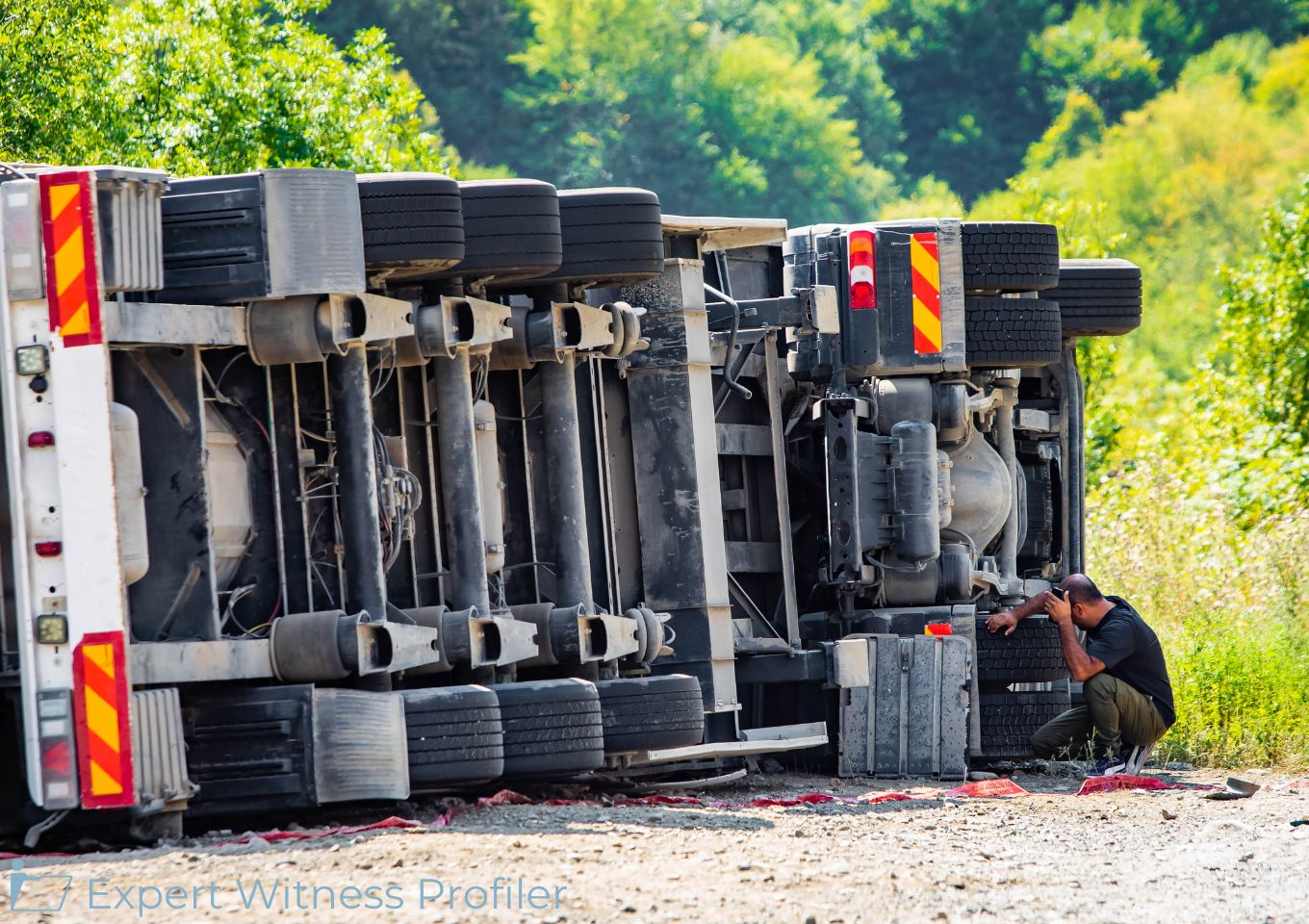
Plaintiff Andrew Christensen alleged that he was injured while working at Plaintiff Jessica Lawrence’s home, using an aluminum stepladder, Model W-2112-065, which was manufactured by Defendant Louisville Ladder, Inc. Plaintiff Lawrence had purchased the Ladder from Walmart, Inc.
Christensen asserted products liability claims against Louisville Ladder based on the alleged injury.
Louisville Ladder filed a motion to exclude the testimony of Plaintiff Christensen’s expert, Frank L. Burg.
Safety Engineering Expert Witness
Frank Lewis Burg is an expert in various domains, particularly general industry and construction safety and health, alongside expertise in ergonomics. His investigative experience spans injuries related to cranes, rigging, road construction accidents, falls, railroad incidents, electrical mishaps, machine guarding, gas and oil well incidents, hazardous chemicals, and cases involving human factors engineering and FELA (Federal Employees Liability Act). Beyond investigations, Burg conducts training seminars, OSHA-style audits, and offers expert testimony in his field of expertise.
Defendant argued, among other things, that Burg should be excluded because he is not qualified to render an opinion on a manufacturing defect. Defendant also argued that his opinions have insufficient factual foundation, are not founded in proper methodology, and only provide bottom-line conclusions without sufficient support. Finally, Defendant argued that his testimony should be excluded because he has disclosed a preliminary report only.
Burg, a registered professional safety engineer with Accident Prevention Corporation concluded his report by writing that Christensen’s injuries were “caused by a structural failure of the Louisville Ladder. There is no indication that Christensen did anything that would cause the catastrophic failure seen in the photographs.”
Burg characterized his report as preliminary, and at his deposition, he testified that his opinions were not final. He further admitted during his deposition that he added a statement to the report that he normally does not, reserving the right to have the Ladder examined further and potentially change his opinions because he “wrote [the] report with very limited information.” He also stated that should this case go to trial, he would want to have the Ladder tested and obtain testimony from a metallurgist or structural engineer.
Analysis
Burg is a qualified expert in safety practices and hazard prevention, but he is not a design expert or metallurgist. He lacked the education, training, and experience to offer an opinion that there was a construction defect in the Ladder that caused the accident.
Moreover, Burg did not visit the scene of the accident. He did not perform any testing or complete his own investigation. In fact, he did not even inspect the Ladder. Instead, he talked to Plaintiff Christensen and relied on materials provided to him. In other words, Burg’s opinions that the Ladder had a construction defect and the defect caused Plaintiff Christensen’s injuries are based on photographs and interviews
The Court found that in forming his opinions, Burg did not employ a proper methodology, and the opinions lacked sufficient support.
Held
The Court granted Defendant Louisville Ladder, Inc.’s motion to exclude the testimony of Frank Burg.
Key Takeaway:
Burg did not apply a methodology, and he failed to provide any explanation of the analysis he used in forming his opinions that the Ladder had a construction defect, and the defect caused the Ladder to collapse, other than to state that there is no other possible cause.
In short, there is nothing within his report that relies upon any specific method or scientific principles that would be otherwise unavailable to the trier of fact. Burg is being offered to give the opinions that the damage to the Ladder was not merely from a fall, but rather that the Ladder collapsed, and the collapse was caused by a construction defect.
Case Details:
Case Caption:
Christensen Et Al V. Louisville Ladder, Inc. Et Al
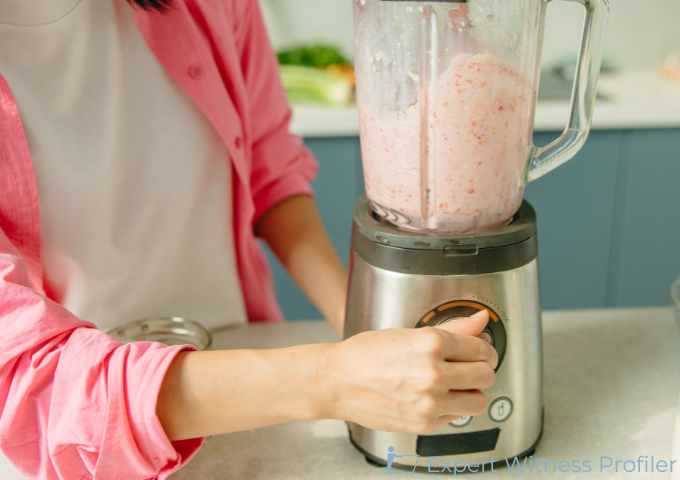
Plaintiff Lori Lynne Hoff brought a product liability claim against Defendants Capital Brands, LLC and NutriBullet, LLC under the New Jersey Products Liability Act, alleging a design defect in the NutriBullet 600 blender.
On February 17, 2020, Hoff used the blender to make celery juice, combining water and chopped celery below the max fill line. After sealing and inserting the blender cup into the power base, the unit began operating. As Hoff reached out to stop the machine around the ten-second mark, the blender exploded. The contents splashed onto her face and eyes, and she suffered a cut to her pinky finger, dizziness, and a temporary loss of vision. She later received emergency room treatment.
Hoff’s expert, Derek King, inspected the blender and concluded that over pressurization caused the cup to separate from the base. Defendants later filed a motion to exclude Hoff’s expert.
Mechanical Engineering Expert Witness
Derek A. King holds an M.S. degree in Electrical Engineering from Ohio University, and a B.S. degree in Mechanical Engineering from the University of California, Berkeley. He is also a registered professional engineer in the State of California. From 2009 to the present, he has worked as an engineer for Berkeley Engineering and Research in the areas of failure analysis, design, and risk assessment of consumer and industrial equipment, including consumer blenders.
The Court addressed Defendants’ motion to exclude Plaintiff’s expert, Derek King, under Daubert and Federal Rule of Evidence 702. Defendants argued that King’s opinions were both irrelevant and unreliable. Because Plaintiff’s design defect claim hinged on King’s expert testimony, Defendants also moved for summary judgment, asserting that without admissible expert evidence, Plaintiff could not prove causation or a feasible alternative design.
Plaintiff’s Claim Required a Reasonable Alternative Design
Under the New Jersey Products Liability Act (NJPLA), a design defect claim requires the plaintiff to show that a practical and safer alternative design existed. Plaintiffs often rely on expert testimony to establish this point. King proposed two such alternatives: an automatic timer and a pressure relief mechanism. The Court reviewed whether these opinions met the requirements of relevance and reliability under Daubert.
Automatic Timer Deemed Irrelevant
King suggested that a one-minute automatic timer could have mitigated pressure buildup in cases involving excessive run time. However, Plaintiff testified that she ran the blender for fewer than ten seconds, far below the threshold King’s design targeted. King himself acknowledged that a timer would not have been necessary in Hoff’s situation. The Court therefore found that King’s timer proposal did not “fit” the facts of the case and would not assist the jury in understanding what happened. As such, the Court ruled the timer design irrelevant.
Pressure Relief Design Found Unreliable and Unhelpful
King also proposed that a pressure relief mechanism, such as a blowout plug or pressure valve, could have prevented the incident. He based this design on general engineering knowledge and prior use of similar mechanisms in pressure cookers. However, King did not test this design in a blender or with carbonated ingredients, which were suspected to be the cause of the overpressurization. Defendants argued, and the Court agreed, that the lack of testing made the methodology weak and speculative.
Further, the Court emphasized that none of King’s identified causes of overpressurization, heat, carbonation, or prolonged blending, were clearly present in the incident. His opinion asked the jury to consider hypotheticals and possibilities beyond the scope of the actual case. The Court concluded that this opinion would confuse rather than clarify the central issues and thus failed the relevancy (fit) requirement under Daubert.
Held
The Court granted the Defendant’s motion to exclude the testimony of Derek King.
Key Takeaway:
Expert testimony must be both reliable and directly relevant to the facts of the case. In Hoff v. Capital Brands, the Court excluded Plaintiff’s expert, Derek King, finding that his proposed alternative designs, an automatic timer and a pressure relief mechanism, either didn’t apply to the incident or lacked testing to support their feasibility. Without admissible expert evidence, Plaintiff could not proceed with her design defect claim under the New Jersey Products Liability Act.
On August 23, 2021, Plaintiff Virginia Huss used a Ninja BL660 blender, designed and manufactured by Defendant SharkNinja Operating LLC, to blend a mixture of chocolate chips that she had microwaved for 60 to 90 seconds. After blending, Huss attempted to twist open the blender lid and the lid shot off the blender cup, causing scalding hot fudge to explode and burn her face, chest, arms, and hands. As a result, Huss initiated this product liability against SharkNinja.
In her amended complaint, Huss focused on the ‘cool to explosively hot’ theory, which posits that the blender’s fast-moving blade heats cool or room temperature food which creates friction and, ultimately, causes the blender contents to explode when the user opens the blender cup.
Huss Filed the Following Allegationsin Support of her Cool to Explosively Hot Theory:
a. The blender is defectively designed because “the extremely fast-moving blade of the blenders heat the contents of the sealed bullet-shaped canister, which can (and does) unexpectedly explode when being used in its normal and intended manner by consumers. In a matter of a short amount of time, the fast-spinning blades can unexpectedly heat up its contents, such that if the blender explodes, the user is at risk of severe burns or lacerations and injuries requiring medication attention.”
b. “During the normal, as-directed use of the blender, a consumer puts cool or room temperature food into the plastic ‘bullet’ cup. Once the cup is secured to the blade assembly and placed onto the unit’s base, the user is able to run the blender by pressing down on the cup. The blades then rotate, creating friction as they cut and chop the cup’s contents, which in turn causes the contents to heat up.”
c. “As the temperature rises inside the cup, the pressure from the frictional energy also rises. The temperature can get so hot that the pressure inside the cup forces the cup to separate from the blade while the blender is still running. This can cause the hot contents of the cup to explosively project outward without warning, landing on anyone and anything nearby.”
d. “Even if the cup does not separate from the blender while in use, the user is still at risk. If the contents of the cup are hot and under pressure when the cup is opened, the hot contents can again be explosively ejected onto the user, causing se[ve]re lacerations from a detached blade.”
Derek King
King set forth three other design defect theories in his expert report:
(i) that the threaded connection between the blender cup and the blade assembly is “susceptible to slippage and so it may separate…before venting can occur” (the “Thread Slippage Theory”)
(ii) that “the threaded connection was under load (from internal pressure) and also at an elevated temperature” and “it is likely that one or both materials experienced some softening due to temperature which contributed to the threads failing to keep the blade assembly fastened to the cup long enough for the pressure to vent” (the “Softening Materials Theory”)
(iii) that Huss had observed that the blade assembly “kind of untwists itself the rest of the way,” which King found was “consistent with the force from internal pressure being transferred into a rotational motion due to the slope of the threaded connection between the cup and blade assembly” (the “Spontaneous Untwisting Theory”)
In response, SharkNinja filed a motion to exclude the expert testimony of Derek King.
Mechanical Engineering Expert Witness
Derek A. King has a Bachelor of Science degree in Mechanical Engineering from the University of California, Berkeley and a Master of Science in Electrical Engineering from Ohio University. He has worked as an engineer for Berkely Engineering and Research since 2009 “in the areas of failure analysis, design, and risk assessment of consumer and industrial equipment, including industrial pressure vessels and consumer propane tanks, pressure cookers and blenders.”
King was tasked with providing his opinions regarding the following topics:
(1) “Whether or not the blender would enable and allow the incident to occur”; and
(2) “What design aspects of the subject blender enable and/or fail to mitigate the risks of pressurization and burn injury.”
By “applying well-established engineering principles” and performing “exemplar testing,” King concluded that “a sealed blender cup will heat and pressurize due to the blending process, thus establishing the possibility that the subject blender could create the hazard and risk consistent with Huss’ description.”
As to his “exemplar testing,” King provided a spreadsheet which reflected the following headings: (1) T(s); (2) External °F; (3) Internal °F; (4) Pressure PSI; (5) Note; (6) T-start; and (7) Recipe. Oddly, the Court noted that King provided no explanation whatsoever in his Report regarding the meaning of the headings, exactly what the variables of his tests were, and what the outcomes of his tests were. SharkNinja described King’s test results as follows:
• “The only testing of the incident recipe that King conducted involved blending a chocolate-chip mixture heated to 121°F. But this testing did not result in any pressurized ejection of hot content.”
• “King blended incident recipe ingredients that were preheated to 121°F for one minute and 49 seconds in a BL660 single-serve cup, and this testing did not demonstrate any explosive projection of the cup’s contents.”
It should be noted that Huss did not dispute SharkNinja’s characterizations of King’s testing and did not otherwise discuss the testing other than to assert that King considered Huss’ testimony that the chocolate chips were “lukewarm” temperature and “applied it to his analysis.”
Analysis
Absent an explanation from King or Huss — or disagreement regarding SharkNinja’s characterization — of the meaning of the data contained on King’s testing spreadsheet or how the testing was carried out in general and what results it yielded, the Court proceeded to analyze King’s opinion with the following premise in mind: King’s testing involved blending ingredients that had previously been heated to 121°F for one minute and 49 seconds, and that testing did not result in an explosive projection of the blender’s contents.
1. Whether King Is Qualified
SharkNinja did not challenge King’s qualifications as to his design defect opinions. However, the Court found, in accordance with its gate-keeping obligation and the standard set forth in Rule 702, that King’s undergraduate and graduate degrees in mechanical and electrical engineering along with his work experience since 2009 “in the areas of failure analysis, design, and risk assessment of consumer and industrial equipment, including blenders” is sufficient to qualify him to testify regarding design defects in blenders.
2. Whether King’s Methodology Is Scientifically Reliable
The Court also considered whether Huss had sustained her burden of showing that that it is more likely than not that King’s methodology is scientifically reliable and that his testimony will aid the trier of fact.
a. Cool to Explosively Hot Theory
SharkNinja argued that King did not have a reliable foundation to provide expert testimony regarding the cool to explosively hot theory because he did not conduct any testing with cool or room temperature ingredients. It asserted that King’s test involved blending a mixture of chocolate chips, sweetened condensed milk, and vanilla extract preheated to 121°F for one minute and 49 seconds in a BL660 single-serve cup blender and that even though he started with preheated ingredients (versus cool or room temperate ingredients) and blended the ingredients longer than Huss did (one minute and 49 seconds versus “probably less than a minute”), “his testing did not demonstrate any explosive projection of the cup’s contents.”
Accordingly, it argued, King “should be precluded from opining that blending cool or room temperature ingredients for any length of time can result in ‘contents being forcefully expelled from the blending cup under pressure and at high temperature.’”
SharkNinja’s main critique of King’s methodology for his opinions regarding the cool to explosively hot theory was that King was not able to re-produce an explosive projection when he blended chocolate chips, sweetened condensed milk, and vanilla extract for a longer period of time than Huss, and that the ingredients he blended were preheated to 121°F rather than being cool or at room temperature as necessary to test the cool to explosively hot theory.
Court’s Decision
The Court acknowledged that “an expert need not wear a lab coat nor cite peer-reviewed studies to reliably lend his expertise to the trier of fact—experience is an equally valuable teacher.”
But, at bottom, King still had to explain the methodology that he used and how his experience led him to his conclusions. He did not do so and, moreover, the testing he did perform used different conditions than the cool to explosively hot theory, making his methodology regarding his opinion that the blender had a design defect based on that theory unreliable.
b. Thread Slippage Theory
While SharkNinja agreed with King’s premise that ‘blending creates friction, friction causes heat, and, given enough time, a marathon blending session can eventually generate sufficient heat and pressure within a sealed cup to cause the blended contents to eject out energetically when the cup is opened,’ it argued, however, that King’s opinions that this can take place after one minute of blending is not supported by testimony or “any other reliable foundation.”
Specifically, SharkNinja noted that King blended preheated ingredients for one minute and 49 seconds and “did not identify any thread slippage or pressurized ejection of contents” from the blender cup, and that the thread slippage theory is speculation and unreliable.
SharkNinja asserted that there is an “analytical gap” in King’s analysis because “whether the blade assembly can ‘shift’ does not address whether the threads between the blade assembly and the BL660 cup can, in fact, ‘slip.’” It noted that King did not identify any testing to support his finding and that Huss does not argue that this theory has been subjected to peer review or publication, is generally accepted in the engineering community, or has a known or potential error rate.
Court’s Decision
The Court rejected Huss’ argument that SharkNinja can simply cross-examine King to address any shortcomings in his methodology. This notion is contrary to the 2023 amendment to Rule 702, which requires the Court to determine whether an expert’s methodology is reliable rather than leaving that determination to the jury.
As to SharkNinja’s issues with King’s methodology, King opined that “a potential opportunity for venting before sudden separation is present in the intermittent thread design, however, geometric analysis shows that the threaded connection is susceptible to slippage and so it may separate…before venting can occur.” He described the blender’s threading in detail, but did not set forth any methodology for how he reached his conclusion that thread slippage could have occurred after less than one minute of blending and caused the contents of Huss’ blender to explode. The Court held that King’s methodology regarding his opinion on the thread slippage theory is non-existent and, therefore, unreliable.
c. Softening Materials Theory
SharkNinja argued that King “did not attempt to substantiate his softening materials theory with any testing or other reliable foundation,” instead simply noting the deflection temperature of the materials that make up the blender’s construction and stating that it is likely those materials softened during use.
SharkNinja noted that King examined the blender but “did not state that he observed any evidence of softening in either the blade assembly or the single-serve cup,” that his testing “did not demonstrate any evidence of either component softening,” and that he did not cite any support for his theory in scientific literature or otherwise.
Court’s Decision
The Court rejected Huss’ contention that SharkNinja can simply address shortcomings in King’s methodology through cross-examination and proceeded to consider the issues that SharkNinja raised.
While King stated in his report that “An overview of the material properties indicates that cup material has a deflection temperature of approximately 200 °F, while the blade assembly deflection temperature is approximately 100 to 300 °F. Huss’ description of a pressurized release and sustaining burn injuries indicates that the threaded connection was under load (from internal pressure) and also at an elevated temperature. It is likely that one or both materials experienced some softening due to temperature which contributed to the threads failing to keep the blade assembly fastened to the cup long enough for the pressure to vent,” he did not indicate that he tested the blender, observed softening of the components’ materials, or employed any other methodology to reach his conclusion.
He merely stated that ‘it is likely’ the materials ‘experienced some softening’ based on their deflection temperatures, which ‘contributed to the threads failing to keep the blade assembly fastened.’ The Court held that his speculative conclusion is not supported by any methodology. In other words, King’s methodology relating to the softening materials theory is not reliable.
d. Spontaneous Untwisting Theory
SharkNinja argued that King simply states that Huss’ observation that the blade assembly untwists itself is consistent with the use of the blender, but “offers no reliable foundation for this opinion,” “does not attempt to substantiate his opinion by citing to any scientific literature (or anything at all other than Plaintiff’s deposition testimony),” and “did not disclose any evidence of the BL660 blade assembly untwisting itself based on the slope of the threaded connection during his own testing of the incident recipe.”
Basically, SharkNinja contended that King “does not identify any testing that would support his spontaneous untwisting theory,” and noted that his testing with preheated ingredients did not result in the blender cup spontaneously untwisting from the blade assembly.
King opined that ‘Huss’ observation that the blade assembly “kind of untwists itself the rest of the way” is consistent with the force from internal pressure being transferred into rotational motion due to the slope of the threaded connection between the cup and blade assembly.’
He did not state that he tested this theory and observed spontaneous untwisting or set forth any other methodology that he used in reaching this conclusion. He simply baldly stated that Huss’ observation is consistent with the use of the blender and the slope of the threaded connection. The Court held that King’s methodology regarding the spontaneous untwisting theory is speculative and not reliable.
The Court found that Huss has not sustained her burden of showing by a preponderance of the evidence that King’s methodology as it relates to the cool to explosively hot theory, the thread slippage theory, the softening materials theory, or the spontaneous untwisting theory is reliable.
3.Whether King’s Testimony Would Aid the Trier of Fact
SharkNinja argued that King’s opinions would not aid the trier of fact because they were speculative in nature and not based on a reliable methodology.
The Court held that King’s opinions are not grounded in a reliable methodology — they are not based on any physical testing and King does not set forth any other methodology to explain how he reached his conclusions. The speculative nature of his opinions relating to all four design defect theories will not aid the trier of fact. The Court found that Huss has not shown that it is more likely than not that King’s testimony will aid the trier of fact.
In sum, Huss has not sustained her burden of showing by a preponderance of the evidence that King’s methodology is reliable and that his opinions would aid the trier of fact.
Held
The Court granted the Defendant’s motion to exclude the testimony of Plaintiff’s expert Derek King.
Key Takeaway:
Despite King’s qualifications in mechanical and electrical engineering and his experience in failure analysis and design, the Court held that he failed to demonstrate a scientific basis for his conclusions regarding the alleged design defects of the Ninja BL660 blender. His testing did not replicate the conditions claimed by the Plaintiff, and he did not substantiate his theories—such as the cool to explosively hot theory, thread slippage theory, softening materials theory, and spontaneous untwisting theory—with physical testing, mathematical models, or citations to scientific literature. The Court determined that King’s unsupported conclusions would not aid the jury in evaluating the alleged design defects, rendering his testimony inadmissible.
Case Details:
Case Caption:
Virginia Iris Huss vs. Sharkninja Operating LLC
Docket Number:
1:23cv1435
Court:
United States District Court for the Southern District of Indiana, Indianapolis Division
On October 24, 2019, William Harrison Sims (Plaintiff) was driving his 2004 BMW 330Ci (the “Vehicle”) in Florida when another vehicle unexpectedly turned left in front of him, causing a minor accident. As a result of the collision, the Vehicle’s front driver-side airbag was signaled to deploy. However, the airbag inflator unexpectedly ruptured and shot metal shrapnel into Plaintiff’s face and body, leading to severe, permanent, and life-altering injuries.
Defendants, BMW of North America (“BMW NA”) and Bayerische Motoren Werke AG (“BMW AG”), procured and installed the airbag inflator during the process of designing, manufacturing, assembly, and producing the vehicle. Plaintiff filed a lawsuit against both Defendants, alleging strict liability and negligence for procuring and installing the defective airbag.
Defendants moved to exclude testimony from Plaintiff’s expert, Perry Ponder (“Ponder”), and two demonstrative exhibits. Defendants argued that Ponder changed his opinion regarding the lane of travel occupied by the alleged at-fault driver, non-party Tameca Harris-Jackson (“Harris-Jackson”). Ponder testified at deposition that Harris-Jackson turned from one of the through lanes instead of the left lane before colliding with Plaintiff’s vehicle. Defendants also identified two demonstrative exhibits produced before Ponder’s deposition, which depicted the placement the alleged at-fault vehicle and Plaintiff’s vehicles leading up to the collision.
Accident Reconstruction Expert Witness
Perry L. Ponder, P.E., holds a Bachelor of Science in mechanical engineering from Florida State University and is a licensed professional engineer in the states of Florida and Illinois. Ponder specializes in accident reconstruction, failure analysis, and designing semi-trailers, truck components, underride crash protection, and patented adjustable structures. He has significant experience reconstructing accidents of various types: trucks, cars, pedestrian and cycles.
A. Plaintiff Failed to Meet His Fed. R. Civ. P. 26(a) Expert Disclosure Obligations
Defendants argued that Ponder, Plaintiff’s accident reconstruction expert violated Rule 26(a)(2) because he “renounced his former opinion that the Hyundai initiated its turn from the left lane of Good Homes Road while the deposition was underway.” Instead, he testified that the Hyundai turned from one of the through lanes of Good Homes Road and not from the left lane. Defendants contended that this new opinion was disclosed for the first time at the deposition.
Plaintiff countered that Defendants misunderstood or misrepresented the opinions expressed in Ponder’s report as compared to his deposition testimony. The Plaintiff emphasized that Ponder’s report did not specify which lane Harris-Jackson was traveling in when she initiated her left turn, only stating that she started her left turn from the northbound lanes of Good Homes Road. The Court agreed with Plaintiff, stating that Ponder did not offer an opinion in his report that Harris-Jackson was traveling in the left-hand lane when she initiated the turn and collided with Plaintiff
Moreover, Defendants failed to cite Ponder’s report to support their claim that he originally opined Harris-Jackson was traveling in the left-hand lane. Instead, Defendants cited the Crash Report created by the Orlando Police Department, a diagram of the collision prepared by a Trooper, and Harris-Jackson’s deposition. While Ponder reviewed these materials, the Court held that he did not adopt Harris-Jackson’s testimony or the police officer’s reconstruction as his opinion.
i.Reliability of Harris-Jackson’s Testimony
While Ponder cited Harris-Jackson’s testimony, in which she claims she stopped in the left lane and proceeded slowly after the traffic signal changed, he found Harris-Jackson’s testimony unreliable. Accordingly, Ponder did not offer a new opinion at the deposition. Even if he had, the Court held that Defendants had ample opportunity to cross-examine Ponder on the analysis employed to reach this opinion.
Furthermore, Ponder’s relative speed calculation for each vehicle was partially offered as a rebuttal to Defendants’ expert. At his deposition, Ponder conceded that Harris-Jackson could have turned from the left lane into Plaintiff’s path. However, he opined that “her orientation is more consistent with a turn that’s a bit more mature, so to speak, getting herself westward to take the 408 west.” He concluded that if Harris-Jackson had made the turn from the left-hand lane, “you’d expect more of a nose-to-nose kind of orientation as opposed to a square orientation (indicating) that we had in this impact.”
Regardless, the Court held that Ponder did not change his opinion at deposition, which is why the Defendants suffered no surprise or prejudice.
B. Demonstrative Exhibits
Defendants also challenged two demonstrative exhibits that displayed Good Homes Road intersecting with SR 408. Ponder’s report included diagrams prepared by law enforcement, as well as drone-generated top-down images of the crash scene. The Court held that the two demonstrative aids offered at the deposition are neither a surprise nor are they prejudicial because they are cumulative. Expert witnesses routinely create demonstrative exhibits on whiteboards or butcher paper at trial to drive home a point. To the extent that the demonstrative aids were untimely—which the Court does not find—their disclosure is harmless.
C. Ponder’s Testimony is Unreliable and Unhelpful
Defendants challenged Ponder’s accident reconstruction analysis, claiming it was unreliable and unhelpful. They argued that he failed to conduct independent testing, inspect or obtain an exemplar vehicle, drive an exemplar vehicle for work in the case, drive the intersection of the road in a Hyundai Sonata under the conditions to which he testified to or measure g-forces Harris-Jackson would have sustained had she turned from the through lane without stopping.
However, the Court held that the Defendants’ attack on Ponder’s analysis is boilerplate and unconvincing. They listed actions Ponder could have undertaken without explaining why he would need to take these steps. Ponder’s accident reconstruction analysis followed standard procedures, including a detailed crash scene examination, review of relevant documents as well as photographs of the 2010 Hyundai. It also considered the Crash Stiffness Coefficients for BMW vehicles and the deposition testimony. He also identified the final rest location of Plaintiff’s BMW and debris field and conducted a 3D scan of the subject BMW to quantify the damage.
Ponderthen applied the General Momentum Equations to discern that Plaintiff’s BMW was traveling about 29 mph at the moment of impact, while Harris-Jackson’s Hyundai was traveling about 24 mph, with a resulting delta V, or change in velocity of 23 mph and a principle direction of force of 30 degrees counterclockwise of its longitudinal axis for the BMW. Hefactored in the speed and weight of the BMW to opine that the momentum was inadequate to propel the vehicle beyond the south edge of the intersection. Ponder supports this opinion with photographic evidence.
Just because Ponder reached a conclusion that differs from a crash report prepared by a Trooper whose qualifications are unknown, the Court held that it not indicate the failure to employ “the same level of intellectual rigor that characterizes the practice of an expert accident reconstructionist.” The Court noted that Defendants did not articulate how examining or driving an exemplar vehicle would add to the analysis. It would not support the determination of the delta-V, PDOF, or relative speed of the subject vehicles. And while knowing the g-force experienced by Harris-Jackson would be interesting, the Court held that Defendants offered no support for their contention that the failure to calculate g-force undermines Ponder’s analysis.
The Court ruled that Ponder is a highly qualified expert whose analysis was reliable, well-supported, and helpful to the jury. His core opinions remained unchanged, and the two demonstrative exhibits did not prejudice Defendants.
Held
The Court denied Defendants’ motion to exclude the testimony of Perry Ponder, P.E.
Key Takeaway:
While the Court admitted Ponder’s testimony regarding his accident reconstruction analysis, including his calculations of the vehicles’ speeds, momentum, and impact angles, the Court did not accept Defendants’ argument that Ponder had violated Rule 26(a)(2) by changing his opinion during his deposition. The Court found no evidence that Ponder’s core opinion had changed and ruled that Defendants were not prejudiced by the introduction of the two demonstrative exhibits, as they were merely cumulative of the evidence that was already presented. Further, while Defendants challenged Ponder’s failure to conduct independent testing and measure g-forces, the Court found these objections unpersuasive, stating that Ponder’s methodology was consistent with standard practices in accident reconstruction. In conclusion, the Court affirmed that Ponder’s testimony was both reliable and helpful to the jury in understanding the technical aspects of the case.
Please refer to the blog previously published about this case:
Plaintiff, Ansur America Insurance Company, sued Defendants, James A. Borland and Quinn, Johnston, Henderson & Pretorious, Chtd., an experienced defense lawyer and his law firm, for alleged legal malpractice in handling a complex product liability case in St. Clair County, Illinois. Plaintiff alleged that Defendants failed to meet the standard of care in representing Plaintiff in a tripartite relationship, where Plaintiff insured a company that sold the underlying plaintiff a shower stool that broke, causing her to fall and dislodge hardware recently placed by a surgeon in her spine.
Defendant filed motions to excude the opinions of Plaintiff’s experts Falak Shah and Sari Montgomery.
Structural Engineering Expert Witness
Falak Shah, Ph.D., P.E., C.W.I., is a managing engineer in Exponent’s Mechanical Engineering Practice with experience assessing the performance, mechanical integrity, and fitness-for-service of structural and mechanical systems. His experience involves leading investigations of different structures, products, and mechanical systems in a broad variety of applications and a wide range of materials. He is a licensed professional engineer in the state of Illinois and is a certified welding inspector (C.W.I.), a certification from the American Welding Society (AWS). Shah has a Ph.D. and M.S. in civil engineering (with a specialization major in structural engineering) from the Georgia Institute of Technology and a B.S. in civil engineering from the University of Florida. He has completed advanced coursework in and has experience with the analysis and design of a variety of materials, including wood, metals, and composite materials. In addition to his degrees, licensure, and other certifications, he has a multidisciplinary certificate in the mechanical properties of materials.
Sari Montgomery received her B.A. at the University of Chicago and her J.D. at Loyola University Chicago. Since her graduation in 1994, she has worked as Litigation Counsel for the Illinois Attorney Registration and Disciplinary Commission (“ARDC”) and was ultimately promoted to Senior Litigation Counsel. In those roles, she performed hundreds of investigations and prosecuted over 50 disciplinary cases before the ARDC’s Hearing Board. She also trained ARDC counsel and staff.
Since 2010, Montgomery has been employed at Robinson, Steward, Montgomery & Doppke LLC, where she has represented attorneys in disciplinary investigations, hearings, and appeals before the ARDC and the Illinois Supreme Court, represented judges before the Illinois Judicial Inquiry Board and bar applicants in character and fitness matters. She has provided ethics advice and opinion letters to law firms, attorneys, government agencies and law-related businesses, and has served as an expert witness in legal malpractice and fee litigation. She has served as an adjunct professor teaching legal ethics and professional responsibility, has served on numerous committees and boards, and has authored numerous publications.
Shah was requested to “analyze the mechanical cause or causes of the failure” of the shower stool.
Defendants argued that Shah’s opinions are irrelevant and unreliable in that he provides only an outline of untested hypotheses in his June 14, 2023 report, such that his analysis is incomplete and cannot be analyzed through any relevant means. They further argued that Shah provides failed to eliminate possible causes related to the failure of the shower stool.
Shah’s report and opinions are based on his visual inspection of the shower stool in April 2023, and a review of documents provided. The parties had agreed in advance of Shah’s inspection that the stool could be photographed, videoed, examined, and measured. Whether any additional testing would take place was left to be determined.
Shah opined that a visual examination alone did not provide him with sufficient information to determine the mechanical cause or causes for the stool’s failure to a reasonable degree of engineering certainty. He further opined that there are three categories under which the mechanical cause or causes could fall, but additional analyses beyond merely visual inspection would be required to assess each of those.
While Shah didoes not identify the mechanical cause for the stool’s failure, the Court finds that his opinions and conclusion that a visual inspection alone could not determine the mechanical cause or causes of the stool’s failure are directly relevant to the issue of whether the applicable standard of care required Defendants to retain an engineering expert to conduct the analyses necessary to make the determination.
Sari Montgomery
Defendants sought to exclude Montgomery’s opinions that Defendants violated the standard of care by:
(1) Failing to issue a litigation hold letter at the beginning of the litigation;
(2) Failing to conduct jury verdict research;
(3) Failing to timely advise Ansur and Signature of conflicts of interest over the law barring insurance for punitive damages; and,
(4) Failing to inform Ansur and Signature that there could be a $10 million punitive damage award in addition to a $1.35 million award in compensatory damages, one month before the trial, when prior liability estimates had exposure not exceeding $325,000.
Montgomery is not qualified to render opinions in this case regarding the standard of care because she lacks the experience to qualify her as an expert product liability litigation attorney
Defendants also pointed out that Montgomery has never represented a product manufacturer nor handled a case involving a personal injury or consumer products, has never represented a client who has been alleged to be liable for punitive damages apart from sanctions, and has not handled a case in St. Clair County, Illinois.
As a licensed attorney who had represented attorneys in disciplinary investigations, hearings and appeals, both for the Illinois Attorney Registration and Disciplinary Commission and in private practice, the Court held that Montgomery has the requisite background and experience to render opinions regarding the standard of care Defendants owed to Plaintiff based on the applicable ethical requirements and rules of professional responsibility.
Montgomery’s opinions regarding Defendants’ requirement to give coverage advice to Ansur and the insured company in the underlying case violate the Rules of Professional Conduct
Defendants contended that if they had disclosed a conflict of interest between Ansur and the insured, Signature, Ansur would have been handed a significant coverage defense, thereby greatly harming Signature and violating Rules of Professional Conduct 1.6(b)(7). They also argued that an attorney retained by an insurance company to defend its insured owes a duty to the insured not to disclose facts to the insurer that might prejudice the insured’s rights in a potential coverage dispute with the insurer, as set forth in the Illinois State Bar Association (“ISBA”) Advisory Opinion, dated July 17, 1992.
In the instant case, Ansur alleged that at no time after the filing of the motion seeking punitive damages in the underlying case, did Defendants advise Ansur or Signature that there was a potential conflict of interest between them because punitive damages would not be covered under Signature’s policy.
Montgomery’s report sets forth her opinions regarding Defendants’ ethical duties and that a breach occurred when Defendants did not disclose the existence of a resulting conflict of interest between Ansur (the insurer) and Signature (the insured) on the issue of punitive damages. The Court held these opinions to be reliable, and directly relevant to Ansur’s claims and the issues raised in this case.
Defendants also argued that Montgomery’s opinions regarding a conflict of interest on coverage and punitive damages conflict with an Illinois State Bar Association Advisory Opinion and are therefore impermissible.
However, the ISBA opinion itself stated “While the Opinions express the ISBA interpretation of the Illinois Rules of Professional Conduct and other relevant materials in response to a specific hypothesized fact situation, they do not have the weight of law.”
Montgomery’s opinions regarding Defendants’ communications to Ansur about the liability and damages exposure in the underlying case should be barred because she doesn’t have education, training, or experience in evaluating a product liability case
Defendants asserted that her opinions, claiming Defendants violated Rule 8.4(c) and were dishonest and deceitful, are “off base” because she has never handled a product liability case and would not know whether rapid changes in the case as it approaches trial require different or additional reporting.
The Court held that Montgomery has the requisite background and experience to render opinions regarding the standard of care Defendants were required to meet based on the applicable ethical requirements and rules of professional responsibility. Specific experience with respect to product liability litigation is not required in this case.
Finally, Defendants argued that Montgomery’s opinion regarding Defendants’ failure to conduct appropriate jury verdict research should be barred because she lacks experience in product liability defense, cannot opine how a product liability defense lawyer determines exposure, has never done product liability defense jury verdict research, and did not conduct her own jury verdict research before rendering her opinion. On this point, the Court agreed. Montgomery failed to provide a basis for this particular opinion, and her background and experience alone do not suffice.
Held
The Court denied Defendants’ motion to exclude the expert testimony of Falak Shah.
The Court granted in part and denied in part Defendants’ motion to exclude the expert testimony of Sari S. Montgomery.
Key Takeaway:
Defendants’ argument that Shah’s opinions are unreliable because they do not address each of the Daubert factors fails as well. Here, Shah’s methodology and analysis were appropriate given the issues and under the circumstances presented. He performed a visual inspection as agreed before opining that he could not determine the cause the stool’s failure solely based on that type of inspection, which is an issue presented in this case.
Montgomery’s opinion regarding Defendants’ failure to conduct appropriate jury verdict research was barred because she lacks experience in product liability defense, cannot opine how a product liability defense lawyer determines exposure, has never done product liability defense jury verdict research, and did not conduct her own jury verdict research before rendering her opinion. However, specific experience with respect to product liability litigation is not required in this case. Montgomery has the requisite background and experience to render opinions regarding the standard of care Defendants were required to meet based on the applicable ethical requirements and rules of professional responsibility.
Case Details:
Case Caption:
Ansur America Insurance Company V. Borland Et Al
Docket Number:
3:21cv59
Court:
United States District Court for the Southern District of Illinois
Pamela Ahmed has a history of back problems dating back to a traffic accident in approximately 1988. By 2020, Ahmed had a litany of “bad orthopedic issues,” leading her doctor to deem her an “orthopedic disaster.”
She began to experience significant hip arthritis, and her doctor diagnosed her with end-stage osteoarthritis. Ahmed underwent a right total hip arthroplasty on November 4, 2020, during which her doctor implanted her with a Pinnacle Altrx polyethylene liner, Pinnacle cup, and Biolox ceramic femoral head.
On February 25, 2021, Ahmed reported to her doctor that her hip was popping and that she had fallen. Ahmed underwent a revision hip arthroplasty in March 2021, and received a new femoral head and acetabular liner. On March 19, 2021, Ahmed underwent an additional surgery as a result of an infection. In June and August 2021, Ahmed experienced two incidences of hip dislocation.
Ahmed filed this lawsuit alleging that she was injured when her polyethylene hip implant (the Pinnacle Altrx) became dislocated. She retained two expert witnesses Richard Edwards and Dr. Kenneth Sands.
Defendants have since moved to exclude all opinions of Plaintiff’s expert, Edwards, and Plaintiff’s rebuttal expert, Sands.
Materials Science Expert Witness
Richard Edwards held a Bachelor’s degree in materials science and engineering and had studied in a mechanical engineering graduate program. He had extensive experience conducting failure analyses on various materials, including medical device implants and hip replacement systems. Edwards had analyzed plastics, including polyethylene used in the hip implant liner. He examined the failed hip implant components, reviewed relevant literature, and conducted non-destructive testing. However, he had not previously analyzed a polyethylene hip implant liner prior to this product liability case.
Dr. Kenneth Sands M.D. is an orthopedic surgery expert witness from Florida. He is certified by the American Board of Orthopaedic Surgery. Dr. Sands completed his BS in 1992 from Duke University. He completed his MD in 1996 from Tulane University School of Medicine. He also completed his residencies in 2002 from SUNY Downstate Health Sciences University. Currently, Dr. Sands is an Orthopedist at Melbourne Regional Medical Center.
The Court held that Edwards’ design defect opinions are generally reliable, but he may not testify as to alternative design theory.
1. Edwards Is Qualified to Testify as an Expert Regarding the Hip Implant
The Court held that Defendants’ attempts to narrow the subject matter about which Edwards must be qualified to testify are unavailing. His mechanical engineering background and decades of experience conducting failure analyses, including of medical devices and of hip implants specifically, meant that this subject matter was “sufficiently within his expertise.”
2.Edwards’ Design Defect Opinions are Generally Reliable, but he may not Testify as to Alternative Design Theory
Defendants argued that Edwards’ design defect opinions should be excluded because they are not the product of objective scientific testing or methodology. The Court found that Edwards’ design defect opinions are scientifically reliable despite his lack of destructive testing of the incident product. Defendants also attacked Edwards’ opinions as unscientific resting on a “selective and incomplete review of the literature.” Yet, Edwards’ report cited the 25 sources that he reviewed while investigating the product failure, including a variety of academic papers and published industry reports. Defendants argued that that Edwards’ conclusions amounted to “unauthorized conclusions from limited data” because “none of the papers he considered actually concluded that the Pinnacle hip replacement device or any component parts (including the Altryx liner at issue) were defective. The Court held that Edwards’ literature review was part of a wider technical process, which also included examining and measuring the Hip Implant’s ball and liner; conducting an infrared spectrograph of the liner material; and creating a replica to better visualize some of the liner’s characteristics.
3.Edwards may not Reliably Testify as to Alternative Design Theory
Edwards’ expert report consisted of multiple alternative design proposals. The Court disagreed as to Edwards’ ability to testify regarding a theoretical alternative design when applicable case law suggests that the failure to test a proposed alternative design or cite another’s testing of the design is fatal to the admissibility of said testimony.
4.Edwards’ Manufacturing Defect Opinions are not Impermissible Ipse Dixit
According to Defendants, Edwards’ manufacturing defect opinions are pure ipse dixit, “based on speculation, conjecture and inference, rather than reliable principles and methods.” The Court held that while Edwards may not reliably testify as to alternative design theory, his defect opinions are “the product of reliable principles and methods” and reflect “a reliable application of the principles and methods to the facts of the case.” Like many (if not most) scientists, Edwards did not have direct evidence of a manufacturing or design flaw in the Hip Implant but instead employed inductive reasoning to reach the hypothesis that the product was defective in either manufacturing or design.
5.Edwards’ Non-Medical Causation Opinions Are Not Excludable
Defendants also asked that the Court exclude Edwards’ causation opinions because he is not qualified to offer medical causation opinions, and even if he were qualified to offer medical causation opinions, “his opinions would still be inadmissible because he failed to meaningfully account for far more likely factors and causes of Ahmed’s alleged injuries.” Edwards concluded that the Hip Implant malfunctioned because the locking mechanism between the Altrx liner and Pinnacle cup was inadequate to hold the liner in place after impingement occurred. The Court held that this is a product defect opinion from a materials scientist and engineer with over forty years’ experience in failure analysis of various materials. It is not a medical causation opinion. And, as explained infra, an expert opinion regarding medical causation is not necessary under the facts/allegations of this case.
6.Opinions that Edwards Revealed for the First Time at his Deposition May Come In
Edwards discussed at his deposition the following that were not included in his expert report: (1) his opinion that “the plastic in the liner is too deformable,” and (2) a free body diagram to calculate the forces exerted on the Hip Implant. As to both, the Court cannot see how Defendants’ objections hold water. For Rule 26(a)(2)(B) experts, the party’s duty to supplement extends to both to information in that expert’s report and information given during the expert’s deposition. The Court held that no supplementation was needed for merely explaining an opinion that Edwards already detailed in his report. Rule 26(e) envisions supplementation when a party’s discovery disclosures happen to be defective in some way so that the disclosure was incorrect and incomplete, and therefore, misleading. To conclude, Plaintiff had no duty to supplement Edwards’ expert report.
Kenneth Sands
The Court held that Sands may not testify in Plaintiff’s case-in-chief to establish medical causation. He may only testify to rebut the Defendant’s expert. Nonetheless, as discussed infra, expert medical causation testimony is not necessary in this case because the Record does not reveal a genuine dispute that the Hip Implant’s failure caused Plaintiff’s injuries — only whether there was a defect in the Hip Implant that caused it to fail. The Plaintiff tendered Edwards’ testimony in aid of the latter purpose.
1.Sands Reliably “Ruled In” Defect as a Cause of Ahmed’s Injuries
Sands based his opinion that the cause of the failed Hip Implant was multifactorial on his review of Ahmed’s medical records, depositions of relevant parties, medical case reports, Edwards’ expert report, and his own experience with total hip arthroplasty.
Defendants attacked Sands’ reliance on case reports as impermissible because “they are not the kind of scientific materials on which experts would rely outside the courtroom.”
The Court held that Sands’ rebuttal report cannot properly and did not prove causation — that’s Edwards’ job. All the same, given that the Court already held supra that Edwards’ design defect opinions were generally reliable, Sands was allowed to rule on them in support of his refusal to rule out the Hip Implant itself as a major contributing factor for Ahmed’s failed total hip replacement.
2. Sands Did Not “Rule Out” Any of the Three Variable as Potential Causes for the Hip Implant’s Failure and Was Not Obligated to Do So
An expert’s differential diagnosis testimony is unreliable when it fails to sufficiently explain why other potential causes have been ruled out. Yet a differential diagnosis is not an absolute requirement to survive a Daubert challenge.
The Court held that Sands did not conduct a differential diagnosis in this case and was not required to do so.
Both Sands and Defendants’ expert Barrington agreed that a successful arthroplasty necessitated the alignment of three variables: the surgeon, the implant, and patient-specific factors. Sands did not rule out any of these as potential causes; rather, his detailed concerns with respect to each factor undergird his conclusion that Ahmed’s failed total hip replacement was multifactorial. Nor did he find that all possible causes were causes.
Held
The Court granted Defendants’ motion to exclude opinions of Richard Edwards to the extent that Edwards was prohibited from testifying as to any alternative design for the Hip Implant but denied it as to every other respect.
The Court denied Defendants’ motion to exclude opinions of Kenneth Sands.
Key Takeaways:
Rebuttal experts can address the same subject matter as opposing experts and arrive at contradicting conclusions, provided they directly respond to the opposing expert’s opinions.
Experts may rely on case reports to support their opinions, acknowledging the limitations of such reports and using them in conjunction with other evidence.
A formal differential diagnosis is not always required for expert testimony on causation to be admissible.
Expert qualifications are assessed liberally, with experience in a related field qualifying an expert to testify on specific issues.
Alternative design theories must undergo testing or validation to be admissible as expert testimony.
Opinions first disclosed during an expert’s deposition may be admissible if they do not materially differ from the expert’s report and are disclosed before the pretrial deadline.
Case Details:
Case Caption:
Ahmed v. Johnson & Johnson Healthcare Sys.
Docket Number:
1:22cv190
Court:
United States District Court for the Southern District of Alabama
Plaintiff Nathan Cottrill (“Plaintiff” or “Cottrill”) filed a lawsuit against Defendant Tricam Industries, Inc. (“Defendant” or “Tricam”), alleging product liability and breach of implied warranty.
Nathan Cottrill, a Best Buy Geek Squad employee, went to a client’s house on December 22, 2019, to mount two Sonos 5 speakers in an indoor basketball court. To carry out the installation, Cottrill utilized a ladder manufactured by the Defendant, a GLMPX-26 articulating ladder (“accident ladder”). After successfully ascending and descending the accident ladder twice, Cottrill proceeded to climb it for a third time, standing about 11 to 12 feet off the ground. Unexpectedly, he fell to the ground. According to Cottrill, the accident ladder was bent near a rivet point.
Cottrill stated that Mechanical Engineering Expert Witness, Kurt Whitling had identified the manufacturing defect that caused his fall.
Whitling authored an expert report on October 19, 2021, following his inspection of the accident ladder on September 15, 2021, twenty-two months after the incident. Whitling’s findings indicated that the failure seemed to have originated at a rivet hole on the left side of the ladder, proceeding almost entirely through the U channel. Additionally, he noted that the rivet hole was oblong in shape, and the oblong portion extended beyond a section of the U channel that measured 1/16” thick, into an edge that was 1/8” thick.
Tricam filed a motion to exclude Whitling’s opinions, along with a motion for summary judgment.
Tricam also filed a motion to exclude opinions contained in Kurt Whitling’s second and third Reports. Oral argument was held on October 19, 2023, during which Plaintiff withdrew Whitling’s second and third reports. The Court, therefore, denied as moot Defendant’s motion to exclude opinions contained in Kurt Whitling’s second and third Reports.
Mechanical Engineering Expert Witness
Kurtis G. Whitling is a mechanical engineer with experience in forensic engineering, and product design. Whitling has work experience in a wide range of fields and prides himself in applying sound engineering principles in every investigation.
Discussion by the Court
In addition to inspecting the ladder, Whitling stated that he reviewed the manual for the Gorilla Model GLMPX-13-17-22-26 and the technical specifications for that ladder from the Gorilla Ladder website.
Finally, Whitling articulated the following conclusions “to a reasonable degree of engineering certainty” based on his inspection and review:
At the time of the accident, Cottrill’s weight was much less than the ladder’s rated capacity of 375 pounds.
Cottrill properly set up the ladder as an extension ladder at the time of the accident.
Gorilla Ladders modified the hole in the left U channel portion of the ladder in order to install a rivet for the cross brace piece due to some unknown manufacturing issue. By modifying the U channel, the hole protruded into the thicker portion of the U channel. This significantly weakened the U channel and caused a large stress concentration in that area. Gorilla Ladders’ modification to the U Channel caused the failure of the ladder.
When Cottrill attempted to climb the ladder, the weakened U channel cracked, then twisted. The failure threw Cottrill from the ladder and caused the injuries.
Motion to Exclude the Opinions in the Whitling Report
Tricam asserted the following arguments in support of its motion to exclude the opinions in the Whitling Report: (1) the report did not comply with the requirements of Federal Rule of Civil Procedure 26(a)(2)B); (2) the report provided insufficient evidence to show that Whitling was qualified to offer his opinions; and (3) the opinions in the report were not based on a reliable methodology.
Should Mechanical Engineering Expert Witness’ Report be Excluded Under Rule 26(a)(2)(B)
Tricam argued first that the Court should exclude Whitling Report from evidence because it did not set forth Whitling’s “experience or purported qualifications” and did not attach “a CV, rate sheet, or testimony list” as required under Federal Rule of Civil Procedure 26(a)(2)(B). In response, Cottrill explained that he had received both the Whitling Report and a separate document containing Whitling’s CV and testimony list in August 2021, but that his counsel had inadvertently failed to forward the document containing the CV and testimony list to Tricam when he served the Whitling Report. Here, the Court found that Cottrill had met his burden to show that his failure to timely disclose Whitling’s CV, rate sheet, and list of prior testimony was a harmless violation of Rule 26(a)(2)(B).
Whether Mechanical Engineering Expert Witness is Qualified to Offer His Expert Opinion
Tricam argued that Whitling lacked the necessary qualifications because “there is no evidence that he has ever designed, tested, manufactured or assessed ladders for purposes of defect or causation.”
In opposition, Cottrill noted that Whitling was a mechanical engineer and a registered professional engineer in Ohio. He explained that “the cause at issue here is two pieces of aluminum which were fastened by a steel rivet and that failed and pulled apart,” and asserted that this was an issue any engineer would be qualified to assess. As to specific experience relevant to Whitling’s opinions, Cottrill highlighted Whitling’s past work at a defense-oriented engineering firm and his asserted expertise in testing and analysis, origin and cause, and critical fastening – bolted joint failure analysis. The Court found the evidence sufficient to demonstrate that Whitling was qualified to offer an opinion as to whether a manufacturing defect was evident from a ladder with an elongated rivet hole.
Whether Mechanical Engineering Expert Witness Used a Reliable Methodology
Tricam argued that visual inspection was insufficient to support Whitling’s opinions, including his opinion that Tricam “modified the hole in the left U channel portion of the ladder . . . due to some unknown manufacturing issue.” As to this opinion, Tricam noted that Whitling did not, for example, compare the accident ladder to an exemplar or design drawings to confirm what “unknown manufacturing issue” spurred the contemplated modification to the hole. As to Whitling’s additional opinion that a modification to the rivet hole “significantly weakened the U channel and caused a large stress concentration in that area,” Tricam further argued that Whitling did not perform calculations to determine the stress concentration or assess the increased amount of stress caused by the modification.
The Court concluded that there was too great an analytical gap between Whitling’s stated findings and observations and his ultimate conclusions as to causation. His testimony was based on visual observations without calculations or testing and lacked comparison to design drawings or other ladders to explain and support his conclusions.
The Court granted the motion for summary judgment that Tricam filed before dismissing Cottrill’s complaint.
Held
The Court excluded the testimony of Mechanical Engineering Expert Witness Kurt Whitling for being unreliable. Then, the Court dismissed Cottrill’s complaint.
Key Takeaways:
Importance of Evidence Support: Tricam emphasized the necessity for comprehensive evidence supporting expert opinions. The Court deemed visual inspection alone insufficient to validate Whitling’s conclusions.
Analytical Gap Concerns: Tricam raised concerns about the analytical gap between Whitling’s observations and his ultimate conclusions regarding causation. The Court emphasized the need for a clearer connection between the evidence presented and the conclusions drawn.
Exemplars and Design Comparisons: Tricam highlighted the absence of comparisons between the accident ladder and exemplars or design drawings to confirm assertions regarding manufacturing issues. This suggests that thorough comparative analysis can strengthen expert opinions.
This case involved a product liability lawsuit filed by Harvey Mahler against The Vitamin Shoppe Industries, Inc. in the United States District Court for the Northern District of Illinois. Mahler alleged that he developed peripheral neuropathy after taking a multivitamin manufactured by The Vitamin Shoppe that contained arsenic and lead.
Mahler purchased two bottles of The Vitamin Shoppe’s One Daily Men’s 50+ vitamin supplement on June 25, 2017. He took one tablet per day from June 25 to August 16, 2017, for a total of 51 days. In mid-August 2017, Mahler began experiencing symptoms including peripheral and ulnar neuropathy, bilateral foot numbness, hypertension and renal artery thrombosis. He saw several physicians, including his primary care doctor, a nephrologist and a hematologist. None of them diagnosed Mahler with heavy metal poisoning or ordered tests to screen for heavy metals.
Nonetheless, Mahler sent the vitamin supplement to an independent laboratory, Eurofins, which detected arsenic and lead in the product. Eurofins sent back a report that showed the Vitamin Supplement contained a detectable amount of arsenic and lead—two types of heavy metals. Although his physicians did not link his symptoms to the vitamins, Mahler believed based on his own research that the arsenic and lead caused his health issues.
On June 5, 2018, Mahler visited Octavia Kincaid, a neurologist. He reported neuropathy in his feet and left hand fingers. Kincaid reviewed prior electromyography (EMG) tests and examined Mahler. She diagnosed him with peripheral neuropathy. Mahler told Kincaid about the vitamins containing heavy metals and gave her the Eurofins report. Kincaid said arsenic and lead could cause his symptoms. Her blood tests for other potential causes came back normal. She clinically diagnosed Mahler with peripheral neuropathy likely from heavy metal toxicity.
In his lawsuit, Mahler alleged that the arsenic and lead in the vitamin supplement caused his peripheral neuropathy. He asserted claims for strict liability, negligence, breach of warranty, negligent misrepresentation, and violation of the Illinois Consumer Fraud and Deceptive Business Practices Act (“ICFA”)
The Vitamin Shoppe moved for summary judgment, arguing that Mahler lacked evidence that the small amounts of arsenic and lead in its product could have caused his alleged injury. Mahler relied on neurologist Octavia Kincaid and pharmacist James O’Donnell to provide pharmacology and neurology expert opinions on causation. The Vitamin Shoppe moved to exclude them under Daubert, asserting their opinions were unreliable. Defendant also filed a Daubert motion to exclude the testimony of Plaintiff’s other two experts- Jon Edward Clark and Stanley Vladimir “Stan” Smith.
Causation and Damages Expert Witnesses
James Thomas O’Donnell, PharmD, M.S., F.C.P., is highly qualified as an expert in pharmacology, toxicology, and pharmacy. He has over 30 years of experience in teaching, research, and consulting in these fields. O’Donnell holds a Doctor of Pharmacy degree from the University of Michigan and a Master of Science in Clinical Nutrition from Rush University. He is an Associate Professor of Pharmacology at Rush University Medical Center.
O’Donnell has authored numerous books related to pharmacology, toxicology, and pharmacy law. He has also published articles in peer-reviewed journals and consulted with pharmaceutical companies.
His qualifications include being board certified as a Diplomate in the American Board of Clinical Pharmacology. He is a Fellow of the American College of Clinical Pharmacology and the American College of Nutrition.
In summary, O’Donnell’s extensive education, teaching and research experience, publications, and board certifications in pharmacology, toxicology, and pharmacy make him highly qualified to provide expert testimony on the topics relevant to this case.
Octavia B. Kincaid, M.D.is a Neurologist who provided medical care to Harvey Mahler from June 5, 2018 to the present. She is an adult neurologist who specializes in neuromuscular neurology. She holds board certification in adult neurology, clinical neurophysiology, and neuromuscular medicine through the American Board of Psychiatry and Neurology. She received her medical degree from The University of Texas Health Science Center at San Antonio and has been in practice for more than 20 years.
Octavia Kincaid is currently working as a Neurologist at NorthShore University HealthSystem. Before her current position, she served as the Assistant Dean for Curriculum in the College of Medicine at the University of Illinois, Chicago. Additionally, she held a previous role as a Neurologist at the University of Illinois Hospital & Health Sciences System.System.
Jon Edward Clark, M.S., has over 35 years of experience in the pharmaceutical industry, including extensive expertise with FDA regulations and practices. He holds Bachelor’s and Master’s degrees in Chemistry. He worked for 21 years at the FDA, serving in leadership roles developing and implementing policy. After the FDA, he served as an executive in the U.S. Pharmacopeia, involved with setting standards for medicines and dietary supplements. He now runs an independent consulting firm focused on FDA regulatory requirements and compliance.
Stanley Vladimir Smith,Ph.D. is a nationally renowned economist who received his Ph.D. from the University of Chicago.
Discussions by the Court
The Vitamin Shoppe moved to exclude the causation opinions of Kincaid and O’Donnell under Daubert and Rule 702. The Court granted both motions, finding their methodologies unreliable.
Plaintiff relied upon Octavia Kincaid to establish both general and specific causation—that is, that the lead and arsenic contained in the Vitamin Supplement Plaintiff took could and did cause his peripheral neuropathy.
However, the Court first found Mahler failed to properly disclose Kincaid as a non-retained expert under Rule 26(a)(2)(C). He did not provide a summary of the facts and opinions to which she would testify on causation. However, the Court excluded Kincaid based on unreliability even if she had been properly disclosed.
Kincaid testified there were likely thousands of potential causes of peripheral neuropathy, with heavy metal exposure being rare. She said Mahler told her he took vitamins containing heavy metals and provided the Eurofins report. Although Kincaid ordered blood tests for more common neuropathies, they came back normal. With no other apparent cause, she clinically diagnosed Mahler with heavy metal induced peripheral neuropathy.
The Court found this process unreliable under Daubert. Kincaid agreed dose and duration of exposure were relevant to causation. But she could not recall investigating the levels of arsenic/lead in the vitamins or how long Mahler took them. She speculated she probably looked up reference levels but had no notes documenting so. The Court also did not express an opinion on Kincaid’s clinical or treatment methods. Kincaid herself clarified that her conclusion was a “clinical diagnosis” made based on the available information at the time. It’s important to note that her intent was not to establish “proof” of causation in a legal sense.
The Court cited cases requiring experts to consider dose-response in toxic tort cases. As Kincaid failed to evaluate dosage, the Court deemed her opinions inadmissible.
The Defendant made three main arguments for excluding O’Donnell’s expert testimony. First, it contended he lacked qualifications for some opinions. Second, it argued his opinions about raw ingredients were irrelevant. Third, it asserted O’Donnell did not use a reliable methodology for his general causation conclusions, as he failed to analyze the dose-response relationship between the levels of arsenic and lead in the Vitamin Supplement and the onset of peripheral neuropathy. Defendant argued that the factual assumptions made by O’Donnell did not support the record.
The Court found multiple reliability issues rendering O’Donnell’s opinions inadmissible. First, O’Donnell incorrectly assumed Mahler took the vitamins for four years rather than the 51 days supported by the record. He speculated all of Mahler’s vitamins contained arsenic/lead based merely on other products from China having contamination, not evidence specific to The Vitamin Shoppe’s products. The Court held this undue speculation did not satisfy Daubert.
Additionally, like Kincaid, O’Donnell failed to reliably consider dosage. He agreed dose response was relevant to toxicity. He knew there were acceptable daily intake levels of arsenic/lead under which toxicity would not be expected. Yet he conducted no analysis of the dose levels in the vitamins Mahler took or whether they exceeded acceptable thresholds. Instead, he reasoned that because Mahler developed neuropathy and his vitamins contained some level of arsenic/lead, they must have contained enough toxins to cause the neuropathy. The Court found this circular reasoning evidenced no reliable methodology under Daubert which rendered his opinions both unreliable and irrelevant.
Held
In sum, the Court held that neither Kincaid nor O’Donnell employed reliable methods in reaching their causation opinions. Their failures to account for dosage of toxins in the vitamins rendered their testimony inadmissible under Rule 702. With no other evidence of causation, Mahler could not withstand summary judgment. Thus, the Court granted The Vitamin Shoppe’s motions to exclude Octavia Kincaid and James T. O’Donnell, and its motion for summary judgment. The Court denied as moot the motions to exclude Mahler’s other experts, Jon Clark and Stan Smith and subsequently terminated the case.
Key Takeaways
This product liability case illustrates the importance of ensuring expert witnesses employ reliable principles and methods under Daubert and Rule 702. The Court excluded both of Plaintiff Mahler’s causation experts because their opinions lacked sound methodology.
In toxic tort cases, experts must carefully consider dose and duration of exposure when rendering an opinion on causation. Both Kincaid and O’Donnell acknowledged this principle, yet failed to analyze or account for the levels of toxins in the vitamins Mahler consumed, it rendered their testimony unreliable.
Experts should not rely on unfounded assumptions or speculation. For example, O’Donnell unreasonably assumed that because Plaintiff was diagnosed with heavy metal-induced neuropathy and because the Vitamin Supplement that Plaintiff took contained lead and arsenic, it meant the Vitamin Supplement must have contained enough lead and/or arsenic to cause neuropathy. Expert opinions must be grounded in the facts of the specific case.
Additionally, Experts should avoid circular reasoning that uses the injury itself as proof of causation. The Court found O’Donnell employed this flawed logic.
In excluding the experts, the Court demonstrated its critical gatekeeping role in vetting unreliable expert opinions before admission. Attorneys offering expert testimony must ensure their experts adhere to sound scientific principles and methods that can withstand Daubert scrutiny.
In October 2019, Plaintiffs Anthony Azzinaro and Kathryn Lindsay were severely injured when their recreational vehicle (RV) caught fire after a blowout of the front passenger-side tire. The RV fire occurred while they were driving on a freeway in Cochise County, Arizona. Azzinaro and Lindsay filed a lawsuit against Shyft Group Inc. and Shyft Group USA Inc., the companies that designed and manufactured the chassis of their RV.
The Plaintiffs alleged that the fuel fill line on the RV was “unprotected,” and when the tire blew out, it knocked the fuel fill line loose from the fuel tank. This caused gasoline to leak out rapidly and ignite, resulting in the fire that injured Azzinaro and Lindsay. Their complaint included two claims against the Defendants: (1) strict product liability for a design defect regarding the unprotected fuel line, and (2) negligence in designing the chassis including the placement of the fuel fill line.
The case was filed in Arizona state court but removed to federal court based on diversity jurisdiction. During discovery, the Defendants retained Henry Miller as an expert witness on the reasonableness of the Plaintiffs’ claimed medical expenses. Miller produced a report opining that the full “hospital charges” billed for Azzinaro’s and Lindsay’s medical treatment were not a reasonable measure of the value of those services.
Dr. Miller’s opinion emphasized that the charges listed by hospitals for their services were not indicative of the reasonable or actual value of those services. He supported this view by pointing out that hospitals generally did not anticipate receiving the full amount of their listed charges from patients who did not have health insurance coverage and Valleywise Medical Center was no exception.
The Plaintiffs filed a motion to preclude Miller’s testimony on grounds that it violated Arizona’s collateral source rule and was irrelevant and unreliable. The collateral source rule prohibits reducing a tortfeasor’s liability based on compensation received by the Plaintiff from independent sources such as insurance. The Plaintiffs argued Miller’s opinions about lower negotiated rates improperly relied on the existence of their insurance coverage. The Plaintiff also filed a motion to preclude certain testimony of Defendant’s expert, James J. Keough, Jr. on issues such as the design of a recreational vehicle (RV), issues concerning fuel spillage, and the history of prior repairs. The Defendants, in turn, filed a motion seeking to prevent certain testimony from the Plaintiffs’ expert, Mark V. Sutherland determining the cause and origin of an RV fire at the center of the case.
Product Defects and Healthcare Finance Expert Witness
Henry Miller has over 50 years of experience as a healthcare consultant and researcher specializing in healthcare finance, public policy, regulatory analysis, and strategic planning. He has a PhD in Accounting and Economics from the University of Illinois and an MBA from the City College of New York. Miller has conducted studies on healthcare costs and health insurance for the Medicare program, over 40 health insurers, and several state Medicaid programs. Currently, Miller is the Managing Director of Health Analytics at Berkeley Research Group.
Miller has designed hospital, physician, and pharmaceutical payment systems for 7 state Medicaid programs and over 30 health plans. He has provided expert testimony to Congress, state legislatures, and in court cases regarding reasonable medical costs, provider payments, network management, and other healthcare finance topics.
Miller has directed evaluations of federal health programs for HHS agencies including the Health Resources and Services Administration, National Center for Health Statistics, and Agency for Healthcare Research and Quality. He has worked extensively with Blue Cross Blue Shield plans and advised over 50 health plans on issues like network management, reimbursement approaches, Medicare Advantage, and strategic planning.
Miller served on the Medicare committee overseeing development of the physician fee schedule. He assisted CMS on projects related to the Medicare hospital outpatient prospective payment system and inpatient DRG system. Miller also directed studies on improving access to care for disadvantaged populations and evaluating health data systems for the Maryland Health Care Commission.
In summary, Miller has decades of experience researching, analyzing, and advising on complex healthcare finance and policy issues for government, health plans, and providers. His qualifications as an expert are firmly established based on his education, research, public testimony, and consulting work at the federal and state level.
James Keough possesses extensive expertise in the field of specialty vehicle engineering, design, development, analysis, and testing. His specialization encompasses a wide range of specialty vehicles, including recreational vehicles (such as Class A, Class B, Class C, fifth wheels, travel trailers, toy haulers, and truck campers), as well as ambulances, terminal trucks, buses, and street sweepers. With a remarkable 29 years of experience in this domain, including 17 years in engineering management, Keough has a track record of leadership in developing RV chassis and terminal truck designs, emphasizing critical aspects like weight distribution, structural analysis, compliance with regulations, and rigorous testing. He has successfully implemented advanced techniques like finite element analysis and accelerated durability testing across five different specialty vehicle manufacturers. Keough also boasts expertise in the development of slide-out systems, spanning cable, hydraulic, and gear-driven mechanisms, including full-body slide systems. Additionally, his experience extends to ensuring compliance with the Federal Motor Vehicle Safety Standards (FMVSS) and testing for specialty vehicle applications. He has worked on legal matters related to the Magnuson-Moss Warranty Act and the Song-Beverly Act, particularly in the context of California Lemon Law cases, encompassing both automotive and specialty vehicle applications, including Texas and Florida Lemon Law matters. Keough has also contributed his knowledge and skills to cases involving Patent and Trade Dress matters.
Mark Sutherland is a licensed Professional Engineer in both Texas and Oklahoma, with a degree in electrical engineering from the University of Texas at Austin. He holds certifications as a Certified Fire and Explosion Investigator, Certified Vehicle Fire Investigator, and Certified Fire Investigator Instructor. He obtained his requisite certification in 2002 through the National Association of Fire Investigators and the National Fire Protection Association. Sutherland serves as the president of Sans Peur Inc. d/b/a Expert Forensic Engineers, an engineering and technical services firm located in Brownwood, Texas. His extensive background encompasses electrical engineering, including design, development, marketing, and troubleshooting, dating back to 1983. Since 2002, he has specialized in forensic engineering, particularly in the fields of fire and explosion investigation, electrical faults, and failures, having conducted over 1,400 investigations.
Discussions by the Court
The Court first examined the collateral source rule. This rule prohibits reducing a Defendant’s liability based on compensation the Plaintiff receives from independent sources like insurance. Both parties agreed that reasonable medical expenses should be based on the fair market value of the services, defined as the price a willing buyer and seller would agree to.
The Plaintiffs contended Miller’s opinions about discounts and negotiated rates violated the collateral source rule. However, the Court found the negotiated rates were highly relevant to determining fair market value. Although the collateral source rule prevented the jury from considering the Plaintiffs’ specific insurance coverage and write-offs, it did not make negotiated rates irrelevant.
The Court could not conclude that evidence of negotiated rates was inadmissible. The negotiated rate was the price the provider agreed to accept. This was relevant to the reasonableness analysis. No authority said the collateral source rule required excluding rate evidence.
The Court would allow Miller’s testimony about negotiated rates. But it would instruct the jury not to consider the Plaintiffs’ insurance coverage or write-offs. The Defendants were liable for the full reasonable value of medical services, not just the Plaintiffs’ out-of-pocket costs.
Next, the Court examined the relevance and reliability of Miller’s specific opinions. It found his opinions about hospital accounting principles and unregulated charges were relevant to determining fair market value. The link between these factors and the price a hospital would accept was clear.
Dr. Miller’s testimony concerning GAAP (Generally Accepted Accounting Principles) and the accounting methods hospitals used to anticipate payments for healthcare services, along with his assertion that hospital charges were unregulated and not necessarily tied to the hospital’s actual costs, held relevance in the fact-finder’s task of determining the fair market value of medical expenses. This encompassed the reasonable price a hospital would agree to accept for its medical services. By shedding light on these aspects, Dr. Miller helped establish a clear connection between these factors and the price that a hospital would consider acceptable.
The court also rejected the plaintiffs’ argument that Miller’s testimony about charges being unrelated to costs was unfairly prejudicial. The connection between costs and acceptable price was apparent. The court would instruct the jury on the proper legal standard.
However, the Court agreed with the Plaintiffs that Miller’s comparison of Valleywise’s rates to two other hospitals for unrelated conditions was problematic. This limited sample was not sufficiently relevant and reliable. So the Court precluded Miller’s opinions in that specific section of his report.
In conclusion, the Court denied most of the Plaintiffs’ motion to preclude Miller’s testimony. His opinions about negotiated rates and industry practices would help the jury evaluate reasonable medical expenses. But the Court precluded the rate comparison analysis and would instruct against considering specifics of the Plaintiffs’ insurance and write-offs.
The Plaintiffs filed a motion to preclude certain testimony of the Defendant’s expert, James J. Keough, Jr. The Plaintiffs argued Keough’s conclusions regarding the RV design, fuel spillage, and prior repairs were not reliable under Rule 702.
The Court first examined whether Keough’s reports showed he relied on sufficient facts and data. The Court found the reports identified numerous materials Keough reviewed, including engineering drawings, industry standards, case materials, prior insurance claims, and his multiple inspections. Keough also described his extensive experience in RV design. Read together, the reports adequately described the facts, data, and experience underlying Keough’s opinions.
Next, the Court addressed whether Keough’s methodology was reliable. The Court found that even where not explicitly stated, Keough’s methodology of relying on the facts, data, and his experience was apparent and sufficiently reliable. The Court noted that at trial, the Plaintiffs could challenge the weight of Keough’s opinions, but his methodology satisfied Rule 702.
The Court also rejected the Plaintiffs’ argument that Keough’s testimony was irrelevant or unduly prejudicial under Rule 403. The Court found Keough’s opinions about the fuel tank design and safety were clearly relevant to determining the fuel spill cause. His views on modifications made to the tires and structure of the Subject RV after its manufacture-some resulting from prior damage to the Subject RV-were relevant and admissible to potentially explain the accident sequence or resulting damage.
Additionally, the Court stated that evidence of Fleetwood’s role as RV manufacturer was relevant to comparative fault issues. The Plaintiffs did not seek to exclude evidence regarding Fleetwood. Thus, the Court found Keough’s testimony would not be unfairly prejudicial overall.
In conclusion, the Court denied the motion to preclude Keough’s testimony. His proposed opinions were supported by sufficient facts, data, and experience. He applied a reliable methodology based on his technical expertise. While the Plaintiffs could contest the weight and conclusions of Keough’s testimony at trial, it was admissible under the standards set forth in Daubert and Rule 702.
Therefore, the Court rejected the Plaintiffs’ core argument that Keough’s opinions lacked an adequate foundation and methodology. It found his testimony regarding the RV design, fuel spillage, and prior repairs would assist the fact-finder, with the veracity of his conclusions subject to challenge by the Plaintiffs. The Court emphasized that vigorous cross-examination, rather than exclusion, was the appropriate method to address shaky but admissible expert testimony.
The Defendants filed a motion to preclude certain testimony of the Plaintiffs’ expert, Mark Sutherland, regarding the cause and origin of the RV fire. The Defendants argued Sutherland’s testimony lacked reliability under Rule 702 by failing to use proper methodology and rely on adequate testing or data.
First, the Court examined the Defendants’ argument that Sutherland should be limited to testifying about fire cause and origin, not “accident reconstruction.” The Court found Sutherland had to consider accident facts and evidence to reliably determine how the fire started. Examining fire cause and origin in a vacuum would undermine credibility. The facts and data Sutherland cited were within his expertise to comprehend.
Next, the Court reviewed the Defendants’ challenge to reliability of Sutherland’s first fuel opinion. The Court noted Sutherland’s opinion went beyond the snippets quoted by Defendants and relied on multiple accident facts. The Court found Defendants could challenge Sutherland’s conclusions on cross-examination, but his first fuel opinion was sufficiently reliable.
The Court then addressed the Defendants’ argument that Sutherland failed to properly test hypotheses for the ignition source under NFPA 921 standards. The Court reviewed how Sutherland identified and eliminated other possible sources based on the facts, settling on sparks from the blown tire. Sutherland thereby followed NFPA 921 methodology.
Overall, the Court was not convinced Sutherland used an improper methodology or lacked a reliable basis for his opinions. The Court emphasized that disagreements over an expert’s conclusions do not render the testimony inadmissible. Vigorous cross-examination was the appropriate method to challenge shaky but admissible expert opinions.
In conclusion, the Court denied the motion to preclude Sutherland’s testimony. His experience regarding vehicle fires qualified him as an expert. The facts and data underlying his opinions were adequate. And his methodology reliably applied his expertise to the case evidence. The Defendants could contest Sutherland’s conclusions, but his testimony met Rule 702 standards.
Therefore, the Court rejected the core argument that Sutherland’s opinions were methodologically unreliable. It found his cause and origin testimony was properly grounded in the facts and his technical knowledge. Mere disagreement with an expert’s conclusions does not warrant exclusion under Daubert.
Held
The Court precluded one small portion of Miller’s proposed expert testimony but otherwise denied the Plaintiffs’ motion. Miller would be allowed to testify that normal negotiated rates between hospitals and insurers, rather than full undiscounted charges, are the best evidence of reasonable medical expenses. This was directly relevant to the jury’s evaluation of damages. However, the jury could not make any inference about the specifics of the Plaintiffs’ medical coverage or net out-of-pocket costs resulting from insurance adjustments.
The Court held that the opinions presented by Keough were indeed relevant, particularly with regard to the design and safety of the fuel tank location, as this directly pertained to determining the cause of a fuel spill in an accident. Additionally, Keough’s opinions regarding modifications made to the RV’s tires and structure after its manufacture, especially those related to prior damage, were deemed admissible because they may provided valuable information in describing the accident or potentially contributing to it or the resulting damage. The Court denied the Plaintiff’s motion to preclude the testimony of James J. Keough, Jr.
The Court denied the Defendant’s motion to limit the testimony of Mark V. Sutherland since the Court had not been convinced by the Defendants that Sutherland employed an improper methodology, which warranted the exclusion of his testimony as unreliable under Rule 702. The Court aligned with the Plaintiffs in the belief that mere disagreement by the Defendants, or their own expert, with Sutherland’s conclusions does not render those conclusions inadmissible. Instead, the Defendants were permitted to cross-examine Sutherland’s opinions.
The Court has not arrived on an outcome for this case since the remaining issues involved in this case still await resolution.
Key Takeaways
This case demonstrates how Courts apply reliability and relevance standards to determine admissibility of expert opinions under Daubert and Rule 702. The Court allowed most of the defense expert’s proposed testimony because it would aid the jury in evaluating reasonable medical expenses. Testimony about factors influencing negotiated rates between hospitals and insurers met the rules’ relevance test. The expert’s long industry experience analyzing hospital billing provided a reliable methodology foundation.
However, the Court precluded one portion of the proposed testimony comparing the Plaintiff’s hospital’s rates to others. This limited sample lacked sufficient relevance to the case facts. And the arbitrary, narrow methodology failed to meet reliability standards. This illustrates how even qualified experts cannot introduce opinions connecting loosely to the facts or lacking a sound methodology.
Overall, the Court emphasized tailoring the testimony to the needs of the case while excluding unreliable or irrelevant portions. Expert opinions must assist the trier of fact rather than confuse or distract. This case also highlights the need for careful jury instructions explaining the proper and improper uses of expert testimony when exclusions are limited. Qualified, relevant expert opinions can be presented, but within defined legal parameters.
The Court further held that the testimony does not warrant exclusion normally if the methodology the testimony is premised on is fundamentally sound but however the opposing party is free to contest the veracity and weight of the testimony through cross examination.