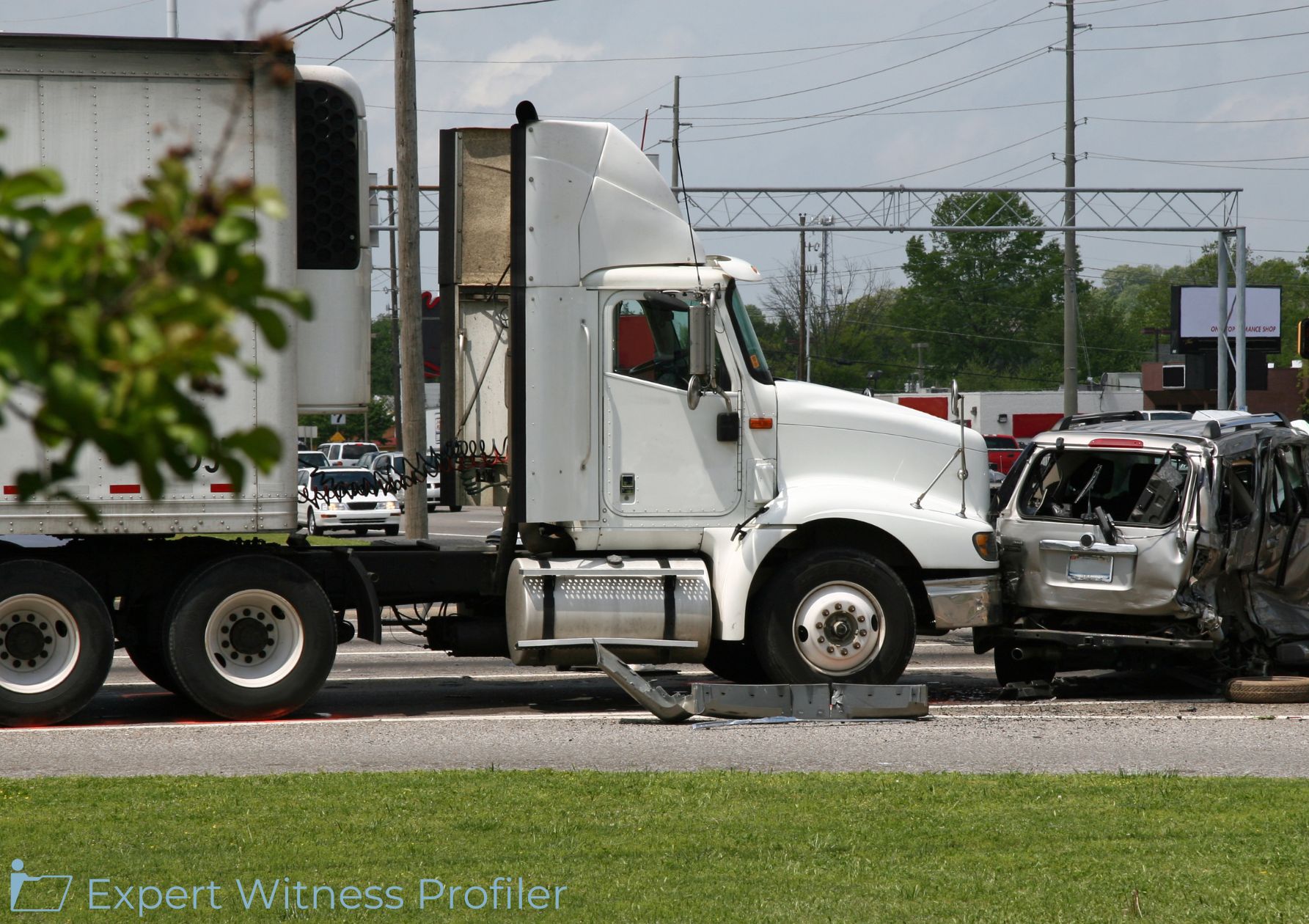
This lawsuit stemmed from a three-vehicle rear-end collision that occurred on Loop 1604 in Bexar County, Texas, on September 28, 2022. At the time, Plaintiff Bobby Mutz was driving a GMC truck behind Plaintiff Casey Eggleston, who was operating a Jeep Bronco. Both Plaintiffs had stopped due to traffic ahead. Defendant Tatevos Isakhanyan, who was driving an 18-wheeler owned and operated by Defendant TSH Trucking Inc. (“TSH”), failed to stop in time and struck the rear of Mutz’s vehicle, which in turn caused Mutz to collide with Eggleston’s vehicle.
Plaintiffs designated Kerry V. Nelson as a “truck and safety expert” expected to testify on fleet vehicle safety, commercial driver training, compliance with Department of Transportation (“DOT”) regulations, and causation.
Defendants filed a motion to strike Nelson’s testimony, challenging both his expert qualifications and the reliability of his opinions on causation.
Trucking Expert Witness
Kerry V. Nelson is an expert in the field of fleet vehicle and commercial vehicle safety, compliance as well as fleet vehicle management. He is also a former highway patrol officer with the Arizona Department of Public Safety.
Defendants contended that Nelson’s testimony should be excluded for two main reasons: (1) he was not an accident reconstructionist and therefore was not qualified to testify on matters related to causation; and (2) his opinions were unreliable because they had not been tested or peer-reviewed and were based solely on his review of the police report, deposition testimony, and relevant regulations.
In prior cases, Nelson was allowed to testify about the general obligations of commercial motor vehicle operators; however, he was not allowed to testify specifically about whether the Defendants had failed to meet those obligations. The Court found no reason to depart from its rulings limiting Nelson’s testimony in those cases.
Held
The Court granted in part and denied in part the Defendants’ motion to strike Kerry Nelson’s testimony.
Key Takeaway:
Defendants did not appear to object to Nelson’s testimony regarding DOT regulations in general; rather, their objections focused on his opinions about whether they had complied with those regulations.
Consistent with prior rulings, the Court permitted Nelson to speak only on general commercial vehicle operator obligations—not on whether Defendants violated those obligations.
Plaintiff Multiple Energy Technologies, LLC (“MET”) accused Under Armour of false advertising in relation to certain products that contain bioceramic powder. MET contended that Under Armour inaccurately claimed that the Federal Food and Drug Administration had determined that those products enhanced recovery.
Under Armour sells activewear and sleepwear products directly to consumers. This includes the sale of products containing a competing bioceramic product known as celliant, which is manufactured by Hologenix, LLC (“Hologenix”). Under Armour advertises these products separately from their other product offers and as helping to promote recovery, especially for athletes.
Plaintiff MET brought four claims against Defendant Under Armour, Inc.: violation of the Lanham Act, violation of the Sherman Act, misappropriation of trade secrets; breach of non-disclosure agreement; tortious interference with contract; tortious interference with prospective business expectancies; unjust enrichment; unfair competition; conversion; a claim for an accounting; and a claim for injunctive relief.
Alberto Gutierrez
MET’s Lanham Act claim is based principally on certain advertisements for Under Armour products that reference the FDA’s alleged treatment of celliant. The FDA language used in those advertisements originated with Hologenix, the manufacturer of celliant. Hologenix based those statements on its interpretation of the FDA’s June 8, 2017 response to Hologenix’s request for information regarding the FDA’s classification of celliant (the “FDA Letter”).
MET retained Dr. Alberto Gutierrez to “opine about the classification process by the FDA, the intent of the June 8, 2017 letter from the FDA to Hologenix and the statements made by Under Armour about celliant and the FDA.” Under Armour filed a motion to exclude Gutierrez’s opinions.
Chemistry Expert Witness
Alberto Gutierrez worked at the FDA for 25 years in various departments. At the FDA, Gutierrez was personally involved with the process by which the FDA responds to requests for information pursuant to section 513(g) and in making determinations of what is a medical device that would be regulated by the FDA. Gutierrez is now a consultant who helps device companies navigate the FDA regulatory requirements and provides strategic advice on regulatory issues and helps companies with submissions to the FDA.
First, Under Armour argued that ” Gutierrez is not qualified as an expert to opine on advertising or marketing issues, including the intent of the advertisements in question or the impact of those advertisements on consumers” because his background is in chemistry, he has no experience in advertising or consumer perception, and has never studied nor done any consulting work on the impact of advertisements on consumers. According to Under Armour, Gutierrez’s opinion is “purely speculative” with regard to whether Under Armour adopted a “campaign of deception.” Under Armour also argued that even if Gutierrez is not being offered as a consumer impact expert, his “campaign of deception” opinion is speculative and unreliable and shouldn’t be admitted.
The Court concluded that Gutierrez is qualified to offer an opinion on Under Armour’s statements about celliant and the FDA. Gutierrez is not being offered as an expert on the intent or consumer impact of advertisements—instead, Gutierrez is being offered “to opine about the classification process by the FDA, the intent of the June 8, 2017 letter from the FDA to Hologenix and the statements made by Under Armour about celliant and the FDA.”
The Court noted that Gutierrez worked at the FDA for 25 years in various positions, ultimately holding a director position. After his career in the FDA, Gutierrez joined a consulting group that helps companies navigate FDA regulatory requirements.
Independent Analysis
Second, Under Armour argued that even if Gutierrez is not qualified as an expert in the field of consumer perception, his report should be excluded because he did not perform any independent analysis. Under Armour argued that Gutierrez “took counsel’s word for it” that Under Armour engaged in a campaign of deception and did not review data related to consumers visiting websites containing the advertisements at issue, how long each website was active, or how many products with celliant Under Armour sold in a given year. Under Armour further argued that the “campaign of deception” opinion is not based on independent analysis.
However, the Court found that Guttierez did perform sufficient independent analysis. Under Armour objects to Gutuerrez’s statement that Under Armour engaged in a “campaign of deception.” Gutierrez concluded in his report that Under Armour’s statements about celliant were false in light of FDA regulations and practices.
He further opined that the statements in the documents that he reviewed were “false, deceptive and misleading” because the FDA had not determined that celliant products led to faster recovery, only that the health-related claims made by Hologenix would qualify celliant products as medical devices.
Moreover, Under Armour, by claiming that Gutierrez is not qualified as an expert on the intent of advertisements, attacked Gutierrez’s conclusions by stating that he “took counsel’s word for it” about Under Armour’s intent to deceive. But the Court held that Gutierrez did not purport to opine on Under Armour’s intent in the advertisements—instead, he concluded based on his knowledge and expertise that the statements were false, not that Under Armour intended to deceive consumers.
Documents and Conclusions
Third, Under Armour argued that the documents Gutierrez relied on do not support his conclusions. Additionally, Under Armour objects to the use of the phrase “FDA approval” in Gutierrez’s report and argues that his report should be excluded because he reviewed no documents with that specific claim.
However, the Court found that the documents Gutierrez reviewed support his opinions, and any argument that they do not goes to the weight, and not the admissibility, of his opinion.
Gutierrez’s report states that he reviewed Under Armour product pages from its website and from Amazon, and he also reviewed a letter from the FDA to Holegenix. Additionally, Gutierrez reviewed an article stating that celliant fabric had received “FDA approval” as a medical device.
Opinions about FDA Regulations
Fourth, Under Armour argued that Gutierrez’s report contains impermissible legal opinions on the applicability of FDA regulations to the case.
The Court found that Gutierrez’s opinions about the FDA’s regulations and procedures are relevant and are not legal opinions. Courts frequently admit the type of expert testimony that Gutierrez offers, and the Court sees no issues with admitting his opinions here.
The Court held that Gutierrez may testify so long as he does not give an opinion as to what is required under the law.
Held
The Court denied Under Armour’s motion to exclude Dr. Alberto Gutierrez’s expert report.
Key Takeaway:
Concerns about the documents an expert reviewed go to the weight of the evidence, not the admissibility, and are appropriately addressed in cross-examination. An expert has “good grounds” for relying on documents containing statements regarding the FDA because they are the type of documents an expert reviewing whether statements are consistent with FDA regulations would rely upon.
Please refer to the blog previously published about this case:
On June 24, 2023, at approximately 3:08 PM, Colter Bay Rangers were notified “of an illegally landed helicopter at the base of Moran Creek in Moran Bay.” According to the probable cause statement, Rangers G’Sell and Cardenas responded and found “a Eurocopter Helicopter (N708SD) . . . [with] two individuals outside the helicopter.” After contacting the Defendant, the Rangers informed him that he had landed within Grand Teton National Park.
Peter Smith, pilot in command of the white Eurocopter (N708SD) aircraft determined that he landed the flight to avoid further exposure to high-risk weather conditions.
Defendant was charged with two separate violations of the Code of Federal Regulations under 36 C.F.R. 2.17 for operating an aircraft on lands/waters other than designated areas and failure to comply with Federal Aviation Administration [FAA] regulations (i.e. having physical possession of a pilot certificate or making it readily accessible in the aircraft).
On October 16, 2023, Defendant filed his notice of intent to offer the expert testimony of Mark Warren, (Designation), “an airline pilot flying for American Airlines”.
On the other hand, the government sought to preclude any testimony or evidence presented regarding Warren’s statements “related to legal assertions or analysis of domestic law and providing testimony related to the credibility or veracity of any party or to vouch for the credibility of . . . Defendant or any witness.”
Aviation Expert Witness
Mark Warren is currently an airline pilot flying for American Airlines. During his tenure with American Airlines’ predecessor, Mark Warren served as Flight Operations Regulatory Compliance officer.
Warren has over 45 years of experience as a general aviation pilot flying the Colorado Rockies and other mountain regions in the United States.
The government pointed to the expert witness Notice provided by Defendant for Warren, the statements within the Notice focused on bolstering Defendant’s version of facts, dictated how the Court should interpret FAA regulations in relation to Defendant’s version of facts, and highlighted the lack of proper disclosure of expert opinions or reports. To sum it up,the government argued that the Court should not permit any testimony offered regarding FAA regulations based on the role the Court holds in judicial proceedings.
Defendant asserted that Warren had an extensive background in FAA regulations. Defendant argued that there was no basis for limiting Warren’s testimony since he will only be “stating [what FAA regulations] exist and what they are.”
The Court noted that Warren was not present in the Park when Rangers contacted Defendant, nor was he in the aircraft when Defendant flew his helicopter on June 24, 2023.
The Court agreed when the government stated that the insufficiency of Defendant’s disclosure was apparent on the face of [the expert witness] Notice—it contained few details of Warren’s opinions to be elicited, no facts [or] data relied upon, and it was devoid of the principles and methods used to reach the undisclosed conclusions. In other words, the Notice was lacking and failed to provide adherence to Rule 16(b)(1)(C).
The Court noted that if the conclusory statements in the Notice were indicative of Warren’s testimony, then his testimony would be improper.
The Court limited Warren’s testimony to the hypothetical scenario, his expertise as a pilot. It did not allow him to testify about the application of the FAA regulations in this case. The Court also did not permit him to testify about facts he had not witnessed.
Held
The Court granted in part and denied in part the testimony of Mark Warren.
Key Takeaways:
Insufficiency of Disclosure: The Court agreed when the government stated that the insufficiency of Defendant’s disclosure was apparent on the face of [the expert witness] Notice—it contained few details of Warren’s opinions to be elicited, no facts [or] data relied upon, and it was devoid of the principles and methods used to reach the undisclosed conclusions. In other words, the Notice was lacking and failed to provide adherence to Rule 16(b)(1)(C). It was insufficient to have put the government on notice of what the witness would testify to, the opinions he held, and whether such were the product of true expertise and reliable application of principles used in the field.
Legal Assertions: It is not an expert’s role to tell the Court what federal regulations apply, or how they are interpreted, rather that is the role of the Court.
Case Details:
Case Caption:
USA V. Smith
Docket Number:
L:23po382
Court:
United States District Court for the District of Wyoming