Tag: Reliable

  • Safety Engineering Expert  Allowed to Opine on Codes and Industry Standards

    Safety Engineering Expert Allowed to Opine on Codes and Industry Standards

    On January 22, 2022, Sharon Marshall was dining at an Outback Steakhouse in Fort Smith, Arkansas, when she slipped, fell, and received serious injuries. She alleged that she slipped on soup that had spilled in the floor which Outback had negligently failed to clean up.

    Outback has filed motions to exclude or limit the testimony of two of Marshall’s expert witnesses: Dr. Brian Goodman, who is one of her treating physicians, and Jason English, who is an industrial and safety engineer.

    Pain Medicine Expert Witness

    Brian Goodman, M.D. is a board-certified physician in pain medicine and
    anesthesiology. He completed a fellowship in pain medicine. He frequently treats patients suffering from pain caused by slip-and-falls.

    Get the full story on challenges to Brian Goodman’s expert opinions and testimony with an in-depth Challenge Study.

    Safety Engineering Expert Witness

    Jason English is a safety engineer who has two and a half decades of experience as a consultant who performs accident cause analysis, including fall protection and prevention from elevation as well as from the same level.

    Want to know more about the challenges Jason English has faced? Get the full details with our Challenge Study report.

    Discussion by the Court

    A. Motion to Limit Testimony of Plaintiff’s Treating Physician Brian Goodman, M.D.

    Goodman is a physician who has been providing Marshall with pain management treatment for spinal injuries which she alleges were caused by her fall at Outback. Furthermore, Goodman has also been retained to offer opinion testimony as an expert witness in this case. Specifically, those opinions include the opinion that the spinal injuries and associated pain that he has been treating were caused or worsened by Marshall’s fall at Outback.

    However, Outback argued that Goodman should not be allowed to offer these opinions, for two reasons. Firstly, Outback contended that Goodman is not qualified to opine on what caused the injuries that are the subject of this case because he is not a spinal specialist, did not perform surgery in this case, and is not an orthopedic surgeon, neurologist, diagnostic radiologist, or biomechanical engineer. Secondly, Outback maintained that Goodman’s causation opinions are speculative and unreliable because they are based only on Marshall’s statements to him and not on “any sort of scientific analysis” nor on the review of “any additional medical records, depositions, photographs, or otherwise.”

    Analysis

    The Court found that Goodman was qualified to offer his opinions in this case. Specifically, he has been treating Marshall for pain that he believes was caused by the injuries that are the subject of this lawsuit.

    As for Outback’s second argument regarding the reliability of Goodman’s methodology: the Court believed his methods were sufficiently reliable to satisfy the requirements of Rule 702. Outback fixates on the relatively small number of materials Goodman reviewed during the first period when he was treating Marshall, during which time it seems he was relying primarily on her reports to him of her pain to inform his decisions and was unaware of significant parts of her medical history including possibly even the fact of her fall at Outback. However, the critical question for the admissibility of Goodman’s opinions in this case is not what he knew or didn’t know at the time he began treating Marshall, but rather what informed his opinions at the time that he offered them for purposes of this litigation.

    And Goodman has testified that before offering his most recent expert report in this case he reviewed many binders of materials containing Marshall’s medical history, both pre-fall and post-fall, and that his opinions in this case were informed by his review of those materials as well as his personal experience treating Marshall and her reports to him of her pain, and his experience treating patients with injuries from slip-and-falls more generally.

    Motion to Exclude Plaintiff’s Expert Jason English

    Marshall retained English to offer expert opinions about whether the spill caused her fall (he opines it did), and about whether Outback’s response to the alleged spill hazard and training of its employees to deal with such hazards was consistent with industry standards (he opines it wasn’t). Outback offered two arguments for excluding English’s opinions. First, they contended his opinions were not reliable. Second, they said his opinions were not specialized.

    Analysis

    Regarding reliability, Outback argued that English “is not a hospitality or restaurant expert,” and that his opinions are not based on any examination or testing of the specific floor and restaurant at issue in this case. On the first point, however, English holds a certification in the measurement and evaluation of pedestrian traction on walking surfaces, and is a member of the “ASTM International F13 Committee on Pedestrian/Walkway Safety and Footwear.” The Court determined that clearly has expertise in the topics on which he is opining.

    As for testing on the specific floor where Marshall fell, English testified that
    he saw no point in testing that floor. Instead, English based his analysis on the deposition testimony, photographs, and document discovery that were produced in this case.

    According to English, “the floor in this particular case is just a common commercial flooring found not only in restaurants but other types
    of commercial facilities as well.”

    Regarding whether English’s opinions are specialized: Outback insisted that “[t]here is nothing specialized, scientific, or particularly technical about his opinion. He has simply looked at all the evidence of record and come to a conclusion. The jury can do the same.”

    The Court disagreed. English’s report extensively discussed codes and industry standards around, for example, slip resistance, spills,
    warning signs, and cleaning methods, and opined that Outback failed to meet them. He also discussed the “authoritative literature” on “ordinary human
    factors” that can influence patrons’ awareness of hazards.

    Held

    The Court denied the Defendant Outback Steakhouse of Florida, LLC’s motion to limit testimony of Plaintiff’s treating physician Brian Goodman, M.D and motion to exclude Plaintiff’s expert Jason English.

    Key Takeaway:

    • Goodman took care to emphasize the difference between what information he relied on in forming his opinion of how to treat Marshall and what information he relied on in forming his opinions that were offered for purposes of this litigation.
    • English’s report extensively discusses codes and industry standards around, for example, slip resistance, spills, warning signs, and cleaning methods.

    Case Details:

    Case Caption: Marshall V. Outback Steakhouse Of Florida, LLC
    Docket Number: 2:23cv2119
    Court Name: United States District Court, Arkansas Western
    Order Date: April 11, 2025
  • Audiology Expert’s “Chart Note” is Not a Proper Expert Report

    Audiology Expert’s “Chart Note” is Not a Proper Expert Report

    This case stems from a rear-end, chain-reaction accident. Plaintiffs alleged that, on or about June 16, 2019, Plaintiff Miranda Allen was driving northbound on Interstate 5 in Skagit County, Washington, with Plaintiff J.M. as a passenger in her vehicle.

    While Plaintiff Allen’s vehicle was stopped in traffic, Defendant Martin Barratt, also driving northbound on Interstate 5, rear-ended Plaintiff Allen’s vehicle, “caus[ing] Plaintiff Allen’s vehicle to crash into the rear of the vehicle directly in front of them.” As a result of the accident, Plaintiff Allen allegedly sustained substantial and permanent injuries.

    On February 3, 2025, the Parties timely filed respective motions to exclude expert testimony. First, Plaintiffs filed a motion to exclude the expert testimony of Dr. Michael Hatzakis, Defendants’ physiatrist expert. Later that day, Defendants filed a motion to exclude the expert testimony of Dr. Leah Keylard, Plaintiffs’ audiologist expert.

    Physical Medicine And Rehabilitation Expert Witness

    Dr. Michael Hatzakis has been board certified in Physical Medicine and Rehabilitation for the last 20 years.

    Hatzakis worked as an engineer for almost a decade before entering medical school at Stanford University School of Medicine in California. While attending medical school, he also worked in the department of Electrical Engineering at Stanford, Neurosurgery and Interventional Radiology. Among other projects, he developed neural prosthetic devices under a joint program between Stanford medical school and the Department of Electrical Engineering. He did his residency training in Physical Medicine and Rehabilitation at Thomas Jefferson University Hospital in Philadelphia, PA.

    Over the last five years, through his leadership in the American Academy of Physical Medicine and Rehabilitation (AAPM&R), he has spearheaded one of the most ambitious “big- data” projects to improve the quality of care for individuals with low back pain, and, with neurological disorders. 

    Get the full story on challenges to Michael Hatzakis’ expert opinions and testimony with an in-depth Challenge Study.

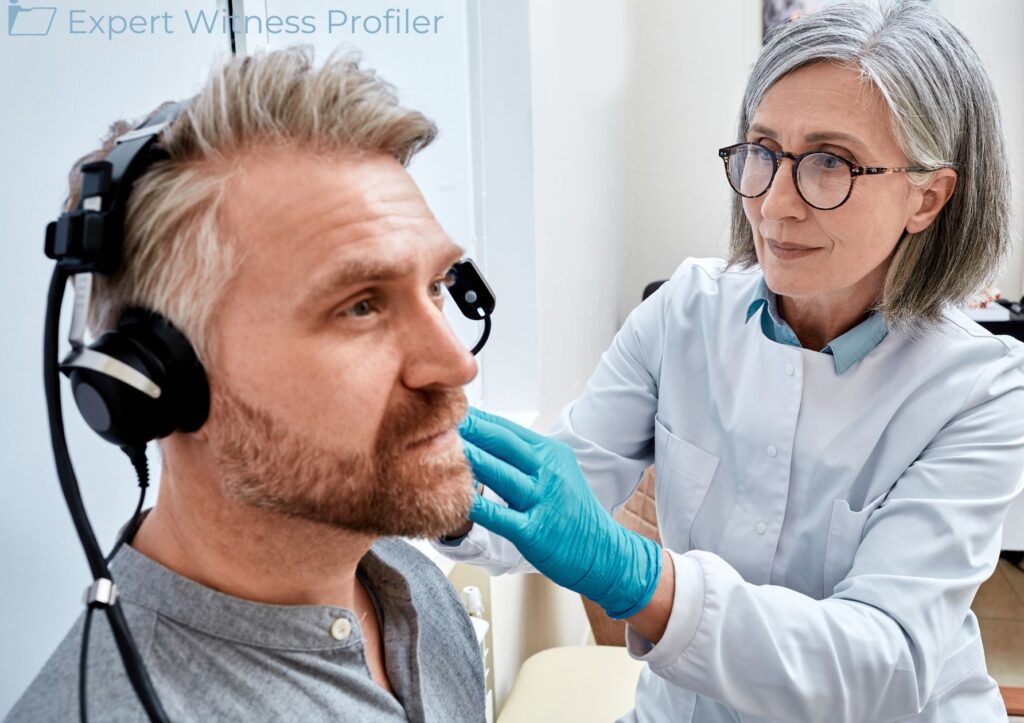
    Audiology Expert Witness

    Leah Wilkinson Keylard is a clinical audiologist and has been practicing since 1999.

    She has a strong background in diagnostic and rehabilitative audiologic techniques. She holds a Doctor of Audiology (Au.D.) from the Arizona School of Health Sciences.

    Get the full story on challenges to Leah Keylard’s expert opinions and testimony with an in-depth Challenge Study. 

    Discussion by the Court

    Michael Hatzakis

    Plaintiffs sought to exclude the expert testimony of Michael Hatzakis as insufficient under Federal Rule of Evidence 702.

    Plaintiffs represented that Hatzakis produced an initial expert report in November 2023 where he opined, inter alia, that Plaintiff Allen’s injuries had been proximately caused by the motor vehicle collision at issue in this case.

    According to Plaintiffs, Hatzakis’ opinions in the November 2023 report concurred with other expert testimony in the case: Hatzakis agreed that Allen suffered from the injuries and damages the other expert and independent medical examiners had found.” On November 26, 2024, however, Hatzakis provided Plaintiffs with an addendum to his original report. In the addendum, Hatzakis diverged from his original findings, opining that “none of Allen’s injuries or damages were caused by the collision, in direct contrast to his first report.”

    Plaintiffs’ Grounds for Exclusion

    First, Plaintiffs asserted that “Hatzakis has rendered opinions and conclusions which are contrary to scientifically accepted principles, and are based upon inaccurate and incomplete information.” Second, Plaintiffs asserted that Hatzakis’ opinions and conclusions “are . . . in direct contrast to the one other matter [Plaintiffs’ counsel] could find.”

    a. Opinions “Contrary to Scientifically Accepted Principles”

    Opinions and conclusions are intellectual constructs that are dissimilar from, and incomparable to, scientific principles. In and of itself, an opinion or conclusion cannot contradict a scientific principle, unless it is an opinion or conclusion that specifically addresses the merits of that principle.

    A sum, for example, cannot be “contrary” to, say, arithmetic; an x-ray impression cannot be “contrary” to radiology. To the extent that Plaintiffs intended to assert that Hatzakis’ opinions and conclusions are based on or derived from non-scientific principles—or, alternatively, are incorrectly based on or improperly derived from scientific principles—Plaintiffs do not sufficiently demonstrate that this is so. The Court held that the Plaintiffs relied on conclusory statements and did not connect their lengthy recitation of the rules of evidence to their cursory discussion of how Hatzakis’ testimony transgresses those rules.

    Moreover, Plaintiffs’ argument that Hatzakis’ opinions and conclusions are based upon inaccurate and incomplete information also failed. Plaintiffs did not provide any indication that Hatzakis reviewed any data that were factually wrong or otherwise erroneous. Plaintiffs suggested that Hatzakis might have based his opinions on an incomplete set of records, but not that those records were, however scant, faulty. According to the Court, the fact that an expert might have based their opinion on incomplete records is not sufficient grounds for exclusion under the Daubert standard. Rather, such a critique “goes to the weight of his opinions rather than their admissibility.”

    b. Opinions “in Direct Contrast” with Other Opinions

    As to Plaintiffs’ second basis for excluding Hatzakis’ testimony, it simply did not make sense. Plaintiffs asserted that Hatzakis’ opinions and conclusions are “in direct contrast to the one other matter [Plaintiffs’ counsel] could find, absent providing an adequate testimony list.” Taking Plaintiffs’ argument at face value, the Court is at a loss to see how Hatzakis’ opinions in an unrelated case have anything to do with his opinions in this one. Unless the facts, circumstances, and damages that were the subject of Hatzakis’ opinions in the other matter are directly comparable to Plaintiff Allen’s injuries and damages here—and Plaintiff does not provide any evidence indicating that they were—then it is not clear how those opinions and conclusions could logically be “in direct contrast” to the opinions and conclusions at issue in this case.

    To the extent Plaintiffs asserted that Defendants should have provided more robust disclosure with respect to Hatzakis’ testimony either before or after his deposition, the Court noted that Plaintiffs had Hatzakis’ list of testimony as early as November 20, 2023, yet waited more than a year—until December 5, 2024, one day after discovery motions were due and just 11 days before Hatzakis’ scheduled deposition on December 16, 2024—to raise the issue of the adequacy of the list of testimony.

    c. Opinions Based on “Erroneous Assumptions”

    Finally, as to Plaintiffs’ third basis for excluding Hatzakis’ testimony, Plaintiffs did not identify any of the purported “erroneous assumptions” not in the record upon which Hatzakis’ opinions are based. As discussed above, it appears that Plaintiffs objected to the size of the body of evidence that Hatzakis reviewed when forming his opinions, not the evidence itself. The Court ruled that such a deficiency can be borne out in cross examination and need not form the basis for exclusion.

    Leah Keylard

    Plaintiffs chose to list Dr. Leah Keylard, an audiologist, as a retained expert witness under Rule 26(a)(2)(B), meaning she was required to provide a written report.

    Defendants sought to exclude the testimony of Keylard. Keylard opined on Plaintiff Allen’s alleged injuries. Unlike Plaintiffs’ other expert reports disclosed under Rule 26(a)(2)(B), Keylard’s report is captioned as a “chart note,” not an expert report, and it is only three pages long.

    Although Keylard’s report refers to a “[r]eview of medical records as well as described history of noise provided by the patient,” the report does not discuss any specific documents or medical records that informed Keylard’s opinion and provides only a cursory summary of the results of three diagnostic tests. Indeed, the “report” reads much like it is labeled: as a healthcare provider’s note prepared subsequent to a patient encounter, not a studied synthesis and analysis of diagnoses and data from multiple sources.
    Defendants argued that the brevity of Keylard’s report, as well as its lack of specific detail, particularly with respect to the sources upon which Keylard has based her conclusions, leaves the report short of the requirements that Rule 26(a)(2)(B) prescribes for an expert report.

    Defendants’ Grounds for Exclusion

    a. Rule 26(a)(2)(B)

    As Defendants pointed out, Keylard’s report is a “‘chart note’ and not a full report.” The Court held that a “chart note” is not a proper expert report under Rule 26(a)(2).

    Indeed, when presented with expert reports similar to that of Keylard, courts have excluded the testimony as having been insufficiently disclosed under Rule 26(a)(2)(B).

    Keylard’s report refers to “records relating to [her] independent medical evaluation but d[oes] not provide records of that evaluation,” leaving Defendants “[without] the necessary records to counter-designate a rebuttal expert.”

    For their part, Plaintiffs argued, inappositely, that Keylard’s Rule 26(a)(2)(B) report was sufficient because “Defendant[s] had an opportunity to depose Keylard and chose not to.” This is beside the point. The relative sufficiency of a Rule 26(a)(2)(B) report is not enhanced by the opposing party’s decision not to depose its author—in fact, the rule contemplates the exact opposite relationship between disclosures and depositions.

    b. Rule 37(c)(1)

    Plaintiffs argued that Keylard’s testimony should not be excluded, because “[e]xclusionary sanction based on discovery violations are [sic] generally improper absent undue prejudice to the opposing side.”

    This misstates the law, which provides that “information may be introduced if the parties’ failure to disclose the required information was substantially justified or harmless.”

    Plaintiffs relied on “Defendant[s’] fail[ure] to depose Keylard” as demonstrative that the deficiencies in Keylard’s report were substantially justified or harmless.

    As discussed above, this is not a germane argument with respect to violations under Rule 26 and exclusion under Rule 37. As the Seventh Circuit has held, “the [expert] report must be complete such that opposing counsel is not forced to depose an expert in order to avoid ambush at trial; and moreover the report must be sufficiently complete so as to shorten or decrease the need for expert depositions and thus to conserve resources.”

    The Court thus found that Plaintiff’s deficient Rule 26(a)(2)(B) disclosure with respect to Keylard was neither substantially justified nor harmless. Moreover, given that discovery is closed, the deadline for dispositive motions has lapsed, and trial begins in approximately two months, the deficiencies cannot be easily remedied without radically reworking this case’s longstanding schedule.

    Held

    1. The Court denied Plaintiff’s motion to exclude defense expert Michael Hatzakis.
    2. The Court granted Defendants’ motion to exclude Dr. Leah Keylard.

    Key Takeaways:

    • Opinions and conclusions are intellectual constructs that are dissimilar from, and incomparable to, scientific principles. In and of itself, an opinion or conclusion cannot contradict a scientific principle, unless it is an opinion or conclusion that specifically addresses the merits of that principle.
    • Plaintiffs had plenty of time between the issuance of the most recent scheduling order and the lapsing of deadline for discovery motions to try to resolve the issue with Defendants and, if necessary, file an appropriate motion with the Court to obtain any needed information prior to Hatzakis’ deposition.

    Case Details:

    Case Caption: Allen V. Barratt Et Al
    Docket Number: 2:23cv474
    Court Name: United States District Court, Washington Western
    Order Date: April 08, 2025
  • Credit Reporting Expert May Not Opine as to Whether the Procedures were Reasonable or Unreasonable

    Credit Reporting Expert May Not Opine as to Whether the Procedures were Reasonable or Unreasonable

    Plaintiff Barbara Cooper alleged that Defendant Milliman, Inc. (“Milliman”) violated the Fair Credit Reporting Act in two ways: first, when
    it issued a report about her medical and prescription history that mixed her with another individual; and second, when it issued a second report wherein Milliman reinserted information it had previously deleted after purportedly reinvestigating Plaintiff’s dispute.

    Milliman principally attributes its repeated errors to a “glitch” with the software that matches information about consumer identity with medical
    record information.

    Milliman’s expert Rebecca Kuehn’s report states she will offer the following opinions:

    A. Milliman’s process for matching consumer records is consistent with industry practice and otherwise reasonable.

    B. Milliman’s procedure for blocking information that was previously removed from a consumer report is consistent with industry practice and reasonable.

    Plaintiff argued that Kuehn is unqualified and her proffered testimony is unreliable. “As such,” Plaintiff contended, “her opinions are nothing more than bare legal conclusions that are pasted on to Milliman’s factual theories.”

    Credit Reporting Expert Witness

    Rebecca Kuehn is an attorney focusing on consumer financial services and consumer protection matters in the Washington, D.C. office of Hudson Cook, LLP.

    She is an expert in the policies, procedures, and practices that consumer reporting agencies (“CRAs”) use to ensure compliance with the Fair Credit Reporting Act (FCRA). She developed this expertise through substantial experience in the industry, advising CRAs, lenders, and other users of credit reports on the development of procedures designed to comply with the FCRA.

    Get the full story on challenges to Rebecca Kuehn’s expert opinions and testimony with an in-depth Challenge Study. 

    Discussion by the Court

    Kuehn’s Expert Qualifications

    Kuehn’s resume shows that Kuehn graduated near the top of her class at George Washington Law School. She served five years at the Federal Trade Commission (FTC), as an Assistant Director, where she was “[p]rimarily
    responsible for the [FCRA] program, leading the Commission’s enforcement, policy, outreach, and rulemaking activities in that area.”

    In addition, Kuehn has served as co-chair of the FCRA Litigation Subcommittee in the American Bar Association, given numerous presentations on the FCRA, authored various publications on the FCRA, and “testified before the U.S. House Committee on Financial Services . . . on behalf of the Consumer Data Industry Association, at a hearing on ‘Consumer Credit Reporting: Assessing Accuracy and Compliance.’”

    When Plaintiff argued that Kuehn is unqualified to opine on industry standards because of any lack of experience as to reporting of medical information, she essentially argued that the FCRA requires specificity as to each area it applies. But the FCRA deals with CRAs in general and whether their procedures are reasonable.

    It requires all CRAs, regardless of industry, to follow or maintain reasonable procedures and nothing in the Act provides separate rules based on the type of information collected and reported. Same goes for Plaintiff’s argument that Kuehn must have direct knowledge about Milliman’s identity matching or software.

    As Plaintiff herself admits, Kuehn has “impressive credentials” at first sight. Even Plaintiff’s own expert has recognized Kuehn’s FCRA qualifications.

    The Court held that Plaintiff’s arguments against Kuehn’s qualifications failed because they concerned the weight of Kuehn’s proffered testimony, not its admissibility.

    Reliability of Methodology

    Kuehn has published numerous works on the FCRA. One publication was at the FTC, which can set guidance as to what procedures are or are not reasonable.

    Her knowledge has been tested at various presentations, in Court, and before Congress. As a result, the Court finds Kuehn possesses the required knowledge and experience to provide reliable testimony that is not merely ipse dixit. Other arguments, like that Kuehn’s opinion is unreliable because of her lack of knowledge about identity matching or Milliman’s software and her excessive reliance on information supplied by Milliman’s corporate representative, as discussed earlier, are unpersuasive because they go to the weight of Kuehn’s testimony, not its admissibility.

    However, Kuehn will be able to testify to compliance or non-compliance with industry customs and standards, but not whether Milliman’s procedures were reasonable or unreasonable. The consensus in the Middle District of Florida is that an FCRA expert cannot testify whether procedures were “reasonable” or “unreasonable.”

    Helpfulness

    An average lay person does not know the industry-standard procedures used by CRAs.

    Therefore, the Court ruled that Kuehn’s testimony could help the jury determine whether Defendant’s procedures were reasonable and if any violation was willful.

    Rule 403

    Kuehn satisfies all three prongs of Daubert and except for the exclusion of witness testimony as to “reasonableness” or “unreasonableness”, the Court finds no undue prejudice from the anticipated testimony.

    Held

    The Court granted in part and denied in part the Plaintiff’s motion to exclude opinion evidence from Rebecca Kuehn.

    Key Takeaways:

    • The reliability of non-scientific expert opinions depends heavily on the knowledge and experience of the expert, not the exactness of the methodology. Evidence of compliance or non-compliance with a custom within a particular industry, though not conclusive, is a factor the trier of fact may consider.
    • While a witness may testify concerning an ultimate issue of fact, the witness may not “tell the jury what result to reach.”

    Case Details:

    Case Caption: Cooper V. Milliman, Inc.
    Docket Number: 2:23cv28
    Court Name: United States District Court, Florida Middle
    Order Date: April 07, 2025
  • Psychology Expert Witness is Unqualified to Testify as to Reputational Damages

    Psychology Expert Witness is Unqualified to Testify as to Reputational Damages

    On June 15, 2020, Michael J. Fitzgerald and Ronda and Will McNae finalized a Settlement Agreement to resolve claims related to alleged rape and sexual assault. This agreement included Fitzgerald paying a sum of money and, in return, the McNaes releasing their claims, agreeing not to contact Fitzgerald’s employer, SoftwareONE, refrain from writing about him directly and indirectly, and avoid disparaging him. Fitzgerald is now pursuing the only claim remaining in this case, a breach of contract claim against Ronda McNae for breach of the Settlement Agreement.

    On March 5, 2025, this Court entered its Order Granting Plaintiff Fitzgerald’s Motion for Partial Summary Judgment as to Liability, finding that Defendant Ronda McNae breached the Settlement Agreement. This case is soon proceeding to trial to determine damages Plaintiff has sustained from Defendant Ronda McNae’s breach of the Settlement Agreement.

    Plaintiff Fitzgerald disclosed three experts in connection with this case. First, he disclosed Sheri Fiske, a certified public accountant, who will testify to Fitzgerald’s purported economic damages. Second, Plaintiff disclosed Dr. Michael DiTomasso, a forensic psychologist, to testify as to his non-economic, reputational damages. Third, Plaintiff disclosed Dr. Kim Fromme, a clinical psychologist to testify that Defendant Ronda McNae’s memory of having been raped and assaulted is false, and that the parties engaged in consensual sexual relations. Defendant Ronda McNae seeks to exclude the expert opinions of these three expert witnesses pursuant to Federal Rule of Evidence 702.

    Accounting Expert Witness

    Sheri Fiske Schultz brings extensive experience to the table, with over 35 years in public accounting and more than 30 years of specialized expertise in the fields of forensic accounting and business valuations.

     In addition to being a licensed CPA, Sheri holds the designation of Accredited in Business Valuation (ABV) and is Certified in Financial Forensics (CFF) by the American Institute of Certified Public Accountants (AICPA).

    Get the full story on challenges to Sheri Fiske Schultz’s expert opinions and testimony with an in-depth Challenge Study. 

    Psychology Expert Witnesses

    Michael DiTomasso has specialized in the clinical and forensic evaluation of children and their parents in cases involving sexual and physical abuse, neglect, domestic violence, and systemic family pathology. He has been recognized by various courts as an expert in the areas of Child Abuse and Neglect, Domestic Violence, and Family Functioning on hundreds of occasions. DiTomasso also handles many Juvenile Delinquency and Adult Criminal cases. He holds a Ph.D. in Clinical Psychology from The University of Miami.

    Want to know more about the challenges Michael DiTomasso has faced? Get the full details with our Challenge Study report. 

    Kim Fromme, Ph.D., is Professor Emeritus of Clinical Psychology at The University of Texas at Austin. She has over 120 peer-reviewed publications focused on alcohol use and the effects of alcohol intoxication, including blackouts, cognitive processes, and behavioral risks. Consequently, she provides unique expertise in legal cases that involve alcohol, behavior, thinking, and memory.

    Fromme has been qualified to opine on these matters in 20 civilian criminal cases, 16 civil and Title IX matters, and 53 military courts-martial. She has successfully passed three Daubert challenges.

    Discover more cases with Kim Fromme as an expert witness by ordering his comprehensive Expert Witness Profile report.

    Discussion by the Court

    Sheri Fiske

    Initially, the Defendant contended that Fiske’s calculations for lost quarterly and annual bonuses were unreliable and not useful. Their primary argument was that Fiske could not accurately determine Fitzgerald’s target bonus earnings. In response, the Plaintiff asserted that the Defendant overlooked the 2022 Salary Review Letter, which guaranteed specific bonus amounts (100,000 GBP quarterly and 120,000 GBP annually) as well as a a salary increase independent of company performance or Fitzgerald’s individual target achievement. Consequently, the Court rejected the Defendant’s motion on this particular point.

    Defendant argued that Fiske’s calculations of the lost value of performance share units (PSU) are unreliable. Specifically, Defendant argued that Fiske’s initial calculation was incorrect. Later, Fiske updated her estimate prior to her deposition to reflect a lower, more conservative estimate of lost PSUs based on more recent information provided to Fiske from SoftwareONE dated June 6, 2023, which Fiske received after issuing her May 15, 2023 Damages Report but before her deposition on June 7, 2023.

    Nonetheless, Defendant still sought to exclude the supplemental report arguing that Fiske does not know the basic facts to allow her to express a reliable opinion about the PSUs. However, when Fiske received the updated information from SoftwareONE, Fiske compared the number of PSUs Fitzgerald actually received to the number he was promised. Therefore, the Court, once again, rejected the Defendant’s motion as to this aspect.

    The Court defers ruling on the following issues:

    • Whether Fiske’s testimony as to calculation of the full contract amount is not helpful 
    • Whether Fiske should not be permitted to testify about facts and evidence that are irrelevant to her purported calculations.

    Should Plaintiff seek to introduce such testimony that Defendant moves to exclude, the parties shall argue this issue to the Court outside the presence of the jury.

    Dr. Michael DiTomasso

    Plaintiff Fitzgerald “sought damages for the reputational harm caused by McNae both in the industry he spent his life working in, and at SoftwareONE, which he dedicated his professional life building” and “sought damages due to the personal harm he has suffered to his mental health, emotional wellbeing, and enjoyment of life.”

    Defendant argued that DiTomasso was unqualified to offer an opinion on damages, specifically because he is not board certified, is not an expert in the technology market, and is not an occupational therapist. This Court agreed with Defendant that DiTomasso was unqualified to testify as to reputational damages. When asked what qualifications he has to opine on the amount of damages that should be awarded in this case, DiTomasso himself stated “none.” As to emotional damages, this Court held in its Order Granting in Part and Denying in Part Defendant Ronda McNae’s Motions in Limine that any evidence or testimony related to emotional distress will be excluded. 

    Kim Fromme

    Defendant sought to exclude Fromme’s testimony arguing it is unreliable, unhelpful, and that the issue of whether a rape occurred is for the determination of the jury. 

    However, Fromme’s testimony will be necessary only if the defense of duress is permitted. Since this Court ruled in its Order Granting Plaintiff’s Motion for Summary Judgment that Defendant Ronda McNae’s duress defense will not be permitted, the Court declared this issue moot. 

    Held

    The Court granted in part and denied in part the Defendant Ronda McNae’s motion to exclude the opinions of Sheri Fiske Schultz, Dr. Michael DiTomasso, and Dr. Kim Fromme.

    Key Takeaway:

    1. Fiske’s calculations of lost quarterly and annual bonuses are not unreliable just because the Defendant overlooked crucial piece of evidence i.e the 2022 Salary Review Letter.
    2. DiTomasso is unqualified to offer an opinion on damages, specifically because he is not board certified, is not an expert in the technology market, and is not an occupational therapist.

      Case Details:

      Case Caption: Fitzgerald v. McNae
      Docket Number: 1:22cv22171
      Court Name: United States District Court, Florida Southern
      Order Date: April 02, 2025
    1. Recreational Vehicle Expert’s Valuation Determination Complies with Rule 702 

      Recreational Vehicle Expert’s Valuation Determination Complies with Rule 702 

      Plaintiff Jason Greene purchased a recreational vehicle (“RV”) from Defendant Thor Motor Coach, Inc. (“Thor”). The purchase included a 12 month / 15,000 mile limited warranty (the “Limited Warranty”). After purchasing the RV, Greene encountered issues with the RV that led him to seek repairs on several occasions. Some issues remained even after the attempted repairs. Greene thus sued Thor for violation of the Magnuson Moss Warranty Act (“MMWA”), breach of express warranty, breach of implied warranty, violation of the Indiana Deceptive Consumer Sales Act (“IDCSA”) and violation of the Pennsylvania Unfair Trade Practices and Consumer Protection Law.

      Thor seeks to exclude the proposed valuation opinions of Greene’s proffered expert, Mr. Dennis Bailey, arguing that Bailey’s opinion is unreliable.

      Recreational Vehicle Expert Witness

      Dennis Bailey had a self-owned recreational vehicle business. He has been directly involved in the daily decisions of retail sales (trade in values-new and used manufacturer purchases) wholesale sales (buying and selling), customer service (determination of warrantable defect for submission to the manufacturer-solutions for repair and actual repair), retail and wholesale parts (determination parts pricing-decisions on what specific inventory to purchase and how much). Bailey has attended technical schools such as Norcold, Dometic, Lippert leveling and slide out certified and is RVIA certified.

      Bailey has experience in appraisals since 1980’s. Other areas of designated certification are Certified Infrared Thermographer through Flir and LP certified gas. Bailey is an experienced appraiser specializing in recreational vehicles. He has conducted over 1,000 specialized RV appraisals and estimates. He is an independent Investigator.

      Get the full story on challenges to Dennis Bailey’s expert opinions and testimony with an in-depth Challenge Study. 

      Discussion by the Court

      Thor concedes that Bailey’s experience “likely endows Bailey with sufficient technical knowledge to render opinions about the presence of defects in a motorhome like the RV” but argues that Bailey’s valuation opinion is inadmissible because it is mere ipse dixit and fails to meet the reliability standards required under Fed. R. Evid. 702 and Daubert.

      Greene purchased the RV for $249,901.59. In Bailey’s report, he opines that, after considering the purported defects, the fair market value of the RV at the time it was purchased was $100,000.00. 

      Bailey’s report details his findings related to purported defects in Greene’s RV. Bailey lists 24 variables that can affect an RV’s value. His report also refers to the National Automobile Dealer Association (“NADA”) guidebook, which he describes as the “generally accepted industry standard for guideline value only. It is not the Bible of the true value as it strictly [sic] a guide only.”

      Thor argues that, when Bailey was deposed and had to elaborate on those 24 variables and describe his methodology, Bailey’s conclusions ultimately rest on Bailey’s “say-so” and amounts to inadmissible ipse dixit. The Court agrees with Thor that, at times Bailey’s testimony suggests that his conclusions are speculative.

      Market Supply and Demand

      However, at Bailey’s deposition, he does provide some additional explanation for his proffered opinions. He testified that several of the 24 variables did not factor into his valuation determination because they were not relevant. As mentioned, one variable Bailey did consider was market supply and demand. When questioned how he evaluated that variable, he testified that he’s been in the business for over “45 years” that he has “seen units” and “used to work at one of the biggest dealerships and we had those. I know about them units. I know about the RVs and which ones sell and which ones don’t.”

      Insurability Risk

      Another variable Bailey considered was insurability risk. Bailey testified that he did not consult any insurance companies in reaching his determination, but that in his experience he has “dealt with insurance companies. I have dealt with them when I did work for the dealers and stuff selling trailers. I know that they won’t insure a lot of these people if they find out that they have damage to them.”

      Economic Cost

      When discussing the economic cost—another valuation factor—Bailey testified that he considered the cost to fuel the RV given the present cost of $6 a gallon for gas and $7 a gallon for diesel, and the cost for bringing the RV back and forth to the dealership to get it fixed.

      Prohibited Use on Highways

      When discussing another factor—prohibited use on highways—Bailey elaborated that it is his opinion that the RV’s alleged defects to the electrical system make it dangerous to take on the highways.

      Such a conclusion does not strike the Court as mere ipse dixit, particularly because Thor does not challenge the admissibility of Bailey’s opinions on the existence of the alleged defects. Bailey also testified that he considered whether the RV could be financed based on his experience selling units and trying to get customers financing. While Bailey was unable to provide itemized deductions for the factors he considered, this Court has held that itemized deductions are not required.

      In conclusion, Greene’s evidence suggests that Bailey’s testimony is the product of reliable principles and methods, and his opinion reflects a reliable application of the principles and methods to the fact of the case under Rule 702.

      Held

      The Court denied Thor’s motion to exclude the valuation opinion of Greene’s expert witness, Dennis Bailey.

      Key Takeaway:

      The experienced appraiser’s opinion is sufficient if the opinion consists of an explanation of the methodologies and principles referenced, and the conclusions are not solely based on subjective opinion or speculation, as appraisals are not an exact science that can be mechanically scrutinized.

      Case Details:

      Case Caption: Greene V. Thor Motor Coach, Inc.
      Docket Number: 3:22cv1011
      Court: United States District Court, Indiana Northern
      Order Date: March 28, 202
    2. Data Privacy Expert Has Sufficient Experience in TCPA Compliance and Wrong Number Issues

      Data Privacy Expert Has Sufficient Experience in TCPA Compliance and Wrong Number Issues

      David Elliot filed a lawsuit against Humana, claiming the company violated the Telephone Consumer Protection Act (TCPA) by repeatedly calling him with robocalls even though he wasn’t a customer and had informed them they had the wrong number. Elliot wants to pursue this as a class action, arguing that many others have experienced similar unwanted robocalls from Humana over a four-year period.

      To support his request for class certification, Elliot offered expert testimony from Anya Verkhovskaya, who believes Humana’s data allows for a reliable and efficient way to identify and notify potential class members, meeting Fed. R. Civ. P. 23 and due process. Humana countered with their own expert, Margaret Daley, who argues that Verkhovskaya’s method for identifying class members who received prerecorded messages as non-customers is unreliable and that individualized investigations would be necessary. Daley also challenges the reliability of Verkhovskaya’s reverse-append methodology, claiming it does not reliably identify people who should receive notice. 

      Daley was admitted to opine on “whether there is a reliable way to determine on a class wide basis whether Humana non-members received prerecorded messages.”

      Data Privacy Expert Witness

      Margaret Daley is the Vice President at Charles River Associates (“CRA”) and a member of its Forensics Services practice group. Daley has specialized experience in TCPA compliance, and digital forensic investigations. She has also authored three publications on TCPA compliance and wrong number issues.

      Daley has significant experience providing expert testimony, litigation and regulatory support, and data analytics to law firms, Fortune 500 corporations, government agencies, and various regulatory bodies. 

      She is is a Certified Information Privacy Professional (CIPP), a Certified Fraud Examiner (CFE) and a licensed attorney in the state of Illinois. 

      Get the full story on challenges to Margaret Daley’s expert opinions and testimony with an in-depth Challenge Study.

      Discussion by the Court

      Qualifications

      Daley possesses ample experience in TCPA compliance, wrong number issues, and the reverse-append procedure proposed by Verkhovskaya. Consequently, her expert opinions will be helpful for the Court. Furthermore, other district courts have recognized Daley’s qualifications to testify on similar matters. Her education, certifications, and extensive experience demonstrate relevant training in the areas she has provided opinions on. Therefore, this Court finds Daley qualified by both training and experience to offer expert testimony on class action notice and TCPA claim issues, and Elliot’s opposing arguments are not persuasive.

      Reliability

      Elliot challenged Daley’s expert opinion, claiming it was based on “unsupported speculation” and a lack of factual knowledge. Humana countered that Daley had access to the same information as Elliot’s expert, Verkhovskaya, including her report, and even conducted her own analysis of that data. Humana emphasized that Daley’s opinion critiques Verkhovskaya’s methodology for identifying and notifying the class, drawing upon Daley’s experience in related fields. Because Daley relied on the same information provided by Humana’s records as Verkhovskaya, Humana argued that experts are permitted to base opinions on data provided by counsel and that a challenge to Daley’s factual basis is essentially a challenge to the already-deemed-reliable report of Verkhovskaya. Moreover, Humana pointed out that Daley went beyond what was required by testing aspects of Verkhovskaya’s methodology to ensure her own opinion’s reliability.

      Humana concluded that Daley’s opinion is sound both factually and methodologically. Finally, the Court asserted that Elliot’s objections regarding Daley’s reliability primarily concern the weight of her testimony, not its admissibility, especially since they target the foundation of her opinion – Verkhovskaya’s own report and data. Humana reminded the Court that Elliot will have the opportunity to cross-examine Daley at trial.

      Relevance

      Elliot challenged the relevance of Daley’s opinion on two grounds. First, he argued that Daley misinterpreted the notice procedure of Federal Rule of Civil Procedure 23. Second, Elliot claimed that Daley misrepresented Verkhovskaya’s testimony.

      In defining the proper scope of rebuttal testimony, courts have held that rebuttal evidence “identifies a flawed premise in an expert report that casts doubt on both that report’s conclusions and its author’s expertise.” The Court determined that Daley’s opinions are relevant because they point out potential weaknesses in Verkhovskaya’s analysis that are important for deciding key aspects of class certification under Federal Rule of Civil Procedure 23, specifically numerosity, typicality, ascertainability, and whether common questions predominate for class certification.

      Daley claimed Verkhovskaya’s opinion is irrelevant because it will misidentify and notice some non-class members

      According to Elliot, Daley claimed Verkhovskaya’s opinion is irrelevant because it will misidentify and notice some non-class members because of a “lack of knowledge of the standards for class notice,” which renders Daley’s opinion irrelevant as she does not know the standard.

      This argument fails for two main reasons. First, the claim that Daley lacks knowledge of class notice standards is essentially an attack on her qualifications, which the Court has already affirmed. Second, Elliot misinterprets Daley’s point. Daley’s argument isn’t simply about some non-class members being noticed improperly; she contends that identifying class members is impossible without individualized investigation, a fundamental flaw in the proposed process and relevant to a question that must be answered at this stage of the case.

      Daley misrepresents Verkhovskaya’ methodology as “a one item, reverse append, review”

      Elliot also argues that Daley mischaracterizes Verkhovskaya’s methodology as simply “a one item, reverse append, review,” but this is not supported by the evidence. Daley’s opinion considers Verkhovskaya’s entire analysis, focusing on the reverse append review because she believes this key component is unreliable for identifying class members. Daley simply dedicates more attention to the aspect of Verkhovskaya’s methodology she finds most problematic.

      Furthermore, Elliot suggests Daley’s opinion is irrelevant because it was developed solely for this lawsuit, not from her regular technical work. While courts may scrutinize such opinions more closely, Elliot provides no specific examples or evidence to support this claim about Daley or her testimony, nor does he explain why this would make her opinion inadmissible. Because Elliot offers only a bare assertion without developed argumentation or record citations, the Court does not need to consider this point, as perfunctory arguments are deemed waived. Elliot retains the right to question Daley about her reliability and the development of her opinion during cross-examination at trial.

      Held

      The Court denied David Elliot’s motion to exclude Margaret Daley’s testimony.

      Key Takeaway:

      Despite Elliot’s challenges arguing that Daley was not qualified, relied on speculation, and misrepresented the opposing expert’s methodology and lacked knowledge of the standards for class notice, the Court upheld Daley’s expertise, noting her extensive experience and the fact that her opinions identified potential flaws in Elliot’s expert’s methodology that are pertinent to the key requirements for class certification under Rule 23. The Court also dismissed Elliot’s argument that Daley’s opinion was solely litigation-driven due to lack of supporting evidence, emphasizing that these concerns could be addressed through cross-examination at trial.

      Case Details:

      Case Caption: Elliot V. Humana, Inc.
      Docket Number: 3:22cv329
      Court: United States District Court, Kentucky Western
      Order Date: March 28, 2025
    3. Court Accepts the Mortgage Expert’s Opinion on the OPERS’ Primary Fraud Theory

      Court Accepts the Mortgage Expert’s Opinion on the OPERS’ Primary Fraud Theory

      Defendant Federal Home Loan Mortgage Corporation (“Freddie Mac”) offered Dr. Chudozie Okongwu, a mortgage market expert, to discuss the mortgage and subprime markets and the credit crisis between August 1, 2006, and November 20, 2007 (the “Relevant Period”). The lawsuit concerns whether “Freddie Mac concealed its overextension in the nontraditional mortgage market—generally composed of instruments known as subprime mortgages or low credit and high risk instruments—and its materially deficient underwriting, risk management and fraud detection practices through misstatements and omissions to investors.”

      According to Ohio Public Employees Retirement System  (“OPERS”), the central issue is not the definition of subprime or the performance of Freddie Mac’s loans relative to others, but rather if Freddie Mac’s public disclosures about its portfolio, underwriting, credit risk, and capital position were misleading and fraudulent. OPERS alleged Freddie Mac was undertaking more risk than it revealed. Freddie Mac retained Okongwu to conduct economic and financial analysis regarding some of OPERS’ claims. His analysis aimed to refute OPERS’ primary-fraud theory, asserting that Freddie Mac’s Caution Loans did not carry “subprime risk” because “[t]he Caution Loans have different characteristics to the CoreLogic Subprime Loans and perform differently than the CoreLogic Subprime Loans. In particular, the serious delinquency rates of the Caution Loans were substantially lower than those of the CoreLogic Subprime Loans at both Q3 2007 and Q3 2008.”

      OPERS contended that Okongwu’s report, testimony, and purported opinions are inadmissible as expert evidence due to being irrelevant, unreliable, unhelpful, confusing, unfairly prejudicial, and failing to meet the necessary threshold.

      Mortgage Expert Witness

      Dr. Chudozie Okongwu is a Ph.D. economist and consultant with extensive experience in finance, economics, and valuation. He possesses expertise in the mortgage market, the evolution of the credit crisis during the Relevant Period, residential-mortgage products, and mortgage-backed securities (including their sensitivity to housing price and interest rate changes). He also has significant experience using econometric models for analyzing residential-mortgage products.

      Get the full story on challenges to Chudozie Okongwu’s expert opinions and testimony with an in-depth Challenge Study. 

      Discussion by the Court

      Okongwu’s Proposed Testimony on the First Two Topics in his Amended Expert Report about Background Facts of the Mortgage and Subprime Markets is Irrelevant and Unreliable

      OPERS contended that all of Okongwu’s planned testimony concerning the background of the mortgage and subprime markets in the initial two sections of his revised expert report was irrelevant and unreliable. However, the Court disagreed with OPERS’ central argument that Okongwu’s opinions on these first two topics were not suitable for expert testimony.

      The Court reasoned that this proposed testimony covers specialized areas related to events in the mortgage market during the financial crisis and OPERS’ claim that Freddie Mac did not disclose its involvement with subprime loans—details that are beyond the common understanding of an average juror. Furthermore, the Court found Okongwu’s testimony on these first two topics in his amended expert report to be reliable. His methodology was thoroughly explained, and he clearly stated the foundation for all his provided definitions. The Court also noted Okongwu’s expertise in residential-mortgage products and mortgage-backed securities (including their sensitivity to changes in housing prices and interest rates), along with his substantial experience in using econometric models to analyze residential-mortgage products.

      Okongwu’s Prepared-Solely-for-Litigation Proposed Testimony about what Freddie Mac Disclosed Between 2005 and 2008 is Irrelevant and Unreliable

      Okongwu’s analysis focuses on critical parts of Freddie Mac’s extensive disclosures to investors, which cautioned about credit risks leading up to the financial crisis. OPERS argued that Okongwu’s proposed testimony about Freddie Mac’s disclosures between 2005 and 2008—prepared solely for this litigation—is irrelevant, unreliable, and that he lacks the necessary qualifications to testify on this subject. However, the Court recognized that what OPERS described as a simple factual account is actually an independent analysis of substantial materials covering specialized topics. The Court noted that Okongwu has extensively published on the subjects relevant to his proposed testimony in this case. Consequently, the Court found Okongwu’s testimony on Freddie Mac’s extensive disclosures to be reliable, as he reviewed and analyzed these disclosures regarding credit risks within the context of the prevailing market conditions, drawing upon his expertise.

      Okongwu’s Proposed Testimony about Freddie Mac’s Caution Loans being Different from the CoreLogic Subprime Loans is Irrelevant and Unreliable

      Okongwu performed an empirical study employing specific analytical methods to compare millions of these two loan categories, ultimately concluding that OPERS’ “primary fraud” theory is flawed. His analysis indicated that Caution Loans and subprime loans were not the same, with Freddie Mac’s Caution Loans demonstrating significantly better performance. The Court ruled that Okongwu’s analysis comparing caution loans and subprime loans is admissible, relevant, and will aid the fact-finder in comprehending and deciding on OPERS’ primary-fraud theory.

      The Court also found Okongwu’s testimony analyzing Freddie Mac Caution Loans and comparing them to the CoreLogic Subprime Loans to be reliable. However, OPERS argues that Okongwu’s comparison was incomplete, as he did not examine “the totality of Freddie Mac’s subprime-like loans” because the Caution Loans he analyzed originated from the “Loan Prospector automated underwriting system . . ., which applied higher underwriting standards than other channels from which Freddie Mac purchased loans. . . .” The Court determined that Okongwu’s proposed testimony regarding the difference between Freddie Mac’s Caution Loans and the CoreLogic Subprime Loans is a suitable topic for examination through direct and cross-examination, but does not warrant excluding the proposed testimony.

      Held

      The Court denied OPERS’ motion to strike and exclude the testimony of Dr. Chudozie Okongwu.

      Key Takeaway:

      The Court operates with wide latitude in deciding how to test an expert’s reliability, and thus has considerable leeway in deciding how to go about determining whether particular expert testimony is reliable.

      Case Details:

      Case Caption: Ohio Public Employees Retirement System V. Federal Home Loan Mortgage Corp., Et Al.
      Docket Number: 4:08cv160
      Court Name: United States District Court for the Northern District of Ohio, Eastern Division
      Order Date: March 21, 2025
    4. Engineering Expert’s Testimony on the Formation of Black Ice Admitted

      Engineering Expert’s Testimony on the Formation of Black Ice Admitted

      In a premises liability lawsuit, Plaintiff Susana Aqueche claimed she was injured after slipping on ice in the parking lot of a Hobby Lobby and is suing SVAP II Pasadena Crossroads, LLC (SVAP), Sterling Retail, Sterling Mid-Atlantic, The Sterling Organization, Paramount Crossroads, Sterling Organizational Systems, and Hobby Lobby. In response, SVAP, Sterling Retail, Sterling Mid-Atlantic, and The Sterling Organization have requested summary judgment, arguing that Aqueche was negligent by failing to see and avoid an obvious icy condition. They further contend that the report from Aqueche’s expert, Richard Balgowan, should be excluded because his certification doesn’t meet Federal Rule 56(c) requirements and his opinions are speculative and not helpful to the Court.

      Engineering Expert Witness

      Richard Balgowan possesses a wide range of professional certifications and licenses, including being a licensed professional engineer in twelve states, a licensed professional planner, and holding certifications as a public manager, public works manager, snow and ice control manager, and asphalt pavement technician. He is also a public works leadership fellow.

      Get the full story on challenges to Richard Balgowan’s expert opinions and testimony with an in-depth Challenge Study. 

      Discussion by the Court

      Plaintiff points to Balgowan’s certification that the “report is an accurate statement of all his opinions, and the basis and reasons for them, to which he will testify under oath.” Furthermore, Plaintiff cites to Balgowan’s qualifications and further maintains that Balgowan’s report assists the trier of fact in “understanding how ‘black ice’ is formed, why it is likely that the hazard in this incident was ‘black ice,’ and is consistent with the testimony of Aqueche that it was ‘black ice’ which existed and caused her to fall.”

      Turning to the Defendants’ challenges to Balgowan’s report, the Court finds that the expert testimony outlined within it has a clear path to being admissible at trial. Specifically, Balgowan’s certification in the report and his affidavit confirm his intent to testify to its contents. Therefore, the Court can consider the report when evaluating the Defendants’ motion for summary judgment.

      With regard to the Defendants’ arguments about the report’s reliability and methodology, the Court concludes that Balgowan’s report is sufficiently reliable to be considered at this stage. This conclusion is based on the fact that Balgowan’s findings are rooted in over forty years of experience in snow and ice control, as well as a review of weather data for the relevant timeframe, and a site visit to the Hobby Lobby parking lot. Consequently, his opinions are helpful for understanding how black ice is formed, as well as the likelihood of black ice forming in the Hobby Lobby parking lot on December 26, 2020. As a result, the Court will consider Balgowan’s report in assessing the Defendants’ motion.

      Finally, viewing the evidence favorably to the Plaintiff, the Court determined that a genuine factual dispute exists regarding the visibility of the ice. Therefore, summary judgment was not appropriate and the Defendants’ motion was partially denied.

      Held

      The Court, therefore, found that Mr. Richard Balgowan’s report may be considered in evaluating Defendants’ motion for summary judgment.

      Key Takeaway:

      Despite the Defendants’ challenges, the Court found Balgowan’s report reliable enough for the summary judgment stage due to his extensive experience, review of relevant data, and site visit. The Court recognized that Balgowan’s opinions on how black ice is formed, as well as the likelihood of black ice forming in the Hobby Lobby parking lot on December 26, 2020 were helpful for understanding the case.

      Case Details:

      Case Caption: Aqueche V. Svap Pasadena Crossroads, LLC
      Docket Number: 1:24cv1395
      Court Name: United States District Court, Maryland
      Order Date: March 20, 2025
    5. Court Admitted Public Relations Expert’s Testimony Describing the Experience of a Wine Consumer

      Court Admitted Public Relations Expert’s Testimony Describing the Experience of a Wine Consumer

      This case examines the compatibility of Ohio’s three-tier liquor control system, established under the Twenty-first Amendment of the United States Constitution, with the Dormant Commerce Clause. The Sixth Circuit has directed the Court to determine, based on the presented facts and evidence, whether the statutes that Plaintiffs’ challenge “(1) ‘can be justified as a public health or safety measure or on some other legitimate nonprotectionist ground,’ and whether (2) their ‘predominant effect’ is ‘the protection of public health or safety,’ rather than ‘protectionism.’”

      In short, Plaintiffs’ constitutional challenge to Ohio’s wine importation laws is before the Court following remand from the Sixth Circuit Court of Appeals.

      Plaintiff Kenneth M. Miller is an Ohio resident and wine collector. His Co-Plaintiff, The House of Glunz, Inc., is an Illinois wine retailer with no permit or license from the Ohio Division of Liquor Control. Defendant Dave Yost serves as Ohio’s Attorney General. The Wholesale Beer & Wine Association of Ohio (“WBWAO”) has intervened as a Defendant. 

      WBWAO sought to have the Court strike the Plaintiffs’ submitted report of Tom Wark. Wark is the Executive Director of the National Association of Wine Retailers.

      Public Relations Expert Witness

      Tom Wark is a highly influential figure in the wine industry, boasting over 25 years of experience in public relations and communications. He is a leading wine blogger, consumer advocate, and industry speaker, and has played a key role in founding the American Wine Blog Awards and the Wine Bloggers Conference. His extensive experience and advocacy have earned him recognition as one of the wine industry’s most inspiring individuals.

      Get the full story on challenges to Tom Wark’s expert opinions and testimony with an in-depth Challenge Study. 

      Discussion by the Court

      The WBWAO sought a ruling that the contents of Wark’s 2021 report
      are inadmissible. In his report, Wark offered “a basic description of the market conditions in which wine consumers and wine retailers interact” as of July 2021. He drew ten “conclusions” on the basis of the recited background facts.

      Wark is qualified to testify as an expert on the retail wine business

      The Wholesale Beer & Wine Association of Ohio (WBWAO) initially challenged Tom Wark’s qualifications to testify as an expert in this case. At the time of his report, Wark had accumulated over thirty years of experience as a public relations consultant within the alcohol industry. Notably, he served as the Executive Director of the National Association of Wine Retailers for thirteen years and published a daily blog focused on the wine business. While Wark’s curriculum vitae lists expertise in areas such as ‘Media Relations,’ ‘Wine Industry Marketing,’ ‘Marketing Communications,’ ‘Alcohol Industry Regulation,’ ‘Writing,’ ‘Association Management,’ ‘Wine Evaluation,’ and ‘Wine Industry Politics,’ the Plaintiffs presented him specifically as ‘an expert in the retail wine business.’ The Court determined that his experience managing an association representing wine retailers sufficiently qualifies him as an expert in that particular area

      Eleven of the fourteen proffered pieces of testimony are admissible

      Paragraphs 10 and 11

      Wark estimates the national wine market offers up to one million wines and explains how state Direct Ship Restrictions limit consumer access. The Court found this testimony on market dynamics relevant and reliable, illustrating the economic impact of such restrictions, and therefore denied WBWAO’s motion to strike.

      Paragraphs 21, 23, and 24

      Wark describes typical wine consumer behavior, highlighting situations where interstate wine purchases are desired and emphasizing the limited wine selection in standard retail settings. The Court deemed this testimony relevant to the effects of state laws on interstate commerce in wine and denied WBWAO’s motion.

      Paragraphs 29 and 30

      Wark discusses the challenges faced by brick-and-mortar wine retailers, particularly regarding the availability of rare and collectible wines. He argues that Direct Ship Restrictions prevent access to these specialty wines, sold by a limited number of retailers. The Court found this testimony reliable and relevant to the case, and thus denied WBWAO’s motion to strike these paragraphs as well.

      Paragraphs 38

      Wark reports that the Wine Institute, the leading authority on U.S. wine production, states that 44 states currently allow shipments from out-of-state wineries to consumers.

      As the first sentence is inadmissible hearsay and the report’s sole reference to the Wine Institute, the second sentence is irrelevant. The Court, therefore, granted WBWAO’s motion to strike paragraph 38.

      Paragraphs 41-44

      Paragraphs 41, 42, and 43 describe the typical process for consumers receiving direct wine shipments from out-of-state retailers in permitted states. The Court found this testimony reliable and relevant, denying WBWAO’s motion to strike. However, paragraph 44, which summarizes findings from a 2003 Federal Trade Commission report and a 2012 Maryland Comptroller study, was deemed inadmissible hearsay and lesser evidence. Those reports, which are included in the record, speak for themselves.

      As those reports are part of the record, the Court granted WBWAO’s motion to strike paragraph 44.

      Paragraph 45

      In paragraph 45, Wark states that

      “there has been no study nor any report ever produced by any law enforcement or any alcohol regulatory body that shows the direct shipment of wine from out-of-state retailers has led to a problem with minors obtaining alcohol in any state. While a limited number of academic and law enforcement studies have shown via coordinated “stings” that minors could be able to obtain alcohol via direct shipment, no study has shown that minors actually use the Internet to obtain alcohol.

      The 2015 National Survey on Drug Use and Health carried out by the Substance Abuse and Mental Health Services Administration looked at how minors obtain alcohol. No minor responding to the national survey cited the Internet as their source of alcohol. In fact, no state has produced any report or evidence that direct shipment of wine from out-of-state wineries or retailers in any way negatively impacts the health and safety of its residents.”

      The third and fourth sentences of paragraph 45 are inadmissible hearsay, as previously established. The remaining sentences, which claim ‘no’ study or report demonstrates adverse effects from direct wine shipments, are also problematic. Wark admitted in his deposition that he only reviewed the limited studies cited in his report, which is insufficient to support such sweeping assertions. Therefore, the Court, exercising its gatekeeping role, excludes these sentences due to a lack of sufficient factual basis.

      Paragraph 54

      In paragraph 54, Wark states that:
      “All wine sold at wine retail stores is in sealed containers and has been
      approved for sale to the public by the Alcohol and Tobacco Tax and Trade Bureau (TTB) and the state alcohol regulatory agency in which the retailer is located. There are no reports of any contaminated or harmful wine sold and shipped from these retailers to consumers.”

      Wark and his proponents have failed to demonstrate that these statements are based on sufficient facts or data for admissibility.

      The Court granted WBWAO’s motion as to paragraph 54.

      In view of the above rulings, the Court saw no reason to strike Wark’s
      deposition testimony from the record.

      Held

      The Court granted in part and denied in part the the WBWAO’s motion to strike Tom Wark’s testimony.

      Key Takeaway:

      The Court meticulously reviewed Wark’s report, admitting testimony that provided relevant and reliable descriptions of market dynamics, consumer behavior, and the experience of a wine retailer. However, the Court exercised its “gatekeeping” function, excluding portions of Wark’s report that relied on inadmissible hearsay or lacked sufficient factual support for broad claims. Ultimately, the Court’s rulings underscored the importance of ensuring expert testimony is grounded in sufficient facts and data, demonstrating a careful balance between allowing relevant expert opinions and protecting against unreliable evidence.

      Case Details:

      Case Caption: Derek Block Et Al V. Canepa Et Al
      Docket Number: 2:20cv3686
      Court: United States District Court, Ohio Southern
      Order Date: March 20, 2025
    6. Accounting Expert Allowed to Testify Despite Lacking Forensic Accounting Expertise

      Accounting Expert Allowed to Testify Despite Lacking Forensic Accounting Expertise

      This case involves a dispute over the alleged misuse of funds from two New Mexico payday lending businesses, Cashco, Inc. and Budget Payday Loans, L.P. The Light Defendants (John Ernest Light, Tina S. Light, and Investors Services, Inc.) were hired to manage the financial operations of these businesses, including record-keeping and transaction processing.

      They were given access to the operating accounts in exchange for a monthly fee. The owners of the businesses (Randall C. Roche, Ronald Tsuchiyama, Michael Harada, and William Montelongo), through their entity HiTex, LLC, claim that the Light Defendants abused this access, diverting approximately $360,000 for their own use, rather than distributing it to the rightful owners. HiTex, LLC, has filed a lawsuit asserting claims of breach of contract, breach of fiduciary duty, conversion, fraud, unjust enrichment, and negligence, seeking $320,000 in damages.

      Plaintiff sought to exclude the opinions and testimony of the Light Defendants’ retained expert, Ted Blodgett. The Light Defendants, in turn, sought to exclude the opinions and testimony of Plaintiff’s retained expert, David Bloom.

      Accounting Expert Witnesses

      Ted Blodgett, managing partner of Gray, Blodgett & Company, PLLC, possesses 30 years of public accounting expertise. He specializes in tax planning, business valuations for estate and gift tax, and litigation support. A seasoned expert witness, he regularly testifies in Oklahoma courts on complex accounting and tax matters, including marital dissolution.

      Get the full story on challenges to Ted Blodgett’s expert opinions and testimony with an in-depth Challenge Study. 

      David Bloom has over 40 years of public accounting experience as a private business executive, business consultant, and forensic accountant, has served as Chief Financial Officer, interim Chief Financial Officer, and consultant to private businesses of various sizes on matters of taxation, accounting policy, and audit. He is an active Certified Public Accountant in the State of Oklahoma, license number 15384 and a graduate from Southern Nazarene University.

      Want to know more about the challenges David Bloom has faced? Get the full details with our Challenge Study report. 

      Discussion by the Court

      The Blodgett Motion

      Blodgett is Qualified to Offer his Opinions

      Blodgett’s expertise is unchallenged by the Plaintiff, and the Court confirmed that Blodgett’s accounting and valuation background qualified him to provide expert opinions.

      Blodgett’s Opinions are Sufficiently Reliable

      Plaintiff argued that Blodgett’s analysis is flawed, claiming he failed to adequately consider the case’s documents and evidence. Specifically, they criticized his hypothetical, stating that “Plaintiff cannot have suffered damages if a distribution was recorded as a distribution payable and then later distributed,” rendering his opinions “inconsistent with the evidence produced.”

      The Light Defendants countered that the Plaintiff’s interpretation of Blodgett’s hypothetical “are contrary to Blodgett’s own explanation of his hypothetical.” They further asserted that Blodgett’s limited scope of work justified reviewing only a “narrow set of documents,” and therefore, any omissions affect “the weight of Blodgett’s testimony, not its admissibility.”

      The Court concurred with the Light Defendants. It found that the Plaintiff’s concerns primarily address the weight of Blodgett’s testimony, not its admissibility. The fact that Blodgett did not review all evidence deemed relevant by the Plaintiff does not automatically disqualify his testimony. The Plaintiff retained the right to challenge Blodgett’s analysis during cross-examination.

      Given the limited scope of Blodgett’s testimony, the Court concluded that his conclusions are reasonably based and will aid the fact-finder. The Plaintiff’s objections pertain to the “weight of Blodgett’s testimony” and are more appropriately explored during cross-examination at trial.

      The Bloom Motion

      Bloom is qualified to offer his opinions

      The Light Defendants contended that although Bloom may possess general accounting qualifications, he lacks the specific expertise in “forensic accounting, financial forensics, and/or fraud investigation” necessary to testify in this case. Consequently, they argue that his opinions should be excluded. Conversely, the Plaintiff asserts that Bloom’s “rigorous education” as a Certified Public Accountant qualifies him. Furthermore, addressing the Light Defendants’ claim of insufficient specialized knowledge, the Plaintiff cites the Association of International Certified Professional Accountants, stating that “all CPAs, including Bloom, possess the specialized knowledge and investigative skills required to perform forensic accounting services.”

      Ultimately, after reviewing Bloom’s report and deposition testimony, the Court, even though acknowledging it’s a close decision, finds Bloom qualified to offer opinions on the topics presented. Indeed, while Bloom may not have the specific forensic accounting credentials the Light Defendants deem crucial, this perceived deficiency relates to the weight a jury should assign to his testimony, rather than its admissibility. Therefore, the Court determines that Bloom is qualified by knowledge, skill, experience, training, or education to provide the opinions outlined in his report.

      Bloom’s Opinions are Sufficiently Relevant

      The Light Defendants further argued that, in their view, Bloom’s opinions lacked relevance, asserting they did not “fit with the issues of this case.” In particular, they claimed Bloom addressed matters beyond the “four (4) transactions giving rise to the distributions allegedly owed to the Owners and the damages the Owners sustained in not receiving those distributions.”

      On the other hand, the Plaintiff maintained that Bloom’s challenged opinions are relevant to demonstrate “that Defendants no longer have access to the funds intended to be used for distributions and, therefore, such distributions cannot be paid to Plaintiff.” Furthermore, the Plaintiff asserted that Bloom’s opinions bolster their theory that the Defendants commingled funds, effectively rendering them untraceable.

      Ultimately, after careful consideration, and for reasons largely consistent with those discussed later, the Court deemed Bloom’s opinions sufficiently relevant. To be sure, the Light Defendants retained the right to scrutinize the perceived weaknesses in Bloom’s analysis during cross-examination, particularly regarding the four transactions outlined in the Complaint, or any other perceived deficiencies. Nevertheless, the Court is convinced that Bloom’s testimony is “sufficiently tied to the facts of the case [such] that it will aid the jury.”

      Bloom’s opinions are sufficiently reliable

      The Light Defendants then argued that Bloom’s opinions lacked reliability, claiming they did not “rely upon any explained methodology.” Specifically, they criticized Bloom for failing to “connect the dots between the materials he reviewed and his own education or experience to then detail the supporting bases for his opinions.”

      Conversely, the Plaintiff asserted that “any trained CPA with Bloom’s experience and education would be able to conduct the same analysis Bloom had done with the same documents.” Moreover, the Plaintiff contended that, because Bloom had based his opinions on both his experience and the case’s documents, rather than solely one or the other, his opinions were sufficiently reliable.

      Ultimately, after careful consideration, the Court determined that Bloom’s opinions were sufficiently reliable, and that the Light Defendants’ arguments pertained to the weight of those opinions, not their admissibility. In essence, the Court disagreed with the assertion that Bloom’s report “was unreliable because [he] either did not employ or failed to disclose any particular methodology.”

      Held

      • The Court denied the Plaintiff’s Daubert motion to strike the testimony of Defendants’ expert witness Ted Blodgett.
      • The Court denied the Defendants John Ernest Light, Tina S. Light, and Investors Services, Inc.’s motion to exclude the testimony of the Plaintiff’s expert witness David Bloom.

      Key Takeaway:

      Despite challenges regarding the scope of reviewed materials, specialized expertise, relevance, and methodology, the Court found both experts, Blodgett and Bloom, qualified to offer their opinions. The Court emphasized that critiques concerning the experts’ analysis, including perceived omissions or methodological shortcomings, primarily affect the weight of their testimony, not its admissibility. Consequently, the Court deemed cross-examination the appropriate venue for addressing these concerns, ensuring the jury could properly evaluate the experts’ credibility and the strength of their conclusions.

      Case Details:

      Case Caption: Hitex, LLC V. Vorel Et Al
      Docket Number: 5:21cv1125
      Court: United States District Court, Oklahoma Western
      Order Date: March 20, 2025