Plaintiff The Upper Deck Company (“Upper Deck”) sued its former contractor, Ryan Miller (“Miller”), and its competitor, Ravensburger North America Inc. (“Ravensburger”), for claims arising from the alleged copying of Upper Deck’s new trading card game (“TCG”), Rush of Ikorr.
Miller filed motions to exclude Plaintiff’s expert witnesses Dr. Roberto J. Cavazos and Dr. Ian Bogost while Plaintiff filed a motion to exclude Miller’s expert witness James E. Pampinella.
Gaming Expert Witness
Dr. Ian Bogost serves as a professor of Film and Media Studies as well as Computer Science and Engineering at Washington University in St. Louis and enjoys international recognition “as a key figure in game design and game studies.”
Dr. Roberto J. Cavazos is an economics professor with thirty years of experience. He has worked in a number of areas including lost earnings, business damages, labor management relations for global multinationals.
James E. Pampinella CPA, CFF, CLP has been providing consultation services in the area of complex commercial litigation and valuation services for over 30 years, specializing in intellectual property strategic consulting and disputes, including matters involving copyrighted works.
Miller’s Motion to Exclude Plaintiff’s Expert Bogost
Bogost is qualified to testify about TCGs
Miller sought to exclude Bogost’s testimony, arguing that he is not qualified to opine on TCGs, that his methods are unreliable, and that he offered improper legal opinions.
The Court noted that Bogost’s CV has a marked video game slant. However, his CV also contains several indications of general game expertise: throughout his career, Bogost has written several publications on games and game theory generally, taught multiple university courses on game design, and presented at several conferences on games.
Given Bogost’s ample experience in the field of games, game design, and game review—and because his opinions are based on specialized knowledge other than science—the Court found that Bogost met the minimum bar set by Rule 702 to qualify as an expert on TCGs.
Bogost’s methodology is sufficiently reliable to offer expert opinions about the two TCGs
Miller also challenged the reliability of Bogost’s methodology. Bogost first obtained two sets of Lorcana starter decks, which included “ready to play” decks, a booster pack of cards, a tabletop play mat, printed rules, and “a set of cardboard chits.” Bogost next considered what version of Rush of Ikorr to use in his analysis. After reviewing case materials, Bogost obtained the materials Miller submitted to Upper Deck prior to his departure (“Version 2.6”), then played both games. After playing the games, Bogost made observations about each game, and formed opinions as to particular “bundles of expression” drawing on his experience in game design.
Miller took issue with how Bogost played Version 2.6 because he did not use overlays, and did not play in team mode. But as Upper Deck pointed out, Bogost could not recall whether he used the overlays and Rush of Ikorr can be played as a single-player or team-based game.
Bogost initially made determinations as to which versions of the games to obtain based on the particular facts in the record, then proceeded to play the games, and draw conclusions based on his knowledge of game mechanics.
Miller also moved to exclude Section E of Bogost’s report. In Section E, Bogost first explained that “rough-looking” materials, such as Version 2.6, still represent a substantially complete work product in the game design process. While the completeness of Version 2.6 was relevant to the copyright claim, the state of that work product when Miller left Upper Deck and whether it was sufficiently complete or valuable may also be relevant to Plaintiff’s contract claim.
Accordingly, the Court denied Miller’s motion to exclude Bogost.
B. Defendant’s Motion to Exclude Upper Deck’s Copyright Damages Expert Dr. Roberto Cavazos
In this case, Cavazos provided his opinion on copyright damages, estimating economic harm by analyzing the “market value” of rights allegedly taken, and by calculating Defendant Ravensburger’s profits allegedly derived from infringement of Upper Deck’s TCG.
Cavazos testified that his methods arise under copyright law, and were based upon his understanding from counsel of the applicable measure of copyright damages.
Cavazos does not attempt to quantify any alleged breach of contract by Miller, nor assign value to Miller’s work on Version 2.6 in the context of the profits from the Lorcana game, nor does it seem he would be qualified to do so. Rather, the royalty rate that Cavazos calculated considered only Ravensburger’s total global revenues and profits from sales of Lorcana, and did not attempt to apportion any value to Miller’s alleged disclosures of confidential information.
Cavazos admitted that he was not an expert in game design, did not identify the intellectual property at issue, and did not provide a basis for his one-third opinion, beyond that it “stands to reason” that some people would buy the game because of the underlying game design, not just because of the use of Disney IP.
The Court held that Cavazos’s opinions are no longer relevant to the issues in this case, and to the extent that they could be, he is not qualified to provide them.
C. Plaintiff’s Motion to Exclude Defense Damages Expert James Pampinella
With regard to Upper Deck’s general objection to Pampinella’s use of the costs approach, Upper Deck acknowledged that the method is one of three that is accepted by economic literature. Thus, Upper Deck’s objection to Pampinella’s decision to rely solely upon the costs approach concerned the weight rather than admissibility.
Upper Deck also took issue with Pampinella’s results under the costs approach, arguing that “it is illogical and unreliable for Pampinella to assert that there are no actual damages.” While Pampinella found no actual damages as to the alleged conduct of Ravensburger and Miller, he also concluded that Upper Deck could have suffered economic damages of up to $39,000—the amount paid to Miller under his contracts with Upper Deck.
The Court is also unpersuaded that Pampinella’s lack of expertise in the gaming industry damages renders his opinion inadmissible for the same reason it found Bogost’s lack of specialized TCGs experience not to be dispositive.
Held
The Court denied Miller’s motion to exclude Dr. Ian Bogost’s testimony.
The Court denied Upper Deck’s motion to exclude James E. Pampinella’s testimony.
The Court granted Miller’s motion to exclude Dr. Roberto Cavazos’ testimony.
Key Takeaway:
It is true that the Daubert standard can be more difficult to apply where “expert testimony is ‘experience-based’ rather than ‘science-based.’ But here, Bogost obtained the materials Miller submitted to Upper Deck prior to his departure (“Version 2.6”), then played both games. After playing the games, Bogost made observations about each game, and formed opinions as to particular “bundles of expression” drawing on his experience in game design.
EcoFactor, Inc. (EcoFactor) owns U.S. Patent No. 8,738,327, which relates to the operation of smart thermostats in computer-networked heating and cooling systems.
In January 2020, EcoFactor sued Google in the Western District of Texas, alleging Google’s Nest thermostats infringed claims of the ‘327 patent, among other patents.
Before trial, Google filed a motion to exclude the testimony from EcoFactor’s damages expert, David Kennedy, under Federal Rule of Evidence 702 and Daubert. The district court, however, held that Kennedy’s testimony that $X is an established royalty for the patented technology was indeed supported by reliable methodology.
Google appealed the district court’s denial of the motion to exclude Kennedy’s testimony. Google argued that the district court abused its discretion in denying a new trial on damages because Kennedy’s expert opinion was unreliable.
Intellectual Property Expert Witness
David A. Kennedy is an expert in intellectual property valuation and negotiating the economics of patent sales and licensing agreements. He has been acknowledged as one of the World’s Leading IP Strategist by Intellectual Asset Management for each of the last 11 years.
Kennedy has bought and sold patent portfolios and negotiated license agreements in commercial transactions and helped clients establish royalty rates for individual patents and large portfolios of implementation and standard essential patents.
As part of his analysis, Kennedy considered lumpsum settlement licenses between EcoFactor and three licensees: Daikin Industries, Ltd. (Daikin); Schneider Electric USA, Inc. (Schneider); and Johnson Controls Inc. (Johnson).
Kennedy offered his expert opinion on “the amount of patent damages in this case,” and ultimately concluded that Google LLC (“Google”) should pay damages based on a royalty rate of $X per unit. Kennedy’s testimony is also supported by license agreements between EcoFactor, Inc. (“EcoFactor”) and Johnson Controls, Inc. (“Johnson”), Daikin Industries, Ltd. (“Daikin”), and Schneider Electric, USA (“Schneider”).
Apart from the licenses themselves, the only evidence upon which Kennedy relied was the testimony of Eco-Factor’s CEO, Shayan Habib. Habib testified that the lump-sum payments for each of the three licenses was calculated by multiplying the licensee’s past and future projected sales by the $X per unit rate. Habib also testified about Google’s sales compared to the sales of Johnson, Daikin, and Schneider, and he concluded that “as it relates to the smart thermostat business, they’re actually either quite new or very small in our space specifically.”
Kennedy’s Opinion that the Licenses Showed Industry Acceptance of an $X per unit Royalty Rate was not Based on Sufficient Facts or Data
To estimate a reasonable royalty in this case, Kennedy’s damages opinion employed the hypothetical negotiation or “willing licensor-willing licensee” framework, which “attempts to ascertain the royalty upon which the parties would have agreed had they successfully negotiated an agreement just before infringement began.”
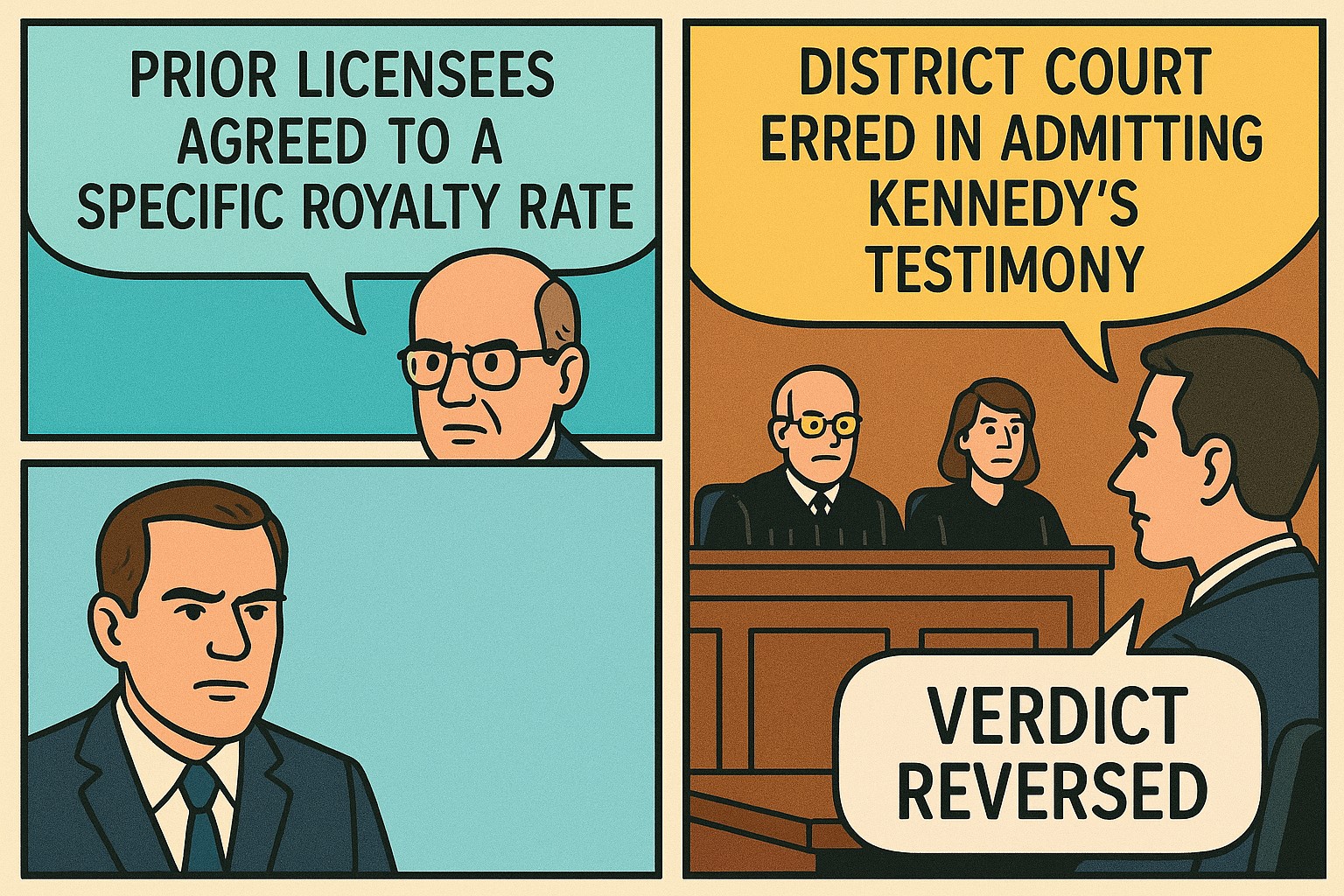
The Federal Circuit held that the existing licenses upon which Kennedy relied were insufficient, individually or in combination, to support his conclusion that prior licensees agreed to the $X royalty rate and therefore the district court abused its discretion in failing to exclude this testimony.
There is also evidence in the record supporting Google’s contrasting belief that none of Schneider, Daikin, or Johnson ever agreed to an $X rate. For example, the Schneider and Daikin agreements (though not the Johnson agreement) provided that the “[lump-sum] amount [paid by each licensee] is not based upon sales and did not reflect or constitute a royalty.”
In other words, the plain language of the Daikin, Schneider, and Johnson license agreements did not support Kennedy’s testimony that the licensees agreed to pay the $X per unit royalty rate.
The “whereas” recital of the Schneider license indicated that EcoFactor believes $X is a reasonable royalty, but it made it equally clear that Schneider did not agree that $X per unit is a reasonable royalty. Also, the “whereas” recital of the Johnson license indicated EcoFactor’s representation of its unilateral belief that $X constituted a reasonable royalty and did not provide a basis for Kennedy to testify that Johnson agreed to the $X rate. Same with Daikin.
Moreover, the federal circuit stated that Habib’s testimony did not provide a sufficient basis for Kennedy’s testimony that Daikin, Schneider, and Johnson agreed to pay a royalty of $X per unit.
Held
The Federal Circuit ruled that the district court should have granted Google a new damages trial because David A. Kennedy’s expert testimony—claiming the licenses proved the industry accepted an $X-per-unit royalty rate—lacked the solid facts and data that Rule 702 requires.
Key Takeaway:
The Court found that David Kennedy’s testimony that the licensees agreed to the $X per unit royalty rate was not supported by sufficient facts or data as required by Rule 702, rendering his opinion unreliable and inadmissible. The plain language of the licenses contradicted Kennedy’s assertion, and Habib’s testimony did not provide a sufficient factual basis. The Court held that the district court failed in its gatekeeping role under Daubert by allowing Kennedy to testify despite the lack of factual support for a critical premise of his opinion.
This putative class action was initiated by Plaintiffs, a group of individuals who are leaseholders of oil and gas leases, against Defendant XTO Energy Inc (“XTO”) alleging that XTO breached their leases when it deducted unreasonable and excessive post-production costs from their royalty payments.
John Burritt McArthur has been serving as an arbitrator for 22 years and working as a trial lawyer, representing Plaintiffs and Defendants in courts around the country, for 33 years. He has offices in Berkeley California and in Houston and is a past partner of Susman Godfrey LLP in Houston and Hosie McArthur LLP of San Francisco, both firms with national trial dockets.
Also, McArthur was Editor in Chief of the Texas Law Review, a Chancellor, and a member of the Order of the Coif in law school. He is a Phi Beta Kappa, magna cum laude graduate of Brown University. Moreover, McArthur clerked for Judge Joseph Sneed on the Ninth Circuit after law school.
In addition to his J.D., he holds an M.A. in economics, an M.P.A. from Harvard University’s Kennedy School of Government, and has graduate-level economics training from the London School of Economics and a Ph.D in public policy from the Goldman School of Public Policy at the University of California (Berkeley).
XTO argues that portions of McArthur’s reports should be stricken because McArthur improperly offers legal conclusions advocating for class certification under Fed. R. Civ. P. 23.
Plaintiffs did not dispute that McArthur’s reports consisted of some legal conclusions (and indicated they did not intend to offer that testimony as an expert opinion) but maintained the reports also consisted of testimony based on industry standard in the oil and gas field.
However, the Court held that McArthur’s reports highlighted by XTO largely offered legal opinions about whether Plaintiffs’ proposed class should be certified under the Fed. R. Civ. P. 23 factors and will not be considered in the forthcoming recommendation on the motion for class certification.
However, to the extent McArthur’s expert reports contain opinions based on standards, customs and practices of the oil and gas industry, the Court will consider those opinions where relevant.
Held
The Court granted XTO’s motion to exclude certain legal opinions by Plaintiffs’ expert John Burritt McArthur.
Key Takeaway:
Basically, experts are allowed to testify about customs and practices in a field of business but not whether those customs or practice complied with the law or regulations.
Therefore, where an expert offers a legal opinion, the court must “exclude opinions phrased in terms of inadequately explored legal criteria.”
Case Details:
Case Caption:
Kriley v. Xto Energy Inc.
Docket Number:
2:20cv416
Court Name:
United States District Court for the Western District of Pennsylvania, Pittsburgh Division
In early 2015, Plaintiffs, US Thrillrides, LLC (“USTR”) and Polercoaster, LLC began discussions with Defendant, Intamin Amusement Rides Int. Corp. Est. about partnering to build Polercoasters for Plaintiffs’ customers. The “Polercoaster” is “a roller coaster that is supported or suspended from a vertical tower instead of moving along a horizontal track.”
This case arises from a project to build a roller coaster at the Dubai Hills Mall. The developer of the Dubai Project, Emaar Entertainment LLC, originally entered into a Letter of Acceptance (“LOA”) agreement with Plaintiff US Thrillrides LLC (“USTR”) relating to the Dubai Project. However, Emaar ultimately terminated that agreement and contracted with Defendant to build a different roller coaster.
Basically, Plaintiffs filed claim for breach of the Confidentiality Non-Disclosure Agreement (“CNDA”) insofar as it is based on unauthorized use of Plaintiffs’ copyrights by Defendant and Plaintiff Polercoaster LLC’s (“Polercoaster”) copyright infringement claim.
Defendant filed a motion to exclude the testimony of Plaintiffs’ damages expert, Eric Lee while Plaintiff filed a motion to exclude the testimony of Defendant’s expert, Dr. Keith Ugone.
Accounting Expert Witness
Eric Lee is a financial and fraud expert with over 20 years of experience. He is a Certified Fraud Examiner (CFE) and Certified Insolvency and Restructuring Advisor (CIRA) and has a bachelor of science degree in accounting from Arizona State University.
Also, Lee has spent the last 15+ years in litigation, forensic and bankruptcy consulting, including the quantification of complex financial damages, lost profits, class action litigation, fraud investigations, reconstruction of financial records, corporate internal investigations, funds tracing, and other financial analyses.
Dr. Keith R. Ugone has provided economic and damages consulting services in antitrust cases, breach of contract cases, business interruption cases, class action certification matters, employment / loss of earnings cases, intellectual property cases, lender liability cases, professional negligence cases, and securities-related cases, among others.
Moreover, he specializes in the application of economic principles to complex business disputes and generally is retained in cases requiring economic analyses and/or damages-related analyses.
Plaintiffs’ claims are based on the breach of the CNDA due to unauthorized use of copyrights and copyright infringement. Lee’s expert opinions relate to actual damages, which are recoverable for both causes of action.
As is typical with damages expert opinions, Lee assumed that Plaintiffs will prevail on their substantive claims and that Plaintiffs are entitled to an award of actual damages. With those assumptions in place, Lee calculated the amount of damages that he opined would be appropriate.
Basically, Lee calculated two types of damages: (1) lost profits from consulting fees and royalty fees that Plaintiffs would have earned had the LOA not been terminated and their participation in the Dubai Project been completed; and (2) a reasonable royalty for the misappropriation of Plaintiffs’ intellectual property.
Lost Profits
Plaintiffs have not and cannot prove that Defendant caused the termination of the LOA or the end of Plaintiffs’ involvement in the Dubai Project. Multiple representatives involved in the decision to terminate Emaar’s relationship with Plaintiffs made clear that they would have chosen to have no roller coaster at the Dubai Hills Mall before they would have continued their relationship with Plaintiffs.
Therefore, the Court held that Lee’s opinions as to the amount of lost profits—i.e., the unpaid consulting fees and royalty contemplated under the LOA—will be excluded because Plaintiffs are not entitled to an award of such damages.
Reasonable Royalty
Lee’s opinions involve the calculation of a reasonable royalty for all of the intellectual property, confidential information, and trade secrets that Plaintiffs alleged were misappropriated or infringed in this case combined.
However, Lee did not break down the analysis by type of intellectual property or information. As relevant here, Lee’s opinions did not allocate a reasonable royalty to the use of Plaintiffs’ copyrights, specifically.
Without any basis to parse the damages allocated to copyright infringement—as opposed to patents, trade secrets, or confidential information which are no longer at issue—Lee’s opinions would only serve to confuse the jury.
The Court held that Lee’s opinions regarding the reasonable royalty, which do not allocate a royalty based on Plaintiffs’ copyrights specifically, must be excluded.
Keith Ugone
Plaintiffs sought to exclude the expert testimony of Defendant’s expert, Dr. Keith Ugone. As indicated by Defendant, Ugone is purely a rebuttal expert, offering a critique of Lee’s damages opinions. Because Lee’s opinions are being excluded, the Court held that Ugone’s opinions are no longer relevant and will also be excluded.
Held
The Court granted Defendant’s motion to exclude the testimony of Eric Lee.
2. The Court granted Plaintiffs’ motion to exclude Keith Ugone’s Testimony.
Key Takeaway:
To begin with, an expert’s offered opinion and the facts of the case must be an appropriate fit. There is no fit where a large analytical leap must be made between the facts and the opinion.
The Court excluded Lee’s opinions regarding the reasonable royalty because there is simply no “fit” between the facts remaining at issue in this case and the opinions rendered.
Please refer to the blog previously published about this case:
Plaintiff Multiple Energy Technologies, LLC (“MET”) accused Under Armour of false advertising in relation to certain products that contain bioceramic powder. MET contended that Under Armour inaccurately claimed that the Federal Food and Drug Administration had determined that those products enhanced recovery.
Under Armour sells activewear and sleepwear products directly to consumers. This includes the sale of products containing a competing bioceramic product known as Celliant, which is manufactured by Hologenix, LLC (“Hologenix”). Under Armour advertises these products separately from their other product offers and as helping to promote recovery, especially for athletes.
Plaintiff MET brought four claims against Defendant Under Armour, Inc.: violation of the Lanham Act, violation of the Sherman Act, misappropriation of trade secrets; breach of non-disclosure agreement; tortious interference with contract; tortious interference with prospective business expectancies; unjust enrichment; unfair competition; conversion; a claim for an accounting; and a claim for injunctive relief.
Under Armour retained Jerome Schmitt to rebut MET’s damages expert, Peter Wrobel. MET filed a motion to exclude the expert testimony of Under Armour’s accounting expert witness, Jerome Schmitt.
Accounting Expert Witness
Jerome B. Schmitt is a Certified Public Accountant (CPA) and is accredited in business valuation, certified in financial forensics, and a Certified Fraud Examiner.
He has extensive experience in calculating damages—including claims for monetary relief in trademark infringement, false advertising, and other Lanham Act cases—and in the valuation of intellectual property, including trademarks and trade names.
Schmitt earned his Bachelor of Science in Business Administration in Accountancy from John Carroll University in 2000. He followed this with a Master of Business Administration degree from the same institution in 2002.
Schmitt concluded that any disgorgement of Under Armour’s profits from the sale of Recover products would not exceed $151,162. This was based on several assumptions and methods, including the following:
He assumed that the appropriate time frame for the disgorgement analysis spanned from July 1, 2017, to December 31, 2020.
He applied the “full absorption” method and determined that certain costs qualified as appropriate deductions for purposes of calculating the profits subject to disgorgement.
He assumed factors beyond the alleged advertising, such as contributions from Under Armour’s brand value and advertising of the Recover products beyond the alleged false statements, should be taken into account in calculating profits subject to disgorgement.
He used the relief from royalty method to discount damages due to Under Armour’s brand value.
MET argued that Schmitt’s opinions:
I. addressed topics beyond his qualifications.
II. used unreliable methodology for calculating damages.
III. presented a serious risk of confusing the jury and were unfairly prejudicial.
The Court addressed each of these arguments.
I. Schmitt has not opined on topics beyond his expertise
MET claimed that Schmitt offered opinions that he was unqualified to give, regarding:
(1) the appropriate time frame for measuring damages arising out of false advertising;
(2) the value of Under Armour’s brand and how that value reduced the amount of profit realized from false advertising;
(3) the impact of Under Armour’s advertisements beyond the alleged false statements; and
(4) reasons as to why Under Armour would or wouldn’t enter into a contract with MET.
Time frame for measuring damages
Based on evidence in the record and for the purpose of his analysis, Schmitt assumed that a potential disgorgement of Under Armour’s profits would be limited to sales of Recover products from July 1, 2017, to December 31, 2020.
The Court found this assumption regarding the appropriate time frame perfectly acceptable. The Court observed that MET confused Schmitt’s assumption for calculating Under Armour’s profits attributable to false advertising as an opinion about marketing and advertising.
It was held that his assumption about the appropriate time frame for measuring damages relied on evidence in the record. Specifically, it was based on responses to interrogatories indicating that Under Armour’s advertisements referencing the FDA had ended by March 2020. Additionally, the Court found that MET did not identify any specific instances of alleged false advertising after 2020. Therefore, the Court was held that the assumption was permissible.
Brand valuation
Schmitt opined that Under Armour’s brand contributed to Under Armour’s ability to make sales of Recover products. He applied the relief from royalty method to reduce Under Armour’s profits from the sale of Recover product by the value of the Under Armour brand.
MET argued that Schmitt was not qualified to opine on Under Armour’s brand value or the impact that it had impact on profits. However, the Court disagreed.
Given his qualifications as a CPA with extensive experience in calculating damages and the valuation of intellectual property, the Court found that Schmitt was qualified to opine on brand valuation and on how Under Armour’s brand and intellectual property contributed to the profit on sales of Recover products.
Impact of Under Armour’s advertisements beyond the alleged false statements
Schmitt opined that Under Armour’s advertisements for Recover products “contain additional language and concepts that are not alleged to be false advertising.” These included references to “fast recovery, the use of bioceramic powder, and the product’s functionality.” He stated that, assuming a finding of liability, it was appropriate to account for the contribution of such language relative to the alleged false advertising.
Analysis
To begin with, the Court found that Schmitt was qualified to opine on factors that could appropriately be considered as part of the disgorgement analysis. The Court found that, contrary to MET’s argument, Schmitt did not opine on the impact that the advertising at issue had on sales of particular products, particularly because he did not purport to calculate the amount of profits attributable to the effect of advertising that is not alleged to be false.
When MET argued that Schmitt’s testimony on causation was inappropriate, the Court found that Schmitt stated in his report and deposition testimony that his analysis was based on “an assumption that there will be a finding of liability.” Schmitt further explained that, while the damages expert is not necessarily opining as to the liability of the alleged act, the damages expert cannot simply calculate damages that are untethered to the act.
In conclusion, the Court found that Schmitt’s damages opinion “did not attempt to define the law applicable to the case.” Instead, the conclusions he drew in his report, such as the propriety of accounting for the effect of “positive” advertising when assessing profits for disgorgement, were based on his apportionment analysis under the Lanham Act.
Schmitt merely opined that the disgorgement calculation could be further reduced by the profits that are not attributable to the alleged false advertising. To sum up, this fell into the category of “facts leading to a legal analysis,” not a “legal conclusion.”
Analysis of Wrobel’s “reasonable royalty” calculation
MET argued that Schmitt inappropriately opined on “reasons as to why Under Armour would or would not enter into a contract with MET.” However, the Court interpreted Schmitt’s report differently. Schmitt instead opined that Wrobel’s “reasonable royalty” calculation was speculative because of his assumption that, but for the alleged misconduct, Under Armour would have entered into an agreement with MET instead of Hologenix.
Schmitt disputed this assumption by citing the record. He noted “a number of factors that influenced [Under Armour’s] decision to switch from” MET to Hologenix, “that are independent of the alleged false advertising or other alleged wrongful conduct.”
The Court found that, in rebutting Wrobel’s expert report, Schmitt made permissible assumptions. In other words, these assumptions were “reasonably based on the evidence in the record.” It added that any weaknesses in the facts and assumptions underlying Schmitt’s opinion could be explored on cross-examination.
II. Schmitt may use the full absorption method to calculate costs, but the Court will hold in abeyance its decision on the relief from royalty method
A. Full absorption method
To determine the profits available for disgorgement, Schmitt applied the full absorption method. This method “deducts costs that assist in the production, distribution, or sale of the products at issue, irrespective of whether or not such costs are considered fixed or variable.” After reviewing Under Armour’s financial reports and having a discussion with an Under Armour employee, he concluded that certain costs included in Under Armour’s selling, general, and administrative expenses contributed to the sales of the Recover products at issue. He then deducted these costs from the revenue on Recover products.
MET argued that Schmitt’s use of the full absorption method was inappropriate because Under Armour would have incurred much of those fixed costs without selling the infringing product which is why the method failed to show that the costs and profits excluded from the disgorgement analysis were not attributable to the infringing product.
The Court decided not to exclude Schmitt’s testimony applying the full absorption method. Generally, in trademark infringement cases, courts have used two methods for apportioning costs:
a) The incremental approach “under which only direct costs of production are deducted.”
b) the full absorption approach “under which overhead costs are apportioned to production of the infringing item.”
According to the Court, MET was correct that, for a disgorgement analysis under the Lanham Act, the infringer “bears the burden of proving all elements of cost or deduction” and “has the burden to isolate the profits which are attributable to” the infringement.
However, MET’s criticisms of Schmitt’s application of the full absorption method concerned the weight of his testimony, not its admissibility. The Court held that these criticisms should be addressed through cross-examination of Schmitt, a crucial part of which would be his decision to use the full absorption method.
B. Relief from royalty method
To value the contribution of Under Armour’s intellectual property to the sale of its products, Schmitt used the relief from royalty method. Under this method, he applied a “market-based royalty for the subject intellectual property at issue as a reasonable proxy for the profit or value it contributes to the sale of products that use the intellectual property.”
Basically, to establish what the applicable royalty rate would be for the Under Armour brand, he looked at one instance in which Under Armour licensed its name and logo to an apparel distributor, through which Under Armour received a 14% royalty of the net revenue of apparel sold with its name or logo. He then reduced Under Armour’s profits from the sale of Recover products by 14%, to reflect the royalty that Under Armour “was relieved from paying by virtue of owning its brand.”
MET argued that Schmitt’s use of the relief from royalty method was improper because a hypothetical royalty amount isn’t a proper deduction when evaluating Lanham Act damages.
While Under Armour argued that “courts accept the apportionment of profits for contributions made by a Defendant in generating those profits,” it had not sufficiently established that the relief from royalty method had been subjected to peer review or that it is a generally accepted method for calculating proper costs or deductions in the Lanham Act context.
While the novelty of Schmitt’s methodology was “not a per se reason for exclusion,” the Court lacked a basis to decide whether his methodology was sufficiently reliable. Therefore, the Court declined to rule on whether Schmitt’s testimony applying the relief from royalty method should be excluded. The Court intended to hold an in limine hearing, with Schmitt in appearance-as to the relief from royalty methodology and its reliability.
III. The Court won’t exclude Schmitt’s report and testimony under Rule 403
MET argued that based on the purported deficiencies, Schmitt’s testimony presented a serious risk of confusing the jury and prejudicing MET as per Rule 403.
Balancing the probative value against the prejudice, the Court found that the probative value of Schmitt’s expert opinions was high. In other words, it was held that there was no danger of unfair prejudice. If any confusion or potential prejudice arose, the Court declared that it was open to curative jury instructions to assist the jury.
Held
The Court held that it would leave open the issue of whether Schmitt’s application of relief from royalty methodology is admissible under Rule 702. However, it denied MET’s motion to exclude expert Jerome Schmitt’s report and testimony in all other respects.
Key Takeaways:
The Court denied MET’s motion to exclude Jerome Schmitt’s testimony in all other respects for three main reasons:
Qualification and Expertise: The Court found that Schmitt did not exceed the scope of his expertise. His opinions regarding the timeframes, brand valuation, and advertising impact were all within his qualifications given his extensive experience in damages calculation and intellectual property valuation. The Court noted that Schmitt based his assumptions on evidence in the record and didn’t make impermissible legal conclusions.
Methodology: The Court accepted Schmitt’s use of the “full absorption” method to determine the profits available for disgorgement. The Court viewed MET’s criticism of the method as a challenge to its weight, not its admissibility. It determined that cross-examination could address these issues.
Rule 403 Balancing: The Court determined that Schmitt’s testimony had high probative value that outweighed any potential prejudice. Therefore, any risk of jury confusion could be addressed through curative jury instructions.
Please refer to the blogs previously published about this case:
Plaintiff Wireless Alliance, LLC (“Plaintiff” or “Wireless Alliance”) brought allegations against Defendants AT&T Mobility LLC, AT&T Services, Inc., and AT&T Corp. (“Defendants” or “AT&T”). Wireless Alliance asserted that AT&T infringed on several United States patents concerning enhancements to cellular networking systems. The patents in question include United States Patent No. 9,144,106 (the “‘106 patent”), Patent No. 9,565,662 (the “‘662 patent”), and Patent No. 10,045,383 (the “‘383 patent”), collectively referred to as the “Asserted Patents.” Wireless Alliance holds exclusive licensing rights for the ‘106 and ‘662 patents and owns the ‘383 patent through assignment.
Defendants filed a motion to strike the testimony of Wireless Alliance’s damages expert, Jim W. Bergman.
Intellectual Property Expert Witness
Jim W. Bergman, the Founder and President of Bergman Consulting, held a B.A. in Economics and an M.B.A. from the University of California at Irvine, along with a Chartered Financial Analyst (CFA) designation. He pursued a Master of Computer Science degree from the Georgia Institute of Technology.
Before establishing Bergman Consulting in 2017, he led Conway MacKenzie’s national intellectual property litigation group and worked as an in-house economic consultant for various national law firms for over a decade. With nearly ten years of experience in the information technology sector, Bergman obtained multiple industry-recognized certifications in hardware, software, and networking.
He specialized in intellectual property, commercial, and bankruptcy litigation, serving as a testifying or consulting expert in areas such as business litigation, patent and technology issues, trade secrets, trademarks, securities litigation, business valuation, bankruptcy reorganization, solvency, and general damages.
Defendants contended that Bergman improperly switched royalty bases by deriving a per-patent family device rate for Ericsson’s portfolio and applying it to the service revenues of the carriers. They argued that this methodology contradicted Federal Circuit precedent, as the royalty should depend on whether the Defendant manufactured the device or was the end user. The carriers maintained that no carrier would pay a royalty based on Ericsson’s cellphone or infrastructure rates based on the carrier subscriber revenue. However, the Court found that Defendants did not provide sufficient grounds to strike Bergman’s report under Rule 702 and Daubert. The Court determined that Defendants’ concerns highlighted credibility disputes rather than issues of reliability.
B. Entire Market Value Rule and Apportionment
Defendants further sought to strike Bergman’s report, alleging that he improperly used the entirety of their subscriber revenue, raising concerns that the Plaintiff aimed to present large revenue numbers to influence the jury’s perception of damages. However, the Parties had already agreed to a motion in limine addressing this concern. Defendants also argued that Bergman misapplied the Entire Market Value Rule (EMVR) without adequate support. In response, the Plaintiff asserted that Bergman conducted multiple patent- and Defendant-specific analyses, supported by technical opinions, to calculate apportionment factors for the incremental value of the infringing features over non-infringing features. And based on that, apportioned the revenue from the allegedly infringing features and thus did not implicate the EMVR. The Court was satisfied that Bergman’s approach did not invoke the EMVR. What remains is a fact issue.
C. Unreliable Patent Rates
Additionally, Defendants argued that Bergman made two methodological errors: first, by improperly applying essentiality studies of declared patents to charted patent families, and second, by basing his reliance on a certain claim that the top 10% of patents in a portfolio drive 84% of the value. They also pointed out inconsistent statements from the Plaintiff’s other expert. In contrast, Plaintiff contested Defendants’ view, asserting that Bergman used the claim in question only in the final step to differentiate apportionment rates between high-value and lower-value patents. The Court allowed Defendants to cross-examine Bergman regarding potentially inconsistent statements but found no basis to strike his testimony.
Legal Standards
An expert witness may provide opinion testimony if “(a) the expert’s scientific, technical, or other specialized knowledge will help the trier of fact to understand the evidence or to determine a fact in issue; (b) the testimony is based on sufficient facts or data; (c) the testimony is the product of reliable principles and methods; and (d) the expert has reliably applied the principles and methods to the facts of the case.”
Importantly, in a jury trial setting, the Court’s role under Daubert is not to weigh the expert testimony to the point of supplanting the jury’s fact-finding role; instead, the Court’s role is limited to that of a gatekeeper, ensuring that the evidence in dispute is at least sufficiently reliable and relevant to the issue before the jury that it is appropriate for the jury’s consideration
Held
The Court denied Defendants’ motion to strike the testimony of Plaintiff Wireless Alliance LLC’s damages expert, Jim W. Bergman.
Key Takeaways:
The Court upheld Bergman’s methodology when Defendants argued he improperly switched royalty bases, declaring it to be insufficient grounds for exclusion. It rejected concerns that his use of subscriber revenue aimed to unduly influence the jury’s perception of damages, noting this issue had been addressed in a prior motion in limine. While Defendants claimed Bergman misapplied the Entire Market Value Rule (EMVR), the Court determined he conducted adequate analyses to support his calculation of the apportionment factors.
Please refer to the blog previously published about this case:
In this trademark infringement action, Plaintiffs, Makina Ve Kimya Endustrisi AS (“MKE”) accused the Defendants, A.S.A.P. Logistics Ltd. of engaging in massive fraud when they offered to sell millions of rounds of Plaintiff’s military goods, to multiple purchasers, without permission or right.
MKE’s damages expert, Pamela O’Neill, opined that MKE suffered millions of dollars in damages. She offered three alternative bases of calculating MKE’s alleged damages: $11.175 million for a reasonable royalty, $7.4 to $8.1 million for corrective advertising costs, or a “floor calculation” of $4.34 million for lost profits from a single customer. Defendants moved to have O’Neill’s opinions excluded.
Reasonable royalties are an especially bad fit here, where there was no licensing agreement ever contemplated between the parties, no sales related to the infringing use, and no rationale for why a licensing agreement would have ever been agreed to.
Business Valuation Expert Witness
Pamela O’Neill has spent more than 30 years as a valuation professional and has directed more than 900 valuation assignments. Early in her career, she was called to testify before the New York Stock Exchange Arbitration Panel and was cited by the Panel as “an excellent expert witness”.
Her international valuation career has included significant assignments in North America, South America, Europe, Asia, the Middle East, Australia, and New Zealand. She has prepared expert reports for litigation purposes as well as for financial and tax reporting, dispute resolution, investigations, antitrust matters, negotiations, acquisitions, divestitures, reorganizations, solvency and bankruptcy.
The Court held that O’Neill’s use of a reasonable-royalty model is not a fit for the facts of this case.
In addition, her calculation of the royalty rate is plainly unreliable. Since O’Neill could not rely on a licensing agreement that the parties had with each other or with third parties, she attempted to identify comparable licensing agreements. But the six licensing agreements she cites are far from comparable. O’Neill did not actually review the licensing agreements themselves. Instead, she reviewed summaries of transactions available on a database. Also, Defendants say that two other transactions involved celebrity endorsement deals. O’Neill’s report does not acknowledge any of these differences or explain how she accounted for them in her calculation.
O’Neill applied a royalty rate of 5% (gleaned from these allegedly comparable licenses) not to Defendants’ sales—because there were none—but rather to two transactions that resulted in no sales: an unsigned contract with TD Group for $216 million, and an unfulfilled $7.5 million purchase order and invoice relating to M42, resulting in a calculation of $11.175 million in damages.
In selecting these transactions, her report simply states that they were chosen because TD Group and M42 “intended to enter into and be bound by these contracts.” O’Neill does not point to any evidence that a hypothetical negotiation between the parties would have been informed by these deals (which arose after the infringement commenced), anything in the parties’ dealings with each other or third parties that would support their use, or anything from the allegedly comparable licenses to support this kind of royalty base. Plus, O’Neill does not even address the fact (which MKE does not dispute) that the TD Group contract allowed the purchase of “up to” $216 million in ammunition but did not have any minimum purchase requirement.
Lost Profits
Defendants did not put forward a traditional lost-profits model of damages, and O’Neill confirmed that there was insufficient evidence to support such a model.
MKE pointed to O’Neill’s expert report, which it says “directly ties Defendants’ misconduct to MKE’s lost profit damages.” MKE says that O’Neill relied on an interview she did with John Sharpley, the individual who handles procurement and contractual issues for non-party Shawnee Outdoors, in reaching her conclusions. Sharpley allegedly told O’Neill that he had conversations with Bear Tactical’s CEO. But “a party cannot call an expert simply as a conduit for introducing hearsay under the guise that the testifying expert used the hearsay as the basis of his testimony.”
MKE contended that O’Neill may properly rely on otherwise inadmissible “facts or data” as a basis for her opinion. But here MKE is just using O’Neill to skirt the rules of evidence by having her relay double hearsay to the jury on an issue of historical fact as to which her expert opinion would not be permitted—the reasons for Bear Tactical’s termination of its contract. O’Neill’s testimony cannot serve as factual support that MKE’s lost profits from Bear Tactical can be attributed to Defendants.
Due to the lack of admissible evidence linking MKE’s claimed lost profits to Defendants, the Court did not consider Defendants’ motion to exclude O’Neill’s lost-profits calculations.
Corrective Advertising
The Court held that O’Neill’s so-called expert analysis simply involved a calculation of the relative increase in MKE’s “Marketing, Sales & Distribution” expenses for the first half of 2022. As a threshold matter, the Court notes that while O’Neill’s report was required to include “a complete statement of all opinions the witness will express and the basis and reasons for them,” her discussion of corrective advertising damages is limited to two paragraphs and a related exhibit containing calculations. Those paragraphs and the exhibit don’t explain the specifics of what the “Marketing, Sales & Distribution” category contains, does not explain why advertising—as opposed to some other factor—accounted for the increase in that line-item for 2022, and provides no basis—not even explaining conversations had with MKE—to attribute that increase to corrective advertising due to Defendants’ conduct.
O’Neill admitted that she did not know what was encompassed within the sales component or the distribution component of the figure and said the expenses that these categories may include are different for each company.
The Court held that O’Neill therefore lacked reliable basis to conclude that the increase of the “Marketing, Sales & Distribution” figure (which may or may not have included MKE’s advertising that may or may not have taken place in response to Defendants’ conduct) was an accurate approximation of corrective advertisement in this case.
As the Court can see, O’Neill did not rely on any information, such as the underlying expenses that made up the financial data. In fact, MKE never provided O’Neill that data despite her specific requests.
Held
The Court granted in part the Defendants’ motion to exclude Pamela O’Neill’s opinions.
Key Takeaway:
The Court cannot ignore the limited number of licensing agreements that O’Neill considered, the differences identified between those licensing agreements and the alleged hypothetical negotiation here, and O’Neill’s failure to acknowledge or account for these differences in her report.
The Court noted that O’Neill was left to rely on MKE’s sayso that calculating the change in the “Marketing, Sales & Distribution” expenditure would measure corrective advertisement. And since the Court does not even know who provided O’Neill these assurances, the Court cannot verify just how reliable that source of information was. All to say, as an expert witness, O’Neill was not permitted to simply rely on her client’s assurances that it expended money.
Case Details:
Case Caption:
Makina Ve Kimya Endustrisi A.S V. A.S.A.P. Logistics Ltd Et Al
On June 11, 2021, Utherverse filed a patent infringement complaint against Epic, alleging that four Fortnite events (the “Accused Events”) violated the ‘071 Patent and the ‘605 Patent, collectively known as the “Asserted Patents.” These patents relate to enabling numerous participants to connect in a virtual computer-generated environment for shared virtual experiences. The current issue before the Court involves Epic’s Daubert motion to exclude Utherverse’s damages expert, Michele Riley. Judge Theresa L. Fricke, United States Magistrate Judge, issued a Report and Recommendation, which pushed for denying the motion to exclude the testimony of Michele Riley.
Finance Expert Witness
Michele Riley is a Managing Director at Stout, specializing in complex litigation consulting for breach of contract, unfair competition, investigations, and compliance. She holds certifications as a Certified Public Accountant, Certified Fraud Examiner, and is Certified in Financial Forensics. Riley specializes in assessing intellectual property damages and valuation. She has testified in cases involving patent, trademark, and copyright infringement, as well as trade secret misappropriation.
Discussion by the Court
According to the Court’s decision in Exmark Mfg. Co. v. Briggs & Stratton Power Prods. Grp., LLC, 879 F.3d 1332, 1347 (Fed. Cir. 2018), it was established that when reviewing damages in patent cases, the Federal Circuit applies regional circuit law to procedural issues and Federal Circuit law to substantive and procedural issues related to patent law. In reviewing motions to exclude expert testimony related to patent royalties, the Federal Circuit has applied its own law.
Judge Fricke, citing Lucent Techs., Inc. v. Gateway, Inc., 580 F.3d 1301, 1324 (Fed.Cir.2009), observed that two alternative methods exist for calculating damages in a patent case; they “are the patentee’s lost profits and the reasonable royalty he would have received through arms-length bargaining.” To calculate the reasonable royalty, patentees generally consider a hypothetical negotiation, in which the asserted patent claims are assumed valid, enforceable, and infringed, and attempt “to ascertain the royalty upon which the parties would have agreed had they successfully negotiated an agreement just before infringement began.” This hypothetical negotiation “necessarily involves an element of approximation and uncertainty.” In determining the reasonable royalty that would have been agreed to at the hypothetical negotiation, parties in patent cases frequently utilize the fifteen factors enunciated in Georgia-Pacific Corp. v. U.S. Plywood Corp., 318 F.Supp. 1116, 1120 (S.D.N.Y.1970).
In Lucent Technologies Inc. v. Microsoft Corporation, 580 F.3d at 1326, it was established that a hypothetical negotiation can result in either a lump-sum license or a running royalty license. A lump-sum license is an up-front payment in full for the invention that involves uncertainty about “whether the technology is commercially successful or even used.” In contrast, a running royalty license is directly tied to how often the invention is incorporated into products by the licensee and is calculated by multiplying the proposed royalty rate by the proposed royalty base. The burden of proving damages falls on the patentee.” To properly carry this burden, the patentee must sufficiently tie the expert testimony on damages to the facts of the case.
Judge Fricke stated that Riley’s analysis began with a general overview of the parties’ industries, the parties themselves, and the Accused Events. She explained that, based on her discussions with Craig Rosenberg, Utherverse’s technical expert, she understood that the Asserted Patents involved enabling a large number of participants to connect in a virtual computer-generated environment for shared virtual experiences. She calculated the royalty base by determining the revenue attributable to the Accused Events, including microtransaction purchases made by Fortnite users through the in-game currency. This encompassed items specifically available for the Accused Events in the Fortnite Item Shop, incremental revenue from microtransaction purchases related to the Accused Events, and the value to Epic of new and returning users due to the Accused Events.
For determining the royalty rate, Riley analyzed Utherverse Digital agreements, explaining their relevance in a hypothetical negotiation. After reviewing various data points and assessing their significance in a hypothetical negotiation, Riley made her conclusions about the royalty rate range known. She partially relied on the 2020 Royalty Rate Industry Summary from IPSCIO Reports.
Georgia-Pacific factor 1 considers: “The royalties received by the patentee for the licensing of the patent in suit, proving or tending to prove an established royalty.” Judge Fricke citing Wordtech Sys. v. Integrated Networks Solutions, Inc., 609 F.3d 1308, 1320 (Fed.Cir. 2010), held that a patentee may not rely on license agreements that are ” ‘radically different from the hypothetical agreement under consideration’ to determine a reasonable royalty.” Further, “comparisons of past patent licenses to the infringement must account for ‘the technological and economic differences’ between them.”
Ephere was engaged in computer graphics and software development, specializing in designing and implementing software solutions for computer graphics, film, and games, extending existing software for new functions, and providing consulting and support in the film and games industry. Epic argued that Riley inappropriately used the Ephere license as a substitute for apportionment, as she did not demonstrate sufficient comparability. Specifically, Epic contended that Riley failed to analyze the technological comparability between the ‘962 Patent from the Ephere license and the Asserted Patents. The Court was urged to conclude that Riley had not established a baseline comparability between the technology in the Ephere License and the Asserted Patents.
But Judge Fricke observed that in addition to providing a summary of the ‘962 Patent and the background of the invention itself, Riley also discussed the relationship between the patent from the Ephere license and the Asserted Patents. Judge Fricke determined that, according to Federal Circuit precedent, Riley needed to demonstrate baseline comparability between the ‘962 Patent and the Asserted Patents. It was noted that she had fulfilled this requirement in her report. Any further examination of the similarities and differences between the two was considered a factual matter rather than a methodological one and could be addressed during cross-examination.
Epic asserted that Riley couldn’t rely on Epic’s internal document about payment to an artist of one of the Accused Events, Epic’s merchandise agreements, a published industry report, and a Utherverse Digital license agreement to establish her royalty base. Judge Fricke, referencing Microsoft Corp. v. Motorola, 904 F.Supp.2d 1109, 1118 (W.D. Wash. 2012), found that these documents provided some indication of the appropriate initial royalty rate, making Riley’s testimony admissible. For instance, the merchandise agreements involved Epic and certain artists linked to the Accused Events, while the Utherverse Digital agreement supported Riley’s opinion on a suitable royalty rate.
Regarding Epic’s internal document and the IPSCIO industry report, these were among various data points Riley used in her royalty rate analysis. Judge Fricke asserted that she clarified the relevance of these documents and their connection to her analysis, leaving the degree of comparability for cross-examination rather than a Daubert motion.
Defendant Epic Games, Inc. (“Epic”) respectfully objected to the Report and Recommendation concerning the motion to exclude the testimony of Riley on the following grounds:
The R&R had erroneously recommended that the Court find Riley demonstrated the required baseline technological comparability between the license agreement she relied on and the technology at issue in this case. The record did not support such a finding, and holding otherwise on this record would have been contrary to binding Federal Circuit precedent.
The R&R had not addressed Epic’s motion to exclude Riley’s royalty rate opinion for failing to apportion damages. Adopting the R&R and allowing Riley to present a damages theory that failed to apportion damages would have been contrary to established Federal Circuit law.
The R&R’s finding that certain “comparable transactions” would inform the starting point of a royalty rate was clearly erroneous because those transactions were not patent licenses and were in no way economically or technologically comparable to the facts of this case.
After reviewing the Report and Recommendation of Judge Fricke as well as the objections to the Report and Recommendation, the Court adopted the Report and Recommendation.
Held
The Court denied Epic Games, Inc.’s motion to exclude Utherverse Gaming, LLC’s damages expert, Michele Riley. The Court has not arrived on an outcome for this case since the remaining issues involved in this case still await resolution.
Key Takeaways:
The Court scrutinized Riley’s analysis, noting her thorough examination of industry, parties, and events involved. The analysis included determining the royalty base and rate, involving a hypothetical negotiation and reliance on Utherverse Digital agreements. The Court acknowledged the inherent approximation and uncertainty in such assessments but deemed Riley’s methodology admissible. This demonstrates the Court’s consideration of the application of established principles in patent cases.
Concerns were raised by Epic regarding Riley’s use of the Ephere license and other documents for establishing the royalty base. The Court, citing Federal Circuit precedent, required Riley to demonstrate baseline technological comparability, which was found to be fulfilled in her report. The Court acknowledged that further exploration of similarities and differences could be addressed during cross-examination, highlighting the importance of factual matters in such evaluations.
Epic’s objection to the use of certain documents, including an internal document, merchandise agreements, and industry reports, was addressed by the Court. The Court, referencing relevant legal precedent, found these documents provided indications of an appropriate initial royalty rate, supporting the admissibility of Riley’s testimony. The Court emphasized the role of cross-examination in assessing the degree of comparability, showcasing a balanced approach to the admissibility of evidence.
In summary, the Court’s decision underscores the importance of adherence to established legal principles in patent cases, including the use of regional circuit law and Federal Circuit law, the consideration of two primary methods for calculating damages, and the scrutiny of expert testimony methodologies. The decision reflects a nuanced approach, allowing for cross-examination to address factual matters while ensuring the admissibility of expert opinions based on sound methodology.