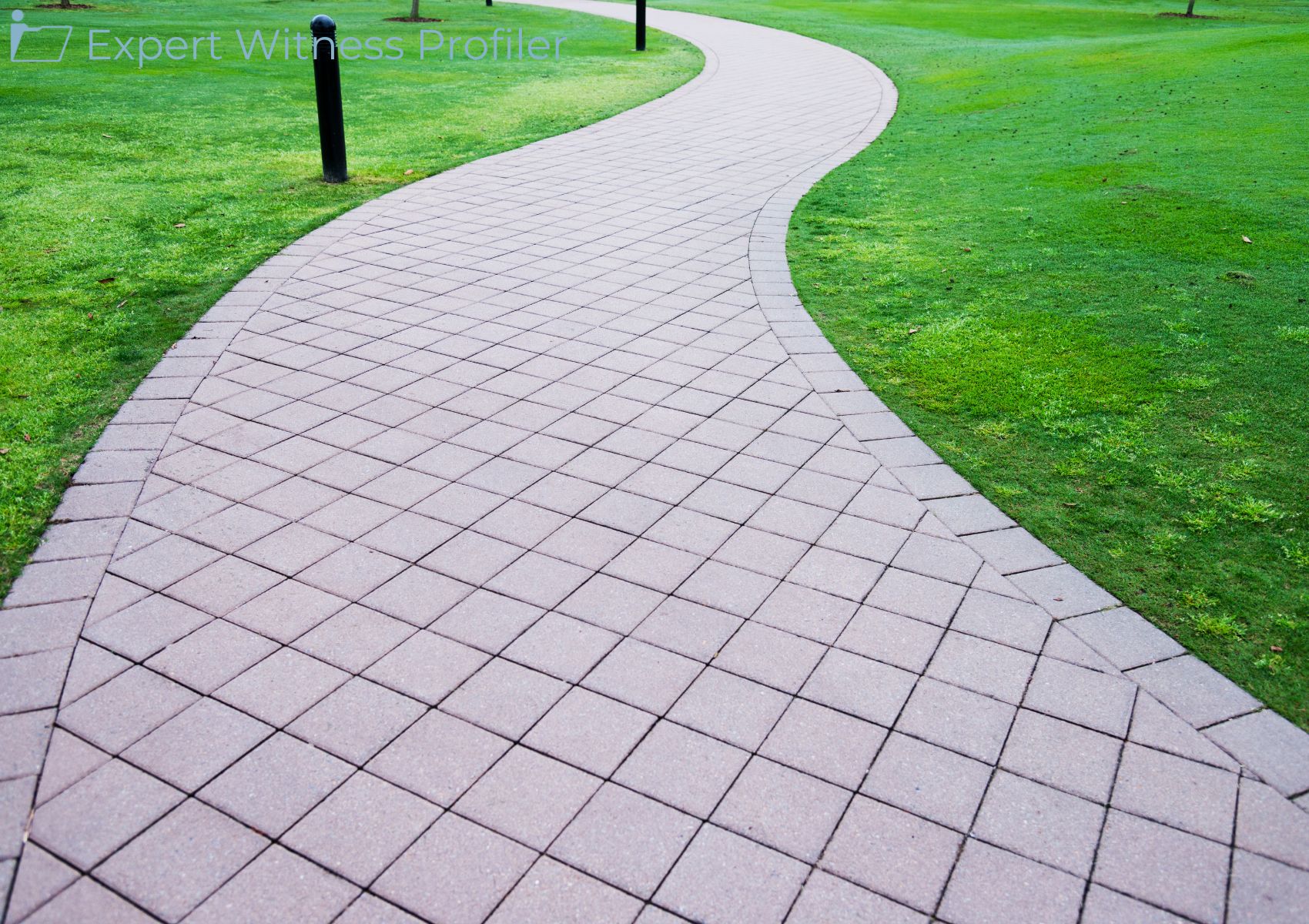
In this facially simple premises liability lawsuit, Plaintiff Stephanie Lewis sought to recover damages incurred when she tripped and fell on the front walkway of Samuel B. Heggie, Jr.’s home while she was delivering a pizza in February 2020. Samuel Heggie having died during the pendency of this lawsuit, the Plaintiff now proceeds against the Estate of Samuel B. Heggie, Jr., represented by Patrick Heggie as the Administrator ad Litem.
Plaintiff filed a motion in limine to exclude the testimony of Defendant’s liability expert, Brian Grieser, while the Defendant filed a motion in limine to exclude the testimony of Plaintiff’s expert, David Johnson.
Engineering Expert Witness
David Patrick Johnson P.E., CSP is a Licensed Professional Engineer in the State of Tennessee and a Certified Safety Professional. He has over 32 years of experience in safety engineering, including work involving walkway safety and sidewalks.
Human Factors Expert Witness
Brian C. Grieser P.E., C.P.S.M., CSP, CPE has extensive experience in conducting evaluations in a wide range of product, occupational, and premises projects involving litigation as well as proactive consulting. His assessments have included walkway slip resistance; recreational boat design; watercraft occupant safety; towed watersports safety; time and motion studies; work sampling; human vibration and acceleration exposure; sound measurement and analysis; and human movement, climbing, and stability analysis.
Grieser is a member of several professional societies including the Human Factors and Ergonomics Society, ASTM International, the Society of Naval Architects and Marine Engineers, the American Boat and Yacht Council, and USA Water Ski & Wake Sports.
Discussion by the Court
It is undisputed that the Plaintiff tripped on a vertical displacement—i.e., a raised lip—of approximately 0.8 inches in the front walkway leading from Heggie’s driveway to the front door of Heggie’s house. It is also undisputed that Heggie was aware of the condition of the front walkway. The parties dispute whether the defect in the walkway (or sidewalk, as the parties refer to it) created an unreasonably dangerous condition.
David Johnson
A. The Parties’ Arguments
Johnson opined that the pedestrian falls on sidewalks are often the result of the failure of the property owner or other responsible person to maintain the sidewalk in a reasonably safe condition. According to Johnson, if cracks in sidewalks are greater than 1/4 inch, this can create a trip hazard because it is unexpected; if such variances are found, repairs should be made.
Johnson concluded that the walkway would be considered substandard and hazardous by ANSI and ASTM standards.
The Defendant characterized Johnson’s opinions as largely concerning matters of common sense dressed up with technical language, or “common experience gilded by the expert’s credentials.” As for reliability, the Defendant contended that (1) many of Johnson’s opinions consisted of verbatim quotations from insurance company websites that Johnson found doing a Google internet search that Johnson himself characterized as “doing some research on some different aspects of trip-and-fall cases” and (2) Johnson’s references to various “safety standards” and “codes” are unreliable, insofar as he admits that none of the standards he cites apply to single-family residences, and none has been adopted by any Tennessee court or Sumner County authority.
In response, the Plaintiff argued that Tennessee courts have held that whether a sidewalk is unsafe can be established by expert testimony.
B. Discussion
1. Relevance
Several of Johnson’s opinions are based on the failure of the walkway to meet various international standards and codes, including (1) the International Residential Code (“IRC”), which incorporates by reference the International Property Maintenance Code and had been adopted by Sumner County at the time of the incident; (2) the American Standards for Testing and Materials (ASTM) F 1637-2013 Standard Practice for Safe Walking; (3) the American National Standard Institute (“ANSI”) standard 1264.2-2006; (4) standards promulgated by the National Institute of Occupational Safety and Health (“NIOSH”); and (5) the International Code Council (ICC)/ANSI A117.1-2017-American National Standard for Accessible and Usable Buildings and Facilities.
In his deposition, Johnson conceded that the ANSI and NIOSH standards apply to workplaces, not residences. The ICC/ANSI standards to which he refers pertain to accommodations for persons with disabilities. These standards are irrelevant in this case, which involves a private residence, and Johnson’s reliance on them is misplaced and, moreover, will not assist the jury in determining whether the Defendant was negligent.
The Plaintiff contended that the IRC code has been adopted by Sumner County and so is clearly applicable. However, the standard contains nothing outside what the common law negligence standard of care establishes. An expert is not required to establish the common law negligence standard.
Finally, regarding the ASTM F 1637-2013 Standard Practice for Safe Walking, the plaintiff argues that the question of whether this standard has been adopted by Sumner County is irrelevant, because it is a national standard and provides a relevant guide for determining the reasonableness of the Defendant’s conduct in failing to repair the walkway. However, this is not a negligence per se case. The Court finds that this standard, too, is irrelevant to the question of whether the Defendant in this case exercised reasonable care.
2. Reliability
The Court found that Johnson’s opinions as a whole will not assist the jury in determining any fact at issue in this case. Moreover, insofar as he appears to have derived many of his opinions directly from insurance company websites, from which he quotes verbatim, and from a manual drafted by a lawyer and intended as litigation support in premises liability cases, those opinions did not rest on a reliable foundation.
The Plaintiff simply has not established that Johnson’s proposed opinions are the “product of reliable principles and methods” or that they “reflect a reliable application of the principles and methods to the facts of the case.”
Brian Grieser
The Defendant sought to offer the expert opinions of Brian Grieser, a consultant with Applied Safety + Ergonomics, a Rimkus Company, to rebut the testimony of the Plaintiff’s expert. He sought to offer the following opinions:
- As Lewis approached the area of her fall, the subject condition would have been in her field of view and available to be seen.
- Because of the contrast in color, texture, and depth related to the section of the concrete sidewalk that had settled, the subject condition would have been conspicuous and detectable against the neighboring unsettled concrete.
- From a human factors perspective, it is reasonable to expect that a pedestrian will encounter pavement conditions that will need to be attended to during normal everyday walking.
- Immediately prior to the incident, Lewis did not give sufficient attention to where she was walking, which contributed to her incident.
- Had Lewis paid sufficient attention to the area where she was walking as she approached the settled pavement, she could have changed her gait or path to avoid tripping and falling on the subject condition.
- Given that the subject condition would have been conspicuous and was a common condition, no additional warning was needed to inform Lewis of its presence.
- Johnson’s opinions conflict with published research related to pedestrians successfully navigating sidewalks outdoors with elevation changes substantially greater than 1/4-inch.
- Johnson cited several standards in his report that were not applicable to the subject property and were unlikely to have been known by a homeowner such as Heggie.
- Johnson did not provide a basis in his report to indicate that the subject condition was a recognized hazard to a typical homeowner.
Analysis
Having already found that Johnson’s opinions will not assist the trier of fact, the Court found that Grieser’s first six opinions are excludable for the same reason.
These opinions offer nothing that a reasonable jury could not determine on its own without the assistance of expert testimony. The rest of the opinions, the sole purpose of which is to rebut Johnson’s testimony, are unnecessary, as the Court has determined that Johnson will not be permitted to testify.
Held
The Court excluded the testimony of both the Plaintiff’s proposed expert, David Johnson, and the Defendant’s proposed expert, Brian Grieser.
Key Takeaway
As set forth above, under Daubert, courts assess the reliability of scientific testimony by considering such factors as (1) whether the [expert’s] theory or methodology has been or can be tested; (2) whether it has been subjected to peer review; (3) whether it has a known or potential rate of error; and (4) whether it has been generally accepted in the scientific community. None of these showings has been made here.
Case Details:
| Case Caption: | Lewis V. Heggie, Jr. |
| Docket Number: | 3:24cv501 |
| Court Name: | United States District Court, Tennessee Middle |
| Order Date: | December 30, 2025 |