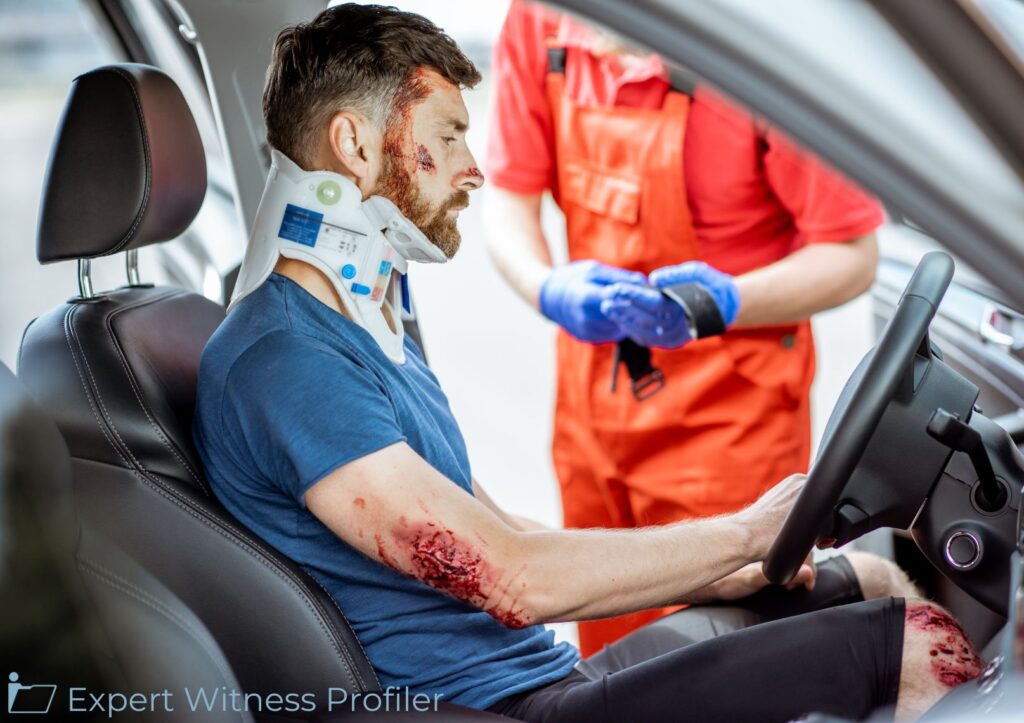
Plaintiff Sabrina Solomon was involved in a motor vehicle accident (“MVA”) in April 2021 that left her with “a permanent injury to the body as a whole” leading to this underinsured motorist benefits and loss of consortium case.
One of Defendant’s expert witnesses, Dr. Richard A. Ofstein, emphasized that Plaintiff Sabrina Solomon’s brain imaging was “most consistent with, if not diagnostic for, an incidental cavernous angioma,” rather than a TBI. As for her spine and shoulder injuries, Ofstein opined these were consistent with aging or “degenerative” changes or disease, rather than an acute trauma.
In reaching the opinions outlined in his report, Ofstein consulted the medical records for Plaintiff Sabrina Solomon that were provided to him, including numerous diagnostic images (MRIs and angiograms).
Plaintiffs filed a motion to exclude Ofstein from testifying at trial. According to them, “ Ofstein is not qualified to give such opinions,” “his opinions are not based on sufficient facts and data,” and “his opinions are not based on a reliable scientific methodology.”
Radiology Expert Witness
Richard Alan Ofstein is a radiologist with over forty years of experience. He is board certified in Diagnostic Radiology and has a Certificate of Added Qualifications in Neuroradiology. He is currently an Adjunct Assistant Professor of Radiology at the University of Utah and previously worked as an Assistant Clinical Professor of Radiology at the UCLA School of Medicine. Additionally, Ofstein worked in private practice for most of his career.
Plaintiffs argued that Ofstein is not qualified to give the opinions from his report. According to them, “although Ofstein might be qualified to give radiology opinions, i.e., what he sees on Plaintiff’s diagnostic imaging, he is not qualified to give opinion testimony on the specific causation of injury that might arise as a result of a motor vehicle accident, nor the appropriateness or relatedness of any treatment incurred or to be incurred by Plaintiff Sabrina Solomon.”
The Court disagreed. A radiologist may opine on the likely cause of an injury observed in radiological imaging, such as whether an injury results from an acute trauma or degeneration. Furthermore, Ofstein made clear in his deposition that he was not opining on the medical appropriateness of Plaintiff Sabrina Solomon’s spinal and shoulder surgeries. Rather, Ofstein clarified that he was “addressing the relationship of the need for surgery and the accident at issue.”
In other words, Ofstein’s opinion on the surgeries was appropriately limited to the fact that the injuries addressed by those surgeries were not caused by the motor vehicle accident. This opinion falls within the expertise of a radiologist.
Methodology
According to Plaintiffs, Ofstein’s methodology in reaching his opinions was unreliable. They complained that “Ofstein’s opinions are not founded on any established scientific method” because “he solely relies on the deposition of the Plaintiff in performing his clinical correlation and coming to his opinions.” Plaintiffs also contended that Ofstein’s “opinions are not based on sufficient facts or data”: “Ofstein’s deposition testimony shows that his opinions on causation and relatedness or appropriateness of treatment were based only on him looking at the radiological studies and medical records from [Plaintiff Sabrina Solomon’s] treating providers after the subject accident.” Thus, in Plaintiffs’ view, “Ofstein’s opinion in this case lacks the proper informational foundation to opine on causation and relatedness or appropriateness of medical treatment.”
Again, the Court disagreed. Ofstein used a trustworthy methodology in reviewing Plaintiff Sabrina Solomon’s radiological images in reaching his conclusions.
The fact that Ofstein “did not review any of Plaintiff’s medical records outside of the radiology reports produced by Plaintiff’s treating physicians” did not render his methodology unreliable. Ofstein’s review of the radiological imaging, the radiology reports from Plaintiff Sabrina Solomon’s treating physicians, as well as the police report from the accident and Plaintiff Sabrina Solomon’s deposition, supports that he applied a sufficiently trustworthy methodology in reaching his opinions.
Held
The Court denied the Plaintiffs Sabrina and Stanford Solomon’s Daubert motion to exclude causation and appropriateness of treatment opinions of Defendant’s expert, Dr. Richard Ofstein.
Key Takeaway:
The methodology used by Ofstein is standard and consistent with the literature and methodology used by radiologists in the United States. The fact that the expert radiologist did not review Plaintiff’s complete medical records did not render his methodology unreliable. In fact, it is consistent with the way that radiologists interpret films every day.
Case Details:
Case Caption:
Solomon Et Al V. Aig Property Casualty Company
Docket Number:
8:24cv2650
Court Name:
United States District Court for the Middle District of Florida, Tampa Division
Plaintiff Ellen Thomas brought this action against Defendant Smith’s Food & Drug Centers alleging negligence relating to a slip and fall in December 2020.
Defendant filed a motion to strike the testimony of Plaintiff’s expert, Dr. James J. Lynch, regarding future possible medical treatment and the cause thereof.
Plaintiff saw Lynch, at Swift Institute, on March 8, 2023, for low back pain, right lower extremity pain, and right knee pain. Because Plaintiff had failed conservative treatment measures, Lynch recommended a lumbar surgery to treat Plaintiff’s low back pain. Surgery was originally scheduled for April 27, 2023.
On October 5, 2023, the Court entered a discovery plan and scheduling order which set the expert disclosure deadline for January 4, 2024, the rebuttal expert disclosure deadline for February 5, 2024, and the discovery cutoff for March 4, 2024. On January 5, 2024, Plaintiff served her non-retained expert witness disclosure that included Lynch.
After the close of discovery, Defendant moved to exclude any evidence of future damages. The Court specifically denied Defendant’s motion to exclude future back surgery, finding Plaintiff’s failure to formally disclose Lynch as a witness harmless under the circumstances. Pursuant to that holding, the Court allowed a limited re-opening of discovery so that Defendant could depose and review the records and testimony of Lynch.
During his deposition, Lynch testified that Plaintiff’s low back pain was caused by the December 2020 slip and fall, which necessitated surgery. Defendant subsequently filed a motion to strike evidence, testimony, and opinions of Lynch. After Defendant filed the motion to strike, the Court ruled that because Lynch is a treating doctor who was disclosed as a non-retained expert, he did not need to be disclosed as a retained expert.
Neurosurgery Expert Witness
James J. Lynch, MD, FACS, FAANS is a board-certified neurosurgeon with 30 years of experience specializing in complex spine surgery, cervical disorders, degenerative spine, spinal deformities, trauma, tumor infection, and minimally invasive spine surgery. He is also proficient in endoscopic spine surgery techniques.
He earned his medical degree from Trinity College in Dublin, Ireland, followed by a Mayo Clinic residency in Rochester, MN.
While the Defendant did not challenge Lynch’s qualifications as a medical expert, it filed a motion to strike his testimony on the grounds that it: (1) lacks a sufficient basis in facts and data, (2) is not the product of reliable principles and methods; and (3) is internally inconsistent and contradicts both Plaintiff’s testimony and her medical records.
Helpfulness to the Jury
The Court must consider whether Plaintiff has shown that Lynch’s medical expertise regarding low back pain and analysis of Plaintiff’s lumbar pathology will help the jury understand the evidence.
Lynch knows clinical guidelines for treating low back pain; he understands how to interpret medical records and imaging; and he personally treated Plaintiff for her low back pain. Assessing Plaintiff’s damages in this negligence case will require the jury to assess which of Plaintiff’s injuries were caused by the slip and fall. It will also require the jury to understand what future medical treatment is needed. Lynch’s specialized knowledge will be useful to the jury, and Plaintiff has met her burden to show as much.
Sufficient Facts or Data
Defendant argued that Lynch “based his opinions on the recommended surgery on Plaintiff’s statement that ‘she relates that her back pain and leg pain and knee pain began after the fall in December 2020.’”
Lynch has used sufficient facts and data to reach his conclusions regarding Plaintiff’s need for surgery and the cause of her low back pain. He used Plaintiff’s relevant medical records, which showed that Plaintiff had failed conservative treatment methods, as well as medical imaging, to reach his conclusions. Lynch also relied on his medical knowledge and experience.
These sources together form an appropriate basis for Lynch’s opinions. The Court thus held that Plaintiff has shown that Lynch has used sufficient data and facts to survive a motion to strike evidence, opinions, and testimony regarding future possible medical treatment and the cause thereof.
Reliable Principles and Methods
Defendant claimed that the record is “lacking in testing to confirm Lynch’s theories” such as neurological examinations or nerve studies to “determine the source of radiculopathy that Plaintiff alleged was from back pain caused from the incident;” or “review of prior medical records or films to determine when the actual cyst appeared in Plaintiff’s lower back that is the origin of her pain complaints.”
Plaintiff argued that Lynch conducted a differential diagnosis regarding causation of Plaintiff’s back injury after “taking her medical history, physically examining her as her treating physician, and reviewing her MRI and medical history.”
Lynch testified that, based on Plaintiff’s Magnetic Resonance Imaging (MRI) scan and X-rays, he recommended a particular lumbar surgery, that a majority of physicians would recommend for similar pathology. Based on those imaging tests, his appointment with Plaintiff, and a review of Plaintiff’s medical history, Lynch testified that he believed, to a reasonable degree of medical probability, that Plaintiff’s low back pain was caused by the December 2020 slip and fall.
Lynch also considered whether the low back pain was caused by something other than the slip and fall but found that even if Plaintiff had a lumbar disc bulge or cyst prior to the fall, it became symptomatic only after the fall. To the extent that Lynch did not adequately rule out alternative causes for Plaintiff’s injuries, this is a “credibility determination that goes to the weight of his opinions, not their admissibility.” The Court therefore found that Lynch’s testimony used reliable methods and principles.
Discrepancies Regarding Lynch’s Testimony
Defendant centers much of its motion to strike on alleged inconsistencies in Lynch’s deposition testimony, particularly focusing on his answers to questions regarding the cause of certain pathology seen in Plaintiff’s vertebrae.
Defendant contrasts Lynch’s testimony that he could not render an opinion, to a reasonable degree of medical certainty, as to when Plaintiff’s synovial cyst, disc bulge, and disc slippage first occurred, but did render such an opinion as to what caused Plaintiff’s low back pain, noting that issues like cysts and disc bulges could be asymptomatic, until an injury, like the one at Smith’s, precipitated symptoms.
Similarly, Defendant argued that Lynch’s testimony regarding the cause of Plaintiff’s low back pain contradicts both Plaintiff’s own testimony and her medical records, which, according to Defendant, indicate that her low back pain did not become a primary concern until 2022.
However, Lynch testified that her low back pain was not well-documented and may have worsened over time, ultimately resulting in her appointment with him in 2023.
Defendant failed to explain how these answers are irreconcilable and further neglects to cite to any case law standing for the proposition that such discrepancy is sufficient ground to strike evidence, testimony, and opinions of an expert.
The Court declined to strike Lynch’s testimony regarding future possible medical treatment and the cause thereof.
Held
The Court denied the Defendant’s motion to strike the testimony Plaintiff’s expert James Lynch, M.D.
Key Takeaway:
The mere possibility that an expert may be impeached is not a ground for exclusion. The Defendant failed to cite any case law supporting the proposition that such a discrepancy is sufficient to strike an expert’s evidence, testimony, or opinions.
This case concerns a personal injury. On July 5, 2021, Plaintiff Cline Cockburn was employed by AmSpec Services, LLC as a petrochemical inspector performing work for Marathon Petroleum Company, LP aboard in rem Defendant the M/V San Roberto, a vessel owned and operated by Defendant Buffalo Marine Service, Inc. (“Buffalo Marine”).
At the time, the San Roberto was moored at a dock facility in Mt. Airy, Louisiana, that was owned by Apex Oil Company, Inc. Cockburn was injured while disembarking from the San Roberto when the gangway leading from the barge to the dock “gave way.” On July 5, 2022, Cockburn filed this suit against Apex, Buffalo Marine, and the San Roberto, in rem, and amended it on June 21, 2023, alleging negligence claims.
In April 2022, nearly nine months after the accident, Cockburn began treatment with Dr. Alexis M. Waguespack, an orthopedic surgeon.
Plaintiff Cline Cockburn filed a motion in limine to exclude evidence of prior alleged acts of malpractice and credentialing records related to Waguespack while Defendants Buffalo Marine Service, Inc. and Apex filed a motion in limine to exclude Waguespack’s testimony.
Both Buffalo Marine and Apex filed a motion in limine to exclude the testimony of lifecare planner Jordan Frankel.
Orthopedic Surgery Expert Witness
Dr. Alexis Mayoral Waguespack has been performing orthopedic spinal surgery since 1998. She attended medical school at Louisiana State University School of Medicine, did her residency at LSU and completed a fellowship in spine surgery at the San Francisco Spine Institute in California.
Jordan Frankel earned his Master of Health Sciences in Rehabilitation Counseling degree from Louisiana State University Health and Sciences Center. Frankel is a Licensed Rehabilitation Counselor in the State of Louisiana, and has national certifications as a Certified Rehabilitation Counselor and a Certified Life Care Planner.
He is a member of the International Association of Rehabilitation Professionals. Frankel has testified in federal court in the fields of Vocational Rehabilitation and Life Care Planning.
Buffalo Marine and Apex argued that Waguespack’s testimony should be excluded to the extent she may offer expert opinions on medical causation or necessity of treatment, or testify in any way as an expert, because, they say, she lacks the requisite expertise and her opinions are not reliable or based on sufficient facts or data.
Buffalo Marine and Apex contended that Waguespack lacked expertise because she let her certification with the American Board of Orthopaedic Surgery lapse from January 1, 2021, to January 15, 2023, during part of Cockburn’s treatment, which began in April 2022.
They also argued that Waguespack’s opinion—that Cockburn’s cervical symptoms and two cervical surgeries were more likely than not caused by the July 2021 incident—is unreliable, because it rests on Cockburn’s self-reported pain nine months after the incident.
Analysis
Having weighed Waguespack’s qualifications, history of treating Cockburn, and her deposition testimony against the arguments presented, the Court found that she is qualified by education and experience to render opinions as to medical necessity and causation. The opinions are reliable, considering her long career as an orthopedic surgeon and history of treating Cockburn. While the temporary lapse in Waguespack’s board certification does not make her unqualified to render the proffered opinions, it does raise questions as to her credibility and status at the time she began treating Cockburn. Therefore, the Court will not exclude such evidence.
On the other hand, evidence about medical malpractice claims made against Waguespack are not relevant and would be more prejudicial than probative, and so will not be admitted into evidence. The questions raised by Buffalo Marine and Apex regarding the reliability of Waguespack’s testimony, such as the basis for her diagnosis, causation opinion, and the necessity of future treatment, can be addressed through vigorous cross-examination and the presentation of countervailing expert testimony.
Jordan Frankel
Buffalo Marine and Apex argued that Frankel’s testimony as to the cost of future medical treatment is predicated on Waguespack’s recommendation for a cervical fusion and that such evidence should be excluded to the extent that Waguespack’s testimony is excluded.
Because the Court is not excluding Waguespack’s opinions on future treatment, it will not exclude Frankel’s opinions based on them.
Held
The Court denied Buffalo Marine and Apex’s motions in limine to exclude the testimony of Alexis Waguespack and Jordan Frankel.
Key Takeaway:
Waguespack’s temporary lapse in board certification does not mean that she lacked expertise, especially considering her long career as an orthopedic surgeon and history of treating Cockburn. However, it does raise questions as to her credibility and status at the time she began treating Cockburn.
Plaintiff Matthew Iwaskow was injured in a car accident on December 4, 2015. Iwaskow sought insurance proceeds that he alleged he is entitled to under his policy’s underinsured motorist bodily injury coverage.
On November 27, 2023, Safeco filed a Federal Rule of Evidence 702 motion seeking to exclude three opinions of Iwaskow’s retained medical expert, Jeffery Petersohn, namely, (1) that Iwaskow is suffering from radicular nerve pain that is caused by a herniated disc and by a damaged vertebral endplate; (2) that Iwaskow should have fusion surgery to ameliorate his pain; and (3) that a herniated disc in Iwaskow’s back causes nerve impingement.
On February 2, 2024, the Court granted in part and denied in part Safeco’s motion. The Court concluded that Petersohn could testify that Iwaskow had a herniated disc, but that he could not testify that the herniated disc was impinging a nerve or that Iwaskow’s pain was caused by damage to his endplate. However, the Court found admissible Petersohn’s opinions that Iwaskow’s accident caused his injuries and that a fusion surgery could ameliorate Iwaskow’s pain.
On December 20, 2023, Iwaskow filed a motion asking the Court to allow Iwaskow to disclose recent medical records concerning Iwaskow’s pending back surgery. The Court denied the motion, finding that the disclosure of this evidence so close to the February 12, 2024 trial would prejudice Safeco. The trial was later vacated due to a criminal trial set on the same day and was reset for December 16, 2024. Iwaskow then renewed his motion seeking to reopen discovery.
Given the continuance of the trial, the Court found that Safeco now had sufficient time to complete the additional discovery necessary to cure any prejudice to it from Iwaskow’s new disclosures and therefore granted Iwaskow’s motion to reopen discovery.
Supplemental Expert Report
In its order reopening discovery, the Court ordered Iwaskow to “produce to defendant all previously undisclosed medical records, documents concerning plaintiff’s surgery, and records from plaintiff’s treating providers.”
The Court required the parties to “submit to Magistrate Judge Susan Prose proposed amendments to the final pretrial order in the form of suggested deadlines to complete additional discovery, to file additional discovery objections or motions, and to file any Rule 702 challenges based on the new discovery and supplemental expert reports.”
On July 22, 2024, Judge Prose granted Safeco’s request for it to conduct a second Independent Medical Exam (“IME”) of Iwaskow and set deadlines for the parties to file Rule 702 motions.
On October 14, 2024, Petersohn wrote a supplemental expert report responding to Safeco’s retained medical expert’s report on Iwaskow’s second IME.
Safeco filed its motion to exclude three opinions in Petersohn’s supplemental report and mentioned in Petersohn’s deposition regarding the second IME. First, Safeco asks the Court to exclude Petersohn’s opinion that Iwaskow has endplate fractures on the grounds that the Court has already excluded this opinion.
Safeco also sought to exclude Petersohn’s opinions that (1) Iwaskow has a painful radial annular tear caused by trauma and (2) Iwaskow’s surgery was necessitated by the injuries that were caused by the 2015 accident.
Pain Management Expert Witness
Jeffery Petersohn has run a private interventional pain medicine practice in New Jersey and Colorado.
His specialty is “diagnostic discography, interventions for discogenic pain, kyphoplasty, spinal cord and DRG stimulation, interspinous spacers, sacroiliac joint fusion, lumbar transforaminal and interlaminar full-endoscopic discectomy/foraminotomy/facetectomy.
Safeco did not challenge Petersohn’s qualifications to provide the expert medical opinions contained in his October 14, 2024 report. Safeco challenged whether three opinions in Petersohn’s October 14, 2024 expert report are based on sufficient facts and data, are the products of reliable principles and methods, and reflect a reliable application of those methods to the facts of this case. Therefore, the Court will determine whether the opinions found in Petersohn’s October 14, 2024 report are sufficiently reliable.
Opinion that Plaintiff has Endplate Damage
The Court previously excluded Petersohn’s opinion that Iwaskow has endplate damage because Iwaskow failed to demonstrate that this opinion was based on sufficient evidence and a reliable methodology. Petersohn’s reference to Modic changes, which could be consistent with a “possible endplate fracture,” was insufficient to demonstrate that Petersohn’s opinion regarding endplate damage is based on sufficient data and a reliable diagnostic method.
The Court found that “Petersohn’s reports assert only that an endplate fracture is possible and do not discuss the likelihood of this possibility.”
Petersohn’s report does not define “HNP.” The Court takes judicial notice of the fact that HNP stands for herniated nucleus pulposus, which “is a condition in which part or all of the soft, gelatinous central portion of an intervertebral disk is forced through a weakened part of the disk, resulting in back pain and nerve root irritation.”
In his June 9, 2024 report, Petersohn’s only reference to endplate damage is his statement that the “vertebral bodies at the vertebral endplates adjacent to the HNP continue to demonstrate endplate fractures.”
In his October 14, 2024 report, Petersohn stated that Iwaskow has “small vertebral endplate fractures noted in the adjacent vertebral body endplates” and that this could be a source “of pain and symptomatic injury to Iwaskow’s Lumbar intervertebral disc and vertebral bodies.”
Analysis
The Court held that Petersohn’s opinions regarding Iwaskow’s endplate fractures in his October 14, 2024 report are outside the scope of the order permitting disclosure of expert opinions on Iwaskow’s second IME and will be excluded on this basis.
Turning to Petersohn’s statement in his June 9, 2024 report that Iwaskow’s “vertebral bodies at the vertebral endplates adjacent to the HNP continue to demonstrate endplate fractures,” the Court held that Iwaskow provides no support for the proposition that his obligation under Rule 26(e) to supplement incomplete or incorrect information in an expert report somehow exempts him from the Court’s prior ruling that Petersohn’s opinion is inadmissible.
In the Court’s order reopening discovery, the Court permitted Iwaskow to “supplement his expert disclosures with any opinions related to recent recommendations by Iwaskow’s treating physicians that he undergoes disc arthroplasty or fusion surgery.” Nothing in that order permits Petersohn to supplement opinions that have been excluded by the Court.
Petersohn’s statement that Iwaskow’s “vertebral bodies at the vertebral endplates adjacent to the HNP continue to demonstrate endplate fractures” is an apparent reference to Petersohn’s reading of a December 4, 2023 MRI taken of Iwaskow’s back. This MRI was unavailable to Petersohn when he wrote his initial expert reports in this case.
Petersohn’s June 9, 2024 report did not address how his opinion that Iwaskow has endplate damage is “related to recent recommendations by Iwaskow’s treating physicians that he undergoes disc arthroplasty or fusion surgery” and is therefore beyond the scope of the Court’s order permitting Petersohn to supplement his opinions. Therefore, the Court ended up excluding Petersohn’s opinion that Iwaskow has endplate damage.
Opinion that Plaintiff has a Radial Annular Tear Caused by Trauma
Safeco argued that, “[b]ecause Petersohn cannot establish that the annular tear he claims Plaintiff suffered in the 2015 car crash has been the longstanding, and recent, source of Plaintiff’s pain, he should not be permitted to opine that Plaintiff’s 2024 spinal surgery was necessitated by the 2015 Accident.”
In his October 14, 2024 report, Petersohn distinguishes between two types of annular tears. Petersohn states that annular tears of individual collagen fibrils or delamination that “transverse within the posterior disc annulus” are “rarely and infrequently symptomatic.”
Petersohn asserted that an “annular tear that extends from the inside of the disc (the nucleus) and extends through multiple sheets of collagen into or through the outer wall of the disc is called a radial tear and this is more likely the result of trauma. This is frequently associated with neovascularization and neoinnervation of the annular fissure, causing pain.”
First, Safeco argued that Petersohn provides no support for the proposition that radial tears are most often the result of trauma. Next, Safeco argued that Petersohn’s opinion that Iwaskow has a radial annular tear is not supported by sufficient data because Petersohn’s opinion that Iwaskow’s MRIs show a High-Intensity Zone (“HIZ”) is not supported by the rest of Iwaskow’s medical records.
Safeco contended that Petersohn’s method of diagnosing Iwaskow’s annular tear is unreliable because, at Petersohn’s deposition, he stated that an MRI was insufficient to show that Iwaskow has a radial annular tear.
Analysis
The Court finds that Iwaskow has failed to demonstrate that Petersohn’s opinion that Iwaskow has a radial annular tear is based on a reliable method. Even if the Court were to find that Petersohn’s method of diagnosing Iwaskow’s annular tear as radial based on Modic changes was sufficiently reliable, Iwaskow has failed to show that Petersohn’s opinion fits the facts of the case.
Finally, the Court considers Petersohn’s opinion that “Iwaskow’s surgery was necessitated to treat the painful HNP, the annular tear, the endplate fractures and resulting nerve pain that were caused by the MVC.”
Petersohn’s report states that (1) Iwaskow’s annular tear is shown as an HIZ on his MRIs, (2) HIZs correspond to a high likelihood of a positive surgical outcome, and (3) Iwaskow’s annular tear was caused by the 2015 accident.
The Court excluded Petersohn’s opinion that Iwaskow’s annular tear is more likely the result of trauma but found Petersohn’s opinion that Iwaskow has an HIZ on his MRI imaging was based on sufficient facts and data.
Since Petersohn’s report cites authority for the proposition that the presence of an HIZ in an individual with an annular tear indicates a 70% likelihood that a patient would have a “positive surgical outcome,” and that further studies indicate the probability of a positive surgical outcome is increased when certain other diagnostic factors are present, the Court held that Petersohn will be allowed to testify that Iwaskow’s surgery was necessitated, in part, as a means of treating his annular tear.
Opinion that Plaintiff’s Surgery was Necessitated by the December 15, 2015 Car Accident
Safeco argued that Petersohn should not be permitted to opine that the December 15, 2015 car accident caused the injuries and pain for which Iwaskow underwent surgery.
First, Safeco argued that Petersohn’s opinion that the 2015 car accident necessitated Iwaskow’s back surgery to treat his disc herniation and annular tear should be excluded because Petersohn does not rule out the possibility that Iwaskow’s pain is caused by his Bertolotti’s syndrome.
In his October 14, 2024 report, Petersohn stated that
1) Iwaskow has an anatomic abnormality of the spine called “Bertolotti’s syndrome” that is present in 4-8% of the population,
2) Bertolotti’s syndrome is a spinal developmental defect present before birth that makes injury to the spine following a vehicular collision more likely than in a patient who does not have this abnormality. These injuries include disc herniation, painful annular tears, and vertebral, endplate fractures
3) Iwaskow suffered injury to the lumbar disc and to the vertebral endplate regions at the level adjacent to the Bertolotti’s abnormality that were the original sources of his pain,
4) Iwaskow’s surgery was necessitated to treat the painful HNP, the annular tear, the endplate fractures and resulting nerve pain that were caused by the MVC.
5) Surgery was not necessitated to treat the Bertolotti’s syndrome.
Analysis
The Court held that Petersohn’s opinions regarding Iwaskow’s Bertolotti’s syndrome are within the scope of the order limiting the scope of Petersohn’s response to Sabin’s second IME, given that Sabin raises the issue of Iwaskow’s potential Bertolotti’s syndrome.
Safeco argued that Petersohn’s opinion that “[s]urgery was not necessitated to treat the Bertolotti’s syndrome” is not reliable because medical literature indicated that individuals with Bertolotti’s syndrome are more likely to experience disc herniation and that Bertolotti’s syndrome can cause chronic back pain.
No party disputes that Iwaskow first began reporting pain after the car accident. Safeco did not explain why the presence of Iwaskow’s Bertolotti’s syndrome throughout his life but the absence of pain until the accident is insufficient to show that Iwaskow’s Bertolotti’s syndrome did not cause Iwaskow’s back pain. Therefore, the Court finds that Petersohn may testify that Iwaskow’s surgery was not necessitated by his Bertolotti’s syndrome.
The Court also finds that Petersohn’s opinion that Iwaskow’s surgery was necessitated to treat the herniated disc, the annular tear, and the resulting nerve pain caused by the 2015 accident is admissible.
Petersohn’s opinion, in full, is that “Iwaskow’s surgery was necessitated to treat the painful HNP, the annular tear, the endplate fractures and resulting nerve pain that were caused by the MVC.” The Court has excluded Petersohn’s opinion that Iwaskow’s herniated disc is impinging a nerve. Therefore, to the extent that Petersohn’s statements regarding a “painful HNP” and “resulting nerve pain” is in reference to a herniated disc impinging a nerve, that opinion is excluded. Moreover, for the reasons discussed above, Petersohn will not be permitted to testify that Iwaskow has endplate fractures and cannot testify that such fractures are causing Iwaskow’s pain.
Held
The Court granted in part and denied in part the Defendant Safeco Insurance Company of America’s Rule 702 motion to exclude and/or limit testimony of Plaintiff’s expert witness Dr. Jeffery D. Petersohn.
Key Takeaway:
It should be noted that since Iwaskow first began reporting pain after the accident and has done so consistently since 2015, Iwaskow’s medical reports are consistent with Petersohn’s opinion that the accident caused Iwaskow’s injuries. Therefore, Petersohn’s opinion that the accident caused the herniated disc, annular tear, and back pain that was treated by the back surgery is sufficiently reliable.
However, when Safeco sought to exclude Petersohn’s opinion that Iwaskow’s herniated disc is impinging a nerve, the Court held that Petersohn’s October 14, 2024 report only discusses Iwaskow’s herniated disc and does not mention that the disc is pinching a nerve. Moreover, the Court has already excluded this opinion while Iwaskow states that he “is not seeking to resuscitate the opinion on nerve impingement.”
A district judge in Nebraska admitted the testimony of an orthopedic spine surgeon despite lacking the required education, training and experience in physics, engineering, accident reconstruction or biomechanics.
Plaintiffs, Lisa Rentz Johnson and George Johnson, have brought a personal injury lawsuit involving an accident between two tractor-trailers in a parking lot. Lisa alleged she sustained physical injuries and disability because of the collision, including injuries to her head, neck, back, left arm, and left knee. George sought damages for alleged loss of consortium.
The Defendants retained Dr. Chris Cornett, an orthopedic spine surgeon with Nebraska Medicine, as an expert witness to perform an independent medical evaluation (“IME”) of Lisa.
The Plaintiffs filed a motion to exclude certain testimony and opinions found in Cornett’s report.
The Plaintiffs argued Cornett’s opinions related to the severity of the collision must be stricken and excluded from trial because he failed to provide the methodology by which he formed his non-medical opinions.
Orthopaedic Surgery Expert Witness
Dr. Chris A. Cornett, an orthopedic spine surgeon with Nebraska Medicine, has more than a decade of experience as a trauma doctor. He attended medical school at University of Nebraska Medical Center and also has a master’s degree in physical therapy from the UNMC Medicine School of Allied Health Professions. He is a member of the American Academy of Orthopaedic Surgeons (AAOS).
The Plaintiffs objected to Cornett’s description of the damage to the two vehicles based on the photographs he reviewed; Cornett’s noting, “The mechanism in this case and the photographs of the vehicles seem mild, and certainly not high energy in my opinion”; and his conclusion that he did “not see any reason, given this mechanism and the prior history, that one could medically state that this injury permanently aggravated or worsened those preexisting conditions.”
The Plaintiffs argued that since Cornett has no education, training and experience in anything other than orthopedics, all of his opinions on speed, impact and energy should be excluded.”
Cornett testified during his deposition that he did not see it was “reasonable medically that [Lisa] suffered a significant spine injury or a permanent worsening of a prior condition that ultimately required surgery.”
When Cornett was asked what qualifications he has “to assess the energy forces related to the impact of the case”, he responded, “I would say no qualifications, again, as a physicist or a biomechanical expert but just qualifications as taking Level 1 trauma call for over a decade.”
Cornett testified that through his experience as a trauma doctor, it is common to have some description of an accident, either through first responders directly or in subsequent reports.
The Court was satisfied that Cornett is sufficiently qualified and reliable to opine on the specific issues relevant to this case.
Held
The Court denied Plaintiffs’ motion to exclude certain testimony and opinions found in Chris Cornett’s report.
Key Takeaway:
Cornett lacked education in physics, engineering, accident reconstruction or biomechanics but testified that through his experience as a trauma doctor, it is common to have some description of an accident, either through first responders directly or in subsequent reports.