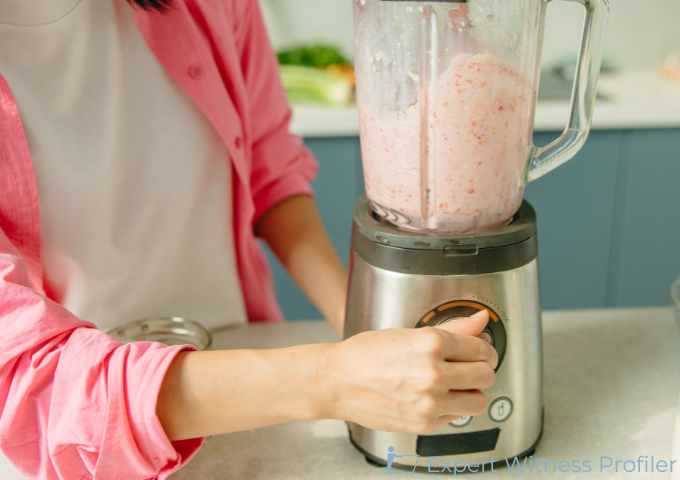
On August 23, 2021, Plaintiff Virginia Huss used a Ninja BL660 blender, designed and manufactured by Defendant SharkNinja Operating LLC, to blend a mixture of chocolate chips that she had microwaved for 60 to 90 seconds. After blending, Huss attempted to twist open the blender lid and the lid shot off the blender cup, causing scalding hot fudge to explode and burn her face, chest, arms, and hands. As a result, Huss initiated this product liability against SharkNinja.
In her amended complaint, Huss focused on the ‘cool to explosively hot’ theory, which posits that the blender’s fast-moving blade heats cool or room temperature food which creates friction and, ultimately, causes the blender contents to explode when the user opens the blender cup.
Huss Filed the Following Allegations in Support of her Cool to Explosively Hot Theory:
a. The blender is defectively designed because “the extremely fast-moving blade of the blenders heat the contents of the sealed bullet-shaped canister, which can (and does) unexpectedly explode when being used in its normal and intended manner by consumers. In a matter of a short amount of time, the fast-spinning blades can unexpectedly heat up its contents, such that if the blender explodes, the user is at risk of severe burns or lacerations and injuries requiring medication attention.”
b. “During the normal, as-directed use of the blender, a consumer puts cool or room temperature food into the plastic ‘bullet’ cup. Once the cup is secured to the blade assembly and placed onto the unit’s base, the user is able to run the blender by pressing down on the cup. The blades then rotate, creating friction as they cut and chop the cup’s contents, which in turn causes the contents to heat up.”
c. “As the temperature rises inside the cup, the pressure from the frictional energy also rises. The temperature can get so hot that the pressure inside the cup forces the cup to separate from the blade while the blender is still running. This can cause the hot contents of the cup to explosively project outward without warning, landing on anyone and anything nearby.”
d. “Even if the cup does not separate from the blender while in use, the user is still at risk. If the contents of the cup are hot and under pressure when the cup is opened, the hot contents can again be explosively ejected onto the user, causing se[ve]re lacerations from a detached blade.”
Derek King
King set forth three other design defect theories in his expert report:
(i) that the threaded connection between the blender cup and the blade assembly is “susceptible to slippage and so it may separate…before venting can occur” (the “Thread Slippage Theory”)
(ii) that “the threaded connection was under load (from internal pressure) and also at an elevated temperature” and “it is likely that one or both materials experienced some softening due to temperature which contributed to the threads failing to keep the blade assembly fastened to the cup long enough for the pressure to vent” (the “Softening Materials Theory”)
(iii) that Huss had observed that the blade assembly “kind of untwists itself the rest of the way,” which King found was “consistent with the force from internal pressure being transferred into a rotational motion due to the slope of the threaded connection between the cup and blade assembly” (the “Spontaneous Untwisting Theory”)
In response, SharkNinja filed a motion to exclude the expert testimony of Derek King.
Mechanical Engineering Expert Witness
Derek A. King has a Bachelor of Science degree in Mechanical Engineering from the University of California, Berkeley and a Master of Science in Electrical Engineering from Ohio University. He has worked as an engineer for Berkely Engineering and Research since 2009 “in the areas of failure analysis, design, and risk assessment of consumer and industrial equipment, including industrial pressure vessels and consumer propane tanks, pressure cookers and blenders.”
Discussion by the Court
King’s Testimony
King was tasked with providing his opinions regarding the following topics:
(1) “Whether or not the blender would enable and allow the incident to occur”; and
(2) “What design aspects of the subject blender enable and/or fail to mitigate the risks of pressurization and burn injury.”
By “applying well-established engineering principles” and performing “exemplar testing,” King concluded that “a sealed blender cup will heat and pressurize due to the blending process, thus establishing the possibility that the subject blender could create the hazard and risk consistent with Huss’ description.”
As to his “exemplar testing,” King provided a spreadsheet which reflected the following headings: (1) T(s); (2) External °F; (3) Internal °F; (4) Pressure PSI; (5) Note; (6) T-start; and (7) Recipe. Oddly, the Court noted that King provided no explanation whatsoever in his Report regarding the meaning of the headings, exactly what the variables of his tests were, and what the outcomes of his tests were. SharkNinja described King’s test results as follows:
• “The only testing of the incident recipe that King conducted involved blending a chocolate-chip mixture heated to 121°F. But this testing did not result in any pressurized ejection of hot content.”
• “King blended incident recipe ingredients that were preheated to 121°F for one minute and 49 seconds in a BL660 single-serve cup, and this testing did not demonstrate any explosive projection of the cup’s contents.”
It should be noted that Huss did not dispute SharkNinja’s characterizations of King’s testing and did not otherwise discuss the testing other than to assert that King considered Huss’ testimony that the chocolate chips were “lukewarm” temperature and “applied it to his analysis.”
Analysis
Absent an explanation from King or Huss — or disagreement regarding SharkNinja’s characterization — of the meaning of the data contained on King’s testing spreadsheet or how the testing was carried out in general and what results it yielded, the Court proceeded to analyze King’s opinion with the following premise in mind: King’s testing involved blending ingredients that had previously been heated to 121°F for one minute and 49 seconds, and that testing did not result in an explosive projection of the blender’s contents.
1. Whether King Is Qualified
SharkNinja did not challenge King’s qualifications as to his design defect opinions. However, the Court found, in accordance with its gate-keeping obligation and the standard set forth in Rule 702, that King’s undergraduate and graduate degrees in mechanical and electrical engineering along with his work experience since 2009 “in the areas of failure analysis, design, and risk assessment of consumer and industrial equipment, including blenders” is sufficient to qualify him to testify regarding design defects in blenders.
2. Whether King’s Methodology Is Scientifically Reliable
The Court also considered whether Huss had sustained her burden of showing that that it is more likely than not that King’s methodology is scientifically reliable and that his testimony will aid the trier of fact.
a. Cool to Explosively Hot Theory
SharkNinja argued that King did not have a reliable foundation to provide expert testimony regarding the cool to explosively hot theory because he did not conduct any testing with cool or room temperature ingredients. It asserted that King’s test involved blending a mixture of chocolate chips, sweetened condensed milk, and vanilla extract preheated to 121°F for one minute and 49 seconds in a BL660 single-serve cup blender and that even though he started with preheated ingredients (versus cool or room temperate ingredients) and blended the ingredients longer than Huss did (one minute and 49 seconds versus “probably less than a minute”), “his testing did not demonstrate any explosive projection of the cup’s contents.”
Accordingly, it argued, King “should be precluded from opining that blending cool or room temperature ingredients for any length of time can result in ‘contents being forcefully expelled from the blending cup under pressure and at high temperature.’”
SharkNinja’s main critique of King’s methodology for his opinions regarding the cool to explosively hot theory was that King was not able to re-produce an explosive projection when he blended chocolate chips, sweetened condensed milk, and vanilla extract for a longer period of time than Huss, and that the ingredients he blended were preheated to 121°F rather than being cool or at room temperature as necessary to test the cool to explosively hot theory.
Court’s Decision
The Court acknowledged that “an expert need not wear a lab coat nor cite peer-reviewed studies to reliably lend his expertise to the trier of fact—experience is an equally valuable teacher.”
But, at bottom, King still had to explain the methodology that he used and how his experience led him to his conclusions. He did not do so and, moreover, the testing he did perform used different conditions than the cool to explosively hot theory, making his methodology regarding his opinion that the blender had a design defect based on that theory unreliable.
b. Thread Slippage Theory
While SharkNinja agreed with King’s premise that ‘blending creates friction, friction causes heat, and, given enough time, a marathon blending session can eventually generate sufficient heat and pressure within a sealed cup to cause the blended contents to eject out energetically when the cup is opened,’ it argued, however, that King’s opinions that this can take place after one minute of blending is not supported by testimony or “any other reliable foundation.”
Specifically, SharkNinja noted that King blended preheated ingredients for one minute and 49 seconds and “did not identify any thread slippage or pressurized ejection of contents” from the blender cup, and that the thread slippage theory is speculation and unreliable.
SharkNinja asserted that there is an “analytical gap” in King’s analysis because “whether the blade assembly can ‘shift’ does not address whether the threads between the blade assembly and the BL660 cup can, in fact, ‘slip.’” It noted that King did not identify any testing to support his finding and that Huss does not argue that this theory has been subjected to peer review or publication, is generally accepted in the engineering community, or has a known or potential error rate.
Court’s Decision
The Court rejected Huss’ argument that SharkNinja can simply cross-examine King to address any shortcomings in his methodology. This notion is contrary to the 2023 amendment to Rule 702, which requires the Court to determine whether an expert’s methodology is reliable rather than leaving that determination to the jury.
As to SharkNinja’s issues with King’s methodology, King opined that “a potential opportunity for venting before sudden separation is present in the intermittent thread design, however, geometric analysis shows that the threaded connection is susceptible to slippage and so it may separate…before venting can occur.” He described the blender’s threading in detail, but did not set forth any methodology for how he reached his conclusion that thread slippage could have occurred after less than one minute of blending and caused the contents of Huss’ blender to explode. The Court held that King’s methodology regarding his opinion on the thread slippage theory is non-existent and, therefore, unreliable.
c. Softening Materials Theory
SharkNinja argued that King “did not attempt to substantiate his softening materials theory with any testing or other reliable foundation,” instead simply noting the deflection temperature of the materials that make up the blender’s construction and stating that it is likely those materials softened during use.
SharkNinja noted that King examined the blender but “did not state that he observed any evidence of softening in either the blade assembly or the single-serve cup,” that his testing “did not demonstrate any evidence of either component softening,” and that he did not cite any support for his theory in scientific literature or otherwise.
Court’s Decision
The Court rejected Huss’ contention that SharkNinja can simply address shortcomings in King’s methodology through cross-examination and proceeded to consider the issues that SharkNinja raised.
While King stated in his report that “An overview of the material properties indicates that cup material has a deflection temperature of approximately 200 °F, while the blade assembly deflection temperature is approximately 100 to 300 °F. Huss’ description of a pressurized release and sustaining burn injuries indicates that the threaded connection was under load (from internal pressure) and also at an elevated temperature. It is likely that one or both materials experienced some softening due to temperature which contributed to the threads failing to keep the blade assembly fastened to the cup long enough for the pressure to vent,” he did not indicate that he tested the blender, observed softening of the components’ materials, or employed any other methodology to reach his conclusion.
He merely stated that ‘it is likely’ the materials ‘experienced some softening’ based on their deflection temperatures, which ‘contributed to the threads failing to keep the blade assembly fastened.’ The Court held that his speculative conclusion is not supported by any methodology. In other words, King’s methodology relating to the softening materials theory is not reliable.
d. Spontaneous Untwisting Theory
SharkNinja argued that King simply states that Huss’ observation that the blade assembly untwists itself is consistent with the use of the blender, but “offers no reliable foundation for this opinion,” “does not attempt to substantiate his opinion by citing to any scientific literature (or anything at all other than Plaintiff’s deposition testimony),” and “did not disclose any evidence of the BL660 blade assembly untwisting itself based on the slope of the threaded connection during his own testing of the incident recipe.”
Basically, SharkNinja contended that King “does not identify any testing that would support his spontaneous untwisting theory,” and noted that his testing with preheated ingredients did not result in the blender cup spontaneously untwisting from the blade assembly.
King opined that ‘Huss’ observation that the blade assembly “kind of untwists itself the rest of the way” is consistent with the force from internal pressure being transferred into rotational motion due to the slope of the threaded connection between the cup and blade assembly.’
He did not state that he tested this theory and observed spontaneous untwisting or set forth any other methodology that he used in reaching this conclusion. He simply baldly stated that Huss’ observation is consistent with the use of the blender and the slope of the threaded connection. The Court held that King’s methodology regarding the spontaneous untwisting theory is speculative and not reliable.
The Court found that Huss has not sustained her burden of showing by a preponderance of the evidence that King’s methodology as it relates to the cool to explosively hot theory, the thread slippage theory, the softening materials theory, or the spontaneous untwisting theory is reliable.
3. Whether King’s Testimony Would Aid the Trier of Fact
SharkNinja argued that King’s opinions would not aid the trier of fact because they were speculative in nature and not based on a reliable methodology.
The Court held that King’s opinions are not grounded in a reliable methodology — they are not based on any physical testing and King does not set forth any other methodology to explain how he reached his conclusions. The speculative nature of his opinions relating to all four design defect theories will not aid the trier of fact. The Court found that Huss has not shown that it is more likely than not that King’s testimony will aid the trier of fact.
In sum, Huss has not sustained her burden of showing by a preponderance of the evidence that King’s methodology is reliable and that his opinions would aid the trier of fact.
Held
The Court granted the Defendant’s motion to exclude the testimony of Plaintiff’s expert Derek King.
Key Takeaway:
Despite King’s qualifications in mechanical and electrical engineering and his experience in failure analysis and design, the Court held that he failed to demonstrate a scientific basis for his conclusions regarding the alleged design defects of the Ninja BL660 blender. His testing did not replicate the conditions claimed by the Plaintiff, and he did not substantiate his theories—such as the cool to explosively hot theory, thread slippage theory, softening materials theory, and spontaneous untwisting theory—with physical testing, mathematical models, or citations to scientific literature. The Court determined that King’s unsupported conclusions would not aid the jury in evaluating the alleged design defects, rendering his testimony inadmissible.
Case Details:
| Case Caption: | Virginia Iris Huss vs. Sharkninja Operating LLC |
| Docket Number: | 1:23cv1435 |
| Court: | United States District Court for the Southern District of Indiana, Indianapolis Division |
| Order Date: | January 21, 2025 |