Tag: Warn

  • Hospitality Expert Was Allowed to Opine on Guest Safety

    Hospitality Expert Was Allowed to Opine on Guest Safety

    Plaintiff was a guest at Defendant’s beachfront hotel in Miramar Beach over the Fourth of July holiday weekend in 2024. Defendant owned the dry sand portion of the beach in front of the hotel, and it rented chairs and other concessions to hotel guests using the beach.

    On the morning of July 6, Plaintiff entered the water of what is now known as the Gulf of America from the hotel’s private beach despite seeing a yellow flag warning beachgoers to exercise caution in the water due to the presence of “moderate surf and/or currents.” Plaintiff went out to hip-deep water, and after 10 to 15 minutes, she exited the water without any issue.

    After lunch, Plaintiff re-entered the water despite noticing that there were more waves than there were in the morning. Plaintiff went further out into the water than she did in the morning, but when the weather started to worsen and the water became more turbulent and “murky,” Plaintiff decided to head back to the beach.

    While heading back, Plaintiff allegedly got stuck in an “underwater trench” that was at least waist-deep. While Plaintiff was stuck in the trench, she was allegedly hit by a wave that knocked her forward and caused her to strike her head on an adjacent nearshore sandbar with such force that she suffered a severe cervical spine injury that rendered her quadriplegic.

    Defendant filed Daubert motions to limit or exclude the testimony of two of Plaintiff’s experts, John Fletemeyer, Ed.D., and Gary Deel, Ph.D.
    Aquatic Safety Expert Witness

    John Robert Fletemeyer, Ed.D. has been continuously and professionally involved in aquatic safety for more than 50 years and have acquired several professional certifications including instructor certifications from the American Red Cross (First Responder, BLS, CPR and AED Instructor), YMCA of the USA Lifeguard Instructor, World Lifesaving Training Officer, licensed EMT, NAUI Instructor, PADI instructor, USLA Certification Accreditation officer, and Swift Water Rescue Specialist.

    He has been awarded several postgraduate degrees including graduate degrees from the University of Wisconsin (M.A.), University of Cape Town (M.S. Honors) and Florida International University (Ed.D). He has held teaching and research positions at Broward College, Nova University and Florida International University.

    Fletemeyer has been retained in over 500 criminal and civil cases involving drowning and serious aquatic incidents.

    Want to know more about the challenges John Fletemeyer has faced? Get the full details with our Challenge Study report.

    Hospitality Expert Witness

    Gary Lee Deel spent ten years in professional work within the hospitality industry, including hotels, motels, resorts, restaurants, amusement parks, attractions, casinos, golf courses, dayclubs, nightclubs, meetings and events, and other aspects of the industry which are commonly integral to hotel and resort operations.

    He has also spent more than 16 years teaching hospitality management for various hospitality schools including the UCF Rosen College of Hospitality Management, the UF Tourism and Hospitality School, and the UNLV Harrah Hotel College.

    Want to know more about the challenges Gary Deel has faced? Get the full details with our Challenge Study report.

    Discussion by the Court

    John Fletemeyer

    Fletemeyer’s expert report broadly opined that Defendant was “grossly negligent for not providing guests with any comprehensive and effective beach safety program that prevents foreseeable injuries and drowning/near drownings from occurring.”

    1. Qualification

    Defendant argued that Fletemeyer is unqualified to opine on “offshore hydrodynamics, sandbar-formation science, and the design, staffing, and operation of professional open-water rescue systems.” The Court agreed in part.

    Fletemeyer did not appear to be qualified in the areas of “hydrodynamics” or “sandbar-formation science,” and Plaintiff represents he will not offer opinions on those issues. Thus, consistent with that representation, Fletemeyer may not opine on how certain underwater terrain and features—such as underwater trenches and sandbars—are formed. Nor may he opine on the science of how water and wave forces interact with the human body.

    That, however, did not preclude Fletemeyer from testifying about the risks posed by aquatic conditions like trenches and nearshore sandbars. Indeed, Fletemeyer’s extensive experience—which includes work as a beach patrol supervisor and beach patrol chief for about 28 years with over 50,000 hours supervising beaches and observing hazardous water conditions, along with work as a consultant for over 30 government and private entities (including other Hilton hotels) investigating aquatic injuries and evaluating aquatic safety programs—more than adequately qualifies him to offer opinions about aquatic safety issues and trench/sandbar risks on Florida beaches.

    Fletemeyer is also qualified to opine on “professional open-water rescue systems” because, as Defendant acknowledged, Fletemeyer’s “background is strongest in lifeguard operations, beach-safety education, and drowning-prevention advocacy.” Moreover, Fletemeyer has worked with “several hotels” to conduct aquatic safety audits and train staff. Thus, contrary to Defendant’s argument, Fletemeyer is adequately qualified to opine on matters pertaining to the design and implementation of open-water rescue systems.

    2. Reliability

    Defendant argued that Fletemeyer’s opinions are unreliable because they are primarily based only on his own experience and research. For the most part, the Court disagreed.

    Fletemeyer is entitled to rely on his experience, and that experience includes designing aquatic safety programs “consistent with the standards at other resorts,” which include “multiple, coordinated layers of hazard identification, guest education, staff training, and emergency planning specifically directed at the nearshore trench/sandbar hazard and its associated injury risks.”

    The Court did not overlook Defendant’s argument that Fletemeyer “relied almost entirely on his own experience … and own 1999 book” rather than invoking a “recognized risk-assessment framework, coastal-engineering protocol, or specific industry standard for beachfront hotels in Florida.”

    However, putting aside the fact that an expert can rely on his own experience and that his book is published in a peer-reviewed press, Fletemeyer did refer to industry standards when he discussed how he evaluated Defendant’s aquatic safety programs against the “commonly adopted practices” at comparable resorts. 

    The Court also did not overlook Defendant’s argument that Fletemeyer failed to conduct “tests, measurements, or quantitative analysis” as to the Gulf’s forces that day or the sandbar,  but such analysis is not required for Fletemeyer’s experience-based testimony.

    However, the Court agreed with Defendant that Fletemeyer provided no reliable basis for his opinion that the proposed safety measures would have prevented Plaintiff from being injured by the sandbar or made her injury less likely. Nor did he explain how his experience led to his conclusion.

    3. Helpfulness

    Defendant argued that some of Fletemeyer’s opinions are unhelpful because they are impermissible legal conclusions and invade the province of the jury. The Court agreed in part.

    Here, Defendant argued that some of Fletemeyer’s opinions—such as his opinions that Defendant was “negligent” or “grossly negligent” and that Plaintiff’s injury occurred in an area that Defendant had a “duty” for guest safety—are impermissible legal conclusions.

    The Court agreed. Thus, Fletemeyer will not be permitted to couch his opinions in that manner.

    Defendant also argued that some of Fletemeyer’s opinions improperly commented on witness credibility and usurped the role of the jury. Plaintiff conceded that Fletemeyer’s “characterization” of certain testimony as “questionable” and “his inference that [Defendant] ‘failed to take notice’” of the hazards are “immaterial remarks.”

    Gary Deel

    Deel is a hospitality operations, safety, and risk management professional and academic. His expert report includes three main opinions, which were more succinctly summarized in his affidavit as follows:

    • [Defendant] had a responsibility to ensure a reasonably safe environment for guests entering the Gulf and failed to meet this responsibility.
    • [Defendant] knew or should have known of the recurring danger of concealed trenches and sandbars, but it failed to warn guests adequately.
    • [Defendant] failed to implement reasonable safety measures and failed to investigate or remediate known hazards, demonstrating systemic safety-management failures.

    1. Qualification

    Defendant challenged portions of Deel’s opinions by arguing that he is unqualified to opine on the “foreseeability of underwater trenches and sandbars,” the design of professional beach rescue programs that would have prevented the incident, and the “hydrodynamic effects of the underwater topography” because he lacks formal education or training in coastal science and open-water lifeguard operations. The Court agreed.

    Deel spent ten years in the hospitality industry working in areas such as hotel operations, safety, security, and risk management, and he has spent sixteen years teaching those same subjects at various universities. That experience provided Deel sufficient qualifications to render opinions on hotel risk management practices, but Plaintiff has not shown that his experience qualifies him to render reliable opinions on the foreseeability or danger of underwater trenches/sandbars within the Gulf’s waters, rip-current formation, or open-water lifeguard operations.

    On the latter point, although Deel supposedly relied on “aquatic-safety literature and beach-management practice” to opine that Defendant knew or should have known about the “specific and recurring danger of concealed underwater trenches and sandbars in the Gulf waters,” the “industry standards” he cited for that proposition did not mention that type of hazard.

    That said, Deel is more than adequately qualified to opine about industry practices relating to risk identification and management. Thus, while he cannot testify as to the dangerousness of underwater trench and sandbar configurations, he may opine, for example, about whether Defendant complied with (or deviated from) industry standards when it did not “inspect the Gulf waters,” conduct a “risk assessment or safety inspection of its beach operations,” or have “established procedures governing guest safety in the water.”

    2. Reliability

    Defendant argued that Deel’s opinions are unreliable because they lacked a sound methodology and failed to identify industry standards.

    Deel cited several standards for his methodology and explained that those standards, combined with his experience in the hospitality industry, require a systematic review of available data and a determination as to whether certain safety practices sufficiently mitigate known hazards.

    Defendant did not critique those “process-oriented guidelines” about structuring investigations and conclusions; it merely argued that Deel’s opinions did not establish substantive hotel safety standards.

    Deel is entitled to rely on his own experience so long as his methodology is sound, and it is here because he identified a methodology, cites specific “standards of care” from “authoritative sources” (that he knows from his experience in the industry), and evaluates whether Defendant’s risk management program was consistent with those standards.

    The Court did not overlook Defendant’s argument that Deel did not identify a specific industry standard requiring a Florida beachfront hotel to survey underwater sandbars, monitor rip currents, and give hazard-specific warnings. However, the industry standards he cited required hotel operators to establish systematic processes of risk identification and management, including identifying water hazard risks, preparing emergency procedures, and warning guests of hazards. And, according to Deel, those standards apply to both pools and beaches. Thus, Deel reliably applied his methodology to reach his conclusions.

    That said, the Court agreed with Defendant that Deel’s opinion that Plaintiff’s injury resulted from Defendant’s “systemic breakdown in safety management” and that had Defendant conformed with industry standards, the incident “more than likely could have been prevented” is ipse dixit because, like Fletemeyer’s causation opinion, there is a substantial analytical gap between the facts and conclusion offered.

    3. Helpfulness

    Defendant argued that some of Deel’s opinions are impermissible legal conclusions and unhelpful. The Court agreed in part.

    Like Fletemeyer, Deel may not couch his opinions as impermissible legal conclusions or invade the province of the jury. Thus, Deel may not opine that Defendant, by commercially controlling the beach, had a “duty” to ensure a reasonably safe environment or how far that duty extended; that Defendant held “a legal right to use and control” the beach; or that Defendant “knew or should have known” about the underwater trench/sandbar hazard being foreseeable. However, as discussed above, he may opine—without phrasing his opinions as legal conclusions—on whether Defendant deviated or complied with industry risk management standards.

    Defendant also argued that Deel’s opinions will be unhelpful to the jury because Florida hotels owe no duty to warn of naturally occurring conditions like rip currents and sandbars. But as was the case with Fletemeyer, to the extent Defendant is wrong about the law, Deel’s opinions will be helpful to the jury in determining whether Defendant breached the duty it owed to hotel guests like Plaintiff.

    Held

    The Court granted in part and denied in part Defendant’s Daubert motions to limit or exclude the testimony of Dr. John Fletemeyer and Dr. Gary Deel.

    Key Takeaway

    Fletemeyer merely asserted a conclusion and asked the Court to take his word for it based on his experience. That, however, is not enough because it is well established that “nothing in either Daubert or the Federal Rules of Evidence requires a district court to admit opinion evidence that is connected to existing data only by the ipse dixit of the expert.” If admissibility could be established merely by the ipse dixit of an admittedly qualified expert, the reliability prong would be, for all practical purposes, subsumed by the qualification prong.

    Case Details:

    Case Caption: Davidson V. Sandestin Beach Hotel
    Docket Number: 5:24cv247
    Court Name: United States District Court, Florida Northern
    Order Date: March 04, 2026
  • Mechanical Engineering Expert Allowed to Opine on Clear Warnings

    Mechanical Engineering Expert Allowed to Opine on Clear Warnings

    This lawsuit arises out of the death of Timothy L. Stringer (“Stringer”) resulting from a May 15, 2021, explosion on an offshore oil and gas production platform owned by Fieldwood Energy LLC (“Fieldwood”).

     At the time of the accident, Stringer was working on the platform and, along with another employee, was performing a pressure integrity test on a well. To perform this test, Stringer was provided with a Crystal XP2i Digital Test Gauge (“Crystal Gauge”) to monitor the internal pressure on the pipe casing. Ametek, Inc. is the manufacturer of the Crystal Gauge, and Robin Instrument & Specialty, LLC (“Robin”) distributed it to Stringer’s employer. 

    Stringer’s spouse and children alleged that Ametek and Robin failed to warn users like Stringer of the foreseeable misuse that the Crystal Gauge could be set to read in either PSI or Bar and of the dangers associated with misinterpreting or mixing up the units of pressure.

    Ametek, joined by Robin, argued that Plaintiffs’ expert, Glenn Gleason (“Gleason”), is unqualified and that his report and testimony are speculative and unreliable.

    Mechanical Engineering Expert Witness

    Glenn H. Gleason is a licensed Professional Engineer with a Ph.D., Master of Science, and Bachelor of Science in Mechanical Engineering. During his academic career, Gleason claims that he became proficient with different types of physical mechanisms and instruments commonly used to measure pressure. 

    Gleason also served as a consultant at an engineering firm where he conducted “mechanical system and equipment failure analysis” and tested mechanical relief valves, pressure vessels, and the use of pneumatic and hydraulic equipment requiring the monitoring of pressure gauges.

    Want to know more about the challenges Glenn Gleason has faced? Get the full details with our Challenge Study report.

    Discussion by the Court

    The Court found that Gleason is qualified to serve as an expert in this matter due to his educational and professional experience. Any doubts as to Gleason’s qualifications are suitable for cross-examination, but these doubts do not warrant exclusion.

    The Court next turned to Gleason’s methodology in reaching his proffered opinion. In his report, Gleason opined that Ametek could and should have: (i) presented clear warnings accompanying pressure units so consumers can disable unused unit systems on the gauges; and (ii) limited available unit systems through factory default settings on gauges that would be used in industries that only use PSI.

    Gleason based his opinion on investigations of the incident conducted by other engineering firms, the market in which the Crystal Gauge was sold (where PSI was the sole unit of measure), deposition testimony stating that Ametek disabled all other units besides Bar in the Chinese market, the Crystal Gauge’s operation manual, and a physical inspection of the Crystal Gauge itself. All told, these factual bases are sufficient for this Court to find that Gleason’s report is not so speculative as to warrant exclusion.

    Doubts about an expert’s qualifications or the factual basis for their testimony generally concerns the weight of the evidence, not its admissibility. As a result, doubts regarding Gleason’s qualifications or the factual basis for his opinions are best left to a jury, not this Court. 

    Held

    The Court denied Defendants’ Daubert motion to exclude the testimony of Glenn Gleason.

    Key Takeaway

    An expert may base an opinion on facts or data in the case that the expert has been made aware of or personally observed. If experts in the particular field would reasonably rely on those kinds of facts or data in forming an opinion on the subject, they need not be admissible for the opinion to be admitted.

    Case Details:

    Case Caption: Stringer V. Robin Instrument & Specialty, LLC
    Docket Number: 6:23cv415
    Court Name: United States District Court for the Western District of Louisiana, Lafayette Division
    Order Date: February 20, 2026
  • Materials Science Expert’s Testimony on Fire Causation Excluded

    Materials Science Expert’s Testimony on Fire Causation Excluded

    Ibrahim Qasim bought a sixty-four ounce container of EcoLogic Bed Bug Killer 2 (“Product”) from Home Depot on August 26, 2019. On September 2, 2019, at 9:00 a.m., Ibrahim sprayed all sixty-four ounces of the product into the living room of the apartment he and Nouh Qasim shared. At 5:00 p.m., as Nouh turned on the gas stove in the kitchen to make coffee, a fireball erupted, severely burning both Plaintiffs. The Newark Fire Department found sodium azide in the bathtub drain, a highly toxic chemical compound “used to make explosives and methamphetamine.” First responders also found a gasoline can in the apartment.

    Plaintiffs sued Defendants Spectrum Brands Holdings, Inc. (“Spectrum”), United Industries Corporation (“United”) and Liquid Fence Company for strict products liability and violations of the Consumer Fraud Act.

    Plaintiffs retained Dr. James W. Pugh, Ph.D. as an expert, who summarized his analysis in a two-page report (“Pugh Report”). Pugh concluded, to a reasonable degree of scientific, engineering, ergonomic, and human factors certainty, that the defective labeling of the product was the proximate cause of the accident.

    Defendants argued that Pugh’s expert report should be excluded because it concluded the warning label on the product caused the fire without “any mention of scientific methodologies, mathematical calculations, or independent testing and analysis.”

    Materials Science Expert Witness

    Dr. James Whitworth Pugh, Ph.D. earned an undergraduate degree in metallurgy and materials science and a Ph.D. in biomedical engineering from the Massachusetts Institute of Technology (“MIT”).

    While a graduate student at MIT, Pugh worked at the U.S. Army Materials and Mechanics Research Lab. After graduating, Pugh taught biomechanics, engineering, and materials sciences at several institutions, including New York University.

    Fortify your strategy by reviewing a Challenge Study detailing grounds for excluding James Pugh’s expert testimony.

    Discussion by the Court

    A. Qualification

    Pugh opined about the Product’s warning label and the cause of the fire. Pugh has extensive experience analyzing “products, warnings, and instructions.” So, he has more knowledge than the average layperson about the adequacy of warnings. Pugh, therefore, is qualified to opine about the Product’s warning label.

    Pugh, however, is not qualified to testify about the cause of the fire. To be sure, Pugh testified he had “done a lot of thermal injuries analysis” and was “exposed to a large amount of fire and thermal events” in his work at MIT. But analyzing burns on the human body or seeing fires in a ballistics laboratory are fundamentally different than investigating the origin of a fire.

    Pugh has never been a fire investigator, been a member of a professional fire investigation organization, or published an article on the causes of fires. Pugh has no training in recognizing burn patterns. And the record did not reflect that he has any practical experience investigating the origin of a fire. Instead, Pugh’s sole experience with fire causation comes from owning a sailboat with an isopropyl alcohol stove, and taking courses at MIT covering isopropyl alcohol fires. But the fact that Pugh knows what an alcohol fire looks like in a stove on a boat does not qualify him to give an expert opinion that this fire was an alcohol fire, or the Product caused it.

    While Pugh is qualified to testify about warning labels, the Court held that he is not qualified to testify about the cause of the fire.

    B. Reliability

    i. Fire Causation

    Pugh’s opinion about the cause of the fire lacked good grounds because it is based entirely on comparing pictures of the apartment to his experience using an alcohol stove on a boat.

    Pugh did not test the Product or account for the distance between where Ibrahim sprayed the Product and the site of the fire, the time between when Ibrahim sprayed the Product and the fire, or the presence of other flammable substances in the apartment. He “used little, if any, methodology beyond his own intuition.”

    The Court concluded that Pugh had no reliable basis to conclude the Product’s isopropyl alcohol content caused the fire.

    ii. Failure to Warn

    Pugh’s conclusions about the product’s warning label lacked signs of reliability. Here, the product had a flammability warning. Examining a fourteen-ounce spray can of the product, Pugh concluded the text was too small. However, it did not appear that he examined the warning on the much larger sixty-four-ounce container of the product Ibrahim used on the day of the accident.

    Pugh did not consider federal pesticide labeling standards, industry practice, the Product’s accident history, scientific testing, whether his proposed open flame pictogram was feasible, or whether it would have prevented the accident. Nor did he provide any visual aids to explain his conclusion that the Product had an inadequate warning and that his proposed warning was adequate. At most, Pugh asserted that the product’s warning did not comply with two standards from the American National Standards Institute (“ANSI”) and a warning handbook from 2006.

    According to the Court, neither Pugh’s opinion that the product caused the fire, nor his opinion that the flammability warning on the product was inadequate, are reliable.

    C. Fit

    At the Daubert hearing, Pugh testified that it was “unlikely” the Product caused the fire if Ibrahim’s timeline were true. Pugh added he “disagreed with the characterization of the time that Ibrahim applied it in view of what [Nouh] said.” But Pugh did not explain why he disagreed with Ibrahim’s account and believed Nouh’s. Nor did he address the issue in his report. Instead, he simply concluded the fire started when Nouh said it did. That is of no assistance to the factfinder.

    Likewise, although Ibrahim testified “he never read the warnings or instructions on the product” before using it, Pugh concluded that an open flame pictogram would have prevented the fire. Pugh entirely failed to explain why a Plaintiff who did not read any of the warnings on the product would nonetheless read a different warning on the product. Here, too, the lack of a why or wherefore did not assist the factfinder. The Court held that Pugh’s opinions, accordingly, did not fit the proceedings.

    Held

    The Court granted the Defendants’ motion to exclude the testimony of Plaintiffs’ expert Dr. James Pugh.

    Key Takeaway

    An expert’s testimony ‘fits’ the proceedings, if it will help the trier of fact to understand the evidence or to determine a fact in issue. Pugh’s analysis is bereft of a why or wherefore.

    Because Pugh is not qualified to render expert opinions on fire causation, his conclusions on fire causation and adequate warnings are unreliable, and his analysis does not fit the proceedings, the Court excluded his testimony.

    Case Details:

    Case Caption: Qasim Et Al V. Spectrum Brands Holdings, Inc.
    Docket Number: 2:21cv18744
    Court Name: United States District Court, New Jersey
    Order Date: January 12, 2026
  • Mechanical Engineering Expert’s Testimony on the Mechanical Interlock Design Admitted

    Mechanical Engineering Expert’s Testimony on the Mechanical Interlock Design Admitted

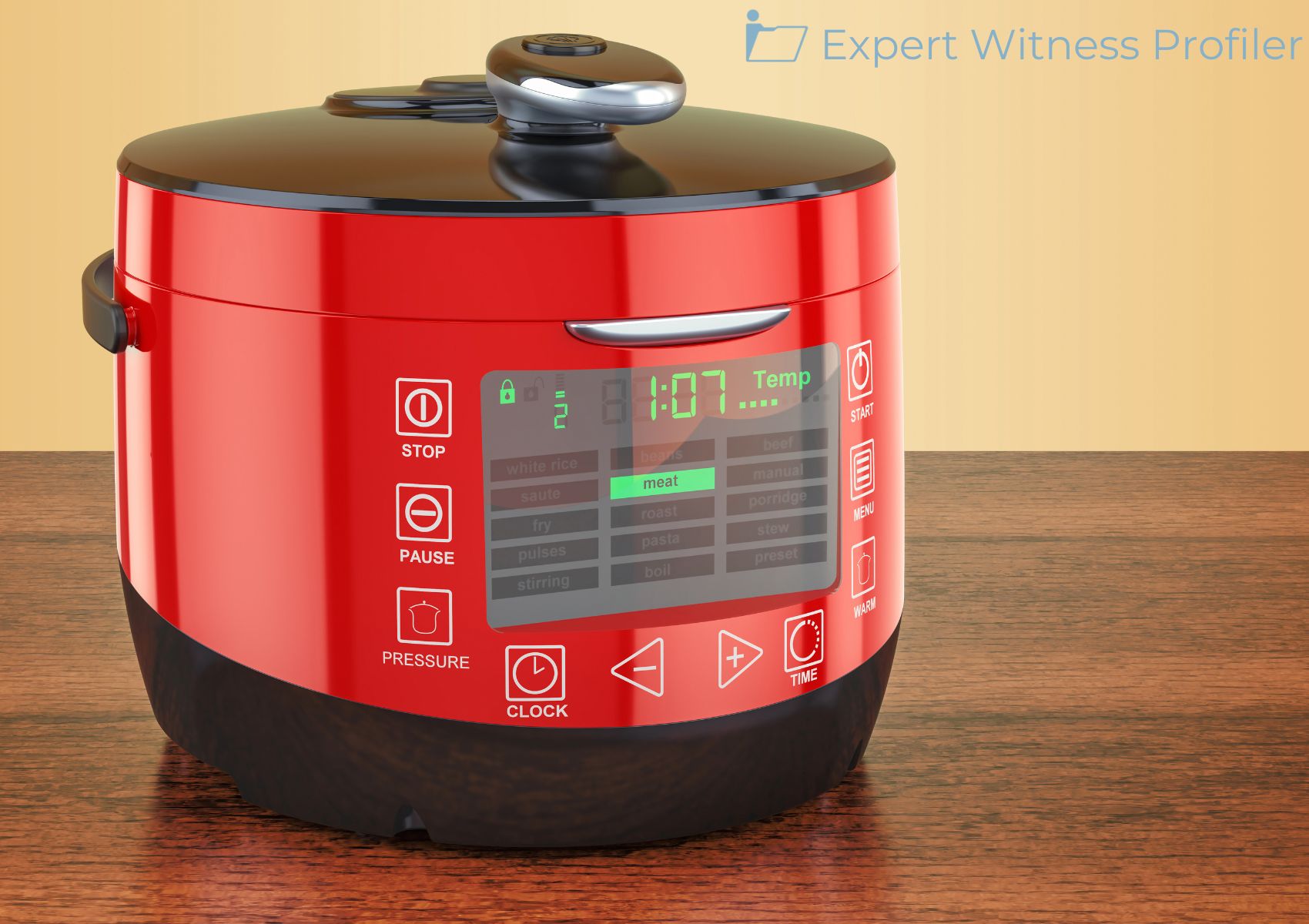
    While preparing a roast in her Magic Chef 7-in-1 Multicooker, Tarsha Allgood was injured when the device’s lid opened causing its “scalding hot contents to be forcefully ejected from the pressure cooker.”

    Allgood filed this lawsuit against CNA International, Inc. d/b/a MC Appliance Corporation raising claims under North Carolina law for inadequate warning, inadequate design, common law negligence, breach of express warranty, and breach of implied warranty.

    CNA filed a motion to exclude the testimony of Allgood’s expert witness, David M. Rondinone, an engineer with Berkeley Engineering and Research, Inc.

    Rondinone examined exemplars and other documents and materials, and concluded, among other things, that: (a) the mechanical interlock design intended to lock the lid is defective in that it fails to perform its function. This conclusion is based on, among other things, the geometric dimensions of the pin, lid, and cooker, which results in the interlock “providing very little resistance to the user;” and (b) “the presence of a defective pressure interlock increases the likelihood of the lid being opened and the cooker contents being expelled under pressure.” The touchstone of CNA’s argument is that Allgood threw away the device’s lid, so Rondinone could not test the actual multicooker Allgood used.

    Mechanical Engineering Expert Witness

    David Michael Rondinone has over 20 years of experience in mechanical engineering including design and failure analysis, fire suppression, explosions, flammability, flame arrestors, ignition, finite element analysis, accident reconstruction and crashworthiness, mechanical testing, failure of mechanical connections, dynamic stability of equipment and structures, pressure vessels and pipelines, medical implants and equipment, automotive component analysis and design.

    Rondinone has a Masters and Ph.D in Mechanical Engineering from the University of California, Berkeley, where he previously received his B.S. in Engineering Physics and B.A. in Astrophysics.

    Want to know more about the challenges David Rondinone has faced? Get the full details with our Challenge Study report.  

    Discussion by the Court

    The exemplar multicooker that Rondinone examined was used when it was purchased such that its prior history is unknown. CNA noted that the exemplar’s lid had a pre-existing scratch that Rondinone concluded means the lid was “force[d] open while under pressure by a prior user (an interlock override event).” CNA challenged the reliability of Rondinone’s opinion that the device was defectively designed because the mechanical interlock system could not meet the Underwriters Laboratories Cover Opening Standard.

    According to CNA, Rondinone’s methodology relied on broad generalizations and failed to account for whether the exemplar met relevant Underwriters Laboratories’ standards before the exemplar was damaged. 

    Allgood countered that Rondinone set forth his methodology in his report. He explained how he examined and measured the exemplar, including its interlock features, and considered relevant Underwriters Laboratories standards. He then concluded that the mechanical interlock design that is intended to lock the lid of the device is defective in that it fails to perform its intended function.

    The Court agreed with Allgood that Rondinone’s conclusions are sufficiently reliable. Among other things, he explained how the exemplar he examined showed “linear defects in the coating which are consistent with wear from the lid locking pin sliding over the tab,” and that the pre-existing scratch on the lid he examined could be the result of the lid being opened under pressure despite the sliding pin lock being held in place by the float valve.

    CNA’s remaining arguments failed to persuade the Court. That Rondinone did not take measurements that CNA deems critical, failed to perform a statistical or comparative analysis, or reached his conclusions based on a “single nonrepresentative data point,” are fair points for cross-examination.

    Held

    The Court denied the Defendant’s motion to exclude the testimony of David Rondinone.

    Key Takeaway:

    The Court held that Rondinone’s opinions are appropriately based on sufficient data, an examination of an exemplar, and a reliable application to the facts of this case. His testimony would also assist the fact finder with determining whether a defect existed at the relevant time, and the methodology underlying his conclusions is sound and sufficiently reliable for trial.

    To the extent CNA wishes to challenge the facts forming the basis of Rondinone’s opinions, including the impact, if any, that examining an exemplar had on his conclusions, it may do so on cross-examination. Although the facts on which an expert bases his opinion must have some basis in the record, there is no requirement that the basis must consist of undisputed evidence.

    Case Details:

    Case Caption: Allgood V. CNA International, Inc.
    Docket Number: 1:23cv462
    Court Name: United States District Court, Illinois Northern
    Order Date: September 3, 2025
  • Safety Expert’s Testimony on Label Warning Issues Admitted

    Safety Expert’s Testimony on Label Warning Issues Admitted

    This products liability case arises out of injuries sustained by Plaintiff Joseph Gonsoulin (“Gonsoulin”) while seated on an allegedly defective electronic motorcycle that unexpectedly took off and caused him to crash into a wall.

    As a result, Gonsoulin sued both the manufacturer of the Beta Explorer— Defendant Zhejiang Apollo Sports Technology (“Apollo”)—and the bike’s American distributor—Defendant Beta USA, Inc. (“Beta USA”).

     Gonsoulin’s theories of liability and the factual issues flowing from them are: (1) whether the Beta Explorer in question should have had a kill switch or a right rear foot brake, (2) whether the Beta Explorer’s throttle was overly-sensitive to the extent that it posed an unreasonably danger to its users; and (3) whether the Beta Explorer’s warnings were legible and substantively adequate. 

    Defendants Beta USA and Apollo filed motions to exclude the opinions of Gonsoulin’s expert witnesses: Mr. Robin L. Simmons, Mr. Edward L. Patterson III, and Mr. James P. Evans

    Motorcycles Expert Witness

    Robin L. Simmons is a motorcycle mechanic and service manager with over forty-five years of experience in the industry.  He specializes in motorcycle repair, maintenance, and safety inspections and holds technician certifications from several major brands like Kawasaki, Yamaha, and Suzuki.

    He has also testified as a motorcycle expert in at least two federal cases and received nationwide awards for his mechanic training videos related to topics, including but not limited to: transmission troubleshooting and hydraulic brake systems.

    Outside of his professional career, Simmons stated that he has been riding motorcycles for over 60 years, currently owns over eleven different dirt and street bikes, and holds a motorcycle endorsement on his driver’s license.

    Want to know more about the challenges Robin Simmons has faced? Get the full details with our Challenge Study report.

    Safety Expert Witness

    Edward L. Patterson III is a Motorcycle Safety and Operation Consultant and currently serves as the Program Manager for the Louisiana Department of Public Safety’s Motorcycle Safety, Awareness, and Operator Training Program.

    In that capacity, he oversees motorcycle safety instruction statewide and was certified as a Rider Coach Trainer and Master Instructor with the Motorcycle Safety Foundation—one of the country’s leading safety resources for motorcyclists. 

    Patterson has developed motorcycle safety curricula and instructional manuals that have been implemented internationally in countries like Indonesia, Zamia, Malawi, etc. In addition to his role involving motorcycle safety regulations, Patterson has also frequently testified as an expert in motorcycle accident cases across the state of Louisiana for over twenty-seven years. Finally, Patterson has been personally riding motorcycles for over fifty years and has a motorcycle endorsement on his license. 

    Discover more cases with Edward Patterson as an expert witness by ordering his comprehensive Expert Witness Profile report.

    Accident Reconstruction Expert Witness

    James Paul Evans is a licensed Professional Engineer and a nationally-certified accident reconstructionist with a mechanical engineering degree from Texas A&M University. He has more than thirty years of mechanical experience with motor vehicles and around twenty-one years of work in accident reconstruction involving motorcycles specifically.

    Evans’ work requires him to frequently conduct crash testing and assess vehicle accelerometer equipment, such as brakes, acceleration, and turn testing. 

    Evans has previously testified as an expert accident reconstructionist in more than 500 cases, both civil and criminal, across the country.

    Want to know more about the challenges James Evans has faced? Get the full details with our Challenge Study report

    Discussion by the Court

    a. Robin Simmons

    Simmons’ extensive background as a motorcycle mechanic, combined with the relatively simple nature of the design defect and warning issues associated with the Beta Explorer, supported the conclusion that he possessed the necessary expertise to testify at trial. Additionally, the Court found no indication in the record that the materials Simmons relied upon—such as the Beta Explorer itself and the Owner’s Manual—or the method he used to review them were unreliable for forming a proper expert opinion

    Simmons employed his “decades of practical experience diagnosing, repairing, and riding motorcycles to assess how the Beta Explorer functions, what mechanical risks are present, and how its features compare to industry norms.” To the extent that Defendants dispute Simmons’ credentials, the substantive nature of his expert opinions, or the depth of his experience with electric motorcycles specifically, they may raise these issues at trial during cross-examination.

    b. Edward Patterson, III

    The Court found that Patterson had the necessary background and expertise in motorcycles to testify about the design defect and warning label issues involving the Beta Explorer. His broad experience in motorcycle safety directly related to the very features at issue in this case, such as the absence of a kill switch and rear brake pedal. Accordingly, the Court concluded that Patterson was clearly qualified to testify as an expert on these matters.

    As for the facts, data, and methods Patterson used to prepare his expert report, the Court determined that they were more than sufficient to meet the requirements of Rule 702. He reviewed, among other things, the Beta Explorer’s warning labels, owner’s manual, and advertisements relied upon by both parties’ experts. He also examined and tested both the Beta Explorer and Apollo’s RFN Rally Pro motorcycle, and conducted a comparative analysis with other similarly situated electric motorcycles. His opinions were not based solely on experience, but also on a structured inspection, side-by-side comparisons with competing models, and hands-on operation of the product at issue.

    James Evans

    The Court concluded that Evans has the expertise necessary to testify regarding the Beta Explorer’s safety designs and warnings. Moreover, Evans has largely relied on the same materials as those reviewed by other experts in this case and individually conducted rigorous scientific testing on the throttle sensitivity in both the Beta Explorer and different electric motorcycles. Thus, it cannot be said that his facts and data upon which he relied or his methodology are so unreliable as to warrant a categorical exclusion of his testimony.

    Indeed, as Gonsoulin notes in his opposition, Evans “applied established accident reconstruction methodologies—such as velocity-time-distance calculations and mechanical analysis of throttle behavior—to quantify the Beta Explorer’s acceleration and speed during the incident.” To the extent Defendants argued that Evans’s reconstruction report would be unhelpful to the jury, the Court patently rejected such an argument, noting that his testimony is key to Gonsoulin’s case and proposes a likely scenario on how exactly this accident occurred. 

    Held

    The Court denied the Defendants’ Daubert motions regarding Joseph Gonsoulin’s expert witnesses, Robin Simmons, Edward Patterson III, and James Evans. 

    Key Takeaway:

    Gonsoulin’s experts have the necessary expertise to testify and otherwise will provide valuable testimony as to the cause of the accident. 

    Simmons employed his decades of practical experience diagnosing, repairing, and riding motorcycles to assess how the Beta Explorer functions, what mechanical risks are present, and how its features compare to industry norms. Patterson’s opinions are based on methodical inspection, side-by-side comparisons with competing motorcycle models, and real-world operation of the product in question. As for Evans, he “applied established accident reconstruction methodologies—such as velocity-time-distance calculations and mechanical analysis of throttle behavior—to quantify the Beta Explorer’s acceleration and speed during the incident.”

    Case Details:

    Case Caption: Gonsoulin V. Beta USA, Inc.
    Docket Number: 2:24cv1005
    Court Name: United States District Court, Louisiana Eastern
    Order Date: August 05, 2025