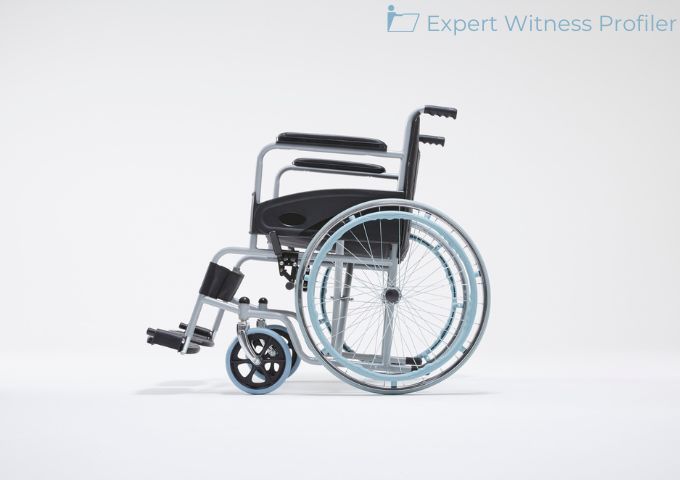
This case arises from an incident in which Plaintiff William Dowdy was injured after falling from a temporary wheelchair while using his wheelchair ramp. The temporary wheelchair had been supplied by NuMotion while Dowdy’s regular wheelchair was being serviced and repaired.
NuMotion sought to exclude the testimony of Plaintiff’s expert Mark Ezra, arguing that he lacks the proper qualifications, that his opinions rest on speculation rather than reliable methodology, and that his testimony will not assist the jury.
Mechanical Engineering Expert Witness
Mark A. M. Ezra is a board-certified professional engineer with a degree in mechanical engineering and a diploma in automatic control systems. His professional background includes decades of engineering practice, mechanical failure analysis, and forensic investigation.
NuMotion emphasized that Ezra is not a biomechanical engineer, has never worked for a wheelchair supplier, and has no experience as an Assistive Technology Professional (“ATP”).
Mechanical engineering is directly relevant to the design, stability, braking systems, and mechanical behavior of powered wheelchairs—the very issues at the heart of this case. The Court therefore found that Plaintiff has shown by a preponderance of the evidence that Ezra is qualified to offer expert testimony.
Reliability
NuMotion argued that Ezra’s opinions lack a factual foundation, that he improperly relied on the testimony of ATP Vincent Fels, and that he cannot identify the precise electrical defect that caused the wheelchair to stop.
Ezra’s expert report reflected a systematic engineering analysis grounded in physical inspection, measurements, documentary review, and application of mechanical principles. He personally inspected the TSS 300 wheelchair, took custody of it, and measured the slope of Plaintiff’s ramp. He reviewed the owner’s manuals for both the TSS 300 and the Jazzy 600, analyzed their braking systems, and compared their wheel configurations and stability characteristics. Ezra considered Plaintiff’s prior successful use of both wheelchairs on the same ramp and applied simple Newtonian mechanics to explain how a sudden stop would eject a seated user.
Based on this analysis, Ezra concluded that the “most probable and direct cause” of the incident was a power failure in the TSS 300’s electrical system, which triggered the automatic deployment of the parking brakes.
NuMotion also contended that Ezra improperly relied on ATP Fels’ testimony to opine on warnings and training. But Ezra’s core opinions concern mechanical behavior like stability, braking forces, and the consequences of a sudden stop, not ATP standards of care. The Court concluded that his references to Fels’ testimony serve only to contextualize the absence of instruction and the differences between the two wheelchairs, not to substitute himself for an ATP.
Relevance
NuMotion argued that Ezra’s testimony will not assist the jury because he cannot say whether NuMotion caused the defect or could have prevented it.
But Rule 702 does not require an expert to resolve every element of liability. Ezra’s testimony will help the jury understand the mechanical forces at play, the behavior of the TSS 300 during braking, the significance of the design differences between the TSS 300 and the Jazzy 600, and the mechanical plausibility of Plaintiff’s account. These matters are well outside the knowledge of a lay juror. Whether NuMotion caused the defect is a separate question for the jury, informed by, but not dependent on, Ezra’s mechanical analysis.
Held
The Court denied NuMotion’s motion to strike the testimony of Mark Ezra.
Key Takeaway
This methodology of identifying possible mechanical causes, ruling out alternatives, and applying engineering principles to the physical evidence is consistent with accepted practices in mechanical failure analysis. The fact that Ezra cannot identify the specific electrical component that failed does not render his opinion unreliable. Experts are not required to pinpoint the exact microscopic failure mechanism where the available evidence supports a broader, scientifically grounded conclusion. Ezra’s reasoning is transparent, testable, and rooted in the materials he reviewed.
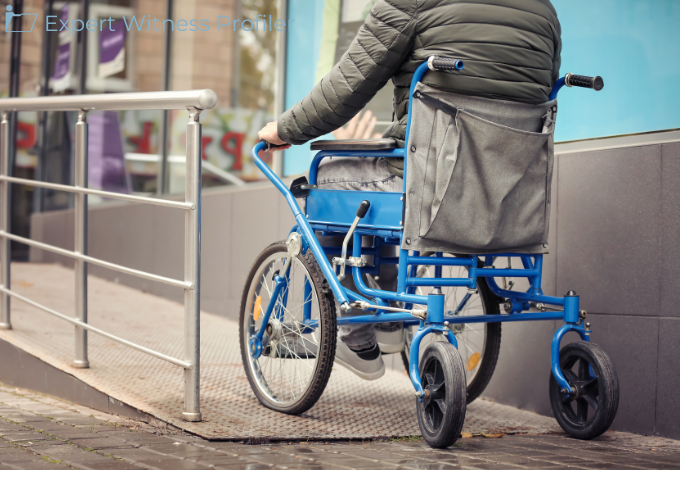
On March 19, 2018, Ralph Monte (“Monte”) visited the Defendant Sherwin-Williams Development Corporation’s store at 4473 South Semoran Boulevard in Orlando, Florida. While attempting to negotiate the ramp from the parking lot to the sidewalk, a wheelchair-bound Monte fell and sustained injuries. He claimed that the fall occurred because Defendant negligently maintained the premises and/or failed to warn him of a dangerous condition. Subsequently, Ralph Monte and his wife, Amarillis Monte filed this premises liability lawsuit under Florida law.
The Plaintiffs retained Robert Henry Burke, a forensic architect, as an expert witness to assess whether the conditions of the Defendant’s premises contributed to Monte’s accident. Burke visited the accident site twice, reviewed photographs taken by Monte and the Plaintiffs’ counsel, analyzed images pulled from the Internet in May 2019, and spoke with Monte on May 19, 2021. Burke produced his final expert report on May 30, 2024, a few days before the June 4, 2024 deadline to disclose expert reports.
In response, Defendant filed a motion to exclude Burke’s testimony regarding the slope and cross-slope of the ramp and whether or not the slope or cross-slope contributed to Monte’s accident. The Defendant argued that:
Burke’s opinions were not timely disclosed
He is unqualified to render these opinions
His opinions are not reliable or helpful
Architecture Expert Witness
Robert H. Burke Jr., AIA, served as NCARB president in 1992 and holds the distinction of being the only Florida architect to serve as both chairman of the Florida Board of Architecture and Interior Design and president of NCARB. A graduate of the University of Florida, Burke has received the Distinguished Alumnus and Distinguished Service Awards from the School of Architecture. In 1974, he co-founded his architectural firm, now known as BHM Architecture, which grew into one of central Florida’s most respected architectural practices. In 2013, he established RHBj Consulting to provide litigation support services for design and construction matters across Florida.
After assessing the premises’ conditions with regard to the relevant building codes, Burke opined that:
The ramp was improperly placed in an access aisle.
A one-inch change in level at the top of the ramp and sidewalk violated relevant code provisions.
The slope of the ramp was measured to be between 12.1% and 12.8%, while the relevant code allows a maximum slope of 8.33%.
After the ramp was removed following Monte’s accident, Burke calculated the slope by holding a twelve-inch digital level to the “clean concrete surface along the adjacent concrete curb” that was created by the ramp’s removal. In his view, these opinions “portray hazardous conditions and caused or contributed to Monte’s wheelchair fall accident.” He added that the premises were subject to other code violations.
When Defendant deposed Burke on August 2, 2024, he admitted that the methodology used to determine the slope of the ramp was inaccurate and could not be relied upon. Rather, a new calculation that he prepared the day before his deposition was “more accurate.” Accordingly, Burke stated that he was formally withdrawing his opinion regarding the slope of the ramp. Similarly, while Burke testified at his deposition that he had, since preparing his expert report, determined that the ramp was subject to a cross-slope that also contributed to Monte’s injury, he conceded that his report did not contain any opinion regarding cross-slope. Defendant reports that as of September 30, 2024, Burke had “not issued an updated report to reflect these new opinions and the opinions that were withdrawn.”
Analysis
When the Defendants moved to exclude some of Burke’s testimony, the Plaintiffs filed an untimely response. The Defendant moved to strike the Plaintiffs’ untimely response, and the Court granted the motion. Essentially, the Defendant’s motion to exclude is unopposed. Furthermore, the Court noted that the Plaintiffs failed to meet their burden of demonstrating the admissibility of Burke’s opinions.
Opinions Were Not TimelyDisclosed
The Court noted that the Plaintiffs failed to provide a supplemental expert report updating Burke’s opinions as to the slope and cross-slope. In other words, Plaintiffs failed to file a supplemental report detailing the new methodology employed by Burke to calculate the slope of the ramp and discussing how he determined that the ramp was subject to cross-slope. The case management and scheduling order required Plaintiffs’ expert report to be disclosed by June 4, 2024. Indeed, even if Plaintiffs had filed a supplemental expert report immediately after Burke’s deposition—which they did not—the Court would have had the discretion to exclude that supplemental report because the date to file expert disclosures had passed.
Reliability of Opinions
Even if the Court were to consider the untimely response, it found that Burke’s opinions were not reliable as per the Daubert standard. Initially, Burke calculated the slope of the ramp using a methodology that he later admitted was unreliable. Despite recognizing the error in his initial approach, Burke did not provide an updated report to correct or clarify his revised opinion. As a result, the Court concluded that the Plaintiffs failed to establish the reliability of Burke’s opinions regarding the slope.
The Court also noted that Burke did not explain how he determined that the ramp was subject to a cross-slope contributing to Monte’s injury, rendering his opinion on the cross-slope unreliable as well.
Held
The Court granted the Defendant’s motion to exclude certain testimony provided by the Plaintiff’s architecture expert witness, Robert Henry Burke.
Key Takeaways:
The Court granted Defendant’s motion to exclude Burke’s testimony due to the Plaintiff’s failure to timely disclose revised opinions. Additionally, the Court found that Burke’s opinions were unreliable. His opinion regarding the ramp’s slope relied on an inaccurate methodology, and no supplemental report was provided after he withdrew his initial opinion. Furthermore, Burke did not adequately explain the cross-slope issue or its contribution to the accident, leading the Court to exclude his testimony for lack of reliability and untimely disclosure.
Please refer to the blog previously published about this case:
It all started when Lewis Youngman fell from his motorized wheelchair while driving on the entry gangway of the Defendant’s cruise ship, Mariner of the Seas. Youngman alleged that, as a result of Defendant’s negligence, a certain portion of the gangway was impermissibly steep, uneven, and mis-leveled. Consequently, Youngman argues, the uneven flooring caused his wheelchair to tip over. This alleged negligence then resulted in severe injuries.
Defendant sought to strike some of this expert testimony from Plaintiff’s expert witness, Frank Fore, and Plaintiff’s hybrid witnesses, Timothy Carter, M.D., and Mark Fulton, M.D. As to Fore (an engineer), Defendant sought to strike his opinion that Plaintiff would not have been ejected from his motorized wheelchair were it not for the impermissibly steep incline of the gangway. Additionally, Defendant sought to strike Fore’s testimony that, had one of Defendant’s crewmembers more appropriately assisted Plaintiff, in accordance with Defendant’s own internal policies, Plaintiff’s incident would not have occurred.
Further, Defendant sought to strike Plaintiff’s treating physicians, Carter and Fulton, for Plaintiff’s allegedly insufficient pretrial disclosure. Alternatively, if the Court deems Plaintiff’s disclosures to be sufficient, Defendant moved to strike certain testimony from Carter on reliability grounds.
Forensic Engineering Expert Witness
Frank A. Fore is a forensic engineer, his specialties include vessel dynamics, kinematics, and accident reconstruction; occupant and pedestrian biomechanical dynamics, kinematics and injury analysis, tribology and the engineering of interacting moving surfaces, including the study of the co-efficient of friction, lubrication, and wear.
Mark Fulton is a Board-Certified Diplomat by the American Board of Neurological Surgery and is a fellow American Association of Neurological Surgeons, who specializes in both complex spinal and intracranial surgery. He received his medical degree from University of Utah School of Medicine and served both a Residency program and a Surgical Critical Care Fellowship at the Ohio State University Hospitals.
Timothy D. Carter is a Board-Certified Diplomat by the American Board of Neurology, who specializes in neurology, internal medicine, and clinical neurophysiology. He received his medical degree from University of Florida School of Medicine and completed a year of internal medicine residency at the University of Virginia affiliated programs. His neurology residency and clinical neurophysiology fellowship were completed at the Medical University of South Carolina where he was also Chief Resident.
“Plaintiff would not have been ejected and injured had his mobility scooter not abruptly tipped over on the gangway’s steep slope … or if the Gangway and Transition Plate had not exceed[ed] the mandatory maximum slope requirements as set forth in the Americans with Disabilities Act and the Florida Building Code, inter alia.”
Defendant argued that this conclusion is inadmissible because Fore did not engage in sufficient—or indeed any—testing before reaching this conclusion. Specifically, Defendant avers that Fore had no information regarding the make or model of Plaintiff’s motorized wheelchair (which Fore mistakenly referred to as a mobility scooter throughout his report); did not know how much the wheelchair weighed; did not know how much Plaintiff weighed; did not know how many wheels the wheelchair had; did not consider, or even know, the speed at which the wheelchair was traveling; and lacked understanding of other important details before drawing his conclusion. Defendant also pointed out that Fore did no experiments or other tests before arriving at his conclusion.
Fore made no effort to gather pertinent facts before concluding that the slope of the gangway was the cause of Plaintiff’s injury
The Court held that Fore’s conclusion is borne almost entirely of “anecdotal experience or speculation.” Fore offered no awareness of any facts specific to Plaintiff’s situation, let alone that he considered those facts in his opinion. Specifically, Fore’s opinion is untethered to critical facts such as the speed at which Plaintiff was traveling, the assistive device in which Plaintiff was traveling, the weight at which Plaintiff was traveling, or other details which would be necessary to render a reliable, non-speculative methodology. To the contrary, Fore’s opinion is based entirely on the theory that the gangway appeared to him to be improperly sloped, juxtaposed against videos of other people ostensibly falling on the gangway. The Court “concluded that there is simply too great an analytical gap between the data and the opinion proffered.”
However, Plaintiff missed the operative purpose for which this testimony was offered: “Defendant’s conformity to industry safety standards.” Here, Defendant has wisely opted not to challenge the portion of Fore’s testimony that opines on whether the gangway conforms with industry standards. Given Fore’s stated experience and training, plus his review of the basics of the record in the case, the Court held that this conclusion does fall within the Daubert reliability standard.
The Court held that Fore’s opinion rests too strongly upon speculation, such that it is unreliable under Daubert and its progeny. And because Fore’s speculation-laden testimony that the allegedly improperly-sloped gangway was the but-for cause of Plaintiff’s injuries lacked legal reliability, the Court granted Defendant’s motion to strike that portion of Fore’s testimony.
However, the Court refused to strike Fore’s testimony that “certain building codes and guidelines or regulations were arguably applicable to the subject gangway and that any alleged deficiencies with the subject gangway may have contributed to Plaintiff’s incident.”
Fore may not, however, testify that Plaintiff’s “mobility scooter would not have tipped over” had Defendant complied with its policy
Defendant sought to strike the portion of Fore’s report that Plaintiff’s “mobility scooter would not have tipped over had an RCCL crewmember assisted [Plaintiff] as required by RCCL internal policies ….”
The Court decided that Fore may testify as to whether, in his opinion, Defendant complied with its own internal policies. Indeed, courts have held that it is not a legal conclusion to analyze a party’s actions against its internal policies, and to determine whether the party complied with those policies.
The Court held that Fore may not, however, testify that Plaintiff’s “mobility scooter would not have tipped over” had Defendant complied with its policy. This testimony certainly rings again of an ultimate legal conclusion; i.e., that Defendant’s alleged failure to comply with its policy was the but-for cause of Plaintiff’s injuries. Thus, this portion of Fore’s anticipated testimony is inadmissible as it is purely a legal conclusion.
Challenges as to the Disclosure of Mark Fulton and Timothy D. Carter
Mark Fulton and Timothy D. Carter are hybrid witnesses pursuant to Federal Rule of Civil Procedure 26(a)(2)(C). Both are treating physicians of the Plaintiff, who will offer opinions within their areas of expertise, as disclosed below, but who need not provide a written report.
In addition to no reports being disclosed, Defendant argued that Plaintiff’s description of the testimony was also vague. That description is as follows:
“The Plaintiff’s medical condition related to the injuries that the Plaintiff sustained as alleged in the Complaint, including Plaintiff’s current medical symptoms, past and future medical and surgical condition and treatment, injury causation, aggravation of injuries and preexisting conditions due to the subject incident, diagnosis, prognosis, permanency, disability, and impairment, … the reasonableness of the costs and necessity of the medical care and treatment that was performed on the Plaintiff and the nature and estimated cost of future necessary medical and treatment for the Plaintiff.”
While the Court doubted whether the disclosure’s description is sufficient, the Court readily found that the ample time to depose the expert witnesses cured any ostensible prejudice.
Challenges as to Carter’s Anticipated Testimony
Defendant lodged substantive challenges to Carter’s proffered testimony.
Carter is a neurologist who has been treating Plaintiff since 2017. In 2019, Carter seemed to indicate that Plaintiff was experiencing neurological issues, and in 2021 essentially reaffirmed Plaintiff’s 2019 condition. On August 21, 2022, Plaintiff experienced his fall, and on September 7, 2022, underwent neck surgery. Eight months after Plaintiff’s fall, in May 2023 (and again in June 2023), Plaintiff had a visit with Carter. At that point, Carter seemed to notice marked differences in Plaintiff, including significant declines in his “mental and cognitive status,” his “speech and language,” his “attention and concentration,” and other mental faculties. Now, Carter seeks to testify that “more likely than not … the confluence of events together [i.e., Plaintiff’s fall and subsequent surgery] certainly contributed to some degree of deterioration.”
Defendant argued that Carter’s causation opinions should be excluded because Carter relied too heavily on temporal proximity and failed to rule out other factors causing Plaintiff’s neurological demise. Specifically, Defendant argued that Plaintiff, per Carter, was beginning to experience decline before Plaintiff’s fall; that imaging showed Plaintiff’s brain was already losing size and blood flow; that Carter failed to rule out that Plaintiff’s recurring urinary tract infections, as well as opioid and cannabis use, contributed to Plaintiff’s cognitive decline; that Carter could not determine that Plaintiff’s cerebral fluid issues were caused by the fall; and that Carter could not connect Plaintiff’s bowel and bladder incontinence to the fall.
Defendant’s Unpersuasive Challenges to Carter’s Opinions are Meritless
Carter bases his findings on a years-long relationship with Plaintiff, myriad neurological testing over those years, unchallenged qualifications in neurology, Plaintiff’s accident and surgery, and observations based on those years of visiting with Plaintiff to conclude that “the confluence of events together certainly contributed to some degree of deterioration.”
The Court held that it suffices to pass muster under Daubert, regardless of whether Carter directly ruled out every other cause of Plaintiff’s sudden neurological decline, or in part considered temporal proximity.
And to the extent that Defendant challenged the certainty of Carter’s findings (i.e., that “the confluence of events” contributed to “some degree of deterioration”), the Court decided that the Defendant is entitled to draw out Carter’s certainty before the jury via cross-examination. But such an argument goes to the weight, not the admissibility, of Carter’s testimony.
Held
The Court granted Defendant’s motion to strike Frank Fore’s testimony that the allegedly improper gangway slope was the primary or but-for cause of Plaintiff’s injury (or in other words the accident would not have happened but for the slope).
The Court denied Defendant’s motion to strike Fore’s testimony that Defendant failed to comply with its internal policies.
The Court granted Defendant’s motion to strike Fore’s testimony that Defendant’s failure to comply with its internal policies is the primary or but-for cause of Plaintiff’s injuries (or in other words the accident would not have happened had Defendant followed its internal policies).
The Court held that any deficiency in Plaintiff’s disclosures of Mark Fulton and Timothy Carter will be cured so long as Plaintiff makes Fulton and Carter available for deposition within twenty days of this Order.
The Court denied Defendant’s substantive motion to strike the testimony of Carter.
Key Takeaways:
Defendant persuasively challenged the reliability of the methodology Fore employed to go a step further to conclude that the ostensibly-improper gangway was the but-for cause of Plaintiff’s injurious ejection. An ultimate causation opinion goes a great deal further than simply an opinion that industry standards were not followed. A causation opinion must be supported by greater analysis and investigation.
Fore’s testimony that “certain building codes and guidelines or regulations were arguably applicable to the subject gangway and that any alleged deficiencies with the subject gangway may have contributed to Plaintiff’s incident” certainly falls within his expertise and experience. And the work he undertook to reach that more limited opinion is sufficient for Daubert purposes.