Manichanh Sitivong sued the United States under the Federal Tort Claims Act (FTCA) for injuries she sustained when her car collided with a car driven by a Federal Bureau of Investigation agent.
Sitivong sought to exclude the government’s biomechanical engineering expert, Keith Stolworthy, Ph.D, P.E. Sitivong argued that Stolworthy’s report (1) incorrectly assumed that Sitivong experienced only frontal forces and not lateral or rotational forces, (2) was insufficiently based on photographs and repair bills for Sitivong’s vehicle, (3) improperly opined on the medical causes of Sitivong’s injuries, (4) relied on volunteer crash safety tests that are disconnected from the conditions of Sitivong’s collision, and (5) relied on a misleading daily activities chart.
Mechanical Engineering Expert Witness
Dean Keith Stolworthy, Ph.D, P.E. understands the mechanical performance of biological tissue (e.g., how the body moves and breaks) and applies this in the analysis of injury-causing events and the design of biomechanical devices. He has served as an expert witness on hundreds of cases involving vehicle accidents (including front, rear, and side-collisions; roll-overs, occupant ejections; and motorcycle crashes); slips, trips, and falls; projectiles and falling objects; workplace accidents; medical devices and consumer product failures; and other injury-causing events.
Stolworthy received bachelor’s, master’s, and doctorate degrees in Mechanical Engineering from Brigham Young University and was a postdoctoral researcher at Vanderbilt University.
Discussion by the Court
Sitivong contended that Stolworthy’s report “never explains” why he concluded that her vehicle “experienced virtually no left-right or clockwise rotation during the impact.”
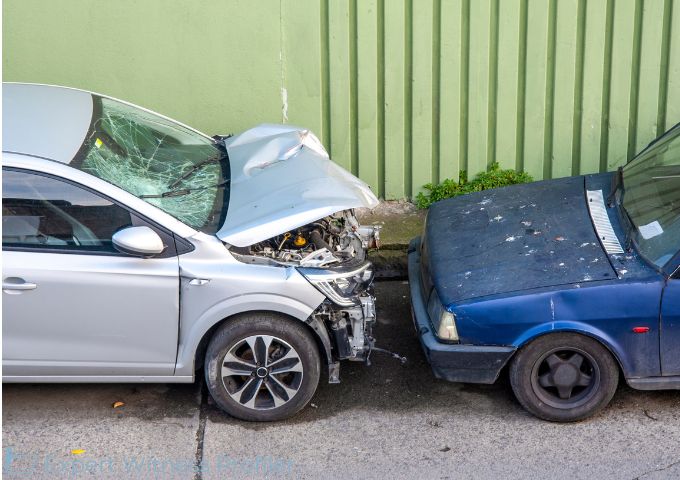
Stolworthy performed a crush-based analysis to determine the vehicle dynamics of the collision, specifically the “rearward-directed change in speed (delta-V)” of Sitivong’s vehicle. After estimating the size of the damage to Sitivong’s vehicle, he “appl[ied] well-accepted formulas in the field of vehicle accident reconstruction” to determine that the delta-V of Sitivong’s vehicle was “less than 7.5 mph.”
Stolworthy did not state what formulas he applied, how he applied them, or what the potential error rate was for this calculation. He claimed the formulas are “well-accepted” in the field of vehicle accident reconstruction, but he did not cite tests, studies, or peer-reviewed publications. As it stands, Stolworthy’s delta-V calculation using the crush analysis is a black box that does not allow for determination of whether it falls within the range of accepted standards governing how scientists reach their conclusions.
Stolworthy used other methods to calculate delta-V, including National Automotive Sampling System-Crashworthiness Data System, Crash Investigation Sampling System, and Insurance Institute for Highway Safety analyses. However, these analyses provided only an upper limit or approximation of delta-V. The only other method Stolworthy used to calculate a specific delta-V value is a kinematics analysis.
Stolworthy relied on his delta-V calculation throughout the rest of his report. Because the Court cannot determine how Stolworthy calculated delta-V, his report is unreliable. However, the problems appear curable, so the Court gave the government an opportunity to supplement Stolworthy’s report if he can provide the basis for his delta-V calculation.
Held
The Court granted in part Plaintiff’s motion to exclude the testimony of Keith Stolworthy, Ph.D
Key Takeaway
The Rule 702 factors are not exhaustive, vary in applicability depending on the case, and are meant to determine whether the expert’s analysis “falls within the range of accepted standards governing how scientists conduct their research and reach their conclusions.”
Case Details:
| Case Caption: | Sitivong V. United States Of America |
| Docket Number: | 2:22cv169 |
| Court Name: | United States District Court, Nevada |
| Order Date: | May 01, 2026 |