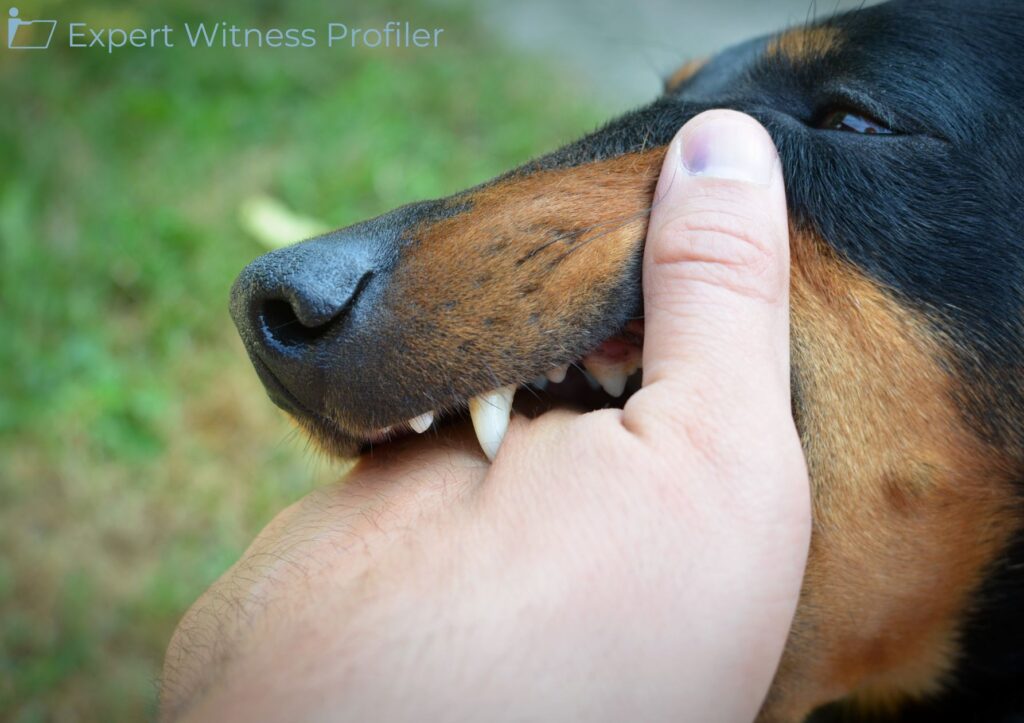
In this excessive force case involving a police canine, Plaintiff Herman Evans (“Evans”) filed a motion to exclude the opinion of The City of Lynchburg’s (“City”) expert witness—Jeffrey T. Barrett (“Barrett”).
Barrett offered four opinions (although the confines of those opinions are not as clearly defined as they should be). First, he reviewed the training records for Officer Reed and the canine Knox—the police officer and canine accused of using excessive force against Evans—and will opine that they received sufficient training. Second, he generally opined on acceptable use of force procedures involving police canines, including the Lynchburg Police Department’s use of force directives. Third, he opined on Evans’ behavior, concluding that he “agrees with the assessments made by Officer Reed about Evans being under the influence of drugs and alcohol.” And fourth, he opined that based on the facts of this case Reed’s decision to employ the canine Knox against Evans was a reasonable use of force.
Law Enforcement Expert Witness
Jeffrey Todd Barrett is a retired police officer, having served 31 years as a canine handler. For the last 22 years of his law enforcement career, Barrett trained other law enforcement officers on handling police canines. Barrett has 1,920 hours of canine training, having attended at least sixteen advanced courses on handling police canines. Barrett also served as an instructor for canine handlers, providing trainings for the Federal Bureau of Investigation; the Secret Service; Customs and Border Patrol; and the U.S. Army and Marine Corps. He has served as an expert witness in at least three other cases and co-authored the book, Canines in the Courtroom.
Evans sought to exclude Barrett’s opinions, arguing they: (1) are outside the scope of Barrett’s expertise, (2) are legal conclusions; and (3) are not derived from reliable principles or methods.
Generally, these arguments collide with Barrett’s experience and education—including decades as a law enforcement officer and canine handler and numerous, specialized trainings in handling police canines. Barrett has also trained other law enforcement officers—including FBI agents–on handling police canines and has written a book on police canines.
Analysis
The Court held that Barrett’s testimony about the standards and procedures for training and using police canines appeared to be both reliable and relevant—the two hallmarks of any Daubert inquiry.
Barrett is also free to apply his expertise—i.e., knowledge about how canines should be trained, handled, and employed in the field—to the facts of this case and is free to opine on whether Officer Reed deviated from standard police practices.
However, Barrett will not be allowed to opine on whether Officer Reed used excessive force in violation of the Constitution as that crosses the line from offering an opinion on the ultimate issue to offering an impermissible legal conclusion.
Barrett will also be precluded from offering expert testimony on Evans’ behavior. Barrett purported to “agree with the assessments made by Officer Reed about Evans being under the influence of drugs and alcohol.” However, Barrett provided no basis for reaching that opinion. He does not purport to be an expert in toxicology or in any behavioral science. He also was not present on the date of the incident to personally observe Evans’ behavior. Rather, Barrett appeared to be parroting Officer Reed’s view of the facts. The jury can compare Officer Reed’s and Evans’ testimony, review any additional evidence (including if there is shoulder camera footage), and make a factual determination about Evans’ behavior without any assistance from Barrett.
Barrett’s attempt to pile on when he was not a firsthand witness to Evans’ behavior crossed the Daubert line and will not assist the jury in any meaningful way. Accordingly, the Court excluded that proffered testimony.
Held
The Court granted in part and denied in part Evans’ motion to exclude the opinion of The City of Lynchburg’s expert witness—Jeffrey T. Barrett.
Key Takeaway
An expert can testify to the ultimate issue so long as there is an adequate foundation. The line between a permissible opinion on an ultimate issue and an impermissible legal conclusion is not always easy to discern. In this case, however, Barrett will not be allowed to opine on whether Officer Reed used excessive force in violation of the Constitution as that crosses the line from offering an opinion on the ultimate issue to offering an impermissible legal conclusion.
This case arises under the Trafficking Victims Protection Reauthorization Act (TVPRA), which provides victims of sex trafficking a civil remedy against the perpetrators and beneficiaries of their trafficking. Plaintiff C.L.F. filed this action to recover for alleged harm she experienced from being trafficked at a Motel 6 in Wichita, Kansas, that she claims was owned and operated by the Defendants.
On August 21, 2025, C.L.F. filed the motion sub judice, seeking to exclude as irrelevant the testimony of Defendants’ designated law-enforcement expert witness Bill Woolf.
Law Enforcement Expert Witness
William “Bill” Woolf has spent over 15 years of experience in law enforcement, specializing in the investigation of human trafficking, organized criminal enterprises, narcotics, and gang-related crime.
He has conducted extensive fieldwork in identifying, investigating, and dismantling human trafficking networks, with a focus on both sex trafficking and labor trafficking operations occurring in a variety of settings, including hospitality environments.
Woolf is the Principal and Founder of The Woolf Group, a national consulting firm providing expert guidance on human trafficking prevention, investigation, training, and public policy.
C.L.F. asked the Court to exclude all four opinions offered by Woolf. Namely, Woolf’s opinions that:
(1) “There is no evidence that trafficking involving CLF was identified or interdicted by law enforcement during the relevant period;”
(2) “Hotel staff are not trained, equipped, or authorized to investigate or intervene in suspected trafficking operations;”
(3) “In transient lodging environments, the investigative and intervention burden for human trafficking rests with law enforcement, not hotel personnel;” and
(4) “It is unreasonable to retroactively impose a higher duty of detection on hotel staff than the standard applied by law enforcement at the time.”
C.L.F. claimed that “all of Woolf’s opinions are red herrings that draw the jury’s attention to topics that have no bearing on the actual issues that must be decided in this case.”
Opinion 1
Woolf may not tell the jury there was “no evidence that trafficking involving C.L.F. was identified or interdicted by law enforcement during the relevant period.” This is irrelevant to understanding whether hotel staff knew or should have known of sex trafficking at the Wichita Motel 6. It is also misleading. Hearing that police officers had “frequent engagement with the subject properties” and that they made no reports or arrests for sex-trafficking related crimes would lead a juror to conclude that such conduct was absent. That distracts the jury from the pertinent inquiry. Numerous arrests for sex trafficking might put hotel employees on notice, but that logic does not follow from a total absence of arrests. Law enforcement may not have arrested anyone for trafficking at the Wichita Motel 6, but that in no way precludes hotel management and staff from being aware of ongoing sex-trafficking-related activity.
As such, the Court struck Woolf’s opinion as irrelevant and misleading.
Opinion 2
The Court struck Woolf’s second opinion as misleading. Investigating and/or intervening in human trafficking is not an element of the TVPRA and to suggest that Defendants’ employees were not trained or able to investigate, identify, or interdict trafficking injects elements into C.L.F.’s burden of proof that simply are not there. All that is required for C.L.F. to show is that Defendants’ employees were negligently aware of sex-trafficking-related activity on the property.
Opinion 3
The jury cannot hear Woolf’s third opinion. It would tell the jury that, since hotel staff lack the “access to confidential intelligence, interagency data, investigative tools, and legal mechanisms such as warrants and subpoenas” that police officers have, hotel staff are unable to “reliably assess” potential trafficking red flags.
This would seriously undercut the jury’s factfinding role. As said, hotel staff cannot escape imputing knowledge from their own observations of sex-trafficking-related activity just because they lack military-grade investigative tools. A janitor’s inability to petition a judge for an arrest warrant has no bearing on his awareness of sex trafficking if there were observable signs of trafficking in the hotel hallways. The jury, who “is solely responsible for determining the weight and credibility of the evidence,” should assess how Defendants’ staff interpreted those signs without assessing how a police officer would react.
Further, pointing out hotel staff’s lack of crime-prevention tools might mislead the jury to think that the TVPRA excuses liability where a defendant is unable to prevent sex trafficking. As the parties know, making that suggestion to the jury would be wholly inappropriate because “the TVPRA does not impose an affirmative duty to police and prevent sex trafficking” (nor excuse sex-trafficking liability because no duty to prevent exists). The relevant inquiry is whether hotel staff knew of trafficking, not if they prevented, or attempted to prevent, it.
Opinion 4
Woolf’s fourth opinion is simply a summary of his already discussed testimony. His claim that it is “unreasonable to retroactively impose a higher duty of detection” on hotel staff than law enforcement highlights the irrelevance of his other opinions. Discussion of law enforcement’s knowledge or lack thereof regarding trafficking at the Wichita Motel 6 has no effect on that of hotel management and staff. Referring to it would only mislead the jury. Woolf’s testimony appears designed to imply that Defendants were unaware of sex trafficking because law enforcement, with all its law-enforcement techniques, was also unaware. While sensible to think that a layperson would not detect an ongoing crime if a police officer in the same situation could not, that analogy is “non-helpful” here.
The standard is whether hotel staff knew of sex trafficking at their hotel. As explained, hotel staff are in a much different position than police officers to observe the day-to-day happenings at a hotel. The ways in which law enforcement and hotel staff acquire knowledge of sex trafficking at a hotel are completely different and to conclusively suggest to the jury that what was not observable to law enforcement was not observable to hotel staff is both untrue and unhelpful.
Rebuttal Opinions
Defendants pointed out that Woolf also offered rebuttal testimony to C.L.F.’s experts, and that C.L.F.’s motion did not request those rebuttal points to be excluded. C.L.F. responded that, if the Court excludes Woolf’s opinions, then it should also exclude his rebuttal opinions.
All four opinions asserted that it would be unreasonable to find that hotel staff were aware of sex trafficking at the Wichita Motel 6 because law enforcement, with its greater resources, tools, and training, was not. As explained, such testimony would only confuse the jury.
Rebuttal Opinion 2 responded to C.L.F.’s expert witnesses’ claims that hotel training was inadequate by pointing out that no industry standards about sex-trafficking awareness, such as the DHS Blue Campaign Hospitality Toolkit, existed until after this case’s relevant trafficking period.
The opinion also pointed out how “assertions by [C.L.F.’s law-enforcement expert] Christi Decouflé that G6 policies actively discouraged reporting to law enforcement are not substantiated by the record.” But this is straightforward impeachment. It did not help the jury to have Woolf provide such testimony. Impeaching a witness by highlighting inconsistencies between their testimony about documents and facts contained in and relating to those documents does not require specialized knowledge, nor even a live witness; instead, that is the role of counsel.
This Ruling Remains Good for Both the Goose and the Gander
Woolf’s testimony could only muddle things, as he would not testify about red flags observable or known to hotel employees. Instead, he wants to advise the jury on what law enforcement would or would not have known. This would not help the jury.
While Woolf’s testimony goes to Defendants’ actual or constructive knowledge about the trafficking, it is inappropriate as compared to other experts.
Decouflé’s testimony here is based on Defendants’ own policies, guests’ online reviews, and what potential sex-trafficking-related facts the hotel workers, not police, saw during the relevant time. She would testify to hotel-staff knowledge based on hotel-staff observations while Woolf would compare hotel-staff knowledge and training to police-officer knowledge and training. For a jury deciding what the hotel staff knew or should have known, the former is helpful; the latter is not. Woolf’s testimony is irrelevant.
Held
The Court granted Plaintiff’s motion to strike or exclude the testimony of Bill Woolf.
Key Takeaway:
The perspective of a trained law enforcement officer experienced in identifying, investigating, and intervening in cases of human trafficking—even within hospitality settings—would not help the jury understand or determine whether G6’s management or staff knew, or should have known, that sex trafficking was occurring at the Wichita Motel 6.
While Woolf indicated that he considered “the observable signs and behaviors that might have been available to hotel staff,” his opinions address only what law enforcement would understand and/or do in response to those observations.
Please refer to the blog previously published about this case:
This suit involves the unnecessary use of excessive force by police officers against a black man suffering from a mental health crisis.
On November 21, 2021, during a mental health crisis, Jabari Asante-Chioke encountered Louisiana State Police (“LSP”) Officer Nicholas Dowdle and East Jefferson Levee District (“EJLD”) Officers Jonathon Downing and Gerard Duplessis (collectively referred to herein as “Officer Defendants”
Plaintiff, Malikah Asante-Chioke, individually, and on behalf of her father, Jabari Asante-Chioke, herein filed this action against the Defendants, accusing them of failure to use less-than-lethal methods in accordance with training and state and federal law, to subdue Mr. Asante-Chioke.
Malikah Asante-Chioke filed a motion to exclude the testimony of John J. Ryan.
Law Enforcement Expert Witness
John J. Ryan has been actively involved in police practices and law enforcement since 1981.
He was an active police officer for twenty years in Providence, Rhode Island. In the final year of his active career and since his retirement in June of 2002 from police services, he has been involved in police and law enforcement practices as a private consultant regarding law enforcement issues.
Plaintiff sought to exclude Ryan’s statement in his report which provides, “It is well known that [if] [sic] an officer reasonably perceives an immediate threat of serious bodily harm or death against themselves, another officer, or any third party, the officer may respond with deadly force.”
EJLD Defendants argued that a full reading of Ryan’s opinion will explain how this statement is based on Ryan’s “expertise in generally accepted [police] policies, practices, training, and industry standards.”
While that may be the case, the Court held that Ryan’s statement is not couched in the appropriate terms.
The Court will not exclude Ryan’s statements of applicable police standards and practices, nor his conclusion that Officers Downing and Duplessis complied with those standards. As the Court has explained, an expert may opine on whether officers complied with applicable police policies and procedures.
EJLD Defendants argued that Ryan did not need to discuss relevant East Jefferson Levee District policies and procedures and the Court agreed.
Lastly, Plaintiff argued that Ryan offered impermissible legal opinions because he opined that the EJLD Defendants acted reasonably. While reasonableness is an inadmissible legal conclusion, Plaintiff failed to offer specific examples from Ryan’s report where he opined on the reasonableness of the EJLD Defendants’ actions.
II. The “Reactionary Gap”
Plaintiff also argued that Ryan is unqualified to opine on the “reactionary gap” between when an officer receives a stimulus to stop or start firing and when an officer responds to said stimulus.
EJLD Defendants argued that Ryan is qualified to opine on reaction time because he has spent numerous hours training officers in shooting scenarios, including conducting stimulus drills on a shooting range. The Court agreed with EJLD Defendants.
Plaintiff also argued that, even if Ryan were qualified, his opinions on the reactionary gap will not help the factfinder because perception reaction times are common sense. However, the Court disagreed. In this case, Ryan may help the factfinder determine whether the Defendants officers’ actions to continue shooting Asante-Chioke were reasonable. Consequently, the Court refused to exclude Ryan’s testimony as unhelpful.
III. Ryan’s Factual Interpretations
Plaintiff also argued that the Court should exclude “Ryan’s opinions that merely recite defense counsel’s factual and legal narratives.”
EJLD Defendants argued that Ryan’s opinions are not based on defense counsel’s factual and legal narratives, but instead are based on his view of the body cam, dash cam, and bystander video evidence. This Court agreed with EJLD Defendants. Throughout his report, Ryan utilized the available video evidence and deposition testimony to formulate his opinions.
Held
The Court granted in part and denied in part Malikah Asante-Chioke’s motion to exclude the testimony of John J. Ryan.
Key Takeaway:
While a lay person may have a general understanding of perception reaction times, “a lay person typically would not have experience or knowledge about the time it takes an officer to react to a perceived threat or the absence of a perceived threat.”
By opining that shooting officers take time to react to a stimulus to stop shooting, Ryan may help the factfinder determine whether the Defendants officers’ actions to continue shooting Asante-Chioke were reasonable.
Please refer to the blog previously published about this case:
Johnson is charged with three counts relating to sex trafficking or transportation of a minor for purposes of engaging in sexual activity: sex trafficking of a minor, coercion and enticement of a minor to engage in sexual activity, and interstate transportation of a minor for criminal sexual activity.
On October 3, 2025, the government notified counsel for Johnson that it intended to introduce the expert testimony of FBI Special Agent James E. Hardie who is alleged to be an expert in sex trafficking involving minors.
On October 14, 2025, Johnson filed the present motion in limine to preclude the government from introducing Hardie’s “so called ‘expert’ testimony.” He argued that Hardie’s proposed testimony is inadmissible because “it is not an area of any actual expertise,” and that “in effect, what the Government has proposed to do is elicit testimony from a law enforcement officer wherein the officer testifies that Johnson’s behavior is that of a sexual predator.”
Law Enforcement Expert Witness
James E. Hardie is a member of the FBI’s Critical Incident Response Group, National Center for the Analysis of Violent Crime, Behavioral Analysis Unit – 3. In that role, he is responsible for providing operational support to local, state, federal, and international law enforcement agencies investigating crimes against children, including sex trafficking.
Previously, Hardie served in other roles within the FBI, including supervising a squad of FBI special agents who were responsible for conducting sex trafficking investigations, working as an FBI liaison to the National Center for Missing and Exploited Children (“NCMEC”), and investigating child and adult sex trafficking cases as an FBI special agent.
On one hand, the government painted Hardie’s testimony as more general and described it as including: “(1) methods and techniques used in the management and procurement of commercial sex and (2) common characteristics and factors of victims of sex trafficking.” Whereas Johnson maintained that Hardie planned to testify specifically to his “expert opinion that Johnson behaved like a sexual predator.”
Having reviewed the statement of Hardie’s anticipated testimony, the Court found that his testimony included opinions of a general nature rather than opinions specific to this case, Johnson, or Minor Victim. However, to be clear, the Court agreed with Johnson that Hardie may not testify that “ Johnson behaved like a sexual predator” or that he “must be a sexual predator.” This testimony would be tantamount to Hardie providing legal opinion and usurping the role of the jury, which is impermissible.
Again, considering Hardie’s proposed testimony as contained in the government’s notice, the Court has no reason to anticipate that Hardie will testify impermissibly.
b. Qualifications, Reliability, and Relevance
The Court found no support for Johnson’s suggestion that Hardie’s specialized knowledge is not a valid area of expertise or that his extensive experience cannot render him an expert pursuant to Rule 702.
Based on Hardie’s qualifications, and like the other courts have found with respect to Hardie’s background testimony regarding sex trafficking, the Court found that Hardie’s testimony is reliable.
The Court also found that Hardie’s testimony is relevant to the issues in this case and will be helpful to the jury. The “culture and dynamics of sex trafficking are ‘not the subject of common knowledge.’”
For these reasons, the Court made a preliminary determination that Hardie’s testimony is admissible. Furthermore, after reviewing the above-cited caselaw, the Court found that a pre-trial Dauberthearing is unnecessary.
Held
The Court denied the Defendant Johnson’s motion in limine to preclude the testimony of James Hardie.
Key Takeaway:
Hardie’s testimony will assist the jury in understanding the behaviors and dynamics of trafficking victims and traffickers as well as assist it in assessing the credibility of the witnesses.
Plaintiff Shelby Ross asserted a Fourth Amendment unreasonable search and seizure claim against Defendant Jeremy Finney. In addition, Plaintiff asserted state law claims of assault and battery against Finney. Against Tipton County, Plaintiff averred “negligent failure to protect”/“negligent failure to prevent” claims under Tennessee law.
Ross hired Roy G. Taylor as an expert witness in areas such as police use-of-force policies, de-escalation techniques, and traffic stops.
Defendants argued that Taylor should be excluded as an expert because (1) his methods are not reliable under Daubert and (2) his report includes inadmissible legal conclusions about whether Finney had probable cause and reasonable suspicion to support his actions.
Law Enforcement Expert Witness
Roy Garvin Taylor is a former law enforcement officer and current adjunct professor with over forty years of experience “in various federal, state, local, and private Police Chief positions.” His areas of expertise include nationwide police procedures around traffic stops, use of force, and de-escalation techniques.
Defendants first argued that, under Daubert, Taylor “does not reliably employ principles and methods to base his conclusions.” Daubert’s factors ask “whether a method is testable, whether it has been subjected to peer review, the rate of error associated with the methodology, and whether the method is generally accepted within the scientific community.” Taylor’s opinions did not satisfy these factors, according to Defendants, because Taylor “generally relies upon his experience, education, and training in law enforcement.”
However, it is unclear what additional methodology Defendants would ask a police procedure expert to possess. After all, the methods of an expert in police procedure are not the kinds of methods that are regularly tested, peer reviewed, or accepted by the scientific community. As Ross pointed out, “Daubert is only of limited help in assessing technical or experiential expertise.”
Taylor’s qualifications include forty years of law enforcement and police training experience. Although his opinions fall outside the realm of science, the Court held that his personal knowledge and experience are appropriate substitutes to support a finding of reliability. Defendants will have a chance to challenge Taylor’s opinion through cross-examination and presentation of contrary evidence at trial, but exclusion is not the right path.
II. Inadmissible Legal Conclusions
Defendants next asserted that Taylor opined in his Initial Report about whether Finney had probable cause or reasonable suspicion to engage in certain actions on May 11, 2023. For her part, Ross conceded that some of the opinions in Taylor’s report “cross the line into ultimate questions of fact.”
Ross acknowledged that, to the extent Taylor used “phrases like ‘objectively unreasonable’ as a shorthand for something like ‘consistent with national standards,’ he should be required to use more precise language at trial.”
The Court concluded that Taylor cannot offer legal conclusions on questions including, but not limited to, reasonable suspicion, probable cause, whether conduct was lawful or unlawful, whether exigent circumstances existed, or whether a use of force constituted assault and battery. However, he may offer his opinions that do not include these terms and conclusions.
III. Supplemental Report
After Taylor submitted his initial report, and after he received the report of Defendants’ expert along with a copy of Tipton County’s police policies, Taylor submitted the supplemental report.
Defendants argued that, “at a minimum,” this supplemental report should be excluded because Taylor failed to include in his initial report “a complete statement of all opinions the witness will express and the basis and reasons for them.”
Instead, according to Defendants, Taylor later issued a supplemental report merely “as an attempt to bolster former opinions, provide totally new opinions, or combat the opinions of Defendants’ expert.”
Defendants further argued that Taylor’s analysis of the Tipton County police policies is irrelevant to this case, since there is no constitutional claim based on those policies nor any excessive force claim.
Because Taylor did not receive the police policies until after the Initial Report was written, Ross contended that he had a valid reason to supplement his earlier opinions. Ross further argued that the Tipton County use-of-force policies are still relevant to this case.
The Court deemed Taylor’s use-of-force analysis, drawn from the Tipton County police policies, relevant to this case, even though no Fourth Amendment excessive force claim is at issue, because the analysis of the state law assault and battery claim mirrors that of an excessive force claim.
Held
The Court granted in part and denied in part the Defendants’ motion to exclude the testimony of Plaintiff’s expert Roy Taylor.
Key Takeaway:
For nonscientific expertise such as Taylor’s, the relevant reliability concerns may focus on personal knowledge or experience. It helps that Taylor’s qualifications include forty years of law enforcement and police training experience.
Plaintiff Jeffrey Fulkerson accused Deputy Keegan Kirkpatrick of the Nelson County Sheriff’s Office (“NCSO”) of using excessive force during his arrest.
Defendants retained Brian S. Batterton as a “police practices expert.” Batterton’s report contains three opinions:
“(1) Based upon the facts and reasons contained Paragraphs 25 through 41 . . . a reasonable and well-trained law enforcement officer would be acting consistent with generally accepted police practice and training in using soft-empty-hand control to escort Fulkerson to a police vehicle for transport to jail.
(2) Based upon the facts and reasons contained Paragraph 45 through 52 . . . Sergeant Brian Voils supervised the October 16, 2022 incident involving Jeffrey Fulkerson in accordance with generally accepted police practice . . . and that Sergeant Voils supervised Deputy Kirkpatrick according to generally accepted police practice, based on Kirkpatrick’s Annual Evaluation and Response to Resistance reports documented and reviewed by Sergeant Voils.
(3) Based on . . . the information discussed in Paragraphs 56 and 58 . . . Deputy Kirkpatrick was trained in accordance with generally accepted police practice for his position as a Nelson County Sheriff’s Deputy.”
Fulkerson filed a motion to exclude each of Batterton’s opinions based on the argument that the opinions are not helpful to the jury and thus not relevant.
Law Enforcement Expert Witness
Brian Scott Batterton has been actively involved in police practices and law enforcement since 1994. His education includes a Bachelor of Science Degree in Criminal Justice from Georgia State University in Atlanta, Georgia and a Juris Doctor from John Marshall Law School in Atlanta, Georgia. He is an active member of the State Bar of Georgia.
He is currently on the Legal and Professional Advisory Board of the Legal and Liability Risk Management Institute.
1.Batteron’s First Opinion Regarding the Use of Soft-Empty-Hand Control
Fulkerson argued that Batterton’s opinion that an officer’s use of soft-empty-hand control would be consistent with generally accepted police practice is not helpful to the jury because it will not help the trier of fact determine whether Fulkerson’s or Kirkpatrick’s version of events is true.
Batterton’s report explains how law enforcement officers are generally trained to make investigatory stops, provides factors that officers must consider when determining how much force is necessary, and provides information on the “use of force continuum”—the different levels of force officers are trained to use in different situations.
The report also explains how officers are trained to handle domestic dispute calls—the type of call that officers were responding to in this case. This information will help jurors understand how a trained officer would behave in the situation, and, upon determining which version of events they believe, whether Kirkpatrick acted reasonably. The jury can use the opinion about training standards as a guide, but it does not go to the ultimate issue of, and is not determinative of, whether the officer acted reasonably and does not equate to a finding that the officer acted unreasonably.
The Court found Fulkerson’s argument that Batterton’s report improperly invades the province of the jury by basing his opinions on Defendants’ version of events similarly unavailing. The fact that Batterton bases his conclusions on Defendants’ version of events did not prevent the jury from making its own credibility determination or accepting Fulkerson’s version as true.
However, to the extent that Batterton opined as to the reasonableness of Kirkpatrick’s actions, it is not admissible.
2. Batteron’s Second Opinion Regarding Whether Voils Acted in Accordance with Generally Accepted Police Practice
Batterton’s second opinion stated that “Sergeant Voils supervised the . . . incident involving Jeffrey Fulkerson in accordance with generally accepted police practice” and that “Voils supervised Deputy Kirkpatrick according to generally accepted police practice, based on Kirkpatrick’s Annual Evaluation and Response to Resistance reports documented and reviewed by Sergeant Voils.”
Fulkerson argued that this opinion is not helpful to the jury because he “entirely adopts the Defendants’ version of events” and ignored Fulkerson’s claim that Voils threatened to bring additional charges.
To hold a supervisor liable for a violation of a Plaintiff’s constitutional rights, there must be (1) knowing acquiescence to the unconstitutional conduct by the supervisor; (2) a causal connection between supervisor’s acts and the deprivation of rights, and (3) a deprivation of a clearly established right.
According to the Court, Batterton’s opinion gives the jury an understanding of how supervisors are typically expected to respond to and investigate such incidents, which will allow the jury to determine whether Voils acted in accordance with those practices and thus whether he “knowingly acquiesced” to unconstitutional conduct. As a result, Batterton’s testimony is relevant and admissible to the extent that it opines as to generally accepted police practices and whether Voils acted in accordance with such practices in supervising the incident.
However, to the extent that Batterton’s opinion relied on now-excluded evidence, it is not admissible. Batterton cited to the NCSO general directives manual and Kirkpatrick’s personnel files, both of which are excluded pursuant to the magistrate judge’s order.
3. Batterton’s Third Opinion as to Whether Kirkpatrick was Trained in Accordance with Generally Accepted Police Practice
As to Batterton’s third opinion, Fulkerson reasserted his argument that the opinion is not helpful because Batterton simply adopted the Defendants’ version of events and “concluded that if the Defendants are telling the truth, they are not liable.”
Batterton may rely on the assumption that Defendants’ version of events is true in giving his opinion. Moreover, testimony as to whether Kirkpatrick was trained in accordance with generally accepted practices would be directly relevant to the question of whether Voils properly supervised Kirkpatrick. However, Batterton’s third opinion is based almost exclusively on Kirkpatrick’s personnel files from the NCSO and the LaRue County Sheriff’s Office, both of which have been excluded.
To the extent that Batterton’s opinion relied on these documents, it was deemed inadmissible. The Court recognized that Kirkpatrick may have personal knowledge of his training to which he can testify. If that is the case, Batterton may opine as to whether those training practices align with generally accepted practices, provided he does not rely on the excluded documents.
Held
The Court granted in part and denied in part Fulkerson’s motion to exclude the testimony of Brian Batterton.
Key Takeaway:
In other words, Batterton bases his opinions on an assumption that one version of events is true—which is permitted under the Rules—not an explicit endorsement of that version. Outright exclusion of this testimony by the Court would not be appropriate, particularly when “rejection of expert testimony is the exception, rather than the rule.”
However, to the extent that Batterton opined as to the reasonableness of Kirkpatrick’s actions, it is not admissible. Although the Federal Rules of Evidence allow an expert’s opinion to “embrac[e] an ultimate issue,” the Sixth Circuit has held that this “reference must be to stating opinions that suggest the answer to the ultimate issue or that give the jury all the information from which it can draw inferences as to the ultimate issue.”
Case Details:
Case Caption:
Fulkerson V. Kirkpatrick Et Al
Docket Number:
3:23cv520
Court Name:
United States District Court for the Western District of Kentucky, Louisville Division
The claims in this case can be traced back to an unfortunate chain of events, as a routine three-officer search degenerated in the blink of an eye to chaos in a cramped apartment, the arrests of four family members, and a police dog attack that caused severe injuries to Plaintiff.
On March 11, 2019, Plaintiff Kim Saddlers was arrested for battery on a law enforcement officer, a felony charge that the Polk County Sheriff’s Office later nolle prossed. During her arrest, which occurred in her home, Saddlers was bitten by a police dog, causing a wound that required 30 sutures to repair. She alleges that 1) there was neither actual nor arguable probable cause to arrest her for any offense, and 2) that the force inflicted during her false arrest was excessive, and thus both unreasonable under the Fourth Amendment and constituting a battery under Florida common law.
As a result, Saddlers brought this civil rights action against the Defendants, Benjamin Blommel and Chad Landry, police officers employed by the City of Lakeland.
Plaintiff filed a motion to exclude the testimony of defense expert Kenneth Wallentine.
Law Enforcement Expert Witness
Kenneth R. Wallentine worked as a law enforcement officer in Utah, formerly serving as the Chief of Law Enforcement for the Utah Attorney General, and serving as Bureau Chief of the Utah Department of Public Safety, Peace Officer Standards and Training Division, among a number of other positions across the fields of law enforcement, police use-of-force and accountability research, teaching, legal practice, and expert legal services.
Plaintiff asked the Court to exclude three opinions under Daubert and Rule 702. The first is Wallentine’s statement that “Officer Landry’s decision to deploy [police dog] Nox to search for and track the unidentified suspect from the stolen car and his actions in tracking with Nox were reasonable and were consistent with accepted policies, practices, and training for police service dog teams.” The second opinion is that “[t]he unintentional bite to Plaintiff occurred as the officers were acting consistently with the actions of reasonable and well-trained officers attempting to defend themselves and to make lawful arrests of their assailants.” Finally, Plaintiff moved for exclusion of Wallentine’s opinion that “[c]iting Plaintiff for the offenses for which she was arrested was consistent with the actions of a reasonable and well-trained officer.”
Plaintiff’s Motion to Exclude Expert Testimony
The Court declined to exclude the first opinion and its underlying analysis because it provided background as to why it was that Plaintiff and Defendants crossed paths in the first place and why a police dog was used. Moreover, the Court agreed with Defendants that the leadup to the events could not only inform the jury, generally, but also have a direct bearing on Defendants’ culpability as to the claim for negligence, and specifically on whether either officer breached his duty to use reasonable care in conducting their investigation and during the subsequent altercations.
Plaintiff argued that this second opinion improperly purports to “divine Landry’s state of mind in employing his police dog to arrest Saddlers, and thus addresses the excessive force issue in the case.”
Defendants responded that the opinion did not speculate about Landry’s state of mind and instead draws upon Wallentine’s experience and the facts of this case to conclude that the canine was not instructed to apprehend Plaintiff and instead acted in accordance with his instinctual drive and trained behavior to protect his handler, Landry. The Court agreed with Defendants as to this second opinion and will not exclude it.
Plaintiff challenged a third opinion in Wallentine’s report. Considering the facts in light of his knowledge and experience in the areas of police training and the prosecutorial process, Wallentine opined that the Lakeland Police Department followed processes consistent with common practice throughout the United States and consistent with the actions of a reasonable well-trained officer.
Instead of explaining why Wallentine’s opinions are similarly defective, Plaintiff presented the broad argument that his “proffered testimony in this case suffers from the same deficiencies identified in an out-of-circuit district court opinion which is not binding on this Court.”
Held
The Court denied the Plaintiff’s motion to exclude the testimony of defense expert Kenneth Wallentine.
Key Takeaway:
Plaintiff failed to establish that the expert testimony would not be helpful to the trier of fact. Instead, the Court found that Ken Wallentine’s opinions would likely be helpful to the jury based on his qualifications, experience, analysis of the records, evidence, deposition testimony, and based on his expertise as a law enforcement officer, professor, police dog trainer, and investigations supervisor.
Case Details:
Case Caption:
Saddlers V. City Of Lakeland, A Florida Municipality Et Al
Plaintiffs Michael Gomez (“Gomez”), Joseph Lowe (“Lowe”), Ian Joi, and Alejandro Baez and Josephine Cartagena, as co-representatives of the Estate of Jayden Baez (“Baez”) (collectively, “Plaintiffs”) filed an Amended Complaint against Defendants Scott Koffinas (“Koffinas”), Ramy Yacoub (“Yacoub”), and Chris A. Blackmon (collectively, “Defendants”).
Plaintiffs alleged that Defendants Koffinas and Yacoub—members of the Osceola County Sheriff’s Department (“OCSD”)—exhibited “excessive and unreasonable force” in responding to Plaintiffs’ suspected petty theft at a Target store in Kissimmee, Florida.
To support their allegations, Plaintiffs offered the expert testimony of Jeronimo “Jerry” Rodriguez (“Rodriguez”), a law enforcement practices expert. Defendants filed a motion to exclude certain portions of Rodriguez’s testimony, specifically, his opinions on the OCSD officers’ tactical approach to apprehend Plaintiffs.
Law Enforcement Expert Witness
Jeronimo “Jerry” Rodriguez spent 26 years with the Los Angeles Police Department, retiring in 2013 at the rank of Captain.
For years Rodriguez consulted and guided municipalities on high profile police-involved incidents as a member of the agency. However, in retiring as a Law Enforcement Expert in 2021, he has been recruited to work on high-profile and sensitive cases.
Rodriguez is a graduate of theFBI National AcademyClass 234 and holds a master’s degree in Leadership from St. Mary College of California, as well as a bachelor’s degree in Business Management.
Defendants first argued that the Court should exclude certain portions of Rodriguez’s testimony because the lack of a national standard for apprehending subjects makes his criticisms of the officers’ tactics unreliable.
As shown in his expert reports, depositions, and curriculum vitae, Rodriguez used his law enforcement experience and knowledge, and training in police practices, to evaluate the facts of the instant case and form his opinions. Therefore, the Court found Rodriguez’s methodology sufficiently reliable.
Therefore, the lack of an express national standard did not make Rodriguez’s testimony unreliable. Defendants cited no authority for this proposition, nor is the Court aware of any.
Assistance to the Trier of Fact
Defendants next contended that Rodriguez’s inability to cite to a national standard rendered his testimony unhelpful to the jury, noting that it would risk misleading jurors into confusing his criticisms with constitutional norms.
The Court held that Rodriguez’s testimony is relevant and would be helpful to the jury. Specifically, his testimony would help the jury understand why a score of deputies, using a vehicle blocking maneuver, found it necessary to shoot 31 times into a vehicle containing four shoplifting suspects, killing Baez and injuring the other Plaintiffs. Moreover, the lack of an express national standard for police practices did not diminish the testimony’s helpfulness. There is no risk that jurors will confuse his opinions with constitutional norms. While Rodriguez’s testimony embraces an ultimate issue, it did not tell the jury what result to reach—the jury will decide how much credibility to give his opinions when making that determination.
Held
The Court denied the Defendants’ motion to exclude portions of Rodriguez’s opinion testimony except for the portion of the Defendants’ motion that sought to exclude Rodriguez’s testimony regarding the officers’ use of a vehicle block to practice their training, which was denied as moot.
Key Takeaway:
Defendants’ arguments regarding the unhelpfulness of Rodriguez’s testimony are simply meritless. The necessary and appropriate use of force by law enforcement is beyond the understanding of an average lay person and would therefore assist a jury.
Plaintiff Tonya Armstead Miller brought five claims on behalf of herself and the estate of Roderick Marcell Inge relating to the fatal shooting of Mr. Inge.
Specifically, Miller alleged that Defendant Chief Brent Blankley “maintained a system of grossly inadequate training” that caused officers to violate Inge’s Fourth and Fourteenth Amendment rights (“Count One”); that Defendant Officers John Beasley and Elijah Rodriguez unlawfully seized Inge by shooting and killing him in violation of his Fourth and Fourteenth Amendment rights (“Counts Two and Three”); and that Officers Beasley and Rodriguez negligently caused the death of Inge in violation of Alabama law.
Defendants filed a motion to strike the report and affidavit of Plaintiff’s expert Daniel Busken.
Law Enforcement Expert Witness
Daniel Busken served as a municipal police officer for 35 years including 25 years as a chief of police. This service included responsibility for development of and compliance with progressive law enforcement policies and procedures. Chief Busken served on the Board of Directors for the Texas Police Chiefs Recognition Program. This program sets the standards for progressive and professional law enforcement practices throughout the State of Texas.
He earned his BS in Business and Economics from Culver-Stockton College, his MPA from Saint Louis University, and his MBA in Criminal Justice from Northcentral University.
Defendants contended (1) Miller did not timely produce the report to them, and (2) it is not in the appropriate form.
The Court ordered Miller to disclose any experts and their reports by April 29, 2024. No extensions of any deadlines affected this deadline. The parties agreed that Miller did not provide any notice that Busken had been retained as an expert witness for Miller until May 3, 2025 and did not produce Busken’s report until she responded to the motion for summary judgment on October 24, 2024. The notice provided on May 3, 2025 identified Busken and provided his curriculum vitae, but it did not include his expert report, his affidavit, or any of the conclusions he drew in his report.
Miller did not argue that her failure to comply with the deadline set by the Court’s order was harmless or substantially justified. Instead, she argued that Defendants did not object to her late notice of Busken or seek to depose him.
But Defendants’ failure to object or seek to depose Busken did not make Miller’s non-compliance with the deadline harmless or substantially justified. To the contrary, her late disclosure prejudiced Defendants by denying them access to the substance of his opinion until after they had already moved for summary judgment.
Held
The Court granted the Defendants’ motion to strike Daniel Busken’s report and affidavit.
Key Takeaway:
A party’s failure to provide information or identify a witness as required by Rule 26(a) precludes the party from using “that information or witness to supply evidence on a motion unless that failure was substantially justified or harmless.
Plaintiff Omar O’Hara brought this civil rights action against Defendants Terrence Lott and Marlissa Butler-Cherry, who are police officers with the University City Police Department (“UCPD”), in their individual capacities. He alleged that Defendants violated his constitutional rights when they wrongfully arrested him during the early morning hours on March 15, 2023.
Plaintiff filed a motion to exclude the opinions, testimony, and report of Defendants’ police-practices expert, Steven Ijames.
Law Enforcement Expert Witness
Stephen Bradford Ijames has been a police officer since 1979 and retired as an assistant chief with the Springfield, Missouri Police Department. Since then he has served as chief of police in Republic and Ozark, Missouri.
Ijames has a bachelor’s degree in Criminal Justice, a master’s degree in Public Administration, and is a graduate of the 186th FBI National Academy. Ijames has served in, supervised, and commanded a variety of assignments including uniformed patrol, criminal investigations, undercover narcotics, and Special Weapons and Tactics (SWAT).
Plaintiff argued that Ijames’ opinions that Plaintiff’s arrest “was not an unreasonable seizure,” was supported by “reasonably trustworthy information” and “adequate probable cause,” “was not a ‘false arrest/imprisonment,’” and “was justified, appropriate, and consistent with generally and commonly accepted police training, policy, and practice” are impermissible legal conclusions. Moreover, Plaintiff contended that Ijames’s opinions as to what the video evidence portrayed are irrelevant and unhelpful to the jury.
As Defendants conceded, much of Opinion I consisted of impermissible legal conclusions about the reasonableness of Defendant Lott’s conduct in light of constitutional standards.
As a result, the Court held that Opinion I is so couched in legal conclusions and impermissible credibility determinations that it would provide the jury with no information other than what Ijames believes the verdict should be.
Opinion II
Ijames’ opinion that “[i]n assessing whether the overall force used and referenced above was consistent with generally and commonly accepted police training and practice, the totality of circumstances presented should be viewed in the context of the key factors referenced under Graham v. Connor” was held to be inadmissible for the same reasons as Opinion I.
According to the Court, Opinion II invaded the province of the jury by drawing inferences from Defendants’ unsworn characterizations of the incident, reaching conclusions about what the video evidence shows, and “mirroring [Defendants’ hearsay] version of events” “in the guise of a professional opinion.”
Held
The Court granted the Plaintiff’s motion to exclude the testimony of Steven Ijames.
Key Takeaway:
Expert testimony may be excluded if it is so couched in legal conclusions that it supplies the fact finder with no information other than what the witness believes the verdict should be.
Case Details:
Case Caption:
O’Hara v. Lott
Docket Number:
4:23cv442
Court Name:
United States District Court for the Eastern District of Missouri, Eastern Division