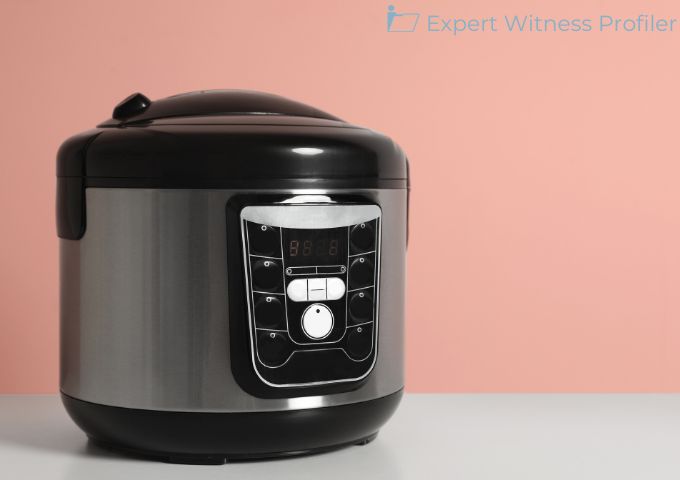
Grace Pennington filed a complaint alleging that she was seriously injured by an Instant Pot ULTRA Pressure Cooker she had purchased from Kohl’s Corporation.
The Defendant filed a motion to exclude the opinions of the Plaintiff’s expert, Dr. David M. Rondinone.
Mechanical Engineering Expert Witness
David Michael Rondinone holds an M.S. degree and a Ph.D. degree in Mechanical Engineering from the University of California, Berkeley, majoring in material behavior and design and minoring in structures and dynamics and electronic controls. He also holds a B.S. degree in Engineering Physics and a B.A. degree in Astrophysics from the University of California, Berkeley.
He has worked for more than 30 years in the areas of failure analysis, design, and risk assessment of consumer and industrial equipment, including pressure cookers.
I.Rondinone failed to consider whether the Plaintiff’s misuse caused the incident
The Defendant sought to exclude all of Rondinone’s opinions as unreliable because the Defendant asserted that he failed to consider whether the Plaintiff’s misuse caused the incident.
The “incident summary” in Rondinone’s expert report stated that the Plaintiff first “noted that the floating lock pin was in the ‘Up’ position,” so she manually released the pressure until “the floating lock pin depressed into the ‘Down’ position” before attempting to open the lid. None of the evidence shows that the Plaintiff attempted to remove the lid while the float valve was up. The Defendant’s theory that the Plaintiff misused the Instant Pot by attempting to open it while the float valve was up is not supported by evidence. Rondinone is not required to consider an alternative cause of injury that is not supported by evidence. The Court will not exclude Rondinone’s opinions as unreliable for this reason.
II. Rondinone did not employ a reliable methodology
The Defendant next argued that Rondinone did not employ a reliable methodology to conclude the Instant Pot’s float valve may have been clogged because he did not test the Instant Pot and did not observe clogging in the float valve.
Rondinone explained that “prior testing and experience” has shown that food can clog pressure cooker valves. Based on this, Rondinone concluded that “the float valve in the subject cooker is exposed to potential clogging from food.”
Because Rondinone is entitled to rely on prior testing and experience with similar pressure cookers to determine that the pressure cooker in this case was susceptible to clogging due to its exposed float valve, the Court cannot conclude that Rondinone’s methodology is so fundamentally flawed that the Court must exclude his opinion on a reliability basis.
III. Rondinone’s opinion that the float valve may have clogged is irrelevant
The Defendant also argued that Rondinone’s opinion that the float valve may have clogged is irrelevant because there is no evidence of clogging in this case.
Rondinone generally opined that float valve clogging can occur, he does not opine that in this case the float valve was clogged at the time of the incident or that clogging could have caused the incident. Instead, he stated that a boil-over is “the most likely scenario.”
Based on Rondinone’s description of a boil-over, it has nothing to do with a clogged float valve. The Court, as a result, excluded Rondinone’s opinions about float valve clogging as irrelevant.
The Defendant argued that Rondinone’s opinion that the Plaintiff may have accidentally depressed the float valve while releasing steam from the Instant Pot is speculative and unsupported. Stating that it is “possible” that the Plaintiff depressed the float valve does not meet the standard of reliability. Nor did Rondinone tie this possibility to any defect in the pressure cooker’s design. Rondinone did not opine that the placement of the float valve is a design defect or that it makes the pressure cooker unreasonably dangerous. This opinion is not reliable or relevant to the facts of the case and must be excluded.
For similar reasons, the Court excluded Rondinone’s opinions about the Defendant’s failure to perform an Failure Modes and Effects Analysis (“FMEA”) because they are not tied to any defect in the pressure cooker’s design.
IV. Rondinone’s opinions about the boil-over event and the Defendant’s related warnings
The Court last addressed Rondinone’s opinion that the Plaintiff’s injuries were caused by a boil-over event. Unlike his excluded opinions, this opinion is relevant to the Plaintiff’s claims. Rondinone opined that other manufacturers warn users of the risk of a boil-over event and how that risk may be mitigated.
The adequacy of the Defendant’s warnings is relevant to the Plaintiff’s warning defect claim. Further, Rondinone directly tied the warning to his proposed cause of the Plaintiff’s injuries. The Court will not exclude Rondinone’s opinions about the boil-over event and the Defendant’s related warnings.
Held
The Court granted in part the Defendant’s motion to exclude Dr. David Rondinone’s opinions.
Key Takeaway
When assessing reliability, the focus must be solely on principles and methodology, not on the conclusions that they generate.
The soundness of the factual underpinnings of the expert’s analysis and the correctness of the expert’s conclusions based on that analysis are factual matters to be determined by the trier of fact, or where appropriate, on summary judgment.
Case Details:
Case Caption:
Pennington V. Kohl’s Corporation
Docket Number:
2:23cv1736
Court Name:
United States District Court for the Eastern District of Wisconsin
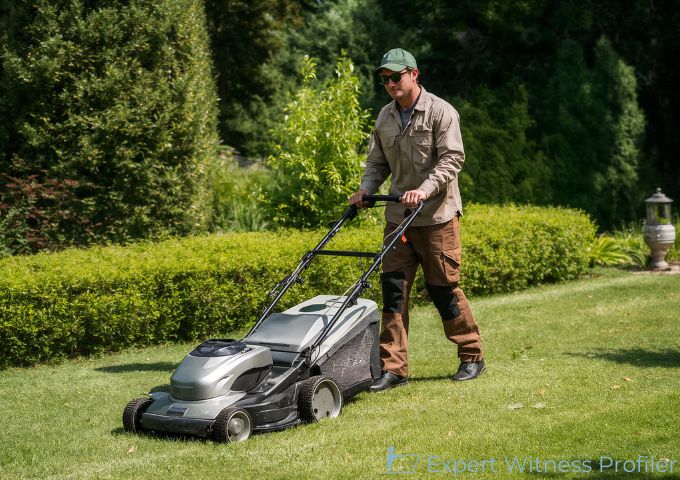
Plaintiffs Jaron and Rachel George (“Plaintiffs”) brought this subrogation action against Defendants Stanley Black & Decker, Inc. (“SBD”) and MTD Products, Inc. (“MTD”) for strict liability, negligence, and breach of warranty claims based on a riding lawnmower fire resulting in substantial damage to Plaintiffs’ home.
Defendants filed a motion in limine to exclude one of Plaintiff’s experts, Mr. Michael Zazula.
Zazula opined during discovery that Plaintiffs’ lawnmower was in a defective condition because it incorporated a muffler cannister that had become distended and bowed over the years, and a gap had been created between the muffler and deflector, raising temperatures in the engine that resulted in the fire.
Zazula did not point to any additional evidence of a defect at the time the lawnmower left the hands of Defendants but seems to suggest the distended muffler cannister itself was sufficient to prove a defect.
Mechanical Engineering Expert Witness
Michael J. Zazula specializes in applicable codes and standards for mechanical system components and the installation and maintenance of fire suppression systems, gas storage and delivery systems, boilers, HVAC equipment, and other fuel fired appliances.
With over 20 years of forensic experience, he has conducted over 2,000 investigations.
Zazula’s testing regarding fire causation is not reliable
The basic premise of Zazula’s opinion is that the distention of the lawnmower’s muffler cannister was deformed, creating a 1/4 inch gap between it and the deflector, and this allowed hot exhaust gases to escape and caused higher temperatures and the ignition of combustible materials in the engine area.
He proffers that this condition was a design or manufacturing defect of the lawnmower. Defendants argued that the expert testimony Zazula offered to support this premise is not admissible pursuant to Daubert. This Court agreed that Zazula’s report and opinion should not be considered.
The methodology Zazula used for investigation and testing is Chapter 4 of the National Fire Protection Association (“NFPA”) 921, Guide for Fire and Explosion Investigations. The purpose of NFPA 921 “is to establish guidelines and recommendations for the safe and systemic investigation or analysis of fire and explosion incidents.”
Zazula’s report explained that he performed his testing on a “used” Cub Cadet LTX 1040 lawnmower like the subject 1045 tractor lawnmower, and both contained the same parts. The temperature testing, which used thermal probes, at various parts of the used lawnmower on or near the muffler indicated temperatures ranging anywhere from approximately 400 degrees to the high of 726 degrees. Significantly, however, Zazula admitted that he did not conduct any testing on a lawnmower without a “distended muffler” and a 1/4 inch gap to try to prove or disprove whether the gap did, in fact, increase the temperatures in the engine area.
Zazula could have fully tested his hypothesis, but he chose not to. Because he failed to conduct testing based on “the methods and procedures of science,” rather than mere “subjective belief,” the Court found that his opinion—that the muffler and the 1/4-inch gap (as a purported defect) caused the fire—was unreliable and inadmissible.
Zazula’s expert testimony regarding fire causation does not “fit” the case or assist the trier of fact
For similar reasons why Zazula’s opinion regarding the cause of the fire is not reliable, the Court held that Zazula’s opinion does not “fit” the case or assist the trier of fact. As explained before, it is not based on valid reasoning and reliable methodology. In addition, Zazula’s conclusion that the 1/4 inch gap caused the rise in temperatures is too speculative and subjective, considering he never conducted testing and compared temperatures in the engine of a lawnmower with a distended muffler and 1/4 inch gap and one without. This is especially so when two other experts who conducted the testing found no difference in the engine temperatures between the two.
Even assuming Zazula is qualified to opine about the cause of the fire in the lawnmower, for the reasons explained above, his opinion is unreliable and unhelpful to the jury and is therefore precluded based on Daubert.
Zazula is also not qualified as an expert to provide testimony regarding the alleged defective condition of the lawnmower, and the Court will exclude his opinion on that issue
Zazula proffered that the lawnmower at issue was defective because the distended muffler and the 1/4 inch gap suggested a manufacturing defect or design defect. When asked what evidence supported the existence of a manufacturing defect, Zazula pointed solely to the distended muffler and gap, stating if he took the muffler into MTD, MTD would say “that’s not right.”
Preliminarily, despite arguably being a fire causation expert, Zazula admitted he is not a design engineer regarding mufflers and exhaust systems, nor is he a warnings expert. Therefore, any of Zazula’s testimony regarding the lawnmower’s purported defects should not be considered. This includes his opinion without more that the distended muffler and 1/4 inch gap somehow was the result of the lawnmower’s defective condition, including a design defect, manufacturing defect, or failure to warn.
Even if Zazula was qualified to testify about the “defective condition” of the lawnmower, the Court held that his testimony is not reliable. While his report stated, in part, the muffler deformation and gap between the muffler and deflector “exacerbates the ignition of foreseeable combustible material . . . . when the hot exhaust are not properly vented out the side of the deflector as designed [and] intended,” during his deposition he gave no evidence to support or further explain any design defect theory.
The Court agreed that Zazula applied no methodology or procedures of science to support his opinion of a defect in the Cub Cabet at issue, and his opinion on any defect constitutes unreliable “subjective belief or unsupported speculation.”
Finally, and for similar reasons, the testimony is not helpful to the jury. Here, the testimony is not sufficiently tied to any of the facts to aid the jury in resolving whether MTD’s lawnmower, in fact, suffered from a defective condition.
Held
The Court granted Defendants’ motion in limine to exclude the testimony of Plaintiffs’ expert Michael Zazula.
Key Takeaway
Zazula speculates what possibly caused the fire (in a case where there are several possible fire causes), without providing any specific evidence or testimony to support his opinion that the lawnmower was defective. As a result, the Court determined that any of Zazula’s testimony about any defective condition of the lawnmower should be excluded.
Case Details:
Case Caption:
George V. Stanley Black & Decker, Inc.
Docket Number:
2:24cv2035
Court Name:
United States District Court, Pennsylvania Eastern
On January 21, 2022, James Raeford Hatcher (“Hatcher”), an employee of South East Grinding, was fatally injured while attempting to unjam a debaler at his workplace. His clothing became entangled in the machine, and he was unable to stop its operation. The machine in question—a “Model BBU.90” debaler—was manufactured by Emerging Acquisitions, LLC. Plaintiff Connie Hatcher, on behalf of Hatcher’s estate, brought claims against Defendant for negligence, strict liability, and breach of warranty.
According to Plaintiff, Defendant designed, manufactured, and sold the debaler in question and was aware of previous injuries and fatalities involving similar models. Despite this knowledge, Plaintiff alleged that the Defendant failed to implement standard safety features—such as human detection sensors or “light curtains”—unless specifically requested by customers. The debaler that killed Hatcher did not have these features.
Defendant filed a motion to exclude Plaintiff’s design engineering expert, Dr. James L. Glancey, arguing he lacked specific experience with recycling machinery and failed to test his proposed design alternatives.
Mechanical Engineering Expert Witness
Dr. James L. Glancey holds a Ph.D. in mechanical engineering from the University of California, Davis and is a licensed professional engineer with over 20 years of experience in the field. Furthermore, he has published more than 50 engineering articles and has served as an expert in over 200 product-related matters.
While Glancey lacked direct experience with debalers or recycling machinery, his mechanical engineering background qualified him to offer opinions on industrial machine design. After all, Glancey has a Ph.D. in mechanical engineering and thirty years of experience teaching product design. He has designed several machines, consulted on failure analysis for various products, and taught courses on both.
The Court held that the Plaintiff was not required to retain an expert specifically in debalers, and found that Glancey was sufficiently qualified to testify under Rule 702.
Alternative Design
Glancey’s proposed alternative designs incorporated light curtain technology and interlock safety features. He specifically testified that such technology has been available for incorporation in similar machines since the 1970’s.
Indeed, Defendant has incorporated a light curtain in other debalers it has manufactured. Plaintiff cited ample authority, uncontroverted by Defendant, to support the proposition that the existence of the alternative technology in the market subdues the need for expansive feasibility analysis or functional testing.
As a result, Glancey’s alternative design opinions were deemed sufficiently reliable under Daubert.
Warnings and Open and Obvious Danger
Defendant argued that Glancey’s warnings analysis was inadmissible because the danger was open and obvious, and no efficacy testing was done.
The Court found that Glancey analyzed the original warnings and identified deficiencies, including the lack of clear unjamming instructions. Whether the danger was sufficiently open and obvious to negate a duty to warn is a factual question for the jury.
Held
The Court denied Defendant’s motion to exclude Plaintiff’s expert, Dr. James L. Glancey.
Key Takeaway:
Plaintiff must present a reasonable alternative design, considering cost, safety, and functionality. The need for testing is blunted if the proposed alternative design is simple or is already used in the industry. In this case, the Plaintiff cited ample authority, uncontroverted by Defendant, to support the proposition that the existence of the alternative technology in the market subdues the need for expansive feasibility analysis or functional testing.
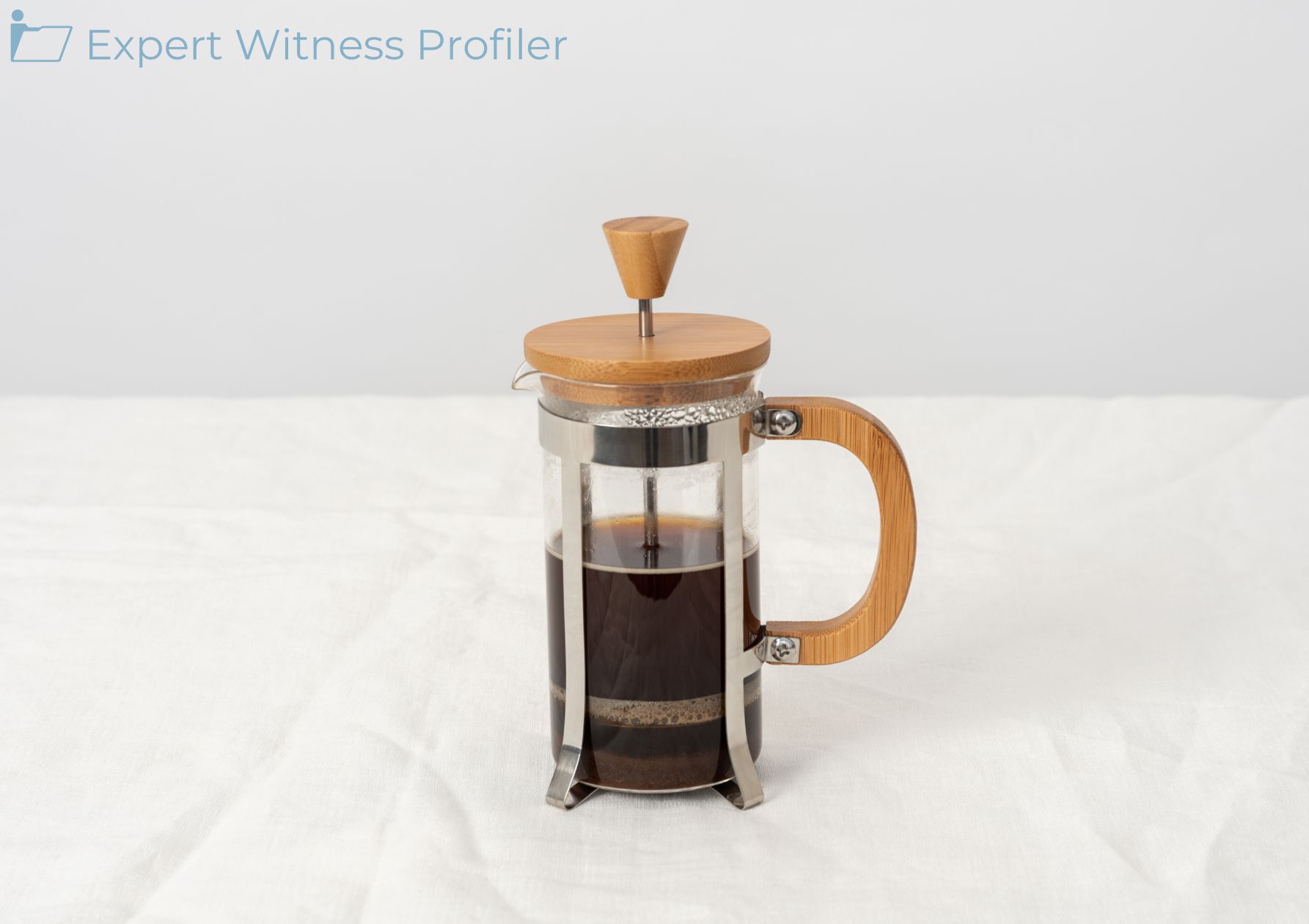
Plaintiff, Wade Mullen, filed a products liability lawsuit against Defendant Bodum USA, Inc. (“Bodum”), claiming damages for injuries he suffered when his Bodum French press shattered and splashed him with hot coffee.
Bodum filed a motion to exclude the testimony of Mullen’s expert Mingxi Zheng, an engineer who inspected the shattered French press.
Mechanical Engineering Expert Witness
Mingxi Zheng has 8 years of experience in the general field of materials science, mechanical engineering design, metallurgy, failure analysis and materials characterization. At her previous engineering roles, she has spent time in both active manufacturing environments and R&D phase companies developing new technologies.
Bodum contended that Zheng’s report should be excluded on reliability grounds, first, because it consisted of analytical gaps concerning what caused the French press to shatter, and second, because Zheng failed to support her analysis of alternative French press designs with any testing of those proposed alternatives.
To be precise, Bodum argued that that Zheng’s report consisted of four analytical leaps: First, Zheng assumed that the scratches and stainless steel residue found on the inside of the French press’ glass carafe came from the metal coil on the press’ plunger “without having done any testing or analysis to determine if in fact there was any contact between the stainless steel plunger component and the glass.”
Second, Zheng concluded that the defects resulting from the contact between the plunger’s metal coil and the carafe could cause the French press to shatter without testing to determine whether such contact “could actually cause a scratch of sufficient dimension and depth to reduce the tensile strength to the point where thermal stress could cause a fracture.”
Third, Zheng conducted no testing to support her conclusion that thermal stress from the hot coffee caused the French press to facture. And fourth, Zheng did not rule out alternative causes for the French press’ shattering.
Causation
The Court considered Zheng’s opinion that, “more likely than not,” the plunger’s protruding coil is what scratched the press’ glass carafe and created crack initiation sites. Zheng reached this conclusion after she analyzed the metal residue observed by the crack initiation site and found it to be made of stainless steel, the same material contained in the press’ plunger and the protruding coil. Zheng concluded that thermal fracturing occurred after observing (1) Wallner lines perpendicular to the carafe’s surface, (2) cracks that formed near-ninety-degree angles with the edge and surface of the glass, and (3) the absence of branching crack patterns, all of which are indicators of thermal stress.
While Bodum objected to Zheng’s failure to conduct additional testing to determine what level of thermal shock would be necessary to shatter the French press given the existence of the imperfections observed on the glass carafe, the Court held that testing is not an ‘absolute prerequisite’ for an expert’s theory of causation to be admissible in a design defect case.
The Court also refused to exclude Zheng’s opinions for failing to rule out fracture due to any other alternative cause.
Alternative Designs
In her report, Zheng explained that she reviewed Bodum’s website and found, based on the company’s image of the replacement part containing the metal coil, that a protruding coil “is the normal condition for this part.” She extrapolates that the protruding coil is a design or manufacturing defect because it allows for the extra pressure of a sharp exposed edge to scratch the inner surface of the glass carafe, which may bring about “compromising contact.”
Based on this finding, Zheng concluded that three alternative design options exist that would reduce or eliminate glass fracture. First, Bodum could—and has—designed a French press with a non-glass carafe. Second, Bodum could use silicone or a different temperature-resistant soft material on the edge of the plunger to act as a barrier between the plunger’s steel components and the carafe. And third, Bodum could weld or tack down the protruding coil to prevent it from scratching the glass.
The Court held that Zheng’s opinion on alternative designs is not grounded in the methods and procedures of science but is rather a conclusion that any lay person could draw by visually inspecting the plunger and searching the internet for varieties of French presses.
Held
The Court granted in part and denied in part the Defendant’s motion to exclude the testimony of Plaintiff’s expert Mingxi Zheng.
Key Takeaway:
The law is clear that an expert need not rule out every alternative in forming an opinion. Although the most convincing expert reports are likely to address alternative causal mechanisms, for an opinion to be admissible, an expert need address only obvious alternative explanations for the phenomenon in question. Here, there is no obvious alternative that could explain the French press’ shattering, nor did Bodum propose any.
In this products liability action, Plaintiff Joshua Cleaveland sued Defendants Tricam Industries, Inc. and Home Depot USA Inc. after he fell from a Tricam model GLX-5B ladder on August 26, 2021. The ladder was manufactured by Tricam and purchased from Home Depot. According to Plaintiff, he was injured because the ladder was defective.
Defendants filed a motion to exclude the testimony of Plaintiff’s expert, Dr. Jonathan Slocum.
Mechanical Engineering Expert Witness
Jonathan Slocum is a mechanical engineer who earned his bachelor’s degree in 2014, master’s degree in 2015, and doctorate in 2018 in mechanical engineering from the Massachusetts Institute of Technology.
He worked at Materials and Engineering Group LLC from 2017 to 2022 as a senior consultant, where he provided forensic and design consulting and failure analysis. Since 2020, his company LTAG Systems, LLC has been developing technology and devices for the United States Department of Defense.
Defendants filed a motion to exclude Slocum’s expert testimony on the grounds that Slocum is not qualified to opine on ladder defects and design and causation, and his expert testimony is unreliable and speculative.
Initial Matters
The Court first addressed whether Plaintiff may rely on the First Slocum Affidavit to respond to Defendants’ motion to exclude.
The Court concluded that Plaintiff may offer the First Slocum Affidavit to defend the principles and methodology used by Slocum in his initial report.
To the extent that the Plaintiff attempted to use the First Slocum Affidavit to further explain Slocum’s qualifications as an expert in this case, the disclosure was untimely. Under Rule 26(a)(2)(B)(iv), Slocum was required to include all relevant qualifications in his initial expert report. As a result, the Court excluded certain parts of the First Slocum Affidavit.
Slocum’s Qualifications
The Court rejected Defendants’ argument that Slocum is unqualified to render an opinion in this case because he has never provided testimony specific to ladder design or accidents, has never designed a ladder or worked in the ladder industry, has no experience researching or addressing the causes of ladder-related accidents, and has never participated in any relevant committees that address ladder safety issues. While it is true that Slocum’s curriculum vitae indicated that he had little to no experience specific to ladder design and ladder-related accidents, his extensive education and professional background in mechanical engineering and metallurgy demonstrated that he is qualified to opine on whether the aluminum ladder in this case was defectively designed and manufactured.
Reliability of Slocum’s Testimony
First, the Plaintiff has failed to show that a simple visual inspection is a reliable methodology from which to draw conclusions about whether the ladder suffered from a manufacturing or design defect. While Slocum himself claimed, without proof, that his methodology is generally accepted in the “scientific community,” the Court cannot conclude that Slocum’s methodology is reliable because the Plaintiff has not put forth any evidence or argument that visual inspection alone is a reliable methodology for assessing the causes of ladder-related accidents.
Based on a visual examination of the accident ladder and the exemplar ladder and calculating the height/wall thickness ratio of the accident ladder’s rear rail, Slocum found “evidence of buckling at the pin joint” and “deformation of the aluminum tubing,” which he concluded to be a manufacturing defect that contributed to Plaintiff’s accident. However, Slocum provided no explanation or testing to demonstrate why the deformity at the “rear-left rail extrusion that the spreader-link pin-joint passes through” could be problematic.
Slocum concluded that the ladder was defective in design because he found that a “side load” is applied to the ladder’s front and rear rails when a user’s weight is on one of the top two steps of the ladder, leading to deformation of the ladder’s rails and spreader links. However, Slocum did not perform any tests to determine whether Plaintiff’s position on the top step of the ladder would lead to the buckling observed on the accident ladder or to prove that the spreader link of the ladder applied both an “eccentric load” and “torsion to the tube, which would add to the overall stress it experiences when loaded.” He also did not explain how much torsion or eccentric load is acceptable.
Held
The Court granted Defendants’ motion to exclude Dr. Jonathan Slocum’s opinion.
Key Takeaway:
Rule 702 does not require expertise to be so exacting. Although Slocum’s curriculum vitae shows minimal, if any, direct experience with ladder design or ladder-related accidents, his extensive education and professional background in mechanical engineering and metallurgy support his qualification to offer an opinion on whether the aluminum ladder in question was defectively designed or manufactured.
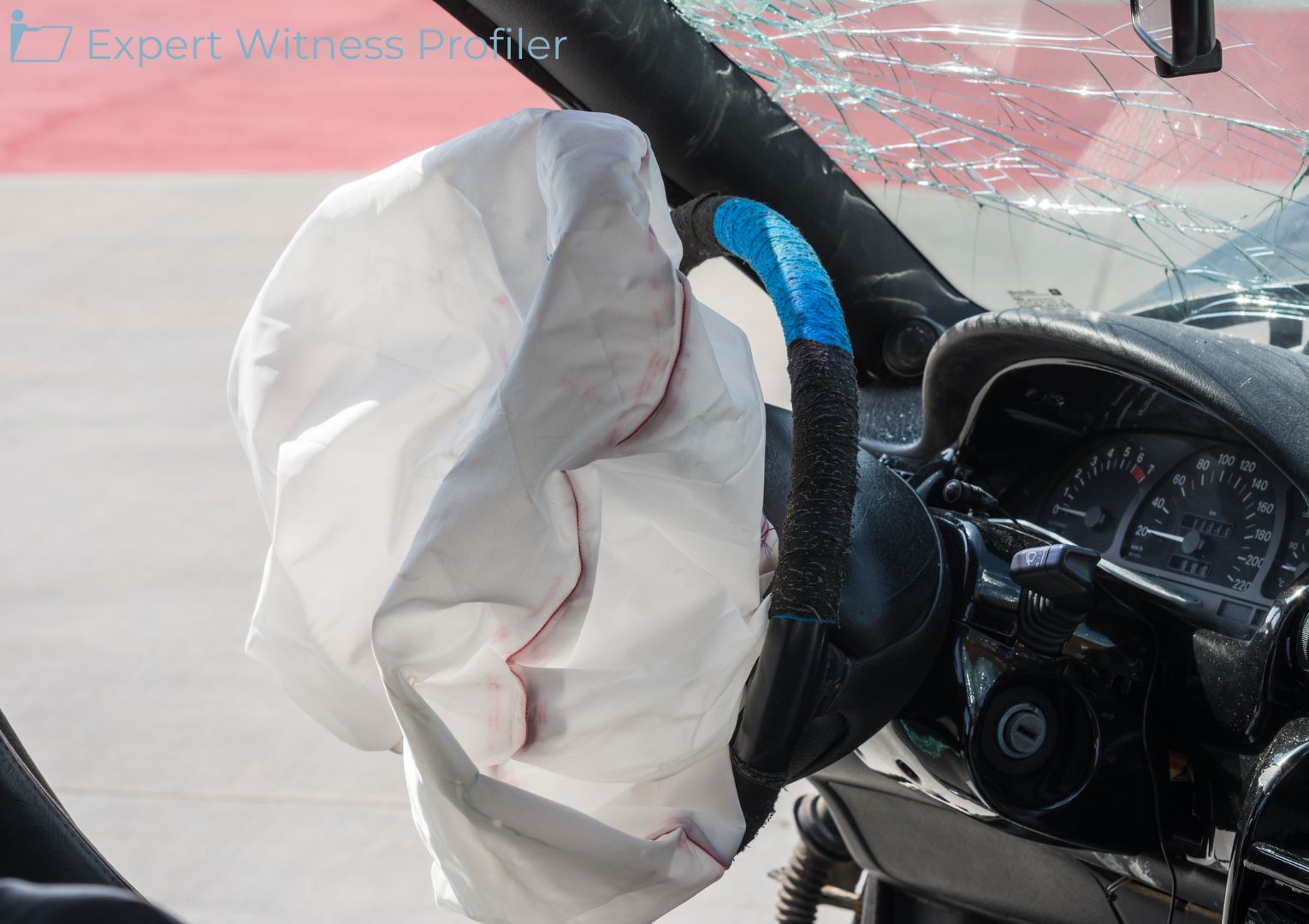
Plaintiff, William Harrison Sims’ claims arise out of an October 24, 2019, two-vehicle collision involving Plaintiff, who was operating the 2004 BMW (“Subject BMW”). Tameca Harris-Jackson (“Harris-Jackson”) was operating the Hyundai that collided with the Subject BMW. Plaintiff alleges he sustained “severe, permanent, and life-altering injuries” due to the driver-side Takata airbag unexpectedly rupturing and shooting “metal shrapnel into his face and body.”
Defendants procured and installed the airbag inflator during the process of “designing, manufacturing, assembling, and producing” the vehicle. Plaintiff brought this action for damages against both Defendants BMW of North America (“BMW NA”) and Bayerische Motoren Werke AG (“BMW AG”), alleging strict liability and negligence from procuring and installing the airbag.
Plaintiff submitted that Mr. Robert C. Lange, BMW’s mechanical engineer, is prepared to opine that he is unaware of any evidence showing the Defendants “could have been aware air bag systems supplied by Takata to BMW AG were defectively designed prior to Takata’s announcement of defect findings beginning in 2014.”
Lange will also opine that when the subject 2004 BMW was distributed by BMW NA, “no motor vehicle manufacturer or distributor could have known of the technical research findings regarding the latent defect in Takata air bag inflators because the science was not settled until 2015-2016.”
He also contended that Takata falsified data provided to vehicle manufacturers through 2015 and failed to correct the false data once the defect was discovered. Plaintiff argued that Lange’s opinions were unsupported and unreliable.
Automotive Engineering Expert Witness
Robert Lange has over 50 years of experience in automotive engineering. He specializes in motor vehicle systems architectures, structures, safety, and public health.
Lange has experience in statistical analysis of motor vehicle service performance databases, statistical forecasting and reliability analysis, FMEA and failure mode avoidance methods, collision-related data acquisition and analysis, safety rulemaking, strategy, and the like.
The issue is whether Lange’s opinions are based on sufficiently reliable methods and principles. If they are, then Lange’s opinions are undoubtedly helpful to the jury. If his opinions are unsupported ipse dixit, they must be excluded.
Lange’s Methodology and Opinions
Plaintiff contended that BMW knew that the subject vehicle was defective because the airbag inflator used phase-stabilized ammonium nitrate (“PSAN”) as the airbag’s propellant, causing the inflator to rupture when the airbag deployed during the accident.
Lange discussed his investigation into the Takata air bag failures. He noted that Honda conducted the first recall of Takata air bag systems for inflator failure in a letter dated November 11, 2008.
National Highway Traffic Safety Administration (“NHTSA”) hired Dr. Harold Blomquist to assist in its Takata defect investigation and issued his report in 2015.
Documents from the Recall Query revealed that Takata represented to Honda that the ruptures were caused by a “Stokes press” that forms propellant into a wafer, causing the propellant to burn too quickly and rupture the inflator. Accordingly, in 2010, Honda expanded the recall to include the new basis. Between 2010 and 2013, Honda and Takata continued to receive reports of inflator ruptures, and Takata retained consultants to conduct a root cause analysis.
Takata’s root cause analysis continued, and in 2014, research pointed to moisture and temperature in high absolute humidity regions as causing an increased propellant burn rate. Lange, however, concluded that “during the inflator development phases, Takata falsified data provided to vehicle manufacturers. When the false data was discovered, Takata failed to correct the false data by informing the manufacturer and correcting the record.”
Plaintiff’s Objections
Plaintiff challenged the admissibility of the following opinions offered by Lange:
75. I am unaware of any evidence showing BMW AG and BMW NA could have been aware air bag systems supplied by Takata to BMW AG were defectively designed prior to Takata’s announcement of defect findings beginning in 2014.
76. As of the date of distribution of the Subject 2004 BMW 330Ci, by BMW NA, no motor vehicle manufacturer or distributor could have known of the technical research findings regarding the latent defect in Takata air bag inflators. The science was not settled until 2015-2016.
Plaintiff also challenges the following statement made by Lange:
“During the inflator development phases, Takata falsified data provided to vehicle manufacturers. When the false data was discovered, Takata failed to correct the false data by informing the manufacturer and correcting the record. Takata’s false dealings with vehicle manufacturers evidently extended into 2015.”
Plaintiff contended that Lange will confuse the jury if permitted to offer evidence that Takata lied to other vehicle manufacturers without having proof Takata lied to BMW. Moreover, Lange “knows little about the relationship between BMW and the supplier of the defective airbag inflator at issue in this case, Takata.”
Plaintiff also argued that Lange’s opinion that he is “unaware of any evidence” showing BMW’s knowledge of the defect is not helpful to the jury. Plaintiff asserted that Lange failed to inform himself on the subject matter sufficiently, and his lack of evidence that BMW was aware of the risks attendant to using PSAN does not equate with BMW’s lack of knowledge.
Ruling
Lange has extensive experience working at Ford Motor Company, Failure Analysis Associates, and the General Motors Corporation. During his work with Ford, Lange was responsible for vehicle design and remedying safety defects serviced as recall actions. As the Safety Executive with General Motors, Lange oversaw research projects involving air bags, occupant restraint systems, driver assist technology, and other vehicle systems. He also supervised the “Product Investigations” Department and was responsible for identifying potential safety defects and initiating investigations. In other words, the Court held that Lange possesses the requisite experience to review the data, investigative reports, and shifting root-cause analysis discussed in his report.
On balance, the Court did not find that Lange’s opinions rest on mere ipse dixit and instead are based on his review of relevant documents showing Takata’s shifting root cause analysis. Takata initially focused on a manufacturing defect before conceding that the defect had broader implications, which was consistent with Takata hiding the ball from BMW. Basing one’s opinions on the Honda recall and subsequent NHTSA investigations to conclude that the science was not settled until the mid-2000s is a sufficiently reliable methodology. Lange’s opinion that BMW NA was not responsible for the defective design of the subject inflator and that BMW was not on notice until around 2015 was supported by these evolving investigations.
Held
The Court denied Plaintiff’s motion to exclude certain opinions of Robert C. Lange.
Key Takeaway:
Lange reviewed the data, investigative reports, and shifting root-cause analysis to conclude that Takata falsified data provided to vehicle manufacturers through 2015 and failed to correct the false data once the defect was discovered.
Case Details:
Case Caption:
Sims V. Bmw Of North America LLC
Docket Number:
6:22cv1685
Court:
United States District Court, Florida Middle
Order Date:
February 20, 2025
Please refer to the blogs previously published about this case:
On August 23, 2021, Plaintiff Virginia Huss used a Ninja BL660 blender, designed and manufactured by Defendant SharkNinja Operating LLC, to blend a mixture of chocolate chips that she had microwaved for 60 to 90 seconds. After blending, Huss attempted to twist open the blender lid and the lid shot off the blender cup, causing scalding hot fudge to explode and burn her face, chest, arms, and hands. As a result, Huss initiated this product liability against SharkNinja.
In her amended complaint, Huss focused on the ‘cool to explosively hot’ theory, which posits that the blender’s fast-moving blade heats cool or room temperature food which creates friction and, ultimately, causes the blender contents to explode when the user opens the blender cup.
Huss Filed the Following Allegationsin Support of her Cool to Explosively Hot Theory:
a. The blender is defectively designed because “the extremely fast-moving blade of the blenders heat the contents of the sealed bullet-shaped canister, which can (and does) unexpectedly explode when being used in its normal and intended manner by consumers. In a matter of a short amount of time, the fast-spinning blades can unexpectedly heat up its contents, such that if the blender explodes, the user is at risk of severe burns or lacerations and injuries requiring medication attention.”
b. “During the normal, as-directed use of the blender, a consumer puts cool or room temperature food into the plastic ‘bullet’ cup. Once the cup is secured to the blade assembly and placed onto the unit’s base, the user is able to run the blender by pressing down on the cup. The blades then rotate, creating friction as they cut and chop the cup’s contents, which in turn causes the contents to heat up.”
c. “As the temperature rises inside the cup, the pressure from the frictional energy also rises. The temperature can get so hot that the pressure inside the cup forces the cup to separate from the blade while the blender is still running. This can cause the hot contents of the cup to explosively project outward without warning, landing on anyone and anything nearby.”
d. “Even if the cup does not separate from the blender while in use, the user is still at risk. If the contents of the cup are hot and under pressure when the cup is opened, the hot contents can again be explosively ejected onto the user, causing se[ve]re lacerations from a detached blade.”
Derek King
King set forth three other design defect theories in his expert report:
(i) that the threaded connection between the blender cup and the blade assembly is “susceptible to slippage and so it may separate…before venting can occur” (the “Thread Slippage Theory”)
(ii) that “the threaded connection was under load (from internal pressure) and also at an elevated temperature” and “it is likely that one or both materials experienced some softening due to temperature which contributed to the threads failing to keep the blade assembly fastened to the cup long enough for the pressure to vent” (the “Softening Materials Theory”)
(iii) that Huss had observed that the blade assembly “kind of untwists itself the rest of the way,” which King found was “consistent with the force from internal pressure being transferred into a rotational motion due to the slope of the threaded connection between the cup and blade assembly” (the “Spontaneous Untwisting Theory”)
In response, SharkNinja filed a motion to exclude the expert testimony of Derek King.
Mechanical Engineering Expert Witness
Derek A. King has a Bachelor of Science degree in Mechanical Engineering from the University of California, Berkeley and a Master of Science in Electrical Engineering from Ohio University. He has worked as an engineer for Berkely Engineering and Research since 2009 “in the areas of failure analysis, design, and risk assessment of consumer and industrial equipment, including industrial pressure vessels and consumer propane tanks, pressure cookers and blenders.”
King was tasked with providing his opinions regarding the following topics:
(1) “Whether or not the blender would enable and allow the incident to occur”; and
(2) “What design aspects of the subject blender enable and/or fail to mitigate the risks of pressurization and burn injury.”
By “applying well-established engineering principles” and performing “exemplar testing,” King concluded that “a sealed blender cup will heat and pressurize due to the blending process, thus establishing the possibility that the subject blender could create the hazard and risk consistent with Huss’ description.”
As to his “exemplar testing,” King provided a spreadsheet which reflected the following headings: (1) T(s); (2) External °F; (3) Internal °F; (4) Pressure PSI; (5) Note; (6) T-start; and (7) Recipe. Oddly, the Court noted that King provided no explanation whatsoever in his Report regarding the meaning of the headings, exactly what the variables of his tests were, and what the outcomes of his tests were. SharkNinja described King’s test results as follows:
• “The only testing of the incident recipe that King conducted involved blending a chocolate-chip mixture heated to 121°F. But this testing did not result in any pressurized ejection of hot content.”
• “King blended incident recipe ingredients that were preheated to 121°F for one minute and 49 seconds in a BL660 single-serve cup, and this testing did not demonstrate any explosive projection of the cup’s contents.”
It should be noted that Huss did not dispute SharkNinja’s characterizations of King’s testing and did not otherwise discuss the testing other than to assert that King considered Huss’ testimony that the chocolate chips were “lukewarm” temperature and “applied it to his analysis.”
Analysis
Absent an explanation from King or Huss — or disagreement regarding SharkNinja’s characterization — of the meaning of the data contained on King’s testing spreadsheet or how the testing was carried out in general and what results it yielded, the Court proceeded to analyze King’s opinion with the following premise in mind: King’s testing involved blending ingredients that had previously been heated to 121°F for one minute and 49 seconds, and that testing did not result in an explosive projection of the blender’s contents.
1. Whether King Is Qualified
SharkNinja did not challenge King’s qualifications as to his design defect opinions. However, the Court found, in accordance with its gate-keeping obligation and the standard set forth in Rule 702, that King’s undergraduate and graduate degrees in mechanical and electrical engineering along with his work experience since 2009 “in the areas of failure analysis, design, and risk assessment of consumer and industrial equipment, including blenders” is sufficient to qualify him to testify regarding design defects in blenders.
2. Whether King’s Methodology Is Scientifically Reliable
The Court also considered whether Huss had sustained her burden of showing that that it is more likely than not that King’s methodology is scientifically reliable and that his testimony will aid the trier of fact.
a. Cool to Explosively Hot Theory
SharkNinja argued that King did not have a reliable foundation to provide expert testimony regarding the cool to explosively hot theory because he did not conduct any testing with cool or room temperature ingredients. It asserted that King’s test involved blending a mixture of chocolate chips, sweetened condensed milk, and vanilla extract preheated to 121°F for one minute and 49 seconds in a BL660 single-serve cup blender and that even though he started with preheated ingredients (versus cool or room temperate ingredients) and blended the ingredients longer than Huss did (one minute and 49 seconds versus “probably less than a minute”), “his testing did not demonstrate any explosive projection of the cup’s contents.”
Accordingly, it argued, King “should be precluded from opining that blending cool or room temperature ingredients for any length of time can result in ‘contents being forcefully expelled from the blending cup under pressure and at high temperature.’”
SharkNinja’s main critique of King’s methodology for his opinions regarding the cool to explosively hot theory was that King was not able to re-produce an explosive projection when he blended chocolate chips, sweetened condensed milk, and vanilla extract for a longer period of time than Huss, and that the ingredients he blended were preheated to 121°F rather than being cool or at room temperature as necessary to test the cool to explosively hot theory.
Court’s Decision
The Court acknowledged that “an expert need not wear a lab coat nor cite peer-reviewed studies to reliably lend his expertise to the trier of fact—experience is an equally valuable teacher.”
But, at bottom, King still had to explain the methodology that he used and how his experience led him to his conclusions. He did not do so and, moreover, the testing he did perform used different conditions than the cool to explosively hot theory, making his methodology regarding his opinion that the blender had a design defect based on that theory unreliable.
b. Thread Slippage Theory
While SharkNinja agreed with King’s premise that ‘blending creates friction, friction causes heat, and, given enough time, a marathon blending session can eventually generate sufficient heat and pressure within a sealed cup to cause the blended contents to eject out energetically when the cup is opened,’ it argued, however, that King’s opinions that this can take place after one minute of blending is not supported by testimony or “any other reliable foundation.”
Specifically, SharkNinja noted that King blended preheated ingredients for one minute and 49 seconds and “did not identify any thread slippage or pressurized ejection of contents” from the blender cup, and that the thread slippage theory is speculation and unreliable.
SharkNinja asserted that there is an “analytical gap” in King’s analysis because “whether the blade assembly can ‘shift’ does not address whether the threads between the blade assembly and the BL660 cup can, in fact, ‘slip.’” It noted that King did not identify any testing to support his finding and that Huss does not argue that this theory has been subjected to peer review or publication, is generally accepted in the engineering community, or has a known or potential error rate.
Court’s Decision
The Court rejected Huss’ argument that SharkNinja can simply cross-examine King to address any shortcomings in his methodology. This notion is contrary to the 2023 amendment to Rule 702, which requires the Court to determine whether an expert’s methodology is reliable rather than leaving that determination to the jury.
As to SharkNinja’s issues with King’s methodology, King opined that “a potential opportunity for venting before sudden separation is present in the intermittent thread design, however, geometric analysis shows that the threaded connection is susceptible to slippage and so it may separate…before venting can occur.” He described the blender’s threading in detail, but did not set forth any methodology for how he reached his conclusion that thread slippage could have occurred after less than one minute of blending and caused the contents of Huss’ blender to explode. The Court held that King’s methodology regarding his opinion on the thread slippage theory is non-existent and, therefore, unreliable.
c. Softening Materials Theory
SharkNinja argued that King “did not attempt to substantiate his softening materials theory with any testing or other reliable foundation,” instead simply noting the deflection temperature of the materials that make up the blender’s construction and stating that it is likely those materials softened during use.
SharkNinja noted that King examined the blender but “did not state that he observed any evidence of softening in either the blade assembly or the single-serve cup,” that his testing “did not demonstrate any evidence of either component softening,” and that he did not cite any support for his theory in scientific literature or otherwise.
Court’s Decision
The Court rejected Huss’ contention that SharkNinja can simply address shortcomings in King’s methodology through cross-examination and proceeded to consider the issues that SharkNinja raised.
While King stated in his report that “An overview of the material properties indicates that cup material has a deflection temperature of approximately 200 °F, while the blade assembly deflection temperature is approximately 100 to 300 °F. Huss’ description of a pressurized release and sustaining burn injuries indicates that the threaded connection was under load (from internal pressure) and also at an elevated temperature. It is likely that one or both materials experienced some softening due to temperature which contributed to the threads failing to keep the blade assembly fastened to the cup long enough for the pressure to vent,” he did not indicate that he tested the blender, observed softening of the components’ materials, or employed any other methodology to reach his conclusion.
He merely stated that ‘it is likely’ the materials ‘experienced some softening’ based on their deflection temperatures, which ‘contributed to the threads failing to keep the blade assembly fastened.’ The Court held that his speculative conclusion is not supported by any methodology. In other words, King’s methodology relating to the softening materials theory is not reliable.
d. Spontaneous Untwisting Theory
SharkNinja argued that King simply states that Huss’ observation that the blade assembly untwists itself is consistent with the use of the blender, but “offers no reliable foundation for this opinion,” “does not attempt to substantiate his opinion by citing to any scientific literature (or anything at all other than Plaintiff’s deposition testimony),” and “did not disclose any evidence of the BL660 blade assembly untwisting itself based on the slope of the threaded connection during his own testing of the incident recipe.”
Basically, SharkNinja contended that King “does not identify any testing that would support his spontaneous untwisting theory,” and noted that his testing with preheated ingredients did not result in the blender cup spontaneously untwisting from the blade assembly.
King opined that ‘Huss’ observation that the blade assembly “kind of untwists itself the rest of the way” is consistent with the force from internal pressure being transferred into rotational motion due to the slope of the threaded connection between the cup and blade assembly.’
He did not state that he tested this theory and observed spontaneous untwisting or set forth any other methodology that he used in reaching this conclusion. He simply baldly stated that Huss’ observation is consistent with the use of the blender and the slope of the threaded connection. The Court held that King’s methodology regarding the spontaneous untwisting theory is speculative and not reliable.
The Court found that Huss has not sustained her burden of showing by a preponderance of the evidence that King’s methodology as it relates to the cool to explosively hot theory, the thread slippage theory, the softening materials theory, or the spontaneous untwisting theory is reliable.
3.Whether King’s Testimony Would Aid the Trier of Fact
SharkNinja argued that King’s opinions would not aid the trier of fact because they were speculative in nature and not based on a reliable methodology.
The Court held that King’s opinions are not grounded in a reliable methodology — they are not based on any physical testing and King does not set forth any other methodology to explain how he reached his conclusions. The speculative nature of his opinions relating to all four design defect theories will not aid the trier of fact. The Court found that Huss has not shown that it is more likely than not that King’s testimony will aid the trier of fact.
In sum, Huss has not sustained her burden of showing by a preponderance of the evidence that King’s methodology is reliable and that his opinions would aid the trier of fact.
Held
The Court granted the Defendant’s motion to exclude the testimony of Plaintiff’s expert Derek King.
Key Takeaway:
Despite King’s qualifications in mechanical and electrical engineering and his experience in failure analysis and design, the Court held that he failed to demonstrate a scientific basis for his conclusions regarding the alleged design defects of the Ninja BL660 blender. His testing did not replicate the conditions claimed by the Plaintiff, and he did not substantiate his theories—such as the cool to explosively hot theory, thread slippage theory, softening materials theory, and spontaneous untwisting theory—with physical testing, mathematical models, or citations to scientific literature. The Court determined that King’s unsupported conclusions would not aid the jury in evaluating the alleged design defects, rendering his testimony inadmissible.
Case Details:
Case Caption:
Virginia Iris Huss vs. Sharkninja Operating LLC
Docket Number:
1:23cv1435
Court:
United States District Court for the Southern District of Indiana, Indianapolis Division
The Boppy Newborn Lounger (“BNL”) was on the market for nearly sixteen years, and during that time, Boppy sold over 3.3 million BNLs. Boppy’s warnings and marketing made clear that the BNL was intended to give caregivers a place to lay infants down for supervised awake time only, but never for sleeping. As with any product, there were risks associated with improper use, against which Boppy warned and for which Boppy provided instructions concerning safe use.
On October 2, 2020, Plaintiff Danielle Clark swaddled her infant daughter (“D.B.”) in a blanket that was loosely wrapped around D.B.’s head, but not covering her face. D.B. was then placed “mainly on her side” and in the center of the BNL, which was sitting on the couch. Around 10:30 or 11:00 p.m., Clark fell asleep with her head on the side of the Boppy pillow. When Clark awoke approximately three to four hours later, she found her daughter unresponsive. The decedent was proclaimed dead, and according to the coroner, the cause was “probable asphyxia in the setting of co-sleeping and soft bedding.”
Plaintiffs alleged that the tragic death of their infant was caused by the BNL. Plaintiffs’ purported expert witness, Dr. Erin Mannen opined that “the design of the Boppy Newborn Lounger resulted in a dangerous biomechanical position that explains the death of [D.B.].” Dr. Ian Noy, also retained by the Plaintiffs, opined that the BNL’s warnings were inadequate.
Boppy filed motions to exclude the opinions provided by Erin Mannen and Ian Noy.
Human Factors Expert Witness
Ian Noy has a Ph.D. and M.S. in industrial engineering from the University of Toronto. He is a distinguished human factors and ergonomics consultant and forensic expert with extensive background in innovative and applied safety research, industrial engineering, behavioral sciences, and science management.
Erin M. Mannen earned a Ph.D. in Mechanical Engineering from the University of Kansas in 2014, completed a Postdoctoral Fellowship in the Center for Orthopaedic Biomechanics within the Department of Mechanical and Materials Engineering at the University of Denver in 2017, and has been researching biomechanics for over 14 years.
She is currently employed full-time as an assistant professor in the Mechanical and Biomedical Engineering Department at Boise State University in Boise, Idaho.
Boppy has moved to exclude the report of Plaintiffs’ expert witness, Ian Noy. Most of Boppy’s challenges do not relate to Noy’s qualifications or the relevance of his opinions, but rather, the reliability of his methodology. Specifically, Boppy takes issue with the following: (1) his failure to supply an alternative warning; (2) his reliance on the American National Standard Institute’s (“ANSI”) safety standards; (3) his failure to consider evidence regarding Clark’s refusal to follow the BNL’s warnings; and (4) his opinions about the design of the BNL.
His failure to supply an alternative warning
Boppy argued that an expert testifying on the inadequacy of a product’s warning is required to draft an adequate alternative warning. In the absence of a proposed alternative, Boppy argued, Noy’s opinions are unreliable.
Here, Noy was made personally aware of the label’s content through examining the BNL at issue. After examining the BNL and consulting a myriad of other materials, Noy highlighted alleged design deficiencies in the BNL’s safety alert signs on the product and its carrying case.
Noy appeared to suggest that, for example, the alternative proposed warning would include a safety label with no busy background, the font would be larger, there would be a distinction made between suffocation hazard and positional asphyxia hazard, there would be a description provided as to the nature and severity of hazards, and there would be a more effective message prohibiting “chin-on-chest” and providing contrasting symbols for “chin-on-chest” and “chin-off-chest” positions.
The Court found that “it would be simplistic to view [Noy’s] failure to ‘draft’ an alternative warning as being fatal to his opinion,” in light of the reasoning gleaned from his report and his expertise in human factors engineering.
His reliance on the American National Standard Institute’s (“ANSI”) safety standards
Boppy also challenged Noy’s reliance on standards from the American National Standards Institute (“ANSI”). According to Boppy, there is no ANSI standard that applies to the BNL or any baby lounging products.
It is noteworthy that Noy’s report summarizes ANSI Z535’s key requirements, and uses those requirements to outline the deficiencies in BNL’s warning label. According to the Court, this is not a situation where an expert is attempting to substitute scientific methodology for their personal observations.
Boppy also challenged Noy’s reliance on ANSI standards as a substitute for user testing.
The Court held that Noy’s opinions are not unreliable just because his report offered a comparative analysis based on ANSI standards, rather than results from user testing on the BNL’s warnings. While having expert testimony on this point would certainly aid Plaintiffs in proving causation, it is not essential for Daubert purposes.
His failure to consider evidence regarding Clark’s refusal to follow the BNL’s warnings
Boppy argued that Noy’s opinion is unreliable because he failed to consider evidence regarding Clark’s failure to follow the BNL’s warnings. The Court is unconvinced. In his deposition, Noy stated that Clark’s deposition was made available to him when he generated his expert report. Additionally, Noy confirmed that he knew Clark did not read the BNL’s labels.
His opinions about the design of the BNL
Boppy contended that Noy’s “report is littered with statements” that offer opinions about the BNL’s design, a topic which Noy is not qualified to speak on.
Boppy specifically takes issue with Noy’s statements about the hazard control hierarchy. According to Noy, the hazard control hierarchy is “a widely accepted process for eliminating or mitigating hazards through prioritized intervention strategies.”
As a human factors expert, the Court held that Noy can incorporate the hazard control hierarchy, a theory “[d]eveloped within the fields of safety and human factors,” into his expert report. Moreover, Noy can acknowledge that, for example, Boppy did not explore design alternatives and that Boppy did not conduct studies to inform safe product design, without opining on the biomechanical or related mechanism design defects in the BNL.
Mannen’s Report
Boppy filed a motion to exclude Erin Mannen’s expert report, which relates to the alleged design defects of the BNL. Boppy argued that Mannen (1) failed to consider the material facts of this case, (2) her opinions violate Rule 26, (3) she is not qualified to opine on cause of death, and (4) her opinion fails to account for alternative causes.
She failed to consider the material facts of this case
According to Boppy, Mannen failed to consider the facts and circumstances surrounding D.B.’s death. It is true that Mannen did not review Clark’s deposition before writing her report. Mannen did, however, consider Plaintiff’s Complaint, the autopsy report, photos of the reenactment of the incident, and the coroners file which contained the Howard County Police report.
Mannen explained that even taking into consideration the unsafe sleeping practices exercised by Clark, the BNL’s defective design was a substantial factor in D.B.’s death.
Boppy also takes issue with Mannen’s report being premised on an infant’s “ideal body position” in the product, when here, D.B. was placed on her side. When confronted with this discrepancy, Mannen explained that she “understand[s] that there was a blanket, and . . . that the baby was partially on her side, but that [did not] change the fact that even in an ideal body position, [she had] identified all these hazards in the [BNL].”
Mannen believes that there are inherent hazards in the BNL’s design, even if there is no misuse of the product or unsafe sleeping practices employed. The Court held that Mannen’s opinions are not deprived of a sound factual basis just because her opinion hones the BNL’s alleged inherent design flaws.
Her Opinions Violate Rule 26
According to Boppy, Mannen’s report should be excluded under Rule 26 because she has not shared information about the underlying incidents, products, and manufacturers included in the 2019 and 2022 U.S. Consumer Product Safety Commission (“CPSC”) studies her report relies on. In her report, Mannen concluded that, “[b]ecause of the similarities in the designs of inclined sleep products and the Boppy Newborn Lounger Pillow products . . . the concepts from our published in vivo biomechanics studies can be applied to the Boppy Newborn Lounger Pillow.” This is problematic, Boppy argued, because Mannen has refused to disclose the products involved in the studies. With the products left unidentified, Boppy states that it is “left to simply take her word for it,” that the unidentified products are similar to the BNL.
While Mannen cannot disclose the “incidents, products, and manufacturers” in her previous studies, the 2022 CPSC study provides photos of the sample pillows that were studied, and descriptions of the sample pillows, including their shape, mass, overall diameter or height and length, tube circumference or width, and thickness, as well as their cover and filler material. Albeit the 2019 CPSC study does not similarly provide photos of the fourteen inclined sleep products that were evaluated. However, Mannen’s report summarizes the sample measurements and characteristics of the products.
Thus, Boppy is not simply left to take Mannen’s word for it—Boppy has within its possession sufficient information to challenge Mannen’s assertion that the sample products are functionally similar to the BNL. The Court held that Boppy can surely critique Mannen’s opinions and attempt to distinguish the sample products tested in the 2019 and 2022 studies from the BNL on cross-examination. But exclusion of her testimony under Rule 26(a) is not appropriate in this case.
She is not qualified to opine on cause of death
Boppy also contended that Mannen’s report offers an opinion on D.B.’s cause of death.
Boppy asserts that by stating that “the design of the Newborn Lounger Pillow resulted in a dangerous biomechanical position that is capable of causing suffocation and/or positional asphyxia, like in the death of [D.B.],” Mannen impliedly offered a medical causation opinion.
As a biomechanical expert, the Court held that Mannen can attest to the design deficiencies in the BNL she believes contributed to D.B. rolling and suffocating.
Her opinion fails to account for alternative causes
Boppy expressed its dissatisfaction with Mannen’s failure to consider alternative causes—namely, the blanket, the side-lying, co-sleeping, and misuse of the BNL on the couch. In her rebuttal report, Mannen addressed the foregoing biomechanical problems that Boppy’s expert states played a role in D.B.’s death and offers her dissent.
These alleged contributors to D.B.’s ultimate suffocation certainly may prove problematic for Plaintiffs. That said, the Court held that Boppy can press Mannen on the extent to which these alleged biomechanical problems contributed to D.B.’s movement and ultimate suffocation at trial.
Held
The Court denied Plaintiffs’ motion to exclude the opinions provided by Dr. Ian Noy.
The Court denied Plaintiffs’ motion to exclude the opinions provided by Dr. Erin Mannen.
Key Takeaway:
The Daubert inquiry is a flexible one. Where, as here, an expert’s qualifications are clear and their methodology is sound, “helpful, legitimate expert testimony reaches the jury.”
Boppy’s qualms with Noy and Mannen’s opinion will no doubt be addressed on cross-examination.
Raytheon Company (“Raytheon” or “Plaintiff”) is a large, international military and defense contractor holding several prime contracts with the United States Government. At their Fairdale location Raytheon maintains, stores, and services multiple mobile charging stations and storage locations for lithium-ion battery boxes (“LBBs”). The LBB’s were designed and manufactured by Saft but owned by the government pursuant to military contracts. Each LBB was stored within specially designed trailers commonly referred to as vaults.
Several of these prime contracts relate to the military’s ITAS/MITAS weapons system. The ITAS/MITAS weapon system is powered by large lithium-ion battery boxes (“LBBs”), several hundred of which were maintained, serviced, and stored at Raytheon’s facility in Louisville, Kentucky. The LBBs were stored in a series of containers known as LBB Vaults, which were supposedly explosion-proof.
On April 15, 2020, several of the LBBs inside LLB Vault #2 failed. Ahtna agreed to provide qualified sustainment services and other necessary support to Raytheon, which included management and oversight of Vault #2. No steps were taken by Raytheon to immediately remediate the hazard. The failed LBBs eventually ignited, leading to multiple fires on May 13 and May 14, 2020. The fires purportedly caused damage to Raytheon’s property. In this action, Raytheon seeks to hold the Ahtna Defendants and several of ASTS’ employees responsible for the damages allegedly stemming from this fire. The predicate for Raytheon’s claim is that the Ahtna Defendants breached the terms and conditions of an alleged contract between the parties pursuant to which the Ahtna Defendants were to supply field engineers and other support staffing to assist Raytheon in servicing the ITAS/MITAS weapons system.
Motion to Exclude
Doctor Tal Nagourney (“Dr. Nagourney”) is Ahtna’s expert witness in LBB design. In his opinion Nagourney discusses the LBB failures that occurred in April 2020, and how that incident relates to the fires in May 2020.
Tal Nagourney is an electrical engineer specializing in fire investigation and failure analysis of consumer electronics, appliances, batteries, USB devices, and semiconductor devices. He conducts scientific investigations to guide critical decisions.
His expertise is built on a foundation of research and experimental design from his doctoral studies in micro-electro-mechanical systems. As a forensic electrical engineer, he leverages this experience to lead an effective investigation, identify the root cause, and present the findings clearly to any audience.
In the field, Nagourney thoroughly documents the scene and ensures critical evidence is collected. In the laboratory, he performs meticulous testing to identify issues with design, manufacturing, and usage. Moreover, his experience with failures lends itself to design review, and he helps his clients avoid product failures that elude typical safety standard testing.
i. Legal Conclusions and Admissibility of Opinion Evidence
In his report, Nagourney stated (1) that “[t]he fire in Vault 2 on May 13, 2020 would not have occurred if LBBs 528 and 941 had not experienced exothermic failures one month prior on April 15, 2020” and (2) that “the LBB that ignited the May 13, 2020 fire was one of 14 compromised by the initial exothermic failures of LBBs 528 and 941. Had it not been compromised, the fire would not have occurred.”
The Court held that Nagourney’s contested opinions do not qualify as legal conclusions. The opinions do not touch on an ultimate issue of this claim, which is whether the LBBs were defectively designed such that they were the primary cause of the May event. Instead, they merely reflect the expert’s belief that the April and May fires in the Vault #2 were connected, not that Saft was responsible for either fire. Basically, his opinion does not define any legal standard or apply the facts of this case to any legal standard. And Nagourney’s opinion lacks any specialized legal language at issue, but instead, uses more scientific phrasing and conclusions such as, “would not have occurred” or “compromised.”
ii. Rule 702 Reliability Analysis
Saft argues that under Fed. R. Evid. 702’s “nonexclusive checklist for trial courts to consult in evaluating the reliability of expert testimony,” Nagourney’s testimony was unreliable, speculative, and inadmissible. Saft specifically alleged that the opinions were, (1) not tested, (2) not subjected to peer review and publication, (3) has an unknown error rate and unknown community acceptance rate, and (4) are unhelpful to the trier of fact.
a. Lack of testing
To begin with, Nagourney is a cause of accident expert. He conducted engineering analysis and a fire and explosion investigation using techniques found in NFPA 921, “Guide for Fire and Explosion Investigations.” Moreover, in making his own report Nagourney relied upon 84 different documents in some form. This included numerous incident and failure reports produced by Saft, Ahtna and Raytheon, videos and pictures of the April and May events, and reports and analysis about general hazards concerning LBBs. In fact, Nagourney was unable to perform independent testing of the LBB’s as they are government property and requests to conduct an examination were repeatedly denied by the other parties.
The Court held that since Nagourney was not only prevented from conducting independent testing of the LLBs but given the source and availability of data and information used by Nagourney in developing his opinion, independent testing is not needed.
b.Peer Review and Error Rate
Because Nagourney’s report is a cause of accident report which does not generally require independent testing, arguments regarding the lack of peer review or known error rates are irrelevant in determining whether the opinion meets the reliability requirement for purposes of admissibility.
Moreover, analysis of publication, peer review, error rate, and acceptance are all tied to testing. Since this Court has found that testing is not required, or particularly significant, in this case, Nagourney’s testimony is sufficiently reliable without peer review or known error rate. Therefore, those factors are inapplicable here.
c. Helpfulness to the Trier of Fact
Saft agued that Nagourney’s opinion “will not assist the trier of fact to understand the evidence or determine a fact in issue” for all the reasons previously alleged.
Nagourney’s qualifications as an expert witness are not challenged. Therefore, Nagourney’s report and opinions are based on his examination of provided facts and evidence and rely upon his technical and specialized knowledge of LBB’s to opine as to the cause of the May fires. Under Fed. R. Evid. 702 this is helpful to the trier of fact in determining whether Saft had manufactured or designed defective LBBs, key fact at issue regarding whether Ahtna could indemnify Saft for damages arising from the May event. Moreover, the Court has already examined Daubert factors that Saft cumulatively alleges here and finds that they do not make Nagourney’s opinion unreliable. The Court concluded that Nagourney’s opinions are helpful to the trier of fact.
Vouching for Another Expert
Saft alleged that the testimony in Nagourney’s supplemental report is inadmissible under Fed. R. Evid. 703 as it’s use of engineer Keith Thobe’s report is merely “vouching for the truth of what another expert told him.”
However, Federal Rule of Evidence 702 and 703 make clear that experts can rely on the data of others in certain circumstances. The drafters of the Federal Rules of Evidence “specifically contemplated that experts would rely on others with specialized knowledge.’” In conclusion, the Court held that Nagourney’s usage of data from an engineer in his own supplemental report is nothing more than the use of data from a source with specialized knowledge, a practice contemplated and permitted by the Federal Rules of Evidence.
Held
The Court denied Saft’s motion to exclude the testimony of Tal Nagourney.
Key Takeaways:
Firstly, Nagourney’s opinions do not touch on an ultimate issue of this claim, which is whether the LBBs were defectively designed such that they were the primary cause of the May event.
Secondly, Nagourney was unable to perform independent testing of the LBB’s as they are government property and requests to conduct an examination were repeatedly denied by the other parties.
Thirdly, Nagourney’s report and opinions are based on his examination of provided facts and evidence and rely upon his technical and specialized knowledge of LBB’s to opine as to the cause of the May fires.
Fourthly, Nagourney’s usage of data from an engineer in his own supplemental report is nothing more than the use of data from a source with specialized knowledge, a practice contemplated and permitted by the Federal Rules of Evidence.
Case Details:
Case Caption:
Raytheon Company V. Ahtna Support And Training Services, Llc Et Al
Plaintiff Michael Colwell alleged that a Sig Sauer P320, which he was issued in connection with his duties as a police officer in Troy, New York, discharged during a police training exercise even though Plaintiff never touched the trigger. Plaintiff testified that he put the gun in his holster during the exercise and was starting to move across his body to get his taser, or was “just about to get there,” when the gun discharged.
As a result, Colwell brought this diversity action against Defendant Sig Sauer, the manufacturer of a Sig Sauer P320 handgun which Plaintiff alleges discharged unintentionally, into Plaintiff’s thigh. Colwell asserted claims for strict products liability, negligence, breach of implied warranty of merchantability, breach of express warranty, and negligent and intentional infliction of emotional distress. His wife, Julia Colwell, asserted a claim for loss of consortium.
Defendants’ motions challenged the expert testimony of William Vigilante and James Tertin. The experts have opined that the lack of external safeties rendered the P320 defective because it is a single-action pistol with a short trigger pull, which makes it more likely to be actuated. Both experts have opined that the defective design was a cause of the unintentional discharge in this case.
General Background Regarding the P320
Tertin opined that the P320 had no external safeties. External safeties “help prevent unintended discharges by manually blocking the trigger from being pulled until the user decides they are ready to fire.” Competitors sell striker-fired handguns with external safeties, such as (1) thumb safeties and (2) tabbed trigger safeties.
Plaintiffs asserted that the failure to include a manual thumb safety and/or a tabbed trigger into the design of the P320 rendered the firearm defective and unreasonably dangerous.
Firearms & Ballistics Expert Witness
James Tertin is currently the director of research and development for Magnum Research, a firearms manufacturer based in Pillager, Minnesota. In that role, he is responsible for designing and developing new firearms for the company.
He has been a professional gunsmith since graduating in 1972 from the Gunsmithing School at Trinidad State College in Colorado; the oldest gunsmithing school in the United States. Over the past fifty years, he has been awarded seven firearm design patents.
William Vigilante graduated with a Doctoral of Philosophy and a Master’s of Science in Ergonomics (Human Factors) Psychology and a Bachelor of Science degree in Psychology (Cognitive track). He is also a Certified Professional Ergonomist by the Board of Certification in Professional Ergonomics. He has more than 25 years of experience in psychological and human factors research with a focus on human-machine interaction, control-display design, product design, hazard identification and mitigation, risk perception, situational awareness, perception-reaction time, and the design and testing of warning systems.
Plaintiffs sought to present Vigilante’s testimony “that the P320’s lack of safety features was a proximate cause of Plaintiff’s unintended discharge.” Vigilante testified that “had Sig Sauer integrated a tab trigger safety into the design of the Sig P320, the subject unintentional discharge would most likely not have occurred and Michael Colwell would not have been injured.”
The Court held that Vigilante’s knowledge of this particular incident is severely limited. He did not personally inspect the holster or the pistol. He read Plaintiff’s testimony but did not speak with Plaintiff or anyone with direct knowledge about the incident.
The Court found that Vigilante’s causation opinion did not pass muster under Rule 702 because it is not “based on sufficient facts or data”; it is not “the product of reliable principles and methods” and it does not “reflect a reliable application of the principles and methods to the facts of the case.”
Plaintiffs have cited cases in which Vigilante’s proffered testimony had established a connection between the alleged design defect and the facts of the particular case. In one case, there was video footage of the incident, leading to an undisputed theory of how the pistol discharged. Here, however, there was no video footage, no explanation as to why Colwell’s pistol discharged, and no experimentation.
James Tertin
In forming his opinions, Tertin relied upon his inspection of the P320 pistol used by Plaintiff, his inspection of an exemplar P320, his review of several competitor pistols, and videos of other similar incidents.
During his deposition Tertin testified that he did not review any file materials in this matter and understood the incident to have occurred as Plaintiff described it. Tertin did not inspect the Plaintiff’s holster and did not have an opinion as to whether Plaintiff’s hands were fully off the pistol at the time it discharged or what conclusions the police reached regarding the incident.
Tertin acknowledged that he had no information about whether Plaintiff would have engaged a manual thumb safety in this instance if one had been available. To that end, there is nothing in the record to demonstrate that a manual safety would have been engaged if the P320 had one. According to the Court, without any evidence permitting an inference that a thumb safety would have been used, a finding that the lack of a thumb safety caused the accident is pure speculation.
Tertin’s analysis hinges on “practical function” that because a pistol with a tabbed trigger has “one more step for safety,” Plaintiff’s pistol would have been less likely to fire if it had a tabbed trigger. Nevertheless, Tertin acknowledged that guns with tabbed triggers can discharge unintentionally too. It is worth noting that Tertin did not explain how a tabbed trigger would have prevented the accident if a foreign object, such as an article of clothing, had been caught in the trigger.
Held
The Court granted Defendant’s motions in limine challenging the opinions of William Vigilante and James Tertin.
Key Takeaways:
Vigilante’s causation opinion was excluded because of his severely limited knowledge of the incident.
Tertin’s conclusion that the lack of a thumb safety caused the accident is not supported by evidence permitting an inference that a thumb safety would have been used.