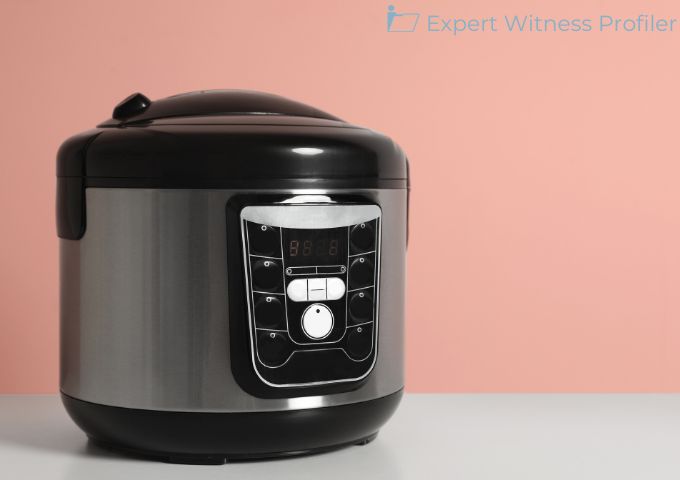
Grace Pennington filed a complaint alleging that she was seriously injured by an Instant Pot ULTRA Pressure Cooker she had purchased from Kohl’s Corporation.
The Defendant filed a motion to exclude the opinions of the Plaintiff’s expert, Dr. David M. Rondinone.
Mechanical Engineering Expert Witness
David Michael Rondinone holds an M.S. degree and a Ph.D. degree in Mechanical Engineering from the University of California, Berkeley, majoring in material behavior and design and minoring in structures and dynamics and electronic controls. He also holds a B.S. degree in Engineering Physics and a B.A. degree in Astrophysics from the University of California, Berkeley.
He has worked for more than 30 years in the areas of failure analysis, design, and risk assessment of consumer and industrial equipment, including pressure cookers.
Discussion by the Court
I. Rondinone failed to consider whether the Plaintiff’s misuse caused the incident
The Defendant sought to exclude all of Rondinone’s opinions as unreliable because the Defendant asserted that he failed to consider whether the Plaintiff’s misuse caused the incident.
The “incident summary” in Rondinone’s expert report stated that the Plaintiff first “noted that the floating lock pin was in the ‘Up’ position,” so she manually released the pressure until “the floating lock pin depressed into the ‘Down’ position” before attempting to open the lid. None of the evidence shows that the Plaintiff attempted to remove the lid while the float valve was up. The Defendant’s theory that the Plaintiff misused the Instant Pot by attempting to open it while the float valve was up is not supported by evidence. Rondinone is not required to consider an alternative cause of injury that is not supported by evidence. The Court will not exclude Rondinone’s opinions as unreliable for this reason.
II. Rondinone did not employ a reliable methodology
The Defendant next argued that Rondinone did not employ a reliable methodology to conclude the Instant Pot’s float valve may have been clogged because he did not test the Instant Pot and did not observe clogging in the float valve.
Rondinone explained that “prior testing and experience” has shown that food can clog pressure cooker valves. Based on this, Rondinone concluded that “the float valve in the subject cooker is exposed to potential clogging from food.”
Because Rondinone is entitled to rely on prior testing and experience with similar pressure cookers to determine that the pressure cooker in this case was susceptible to clogging due to its exposed float valve, the Court cannot conclude that Rondinone’s methodology is so fundamentally flawed that the Court must exclude his opinion on a reliability basis.
III. Rondinone’s opinion that the float valve may have clogged is irrelevant
The Defendant also argued that Rondinone’s opinion that the float valve may have clogged is irrelevant because there is no evidence of clogging in this case.
Rondinone generally opined that float valve clogging can occur, he does not opine that in this case the float valve was clogged at the time of the incident or that clogging could have caused the incident. Instead, he stated that a boil-over is “the most likely scenario.”
Based on Rondinone’s description of a boil-over, it has nothing to do with a clogged float valve. The Court, as a result, excluded Rondinone’s opinions about float valve clogging as irrelevant.
The Defendant argued that Rondinone’s opinion that the Plaintiff may have accidentally depressed the float valve while releasing steam from the Instant Pot is speculative and unsupported. Stating that it is “possible” that the Plaintiff depressed the float valve does not meet the standard of reliability. Nor did Rondinone tie this possibility to any defect in the pressure cooker’s design. Rondinone did not opine that the placement of the float valve is a design defect or that it makes the pressure cooker unreasonably dangerous. This opinion is not reliable or relevant to the facts of the case and must be excluded.
For similar reasons, the Court excluded Rondinone’s opinions about the Defendant’s failure to perform an Failure Modes and Effects Analysis (“FMEA”) because they are not tied to any defect in the pressure cooker’s design.
IV. Rondinone’s opinions about the boil-over event and the Defendant’s related warnings
The Court last addressed Rondinone’s opinion that the Plaintiff’s injuries were caused by a boil-over event. Unlike his excluded opinions, this opinion is relevant to the Plaintiff’s claims. Rondinone opined that other manufacturers warn users of the risk of a boil-over event and how that risk may be mitigated.
The adequacy of the Defendant’s warnings is relevant to the Plaintiff’s warning defect claim. Further, Rondinone directly tied the warning to his proposed cause of the Plaintiff’s injuries. The Court will not exclude Rondinone’s opinions about the boil-over event and the Defendant’s related warnings.
Held
The Court granted in part the Defendant’s motion to exclude Dr. David Rondinone’s opinions.
Key Takeaway
When assessing reliability, the focus must be solely on principles and methodology, not on the conclusions that they generate.
The soundness of the factual underpinnings of the expert’s analysis and the correctness of the expert’s conclusions based on that analysis are factual matters to be determined by the trier of fact, or where appropriate, on summary judgment.
Case Details:
| Case Caption: | Pennington V. Kohl’s Corporation |
| Docket Number: | 2:23cv1736 |
| Court Name: | United States District Court for the Eastern District of Wisconsin |
| Order Date: | June 18, 2026 |