This case concerns a motor vehicle collision that occurred between Plaintiff Bryan Russell Arnett (“Plaintiff”) and Defendant Larry Tyrone Fairell, II (“Fairell”) on December 14, 2022.
Fairell filed a motion to partially strike the testimony of Arnett’s retained transportation safety expert, David Hedgpeth.
Transportation Safety Expert Witness
David Hedgpeth is the principal owner of Hill Country Transportation Resources, LLC and has over 35 years of experience in the commercial transportation industry.
Hedgpeth has a comprehensive understanding of commercial transportation industry standards, best practices, and regulatory guidelines, and in particular, what would be considered usual and customary, with employees, commercial drivers, delivery services and company management.
Arnett designated Hedgpeth, of Hill Country Transportation Resources, LLC, in his First Supplemental Expert Designations on March 24, 2025. The designation stated that Hedgpeth “will testify about transportation safety, regulatory compliance, fleet management, commercial motor vehicle accident investigation, and industry standards of care.”
On May 06, 2025, Arnett served his Eleventh Supplemental Rule 26 Disclosures, which included Hedgpeth’s supplemental report.
The parties did not dispute that Arnett’s original designation of Hedgpeth was timely. But the Defendants took issue with the service of Hedgpeth’s supplemental report, which they asserted “addresses new topics and offers new opinions not addressed in Hedgpeth’s original report not disclosed in Plaintiff’s Designations.”
And, so, Defendants contended that Hedgpeth’s supplemental report should be stricken because it is untimely and fails to comply with Rule 26’s disclosure requirements and because the opinions contained in it are unreliable and, consequently, inadmissible under Rule 702 and Daubert.
Rule 26
Defendants argued that Hedgpeth’s supplemental report is untimely because it consisted of “new” opinions about whether speeding was a contributing factor to the incident at issue, which were not contained in his original report.
Arnett stated that the original report analyzed compliance with Federal Motor Carrier Safety Regulations (“FMCSR”) and, specifically, section 395.8(2)(i), which requires drivers to record their duty status. And the supplemental report “builds on this” by analyzing newly produced bills of lading, which “provide additional data regarding the driving hours and mileage of Defendant Fairell [and] directly relate to the original opinion about FMCSR compliance and safety concerns.”
Arnett contended that the supplemental report bolsters Hedgpeth’s original conclusions about FMCSR compliance and safety concerns but did not exceed the scope of his original report.
Based on its review of Hedgpeth’s original and supplemental reports, the Court agreed with Arnett.
Hedgpeth’s supplemental report serves to elaborate – more generally – on his original opinions about compliance with federal safety regulations. And, so, it does not depart from his original report in material respects.
As to timeliness, the documents (bills of lading) that formed the basis of Hedgpeth’s supplemental report were purportedly produced on March 12, 2025, which was before Arnett’s expert designation deadline.
Arnett asserted that Hedgpeth reviewed the materials and produced the supplement “as quickly as practicable,” which allowed Arnett to serve the supplemental report on Defendants on May 6, 2025 – ten days after the discovery deadline.
Rule 702 and Daubert
Defendants also contended that Hedgpeth’s opinions in his supplemental report are unreliable under Rule 702 and Daubert because they are facially speculative. Specifically, Defendants pointed to Hedgpeth’s statements that he “is unable to come to an accurate conclusion as to speed and hours of service” and that the “information and data is inconclusive.”
But Arnett’s response persuasively addressed Hedgpeth’s qualifications, methodologies, materials reviewed, and summary of his opinions as it relates to his supplemental report. And, so, the Court found that Hedgpeth’s supplemental report satisfied Rule 702 and Daubert and that it should not be excluded on that basis.
Held
The Court denied the Defendants’ motion to partially strike the testimony of transportation safety expert, David Hedgpeth.
Key Takeaway:
Insofar as Arnett’s supplemental disclosure fell short of Rule 26’s requirements, the Court found that such non-compliance – on considering the arguments that Arnett persuasively lays out in his response – was harmless.
In this insurance coverage dispute, Plaintiff Will Properties Inc. brought claims against Defendant Century Surety Company for breach of contract, common law bad faith, and violations of the Texas Insurance Code.
Plaintiff alleged that its exhibition center in Harker Heights, Texas was covered by Defendant’s policy, which included hail and windstorm coverage, from November 1, 2020 to November 1, 2021, and that the property “sustained extensive damage resulting from a severe storm that passed through the Bell County, Texas area” during the policy period.
Defendant contended that Plaintiff cannot show that its claimed damages resulted from a covered cause of loss because it cannot segregate between damages that occurred during and before the policy period, including in a 2013 storm.
Moreover, Defendant asked the Court to exclude the opinions of Plaintiff’s expert, Neil B. Hall.
Civil Engineering Expert Witness
Neil Bradley Hall is a graduate of City College of New York and a licensed Professional Engineer in Texas, Minnesota, New York, New Jersey, USVI and Mississippi, with over 25 years of professional experience in the practice of engineering.
Hall is the owner and principal of Groundtruth Forensics, a consulting firm specializing in building performance, failure analysis and damage assessment.
Defendant contended: “According to the facts that Hall acknowledges, the Property suffered damage from a combination of covered and non-covered causes of loss. Yet nowhere in his written reports or deposition testimony does Hall even attempt to segregate the damage between those two.”
Therefore, Defendant asserted, “Hall’s opinions do nothing to aid the fact finder and offer no information relevant to a determination of whether or to what extent Will Properties’ roof might have been damaged by a covered cause of loss.”
In response, Plaintiff emphasized that Defendant did not challenge Hall’s education, qualifications, or methodology. Instead, Plaintiff contended, Defendant misstated the testimony of Hall, who “explained how he segregated damages between the Policy period and those pre-existing the Policy period.” Plaintiff submitted the transcript of Hall’s deposition and his declaration responding to the motion to exclude. In both, Hall explained his efforts to segregate hail damage to Plaintiff’s property by age, including by reviewing storms five years before the reported date of loss and focusing on two hail storms in 2019 and 2020; he also testified that he reviewed information from the 2013 storm.
The Court, therefore, found that Hall’s opinions are relevant and sufficiently reliable to be considered by the finder of fact, who will be free to consider Hall’s methodology for segregating damages when determining the proper weight to accord his opinions.
Held
The Court denied the Defendant Century Surety Company’s motion to strike and exclude the opinions of Neil B. Hall.
Key Takeaway:
As a general rule, questions relating to the bases and sources of an expert’s opinion affect the weight to be assigned that opinion rather than its admissibility. Therefore, Defendants’ arguments about the reliability of Hall’s opinions go to the weight properly afforded his testimony, not its admissibility.
In this personal injury case, Johnathan Mudge sought to recover for injuries allegedly resulting from an automotive collision that occurred on October 5, 2021.
Mudge has sued three Defendants in this matter: Riverside Transportation, Inc., Riverside Transport, Inc., and Rena Talton, the driver of the vehicle that collided with Plaintiff’s vehicle.
Defendants collectively filed a motion to exclude testimony from one of Plaintiff’s treating physicians, Dr. Winston B. Morris, a family medicine practitioner.
Plaintiff elicited testimony from him regarding the anatomy of the spine, including the grouping of vertebrae, the nature and function of spinal discs, and the nature, causes, and symptoms of spinal disc injuries.
Family Medicine Expert Witness
Winston Barrington Morris, MD, holds a Bachelor of Arts degree in Biology from the University of South Florida, and he graduated as a Doctor of Medicine from the Medical University of South Carolina in 1997. He completed family medicine residencies in 2004, and he is certified by the American Board of Family Practice.
Morris offered some testimony based on scientific, technical, and otherwise specialized knowledge. For such testimony to be admissible in Court proceedings, Morris must be “qualified as an expert by knowledge, skill, experience, training, or education.” Morris’ medical education and significant experience as a doctor of family medicine satisfy this requirement.
Next, the Court must determine whether it is “more likely than not that the expert’s scientific, technical, or other specialized knowledge will help the trier of fact to understand the evidence or to determine a fact in issue.” Morris’ medical knowledge is more likely than not to assist the jury in this case with understanding medical evidence and deciding on relevant medical facts. Thus, his testimony satisfies this requirement as well.
Finally, the opinions he offers in this case must be “based on sufficient facts or data; be the product of reliable principles and methods; and must reflect a reliable application of the principles and methods to the facts of the case.” The Court ruled that Morris’ testimony about general medical facts meets the required standard. His knowledge of how the brain, spine, and nervous system work comes from his medical training. While he may not be a specialist, it’s up to the jury to decide how much weight to give his testimony.
Similarly, Morris’ testimony regarding Plaintiff’s medical condition is based on his own experience treating the Plaintiff, including his review of Plaintiff’s own statements and medical records, in keeping with Morris’ medical training. The Court deemed it sufficient for his testimony to be admissible.
Held
The Court denied the Defendants’ motion to strike the testimony of Plaintiff’s treating physician, Winston Barrington Morris.
Key Takeaway:
Plaintiff has shown that Morris is qualified as an expert, and that it is more likely than not his specialized knowledge will assist the factfinder. He has also shown that Morris’ opinions are based on sufficient data, are the product of reliable principles and methods, and reflect a reliable application of the principles and methods.
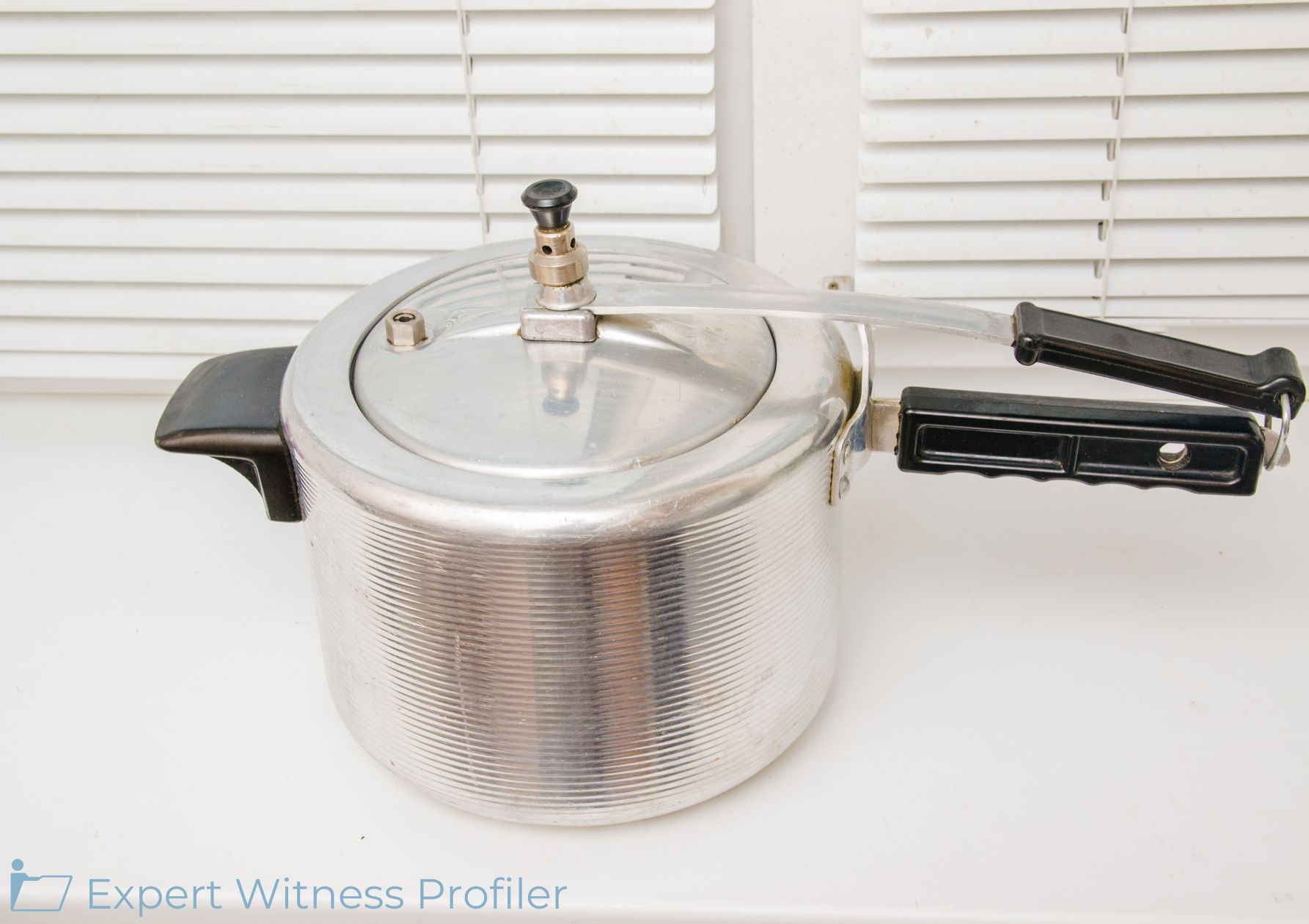
This is a product liability case involving Walmart’s sale of a pressure cooker that Plaintiff Vanessa Loftis claims injured her when the lid was able to be removed while the pressure cooker was—unbeknownst to her—still pressurized.
During the depressurization process, pressure cookers release steam; according to Loftis, the steam on that night “lasted forever,” around thirty to forty-five minutes. Loftis testified that she “kept checking on it, and then, when [the steam] finally did stop, that’s when [she] opened it and it kind of blew up.”
The contents of the cooker were ejected onto Loftis, causing burns to approximately 12% of her body, mostly on her abdomen, that later required debridement.
Walmart filed a motion to exclude Loftis’ expert, Dr. David Rondinone, arguing that his opinions are speculative, unreliable, and not tied to any applicable methodology.
Walmart appeared to make three specific challenges to Rondinone’s opinion: (1) that he proposed only “possible” causes of the incident with no basis in evidence; (2) that he did not physically test the subject cooker or an exemplar; and (3) that he did not rule out alternative causes.
Mechanical Engineering Expert Witness
David Rondinone holds an M.S. degree and a Ph.D. degree in Mechanical Engineering from the University of California, Berkeley, majoring in material behavior and design and minoring in structures and dynamics and electronic controls.
He also holds a B.S. degree in Engineering Physics and a B.A. degree in Astrophysics from the University of California, Berkeley. From 1993 to the present, he has worked as a Mechanical Engineering Consultant, and is a principal of Berkeley Engineering And Research, Inc. (referred to herein as “BEAR”).
He has worked for more than 30 years in the areas of failure analysis, design, and risk assessment of consumer and industrial equipment, including pressure cookers.
Rondinone proposed three potential causes of the accident: (1) a float valve clog, resulting from an inadequately designed float valve, that caused the lid to remain unlocked while under pressure; (2) a boil-over event that was not properly warned against; or (3) a failure of the interlocking sliding mechanism.
Possible Causes
Walmart contended that Rondinone posits only “possible,” rather than “probable” causes of the accident and failed to ground these in facts.
However, Rondinone identified a float valve clog as the “most likely scenario” and “would say to a degree of reasonable engineering certainty it’s more likely a clogged or insufficient float valve interlock event” caused Loftis’ injuries “than . . . a boil-over event.”
Since Rondinone intended to testify that the incident was most likely caused by a clogged float valve, as supported by his expertise, prior testing of pressure cookers, examination of Instant Pots, and Loftis’ description of the incident, the Court refused to exclude his testimony on that basis.
Physical Testing
While Walmart conceded that it was not possible for Rondinone to test the subject pressure cooker in this case, as it was not available, it argued that his failure to conduct tests using an exemplar model is unjustified and rendered his testimony inadmissible.
However, Rondinone explained that in order to help him gain a more precise determination on probability as to whether this was a float valve incident, he would have had to run “an extensive statistical study, probably hundreds of tests,” and he has not “know[n] anybody who ever has” done that.
Further, he explained that it is “difficult to repeat” a clogged float valve, but his lab has “done tests for clogging on other models of pressure cooker” and shown that a user “can with a single use clog the vent,” which he reports “present[s] a risk of pressurization with the lid in an unlocked state.”
However, the Court held that Rondinone’s opinion that the float valve was clogged is supported by Loftis’ description of the incident and his prior testing of pressure cookers, not “unfounded assumptions.”
While Rondinone is “unable to recreate” the incident, the Court held that his opinion is “based on known facts and his expertise.”
Alternatives
Walmart challenged the admissibility of Rondinone’s opinion on the argument that he failed to rule out other possible causes.
In this case, Rondinone did engage with alternative explanations, including a boil-over event, a failed sliding mechanism, or some other accident like a spill. He then applied his expertise in the mechanics of pressure cookers to the facts in this case to deduce that a float valve clog was the most likely mechanical scenario here.
As for the possibility of a spill, he stated that “physically it’s probably possible,” but he would “have to disregard Loftis’ entire testimony, though, from start to finish for that to be true,” including “disbelieving her explanation of the removal of the lid and how the contents came out.”
Rondinone refused to say with absolute certainty that a float valve clog occurred here, but he did conclude the most likely cause within a “degree of reasonable engineering certainty.”
The Court held that Rondinone’s refusal to completely rule out other alternatives goes to the weight of his testimony, not its admissibility.
Held
The Court denied Walmart’s motion to exclude Dr. David Rondinone.
Key Takeaway:
Despite the fact that Rondinone did not test the subject pressure cooker or an exemplar model in this case, there is no single requirement for admissibility as long as the proffer indicates that the expert evidence is reliable and relevant.
The Court held that Rondinone’s conclusions are based on his experience and expertise [in pressure cooker cases], general engineering principles, information from Loftis about the accident, examination of an exemplar cooker, its design and specifications, competitors’ cookers, and photos of the accident, including of the subject pressure cooker and Loftis’ burns.
In this personal injury case, Plaintiff Ana Maria Marcela Tavantzis (“Tavantzis”), individually and on behalf of her husband, Jesus Plascencia (“Plasencia”), alleged Defendant American Airlines, Inc. (“American”) was responsible for a stroke Plasencia suffered just prior to landing on an international flight from Miami to Madrid, Spain.
Plaintiff’s expert Captain Richard J. Levy advanced three opinions related to three critical periods before and during the flight at issue: (1) just before takeoff when the pilot spoke with Plaintiffs; (2) when Plasencia presented stroke symptoms an hour and a half into the flight; and (3) when the pilot landed in Madrid.
American argued that the Court should exclude Levy’s opinions because the opinions (1) are unreliable under the Daubert standard; (2) exceed the scope of his aviation expertise; (3) rely on destroyed data; and (4) supplant the jury’s function by opining on the ultimate facts.
Aviation Expert Witness
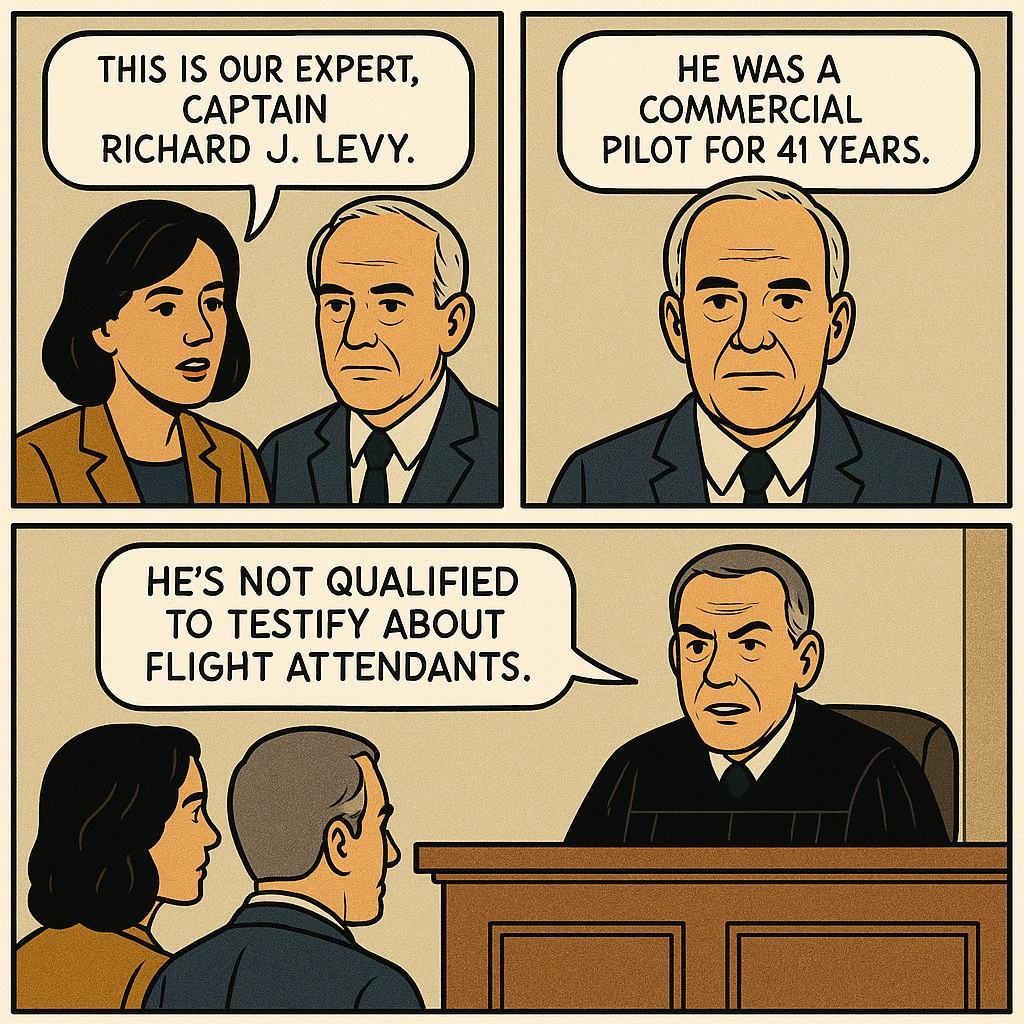
Captain Richard J. Levy flew forty-one years at a major international airline, American Airlines, until the mandatory retirement age of 65 in June of 2018.
He has decades of flight experience in both the commercial and military field. Since his retirement, he has been conducting simulator and classroom training as a Flight Crew Training Instructor at another major airline, Southwest Airlines.
American disputed the reliability of Levy’s experience as the basis for his opinions.
To support this contention, American advanced three reasons:
First, American argued that Levy’s testimony is unreliable because it does not explicitly “set forth what Levy was asked to opine on.”
Second, American argued that Levy’s opinions are unreliable because his opinions did not cite directly to the record or engage in sufficient “analysis.”
Finally, American contended that Levy’s opinions are irrelevant because they did not have “any tendency to make a fact more or less probable than it would be without the evidence.”
Analysis
American never explains why the imprecision surrounding the scope of Levy’s engagement renders his opinions unreliable. What Levy thought the contours of his assignment were has no bearing on his qualifications or experience; the Court held that he is still a flight training instructor who for 41 years served as a commercial pilot for Defendant American Airlines.
Moreover, the facts of this case are not so complicated that it requires citations to the record to understand the context of Levy’s opinions. His opinions reflect the application of his specialized knowledge and experience to the straightforward facts of this case, which he describes at the outset of his report. Because Plaintiffs submitted Levy as an expert for his experience, Levy need not have conducted any “analysis” in the manner American insisted he must.
Besides, the Court determined that Levy’s opinions make some facts more or less probable, if the American flight in this case had sufficient fuel for the pilot to turn the plane around if Plasencia presented stroke symptoms an hour and a half into the flight (a fact that is disputed by the parties).
Scope
American specifically challenged Levy’s statements regarding the proper conduct of American employees, other than the pilot, who were working on the aircraft during Plaintiffs’ flight. As an expert, Levy is allowed to make certain factual assumptions within his opinions.
However, considering Levy’s experience was as a pilot, not a flight attendant, the Court held that he is not qualified to opine on whether the flight attendants on board contravened policy or acted negligently.
The Court excluded all portions of Levy’s testimony that opine on the behavior, conduct, or propriety of any American employee other than the pilot.
Origin of Flight Track Data
The flight data that Levy used in his report is reliable. American argued otherwise, suggesting that the flight data was suspect because it was obtained from third party FlightRadar24 and is now no longer available on that site.
Plaintiffs responded that the limited data that Levy relied upon—a cropped rendering of the flight path after an hour and a half of flight time—was provided to American. The Court deemed it sufficient under Civil Procedure Rule 26.
Ultimate Issue
In this case, American conflates factual issues and legal issues; experts are only proscribed from opining on the latter when it goes to the ultimate issue in the case.
The Court held that Levy does not opine on any legal issues, so there is no reason to exclude Levy’s proffered testimony on those grounds.
Held
The Court granted in part and denied in part American’s Daubert motion to exclude the opinions of Plaintiffs’ expert, Ret. Captain Richard J. Levy.
Key Takeaway:
Levy goes beyond the scope of his expertise to opine on the proper conduct of American employees, other than the pilot, who were working on the aircraft during Plaintiffs’ flight. After all, Levy’s experience was as a pilot, not a flight attendant.
As the COVID-19 pandemic took hold in early 2020, Congress established the Paycheck Protection Program (PPP). Several businesses applied for and received PPP loan approval from Prestamos CDFI, LLC (Prestamos). However, due to individual bank-related issues, the loan funds were returned to Prestamos, leaving the businesses without the promised financial assistance. Consequently, these businesses initiated a class action lawsuit against Prestamos, alleging breach of contract. They contend that Prestamos failed to fulfill its funding obligations, falsely recorded the loans as disbursed, held them liable for repayment, and hindered their ability to secure alternative funding.
Plaintiffs moved for class certification on September 6, 2024. They believe that class certification is appropriate because liability for each Plaintiff rises and falls with the same contract and PPP regulations.
Prestamos filed a motion to exclude the expert reports of William Briggs, William Manger, and Steven Feinstein. According to Prestamos, none of the expert reports satisfy Daubert because they improperly offered legal conclusions. And even if the experts can make such conclusions, Prestamos argued that Briggs and Manger are not qualified and that Feinstein did not use an accepted methodology. Plaintiffs opposed excluding the three reports.
Business Administration Expert Witnesses
William Briggs operates a consulting firm based in Austin, Texas. From November 2017 to January 2021, he served in multiple roles at the United States Small Business Administration (SBA). Prior to his appointment at the United States Small Business Administration, he was employed in multiple positions in and out of public service advising clients, companies, and officials.
William Manger served in the United States Small Business Administration (the “SBA”) for a total of almost eight years, from 2005 to 2009 and again from 2017 to January 2021. Most recently, he was Chief of Staff of the SBA from March 2020 to January 2021, during which he oversaw and led the SBA’s implementation of the Paycheck Protection Program (the “PPP”). In that role, he was responsible for promulgating PPP-specific rules and guidance, implementing PPP-specific processes at the SBA, and communicating with lenders, trade associations, government agencies, and members of Congress.
Steven Feinstein is Associate Professor of Finance at Babson College, and the founder and president of Crowninshield Financial Research, Inc., a financial economics consulting firm.
He holds a Ph.D. in Economics from Yale University, a Master of Philosophy degree in Economics from Yale University, a Master of Arts degree in Economics from Yale University, and a Bachelor of Arts degree in Economics from Pomona College. He also holds the Chartered Financial Analyst (“CFA”) designation, granted by the CFA Institute.
In 2023, the Northern District of Texas decided Greathouse v. Capital Plus Financial, LLC, 2023 WL 5746927 (N.D. Tex. Sept. 6, 2023). That case is virtually identical to this one. In both cases, borrowers brought a class action suit against a private lender alleging that the lender failed to fund their approved PPP loans in breach of the standard contracts.
In both cases, Plaintiffs alleged similar harms—responsibility to repay unfunded loans and inability to get loans from other lenders. Plaintiffs also had the same counsel and experts in both these cases. Both cases consisted of two motions—one to exclude the expert reports and another to certify the proposed classes. And, in both cases, the result will be the same: the expert reports will only be considered for their background opinions on the PPP and the proposed classes will not be certified because of the factual differences between Plaintiffs’ loan processes.
Prestamos likely objects most strongly to the three experts offering improper legal opinions that aim to differentiate this case from Greathouse and interpret PPP regulations.
Analysis
The Court excluded the opinions explaining the differences between this case and Greathouse. The experts’ opinions interpreting the PPP regulations were also be excluded because they provided legal conclusions on whether Prestamos complied with its regulatory duties under the PPP.
Beyond distinguishing this case from Greathouse and interpreting the PPP regulations, the Court noted that all three experts gave background information on the CARES Act, the PPP, and the relevant regulations.
Moreover, both Briggs and Manger have extensive experience serving in multiple roles in the SBA and Feinstein has significant knowledge of financial markets, investments, and relevant regulations.
Because Briggs, Manger, and Feinstein are qualified and their background opinions are reliable and fit with the main issue in the case, the opinions satisfy Daubert.
Held
The Court granted in part and denied in part Prestamos’s motion to exclude the expert reports of William Briggs, William Manger, and Steven Feinstein while the Plaintiffs’ motion for class certification was denied.
Key Takeaway:
The common question in this case asks whether Plaintiffs’ PPP loans should ever have been canceled. To answer this question, the Court needs to understand the PPP and the procedure of the loan process. The experts’ background opinions supply some of this knowledge by laying out basic information about the relevant statute and regulations.
Case Details:
Case Caption:
Marshall v. Prestamos Cdfi, LLC Chicanos Por LA CaUSA, Inc.
Docket Number:
5:21cv4337
Court Name:
United States District Court, Pennsylvania Eastern
In early 2015, Plaintiffs, US Thrillrides, LLC (“USTR”) and Polercoaster, LLC began discussions with Defendant, Intamin Amusement Rides Int. Corp. Est. about partnering to build Polercoasters for Plaintiffs’ customers. The “Polercoaster” is “a roller coaster that is supported or suspended from a vertical tower instead of moving along a horizontal track.”
This case arises from a project to build a roller coaster at the Dubai Hills Mall. The developer of the Dubai Project, Emaar Entertainment LLC, originally entered into a Letter of Acceptance (“LOA”) agreement with Plaintiff US Thrillrides LLC (“USTR”) relating to the Dubai Project. However, Emaar ultimately terminated that agreement and contracted with Defendant to build a different roller coaster.
Basically, Plaintiffs filed claim for breach of the Confidentiality Non-Disclosure Agreement (“CNDA”) insofar as it is based on unauthorized use of Plaintiffs’ copyrights by Defendant and Plaintiff Polercoaster LLC’s (“Polercoaster”) copyright infringement claim.
Defendant filed a motion to exclude the testimony of Plaintiffs’ damages expert, Eric Lee while Plaintiff filed a motion to exclude the testimony of Defendant’s expert, Dr. Keith Ugone.
Accounting Expert Witness
Eric Lee is a financial and fraud expert with over 20 years of experience. He is a Certified Fraud Examiner (CFE) and Certified Insolvency and Restructuring Advisor (CIRA) and has a bachelor of science degree in accounting from Arizona State University.
Also, Lee has spent the last 15+ years in litigation, forensic and bankruptcy consulting, including the quantification of complex financial damages, lost profits, class action litigation, fraud investigations, reconstruction of financial records, corporate internal investigations, funds tracing, and other financial analyses.
Dr. Keith R. Ugone has provided economic and damages consulting services in antitrust cases, breach of contract cases, business interruption cases, class action certification matters, employment / loss of earnings cases, intellectual property cases, lender liability cases, professional negligence cases, and securities-related cases, among others.
Moreover, he specializes in the application of economic principles to complex business disputes and generally is retained in cases requiring economic analyses and/or damages-related analyses.
Plaintiffs’ claims are based on the breach of the CNDA due to unauthorized use of copyrights and copyright infringement. Lee’s expert opinions relate to actual damages, which are recoverable for both causes of action.
As is typical with damages expert opinions, Lee assumed that Plaintiffs will prevail on their substantive claims and that Plaintiffs are entitled to an award of actual damages. With those assumptions in place, Lee calculated the amount of damages that he opined would be appropriate.
Basically, Lee calculated two types of damages: (1) lost profits from consulting fees and royalty fees that Plaintiffs would have earned had the LOA not been terminated and their participation in the Dubai Project been completed; and (2) a reasonable royalty for the misappropriation of Plaintiffs’ intellectual property.
Lost Profits
Plaintiffs have not and cannot prove that Defendant caused the termination of the LOA or the end of Plaintiffs’ involvement in the Dubai Project. Multiple representatives involved in the decision to terminate Emaar’s relationship with Plaintiffs made clear that they would have chosen to have no roller coaster at the Dubai Hills Mall before they would have continued their relationship with Plaintiffs.
Therefore, the Court held that Lee’s opinions as to the amount of lost profits—i.e., the unpaid consulting fees and royalty contemplated under the LOA—will be excluded because Plaintiffs are not entitled to an award of such damages.
Reasonable Royalty
Lee’s opinions involve the calculation of a reasonable royalty for all of the intellectual property, confidential information, and trade secrets that Plaintiffs alleged were misappropriated or infringed in this case combined.
However, Lee did not break down the analysis by type of intellectual property or information. As relevant here, Lee’s opinions did not allocate a reasonable royalty to the use of Plaintiffs’ copyrights, specifically.
Without any basis to parse the damages allocated to copyright infringement—as opposed to patents, trade secrets, or confidential information which are no longer at issue—Lee’s opinions would only serve to confuse the jury.
The Court held that Lee’s opinions regarding the reasonable royalty, which do not allocate a royalty based on Plaintiffs’ copyrights specifically, must be excluded.
Keith Ugone
Plaintiffs sought to exclude the expert testimony of Defendant’s expert, Dr. Keith Ugone. As indicated by Defendant, Ugone is purely a rebuttal expert, offering a critique of Lee’s damages opinions. Because Lee’s opinions are being excluded, the Court held that Ugone’s opinions are no longer relevant and will also be excluded.
Held
The Court granted Defendant’s motion to exclude the testimony of Eric Lee.
2. The Court granted Plaintiffs’ motion to exclude Keith Ugone’s Testimony.
Key Takeaway:
To begin with, an expert’s offered opinion and the facts of the case must be an appropriate fit. There is no fit where a large analytical leap must be made between the facts and the opinion.
The Court excluded Lee’s opinions regarding the reasonable royalty because there is simply no “fit” between the facts remaining at issue in this case and the opinions rendered.
Please refer to the blog previously published about this case:
In this antitrust action, separate Plaintiff groups of users and advertisers sued Meta Platforms, Inc. (Meta), for alleged anticompetitive conduct under the Sherman Act and California state law in connection with the Facebook social-networking app.
The user group, headlined by named Plaintiffs Maximilian Klein, Sarah Grabert, and Rachel Banks Kupcho, alleged that Meta illegally acquired and maintained a monopoly in the “personal social network services” (PSNS) market “through repeated misrepresentations over its data collection and use practices” that “deprived its competitors of the ability to compete.” The user Plaintiffs have asked to certify a class of all persons in the United States who used a Facebook profile between December 2016 and December 2020.
The certification request rises or falls on the validity and reliability of the opinions of the user Plaintiffs’ economist, Nicholas Economides, with respect to antitrust injury and other elements required for proof of a monopolization claim. Meta asked to exclude the opinions of Dr. Economides under Federal Rule of Evidence 702 and related cases.
Meta illegally acquired and maintained a monopoly in the PSNS market
The user Plaintiffs’ main allegation is that Meta illegally acquired and maintained a monopoly in the PSNS market by deceiving users into believing that Facebook’s data collection and privacy practices were more protective than they actually were.
In Plaintiffs’ view, these false assurances prevented other firms from effectively competing in the alleged PSNS market. The user Plaintiffs contended that this barrier to competition injured them in a manner contemplated by the antitrust laws.
For the request to certify a class comprised of millions of Americans who used Facebook over the span of four years, the user Plaintiffs advance a single theory of antitrust injury. The theory is that, but for the misrepresentations about data privacy, Meta would have found itself in a competitive PSNS market that would have forced it to pay users for their data to retain robust user engagement. This theory is based entirely on the report of Economides, who opined that “Facebook would have compensated [users] a certain amount per month for their data in the but-for world where [users] knew the truth about Facebook’s data practices, because the alternative would have led to an unacceptable loss of market share for Facebook.”
Economics Expert Witness
Nicholas Economides is an internationally recognized academic authority on network economics, electronic commerce and public policy. His fields of specialization and research include the economics of networks, especially of telecommunications, computers, and information, the economics of technical compatibility and standardization, industrial organization, the structure and organization of financial markets and payment systems, antitrust, application of public policy to network industries, strategic analysis of markets and law and economics.
Professor Economides has published more than 100 articles in top academic journals in the areas of networks, telecommunications, oligopoly, antitrust, product positioning and on the liquidity and the organization of financial markets and exchanges. He holds a Ph.D. and M.A. in Economics from the University of California at Berkeley, as well as a B.Sc. (First Class Honors) in Mathematical Economics from the London School of Economics. Previously, he taught at Columbia University (1981-1988) and at Stanford University (1988-1990).
Economides starts with the general observation that, in competitive markets, “sellers must lower their prices or else lose market share.” He starts with the general observation that, in competitive markets, “sellers must lower their prices or else lose market share.”
This observation requires immediate modification for the alleged PSNS market because, as every online denizen knows, Facebook and other social-networking apps are provided without charge to users. Economides attempts to account for this fact by saying that, although users do not pay Meta to use Facebook, Meta “charges a price to users in the form of data collection and use.” He then proposes that, in a but-for world where competition in the PSNS market was not illegally constrained as alleged by plaintiffs, rival apps would offer “more competitive privacy practices” than Facebook, which would compel Meta to compete through “a reduction in the effective price of using Facebook.”
Economides postulated that this “reduction in the effective price” would take the form of a “negative price,” by which he means an affirmative payment by Facebook to users for their data. He quantified this but-for payment to be $5.00 per user per month.
Consequently, Economides concluded that the putative class of users suffered antitrust injury by being “overcharged” by Facebook, in that they were not affirmatively paid a flat rate of $5.00 per month for using Facebook, and that this resulted over the relevant class period in “total damages to the Class of $52.8 billion (pre-trebling).”
Meta’s Motion To Exclude Economides’ Testimony
Meta stated that Economides’ antitrust injury opinions amount to ‘junk science’ and should be excluded from the case under Federal Rule of Evidence 702 and the familiar standards set by the Daubert line of cases.
In Meta’s view, “the mere theory of ‘negative price markets’ . . . cannot bridge the analytical gap between how [Facebook] actually competes for users and how Economides speculates it would.”
Economides’ Antitrust Injury Opinions
Meta did not challenge Economides’ qualifications, and rightfully so. The record indicated that he is a qualified antitrust economist.
Meta’s main criticism was that Economides’ antitrust injury opinion, namely that Facebook users suffered the loss of direct payments for their data that they assertedly would have received in the but-for world, was unsupported by the record.
The necessary links in Economides’ theory of antitrust injury are: (1) Meta competes on price and quality (2) in the but-for world without the alleged data-privacy deception, Meta would face greater competition from rivals with respect to privacy practices (3) in response to greater competitive pressure, Meta would compete on price instead of quality to avoid losing users to rivals (4) even though the price for using Facebook is “zero,” in the sense that no money is exchanged, economic theory recognizes that competitive conditions in certain markets can result in “negative” prices (5) accordingly, Meta would pay users a “negative” price to retain them instead of collecting less data.
Because Economides cited credible sources for the various economic concepts he applied, the Court saw no basis for concluding those theories and principles themselves are not well accepted in the field of economics.
In response to greater competitive pressure, Meta would compete on price instead of quality to avoid losing users to rivals
Meta did not challenge Economides’ belief that Facebook would not change its data-collection practices in the but-for world. Rather, the thrust of Meta’s challenge to his opinions on antitrust injury concerns the third link described above that Facebook would choose to compete on price instead of quality in the but-for world to avoid losing users.
To be sure, Economides relied on economic literature discussing the theory and existence of negative prices in online and double-sided platform markets, which are the types of markets the PSNS market is said to be. However, the Court held that economic theory alone does not make his opinions admissible.
In addition, the user Plaintiffs did not even allege, let alone establish with evidence, that any other participant in the PSNS market has ever competed by paying users. In telling contrast, Meta provided evidence that firms in the PSNS and adjacent markets have never competed via “negative” prices.
The record undercuts the third link in Economides’ theory by demonstrating that firms in the PSNS market, including Meta, have consistently competed on the axis of quality through better content, functionality, services, and the like to keep users engaged and the stream of user data flowing, even if the firms theoretically could compete on price. The Court held that this undisputed record about the real world, and the lack of any meaningful contrary evidence, is a big red flag for Economides’ theory.
Also, citations to economic literature did not demonstrate that the economic principles of zero-and negative-price markets were reliably applied to the facts of this case.
Overall, Economides did not identify reliable and validated economic literature to support his specific conclusion that, upon coming to the proverbial fork in the road between quality and price, Facebook would choose price in the but-for world
Lack of Sufficient Factual Grounds
Besides, Economides pointed to research initiatives where Meta paid individuals in test groups to permit Meta to harvest and use a range of data from them. The problem for Economides is that these market-research programs entailed payments for user data outside the context of Facebook’s social-networking services, where Meta is not already “bartering” for user data with Facebook’s services and the quality thereof.
The problem of factual fit also affected Economides’ opinions about Meta’s internal discussions of paying users. The Court held that the two discussions that he highlighted actually concerned user data that Meta could not or did not already obtain through Facebook’s social-networking service.
A third proposal discussed by Economides arose in the context of Apple’s 2020 App Tracking Transparency (ATT) feature, which required apps running on Apple products to “obtain users’ agreement to ‘track’ users (i.e., collect and use their data) outside that app” through a pop-up prompt. This proposal contemplated paying a “data dividend” (i.e., money for relevant purposes) “to users to incentivize them to continue providing their data to Facebook” when confronted with the ATT prompt. The Court found Economides’ analysis of this proposal and its relevancy perfunctory to the point of being of little utility.
To be sure, a fourth and final proposal did contemplate “paying users for access to their personal information” as part of a “transparent approach to privacy that should become the model moving forward.”
The Court held that this idea alone, which Meta ultimately rejected, is too thin a reed on which to base the sweeping extrapolation Economides makes that Meta would pay all U.S. users money every month for using Facebook.
Analysis
Even taken as a whole, the Court held that the four proposals did not provide “sufficient factual grounds” for the third necessary link in Economides’ theory.
For all four, he opined that “Facebook recognized that the data it was collecting and using was responsible for much of its revenue and that it would make economic sense to compensate users in order to get that data (rather than lose it).”
But that conclusion does not necessarily follow from the starting point. Economides never explained why Meta would focus exclusively on answering new competition by paying users. There is no doubt, as he says, that Meta makes a lot of money from user data, but he did not demonstrate that Meta would be compelled to retain users by paying them, rather than through innovations in services and product quality. This shortfall goes beyond merely ignoring evidence that Meta in the real world has consistently competed on the basis of quality.
Consequently, the Court concluded that Economides’ opinions cannot be the basis for finding antitrust injury in this case.
Held
The Court granted in part Meta’s motion to exclude Economides’ opinions about antitrust injury. The Court denied the user Plaintiffs’ renewed motion for class certification.
Key Takeaway:
There is simply too great an analytical gap between the facts on which Economides relies and that third link in his theory. The purpose of the Court’s inquiry under Rule 702 is to “ensure that proposed expert testimony imparts ‘scientific knowledge’ rather than guesswork.” Because that necessary third step in his theory of antitrust is without basis, and so rests on guesswork, the Court cannot conclude that Economides’ methodology and opinions are reliable and consequently admissible.
An expert’s job is to consider existing data and make inferences, hypotheses, and extrapolations, and “for this reason, ‘an expert is permitted wide latitude to offer opinions.’” Even so, there must be a sound foundation in the evidence to support every step on the way to their conclusions.
Case Details:
Case Caption:
Klein Et Al V. Meta Platforms
Docket Number:
3:20cv8570
Court:
United States District Court for the Northern District of California
This case involves the alleged unconstitutionality of House Bill No. 71, Act 676 (“H.B. 71” or the “Act”).
This law provides in relevant part: No later than January 1, 2025, each public school governing authority shall display the Ten Commandments in each classroom in each school under its jurisdiction. The nature of the display shall be determined by each governing authority with a minimum requirement that the Ten Commandments shall be displayed on a poster or framed document that is at least eleven inches by fourteen inches. The text of the Ten Commandments shall be the central focus of the poster or framed document and shall be printed in a large, easily readable font.
Defendants Cade Brumley, Conrad Appel, Judy Armstrong, Kevin Berken, Preston Castille, Simone Champagne, Sharon Latten-Clark, Lance Harris, Paul Hollis, Sandy Holloway, Stacey Melerine, Ronnie Morris, East Baton Rouge School Board, and St. Tammany Parish School Board (collectively, “AG Defendants”) challenged Plaintiffs’ introduction of Steven K. Green as an expert witness under the Daubert standard.
History Expert Witness
Steven K. Green earned a B.A. degree in History and Political Science, Magna Cum Laude, from Texas Christian University in 1978 where his minor was Religious Studies. He graduated from the University of Texas School of Law in 1981, earning a J.D. degree. In 1987, he received a Master’s degree in American Religious History from the University of North Carolina, Chapel Hill and a Ph.D. in Constitutional History from the same university in 1997. He is currently the Fred H. Paulus Professor of Law and Affiliated Professor of History and Religious Studies at Willamette University in Salem, Oregon, where he was also the Director of the Willamette Center for Religion, Law and Democracy from 2007 to 2020. He has authored “seven books and more than fifty scholarly articles and book chapters” in the area of “the intersection of law, religion, and history.”
In his report and testimony, Green offered opinions regarding “the history of the U.S. Constitution and First Amendment with respect to religious matters; the history of the Ten Commandments with respect to U.S. law and government; the history of displays of the Ten Commandments in public schools; and the denominational nature of the specific version of the Ten Commandments adopted in House Bill No. 71, Act No. 676 . . . .” In his report and testimony, Green offered “four key conclusions”: –
The Religion Clauses of the First Amendment were rooted in the Founders’ profound concerns for protecting the conscience of individuals and religious communities; avoiding official denominational preferences, including official promotion of religious doctrine; and preventing the religious divisiveness that flows from government favoritism of some religions or non-religion.
The historical record demonstrates that the Ten Commandments are not a foundation of the American Government or legal system.
There is no evidence of a longstanding historical acceptance and practice of widespread, permanent displays of the Ten Commandments in public school classrooms.
The version of the Ten Commandments adopted under H.B. 71 is Protestant and thus religiously exclusive.
Summary of AG Defendants’ Arguments
AG Defendants contended that Green has failed “to identify any external standard validating his methodology.” Moreover, his opinions “attempt to overrule the Supreme Court on historical questions it has already definitively asked and answered.” AG Defendants added that Green’s proffered opinions are not truly independent because of his background as an advocate.
Most importantly, Green’s opinions are not relevant because (a) “the standard [governing the Establishment Clause] is not concerned with whether a specific challenged practice occurred in the past, but instead with whether the current challenged practice reflects any of the already-identified hallmarks of a religious establishment[,]” and (b) his opinions do “not tend to establish any fact at issue [since] the historical facts are not in dispute, just how to characterize those facts.”
Analysis
A. Has Green Used an Accepted Methodology in Reaching His Opinions?
AG Defendants argued that Green has failed to use, or at least identify, an “external standard validating his methodology.” But in his report, Green explains the methodology he used for his historical analysis which he described as “standard and well-accepted methodologies used by historians” including “review[ing] both primary and secondary sources[,]” determining the reliability of the sources, comparing their consistency to other evidence, considering the circumstances of their production (including the place, time and source of production), “consider[ing] how the plain language of the source would have been interpreted at the time of its writing, and avoid[ing] the application of modern interpretations to documents that were centuries old.”
At the Daubert hearing, during both direct and cross-examination, Green went into greater detail regarding the standard methodology utilized by historians in reaching conclusions and how he utilized this methodology in reaching his opinions in this case. To the extent that he relied on his prior work in this area, he explained that he followed that same methodology there. In both direct and cross-examination, Green pointed to the fact that many, if not most, of the books and articles relied upon by him had been peer-reviewed and explained the peer-review process.
Counsel for the AG Defendants acknowledged that Fifth Circuit precedent does not require the same criteria for measuring reliability of expert testimony in the “soft sciences” as in the “hard sciences.” Similarly, and pertinent to this case, the Fifth Circuit has concluded that “soft sciences” involve “necessarily diminished methodological precision” when compared to other scientific disciplines like mathematics and engineering.
The Court found that Green has shown a well-articulated, supported, and adequate methodology used in reaching his opinions and therefore denies this basis for AG Defendants’ Daubert challenge.
B. Do Green’s opinions “attempt to overrule the Supreme Court on historical questions it has already definitively asked and answered”?
AG Defendants argued that Green’s opinions “attempt to overrule the Supreme Court on historical questions it has already definitively asked and answered.” Specifically, AG Defendants pointed to Green’s statement that “the Ten Commandments are not a foundation of the American government or legal system.” They argued that this is at odds with Supreme Court and Fifth Circuit jurisprudence.
AG Defendants contended that Green’s opinions contradict the Supreme Court and is thus ipso facto unreliable.
To state the obvious: contrary to AG Defendants’ suggestion to the contrary, an expert cannot “overrule” a Supreme Court opinion. Indeed, experts cannot render legal conclusions at all. But Green was not tendered as a legal expert and, indeed, the Court sustained objections to questions posed to Green by counsel for AG Defendants during cross-examination that attempted to elicit legal opinions from him.
The Court held that AG Defendants’ objections go to the merits of his testimony and are therefore a matter for cross-examination at the hearing rather than exclusion via a Daubert motion.
C. Does “Green’s background as an advocate . . . mean[ ] his proffered opinions are not truly independent and are thus unreliable”?
AG Defendants argued that “Green’s background as an advocate means his proffered opinions are not truly independent and are thus unreliable.” They maintained that his work for Americans United for Separation of Church and State (“AUSCS”) for over a decade including directing the organization’s litigation practice and representing AUSCS in cases similar to the present one “indicated a potential for bias.”
Both sides agreed that the fact that an expert is an employee or former employee of a party is not grounds for automatic exclusion and that employees and former employees are sometimes admitted as experts.
The Court agreed with Plaintiffs that AG Defendants have failed to show bias merely because of Green’s employment with AUSCS some twenty years ago, and this is especially true in light of Green’s extensive scholarship in the area at issue. Despite the opportunity to cross-examine Green on this issue, AG Defendants have offered no additional evidence of supposed bias.
D. Are Green’s Opinions Relevant to the Issues to be Decided?
The Court rejected AG Defendants’ arguments regarding the alleged irrelevance of Green’s opinions.
E. Is There a Lessened Need for Daubert Scrutiny?
If this Daubert motion were in advance of a jury trial, the Court would, for the reasons stated above, find Green’s methodology and the reliability of his opinions such that the Court would deny the Motion. But the testimony was given at a preliminary injunction hearing tried to the bench where “[t]here is less need for the gatekeeper to keep the gate when the gatekeeper is keeping the gate only for himself.” This is an additional reason that denial of the Motion is warranted.
Held
The Court denied the Defendants’ motion to exclude the testimony of Steven Green.
The Court accepted Green as an expert in the fields tendered: the history of the United States Constitution and the First Amendment with respect to religious matters, the history of religion in U.S. public schools, and denominational variations in the text of the Ten Commandments.
Key Takeaways:
It is not the role of the court to decide whether an expert’s opinions are correct or, in the case of competing and conflicting expert opinions, which one is right or even which one has greater support. It will often occur that experts come to different conclusions based on contested sets of facts. A Daubert challenge does not test the correctness of the opinion but only the methodology utilized by the expert.
The fact that an expert is an employee or former employee of a party is not grounds for automatic exclusion and employees as well as former employees are sometimes admitted as experts.
Both in his report and in his testimony, Green explained in exquisite detail how his “four key conclusions” were supported by historical sources and the other data upon which he relied.
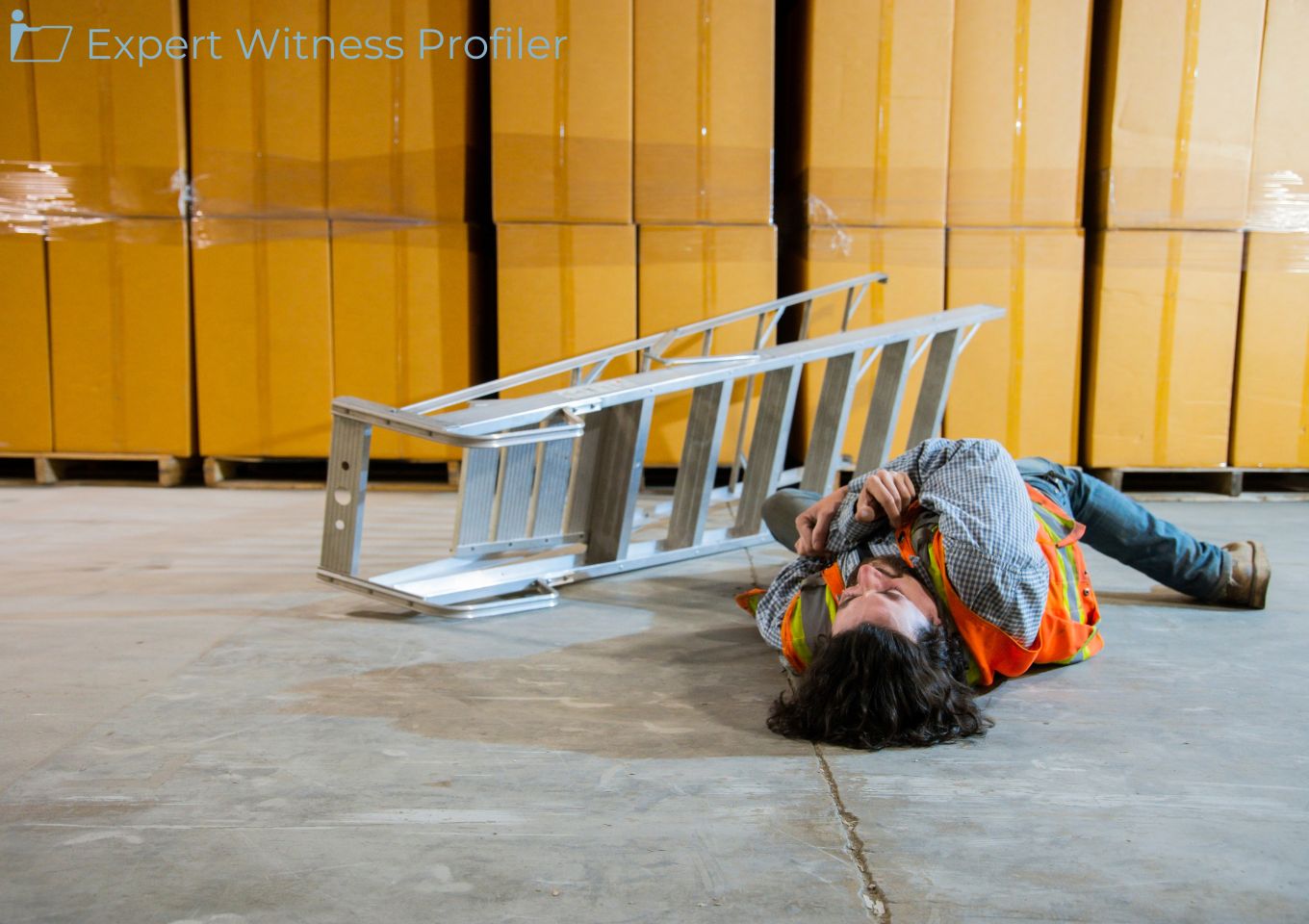
Plaintiff Patricia Medellin filed a lawsuit to recover damages for severe injuries she suffered when she fell while using Defendant’s Little Giant Velocity Ladder, a multi-use ladder with adjustable features. The ladder could be configured into various climbing systems, including an extension ladder. Medellin asserted that the “Rock Locks” (version 2.1), which were the locking mechanisms on either side of the ladder used to secure the extension sections at the user’s chosen height, failed to function properly. This alleged failure resulted in the Rock Locks not securing the ladder in its extended position, leading to Medellin’s fall from height.
On November 29, 2019, Patricia Medellin and her fifteen-year-old grandson, Benjamin Jones, were hanging Christmas lights along the roof of Medellin’s home. They unfolded the ladder and extended it until hearing the Rock Locks “click” into place, indicating proper security. At some point after Medellin climbed the ladder, she heard clicking sounds as the top of the ladder retracted downward, and the bottom of the ladder slid away from the house. Benjamin Jones also heard clicking sounds and observed the ladder telescoping down. Medellin fell with the ladder, landing face-down on it. As a result, Medellin alleged she sustained multiple bodily injuries.
Medellin alleged that the Defendant had “defectively designed and manufactured” her ladder and “provided improper warnings and instructions.” According to Medellin’s expert witness, Stanley A. Kiska, the Rock Locks could be inadvertently set in a “false lock” condition, where “the extended section of the ladder is able to remain in place and may appear to be locked to the user, but, in fact, it is not properly and completely secured.” When in this false lock condition, the ladder gives the illusion of being securely locked, though it is not. The ladder, when in a false-locked condition, would retract (i.e. shorten) under the user’s weight during a climb, resulting in both the ladder and the user falling.
The Defendant moved to exclude Stanley Kiska’s testimony and sought summary judgment. The case had been referred to the Magistrate Judge Peter Bray in accordance with 28 U.S.C. § 636(b)(1). The Judge Peter Bray gave his recommendation after reviewing the motions, the responses, and relevant legal provisions.
Mechanical Engineering Expert Witness
Stanley A. Kiska, a licensed professional engineer holding a Bachelor of Science degree in Mechanical Engineering, has a comprehensive background in ladder-related matters. With a 16-year tenure as a Product Engineer/Senior Product Engineer at the Werner Ladder Company, he garnered extensive expertise in ladder design, development, testing, manufacturing, and quality control. Currently, Kiska serves as an independent engineering consultant for Integra Engineering, PC, specializing in forensic engineering and investigating hundreds of ladder and scaffolding accidents. He has applied forensic engineering principles to develop opinions, write reports, and provide expert witness testimony in depositions and trials, representing both Defendants and Plaintiffs. With over 35 years of experience, his qualifications underscore his proficiency and authority in the field.
Discussion by the Court
Stanley Kiska’s opinion was that Medellin’s ladder could be placed in a false locked condition on the ground, set into position for use, and partially climbed without revealing the false locked condition to the user. He reached this opinion after reviewing deposition testimony from Medellin and Jones, examining photographs and videos of Medellin’s ladder, and inspecting both the ladder itself and the site of Medellin’s accident. Additionally, Kiska studied reports and video demonstrations of testing conducted by another of Medellin’s experts, Peter J. Poczynok, P.E., in a separate federal case (Davis v. Little Giant Ladder Sys., LLC, 2:19-cv-00780-SPC-NPM (M.D. Fla.)). Kiska also consulted with Poczynok during the process.
The Davis lawsuit involved the identical ladder model, the same version of Rock Locks, and the same false lock claim as the present case. Poczynok’s testing and reports in Davis, which were attached to Poczynok’s declaration in this case demonstrated that ladders with Rock Locks version 2.1 could be set in the false lock condition and positioned for use while still falsely locked. Additionally, Poczynok illustrated that the false lock could disengage after a user’s weight was applied to the ladder’s rungs. In his declaration for this case, Poczynok stated that, during his work on the Davis case, he “was able to place the locks in a false lock condition when he set up the ladder on the ground, then raised it into position.” He further mentioned that he had “on numerous occasions placed the locks in a false lock condition, on the ground, on the same model ladder that was involved in Medellin’s incident, including Medellin’s ladder, and had been able to set the ladders into a raised and upright position with the false lock intact.” Kiska reviewed and incorporated Poczynok’s testing and opinions into his analysis of Medellin’s accident.
While the Defendant raised multiple complaints about how Kiska relied on Poczynok’s testing, it’s noteworthy that the Defendant did not move to exclude Poczynok’s opinions. Poczynok had been designated as an expert witness in the case and was permitted to testify at trial, specifically about his opinion that the ladder could be placed into a false lock condition on the ground and then raised into position without disturbing that condition. The Defendant clarified that it strategically chose to “utilize Poczynok’s testing videos to highlight elements absent from Medellin’s accident”. Additionally, the Defendant did not object to Kiska relying on Poczynok’s testing. The objection was solely directed at Kiska’s opinions that Medellin was able to (1) set her ladder into a ‘false lock’ condition on the ground and (2) raise it into position without disturbing the condition.
Kiska based the objected-to opinion on various sources of information and his extensive professional engineering experience in the field. He drew upon Poczynok’s testing, conducted his own inspection of the ladder, and considered the eyewitness testimony of both Medellin and her grandson. The Defendant failed to present any valid reason for asserting that Kiska’s reliance on these information sources was improper. It was entirely appropriate for Kiska to rely on Poczynok’s opinions, as the Federal Rules of Evidence allow experts to base their opinions on the opinions of other experts, according to the Advisory Committee’s Notes to the 2000 Amendments of Fed. R. Evid. 702.
The Defendant heavily criticized Poczynok’s testing methodology and opinions but framed these complaints as arguments against Kiska’s reliance on Poczynok’s opinions, rather than directly moving to exclude Poczynek as an expert. The Defendant argued, in the context of seeking to exclude Kiska’s opinions, that Kiska could not rely on Poczynok’s opinions because there was “no established protocol or general acceptance of such testing.” However, the Defendant made a strategic choice not to challenge Poczynok as an expert and expressed the intention to cross-examine Poczynok at trial as part of its defense. Therefore, any attempt by the Defendant to challenge Poczynok’s opinions under the guise of objecting to Kiska’s reliance on those opinions was not presented before the Court at this juncture.
The Defendant contended that Kiska was obligated to validate or replicate Poczynok’s testing before relying on it, a requirement the Court found no awareness of. Contrary to the argument, as discussed in the preceding paragraph, Kiska was only required to ensure that the other experts he relied on were reliable. Poczynok’s reports were deemed to meet this standard, being detailed, inclusive of photos, describing his testing, and outlining his methodology. Kiska thoroughly reviewed these materials and integrated them into his analysis.
The Defendant argued that Poczynok’s testing could not be reliably applied to the context of Medellin’s accident due to several reasons: (1) the pitch of Medellin’s roof was more distinct than the roof on which Poczynok conducted his testing; (2) in four of Poczynok’s ten tests, the ladder was extended well beyond the roofline, making those tests inapplicable to Medellin’s accident, a point conceded by Kiska; (3) of the remaining six applicable tests, only two showed the ladder contracting and losing contact with the roof, resulting in the climber falling; (4) in the two tests where the climber fell, the ladder did not slide straight back, as in Medellin’s case, but instead rotated out from under the climber due to the roof’s pitch; and (5) none of the ten tests replicated the “clicking” sound described by Medellin and Jones.
The Court was not convinced that the distinctions between Poczynok’s tests and Medellin’s accident rendered the tests inadmissible. Even if Poczynok’s tests were not intended to precisely recreate Medellin’s accident, the Court emphasized that recreations must only be “substantially similar” to provide a fair comparison, as outlined in United States v. Norris, 217 F.3d 262, 270 (5th Cir. 2000). The Court found that the conditions of Poczynok’s testing were substantially similar to those of Medellin’s fall. Poczynok used the same model ladder as Medellin (equipped with Rock Locks 2.1), configured it as an extension ladder, and positioned it against a pitched roof above the driveway. The Court also highlighted that Kiska critically evaluated Poczynok’s tests and disregarded those he deemed inapplicable to Medellin’s accident. The distinctions raised by the Defendant were not significant enough to render Poczynok’s tests an unfair comparison to Medellin’s accident. The Court noted that any disparities between Medellin’s accident and Poczynok’s testing could be demonstrated through cross-examination.
The Defendant argued that Kiska’s opinions on design defect should be excluded, contending they were unreliable and irrelevant. Specifically, the Defendant asserted that Kiska failed to provide evidence or testing to demonstrate that his alternative design would have prevented Medellin’s accident.
In design defect claims, the Plaintiff is required to present a safer alternative design that “would have prevented or significantly reduced the risk of the Plaintiff’s personal injury without substantially impairing the product’s utility”. While the alternative design must be tested before a jury can conclude it would prevent or reduce the risk of injury, it’s not mandatory for the Plaintiff to build and test a prototype. Testing “can be as simple as applying math and physics to establish the viability of a design,” as clarified in Sims v. Kia Motors of Am., Inc., 839 F.3d 393, 407 (5th Cir. 2016).
Kiska provided the opinion that the Rock Locks 2.1 were defective in design due to the aluminum barrel pins pivoting into place and the locks lacking contrasting color to signal incomplete insertion of the barrel pins. His alternative design suggested the use of steel barrel pins that move linearly/perpendicularly into place and are colored red. The Defendant contended that Kiska had not tested the proposed design, thus lacking evidence that it would have prevented or significantly reduced the risk of Medellin’s injury.
Kiska tested the alternative design by applying engineering principles and analyzing the functionality of the current and proposed designs as a professional engineer. In support of the steel barrel pin with perpendicular movement, Kiska compared the coefficient of friction between an aluminum barrel pin and a steel barrel pin. He pointed out that “aluminum barrel pins are undesirable because of the higher coefficient of friction that exists between sliding parts (aluminum on aluminum vs. aluminum on steel), which can adversely affect proper locking”. Kiska determined that the friction coefficient of the aluminum-to-aluminum interface would be approximately twice as great as aluminum-to-steel, making it more difficult for the locking pins to engage properly and, therefore, more likely to ‘falsely lock.’
Kiska had also proposed using barrel pins that approach the rung holes perpendicularly, similar to those utilized in version 3.0 of Defendant’s Rock Locks. Although Kiska did not take measurements of a ladder equipped with Rock Locks 3.0, he testified that the perpendicular design is “more forgiving all things being equal” and “more favorable in terms of properly engaging and not hanging up on the inner section swage and false locking”. Kiska explained that, based on the design’s operation, the angled or arcing approach of the ladder’s barrel pins necessitates a “more exacting alignment between the sections” to get the barrel pins to properly engage beyond a false lock. The Court concluded that Kiska should be permitted to testify about his proposed alternative design, and any weaknesses in his analysis could be addressed through cross-examination.
Regarding the red coloring on the barrel pin, the Defendant argued that Kiska did not test the proposed design, wasn’t a human factors expert, and did not cite any study, testing, or modeling to demonstrate that a colored barrel pin would reduce the risk of injury. However, Kiska, being an expert in the field, was familiar with the use of coloration for safety purposes. He expressed the opinion that “many manufacturers use creative coloring (particularly the color red) as a means to draw attention to locking components as a means to communicate to users that a safety problem may exist”. Kiska’s report included side-by-side photographs illustrating the visual differences in the ladder’s design and the alternative design. He noted that when the colored pin is completely inserted, the red color would not be visible to the user, indicating that the lock is properly engaged. Kiska also referred to one of Defendant’s prior ladder designs that used colored locks to signal improper engagement of the locking mechanism. The Court acknowledged the weaknesses pointed out by the Defendant but deemed the arguments insufficient to completely exclude Kiska as an expert. Any weaknesses could be addressed by the Defendant through cross-examination to present them to the jury.
The Defendant argued that Kiska’s opinions on manufacturing defects were irrelevant because Kiska had not demonstrated that: (1) the identified manufacturing defects existed when Medellin’s ladder left the manufacturer; and (2) the manufacturing defects caused Medellin’s accident.
In a manufacturing defect claim, the Plaintiff was required to prove, among other things, that a product was defective when it left the manufacturer and that the defect was a producing cause of the Plaintiff’s injuries.
Kiska’s report had identified two manufacturing defects: (1) the hardness of the ladder’s feet exceeded the product specification’s upper tolerance limit; and (2) the width of the ladder’s outer section assembly exceeded the product specification’s upper tolerance limit. The Defendant argued that Kiska had not demonstrated that Medellin’s ladder was defective when it left the manufacturer.
Kiska’s report stated that “Inspection of the subject ladder shows that it was not manufactured to specification”, and Medellin’s deposition testimony, which Kiska reviewed, tended to demonstrate that the ladder’s condition remained unchanged between its manufacturing and Medellin’s accident. For instance, Medellin mentioned purchasing her ladder in November 2017 and using it only twice before her accident occurred: once in 2017 and once in 2018. She stored the ladder in her garage in its most compact configuration—fully retracted on both sides and folded in half. No one else used the ladder, and it had not been used after Medellin’s accident. Kiska inspected Medellin’s ladder and found it to be in generally good condition. The Defendant did not challenge Medellin’s testimony regarding her storage or use of the ladder or provide evidence that the ladder’s condition changed between its manufacture and Medellin’s accident or between Medellin’s accident and Kiska’s inspection. Whether the identified manufacturing defects existed when the ladder left the factory was deemed a question for the jury.
Regarding the causal connection between the manufacturing defects and Medellin’s accident, Kiska explained that the hardness of the ladder’s feet exceeded the product specifications, and harder material provides less slip resistance. He opined that “The likelihood of bottom slip out of a ladder is greater when its feet are composed of a harder material. This was the case with Medellin’s ladder”. Kiska reviewed the ladder’s specifications, which required slip-resistant feet “with a ‘Shore A durometer of 80+1-2.’” Thus, the maximum durometer reading would be 82 Shore A, but Medellin’s ladder’s left foot measured 91-92 Shore A, while the right foot measured 92-93 Shore A. Kiska stated that the feet on Medellin’s ladder would not be expected to provide as much resistance to slipping out as feet within the proper specifications. Thus, Kiska tied the out-of-specification hardness of the ladder’s feet to its propensity to slide out from under the user.
Kiska had also determined that the outer assembly of Medellin’s ladder exceeded the product specification’s upper tolerance limit. He explained that the specification drawing set the ladder’s outer assembly width at 15.00 inches, +0.00/-0.06, meaning the width should not exceed 15.00 inches under any circumstances. Kiska measured Medellin’s ladder at various points and found that both extension sections exhibited widths greater than allowed by the manufacturing drawings. This increased clearance could allow for greater misalignment of the two sections and their mating parts. Kiska explained that while some clearance is necessary for sections to slide freely, excessive clearance increases the inner section’s ability to shift relative to the outer section, adversely affecting the alignment of the locking pins and exacerbating the ability of the pins to be directed into their respective rung holes.
Kiska had connected his measurements indicating the ladder was out of specification to the ladder’s tendency to become falsely locked. Consequently, Defendant’s motion to exclude Kiska as an expert was denied.
Defendant sought summary judgment, reiterating the same arguments presented in the motion to exclude Kiska’s opinions. Defendant contended that Medellin did not establish causation, failed to propose a safer alternative design, and could not link the manufacturing defects to her accident. The Court, having found Kiska’s opinions admissible, suggested that if Defendant contested the degree of slip resistance in Medellin’s ladder, it could address that issue during Kiska’s cross-examination. The Court recommended that the Defendant’s Motion for Summary Judgment be denied.
Therefore, Judge Peter Bray denied Defendant’s Motion to Exclude the Opinions of Stanley Kiska and also recommended the denial of Defendant’s Motion for Summary Judgment. The parties were granted fourteen days from the service of the Memorandum and Recommendation to submit written objections. Failure to file timely objections would result in the preclusion of appellate review for factual findings or legal conclusions, except for plain error.
On January 2, 2024, the Defendant filed four objections. Initially, the Defendant contested Judge Bray’s denial of their challenge to Kiska’s opinions regarding the “false lock” condition of the Plaintiff’s ladder. Subsequently, the Defendant objected to Judge Bray’s determination that Kiska’s opinions on design defects should be allowed as evidence. Additionally, the Defendant raised an objection to Judge Bray’s conclusion that Kiska’s opinions on manufacturing defects should be admitted. Finally, the Defendant opposed Judge Bray’s recommendation to deny their Motion for Summary Judgment.
Upon thorough de novo consideration of the objected portions of the Magistrate Judge’s Report and Recommendation (M&R) and a review of the remaining proposed findings, conclusions, and recommendations for plain error, the Court found no errors. Consequently, the Court accepted the M&R and adopted it as the opinion of the Court. The Defendant’s arguments were deemed insufficient to warrant reversal, as they were fully examined and failed to demonstrate a compelling reason for a different outcome.
Held
The Court rendered the following decisions:
Judge Bray’s Magistrate Judge’s Report and Recommendation (M&R) was fully accepted and adopted as the holding of the Court.
The Defendant’s Motion to Exclude the Opinions of Stanley Kiska is denied.
The Defendants’ Motion for Summary Judgment is also denied.
The Court has not arrived on an outcome for this case since the remaining issues involved in this case still await resolution.
Key Takeaways:
Stanley Kiska’s expert opinion regarding the “false lock” condition of Medellin’s ladder was accepted by the Court, asserting that the ladder could be falsely locked on the ground, raised into position for use, and partially climbed without the user detecting the false lock. Kiska based this conclusion on a comprehensive review of deposition testimonies, photographs, videos, ladder inspections, and testing conducted by another expert, Peter J. Poczynok, in a related case. Despite the Defendant’s objections to Kiska relying on Poczynok’s testing methodology, the Court noted that the Defendant strategically chose not to challenge Poczynok as an expert witness during the case and did not object to Kiska’s reliance on Poczynok’s testing.
Furthermore, the Defendant’s objections to the validity of Poczynok’s testing for comparison purposes were overruled by the Court, which deemed Poczynok’s testing substantially similar, with any disparities to be addressed during cross-examination. The Court also allowed Kiska to testify about design defects and propose an alternative design, emphasizing that testing could be as simple as applying math and physics. The Defendant’s objections to Kiska’s reliance on Poczynok’s testing for design defects were considered insufficient, and the Court permitted Kiska to present his expert opinions.
In addition, the Court addressed the Defendant’s objections to Kiska’s opinions on manufacturing defects, specifically challenging the lack of evidence demonstrating that the defects existed when Medellin’s ladder left the manufacturer and that they caused the accident. The Court found Kiska’s measurements and analysis adequate to present a question for the jury on these issues.
Overall, the Court deemed Kiska’s expert opinions admissible, rejecting the Defendant’s objections as lacking merit and providing a comprehensive analysis of the expert’s methodologies and conclusions in the case.
Case Caption: Medellin v. Wing Enters., Inc.
Docket Number: 4:21cv3582
Court: United States District Court, Texas Southern