Crestbrook Insurance Company, as subrogee of Central Prairie Co-Op, sued Ecolab, Inc., for negligence and breach of contract.
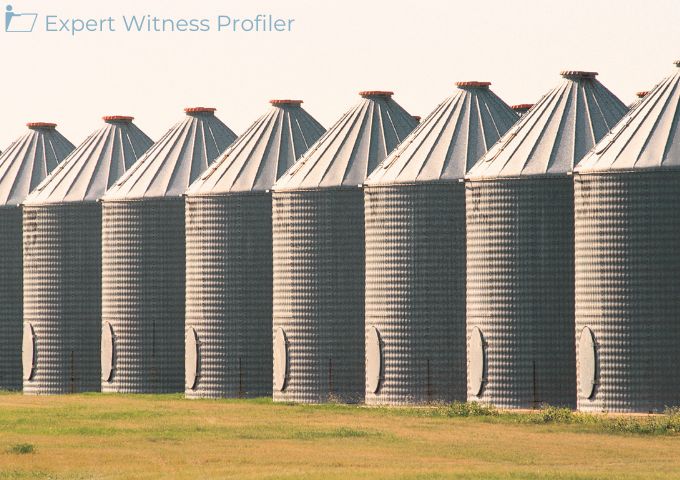
This case is about a fire that destroyed a grain storage bin and its contents. Central Prairie is a Kansas grain cooperative that stores wheat and other grains in large bins at facilities across the state. In late October 2022, Ecolab—a commercial fumigation company—fumigated two bins at Central Prairie’s remote, unmanned site in Lyons, Kansas. Seventeen days later, a fire broke out in one of the bins, destroying the wheat inside and damaging the bin.
Crestbrook, which insured the property, paid Central Prairie $573,919.74 for the loss and, as subrogee, then filed suit, asserting claims for negligence and breach of an oral contract.
Ecolab’s phosphine product at issue here, VAPORPH3OS, addressed the flammability risk through its delivery system. Ecolab applied VAPORPH3OS using a machine called the HDS 200, which automatically dilutes the raw phosphine with carbon dioxide or forced air. The HDS 200 is engineered to ensure the delivered concentration never exceeds 10,000 parts per million—about 55% of the flammability threshold—and its built-in safeguards are designed to keep the concentration from ever crossing that line.
Between Crestbrook and Ecolab, the parties have filed four motions to exclude expert testimony. Crestbrook sought to exclude two of Ecolab’s experts, Benjamin Streifel and Jeffrey Tucker while Ecolab sought to exclude two of Crestbrook’s experts, Dirk Maier and Peter Dahl.
Chemistry Expert Witness
Benjamin Streifel is a chemist. He trained at Johns Hopkins University and has practiced in the field for more than fifteen years.
Entomology Expert Witness
Jeffrey B. Tucker is a board-certified entomologist with more than forty years of experience in commercial fumigation.
Agricultural Engineering Expert Witness
Dirk E. Maier is an agricultural engineer. He is a professor in the Agricultural & Biosystems Engineering Department at Iowa State University. Maier as worked with fumigation practices at different institutions for close to thirty years.
Fire Investigation Expert Witness
Peter J. Dahl is a Certified Fire Investigator with decades of experience conducting fire origin and causation analyses.
Discussion by the Court
Benjamin Streifel
Ecolab retained Streifel to address the chemistry, properties, and behavior of phosphine gas and phosphine-air mixtures in confined containers.
He offered four opinions. First, there is no evidence of phosphine separation or concentration once the HDS 200 mixes phosphine into air. Second, gravitational separation based on density alone, as hypothesized by Crestbrook, would require timescales exceeding the ten-day window between the bins’ unsealing and the fire. Third, gravitational separation at the applied concentrations would require length scales far exceeding Bin 2’s 100-foot height. Fourth, phosphine concentrations in grain bins naturally decrease, rather than increase, over time. Each of these opinions challenged Crestbrook’s core causation theory that residual phosphine could have settled and concentrated in Bin 2’s cone bottom to the level required for ignition.
Analysis
Crestbrook argued that Streifel’s opinions exceeded the scope of his expertise. In particular, it argued that his opinions are speculative and rest on unreliable methods because he has not worked with phosphine, performed a commercial fumigation, or formally studied conditions inside a grain bin. Crestbrook failed to explain how or why Streifel’s lack of these experiences undermines the reliability of his analysis or methodology.
Crestbrook next argued that Streifel conducted no independent investigation and relied “exclusively” on information Ecolab supplied. Streifel reviewed the HDS 200 Operator’s Manual, the Fumigation Management Plan, the VAPORPH3OS product label, depositions from those involved with the fumigation, and forty other sources, including fifteen peer-reviewed publications on phosphine and gas diffusion.
Crestbrook also argued that Streifel did not engage with the scene investigators, did not attend a scene examination, and did not attend a lab examination. Ecolab noted, and Crestbrook did not deny, that scene investigators photographed and measured the empty bin, electrical equipment, and charred aeration fan. At the lab, they examined the removed fan for signs of fire origin. Crestbrook made no concrete argument why Streifel had to experience this in person and could not rely on the recorded observations.
Crestbrook’s last set of critiques concerned Streifel’s understanding of the HDS 200 on two grounds. First, Crestbrook argued that Streifel’s opinions were unreliable because they rested on a capability the HDS 200 did not have, namely, the ability to create a “new and stable gas.” But nowhere in his report did Streifel discuss this capability. And when the issue arose during his deposition, Streifel explicitly disavowed Crestbrook’s characterization of his opinion.
Second, Crestbrook argued that Streifel never inspected the HDS 200, never tested its output, and never reviewed maintenance or calibration records to confirm it operated as designed. But this conflates the issue. Streifel did not opine on whether the HDS 200 worked as intended, and, notably, his analysis took into account malfunction scenarios.
The Court found that none of Crestbrook’s challenges to Streifel’s opinion show that his opinion must be excluded.
Jeffrey Tucker
Crestbrook sought to strike Tucker’s opinion that the industry standard for commercial fumigators is to follow the EPA label physically attached to or accompanying the pesticide at the time of manufacture, rather than the most recently approved EPA label that may have been issued after manufacture.
Crestbrook first argued that Tucker’s opinion is “flatly contradicted” by federal and Kansas pesticide statutes. But this is not a basis for exclusion. The gist of Crestbrook’s argument on this point appears to be that because Tucker’s conclusion is wrong, his opinion is inadmissible. That argument failed to justify exclusion because the relevant inquiry is whether an expert’s principles and methods are reliable, not whether the moving party agrees with where those methods lead.
Crestbrook next argued that Tucker’s opinion is an impermissible legal conclusion that “invades the Court’s role” of instructing the jury on the law.
The bulk of Tucker’s challenged opinion is permissible. He described the training of fumigators and industry customs. He explained the practical reasons for that custom, namely, because labels do not always reach fumigators promptly after a new one is approved, and product purchased earlier may sit in inventory before use.
In his deposition, however—the testimony on which Crestbrook’s motion rests—Tucker more than once framed that custom in the language of legal obligation, veering into territory reserved for the court. Pressed by Crestbrook’s counsel, he stated that fumigators “are obligated to follow” the cylinder-affixed label and “are not obligated to follow the most recent EPA label.” Because those statements were elicited at deposition rather than offered as report opinions, the limitation is prophylactic.
The Court granted Crestbrook’s motion to exclude Tucker’s opinion to the extent that it treated the industry custom he described as a matter of legal obligation or compliance.
Dirk Maier
Maier offered an interlocking chain of opinions on causation. Specifically, he asserted that residual phosphine remained in Bin 2 after Ecolab unsealed it on November 1, 2022. Then, over the next ten days, the residual gas settled and concentrated in the bin’s cone bottom under the combined effect of natural convection and a day-night “pumping action” through the headspace. The concentration eventually reached phosphine’s 18,000-parts-per-million lower flammability limit and the gas then self-ignited and initiated a “slow pyrolysis” smoldering fire in the wheat surrounding the north aeration duct.
Maier also opined that Ecolab’s failures to monitor phosphine concentrations and to aerate Bin 2 upon unsealing constitute “violations of State of Kansas and federal law.” Maier’s causation chain provided the foundation of Crestbrook’s negligence theory by supplying chemistry and physics explanations for how residual phosphine settled and concentrated in Bin 2’s cone bottom to the ignition threshold during the ten-day window before aeration.
Analysis
Ecolab challenged Maier’s central causation theory. Specifically, it sought to exclude his opinion that residual phosphine, after Ecolab unsealed Bin 2 on November 1, 2022, settled by gravity and convection into the cone bottom of Bin 2 and concentrated to its 18,000 parts per million lower flammability limit during the ten-day window before aeration.
To begin with, Maier conducted no testing of the theory. Moreover, Maier admitted that he is aware of no peer-reviewed literature documenting gravitational concentration of phosphine within a grain bin. Furthermore, Maier’s own peer-reviewed work on phosphine, which he omitted from his report, undermined his opinion.
Ecolab next challenged Maier’s calculation that 2,280 grams of phosphine could reach 18,000 parts per million if concentrated into a volume of 3,165 cubic feet within Bin 2. First, it assumed that all 2,280 grams of phosphine introduced into Bin 2 on October 27 remained in the bin on November 1—an assumption Maier conceded is wrong and that he made no attempt to quantify. Second, the calculation’s premise that the gas was “trapped” or “contained” within a small subset of the bin’s interior—the 3,165 cubic feet of the cone bottom—had no basis in the record.
Ecolab’s third challenge concerned Maier’s opinion that once phosphine reached its 18,000 parts per million self-ignition limit in the cone bottom of Bin 2, it ignited and initiated a “slow pyrolysis” smoldering fire in the wheat surrounding the north aeration duct.
Maier admitted that he has done “no calculation, modeling, or testing to determine how much thermal energy would have to be given off by a phosphine gas ignition to in fact ignite wheat.”
Ecolab’s final challenge concerned Maier’s statements that Ecolab’s failure to monitor and failure to aerate “are violations of State of Kansas and federal law.”
The Court held that the legal-conclusion problem is properly remedied not by wholesale exclusion of the expert’s testimony but by exclusion of the offending statements. Maier remains free to testify—within the boundaries set above—about what the VAPORPH3OS label requires of a licensed fumigator, the industry custom for monitoring and recording phosphine concentrations during fumigation, the content of the Fumigation Management Plan Ecolab submitted, and the practical reasons that label requires the steps it does.
Peter Dahl
Dahl opined that the ignition source was a concentrated pocket of residual phosphine that, having settled at the lowest point in the north aeration pipe inside Bin 2, reached its 18,000-parts-per-million lower flammability limit and produced a momentary flame front that ignited adjacent wheat. Dahl’s specific-causation chain depends on the general-causation premise—that residual phosphine could and did concentrate to ignitable levels in Bin 2’s cone bottom—that he obtained from his conversations with Maier and his review of phosphine manufacturers’ Material Safety Data Sheets. Dahl conducted no independent research, testing, modeling, or peer-reviewed-literature analysis of phosphine settling, concentration, or the ignition mechanism his opinion describes.
Ecolab argued that Dahl’s causation opinion did not satisfy Rule 702 because it depended entirely on a general-causation premise that Dahl did not himself develop, but instead obtained from Maier.
The evidence on which Dahl relies for his causation case needs to be independently reliable. But, as noted above, Maier’s opinion as to causation—which forms the basis of Dahl’s own opinion—was not reliable. Without that foundation, Dahl’s causation analysis cannot stand and thus, the Court granted Ecolab’s motion to exclude his testimony.
Held
- The Court denied Crestbrook’s motion to exclude Benjamin Streifel.
- The Court granted in part and denied in part Crestbrook’s motion to exclude Jeffrey Tucker.
- The Court granted in part and denied in part Ecolab’s motion to exclude Dirk Maier.
- The Court granted Ecolab’s motion to exclude Peter Dahl.
Key Takeaway
- An expert may testify where the subject is within “the reasonable confines” of his expertise even if he lacks specialization in the precise application.
- While testing is not required, when an expert relies on a novel theory and the basis for the expert’s opinion is subject to debate, the importance of testing as a factor in determining reliability is at its highest.
Case Details:
| Case Caption: | Crestbrook Insurance Company V. Ecolab Inc. |
| Docket Number: | 6:24cv1091 |
| Court Name: | United States District Court, Kansas |
| Order Date: | June 11, 2026 |