Category: Fire Investigation Expert Witness

  • Chemistry Expert Was Allowed to Opine on Phosphine-Air Mixtures

    Chemistry Expert Was Allowed to Opine on Phosphine-Air Mixtures

    Crestbrook Insurance Company, as subrogee of Central Prairie Co-Op, sued Ecolab, Inc., for negligence and breach of contract.

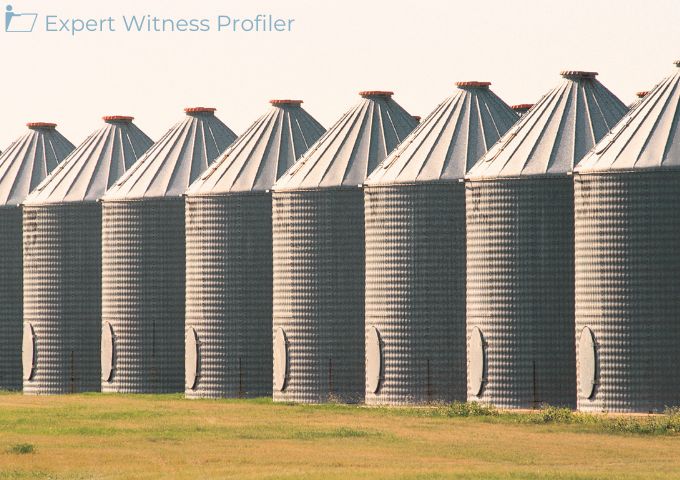
    This case is about a fire that destroyed a grain storage bin and its contents. Central Prairie is a Kansas grain cooperative that stores wheat and other grains in large bins at facilities across the state. In late October 2022, Ecolab—a commercial fumigation company—fumigated two bins at Central Prairie’s remote, unmanned site in Lyons, Kansas. Seventeen days later, a fire broke out in one of the bins, destroying the wheat inside and damaging the bin.

    Crestbrook, which insured the property, paid Central Prairie $573,919.74 for the loss and, as subrogee, then filed suit, asserting claims for negligence and breach of an oral contract.

    Ecolab’s phosphine product at issue here, VAPORPH3OS, addressed the flammability risk through its delivery system. Ecolab applied VAPORPH3OS using a machine called the HDS 200, which automatically dilutes the raw phosphine with carbon dioxide or forced air. The HDS 200 is engineered to ensure the delivered concentration never exceeds 10,000 parts per million—about 55% of the flammability threshold—and its built-in safeguards are designed to keep the concentration from ever crossing that line.

    Between Crestbrook and Ecolab, the parties have filed four motions to exclude expert testimony. Crestbrook sought to exclude two of Ecolab’s experts, Benjamin Streifel and Jeffrey Tucker while Ecolab sought to exclude two of Crestbrook’s experts, Dirk Maier and Peter Dahl.
    Chemistry Expert Witness

    Benjamin Streifel is a chemist. He trained at Johns Hopkins University and has practiced in the field for more than fifteen years.

    Want to know more about the challenges Benjamin Streifel has faced? Get the full details with our Challenge Study report.

    Entomology Expert Witness

    Jeffrey B. Tucker is a board-certified entomologist with more than forty years of experience in commercial fumigation.

    Discover more cases with  Jeffrey Tucker as an expert witness by ordering his comprehensive Expert Witness Profile report.

    Agricultural Engineering Expert Witness

    Dirk E. Maier is an agricultural engineer. He is a professor in the Agricultural & Biosystems Engineering Department at Iowa State University. Maier as worked with fumigation practices at different institutions for close to thirty years.

    Get the full story on challenges to Dirk Maier’s expert opinions and testimony with an in-depth Challenge Study.

    Fire Investigation Expert Witness

    Peter J. Dahl is a Certified Fire Investigator with decades of experience conducting fire origin and causation analyses.

    Gain a comprehensive understanding of Peter Dahl’s qualifications and casework history with his Expert Witness Profile report.

    Discussion by the Court

    Benjamin Streifel

    Ecolab retained Streifel to address the chemistry, properties, and behavior of phosphine gas and phosphine-air mixtures in confined containers.

    He offered four opinions. First, there is no evidence of phosphine separation or concentration once the HDS 200 mixes phosphine into air. Second, gravitational separation based on density alone, as hypothesized by Crestbrook, would require timescales exceeding the ten-day window between the bins’ unsealing and the fire. Third, gravitational separation at the applied concentrations would require length scales far exceeding Bin 2’s 100-foot height. Fourth, phosphine concentrations in grain bins naturally decrease, rather than increase, over time. Each of these opinions challenged Crestbrook’s core causation theory that residual phosphine could have settled and concentrated in Bin 2’s cone bottom to the level required for ignition.

    Analysis

    Crestbrook argued that Streifel’s opinions exceeded the scope of his expertise. In particular, it argued that his opinions are speculative and rest on unreliable methods because he has not worked with phosphine, performed a commercial fumigation, or formally studied conditions inside a grain bin. Crestbrook failed to explain how or why Streifel’s lack of these experiences undermines the reliability of his analysis or methodology.

    Crestbrook next argued that Streifel conducted no independent investigation and relied “exclusively” on information Ecolab supplied. Streifel reviewed the HDS 200 Operator’s Manual, the Fumigation Management Plan, the VAPORPH3OS product label, depositions from those involved with the fumigation, and forty other sources, including fifteen peer-reviewed publications on phosphine and gas diffusion.

    Crestbrook also argued that Streifel did not engage with the scene investigators, did not attend a scene examination, and did not attend a lab examination. Ecolab noted, and Crestbrook did not deny, that scene investigators photographed and measured the empty bin, electrical equipment, and charred aeration fan. At the lab, they examined the removed fan for signs of fire origin. Crestbrook made no concrete argument why Streifel had to experience this in person and could not rely on the recorded observations.

    Crestbrook’s last set of critiques concerned Streifel’s understanding of the HDS 200 on two grounds. First, Crestbrook argued that Streifel’s opinions were unreliable because they rested on a capability the HDS 200 did not have, namely, the ability to create a “new and stable gas.” But nowhere in his report did Streifel discuss this capability. And when the issue arose during his deposition, Streifel explicitly disavowed Crestbrook’s characterization of his opinion.

    Second, Crestbrook argued that Streifel never inspected the HDS 200, never tested its output, and never reviewed maintenance or calibration records to confirm it operated as designed. But this conflates the issue. Streifel did not opine on whether the HDS 200 worked as intended, and, notably, his analysis took into account malfunction scenarios.

    The Court found that none of Crestbrook’s challenges to Streifel’s opinion show that his opinion must be excluded. 

    Jeffrey Tucker

    Crestbrook sought to strike Tucker’s opinion that the industry standard for commercial fumigators is to follow the EPA label physically attached to or accompanying the pesticide at the time of manufacture, rather than the most recently approved EPA label that may have been issued after manufacture.

    Crestbrook first argued that Tucker’s opinion is “flatly contradicted” by federal and Kansas pesticide statutes. But this is not a basis for exclusion. The gist of Crestbrook’s argument on this point appears to be that because Tucker’s conclusion is wrong, his opinion is inadmissible. That argument failed to justify exclusion because the relevant inquiry is whether an expert’s principles and methods are reliable, not whether the moving party agrees with where those methods lead.

    Crestbrook next argued that Tucker’s opinion is an impermissible legal conclusion that “invades the Court’s role” of instructing the jury on the law.

    The bulk of Tucker’s challenged opinion is permissible. He described the training of fumigators and industry customs. He explained the practical reasons for that custom, namely, because labels do not always reach fumigators promptly after a new one is approved, and product purchased earlier may sit in inventory before use.

    In his deposition, however—the testimony on which Crestbrook’s motion rests—Tucker more than once framed that custom in the language of legal obligation, veering into territory reserved for the court. Pressed by Crestbrook’s counsel, he stated that fumigators “are obligated to follow” the cylinder-affixed label and “are not obligated to follow the most recent EPA label.” Because those statements were elicited at deposition rather than offered as report opinions, the limitation is prophylactic.

    The Court granted Crestbrook’s motion to exclude Tucker’s opinion to the extent that it treated the industry custom he described as a matter of legal obligation or compliance.

    Dirk Maier

    Maier offered an interlocking chain of opinions on causation. Specifically, he asserted that residual phosphine remained in Bin 2 after Ecolab unsealed it on November 1, 2022. Then, over the next ten days, the residual gas settled and concentrated in the bin’s cone bottom under the combined effect of natural convection and a day-night “pumping action” through the headspace. The concentration eventually reached phosphine’s 18,000-parts-per-million lower flammability limit and the gas then self-ignited and initiated a “slow pyrolysis” smoldering fire in the wheat surrounding the north aeration duct.

    Maier also opined that Ecolab’s failures to monitor phosphine concentrations and to aerate Bin 2 upon unsealing constitute “violations of State of Kansas and federal law.” Maier’s causation chain provided the foundation of Crestbrook’s negligence theory by supplying chemistry and physics explanations for how residual phosphine settled and concentrated in Bin 2’s cone bottom to the ignition threshold during the ten-day window before aeration.

    Analysis

    Ecolab challenged Maier’s central causation theory. Specifically, it sought to exclude his opinion that residual phosphine, after Ecolab unsealed Bin 2 on November 1, 2022, settled by gravity and convection into the cone bottom of Bin 2 and concentrated to its 18,000 parts per million lower flammability limit during the ten-day window before aeration.

    To begin with, Maier conducted no testing of the theory. Moreover, Maier admitted that he is aware of no peer-reviewed literature documenting gravitational concentration of phosphine within a grain bin. Furthermore, Maier’s own peer-reviewed work on phosphine, which he omitted from his report, undermined his opinion.

    Ecolab next challenged Maier’s calculation that 2,280 grams of phosphine could reach 18,000 parts per million if concentrated into a volume of 3,165 cubic feet within Bin 2. First, it assumed that all 2,280 grams of phosphine introduced into Bin 2 on October 27 remained in the bin on November 1—an assumption Maier conceded is wrong and that he made no attempt to quantify. Second, the calculation’s premise that the gas was “trapped” or “contained” within a small subset of the bin’s interior—the 3,165 cubic feet of the cone bottom—had no basis in the record.

    Ecolab’s third challenge concerned Maier’s opinion that once phosphine reached its 18,000 parts per million self-ignition limit in the cone bottom of Bin 2, it ignited and initiated a “slow pyrolysis” smoldering fire in the wheat surrounding the north aeration duct.

    Maier admitted that he has done “no calculation, modeling, or testing to determine how much thermal energy would have to be given off by a phosphine gas ignition to in fact ignite wheat.”

    Ecolab’s final challenge concerned Maier’s statements that Ecolab’s failure to monitor and failure to aerate “are violations of State of Kansas and federal law.”

    The Court held that the legal-conclusion problem is properly remedied not by wholesale exclusion of the expert’s testimony but by exclusion of the offending statements. Maier remains free to testify—within the boundaries set above—about what the VAPORPH3OS label requires of a licensed fumigator, the industry custom for monitoring and recording phosphine concentrations during fumigation, the content of the Fumigation Management Plan Ecolab submitted, and the practical reasons that label requires the steps it does.

    Peter Dahl

    Dahl opined that the ignition source was a concentrated pocket of residual phosphine that, having settled at the lowest point in the north aeration pipe inside Bin 2, reached its 18,000-parts-per-million lower flammability limit and produced a momentary flame front that ignited adjacent wheat. Dahl’s specific-causation chain depends on the general-causation premise—that residual phosphine could and did concentrate to ignitable levels in Bin 2’s cone bottom—that he obtained from his conversations with Maier and his review of phosphine manufacturers’ Material Safety Data Sheets. Dahl conducted no independent research, testing, modeling, or peer-reviewed-literature analysis of phosphine settling, concentration, or the ignition mechanism his opinion describes.

    Ecolab argued that Dahl’s causation opinion did not satisfy Rule 702 because it depended entirely on a general-causation premise that Dahl did not himself develop, but instead obtained from Maier.

    The evidence on which Dahl relies for his causation case needs to be independently reliable. But, as noted above, Maier’s opinion as to causation—which forms the basis of Dahl’s own opinion—was not reliable. Without that foundation, Dahl’s causation analysis cannot stand and thus, the Court granted Ecolab’s motion to exclude his testimony.

    Held

    • The Court denied Crestbrook’s motion to exclude Benjamin Streifel.
    • The Court granted in part and denied in part Crestbrook’s motion to exclude Jeffrey Tucker.
    • The Court granted in part and denied in part Ecolab’s motion to exclude Dirk Maier.
    • The Court granted Ecolab’s motion to exclude Peter Dahl.

    Key Takeaway

    • An expert may testify where the subject is within “the reasonable confines” of his expertise even if he lacks specialization in the precise application.
    • While testing is not required, when an expert relies on a novel theory and the basis for the expert’s opinion is subject to debate, the importance of testing as a factor in determining reliability is at its highest.

    Case Details:

    Case Caption: Crestbrook Insurance Company V. Ecolab Inc.
    Docket Number: 6:24cv1091
    Court Name: United States District Court, Kansas
    Order Date: June 11, 2026
  • Product Safety Expert’s State-of-Mind Testimony Excluded

    Product Safety Expert’s State-of-Mind Testimony Excluded

    On November 10, 2022, Kenneth and Phyllis Zerr perished in a house fire. Plaintiffs—the Zerrs’ children and Kenneth Zerr’s estate—alleged that the fire was caused by a defective dehumidifier produced by Gree.

    In support of their defense, Defendants planned to use expert witnesses. On the origin of the fire, Defendants offered Todd Soong. On the potential electrical causes of the fire, Defendants offered Arash Hajjim. Lastly, on fire dynamics, patterns, and potential causes of the fire, Defendants offered Carlos Fernandez-Pello. Together, the experts purport to establish that the cause of the fire remains undeterminable. Plaintiffs sought the exclusion of three defense experts.

    Plaintiffs have also produced Roy Deppa as an expert on the topic of Consumer Product Safety Commission (CPSC) regulations and procedures for the purpose of establishing that Defendants failed to timely report dangerous defects in their dehumidifiers. Defendants sought the exclusion of Deppa.

    Fire Investigation Expert Witness

    James Todd Soong is a certified fire investigator (CFI) by the International Association of Arson Investigators (IAAI) and a certified fire and explosion investigator (CFEI) by the National Association of Fire Investigators (NAFI). He has in excess of 10 years of experience.

    Get the full story on challenges to Todd Soong’s expert opinions and testimony with an in-depth Challenge Study.

    Electrical Engineering Expert Witness

    Arash Hajjam is a forensic electrical engineer and has in excess of 15 years of experience.

    Discover more cases with Arash Hajjam as an expert witness by ordering his comprehensive Expert Witness Profile report.

    Thermodynamics Expert Witness

    Dr. Carlos A. Fernandez-Pello is a Distinguished Professor of the Graduate School in Mechanical Engineering, at the University of California, Berkeley, USA. His work involves applying fire thermodynamics and combustion principles to analyze various aspects of fire and combustion processes, ranging from laboratory-scale solid fuel combustion to wildland fire dynamics.

    Get the full story on challenges to Carlos Fernandez-Pello’s expert opinions and testimony with an in-depth Challenge Study.

    Product Safety Expert Witness

    Roy W. Deppa has over 40 years of experience in product safety, including 27 years in various positions at the Consumer Product Safety Commission. This experience gave him extensive knowledge of the agency’s regulations, processes, and procedures, as well as industry standards.

    He is a registered Professional Engineer licensed in the State of Maryland.

    Want to know more about the challenges Roy Deppa has faced? Get the full details with our Challenge Study report.

    Discussion by the Court

    I. Todd Soong

    Defendants retained Soong to determine the origin of the fire and its potential causes. Plaintiffs argued that Soong’s opinions must be excluded because they are based on incomplete and inaccurate information and they are not the product of reliable principles and methods.

    A. Soong’s opinions on the origin and cause of the fire are admissible

    Soong followed the methods prescribed by NFPA 921 in determining that the fire originated in the home’s utility room and that the cause of the fire could not be definitively determined. He performed an inspection of the building, observing fire damage levels and patterns.

    Plaintiffs argued that Soong’s opinions are unreliable because he did not conduct his own testing; he uses “ambiguous words such as ‘possible,’ ‘may,’ and ‘can’”; and he developed his opinions with cherry-picked facts and confirmation bias.

    However, the Court found that Soong’s method of determining the origin and potential causes of the fire—relying on observations of physical evidence, scientific principles, experience, and the opinions of Defendants’ other expert witnesses—is consistent with NFPA 921 and sufficient to satisfy Rule 702.

    NFPA 921 advises that investigators should seek assistance when they “lack expertise to properly attribute meaning to a piece of data” and should utilize the “special talents or training” of other individuals in the fields of “electrical, heating and air conditioning, and other engineering fields” when needed. And NFPA 921 specifically instructs investigators to utilize words like “probable” and “possible” to denote the appropriate level of certainty.

    B. Soong’s opinion relating to spoliation is inadmissible

    Plaintiffs also argued that “Soong improperly claimed spoliation of evidence” under NFPA 921, which defines spoliation as “loss, destruction, or material alteration of an object or document that is evidence or potential evidence in a legal proceeding by one who has the responsibility for its preservation.”

    The Court found that Soong is not qualified to opine on whether anything he observed was a result of “spoliation” or some other cause. 

    II. Arash Hajjam

    Plaintiffs argued that Hajjam’s opinions must be excluded because he failed to follow the methodology outlined in NFPA 921.

    However, Hajjam followed NFPA 921’s prescribed method for fire cause determination. His report relied on two joint site examinations, two lab inspections, the expert reports of the other fire investigation experts proffered in this case, and several other photographs and documents, including NFPA 921.  

    Based on his observations of the scene and analysis of the artifacts, Hajjam identified three potential causes of the fire—the dehumidifier, the branch circuit wiring in the ceiling, and a nearby light fixture—and examined each in a laboratory. Hajjam then evaluated each potential cause and ultimately concluded that “given the extensive damage and the presence of missing artifacts, multiple potential ignition sources remain, preventing a definitive conclusion regarding the exact ignition source of the fire.” The Court found that Plaintiffs’ arguments regarding the sufficiency of Hajjam’s testing and his alleged consideration of improper evidence are insufficient, in this case, to undermine the admissibility of his testimony.

    III. Carlos Fernandez-Pello

    Defendants offered Fernandez-Pello to discuss “potential causes and contributing factors to the fire and the possibility of the subject Dehumidifier and other potential ignition sources causing the fire.” Specifically, he was expected to provide testimony that the cause of the fire is indeterminate as per NFPA 921.

    Fernandez-Pello’s opinions followed NFPA 921’s prescribed method for fire cause determination. Moreover, Fernandez-Pello discussed the fire patterns surrounding the dehumidifier, the results of the dehumidifier tests, and generated computer simulations.

    Plaintiffs argued that Fernandez-Pello’s opinions should be excluded because (1) he failed to consider the presence of additional fuel loads in the vicinity of the dehumidifier; and (2) he failed to conduct testing regarding internal arcing in the dehumidifier. Those arguments fail. Although Fernandez-Pello initially testified that he was not aware of several plastic buckets near the dehumidifier, he later submitted errata indicating that he had reviewed photographs of the buckets, “concluded that the buckets didn’t burn, only melted,” and “thus, there was no need to investigate the issue anymore.”

    Such inconsistency in Fernandez-Pello’s testimony on different occasions may be relevant to his credibility as a witness, but it does not undermine its admissibility altogether. And given Fernandez-Pello’s position that the dehumidifier could not have been the cause of the fire, regardless of how it ignited, the fact that he did not do additional testing to determine whether there was internal arcing did not undermine the credibility of his opinion.

    IV. Roy Deppa

    Defendants argued that Deppa’s testimony should be excluded because (1) Deppa is unqualified, as a professional engineer, to opine on the interpretation of federal regulations or Defendants’ state of mind; (2) his opinions concerning the process by which companies issue recalls and Defendants’ state of mind lack scientific methodology; (3) his opinions improperly relate only to punitive damages; and (4) his opinions, even if admissible, are barred under Federal Rule of Evidence 403, as his “interpretation of federal regulations and Defendants’ obligations under them would run the risk of creating a danger of overriding the Court’s jury instructions on the same” and his opinions concerning the severity of Defendants’ failure to recall risked interfering with the jury’s duty to evaluate liability.

    Analysis

    As an initial matter, the Court found that Deppa’s proposed testimony relating to Defendants’ state of mind is improper. Moreover, Deppa may not offer his opinion about whether Defendants’ conduct violated applicable regulations because the the law is clear that expert witnesses may not opine as to whether a party violated a given regulation.

    The Court also shared Defendants’ concern that Deppa’s report included qualitative characterizations of Defendants’ conduct unconnected to any specific industry standard, and that such characterizations invade the province of the jury, who will be tasked with determining if Defendants’ conduct “showed complete indifference to or conscious disregard for the safety of others.”

    In spite of that, the Court concluded that Deppa, based on his professional experience, is qualified and permitted to testify about (1) the industry standards relating to CPSC recalls, including references to relevant regulations, so long as he does not opine on whether Defendants’ conduct actually violated any regulations; and (2) Defendants’ conduct in response to the product defect that Plaintiffs allege is at the heart of this case, including the effects of those actions on the availability of the defective product.

    Held

    • The Court denied Plaintiffs’ motions to exclude the testimony of Arash Hajjam and Carlos Fernandez-Pello.
    • The Court granted in part Plaintiffs’ motion to exclude the testimony of Todd Song.
    • The Court granted in part Defendants’ motion to exclude the testimony of Roy Deppa.

    Key Takeaway

    Expert testimony on “the intent, motives, or states of mind of corporations, regulatory agencies and others have no basis in any relevant body of knowledge or expertise.” Thus, Deppa may not opine on what Defendants, or individuals employed by Defendants, thought or about their motivations. 

    Please refer to the blogs previously published about this case:

    Fire Investigation Expert Was Allowed to Opine on UL Listing

    Insurance Expert Not Allowed to Opine on the Actual Cash Value of the Home

    Case Details:

    Case Caption: Hillman V. Gree USA, Inc.
    Docket Number: 4:23cv830
    Court Name: United States District Court, Missouri Eastern
    Order Date: May 23, 2026
  • Fire Investigation Expert Was Allowed to Opine on UL Listing

    Fire Investigation Expert Was Allowed to Opine on UL Listing

    On November 10, 2022, Kenneth and Phyllis Zerr perished in a house fire. Plaintiffs—the Zerrs’ children and Kenneth Zerr’s estate—alleged that the fire was caused by a defective dehumidifier produced by Gree.

    To support their theory that the fire was caused by a defective dehumidifier, Plaintiffs planned to use expert witnesses. On the origin of the fire, Plaintiffs offered Robert D. Helmkamp. On potential electrical causes of the fire in the room identified as the origin, Plaintiffs offered William Truss. And on the origin of the fire within the dehumidifier and design defects in the dehumidifier, Plaintiffs offered Derek Starr.

    Together, the experts purported to establish the fire’s cause by identifying the origin of the fire through Helmkamp, eliminating alternative causes through Truss, and examining the dehumidifier to establish an origin theory through Starr. All three experts purported to have relied on the National Fire Protection Association’s publication, NFPA 921: Guide for Fire and Explosion Investigations (“NFPA 921”). However, Defendants filed motions to exclude all three expert witnesses.

    Fire Investigation Expert Witnesses

    Robert David Helmkamp is a Certified Fire Investigator through the International Association of Arson Investigators, the National Association of Fire Investigators, the National Board on Fire Service Professional Qualifications, and the State of Missouri.

    Get the full story on challenges to Robert Helmkamp’s expert opinions and testimony with an in-depth Challenge Study.

    William W. Truss is a Certified Fire and Explosion Investigator (NAFI-CFEI) and a Certified Vehicle Fire Investigator (NAFI-CVFI). He is a member of the Institute of Electrical and Electronics Engineers (IEEE), the International Association of Arson Investigators (IAAI), the National Association of Fire Investigators (NAFI), and the National Fire Protection Association (NFPA).

    He also graduated with Electrical Engineering and Computer Engineering Degrees from the University of Missouri – Columbia in 1987 and is a licensed professional engineer in several states.

    Discover more cases with William Truss as an expert witness by ordering his comprehensive Expert Witness Profile report.

    Derek A. Starr is a professional forensic electrical engineer and fire investigator. Prior to his current employment, he spent more than six years performing certification evaluations at Underwriters Laboratories, Inc.

    Want to know more about the challenges Derek Starr has faced? Get the full details with our Challenge Study report.

    Discussion by the Court

    I. Robert Helmkamp

    To begin with, Helmkamp followed the methods prescribed by NFPA 921 in determining the fire’s origin. He analyzed witness information, fire patterns, and fire dynamics. Helmkamp also performed an inspection of the building, observing fire damage levels and patterns. He examined the exterior of the house before moving to the interior, starting in areas with the least damage and moving to the areas with the most damage. Through his inspection, he determined that the fire started in the utility room by systematically eliminating every other room as a possibility.

    He then used burn patterns and relative fire damage to identify a suspect zone within the utility room. Ultimately, he concluded that “based upon fire patterns, degrees of fire damage, fire behavior indicators and electrical activity within the dehumidifier appliance, it is my professional opinion the fire originated at, or within, the dehumidifier appliance located on the floor in the basement utility room.”

    Defendants also contended that Helmkamp failed to consider evidence of alternative ignition sources, including ceiling-level electrical arcing, minimally damaged combustibles, and the results of the second lab exam. Helmkamp did not ignore such evidence. In his initial report, he noted the “lack of damage observed to combustible and metal components located in close proximity nearby” and “thermal damage, likely masking evidence of electrical arcing.” And in his supplemental report, he considered the “additional investigation and data” collected at the second lab exam, including the opportunity for closer examination of the evidence of ceiling-level electrical arcing. In both reports, he found such evidence consistent with his opinion that the fire originated at or within the dehumidifier. While Defendants’ experts may disagree with Helmkamp about the significance of the evidence, Defendants have not pointed to any “total lack of consideration of .. . clear alternative ignition sources constituting ‘serious error.’”

    II. William Truss

    Defendants argued that Truss’ opinions must be excluded because he failed to follow NFPA 921; he relied on “negative corpus”; he conducted no testing; and he failed to consider alternative ignition sources and contradictory evidence.

    As documented in his initial report, Truss followed NFPA 921’s prescribed method for fire cause determination. His report relied on three site examinations (two of which were joint examinations), a laboratory examination, Helmkamp’s report and several other documents and procedures.

    Truss identified and analyzed electrical artifacts in the area of origin. Truss then systematically eliminated the electrical artifacts other than the dehumidifier as potential causes. He began by eliminating artifacts that were substantially outside the area of origin. Then he eliminated artifacts that showed no evidence of an electrical failure. That left four electrical artifacts that could have been the cause of the fire. Truss then individually evaluated the hypotheses that each of the remaining artifacts contributed to the cause of the fire, explaining why he found that three of them were “inconsistent with the facts and the principles of science.”

    Defendants argued that Truss’ opinion should be excluded because his evaluations of alternative ignition sources lacked “scientific testing, analysis, measurements, calculations, empirical data, or peer-reviewed literature,” but that does not defeat its admissibility.

    However, no specific kind or quantity of “testing” is necessary for Truss’ testimony to qualify as reliable. His evaluations of the four hypotheses cite observations of physical evidence and his own experience.

    Truss addressed “the additional investigation and data collected” in a supplemental report, finding that none of it was in conflict with his earlier opinions.

    III. Derek Starr

    A. Starr’s opinion on the origin of the fire is admissible

    Starr’s opinion was not based only on internal damage to the dehumidifier; he also relied on the opinions of Helmkamp and Truss. Starr also did not ignore the results of the second lab exam. He considered the findings and concluded that they did not support an alternative hypothesis or conflict with his previously stated opinion. Resolving the experts’ disagreements as to the significance of the second lab exam is a job for the jury.

    Therefore, the Court held that Starr’s methods in determining that the fire originated internally to the dehumidifier—relying on observations of physical evidence, scientific principles, experience, and the opinions of Plaintiffs’ other experts—were consistent with NFPA 921. 

    B. Starr’s opinion relating to UL certification is admissible

    Defendants objected to Starr’s opinions relating to the dehumidifier’s UL listing because (1) he ignored the absence of a pattern of dehumidifier fires prior to 2012 and evidence that Plaintiff Hillman purchased the dehumidifier in May 2011, (2) he provided no timeline as to when the UL listing would have been removed and whether it would have actually prevented the sale of the dehumidifier if it was purchased in May 2011, and (3) he did not sufficiently explain UL standards or decision-making processes or “provide any evidence that exceeding a temperature rating under similar testing would automatically trigger removal of the UL Mark.”

    Analysis

    In his initial report, Starr explained what a UL listing is, what purpose it serves, and the requirements UL imposes on manufacturers, including the duty to inform UL if a manufacturer becomes aware that a certified product could pose a “substantial hazard.”

    Starr’s second supplemental report explained why the November 2010 Low Refrigerant Charge Operation Test of a GE-branded dehumidifier is relevant to the dehumidifier at issue in this case; what the test results were; and why they were indicative of a fire hazard. Finally, he opined that the test provided Gree with “knowledge of a substantial hazard to users,” which triggered its duty to notify UL, and would have jeopardized its UL listing.

    Defendants also objected that Starr ignored the evidence that Hillman purchased the dehumidifier in 2011 and “provided no timeline as to when the UL listing would have been removed and/or whether this would have actually prevented the sale of the subject Dehumidifier.”

    But—as far as the Court can tell—Starr’s opinion did not appear to rest on a disputed fact. His opinion did not assert that decertification would have happened on any particular timeline or prevented any particular sale, and it also did not rest on any claims about reports of dehumidifier fires.

    IV. The Experts’ Testimony will not be Excluded under Rule 403

    Defendants also argue that all three experts’ testimony should be excluded under Federal Rule of Evidence 403, because its probative value is substantially outweighed by the danger of confusing or misleading the jury. The Court disagreed. All three experts’ opinions are probative of critical issues the jury will have to decide, and the Court has seen no evidence that they would pose a significant risk of confusing or misleading the jury.

    Held

    The Court denied Defendants’ motions to exclude the testimony of Plaintiffs’ experts Robert Helmkamp, William Truss, and Derek Starr.

    Key Takeaway

    In the context of fire investigations, expert opinions formed on the basis of observations and experience may meet the Rule 702 reliability threshold. Similarly, an expert opinion based on the NFPA 921 investigative guidelines for fire investigations meets this reliability threshold if NFPA 921 is applied reliably.

    Case Details:

    Case Caption: Hillmann V. Gree USA, Inc.
    Docket Number: 4:23cv830
    Court Name: United States District Court, Missouri Eastern
    Order Date: March 16, 2026
  • Fire Investigation Expert Was Not Allowed to Opine on the Grill Installation

    Fire Investigation Expert Was Not Allowed to Opine on the Grill Installation

    This case arises from a fire that occurred on April 13, 2020 at the Nashville home of Ethan and Ashley Colclasure. The Colclasures’ home, at the time, was insured by a policy (“Policy”) issued by Plaintiff Central Mutual Insurance Company (“CMIC”). Pursuant to the terms of the Policy, CMIC paid a substantial sum to the Colclasures to reimburse them for the costs incurred in repairing the damage caused by the fire. CMIC brought this action as subrogee of the Colclasures against Defendants Ferguson Enterprises, LLC, Ferguson U.S. Holdings, Inc., Ferguson-Showroom No. 907, and Ferguson Enterprises, LLC No. 20 (referred to collectively herein, in the singular, as “Ferguson” or “the Defendant”), to recover the sums it paid to its insureds.

    Ferguson supplied and installed an outdoor gas grill, the Superior Equipment Solutions d/b/a Artisan Grills Model No. ARTP-36 (the “grill”), in the outdoor patio/lanai area of the house.

    In April 2020, Ethan Colclasure used the grill to sear steaks. Basically, there is no dispute that Ethan Colclasure neglected to turn the grill off, causing the fire that led to catastrophic damage to the home.

    The Plaintiff identified as retained experts both Jerry R. Carter, a fire scene origin and cause investigator, and Randy M. Grundy, an executive general adjuster and claims management professional and expert in evaluating catastrophic residential property damage claims. Defendants, however, filed a motion to exclude the testimony of Plaintiff’s retained experts.

    Fire Investigation Expert Witness

    Jerry R. Carter is an International Association of Arson Investigators Certified Fire Investigator, IAAI Evidence Collection Technician, IAAI Certified Instructor, National Fire Protection Association Certified Fire Protection Specialist, National Association of Fire Investigators Certified Fire and Explosion Investigator, and NAFI Certified Fire Investigator Instructor who performs origin and cause investigations of residential, commercial, and industrial properties.

    Want to know more about the challenges Jerry Carter has faced? Get the full details with our Challenge Study report.

    Claims Handling Expert Witness

    Randy Mark Grundy is a highly experienced Executive General Adjuster and claims management professional with expertise in employee dishonesty, extra expense claims, heavy equipment, commercial property, and inland marine transportation.

    Get the full story on challenges to Randy Grundy’s expert opinions and testimony with an in-depth Challenge Study.

    Discussion by the Court

    A. Exclusion of Carter’s Testimony

    Ferguson argued, first, that Carter’s testimony must be excluded because it is neither relevant nor reliable, insofar as his opinions are not based on sufficient facts or data, are not the product of reliable principles and methods, and rely entirely on “anecdotal evidence and improper extrapolation.”

    Alternatively, the Defendant contended that Carter’s testimony should be excluded under Rule 37(c), based on the Plaintiff’s failure to comply with Rule 26(a)(2)(B), because the opinions in his expert report are not accompanied by the basis and reasons for each opinion or the facts and data considered in forming each opinion.

    Regarding the latter argument, the Court observed that Carter’s expert report was clearly deficient, insofar as it merely pronounced Carter’s conclusions without providing any indication of how he reached them. That failure was harmless, however, because the Defendant deposed Carter at length regarding the bases for his opinions.

    Carter’s opinions are that (1) “the Artisan grill and insulated jacket were not installed in accordance with manufacturer’s instructions as the assembly was positioned only 2.5 inches from the combustible wall assembly and is required to be installed 5.75 from combustible components”; (2) “had the grill and jacket assembly been properly installed, with the required 5.75″ clearance to combustible components, the fire would not have occurred”; and (3) “even with the grill operating for more than 20 hours, had it been properly installed, the fire would not have occurred.”

    Here, although Carter claimed that he employed the “scientific method” every time he analyzes a fire and that the scientific method requires him to collect data, formulate hypotheses, and test those hypotheses , the record established that he did not test his governing hypothesis.

    The Court held that Carter’s opinions amount to no more than unsupported speculation and, as such, are inadmissible. 

    B. Exclusion of Grundy’s Testimony

    Ferguson asserted that the Plaintiff’s disclosure of Grundy as a retained expert did not comply with Rule 26(a) and that the failure is neither harmless nor substantially justified. The Defendant pointed out that, although Grundy was disclosed in the September 19, 2025 disclosure, that disclosure was not accompanied by an expert report, much less an expert report that included all of the items listed in Rule 26(a). In fact, the only document pertaining to Grundy that accompanied the disclosure was his CV.

    The Plaintiff had not shown that it complied with Rule 26(a)(2)(B) or that its failure to do so is substantially justified or harmless. This case is now scheduled for trial in less than 90 days. As a result, Ferguson’s motion to exclude the testimony of the Plaintiff’s retained expert, Randy Grundy, was granted by the Court under Rule 37(c), based on the Plaintiff’s complete failure to comply with Rule 26 and failure to show that the failure was harmless or substantially justified.

    Held

    The Court granted the Defendants’ motion to exclude the testimony of Plaintiff’s retained experts, Jerry R. Carter and Randy M. Grundy.

    Key Takeaway

    No matter how qualified Carter may be, his subjective belief—supported by nothing more than the grill’s setback requirements and his conjecture that the manufacturer must have done some testing to support those requirements—is not sufficiently reliable to be admitted.

    Case Details:

    Case Caption: Central Mutual Insurance Company V. Ferguson Enterprises, LLC
    Docket Number: 3:23cv661
    Court Name: United States District Court, Tennessee Middle
    Order Date: May 04, 2026
  • Fire Investigation Expert’s Specific Ignition-Source Opinion Excluded

    Fire Investigation Expert’s Specific Ignition-Source Opinion Excluded

    This subrogation action arises from a fire that occurred on April 10, 2022, involving a dump truck owned by Boggs Transport, Inc. (“Boggs”) and insured by Plaintiff Amerisure Insurance Company (“Amerisure”).

    The fire began in a parked dump truck identified as Truck No. 863 at Boggs’s facility in Pageland, South Carolina, and spread to four adjacent trucks, resulting in damage to five vehicles. At the time of the fire, Truck No. 863 had been upfitted with a tarping system manufactured and installed by Defendant and Third-Party Plaintiff Ox Bodies, Inc. (“Ox Bodies”). Amerisure, as subrogee of Boggs, initiated this action asserting claims against Ox Bodies arising from the alleged origin and cause of the fire. Ox Bodies denied liability and disputed both the location of the fire’s origin and the mechanism by which the fire ignited.

    In support of its claims, Amerisure designated two expert witnesses. Kenny A. McClure, P.E., M.S.M.E., CFEI, is offered as an expert in fire origin. McClure opined that the fire originated along the driver’s side of Truck No. 863, in the area of the battery compartment and associated electrical components mounted along the frame rail. Kevin R. Davis, P.E., is offered as an expert in fire causation. Davis opined that the fire was caused by an electrical failure associated with components of the tarping system, including a relay or controller installed as part of the Ox Bodies upfit.

    Ox Bodies filed a motion to exclude the testimony of both of Amerisure’s experts pursuant to Federal Rule of Evidence 702.

    Fire Investigation Expert Witnesses

    Kenny A. McClure, P.E., M.S.M.E., CFEI holds an Associate of Applied Science in mechanical engineering technology, a Bachelor of Science in engineering technology, a Master of Science in mechanical engineering, and designations as a licensed professional engineer, a certified fire explosion investigator, a certified fire vehicle investigator, and a certified fire and explosion investigator.

    Get the full story on challenges to Kenny McClure’s expert opinions and testimony with an in-depth Challenge Study.

    Kevin Ray Davis, P.E. holds a Bachelor of Science in Electrical Engineering, is a licensed professional engineer, and maintains professional certifications in fire and explosion investigation and vehicle fire investigation. He has also worked for more than fifteen years as a consulting engineer investigating fires and electrical failures.

    Want to know more about the challenges Kevin Davis has faced? Get the full details with our Challenge Study report.

    Discussion by the Court

    A. Kenny McClure

    1. Reliability of the Origin Opinion

    Defendant primarily argued that McClure’s testimony is unreliable because his defined origin area is allegedly inconsistent with Defendant’s expert’s electrical arcing theory.

    Defendant framed the issue as a logical dilemma: if McClure’s origin area excluded the arcing location identified by Defendant’s expert, then McClure allegedly failed to consider an obvious alternative ignition source. Conversely, Defendant argued that if McClure’s origin area included that location, the opinion is unnecessary because both parties’ experts would be describing the same origin area. The Court did not find this argument persuasive because it conflates the geographic scope of an origin determination with the identification of a specific ignition source.

    To begin with, McClure is offered as an origin expert, not a causation expert. His opinions concerned the location of the fire’s origin within Truck No. 863, not the specific mechanism of ignition. That distinction frames the Court’s Rule 702 analysis.

    Fire investigators commonly identify an area of origin rather than a single ignition point when the available physical evidence does not permit greater precision. McClure applied this methodology here, concluding that the fire originated “along the driver’s side of Truck 863 in the area where the battery compartment, conductors, and electrical components are mounted along the frame rail.” That conclusion was based on his examination of burn patterns, fire dynamics, and electrical artifacts observed during the investigation. The record reflected that McClure employed the systematic fire-investigation methodology described in NFPA 921. Ox Bodies did not challenge the reliability of that methodology itself. Accordingly, the Court concluded that McClure’s origin analysis rests on a reliable investigative methodology consistent with Rule 702.

    2. Defendant’s Relay-Knowledge Argument

    Ox Bodies also argued that McClure’s opinion is speculative because he did not account for the post-fire location or condition of certain tarping-system relays.

    The Court concluded that this argument improperly conflates origin analysis with ignition-source or causation analysis.

    Under NFPA 921’s scientific method, investigators commonly determine the fire’s area of origin before identifying the specific ignition source. An investigator’s inability to determine the precise ignition mechanism does not invalidate the origin determination so long as the origin analysis is based on observed fire patterns, electrical artifacts, and other physical evidence.

    Here, McClure’s testimony concerns the area where the fire began, not the precise electrical component that initiated it. Defendant’s criticisms regarding relay locations, therefore, go to the weight of the testimony rather than its admissibility.

    3. Helpfulness to the Jury

    Ox Bodies also contended that McClure’s origin opinion is so broad that it amounts to common knowledge and is unhelpful to the jury. The Court disagreed. Although the identified origin area is not confined to a single component, the opinion rests on specialized interpretation of burn patterns, electrical artifacts, and fire dynamics beyond the experience of lay jurors. Interpreting burn patterns, electrical damage, arc mapping artifacts, and other indicators of fire progression requires specialized training and experience. Jurors lack the technical background to interpret such evidence reliably without expert assistance.

    Accordingly, the Court found that McClure’s origin opinions are grounded in accepted fire-investigation principles and satisfy Rule 702.

    Kevin Davis

    1. Reliability of Davis’ Methodology

    Ox Bodies first argued that Davis’ opinions violated accepted fire-investigation methodology because he did not determine ignition temperature, quantify the duration of any electrical fault, or conduct testing to replicate the proposed ignition mechanism.

    The Court agreed that portions of Davis’ analysis lack sufficient methodological support. Davis did not perform testing to confirm that the specific relay installed on Truck No. 863 could produce sufficient heat to ignite surrounding materials. Nor did he quantify the ignition temperature or duration necessary to produce ignition under the conditions present in the vehicle. Davis also relied in part on exemplar relay testing and recall information involving different relay configurations and applications.

    Here, the record does not contain sufficient evidence connecting the exemplar relay testing or recall materials to the specific relay installed in Truck No. 863. Without testing, analysis, or other evidence showing that the relay in question was capable of generating sufficient heat to ignite the surrounding materials under the conditions present in the truck, the Court concluded that the methodology supporting Davis’ specific ignition-source opinion is insufficient under Rule 702.

    2. Application of the Methodology to the Facts

    The Court nevertheless found that Davis’ testimony is not wholly inadmissible. Davis’s report also included engineering analysis concerning the truck’s electrical system, including the condition of the wiring harness, the lack of circuit protection in portions of the tarp-system wiring, and the potential for energized conductors to create ignition sources within the electrical system.

    These opinions are grounded in Davis’s inspection of the physical evidence and his application of electrical engineering principles to it. Such testimony may assist the jury in understanding the electrical mechanisms that could have produced a fire in the relevant portion of the vehicle.

    Accordingly, Davis may testify regarding electrical fire mechanisms, wiring damage, circuit protection, and the potential for energized conductors to act as ignition sources within the electrical system of Truck No. 863. However, Davis may not opine that a specific relay or tarping-system component installed on Truck No. 863 was the ignition source of the fire.

    This limited exclusion reflects the Court’s obligation under Rule 702 to ensure that expert testimony rests on a reliable foundation while permitting otherwise admissible technical testimony that may assist the trier of fact.

    To the extent Davis discussed the circuit breaker during his deposition testimony, the Court found that those statements elaborate on the electrical-fault theory disclosed in his report and are not a new expert opinion requiring exclusion under Rule 26.

    Held

    • The Court denied Defendant and Third-Party Plaintiff Ox Bodies, Inc.’s motion to exclude the testimony of Kenny A. McClure, P.E., M.S.M.E., CFEI.
    • The Court granted in part and denied in part Defendant and Third-Party Plaintiff Ox Bodies, Inc.’s motion to exclude the testimony of K.R. Davis, P.E. 

    Key Takeaway

    Even assuming McClure’s origin area overlaps with the location proposed by Defendant’s expert, the testimony remains relevant and helpful because McClure explains the fire patterns, burn damage, and electrical artifacts that confine the fire’s origin to a particular structural portion of the vehicle. Such analysis assists the jury in understanding the physical evidence and does not become inadmissible simply because the parties’ experts may partially overlap in their conclusions.

    Case Details:

    Case Caption: American Insurance Company V. Ox Bodies, Inc
    Docket Number: 4:23cv2445
    Court Name: United States District Court, South Carolina
    Order Date: March 17, 2026
  • Fire Investigation Expert Witness Was Allowed to Opine on the Defective Candle

    Fire Investigation Expert Witness Was Allowed to Opine on the Defective Candle

    Plaintiffs Robert and Jill Motto brought this action to recover for property damage to their home arising from a fire allegedly caused by a defective candle manufactured and sold by Defendants Newell Brands and The Yankee Candle Company.

    During the litigation, Plaintiffs retained two experts, Roger Spadt and Dr. John Golder, to investigate the origin and cause of the fire. These experts concluded that the candle was the cause of the fire. Defendants disagreed and have moved to preclude both experts’ testimony, arguing that their opinions do not satisfy the minimum reliability requirements set forth in Federal Rule of Evidence 702.

    Fire Investigation Expert Witnesses

    Roger A. Spadt has over forty years of public and private experience investigating fires. He has worked as Assistant to the State Police Fire Marshal, was a Fire Marshal himself in a Lehigh Township fire
    company, and has been a private fire investigator since 2015.

    Want to know more about the challenges Roger Spadt has faced? Get the full details with our Challenge Study report.

    John J. Golder is a former ATF officer and current forensic fire investigator with a Ph.D. in forensic sciences and over a decade of experience investigating product defects, including candles.

    Get the full story on challenges to John Golder’s expert opinions and testimony with an in-depth Challenge Study.

    Discussion by the Court

    A. Roger Spadt

    Based on his investigation, Spadt concluded that the fire was caused by the candle, which he deemed “the only competent ignition source within the area of the fire’s origin.”

    Defendants argued that Spadt’s testimony is not reliable because he failed to follow industry guidelines for methodology in fire investigations. Specifically, Defendants argued that he failed to properly analyze the origin of the fire according to the scientific standards set forth in NFPA 921.

    1. Industry Guidelines for Fire Investigations

    The National Fire Protection Association published an industry guide for investigations into the origin and cause of fires, “NFPA 921.” NFPA 921 sets forth the scientific methods the Association recommends investigators use to determine the cause of a fire. This scientific method generally requires an investigator to “define the problem, collect data, analyze data, develop hypotheses, test the hypotheses, and select a final hypothesis.”

    The parties disagreed about the degree to which an investigator must follow every provision of NFPA 921.

    Defendants characterize NFPA 921 as “the universally accepted peer-reviewed comprehensive guide to procedures and techniques for fire investigations in the United States.” Plaintiffs have the better argument. The plain text of NFPA 921 makes clear that it is not an exacting set of rules. Section 1.3 states that “deviations from these procedures . . . are not necessarily wrong or inferior.” It explains that “every fire and explosion incident is in some way unique and different from any other,” therefore the guidelines are “not designed to encompass all of the necessary components of a complete investigation or analysis of any one case.”

    2. Application of Industry Guidelines by Spadt

    It is clear from Spadt’s report that he employed a scientific method that generally comports with the approach outlined in NFPA 921. Spadt collected data by examining the fire scene, taking photographs of the damage, creating a field diagram, and conducting witness interviews.

    Spadt also considered alternative causes of the fire, including by examining the home’s branch circuit electric conductors and a ceiling fan as potential induction sources, but ruled out these options because they were inconsistent with the physical evidence and witness interviews.

    Finally, even if Spadt’s processes did not adhere to NFPA 921 standards, they independently satisfy Rule 702 and Daubert. Spadt applied the “methods and procedures of science” (in this case, electrical engineering and fire science) to the physical evidence and witness interviews he reviewed in this case, so his opinion rests on “good grounds.”

    At bottom, the various issues Defendants raised with Spadt’s testimony are probative of the weight his testimony should be afforded, not the reliability of his methodology. Accordingly, the Court denied Defendants’ motion to preclude Spadt’s testimony.

    B. John J. Golder

    To begin with, Golder reviewed photographs of the fire scene and witness interviews and conducted a burn test on the same type of Yankee candle. He also determined that the fire was caused by the candle, “which had been burning for an extended period, causing the candle to reach flashover conditions due to the inability of the metal container allowing the heat to dissipate.”

    Defendants argued that Golder’s testimony is unreliable because it is not based on sufficient facts or data, not the product of reliable principles and methods, and his conclusions are based solely on unfounded speculation.

    1. Insufficient Facts/Data

    Defendants argued that Golder’s opinion that the candle reached flashover conditions that resulted in an explosion igniting the materials on the dining room table was reached “without evidence.”

    However, Golder based his report on a variety of evidence. He examined the candle’s remains, reviewed photographs and x-rays of the damage to the house, reviewed deposition testimony of witnesses in this case, and conducted a burn test on an identical Yankee candle. Golder also consulted candle safety standards and peer-reviewed literature and employed his knowledge of forensic science, fire dynamics, chemistry, physics, and origin and cause investigations. All of these inputs constitute “good grounds” for Golder’s opinion.

    2. Unreliable Methods & Application of Methods

    Next, Defendants argued that Golder’s opinion is not based on any scientific method but on mere speculation and his own ipse dixit.

    However, Golder relied on his expertise in fire dynamics, fire science, physics, and chemistry, and used that background to examine the candle’s remains, review photographs, x-rays, and deposition testimony, and conduct a burn test of an exemplar Yankee candle. He also consulted relevant literature on fire causation from candles.

    In the conclusions section of his report, Golder articulated how his scientific analysis informed his opinion. For instance, he explained that when a glass container is placed into a metal container, it is harder for radiant heat to dissipate away from the glass, meaning the container acts as a heat sink to re-radiate energy back into the glass and cause a flashover. A flashover can cause the flame height to increase, which can break the glass and cause the fire to spread to nearby surfaces. These explanations bridge the gap between Golder’s conclusions and his data and methods.

    3. Defendants’ Remaining Arguments

    Defendants raised several additional issues with Golder’s report. Namely, that (1) he failed to consider alternative causes of the fire; (2) the burn test he conducted on an exemplar candle and metal holder was not adequately explained and/or sufficiently similar to the circumstances of the fire; and (3) Golder failed to consider the role that Plaintiffs played in causing the fire.

    Since these arguments are more probative of the weight to be afforded to Golder’s testimony than the reliability of his methods or conclusions, the Court held that Golder’s conclusions met the minimum reliability requirements of Rule 702. 

    Held

    The Court denied the Defendants’ motion to preclude the testimony of Plaintiffs’ experts Roger Spadt and Dr. John Golder.

    Key Takeaway

    Courts considering Daubert motions in fire damage cases have found that similar investigatory processes satisfied NFPA 921. Thus, Defendants are wrong that any minor deviation from the guidelines renders Spadt’s investigation unreliable.

    Case Details:

    Case Caption: Motto V. Newell Brands Inc.
    Docket Number: 2:24cv1338
    Court Name: United States District Court, Pennsylvania Eastern
    Order Date: February 05, 2026
  • Fire Investigation Expert’s Analysis of Burn Patterns Admitted

    Fire Investigation Expert’s Analysis of Burn Patterns Admitted

    Defendants owned and managed an apartment complex called The Trails at Flat Rock in Columbus, Georgia. In October of 2022, a fire occurred in Building A of the apartment complex. Kevin Ford, who was staying in unit A-24 with tenant Anthony Thorpe, died in the fire. Plaintiff, the administrator of Ford’s estate, asserted negligence claims against Defendants based on Ford’s death, alleging that Defendants’ negligence caused Ford’s death and pre-death pain and suffering. Plaintiff intended to support these claims by proffering evidence of negligent inspection, testing, repair, and maintenance of the apartment’s sprinkler system—including expert testimony of Robert Bell, Frank Hagan, and Gregory Gorbett. Defendants argued that the testimony of these three experts should be excluded.

    Fire Investigation Expert Witnesses

    Robert Keith Bell is a certified fire investigator with more than thirty years of experience performing private fire investigations and working for the Georgia State Fire Marshal’s Office.

    Want to know more about the challenges Robert Bell has faced? Get the full details with our Challenge Study report

    Frank E. Hagan is a mechanical engineer with more than thirty years of experience who specializes in fire and explosion consulting. 

    Get the full story on challenges to Frank Hagan’s expert opinions and testimony with an in-depth Challenge Study.

    Gregory E. Gorbett holds a PhD in fire protection engineering and works as a professor in the Fire Protection and Safety Engineering Technology Program at Eastern Kentucky University.

    Discover more cases with Gregory Gorbett as an expert witness by ordering his comprehensive Expert Witness Profile report.

    Discussion by the Court

    Robert Bell

    Bell opined that the fire originated in the kitchen of apartment A-23. Defendants contended that Bell’s testimony did not apply the scientific method outlined in NFPA 921. Those steps are: (1) recognizing the need; (2) defining the problem; (3) collecting the data; (4) analyzing the data; (5) developing hypotheses; (6) testing the hypotheses; and (7) selecting the hypotheses. The Court found Defendants’ arguments unpersuasive.

    First, Defendants contended that Bell’s investigation was insufficient because he ruled out the living room and balcony of A-23 as the fire’s origin without collecting evidence and data from those areas. Defendants acknowledged that it was impossible for Bell to collect such evidence and data because there was nothing left of A-23’s living room and balcony due to the fire damage. Bell examined burn patterns, Matterport scans, and photographs of the fire to rule out the living room and balcony as possible areas of origin.

    Next, Defendants argued that Bell’s investigation was incomplete because he did not interview A-23’s resident. During his investigation, Bell reviewed investigation reports that included statements A-23’s resident made to investigators. The Court is not persuaded that Bell’s failure to follow up with A-23’s resident under these circumstances renders his opinions unreliable.

    Finally, Defendants asserted that Bell’s investigation was incomplete because he did not conduct testing on the contents of a visibly burned pot even though he concluded that the fire started on the range top of A-23 due to careless use of cooking materials. Bell testified that based on the burn damage and burn patterns on the pot, he knew something in the pot itself must have burned. Bell further explained that in reaching his opinion, he considered evidence from the range top and examined burn patterns in the kitchen.

    Frank Hagan and Gregory Gorbett

    Hagan and Gorbett concluded that a sprinkler in the kitchen of A-23 failed to extinguish the fire on the stove top in the kitchen, which allowed the fire to spread to the rest of the building. Defendants argued that the opinion testimony of Hagan and Gorbett should be excluded because they relied on some of Bell’s opinions in reaching their own. Defendants contended that if Bell’s testimony is excluded, then the testimony of Hagan and Gorbett must be excluded too.

    As discussed above, the Court declined to exclude Bell’s testimony.

    Held

    The Court denied the Defendants’ motions to exclude the testimony of Robert Bell, Frank Hagan, and Gregory Gorbett.

    Key Takeaway:

    Federal Rule of Evidence 702 states that an expert’s testimony must be based on sufficient facts or data. Under Rule 702, an expert may rely on the reliable opinions of other experts. Therefore, Hagan and Gorbett may rely on Bell’s opinions in forming their own conclusions. 

    Case Details:

    Case Caption: Kimora Washington V. GWR Management LLC Et Al
    Docket Number: 4:24cv81
    Court Name: United States District Court, Georgia Middle
    Order Date: October 07, 2025
  • Fire Investigation Expert’s Testimony About a Missing Orifice Admitted

    Fire Investigation Expert’s Testimony About a Missing Orifice Admitted

    On January 21, 2021, a fire destroyed Jacqueline Flynn’s home located at 7618 Craig Court in Orlando, Florida. The Plaintiff purchased a Thermacell Patio Shield on the day of the fire. Since the Patio Shield was the only energized device in use on the balcony at the time of the fire, the Plaintiff filed her complaint alleging negligence and strict products liability against the Defendants as a result of the Fire.

    The Defendants filed a Daubert motion to exclude the opinions of Plaintiff’s expert John J. Lentini.

    Fire Investigation Expert Witness

    John Joseph Lentini served as a principal member of the NFPA 921 Technical Committee for 20 years and routinely reviews other investigators’ reports to evaluate their compliance with NFPA 921 and other standards. He is the president and principal investigator at his consulting firm.

    Since 1975, he has given expert testimony in over two hundred cases in civil and criminal court in several states and in the Federal Courts.

    Want to know more about the challenges John J. Lentini has faced? Get the full details with our Challenge Study report

    Discussion by the Court

    Defendants’ Objections

    The Defendants sought to exclude Lentini’s opinion that the Thermacell Patio Shield experienced a manufacturing defect causing the fire. 

    Lentini presented four opinions in his expert report. First, he stated that the fire started on the second-floor balcony where the Thermacell Patio Shield was located. Second, he explained that if the Thermacell unit catches fire, its components will burn vigorously and act as a capable ignition source for nearby combustibles. Third, he suggested that the most probable cause of the fire is a malfunction of the Thermacell unit due to a manufacturing defect. Fourth, he indicated that the most likely manufacturing defect is the absence of an orifice. Lentini supported each of these opinions with their respective bases.

    Lentini’s Opinions

    Methodology

    To begin with, Lentini conducted experiments to demonstrate that if the orifice was omitted from the Thermacell Patio Shield during manufacturing, a flame would appear near the intake and contact the bottom of the combustible heat box. 

    Once Lentini’s experimentation established that the Patio Shield was a competent ignition source, Lentini ruled out other possible causes for the fire. Lentini opined that the Thermacell Patio Shield was the only thing on the second-floor balcony that could have caused the fire.

    Lentini observed that common sense also suggests the Thermacell Patio Shield caused the fire. He stated, “[i]f there was an electrical failure, it is a major coincidence. . . . Almost astronomically impossible coincidence that a latent [electrical] defect decided to manifest itself during that short period of time that the Thermacell unit was burning for the first time.”

    In summary, Lentini tested the Thermacell unit to see if it could serve as a competent fire source. He found that tipping the unit on its side or dropping it from a patio table height did not produce a reliable fire, ruling out the chance of an accidental fire caused by a gust of wind. Lentini also eliminated the possibility of an electrical fire originating from an outlet, overhead lights, or the television on the patio. He then concluded that a manufacturing defect, such as a missing orifice, allowed enough butane to be released to ignite the device, which broke the glass tabletop and set fire to other combustible materials, including the lounge chairs and cushions. The Court therefore found that Lentini’s methodology is sufficiently reliable to meet Daubert standards.

    Lentini’s Opinions on Origin

    They Defendants sought to exclude Lentini’s opinion that the fire originated on the balcony where the Thermacell unit was located.

    Lentini ruled out electrical causes for the fire, leaving the Patio Shield as the source. Since Lentini’s methodology is sound, the Court held that his conclusion—that the fire started on the balcony at the Thermacell unit—remains valid.

    The Defendants also sought to exclude Lentini’s opinion that Garrett Wienckowski of Orange County Fire Rescue and Patrick Dugan of NEFCO Fire Investigations used generally accepted methods to conclude that the fire started at the location of the Thermacell unit.

    Lentini can rely on Dugan’s report, and in doing so, may explain why these facts and data are the types typically relied upon by experts in his field when forming an opinion, including the reliability of Dugan’s methodology. As for Chief Wienckowski, the Defendants argued that Lentini cannot offer an opinion on his conclusions because the Chief’s opinions are inadmissible.

    The Court previously found that his opinion that the fire started on the second-floor balcony, that it was accidental, and that there is no information suggesting this was an electrical fire, are admissible as lay witness opinions. Lentini may testify on how these lay witness opinions are used in forming his own opinions.

    The Defendants’ next objection is to Lentini’s opinion that credible eyewitnesses placed the origin of the fire on the second-floor balcony. However, the Court denied the Defendants’ motion to exclude an opinion on a point they admitted. 

    Defendants also sought to exclude Lentini’s opinion that there were no other potential sources of ignition on the balcony as unsupported by Dugan’s investigation. The Court overruled the Defendants’ Daubert Motion to exclude the testimony of Dugan, finding his methodology sound.

    Held

    The Court denied the Defendants’ Daubert motion to exclude the opinions of Plaintiff’s expert John J. Lentini.

    Key Takeaway:

    The Defendants seemed to argue that neither Lentini’s opinions nor their supporting bases can be stated with certainty. It is important to note that “certainty is not required to provide expert testimony.”

    Because the Court found Lentini’s opinions on the cause of the fire to be sufficiently reliable and helpful, the Defendants’ request to exclude his opinion that the Thermacell unit will burn vigorously and provide a competent ignition source, and that the likely cause of the fire is a manufacturing defect, is denied.

    Please refer to the blog previously posted about this case:

    Fire Investigation Expert’s Opinion on Damage to the Residence Admitted

    Case Details:

    Case Caption: Flynn V. Thermacell Repellents, Inc. Et Al
    Docket Number: 6:23cv1890
    Court Name: United States District Court, Florida Middle
    Order Date: August 01, 2025
  • Fire Investigation Expert’s Opinion on Damage to the Residence Admitted

    Fire Investigation Expert’s Opinion on Damage to the Residence Admitted

    On January 21, 2021, a fire destroyed Jacqueline Flynn’s home located at 7618 Craig Court in Orlando, Florida. The Plaintiff purchased a Thermacell Patio Shield on the day of the fire. Since the Patio Shield was the only energized device in use on the balcony at the time of the fire, the Plaintiff filed her complaint alleging negligence and strict products liability against the Defendants as a result of the Fire.

    The Defendants, Thermacell Repellants, Inc. and Lowe’s Home Centers, LLC filed a Daubert motion to exclude the opinions of Plaintiff’s fire cause and origin expert, Patrick B. Dugan, under Rule 702.

    Fire Investigation Expert Witness

    Patrick B. Dugan, CFI  is a Certified Fire Investigator through the International Association of Arson Investigators and the National Board on Fire Service Professional Qualifications. He is also a Certified Fire and Explosion Investigator and Certified Vehicle Fire Investigator through the National Association of Fire Investigators. In addition, Dugan holds an HVAC Technician certification through the United States Environmental Protection Agency.

    Dugan retired as Deputy Chief and Platoon Commander of the Schenectady Fire Department in 2002 after a 33-year career. Prior to that, he served as deputy chief of training, fire captain, paramedic lieutenant, and fire lieutenant of the same department.

    Want to know more about the challenges Patrick Dugan has faced? Get the full details with our Challenge Study report

    Discussion by the Court

    Dugan offered several opinions regarding the cause and origin of the
    fire. The site inspection was followed by a laboratory examination of fire debris in July 2021 and January 2024. While Dugan did not find remnants of the Patio Shield, he explained that its components are plastic, metal, and butane, which is highly flammable, and that there could be microscopic ceramic components. Dugan also factored weather conditions into his analysis and determined that an eight-mile-per-hour wind was present and sufficient to spread the fire. He also testified that he found no evidence of an electrical source starting the fire.

    Dugan ruled out arson, noting that the Flynn’s owned the home for 18 years before the fire, there was no mortgage on the residence, they had good credit, and the home had never been on the market for sale. He further noted that all indications were that the fire was accidental and was caused by the Patio Shield. Consequently, he testified that a “heavy fire load” was present in proximity to the Patio Shield, consisting of wicker on the table, cushions on the chairs, and plastic coverings. Dugan did not identify any other ignition source aside from the Patio Shield, causing him to identify the product as the fire source.

    Dugan testified that the burn patterns supported his opinion that the Patio Shield caused the fire. Moreover, he concluded that the fire started at the table area, and debris from the table started to burn and dropped down, catching the floor and chairs on fire. He noted that Chapter 19.4.4.3 of NFPA 921 provides that there are circumstances where the ignition source cannot be identified, but the ignition sequence can be logically inferred.

    Analysis

    The Defendants argued that Dugan did not find remnants of the Patio Shield or PIC Coil. However, this criticism ignored Dugan’s explanation that the components of the Patio Shield are combustible and were easily dispersed by the water suppression efforts. As for the PIC Coil, Flynn testified she did not ignite the PIC Coil, and the Defendants offered no competent evidence to the contrary.

    The Defendants further argued that Dugan’s opinions regarding the cause of the fire should be excluded because he did not remove the outlet to examine it before ruling it out. However, Dugan testified that the outlet was destroyed in the fire.

    The Defendants also sought to exclude Dugan’s statement that the “observations of the witnesses and responding firefighters were also consistent with a fire that began in the area of the product” on the balcony.
    Lieutenant Lizbeth Desio, the first firefighter on the scene, testified that based upon her observations at the scene, there is no indication that the fire began anywhere other than the second-floor patio. Neither party identified the statement of any other witness who observed the location of the fire. LT Desio’s statement that fire was observed emitting from the rear, second-floor, balcony of the home, was consistent with Dugan’s opinion that the first responder concluded the fire began in the area of the product on the balcony. The Court denied the motion to exclude Dugan’s opinion that witnesses and first responders concur with his conclusion.

    Because Dugan inspected the scene and provided a detailed description of the damage caused by the fire, the Court denied the Defendants’ request to exclude Dugan’s opinion that the fire caused extensive smoke, fire, and thermal damage to the interior and exterior of the residence.

    Held

    The Court denied the Defendants’ motion to exclude the testimony of Plaintiff’s fire cause and origin expert, Patrick B. Dugan.

    Key Takeaway:

    Dugan’s investigation and analysis easily satisfied Daubert’s mandate that an expert employ a “sufficiently reliable” methodology. His opinions are based on sufficient facts and data; he did not unjustifiably extrapolate his research to reach an unfounded conclusion; he considered—and ruled out—contradictory data (other known ignition sources); his analysis was based on objective data including burn patterns, weather, timing, and available ignition sources, and Dugan is as careful as an expert would be in conducting professional work outside the context of paid litigation. Basically, the Defendants’ criticism of Dugan’s methodology and resulting opinions goes to the weight that the jury may give such testimony—not its admissibility.

    Case Details:

    Case Caption: Flynn V. Thermacell Repellents, Inc. Et Al
    Docket Number: 6:23cv1890
    Court Name: United States District Court, Florida Middle
    Order Date: July 28, 2025
  • Fire Investigation Expert’s Testimony is Crucial to Establishing the Defendants’ Alleged Negligence

    Fire Investigation Expert’s Testimony is Crucial to Establishing the Defendants’ Alleged Negligence

    Cindy Jostworth’s insurance carrier, American Strategic Insurance Corp. (ASIC), has filed a negligence claim against Craig and Elizabeth Meyer. ASIC, acting under its right of subrogation, asserted that the Meyers’ negligent burning of yard waste and debris resulted in a fire that spread and destroyed Jostworth’s residential property at 5558 Silverpoint Drive, Cincinnati, Ohio. Plaintiff’s forensic engineer and fire investigator Kevin Cronan, P.E. concluded that the Meyers’ actions caused the fire.

    Arguing that Ohio law requires a private investigator license, the Defendants claimed that Cronan’s testimony is inadmissible because neither he nor U.S. Forensic possesses such a license.

    Fire Investigation Expert Witness

    Kevin Cronan holds a bachelor’s degree in mechanical engineering and is a licensed professional engineer in 27 states, including Ohio. He also possesses numerous fire certifications, has extensive experience in fire investigations, and volunteers with the fire department.

    Get the full story on challenges to Kevin Cronan’s expert opinions and testimony with an in-depth Challenge Study. 

    Discussion by the Court

    In light of Cronan’s demonstrated expertise and qualifications, the Court deemed him capable of providing expert testimony on the matter.

    National Fire Protection Association 921: Guide for Fire and Explosion Investigations (“NFPA 921”) recommends that fire investigators follow a six-step method: “(1) identify the problem, (2) define the problem, (3) collect data, (4) analyze the data, (5) develop a hypothesis using inductive reasoning, and (6) test the hypothesis using deductive reasoning.”

    The Court ruled that Cronan’s fire investigation, conducted in accordance with the NFPA 921, provided a reliable basis for his expert opinions. Moreover, the Defendants’ attempt to block Cronan’s testimony on the fire’s origin and cause is misplaced. This testimony is crucial to establishing the Defendants’ alleged negligence and, therefore, is clearly relevant.

    Held

    The Court denied the Defendants’ motion to exclude the testimony of Kevin Cronan.

    Key Takeaway:

    Court upheld the admissibility and reliability of expert fire investigation testimony, even in the face of challenges regarding licensing, by confirming that the expert’s qualifications and adherence to established industry standards (NFPA 921) were sufficient.

    Case Details:

    Case Caption: American Strategic Insurance Corp. V. Meyer Et Al
    Docket Number: 1:23cv119
    Court Name: United States District Court, Ohio Southern
    Order Date: March 18, 2025