Plaintiffs Thomas O’Keefe, Kenneth Cunningham, Joseph Lewis, Brian Judge, Byounghoon Ahn, Dione Heusel, Betsy Riggs, and Thomas West are former executives and employees of Defendant Smoothie King Franchises, Inc.
This action arises out of Defendants’ allegedly wrongful decision to terminate Plaintiffs’ stock options in SK USA, Inc.
Plaintiffs engaged expert Craig J. McCann, Ph.D. and CFA, “to provide an analysis of the value of the Plaintiffs’ options on stock of SK USA.”
However, Defendants filed the motion to exclude McCann’s testimony based on three reasons: (1) McCann failed to adhere to the applicable professional standards in his field; (2) McCann’s stock valuation opinions focus on irrelevant time frames; and (3) there is too great an analytical gap between the facts of this case and McCann’s analysis.
Economics Expert Witness
Craig J. McCann, Ph.D. is Principal, SLCG Economic Consulting, LLC. He has taught graduate investment management at Georgetown University and at the University of Maryland, College Park. McCann is a Chartered Financial Analyst.
McCann received a B.A. and an M.A. in Economics from the University of Western Ontario and a Doctorate degree in Economics from the University of California, at Los Angeles.
In his expert report, McCann summed up his findings with two main points:
Value Based on Stock Sale: He calculated that each of the Plaintiffs’ stock options was worth about $3,164 using a standard valuation method (called the OPM backsolve) based on SK USA Holdings’ recent sale of preferred stock.
Real Value is Higher: He argued that this number is too low because the company’s main shareholder deliberately chose to raise $100–$130 million in a way that avoided selling stock, which suggests the stock was more valuable than the sale price implied. Based on this, McCann concluded that the plaintiffs’ stock options were actually worth between $3,337 and $3,619 each.
He also presented a table showing how the options’ value would change if the company’s total value was between $700 million and $800 million (as supported by private equity offers and executive testimony). In that case, he said the options would be worth $3,246 to $3,743 each — again, more than the $3,164 calculated using the first method.
Motion to Exclude
Defendants argued that the Court should exclude McCann’s testimony because he admitted that he did not adhere to the Uniform Standards of Professional Appraisers, the International Valuation Standards, the American Society of Appraisers’ standards, the National Association of Certified Valuators and Analysts’ standards, or the Association of International Certified Professional Accountants’ (“AICPA”) standards in forming his opinions.
Defendants further argued that McCann violated industry standard by not using multiple methods to calculate the value of Plaintiffs’ stock options.
Additionally, Defendants argued for exclusion of McCann’s testimony based on the dates he valued the Plaintiffs’ stock options. According to Defendants, the relevant date for the valuation of Plaintiffs’ stock options is the date the alleged breach of contract occurred.
Finally, Defendants sought to exclude McCann’s testimony, arguing that there is too great an analytical gap between the facts he considered and the opinions he reached.
Analysis
However, the Court found McCann’s opinions to be relevant and reliable and found that his testimony will aid the jury in resolving the factual dispute as to the value of the Plaintiffs’ stock options. The Court was convinced that McCann’s reasoning is scientifically valid.
Basically, the criticisms raised by the Defendants all are related to the bases and sources for McCann’s opinions.
Held
The Court denied Defendants’ motion to exclude the testimony of Craig McCann.
Key Takeaway:
As a general rule, questions relating to the bases and sources of an expert’s opinion affect the weight to be assigned that opinion rather than its admissibility and should be left for the [factfinder’s] consideration. Furthermore, experts may rely on one version of disputed facts in forming their opinions. Any weaknesses in his testimony based on questionable assumptions may be dealt with on cross-examination.
Basically, the Court is convinced that the Defendants will effectively cross-examine McCann as to the bases and sources of his valuation opinions and will highlight any weaknesses in his testimony for the benefit of the jury.
Case Details:
Case Caption:
O’Keefe Et Al V. Smoothie King Franchises, Inc. Et Al
Plaintiff Omar O’Hara brought this civil rights action against Defendants Terrence Lott and Marlissa Butler-Cherry, who are police officers with the University City Police Department (“UCPD”), in their individual capacities. He alleged that Defendants violated his constitutional rights when they wrongfully arrested him during the early morning hours on March 15, 2023.
Plaintiff filed a motion to exclude the opinions, testimony, and report of Defendants’ police-practices expert, Steven Ijames.
Law Enforcement Expert Witness
Stephen Bradford Ijames has been a police officer since 1979 and retired as an assistant chief with the Springfield, Missouri Police Department. Since then he has served as chief of police in Republic and Ozark, Missouri.
Ijames has a bachelor’s degree in Criminal Justice, a master’s degree in Public Administration, and is a graduate of the 186th FBI National Academy. Ijames has served in, supervised, and commanded a variety of assignments including uniformed patrol, criminal investigations, undercover narcotics, and Special Weapons and Tactics (SWAT).
Plaintiff argued that Ijames’ opinions that Plaintiff’s arrest “was not an unreasonable seizure,” was supported by “reasonably trustworthy information” and “adequate probable cause,” “was not a ‘false arrest/imprisonment,’” and “was justified, appropriate, and consistent with generally and commonly accepted police training, policy, and practice” are impermissible legal conclusions. Moreover, Plaintiff contended that Ijames’s opinions as to what the video evidence portrayed are irrelevant and unhelpful to the jury.
As Defendants conceded, much of Opinion I consisted of impermissible legal conclusions about the reasonableness of Defendant Lott’s conduct in light of constitutional standards.
As a result, the Court held that Opinion I is so couched in legal conclusions and impermissible credibility determinations that it would provide the jury with no information other than what Ijames believes the verdict should be.
Opinion II
Ijames’ opinion that “[i]n assessing whether the overall force used and referenced above was consistent with generally and commonly accepted police training and practice, the totality of circumstances presented should be viewed in the context of the key factors referenced under Graham v. Connor” was held to be inadmissible for the same reasons as Opinion I.
According to the Court, Opinion II invaded the province of the jury by drawing inferences from Defendants’ unsworn characterizations of the incident, reaching conclusions about what the video evidence shows, and “mirroring [Defendants’ hearsay] version of events” “in the guise of a professional opinion.”
Held
The Court granted the Plaintiff’s motion to exclude the testimony of Steven Ijames.
Key Takeaway:
Expert testimony may be excluded if it is so couched in legal conclusions that it supplies the fact finder with no information other than what the witness believes the verdict should be.
Case Details:
Case Caption:
O’Hara v. Lott
Docket Number:
4:23cv442
Court Name:
United States District Court for the Eastern District of Missouri, Eastern Division
Marco Antonio Rodriguez and his wife, Rosanna Rodriguez, sued Americold Logistics, LLC and Frez-N-Stor, Inc. seeking damages for injuries he suffered while working at Americold’s facility in La Porte, Texas.
In March 2023, Rodriguez was instructed to remove pallets of frozen chicken from a railcar. He alleged that when he entered the car, hundreds of pounds of frozen chicken tipped over onto him, severely injuring his spinal cord and resulting in paralysis. He sued Americold for negligence in failing to ensure that the frozen chicken pallets had not shifted during the rail transit before starting to unload them. He also sued Frez-N-Stor, the company responsible for moving the frozen chicken parts from Arkansas to Houston, alleging improper packaging and packing of the frozen chicken pallets.
Frez-N-Stor filed a motion to exclude the Plaintiffs’ expert, Stephen Legge, who will opine that Frez-N-Stor failed to package the pallets in the railcar consistent with the industry standards of care and that Frez-N-Stor’s failure to do so caused Rodriguez’s injuries.
Safety Expert Witness
Stephen W. Legge is the Managing Director at Safety Mitigation Specialist, Inc., a consulting firm that specializes in health-and-safety requirements, including railway load securement. He also serves as a Safety and Security Consultant at Gannett Fleming, an architecture, engineering, and construction firm.
He provides consulting and training services on matters relating to railway transportation security and safety, including compliance with safety and security standards set by the Federal Transit Administration, the Federal Railroad Administration, and the Association of American Railroads.
During his career, Legge has accumulated myriad certifications concerning rail-transportation safety, including from programs affiliated with the U.S. Department of Transportation. He also chaired the subcommittee at the Association of American Railroads that is responsible for promulgating and approving safety standards about the safe loading of goods in railcars.
Frez-N-Stor argued that Legge has no specialized education or training that would qualify him to discuss the physics-or engineering-related aspects of the load shift that he opined were present when the pallets tipped and fell. Frez-N-Stor added that Legge is not qualified to criticize its expert, Christopher Bonanti, because Bonanti bases his opinions on physics and engineering principles about which Legge has no relevant expertise.
Although Legge may or may not have the academic background to testify to the mathematical concepts behind load shifts in railcars, the Court held that he can certainly testify, based on his many years of experience and his expertise, about the reasons load shifts occur. He has certainly “seen a lot more [load shifts] than the jurors have.” Legge has worked in the railroad industry for 35 years, chaired the subcommittee of the Association of American Railroads that established standards about how to load safely goods onto railcars, trained individuals on how to comply with these standards, and investigated for railroads incidents of improper loading of goods onto railcars.
Beyond this on-the-job experience, numerous agencies and organizations governing railroad safety have accredited or certified Legge. Therefore, Legge is qualified to testify to the relevant standards of care that apply to safely loading goods on railcars, as well as to the accidents that may occur as a result of failing to adhere to those standards.
The Court held that Frez-N-Stor’s argument that Legge cannot rebut Bonanti’s opinions because Bonanti approached the issues from the perspective of physics and engineering is also unpersuasive. Legge may not be able to rebut directly Bonanti’s engineering-and physic-based opinions or calculations; he does not appear qualified to do so. But Legge may still rely on his own experience and expertise to highlight errors in how Bonanti approached the issues.
Relevancy and Reliability
Frez-N-Stor next attacked the relevance and reliability of Legge’s opinions. First, Frez-N-Stor argued that Legge’s opinions amount to conclusory, ipse dixit statements because they are not based on scientific studies or an accident reconstruction. Second, Frez-N-Stor argued that Legge’s opinions are unreliable because he failed to consider and rule out alternative causes of the accident. Third, Frez-N-Stor argued that Legge’s opinions are unreliable because they are based on the Association’s recommendations, which are not the industry standard and which do not cover the hazard at issue.
Ipse-Dixit Opinions
Frez-N-Stor argued that Legge’s opinions are mere ipse dixits that lack an adequate foundation. Legge opined that Frez-N-Stor failed to comply with the Association’s guidelines, resulting in 25 to 26 inches of void space in a 64-foot railcar that enabled the pallets to shift and fall on Rodriguez. Frez-N-Stor contended that this opinion lacks proper support because Legge did not do an accident reconstruction to analyze the forces applied to the railcar, did not run mathematical calculations, and did not perform fault-tree or root-cause analyses.
However, Legge reviewed the extensive record in the case. Legge then connected his experience, the Association’s warnings about the need to use proper fillings, airbags, or other dunnage when packing loads in railcars, and the testing that led the Association to adopt standards for the steps needed to safely pack loads in railcars for transit.
Frez-N-Stor responded that Legge overstated his opinions, implying certain causation when the Association’s standards express only the possibility of a load shift occurring because of excess void space in a railcar.
The Court found this response unpersuasive for two reasons. First, although the Association’s standards address only the probability of a load shift occurring if the railcar is not packed consistent with the standards, Legge can rely on his experience to testify that a load shift had occurred in every similar case he investigated. Second, even if Frez-N-Stor is correct that Legge is overstating his conclusions, overstatement does not warrant the complete exclusion of Legge’s testimony.
Alternative Causes
Frez-N-Stor next contended that Legge did not consider: (1) whether the railcar experienced turbulence that would have shifted the pallets of frozen chicken even if Frez-N-Stor loaded them in compliance with the Association’s standards; or (2) whether the accident occurred because of Americold’s negligence in unloading the pallets.
Frez-N-Stor highlighted that Legge previously used fault-tree or root-cause analyses to investigate accidents but admitted he did not do so here. Because of these omissions, Frez-N-Stor argued that Legge offered an improper res ipsa loquitur opinion that cannot establish liability.
First of all, the Court held that Legge’s failure to rule out possible alternative causes does not make his opinions unreliable. Legge is “entitled to assume” the “underlying fact” that no overly excessive force occurred during the rail transit, or that Americold was not negligent in a way that contributed to cause the accident, and a jury may give Legge’s opinions less or no weight if it believes either fact to be false. Basically, Frez-N-Stor’s alleged alternative causes did not provide a basis for excluding Legge’s opinions.
Moreover, there is insufficient evidence in the record establishing Frez-N-Stor’s alleged alternative causes to warrant excluding Legge’s opinions. No evidence creates a sufficiently compelling link between some excessive-force event and the falling pallets to warrant excluding Legge’s opinions. Frez-N-Stor also has not proffered enough evidence of Americold’s negligence to warrant excluding Legge’s opinions.
Finally, the Court ruled that Legge’s failure to conduct a root-cause or fault-tree analysis is not fatal to the reliability of his opinions.
The Association of American Railroads Standards
Frez-N-Stor argued that Legge cannot testify that the Association’s guidelines are the industry standards. However, the Court held that Legge can reliably opine that the Association’s guidelines reflect the industry’s standard of care. Additional evidence in the record supports Legge’s testimony. Mike Dickmeyer, Union Pacific’s corporate representative, testified that the Association sets the industry’s safety guidelines and that they are used as the industry standard.
When Frez-N-Stor responded that Legge’s reliance on Union Pacific’s Terms and Conditions transforms his expert testimony into impermissible legal arguments about contract interpretation, the Court held that Legge is not offering inappropriate legal conclusions by identifying references in record evidence to the guidelines that he argues are the industry standard. The Terms and Conditions provide “affirmative evidentiary support” of industry “customs.”
Frez-N-Stor also argued that Union Pacific’s Terms and Conditions undermine Legge’s testimony because the contract refers to the Association’s “rules”—which require a high standard for approval and on which Legge does not rely—as opposed to the Association’s “guidelines”—which have a looser standard of approval and on which Legge relies. However, these arguments do not warrant excluding Legge’s opinions. Legge testified in his deposition that the difference between “rules,” as used in the Union Pacific contract, or “guidelines” or “industry-setting standards” is irrelevant: the point is that the Association promulgates—whether as “rules” or as “guidelines”—concrete safety recommendations based on field testing.
Frez-N-Stor argued that the Association’s standards are irrelevant because they do not address unloading and because they are focused on avoiding freight damage, not worker safety. These arguments are, however, not a basis for excluding Legge’s opinions. First, Legge did not apply the Association’s standards to how workers unloaded the railcar. Second, the Association’s standards did address worker safety.
Failure To Timely Supplement
Frez-N-Stor finally argued that Legge untimely disclosed his supplemental report because he released it six months past the expert designation deadline.
Legge issued his initial report on November 15, 2024 and completed his supplemental report on March 27, 2025. It appeared that the Plaintiffs did not produce Legge’s supplemental report until June 10, 2025. This timeline suggested that the Plaintiffs failed to serve Legge’s supplemental report until the day of his deposition despite having it prepared well before then.
Under Rule 26, Rodriguez timely supplemented Legge’s opinions. In addition, the Court’s scheduling order set the relevant pretrial-disclosure deadline as September 23, 2025. The deadline for filing the Joint Pretrial Order was initially July 25, 2025, but the Court extended it to September 23, 2025, on Frez-N-Stor’s motion for continuance. Under all relevant deadlines, Legge timely supplemented his disclosures.
Finally, Frez-N-Stor did not show prejudice. If Frez-N-Stor felt it could not properly cross-examine Legge on the opinions in his supplemental report during his deposition, it could have sought to continue Legge’s deposition to another date or raise with the Court the need for an additional deposition on that supplemental report. Frez-N-Stor did not request either.
Held
The Court denied Frez-N-Stor’s motion to exclude Stephen W. Legge’s opinions and testimony.
Key Takeaways:
Legge can reliably opine that the Association’s guidelines reflect the industry’s standard of care. An expert’s experience and qualifications can support his or her identification of industry standards.
Legge’s failure to conduct a root-cause or fault-tree analysis is not fatal to the reliability of his opinions. Daubert requires that experts use reliable, rather than optimal or flawless, methodology.
Plaintiff Vicenta Vega was allegedly injured when she slipped on water that had accumulated on the floor of a Ross Stores retail store. She sought damages for past and future medical expenses, past and future pain and suffering, past and future physical impairment, past and future scarring and disfigurement, and lost earning capacity.
Ross Stores designated Patrice Morin-Resch as an expert witness. Her report provided “charge benchmark data,” which she described as “actual medians of ʻcharges’ that doctors and other medical providers have submitted to thirdparty payers and shows how these compare to what the providers have invoiced to the Plaintiff.”
She explained that she used “Context 4 Healthcare data to compare charges made by physicians, chiropractors, outpatient facilities, and hospitals” and that, for medications, she uses GoodRx or Drugs.com. The Context 4 Healthcare data comes “from various clearinghouses that collect the charge information after it is sent from the provider before it is dispatched to a third-party payer,” and Morin-Resch narrowed the data by service date, zip code, and medical code. She explained that her “work is not limited to merely uploading the Context 4 Healthcare comparative fees into a spreadsheet”; she analyzed and compared the billing codes used in medical documentation to determine whether they are correct.
She provided a report that reflected different percentiles showing how much medical providers billed for the same service in the same year and geographic location. As she explained, 50 percent of providers charge equal to or less than the 50th-percentile dollar amount; 60 percent of providers charge equal to or less than the 60th-percentile dollar amount, and so on. The report also included the amount that Medicare paid for those services.
Plaintiff Vicenta Vega filed a motion to strike the testimony of Morin-Resch.
Medical Billing Expert Witness
Patrice Morin-Resch has authored textbooks on medical billing and coding, edited the American Medical Association’s CPT® (Current Procedural Terminology) codebook, and trained thousands of people on the use of CPT® coding.
The report included Morin-Resch’s opinion as to whether the amounts billed by twelve of Vega’s providers were usual, customary, and reasonable when compared with the data compiled from Context 4 Healthcare, Medicare, GoodRx, and Drugs.com.
Vega argued that Morin-Resch’s proposed testimony is irrelevant and based on unreliable data and methodology because it relied on data from Context 4 Healthcare, Inc., Medicare, GoodRx, and Drugs.com and applied a percentile-based methodology to determine the reasonableness of charges.
In response, Ross Stores argued that the data supporting Morin-Resch’s proposed testimony is relevant and reliable and that her methodology reflected her knowledge and expertise. Although Ross Stores spent much of its response reiterating Morin-Resch’s qualifications as an expert, Vega did not challenge her proposed testimony on that basis.
Relevance
Vega argued that Morin-Resch’s opinion, which relied on data from Context 4 Healthcare, Medicare, GoodRx, and Drugs.com, is not relevant because Ross Stores cannot show that Vega had access to services or medications at those prices or that prices available through discount programs are the “benchmark” for reasonableness. Vega specifically asserted that she was not eligible for Medicare and that she did not have a Drugs.com discount card.
However, the Court held that Morin-Resch’s opinion about the reasonableness of charges, based on aggregated data from Context 4 Healthcare, Medicare, Drugs.com, and GoodRx and combined with her own knowledge of billing practices, is relevant to the amount Vega may recover for her medical expenses. That is true even if Vega personally could not access services or medications at the prices charged to other customers.
Reliability
Vega argued that Ross Stores cannot show that Morin-Resch reviewed the data underlying the Context 4 Healthcare reports or that the data has been peer-reviewed or relied on by others to establish usual, customary, and reasonable charges for medical care.
Ross Stores argued that Morin-Resch reviewed the Context 4 Healthcare data to prepare her report and that its data has been used by hundreds of healthcare organizations over the course of decades. Morin-Resch’s report confirmed that she reviewed the report provided by Context 4 Healthcare. According to the Court, her review of the data underlying the report is not determinative of the reliability of her testimony based on that report.
Methodology
Vega challenged Morin-Resch’s conclusion that charges exceeding the 80th percentile are not reasonable because, in her view, there is an insufficient basis to draw the line between reasonable and unreasonable at 80%.
Ross Stores argued that Vega mischaracterized Morin-Resch’s opinion and overlooked the value added by her expert analysis. It pointed to Morin-Resch’s assessments of the billing codes used by Vega’s medical providers, which allowed her to provide additional commentary on how those providers billed. It also noted that Morin-Resch did not reach a blanket conclusion that bills were unreasonable because they exceeded the 80th percentile; instead, she discussed each service billed and compared it to the percentiles, noting that one provider billed 2.33 times the 80th percentile for similar services.
Morin-Resch’s report supported Ross Stores’ position. Morin-Resch’s methodology entailed downloading data from Context 4 Healthcare; filtering it by date, location, and billing code; and extrapolating percentiles from the results. Morin-Resch then analyzed the billing codes used by Vega’s providers, compared them to documentation showing the care Vega actually received, and made corrections as necessary to the billing codes that should have been applied. Morin-Resch then compared the prices charged to Vega with prices charged for the same services, as reflected by the Context 4 Healthcare data. While Vega may be able to criticize the report when it is presented to the jury, the Court held that she cannot show that Morin-Resch employed “no methodology.”
Held
The Court denied Vega’s motion to strike the testimony of Ross Stores, Inc.’s expert witness Patrice Morin-Resch.
Key Takeaway:
Daubert’s “general acceptance” factor goes to whether a theory or technique is reliable. “A proponent need not prove to the judge that the expert’s testimony is correct,” but only that it is based on reliable methods. That means it does not matter, at this stage, whether Morin-Resch is correct that a given charge for a medical service is unreasonable. What matters is how she reached that conclusion, and her report makes that sufficiently clear.
This case arises out of an accident in which Nolan Gorney slipped and fell at a Safeway store. Gorney designated Dr. Michael A. Steingart, an orthopedic surgeon, as an expert. Steingart conducted an independent medical examination and opined that the accident aggravated Gorney’s preexisting condition. He also stated that Gorney’s “vascular status had changed from this fall and in all medical probability caused progression of his clot or for the need of treatment.” Safeway filed a motion to exclude Steingart’s opinions.
Orthopedic Surgery Expert Witness
Michael A. Steingart has a busy orthopedic practice for more than 24 years. He was trained in general orthopedic surgery and has specialized in back/spine issues and extremities for surgical and non-surgical orthopedics. Steingart has extensive training and experience in proper diagnosis and treatment of injuries and ailments of the musculoskeletal system.
Safeway argued that Steingart’s expert opinions must be excluded because (1) he did not review all of Gorney’s relevant medical records, so his opinions are not based on sufficient facts and data or a reliable methodology and (2) as an orthopedic surgeon, he is not qualified to opine on areas that touch on venous issues and wound care.
Failure to Examine All Relevant Medical Records
Steingart based his opinion on a review of Gorney’s medical records—one set of records contained 600 pages, his examination of Gorney, and Gorney’s oral medical history. The Court refused to exclude Steingart’s opinions on this ground.
Safeway argued that, for his opinions to be reliable, Steingart was required to review the medical records from IYA Medical, LLC and from Gorney’s primary care physician, in addition to the records he already reviewed from Arizona Pain Doctors, Chandler Regional Medical Center, Arizona General Hospital, and MRI scans from SimonMed. However, Steingart was not required to do so.
Rule 702 requires only that Steingart’s opinions be based on “sufficient”—not exhaustive—“facts and data.”
Safeway also argued that Steingart’s opinions are unreliable because he relied on summaries of the medical records prepared by Safeway’s experts, Dr. Michael Domer and Dr. David Feuer, rather than on the records themselves.
It was not per se improper for Steingart to consider Domer’s and Feuer’s summaries, especially with regard to Domer because Steingart testified that he has known Domer for years and that Domer prepares honest opinions.
Finally, although Safeway took issue with Steingart’s reliance on Gorney’s self-reported medical history, this is not a proper basis to exclude Steingart’s opinions because the Court permitted Steingart to rely on Gorney’s oral medical history in forming his opinions.
Qualification to Opine on Venous Issues and Wound Care
Although Safeway is correct that a medical doctor’s qualification to opine in one area “does not mean he is qualified to testify on all other medical topics,” Steingart did not venture into territories in which he has no specialized knowledge or experience. Steingart has extensive experience in wound care because, for part of his career, wound management specialists did not exist, so orthopedic surgeons treated such injuries.
That Steingart did not primarily or exclusively practice in wound care does not mean he cannot opine on it based on his years of experience.
As for Steingart’s opinions that touch on venous issues, Steingart is sufficiently qualified to opine on the effect of Gorney’s fall on his body from an orthopedic surgeon’s perspective, even if that includes the fall’s effect on Gorney’s vascular system at large. An orthopedic surgeon specializes in “injuries and diseases of the musculoskeletal system,” including “the bones, joints, tendons, ligaments, and muscles.”
Additionally, considering how intricately connected the human body’s systems are, it is not surprising that Steingart has knowledge about other parts of the body, including the vascular system, that are affected by or which themselves affect injuries to the systems in which he specializes.
The Court held that Steingart is qualified to offer opinions on areas that touch on venous issues and wound care due to his knowledge and experience.
Held
The Court denied Safeway’s motion to exclude Dr. Michael Steingart’s opinions.
Key Takeaway:
An expert witness can review experimental, statistical, or other scientific data generated by others in the field in demonstrating that their opinion adheres to the same standards of intellectual rigor that are demanded in their professional work and are thus reliable.
This case arises from Plaintiff Alvin White’s default on five mortgage loans, secured by five separate properties in Fife, Washington. In February 2006, White purchased five properties—Lot 11, Lot 16, Lot 7, Lot 10, and Lot 12—using funds borrowed from Long Beach Mortgage Company. White executed five promissory notes and deeds of trust to secure the loans.
On January 5, 2024, Quality Loan Services Corporation, as successor trustee, sold Lots 11 and 16 at a public auction to Long Beach Mortgage Loan Trust 2006-4, Asset-Backed Certificates, Series 2006-4 (“2006-4 Trust”) and Long Beach Mortgage Loan Trust 2006-5 (“2006-5 Trust”) (collectively “the Trusts”).
Plaintiffs White and Church of the Gardens (“COTG”) alleged that the past or potential future nonjudicial sale of White’s properties violated “the organic law of this Nation and the State of Washington.”
The core allegation is that the Trusts did not possess the original promissory notes because they were lost or destroyed within a year the notes were signed by White.
One of the Defendants, Deutsche Bank, filed a motion to exclude the testimony of Plaintiffs’ two expert witnesses, Dr. James M. Kelley and William J. Paatalo.
Computer Engineering Expert Witness
James M. Kelley holds a Ph.D. in electrical and computer engineering from the University of California, Santa Barbara. He has over 30 years of experience in advanced electrical and computer engineering applications, including digital signal processing, image forensics, cryptography, and radar systems development.
William J. Paatalo is an Oregon licensed private investigator who has worked exclusively over the last 15 years and spent more than 15,000 hours conducting investigatory research and interviews related to mortgage securitization and chain of title analyses.
To begin with, Kelley inspected the five promissory notes, deeds of trust, and riders held at the Trusts’ counsel’s office. Kelley testified that he scanned all five promissory notes, deeds of trust, and riders with an Epson V-550 photo scanner to determine (1) the presence or absence of satellite ink droplets and (2) the presence or absence of CMYK color separation.
After examining the notes, Kelley made the following findings (1) no indentation evidence that is typically left by a ballpoint pen or manual writing instrument; (2) numerous satellite ink droplets that are observable on all five signatures and endorsements; (3) CMYK color consistency between each signature and the body text; (4) in at least two cases, multiple endorsements that appear in precise alignment; and (5) evidence that suggests that at least two different ink jets printers were used.
1. Kelley’s Testimony Must be Excluded
Deutsche Bank argued that since Plaintiffs cannot establish that Kelley is qualified or that he applies a reliable methodology, Kelley’s testimony on the authenticity of the promissory notes should be excluded.
i. Qualifications
Deutsche Bank argued that Kelley “lacks extensive education, training, or experience in handwriting analysis” and admitted during a deposition in a similar case that he does not have a degree in document examination and described himself as “more of a pure science engineering person.”
The Court agreed that Kelley is not qualified to provide expert testimony on forensic document examination because he lacks the requisite “knowledge, skill, experience, training, or education” in the field.
First, Kelley has no formal education or training in forensic science. He received a Bachelor of Arts from San Jose State University in mathematics. He then earned a master’s in electrical engineering and a Ph.D. in electrical and computer engineering from the University of California, Santa Barbara (“UCSB”). Kelley’s formal training at Litton Industries and UCSB is on “image processing & wavelet signal analysis” and “digital signal processing” none of which relate to forensic science or document examination.
Moreover, the only items listed on Kelley’s curriculum vitae related to forensic document examinations are his training in “ultraviolet and infrared signature detection in forensic science” and experience as an “independent forensic engineering consultant.” Under his work as “consultant,” Kelley listed “forensic document analysis using image-processing and scanning technologies,” “specialized in identification of reconstructed mortgage documents used in foreclosure,” and “expert witness and consultant in federal and state litigation.” But none of these items provided any specific work experience in the area of forensic document examination.
ii. Reliability
Kelley stated that his opinion is based on scientifically valid principles and methods consistent with the Scientific Working Group on Standards (SWGDOC). He examined the scanned copies by applying the “Standard for Examination of Documents Produced with Liquid Ink Jet Technology” established by SWGDOC. Based on his observations of the scanned documents, such as an examination of satellite inkjet droplets and CMYK color separation, Kelley concluded that the notes provided by the Trusts did not contain “a wet-ink signature produced by pen.” Each note was instead a “digitally printed copy of a previously existing note, most likely created using archived image files after the destruction of the original document.”
Review of the SWGDOC showed that Kelley did not apply it in the way it was intended. The “Standard for Examination of Documents Produced with Liquid Ink Jet Technology” applied to “examinations involving copiers, printers, facsimile devices, and multifunction devices using ink jet technology.” In other words, this standard is meant for examination of documents originally produced with an ink jet printer.
Here, Kelley applied a method that assumed the document was produced by an inkjet, to then prove that the document was created by an ink jet printer. As a result, the Court held that Kelley’s expert testimony also failed to meet the reliability threshold.
2. William Paatalo’s Testimony Must also be Excluded
Deutsche Bank argued that Paatalo’s testimony should be excluded because “by his own admission, Paatalo has no expertise in forensic document examination or handwriting analysis” and he “offers no methodology regarding the same.”
The Court agreed that Plaintiffs have not established by a preponderance of evidence that Paatalo is qualified to opine about the authenticity of the promissory notes. Paatalo has no qualifying training or experience that would allow him to differentiate original notes from forged notes. Paatalo’s curriculum vitae instead showed that he worked as a police officer, loan officer, and has been working as a private investigator since 2009. And though Paatalo testified that he is “familiar with and has sufficient training and expertise to qualify as an expert,” his declaration did not show what “knowledge, skill, experience, training, or education” he applied to reach his opinion that the promissory notes were fabricated.
Paatalo submitted an expert declaration opining that the assignment of the mortgage to Wilmington was “fraudulent because the endorsement in blank attached to the assignment of the note to Wilmington . . . is a forgery.” The Court found Paatalo’s declaration inadmissible because it failed the first prong of Rule 702‘s expert qualification requirements. The Court explained that “Paatalo appears to have gathered all this foundational information through searching websites on the internet” and “purports to rely on information that is available to the general public through public websites.”
Paatalo’s opinions did not rely on any “knowledge, skill, experience, training, or education” in a relevant discipline to determine the authenticity of the notes. Instead, Paatalo merely offered his own individual interpretation of these documents, devoid of any relevant expertise, to reach the conclusion that Defendants do not possess the original promissory notes.
Held
The Court granted Deutsche Bank’s motion to exclude the testimony of Plaintiffs’ two expert witnesses, Dr. James M. Kelley and William Paatalo.
Key Takeaway:
As a threshold matter, the Court must determine whether a proffered witness is “qualified as an expert by knowledge, skill, experience, training, or education.” Kelley’s testimony, curriculum vitae, and declaration showed that he lacked formal education, experience, or training related to forensic document analysis.
Like Kelley, Paatalo had no qualifying training or experience that would allow him to differentiate original notes from forged notes. Paatalo’s curriculum vitae instead showed that he worked as a police officer, loan officer, and has been working as a private investigator since 2009.
Case Details:
Case Caption:
Church Of The Gardens Et Al V. Quality Loan Services Corporation Et Al
Plaintiff William Ramsey was allegedly injured while visiting the Defendant’s store in Somerset. As a result, the Plaintiff filed a premises liability cause of action against Defendant, Lowe’s Home Centers, LLC.
Plaintiff relied on the testimony and opinions of Keven Moore. According to Moore, “Defendant did not fulfill the requisite duty of care to safeguard Plaintiff on December 7th, 2022,” and such failure “to adhere to the standard professional care and practices mandated in the retail building materials and home improvement industry, which are critical for the safe operation of such establishments, . . . significantly contributed to the injury sustained by Plaintiff.” Defendant, however, sought to exclude all testimony and opinions by Moore.
RetailSafety Expert Witness
Keven G. Moore is a senior risk control consultant/manager/HSE safety manager/independent consultant of demonstrated experience in leading organizations to integrate progressive safety, health, environmental, risk management and claims initiatives within public and private sectors.” He has over 35 years of risk management & safety professional work experience.
Defendant articulated eight reasons why, it argued, Moore’s report and related testimony would fail to satisfy Daubert and Rule 702, namely that Moore:
(1) Lacked experience in the field of retail lumber or home improvement
(2) Did not document or describe any methodology
(3) Attempted to usurp the function of the Court by opining on the duty allegedly owed by [Defendant] to its customers
(4) Is not qualified to give causation opinions because he is not a medical doctor
(5) Contradicted the burden of proof imposed upon Plaintiff and attempted to redirect it to Defendant
(6) Engaged in flat-out speculation
(7) Opined that Defendant should have had signage in the lumber aisle which is moot based on Plaintiff’s own testimony
(8) Relied on questionable online sources for information which are not sources of scientific, technical, professional, or other specialized knowledge. From this, the Court understood that Defendant primarily challenged Moore’s qualifications and the reliability of his testimony, and it also raised concerns about Moore’s ability to make legal determinations, among other things.
Analysis
The Moore report opined that Defendant “did not uphold a reasonable standard of duty of care to safeguard Plaintiff”; “failed to adhere to the professional care and practices that are customary in the retail building materials and home improvement industry, which are essential for operating such an establishment safely”; “failed to exercise their duty of care in safely retrieving awkward, heavy, and oversized stock”; and, along with its employees, engaged in “several reckless and actions and inactions that helped create a very dangerous environment.”
However, Moore failed to identify the alleged industry standard or professional care and practices that are “customary,” and fails to describe how Lowe’s allegedly breached them. Moreover, the Court held that many of these broad-brush statements are legal conclusions or generic recitations of the legal standard to which Moore cannot properly testify.
Plaintiff has utterly failed to provide the Court with any basis to find that Moore’s method—which remains a mystery to the Court other than his listing of “evidence reviewed” and ostensibly his experience—has been “‘tested, accepted, or used by other experts in the field of retail safety.’” In this case, Moore did not even indicate that he read “publications” relevant to retail home improvement standards. Other than his own experience, Moore identified only litigation documents and websites as the basis for his opinions. Websites such as Wikipedia, Zippia, and Yelp are clearly insufficient to meet Plaintiff’s burden under Rule 702.
Moreover, Moore himself admitted that, because he “was retained as an expert witness nearly two years after the incident had occurred, he “determined that there would be no value in . . . visiting the site of the accident.”
Held
The Court granted the Defendant’s motion to exclude the testimony of Plaintiff’s expert witness, Keven Moore.
Key Takeaway:
Moore failed to rely on anything other than the record in this matter, coupled with his extensive experience. This is insufficient on this record to demonstrate reliability. At no point did Moore, who “relied ‘solely or primarily on experience, . . . explain how that experience leads to the conclusions he reached, why that experience is a sufficient basis for the opinion, and how that experience is reliably applied to the facts.’” The Court simply cannot find that any of Moore’s proffered opinions are sufficiently reliable under Rule 702.
Case Details:
Case Caption:
Ramsey V. Lowe’s Home Centers, LLC
Docket Number:
6:24cv1
Court Name:
United States District Court for the Eastern District of Kentucky, Southern Division
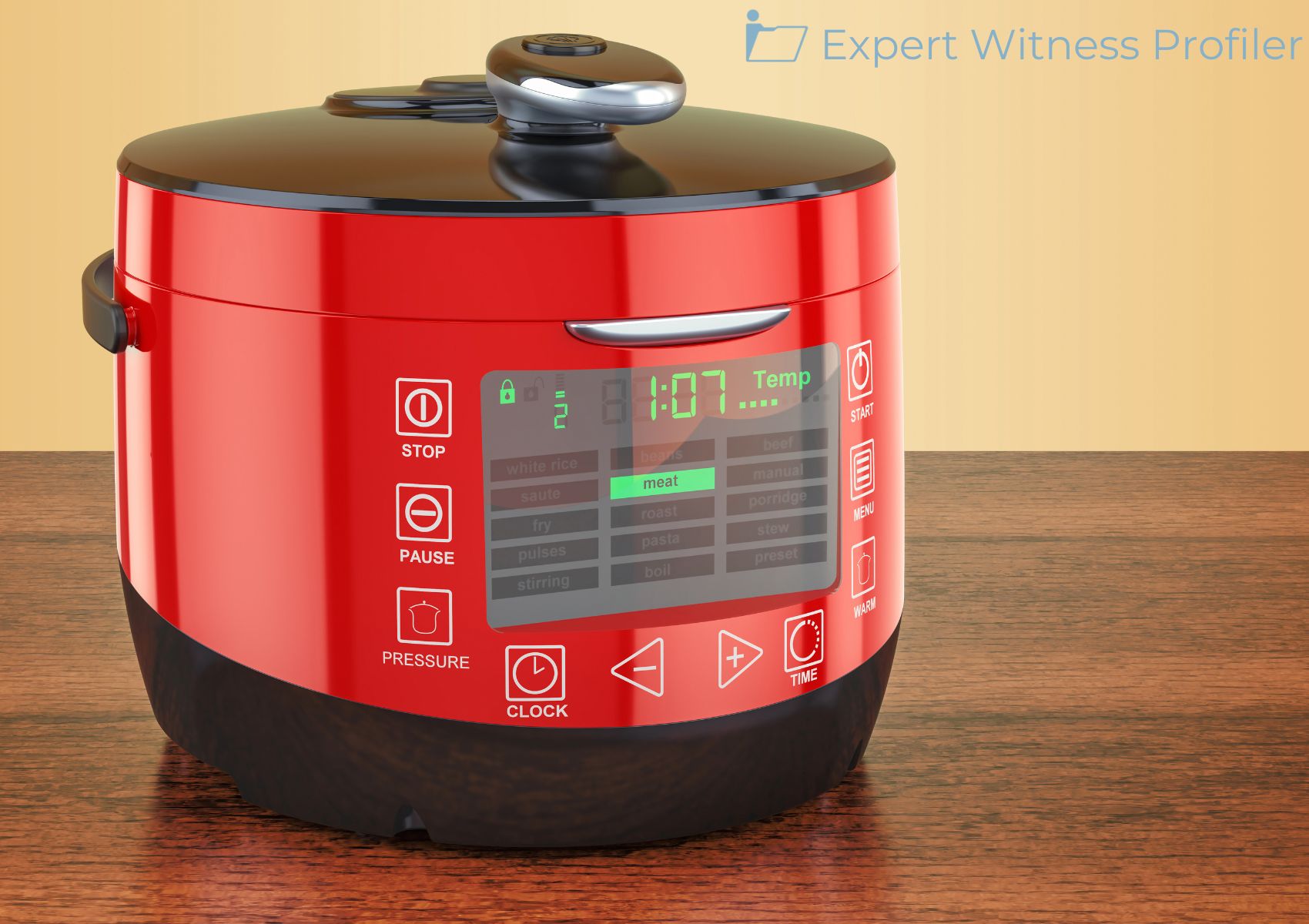
While preparing a roast in her Magic Chef 7-in-1 Multicooker, Tarsha Allgood was injured when the device’s lid opened causing its “scalding hot contents to be forcefully ejected from the pressure cooker.”
Allgood filed this lawsuit against CNA International, Inc. d/b/a MC Appliance Corporation raising claims under North Carolina law for inadequate warning, inadequate design, common law negligence, breach of express warranty, and breach of implied warranty.
CNA filed a motion to exclude the testimony of Allgood’s expert witness, David M. Rondinone, an engineer with Berkeley Engineering and Research, Inc.
Rondinone examined exemplars and other documents and materials, and concluded, among other things, that: (a) the mechanical interlock design intended to lock the lid is defective in that it fails to perform its function. This conclusion is based on, among other things, the geometric dimensions of the pin, lid, and cooker, which results in the interlock “providing very little resistance to the user;” and (b) “the presence of a defective pressure interlock increases the likelihood of the lid being opened and the cooker contents being expelled under pressure.” The touchstone of CNA’s argument is that Allgood threw away the device’s lid, so Rondinone could not test the actual multicooker Allgood used.
Mechanical Engineering Expert Witness
David Michael Rondinone has over 20 years of experience in mechanical engineering including design and failure analysis, fire suppression, explosions, flammability, flame arrestors, ignition, finite element analysis, accident reconstruction and crashworthiness, mechanical testing, failure of mechanical connections, dynamic stability of equipment and structures, pressure vessels and pipelines, medical implants and equipment, automotive component analysis and design.
Rondinone has a Masters and Ph.D in Mechanical Engineering from the University of California, Berkeley, where he previously received his B.S. in Engineering Physics and B.A. in Astrophysics.
The exemplar multicooker that Rondinone examined was used when it was purchased such that its prior history is unknown. CNA noted that the exemplar’s lid had a pre-existing scratch that Rondinone concluded means the lid was “force[d] open while under pressure by a prior user (an interlock override event).” CNA challenged the reliability of Rondinone’s opinion that the device was defectively designed because the mechanical interlock system could not meet the Underwriters Laboratories Cover Opening Standard.
According to CNA, Rondinone’s methodology relied on broad generalizations and failed to account for whether the exemplar met relevant Underwriters Laboratories’ standards before the exemplar was damaged.
Allgood countered that Rondinone set forth his methodology in his report. He explained how he examined and measured the exemplar, including its interlock features, and considered relevant Underwriters Laboratories standards. He then concluded that the mechanical interlock design that is intended to lock the lid of the device is defective in that it fails to perform its intended function.
The Court agreed with Allgood that Rondinone’s conclusions are sufficiently reliable. Among other things, he explained how the exemplar he examined showed “linear defects in the coating which are consistent with wear from the lid locking pin sliding over the tab,” and that the pre-existing scratch on the lid he examined could be the result of the lid being opened under pressure despite the sliding pin lock being held in place by the float valve.
CNA’s remaining arguments failed to persuade the Court. That Rondinone did not take measurements that CNA deems critical, failed to perform a statistical or comparative analysis, or reached his conclusions based on a “single nonrepresentative data point,” are fair points for cross-examination.
Held
The Court denied the Defendant’s motion to exclude the testimony of David Rondinone.
Key Takeaway:
The Court held that Rondinone’s opinions are appropriately based on sufficient data, an examination of an exemplar, and a reliable application to the facts of this case. His testimony would also assist the fact finder with determining whether a defect existed at the relevant time, and the methodology underlying his conclusions is sound and sufficiently reliable for trial.
To the extent CNA wishes to challenge the facts forming the basis of Rondinone’s opinions, including the impact, if any, that examining an exemplar had on his conclusions, it may do so on cross-examination. Although the facts on which an expert bases his opinion must have some basis in the record, there is no requirement that the basis must consist of undisputed evidence.
Plaintiff Mollie Minskoff brought this case against her former boyfriend, Defendant Hector Mendoza Jr., for sexual assault and sexual battery. Defendant brought a counterclaim for defamation, in response to which Plaintiff brought a counterclaim under New York’s Anti-Strategic Lawsuits Against Public Participation statute.
Plaintiff and Defendant engaged in an “on-again, off-again sexual relationship between 2010 and 2015.” At one point in time, the parties lived together in an apartment in New York City owned by Plaintiff’s father. In late 2011, Defendant moved to Los Angeles while Plaintiff remained in New York. For the next several years, the parties continued to see each other occasionally. Plaintiff alleged that Defendant sexually assaulted and battered her on multiple occasions between 2012 and 2015. Defendant maintained that, although the parties had sex on these occasions, all of their interactions were consensual.
The parties agreed that the Plaintiff came to the Defendant’s home the night of August 30, 2014, and that Defendant recorded an argument between the parties that night (the “August 30 recording”). According to Plaintiff, however, Defendant did not record this argument until after Defendant raped her.
Plaintiff filed a motion to exclude the testimony of Defendant’s expert Dr. Lenore E. Walker while Defendant filed a motion to exclude the testimony of Plaintiff’s expert Nick Barreiro.
Psychology Expert Witness
Dr. Lenore E. Auerbach Walker is a licensed psychologist in several states and Board Certified in Clinical Psychology and in Couples and Family Psychology by the American Board of Professional Psychology.
She has practiced all over the U.S. and in several other countries around the world. She earned her doctoral degree in psychology from Rutger’s, The State University in N.J. in 1972 after attaining an M.S. in Psychology from City College of the City University of New York (CCNY) in 1967 and a B.A. from Hunter College of CCNY in 1962.
In 2004, she earned an M.S. in Clinical Psychopharmacology from Nova Southeastern University. Walker began an independent practice of psychology after obtaining her license in N.J. in 1974 where she provided psychotherapy and assessment services throughout the years even after she moved to Denver, Colorado in 1975 and became licensed there. In 1981, she became a full-time employee of Walker & Associates and built her independent psychology practice adding forensic services to psychotherapy until 1998 when she began training other psychologists at Nova Southeastern University College of Psychology.
Nick Barreiro is a certified audio video forensic analyst who has received training in audio forensics from the FBI and the California Department of Justice, among other institutions. In addition to this training, Barreiro has more than sufficient experience: he spent fifteen years as a law enforcement officer in California, during which time he handled all media forensics including collecting, enhancing, and analyzing video footage from surveillance cameras, cell phones, traffic cameras, body-worn cameras, and dash cameras.
Plaintiff’s Motion toExclude Expert Opinion of Dr. Lenore Walker
Defendant retained Lenore Walker, a licensed psychologist, to conduct a forensic psychological analysis of him “to assess for possible psychological damages resulting from harassment, defamation, and false allegations of domestic violence and rape from his former girlfriend, [Plaintiff] Mollie Minskoff.”
Walker’s Initial Forensic Psychological Report on Defendant
Walker’s initial report on Defendant purported to provide opinions on the damages Defendant experienced from, among other things, Plaintiff’s alleged defamation. To support Defendant’s claim that he is entitled to emotional damages from Plaintiff’s defamation, such emotional damages must have been caused by the defamatory statements.
Walker did not once mention in her initial report any impact of the allegedly defamatory statements on Defendant. Instead, her report focused on the emotional and mental damages Defendant suffered from his relationship with Plaintiff, which predated the allegedly defamatory statements at issue by several years and is not relevant to Defendant’s defamation counterclaim or any other claim in this case. Because Walker did not include any analysis of damages Defendant suffered as a result of Plaintiff’s alleged defamation, or any other opinions relevant to the issues in this case in her initial report, the Court held that her opinions contained in that report will not be helpful to the trier of fact and are thus excluded.
Walker’s Rebuttal Forensic Psychological Report on Plaintiff
The parties did not dispute that Walker may testify about the results of the Detailed Assessment of Posttraumatic Stress she administered to Plaintiff, through which Walker found that Plaintiff “meets the criteria for a diagnosis of PTSD.” Nor did Plaintiff challenge the reliability or relevance of the results of Walker’s administration of the Danger Assessment or the Adverse Childhood Experiences Assessment to Plaintiff.
The Personality Assessment Inventory that Walker administered to Plaintiff is plainly a reliable methodology for an expert to use, especially given that Plaintiff’s own expert also administered a Personality Assessment Inventory to Plaintiff. However, as Plaintiff pointed out, and Defendant did not dispute, Walker’s conclusion from the Personality Assessment Inventory that Plaintiff engaged in “negative impression management” is not supported by the assessment itself. Nor did Walker provide any other support for this conclusion. As a result, the Court excluded this opinion.
The Court permitted Walker to testify about the results from the Trauma Symptom Inventory — Second Edition that she administered to Plaintiff. The fact that Walker included in her report that Plaintiff’s responses to this assessment were atypical but did not include the same statement about Defendant in her report about him, despite the parties receiving the same exact results on this metric, did not render this part of her opinion unreliable.
The Court held that Walker may testify about the results of the Battered Woman Syndrome Questionnaire she administered to Plaintiff, including her opinion that Plaintiff does not have battered woman syndrome, but Walker may not testify that Plaintiff is not, in fact, a battered woman based on the questionnaire. Walker was also permitted to provide her opinion that Plaintiff has borderline personality disorder. However, Walker may not testify about Plaintiff’s credibility or whether Plaintiff was sexually assaulted and battered by Defendant.
Walker’s “Addendum” to Her Forensic Psychological Report on Defendant
Walker’s “addendum” to her forensic psychological report on Defendant was disclosed to Plaintiff a mere two days before Plaintiff’s motion to exclude Walker’s testimony was due, and approximately six months after the deadline for the disclosure of expert reports had passed.
Defendant asserted that the addendum report was admissible because it fell under Defendant’s Rule 26(e) duty to supplement information upon learning that previously disclosed information is incomplete or incorrect. Defendant asserted that, when Walker was asked at her deposition whether she had identified in her initial report “specifically which social media postings were the ones that were traumatic for him,” she realized that her initial report was, as this Court has also concluded, “materially incomplete,” and “it was at this moment that Walker’s duty to supplement her report arose.”
However, the actual duty to supplement imposed by Rule 26 “arises when the expert subsequently learns of information that was previously unknown or unavailable, and the new information renders the earlier report incomplete or inaccurate.” In this case, information on the impact of Plaintiff’s allegedly defamatory statements on Defendant, all of which were published in 2023, was not “unknown” to Defendant or “unavailable” to Walker before Walker’s June 2024 deposition. The Court thus rejected Defendant’s characterization of the addendum report as a supplemental report under Rule 26, and turned to consider whether the untimely report should be excluded.
Defendant’s only proffered reason for non-compliance is that “Plaintiff’s counsel did not indicate that they would move to preclude Walker’s testimony” for failing to address the connection between Defendant’s damages and the allegedly defamatory statements “until July 2024.” The Court held that there is nothing except oversight by the defense and Defendant provided no explanation or justification for this oversight.
Defendant’s Motion to Exclude Expert Opinion of Nick Barreiro
Defendant filed a motion to exclude the opinion of Nick Barreiro, a certified audio video forensic analyst, and one of Plaintiff’s experts, concerning the August 30 recording. Barreiro used critical listening to analyze the August 30 recording. In doing so, he identified rustling sounds that are referred to as a “pocket rustle,” leading Barreiro to conclude that the phone used to record the August 30 recording did not “remain[ ] out in the open for the duration of the recording,” and that “[t]he rustling sounds it contains are consistent with a recording device that was inside a pocket, or otherwise concealed in fabric, for a significant portion of the recording.”
The Court found Barreiro’s opinion sufficiently reliable for admission. Critical listening, the method through which Barreiro formed his opinion that Defendant’s phone “was inside a pocket, or otherwise concealed in fabric, for a significant portion of the recording,” has been recognized by the FBI “as an essential component of forensic audio analysis,” and has been accepted by federal courts as a reliable method for conducting forensic audio analysis. Moreover, Barreiro is qualified to provide this opinion.
Defendant’s contention that “Barreiro’s experience and training is too general” and does not extend to “analyzing audio to determine the nature of pocket rustle, whether an audio device is concealed, or what it is concealed by” is belied by Barreiro’s deposition testimony. Barreiro testified that he has determined “many times” whether an audio recording was made on a device that was concealed. The Court determined that Barreiro’s report and deposition testimony did not provide any indication that his opinion was improperly influenced by his background.
Held
The Court granted in part and denied in part the Plaintiff’s motion to exclude Dr. Lenore Walker’s expert testimony.
The Court denied the Defendant’s motion to exclude Nick Barreiro’s expert testimony.
Key Takeaway:
Experts are not free to continually bolster, strengthen, or improve their reports by endlessly researching the issues they already opined upon, or to continually supplement their opinions. Yet, these impermissible aims are exactly what Defendant submits Walker’s addendum report to achieve: Walker’s initial report failed to connect any of Defendant’s psychological damage to the allegedly defamatory statements, so she wrote the addendum report to address this failure, introducing brand new, previously undisclosed opinions.
This case arose from a dispute between homeowners and their insurer over coverage. Plaintiffs, Jessi Shetler and Richard Shetler filed a claim with Defendant, Clear Blue Specialty Insurance Company, their insurer, for the windstorm’s damage to their roof and the interior of their home.
Plaintiffs brought the instant first-party action sounding in breach of contract due to Defendant’s denial of all roofing system damages and undervaluation of the Plaintiff’s insurance claim.
Plaintiffs’ expert, forensic engineer Sonny Gulati, opined that Plaintiffs’ roof and interior “suffered significant storm related and widespread damage” such that the roof needs to be completely replaced and the interior repaired. However, the Defendants filed a Daubert motion to exclude the testimony of Gulati.
Forensic Engineering Expert Witness
Sunil Sonny Gulati has over 30 years’ experience in conducting structural/geotechnical investigations including sinkhole evaluations, ground penetrating radar (GPR) testing and analysis, geotechnical design, environmental consulting, construction materials testing, supervision, and roadway construction project management.
Basically, Gulati opined that Plaintiffs’ roof and interior “suffered significant storm related and widespread damage” such that the roof needs to be completely replaced and the interior repaired.
In forming this opinion, Gulati reviewed weather data, calculated wind forces, inspected the property, interviewed Plaintiff Richard Shetler, and reviewed documentation including prior evaluations, photos, and a wind history report.
Defendants argued that Gulati’s methodology is unreliable and his testimony unhelpful because he leaned too heavily on Richard Shetler’s interview to determine that the windstorm caused the damage to Plaintiffs’ home.
The Court disagreed because Gulati evaluated data, inspected the home himself, and made calculations of the same type that courts regularly find sufficiently reliable. Any weaknesses in his evaluation, such as overreliance on a biased homeowner, are better addressed through cross-examination, not exclusion, as the jury is best equipped to make credibility determinations. To sum up, Gulati’s methodology is sufficiently reliable to put before a jury, and his testimony will be helpful for the same reasons.
Held
The Court denied the Defendant’s Daubert motion to exclude the testimony of Sonny Gulati.
Key Takeaway:
Experts and their opinions need not be perfect to be admissible, and “it is not the role of the district court to make ultimate conclusions as to the persuasiveness of the proffered evidence.” In other words, forensic experts who rely on weather data, engineering formulas, home inspections, and their own knowledge and experience are sufficiently reliable.
Case Details:
Case Caption:
Shetler Et Al V. Clear Blue Specialty Insurance Company
Docket Number:
6:24cv272
Court Name:
United States District Court for the Middle District of Florida, Orlando Division