Plaintiff Michael Swartzendruber claimed that Defendants United Healthcare Insurance Company and United Healthcare of the Mid-Atlantic, Inc. (collectively “United”), and Defendants Sentara RMH Medical Center and RMH Medical Group, LLC (collectively “Sentara”) overcharged him for hospital services and/or by making misrepresentations about the charges for his blood tests.
On each occasion, Swartzendruber’s blood was drawn at a Sentara satellite outpatient location and tested at Sentara’s main hospital location. Sentara billed, and United processed and reimbursed, charges for medical services based on rates associated with the main hospital location as opposed to rates of certain providers operating at the satellites.
Plaintiff filed a motion to exclude the expert testimony of Defendants’ expert, Kristina Kahan. Kahan was retained to opine on whether or not the health insurance claims at issue in this case were properly billed.
Medical Coding Expert Witness
Kristina B. Kahan is a Registered Nurse, Certified Professional Coder, and senior managing director at Ankura Consulting with decades of clinical, compliance, and coding experience in the healthcare industry.
She holds multiple coding certifications: Certified Professional Coder (“CPC”), Certified Outpatient Coder (“COC”), and Certified Risk Adjustment Coder (“CRC”).
To begin with, Plaintiff challenged the relevancy and helpfulness of Kahan’s opinions, and disputes that Kahan has offered a sufficient basis on which to offer her opinions.
a) Basis for Opinions
In her report, Kahan concluded that Sentara properly submitted claims for the services at issue in this case and that United properly adjudicated the claims it received from Sentara.
Specifically, Kahan concluded that Sentara appropriately billed the services rendered as originating from Sentara RMH Medical Center because the services were “performed at off-campus locations of RMH Medical Center and the blood testing was performed at RMH Medical Center’s main hospital location” and thus constituted “facility services.”
Kahan concluded that Sentara properly billed and United properly adjudicated the claims. In making these conclusions, Kahan evaluated Sentara RMH Medical Center’s hospital certification and Medicare Provider Enrollment, Chain, and Ownership System information. As a result, the Court found that Kahan has developed sufficient bases on which to support her opinions.
b) Relevancy and Helpfulness
Defendants asserted that Kahan’s report addressed material aspects of the case—whether Sentara appropriately submitted the claims and whether United appropriately adjudicated them.
However, Plaintiff argued that Kahan’s report is not helpful to the Court because Kahan offered no testimony that is helpful or necessary for the Court to interpret the contract at issue.
The Court found that the Kahan Report presented relevant and helpful evidence as it served to assist the Court in understanding the healthcare claims submission and adjudication processes, including the relevant regulations governing these processes, such that the Court is better equipped to address the issues in dispute in this case.
Held
The Court denied the Plaintiff’s motion to exclude Defendants’ expert Kristina B. Kahan.
Key Takeaway:
Basically, the parties are correct that the Court can read and interpret the contracts at issue, and the Kahan Report does not improperly delve into the world of contract interpretation. Thus, the Court may consider the Kahan Report for its value in understanding the broader environment of the instant case.
Case Details:
Case Caption:
Swartzendruber V. Sentara RMH Medical Center Et Al
Plaintiff Nicholas Price, a former Virginia inmate, filed this civil rights action against Defendant Kyle Smith, M.D. (“Dr. Smith”), alleging that Smith was deliberately indifferent to Price’s serious medical needs after he sustained significant knee injuries while playing basketball at Augusta Correctional Center (“ACC”).
Smith filed a motion to exclude the medical opinions of Price’s expert witness, Dr. Michael J. Katz.
Orthopedic Surgery Expert Witness
Michael Jesse Katz is board certified in Orthopedic Surgery. He has been a practicing physician for 40 years. He has treated thousands of patients with patellar tendon ruptures over the course of my career. Katz has served as an expert in many knee cases in the past.
Smith filed a motion to exclude the medical opinions of Katz on two main grounds: (1) that Katz’s expert designation does not comply with Federal Rule of Civil Procedure 26; and (2) that his medical opinions are inadmissible under Federal Rule of Evidence 702.
1. Katz’s expert medical report fails to comply with the disclosure requirements set forth in Federal Rule of Civil Procedure 26
Katz’s expert report did not fully comply with the disclosure requirements set forth in Federal Rule of Civil Procedure 26(a)(2)(B). Although the report contains some of the necessary components, it omitted several critical elements mandated by the Rule and thus falls short of the required standard for expert disclosures.
Katz stated his principal conclusion—that the delay in treatment for Price’s bilateral patellar tendon ruptures constituted a deviation from the standard of care and was the proximate cause of Price’s worsened condition. He further noted that such injuries require prompt surgical repair.
While this constitutes a basic statement of opinion, the Court held that it is brief and conclusory, lacking meaningful detail or explanation. Courts within the Fourth Circuit have found conclusory findings insufficient to satisfy the requirements of Rule 26(a)(2)(B)(i).
While Katz asserted that the ACC’s delay in providing medical care fell below the standard of care, he did not define the standard, nor did he explain the factual or clinical basis for his opinion.
Furthermore, Katz’s report failed to include a list of prior cases in which he has testified as an expert at trial or by deposition within the last four years, in violation of Rule 26(a)(2)(B)(v).
In sum, the Court held that Katz’s expert report failed to satisfy multiple subsections of Rule 26(a)(2)(B), including those related to the basis for his opinions, prior expert testimony, and compensation.
2. Katz’s medical opinion is not admissible under Fed. R. Evid. 702
While Katz listed the records he reviewed, they consisted solely of Augusta Health records from March 13 to March 24, 2021—after the alleged delay in care had already occurred. He did not review any medical records from ACC, the facility where the delay allegedly took place, nor did he examine any documentation regarding the care provided by Smith, the sole remaining Defendant in the case. Additionally, he opined that the delay caused the injury to worsen, but did not identify how it worsened, or any facts or records upon which he bases this opinion. The last medical records he reviewed were Augusta Health’s discharge records, eight days after surgery—when Price was still wearing knee immobilizers. He did not review the condition of Price’s knee, or the treatment thereof, before arriving at Augusta Health, nor did he evaluate the rehabilitation records that occurred after his stay at Augusta Health.
These omissions are critical. Katz’s conclusion—that the delay in treatment at ACC caused Price’s injury to worsen—depended upon knowing what care was provided, when, and by whom. Without having reviewed any records from ACC, the Court held that his opinion rests on an incomplete and selective factual basis.
Moreover, Katz did not define what the standard of care is, did not identify how it was violated, and did not indicate what constitutes “prompt” treatment under the circumstances. Katz was asked to opine on a question rooted in negligence: whether the delay in treatment “fell below the minimum standard of care.” But this did not address the constitutional threshold of deliberate indifference and thus had no relevance to the central legal question in this case.
Held
The Court granted Smith’s motion to exclude the medical opinions of Price’s expert witness, Dr. Michael Katz.
Key Takeaway:
Katz’s report failed to satisfy any of the four foundational prongs of Rule 702. It is not based on sufficient facts or data, did not reflect or apply reliable principles or methods, and is not relevant to the legal claim of deliberate indifference.
Defendant D.R. Johnson Lumber Co. is an engineered wood products manufacturer located in Riddle, OR. Plaintiff Jasmine Vineyards, Inc. is a grower of table grapes located in Delano, CA.
Plaintiff asserted a negligence claim against Defendant based on allegations that Defendant “fabricated and/or supplied glulam wood beams in connection with a commercial construction project for Plaintiff” in Kern County, California, to contractors hired by Plaintiff to perform the construction services.
On May 9, 2025, Plaintiff disclosed to Defendant pursuant to Rule 26(a)(2) its notice of non-retained expert witness and the report of Joseph Engel. Defendant filed a motion to exclude evidence and testimony anticipated to be offered by expert witness Engel.
Civil Engineering Expert Witness
Joseph C. Engel has a bachelor’s degrees in civil and mechanical engineering from the University of California at Davis. He has been practicing as a licensed civil and structural engineer for over 40 years.
As a part of his practice, Engel has designed at least 75 cold storage rooms.
Engel is Qualified to Render the Challenged Opinions
To begin with, Defendant advanced various complaints about Engel’s lack of qualifications, including his lack of employment history in a glulam beam manufacturing plant and his failure to review discovery documents to inform his opinions and conclusions.
Engel sought to opine that he observed gaps in the glue between the glulam beams’ lamina and that such gaps resulted in shear stresses that compromised the integrity of the beams. He specifically noted that, “regardless of the reason of the glued joint failure, the evidence of the failure can be clearly seen when the failed beam is carefully examined.”
Engel’s degrees in civil and mechanical engineering, his state licensures in civil and structural engineering, his long experience in the field, his experience designing cold storage facilities specifically for table grape storage, including the facility at issue here, and the fact that he has testified at deposition numerous times and recently was qualified in a state court civil case as an expert witness in structural engineering demonstrates sufficient “knowledge, skill, experience, training, or education.”
Moreover, Engel is not being proffered to render opinions concerning the nature and composition of the glue used in the glulam beams, or to offer opinions about why or how any glue deficiencies occurred. Thus, the Court disagreed with Defendant’s proposition that only a “glue or glue performance” expert could opine about the import of gaps observed in a beam and whether such gaps could compromise a beam.
Engel’s Opinions are Relevant and Would Assist the Jury
In arguing that Engel should be precluded from testifying because his testimony would not assist the jury, Defendant relies on the same argument advanced regarding Engel’s lack of qualifications as a “glue expert” and points out that Engel based his opinions only on his physical observations and moisture testing of the beams, but did not take samples from the beams.
Otherwise, Defendant did not directly challenge that Engel relied on improper data or applied unreliable principles and methods in rendering his opinions. This is not surprising given that Defendant’s expert witness, Ali Moradi, similarly relied on his physical observations and moisture measurements of the glulam beams to arrive at competing conclusions regarding the cause of the beams’ alleged failure.
Given that the parties’ two relevant expert witnesses in this case relied on similar types of data and moisture measurements in forming their opinions and conclusions, the Court found that for purposes of Defendant’s pretrial motion to exclude that Plaintiff has shown it is more likely than not that Engel relied on sufficient facts and data and applied reliable principles and methods in rendering his opinions.
Defendant’s argument that Engel’s opinions are irrelevant because they do not squarely address whether Defendant breached the applicable standard of care is unpersuasive. Whether or not expert testimony is necessary in this case on the applicable duty of care and breach thereof, Plaintiff must also prove causation to prevail on its negligence cause of action.
Held
The Court denied Defendant D.R. Johnson Lumber Co.’s motion to exclude the evidence and testimony of Joseph Engel.
Key Takeaway:
The extent of Engel’s specialized knowledge in the specific field of glulam beam failure goes to the weight afforded to his opinion by the trier of fact, not to its admissibility.
Case Details:
Case Caption:
Jasmine Vineyards, Inc. V. D.R. Johnson Lumber Co., Et Al.
Plaintiff, Mary Lynn Feakes, brought this premises liability action, alleging negligence related to a slip and fall accident that occurred on Washington Metropolitan Area Transit Authority’s property on June 5, 2021.
Feakes alleged that she slipped and fell on an unidentified mud-like substance in a parking space while walking from her parked car to the Shady Grove Metro Station.
Plaintiff has designated Mr. Raymond P. Stoner to testify that a hazardous condition existed in the parking garage where she fell. Defendant filed a motion to exclude the testimony of Stoner.
Parking Expert Witness
Raymond Paul Stoner has worked in the parking industry for forty years. His experience includes management and administration of large complex parking operations. This experience has included structured parking facilities in commercial, municipal, hotel, hospital, and transit operations.
During his tenure, he has also held the position of Parking Manager at the Washington Metropolitan Area Transit Authority. He held the position of Director of Parking for the City of Norfolk, Parking Division. An organization that has 20,000 garage and surface lot spaces.
A. Stoner May Testify In Support of Plaintiff’s Surviving Negligence Theory
There are three relevant issues in Stoner’s report: first, as to whether the exception to sovereign immunity applies, if the evidence suggested Defendant abided by its internal cleaning schedules; second, as to whether the failure to do so constituted a breach of duty, if industry standards require compliance with Defendant’s cleaning schedules; and third, as to causation, whether the condition of the clogged drain could have caused Plaintiff’s fall.
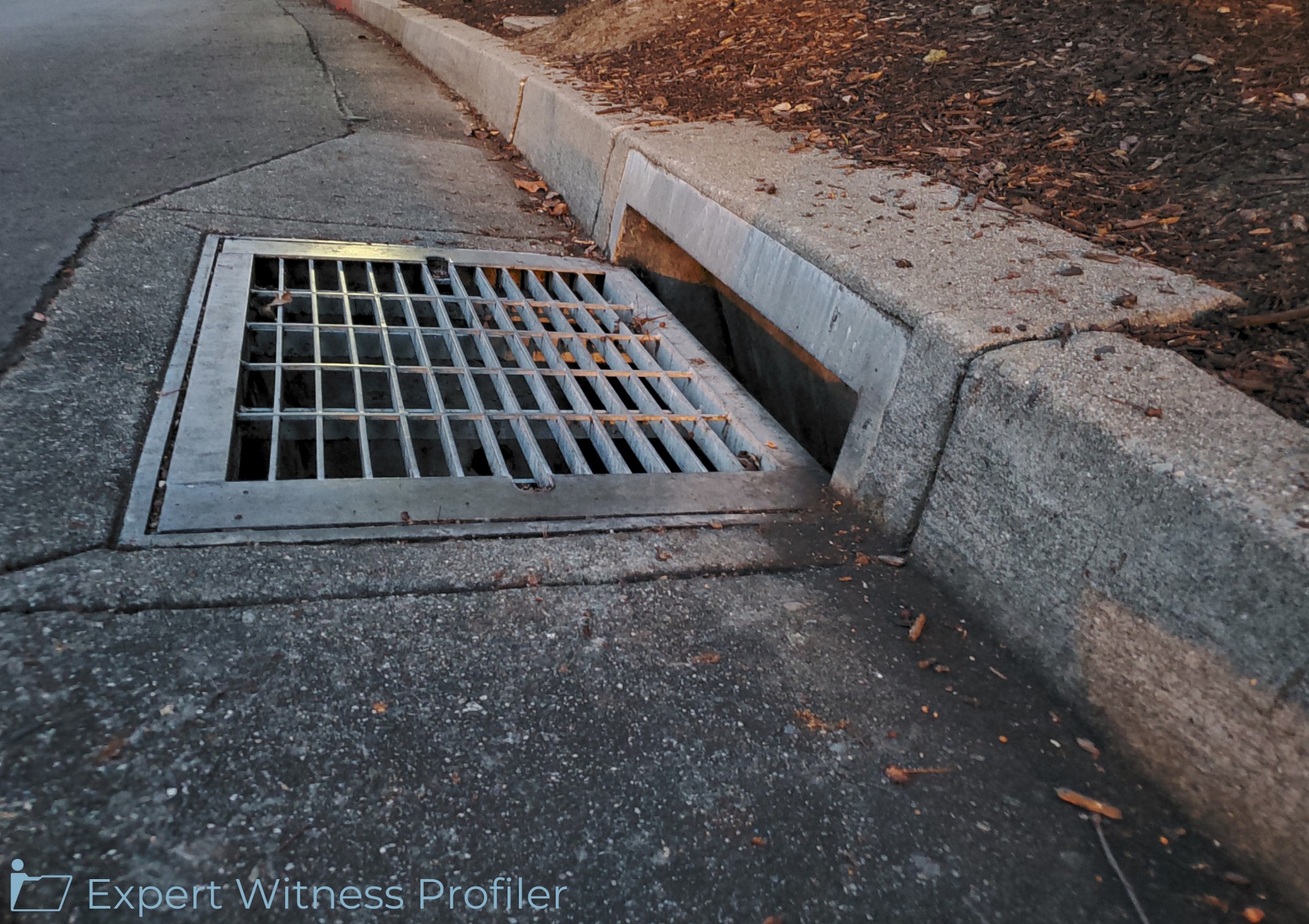
As to both the first and third issues, Stoner offered opinions as to what the drain’s condition evidences regarding how often Defendant cleaned it and the danger that arose when it was not cleaned.
Stoner expanded on such analysis in his deposition as well, noting that “the amount of silt . . . next to the drain where [Plaintiff] fell is . . . pretty excessive and is evidence of the drain and the silt and the mud around it not being cleaned up for quite some time.”
Such testimony is permissible, as it relates directly to Plaintiff’s claim that WMATA was negligent in failing to abide by its own cleaning policies.
As to the second issue, Stoner may opine on whether Defendant’s practices align with broader industry standards, as Plaintiff must establish that Defendant’s failure to comply with its policy constituted a breach of the duty of the care.
However, he may not, for example, testify as to whether Defendant should have abided by “[i]ndustry standards outlined by National Associations” or treatises such as the National Parking Association’s Parking Facility Maintenance Manual, as WMATA is immune to a challenge attacking the sufficiency of its policies.
The Court will permit Stoner to testify, but within the confines detailed above.
B. Stoner’s Opinions are Based on Sufficient Facts or Data and His Methodology is Reliable
Defendant attacked Stoner’s methodology as well as the factual basis for his conclusions. However, Stoner explained how he arrived at his conclusion.
Defendant also objected to Stoner’s decision to not conduct a site visit. The Court was not persuaded. After all, Stoner relied on photographs, the body-worn camera footage, and the depositions of relevant witnesses.
While a site visit may have been beneficial, Stoner’s failure to conduct a site visit does not automatically require exclusion. As Stoner explained, a site visit “was not necessary” in this case because the photographs and video depicted the conditions in the parking garage on the day of the incident, whereas a later site visit would reflect changed conditions—which are less relevant to this case. The same is true of Defendant’s attacks premised on Stoner’s completion of his report in less than six hours, and his failure to test the grate at issue.
Finally, Defendant argued that the photos Stoner reviewed “do not reliably depict the conditions at the time of the incident” because “Stoner admitted that he did not know when the photos he reviewed were taken,” and that in Plaintiff’s deposition, she stated “all the grate photos were taken at least a month after the incident.”
The Court disagreed. There are two relevant sets of photographs: one set taken by the Officer on the scene on the day of the incident, and a second taken approximately one month later. During his deposition, Stoner had stated that he reviewed the photos from the day of the incident, as well as the body-worn camera footage.
C. Stoner’s Testimony May Be Useful to the Jury
The Court held that Stoner’s opinions may be useful to the jury because lay persons are generally unfamiliar with the manner and speed at which sediment builds up surrounding a grate in a parking garage; accordingly, his testimony may better allow the jury to assess whether Defendant adhered to its cleaning schedule.
Held
The Court granted in part and denied in part the Defendant’s motion to exclude the testimony of Raymond Stoner.
Key Takeaway:
Federal Rule of Evidence 702 requires that the opinions of expert witnesses be “based on sufficient facts or data” and be “the product of reliable principles and methods” which have been reliably applied “to the facts of the case.” Stoner’s opinions are not pure speculation, but are grounded in a review of the facts at hand based on his experience in parking operations.
Case Details:
Case Caption:
Feakes V. Washington Metropolitan Area Transit Authority
Plaintiff Ellen Thomas brought this action against Defendant Smith’s Food & Drug Centers alleging negligence relating to a slip and fall in December 2020.
Defendant filed a motion to strike the testimony of Plaintiff’s expert, Dr. James J. Lynch, regarding future possible medical treatment and the cause thereof.
Plaintiff saw Lynch, at Swift Institute, on March 8, 2023, for low back pain, right lower extremity pain, and right knee pain. Because Plaintiff had failed conservative treatment measures, Lynch recommended a lumbar surgery to treat Plaintiff’s low back pain. Surgery was originally scheduled for April 27, 2023.
On October 5, 2023, the Court entered a discovery plan and scheduling order which set the expert disclosure deadline for January 4, 2024, the rebuttal expert disclosure deadline for February 5, 2024, and the discovery cutoff for March 4, 2024. On January 5, 2024, Plaintiff served her non-retained expert witness disclosure that included Lynch.
After the close of discovery, Defendant moved to exclude any evidence of future damages. The Court specifically denied Defendant’s motion to exclude future back surgery, finding Plaintiff’s failure to formally disclose Lynch as a witness harmless under the circumstances. Pursuant to that holding, the Court allowed a limited re-opening of discovery so that Defendant could depose and review the records and testimony of Lynch.
During his deposition, Lynch testified that Plaintiff’s low back pain was caused by the December 2020 slip and fall, which necessitated surgery. Defendant subsequently filed a motion to strike evidence, testimony, and opinions of Lynch. After Defendant filed the motion to strike, the Court ruled that because Lynch is a treating doctor who was disclosed as a non-retained expert, he did not need to be disclosed as a retained expert.
Neurosurgery Expert Witness
James J. Lynch, MD, FACS, FAANS is a board-certified neurosurgeon with 30 years of experience specializing in complex spine surgery, cervical disorders, degenerative spine, spinal deformities, trauma, tumor infection, and minimally invasive spine surgery. He is also proficient in endoscopic spine surgery techniques.
He earned his medical degree from Trinity College in Dublin, Ireland, followed by a Mayo Clinic residency in Rochester, MN.
While the Defendant did not challenge Lynch’s qualifications as a medical expert, it filed a motion to strike his testimony on the grounds that it: (1) lacks a sufficient basis in facts and data, (2) is not the product of reliable principles and methods; and (3) is internally inconsistent and contradicts both Plaintiff’s testimony and her medical records.
Helpfulness to the Jury
The Court must consider whether Plaintiff has shown that Lynch’s medical expertise regarding low back pain and analysis of Plaintiff’s lumbar pathology will help the jury understand the evidence.
Lynch knows clinical guidelines for treating low back pain; he understands how to interpret medical records and imaging; and he personally treated Plaintiff for her low back pain. Assessing Plaintiff’s damages in this negligence case will require the jury to assess which of Plaintiff’s injuries were caused by the slip and fall. It will also require the jury to understand what future medical treatment is needed. Lynch’s specialized knowledge will be useful to the jury, and Plaintiff has met her burden to show as much.
Sufficient Facts or Data
Defendant argued that Lynch “based his opinions on the recommended surgery on Plaintiff’s statement that ‘she relates that her back pain and leg pain and knee pain began after the fall in December 2020.’”
Lynch has used sufficient facts and data to reach his conclusions regarding Plaintiff’s need for surgery and the cause of her low back pain. He used Plaintiff’s relevant medical records, which showed that Plaintiff had failed conservative treatment methods, as well as medical imaging, to reach his conclusions. Lynch also relied on his medical knowledge and experience.
These sources together form an appropriate basis for Lynch’s opinions. The Court thus held that Plaintiff has shown that Lynch has used sufficient data and facts to survive a motion to strike evidence, opinions, and testimony regarding future possible medical treatment and the cause thereof.
Reliable Principles and Methods
Defendant claimed that the record is “lacking in testing to confirm Lynch’s theories” such as neurological examinations or nerve studies to “determine the source of radiculopathy that Plaintiff alleged was from back pain caused from the incident;” or “review of prior medical records or films to determine when the actual cyst appeared in Plaintiff’s lower back that is the origin of her pain complaints.”
Plaintiff argued that Lynch conducted a differential diagnosis regarding causation of Plaintiff’s back injury after “taking her medical history, physically examining her as her treating physician, and reviewing her MRI and medical history.”
Lynch testified that, based on Plaintiff’s Magnetic Resonance Imaging (MRI) scan and X-rays, he recommended a particular lumbar surgery, that a majority of physicians would recommend for similar pathology. Based on those imaging tests, his appointment with Plaintiff, and a review of Plaintiff’s medical history, Lynch testified that he believed, to a reasonable degree of medical probability, that Plaintiff’s low back pain was caused by the December 2020 slip and fall.
Lynch also considered whether the low back pain was caused by something other than the slip and fall but found that even if Plaintiff had a lumbar disc bulge or cyst prior to the fall, it became symptomatic only after the fall. To the extent that Lynch did not adequately rule out alternative causes for Plaintiff’s injuries, this is a “credibility determination that goes to the weight of his opinions, not their admissibility.” The Court therefore found that Lynch’s testimony used reliable methods and principles.
Discrepancies Regarding Lynch’s Testimony
Defendant centers much of its motion to strike on alleged inconsistencies in Lynch’s deposition testimony, particularly focusing on his answers to questions regarding the cause of certain pathology seen in Plaintiff’s vertebrae.
Defendant contrasts Lynch’s testimony that he could not render an opinion, to a reasonable degree of medical certainty, as to when Plaintiff’s synovial cyst, disc bulge, and disc slippage first occurred, but did render such an opinion as to what caused Plaintiff’s low back pain, noting that issues like cysts and disc bulges could be asymptomatic, until an injury, like the one at Smith’s, precipitated symptoms.
Similarly, Defendant argued that Lynch’s testimony regarding the cause of Plaintiff’s low back pain contradicts both Plaintiff’s own testimony and her medical records, which, according to Defendant, indicate that her low back pain did not become a primary concern until 2022.
However, Lynch testified that her low back pain was not well-documented and may have worsened over time, ultimately resulting in her appointment with him in 2023.
Defendant failed to explain how these answers are irreconcilable and further neglects to cite to any case law standing for the proposition that such discrepancy is sufficient ground to strike evidence, testimony, and opinions of an expert.
The Court declined to strike Lynch’s testimony regarding future possible medical treatment and the cause thereof.
Held
The Court denied the Defendant’s motion to strike the testimony Plaintiff’s expert James Lynch, M.D.
Key Takeaway:
The mere possibility that an expert may be impeached is not a ground for exclusion. The Defendant failed to cite any case law supporting the proposition that such a discrepancy is sufficient to strike an expert’s evidence, testimony, or opinions.
Plaintiff Pietoso, Inc. operates Café Napoli restaurant in Clayton, Missouri. It has a Service Agreement for waste removal from the restaurant with Defendant Allied Services, LLC—a subsidiary of Defendant Republic Services, Inc. The Service Agreement sets a basic-service rate of $323 per month, but it allows Allied to unilaterally increase this rate for certain enumerated reasons. All other rate increases require Pietoso’s consent.
Pietoso’s service rate increased incrementally from $323 per month in 2011 to $870.25 per month in 2018. Discovery revealed that Defendants increase their prices every 10-12 months through a Yield Management Process (YMP) whereby parent company RSI generates budget guidance for its subsidiaries using an algorithm that incorporates local division budgets, costs, and historical average price increases as well as individual customer histories, including prior increases, responses thereto, and profitability.
Plaintiff Pietoso centrally asserted that Defendants’ YMP price increase practice violated the Customer Service Agreement (CSA) Rate Adjustment clause. Pietoso engaged Patrick Kilbourne to calculate damages for the class.
Defendants filed a motion to exclude Kilbourne’s expert testimony because his methodology is insufficiently precise to satisfy the legal standards for admissibility of expert testimony.
Forensic Accounting Expert Witness
Patrick J. Kilbourne is a Managing Director at Berkeley Research Group, a business consulting firm. He has an MBA from the University of Pennsylvania Wharton School of Business.
Kilbourne is a Certified Public Accountant, Certified Management Accountant, and Certified Fraud Examiner. He is also Certified in Financial Forensics and Accredited in Business Valuation by the American Institute of Certified Public Accountants.
Accounting for YMP increases in excess of actual operating cost increases, plus the average fuel recovery fee (FRF) as a percentage of the service price, plus the average environmental recovery fee (ERF) as a percentage of both, Kilbourne estimated total damages for the class at $75.1 million. While his report provided averages beyond the class period, it demonstrated the feasibility of extracting more specific data for each year and customer.
Kilbourne indicated that he was able to calculate damages for each class member by site and service. His report shows several examples calculating damages for specific customers based on YMP price increases within a certain date range. Between 2017 and 2019, Pietoso paid $2,526 over the contractually permissible increases (i.e., operating costs plus CPI). Based on the service rate for each month during that period, Pietoso paid $2,546 in FRF and $3,240 in ERF.
Application of Contract Terms
Defendants challenged Kilbourne’s methodology in several respects. First, the CSA defined the “Company” as a specific local division, but Kilbourne didn’t analyze division-level costs, which vary widely between urban and rural areas. Instead, he combined statewide costs to yield an average.
Further, Kilbourne didn’t isolate disposal or transportation cost increases or those attributable to changes in the law, as the Rate Adjustment clause contemplates. He also didn’t isolate the additional category related to recyclable waste contained in some contracts. Rather, he combined all operating costs, thus diluting the contractual categories such that the result is inaccurate.
Defendants contended that they produced division-level financial data sufficiently specific to facilitate more accurate calculations.
Given the data available in the format produced, the Court held that Kilbourne’s inability to isolate costs corresponding to contractual categories is understandable. This is not a defect in methodology warranting exclusion but rather a limitation due to Defendants’ accounting – one that actually favors Defendants by overstating cost increases and potentially understating damages.
In related points, Defendants criticized Kilbourne’s calculations for failing to account for negotiated credits and rollbacks or customer consent. But whether customers consented to increases is a central fact issue beyond Kilbourne’s assignment here.
CAGR for Average Increase in Operating Costs
Because Defendants’ financial statements don’t separate costs categories as between commercial, industrial, and residential customers or between small and large containers, and also because multiple divisions were combined into one financial statement prior to 2018, Kilbourne examined Defendants’ total operating costs of $152.9 million in 2016 to $203.2 million in 2022 to arrive at an average annual cost increase rate, or compounded annual growth rate (CAGR), of 4.9%.
He compared this with the average annual price increases for customers to estimate damages as the difference between cost increases and price increases.
In their motion to exclude, Defendants argued that Kilbourne’s methodology is flawed in that the time period Kilbourne used (2016-2022) doesn’t match the class period, and the annual average of 4.9%, while perhaps useful to predict future growth, is imprecise and factually inaccurate to calculate damages from historical data.
The Court found Kilbourne’s general approach of calculating damages as the difference between customers’ actual rate hikes and contractually “allowable” increases as a percentage increase in annual operating costs plus CPI logical. While CAGR for 2016-2022 may not be the applicable variable if or when damages are calculated in this case, Kilbourne offered a feasible model using the data available, and his report demonstrates that operating cost increases are ascertainable for any given year and also by local division after 2017, as may be required.
YMP Recommendation
Next, Defendants argued that Kilbourne’s methodology is defective because he erroneously relied on “reason code 64” to identify YMP increases, when in reality local divisions use the code differently, according to some witness testimony. But that same evidence and other testimony in the record confirms that code 64 is indeed the correct code for YMP increases, and any other use of code 64 is viewed as misuse or unintended use.
The Court found Kilbourne’s reliance on Defendants’ own coding system entirely reasonable. Any margin of error in this respect is attributable to flaws in Defendants’ data, not in Kilbourne’s methodology.
Defendants also argued here that Kilbourne’s method is unreliable because he ignored the fact that local divisions often depart from YMP recommendations. But Kilbourne expressly acknowledged this fact and noted that it would be possible to exclude YMP increases that were different from the algorithm amount if needed. The data captured every invoice and corresponding payment. Again, the Court is not persuaded that Kilbourne’s model couldn’t accommodate those adjustments, and error-free perfection is not the standard.
SQL Qualifications
As the Court understands it, Kilbourne and his staff used a computer code called structured query language (SQL, or “sequel”) to identify the characteristics of the Plaintiff class and extract their invoicing and payment records from the voluminous data produced by Defendants. Kilbourne relied on technical staff to perform the query to identify class members, then he verified it for accuracy using a quality control test process. Defendants asserted that Kilbourne’s methodology is unreliable because he isn’t qualified in SQL; rather he adopted a methodology of non-experts that he can’t independently opine on because he lacks the necessary expertise.
Kilbourne is, however, an expert in accounting and financial analysis, not computer science. The Court finds it reasonable that his examination of voluminous financial data might require technical assistance to manipulate, sort, and extract the characteristics and figures relevant to this case.
Staff with SQL expertise assisted Kilbourne, and he tested the accuracy of SQL queries through quality control processes. The Court is satisfied that his method is reliable.
Moreover, even accepting Defendants’ tenuous premise here, expertise with SQL is collateral to Kilbourne’s essential qualifications as a CPA and financial analyst. The Court therefore finds that any arguable deficiency goes only to the weight of his testimony, not its admissibility.
Fuel and Environmental Recovery Fees
Defendants’ financial records showed that fuel and environmental costs are included in Defendants’ annual operating costs incorporated in their price increases under the Rate Adjustment clause. However, Defendants also charged additional fuel and environmental recovery fees (FRF and ERF, respectively) as a percentage of the amount invoiced for the underlying services. Kilbourne was asked to calculate the total amount of these surcharges for each class member during the class period. The data enabled him to isolate amounts specific to these fees and calculate average annual increases for each year.
Defendants asserted that Pietoso has failed to plead a viable theory of damages with respect to these fees, leading Kilbourne to merely perform simple math without any meaningful analysis.
The Court will not exclude Kilbourne’s testimony on these fees. Defendants offered no argument that Kilbourne’s methodology is unreliable; they only dispute the applicability of these fees to a damages calculation. Kilbourne has demonstrated his ability to isolate these fees in the data and calculate them in relation to underlying price increases. If the jury deems some portion of the fees recoverable, Kilbourne’s methodology is reliable, and his testimony is relevant and likely to assist the trier of fact
Held
The Court denied the Defendants’ motion to exclude the testimony of Plaintiff’s damages expert, Patrick Kilbourne.
Key Takeaway:
While individual credits and rollbacks may require further examination, the Court is not persuaded that Kilbourne’s model cannot accommodate such adjustments, as the data captures every customer transaction. In the Court’s view, this doesn’t render Kilbourne’s methodology preclusively unreliable. Nothing in Rule 702 “requires the court to nitpick an expert’s opinion in order to reach a perfect expression of what the basis and methodology can support.”
Even viewing Kilbourne’s technical staff as independent experts, the Court found no basis to exclude his opinions, as experts frequently rely on the expertise of others outside their field.
X Social Media LLC (“X Social Media”) and X Corp. both use the letter “X” in association with closely related advertising services. Put simply, X Corp. is an online and app-based social-media platform that allows users to create and share a wide range of digital content, including advertisements. X Social Media is an advertising agency that designs and runs social-media advertising campaigns for mass-tort and class-action law firms.
This is a case for trademark infringement and related claims concerning the parties’ respective use of the letter “X” in connection with distinct product and service offerings.
Both parties retained experts to advance their respective theories of the case. Defendant offered (1) marketing scholar Peter Golder and (2) survey practitioner Hal Poret. Professor Golder analyzed the product markets in which the parties operate and opines that reverse confusion is improbable. Poret conducted an Eveready consumer-perception survey to test for the likelihood of reverse confusion and found minimal confusion.
Plaintiff offered Professor David J. Franklyn, a trademark-law scholar, to rebut both Golder and Poret. Professor David J. Franklyn disputed Golder’s market-structure analysis and critiques Poret for limiting his survey universe to representatives of law firms and advertising agencies, contending that Poret should also have surveyed the consumers who view Plaintiff’s ads on social media.
Professor Peter N. Golder is a Professor of Marketing at the Tuck School of Business at Dartmouth College in Hanover, New Hampshire.
His background includes a Ph.D. in. marketing from the University of Southern California, decades of academic appointments in marketing, and prior experience providing expert marketing testimony in litigation.
Hal Poret is a public opinion researcher with a master’s degree in mathematics and a law degree from Harvard Law School. Poret has personally designed, supervised, and implemented well over 1,000 surveys regarding the perceptions and opinions of consumers.
He has been accepted as an expert in survey research on numerous occasions by U.S. District Courts, the Trademark Trial and Appeal Board, the ITC, the FCC, the FTC, and the National Advertising Division of the Council of Better Business Bureaus (NAD).
David Joel Franklyn is currently a law professor at Arizona State University, with an appointment in the Sandra Day O’Connor College of Law. He is also the Executive Director of the McCarthy Institute at ASU Law, which is focused on scholarship and research in intellectual property law, with particular emphasis in the areas of trademark law, branding and consumer perceptions related to brands.
Franklyn has published extensively on issues relating to intellectual property law and is editor-in-chief and co-author of McCarthy’s Desk Encyclopedia of Intellectual Property Law. Between 2018 and 2021, Franklyn also held a joint appointment at Golden Gate University’s law school and business school.
The Court discussed the challenged opinions of Professor Golder, Poret, and Professor Franklyn in turn.
A. Professor Peter Golder
Defendant retained Golder to analyze the structure of the parties’ product markets, the sophistication of Plaintiffs’ consumers, and the nature of Plaintiffs’ sales process and to “[d]iscuss whether [these] assessments” are “consistent or inconsistent with Plaintiff’s theory of reverse confusion.”
Plaintiff filed a motion to exclude Golder under Rules 702 and 403, contending that he is unqualified, offers improper legal conclusions, ignores the Eleventh Circuit pattern jury instructions for trademark-infringement cases, disregards evidence of actual confusion, relies on irrelevant third-party marks, and “cherry-picks” facts.
1. Summary of Golder’s Opinions
Golder opined that similar brand names can coexist without consumer confusion when they operate in distinct ‘product categories,’ which he illustrated with third-party examples such as “Delta”—the brand-name of an airline, a faucet company, and a dental insurer.
He further noted that Defendant’s public SEC filings identify technology companies such as Meta, Alphabet, Microsoft, and TikTok—not advertising agencies like Plaintiff—as competitors.
He opines that the Plaintiffs’ theory of reverse confusion is “inconsistent with both the documentary record and marketing literature” given the parties’ distinct product categories, the sophistication of Plaintiffs’ customers, and the nature of Plaintiffs’ sales process.
2. Plaintiff’s Daubert Challenges to Professor Golder
Plaintiff first argued that Golder is “not qualified as a trademark law expert” because he is neither a “trademark attorney nor former-USPTO commissioner.” However, Defendant has proffered Golder as a marketing expert, not a legal expert. Evaluated in his proffered field, the Court finds him qualified under Rule 702.
Plaintiff next contended that Golder impermissibly offered legal conclusions, citing his statement that “Plaintiff’s theory of reverse confusion is not consistent with the documentary evidence in this matter or with the marketing literature.” Considered in context, the challenged statements are tied to marketing concepts and record evidence, and Golder expressly disclaimed offering a “legal opinion on confusion.” As a result, the Court rejected Plaintiffs’ argument.
Plaintiff also sought exclusion because Golder did not consider evidence of actual confusion. Since this matter is set for a bench trial, where concerns about the “jury’s expectations” carry no weight, the Court will evaluate evidence of actual confusion independently and consider Golder’s testimony only for its permissible purpose.
Plaintiff next challenged as “irrelevant and misleading” Golder’s reliance on third-party brand examples such as Delta, Dove, Morningstar, Pandora, and Tiffany. To the extent Golder’s examples do not correspond perfectly to this case, the Court held that “objections to the inadequacies of a study are more appropriately considered an objection going to the weight of the evidence rather than its admissibility.”
Finally, Plaintiff argued that Golder “cherry-picked” evidence by declining to evaluate evidence of actual confusion and by emphasizing factors favorable to Defendant. In this case, Golder disclosed the materials he considered and applied recognized marketing principles to the facts of this case.
The Court overruled the Plaintiffs’ cherry-picking objection under Rule 702 because it does not establish unreliability.
B. Hal Poret
Defendant retained Hal Poret, a consumer-survey expert, “to design and conduct a scientific survey” assessing whether “Defendant’s use of its X mark creates a likelihood of reverse confusion with Plaintiff.”
Poret did so and concluded that “Defendant’s use of its X mark does not create a likelihood of confusion with Plaintiff.” Plaintiff filed a motion to exclude his testimony, contending that his survey is unreliable because: (1) it lacked a control group; (2) it used the Eveready format rather than Squirt (3) it relied on flawed coding assumptions; and (4) it tested an underinclusive universe.
1. Summary of Poret’s Opinions
Poret conducted an Eveready survey, in which respondents are shown only the senior user’s mark (here, Plaintiffs “X SocialMedia”) and asked questions to assess whether the respondents associate that mark with the junior user’s mark (here, Defendant’s “X”).
Poret administered the survey online to 200 respondents who had been screened to ensure they worked for law firms or marketing firms that had used or planned to use social media advertising services—the population he identified as Plaintiffs’ customer base.
According to Poret, only 4.0% of respondents provided answers that “suggest reverse confusion” between Plaintiff and Defendant.
2. Plaintiff’s Daubert Challenges to Poret
Plaintiff first argued that Poret’s survey is unreliable because it lacked a control group. Plaintiff argued that without a control, the survey cannot distinguish between genuine confusion and background “noise.” Poret acknowledged the omission but explained that controls are most useful where the initial confusion rate is high enough that noise could materially affect the result. Here, however, “the test group rate of confusion was already so low that it shows a lack of confusion even without taking any potential noise into consideration.”
The Court held that the absence of a control group does not render a survey inadmissible under Rule 702.
Plaintiff next challenged Poret’s use of the Eveready format, arguing it is inappropriate here because it presumes that Defendant’s mark is top-of-mind. The dispute over whether Eveready or Squirt is more probative here is for the trier of fact to decide; it does not implicate methodological reliability under Rule 702.
The Court held that Poret’s survey will not be excluded merely because Plaintiff believes a Squirt survey would be more probative since both Eveready and Squirt formats are accepted in the industry.
Plaintiff also argued Poret’s coding decisions artificially lowered the measured confusion rate. But Plaintiffs’ objections boil down to the assertion that Poret misused a survey method that “in the abstract, is reliable.” It is well-established that “the identification of such flaws in generally reliable scientific evidence is precisely the role of cross-examination.”
Finally, Plaintiff argued that the survey universe was underinclusive because it did not include consumers who merely view Plaintiffs’ ads on Facebook and instead exclusively sampled representatives of legal and marketing firms. However, when assessing reverse confusion, limiting the universe to the senior user’s customers is a generally accepted approach.
C. David J. Franklyn
Defendant filed a motion to exclude two categories of Franklyn’s opinions: (1) all of his critiques of Golder, on the grounds that Franklyn is not qualified to offer marketing opinions and, in any event, his critiques lack reliable methods and sufficient factual support; and (2) his opinion that Poret’s survey used an underinclusive universe.
1. Summary of Franklyn’s Opinions
a. Critiques of Golder
Franklyn disputed Golder’s claim that the parties operate in distinct product categories, opining that the parties “operate in highly overlapping product categories and often provide nearly identical services.”
He criticized Golder’s reliance on third-party brand analogies such as “Delta,” contending that those examples are inapposite because here “the product category of [Defendant] is the brand name of [Plaintiff].”
b. Critiques of Poret
Franklyn criticized Poret’s reverse-confusion survey for, among other things, using an “underinclusive universe” that “fails to account for consumers” who encounter the advertisements Plaintiff creates for its law-firm clients. Poret surveyed only “representatives of legal practices and advertising/marketing firm[s],” and Franklyn opined that the perceptions of consumers exposed to Plaintiffs ads may negatively influence the “viability of the advertising services being provided by [Plaintiff].”
2. Defendant’s Daubert Challenge to Professor Franklyn’s Critiques of Professor Golder
Defendant first argued that Franklyn is unqualified to rebut Golder. Franklyn considers himself an expert in “marketing as it relates to trademark law.” But his academic training is in history, philosophy, religion, and law, and his curriculum vitae identified no degrees, work experience, or professional memberships in marketing or advertising disciplines. He has never practiced marketing, has never attended a marketing conference, and did not review the literature on which Golder relied.
Accordingly, the Court concluded that Plaintiff has not met its burden under Rule 702 to establish that Franklyn is qualified to rebut Golder’s marketing opinions.
Setting aside his qualifications, the Court held that Franklyn’s critiques of Golder failed under Rule 702 because they are not based on reliable principles and methods.
Franklyn admitted that he “didn’t use marketing principles” at all, did not review the marketing literature Golder cited—calling it “mumbo jumbo”—and did not conduct empirical consumer research.
3.Defendant‘sDaubertChallenge to Franklyn’s Critiques of Poret
Franklyn contended that Poret’s survey universe was “underinclusive” because it “failed to account for consumers who will encounter [Plaintiff’s] marks in the form of the advertisements that [Plaintiff] produces on behalf of [its] direct clients.”
The Court found Franklyn’s view that a reverse-confusion survey must include individuals beyond the senior user’s actual customer base is methodologically unsound. The Eleventh Circuit has made clear that the relevant universe in a reverse-confusion case consists of the senior user’s customers.
Moreover, Franklyn’s critique that consumers might view advertisements containing Plaintiff’s name and logo is also predicated on a factual assumption that is unsupported by the record—that members of the general public exposed to Plaintiff’s clients’ Facebook ads actually see Plaintiff’s mark. He identifies no example of a consumer-facing advertisement containing Plaintiff’s name or logo.
Held
The Court denied the Plaintiff’s motion to exclude the opinions of Peter Golder and Hal Poret but granted the Defendant’s motion to exclude the testimony of David J. Franklyn.
Key Takeaway:
Rule 702, however, requires only that an expert be qualified “by knowledge, skill, experience, training, or education” to testify competently “regarding the matters he intends to address.” Nothing in Rule 702 demands experts to have legal credentials.
Please refer to the blog previously published about this case:
Plaintiff Tonya Armstead Miller brought five claims on behalf of herself and the estate of Roderick Marcell Inge relating to the fatal shooting of Mr. Inge.
Specifically, Miller alleged that Defendant Chief Brent Blankley “maintained a system of grossly inadequate training” that caused officers to violate Inge’s Fourth and Fourteenth Amendment rights (“Count One”); that Defendant Officers John Beasley and Elijah Rodriguez unlawfully seized Inge by shooting and killing him in violation of his Fourth and Fourteenth Amendment rights (“Counts Two and Three”); and that Officers Beasley and Rodriguez negligently caused the death of Inge in violation of Alabama law.
Defendants filed a motion to strike the report and affidavit of Plaintiff’s expert Daniel Busken.
Law Enforcement Expert Witness
Daniel Busken served as a municipal police officer for 35 years including 25 years as a chief of police. This service included responsibility for development of and compliance with progressive law enforcement policies and procedures. Chief Busken served on the Board of Directors for the Texas Police Chiefs Recognition Program. This program sets the standards for progressive and professional law enforcement practices throughout the State of Texas.
He earned his BS in Business and Economics from Culver-Stockton College, his MPA from Saint Louis University, and his MBA in Criminal Justice from Northcentral University.
Defendants contended (1) Miller did not timely produce the report to them, and (2) it is not in the appropriate form.
The Court ordered Miller to disclose any experts and their reports by April 29, 2024. No extensions of any deadlines affected this deadline. The parties agreed that Miller did not provide any notice that Busken had been retained as an expert witness for Miller until May 3, 2025 and did not produce Busken’s report until she responded to the motion for summary judgment on October 24, 2024. The notice provided on May 3, 2025 identified Busken and provided his curriculum vitae, but it did not include his expert report, his affidavit, or any of the conclusions he drew in his report.
Miller did not argue that her failure to comply with the deadline set by the Court’s order was harmless or substantially justified. Instead, she argued that Defendants did not object to her late notice of Busken or seek to depose him.
But Defendants’ failure to object or seek to depose Busken did not make Miller’s non-compliance with the deadline harmless or substantially justified. To the contrary, her late disclosure prejudiced Defendants by denying them access to the substance of his opinion until after they had already moved for summary judgment.
Held
The Court granted the Defendants’ motion to strike Daniel Busken’s report and affidavit.
Key Takeaway:
A party’s failure to provide information or identify a witness as required by Rule 26(a) precludes the party from using “that information or witness to supply evidence on a motion unless that failure was substantially justified or harmless.
This action arises from Michael’s Fabric’s LLC’s claim for loss of its inventory of high-end fabrics caused by water damage that was submitted under its insurance policy with Defendant Donegal Mutual Insurance Company. Ultimately, Plaintiff contended “Defendant has intentionally, maliciously and wrongfully denied the claim by Michael’s for replacement value of the inventory.”
David Chadick has been in the fabric business for almost his entire life, working for Rosen & Chadick, his father’s company, from 1983 through 2019, and his own company, David Chadick Fabrics and the Chadick Collection, from 2020 through the present. For nearly 30 years, he was the primary purchaser of all fabrics for Rosen & Chadick.
He has also provided fabric for myriad purchasers, including Broadway productions, Ralph Lauren stores and fashion shows, as well as a number of stores and hotels throughout New York City. Chadick also earned his degree in fashion merchandising in 1983 and is a member of a number of professional organizations concerning fabrics.
William W. Funderburke, CPA, CFE measures business interruption losses, inventory losses, manufacturing/ production losses, gross margin erosion, increased operational expenses, inefficiencies and theft losses for Rollins Accounting and Inventory Services, Inc., a forensic accounting firm that is well-known and highly regarded throughout the loss consulting community.
Defendant’s argument focuses primarily on the following facts: “Chadick never looked at the damaged fabrics to determine the age, condition, thread counts, labels, roll marks, or manufacturer marks. Chadick stated that he never reviewed [Plaintiff’s owner’s] retail prices listed by Michael’s Fabrics for its inventory of fabrics at the time of the water loss. He never reviewed any data from any of the fabric manufacturers to see what they charged for the fabrics. According to Chadick, he didn’t need to do any of the research normally done to determine the value or replacement costs of clothing fabrics, because he just knew the value of each.”
Defendant challenged the reliability of Chadick’s methodology and resulting opinion. However, Chadick valued the damaged fabrics after reviewing the list of fabrics provided by Plaintiff, which “contained a detailed description of the fabric, including the type of fabric, the country of origin, the designer of the fabric, and the yardage of the fabric.” Upon consideration of those factors, he priced the wholesale cost of the fabric based on his education and professional experience in valuing and purchasing fabrics.
Analysis
Plaintiff’s retail prices for the fabric inventory are not data that bear heavily on Chadick’s determination of value; indeed, retail pricing does not appear incredibly relevant, in the common meaning of the word, to the determination of the wholesale or replacement cost of the damaged inventory. And while the Court can imagine some potential benefit of physically examining the damaged fabrics, the Court is not persuaded that failure to look at or examine the damaged fabric undermines Chadick’s opinion, including his methodology and other foundational tenets.
There would, after all, appear to be scant value in reviewing thousands of yards of damaged fabric to opine on the value of that fabric in an undamaged state. As Chadick testified, “there was no need for me to see the rolls of fabrics because I know what every fabric is on the description with my knowledge of doing this for 41 years.”
William Funderburke
Unlike Defendant’s Chadick Motion, the Funderburke Motion did not seek exclusion under Federal Rule of Evidence 702, but instead for non-compliance with Local Rule 103.3 due to Funderburke and his employer’s purported financial interest in the outcome of the claim.
The nature of the relationship is as follows: On January 23, 2023, shortly after the loss at issue in this action, Plaintiff entered into a Public Adjuster Contract with Goodman-Gable-Gould (“GGG”), in which it agreed to pay GGG 10% “of the gross amounts adjusted or otherwise recovered as a result of the losses and/or damages sustained.”
GGG is owned by Molecular Holdings. Funderburke is employed by Rollins Accounting and Inventory Services. Rollins is also owned by Molecular Holdings.
Basically, Defendant contended that common ownership of GGG and Rollins meant that “Funderburke and his employer have a financial interest in the outcome of the claim” that ought to have been disclosed in Plaintiff’s Local Rule 103.3 disclosure statement.
Local Rule 103.3 requirement serves administrative purposes, including aiding the Court in consideration of its jurisdiction. Defendant offered no legal support for the draconian result it seeks; and the Court found no legal support for Defendant’s contention that purported non-compliance with Local Rule 103.3 serves as a basis for disqualifying an expert witness. Moreover, assuming without finding that Plaintiff has not complied with the rule by its non-disclosure of Funderburke, the error and impact is de minimis in nature, and the Court disagreed that such non-compliance calls for exclusion of Funderburke’s testimony.
Held
The Court denied the Defendant’s motions to exclude the opinions of expert witnesses David Chadick and William W. Funderburke.
Key Takeaway:
To sum up, Chadick reached his opinion on value after considering detailed descriptions of the fabrics at issue against the backdrop of his deep knowledge acquired over four decades in the relevant industry.
The Court is satisfied that Chadick’s proffered opinion, grounded in his education and professional experience, is based on and subject to the “the same level of intellectual rigor that characterizes the practice of an expert in the relevant field.”
Case Details:
Case Caption:
Michael’s Fabrics, LLC V. Donegal Mutual Insurance Company
Plaintiff Taplice Stapleton filed suit against her former employer, Prince Carpentry, Inc., and individual Defendants Thomas Voss and John Punis. Plaintiff brought claims for unequal pay and disability discrimination. Defendant Prince Carpentry, Inc., is a drywall and carpentry subcontracting company owned by Defendant Thomas Voss. At the time of Plaintiff’s termination she was earning an annual salary of $62,000.
Defendants filed a motion to strike the expert report of Dr. Balvindar S. Sareen. Defendants argued that Sareen’s report consisted of legal conclusions that are impermissible under the Federal Rules of Evidence, and those portions of his report that did not contain legal conclusions otherwise constituted a narration of irrelevant facts.
Internal Medicine Expert Witness
Dr. Balvindar S. Sareen graduated from the University of Delhi, Maulana Azad Medical College, in 1977, and completed an internship and residency in Internal Medicine at North Shore University Hospital in 1989. Sareen is board certified in Internal Medicine and Geriatrics, is a Diplomate of the American Board of Quality Assurance and Utilization Review Physicians, and holds a Master of Business Administration.
He is licensed to practice medicine in the state of New York. He has actively practiced medicine clinically for over 30 years and has also served in various executive positions. Sareen is currently the Senior Medical Director/Vice President for Healthcare Partners in Garden City, New York, and continues to practice clinically.
Sareen’s report concluded that Plaintiff was “within her rights” to insist on returning to work full-time, notwithstanding her doctor’s medical advice to work only 20 hours per week, and that her request to do so was reasonable.
This determination, as to whether the Plaintiff’s request to work more than 20 hours per week would be a reasonable accommodation, is a conclusion to be reached by the jury in determining Defendants’ liability on Plaintiff’s failure to accommodate claims.
Sareen’s report also stated: “to conclude, the common decision to override physician’s instructions, and make one’s own health-related decision, was here one to be made entirely by Plaintiff.”
However, whether Defendants were reasonable in refusing to grant Plaintiff an accommodation that conflicted with medical guidance is also a determination to be made by the jury. Therefore, the Court agreed that Sareen’s report consisted of legal conclusions unfit for expert evidence, and these conclusions must be stricken from his report.
However, the Court found that Sareen’s testimony regarding the issue of patients failing to comply with their doctor’s orders, and how commonplace that occurrence is, may be admitted to provide helpful background information to the jury. Additionally, the factual narration provided by Sareen in the report is limited and did not impermissibly “invade the province of the jury by finding facts that are in contention in this case.”
Held
The Defendants’ motion in limine to strike the testimony of Balvindar Sareen is granted in part and denied in part.
Key Takeaway:
In sum, it is common for expert reports to contain some background information situating their expert opinion, and the Court declined to strike Sareen’s report in its entirety on that basis.