Blog

  • Fire Investigation Expert’s Testimony About a Missing Orifice Admitted

    Fire Investigation Expert’s Testimony About a Missing Orifice Admitted

    On January 21, 2021, a fire destroyed Jacqueline Flynn’s home located at 7618 Craig Court in Orlando, Florida. The Plaintiff purchased a Thermacell Patio Shield on the day of the fire. Since the Patio Shield was the only energized device in use on the balcony at the time of the fire, the Plaintiff filed her complaint alleging negligence and strict products liability against the Defendants as a result of the Fire.

    The Defendants filed a Daubert motion to exclude the opinions of Plaintiff’s expert John J. Lentini.
    Fire Investigation Expert Witness

    John Joseph Lentini served as a principal member of the NFPA 921 Technical Committee for 20 years and routinely reviews other investigators’ reports to evaluate their compliance with NFPA 921 and other standards. He is the president and principal investigator at his consulting firm.

    Since 1975, he has given expert testimony in over two hundred cases in civil and criminal court in several states and in the Federal Courts.

    Want to know more about the challenges John J. Lentini has faced? Get the full details with our Challenge Study report

    Discussion by the Court

    Defendants’ Objections

    The Defendants sought to exclude Lentini’s opinion that the Thermacell Patio Shield experienced a manufacturing defect causing the fire. 

    Lentini presented four opinions in his expert report. First, he stated that the fire started on the second-floor balcony where the Thermacell Patio Shield was located. Second, he explained that if the Thermacell unit catches fire, its components will burn vigorously and act as a capable ignition source for nearby combustibles. Third, he suggested that the most probable cause of the fire is a malfunction of the Thermacell unit due to a manufacturing defect. Fourth, he indicated that the most likely manufacturing defect is the absence of an orifice. Lentini supported each of these opinions with their respective bases.

    Lentini’s Opinions

    Methodology

    To begin with, Lentini conducted experiments to demonstrate that if the orifice was omitted from the Thermacell Patio Shield during manufacturing, a flame would appear near the intake and contact the bottom of the combustible heat box. 

    Once Lentini’s experimentation established that the Patio Shield was a competent ignition source, Lentini ruled out other possible causes for the fire. Lentini opined that the Thermacell Patio Shield was the only thing on the second-floor balcony that could have caused the fire.

    Lentini observed that common sense also suggests the Thermacell Patio Shield caused the fire. He stated, “[i]f there was an electrical failure, it is a major coincidence. . . . Almost astronomically impossible coincidence that a latent [electrical] defect decided to manifest itself during that short period of time that the Thermacell unit was burning for the first time.”

    In summary, Lentini tested the Thermacell unit to see if it could serve as a competent fire source. He found that tipping the unit on its side or dropping it from a patio table height did not produce a reliable fire, ruling out the chance of an accidental fire caused by a gust of wind. Lentini also eliminated the possibility of an electrical fire originating from an outlet, overhead lights, or the television on the patio. He then concluded that a manufacturing defect, such as a missing orifice, allowed enough butane to be released to ignite the device, which broke the glass tabletop and set fire to other combustible materials, including the lounge chairs and cushions. The Court therefore found that Lentini’s methodology is sufficiently reliable to meet Daubert standards.

    Lentini’s Opinions on Origin

    They Defendants sought to exclude Lentini’s opinion that the fire originated on the balcony where the Thermacell unit was located.

    Lentini ruled out electrical causes for the fire, leaving the Patio Shield as the source. Since Lentini’s methodology is sound, the Court held that his conclusion—that the fire started on the balcony at the Thermacell unit—remains valid.

    The Defendants also sought to exclude Lentini’s opinion that Garrett Wienckowski of Orange County Fire Rescue and Patrick Dugan of NEFCO Fire Investigations used generally accepted methods to conclude that the fire started at the location of the Thermacell unit.

    Lentini can rely on Dugan’s report, and in doing so, may explain why these facts and data are the types typically relied upon by experts in his field when forming an opinion, including the reliability of Dugan’s methodology. As for Chief Wienckowski, the Defendants argued that Lentini cannot offer an opinion on his conclusions because the Chief’s opinions are inadmissible.

    The Court previously found that his opinion that the fire started on the second-floor balcony, that it was accidental, and that there is no information suggesting this was an electrical fire, are admissible as lay witness opinions. Lentini may testify on how these lay witness opinions are used in forming his own opinions.

    The Defendants’ next objection is to Lentini’s opinion that credible eyewitnesses placed the origin of the fire on the second-floor balcony. However, the Court denied the Defendants’ motion to exclude an opinion on a point they admitted. 

    Defendants also sought to exclude Lentini’s opinion that there were no other potential sources of ignition on the balcony as unsupported by Dugan’s investigation. The Court overruled the Defendants’ Daubert Motion to exclude the testimony of Dugan, finding his methodology sound.

    Held

    The Court denied the Defendants’ Daubert motion to exclude the opinions of Plaintiff’s expert John J. Lentini.

    Key Takeaway:

    The Defendants seemed to argue that neither Lentini’s opinions nor their supporting bases can be stated with certainty. It is important to note that “certainty is not required to provide expert testimony.”

    Because the Court found Lentini’s opinions on the cause of the fire to be sufficiently reliable and helpful, the Defendants’ request to exclude his opinion that the Thermacell unit will burn vigorously and provide a competent ignition source, and that the likely cause of the fire is a manufacturing defect, is denied.

    Please refer to the blog previously posted about this case:

    Fire Investigation Expert’s Opinion on Damage to the Residence Admitted

    Case Details:

    Case Caption: Flynn V. Thermacell Repellents, Inc. Et Al
    Docket Number: 6:23cv1890
    Court Name: United States District Court, Florida Middle
    Order Date: August 01, 2025
  • Ski Safety Expert’s Causation Testimony Excluded

    Ski Safety Expert’s Causation Testimony Excluded

    This case arises from 13-year-old Jake Kaminski’s death from a ski accident at the Christmas Mountain Village resort in March 2023. Melissa Kaminski, who is Jake’s mother, and his sisters Mikayla and Jordan brought claims against the owner of Christmas Mountain, BlueGreen Vacations Unlimited, Inc. The Kaminskis contended that Jake’s death was caused by Christmas Mountain’s negligence in failing to properly mark and pad an electrical box near the site of Jake’s accident. The Kaminskis also brought claims for negligent infliction of emotional distress based on their distress at learning of Jake’s death.

    Christmas Mountain filed a motion to strike the testimony of the Kaminskis’ liability expert, Larry D. Heywood.

    Heywood opined that (1) Jake had the skiing skills to ski on the run he was on, including the cross-through trail, (2) Christmas Mountain breached its duties as a ski operator by failing to pad or mark the electrical box, and (3) Jake’s death was caused by the failure to mark or pad the electrical box because he hit the electrical box before hitting the tree.

    However, Christmas Mountain contended that Heywood is not qualified to offer opinions on the cause of Jake’s injury and that his opinions are not the result of a reliable method applied to the facts of this case. Specifically, Christmas Mountain contended that Heywood’s opinion about the cause of Jake’s death is speculative and not based on either a scientific methodology or Heywood’s specialized experience in the winter recreation industry.

    Snow and Ski Safety Expert Witness

    Larry Dwight Heywood is a Snow and Ski Safety Consultant. Heywood previously worked in the ski industry as a ski patroller, director of ski patrol, and then director of mountain operations at a ski resort in California and now works as a consultant on operational and safety issues in the winter recreation industry. 

    Get the full story on challenges to Larry Heywood’s expert opinions and testimony with an in-depth Challenge Study

    Discussion by the Court

    Heywood’s experience working in the winter recreation industry qualifies him to offer opinions about what conditions create safety hazards on a ski slope and the duty that Christmas Mountain owed to those skiing on the mountain. But nothing in Heywood’s report or work history shows that he has any training, special knowledge, or experience on which he based his opinion that Jake hit the electrical box before hitting the tree. To write his report, Heywood reviewed photographs of the scene and Jake’s skis, video of Jake skating, witness statements, and Christman Mountain’s discovery responses.

    Heywood’s assertion that Jake hit the electrical box is based on two pieces of evidence from those materials: a statement from a bystander who did not see the crash but heard a metallic bang before seeing Jake lying on the ground and a dent in one of Jake’s skis. Heywood did not analyze the scene or electrical box in person and his report does not contain any analysis of photographs of the electric box itself. According to the Court, Heywood’s analysis of these two pieces of evidence applies nothing more than common sense to speculate that the metallic bang the bystander heard was Jake’s ski hitting the electrical box and that the dent in his ski must have been caused by the electrical box because that “type of damage only occurs when ski edges strike very hard materials like a rock or metal.”

    Held

    The Court granted Christmas Mountain’s motion to exclude testimony from Larry Heywood concerning causation. But the argument in Christmas Mountain’s motion did not justify its request that the Court preclude Heywood from offering any testimony at all.

    Heywood may not testify that Jake struck the electric box before hitting the tree, but he may offer testimony consistent with his report on the other topics.

    Key Takeaway:

    To begin with, Heywood does not have any training or experience in accident reconstruction or materials science, and he did not consider whether any other hard objects on the mountain could have caused the dent or the metallic sound. 

    An opinion based on nothing more than common sense that would be obvious to a layperson does not assist the trier of fact in understanding the evidence or determining a fact in issue.

    Case Details:

    Case Caption: Kaminski, Melissa Et Al V. Bluegreen Vacations Unlimited, Inc.
    Docket Number: 3:24cv270
    Court Name: United States District Court, Wisconsin Western
    Order Date: July 29, 2025
  • Rehabilitation Expert’s Employability Report Partly Admitted

    Rehabilitation Expert’s Employability Report Partly Admitted

    Plaintiff Jean-Claude Franchitti brought retaliation claims against his former employers, Defendants Cognizant Technology Solutions Corp. and Cognizant Technology Solutions U.S. Corporation.

    More specifically, Franchitti alleged that Cognizant terminated his employment because he spoke out against the company’s unlawful efforts to eliminate experienced non-Indian employees in its workforce, questioned the legality of fraudulent visa applications the company was submitting to on behalf of Indian workers, and complained about discrimination.

    Cognizant retained Rona E. Wexler and Richard V. Turner as expert witnesses to testify about Franchitti’s efforts—or lack thereof—to obtain employment following his termination in 2016. Wexler and Turner coauthored a report (the “Wexler and Turner Report”) that presented their opinion that “Dr. Franchitti failed [to] perform[] a reasonably diligent job search since his separation from Cognizant.” 

    To rebut the opinions of Wexler and Turner, Franchitti proposed to call at trial Roberto J. Cavazos, who authored an “Expert Rebuttal Report” (the “Cavazos Report”) in response to the Wexler and Turner Report.

    Each side filed motions to exclude some or all of the testimony of the other side’s experts.

    Vocational Evaluation & Rehabilitation Expert Witnesses

    Rona E. Wexler, M.A., ADVE/D is the President and Founder of Wexler Vocational and Career Consulting LLC. She holds a B.A. in English and Education from Emerson College and an M.A. in Counseling Psychology and Guidance from New York University. She provides vocational/employability evaluations and expert witness services nationwide.

    With over two decades of experience as a Vocational Evaluator, Career Advisor, and Employability Expert, Wexler also brings 12 years of executive recruiting experience, having served as a principal/managing partner and director in two firms.

    Wexler is certified as a Diplomate (ABVE/D) by the American Board of Vocational Experts. She has served on the ABVE Board of Directors and chaired the committee responsible for overseeing the standards and credentialing process from 2015 to 2022.

    Want to know more about the challenges Rona Wexler has faced? Get the full details with our Challenge Study report

    Richard V. Turner, Ph.D., CRC, IPEC is the Director of Research and Evaluations at Wexler Vocational and Career Consulting LLC. He holds a B.S. in Psychology with a minor in Biology from Kansas State University, an M.A. in Rehabilitation and Counselor Education from The University of Iowa, and a Ph.D. in Rehabilitation Counseling from Southern Illinois University Carbondale. Turner is a Certified Rehabilitation Counselor and received dual training in rehabilitation counseling and clinical mental health.

    Moreover, he has experience in integrated care settings providing rehabilitation and counseling services to individuals with serious mental illness, case management for individuals with disabilities, and vocational evaluation, with particular expertise in standardized testing and assessment.

    Get the full story on challenges to Richard Turner’s expert opinions and testimony with an in-depth Challenge Study

    Economics Expert Witness

    Roberto J. Cavazos, Ph.D. is a professional economist with over 30 years of experience. He holds a bachelor’s degree, a Master of Public Administration, and a Ph.D. from the University of Texas. Basically, his work has focused on labor issues, including lost earnings in litigation matters, labor-management relations for global multinationals, and research and evaluation projects for the U.S. Department of Labor.

    He has served on the faculty of the University of Texas at San Antonio, Florida International University, and Carnegie Mellon University, where he taught graduate-level courses in economics and statistics. He is currently the Analytics Practice Lead at EmployStats, a research firm specializing in economic and statistical analysis for the legal, business, and governmental sectors, and also serves on the faculty of the University of North Texas School of Business.

    Discover more cases with Roberto Cavazos as an expert witness by ordering his comprehensive Expert Witness Profile report.

    Discussion by the Court

    Franchitti’s Motion

    Rule 26

    To begin with, Franchitti argued that the co-authors Wexler and Turner report failed to comply with Rule 26(a)(2)(B) of the Federal Rules of Civil Procedure. That Rule requires an expert’s report to disclose “a complete statement of all opinions the witness will express and the basis and reasons for them.” Franchitti contended that the Wexler and Turner Report ran afoul of that requirement because it made no “distinction as to which opinions were attributable to which expert.”

    Allowing Cognizant to call both Wexler and Turner as experts would run afoul of Rule 403 of the Federal Rules of Evidence, which calls for exclusion of evidence “if its probative value is substantially outweighed by a danger of . . . needlessly presenting cumulative evidence.” Accordingly, pursuant to Rule 403, the Court will permit Cognizant to call only Turner and will exclude Wexler from testifying.

    Since Franchitti is entitled to know whether all of the opinions in the Wexler and Turner Report represent the opinions of Cognizant’s testifying expert, Turner, Cognizant was directed to produce a copy of the report to Franchitti with any portions not adopted by Turner as his own struck through.

    Next, Franchitti argued that Turner should not be permitted to testify that Franchitti failed to conduct a “diligent” job search following his termination. The Court agreed. It would not be proper for [an expert] to testify as to whether [a Plaintiff’s] efforts to find comparable employment were ‘reasonable’ because this is an ultimate question . . . which is for the jury to decide. However, Turner may testify as to what a reasonable job search, in his experience, typically consists of, and how Franchitti’s job-search efforts compare.

    Qualification

    Also, Franchitti argued that Wexler and Turner’s opinion as to the amount of time it would have taken Franchitti to find comparable employment should be excluded. Specifically, Franchitti objected to Wexler and Turner’s conclusion that “if Franchitti had exercised a diligent, full-time job search of consistent and diverse activities, in four to six months he would have been hired in an Information Technology Management, Consulting, or similar role.”

    Franchitti complained that Wexler and Turner are neither qualified to offer this opinion, nor provide sufficient support for their conclusion. The Court disagreed. As to qualifications, the Court is satisfied that Turner’s professional experience — including prior expert-witness work — renders him sufficiently qualified to opine on the matter.

    And as to the reliability of Wexler and Turner’s opinion about the duration of a reasonable job search for someone in Franchitti’s position, the Court agreed that Wexler and Turner’s assessment is admissible.

    In short, Wexler and Turner’s use of general studies and their analysis of Franchitti’s age, skill set, labor market, actual job openings in his field, and unemployment rates, taken together, is sufficient. To the extent Franchitti believes otherwise, his remedy is “vigorous cross-examination” and “presentation of contrary evidence.”

    Cognizant’s Motion

    Cognizant sought to exclude the opinions of Cavazos. Applying the Daubert standard, the Court agreed with Cognizant that Cavazos is not qualified to rebut the employability report because he lacks the relevant expertise in recruiting and career counseling or in Franchitti’s industries — that is, information technology and consulting.

    Although Cavazos has a professional and educational background in economics, he has no experience working as a recruiter or career counselor, has neither taken nor taught courses on career counseling or job search efforts, and has never even provided advice on strategies for finding a new job.

    Cavazos’s closest experience to career coaching appears to be in his role as a university professor, “helping students try to get employment and giving them ideas.” However, this limited experience does not qualify him to offer opinions on Turner’s expert analysis of Franchitti’s job search.

    Held

    • The Court granted in part and denied in part Franchitti’s motion to preclude the testimony of Rona E. Wexler and Richard V. Turner.
    • The Court granted Cognizant’s motion to preclude the testimony of Roberto J. Cavazos.

    Key Takeaway:

    Where the co-authors reviewed the same materials and, working together, came to the same opinions and are both prepared to testify to all the opinions in the report, there is no reason why it would be inherently impermissible for them to file a joint report.

    On the other hand, Rule 26(a) may be implicated when it isn’t clear whether both experts adhere to all of the opinions in the report and they do not delineate which opinions belong to which expert so as to impede the opposing party’s preparation of effective cross-examination.

    Case Details:

    Case Caption: Franchitti V. Cognizant Technology Solutions Corporation Et Al
    Docket Number: 1:21cv2174
    Court Name: United States District Court, New York Southern
    Order Date: July 29, 2025
  • Intelligence Research Expert’s Belated Report Admitted

    Intelligence Research Expert’s Belated Report Admitted

    A grand jury charged Defendants Chariece Chew and Kathryn Coe with engaging in the straw purchase of firearms and making false statements in the acquisition of firearms. Also, the grand jury charged Chew with two counts of being a felon in possession of firearms.

    The Final Pretrial and Trial Order set June 13, 2025 as the deadline for expert disclosures. Nearly a month after that deadline, the United States filed its notice of intent to introduce the expert testimony of Robert Little on July 7, 2025.

    Defendant Chariece Chew filed a motion to exclude Little’s testimony as untimely. 

    Intelligence Research Expert Witness

    Robert Little is an Intelligence Research Specialist at the Bureau of Alcohol, Tobacco, Firearms and Explosive. He has extensive knowledge of the laws and regulations administered by the Bureau, as well as other law enforcement policies, programs, organizational structures, and related matters.

    Want to know more about the challenges Robert Little has faced? Get the full details with our Challenge Study report

    Discussion by the Court

    Here, the United States made a late disclosure of the expert testimony of Robert Little. Although the expert’s report remained unsigned, there was no reason to believe that the witness would not stand behind the report or that its conclusions and opinions were not his. Therefore, on this record, the Court could not say that this deficiency warranted one of the remedies provided under Rule 16.

    With respect to the timeliness of the disclosure, the record in this case did not present a risk of unfair surprise, and the belated expert report did not introduce new facts or evidence previously unknown to Defendant. In discovery, the United States had provided the underlying information and data supporting the report in September 2024. Therefore, Defendant had known since then to identify his own expert, whether to consult in understanding the information and data produced or to testify at trial. Further, based on discussion with counsel at the final pretrial conference, Chew did not express a desire to continue the trial date, which was scheduled to begin on August 11, 2025. At bottom, Little’s disclosure came a month before trial, and the conclusions and opinions it expressed had long been an important part of this case. Further, disclosure of his prior testimony came sufficiently in advance of trial to allow defense counsel effectively to meet that testimony. Therefore, the Court found that the record did not support a more serious remedy under Rule 16, such as exclusion of the evidence.

    Held

    The Court denied the Defendant’s motion to exclude the late expert report of Robert Little. 

    Key Takeaway:

    Effective December 1, 2022, an amendment to Rule 16 took effect, bringing the expert disclosure obligations for criminal cases more closely in line with the current practice in civil cases under Rule 26(a)(2). This amendment largely, but not entirely, imports the best practices from civil practice for expert disclosures to criminal cases. One important aspect of expert practice in civil cases not included in the amendment to Rule 16 is the self-executing sanction of exclusion for failure to make a required disclosure. 

    Instead, Rule 16(d)(2) gives the Court discretion to fashion an appropriate remedy under the circumstances. Indeed, unlike civil practice under Rule 26(a)(2) and Rule 37(c), Rule 16 lists the consequences for a failure to make an expert disclosure in the order of priority in which they should be used to facilitate a trial and resolution of a case on its merits. In other words, Rule 16(d)(2) identifies a list of available remedies beginning with making the disclosure at issue through exclusion to more serious sanctions.

    Case Details:

    Case Caption: United States of America V. Chew
    Docket Number: 1:24cr231
    Court Name: United States District Court, Ohio Northern
    Order Date: July 28, 2025
  • Insurance Expert Permitted to Testify Despite Lacking Specific Certifications

    Insurance Expert Permitted to Testify Despite Lacking Specific Certifications

    Plaintiffs Diane Watts, Anthony Watts, and Adam Pizzitola (collectively, “Plaintiffs”) purchased car insurance policies from Defendants Liberty Mutual Personal Insurance Company.

    In relevant part, the policies contained an Optional Transportation Expenses Coverage endorsement which provided that, in the event of an accident, LMPIC would pay the expense of a rental vehicle while repairs were performed on the damaged vehicle. If the vehicle was declared a total loss, then LMPIC would pay for a rental vehicle for the “period of time reasonably required” to replace the total loss vehicle, up to a maximum of 30 days, or $900.

    Each Plaintiff alleged that after a car accident in which they received access to and payment for a rental vehicle, Liberty Mutual Personal Insurance Company and Liberty Mutual Insurance Company prematurely terminated the rental car coverage, despite the contractual obligation to first determine the amount of time a policyholder reasonably needs to replace their totaled vehicle.

    On May 16, 2025, LMIC filed a motion to strike and exclude the opinions of Plaintiffs’ expert Mr. Jay Angoff pursuant to Federal Rule of Civil Procedure 56(c)(2) and Rule of Evidence 702.

    Insurance Expert Witness

    Jay Angoff is an attorney with a long career working in the insurance industry. At various times over the past 40 years, he has served as the Insurance Commissioner for the State of Missouri, as the Deputy Insurance Commissioner for the State of New Jersey, as the Director of the U.S. Health Care Financing Administration’s Private Health Insurance Group, and as the Director of the HHS Office of Consumer Information and Insurance Oversight.

    Want to know more about the challenges Jay Angoff has faced? Get the full details with our Challenge Study report

    Discussion by the Court

    Defendants contended that the Court should strike the Angoff Report under Rule 702 and Daubert because Angoff is not qualified to render the opinions in his report and because Angoff’s opinions are not reliable.

    Qualifications

    Defendants argued that Angoff is not qualified to render these opinions because he “lacks any education, training, or experience in the field of accounting or financial advisory, or reinsurance” and has no relevant professional certifications or degrees.

    Though Angoff has not served as an expert specifically on financial statements, given this extensive history upon which he renders his opinions, the Court concluded that he is appropriately qualified in this case. The Defendants’ attacks on Angoff’s lack of qualifications or specific certifications are an appropriate line of inquiry for cross-examination, but such bases do not disqualify him from serving as an expert in this case.

    Reliability

    Sufficiency of the Data

    Defendants argued that Angoff’s opinions related to LMPIC’s reserves are unreliable because they are based on plainly erroneous assumptions and cherry-picked facts.

    Angoff’s opinions are predominantly based off LMPIC’s and LMIC’s 2023 accounting statements, from which Angoff has drawn various conclusions based on his experience in the insurance industry reviewing and analyzing financial statements.

    There is no dispute that the accounting statements and the other record evidence considered by Angoff are a reliable basis on which he could form an opinion. While Defendants contended that Angoff’s opinions are based on mistaken assumptions that account only for net numbers and ignore gross numbers, such a challenge is not an appropriate basis for exclusion at this junction. While it is entirely possible that Angoff’s reading of the accounting statements is incorrect, the Court cannot draw that conclusion because would it be appropriate for the Court to do so.

    Legal Conclusions

    Defendants also argued that Angoff’s opinions that LMPIC’s regulator would not permit it to pay a $45 million judgment and that LMPIC does not “act independently” of LMIC are conclusions without factual basis. Defendants further characterized this second conclusion as a legal opinion.

    The Court agreed that some statements in the report are inadmissible conclusions of law. Angoff may testify regarding what, in his experience, a regulator would consider in analyzing an insurance company’s availability and source of funds to pay a judgment, but not the conclusion of law as to whether LMPIC’s regulator would permit LMPIC to pay a $45 million judgment. Similarly, Agnoff may testify as to industry practice in structuring and operating insurance companies and the relationship created in the reinsurance context, but not the conclusion of law that LMPIC does not “act independently” of LMIC.

    Bias

    Defendants also attacked Angoff as an unreliable expert due to alleged bias. Specially, Defendants argued that, “until recently, [Angoff] was a Plaintiff’s class action lawyer who sued insurance companies for a living, and is not independent of Plaintiffs’ counsel given his prior relationship with them.”

    However, an expert’s bias goes to the weight or credibility of his testimony. As such, the Court held that Angoff’s potential bias does not necessitate his exclusion.

    Held

    The Court denied the Defendant’s motion to strike and exclude the opinions of Plaintiffs’ expert Jay Angoff.

    Key Takeaway:

    As long as an expert’s scientific testimony rests upon ‘good grounds, based on what is known,’ it should be tested by the adversary process—competing expert testimony and active cross-examination—rather than excluded from jurors’ scrutiny for fear that they will not grasp its complexities or satisfactorily weigh its inadequacies.

    Angoff’s report is grounded in his experience regarding insurance companies’ financial statements and regulatory requirements. The report and record together contain sufficient explanation of Angoff’s methodological choices and reasoning to overcome a Daubert challenge in this posture.

    Case Details:

    Case Caption: Watts Et Al V. Liberty Mutual Personal Insurance Company Et Al
    Docket Number: 1:23cv12845
    Court Name: United States District Court, Massachusetts
    Order Date: July 29, 2025
  • Medical Expert Cleared to Testify on Treatment in Medicaid Case

    Medical Expert Cleared to Testify on Treatment in Medicaid Case

    The case arose from the use and reimbursement of the drug NovoSeven, which was prescribed to ten Washington Medicaid patients with severe Hemophilia A and inhibitors to Factor VIII. Some used the drug in high doses or for off-label prophylactic treatment. Washington Medicaid reimbursed these prescriptions during the relevant period.

    NNI retained Dr. Michael Tarantino as an expert witness. Tarantino reviewed 65,000 pages of medical records. He found the use of NovoSeven appropriate in eight cases. For the other two, he lacked sufficient data. He also concluded the drug was used safely in the reviewed cases.

    The State of Washington and plaintiff Jamie Siegel moved to exclude his testimony. They argued the case focused on Medicaid reimbursement rules—not medical appropriateness. Washington said Tarantino lacked expertise in state regulations and failed to follow the required hierarchy of evidence.

    Hematology Expert Witness

    Michael Tarantino is a board-certified pediatric hematologist-oncologist with over 30 years of experience in bleeding and clotting disorders. He is the Founder, CEO, and Chief Medical Officer of the Bleeding & Clotting Disorders Institute and Medical Director of the Anticoagulation Consultation Service at St. Francis Medical Center.

    Since 2008, he has served as a tenured Professor of Pediatrics and Medicine at the University of Illinois College of Medicine in Peoria. He earned his M.D. from the University of Wisconsin, followed by a pediatrics residency at the University of Arizona and a fellowship in pediatric hematology-oncology at Wisconsin.

    Tarantino has authored over 125 peer-reviewed publications and 140 abstracts. In 2024, he received the Lifetime Achievement Award from the National Bleeding Disorders Foundation for his contributions to patient care, research, and advocacy.

    Want to know more about the challenges Michael Tarantino has faced? Get the full details with our Challenge Study report.  

    Discussion by the Court

    Expert Qualifications and Scope

    The Court found Dr. Michael Tarantino qualified under Federal Rule of Evidence 702. He had over three decades of clinical and academic experience in hematology. His report reviewed patient records to assess whether NovoSeven use was medically necessary, appropriate, and safe. The Court concluded that his opinions fell within his area of expertise and were relevant to the case.

    Plaintiffs’ Challenge to Relevance

    The State of Washington argued that Tarantino’s testimony failed to address the legal standards for Medicaid reimbursement. Specifically, it said he did not apply the “hierarchy of evidence” required under WAC 182-501-0165(6) or tie his conclusions to regulatory definitions of “medical necessity.” Washington emphasized that the question was not medical appropriateness, but whether the prescriptions met reimbursement criteria.

    Court’s Response: Goes to Weight, Not Admissibility

    The Court held that these arguments affected the weight of the testimony—not its admissibility. Washington had alleged the prescriptions were medically unnecessary and dangerous. Therefore, Tarantino’s analysis of the safety and appropriateness of NovoSeven was directly relevant. The Court ruled that his methodology was reliable and grounded in his clinical experience.

    Context of Medicaid Reimbursement

    The Court noted that Washington Medicaid reimbursed NovoSeven during the relevant time, including after a 2009 internal review by the Hemophilia Working Group. It had already allowed an adverse inference instruction due to the loss of documents related to that review. This instruction permits jurors to infer the documents supported medical necessity. The Court reasoned that expert testimony on medical necessity remained relevant under these circumstances.

    Limits on Testimony Regarding Inducements

    Tarantino also reviewed whether prescriptions were influenced by illegal inducements. The Court allowed him to testify about the medical reasons for using NovoSeven. However, it barred him from opining on whether the prescriptions were free from improper influence. The motion was granted to that limited extent.

    Held

    The Court granted in part and denied in part Plaintiff Washington’s motion to exclude the testimony of Defendant Novo Nordisk’s expert witness, Michael Tarantino.

    Key Takeaway:

    An expert’s failure to apply regulatory definitions or cite legal standards may affect the weight of their testimony—but not its admissibility—if their opinions are otherwise relevant, reliable, and within their expertise. Here, the Court allowed Tarantino to testify on the medical necessity, appropriateness, and safety of NovoSeven use, finding that his clinical evaluation was relevant to the claims, even if it did not directly apply Medicaid reimbursement criteria.

    Please refer to the blogs previously published about this case:

    Law & Legal Expert Helps Jury Understand Medicaid’s Complex Regulatory Framework

    Hematology Expert’s Opinion on NovoSeven’s Medical Appropriateness Admitted

    Pharmacology Expert’s Testimony About the Purpose and Effect of Illegal Marketing Tactics Excluded

    Internal Medicine Expert’s Testimony Limited Despite His Physician Behavior Experience

    Business Valuation Expert’s Testimony on Physicians’ Compensation Admitted

    Case Details:

    Case Caption: United States v. Novo Nordisk, Inc.
    Docket Number: 3:23cv5459
    Court Name: United States District Court for the Western District of Washington
    Order Date: July 15, 2025
  • Business Valuation Expert’s Testimony on Physicians’ Compensation Admitted

    Business Valuation Expert’s Testimony on Physicians’ Compensation Admitted

    Plaintiff State of Washington alleged that Novo Nordisk Inc. (“NNI”) caused physicians to prescribe its drug, NovoSeven®, to Washington hemophilia patients by: (1) promoting it “off-label” for prophylaxis and “high dose” use; (2) paying kickbacks to physicians; and (3) paying bribes to patients, all of which rendered claims to Medicare and Washington Medicaid false.

    The State of Washington has been investigating this case for almost fifteen years, hoping to find evidence of unlawful conduct that allowed its Medicaid program to recoup money it paid for a medically necessary, life-saving drug.

    The State of Washington filed a Daubert motion to exclude the testimony of Defendant NNI’s expert witness, Nicholas J. Janiga. Janiga’s report concluded that the compensation NNI paid to 12 healthcare providers between 2005 and 2016 was consistent with fair market value.

    Washington challenged Janiga’s testimony because “his opinions are not premised on sufficient facts or data, nor are they the product of reliable principles and methods.”

    For instance, Washington objected that Janiga analyzed only 12 physicians, and argued that he should have considered how many other consultants “in a position to prescribe NovoSeven” were paid by NNI. The Court, however, regarded this disagreement over the scope of discovery as merely a matter for cross-examination.

    Business Valuation Expert Witness

    Nicholas J. Janiga is an Accredited Senior Appraiser in Business Valuation by the American Society of Appraisers. He is currently the Managing Director of HealthCare Appraisers, Inc.

    Janiga has extensive knowledge and experience in appraising healthcare business enterprises and medical professionals’ compensation. Moreover, he has extensive experience in analyzing the fair market value of healthcare transactions and arrangements involving the Anti-Kickback Statute (AKS).

    Want to know more about the challenges Nicholas Janiga has faced? Get the full details with our Challenge Study report

    Discussion by the Court

    First, Washington argued that Janiga incorrectly assumed that the physicians provided necessary bona fide services. It also claimed Janiga’s opinion omitted other benefits physicians received from NNI, such as expenses for meals, lodging, and travel, and assistance with writing and publishing medical scholarship.

    NNI asked Janiga only to opine about whether the physicians’ compensation was fair market value. He was not asked to, and did not, opine on any other elements of the AKS’ “Safe Harbor.” Although the Court acknowledged that these were valid subjects for cross-examination, it held that they did not warrant disqualifying Janiga merely because of the limited scope of his study.

    Washington also asserted that Janiga’s report did not account for the fact that NNI’s compensation structure is based on a physician’s “geographical sphere of influence.”

    It argued that this compensation structure is improper because physicians may end up receiving work and compensation for the purpose of influencing other physicians. The Court viewed a physician’s influence in the medical community akin to stature and reputation. This is a valid factor in determining a physician’s compensation and affects the weight, not the admissibility, of Janiga’s testimony.

    Finally, Washington argued that Janiga’s report did not mention that Craig Kessler, the Editor-in-Chief of the publication Haemophilia, received “revenue based compensation from that publication whose revenue was enhanced by [NNI’s] purchase of reprints.” Washington additionally contended that NNI directly paid Kessler for his advice on this case. 

    Since Kessler’s advice to NNI on this case pre-dates Washington’s allegations that NNI inappropriately paid Kessler, any compensation he received for his advice is not relevant to Janiga’s opinion that Kessler was compensated at fair market value.

    Held

    The Court denied Washington’s motion to exclude the testimony of Nicholas J. Janiga.

    Key Takeaway:

    Janiga has sufficient expertise and experience appraising healthcare enterprises and compensation arrangements. Basically, his knowledge, background, and opinions about whether NNI compensated the 12 physicians at fair market value satisfy Rule 702‘s requirement in that his testimony will assist the jury in understanding the evidence and determining facts in issue.

    His testimony will be permitted because he is a qualified expert in the healthcare compensation appraisal through education, training, experience, knowledge, and skill, his report is based on sufficient facts or data, and his opinions are the product of the reliable application of principles and methods.

    Please refer to the blogs previously published about this case:

    Law & Legal Expert Helps Jury Understand Medicaid’s Complex Regulatory Framework

    Hematology Expert’s Opinion on NovoSeven’s Medical Appropriateness Admitted

    Pharmacology Expert’s Testimony About the Purpose and Effect of Illegal Marketing Tactics Excluded

    Internal Medicine Expert’s Testimony Limited Despite His Physician Behavior Experience

    Case Details:

    Case Caption: United States ex rel. Siegel v. Novo Nordisk, Inc.
    Docket Number: 3:23cv5459
    Court Name: United States District Court, Washington Western
    Order Date: July 15, 2025
  • Maritime Expert’s Testimony Admitted Despite the Possible Existence of an Alleged Information Gap 

    Maritime Expert’s Testimony Admitted Despite the Possible Existence of an Alleged Information Gap 

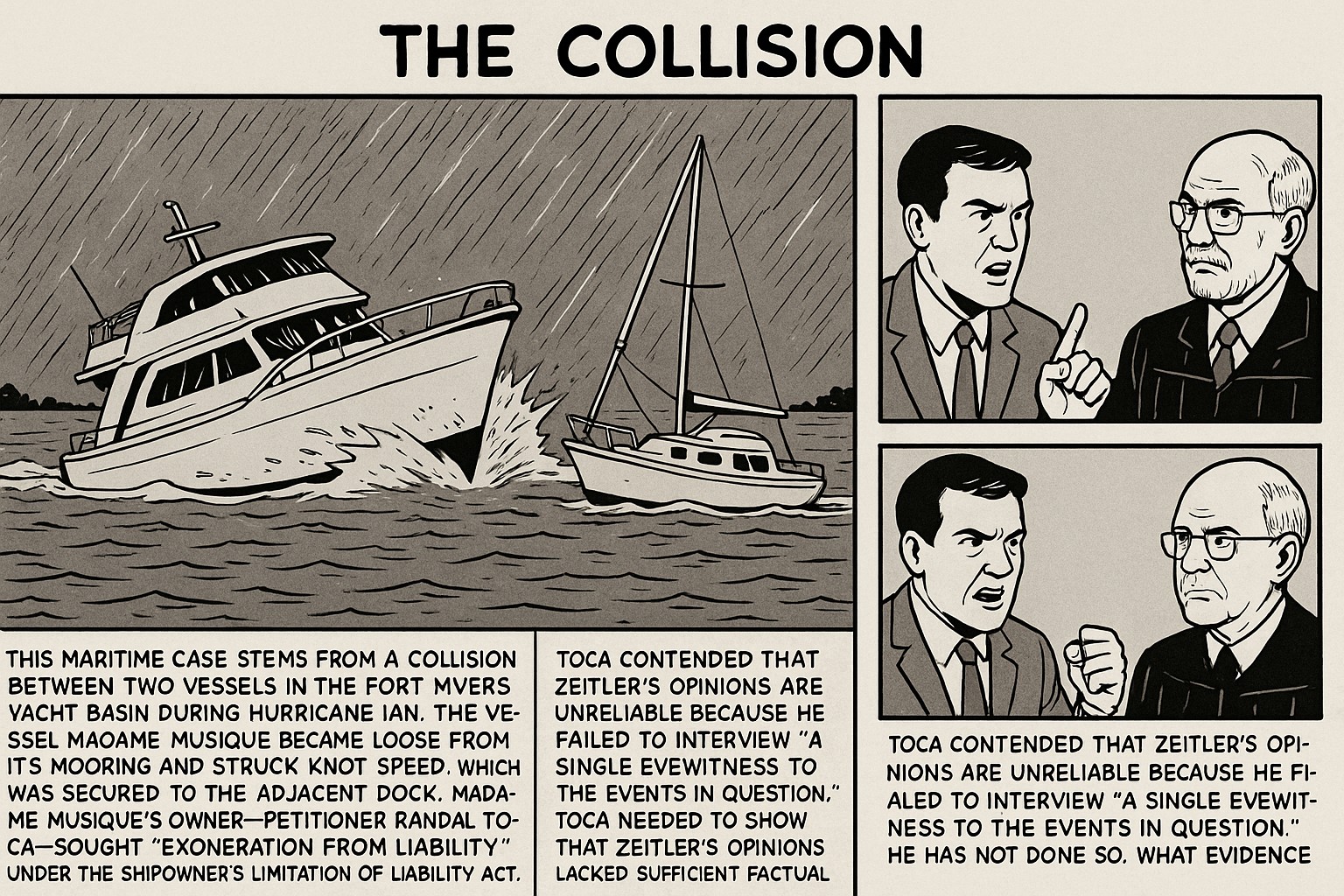
    This maritime case stems from a collision between two vessels in the Fort Myers Yacht Basin during Hurricane Ian. The vessel Madame Musique became loose from its mooring and struck Knot Speed, which was secured to the adjacent dock. Madam Musique’s owner—Petitioner Randal Toca—sought “exoneration from liability” under the Shipowner’s Limitation of Liability Act.

    Knot Speed’s owner Ted Hobson retained George M. Zeitler, a retired Coast Guardsman who spent most of his service conducting “commercial vessel safety inspections and casualty investigations.” 

    Zeitler inspected Knot Speed, the Yacht Basin, and reviewed the documentary evidence. He concluded that Madame Musique “was not adequately moored,” and as a result, it broke free from the dock, drifted across the yacht basin, and hit Knot Speed. According to him, the force of the collision, “combined with the prevailing winds and storm surge,” pressed Madame Musique against Knot Speed and caused it to “heel over” atop “multiple wood pilings,” which “penetrated [its] hull” and ultimately caused it to sink. 

    Toca filed a motion to exclude Zeitler’s testimony. Toca contended that Zeitler’s opinions are unreliable because he failed to interview “a single eyewitness to the events in question.” 

    Maritime Expert Witness

    George M. Zeitler is a graduate of the United States Coast Guard Academy. He spent twenty years in the service, primarily conducting the kinds of inspections and investigations performed here. He also spent a year “overseeing the pre-storm preparations for vessels in multiple South Florida ports.”

    Upon completing his service, Zeitler continued performing inspections and investigations as a consultant and started teaching courses on related subjects at the Chapman School of Seamanship.

    Want to know more about the challenges George Zeitler has faced? Get the full details with our Challenge Study report

    Discussion by the Court

    Toca contended that Zeitler’s opinions “lacked a sufficient factual foundation,” rendering them unreliable, since they were formed “without interviewing any individuals who were actually present when the damage to the Knot Speed occurred.”

    It is not clear to the Court that the alleged information gap exists, as Zeitler reviewed—and considered—the summaries of the opposing expert’s interviews with the relevant witnesses.

    While Zeitler perhaps should have interviewed the witnesses, the Court found that his failure to do so did not warrant excluding his testimony in this case.

    Held

    The Court denied Toca’s Daubert motion in limine to exclude the testimony of George M. Zeitler.

    Key Takeaway:

    Toca needed to show that Zeitler’s opinions lacked sufficient factual foundation. He has not done so. What evidence an expert did, or did not, consider generally affects the weight of their testimony, not its admissibility. 

    Case Details:

    Case Caption: Toca V. Debonair Properties LLC
    Docket Number: 2:23cv303
    Court Name: United States District Court, Florida Middle
    Order Date: July 28, 2025
  • Autopilot Misuse Went Unchecked by Tesla, Expert Claims

    Autopilot Misuse Went Unchecked by Tesla, Expert Claims

    The Plaintiff, Neima Benavides, sued Tesla, Inc. after Naibel Benavides Leon was killed and Dillon Angulo was seriously injured when a Tesla Model S went through a T-intersection in Key Largo and off the pavement, striking their parked Chevrolet Tahoe as they were standing next to it.

    George McGee, the driver of the Model S, had engaged the driver-assistance system, but had dropped his mobile phone and wasn’t watching the road while reaching for the device on the floorboard.

    Mary “Missy” Cummings, an engineering professor at George Mason University is of the opinion that Tesla Inc. has fallen short in safeguarding against the dangerous misuse of its Autopilot system—raising serious concerns about safety and accountability on the road.

    She also noted that even before the crash, Tesla was grappling with drivers routinely ignoring its system’s warnings. Yet, unlike other automakers, the company had resisted adopting geo-fencing technology that would prevent drivers from using Autopilot on roads where it wasn’t meant to be activated.

    Systems Engineering Expert Witness

    Mary Louise “Missy” Cummings was one of the U.S. Navy’s first female fighter pilots. She is now the director of Mason’s Autonomy and Robotics Center (MARC) and a professor at George Mason University. Cummings also holds faculty appointments in the Mechanical Engineering, Electrical and Computer Engineering, and Computer Science departments. She is an American Institute of Aeronautics and Astronautics (AIAA) Fellow and recently served as the senior safety advisor to the National Highway Traffic Safety Administration.

    Cummings received her BS in Mathematics from the U.S. Naval Academy in 1988, her MS in Space Systems Engineering from the Naval Postgraduate School in 1994, and her PhD in Systems Engineering from the University of Virginia in 2004.

    Get the full story on challenges to Missy Cummings’ expert opinions and testimony with an in-depth Challenge Study

    Discussion by the Court

    In a letter to NHTSA, Tesla asserted that “Autopilot has the most robust set of warnings against driver misuses and abuse of any feature ever deployed in the automotive industry.”

    Cummings told the jury, “I saw no evidence that would back up this claim that they have the most robust set of warnings.”

    Cummings has served as an expert witness in at least two other lawsuits against Tesla related to the Autopilot system, according to Court filings.

    But when Cummings was appointed as a safety adviser to NHTSA in 2021, Elon Musk dismissed her as “extremely biased against Tesla,” sparking backlash from Tesla loyalists—some of whom even launched a petition to block her appointment.

    The professor recalled that McGee was adamant—he believed the car was his copilot and would automatically stop for any obstacles. Like many Tesla drivers, she said, McGee placed his trust in Autopilot to take over when he dropped his phone, expecting the system to safely steer and react on its own.

    Key Takeaway:

    Safety expert Mary “Missy” Cummings took the stand with a sharp critique of Tesla’s Autopilot strategy, testifying that the company has failed to do enough to prevent drivers from misusing the technology. She pointed out that Tesla’s owner’s manual is difficult for drivers to access, and even before the crash, the company struggled with drivers ignoring critical computer-generated warnings. According to Cummings, Tesla made a calculated decision in 2019 not to geofence its technology—a move she believes was driven by the desire to boost sales rather than ensure safety.

    Case Details:

    Case Caption: Benavides V. Tesla, Inc
    Docket Number: 1:21cv21940
    Court Name: United States District Court, Florida Southern
  • Fire Investigation Expert’s Opinion on Damage to the Residence Admitted

    Fire Investigation Expert’s Opinion on Damage to the Residence Admitted

    On January 21, 2021, a fire destroyed Jacqueline Flynn’s home located at 7618 Craig Court in Orlando, Florida. The Plaintiff purchased a Thermacell Patio Shield on the day of the fire. Since the Patio Shield was the only energized device in use on the balcony at the time of the fire, the Plaintiff filed her complaint alleging negligence and strict products liability against the Defendants as a result of the Fire.

    The Defendants, Thermacell Repellants, Inc. and Lowe’s Home Centers, LLC filed a Daubert motion to exclude the opinions of Plaintiff’s fire cause and origin expert, Patrick B. Dugan, under Rule 702.

    Fire Investigation Expert Witness

    Patrick B. Dugan, CFI  is a Certified Fire Investigator through the International Association of Arson Investigators and the National Board on Fire Service Professional Qualifications. He is also a Certified Fire and Explosion Investigator and Certified Vehicle Fire Investigator through the National Association of Fire Investigators. In addition, Dugan holds an HVAC Technician certification through the United States Environmental Protection Agency.

    Dugan retired as Deputy Chief and Platoon Commander of the Schenectady Fire Department in 2002 after a 33-year career. Prior to that, he served as deputy chief of training, fire captain, paramedic lieutenant, and fire lieutenant of the same department.

    Want to know more about the challenges Patrick Dugan has faced? Get the full details with our Challenge Study report

    Discussion by the Court

    Dugan offered several opinions regarding the cause and origin of the
    fire. The site inspection was followed by a laboratory examination of fire debris in July 2021 and January 2024. While Dugan did not find remnants of the Patio Shield, he explained that its components are plastic, metal, and butane, which is highly flammable, and that there could be microscopic ceramic components. Dugan also factored weather conditions into his analysis and determined that an eight-mile-per-hour wind was present and sufficient to spread the fire. He also testified that he found no evidence of an electrical source starting the fire.

    Dugan ruled out arson, noting that the Flynn’s owned the home for 18 years before the fire, there was no mortgage on the residence, they had good credit, and the home had never been on the market for sale. He further noted that all indications were that the fire was accidental and was caused by the Patio Shield. Consequently, he testified that a “heavy fire load” was present in proximity to the Patio Shield, consisting of wicker on the table, cushions on the chairs, and plastic coverings. Dugan did not identify any other ignition source aside from the Patio Shield, causing him to identify the product as the fire source.

    Dugan testified that the burn patterns supported his opinion that the Patio Shield caused the fire. Moreover, he concluded that the fire started at the table area, and debris from the table started to burn and dropped down, catching the floor and chairs on fire. He noted that Chapter 19.4.4.3 of NFPA 921 provides that there are circumstances where the ignition source cannot be identified, but the ignition sequence can be logically inferred.

    Analysis

    The Defendants argued that Dugan did not find remnants of the Patio Shield or PIC Coil. However, this criticism ignored Dugan’s explanation that the components of the Patio Shield are combustible and were easily dispersed by the water suppression efforts. As for the PIC Coil, Flynn testified she did not ignite the PIC Coil, and the Defendants offered no competent evidence to the contrary.

    The Defendants further argued that Dugan’s opinions regarding the cause of the fire should be excluded because he did not remove the outlet to examine it before ruling it out. However, Dugan testified that the outlet was destroyed in the fire.

    The Defendants also sought to exclude Dugan’s statement that the “observations of the witnesses and responding firefighters were also consistent with a fire that began in the area of the product” on the balcony.
    Lieutenant Lizbeth Desio, the first firefighter on the scene, testified that based upon her observations at the scene, there is no indication that the fire began anywhere other than the second-floor patio. Neither party identified the statement of any other witness who observed the location of the fire. LT Desio’s statement that fire was observed emitting from the rear, second-floor, balcony of the home, was consistent with Dugan’s opinion that the first responder concluded the fire began in the area of the product on the balcony. The Court denied the motion to exclude Dugan’s opinion that witnesses and first responders concur with his conclusion.

    Because Dugan inspected the scene and provided a detailed description of the damage caused by the fire, the Court denied the Defendants’ request to exclude Dugan’s opinion that the fire caused extensive smoke, fire, and thermal damage to the interior and exterior of the residence.

    Held

    The Court denied the Defendants’ motion to exclude the testimony of Plaintiff’s fire cause and origin expert, Patrick B. Dugan.

    Key Takeaway:

    Dugan’s investigation and analysis easily satisfied Daubert’s mandate that an expert employ a “sufficiently reliable” methodology. His opinions are based on sufficient facts and data; he did not unjustifiably extrapolate his research to reach an unfounded conclusion; he considered—and ruled out—contradictory data (other known ignition sources); his analysis was based on objective data including burn patterns, weather, timing, and available ignition sources, and Dugan is as careful as an expert would be in conducting professional work outside the context of paid litigation. Basically, the Defendants’ criticism of Dugan’s methodology and resulting opinions goes to the weight that the jury may give such testimony—not its admissibility.

    Case Details:

    Case Caption: Flynn V. Thermacell Repellents, Inc. Et Al
    Docket Number: 6:23cv1890
    Court Name: United States District Court, Florida Middle
    Order Date: July 28, 2025