This lawsuit arises out of Port Arthur’s decision to designate Sassine Avenue as a “no truck route.” Kirk Thomas (“Thomas”) and KT Trucking and Cattle, LLC (“KT Trucking”) (collectively, “Plaintiffs”) engaged in various agricultural and commercial activities on Thomas’ property, including a land farming operation and the management of his personal trucking business. As a result, large commercial vehicles frequently entered and exited the property. Plaintiffs asserted that the only safe way for these vehicles to access the property was via Sassine Avenue. However, Port Arthur’s designation prohibited large commercial vehicles from using the road.
On May 20, 2024, the City of Port Arthur, Texas (“Port Arthur”), and Flozelle Roberts (“Roberts”) (collectively, “Defendants”), designated John McInturff as a testifying expert, expecting him to support their position that Thomas’ use of Sassine Avenue did not constitute routine commerce.
In response, Plaintiffs filed a motion to exclude and/or limit the testimony of Defendants’ expert John McInturff. Thereafter, they submitted an amended motion to exclude and/or limit his testimony, wherein they attached exhibits they had omitted from the original filing.
Transportation Engineering Expert Witness
John McInturff is a civil engineer licensed in Louisiana and Texas. McInturff graduated with a Master of Engineering from Texas A&M University and has spent about 50 years, working specifically in highway, traffic, and transportation engineering. Currently, McInturff is a Principal Engineer at Kittelson, LLC, in College Station, Texas.
Plaintiffs styled their objections to McInturff’s testimony as two distinct claims. First, Plaintiffs asserted that McInturff’s testimony should be excluded because it was so speculative that it constituted the ipse dixit of the expert. Second, Plaintiffs maintained that McInturff’s testimony should be excluded because “the analytical gap between the facts and McInturff’s opinion on whether hauling drilling mud is routine commerce is vast.”
McInturff’s Reliability
Plaintiffs did not challenge McInturff’s reliability under the Daubert factors. Instead, they maintained that his testimony lacked reliability because it was based on insufficient facts and data. Plaintiffs claimed that McInturff not only failed to link his opinion regarding the characterization of Thomas’ use of Sassine Avenue to his knowledge and expertise as a civil engineer but also relied on erroneous and unsupported facts to arrive at his conclusions.
McInturff’s Report
In this case, Plaintiffs challenged McInturff’s conclusion regarding the definition of “routine commerce” under Port Arthur Ordinance 106-41(b)(13). The relevant ordinance stated that Port Arthur cannot prohibit a commercial vehicle from using a street for “the purpose of going directly to or from any residential, commercial or industrial establishment abutting on such street for purposes of routine commerce.”
Regarding what constitutes “routine commerce”, his report stated that:
“Trucks traveling to/from the Thomas property are not using Sassine Avenue for routine commerce such as trips for pickup or deliver of goods or services; i.e., delivery of a refrigerator purchased by a homeowner for delivery to their residence, FedEx/UPS deliveries, etc. Instead, the evidence provided to me suggests that the trucks are engaged in non-routine heavy hauling in connection with the disposal of drilling mud from discrete construction projects. The evidence further shows that these hauling activities included twenty-four hour operations involving repeated trips up and down Sassine Avenue from FM 365, which for purposes of traffic design and engineering, is also not routine commerce to be expected on a residential street like Sassine Avenue”.
McInturff Failed to Link his Opinion Regarding the Characterization of Thomas’ Use of Sassine Avenue to his knowledge and Expertise as a Civil Engineer
McInturff evaluates the use of Sassine Avenue from the perspective of a traffic design and engineering expert. Due to the residential nature of the area, McInturff opined that the routine commerce on Sassine Avenue is commerce that provides residential goods and services to that neighborhood.
From a traffic design perspective, McInturff’s report evaluates what constitutes “routine commerce” based on the type of street at issue, the surrounding area, and the type of commerce that street would be expected to withstand. Additionally, McInturff provides examples, stating that routine commerce on Sassine Avenue could include use of the road by package delivery services, such as FedEx or UPS. Since Sassine Avenue, as a residential road, was not designed to withstand repeated and long-term use by large commercial vehicles like the ones used in Thomas’ commercial endeavors, McInturff concluded that Sassine Avenue’s residential design combined with its unsuitability for use by large commercial vehicles demonstrated that Thomas’ commercial activity did not constitute routine commerce.
The Court held that Plaintiffs’ first contention fell flat because Defendants had set forth sufficient facts and data to bridge the alleged analytical gap between McInturff’s opinion and his expertise.
McInturff based his opinion on erroneous facts and data
Specifically, Plaintiffs asserted that McInturff did not base his opinion on “any information . . . other than his belief that the drilling mud is coming from discrete construction projects that sometimes include twenty-four-hour operations and involve repeated trips.” Plaintiffs then elaborated that there is no evidence that the drilling mud Thomas uses in his land farming operation comes from “discrete construction projects.” Rather, Plaintiffs maintained that the drilling mud results from laying pipelines and drilling for oil, practices that Plaintiffs contend are routine in Southeast Texas.
Plaintiffs contended that the repetitious nature of the trips demonstrated the routine nature of Thomas’ commercial activity.
Regardless of the mud’s origin, the parties agreed that Thomas commonly permits companies to dispose of drilling mud on his property as part of his land farming operation. The parties also agreed that large commercial vehicles are needed to haul drilling mud. In his report, McInturff did not highlight Plaintiffs’ hauling practices to establish that the mud resulted from discrete construction projects. Rather, McInturff discussed Thomas’ hauling practices to emphasize the inconsistency between Thomas’ use of Sassine Avenue and the common commercial activity in that area. In other words, the source of the drilling mud was inconsequential to McInturff’s opinion. The Court held that McInturff’s opinion that Thomas’ proposed use did not constitute “routine commerce” was sufficiently based on his knowledge of traffic engineering and design.
Held
While the Plaintiffs’ original motion to exclude the testimony of Defendants’ expert John McInturff was denied as moot, the Plaintiffs’ amended motion to exclude and/or limit the testimony of McInturff was denied by the Court.
Key Takeaway:
McInturff’s report reflected a thorough and methodical evaluation of the present case from the perspective of a civil engineer. McInturff explained why, based on his knowledge of traffic design and roadway engineering, he determined that Thomas’ proposed use of Sassine Avenue did not constitute routine commerce. McInturff relied on the design of the road, its residential designation, the relevant zoning ordinances, the residential nature of the surrounding area, and his knowledge of the germane traffic patterns and signals. Consequently, McInturff’s challenged testimony and his underlying opinion rely on the facts of the present case, the data provided, and his own expertise.
Please refer to the blog previously published about this case:
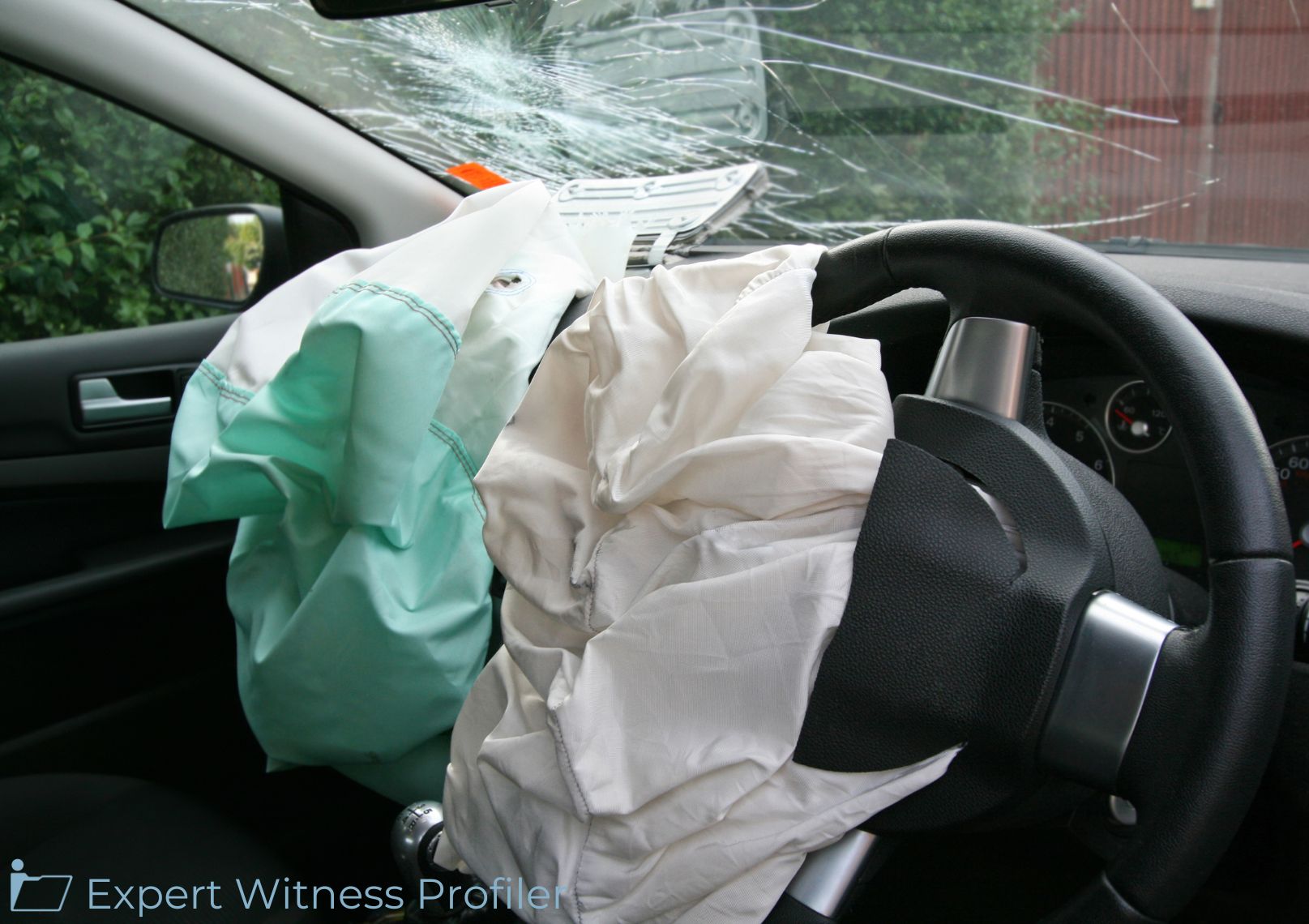
Plaintiff, William Harrison Sims’ claims arise out of an October 24, 2019, two-vehicle collision involving Plaintiff, who was operating the 2004 BMW (“Subject BMW”). Tameca Harris-Jackson (“Harris-Jackson”) was operating the Hyundai that collided with the Subject BMW. Plaintiff alleges he sustained “severe, permanent, and life-altering injuries” due to the driver-side Takata airbag unexpectedly rupturing and shooting “metal shrapnel into his face and body.”
Defendants procured and installed the airbag inflator during the process of “designing, manufacturing, assembling, and producing” the vehicle. Plaintiff brought this action for damages against both Defendants BMW of North America (“BMW NA”) and Bayerische Motoren Werke AG (“BMW AG”), alleging strict liability and negligence from procuring and installing the airbag.
Amanda Duran, P.E. is the Defendants’ accident reconstruction expert. Plaintiff argued that Duran postulated several scenarios regarding how Harris-Jackson was driving and elected, without a rational basis, to endorse the theory that best suited the defense.
Accident Reconstruction Expert Witness
Amanda Duran, P.E. has been working in the automotive engineering field, primarily focusing on the investigation and reconstruction of motor vehicle crashes.
From 2003 until the present, she has been an Engineer at Carr Engineering, Inc. In this role, she performed investigations to determine the causes, conditions, and circumstances of motor vehicle crashes. To date, she has personally been involved in analyzing the various aspects of more than 600 crashes, including more than 500 vehicle inspections and more than 400 scene inspections.
Plaintiff sought to exclude Duran’s opinion that someone failed to yield the right of way because she cannot determine who that someone is. Next, Plaintiff moved to exclude Duran’s opinion that he was driving in the southbound right-hand lane when the crash occurred, as opposed to the left-hand lane. Plaintiff argued Duran ignored the physical evidence that contradicts her opinion, rendering it unreliable, unhelpful, and irrelevant. Plaintiff also sought to eliminate Duran’s opinion that the driver of the Sonata, Harris-Jackson, accelerated from a stop at a slow or moderate rate before the collision.
A. Someone Failed to Yield the Right of Way
The defense conceded that Duran did not determine whether Plaintiff or Harris-Jackson failed to yield the right of way before the two vehicles collided. The defense added that Duran did conclude that “the impact speed of Harris-Jackson’s vehicle [is] consistent with her testimony that her vehicle was stationary before proceeding into the intersection.”
The Court was tasked with determining whether her testimony that somebody failed to yield the right of way survives the rigors of Daubertbut Duran’s opinion that Harris-Jackson’s vehicle was stationary before she turned to enter the highway was of little assistance.
Duran’s inability to determine which driver failed to yield the right of way failed the helpfulness prong of Daubert. The accident only occurred because one of the driver’s failed to yield the right of way. A jury does not need an expert to explain this fact. A collision at an intersection controlled by a traffic light occurs when one of the driver’s fails to yield the right of way. Accordingly, the Court held that Duran’s testimony did not concern a matter that is beyond the understanding of the average lay person.
The defense argued that Duran’s testimony that she was unable to determine which driver failed to yield the right of way is helpful simply because the parties disagree on who is at fault. The Court held that Duran’s testimony that she does not know who failed to yield the right of way does not have a tendency to make a fact more or less probable than it would be without the evidence. In other words, Duran has no opinion as to which driver is at fault.
B. Lane of Travel
Plaintiff challenged Duran’s opinion that he was driving in the southbound right-hand lane when the accident occurred, contrary to Trooper Ndoumbe’s assessment that Plaintiff was traveling in the left-hand lane.
Plaintiff argued that Duran’s opinion was not only unreliable, but also unhelpful because she conceded that Harris-Jackson could have accelerated from a stop at the stop bar with light or moderate acceleration rates and impacted Plaintiff’s BMW in either the right-hand or left-hand lanes.
Duran’s Methodology is Unreliable because She Failed to Account for Physical Evidence Placing the Plaintiff’s Vehicle in the Right Lane
Duran stated in her report that she did not identify any remaining evidence at the crash site relating to this accident. She did, however, review the accident report prepared by law enforcement. Duran also noted in her bullet-point summary of deposition testimony that Trooper Ndoumbe determined the area of impact by a “gouge on the roadway,” but the roadway has since been repaved. It should be noted that Duran did not factor the gouge mark and fluid identified by Trooper Ndoumbe into her analysis. It was never mentioned again in her expert report.
Duran Offered No Explanation for her Decision to Ignore Physical Evidence and the Troopers’ Testimony in Favor of Harris-Jackson’s Version of Events
Trooper Ndoumbe testified that the gouge mark and fluid were consistent with Plaintiff’s vehicle in the left lane at the moment of impact, as documented on his crash diagram.
While the parties did not explain the significance of Plaintiff traveling in the right lane versus the left, it appears from the above that if Plaintiff’s vehicle was in the left lane, this would support Harris-Jackson’s testimony that she proceeded from a stopped position and proceeded slowly. Hence, Duran’s observation that “[r]epeating the above analysis with lower separation speeds and the adjusted post-impact trajectories, the speeds were more consistent [if Plaintiff was in the right lane] with witness testimony and typical driving behavior.” Duran ignored the gouge marks and fluid identified by Trooper Ndoumbe.
Duran emphasized Harris-Jackson’s version of the events over physical evidence, thereby violating her working premise that “[t]he first step in reconstructing the subject crash and performing appropriate calculations to determine the speeds and Delta-Vs is to reconcile the physical evidence on the roadway, the photographs, and the vehicles.” Moreover, Duran offered no explanation for her decision to ignore physical evidence and the Troopers’ testimony in favor of Harris-Jackson’s version of events.
Analysis
The Court held that Duran failed to consider or account for contradictory data, which consisted of a gouge mark and fluid placing the initial point of impact in the left lane. Duran acknowledged in her report that “the first step” in reconstructing the accident and calculating the Delta-Vs is to reconcile the physical evidence with the analysis. She failed to do so, rending her analysis flawed.
Duran stated in her report that “if the Hyundai accelerated from a stop at the stop bar to the area of impact in either lane, with either light or moderate acceleration rates, it could have reached the range of both of our [Ponder and Duran’s] calculated speeds (13 to 24 MPH).” Whether Plaintiff was traveling in the left lane or right was of no consequence to Duran’s speed calculations.
C. Vehicle Speed
Plaintiff challenged Duran’s methodology in calculating the speed of the Hyundai and whether that speed was reached from a stopped position.
It was noted that Duran measured the radius of the typical path for a left turn onto the entrance ramp to be a radius of about 80 feet. Next, Duran calculated the force exerted on Harris-Jackson if she employed Plaintiff’s speed calculation as .05 G and ruled out this aggressive maneuver based on the forces and Harris-Jackson’s testimony.
Duran then used her speed calculation (13 to 25 MPH) and concluded that o.255 G would be applied if Harris-Jackson made the turn without stopping and the maximum speed would be approximately 18 MPH. Similarly, if Harris-Jackson proceeded to turn from a stopped position, applying light or moderate acceleration rates, the speed would be between 13 to 24 MPH.
Plaintiff was correct that Duran offered two competing opinions: either Harris-Jackson proceeded into the intersection from a stop or drove through. In both scenarios, Harris-Jackson would reach speeds within Duran’s calculated range and below the speed calculated by Ponder. The Court held that Duran’s opinion is helpful to the jury tasked with evaluating Harris-Jackson’s credibility. If Harris-Jackson testified she came to a stop before entering the intersection, Duran’s calculations support that testimony. Secondly, Duran’s calculations and opinions countered those of Plaintiff’s expert and went to the weight the jury will accord Ponder’s testimony. Alternative opinions are not per se unreliable or unhelpful.
Held
The Court granted in part and denied in part the Plaintiff’s motion to exclude the testimony of Amanda Duran.
Key Takeaway:
Duran committed the sin of omitting data—the gouge mark, fluid spill, the Trooper’s testimony, and cherry-picking data—giving undue weight to Harris-Jackson’s version of the events. Additionally, as Plaintiff noted, Duran’s opinion was unhelpful. Whether Plaintiff was traveling in the left lane or right was of no consequence to Duran’s speed calculations.
While Duran’s opinion regarding Plaintiff’s lane of travel ignored physical evidence, the opinion that Harris-Jackson proceeded into the intersection from a stopped position was, however, supported by a reliable methodology.
Plaintiff is correct that Duran offered two competing opinions: either Harris-Jackson proceeded into the intersection from a stop or drove through. However, Duran’s opinion is helpful to the jury tasked with evaluating Harris-Jackson’s credibility.
Please refer to the blogs previously published about this case:
Kirsten W. sought payment of benefits for her son C.W.’s treatment at Open Sky Wilderness Therapy (“Open Sky”) and Telos Residential Treatment Center (“Telos”) from Defendants California Physicians’ Service d/b/a Blue Shield of California (“BSC”). C.W. was admitted to Open Sky and Telos for treatment of his depression, anxiety, drug and alcohol use disorders, poor impulse control, and other self-destructive behaviors.
To evaluate coverage of Residential Treatment Center (“RTC”) level of treatment for children and adolescents, BSC has relied on various different criteria that were in effect during different periods. Of particular relevance, BSC utilized the 2018 MCG 21st Edition Residential Acute Behavioral Health Level of Care Guidelines (“MCG Guidelines”) and Version 20 of The Child and Adolescent Level of Care Utilization System Guidelines (“CALOCUS”).
Defendants denied Kirsten’s claims for coverage, relying on statements such as “there was never a significant risk that you would harm yourself or others,” and “there is no active suicidal ideation with intent or plan, homicidal ideation, or overt psychosis” to support the decision to deny benefits.
Plaintiff additionally claimed that Defendants violated the Mental Health Parity and Addiction Equity Act of 2008 (the “Parity Act” or “MHPAEA”) by applying acute requirements to subacute mental health treatment.
BSC disclosed Caitlin R. Costello as an expert for the purpose of providing opinions “regarding the clinical sufficiency of certain guidelines that [BSC] consulted when evaluating the medical necessity of the services allegedly provided to [C.W.].”
Given that Defendants relied on Costello in disputing Plaintiff’s purported MHPAEA violations, the Court first considers whether her report and opinions are admissible under Federal Rule of Evidence 702.
Psychiatry Expert Witness
Caitlin Costello is an associate clinical professor in the Division of Child and Adolescent Psychiatry, Department of Psychiatry, at the University of California, San Francisco. She also serves as the chief of child forensic psychiatry in the Psychiatry and Law Program at the University of California, San Francisco. Additionally, she is the medical director for child and adolescent ambulatory psychiatry at UCSF-West Bay. Costello is also the Training Director of the Child and Adolescent Psychiatry Training Program at the University of California, San Francisco.
She is licensed to practice medicine in the state of California and is certified by the American Board of Psychiatry and Neurology in General Psychiatry, Child and Adolescent Psychiatry, and Forensic Psychiatry.
In her expert report, Costello takes no position on whether the disputed services were “medically necessary.” Instead, she opined that utilization of the MCG Guidelines was “clinically appropriate for Blue Shield to consider” in its medical necessity evaluation.
Costello further opined that the MCG Guidelines did not focus solely, primarily, or improperly on acute symptomology, and that BSC’s reliance on the guidelines did not show any clinically improper focus on acute symptomology.
First, Plaintiff argued that Costello’s report did not compare analogous guidelines (such as those of skilled nursing facilities with the MCG Guidelines) and was thus unhelpful to the Court’s analysis. Second, Plaintiff argued that Costello’s report was unreliable because it ignored the language of the Plan and the relevant MCG Guidelines.
Costello’s Report did not Compare Analogous Guidelines
Plaintiff’s parity act claim is entirely based on her reading of the terms of the MCG Guidelines as requiring acute symptoms in contrast with treatment in a skilled nursing facility, which requires there be “no acute hospital care needs.”
Demonstration that the MCG Guidelines did not require “acute” symptoms was sufficient to defeat Plaintiff’s Parity Act argument. The Court held that Costello’s report is directly relevant to this point.
Costello’s Report was Unreliable because it Ignored the Language of the Plan and the Relevant MCG Guidelines
Plaintiff essentially argued that Costello’s opinion is incorrect as to whether the MCG Guidelines improperly focus on acute symptomology, based on an alleged lack of “citation to any evidence” and in light of a footnote that mentions “acute” symptoms.
First, the Court held that Costello did cite to the record—specifically the language of the applicable guidelines she opines on. Any interpretations of these guidelines, particularly as to whether they employ acute symptomology criteria, fell under her training and experience.
And it was not unreasonable for Costello to not specifically describe every footnote in her report that she did not believe would change her analysis, particularly when Plaintiff did not mention this footnote previously. A threshold showing of reliability did not mean the “expert’s testimony is ‘undisputably correct’ or without uncertainty.”
Plaintiff also argues that discussion of this footnote in Costello’s supplemental declaration attached to Defendants’ Opposition to Plaintiff’s motion for summary judgment amounts to “untimely” expert testimony because the text of the footnote was available upon review of the MCG Guidelines.
The meaning attributed to the footnote falls within “the contested issue of whether Blue Shield improperly applied guidelines that were too restrictive or otherwise inappropriate,” which Defendants disclosed Costello would testify regarding in their expert disclosures.
There was no indication prior to the summary judgment briefing that Plaintiff intended to argue that this single footnote altered the reasonable interpretation of the MCG Guidelines. Plaintiff also chose not to submit an expert report, a rebuttal expert report, or depose Costello.
Therefore, Costello’s declaration was appropriate to rebut Plaintiff’s new argument. Accordingly, the Court finds Costello’s report and opinions sufficiently reliable for the Court to consider regarding the language and meaning of the MCG Guidelines.
Held
The Court denied the Plaintiff’s motion to exclude the opinions of Dr. Caitlin Costello.
Key Takeaway:
A threshold showing of reliability does not mean the “expert’s testimony is ‘undisputably correct’ or without uncertainty.
Costello’s opinion is not incorrect in light of a footnote that mentions “acute” symptoms because it was reasonable for Costello to not specifically describe every footnote in her report that she did not believe would change her analysis, particularly when Plaintiff did not mention this footnote previously. Moreover, Costello does cite to the record—specifically the language of the applicable guidelines she opines on. Any interpretations of these guidelines, particularly as to whether they employ acute symptomology criteria, falls under her training and experience.
Plaintiff Deavrin Sneed (“Sneed”) filed this products liability case against Defendant Crown Equipment Corporation (“Crown”) after a workplace incident involving a Crown RC5500 Series stand-up rider forklift (the “subject forklift”).
Crown’s RC5500 stand-up, side-stance forklifts are used to move palleted materials in warehouse facilities. When operating the forklift, the driver stands sideways with their hands on the controls while leaning against a backrest. And they use their feet to operate the service brake and “power-on pedal.” The operator compartment is open (i.e., there is no door). Operators use the multi-function handle to control travel direction and speed. And they can stop the forklift by braking or using a technique called “plugging,” in which the operator pulls or pushes the multi-function handle in the opposite direction of the direction of travel to slow and stop the forklift.
Plaintiff Deavrin Sneed alleged that, while he was loading and unloading pallets with the subject forklift at a Target Distribution Center, it malfunctioned. The forklift accelerated unexpectedly at a high rate of speed, the brake mechanism failed, and Sneed crashed into a pole, resulting in severe injuries, including a partial leg amputation.
Sneed asserted the following claims against Crown:
(1) product liability – design defect
(2) product liability – manufacturing defect
(3) general negligence (including premises liability, failure to warn, improper supervision, and improper maintenance/inspection)
(4) negligent/faulty maintenance
(5) negligent/faulty repair work.
Sneed retained Dr. Jason Kerrigan and Robert Bullen as mechanical engineering expert witnesses to testify regarding purported design defects concerning the subject forklift.
Crown moved to exclude both opinions, claiming the experts were unqualified to render opinions regarding proposed design alternatives and that their opinions were unreliable.
Mechanical Engineering Expert Witnesses
Jason Kerrigan
Jason Kerrigan is the Commonwealth Professor of mechanical and aerospace engineering and the Director of University of Virginia’s Center for Applied Biomechanics (CAB).
Kerrigan’s research focuses on studying the epidemiology of public health problems related to human injury, characterizing the mechanical response of human tissues, identifying their thresholds for failure (injury), developing and improving mechanical and computational surrogates to study the risks of injury, and exploring countermeasures to mitigate human injury risk and severity.
Robert Bullen, P.E., J.D. is a licensed Professional Engineer with more than 25 years of experience in both the biomedical and mechanical engineering fields His experience includes machine design and industrial plant design, as well as experience as a manufacturing engineer in production environments. In addition to his engineering background, he also holds a Juris Doctor degree.
Kerrigan opined that the subject forklift was defective in design because of the forklift’s open operator compartment and the lack of an operator backrest sensor. He recommended that the subject forklift should be equipped with a door or enclosure and a backrest sensor for safety.
A. Kerrigan is Qualified
Crown asserted that Kerrigan has “little to no experience in the actual field of design or in the field of forklifts in general.”
It contended that Kerrigan admitted at his deposition that he “has never worked for a company that designs, builds, or manufactures stand-up rider forklifts,” “has never designed any component part of a stand-up rider forklift,” “has never published any articles that deal with forklift operation, safety, or design issues,” and “has never been responsible for making design decisions regarding the design of a stand-up rider forklift.”
Kerrigan stated that he began studying forklift designs in April of 2016 when he was retained in his first case involving a left lower extremity injury to the operator of a stand-up forklift. Since then, and over the last 8+ years, he has reviewed and studied deposition testimony, Defense and Plaintiff’s expert reports, and other materials produced during discovery in a total of 13 different civil litigation matters involving left lower extremity injuries sustained by operators of stand-up forklifts similar to the subject forklift in this matter.
Considering Kerrigan’s background and experience in engineering and mechanical design, and specifically his work concerning occupant protection and the impact of crash events in the automobile industry, the Court held that he is qualified to opine regarding the subject forklift’s design.
B. Kerrigan’s Opinions are Unreliable
Crown’s Arguments
Crown contended that Kerrigan’s opinions regarding the subject forklift’s design and specifically, the purportedly safer alternative designs that he proffers, should be excluded because they were unreliable.
Kerrigan proposed the addition of a physical enclosure or door to the operator compartment of the forklift and the inclusion of a backrest sensor.
Crown asserted that it was “fatal to Kerrigan’s proposed alternative design ‘concepts’ that he has provided nothing beyond speculation as to what type of operator compartment door or backrest sensor should be implemented on the Crown RC5500 and how they would be manufactured and implemented on the RC5500.” And he “has not and cannot provide any design details or show any reliable methodology regarding its untested and unengineered ‘concepts.’”
i) Untested and Unengineered Concepts
a)Backrest Sensor
Crown stated that Kerrigan “admitted that he has not developed any design drawings regarding where he would place a backrest sensor or what type of backrest sensor he would add to the Crown RC5500. Specifically, he testified that “I didn’t try to come up with a specific design of anything [regarding the backrest sensor].” He has not developed any prototypes or mockups, nor performed any testing whatsoever regarding his backrest sensor “concept.” In proffering his backrest sensor “concept,” Kerrigan did not apply a reliable—or indeed any—methodology as required by Daubert. Accordingly, his backrest sensor alternative design opinions must be excluded.”
b)Operator Compartment Door
Crown asserted that Kerrigan “also admitted that he has “not created any drawings of any designs [regarding compartment doors].” He further testified that he has not conducted any testing on a forklift equipped with a door. Specifically, he testified that “I haven’t done any testing of any doors at all in this scenario here.” Kerrigan further admitted that:
He has not determined the weight of the door he would add to the Crown RC5500;
He has not determined whether the door would be spring-loaded or latched; and
He has not determined the tension of the spring that would be required to keep the door shut.
Crown also pointed out that Kerrigan admitted that he had “performed no testing” for this case. Kerrigan stated that he had “not formed a specific opinion about all the factors that would need to be considered to implement design changes.”
ii) Failure to Establish Causation and Feasibility
Crown further contended that Kerrigan had not reliably established that an operator compartment door or a backrest sensor were safer alternative designs that would have prevented or significantly reduced the risk of Sneed’s injury under the specific circumstances of this accident.
In support of its contention, Crown stated that Kerrigan “admitted that he has no sketches, calculations, or measurements of the accident scene or the subject forklift and, in fact, has never even been to the accident scene. Further, he did not conduct a reconstruction of Plaintiff’s accident, nor did he even attempt to calculate the accelerations or speed of the forklift prior to the accident.”
Further, Kerrigan admitted that his backrest sensor “concept” would not have prevented Plaintiff’s injuries in this accident: “if the backrest sensor was there, I still think that some way that prevents the occupant from placing their extremities outside the running lines of the forklift while it’s moving would be required.” And regarding his operator compartment door “concept”, when asked whether, if a manufacturer added a door to a stand-up rider forklift, lower left leg injuries would still occur, he testified, “sure. Anything could happen.”
Analysis
When it became clear that Kerrigan’s advocacy for the addition of a physical door or enclosure to the operator compartment and a backrest sensor as feasible design alternatives lacked support from appropriate engineering work, product development, or testing, the Court held that his proposed alternatives were speculative concepts, insufficient to constitute an admissible expert opinion.
Also, it was noted that Kerrigan did not show that his proposed alternatives would have changed the outcome of this accident. And, while Kerrigan may have reviewed Crown’s accident data, the Court held that it is “not evidence of the alternative design’s superior safety because it did not involve similar forces and factors” as involved in Sneed’s accident.
Kerrigan has not met his obligation under Daubert to identify data supporting his opinions that an operator compartment door or a backrest sensor were feasible or that either would have changed the outcome of the incident at issue.
And, because Kerrigan has not connected his opinions to existing data, the Court agreed that Kerrigan’s proposed design alternatives are untested, based on unsupported speculation, and amount to ipse dixit.
II. Expert Robert Bullen, P.E., J.D.,
Bullen opined that the subject forklift’s design was defective and unreasonably dangerous because of the optical switch’s design for the multifunction control handle and the control module programming’s response to an event where there is an accelerator sensor error. Bullen suggested that the subject forklift should be equipped with a “more robust” optical switch and that the control module should be reprogrammed to respond to a hypothetical accelerator sensor error by automatically braking.
A. Bullen is Qualified
Crown contended that Bullen was not qualified by education or experience to render opinions regarding the subject forklift’s design.
It should be noted that Bullen’s experience has primarily concerned “biomedical engineering (both research and primary care) and consulting engineering for the design and construction of industrial manufacturing plants and code compliance issues.”
But Crown asserted that Bullen’s work has never “involved the consideration of how a forklift should be designed or how the electrical component within a forklift should be designed.” And it contended that Bullen admitted at his deposition that he “is not an electrical engineer and does not hold himself out” as one.
However, Sneed asserted that Bullen has dedicated a significant amount of time and study into Crown forklifts safety, safety design, and safety compliance.
Considering Bullen’s background and experience in engineering and work involving forklifts, the Court held that he is qualified to provide opinions regarding the subject forklift’s design.
B. Bullen’s Opinions are Unreliable
Crown’s Arguments
Crown contended that Bullen’s opinions regarding the subject forklift’s design and, specifically, the purportedly safer alternative designs that he proffers should be excluded because they were unreliable.
As discussed above, Bullen proposed incorporating a “more robust” optical switch and reprogramming the control module to respond to a hypothetical accelerator sensor error by automatically braking.
Crown asserted that it was “fatal to Bullen’s proposed alternative design ‘concepts’ that he provided nothing beyond speculation regarding whether the electrical optical switch he proposed was actually a safer design.” Additionally, “his opinion that Crown should modify the programming of the control module such that, in the event of an erroneous signal from the optical switches, the machine could be made to automatically brake, is entirely speculative because he has never installed this type of program or coding sequence in a forklift before, and never tested the ‘concept.’”
As to the “More Robust” Optical Switch
Crown stated that “Bullen admitted that he has never installed his proposed “more robust” optical switch on any forklift and tested the feasibility or application of his “concept”. In fact, he testified that he “would not recommend going through trying to redesign an entire feature around a different switch”. Most importantly, he testified that he does not even know what exactly caused the optical switch to allegedly malfunction in this accident. Bullen has not and cannot identify what the alleged “foreign body” was that allegedly caused the optical switch to malfunction. His use of the magic words “more likely than not” does not cure the purely speculative nature of that opinion. In proffering his “more robust” optical switch “concept”, Bullen does not apply reliable methodology as required by Daubert and, thus his conceptual alternative design opinion must be excluded.”
As to Reprogramming the Control Module
Crown asserted that “Bullen testified that he has not personally developed any program or revised coding to implement his proposed “concept”. He admitted that he has never implemented his proposed control module reprogramming on any stand-up rider forklift. His testimony that he has never reprogrammed any control module on a forklift, let alone a Crown RC5500, or tested any reprogrammed control module, is fatal to his proposed “concept”. Ultimately, Bullen’s optical switch and control module reprogramming “concepts” are completely speculative because he has provided no evidence that his alternative “concepts” would be safer.”
Crown further contended that Bullen did not reliably establish that a “more robust” optical switch or control module reprogramming would have prevented or significantly reduced the risk of Sneed’s injury under the specific circumstances of this accident.
Regarding Bullen’s Investigation of the Subject Accident
Crown stated that “Bullen admitted that he did not perform an accident reconstruction. He testified that he did not prepare any accident site survey. He further testifies that “the video didn’t have sufficient clarity for [him] to be able to look at specific movement. Ultimately, Bullen stated that he “didn’t feel that [the video] had enough clarity to specify any particular motion…”.
Bullen testified that he does not intend to offer any opinions regarding the specific accelerations that Plaintiff experienced during the accident sequence. He also has no opinion assessing how Plaintiff’s foot exited the operator compartment. Bullen also has no opinion regarding whether the brakes failed at the time of Plaintiff’s accident. Bullen testified that he has no opinion when Plaintiff began to “plug” or when Plaintiff first applied the service brake. He has no opinion regarding the speeds that the Crown RC5500 was traveling during the accident sequence.”
Support for Crown’s Contention that Bullen Could Not Opine on Preventing Sneed’s Injuries
In support of its contention that Bullen could not opine that his proposed design alternatives would have prevented Sneed’s injuries, Crown contended that “Bullen testified that he has not done a full analysis of whether or not the optical switch was receiving an electrical signal at the time of the accident. In trying to replicate what he believes caused the accident, Bullen performed ten tests at a post-accident inspection of the subject Crown RC5500 to determine if the signal in the optical switch was occluded or interfered with, and all ten tests showed that the optical switch signal worked properly as expected.
When asked if the type of accident Plaintiff experienced could still occur with his proposed optical switch “concept”, Bullen admitted that there is “absolutely” the potential for dust or debris buildup which could interfere with the electrical signal even if his proposed “more robust” optical switch “concept” was implemented into the subject RC5500.
He admits that even his “more robust” optical switch would not have prevented this accident as required under Texas law. Moreover, Bullen testified that he does not know what exactly caused the optical switch to allegedly malfunction. Because Bullen cannot even identify the foreign body, he has not attempted to replicate that alleged foreign body to test whether it would have made any difference in this accident sequence. Bullen’s “more robust” optical switch “concept” is completely speculative and he categorically cannot opine that this “concept” would have prevented Plaintiff’s injuries here.”
Regarding the Control Module Reprogramming Concept
Defendant also stated that regarding his control module reprogramming “concept”, “Bullen opines that the control module should be reprogrammed so that when an accelerator sensor error is displayed on the RC5500, the full brakes should be immediately engaged. But, as stated above, he has not personally developed any program or revised coding or implemented his proposed control module reprogramming on any stand-up rider forklift.”
Crown argued that “Because he has conducted no analysis of the accident sequence, Bullen cannot articulate how the accident occurred, let alone how reprogramming the control module to immediately apply full braking in response to an alleged accelerator sensor error would have prevented this accident.”
Analysis
Bullen’s opinions are unreliable for reasons similar to the reasons that the Court determined that Kerrigan’s are unreliable.
Bullen admitted that he did not install his “more robust” optical switch on an actual forklift to test its feasibility or application. And he did not implement his proposed control module reprogramming in a stand-up rider forklift.
And, so, without support (such as product development or testing) that the “more robust” optical switch or control module reprogramming would have been feasible with respect to the Crown RC5500 forklift, the Court held that Bullen’s proposals cannot be classified as safer alternative designs but are rather speculative concepts.
Moreover, Bullen also did not show that his proposed alternatives would have changed the outcome of this accident.
As Crown pointed out, he admitted that there is “absolutely” the potential for dust or debris buildup that could interfere with the electrical signal even if the “more robust” optical switch was implemented. And, because Bullen’s analysis of the sequence of events leading up to the accident is, at best, incomplete, and he cannot identify with certainty how the accident occurred, he is unable to show that reprogramming the control module to automatically brake in the event of an accelerator sensor error would have prevented it.
The Court held that Bullen’s proposed design alternatives are untested and based on unsupported speculation. And he has not met his obligation under Daubert to identify data supporting his opinions that a “more robust” optical switch or reprogramming the control module would have changed the outcome of this accident.
Held
The Court granted the Defendant Crown’s motions to exclude the proposed opinions of Plaintiff’s mechanical engineering expert witnesses, Jason Kerrigan and Robert Bullen.
Key Takeaway:
While both mechanical engineering expert witnesses, Jason Kerrigan and Robert Bullen were deemed qualified, their opinions were unreliable under the Daubert standard because their proposed design alternatives lacked the support of actual engineering work and testing.
It was not established exactly how Kerrigan’s suggested operator compartment door or backrest sensor theory, and Bullen’s proposed ‘more robust’ optical switch and control module reprogramming theories, would have changed the outcome of this accident.
Case Details:
Case caption:
Sneed V. Crown Equipment Corporation Et Al
Docket Number:
3:23cv743
Court:
United States District Court for the Northern District of Texas, Dallas Division
SFR Services, LLC (“SFR”) sued American Coastal Insurance Company (“ACIC”) for breach of an insurance policy (the “Policy”) based on ACIC’s failure to provide coverage and remit payment for damage sustained by Steamboat Bend Condominium Association, Inc. (“Steamboat Bend”) during Hurricane Irma. SFR is the assignee of Steamboat Bend’s rights under the Policy.
Plaintiff’s expert Grant Renne conducted a virtual inspection assisted by Durant Saint-Hilaire, a certified roofing inspector who was on-site during the inspection. Renne’s methodology complied with standard practices and used data from the National Oceanic and Atmospheric Administration (NOAA) and the National Weather Service (NWS). Renne’s report stated that his methodology was “based on ASTM E2713-18 (Standard Guide to Forensic Engineering), ASTM E1188-11 (Standard Practice for the Collection and Preservation of Information and Physical Items by a Technical Investigator), and E620-18 (Standard Practice for Reporting Opinions of Scientific or Technical Experts).” Renne prepared his report through “visual inspection of readily observable surfaces, collection of digital evidence, and rotation of roof tiles to determine attachment integrity.”
Renne testified that he excluded from his analysis areas of prior repairs and areas of prior destructive testing. Renne’s report ultimately concluded that Hurricane Irma caused the damage.
ACIC argued that the report should be excluded because Renne’s inspection was done virtually and that Saint-Hilaire, the certified roofing inspector who was on-site during the inspection, did not possess the necessary qualifications. ACIC also argued that Renne’s report was based on insufficient facts and data because he did not interview unit owners and residents or review repair records related to the property, in contravention of the ASCE, ASTM, and his own report. ACIC’s final argument in favor of exclusion is that, because destructive testing was already done prior to Renne’s inspection, Renne’s conclusions were unreliable.
ForensicEngineering Expert Witness
Grant Renne has been a Registered Professional Engineer since 1990, completed over 6,000 property damage investigations throughout his career, and participated in over 400 cases.
Renne’s conclusion that Hurricane Irma caused the damage is based on his review of the buildings, velocity pressure calculations based on the American Society of Civil Engineers (ASCE) 7-10 formula, and historic NOAA weather data.
Renne’s Reliance on Virtual Evidence Does not Inherently Bar his Testimony
At the onset, the Court rejected ACIC’s arguments regarding the virtual nature of the inspection and the destructive testing. An expert’s reliance on virtual evidence does not inherently bar his testimony.
Also, Saint-Hilaire possessed the technical qualifications required to participate in the on-site investigation. Renne testified that he never performed destructive testing, as the ASTM does not allow for destructive testing because the investigation cannot be repeated, tested, or verified. The fact that destructive testing was performed prior to Renne’s investigation did not render his investigation unreliable.
Renne’s Failure to Interview Involved Parties did not make his Report Unreliable
The Court rejected ACIC’s argument that Renne’s failure to interview these involved parties made his report unreliable. ASCE 30-14 stated that it only needs to be done “whenever possible,” not in all circumstances. However, the Court recognizes that Renne’s report is somewhat confusing, as he stated “[t]he following list of standard practices [were] performed” and then lists that “an interview with the property owner may be conducted either on site or via telephone.” Thus, the Court held that any discrepancies between Renne’s report and testimony should be addressed on cross-examination at trial. It goes to his credibility, not the admissibility of his testimony.
Although Renne’s Review of the Repairs was Less than Thorough, that Alone does not Garner Exclusion of his Report
At the crux of ACIC’s issue with Renne’s report is his failure to review repair records from repairs made by Steamboat Bend, despite his review of repair documents related to repairs made by SFR.
ACIC also argued that Renne should not have excluded the areas of repair and deemed it contaminated evidence “unworthy of consideration in the formulation of his opinion.”
Renne testified that he relied on ASCE 30-14. ASCE 30-14 requires inspectors to “obtain and analyze any written documentation for alterations and repairs.” Renne’s report details that “areas of pre-loss repairs and/or post-loss mitigation [were] reviewed.”
Indeed, Renne testified that he reviewed SFR’s repair records and visually reviewed repairs during his investigation. The Court concluded that, although Renne’s review of the repairs was less than thorough, that alone does not garner exclusion of his report as there was “adequate evidence that had not been repaired for him to formulate his opinion.”
Held
The Court denied the Daubert motion to exclude the testimony of Grant Renne without prejudice. ACIC may renew the motion as a motion in limine closer to trial.
Key Takeaway:
Renne’s report is not the model for clarity, yet “experts and their opinions need not be perfect to be admissible.” Renne’s application of his methodology is not so unreliable that the Court should exclude it out of hand. ACIC’s issues with Renne’s report can be used during cross-examination to potentially decrease the weight and credibility the jury gives to his opinion.
Case Details:
Case Caption:
SFR Services, Llc V. American Coastal Insurance Company
Plaintiffs, ECB USA, Inc. and Atlantic Ventures Corp. accused Savencia and Zausner, together with other persons and entities, of commiting a series of tortious acts, including, but not limited to, looting the assets of Schratter Foods Incorporated (“Schratter”), then fraudulently inducing Plaintiffs into executing an agreement to purchase all of Schratter’s shares (the “Stock Purchase Agreement”).
Knowing that the ECB representatives had no experience with cheese and dairy products and were not eligible to work in the United States, Savencia and Zausner, along with other co-conspirators, induced the ECB Representatives to enter a fiduciary relationship with Alain Voss, and then induced Plaintiffs to partner with Voss in the purchase of Schratter. The ECB Representatives, and ultimately Plaintiffs, put their trust and confidence in Voss, who, in turn, colluded with Zausner, Savencia and other co-conspirators in the commission of frauds and other tortious acts.
A key issue in the case is whether, prior to Schratter’s sale, Defendants secretly “stripped” Schratter’s Chief Executive Officer Voss of certain of his powers and duties as CEO and then “lied” to Plaintiffs’ by holding “Voss out as Schratter’s trusted, knowledgeable, and effective chief, for the purpose of persuading [Plaintiffs’] representatives to accept Voss as a fiduciary and to partner with him to purchase Schratter.
Plaintiffs hired Jonathan Macey to provide “opinions on corporate governance and ordinary and customary corporate behavior.” Defendants filed a Daubert motion to exclude Macey’s opinions and testimony because his opinions were unreliable and did not “fit” the facts of the case.
On March 22, 2024, Magistrate Judge Christopher Burke issued a memorandum order granting Defendants’ Daubert motion (“the Order”).
Objections to the Order
The order determined that Macey’s opinions did not fit the facts of the case because they were neither relevant nor would assist the trier of fact. Plaintiffs filed objections to the order on April 5, 2024. On April 19, 2024, Defendants filed a response to Plaintiffs’ objections. Pursuant to Federal Rule of Civil Procedure 72(a), the Court now considers the objections and responses and may “modify or set aside any part of the order that is clearly erroneous or is contrary to law.”
Corporate Law Expert Witness
Jonathan R. Macey is Sam Harris Professor of Corporate Law, Corporate Finance, and Securities Law at Yale University and Professor in the Yale School of Management. Professor Macey earned his B.A. cum laude from Harvard in 1977, and his J.D. from Yale Law School in 1982, where he was Article and Book Review editor of TheYale Law Journal. In 1996, Professor Macey received a Ph.D. honoris causa from the Stockholm School of Economics.
Professor Macey has taught at major universities throughout the world, including Bocconi University (Milan), the University of Tokyo; the University of Toronto; the University of Turin, the University of Amsterdam Department of Finance, and the Stockholm School of Economics, Department of Law. He also has been Professor of Law at the University of Chicago (1990) and Visiting Professor of Law at Harvard Law School (1999). In 1998, he received the D.P. Jacobs prize for the most significant paper in volume 6 of the Journal of Financial Intermediation for his paper (co-authored with Maureen O’Hara), “The Law & Economics of Best Execution.”
Macey provided two principal opinions in his report:
Based on commonly understood conceptions on the role of the CEO in business organizations such as [Schratter], Alain Voss was not actually the CEO of Schratter during the period beginning June 30, 2014 and continuing through December 31, 2014, as the term ‘CEO’ is universally understood in business. During the foregoing period Voss was the CEO of Schratter in name only, without the usual responsibilities, authority, and duties associated with that position.”
Analysis of the quality of management of the company being acquired (the target company) is a critical consideration in making a corporate acquisition where the acquisition is being done with management in place. An inevitable implication of this analysis is that the identity of a company’s CEO should be fully and accurately disclosed, including, but not limited to, in the governing documents of the target company. To the extent that a selling entity makes disclosures about the quality of management, such disclosures should be accurate.”
Analysis
Although Plaintiffs argued that Macey’s opinion is “necessary for the jury to fully understand the role of a CEO as that term is used ‘in business,’ Macey’s opinion about the role of some CEOs did not relate to a “pertinent inquiry in the case.”
Plaintiffs asserted that the order misinterpreted Plaintiffs’ allegations about Voss, “erroneously found that Macey’s opinions regarding the importance of senior management, including a CEO, in an acquisition with management in place, are irrelevant,” and “made an unfounded assumption that a lay person would know what a CEO’s role and duties truly are in business.”
The pertinent inquiry in this case is whether Defendants are liable for fraudulent misrepresentations or omissions made about Voss’s pre-closing role. To answer that inquiry, the jury will need to know what Voss’s role at Schratter was throughout 2014, if that role changed, and “the extent to which facts about Voss’s role were disclosed to Plaintiffs.”
The Court held that information about what CEOs do, generally, is entirely irrelevant as to whether Defendants made material misrepresentation about Voss’s role.
Additionally, to succeed on their fraud claims, Plaintiffs must prove that Defendants’ misrepresentations about Voss’s role were material to Plaintiffs’ decision to retain Voss.
The order concluded that Macey’s opinion could not aid jurors in assessing the materiality element because Macey cannot opine on whether the alleged omissions and misstatements about Voss’s role were important to the specific Plaintiffs in this case. The Court held that Macey was not involved in the decision to retain Voss and thus cannot testify as to the state of mind of those who made the decision. Instead, it is only Plaintiffs, and Plaintiffs’ fact witnesses, who can prove that the alleged misrepresentations and omissions were material to their decision to retain Voss.
Held
The Court overruled the Plaintiffs’ objections to Magistrate Judge Christopher Burke’s memorandum order with regard to the testimony of Jonathan Macey.
Key Takeaway:
The Court agreed with Christopher Burke’s thorough analysis on the issue. To begin with, Macey’s opinion about the role of some CEOs did not relate to a “pertinent inquiry in the case.” Information about what CEOs do, generally, is entirely irrelevant as to whether Defendants made material misrepresentation about Voss’s role.
Moreover, Macey was not involved in the decision to retain Voss and thus cannot testify as to the state of mind of those who made the decision.
Please refer to the blogs previously published about this case:
The present case involves an insurance coverage dispute between an East Texas church, Plaintiff Christian Heritage School c/o Youth With a Mission, and its insurance company, Central Mutual Insurance Company. Between May 1, 2020, to May 1, 2022, Defendant insured Plaintiff’s property, which consisted of a twenty-one building campus in Tyler, Texas. The dispute arises from alleged storm-related damage with a date of loss on April 5, 2022.
Plaintiff designated Kevin Dandridge of Line Safety as a retained expert to testify as to the proper Occupational Safety and Health Administration (‘OSHA’) protocol and procedures that must be implemented when repairing and/or replacing Plaintiff’s property.
Defendant filed a motion to exclude Dandridge from offering testimony as to (1) the cost for OSHA compliance for repairs to claimed damage on the campus sustained on April 5, 2022; or (2) the cost for OSHA safety protocols and procedures for buildings that he did not inspect.
Safety Expert Witness
Kevin Dandridge completed 510 and 500 OSHA certifications. He is able to certify students in 10 and 30‐hour courses. He has a bachelor of science degree in business management from the University of Phoenix in 2008.
Inclusion of a Line-Item Cost Sheet was Not Prejudicial to Defendant
While the majority of Dandridge’s report mostly relates to OSHA safety concerns and protocols, the last ten pages of his report, however, outlines the line-item costs associated with OSHA compliance.
The Court has to decide whether this is outside the scope of testimony for which he has been designated. Dandridge was designated as an expert to testify as to the proper OSHA safety protocol and procedures that must be implemented when repairing and/or replacing Plaintiff’s property.
Because the designation includes implementations for repair/replacement, it logically follows that Dandridge would have included a line-item cost sheet for adhering to OSHA compliance protocols. Thus, the Court cannot say that the inclusion of such a sheet was inherently prejudicial to Defendant in this case or that Defendant was not fairly apprised of this. Indeed, the sheet was disclosed in Dandridge’s report and Defendant deposed Dandridge and specifically inquired about the generation of the cost sheet.
Dandridge’s Opinion is Not Unreliable Because He Conceded that his Cost Report includes a Sheet that is simply an “Example” and is not Final Pricing
Defendant argued that Dandridge’s opinion is unreliable because he conceded that his cost report includes a sheet that is simply an “example” and is not final pricing. Defendant also pointed out that Dandridge admitted that OSHA compliance may have already been included in some construction estimates, but he did not examine any estimate to determine to what extent those costs were already accounted for.
The fact that Dandridge included a cost sheet in his report as exemplary does not make his opinions on OSHA safety protocols and procedures inherently unreliable. Indeed, the Court held that such a fact is precisely an issue that goes to the weight of his opinions, not the admissibility.
Lastly, Defendant wanted to limit Dandridge’s testimony to the buildings he actually inspected because he only inspected 11 buildings, but the lawsuit included 20 buildings. Plaintiff responded by pointing out that Dandridge has limited his opinions to only the 11 buildings he inspected. Thus, the issue appears to be moot as Plaintiff agrees his testimony is limited to these 11 buildings, and Defendant does not address this response in its reply. Nonetheless, the Court held that the inspection of 11 buildings alone is not a basis to exclude Dandridge’s testimony.
Held
The Court denied the Defendant’s motion to strike the testimony of Kevin Dandridge.
Key Takeaways:
The line-item costs associated with OSHA compliance was disclosed in Dandridge’s report and Defendant deposed Dandridge and specifically inquired about the generation of the cost sheet. Thus, the Court cannot say that the inclusion of such a sheet was inherently prejudicial to Defendant in this case or that Defendant was not fairly apprised of this.
Defendant’s attack on Dandridge using a “not final” cost sheet in his report was misplaced because Dandridge was designated to provide expert testimony on OSHA safety protocols and their associated costs, not to provide final cost estimates.
Please refer to the blog previously published about this case:
In a civil RICO lawsuit, Plaintiff Allstate Insurance and its affiliates sued Defendants Dr. Ayman Tarabishy and his medical clinic, Ayman Tarabishy, M.D., PLLC, (doing business as Enhance Center). Allstate alleged that the Defendants orchestrated a racketeering scheme to exploit Michigan’s no-fault insurance law by generating and submitting fraudulent medical bills for reimbursement.
Allstate retained Dr. Wilfred Hynes “to testify regarding the fact, extent, and causation of the alleged services for which Allstate was billed [by the Defendants] relative to patients at issue in this action . . . the medical necessity and reasonableness of the services billed by the Defendants; the billing submitted by the Defendants; and any other subjects or opinions referenced in his report, supplemental report, or in subsequent deposition testimony, including reasonable inferences and summaries arising therefrom.”
On September 8, 2023, Allstate disclosed Hynes’ initial expert report, where he detailed his findings and opinions after reviewing the Defendants’ treatment and billing records for more than 90 patients involved in the case. Eighteen days later, Allstate submitted a supplemental report in which Hynes included five charts that Allstate might “use at trial to summarize the opinions set forth in detail in [Hynes’] medical expert report.”
Pain Management Expert Witness
Dr. Wilfred L. Hynes, M.D. is a pain-management physician at Tufts Medical Center in Boston, Massachusetts. He is board certified in anesthesiology and pain management. Since 2005, he has been the medical director of the pain management center and co-chair of the pain management committee at Tufts Medical Center in Boston, Massachusetts. He is an award-winning, Harvard-trained pain management physician with a long career in interventional pain-management.
Hynes is familiar with the diagnosis and treatment of patients diagnosed with a variety of chronic pain conditions, and the standard of care applicable to the management of these patients.
The Defendants moved to strike both the original and supplemental reports and sought to exclude Hynes’ testimony at trial, on several grounds:
(1) Hynes is not board-certified in the specialties of physical medical rehabilitation or brain injury medicine and is not qualified to render opinions about Defendants’ treatments;
(2) Hynes is not an expert in current procedural terminology (CPT) coding and is not qualified to render opinions about Defendants’ CPT coding or billing;
(3) Hynes did not prepare the “Supplemental” expert report served on September 26, 2023;
(4) Hynes’ opinions regarding “fraud” are beyond his purview and he is not qualified to give an opinion or testify about Defendants’ intent;
(5) Hynes’ reports contain analysis of patients for whom Plaintiffs are not seeking to recover damages and his findings regarding these patients are irrelevant; and
(6) Hynes’ testimony will not assist the trier of fact and is significantly more likely to mislead a jury.
A. Hynes’ Opinions on Medical Care
Defendants argued that Hynes lacked the necessary qualifications and experience to opine on the treatments that Tarabishy provided to patients. Although both doctors are board-certified pain management practitioners, Tarabishy is also board certified in two additional specializations which he regularly practices: physical medicine and rehabilitation (“PM&R”) and brain-injury medicine.
Hynes is not qualified to testify about every medical procedure Tarabishy performed
First, Defendants argued that Hynes “has never practiced outside of an academic or hospital setting,” which means unlike Tarabishy, Hynes does not treat patients throughout the entire course of their injuries. Allstate contested this characterization of Hynes’ practice, and Hynes’ own report contradicted it, too. Even if this were true, the Court held that it does not justify excluding Hynes’ opinions.
Second, the Defendants pointed out that because Tarabishy’s practice is a ‘combination’ of all three of his specialties, Hynes is not qualified to testify about every medical procedure Tarabishy performed.
To bolster this argument, Defendants cited two provisions of Michigan statutes: Mich. Comp. Laws § 600.2169(1)(a), which requires that experts in medical-malpractice suits practice the same specialty and have the same board certifications as the Defendant-physician; and Mich Comp. Laws § 500.3151(2)(a), which requires the same of physicians conducting an independent medical examination under the No-Fault Act.
Allstate pointed out that these state-law provisions have no bearing on the Daubert inquiry, and Defendants provided no authority demonstrating otherwise. The Court agreed.
Moreover, Defendants did not really explain how pain management is so different from PM&R, such that an expert in one could not testify about the other. Nor did they label any specific opinion of Hynes as one that only a PM&R specialist would be qualified to give. In fact, whatever differences between PM&R and pain management, even Tarabishy acknowledged there is overlap: he testified that, in the context of his practice, “it’s really hard to draw a line where one ends and the other one starts.”
Hynes is not qualified to opine on Defendants’ assessment, diagnosis, or treatment of brain or neurological injuries
When Defendants argued that Hynes is not qualified to opine on Defendants’ assessment, diagnosis, or treatment of brain or neurological injuries, Allstate responded that this is a nonissue because “not once in his report does Hynes critique a brain-injury treatment allegedly rendered by the Defendants.”
While the bulk of medical care at issue in this case is not neurological, the Court held that Allstate’s read of the report is not wholly correct—or at least it hides the ball. Neurological treatments aside, Hynes certainly critiques how Defendants handled diagnostic testing for neurological disorders, especially as related to Magnetic Resonance Imaging (MRIs).
Hynes went on to opine that “without concerning neurologic deficits, particularly considering the negative head CT scans, there was no indication to routinely proceed with a brain MRI on every patient with headache complaints.”
While Hynes is no expert in brain injury, he maintained that, based on his “review of the literature” outlined in his report, he could testify as to whether ordering brain MRIs was appropriate.
Although the factual basis is weak, the Court held that Hynes has seen patients with head injuries, ordered diagnostic testing for some such patients, and reviewed medical literature on when ordering such testing is proper. Therefore, Hynes has provided a “reasonable factual basis” for his opinions on whether Defendants properly ordered neurological testing like MRIs.
In sum, Hynes may opine on the bulk of the medical care at issue in this case. The sole caveat is that he may not offer opinions at trial that attempt to interpret the substance of any MRIs related to brain injuries.
B. Hynes’ Opinions on Billing and CPT Coding
Defendants also argued that Hynes’ opinions on Defendants’ billing and use of CPT coding exceeded the scope of his expertise.
The Court, however, noted his decades of experience providing the types of services and treatments at issue in this case—which includes billing and using CPT codes for those services and treatments. This experience alone provides a sufficient basis for Hynes’ testimony.
C. Hynes’ Opinions on Fraud
Hynes accused Defendants of fraud more than once. For instance, he said that Defendants “exhibited clear patterns of health care fraud,” and that they were “fraudulently submitting” bills to Allstate, and that “there was clear evidence of rampant fraud, waste, and abuse of health care resources.”
According to the Court, Hynes plainly overstepped by offering opinions on fraud because they improperly invaded the province of the jury. When Hynes opined that Defendants “committed health care fraud” by “fraudulently submitting” bills to Allstate, he decided the answer to an ultimate issue for the jury.
When Allstate cited Champion v. Outlook Nashville, Inc., 380 F.3d 893, (6th Cir. 2004) because it supported admitting Hynes’ opinions on fraud, the Court found the case distinguishable. There, the district court permitted an expert to testify about a discrete aspect of police practices—the use of excessive force—despite excessive force ultimately being a question for the jury. The Sixth Circuit affirmed, given that the expert had extensive and particularized knowledge about the area.
The Court held that Hynes’ general training for “medicare fraud, waste, and abuse” did not constitute particularized knowledge or expertise about medical fraud.
D. Hynes’ Supplemental Report
Defendants argued that Hynes’ supplement is inappropriate under Civil Rule 26(e), which requires parties to supplement discovery disclosures and responses in certain circumstances.
The supplement stated that its contents “do not alter the opinions set forth in [Hynes’ initial report] in any way, are derived entirely from the opinions set forth [in the initial report], and will be used only to summarize the opinions of [the initial report].”
However, all the supplement’s information comes from Hynes’ initial report—which no one disputes he prepared himself. While Allstate formatted the supplement; by providing all the supplement’s underlying findings and opinions, the Court held that Hynes helped prepare it.
Defendants pointed out 3 instances (out the supplement’s 575 entries) where the “date of treatment” listed differs from the date listed in Hynes’ initial report. They added that “Allstate’s contradictory positions . . . have made it unreasonably difficult for Defendants to prepare their defense or determine what Allstate claims as its damages.”
Although the supplement requirement was not intended “to allow parties to spring late surprises on their opponents under the guise of a ‘supplement to earlier disclosures,’” the Court held that Allstate has attempted no such thing. Moreover, these minor inconsistencies would not substantially mislead or confuse the jury, requiring exclusion under Federal Evidence Rule 403.
E. Patients Not Listed in Allstate’s Damages Chart
Defendants argued that Hynes’ opinions about treatments provided to patients not listed in Allstate’s “damages” chart were irrelevant.
However, the Court held that Hynes’ testimony was relevant to Allstate’s RICO claim, even for patients not included in the damages chart. The Court emphasized that a RICO claim under 18 U.S.C. § 1962(c) required proving “(1) conduct (2) of an enterprise (3) through a pattern (4) of racketeering activity.”
A pattern of racketeering activity requires related predicate acts of racketeering which continued during a substantial period or which by their nature forebode of future criminal conduct. The Court held that Hynes’ opinion on all patients is relevant to proving a pattern of racketeering activity by Defendants.
In other words, Hynes’ testimony about whether Defendants acted similarly across the full range of patients discussed in his expert report goes to this pattern element. Thus, his opinions as to patients not listed in Allstate’s damages chart will not be stricken.
Held
The Court granted the Defendants’ motion to strike Wilfred Hynes’ testimony to the extent that Hynes, may not offer opinions labeling Defendants’ conduct as “fraud” in any way; nor may he offer opinions on the substance of MRIs related to brain injuries. The motion was denied in part in all other respects.
Key Takeaways:
i) Qualifications of Hynes – Defendants argued that Hynes lacked the necessary qualifications to testify as an expert. The Court rejected this claim, ruling that his expertise in pain management qualified him to opine on the medical care at issue in this case, except for brain-injury-related MRIs.
ii)CPT Coding and Billing Practices – Defendants challenged Hynes’ qualifications to testify about their billing practices and use of CPT codes, arguing that his opinions exceeded his expertise. The Court disagreed, ruling that Hynes’ decades of experience provided a sufficient foundation for his testimony.
iii) Legal Conclusions – Defendants objected to Hynes labeling their conduct as “fraud.” The Court agreed and prohibited him from characterizing Defendants’ actions as fraudulent, ruling that such determinations fell into the jury’s province.
iv) Supplemental Report – Defendants sought to exclude Hynes’ supplemental report, asserting that he did not personally prepare it. The Court disagreed because the supplement could not exist without Hynes first generating each of the findings and opinions in his initial report. Even if Allstate formatted the supplement; by providing all the supplement’s underlying findings and opinions, it was Hynes who helped prepare it.
Case Details:
Case Caption:
Allstate Insurance Company Et Al V Ayman Tarabishy, Mc., Pllc Et Al
Docket Number:
2:22cv12736
Court:
United States District Court for the Eastern District of Michigan, Southern Division
The present case involves an insurance coverage dispute between an East Texas church, Plaintiff Christian Heritage School c/o Youth With a Mission, and its insurance company, Central Mutual Insurance Company. Between May 1, 2020, to May 1, 2022, Defendant insured Plaintiff’s property, which consisted of a twenty-one building campus in Tyler, Texas. The dispute arises from alleged storm-related damage with a date of loss on April 5, 2022.
Pursuant to Federal Rule of Civil Procedure 26(a)(2), Plaintiff retained insurance adjuster expert witness, Duane Smith. Smith was supposed to testify about his inspection, investigation, and observations of the property damaged by a hail and wind event on April 5, 2022. His designation also indicated that he would testify to the reasonable costs to repair and/or replace the property that was damaged by the hail and wind event reported to have occurred on April 5, 2022.
Smith’s report included a discussion of his qualifications and experience, the materials he reviewed, his findings, and relevant weather information. Based on this information, he included line items for the property with the estimated costs to repair and/or replace the property.
Defendant moved to exclude Smith from offering opinion testimony on the timing and cause of the claimed damages to the campus, the necessity of replacing roofs rather than repair, and the cost of Occupational Safety and Health Administration (‘OSHA’) compliance and upcharges in his estimate.
Insurance Adjuster Expert Witness
Darrell Duane Smith has been a licensed public insurance adjuster since 2016. With approximately 19 years of experience as an independent insurance adjuster, he has managed numerous commercial and residential insurance claims.
Through these experiences, Smith has adjusted hundreds of wind and hail events, water damage, and fire damage claims during his career, including both commercial and residential claims.
I. Methodology Regarding Causation and Replacement
Defendant’s Arguments
Defendant argued that Smith’s own weather data showed no hailfall at the campus and that he conducted no testing. Defendant claimed that Smith provided no weather data indicating that wind or hailfall occurred on the campus on April 5, 2022 and that he failed to consider all information to exclude other potential causes of damage to the campus, such as pre-existing damage or post date of loss damages.
Plaintiff’s Counter-Argument
Plaintiff pointed out that Smith examined storm data from May 3, 2017, to April 5, 2022, to assess other potential storms but concluded that “the distinctive size, shape, and pattern of the hail damage conclusively established the April 5, 2022 hailstorm as the cause of damage.” Plaintiff also cited to Smith’s report where he concluded this same fact and explained, based upon coloration of old hail damage (discolored, grey, or whited out), versus the characteristics of hail damage that appeared to be “fresh” and consistent in size and shape with the April 5, 2022 storm. Smith also assessed the storm created openings for the roof and water damage, which was consistent with the April 5, 2022 storm due to lack of “long-term” aging.”
Plaintiff argues that Defendant’s arguments went to the weight of Smith’s opinions, not the admissibility of them.
Causation
Smith reviewed weather information from the National Oceanic Atmospheric Administration (“NOAA”) in order to determine which storms, if any, other than April 5, 2022 storm, affected the property. His search covered the period from May 3, 2017, to April 5, 2022, which he provided rules out any other possible date of loss.
Moreover, Smith testified that when he inspected the property in 2023, he was able to distinguish between old and new damage based upon the repairs that already took place and the fact that the marks seemed to be “fresh” because they were not discolored, old, grey, or turning white like might be expected with aging.
Similarly, Smith opined that water damage observed at the property did not exhibit signs of long-term aging, or indicate a long-term ongoing issue nor are there signs of historical repairs at the affected locations. He stated that he considered alternative causes of loss, including foot traffic, wear and tear, and deterioration and concluded that no evidence consistent with these causes of damage was found.
Replacement Versus Repair
As to the necessity of replacement versus repair, Smith explained how he based his conclusions on his own inspection and experience. Smith line itemed the inspection damage in his expert report. He explained how upon inspection, he observed a significant number of unsealed tabs consistent with high wind, as well as hail damage to shingles and metal roofing. He stated that, based upon the damage he observed, it wouldn’t have been feasible to try to conduct repairs because the damage to the roofs was too widespread. This is the basis of his opinion recommending replacement.
The Court found that Smith’s report and testimony explained how he determined, based upon his experience, inspection, and review of the weather data, that the April 5, 2022 storm caused the damage. This included observations regarding prior storms from the weather data, the condition of the damage upon inspection as it relates to characteristics of time and wear, and the possibility of damage from post-date storms which he found occurred not in the relevant area and were several miles away. It was held that this evidence demonstrated that Smith examined other potential causes, thereby rendering his methodology and opinions reliable for purposes of determining admissibility under Daubert and Rule 702.
The Court held that the Defendant may have identified weaknesses in Smith’s opinions, but it does not render them ipse dixit merely because Defendant disagrees with his conclusion. The credibility of Smith’s opinions remained a matter for the jury to consider.
II. OSHA Compliance
Defendant argued that Smith included Kevin Dandridge’s incomplete estimate for OSHA safety protocols and procedures in his estimate, making it unreliable. Dandridge was retained to testify about to the proper OSHA safety protocol and procedures.
The Court held that Smith’s reliance on Dandridge’s OSHA compliance costs was not atypical. The Court, in a separate order, held that Dandridge’s testimony in this regard is permissible. As Dandridge himself explained, these opinions can be reconciled. To the extent the reliance is flawed, or Dandridge’s opinions are based upon a weak foundation, then, again, that remains a matter for cross examination.
III. 20% Inflation Adjustment
Lastly, Defendant argued that Smith included a 20% blanket inflation adjustment without providing a sufficient methodology.
According to the Court, had Smith simply added a blanket 20% inflation adjustment without explanation, then such a methodology would be unreliable. However, Smith has explained his reasoning for this adjustment. As he testified to this point, “because all the major suppliers are sending out demand surge notices and informing all the contractors that due to the supply and demand, that all the materials have went up at least 20 percent, if not more.”
Smith further explained his experience with typical surge pricing due to storm demand having been involved with hurricanes.
Held
The Court denied the Defendant’s motion to strike the expert testimony of Plaintiff’s insurance adjuster expert witness, Duane Smith.
Key Takeaways:
According to Rule 703, an expert may also rely upon the opinion of another expert, as long as the other expert opinion upon which the expert bases an opinion or inference are of a type reasonably relied upon by experts in the particular field in forming opinions or inferences upon the subject. In conclusion, Smith’s reliance on Dandridge’s OSHA compliance costs was not atypical.
Defendant may have pointed out weaknesses in Smith’s opinions, but it does not render them ipse dixit merely because Defendant disagrees with his conclusion. This is simply a matter of credibility of the expert, which the jury can properly consider.
Smith’s testimony explained how he determined, based upon his experience, inspection, and review of the weather data, that the April 5, 2022 storm caused damage to the property. This included observations regarding prior storms from the weather data, the condition of the damage upon inspection as it relates to characteristics of time and wear, and the possibility of damage from post-date storms which he found occurred not in the relevant area and were several miles away. This evidence demonstrates that Smith examined other potential causes, thereby rendering his methodology and opinions reliable.
Case Details:
Case caption:
Christian Heritage School c/o Youth With A Mission v. Central Mutual Insurance Company
Docket Number:
6:24cv45
Court:
United States District Court for the Eastern District of Texas, Tyler Division
Plaintiff, Prunella Banks filed this medical negligence action against Lakeland Nursing and Rehabilitation Center, LLC (“Lakeland”) and one of its nurses, Morgan McGuire, for injuries allegedly suffered by her late mother, Queen Banks during her short residency at the nursing home from April 21, 2021, to May 3, 2021.
According to the Complaint, Nurse McGuire applied “Biofreeze gel” to Banks’ shoulders on April 30, 2021, left the gel in the room, and thereafter, a personal care assistant entered the room and “began rubbing the gel all over Queen Banks’ body including her inner thighs and private part areas.” Banks alleged her mother suffered extreme pain and irritation as a result of this event, necessitating medical treatment.
Plaintiff’s version of events has changed since filing the Complaint, and Plaintiff now claims that McGuire herself misapplied Elidel 1% Cream (not Biofreeze gel) on Banks’ vagina and rectum, resulting in damages.
Plaintiff retained a nursing expert, Lotashia Patrick, to offer opinions such as Lakeland’s staff misapplied the medication to Banks’ “private areas,” causing her “burning, itching, and irritation of her vaginal area.”
At her deposition, Patrick also testified that the medication was misapplied to Banks’ “groin and buttocks” so as to cause her “second-degree burns” and associated pain. Lakeland argued that Patrick cannot offer opinions about Lakeland’s standard of care, any breach of it, or medical causation.
Nurse Patrick received both a Bachelor of Science and Master of Science in Nursing at the University of Mississippi Medical Center in Jackson, Mississippi. Nurse Patrick is a member of the American Nurses Association and the Mississippi Nurses Association & Eliza Pillars Registered Nurses of Mississippi. She has over fifteen (15) years of practice experience in the field of nursing.
According to Lakeland, Patrick can’t testify about its standard of care because she lacks sufficient experience working at a nursing home, evaluating chemical burns, assessing skin breakdown, or applying the medication at issue in this case (Elidel). Banks counters that Patrick worked two months as a supervisor over the RNs at a nursing home and that her credentials qualify her to testify to the standard of care.
Banks offered Patrick for the opinion that applying Elidel in a manner contrary to its manufacturer’s recommendations would violate the standard of care. According to the Court, this is not an opinion that requires the level of particularized expertise Lakeland suggests. Whether a medication is correctly administered lies within the area of nursing practice. And Patrick’s education and experience in various nursing jobs qualifies her to offer this opinion.
Moreover, none of the cases Lakeland cited said that the relevant nursing standard changed from one type of facility to the other, and Lakeland did not show that Patrick was unqualified to supervise nurses at a nursing home.
Breach of the Standard of Care
Although Patrick can testify about the standard of care, Lakeland has shown that she lacks sufficient facts to testify about whether Lakeland’s staff did breach that standard by misapplying the Elidel.
Patrick looked at various records and one deposition to render her opinions. But as to her breach opinion, Patrick testified that she relied on the allegations in the complaint.
The Court granted Lakeland’s motion to exclude Patrick’s opinion that the facility incorrectly administered the medication to Banks. Patrick can opine that if the medication was applied other than as directed by the manufacturer, then a breach of the standard of care occurred.
Medical Causation
To the extent that Patrick in her deposition said or implied that the Elidel caused second-degree burns or other severe injuries to body parts for which Elidel is not contraindicated, the Court held that those opinions went beyond the scope of a nursing expert and are thus inadmissible.
Held
The Court denied in part Lakeland’s motion, insofar as Patrick may offer opinions at trial about what standard of care applied to Lakeland’s administration of topical medication to Banks and whether any application to areas contraindicated for that medication would violate the standard of care. Any other opinions from Patrick, including those alleging breach or addressing medical causation, are excluded.
Key Takeaway:
Rule 702 does not mandate that an expert be highly qualified in order to testify about a given issue. Differences in expertise bear chiefly on the weight to be assigned to the testimony by the trier of fact, not its admissibility.
Under Rule 702(b), experts must base opinions “on sufficient facts or data.” Allegations in a complaint fail that test.
Case Details:
Case Caption:
Banks V. Lakeland Nursing And Rehabilitation Center, Llc Et Al
Docket Number:
3:22cv433
Court:
United States District Court, Mississippi Southern