In this instant interpleader action filed by Plaintiff Minnesota Life Insurance Company, Defendant Melissa D. Alexander (“Alexander”) claimed that undue influence caused her estranged husband to change a beneficiary designation on a life insurance policy. This change directed benefits to the decedent’s mother, Defendant Marcia Gayle (“Gayle”), and an adult son.
Alexander sought to exclude Gayle’s rebuttal neuropsychology expert witness, Robert Brown, arguing that his opinion ignored several critical text messages between Gayle and the decedent. According to Alexander, these messages could provide evidence of Gayle’s undue influence on the decedent. In her brief, Alexander argued that Brown’s cursory treatment of these text messages undermined the factual basis of his opinion, making it unreliable and inadmissible.
Gayle opposed the motion and explained that she had retained Brown solely to rebut Alexander’s neuropsychology expert, Jamie Ducharme. Since Ducharme also did not consider the text messages, Gayle argued that Brown was not obligated to address them.
Neuropsychology Expert Witness
Robert Stanley Brown completed his undergraduate degree in biology at the University of Virginia. He attended medical school at the University of Virginia and graduated in 1981. Brown then completed dual residency training in internal medicine and psychiatry, and he served as the forensic psychiatry fellow at the University of Virginia Institute for Law, Psychiatry and Public Policy. He is board certified by the American Board of Medical Specialties in Internal Medicine, Psychiatry, and Forensic Psychiatry. Brown is licensed in Virginia, North Carolina, and West Virginia.
He is a member of the American Academy of Forensic Sciences, American Academy of Psychiatry and the Law, American Psychiatric Association, and the Blue Ridge Chapter of the Psychiatric Society of Virginia.
Alexander’s motion to exclude Brown’s testimony alleged that the opinion lacked factual support and was therefore unreliable. But as Gayle’s opposition correctly noted, Brown’s opinion analyzed the same evidence considered by Ducharme.That evidence included neuropsychological testing, medical records, and statements from the guardian ad litem and others. Far from lacking factual support, Brown conducted a detailed review of twenty-three categories of source material, including Ducharme’s reports, medical records, radiology reports, the decedent’s divorce pleadings, and discovery produced in this case. Alexander’s motion did not explain how Brown’s failure to also explore the text communications in detail undermines his otherwise rigorously documented opinions that the decedent had capacity and was not vulnerable to undue influence.
The Court held that Brown’s detailed citation to the medical record, history of the decedent’s interaction with his divorce attorney, and statements made by both his treating physician and Ducharme herself, all provide support for his opinions.
Alexander’s motion implied that the text messages between Gayle and the decedent provide evidence of Gayle’s undue influence on the decedent that Brown’s report does not negate. But Brown is a neuropsychologist. He was retained specifically to respond to medical evidence from another neuropsychologist, Ducharme, regarding the decedent’s capacity and susceptibility to undue influence. The Court concluded that Brown was not required to respond to every theory Alexander asserted and his failure to discuss in detail any specific text messages (and none have been identified) does not render his opinion inadmissible.
Held
The Court denied Alexander’s motion to exclude Gayle’s neuropsychology expert witness Robert S. Brown’s rebuttal expert opinions and testimony.
Key Takeaway:
When a motion to exclude questions the factual underpinnings of an opinion, such complaints generally affect the weight and credibility of the witness’ assessment, not its admissibility, and are best addressed by cross examination. The trial court’s role as gatekeeper is not intended to serve as a replacement for the adversary system, and consequently, the rejection of expert testimony is the exception rather than the rule!
Please refer to the blog previously published about this case:
The parties in this case are estranged corporate siblings. Plaintiff Ultra Records LLC is a music recording company. Defendant Ultra International Music Publishing LLC is a music publishing company. (The Court refers to Ultra Records as “Records” and Ultra International Music Publishing as “Publishing.”) Records has sued Publishing for trademark infringement under the Lanham Act, breach of contract, and other claims related to Publishing’s use of the “Ultra” name. For its part, Publishing sought a declaration confirming its right to use that name.
Records sought to exclude the testimony of Bijan Amirkhani and portions of the testimony of Gary Casson. Publishing sought to exclude the testimony of Jeff Rougvie.
Music Industry Expert Witnesses
Bijan Amirkhani began his career over fifteen years ago, initially as a hobby, and then transitioning to a professional producer around 2017, when he received a major placement for an album he helped produce. In the same year, an album he co-produced earned 9X Platinum status and garnered over 1.4 billion streams on Spotify. In addition to these successes, Amirkhani has worked with many recording artists, including such famous ones as Lil Wayne, Kanye, YG, and Sabrina Claudio. Amirkhani also participates in writing camps around the world and interacts with hundreds of recording artists, producers, and songwriters to develop music for various products.
Gary Casson is an attorney and executive who has worked in the music industry for more than 45 years. He has been retained by a number of organizations and major music companies including the RIAA, Sony Music and the Warner Music Group.
Jeff Rougvie is a senior entertainment industry executive with extensive experience in the evaluation, acquisition, monetization and reformatting of IP. He has intimate knowledge of sales, marketing, distribution, and intellectual property law within entertainment and licensing industries.
Bijan Amirkhani’s report discusses the differences between record companies and music publishers, the reasons why songwriters sign with publishing companies, the factors songwriters and producers consider when choosing a publishing company, and the likelihood of confusion “if a record company and publishing company have similar names, but are owned by unrelated entities.”
Records objected that Amirkhani does not have the right sort of personal experience to make him an expert on music industry practices. The Court held that Records doesn’t—and can’t—deny that Amirkhani has practical experience in the general field at issue here. Beyond that, whether he has precisely the sort of experience Records thinks he should “go[es] to the weight, not the admissibility, of his testimony.” Amirkhani used this practical experience as the factual basis for his testimony. His testimony is based on the experience he gained in working with “hundreds of songwriters and publishers” and his own personal experience as a songwriter and producer.
However, the Court held that Amirkhani’s opinion that no one would be confused by Records and Publishing having the same name is plainly out of bounds. As Records points out, Amirkhani’s report failed to provide any reliable basis for his assurances about what’s going on inside the heads of other people.
If Amirkhani were testifying as a fact witness based on his personal knowledge, he certainly could have offered testimony about his own confusion (or lack thereof). But it is precisely to smuggle in otherwise inadmissible market-wide testimony—with no basis in evidence from the marketplace—that he’s been presented as an expert. The Court held that Rule 702 doesn’t allow that.
Gary Casson
Casson’s report discusses the functions of a music publisher, the functions of a record label, and differences between the two. Casson also discusses the history of the Ultra name.
Records acknowledges that much of Casson’s testimony is admissible. It objects to just two paragraphs in his report. In each of these paragraphs, Casson stated point-blank that there is no likelihood of confusion for a particular group of music industry customers.
Publishing said that expert testimony about how consumers decide what to purchase doesn’t require survey evidence, so long as the expert doesn’t speak “about confusion when consumers are faced with the marks.” According to Publishing, Casson will only testify that the marks aren’t part of the buying process, not about confusion between the marks.
If that is the limit of Casson’s testimony, then there is no issue. However, the Court held that Casson’s report states directly that there is no likelihood of confusion among songwriters, DSPs, and synch licensees. That’s an opinion about confusion unmoored from a valid survey or other reliable basis in fact. As Records seems to recognize with its surgical objections, the problem with Casson’s testimony is that he ventures beyond a description of consumers’ buying practices to opine on confusion, which he has no basis to do.
Jeff Rougvie
Rougvie discusses the degree of competitive proximity between record companies and publishing companies.
Qualifications
Publishing claims that Rougvie is unqualified, that his testimony is unreliable, and that his opinions are irrelevant to the issues to be tried.
On Rougvie’s qualifications, Publishing’s argument isn’t that Rougvie lacks experience. Publishing instead claimed that Rougvie lacks both recent and the correct type of experience in the music industry. To Publishing’s credit, Rougvie does characterize the music industry as subject to major “technological disruption.” However, just because the industry is consistently changing doesn’t mean, in Court’s opinion, that Rougvie’s four decades in the industry amount to nothing.
Publishing pointed to Rougvie’s lack of knowledge about several major organizations for songwriters as evidence of his ignorance about songwriters specifically. But Rougvie’s decades of experience in the music industry qualifies him to testify; the Court held that Publishing can air its specific gripes concerning the limits of that experience at trial.
Reliability
Second, Publishing objected that Rougvie’s opinions lack a sufficient factual foundation and are misleading. Publishing’s main complaint is that Rougvie failed to investigate the facts underlying his opinions thoroughly. Again, these criticisms are better directed at cross-examination, not exclusion. On the Court’s read of Rougvie’s report, it contains conclusions about record companies and publishing companies based on Rougvie’s personal experience and explanations of why that experience is relevant to those conclusions.
Publishing also points to what it views as unsubstantiated implications of statements in Rougvie’s report, including about the business choices of Taylor Swift and the reason why half of Ultra Records was sold in 2012. But the testimony itself satisfies the Rule 702 bar. Just as Publishing was able to explain those unsupported inferences in its briefing, the Court held that it can expose any weaknesses in Rougvie’s testimony during cross-examination.
Relevance
The Court held that Rougvie’s report discusses the similarities between the services offered by record companies and publishing companies—a key issue in this case. Proximity of products is one of the factors courts use to determine the likelihood of confusion in a trademark-infringement action.
Publishing doesn’t really engage with this response. Instead, it reasserts that Rougvie’s testimony is based on speculation and is misleading. However, the Court rejects these arguments as grounds for exclusion.
Held
The Court granted in part and denied in part Records’ motion to exclude the expert testimony of Bijan Amirkhani and portions of the expert testimony of Gary Casson.
The Court denied Publishing’s motion to exclude the expert testimony of Jeff Rougvie.
Key Takeaway:
The Court excluded the likelihood of confusion opinions offered by Amirkhani and Casson because they lacked a reliable basis in fact. Rougvie’s report, however, sheds light on the degree of competitive proximity between record companies and publishing companies. Discussing the similarities between the services offered by record companies and publishing companies is relevant because proximity of products is one of the factors courts use to determine the likelihood of confusion in a trademark-infringement action. Though Publishing claims Rougvie doesn’t have experience in the relevant niche within the music industry, the Court held that Rougvie’s decades of experience in the music industry qualifies him to testify.
Case Details:
Case Caption:
Ultra Records, Llc V. Ultra International Music Publishing, LLC
Antoinette Tillman, Individually and as Adminstratrix of the Estate of George Homer Tillman III, brought this action on behalf of George Homer Tillman III against Defendants alleging excessive deadly force, as well as corresponding claims under New York state law, all stemming from a fatal police shooting that occurred on April 17, 2016. The Defendants opened fire on Tillman, killing him.
In his expert report, Plaintiff’s expert David Balash criticized several conclusions reached by Kristen Landi, the medical examiner who conducted the autopsy of the decedent, George Tillman. In particular, he disagrees with Landi regarding the source and trajectories of various bullets that struck Tillman.
Defendants have moved to preclude Balash’s expert testimony. On September 23, 2024, Defendants’ motion was granted in part—specifically, Balash was precluded from testifying as to the results of a test live firing exercise he witnessed, from which he attempted to ascertain the position of the firing officers by marking the locations where spent shell casings hit the ground. The Court reserved decision on the core of Balash’s report—his opinions regarding the trajectories of the various bullets that struck Tillman—pending a Daubert hearing.
At the Daubert hearing, Balash testified as to the bases for those opinions. He also opined, for the first time, that officers failed to properly maintain the scene of the shooting surrounding Tillman’s body during their investigation. He described his conclusions as being based on videos disclosed by the Defendants to Plaintiff after discovery had closed, though he explained that those videos likely would not have affected his core conclusions.
Following the hearing, the parties submitted letters supplementing their motion in limine briefing.
Firearms & Ballistics Expert Witness
David Balash has extensive practical experience examining shooting victims. He has worked in the field of forensic ballistics for over fifty years, first at various positions within the Michigan Department of State Police, then as an independent forensic consultant. Over this time, he has “examined hundreds of shooting victims at crime scenes, autopsies, hospitals and funeral homes” and has “used and interpreted X-rays at crime scenes, autopsies, and hospitals.”
Balash objected to Landi’s conclusion that bullet “A” entered Tillman’s skull, “struck the inner table of the skull with associated fractures of the right middle fossa of the base of the skull and changed direction upward and to the left to the right parietal and frontal lobes.” He opined that “bullets do not change directions to travel back along the same or virtually the same path without something extremely forceful causing that movement.” He concluded that, accepting Landi’s autopsy findings as true, “the only force capable of that change of direction would be a solid hard mass preventing the bullet in question from exiting the skull in the first place” and that “Tillman’s head had to have been against the pavement to explain this bullet’s flight path.”
At the Daubert hearing, Balash clarified that he was not opining that Tillman’s head was, in reality, laying against the pavement when bullet “A” was fired—only that that was the only explanation consistent with Landi’s autopsy notes, which he considers flawed.
Qualifications
The Court held that Balash’s years of experience examining shooting victims and X-rays qualifies him as an expert to dispute Landi’s conclusions regarding the trajectories of the bullets fired at Tillman. Defendants did not explain why Balash’s practical experience is insufficient to qualify as specialized knowledge regarding gunshot trajectories. Nor did they explain why a medical degree is required to qualify as an expert in this field.
Reliability
Balash’s testimony at the Daubert hearing has satisfied the Court that he reached his conclusions about how bullets behave within the body via reliable evidence and methods. Balash testified that he based his opinion—that “[b]ullets do not change directions to travel back along the same or virtually the same path” naturally within the body—on his accumulated experience examining hundreds of autopsies of shooting victims involving bullets of various calibers.
Moreover, Balash’s testimony established that his inferences about bullet trajectories from the shape of the entry wounds, debris found on the decedent’s body around the entry wounds, and condition of the recovered bullets were reliably founded on his extensive history investigating shooting victims and crime scenes.
Relevance
With respect to Balash’s opinions articulated in his expert report on the propriety of the post-shooting investigation and evidence collection conducted by the NYPD and Landi, as the Court indicated at the September 23 conference, Balash may testify as to the specific criticisms he expressed in his report and at the Daubert hearing regarding how Landi’s autopsy procedure was conducted, so long as those criticisms inform his other opinions about why Landi’s conclusions regarding the sources and trajectories of the fired bullets are incorrect or suspect. The Court made it very clear that criticisms of the NYPD and Landi that do not bear on these conclusions, in contrast, are not relevant.
Late Disclosure
Finally, Balash’s opinions regarding how officers should have maintained the scene of the shooting for purposes of evidence preservation are precluded by the Court. If the observations in the videos affected Balash’s opinions, he could have supplemented his expert report anytime in the year since the plaintiff received them. The Court held that permitting him to testify as to a brand-new opinion not contained in his report on the eve of trial would run afoul of Federal Rule of Civil Procedure 26(a)(2)(B).
Held
The Court denied Defendants’ motion in limine to preclude Balash’s expert opinions about Landi’s conclusions regarding the trajectories of bullets fired at Tillman. However, the Court precluded Balash from offering opinions about the maintenance of the scene of the shooting that were not contained in his expert report.
Key Takeaway:
Balash was allowed to form his expert opinions via inferences from his extensive practical experience, and his failure to cite scientific studies regarding bullets’ behavior within the body did not render his opinion inadmissible. Balash based his opinion on his accumulated experience examining hundreds of autopsies of shooting victims involving bullets of various calibers.
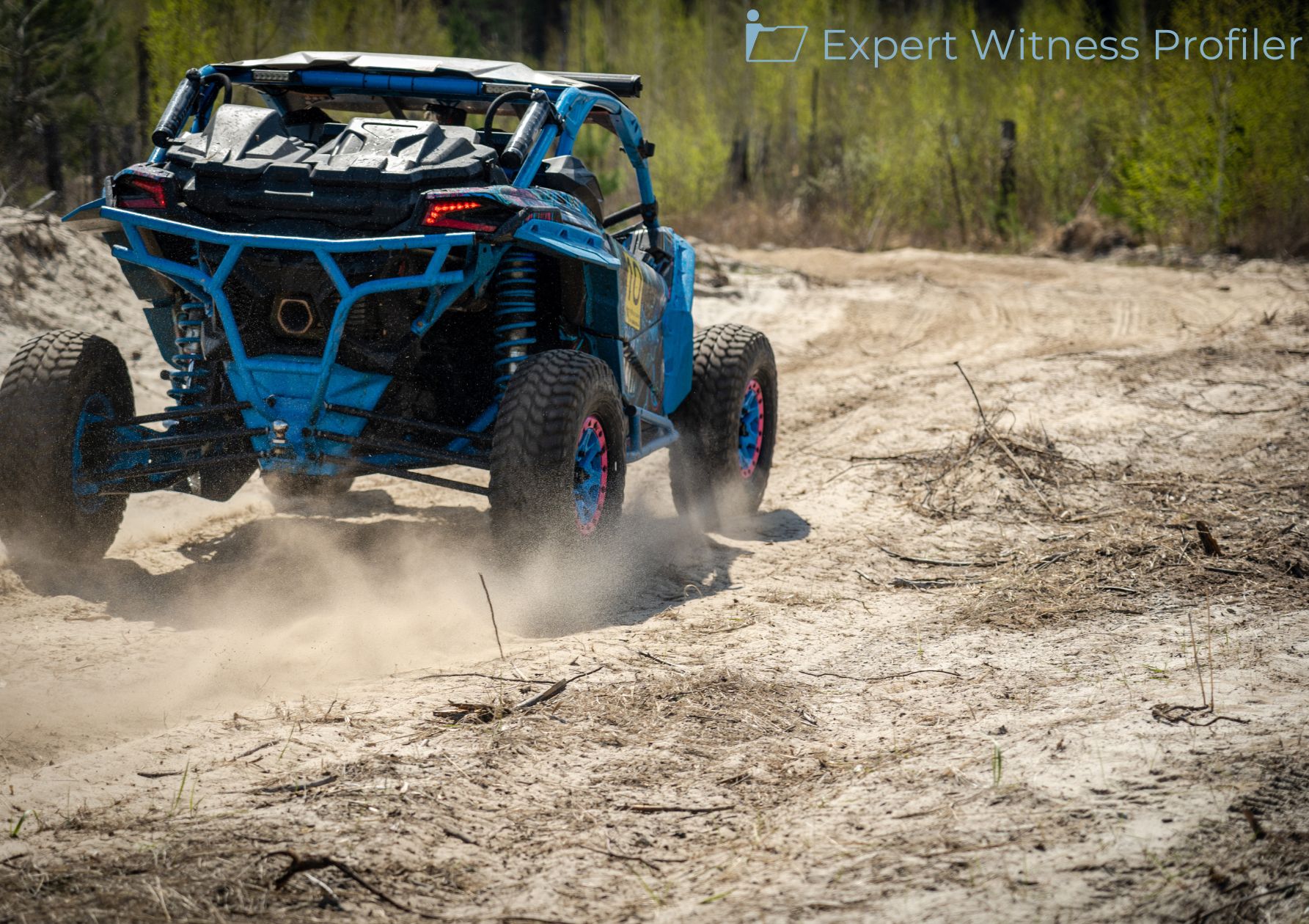
Stephen J. Ratcliffe has brought a lawsuit against BRP, the manufacturer, and Tidd’s Sport Shop, Inc. (Tidd’s), the dealer, of a 2019 Can-Am Maverick X3, a utility terrain vehicle (UTV), asserting negligence and strict liability claims arising out of an incident in which Ratcliffe’s UTV rolled onto its side and crushed his arm. The Plaintiff is pursuing design defect and failure-to-warn theories of recovery. During discovery, by report dated September 8, 2022, Ratcliffe designated Dr. Robert J. Nobilini, a professional engineer, as an expert witness.
BRP U.S., Inc. (BRP) filed a motion in limine to exclude the engineering opinions of Nobilini on the ground that they violate the constraints of Federal Rule of Evidence 702 and the caselaw implementing Daubert and Kumho.
Of Nobilini’s thirteen discrete opinions, BRP specifically focuses on his conclusions that “(i) humans—like Plaintiff—have a natural protective response to extend one’s hand/arm during a UTV rollover; (ii) BRP’s warnings were inadequate or ineffective to prevent the natural protective response; and (iii) the lack of an adequate restraint system to prevent the occupant’s arm from leaving the roll cage during a rollover made the Subject Vehicle unreasonably dangerous for its intended use.”
BRP’s motion includes many catchphrases for expert disqualification. (“unreliable and unscientific opinion testimony,” “no presumption of admissibility,” “untested and demonstrably false,” “inapplicable research studies and misleading, irrelevant and anecdotal videos, rather than testing or literature”). However, when analyzed, the crux of its argument against Nobilini’s testimony is that it is unreliable because he failed to test his opinions about alternative designs. BRP rejected Nobilini’s analogy to the response in a trip-and-fall and describes the analogy as a “classic apples to oranges comparison.”
Biomechanical Engineering Expert Witness
Robert J. Nobilini performs mechanical and biomechanical engineering investigations and analyses of accidents. He offers expert testimony related to slip, trip and fall accidents, automobile accidents, industrial accidents, sports and amusement related accidents, and the safety and failure of products. He is a member of numerous professional societies, including the American Society of Mechanical Engineers, the American Society of Biomechanics, and the Society of Automotive Engineers.
The Court noted that BRP has, rightly, not questioned Nobilini’s qualifications as a professional engineer. After all, Nobilini is well-qualified as a mechanical engineer with a concentration in biomechanics.
The Court found BRP correct in its assertion that Nobilini does not refer to any studies that corroborate his view that a person would naturally extend an arm to break a fall specifically during a UTV rollover. Nevertheless, the Court does not view Nobilini’s proposed testimony as his own ipse dixit. Instead, Nobilini based his biomechanical opinion on three studies of the biomechanics of what people typically do when they are falling from a standing position.
Further, Nobilini viewed twenty-six YouTube videos in which the occupants put their arms out in all-terrain vehicle rollovers and a safety video by Polaris Industries, a BRP competitor, in which the Polaris representative confirmed that “[s]ometimes the natural response is to put your hand out, like you’re falling.” Nobilini also reviewed after-market products, including arm and wrist restraints, designed to restrain users of such vehicles from extending their arms outside the roll cage in the event of a rollover.
The Court held that Nobilini has presented a reliable basis for his conclusions that Ratcliffe’s rollover accident was analogous to a fall, and, according to academic studies of the biomechanical response to falling, that a person’s natural response is to extend his or her arm to break a fall. Further, based on cumulative evidence, Nobilini articulates a reasonable basis for his opinions that the UTV industry generally was aware of the risk presented by this natural human response, that BRP specifically was aware of this risk, and that the UTV industry had developed safety features to mitigate this risk.
Held
The Court has concluded that Robert Nobilini’s proposed testimony meets the requisite “threshold of reliability,” and therefore it “should be presented to a jury and ‘tested by the adversary process—[by] competing expert testimony and active cross examination.’”
Therefore, the Court dismissed without prejudice Defendant BRP’s motion in limine to exclude the opinions of Robert J. Nobilini.
Key Takeaway:
BRP averred that “at its core, all of Nobilini’s opinions flow from one untested and demonstrably false premise—that belted and restrained vehicle occupants instinctively reach out in rollovers.” BRP pointed out that Nobilini has “never done a scientific study of this question” and asserted that his opinion “runs counter to published literature directly on point.”
However, Nobilini articulates a reasonable basis for his opinions that the UTV industry generally was aware of the risk presented by this natural human response, that BRP specifically was aware of this risk, and that the UTV industry had developed safety features to mitigate this risk.
Case Details:
Case Caption:
Ratcliffe v. BRP United States, Inc.
Docket Number:
1:20cv234
Court:
United States District Court for the District of Maine
Plaintiff Securities and Exchange Commission (“SEC”) charged that Defendant Matthew Panuwat engaged in insider trading in violation of Section 10(b) and Rule 10b-5 of the Securities Exchange Act of 1934 (the “Exchange Act”), by using his insider knowledge about Medivation, Inc.’s plan to announce an upcoming merger to make leveraged, short-term trades in Incyte Corporation (“Incyte”) call options.
Following a one-week jury trial, the jury returned a verdict in the SEC’s favor. Panuwat, subsequently, renewed his motion for judgment as a matter of law and, in the alternative, moved for a new trial.
Panuwat argued that a new trial is warranted because the Court “erred by allowing Chyhe Becker to testify as an expert, and then compounded the error by allowing her to introduce hearsay testimony.”
Economics Expert Witness
Chyhe Becker is currently the Deputy Chief Economist and Deputy Director of the Division of Economic and Risk Analysis at the U.S. Securities and Exchange Commission. In her role, she leads a division of approximately 200 economists, statisticians, and data scientists who integrate financial economics and data analytics to support the SEC’s policy, rule-making, enforcement, and examination activities.
Becker joined the Securities and Exchange Commission in March 2008, leading the Office of Litigation Economics until May 2018. She was previously a Principal with Chicago Partners LLC, where she specialized in securities litigation. Prior to Chicago Partners, she was a Principal with the Economic Consulting group at Deloitte Financial Advisory Services LLP where she provided expert testimony and analysis in securities class action matters as well as contract disputes. She received an M.B.A. and Ph.D. in Financial Economics from The University of Chicago Graduate School of Business, and a B.A. in Psychology from Yale University. Her research has been published in the Journal of Financial Intermediation and she taught corporate finance at The University of Chicago Graduate School of Business.
The Court denied Panuwat’s motion in limine to exclude Becker’s testimony. Panuwat asserted then and now that Becker was unqualified to opine about mergers and acquisitions in the biopharmaceutical industry because she “lacked necessary expert qualifications, used unreliable methodologies, and impermissibly relied on hearsay to prepare her report.” But Becker had significant experience in market and risk analysis, and her opinions on how the market would perceive Medivation and Incyte’s stock prices in relation to one another (which was her key area of testimony) did not require specific biopharmaceutical knowledge.
Panuwat contended that “three specific errors” occurred at trial with respect to Becker. The Court addressed each piece of challenged testimony.
Confounding News
The first error, Panuwat argued, occurred when the SEC “violated the Court’s ruling that Becker could testify about analyst reports as relevant to the existence of confounding news … by introducing analyst reports related to a wholly separate issue.” He said that the SEC “in fact introduced no analyst reports as relevant to Becker’s confounding news analysis and introduced the hearsay opinions of three analysts solely in support of Becker’s claim that the so-called economic phenomenon of a spillover effect . . . was relevant to the biopharma industry.”
Panuwat believed that Becker adopted the contents of three article exhibits without conducting any independent analysis. Becker’s testimony at trial suggested that she relied on hearsay opinions asserted in analyst reports to confirm her opinions, not for their truth.
Contrary to Panuwat’s assertion that Becker “adopted the contents of [these exhibits] …without conducting any independent analysis,” the Court held that her testimony showed that she had bases for her own opinions on spillover effects in the market.
She stated that there was peer-reviewed research on the idea of spillover effects, explained why news of a merger would lead to a spillover effect, and why market observers would have expected Incyte’s stock price reaction to Medivation’s merger news, using exhibits. She went on to explain the other things she did to determine whether, in her expert opinion, spillover effects would have affected Incyte’s stock price. At no point did Becker testify that her opinion on spillover effects was based on the at-issue article exhibits. The Court held that her testimony about confounding news was proper and complied with the Court’s limiting order.
Limiting Instruction
Panuwat argued that “even if these hearsay opinions were relevantly admitted to explain Becker’s conclusions on confounding news, the Court erred by failing to issue the required limiting instruction.” The judge, William H. Orrick, instructed the jury generally, several times, that news articles were not admitted for their truth, but only for the “fact that this news was out, such as it is,” or to show “what market observers were saying.”
Cherry Picked Statements
Panuwat also contended that Becker’s opinions relied on “cherry-picked results” from the outset. He posits that her opinion that “market observers would expect Incyte’s stock price to increase” on announcement of Medivation’s merger was not based on objective criteria, but was instead result-oriented. He said that her explanation for how she reached her conclusions was prejudicial because “the jury lacked the skillset necessary to properly evaluate the unreliability of her methods.”
When asked “how she identified” the event studies she used, Becker stated that “what I looked for was were there times when pretty much the same thing had happened in the past . . . and when I say the same thing, I mean the same thing as Medivation’s August 22 merger announcement, and what I’m looking to see is how did Incyte’s stock price react to those prior events that are similar.” She even prepared a demonstrative to help explain what she meant.
Becker explained that she found two prior similar events that she used as event studies. One was a prior announcement that Medivation was a takeover target, the second was a rumor that another company that was “similar” to Medivation (in that it was a biopharmaceutical company focused on oncology drugs) was also a takeover target.
The Court held that Becker provided the jury with an explanation for why she chose the event studies she did. Panuwat had the opportunity to cross-examine her; his argument that they were cherry-picked is conclusory. As for his argument that the jury “lacked the skillset necessary” to determine whether Becker’s opinion was reliable, Panuwat provides no evidence or reason in support of this position.
Held
As a result, the Court denied the Defendant’s motion for judgment as a matter of law and also denied his motion for a new trial.
Key Takeaway:
The Court denied Panuwat’s motion in limine filed against admitting Becker’s testimony. When Panuwat argued that a new trial is warranted because the Court erred by allowing Becker to testify as an expert, the Court held that Becker provided the jury with an explanation for why she chose the event studies she did. Panuwat had the opportunity to cross-examine her; his argument that they were cherry-picked is conclusory.
She stated that there was peer-reviewed research on the idea of spillover effects, explained why news of a merger would lead to a spillover effect, and why market observers would have expected Incyte’s stock price reaction to Medivation’s merger news, using exhibits. She went on to explain the other things she did to determine whether, in her expert opinion, spillover effects would have affected Incyte’s stock price.
Stephen Ratcliffe has brought a lawsuit against BRP, the manufacturer, and Tidd’s Sport Shop, Inc. (Tidd’s), the dealer, of a 2019 Can-Am Maverick X3, a utility terrain vehicle (UTV), asserting negligence and strict liability claims arising out of an incident in which Ratcliffe’s Maverick X3 rolled onto its side and crushed his arm. The Plaintiff is pursuing design defect and failure-to-warn theories of recovery.
Ratcliffe designated Dr. David R. Lenorovitz, a human factors and warnings expert, as a Plaintiff expert.
Lenorovitz opined that the subject vehicle was not only defectively designed but also that the BRP-provided warnings were inadequate, insufficient, or inconsistent.
BRP objected to what it characterizes as Lenorovitz’s “ancillary opinions.” Specifically, BRP described these opinions as “(i) criticizing the lack of clarity on if and how the vehicle-handling could be affected by occupancy load placement; and (ii) claiming that the Subject Vehicle’s 3-point seat belts are insufficient.”
BRP contrasts these with what it describes as Lenorovitz’s “core opinions,” which include:
the warning to keep your hands inside the vehicle was ineffective to prevent a supposed reactive arm movement to brace oneself during a rollover;
the instruction to firmly grip the steering wheel conflicts with the instruction to “brace for impact;” and
the warnings in the Operator’s Guide and on-product warnings to “never do jumps, slides/skids (drifts), or doughnut type ‘tricks’ or ‘maneuvers” conflicts with BRP’s action of “engag[ing] the services of professional drivers and celebrity brand ambassadors that graphically perform. . . such maneuvers in widely accessible on-line video clips and advertising promotions.”
BRP argued that Lenorovitz “conducts no case-specific testing, has no meaningful experience with side-by-sides, and ignores any evidence that does not support his narrative.”
Human Factors Expert Witness
David R. Lenorovitz obtained both an M.S. and PhD in Human Factors Engineering within the Industrial Engineering Department of the State University of New York at Buffalo in 1972 and 1975, respectively. He is board certified in human factors / ergonomics by the Board of Certification in Professional Ergonomics (BCPE). Since January of 2005, he has engaged in providing professional ergonomic consulting and forensic human factors services through my own consulting company, LENPRO Services, Inc.
Ratcliffe assured BRP that he does not intend to introduce Lenorovitz’s ancillary opinions on the Maverick X3’s handling or seatbelts at trial.
The Court noted that BRP has not questioned Lenorovitz’s qualifications as a human factors and warnings expert. Lenorovitz is well-qualified as a human factors and warnings expert.
In his report, Lenorovitz details the data and information he reviewed, including the transcripts of multiple depositions, his inspection of the actual Can-Am Maverick X3 in this case, his reference to American National Standards Institute (ANSI) standards, thirteen published articles, the documents and materials about the Can-Am Maverick X3 that were supplied to Ratcliffe, including the 2019 Operator’s Guide, his analysis of the “hazard control hierarchy” in this case, the sufficiency of the warnings, and his conclusions about deficiencies. From the Court’s perspective, Lenorovitz has satisfied his obligation to demonstrate that his expert opinions rest “on a reliable foundation” and are “relevant to the task at hand.”
In summary, the Court rejected BRP’s Daubert/Kumho challenge to the expert testimony of Lenorovitz as the Plaintiff’s ergonomics, human factors, and warnings expert. The Court concluded that Lenorovitz’s proposed testimony met the requisite “threshold of reliability,” and therefore it “should be presented to a jury and ‘tested by the adversary process—by competing expert testimony and active cross examination.”
In doing so, the Court has considered the 2023 amendments to Rule of Evidence 702 and makes this determination in accordance with the requirements of Rule 104(a).
Held
The Court grants Defendant BRP’ motion to the extent that it seeks to exclude so much of David Lenorovitz’s opinion testimony that constitutes ancillary opinions. The Court otherwise dismisses BRP’s motion in limine without prejudice.
Key Takeaway:
BRP complained that Lenorovitz did no testing. However, as the Plaintiff’s expert in ergonomics, human factors, and warnings, the Court concluded that Lenorovitz’s proposed testimony met the requisite “threshold of reliability.” In his report, Lenorovitz details the data and information he reviewed.
This case concerns claims under the Family and Medical Leave Act and the Americans with Disabilities Act. Plaintiff, Jeremy West (“West”), was hired by Defendant BNSF in January 2014 as a conductor and later as an engineer after receiving his engineer certification.
In 2020, West was diagnosed with a rare medical condition, Susac Syndrome, which if untreated can cause severe headaches; confusion; problems with thinking, such as short-term memory loss, slow thought processing and reduced ability to solve problems; slurred speech; walking difficulties; and/or changes in personality. For the next year, he was treated with medication to manage his disorder. West applied and received intermittent FMLA leave in September 2020 to attend routine appointments related to his condition. West re-applied for FMLA leave in September 2021 to continue attending routine appointments. He was subsequently removed from his position at BNSF in September 21, 2021. West initiated the present action against BNSF alleging he was effectively terminated in violation of the ADA and FMLA.
On September 3, 2024, BNSF filed a motion to exclude the testimony of West’s expert witness, Dr. Kevin Trangle.
Occupational Medicine Expert Witness
Dr. Kevin Trangle has over 40 years of experience as a board-certified physician in internal medicine, occupational medicine, and preventive medicine. He obtained his medical degree from the University of Minnesota Medical School in 1978 and also holds an MBA in healthcare management from Case Western Reserve University. He has served as a medical director for numerous corporations and organizations. His experience encompasses all aspects of occupational medicine including diagnosis and treatment of work-related injuries, disability evaluations, return to work assessments, corporate wellness programs, and substance abuse programs.
Trangle has provided expert consultation services for attorneys, government agencies, and insurers. He has given dozens of presentations to professional organizations on occupational health topics and has published extensively in medical journals. Trangle has particular expertise regarding workplace chemical exposures, having worked extensively with the chemical industry and conducted research on industrial solvents and chemical sensitivity issues. He has also managed corporate drug testing and substance abuse programs.
At West’s behest, Trangle conducted a review of West’s medical records and produced an Independent Medical Evaluation (“IME”) report. In his report, Trangle opined that BNSF “erred in its determination that West could not safely return to his job as a Conductor. Specifically, Aquino’s characterization of West as having a condition which posed an unacceptable future risk of sudden incapacitation was unjustified and based on an improper FFD process . . . .”
BNSF argues Trangle’s report and proposed testimony should be excluded under Federal Rules of Evidence (“FRE”) 702 because his analysis is unreliable, irrelevant, and unduly prejudicial. Specifically, BNSF asserts that Trangle is not qualified to opine on risk assessments in the railroad industry and his conclusions do not rely on scientific, technical, or other specialized knowledge as required by FRE 702. BNSF argues Trangle’s proposed testimony is unreliable because it is based on subjective belief and unsupported speculation.
Analysis
West sought to use Trangle’s report and proposed testimony to challenge BNSF’s risk assessment and subsequent finding that West presented a significant risk and needed to be removed from service.
BNSF’s chief medical officer, Dr. Theodore Aquino, ultimately made the decision to pull West from service after a conversation with West’s neurologist, Dr. Jessica Craddock, and performing independent research on Susac Syndrome. Susac Syndrome is a very rare neurological condition that Aquino had admittedly not heard of prior to BNSF’s diagnosis. Aquino based his conclusion in large part on Craddock’s recommendation that BNSF should not be performing his job as a locomotive engineer. The Court held that Trangle has also examined BNSF’s medical records, Craddock’s findings and performed independent research on Susac Syndrome, thus his testimony is directly relevant to West’s challenge of Aquino’s findings.
Qualifications
BNSF argued Trangle is not qualified to opine on this matter because he has no relevant knowledge, skill, experience, training or education. The Court disagreed. Trangle specializes in occupational medicine and has relied on his specialized knowledge as an occupational medicine doctor in numerous cases related to risk tolerance under the ADA fitness for duty assessment framework. As for Trangle’s knowledge on Susac Syndrome itself, he appeared to have a similar level of background knowledge on the condition as Aquino given that neither were familiar with the condition before West’s diagnosis and this case.
Reliability
BNSF argued that Trangle’s testimony is unreliable because his opinion is based on his subjective belief and is wholly speculative. Aquino came to his conclusions after a discussion with Craddock and independent research. Somewhat similarly, Trangle came to his conclusions after reviewing West’s medical records, Aquino and West’s deposition transcripts, West’s job requirements, and research articles.
Trangle reviewed the underlying facts necessary to support his testimony challenging Aquino’s findings. For these reasons, the Court finds Trangle’s testimony to be both relevant to this case and reliable.
Held
The Court denied the Defendant’s motion to exclude the testimony of Dr. Kevin Trangle.
Key Takeaway:
Trangle was not familiar with Susac Syndrome before West’s diagnosis and this case but he has more than made up for the same by reviewing West’s medical records, Aquino and West’s deposition transcripts, West’s job requirements, and research articles.
Plaintiff Towanda R. Futrell filed this personal injury action on August 28, 2023. The action arises from a motor vehicle accident on Interstate 64 on December 16, 2022, when a tractor-trailer owned by AV Leasing, LLC, leased by Triton Logistics, Inc., and driven by Daniel Cramer, collided with a bus on which Futrell was a passenger.
Pursuant to Rule 26(a)(2) of the Federal Rules of Civil Procedure, on May 28, 2024, Futrell disclosed Dallas Lea, II, M.D. (“Dr. Lea”), as an expert witness in the field of orthopedic surgery who may be called to testify at trial. Futrell disclosed that Lea was expected to testify to: (a) Futrell’s injuries, including a broken right ankle, sprained left ankle, broken eye socket, and broken left jaw; (b) Futrell’s ankle surgeries; (c) Futrell’s “extensive physical medicine and rehabilitation”; and (d) his opinion that Futrell’s injuries, medical treatment, hospitalizations, “past and future pain and suffering, past and future medical expenses and medical costs and life care medical costs, and economic or non-economic related damages” are “a proximate cause of Defendant Daniel Cramer’s negligence.”
Futrell provided Defendants with a copy of Lea’s curriculum vitae. On or before July 9, 2024, Futrell also provided Defendants with Lea’s expert report-a life care plan for Futrell. The life care plan outlines Futrell’s treatment following the accident, Lea’s opinion that Futrell “will have chronic symptoms and residual disabilities resulting from the accident,” and a table containing Lea’s recommendations for Futrell’s “current and future care needs.”
On September 17, 2024, Defendants filed the pending motion in limine to exclude Lea’s opinion because he was not properly designated as an expert in life care planning and the opinions in his life care plan lack the requisite foundation.
Lea was not properly designated as an expert in life care planning
First, the Defendants asserted that Lea was not properly designated as an expert in life care planning. The Defendants noted that Lea was designated as an expert in orthopedic surgery who was expected to testify about Futrell’s injuries, Futrell’s treatment, and his opinion that Futrell’s injuries, treatment, past and future pain and suffering, past and future medical expenses, and life care costs were proximately caused by Defendant Daniel Cramer’s negligence.
Lea’s opinions lack the proper foundation and are speculative
Next, Defendants argued that Lea’s opinions lacked the proper foundation and were speculative. Lea never treated Futrell and did not interview her or her treating physicians prior to developing the life care plan. The life care plan was drafted based on Lea’s review of Futrell’s medical records.
Physical Medicine & Rehabilitation Expert Witness
Dallas Alexander Lea, II M.D. is an internationally recognized spinal cord injury physician, fellowship-trained, and double-boarded in Physical Medicine and Rehabilitation (PM&R) and Spinal Cord Injury (SCI) Medicine.
Errors in the Rule 26(a)(2) disclosure are harmless as Dr. Lea’s CV, life care plan, and deposition clarify his expertise and outline his proposed expert testimony
Futrell asserted that Defendants were provided with a copy of Lea’s CV, which put them on notice that Lea was a life care planner, board certified in physical medicine and rehabilitation, and Defendants were provided with his life care plan on July 5, 2024. During Lea’s deposition, Futrell’s counsel clarified that the designation of Lea as an orthopedic surgeon was due to a “typographical error.” Lea testified that he was not an orthopedic surgeon, but a specialist in spinal cord injury and in physical medicine and rehabilitation. Lea explained that he would not be testifying about causation or negligence, rather he would testify to Futrell’s “injuries and future care and needs,” and that he was asked to “review records, review the case, and produce a life care plan.”
The Court found that Futrell’s failure to identify Lea as an expert to testify about Futrell’s life care plan in the Rule 26(a)(2) disclosure served on May 28, 2024, was harmless. The Rule 26(a)(2) disclosure was inaccurate. Futrell’s explanation for the inaccurate disclosure—that it was a “typographical error”—is less than satisfactory.The inaccuracy also goes beyond simply misstating that Lea is an orthopedic surgeon, by wrongfully disclosing that Lea will testify about the cause of Futrell’s injuries. The disclosure did, however, include Lea’s expected testimony about Plaintiffs future medical care and expected costs over her lifetime. The provision of Lea’s CV and life care plan clarified his expertise and proposed testimony and Defendants were further able to clarify this with his deposition taken September 6, 2024.
Lea’s proposed testimony concerning Futrell’s life care plan is based on his medical expertise and will be helpful to a jury
Defendants also challenged several of the line items in Lea’s life care plan table, specifically house cleaning, ophthalmologist evaluations, an ear, nose, and throat evaluation, yearly visits to her primary care physician, and psychological counseling.
Defendants argued Lea did not know whether Futrell has familial support to take care of house cleaning or to what extent she has suffered emotional injuries and needs counseling. They concluded that the life care plan is speculative and not tailored to Futrell’s unique needs, and Futrell “provides no indication why Lea’s life care plan is more plausible than other possibilities of what she will require in the future.”
Lea explained that: (1) Futrell’s chronic symptoms and residual disabilities “were evident” in her medical records (2) the monthly housecleaning expense is for deep cleaning (3) the ophthalmologist evaluation and ear, nose, and throat evaluation were a precaution due to her jaw fracture and broken eye socket (4) the yearly visit to her primary care physician would be in addition to a routine yearly physical and would be necessary for pain management and pain management medications and (5) psychological counseling was included because of the mention of Futrell’s anxiety in the medical record.
The Court held that Lea reviewed and summarized Futrell’s past treatment, current treatment regimen, and future treatment recommended by her physicians. Lea then developed a life care plan projecting Futrell’s future costs based on this review. A certain amount of speculation is inherent in a life care plan that projects what will be needed in the future and hinges on future events. Permitting cross-examination regarding the facts and data Lea relied on to arrive at the future costs will allow the fact finder to determine the appropriate weight to assign to Lea’s testimony.
Held
The Court held that permitting Lea to testify about the life care plan he outlined for Futrell would not disrupt the trial. Lea, however, will not be permitted to testify about the cause of Futrell’s injuries and his testimony will be limited to the opinions outlined in his life care plan.
The Court found that Lea is qualified to testify as an expert witness and he is proposing to testify to relevant medical knowledge that will assist the trier of fact in understanding a fact in issue. Nor does the Court find that the probative value of such testimony is substantially outweighed by the danger of unfair prejudice, confusion of the issues, or misleading the jury. The Court found that Defendants’ concerns about the reliability of Lea’s testimony may be properly raised during cross-examination, but they are insufficient to persuade the Court to exclude Lea.
The Court denied Defendants’ motion in limine to exclude the expert opinions of Dallas Lea, II, M.D.
Key Takeaways:
The Rule 26(a)(2) disclosure was inaccurate. Futrell’s explanation for the inaccurate disclosure—that it was a “typographical error”—is less than satisfactory.The inaccuracy also goes beyond simply misstating that Lea is an orthopedic surgeon, by wrongfully disclosing that Lea will testify about the cause of Futrell’s injuries.
A certain amount of speculation is inherent in a life care plan that projects what will be needed in the future and hinges on future events.
Case Details:
Case Caption:
Futtrell V. Av Leasing, LLC
Docket Number:
4:23cv118
Court:
United States District Court for the Eastern District of Virginia, Newport News Division
Plaintiff Wireless Alliance, LLC (“Plaintiff” or “Wireless Alliance”) made certain allegations Defendants AT&T Mobility LLC, AT&T Services, Inc., and AT&T Corp. (“Defendants” or “AT&T”). According to Wireless Alliance, AT&T infringed the following United States patents that relate to improvements to cellular networking systems: United States Patent No. 9,144,106 (the “’106 patent”), 9,565,662 (the “’662 patent”) and 10,045,383 (the “’383 patent”) (collectively, the “Asserted Patents”). Wireless Alliance is the exclusive licensee of the ’106 patent and the ’662 patent, and is the owner by assignment of the ’383 patent.
Plaintiff argued that Defendants inappropriately used Craig Bishop to establish the public availability of 3GPP documents despite him not having the “specialized or personal knowledge about public availability of 3GPP documents” because he is “a layperson with no connection to the actual documents.”
Telecommunications Expert Witness
Craig Bishop has over 30 years of experience in the telecommunications industry with an extensive knowledge of 3GPP and ETSI specifications and procedures including document handling and publication practices.
The crux of Plaintiff’s argument is that Bishop’s “opinion is based on nothing more than his subjective, speculative belief that the information displayed on 3GPP’s website is accurate and indicates when the documents were first made publicly available.”
WA then attempted to equate Defendants’ reliance on Bishop’s report with relying on unauthenticated printouts from the internet by using a declaration from a third party. Defendants countered that this Court had already determined the reliability of Bishop’s opinions regarding 3GPP availability.
Defendants also argued that Bishop is qualified to opine on 3GPP publication dates based on his extensive experience with 3GPP and ETSI.
Legal Standards
An expert witness may provide opinion testimony if “(a) the expert’s scientific, technical, or other specialized knowledge will help the trier of fact to understand the evidence or to determine a fact in issue; (b) the testimony is based on sufficient facts or data; (c) the testimony is the product of reliable principles and methods; and (d) the expert has reliably applied the principles and methods to the facts of the case.”
Importantly, in a jury trial setting, the Court’s role under Daubert is not to weigh the expert testimony to the point of supplanting the jury’s fact-finding role; instead, the Court’s role is limited to that of a gatekeeper, ensuring that the evidence in dispute is at least sufficiently reliable and relevant to the issue before the jury that it is appropriate for the jury’s consideration.
Application
The Court found that Plaintiff’s arguments demonstrated disputes regarding credibility, as opposed to reliability, and accordingly can be properly addressed through vigorous cross-examination and presentation of contrary evidence.
Held
The Court denied the Plaintiff’s motion to strike the testimony of Defendants’ expert Craig Bishop.
Key Takeaway:
When Plaintiff contended that Bishop has no specialized or personal knowledge about public availability of 3GPP documents, the Court refused to exclude Bishop’s testimony on that basis because Plaintiff’s arguments consisted of credibility attacks.
On March 12, 2019, a fire broke out at a Forest River manufacturing facility. American Home Assurance Company, a subrogee of Forest River, says a lithium-ion battery from a Makita power drill is to blame. American sued both Makita Corporation of America and Makita U.S.A., Inc. under Indiana’s Product Liability Act. The two companies (called Makita today for short) sought to exclude testimony from two of American’s opinion witnesses, Michael Eskra and Fred Hackett, under Federal Rule of Evidence 702 and Daubert v. Merrell Dow Pharms., Inc., 509 U.S. 579, 113 S. Ct. 2786, 125 L. Ed. 2d 469 (1993).
Chemical Engineering Expert Witness
Michael Eskra has more than 43 years of experience in the battery industry. He earned a bachelor of science in chemical process engineering at the University of Wisconsin and later a master’s in engineering management at the Milwaukee School of Engineering. Early in his career, he worked as a process engineer in battery manufacturing plants, a manager of advanced battery engineering, and then a program manager.
He later ran a research and development company that developed batteries. Since 1996, he has owned Eskra Technical Products, Inc., which develops battery products and conducts battery failure investigations. He has published over 300 papers and articles. He is a member of various professional organizations, including the American Institute of Chemical Engineers, the National Association of Fire Investigators, the International Association of Arson Investigators, and the National Association of Subrogation Professionals. Makita focuses its attack on his methodology rather than cogently questions his credentials, so the court turns to his method.
Fred Hackett was a firefighter from 1977-1978 and then from 1982-1998. He was a lead arson investigator and documentation officer for the Pike Township Fire Department. For about eleven years before his retirement in 1998, he conducted technical investigations of commercial and residential fires and gas explosions. For five overlapping years during this time, he also was a fire and explosion investigator for Wolf Technical Services, Inc. In 1995, he became president of Midwest Forensics—a position he still holds today.
In both 2003 and 2008, he was certified as a fire and explosion investigator through the National Association of Fire Investigators. He has attended numerous conferences on fire investigations for the better part of 40 years, as well as served as an instructor at times, including on CT imaging and analysis for the past 15 years and state certifications for firefighters studying fire origin and cause for the past 34 years. He has received fire and arson training over the years too.
Michael Eskra is American’s proposed battery expert. He presents two opinions: that the fire at Forest River was most probably caused by a Makita power tool battery’s failure, and that the poor design of its battery management system caused its failure when its cell became unstable under normal intended use. He views the damage to this cell to be inconsistent with fire attack, and instead consistent with internal damage and thus a source of the fire.
Eskra inspected battery cells from the Forest River site to determine whether a battery cell caused the fire. He started his work in July 2019 (about four months after the fire). During the July 2019 inspection, Eskra worked with Fred Hackett (the insurer’s area of origin witness) to review about 80 cell artifacts.
Rounded ends are indicative of a fire attack as opposed to a fire’s cause
As one feature, he looked for “bulbous ends, so if it had bulbous ends, he set them aside.” When pressed to quantify the degree of bulbous or rounded ends (at the cell’s negative end), Eskra admitted he could not do so, nor had he performed any testing to quantify whether a cell was “rounded enough.” At the time he prepared his report and testified in deposition, he had not authored any peer-reviewed articles on this theory of rounded ends being indicative of a fire attack as opposed to a fire’s cause.
Eskra has never tested the elongation of the cell’s crimp
Eskra looked for longitudinal stretching or elongation of the cell’s crimp. He explained that, when gas gets generated during heating over time, the crimp softens and elongates. In this event, according to him, it “tends to be more that it was a slow heating process, a longer heating process, so it would be heat-attacked.” Even this feature he struggled to specify, merely saying external heat “tends to move it a little bit”—but even then “almost all cells will vary” and even “in causal cells it may move” too. To date, he has never measured this elongation to know how much or tested this feature to confirm his theory; and, at the time of his report, he had not published his theory for peer review.
Eskra admitted that he had not performed any testing to validate his theory of the jellyroll being pushed to the negative or vented ends
Eskra says cells with bulbous negative ends or elongated crimps should then be evaluated by x-ray. He selected 20 cells for further analysis. Fred Hackett completed the x-rays at a different location, and Eskra thereafter observed the films through Skype. Eskra never obtained the x-rays and never preserved them.
In his method, Eskra looked for differences in the active material or “jellyroll” within the cylinder of the battery. The jellyroll is the core of the battery cell—”layers of cathode, separator and anode [are] wrapped together to form a spirally-wound ‘jellyroll’.” His report offers exemplar x-rays (not from this case) of his focus at this step—in particular, he looks for large gaseous pockets at the negative ends that will eliminate the cells as causal; and, contrastingly, the jellyroll remains pushed toward the negative and positive ends that will identify potential causal candidates.
Eskra admitted that he had not performed any testing to validate his theory of the jellyroll being pushed to the negative or vented ends .
Eskra reexamined rounding and elongation, and the venting of pressure inside the cell that contributed to these features
Nothing seems to memorialize Eskra’s selection process at this stage, but he narrowed the number of candidates from 20 cells to four (two cylindrical cell pairs) using his method.
Of curiosity to him, each of the cell pairs had one cell that had a rounded negative end and elongated crimp, which to him exhibited signs of external heating, whereas the paired cell did not. He ordered CT scans of the two cell pairs (someone else conducted them), and he received the scans (and preserved these).
At this stage, he reexamined rounding and elongation, and the venting of pressure inside the cell that contributed to these features.
Eskra concluded that the damage to the cell was internal in nature and should be considered as a probable source of ignition of the fire
Eskra acted as a sort of tracker or hunter. He examined the cell to determine whether it showed signs of venting at multiple points and, if so, which one occurred first.
Eskra started by finding the venting point, then beginning at the opposite end worked his way through the axial plane moving longitudinally to look for intact jellyroll.
Venting would not inform whether a cell caused the fire, but inform the locations where he needed to examine. With a causal cell, chaos within the jellyroll will have occurred before the gas pressure vents, including melting or cutting or additional shorting.
Using the first CT scan, Eskra determined that this cell pair was damaged by external events based on his examination of rounding, elongation, and jellyroll analysis. Using the second CT scan, he determined that one cell—what he describes as the lower or bowed cell—was fire-attacked because of “a large gas bubble appearing in the lower left longitudinal section.” For the other top cell, he found no evidence of the “same distortion or gas generation and shoving of the jellyroll materials.”
Eskra thus focused more heavily on this top cell of the second pair. He used a longitudinal image of this cell to say the negative end of the cell appeared “fairly normal” and the spacing between the jellyroll and the can at the negative end was “slightly tighter” than a healthy cell. Without having x-rayed all the other cells, he then offered a prediction—that this would be the “opposite of what would be seen on all the other cells if they were all x-rayed.” In short, he eliminated all the other cells as causal because they showed signs of physical rounding and venting.
Eskra’s theory has not been generally accepted in the relevant scientific community
The Court held that Eskra has never tested his theory—not once—though it could be tested. Indeed, he has had decades to do so. His theory has never been published. His theory has not been generally accepted in the relevant scientific community, much less accepted by peer review at this point.
American has the burden to demonstrate its proposed expert’s reliability. At first, American says Eskra employed a methodology similar to that described in C. Mikolajczak, A Scientific Methodology for Investigation of a Lithium Ion Battery Failure, a 2007 paper by Exponent Failure Analysis Associates, a reputable firm well-known to the court. Eskra agreed his method has never been peer-reviewed, though he too equated his method to that of Exponent. The Court held that it turned out to be a poor defense of Eskra’s method because he deviated in material ways from it. His method marginally overlaps the Exponent method at best. Exponent mentions the importance of x-rays and CT scans certainly, but it speaks little of negative end rounding, crimp elongation, or the particular jellyroll dynamics that Eskra offers to support his causation theory, and Exponent directs rather key investigative steps that Eskra just skipped.
Eskra offers only subjective judgments throughout his opinion
Without a tested or generally accepted model, the Court held that Eskra cannot offer an objective criterion for an elongated crimp either, calling a “a little bit” of movement enough to classify a cell “fire-attacked” and eliminate it from consideration as a cause. But this elongated crimp also proves troublingly variable and subject to his mere say-so for interpretation, for he concedes that “almost all cells will vary” and even “in causal cells it may move” too. He can’t offer a measurement, much less even a “specific description” of how much rounding would typically demonstrate a fire-attacked cell versus a causal cell.
American, as the proponent of this opinion, never once explains why such subjective imprecise criteria—which may show one thing or indeed the opposite thing—can reliably support his winnowing of 80 candidate cells to only 20 cells for x-ray analysis.
Eskra’s method gets worse at the x-ray stage because he preserved none of his work. He claims to have examined images of 20 selected cells, but he cannot produce any x-rays. Of course, he reviewed these images through Skype with another fire investigator, but no one else seems to have retained any x-rays either.
Even giving Eskra the benefit of the doubt that x-ray analysis through Skype could qualify as such a close examination of a cell’s internal features (e.g., gas pockets, jellyroll movement, and the like), he offers nothing but his say-so today about what could be seen back then. He never videotaped the down-selection process; he created no notes or other documentation from his review of x-rays; his report replicated no x-ray images; and no one preserved the x-ray images.
Eskra’s experience without a reliable, testable methodology is not sufficient
Eskra winnowed 80 cells down to 4 cells (two 2-cell pairs, with only one cell of each pair of real interest to him). So by this point, 95 percent of his process occurred under unreliable circumstances—untested or unverifiable as it was. Exponent’s method may offer something testable and repeatable, whereas Eskra’s method did no such thing. He may be experienced, and he may have done better in other cases, but “experience without [a] reliable, testable methodology is not sufficient.”
Exponent explains the critical steps of recovering physical evidence, reconstructing that evidence, and then examining that evidence in a way that preserves the chain of custody for further analysis. Indeed, the scientific method anticipates that an expert will similarly document her work, and then preserve it for others to review or replicate should that prove necessary.
Eskra deviated from the Exponent method in a critical way when he concluded that the lack of external damage to this cell and the good condition of the jellyroll at the negative end made this cell the probable cause of the fire, albeit by saying this would be “the opposite of what would be seen on all the other cells if [they] were all x-rayed.”
Exponent says, to determine the cause of a battery failure, “it is generally necessary to open a damaged battery pack, extract and examine the remains of the cells, the battery protection printed circuit board(s) (PCBs), and any fuses or thermal cut-off devices.”
To say Eskra “primarily employed the same methodology” or “completed virtually all steps” as Exponent are bold overstatements
Exponent recommended gathering information about the battery cells, which “can generally be collected from the end user’s description of the background of the device and the events of the incident, as well as from the incident site.”
Eskra collected no information from Forest River about the use of these battery cells. He didn’t know their state of charge. He didn’t know where the batteries had been found, or whether they were even in the area of the fire’s origin.
Exponent recommended “thoroughly document[ing] the condition of the [battery] system upon receipt, both for establishing the chain-of-custody and to provide clues as to the root cause of the incident,” including “damage patterns such as soot deposits, regions of charring, and evidence of melting” . The Court held that Eskra failed to do this—he never photographed each cell he visually examined or took notes that would show his observations of individual cells. They reflect a fundamental failure to conform his method to the one he says he tried to use.
Fred Hackett
Fred Hackett is American’s proposed fire origin expert. He opined that the fire originated within Forest River’s tool crib—more particularly, at or near the southeast end of the tool crib, following the failure of a lithium-ion battery.
Hackett was retained to determine the fire’s origin and cause on March 13, 2019—the day after the fire. He and his associate completed an initial “scene size-up” on March 14 and 15. On March 14, Hackett interviewed the plant manager (David Whisler). At some point, he also interviewed the tool crib manager (Lanny Kistler). Hackett collected information from the Elkhart Fire Department, which responded to the fire.
In preparation for his opinion, Hackett considered a great deal of information. He reviewed the deposition of Larry Shaffer who first saw the fire, overview photographs of the building, a video taken inside the building during the fire, physical damage to a desk located in the tool crib, and burn patterns on a filing cabinet.
Hackett’s opinion contravenes the NFPA 921
Makita advanced several arguments to exclude Hackett’s opinion. First, the company says his opinion contravenes the National Fire Protection Association Guide for Fire and Explosion Investigations (commonly called NFPA 921). NFPA 921 is “a comprehensive, peer-reviewed, and detailed guide for fire investigation, and [courts] have held that its methodology is reliable for purposes of Rule 702.”
NFPA 921 identifies traditional sources of information to use in determining a fire’s origin—witness statements, electronic data, burn patterns, fire dynamics, and (under the latest 2017 edition) arc mapping, though the extent of melting here prevented every investigator from arc mapping.
The Court found that Hackett relied on burn patterns on the filing cabinet directly west of the desk that showed directional fire traveling from east to west. Moreover, Hackett relied on multiple sources of information to reach his opinion, in accordance with NFPA 921. He also explained how these sources led to his conclusion.
There also seems to be a disconnect between the parties as to whether Hackett reviewed the deposition testimony of six eyewitnesses to the fire in preparing his report or sometime afterwards.
Makita argued that Hackett’s billing records identify a different date for reviewing these depositions (a month after issuing his report). Hackett testified to the clerical error in his bill. Because Hackett offered a logical explanation for the billing error, the Court held that it is a credibility question—one of weight, not admissibility.
Hackett’s reliance on the first observer in helping to pinpoint the fire’s origin was inappropriate
As such, this motion devolves into whether Hackett afforded a particular eyewitness too much weight or not enough weight, and such points are designed for crossexamination rather than a pretrial attack on his method. To this point, under NFPA 921, a fire investigator in the field may evaluate the quality of the information shared by an eyewitness, assessing with common sense the person’s knowledge and any potential bias.
In addition, Hackett relied on testimony from Larry Shaffer—the first person to see the fire. Shaffer said he saw the fire at or near the southeast corner of the tool crib, what he described as a fire about one foot tall and two feet wide. He saw the fire nowhere else. Cannisters began exploding, and he exclaimed the fire’s presence to his fellow employees. Hackett also relied on statements made by David Whisler (the plant manager) during an interview with the Elkhart Fire Department’s investigator and a few days later to Hackett’s associate that the fire appeared near the door of the tool crib. Hackett additionally used screenshots of a video taken by an unnamed eyewitness in the early stages of the fire.
Makita marshals testimony from the other eyewitnesses, but each seem to have seen the fire later in time and in a different location. The Court held that it cannot be said on this record, much less under the NFPA 921 method, that Hackett’s reliance on the first observer in helping to pinpoint the fire’s origin was inappropriate, or that his reliance on early statements from the plant manager soon after the event rather than years later in deposition was inappropriate.
Makita largely argued that Hackett chose his data poorly.
Hackett incorrectly assumed the tool crib was constructed of a porous metal cage material
The Court’s review of other information offered by Makita illustrates that the company’s concern focuses on Hackett’s selection of and weight placed on data, not that his opinion is bereft of a legitimate industry-recognized methodology or factual footing.
In another area, Makita simply has its facts wrong. The company argues that Hackett incorrectly assumed the tool crib was constructed of a porous metal cage material, suggesting he did this so he could claim, in some “tortured effort,” that the fire witnesses saw outside the tool crib was actually inside the crib. The company represents that Hackett was forced to admit that the tool crib’s walls were solid. These are gross misstatements of Hackett’s testimony, and the Court will not entertain them.
Hackett’s opinion was reached based on an expectation bias and later reinforced by a confirmation bias framed with cherry-picked facts
Makita next argued that Hackett’s opinion was reached based on an expectation bias and later reinforced by a confirmation bias framed with cherry-picked facts. This is an argument that Makita may offer the jury if the company thinks it compelling. Makita offered no evidence on this record that Hackett fell prey to an early expectation bias—a preconceived idea of the fire’s origin—or a confirmation bias—merely selecting data to confirm this idea.
Hackett used a negative corpus method, which has long been abandoned by the fire science community
Makita also complained that Hackett used a negative corpus method, which has long been abandoned by the fire science community. The Court held that although Hackett used a process of elimination in reaching his conclusion, he had supporting evidence for eliminating certain potential ignition sources.
Hackett developed nine hypotheses as to possible ignition sources. For eight, all save a hypothesis that lithium-ion batteries started the fire, he ruled them out as ignition sources and explained why, including by relying on witness testimony and the examination of artifacts.
Hackett has the expertise, factual analysis, and industry-recognized method to explain why he eliminated certain potential causes of the fire; whether the jury will credit these explanations or find them flimsy, only the jury can say. The Court held that it is still is a far cry from saying a lithium-ion battery caused the fire.
Hackett confessesed he has no expertise in batteries, and no expertise in distinguishing batteries that have caused a fire from those that have been attacked by one. He repeatedly admitted he must defer to Eskra as to causation.
Hackett proposes merely to parrot Eskra
The Court held that Hackett isn’t merely relying on another expert’s opinion, but proposing to repeat it—worse yet without a factual understanding of the circumstances, any supporting testing or analysis, or a credentialed basis for offering the opinion. This makes his opinion unreliable.
Moreover, the record is devoid of any experience Hackett has developed with fires originating from lithium-ion battery failures or the dynamics of such fires (much less a Makita-designed cell or comparable tool manufacturer), and that burden rests on American.
American suggests that Hackett adds independent research to Eskra’s findings, but American cites only two YouTube videos—both of lithium-ion powered scooters, with no information about the circumstances of those fires or the design of those lithium-ion batteries.
Hackett lacks pertinent expertise
Hackett may say a smoldering fire was unlikely the cause and that a “rapid-ignition sequence of events” makes more sense, but he cannot say this fire originated from a lithium-ion battery. He also may say this fire appears to have been violent, explosive, and immediate in nature (and explain why based on this fire’s dynamics and site or witness evidence), but again he cannot say this fire originated from a lithium-ion battery.
The Court held that not only does he lack pertinent expertise, but he has not done the testing or even examined the battery cells to validate this opinion.
To sum it up, the Court held that Hackett’s opinion would not aid the jury to decide an issue of consequence—a question of fit and would instead invite the jury to speculate that because a lithium-ion battery can cause a fire that it must have done so here.
The Court held that Hackett can offer his opinion about the fire’s area of origin and its related dynamics, as well as explain why certain potential sources of ignition should be eliminated, but he cannot speak to the ultimate cause of the fire.
Held
The Court granted the motion to exclude American’s expert Michael Eskra’s opinions.
The Court granted in part and denied in part the motion to exclude American’s expert Fred Hackett’s opinions.
Key Takeaway:
Application of the Amended Rule 702
A witness may testify in the form of an expert opinion when (1) the witness is “qualified as an expert by knowledge, skill, expertise, training, or education;” (2) the testimony is “based on sufficient facts or data;” (3) the testimony is “the product of reliable principles and methods;” and (4) the opinion “reflects a reliable application of the principles and methods to the facts of the case” in such a way that the testimony will “help the trier of fact to understand the evidence or to determine a fact in issue.” The proponent of expert testimony must establish its admissibility by a preponderance of the evidence.
In other words, the rule has been amended to clarify and emphasize that expert testimony may not be admitted unless the proponent demonstrates to the court that it is more likely than not that the proffered testimony meets the admissibility requirements set forth in the rule.
American has the burden to demonstrate its proposed expert’s reliability. However, American has failed to discharge its burden. For instance, when American said Eskra employed a methodology similar to that described in a 2007 paper by Exponent Failure Analysis Associates, it turned out to be a poor defense of Eskra’s method because he deviated in material ways from it.
Moreover, American suggests that Hackett adds independent research to Eskra’s findings, but American cites only two YouTube videos—both of lithium-ion powered scooters, with no information about the circumstances of those fires or the design of those lithium-ion batteries. One could hardly call seconds of two YouTube videos independent or sufficient evidence to render a causation opinion, given Hackett’s ready admissions that he is not the person with expertise to ask.
Case Details:
Case Caption:
American Home Assurance Company V. Makita Corporation Et Al