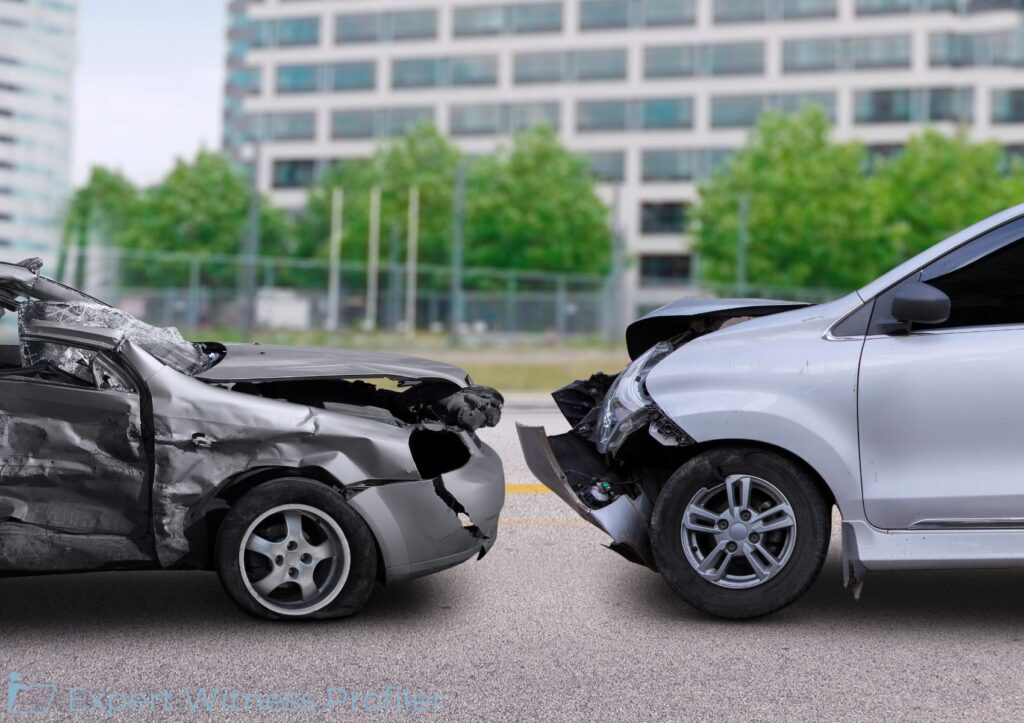
On September 30, 2021 at approximately 4:14 p.m., Defendant Marcus D. Jethrow, was operating a 2021 Volvo 760 tractor-trailer owned by Defendant Keep Trucking, LLC (Defendant Keep Trucking) traveling northbound on US 61 Hwy in Marion County, Missouri. At the same time, Keith Triplett (decedent) was operating a 1988 International Harvester grain hauler traveling east on County Road 338 in the process of crossing US 61 Hwy. The vehicles collided, and Triplett died as a result.
Triplett’s wife asserted claims of negligence in hiring, training, supervising, retaining, and entrusting Jethrow against Defendant Keep Trucking.
Plaintiffs asked the Court to exclude the testimony of the Defendants’ retained accident reconstruction expert witness, Kevin T. Johnson, for both Rule 26(a)(2)(B) and Daubert reasons.
Accident Reconstruction Expert Witness
Kevin Turner Johnson is accredited by A.C.T.A.R., the Accreditation Commission for Traffic Accident Reconstruction, testifies as an expert witness, and trains others in the accident reconstruction community. His 10 years of law enforcement experience, which included over 500 collisions investigated on-scene, lends additional perspective to collision analysis and police investigations.
First, Plaintiffs alleged that Johnson performed an avoidability calculation of what would have occurred if Jethrow had been traveling at exactly the posted speed limit of 65 m.p.h. and then suppressed it, not complying with required disclosures in Rule 26(a)(2)(B).
Johnson analyzed multiple data points to reach his conclusions in this case which would include but are not limited to: physical evidence on the roadway, damage patterns, distances traveled, electronic data from the vehicle showing speeds and braking, and the video of the collision and the event prior thereto.
Johnson’s report contained his analysis of available data and after performing accident reconstruction calculations, determined that Defendant Jethrow’s speed did not cause the accident. Plaintiffs presented no evidence that Johnson or Defendants suppressed anything here or that they did not comply with required disclosures in Rule 26(a)(2)(B). Therefore, the Court refused to exclude his opinion on Plaintiffs’ first point of argument.
Plaintiffs also took issue with the perception-response time analysis done and the traffic standards applied. Johnson focused his reconstruction analysis on a moment in time that the decedent was a hazard — i.e. when he was in the median failing to yield. Plaintiffs’ expert, meanwhile, focused his reconstruction analysis on a ten second window prior to the collision. Just because these analyses are different, the Court held that challenges to the factual basis of Johnson’s testimony go to credibility and the weight of the testimony which are subjects that may be raised during cross-examination.
Held
The Court denied Plaintiff’s motion to exclude the testimony of Defendants’ expert Kevin Johnson.
Key Takeaway
Challenges to the factual basis of Johnson’s testimony go to the credibility of the testimony, not the admissibility, and it is up to the opposing party to examine the factual basis for the opinion in cross-examination. Only if the expert’s opinion is so fundamentally unsupported that it can offer no assistance to the jury must such testimony be excluded.
Case Details:
Case Caption:
Triplett V. Keep Trucking, LLC
Docket Number:
2:25cv1
Court Name:
United States District Court for the Eastern District of Missouri, Northern Division
On July 13, 2021, Mark DeLeon lost his left arm in a horrendous accident while working the overnight shift at Norfolk Southern’s Burns Harbor Trainyard. This case arises out of that tragic event. DeLeon sued Norfolk Southern under the Federal Employer’s Liability Act seeking recovery for his injuries. He has two theories under FELA: one is for general negligence; the other is for per se negligence under FELA because of an alleged violation of the Safety Appliance Act (“SAA”).
Daniel R. Billington II is an expert in accident reconstruction, including “human factors, visibility, and lighting.” Billington has been doing accident reconstructions for decades and has been permitted to testify in a number of cases. His knowledge has made him a speaker in high demand with many legal and insurance organizations.
Colon Ray Fulk has over three decades of experience in train operations. Notably, he has worked for Norfolk as a conductor, brakeman, locomotive engineer, and a foreman. He has extensive experience in railroad operations, including safety inspections and investigations.
Jason R. Engle has 18 years of experience in the railroad industry, holding both mechanical and transportation positions at multiple railway companies.
The Court agreed with Norfolk that the expert reports of Billington, Fulk, and Engle had some improper legal conclusions. Billington, Fulk, and Engle all stated that certain facts constitute a statutory violation and/or negligence. These conclusions “abridge the jury’s role of applying the law to the facts” and, additionally, “usurp the judge’s role of instructing the jury as to the applicable law.”
The experts will not be allowed to testify as to what satisfies a specific legal standard or what a particular statute or regulation means. However, of course, experts may offer opinions “relevant to applying a legal standard” including testimony “describing sound professional standards and identifying departures from them.”
1. Daniel Billington
Billington inspected the site of the incident, took various measurements, and reviewed the footage from the night in question, along with an extensive list of documentary evidence and depositions in this case. He concluded, among other things, that DeLeon struck the air station during the incident in question, that the air station was a close-clearance structure, that the yard was too dark, which posed a danger to employees, and that the bent ladder prevented DeLeon from standing upright, contributing to him hitting the air station.
Billington took detailed and specific measurements at the railyard, including quantifiable lighting measurements under similar weather and time conditions, and he used his experience and measurements to produce a 3D render of the accident to explain how this tragic and perplexing incident occurred.
The Court found that Billington was qualified to testify on these topics and that his inspection of the site, reliance on his experience, and review of the documents constituted a proper methodology for an accident reconstructionist.
One argument Norfolk made that requires special attention is that Billington’s accident reconstruction testimony would not be helpful to a jury. The argument centers on the fact that much of his accident reconstruction is based on the video of the incident, which the jury can watch itself.
This Court has watched the video of the incident several times. It does not speak for itself. The camera was set up far away from the site of the incident. The video is dark, at times blurry, and in black and white.
2. Colon Fulk
Fulk reached various conclusions about the safety of the train yard on the night of the incident, the safety rules Norfolk had in place at the time, and the factors that may have contributed to the accident. He testified about how difficult it is for on-the-ground railmen to know exactly how fast a train is going, especially in nighttime conditions, and opined that it was unsafe for Norfolk to have a rule allowing railmen to board moving trains at all. He testified about many other issues as well, including the dangers posed by the defective ladder and insufficient lighting at the railyard. In reaching his conclusions, he relied not only on the documentary evidence in this case but also on his inspection of the site of the incident.
Norfolk’s main arguments to exclude Fulk’s opinions are that he lacked a reliable methodology and that his opinions are conclusory. However, the Court found that he has employed a proper methodology for an expert in his field and has explained his reasons sufficiently. He reviewed the records relevant to the incident, and inspected the site of the incident, taking specific measurements and photos, and explained the reasons for his findings in an expert report. This is not an area of expertise where, for example, an expert could point to specific mathematical methodology for his opinion. Fulk’s methodology and opinions (that are not legal conclusions, as discussed above) are proper, and are similar to many other cases in which he has been allowed to testify over the years.
3. Jason Engle
Engle’s conclusions include that the bent ladder was unsafe, that the railcar with the bent ladder should not have been in service until the ladder was fixed, and that Norfolk had insufficient, and at times even actively dangerous, safety procedures.
Norfolk’s argument to exclude Engle is a bit shorter and refers to or mirrors the arguments on Fulk, namely that the expert lacks methodology and has conclusory opinions.
The only notable difference is that they admit that Engle provided some “additional detail” compared to Fulk. Like Fulk’s expert report, Engle’s expert report exhibited that he has relevant, specialized experience and that he employed a reliable methodology.
Held
The Court granted in part and denied in part Norfolk’s omnibus motions in limine to exclude the causation opinions of experts Daniel Billington, Colon Fulk, and Jason Engle.
Key Takeaway
Indeed, courts often exclude expert testimony analyzing videos when a jury is just as capable of doing the same thing. While Norfolk argued that Billington brought no more to the table on this issue than a layperson who watches the video, a review of Billington’s report tells a different story.
Billington relied on his extensive experience in accident reconstruction, used video enhancement techniques to view it more closely, employed the study of kinematics in his analysis, did an in-person inspection of the incident site, and produced a 3D model of the incident to help explain what happened. Billington has provided an analysis that goes way beyond a simple recounting of what he believes the video depicts. And to the extent Norfolk is dubious of Billington’s opinions, that’s what cross-examination is for.
Plaintiff Emily LaPrade has paraplegia with limited sensation in her lower body due to a spinal cord injury in 2014. While returning from a camping trip in September 2023, LaPrade rode in the front passenger seat of her family’s 2023 Volkswagen Tiguan. She claimed that she received second-degree burns after she used the vehicle’s seat heater for 20-30 minutes on the highest setting, and one hour on the heater’s middle setting.
In 2024, LaPrade and Jonathan LaPrade (together, “Plaintiffs”) sued Defendant Volkswagen Group of America, Inc. (“Volkswagen” or “Defendant”) arguing that the seat heater in their car was defective.
Defendant filed a Daubert motion to exclude the testimony of Plaintiffs’ expert, Roger Smedsrud.
Accident Reconstruction Expert Witness
Roger W. Smedsrud is a forensic mechanic specializing in accident reconstruction. With 32 years of experience as a mechanic and over 3,000 mechanical inspections of vehicles involved in traffic collisions, equipment accidents, or fraud, he has significant formal training on a variety of vehicles.
1. The Court will permit testimony regarding Smedsrud’s test results
Smedsrud is qualified to testify about the seat heater temperatures he observed via infrared thermometer and diagnostic data from Plaintiffs’ Tiguan. Smedsrud’s significant experience in vehicle repairs, diagnostic systems, and accident reconstruction qualifies him to testify about the tools he used, tests he performed, and data he collected during his examination of Plaintiffs’ vehicle.
Defendant contended that Smedsrud’s testimony in this area is unreliable or irrelevant because “he did not design or conduct his testing in accordance with any Society of Automotive Engineers (SAE) or International Organization for Standardization (ISO) guidelines.”
The Court concluded that Smedsrud’s background and experience are sufficient for him to testify about the data he gathered. That he did not refer to a specific standard does not necessarily invalidate the temperature readouts themselves.
2. The Court will exclude testimony regarding the design or safety of the seat heater
Defendant asked the Court to exclude Smedsrud’s testimony about the design of the Tiguan’s seat heater—namely, his conclusion “that the temperatures set in this vehicle heated seat system are set too high from the factory.”
Smedsrud is not qualified to offer opinions about the design or safety of the Tiguan’s seat heater. Smedsrud’s opinion did not discuss any standard by which he judged the temperature of the seat heater to be “too high.” He testified that he did not rely upon SAE or ISO standards, and that that he was unaware of “any publication that sets the maximum reasonable temperature for a seat heater.” Instead, he formed his conclusion upon the fact that he had “never seen one this high before.” But as Defendant noted, Smedsrud has never investigated an incident where someone was injured from a seat heater. He has only ever repaired a seat heater once—in his own Toyota, after the seat heater stopped working entirely.
Plaintiffs argued that, even if Smedsrud did not rely on any standard, the SAE and ISO standards supported his conclusion that the temperatures of the seat heater were indeed “too high.” But this is irrelevant to the Rule 702 inquiry, which focuses “solely on principles and methodology, not on the conclusions that they generate.”
Held
The Court granted in part and denied in part Defendant’s Daubert motion to exclude the testimony of Roger Smedsrud.
Key Takeaway
The dispositive question is “whether an expert’s methodology can be ‘challenged in some objective sense, or whether it is instead simply a subjective, conclusory approach that cannot reasonably be assessed for reliability.’” Smedsrud’s methodology is the latter.
This case arises from a single, momentary sideswipe on Interstate 95 in which the rightfront tire of the U-Haul truck driven by Corey Hayes-Goode contacted the left-rear corner of Rigoberto Lagunas-Antunez’s GMC van.
The Court dismissed Plaintiffs’ claims against U-Haul that were brought under a design defect theory (the “design defect claims”), but denied the motion as to Plaintiffs’ claims against U-Haul under a failure-to-warn theory, as well as to the Estate of Rigoberto’s wrongful death claim against U-Haul. All of Plaintiffs’ claims against Defendant Hayes-Goode remained.
Human Factors Expert Witness
Ruston M. Hunt holds a B.S. and M.S. in Industrial Engineering and a Ph.D. in Mechanical Engineering from the University of Illinois, where he also taught and conducted applied research on human error and electro-mechanical systems. With over 40 years of experience in human factors engineering, he has led extensive research and development projects for major government agencies and Fortune 500 companies, focusing on operator support systems and human-system interfaces. Hunt has served as a faculty member and administrator at leading institutions, where he taught and developed programs in human factors and systems engineering.
Daniel M. Wolfe has a Bachelor of Science Degree in Engineering and a Doctor of Philosophy degree in Electrical and Electrical and Computer Engineering.
He is a member of the Society of Automotive Engineers, the National Association of Accident Reconstruction Experts, and the Optical Society of America. He is certified by the Society of Automotive Engineers to access and interpret Heavy Vehicle Event Data Recorders in commercial vehicles and is certified as a BOSCH Crash Data Retrieval technician.
Steven T. Kean has over 25 years of experience in traffic crash investigation and reconstruction, including more than 1,000 crash investigations. He has served as an Accident Reconstruction Team member since 2001 and as Team Leader since 2008, and he holds full accreditation as a Traffic Accident Reconstructionist from ACTAR.
Kean’s extensive specialized training—spanning advanced crash reconstruction, event data recorder analysis, heavy vehicle investigations, and human factors—demonstrates his comprehensive expertise in evaluating vehicle dynamics and driver behavior. He has been qualified and testified as an expert in multiple state courts, taught advanced crash reconstruction courses to law enforcement and legal professionals, and is an active member of leading professional organizations, including the National Association of Professional Accident Reconstruction Specialists and the Society of Automotive Engineers.
Brooks Rugemer has over 30 years of experience in trucking safety, driver training, risk management, and accident investigation, including 12 years as a tractor-trailer operator with 1.4 million accident-free miles. He has hired and trained over 5,000 CDL drivers and is intimately familiar with FMCSRs, OSHA regulations, and accepted transportation safety practices.
U-Haul provided that Hunt opined as to the location of the van relative to the Subject Truck at the time of the accident, that the Subject Truck was defective and unreasonably dangerous due to lacking certain technologies, and that U-Haul allegedly failed to provide adequate warnings and training to inexperienced renters.
On review of Hunt’s voluminous report, these opinions primarily involve (1) the Subject Truck being unreasonably dangerous and defective because “insufficient warnings and instructions were provided to renters” and because “it lacked a blind spot detection and warning system,” (2) the dangers of failing to “explicitly train” renters on the proper adjustment of the Subject Truck’s side view mirrors; and (3) the accident-prevention effect that blind-spot detection technologies “likely” would have had in this case, had they been installed on the Subject Truck.
Because Plaintiffs’ design defect claims are no longer viable, Hunt’s opinions that the Subject Truck was defective and unreasonably dangerous due to an alleged design defect are not relevant.
B. Motion to Exclude Expert Daniel Wolfe
Wolfe testified as to the Subject Truck’s alleged design defects and alternative technologies that allegedly could have prevented the instant accident.
As the proposed design-engineering expert, Wolfe’s testimony is relevant only with regard to the now-dismissed design defect claims. Therefore, pursuant to Federal Rule of Evidence 401, the Court granted U-Haul’s motion to exclude the testimony of expert Wolfe.
C. Motion to Exclude Expert Steven Kean
U-Haul took issue with two specific opinions proffered by Kean in his deposition: Plaintiffs’ van was in the Subject Truck’s blind spot prior to the accident, and the van was traveling faster than the Subject Truck at impact.
According to Plaintiffs, Kean’s testimony will “offer critical insight that will help the jury understand the sequence of events and the physical evidence underlying this collision.”
Because the Court can foresee the potential relevance of an accident reconstructionist’s testimony to Plaintiffs’ remaining claims, the Court denied without prejudice U-Haul’s motion to exclude the testimony of expert Steven Kean at this juncture, subject to a Daubert hearing at the appropriate time in the proceedings to ascertain the reliability of his proffered testimony.
D. Motion to Exclude Expert Brooks Rugemer
U-Haul provided that Rugemer’s testimony concerned the countermeasures that U-Haul should have taken in order to prevent the instant accident, such as giving additional training and safety information to inexperienced drivers of rental trucks.
According to Plaintiffs, Rugemer will “explain to the jury how commercial transportation companies manage blind spot and mirror adjustment risks, what reasonable industry practices exist to mitigate foreseeable lane-change collisions, and how U-Haul’s rental procedures fell short of those well-established standards.”
Because the Court can foresee the potential relevance of a commercial safety expert’s testimony to Plaintiffs’ remaining claims, the Court denied without prejudice U-Haul’s motion to exclude the testimony of expert Brooks Rugemer at this juncture, subject to a Daubert hearing at the appropriate time in the proceedings to ascertain the reliability of his proffered testimony.
Held
The Court granted U-Haul’s motions to exclude the testimony of Ruston Hunt and Daniel Wolfe.
The Court denied without prejudice U-Haul’s motions to exclude the testimony of Steven Kean and Brooks Rugemer.
Key Takeaway
Evidence is relevant if it has any tendency to make a fact more or less probable than it would be without the evidence, and the fact is of consequence in determining the action.
This action involves a motor vehicle accident in which James Francis O’Rourke was killed. Plaintiff, as Personal Representative of the Estate of O’Rourke, alleged that Defendants caused the accident by the negligent and wanton transportation of a superload in Alabama. The superload and a vehicle operated by O’Rourke collided on a bridge.
Plaintiff proffered Travis Gourley as an accident reconstructionist. Gourley obtained data which inform his opinions. He collected EDR information from both O’Rourke’s car and the superload, the GPS and Garmin data from the superload, and photographs of the accident scene. Gourley visited the scene in the daytime and nighttime, reviewed dash camera footage from the superload and an escort vehicle. He reviewed security camera footage from two businesses along the designated route.
Defendants filed a motion to strike several of Gourley’s opinions. They first challenged his opinion that O’Rourke’s vehicle was likely not stopped on the roadway shoulder prior to the accident. Defendants characterized this opinion as speculative and conjectural. However, they acknowledged that Gourley based his opinion on physical evidence, the acceleration and deceleration capabilities of O’Rourke’s vehicle, the relative spacing of the vehicles in the superload escort convoy as depicted in surveillance and dash camera video, and the time between the superload driver being informed of oncoming vehicles and the moment of impact.
Defendants argued that Gourley’s opinions should be stricken because he made assumptions for which he “performed no real-world testing or simulations,” and failed to account for alternative variables and other witness testimony.
Accident Reconstruction Expert Witness
Travis R. Gourley holds a bachelor’s degree in civil engineering and has graduate education in vehicle dynamics, human factors, engineering, and accident reconstruction.
To begin with, Defendants specified three opinions that they argued fail “to adequately account for obvious alternative explanations for how and why this accident occurred.”
The three challenged opinions are that the accident could have been avoided if (1) the superload, pilot and Trooper vehicles commenced the move at 9:00 p.m. as opposed to 8:47 p.m., (2) the superload traveled the posted speed limit of 45 mph, and (3) the superload slowed to a complete stop and moved over to the right after being alerted of the oncoming vehicles.
As for the first challenged opinion, i.e., that the accident could have been avoided if the route had begun at 9:00 p.m. rather than 8:47 p.m., Gourley bases his opinion on the subject ALDOT permit and his “common sense” understanding of traffic density. As a result, the Court concluded that Defendants’ motion is due to be granted as to this opinion. Basically, this opinion is speculative, unhelpful to the jury, an improper subject of expert testimony, and improper testimony regarding a violation of the subject ALDOT permit.
The Court concluded that Defendants’ motion as to the second and third specified opinions is due to be denied because those opinions may be helpful to the jury and are not subject to exclusion, but rather are proper subjects of cross-examination.
Held
The Court granted in part and denied in part Defendants’ Daubert challenge and/or motion to strike certain opinions of Plaintiff’s expert Travis Gourley.
Key Takeaway
The failure to include variables in an expert’s testing will affect the analysis’ probativeness, not its admissibility.
Even if a jury could find some inconsistency between an expert’s report and his deposition that might undermine his testimony at trial, that credibility question is one for the jury to answer.
Plaintiff Brooke Mann suffered serious injuries at a music festival in September 2021 when a shuttle tram on which she was riding tipped over on a sloped roadway.
The Lost Lands Music Festival takes place each September at Legend Valley, a large outdoor venue near Buckeye Lake and Thornville, Ohio. The multi-day festival is dinosaur-themed and features electronic dance music. About 30,000 people attended the festival in 2021.
Defendant Apex Event Management LLC is a Delaware company with its principle place of business in California. It promoted the festival in 2021, as it had previously. To present the festival, Apex contracted with other entities and individuals to acquire the necessary rights, to book talent, to market and sell tickets, and to obtain the goods and services needed for putting on the festival.
Apex acquired the right to use Legend Valley through Defendant Trickle Productions LLC, an Ohio business.
Plaintiff sued Apex Event Management, LLC and Trickle Productions, LLC whom she alleges are responsible for the accident under Ohio’s legal standards governing negligence.
Plaintiff’s expert, James Crawford, has issued three separate reports. Apex and Trickle moved to strike the third report, dated December 12, 2024.
Accident Reconstruction Expert Witness
James B. Crawford is a forensic engineer and accident reconstructionist. He provides vehicular accident reconstruction services and has reconstructed over 750 accidents. He has provided expert testimony in Federal, State, and Municipal Courts.
Defendants contended that Plaintiff improperly produced the third report after the Court’s August 26, 2024 deadline for the production of primary expert reports and even after the October 26, 2024 deadline for fact discovery.
Whether the Third Report Qualifies as a Supplemental Disclosure
Crawford’s third report is presented as a complete, stand-alone report. Even so, Plaintiff characterizes it as a supplemental disclosure under Rule 26(e)(2). She argued that disclosure of the third report was required because of new information she learned after Crawford prepared his second report.
Zemba’s corporate representative, Bryan Paisley’s deposition did reveal a new fact – that in the course of creating the reconfigured section, Zemba placed dirt on top of the section of the road where the accident occurred. Had Crawford’s third report incorporated additional material to address that possibly new fact, then the Court would be inclined to agree with Plaintiff’s characterization of the third report as a supplemental disclosure. However, the third report did not even acknowledge, let alone discuss, the fact that dirt had been placed on top of the section of road where the accident occurred.
The new “fact” which the third report instead addresses does not relate to the physical changes to the road but rather to Zemba’s motive in creating the new section of road. Paisley testified that Zemba built the new section – straighter and not as steep as the old section – because it would be easier for its dump trucks to use.
The third report treated Paisley’s testimony as an admission that the old road was “unsafe.” Not only has Crawford mischaracterized Paisley’s testimony – insofar as Paisley testified that the new section was safer, not that the old section was unsafe – but the third report did not include any reconsideration of the conditions of the accident-scene road in light of Paisley’s testimony about dirt being placed on top of it during the 2022 reconfiguration. The Court thus found that the third report is not responsive to “information that was not available at the time” of the second report.
Whether the Untimely Disclosure is Substantially Justified or Harmless
The third report was indeed a surprise. Following the grant of prior extensions, the Court set a strict deadline of August 26, 2024 for the production of primary expert reports. It also set a dispositive motion deadline of December 20, 2024, and advised the parties that no further extensions would be granted. Plaintiff waited until after these deadlines to disclose the third report, and she did so only once Defendants’ motions for summary judgment were filed.
The Court noted that the additional scope of Crawford’s third report (as compared to the second report) went beyond addressing Paisley’s purported admission that the accident-scene road was unsafe. Crawford added content discussing the Federal Highway Administration’s standards for the design and maintenance of gravel roads, the classification of the tram as a “commercial vehicle,” and the resulting implications under federal and state law.
Because all of this additional material was first disclosed in the third report, Defendants did not have notice of Crawford’s new opinions until after the close of expert and fact discovery and after Defendants had moved for summary judgment.
Held
The Court granted the Defendants’ motion to strike the third report of Plaintiff’s expert James Crawford.
Key Takeaway:
While Defendants acknowledged that the new matters addressed in the third report have importance, Plaintiff has not provided a satisfactory explanation for the late disclosure of the third report. The reconfiguration of the accident road was known to Plaintiff several months in advance of the deadline for primary expert reports. To the extent Paisley’s deposition revealed a new fact (the placing of dirt on the old section of road) the third report does not address that fact.
Plaintiff Casey A. Drake sued the Defendants Crete Carrier Corporation and Reuben Robert Shaffer for personal injuries arising from a vehicle collision. Drake was riding in a car driven by his niece, Erica Diehl. Shaffer was driving a tractor-trailer. As the two drivers passed a wrecked vehicle, they collided.
Drake retained Robert Kelly and Jack Leifer as experts to testify that Shaffer caused the collision. The Defendants filed motions to exclude their testimony.
Transportation Expert Witness
Robert P. Kelly was a police officer for ten years. During that time, he investigated more than 300 collisions involving commercial vehicles. He has certifications specific to traffic enforcement and is certified as a driving instructor for commercial vehicles.
Jack Leifer is a mechanical engineer who has taught university courses relating to dynamics, kinematics, and statics and has published multiple works related to the relationships between impacts and force.
He is an affiliate of the Society of Accident Reconstructionists and a member of the Texas Association of Accident Reconstruction Specialists. Leifer is responsible for numerous publications and presentations about topics related to accident reconstruction, and he has participated in continuing education courses dedicated to accident reconstruction.
The Defendants argued that Kelly is not qualified to opine on the cause of the collision because he is not an accident reconstructionist.
A police officer may testify about the cause of a traffic accident if he has sufficient skill and knowledge. As a result, the Court held that Kelly has sufficient experience working with commercial vehicles and investigating collisions involving them to opine on the cause of the collision at issue here.
B. Reliability
The Defendants also argued that Kelly’s testimony would be unreliable because he based his opinion solely on two photographs and did not visit the accident scene, conduct any interviews, or take any measurements.
Kelly based that opinion on his review of footage recorded by a responding police officer’s body camera, two frames of which are reproduced in his report. Those frames appear to show the hood and front tires of the disabled vehicle extending into the right lane over the dashed white line that divides the road. Kelly also reviewed the responding officer’s crash report, which repeated Diehl’s claim that Shaffer moved from the right lane into the right-hand shoulder and struck her car.
Whether a vehicle has space to maneuver is the kind of determination an expert can make based on his review of photographs and videos alone. By reviewing the images available here, Kelly could see the amount of unobstructed space in the right lane of traffic and, applying his knowledge, determine whether or not a tractor-trailer would be able to safely traverse the lane without moving into the shoulder.
C. Irrelevance of Crete’s conduct
Kelly also stated his opinions about Crete’s hiring of Shaffer, Shaffer’s qualifications, whether Crete kept adequate records, and whether Shaffer was adequately trained. The Defendants challenged those opinions as unreliable and as irrelevant to the central issue of causation. Drake did not assert a direct negligence claim against Crete. He sought to hold Crete vicariously liable for Shaffer’s alleged negligence at the time of the collision.
Whether Shaffer was qualified, whether Crete kept adequate records, and whether Shaffer was adequately trained do not bear on whether Shaffer was negligent at that time. Evidence that has no tendency to make a material fact more or less probable is not admissible. As such, the Court excluded Kelly’s opinions about hiring, qualifications, record keeping, and training.
Jack Leifer
A. Qualification
The Defendants argued that Leifer, like Kelly, is not qualified to opine on the cause of the collision because he is not an accident reconstructionist.
His report discusses, based on the damage to Diehl’s car and the conditions of the roadway, the forces that likely applied to the vehicles and the relative speeds that would probably have generated those forces.
Leifer’s observations are based in physics, and his CV reflects substantial knowledge and experience in the relevant scientific fields. The Court held that he is well-qualified to opine and reasonably apply his observations to the facts of this case.
B. Reliability
The Defendants made three arguments that Leifer’s methods and data are unreliable. First, they asserted that Leifer relied on a scientific study that is old and distinguishable from the facts of this case. Second, they argued that, during his deposition, Leifer could not “state with certainty” how the collision occurred. Finally, they noted that Leifer could also not initially state at his deposition what source supported his opinion that lanes of traffic are generally 11–12 feet wide.
Analysis
As to the first argument, both the study Leifer relies on and his own opinion are grounded in physics. The laws of physics operated the same way in 2002, when the challenged study was published, as they did when the collision at issue here occurred.
As to the second argument, Leifer testified that the collision might have occurred in one of three ways: Shaffer’s tractor-trailer was moving to the right, Diehl’s car was straddling the fog line, or Diehl was moving to the left. Although Leifer conceded that any of those three scenarios was possible, he testified that it is most likely that Shaffer was moving to the right at the time of the collision. That opinion was based on his opinions that Shaffer’s vehicle was likely moving faster than Diehl’s and that it would have been unsafe for Shaffer to drive straight through the right lane without moving to the shoulder.
As to the Defendants’ final argument, Leifer’s inability to recite, on the spot during his deposition, a source stating that traffic lanes are generally 11–12 feet wide did not impugn his report’s validity. Leifer testified that he used the standard width of a traffic lane to calculate an approximate location of the collision. Although he also testified that traffic lanes are generally 11–12 feet wide, that figure does not appear in his report.
It would be unreasonable to deem his testimony unreliable just because he had not memorized the citation for a figure, particularly one that did not appear in his report.
Held
The Court granted in part and denied in part the motion to exclude Robert Kelly’s testimony and denied the motion to exclude Jack Leifer’s testimony.
Key Takeaway
As with an expert’s qualifications, whether an expert’s methodology is reliable depends on the particular circumstances of each case. Reviewing photographs, especially where, as here, that review is bolstered by other materials, is not necessarily an unreliable method. In appropriate circumstances, photographs can provide sufficient information for an expert to apply his knowledge and experience and form an opinion.
This case arises from an accident involving a Robinson R44 II helicopter, registration N442VB (“Helicopter”), that occurred on the evening of December 30, 2021, in Levy County, Florida. The Helicopter was being flown at night by the owner-pilot, Ronald Hicks (“Pilot Hicks”), from a local friend’s residence to his private property. At the time of the accident, Pilot Hicks had less than ten hours of night flight experience in helicopters and was not certified under Instrument Flight Rules (“IFR”). Mr. Hicks, Shelly Kate Hicks, and their two children sustained fatal injuries.
Plaintiffs filed a Daubert motion to exclude and/or limit the testimony of Defendant’s accident reconstruction expert Douglas Stimpson.
Accident Reconstruction Expert Witness
Douglas Earl Stimpson has been continually employed in the aviation industry for over 54 years and has participated in over 3,500 aviation accident reconstructions.
He has been a Commercial Pilot and Flight Instructor for over five decades and currently holds FAA certifications as a Commercial Pilot Rotorcraft Helicopter, Certified Flight Instructor Helicopter, Certified Flight Instructor Instruments, and Advanced Ground Instructor.
First, Plaintiffs argued that Stimpson opined regarding “meteorology, metallurgy, and human factors issues” despite being unqualified to do so.
This Court has reviewed Stimpson’s expert report and found that he is qualified as an accident reconstruction expert and may opine from that perspective. He may also rely upon the opinions of Defendant’s other experts when forming his own accident reconstruction opinions, provided he explains he is doing so. However, Stimpson is not qualified as a piloting or meteorological expert. Therefore, he may not offer new piloting or meteorological opinions or offer Defendant’s other experts’ opinions as his own. If Stimpson’s testimony begins to venture beyond these boundaries, this Court is prepared to rein it in immediately.
Second, the Plaintiffs argued that Stimpson’s methodology was unreliable. Plaintiffs take issue with Stimpson’s reliance on flight path ADS-B data for his analysis and the fact that his opinion purportedly conflicts with at least one eyewitness’ testimony regarding the crash. Therefore, while Plaintiffs are free to cross-examine Stimpson regarding perceived deficiencies in his data or conclusions, they have not demonstrated exclusion is warranted.
Third, Plaintiffs argued that Stimpson’s opinions are cumulative because they overlap with Defendant’s other experts. As explained above, the Court found that Stimpson is a qualified accident reconstruction expert and may opine from that unique perspective. To the extent Stimpson is offering the accident reconstruction opinions in his report, his opinions are not cumulative.
Finally, Plaintiffs requested that Stimpson be bound to the opinions contained within his expert report. This Court absolutely agreed that no expert may offer opinions not within their expert report.
Held
The Court granted in part Plaintiffs’ Daubert motion to exclude and/or limit the testimony of Douglas Stimpson.
Key Takeaway
Whether an expert selected the best data set to use is a question for the jury, not the judge. Vigorous cross-examination, presentation of contrary evidence, and careful instruction on the burden of proof are the traditional and appropriate means of attacking shaky but admissible evidence.
Case Details:
Case Caption:
Law V. Avco Corporation
Docket Number:
1:24cv3
Court Name:
United States District Court for the Northern District of Florida, Gainesville Division
This action arises out of a car accident that took place in April 2022 in Gainesville, Georgia. At the time of the accident, Defendant Darar Kerenso was employed as a driver for HJ Trucking. Plaintiff Charlene Taylor-Thomas was sitting in the driver’s seat of a parked and turned off vehicle with a friend in the passenger seat.
Specifically, the vehicle was parked on a curb near the entrance to a gas station. Kerenso turned his trailer into the gas station parking lot and struck the rear of the Plaintiff’s vehicle.
Consequently, the Plaintiff filed a motion to exclude the testimony of Ian Campbell and Marc Paradiso on grounds that the Defendants’ failed to properly disclose these experts and provide a timely expert report pursuant to Fed. R. Civ. P. 26(a)(2)(B).
Biomechanics Expert Witness
Ian C. Campbell, Ph.D, P.E. is a Senior Managing Engineer at Exponent Engineering & Scientific Consulting. He received his bachelor’s degree in Physics and Mathematics from St. Olaf College and his doctorate in Biomedical Engineering from the Georgia Institute of Technology and Emory University. He is a professionally licensed engineer in the states of Georgia, Texas, and California.
Basically, Campbell conducts research in micromobility products (including electric scooters and bicycles), airbag interactions, and analyzes specific incidents resulting in an injury.
Marc A. Paradiso, M.S., P.E. is a Senior Managing Engineer at Exponent Engineering & Scientific Consulting. He received his bachelor’s degree in Mechanical Engineering from The Georgia Institute of Technology and his master’s degree in Mechanical Engineering from Clemson University. He is a professionally licensed engineer in the states of Georgia, Arkansas, and New York.
Paradiso specializes in the investigation and reconstruction of on- and off-road motor vehicle accidents.
Specifically, Plaintiff contended that the Defendants did not provide either a complete statement or written report from these experts as to the subject of their testimony until March 18, 2025, six days prior to the close of the discovery period. As a result, the Plaintiff had less than a week to review the expert reports, schedule depositions, and identify rebuttal experts.
The Defendants opposed the motion, noting that the Plaintiff did not dispute that the content of their disclosures complied with Rule 26 but took issue only with the timing of their disclosures.
They contended that they disclosed the experts’ identities along with a statement as to their backgrounds, qualifications, and expected opinions and testimony on January 21, 2025, approximately three months before discovery closed on March 24.
The Defendants acknowledged that the full expert reports were not served on the Plaintiff until March 18 but asserted that the Plaintiff informed them in February that, although she intended to depose Exponent, Inc.—Campbell and Paradiso’s employer—under Rule 30(b)(6), she did not intend to depose Campbell and Paradiso themselves. As a result, the Defendants argued, any failure to comply with Rule 26 was harmless.
Analysis
However, the Court did not find exclusion of the Defendants’ experts to be warranted under the facts presented. First, it did not appear that the Defendants actually violated Rule 26 with regard to the timing of their disclosures because both experts were identified and complete expert reports were provided to the Plaintiff prior to the close of discovery on March 24, 2025.
The Court acknowledged, however, that the Defendants’ disclosure of the complete expert report on March 18th gave the Plaintiff a tight timeline to review the report and make strategic decisions before the close of discovery on the March 24th.
Second, the Defendants have presented evidence that they provided the Plaintiff with ample opportunity to depose the experts prior to the close of discovery or even after and that the Plaintiff did not express interest in doing so.
Given the Plaintiff’s apparent decision not to pursue deposing Campbell and Paradiso themselves, and to postpone her scheduled deposition of Exponent, the Court cannot find that any violation of Rule 26 harmed the Plaintiff.
As no trial date has been set and Rule 26(a)(2)(D) gave the Plaintiff 30 days to identify a rebuttal expert once she received the complete expert report, the Court cannot find that the Plaintiff has suffered any harm from the Defendants’ alleged violation.
Held
The Court denied the Plaintiff’s motion to exclude the expert reports of Ian Campbell and Marc Paradiso.
Key Takeaway:
The purpose of Rule 26 is to provide the parties ample opportunity to “prepare for effective cross examination and perhaps arrange for expert testimony from other witnesses.”
This case arises from a fatal automobile accident that occurred on September 22, 2017. Blake Haddox was traveling southbound on a motorcycle as Defendant Nicholas Roshon Moore drove a semi-truck in a northbound lane and turned left across traffic. The two collided, and Haddox died as a result.
Plaintiffs planned to present the testimony and opinions of Daniel R. Phillips as an expert in accident reconstruction. Defendants argued that Phillips, an accident reconstructionist, is not qualified to provide the expert testimony he proffers, that his testimony will not help the jury, and that his opinions are unreliable. As a result, Defendants filed a motion to prohibit his testimony.
Accident Reconstruction Expert Witness
Daniel Ray Phillips earned a Bachelor of Science degree in mathematics with a minor in physics from the University of North Texas, and a Master of Science degree in mathematics from Texas A&M University. He is fully accredited by the Accreditation Commission of Traffic Accident Reconstruction and has worked as an accident reconstructionist for over 20 years. Phillips also has received specialized training in accident reconstruction.
A. Phillips is qualified to testify as an accident reconstructionist, but unqualified to testify about “human factors” or make credibility determinations
Defendants argued that Phillips is unqualified to testify about “human factors,” unqualified to provide an “opinion as to whether Moore had a protected green arrow when he proceeded to make his turn,” and unqualified to make credibility determinations.
The Court found Phillips qualified by knowledge, skill, experience, training, and education to render opinions about accident reconstruction. However, the opinions proffered by Phillips extend beyond the realm of an accident reconstructionist. The Court agreed with Defendants that Phillips is unqualified to testify about “human factors.” His curriculum vitae does not reflect any specific training in this area. And during his deposition, Phillips acknowledged that his training in “human factors” stems from “some coursework at Northwestern University,” what has been “provided by Crash Safety Solutions,” and that which is “intrinsic … within reconstruction.”
B. Phillips’s proffered opinions are neither relevant nor reliable
Defendants contended that Phillips’ testimony will not aid the jury. One area of his proffered testimony concerns whether an eyewitness, Bruce Gourd, could view the traffic light at the time of the accident.
The Court is not persuaded that Phillips’ testimony about whether Gourd could view the traffic light at the time of the incident is helpful to the jury. Gourd is listed as one of Plaintiffs’ witnesses. The Court did not find it helpful for an expert to explain what Gourd observed when Gourd can tell the jury himself. Moreover, many of Phillips’ opinions are statements of fact that are adequately covered by fact witnesses who were at the scene the night of the accident.
Phillips’ proposed opinions impermissibly invaded the province of the jury. His opinions included, for example: “Moore’s decision to turn across the path of approaching traffic was causal to the crash”; “the independent witness statements are consistent with one another and indicate that Haddox had a green light upon approach”; and “Moore’s testimony concerning the light sequence is not consistent with either of the independent witnesses.”
Throughout his report, Phillips relied on unreliable data to reach his opinions. For example, his report stated, “an exact impact speed of the motorcycle cannot be determined with the available evidence” but the next sentence provides, “[a] subjective analysis of the damage using my experience does not suggest impact speeds over 30 mph.” Phillips failed to explain what his subjective analysis takes into consideration. Further, he acknowledged in his deposition that the exact speed of the motorcycle cannot be determined from the evidence.
For all the reasons set out above, the Court concluded that Phillips’ opinions will not assist the jury and are therefore not relevant.
Held
The Court granted the Defendants’ motion to strike the testimony of Plaintiffs’ expert Daniel Phillips.
Key Takeaway:
The Court concluded that Phillips’ opinions are not relevant and are unreliable because no special skill, knowledge, or expertise is needed to understand and draw conclusions from facts about common experiences.
The Court is confident that the jury will be fully equipped to form its own conclusions about the weight of Gourd’s testimony, other fact witnesses’ testimony, and the ultimate issues in this case. Further, the facts here and the applicable traffic rules are easily understood and within the common experience of jurors in Oklahoma, where private motor vehicle travel is the primary mode of transportation.