Plaintiff Chanada Robinson (“Plaintiff Robinson”) is the mother of Anthony J. Thompson, Jr., who was involved in an incident at East Austin Magnet High School (“Austin East”) that ended his life on April 12, 2021.
Plaintiff Robinson alleged violations of the Fourth Amendment, deliberate indifference to Thompson’s medical needs, assault and battery, and intentional infliction of emotional distress.
Plaintiff filed the expert witness report of James A. Wilson, M.D. According to Wilson, “the purpose of [his] report is to assess the physical and psychological impact upon Thompson when he was denied medical care following being shot in the chest at close range by [Defendant] Clabough.”
Defendants filed a joint Daubert motion to exclude Wilson’s opinions pursuant to Rule 702 of the Federal Rules of Evidence.
Emergency Medicine Expert Witness
James Andrew Wilson, M.D. is a recent member of US Acute Care Solutions. From 2018-2023 he worked for Envision Physician Services, where he was an Assistant Medical Director of an Emergency Department and an EMS Medical Director for several local agencies.
Wilson received an MD and MBA in one of the first joint degree programs in the country. He completed a residency in emergency medicine at Christ Hospital and Medical Center (also in the Chicago area).
Defendants contended that Wilson cannot offer an opinion about any breach of standard of care because (1) it is a legal conclusion, (2) he is not qualified to offer an opinion about the conduct of law enforcement officers, and (3) his opinion is not reliable.
A. Qualifications
Defendants argued that Wilson cannot offer any opinion about the breach of standard of care because he is not qualified to provide an opinion about the conduct of law enforcement officers.
Wilson opined that the individual Defendants “failed to meet the standard of care for first responders interacting with a gunshot victim.”
Plaintiff outlined Wilson’s educational and experience, which includes experience with first responder triage and teaching about the standard of care for first responders. But Plaintiff has not provided any evidence that Wilson is qualified to testify about the standard of care as it relates to a law enforcement officer.
B. Legal Conclusion
Defendants asserted that Wilson cannot offer an opinion that they breached the standard of care because that is a legal conclusion.
Plaintiff did not respond to this argument. Given that, the Court found it unopposed and the proposition conceded.
C. Reliability
Defendants argued that Wilson’s opinion that they “breached the standard of care by not providing pain medication or by not ensuring that the paramedics (allegedly at the scene) gave pain medications to Thomspon” is unreliable.
Plaintiff, once again, did not respond to Defendants’ argument. Therefore, it too is unopposed and the proposition conceded.
But the Court would also exclude the opinion because it is unreliable. Wilson stated that a person must be conscious to feel pain and that Thompson was conscious between 3:15:28 and 3:19:22.
Defendants have submitted evidence showing that EMS personnel were not at the scene until about 3:20:30, after Thompson became unconscious, and that Officer Willson left with the assistance of KPD officers at 3:18:20.
Held
The Court granted Defendants’ joint Daubert motion as to Plaintiff’s expert Dr. James Wilson, M.D.
Key Takeaway
An expert’s opinion must be supported by ‘more than subjective belief and unsupported speculation’ and should be supported by ‘good grounds,’ based on what is known.
This case involves a Federal Employers Liability Act (“FELA”) claim for emotional distress and a Federal Railroad Safety Act (“FRSA”) whistleblower claim based on alleged retaliation.
Despite the failure to timely file the required documents, the Union Pacific’s Employee Assistance Program (“EAP”) granted Nathan Walker a grace extension of his medical leave of absence.
On May 14, 2022, Walker was flagged in the EAP system for revocation of leave because he failed to timely submit the required medical documents. Union Pacific revoked Walker’s medical leave, placed him in an absent without leave status (“AWOL”), and sent a termination letter to Walker for failure to protect employment. On May 23, 2022, Walker’s counselor cured the defect, and EAP extended Walker’s medical leave of absence until October of 2022. On October 19, 2022, Walker was released from his medical leave of absence and ultimately did return to work.
Walker asserted that Union Pacific unlawfully retaliated against him for engaging in protected activity under the FRSA.
Walker designated Dr. Kenneth G. McCoin, Ph.D. as his economic expert. Union Pacific filed the instant Daubert motion, arguing that (1) McCoin’s methodology and calculations are based off incorrect facts, and (2) his expert opinion is “fundamentally unsupported” and irrelevant because it has no “validity when applied to the pertinent factual inquiry.”
Economics Expert Witness
Kenneth Glen McCoin is a consulting economist and a chartered financial analyst. He holds a Ph.D. in Economics from the University of Houston. His professional experience includes serving as Chief Economist at American General Capital Management. He also taught investments and corporate finance at Houston Baptist University.
First, Union Pacific argued that McCoin has been excluded by a previous Court and thus should be excluded by this Court as well. However, even if other courts have given little weight to McCoin’s testimony or excluded him as an expert, that does not mean his ostensible testimony here will not satisfy a Daubert analysis.
Union Pacific argued that McCoin based his methodology and calculations off incorrect facts because his appraisal of Walker’s earning capacity was “based on the wholly incorrect assumption that [Walker] had not returned to work.”
However, Union Pacific noted that Walker was released from his medical leave of absence and returned to work on October 18, 2022. Union Pacific asserted that McCoin’s opinion is misleading because it assumes a leave of absence three times longer than the actual leave.
Walker conceded that McCoin’s statement of his return-to-work date was an incorrect statement of fact in his report. However, in an affidavit, McCoin stated that he is providing an appraisal of the earning capacity of Walker from the alleged date his economic loss began and continues through his remaining work life. Therefore, Walker contended that fact is not critical to McCoin’s opinion because his opinion is dependent on evaluating a pre-injured Walker and that person’s career earnings prospects.
Analysis
The Court’s role is to ensure that the admitted expert testimony is both reliable and relevant.
McCoin attests that he is determining what Walker “more likely than not could have earned in wages through the rest of his work life if not for his injury.” McCoin further attested that his calculations are not based on what Walker’s actual wages are or will be for any period since his injury or in the future.
It is within the province of the jury, not the Daubert gatekeeper, to analyze and weigh an expert’s findings to determine whether they do in fact support his conclusion.”
Therefore, the Court found the methodology used by McCoin acceptable under Daubert. Additionally, any reliance on incorrect facts in forming some of his opinions did not render all his opinions inadmissible.
Held
The Court denied Union Pacific’s Daubert motion to exclude the opinions of Dr. Kenneth McCoin .
Key Takeaway
The original reliance on the incorrect facts goes to the weight of his testimony not the admissibility of the testimony itself. Thus, the Court concluded that McCoin’s expert testimony is admissible as both relevant and reliable.
This is an antitrust action filed by Plaintiffs CareFirst of Maryland, Inc., Group Hospitalization and Medical Services Inc., and CareFirst Bluechoice Inc. (collectively, “CareFirst”) alleging that Defendants Johnson & Johnson and Janssen Biotech, Inc. (collectively, “J&J”) used monopoly power to unlawfully delay the introduction of biosimilar competitors for their drug ustekinumab (sold under the brand name “Stelara”).
CareFirst proffered Todd Clark as a pharmaceutical business expert. However, J&J filed a motion to exclude the testimony of Clark.
Marketing Expert Witness
Todd D. Clark has over thirty years of experience in the pharmaceutical industry. Before founding his own advisory firm, Clark served as Vice President of Business Development and Director of Media Services for Medicus NY, then the world’s largest pharmaceutical marketing firm.
Clark’s expert report provided four opinions related to causation, all of which are premised on the assumption that the jury finds J&J’s challenged conduct was unlawful under antitrust law.
A. Clark’s “Reasonable Company” Framework
To begin with, J&J’s first objection applies to all four of Clark’s opinions. J&J argued that Clark’s opinions should be excluded on the ground that they are all predicated on an unreliable framework that Clark utilized in his opinions: what a “reasonable” pharmaceutical company could have done.
However, the Court rejected J&J’s overarching argument that Clark’s “reasonable” pharmaceutical company is unreliable. Basically, Clark’s focus on the conduct of a “reasonable” company reflects a well-established approach in the antitrust context for evaluating corporate decision making.
Clark drew on his more than thirty years of experience to offer a range of business options through the lens of industry practice. This approach falls within the province of acceptable testimony from an experiential expert, and it provides a reliable framework for assisting the jury in understanding the options available to companies in J&J’s position.
That Clark applied this framework to the facts of this case did not render it unreliable, especially since Clark did not purport to give an opinion on what J&J actually knew or would have actually done absent the challenged misconduct.
B. Clark’s First Opinion
Clark’s first opinion is that “[a] reasonable company in J&J’s position had options other than asserting the biosimilar manufacturing patents” that “therefore would have avoided the allegedly anticompetitive actions associated with the Momenta biosimilar patents.”
In his first opinion, Clark offers five alternative options “available to J&J or a reasonable company in the same position that would not have involved asserting the biosimilar manufacturing patents against biosimilar manufacturers and therefore would have avoided the allegedly anticompetitive actions associated with the Momenta biosimilar patents.” The five options that Clark offers are:
1) “a reasonable company in J&J’s position could have chosen not to take possession of the biosimilar manufacturing patents at the time of the Momenta acquisition or to divest them upon completing the acquisition”;
2) “a reasonable company in J&J’s position could have chosen not to maintain rights to the biosimilar manufacturing patents”;
3) “a reasonable company in J&J’s position could have chosen not to assert the biosimilar manufacturing patents”;
4) “a reasonable company in J&J’s position could have licensed the biosimilar manufacturing patents to ustekinumab biosimilar makers without also negotiating delayed market entry”; and
5) “J&J could have chosen to license or divest the biosimilar manufacturing patents to another party.”
J&J argued that each option provided by Clark should be excluded because, generally, they “amount to nothing more than conclusory assertions,” are “unsupported by any methodology,” and would not help the jury because Clark provided options other than “asserting” the Momenta patents yet Plaintiffs have expressly disavowed any challenge to J&J’s assertion of these patents.
The Court is unpersuaded by J&J’s arguments for excluding Clark’s first opinion and the five options he provides therein. Clark is an experiential expert, so his over thirty years of experience provides a foundation for understanding the business incentives around patent ownership and divestiture.
C. Clark’s Second Opinion
As for his second opinion, Clark opined that “biosimilar manufacturers could have obtained FDA approval and launched with labels that carved out ulcerative colitis treatment as covered by the ‘307 patent.”
J&J challenges Clark’s second opinion on the following two grounds: (1) because Clark is not a lawyer, he is unqualified to opine the legal risks of using a labeling carve-out, thereby making his opinion mere speculation; and (2) Clark utilized no specific methodology to conclude that skinny labels could avoid infringement, instead basing his opinion on the fact that the FDA has approved biosimilars with labeling carve-outs in the past.
According to the Court, Clark applied a reasoned, experience-based methodology to answer a business and regulatory question, not a legal one. Any concern that J&J has with his conclusions goes to weight, not admissibility.
J&J’s arguments for the exclusion of Clark’s second opinion mischaracterize the nature of the opinion as well as the methodology applied. First, Clark did not purport to offer a legal opinion about patent infringement or to assess the ultimate “legal risks” of labeling carve-outs, an issue he appropriately acknowledged during his deposition would be addressed by patent counsel.
Here, Clark offers an opinion squarely within his expertise: whether, as a matter of regulatory practice and business risk, reasonable biosimilar manufacturers would have viewed a launch under a labeling carve-out as a viable strategy notwithstanding the ‘307 patent.
Second, Clark’s opinion rests on a sufficiently reliable methodology. His report devotes substantial analysis to the history and mechanics of labeling carve-outs, the FDA’s guidance encouraging such practices, and the real-world experience of biosimilar and generic manufacturers launching under a labeling carve-out.
D. Clark’s Third Opinion
As for his third opinion, Clark opined that “absent the allegedly anticompetitive behavior, there would have been no patent-related barrier to earlier availability of ustekinumab biosimilars.”
J&J challenged Clark’s third opinion as conclusory, arguing that it should be excluded because (1) Clark is not an expert in the pertinent art of biosimilar manufacturing and thus is unqualified, and (2) Clark did not conduct any analysis that would allow him to conclude whether biosimilar manufacturers faced patent-related barriers to entry.
The Court held that Clark’s third opinion concerning patent-related barriers to biosimilar entry is appropriate expert testimony because it does not purport to resolve questions of patent infringement but instead offers an industry-based assessment of the patent landscape absent the alleged misconduct. First, Clark does not opine whether any biosimilar would infringe particular patent claims or analyze biosimilar manufacturing methods—tasks that would require the legal or technical expertise he does not claim to possess. Rather, his opinion is limited to whether, during the relevant period, any patents other than those challenged here would have presented a practical barrier to biosimilar entry once FDA licensure was obtained. Where the record shows that no other unexpired Stelara patents could have delayed competition, Clark’s expertise in pharmaceutical markets is sufficient to support that conclusion.
Second, Clark’s opinion is reliable and is not, contrary to J&J’s argument, unsupported ipse dixit. He grounds his analysis in contemporaneous evidence, including J&J’s own statements, litigation positions, and employee testimony describing the scope and significance of the relevant patents.
E. Clark’s Fourth Opinion
As for his fourth opinion, Clark opined that a “reasonable company in J&J’s position would have launched an ‘authorized biologic’ if only one biosimilar had entered the market following expiration of the ‘734 patent.”
J&J argued Clark’s fourth opinion is (1) not reliable because Clark merely recites record evidence in concluding that J&J would have launched an authorized biologic version of Stelara, and (2) not helpful for the jury because reciting the facts of a case without any analysis does nothing to assist the jury.
Regarding reliability, Clark does not merely summarize J&J’s internal materials. Rather, he synthesizes those materials with his extensive experience in pharmaceutical markets and his review of industry literature to explain why, under well-understood competitive dynamics, a reasonable company in J&J’s position would have had strong incentives to launch an authorized biologic if only a single biosimilar entered the market in September 2023.
Accordingly, because Clark explained the rationale behind his conclusions and applied his specialized knowledge to interpret complex business records and competitive incentives, the Court held that his testimony will help the jury understand when and why companies launch authorized biologics.
F. Due Diligence Process
Finally, the parties disagree over whether the opinions Clark offers in his rebuttal expert report concerning the Momenta acquisition due diligence process are supported. In his rebuttal report, Clark opined that, through its pre-acquisition diligence process, “J&J could draw a connection between [the Momenta manufacturing patents] and the potential to delay follow-on versions of Stelara from reaching the market” at the time it acquired Momenta.
J&J challenged Clark’s opinions about the Momenta acquisition due diligence process as speculative and unsupported.
In response, CareFirst argued that Clark’s opinions on the Momenta acquisition due diligence process are admissible because they are grounded in extensive contemporaneous evidence showing that a reasonable company in J&J’s position could have been prompted to investigate these patents during due diligence.
The Court agreed with CareFirst: J&J’s objections to Clark’s opinions regarding the Momenta acquisition due diligence process go to weight, not admissibility, and are therefore appropriate for cross-examination rather than exclusion. Clark’s rebuttal opinions are grounded in record evidence, and they address what a reasonable company in J&J’s position could have discerned or investigated during the pre-acquisition due diligence process.
Held
The Court denied J&J’s motion to exclude the testimony of Todd Clark.
Key Takeaway:
By explaining what a reasonable company could have done instead of the challenged conduct, Clark’s testimony helps the jury understand the competitive landscape and the range of options available to companies in J&J’s position. As CareFirst notes, Clark does not opine whether a reasonable company in J&J’s position “would choose a particular option, but rather that there were multiple rational business options available” and that “none of those options would unlawfully delay biosimilar entry.”
Thus, Clark’s testimony provided helpful context for the jury to evaluate whether the challenged conduct was exclusionary, and any risk of confusion can be addressed through cross-examination rather than exclusion.
Case Details:
Case Caption:
Carefirst Of Maryland, Inc., Et Al. V. Johnson & Johnson, Et Al
This action concerns whether the construction of a condominium building damaged the townhouses on an adjacent property owned by the Plaintiff, Charles Matiella.
Plaintiff alleged causes of action for negligence and trespass against the owner of the adjacent property, Murdock Street, LLC; the two companies who operated as the general contractor and developer for the construction of the condominium building, EWORA, LLC, and IFG Group, LLC; and two subcontractors, City Concrete Corporation and Luis Construction, Inc.
Defendants joined in a motion to exclude the testimony and opinions of Plaintiff’s single expert, Timothy G. Galarnyk.
Construction Expert Witness
Timothy Gerard Galarnyk is CEO of Construction Risk Management Inc. (CRM). Galarnyk has over 30 years of education, training, and field experience in construction and construction risk management. He has traveled the world promoting construction-risk initiatives, injury and fatality prevention, and investigation of these events for legal adjudication.
The Court found that, although Galarnyk was qualified to offer expert testimony, his testimony and opinions were nonetheless inadmissible, principally because he had not established that they were reliable under the standard of Daubert.
Additionally, some opinions were also inadmissible because they constituted legal conclusions or would be unhelpful to the triers of fact. In short, the Court excluded Galarnyk from providing opinions or testifying at trial.
Held
The Court granted Defendants’ motion to exclude Timothy Galarnyk from providing opinions or testifying at trial.
Key Takeaway
Galarnyk clearly relied on “his years of experience—or, perhaps, experience along with training and education—in construction and related fields” to form his opinion, but he “failed to explain how that experience, training, and education ‘lead to the conclusion reached, why they are a sufficient basis for the opinion, and how they are reliably applied to the facts.’”
Case Details:
Case Caption:
Matiella V. Murdock Street LLC
Docket Number:
1:21cv2112
Court Name:
United States District Court, District of Columbia
Plaintiff Slick Slide LLC (“Plaintiff” or “Slick Slide”) brought claims of direct and indirect patent infringement, as well as copyright infringement against the Defendants Edwin L. Reed, Trampoline Park Gurus, LLC, and Adventure Park Contractors, LLC (collectively, the “Reed Defendants”).
Slick Slide filed a motion to exclude the testimony of Defendants’ expert Nathan J. Macdonald.
Mechanical Engineering Expert Witness
Nathan James Macdonald is a registered Professional Engineer in the State of Utah. He is also a Certified Safety Professional in comprehensive practice. MacDonald is also a certified commercial building inspector. He received his Bachelor of Science degree in Mechanical Engineering from Brigham Young University in 2014. He has worked as a mechanical engineering consultant for Alpine Engineering & Design, Inc. for over 12 years.
Slick Slide challenged only Mcdonald’s qualifications, arguing that MacDonald is unqualified to serve as an expert.
Basically, Slick Slide argued that “Macdonald is not qualified to offer an opinion regarding obviousness” because he “has never designed a slide, the subject matter of the ‘821 patent, as well as the subject matter of both references that he suggests could be combined.” Slick Slide further argued that MacDonald is only a “general engineering consultant,” with limited engineering experience that fundamentally—and, from Slick Slide’s perspective, fatally—lacks slide design.
The Court agreed with Defendants that the record made it clear that MacDonald has the “necessary qualifications to testify as an ‘ordinary designer’” in this case. MacDonald is a registered Professional Engineer, with over twelve years of mechanical engineering consultant experience, and who has numerous relevant certifications and licenses. His professional experience includes “taking part in the design, manufacture, and review of numerous products, including ziplines, drop rides, slingshot rides, alpine slides, alpine coasters, roller coasters, water slides, rope swing slides, pendulum swing rides, and more.” He has served as the lead engineer on numerous projects, including “ziplines, exercise equipment . . . aerial lifts, and other hydraulic pneumatic, and electronic equipment,” and has extensive experience with amusement rides and devices.
Finally, to the extent that the exclusion motion challenged MacDonald’s specialized knowledge “with respect to the subject matter of this particular case—slides,” or the obviousness of the ‘821 patent, the Court held that questions regarding the extent of an expert’s specialized knowledge in a field go to the weight of the expert’s testimony, not to its admissibility.
Held
The Court denied Slick Slide’s motion to exclude the testimony of Defendants’ expert Nathan J. MacDonald.
Key Takeaway
As long as an expert stays within the reasonable confines of his subject area, a lack of specialization does not affect the admissibility of the expert opinion, but only its weight.
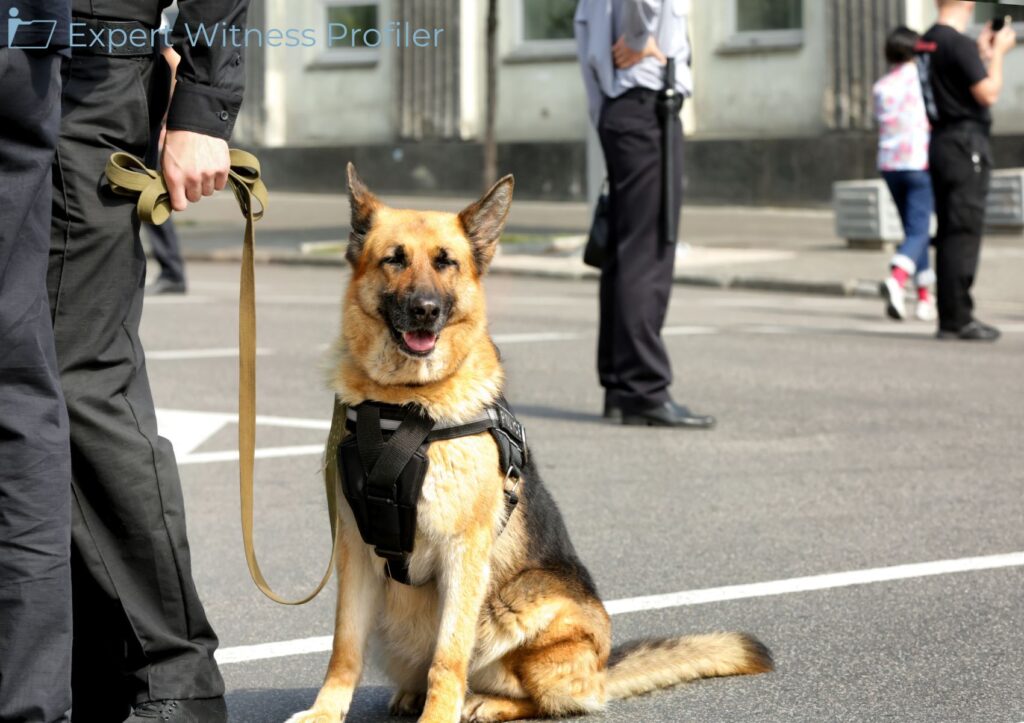
In this excessive force case involving a police canine, Plaintiff Herman Evans (“Evans”) filed a motion to exclude the opinion of The City of Lynchburg’s (“City”) expert witness—Jeffrey T. Barrett (“Barrett”).
Barrett offered four opinions (although the confines of those opinions are not as clearly defined as they should be). First, he reviewed the training records for Officer Reed and the canine Knox—the police officer and canine accused of using excessive force against Evans—and will opine that they received sufficient training. Second, he generally opined on acceptable use of force procedures involving police canines, including the Lynchburg Police Department’s use of force directives. Third, he opined on Evans’ behavior, concluding that he “agrees with the assessments made by Officer Reed about Evans being under the influence of drugs and alcohol.” And fourth, he opined that based on the facts of this case Reed’s decision to employ the canine Knox against Evans was a reasonable use of force.
Law Enforcement Expert Witness
Jeffrey Todd Barrett is a retired police officer, having served 31 years as a canine handler. For the last 22 years of his law enforcement career, Barrett trained other law enforcement officers on handling police canines. Barrett has 1,920 hours of canine training, having attended at least sixteen advanced courses on handling police canines. Barrett also served as an instructor for canine handlers, providing trainings for the Federal Bureau of Investigation; the Secret Service; Customs and Border Patrol; and the U.S. Army and Marine Corps. He has served as an expert witness in at least three other cases and co-authored the book, Canines in the Courtroom.
Evans sought to exclude Barrett’s opinions, arguing they: (1) are outside the scope of Barrett’s expertise, (2) are legal conclusions; and (3) are not derived from reliable principles or methods.
Generally, these arguments collide with Barrett’s experience and education—including decades as a law enforcement officer and canine handler and numerous, specialized trainings in handling police canines. Barrett has also trained other law enforcement officers—including FBI agents–on handling police canines and has written a book on police canines.
Analysis
The Court held that Barrett’s testimony about the standards and procedures for training and using police canines appeared to be both reliable and relevant—the two hallmarks of any Daubert inquiry.
Barrett is also free to apply his expertise—i.e., knowledge about how canines should be trained, handled, and employed in the field—to the facts of this case and is free to opine on whether Officer Reed deviated from standard police practices.
However, Barrett will not be allowed to opine on whether Officer Reed used excessive force in violation of the Constitution as that crosses the line from offering an opinion on the ultimate issue to offering an impermissible legal conclusion.
Barrett will also be precluded from offering expert testimony on Evans’ behavior. Barrett purported to “agree with the assessments made by Officer Reed about Evans being under the influence of drugs and alcohol.” However, Barrett provided no basis for reaching that opinion. He does not purport to be an expert in toxicology or in any behavioral science. He also was not present on the date of the incident to personally observe Evans’ behavior. Rather, Barrett appeared to be parroting Officer Reed’s view of the facts. The jury can compare Officer Reed’s and Evans’ testimony, review any additional evidence (including if there is shoulder camera footage), and make a factual determination about Evans’ behavior without any assistance from Barrett.
Barrett’s attempt to pile on when he was not a firsthand witness to Evans’ behavior crossed the Daubert line and will not assist the jury in any meaningful way. Accordingly, the Court excluded that proffered testimony.
Held
The Court granted in part and denied in part Evans’ motion to exclude the opinion of The City of Lynchburg’s expert witness—Jeffrey T. Barrett.
Key Takeaway
An expert can testify to the ultimate issue so long as there is an adequate foundation. The line between a permissible opinion on an ultimate issue and an impermissible legal conclusion is not always easy to discern. In this case, however, Barrett will not be allowed to opine on whether Officer Reed used excessive force in violation of the Constitution as that crosses the line from offering an opinion on the ultimate issue to offering an impermissible legal conclusion.
Plaintiff Taylor Lavergne sued Hyundai Motor Company and Hyundai Motor America (collectively, “Defendants”) in connection with injuries she allegedly sustained during a rear-end collision between a 2013 Jeep Wrangler and a 2016 Hyundai Accent (the “subject vehicle”) in which she was a passenger.
Plaintiffs designated Brian Herbst as their mechanical engineering expert. Hyundai Motor Company and Hyundai Motor America’s motion to exclude testimony of Brian Herbst under Rule 702.
Mechanical Engineering Expert Witness
Brian Ruben Herbst is a principal in the automotive engineering firm of SAFE Laboratories, L.L.C. He is routinely called upon to evaluate vehicle accidents and to analyze, test and evaluate various vehicle safety systems.
His engineering experience has spanned more than 20 years, almost all of which has related directly to motor vehicle testing, crashworthiness, restraint system, and structural analysis. Herbst has been called upon to analyze several hundred real world accidents. He is a member of the Society of Automotive Engineers (SAE), American Society of Mechanical Engineers (ASME), and the National Society of Professional Engineers (NSPE).
In his report, Herbst opined that “[w]ith the amount of rear crush that occurred in the accident, the subject vehicle failed to maintain an acceptable survival space.” Herbst also stated that he “could design a rear structure to be much stronger, not much more expensive or heavy, just as attractive and able to dramatically reduce crush and prevent serious occupant injury in a rear impact crash,” compared to the subject vehicle.
To that end, Herbst outlined various methods to improve a vehicle’s rear strength:
“Replacing low-strength steel with high-strength steel (i.e. Boron steel is five times stronger than conventional steel)”;
“Implementing and/or improving load paths”;
“Implementing internal reinforcements, including tubular steel reinforcements”;
“Implementing external reinforcements, such as stiffening ribs or doublers”; and
“Reinforcing component voids with structural foam.”
Herbst opined that each of these modification methods “employ basic engineering principles which are standard industry practices” and that all of the methods “were technologically and economically feasible at the time of the manufacture of the accident vehicle.”
Additionally, his list of modification options “can be mixed and matched as desired,” and “it is not necessary for all the modification options to be incorporated to produce a strong and non-defective rear structure.”
Defendants argued that Herbst’s opinions regarding his alternatively designed Hyundai were unreliable and therefore inadmissible because Herbst employed a variable design approach rather than a single design alternative.
Analysis
Herbst offered as an alternative design an exemplar 2012 Hyundai Accent reinforced with a combination of higher-strength steel, additional welding and expanding rigid foam.
Herbst opined that his exemplar alternative design need not be employed in its entirety, but that his proposed “strength improvement design options can be mixed and matched as desired,” and that “it is not necessary for all the modification options to be incorporated to produce a strong and non-defective rear structure.”
Defendants complained that Herbst is not committed to one alternative design, and that he could not identify the strength of steel used in any other comparator vehicle.
Moreover, Defendants remarked that Herbst’s opinion includes any unspecified combinations of his five proposed modification methods for a “non-defective rear structure.” Defendants argued that this noncommittal approach would prejudice Defendants because Herbst has not established that any one of those methods individually “was capable of preventing the claimant’s damage.”
In her opposition, Plaintiff informed the Court that Herbst will testify as to only the alternative design used in Plaintiff’s Rear Impact Test. However, Defendants asked the Court to grant their motion as to “mix-and-match” opinions regarding design options. The Court agreed with Defendant here that the mix-and-match opinions are problematic and should not be permitted at the trial of this matter.
Defendants contended that Plaintiff’s Rear Impact Test is unreliable due to its position that Plaintiff’s Rear Impact Test was not substantially similar to the subject collision and that Plaintiff failed to show that another way to design the product existed. The Court issued a previous Memorandum Order that found that there was substantial similarity and that non-compliance with FMVSS 301-R did not justify exclusion of the alternative design.
Held
The Court granted in part and denied in part Hyundai Motor Company and Hyundai Motor America’s motion to exclude the testimony of Brian Herbst.
Key Takeaway
Herbst was prohibited from testifying or offering any evidence of a variable design approach (“mix-and-match”) because he offered no measurements, testing, or other quantification to support his assertion that “mixing and matching” his proposed modifications would result in a “strong ad non-defective rear structure.”
This case arises from an accident involving a Robinson R44 II helicopter, registration N442VB (“Helicopter”), that occurred on the evening of December 30, 2021, in Levy County, Florida. The Helicopter was being flown at night by the owner-pilot, Ronald Hicks (“Pilot Hicks”), from a local friend’s residence to his private property. At the time of the accident, Pilot Hicks had less than ten hours of night flight experience in helicopters and was not certified under Instrument Flight Rules (“IFR”). Mr. Hicks, Shelly Kate Hicks, and their two children sustained fatal injuries.
Plaintiffs filed a Daubert motion to exclude and/or limit the testimony of Defendant’s metallurgical expert Dr. Gary J. Fowler.
Metallurgy Expert Witness
Dr. Gary Jefferson Fowler is a registered professional metallurgical engineer with nearly fifty years of experience in metallurgy, materials science, and failure analysis.
He holds a B.S., M.S., and Ph.D. (1976) in engineering fields related to metallurgy and materials science from the University of California, Los Angeles (UCLA).
To begin with, Plaintiffs argued that Fowler opined regarding what they characterize as “accident reconstruction and piloting issues” despite being unqualified to do so.
The Court has reviewed Fowler’s expert report and finds that his conclusions are squarely within the realm of his expertise as a metallurgist. Plaintiffs may vigorously cross-examine Fowler’s methodology and conclusions at trial, but they have not demonstrated exclusion is warranted on these grounds.
Methodology
Second, Plaintiffs argued that Fowler relied on insufficient facts or data and his methodology was unreliable. Plaintiffs argued that Fowler did not properly substantiate several opinions, including those regarding foreign object debris “FOD,” that the marks on the crankshaft were “smears,” not “gouges,” and that the helicopter was under power at the time of the crash.
Whether Fowler “selected the best data set to use . . . is a question for the jury, not the judge.” Plaintiffs are certainly free to cross-examine Fowler regarding perceived deficiencies in his data or conclusions, but they have not demonstrated exclusion is warranted.
Substantial Similarity Doctrine
Plaintiffs also claimed that the substantial similarity doctrine warrants exclusion of Fowler’s comparison of the instant crash with other crashes. But the substantial similarity doctrine “applies when one party seeks to admit prior accidents or occurrences involving the opposing party” to demonstrate, for example, notice, lack of safety for intended uses, strength of a product, or causation.
Plaintiffs did not include this standard or addressed why it might apply here, where Defendant, not Plaintiffs, seeks to admit similar crashes. Plaintiffs’ application is limited to arguing that Fowler is “seeking to compare the instant crash to another crash that is dissimilar while seeking to argue that the causes of each crash are similar.” But this is not the import of Fowler’s comparisons. Fowler used elements of the other crashes as discrete points of reference for his metallurgical opinions, for example, that “if a crankshaft gear bolt is improperly installed and suffered from lack of torque, like in the New Jersey accident, then the dowel fracture would occur soon after the overhaul . . . or manufacture,” and that “crashes involving engines under power will exhibit similar signatures to those seen here.” Again, Plaintiffs may cross-examine Fowler regarding perceived deficiencies in these comparisons, but they have not demonstrated exclusion is warranted.
Assistance to the Trier of Fact
Plaintiffs argued that Fowler’s opinions are cumulative, prejudicial, and will not assist the trier of fact. Plaintiffs claimed that Fowler’s testimony will be cumulative when combined with Defendant’s other experts Russo and Knuteson. The Court has already agreed that Russo’s testimony will be needlessly cumulative and has granted Plaintiffs’ motion to exclude on those grounds. Further, the Court has also agreed that, at this juncture, Knuteson’s testimony will also be needlessly cumulative, and has granted Plaintiffs’ motion to exclude on those grounds without prejudice for Defendant to renew its reponse.
Finally, Plaintiffs requested that Fowler be bound to the opinions contained within his expert report. The Court absolutely agreed that no expert may offer opinions not within their expert report.
Held
The Court denied Plaintiffs’ Daubert motion to exclude and/or limit Defendant’s metallurgical expert Dr. Gary Fowler.
Key Takeaway
The Court recognizes and appreciates the importance of its gatekeeping function. It routinely grants Daubert motions when appropriate. In this case, the Court has reviewed Fowler’s expert report and finds that his conclusions are squarely within the realm of his expertise as a metallurgist.
Please refer to the blogs previously published about this case:
Plaintiff Serra Chevrolet, Inc. (“Serra”) sued Defendant General Motors, LLC (“GM”) for breach of contract, violations of Alabama’s Motor Vehicle Franchise Act, negligence, wantonness, and violations of the federal Dealer’s Day in Court Act.
Serra retained Patrick L. Anderson to provide an expert report on lost sales and lost profits in this matter. GM filed a motion to exclude the testimony of Anderson.
Economics Expert Witness
Patrick L. Anderson founded Anderson Economic Group in 1996, and currently serves as the company’s principal and chief executive officer.
Anderson is a graduate of the University of Michigan, where he earned a Master of Public Policy degree and a Bachelor of Arts degree in political science. He is a member of the National Association for Business Economics and the National Association of Forensic Economists. The Michigan Chamber of Commerce awarded Anderson its 2006 Leadership Michigan Distinguished Alumni award for his civic and professional accomplishments.
Anderson has written over 100 published works, including the Economics of Business Valuation from Stanford University Press.
First, GM did not argue that Anderson’s testimony will not assist the trier of fact, and, after thorough review, the Court found that it will.
Second, although GM did not explicitly argue that Anderson is not qualified to act as an expert in this case, GM did state that Anderson merely “purports” to be an economic expert, is not an accountant, and “only holds degrees in ‘public policy.’” This called Anderson’s qualifications into question. The Court found that Anderson is qualified to act as an expert witness in this case.
Anderson’s training, education, and experience all qualify him as an expert: his undergraduate and graduate degrees involved extensive coursework in economics, he worked as an economist for multiple employers, he founded and serves as CEO of Anderson Economic Group, he has published multiple journal articles on economic topics, and he has been recognized by professional economics societies.
Anderson Economic Group has previously done work for numerous automotive manufacturers, including GM, and in the first few months of 2025, several major news outlets cited Anderson Economic Group regard to automotive economic issues. Anderson’s expert testimony regarding damages has been admitted in multiple automotive cases.
II) Reliability
GM did challenge the reliability of Anderson’s opinions and methodology. However, Anderson’s lost sales and lost profits analyses are sufficiently grounded in GM’s own metrics and industry data. He used GM’s Retail Sales Index and Planning Volume projections—metrics that GM itself uses to gauge expected dealer performance—as well as comparisons to similar dealerships’ market penetration. These provide an objective basis for estimating how many more vehicles Serra would have sold if not constrained by GM’s allocations. While GM criticizes Anderson for assuming Serra would sell every additional vehicle allocated, this assumption aligns with evidence that dealers typically sell whatever inventory they receive over time.
GM also argued that Anderson improperly ignored Serra’s actual (poor) profitability and instead applied an average profit per vehicle from other regional dealers. However, Anderson explained that Serra’s own financials were abnormally low because GM’s failure to allocate enough inventory made Serra unprofitable.
Indeed, the entire point of a lost profits analysis is to determine what profits would have been in the absence of the allegedly harmful conduct. Constraining Serra’s lost profit calculation by requiring it to consider its own depressed profits when considering what its profits should have been would run counter to this goal. And using the regional average gross profit per new vehicle provides a reasonable estimate of what Serra could have earned if it, like other dealers, had adequate inventory.
The Court held that any gaps or debatable assumptions in Anderson’s opinion (such as not conducting a customer survey or perfectly allocating sales among competing dealers) are points that GM can attack on cross-examination.
III) Legal Conclusions
Finally, GM raised concerns that Anderson made legal conclusions throughout his report. Specifically, GM is concerned about Anderson’s conclusions that GM’s allocation process is “arbitrary,” “inconsistent with their contract,” “not consistent with the Alabama statute,” and the “proximate cause” of Serra’s damages.
A) Arbitrariness
GM argued that Anderson may not testify that GM’s allocation system is “arbitrary” because whether GM’s allocation system is arbitrary is a question of fact for the jury. GM also argued that because Anderson’s finding of arbitrariness permeates his entire report, Anderson should not be allowed to testify at all.
Because in testifying that GM’s allocation system is arbitrary Anderson would indeed be substituting for the court in charging the jury regarding the applicable law, the Court agreed that Anderson may not testify that GM’s allocation system is arbitrary.
However, it did not follow that Anderson’s entire testimony should be excluded. Instead of saying that a part of GM’s allocation process is “arbitrary,” Anderson can simply use a different word, such as “unexplained” or “discretionary,” and leave it to the jury to determine if such unexplained and discretionary decisions constitute arbitrary behavior. This simple change in word choice is sufficient to bring Anderson’s testimony in line with Rule 702.
B) Contractual Interpretation
GM also argued that Anderson may not opine that GM’s allocation process is “inconsistent with their contract.” Such testimony from Anderson would entail first testifying as to the meaning of contractual provisions and then testifying that GM breached those contractual provisions.
The Court held that Anderson may not testify that the contract between GM and Serra requires GM to consider Serra’s sales requirements and sales potential, because such testimony by Anderson would simply constitute a reiteration of Serra’s interpretation of the contract. This type of testimony is properly excluded regardless of whether it is “within the scope of [the expert’s] undisputed knowledge, training, and qualifications.” Once the Court has found a contract provision to be ambiguous, what an expert witness may provide is extrinsic evidence—such as that of trade usage or industry meaning—to guide the jury’s interpretation of the provision. Thus, although Anderson may not interpret the contract himself, he may provide extrinsic evidence to help the jury interpret the contract.
As to the second issue—whether Anderson may testify that GM breached the contract—the answer is no. Thus, Anderson may not testify that GM breached its contract with Serra.
C) Statutory Interpretation
GM also argued that Anderson may not state that GM’s allocation process is “not consistent with the Alabama statute.”
The Court properly excluded such testimony because stating that GM’s allocation system is not consistent with the Alabama statute did no more than offer expert opinion in the form of legal conclusions, risking confusing, prejudicing, or misdirecting the jury.
D) Proximate Cause
Finally, GM argued that Anderson may not state that GM’s allocation process is the “proximate cause” of Serra’s losses because to state the existence of proximate cause is to make an improper legal conclusion.
The more salient issue is whether Anderson’s testimony as to proximate cause will be helpful to the trier of fact.
Stripped to its core, the causal chain is one that a layperson can easily grasp: a reduction in vehicle allocations necessarily produces a reduction in inventory, which in turn yields fewer sales and lower profits. But this causal chain is heavily contested. Throughout Anderson’s report, he delves into the finer points of how exactly GM’s allocation system caused Serra financial harm.
These are issues on which the opinions of an expert economist who is familiar with the automotive industry would be helpful to the trier of fact.
Held
The Court granted in part and denied in part GM’s motion to exclude the testimony of Patrick Anderson.
Key Takeaway
GM claimed that Anderson’s opinions are unsupported ipse dixit, but this assertion is contradicted by the record. Anderson’s report explicitly lays out how he reconstructed GM’s allocation process from internal documents, identified nine arbitrary aspects of that process (e.g., unexplained use of tiers, inconsistent time frames for sales data, lack of criteria for discretionary allocations), and then used GM’s own sales potential metrics to quantify lost sales. And he did not simply assert in a vacuum that Serra lost sales due to GM’s allegedly unlawful allocations; he tied each lost sale estimate to data points GM itself calculated for Serra’s market. This kind of analysis is not ipse dixit because it is “‘supported by appropriate validation—i.e., ‘good grounds,’ based on what is known.’”
Plaintiffs Sabby Volatility Warrant Master Fund Ltd. (“Sabby”), SZOP Multistrat LP (“SZOP”), Alto Opportunity Master Fund SPC Segregated Master Portfolio B (“Alto”), and Hudson Bay Master Fund Ltd. (“Hudson Bay”), purchasers of common stock of Quanergy Systems, Inc. (“Quanergy”) in a public offering that closed on November 2, 2022 (the “Offering”), brought suit against Defendants Kevin J. Kennedy, Patrick Archambault, Jim Disanto, Karen Francis, Tamer Hassanein, Lisa Kelley, Thomas M. Rohrs, and Tianyue Yu, all former officers and/or directors of Quanergy, for alleged violations Sections 11 and 15 of the Securities Act of 1933, for failing to take reasonable care that there were no material misrepresentations or omissions in the registration statement and prospectus for the Offering (the “Offering Documents”).
Defendants argued that Plaintiff’s expert John Levy should be disqualified because his testimony meets none of the three requirements of Rule 702: Defendants suggested that Levy is not qualified to opine on the topics at issue; that Levy’s opinions are unreliable reflections of personal opinion; and that Levy impermissibly acts as a vehicle to deliver Plaintiffs’ preferred version of the facts and improperly assesses witness credibility, which makes his testimony unhelpful and therefore irrelevant to the factfinders.
Accounting Expert Witness
John F. Levy received a Bachelor of Science from the Wharton School of the University of Pennsylvania and a Master of Business Administration from St. Joseph’s University. Thereafter, he spent nearly five decades working in corporate governance, finance, public reporting, auditing, and accounting.
Levy has been a Certified Public Accountant in Illinois since 1978 and has nearly ten years of accounting experience at several large accounting firms; has been the chief financial officer of four companies and the chief operating officer of one company; has served on the boards of directors of fifteen public companies; has served as chair of the audit committees for eight companies, which required him to write and review public filings; was involved in one public offering in his role as a company officer and another in his role as an outside director; and has taught corporate governance for state accounting societies and other organizations since 2005.
Defendants argued that Levy “lacked the necessary expertise to opine on disclosure obligations or the level of investigation required to satisfy the reasonable investigation defense.”
That Levy has limited previous experience with public offerings generally or with disclosure issues such as those at issue in this case specifically is insufficient to justify declining to qualify him as an expert.
The Court held that Levy’s education plus his decades of business experience qualify him to opine on the level of due diligence customarily performed in connection with public offerings.
Reliability
According to the Court, Defendants’ criticism that Levy failed adequately to describe his methodology was misplaced: Levy’s methodology was to apply his experience to the facts of the case.
As required, Levy’s conclusions are testable under Daubert in the sense that they are “provable (or disprovable) by equivalent testimony by experienced participants in the industry.”
Defendants’ assertion that Levy “could not articulate specific examples” of times he conducted due diligence did not require excluding his expert opinions as unreliable.
Relevance and Helpfulness
Defendants argued that Levy’s testimony is merely “a vehicle for factual narrative” and includes “improper credibility assessments.”
To begin with, Defendants’ argument that Levy’s report is nothing more than a recitation of the facts of the case is not persuasive in light of the fact-intensive nature of any analysis of the adequacy of due diligence. However, Levy explained that customary due diligence requires officers and directors to ask certain questions of counsel, and he opined that Defendants should have asked whether “the risk of failing to meet the $15 Million [Capitalization] Requirement should be included in the Offering Documents.” Levy goes on to say that his review of the record reflects that Defendants failed to ask that question; he therefore concludes that Defendants performed less-than-customary diligence.
A jury does not need expert testimony to understand whether Defendants, in fact, asked questions of counsel about whether to include certain risks. Levy may not testify that the record reflects a failure by Defendants to ask their outside advisors certain questions; he may testify using “hypotheticals based on assumptions about testimony in the record.”
Defendants’ assertion that Levy makes “improper credibility assessments” has force as well. According to the Court, Defendants are correct that Levy went “at least one step” beyond “reviewing and considering” testimony.
Held
The Court granted in part and denied in part the Defendants’ motion to disqualify John Levy from providing opinions.
Key Takeaway
Lack of extensive practical experience directly on point does not necessarily preclude an expert from testifying and a formal education in a particular field is sufficient to qualify a witness as an expert.
Case Details:
Case Caption:
Sabby Volatility Warrant Master Fund Ltd., Et Al V. Kennedy