Blog

  • Physical Medicine And Rehabilitation Expert’s Report Did Not Contain Any Analysis of a Standard of Care

    Physical Medicine And Rehabilitation Expert’s Report Did Not Contain Any Analysis of a Standard of Care

    This case relates to the incarceration of Plaintiff, Nocomie Tomia Moore, in the Spokane County Jail, as well as medical care and treatment she received from Registered Nurse Tsubasa Bruce, Physician Assistant Denae Paul, and NaphCare, Inc.

    Moore brought claims for violations of Washington State’s Medical Malpractice statute. Defendants sought to exclude Plaintiff’s expert witness, Jonathan Pasma, D.O., as not meeting the required standards to offer such testimony. 

    Defendants argued that Pasma should be excluded for a number of reasons: (1) his disclosure is incomplete as he does not specifically reference any Defendant or describe in detail data or facts considered in rendering his decision; (2) his report and testimony is improperly offered as a matter of Washington law; and (3) his report and testimony do not satisfy Federal Rule of Evidence 702 or Daubert.

    Physical Medicine And Rehabilitation Expert Witness

    Jonathan Pasma received his Doctorate of Osteopathy from Pacific Northwest University of Health Sciences in 2012, and he is currently a licensed, board certified physician in Physical Medicine & Rehabilitation.

    Want to know more about the challenges Jonathan Pasma has faced? Get the full details with our Challenge Study report. 

    Discussion by the Court

    Exclusion pursuant to Washington State Medical Malpractice Law

    In Washington, an expert must articulate what a reasonable medical professional would or would not have done, and then specify how a Defendant failed to act in that manner and show that this failure was the cause of injury.

    The Court held that Pasma’s report did not contain any sort of standard on which he based his opinion. He did not analogize the present case with any hypothetical situation, study on which he had reviewed, or real past treatment in which a patient presenting with a similar injury to Plaintiff received a different standard of care than what was provided. He offered nothing by way of his perspective in the practice of medicine that established how a specific member of the medical team at the Spokane County Jail should have reacted; he instead drew cursory conclusions.

    Exclusion based on Federal Rule of Evidence 702 and Daubert

    Defendants contended that Pasma’s report and testimony is neither reliable nor relevant, as his opinion is based on an inaccurate review of the record, he lacks the specialized knowledge of treatment of patients in a corrections setting, and he does not apply the higher degree of analysis typically found in an expert report.

    First of all, Pasma is a physiatrist and testified as his deposition that he has no experience working in an urgent care, emergency room, or corrections setting, and has not independently diagnosed a hip fracture since residency. 

    Second, the Court found Pasma’s account of the factual background of the events of this case scant and arguably incorrect.

    Basically, Pasma’s report did not contain any analysis of a standard of care and any Defendant’s specific breach. He provided a generalized conclusion that “Ms. Moore’s care, specifically timely triage, was improperly delayed 2 days, which of course implies that unnecessary pain/suffering occurred,” but offered nothing to support why this contention was true from his expert position as a physician. Moreover, he stated in his deposition that he was not asserting any violation of a standard of care by a nurse involved, nor did he want to provide a “label,” for the level of care provided by the physician’s assistant in this case.

    Held

    The Court excluded the testimony of Plaintiff’s expert witness, Jonathan Pasma.

    Key Takeaway:

    Even if the Court could look beyond the lack of reliability offered by Pasma’s report, the opinions he offers also lack the requisite relevancy such that offering them to a factfinder would be helpful. Rule 702 requires that an expert witness be vested with “scientific, technical, or other specialized knowledge” that “will assist the trier of fact” in their understanding of the evidence. If satisfied, “a witness qualified as an expert . . . may testify thereto in the form of an opinion.”

    Case Details:

    Case Caption: Nocomie Tomia Moore V. Naph Care Inc Et Al
    Docket Number: 2:22cv256
    Court Name: United States District Court, Washington Eastern
    Order Date: May 08, 2025
  • Aviation Expert’s Testimony on Flight Attendant Conduct Excluded

    Aviation Expert’s Testimony on Flight Attendant Conduct Excluded

    In this personal injury case, Plaintiff Ana Maria Marcela Tavantzis (“Tavantzis”), individually and on behalf of her husband, Jesus Plascencia (“Plasencia”), alleged Defendant American Airlines, Inc. (“American”) was responsible for a stroke Plasencia suffered just prior to landing on an international flight from Miami to Madrid, Spain.

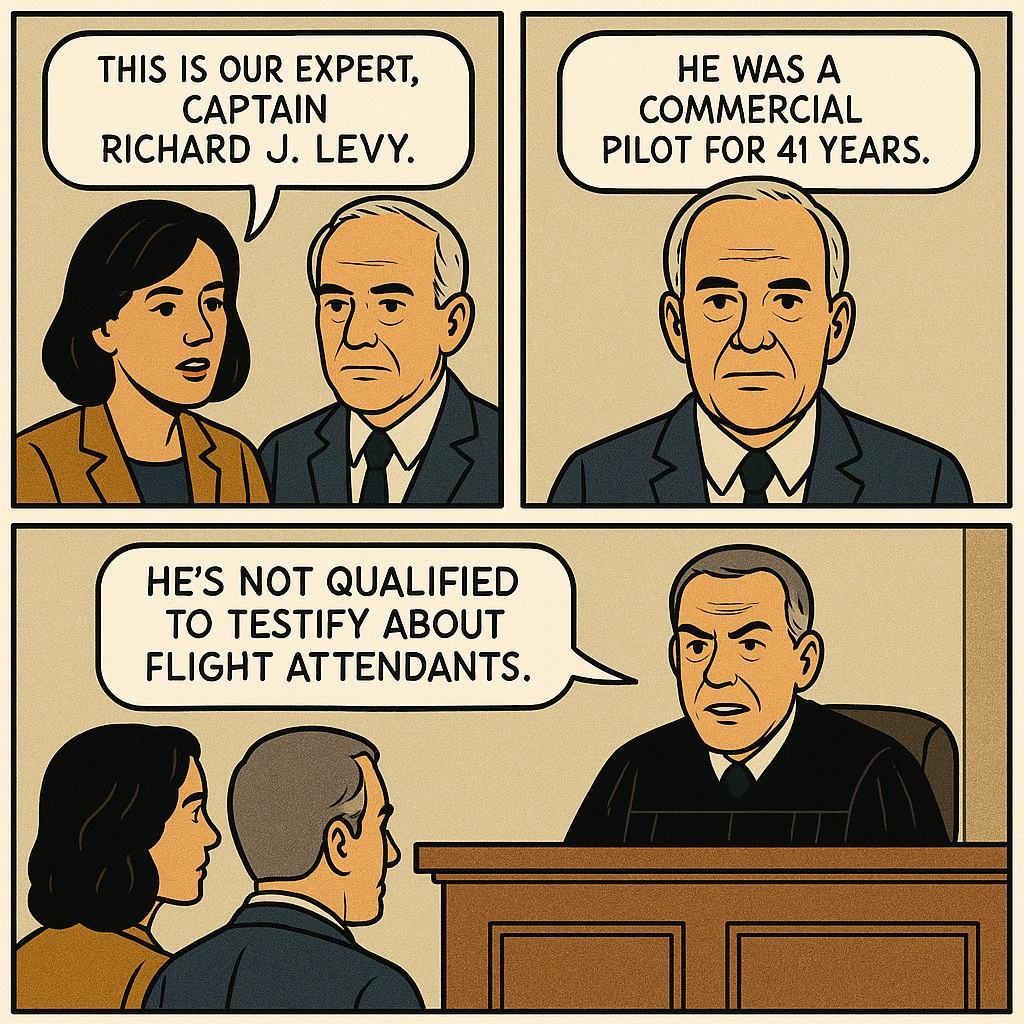
    Plaintiff’s expert Captain Richard J. Levy advanced three opinions related to three critical periods before and during the flight at issue: (1) just before takeoff when the pilot spoke with Plaintiffs; (2) when Plasencia presented stroke symptoms an hour and a half into the flight; and (3) when the pilot landed in Madrid.

    American argued that the Court should exclude Levy’s opinions because the opinions (1) are unreliable under the Daubert standard; (2) exceed the scope of his aviation expertise; (3) rely on destroyed data; and (4) supplant the jury’s function by opining on the ultimate facts. 

    Aviation Expert Witness

    Captain Richard J. Levy flew forty-one years at a major international airline, American Airlines, until the mandatory retirement age of 65 in June of 2018.

    He has decades of flight experience in both the commercial and military field. Since his retirement, he has been conducting simulator and classroom training as a Flight Crew Training Instructor at another major airline, Southwest Airlines.

    Get the full story on challenges to Richard Levy’s expert opinions and testimony with an in-depth Challenge Study. 

    Discussion by the Court

    Reliability

    American disputed the reliability of Levy’s experience as the basis for his opinions. 

    To support this contention, American advanced three reasons:

    • First, American argued that Levy’s testimony is unreliable because it does not explicitly “set forth what Levy was asked to opine on.”
    • Second, American argued that Levy’s opinions are unreliable because his opinions did not cite directly to the record or engage in sufficient “analysis.”
    • Finally, American contended that Levy’s opinions are irrelevant because they did not have “any tendency to make a fact more or less probable than it would be without the evidence.”

    Analysis

    American never explains why the imprecision surrounding the scope of Levy’s engagement renders his opinions unreliable. What Levy thought the contours of his assignment were has no bearing on his qualifications or experience; the Court held that he is still a flight training instructor who for 41 years served as a commercial pilot for Defendant American Airlines. 

    Moreover, the facts of this case are not so complicated that it requires citations to the record to understand the context of Levy’s opinions. His opinions reflect the application of his specialized knowledge and experience to the straightforward facts of this case, which he describes at the outset of his report. Because Plaintiffs submitted Levy as an expert for his experience, Levy need not have conducted any “analysis” in the manner American insisted he must. 

    Besides, the Court determined that Levy’s opinions make some facts more or less probable, if the American flight in this case had sufficient fuel for the pilot to turn the plane around if Plasencia presented stroke symptoms an hour and a half into the flight (a fact that is disputed by the parties). 

    Scope

    American specifically challenged Levy’s statements regarding the proper conduct of American employees, other than the pilot, who were working on the aircraft during Plaintiffs’ flight. As an expert, Levy is allowed to make certain factual assumptions within his opinions.

    However, considering Levy’s experience was as a pilot, not a flight attendant, the Court held that he is not qualified to opine on whether the flight attendants on board contravened policy or acted negligently. 

    The Court excluded all portions of Levy’s testimony that opine on the behavior, conduct, or propriety of any American employee other than the pilot.

    Origin of Flight Track Data

    The flight data that Levy used in his report is reliable. American argued otherwise, suggesting that the flight data was suspect because it was obtained from third party FlightRadar24 and is now no longer available on that site. 

    Plaintiffs responded that the limited data that Levy relied upon—a cropped rendering of the flight path after an hour and a half of flight time—was provided to American. The Court deemed it sufficient under Civil Procedure Rule 26.

    Ultimate Issue

    In this case, American conflates factual issues and legal issues; experts are only proscribed from opining on the latter when it goes to the ultimate issue in the case.

    The Court held that Levy does not opine on any legal issues, so there is no reason to exclude Levy’s proffered testimony on those grounds.

    Held

    The Court granted in part and denied in part American’s Daubert motion to exclude the opinions of Plaintiffs’ expert, Ret. Captain Richard J. Levy. 

    Key Takeaway:

    Levy goes beyond the scope of his expertise to opine on the proper conduct of American employees, other than the pilot, who were working on the aircraft during Plaintiffs’ flight. After all, Levy’s experience was as a pilot, not a flight attendant. 

    Case Details:

    Case Caption: Tavantzis V. American Airlines, Inc.
    Docket Number: 5:23cv5607
    Court Name: United States District Court, California Northern
    Order Date: 5:23cv5607
  • Firearms Expert’s Testimony Excluded Because of His Limited Experience with Machineguns

    Firearms Expert’s Testimony Excluded Because of His Limited Experience with Machineguns

    Defendant Chase Farmer was charged and convicted of multiple firearms offenses in a trial spanning April 29, 2025, to May 6, 2025. Specifically, Defendant was charged with importing, possessing, transporting, and failing to keep proper records for drop-in auto sears (“DIAS”) and Glock switches from Russia, which are machinegun conversion devices regulated as machineguns under the National Firearms Act (“NFA”).

    Four days before trial commenced, the Government filed a motion in limine seeking to exclude various witnesses that Defendant proposed.

    The Court granted the Government’s motion in part. However, the Court took under advisement the Government’s request to exclude Defendant’s proposed firearms expert, Tyler Hilliker. The Court explained that it had doubts that Hilliker met the qualifications for an expert witness.

    Firearms Expert Witness

    Tyler Hilliker founded Hilliker Arms in 2021, and for the following two years was engaged solely in instructing on safe firearms handling and concealed carry.

    He has also completed several courses pertaining to firearms.

    Get the full story on challenges to Tyler Hilliker’s expert opinions and testimony with an in-depth Challenge Study.

    Discussion by the Court

    The Court found that Hilliker’s experience with DIAS and Glock switches is derived solely from watching others work with them, mostly on video, and relatively few times. Moreover, Hilliker’s experience with machineguns in general is limited. He has only manufactured three machineguns: two AR-15s modified with traditionalstyle sears and an Uzi.          

    Moreover, Hilliker based his conclusions in his expert report on modifying an AR-15 with what he called a “traditional” auto sear—not a DIAS. Thus, there was no “fit” between Hilliker’s proffered testimony and the pertinent inquiry in this case, which involves DIAS and Glock switches specifically.

    Held

    The Court granted the government’s motion to preclude Tyler Hilliker as an expert witness.

    Key Takeaway:

    While Hilliker may be knowledgeable about firearms in general, it does
    not mean he is qualified to be an expert witness about converting firearms into machineguns via DIAS or Glock switch.

    Case Details:

    Case Caption: USA V. Farmer
    Docket Number: 2:22cr20678
    Court Name: United States District Court, Michigan Eastern
    Order Date: May 07, 2025
  • Mortgage Expert Allowed to Testify Despite Not Updating the Earnings Model

    Mortgage Expert Allowed to Testify Despite Not Updating the Earnings Model

    The lawsuit concerns whether “Freddie Mac concealed its overextension in the nontraditional mortgage market—generally composed of instruments known as subprime mortgages or low credit and high risk instruments—and its materially deficient underwriting, risk management and fraud detection practices through misstatements and omissions to investors.”

    Plaintiff Ohio Public Employees Retirement System (“OPERS”)  retained Howard Shapiro as a putative non-scientific expert in the mortgage finance industry during August 1, 2006 through and including November 20, 2007 (the “Relevant Period”).

    Freddie Mac alleged that Shapiro is unqualified to offer his opinions, his opinions are unreliable, and therefore, do not meet the threshold of admissibility for expert evidence established by Rules 403 and 702 of the Federal Rules of Evidence

    OPERS also designated Shapiro as a fact witness pursuant to Fed. R. Evid. 701.

    Mortgage Expert Witness

    Howard S. Shapiro was a chartered financial analyst who specialized in the mortgage finance industry for a significant part of his professional career.

    From early 2006 through December 2008, he was a Vice President and Analyst at Fox-Pitt Kelton, a sell-side firm that specializes in financial services.

    His area of expertise is in studying the operations of mortgage finance companies, studying the credit risk that they take, studying their underwriting and product practices, and studying their usage of capital.

    Get the full story on challenges to Howard Shapiro’s expert opinions and testimony with an in-depth Challenge Study. 

    Discussion by the Court

    Shapiro’s first step was to review all of Freddie Mac’s public disclosures from the Relevant Period. Next, he reviewed other publicly available documents about Freddie Mac’s activities during the Relevant Period. Shapiro then reviewed “other analyses of Freddie Mac;” only; in this case, he had access to Freddie Mac’s own internal analyses. He reviewed more than 100 internal assessments (totaling more than 4,000 pages) related to Freddie Mac’s credit risk and underwriting. 

    Shapiro utilized the above methodology to reach his opinion that Freddie Mac was “externally reporting exposure to ‘subprime’ (broadly defined in its own disclosures) at a paltry 0.2% of the portfolio and internally recognizing that roughly 12% of the portfolio was behaving like subprime..”  Had he been made aware of Freddie Mac’s internal credit risk and underwriting assessments during the Relevant Period, Shapiro opines that he “would have rated the stock as ‘Underperform’ and advised our clients to avoid purchasing it” during the Relevant Period. 

    Analysis

    Shapiro’s Opinions Are Not based on Sufficient Facts

    According to Freddie Mac, Shapiro’s opinions are not based on sufficient facts. However, the Court determined that Freddie Mac’s argument that Shapiro should have looked at more and/or different evidence is not a basis on which to exclude him.

    Shapiro’s Opinions are not the Product of Reliable Principles or Methods

    Freddie Mac claimed that Shapiro failed to analyze whether the internal assessments he cited would have changed the “total mix” of information available from Freddie Mac’s public disclosures.

    To the contrary, Shapiro documented in his Rebuttal Report with regard to Freddie Mac’s underwriting that he “found repeated internal discussions, statements and conclusions stretching across the entire Relevant Period pointing to a significant, and multi-faceted, problem within the Company related to underwriting.”

    According to Freddie Mac, Shapiro’s opinions rest on a “faulty legal premise,” namely that Freddie Mac was obligated to disclose “as much information as they could disclose without putting themselves at any competitive risk.”

    Shapiro, however, stated his view as a financial analyst that he would have preferred Freddie Mac to provide “as much information as they could disclose without putting themselves at any competitive risk.”

    Freddie Mac criticized Shapiro for not updating the earnings model he used during the Relevant Period in connection with his opinions in the present case because “another expert cannot replicate it.” However, there was no need for Shapiro to update his 20-year-old financial model that he no longer had access to.

    Freddie Mac argued that Shapiro’s opinions on falsity and materiality are not the product of reliable principles or methods. Shapiro explicitly testified that he was not offering opinions on either of these issues.

    Freddie Mac contended Shapiro’s opinion on loss causation is not the product of reliable principles or methods. However, Shapiro has not been called to opine on the subject of loss causation. Rather, he “will testify that capital insufficiency and unexpected future losses due to credit risk were, in his view, largely responsible for the stock decline on November 20, 2007.” 

    Shapiro Impermissibly Opined on Ultimate Liability Issues

    Freddie Mac asserted Shapiro’s testimony should be excluded because he impermissibly opined on ultimate liability issues by offering legal conclusions on falsity and materiality.

    However, Shapiro is not attempting to instruct the jury on a legal test for falsity or materiality and is not applying any such test to the facts of the case. 

    Held

    The Court granted in part and denied in part Freddie Mac’s motion to exclude the testimony of Howard S. Shapiro. Shapiro will not be allowed to opine as an expert on securities fraud, falsity, materiality or loss causation.

    Key Takeaway:

    The trial court’s gatekeeping analysis with respect to an expert’s methodology is very flexible and must be tied to the facts of a particular case, depending on the nature of the issue, the expert’s particular expertise, and the subject of his testimony.

    Particularly with respect to non-scientific experts, like Shapiro, the relevant reliability concerns may focus upon personal knowledge or experience.

    Case Details:

    Case Caption: Ohio Public Employees Retirement System V. Federal Home Loan Mortgage Corp., Et Al.
    Docket Number: 4:08cv160
    Court Name: United States District Court for the Northern District of Ohio, Eastern Division
    Order Date: March 28, 2025
  • Intellectual Property Expert’s Opinion on Settlement Licenses Excluded

    Intellectual Property Expert’s Opinion on Settlement Licenses Excluded

    Plaintiffs’ claim for breach of contract is based on a 2001 licensing agreement (“the 2001 License” or “the License”) between Plaintiffs and Defendant Extreme Networks, Inc. (“Extreme”).

    Plaintiffs retained Mark Chandler to issue an opinion about “agreements and negotiations related to the licensing, development and commercial use of software, copyrights, and other intellectual property.”

    According to Chandler, Plaintiffs’ previous settlement agreements with third parties are “relevant because they demonstrate [Plaintiffs’] licensing practices under conditions that are similar to their current dispute with [Defendant].”

    Intellectual Property Expert Witness

    Mark Chandler is the founder of Upstream Partners and a recognized expert in commercializing intellectual property (IP) and technology.

    Chandler completed his undergraduate studies in electrical engineering (BSEE, Bucknell University), and continued his technical education in physics while working at the Johns Hopkins Applied Physics Lab. He practiced as a researcher building the world’s most accurate atomic clocks and implantable medical devices, and obtained his MBA from the Wharton School of the University of Pennsylvania.

    He has testified as a financial damages expert and as a licensing expert, on behalf of both Plaintiffs and Defendants, for patent litigation and contract dispute matters in U.S. District Court, state courts and arbitration proceedings.

    Get the full story on challenges to Mark Chandler’s expert opinions and testimony with an in-depth Challenge Study. 

    Discussions by the Court

    The primary issue is whether Chandler’s opinions about Plaintiffs’
    settlement history fit the facts of this case such that they will be helpful to the jury.

    Plaintiffs have not sufficiently explained why Chandler’s analysis of previous settlement agreements are related to Defendant’s liability for breach of contract, copyright infringement, or fraud. Nor have they explained how Chandler’s opinions are relevant to their damages.

    The Court held that Chandler generally discusses the circumstances of Plaintiffs’ previous settlements and his opinions on why Plaintiffs and the third parties arrived at the settlement amount. But he “does not even purport to analyze Plaintiffs’ previous settlements for the purposes of extracting licensing rates that might inform the value of its copyrighted software.” Nor did he connect his summary of Plaintiffs’ three previous settlements to any standard practices and customs.

    Held

    The Court granted Defendant’s motion to exclude the opinions of Mark J. Chandler.

    Key Takeaway:

    Under the circumstances, Plaintiffs did not sufficiently explain why Chandler’s analysis of their previous settlement agreements will assist the jury to understand the evidence or to determine a fact in issue.

    Case Details:

    Case Caption: SNMP Research, Inc. v. Extreme Networks, Inc.
    Docket Number: 3:20cv451
    Court Name: United States District Court for the Eastern District of Tennessee
    Order Date: May 06, 2025
  • Leasing Experts Are Not Allowed to Define Industry Standards

    Leasing Experts Are Not Allowed to Define Industry Standards

    This case is a landlord/tenant dispute regarding a lease agreement between Plaintiff/landlord Trustees Main/270 and Defendants/tenants ApplianceSmart, Inc., and JANONE, Inc. The claims arise from Defendant ApplianceSmart’s failure to pay pursuant to a lease agreement, and Defendant JANONE’s obligations as guarantor under the lease.

    Plaintiff filed a motion in limine related to two witnesses Defendants intended to call at trial to discuss the mitigation issue: Tony Isaac and Virland Johnson. Isaac is a director and the Chief Executive Officer of Defendant JANONE and the director of the parent company of Defendant ApplianceSmart. He will testify to Defendants’ attempts to provide a replacement tenant, show Plaintiff failed to mitigate its damages, and testify regarding the value of Plaintiffs replacement lease as an offset to any claimed damages. Johnson, the Chief financial officer of Defendant JANONE and former Chief Financial Officer of the parent company of ApplianceSmart, will offer similar testimony.

    Plaintiff argued that Defendants did not disclose Isaac and Johnson as expert witnesses.

    Leasing Expert Witnesses

    Virland A. Johnson provided leadership and strategic direction while serving in C-Level executive roles in public and privately held companies such as Cultural Experiences Abroad, Inc., Fender Musical Instruments Corp., Triumph Group, Inc., Unitech Industries, Inc. and Younger Brothers Group, Inc. Johnson’s more than 25 years of experience is primarily in the areas of process improvement, complex debt financings, SEC and financial reporting, turn-arounds, corporate restructuring, global finance, merger and acquisitions and returning companies to profitability and enhancing stockholder value. Johnson holds a Bachelor’s degree in Accountancy from Arizona State University.

    Get the full story on challenges to Virland A. Johnson’s expert opinions and testimony with an in-depth Challenge Study. 

    Tony Isaac has invested in various companies, both private and public from 1980 to present. Isaac’s specialty is negotiation and problem-solving of complex real estate and business transactions. Isaac has served as a director of Live Ventures Incorporated since December 2011. Isaac graduated from Ottawa University in 1981, where he majored in Commerce and Business Administration and Economics.

    Want to know more about the challenges Tony Isaac has faced? Get the full details with our Challenge Study report. 

    Discussions by the Court

    Plaintiff urged the Court to prohibit Isaac and Johnson from offering any opinion testimony: (1) based upon standards within the commercial leasing industry; (2) that the Plaintiff’s actions in mitigation fail to comply with such standards; and (3) that the value of the replacement tenant lease (Plaintiff’s lease with AutoZone) retroactively offsets the rent not paid over the three years.

    Defendants countered that the witnesses’ familiarity with lease terms as lessees of numerous properties across the country, qualifies as permissible lay testimony, not expert testimony.

    Defendants proposed testimony about reasonableness of mitigation efforts and the value of the replacement tenant lease based on the witnesses’ “experiences as businessmen involved on a routine basis with the leasing of properties for their companies’ stores and their experience with landlords requiring or not requiring the sorts of extreme requirements that the Plaintiff demanded here.” 

    Analysis

    While Defendants insisted that the testimony will not be based on technical or other specialized knowledge, the Court held that Isaac and Johnson’s testimony, however, would be improper to the extent their testimony begins to apply their years of experience and specialized knowledge of the commercial leasing industry to define industry standards, conclude on the reasonableness of the Plaintiffs’ actions, or conclude a value of the replacement tenant lease. 

    However, the Court added that Isaac and Johnson could testify as to their personal knowledge and observations of the events in this case.

    Held

    The Court granted in part the Plaintiff’s motion in limine prohibiting Tony Isaac and Virland Johnson from offering any opinion testimony based upon standards within the commercial leasing industry, testimony that the Plaintiff’s actions in mitigation fail to comply with such standards, and any opinion that the value of the AutoZone lease retroactively offsets the rent not paid over the three years.

    Key Takeaways:

    • Lay Testimony vs. Expert Testimony: The Court made a clear distinction between lay testimony and expert testimony. Tony Isaac and Virland Johnson’s familiarity with lease agreements did not automatically qualify them as experts. The Court emphasized that specialized knowledge of the commercial leasing industry would fall under expert testimony, which requires formal disclosure.
    • Failure to Disclose Expert Witnesses: The Defendants did not disclose Isaac and Johnson as expert witnesses, which proved decisive. This non-disclosure led to the Court partially granting the motion in limine, preventing Isaac and Johnson from offering opinion-based testimony on critical aspects of the case.

    Case Details:

    Case Caption: Trustees Main/270 Llc V. Appliancesmart Inc. Et Al
    Docket Number: 2:22cv1938
    Court Name: United States District Court, Ohio Southern
    Order Date: May 4, 2025
  • Appraisal and Valuation Expert is Qualified to Testify about the Value of the Porsche

    Appraisal and Valuation Expert is Qualified to Testify about the Value of the Porsche

    Joseph Falasco bought a non-functioning 1974 Porsche 911S for $10,000 and put a significant amount of time and money into restoring it, including the installation of a new engine and transmission.

    Falasco later filed a claim regarding the non-collision fire that destroyed Plaintiff’s 1974 Porsche 911S (the “1974 Porsche”) and ended up suing USAA for breach of insurance contract, bad faith, and unfair claims
    settlement practices.

    Falasco filed a motion to exclude the testimony of two of USAA’s experts— Roy Da Silva and Mark McGillivray.

    Insurance Expert Witness

    Mark A McGillivray holds a bachelor’s degree in business administration with a concentration in Finance from the University of Puget Sound and a master’s degree in Business Administration with a concentration in Marketing from the University of Illinois at Chicago.

    He also holds the Chartered Property Casualty Underwriter (CPCU) designation from the American Institute for CPCU and the Insurance Institute of America (The Institutes).

    McGillivray has over 41 years of experience in the Insurance Industry, primarily in claims roles. He held various roles at Allstate Insurance Company for over 35 years, including Senior Vice President in claims.

    Since 2019, he has worked as a consultant in the industry, participated in expert networks, and been retained as an insurance expert. He is also on the Board of Directors of Hancock Claim Consultants.

    Get the full story on challenges to Mark A McGillivray’s expert opinions and testimony with an in-depth Challenge Study.  

    Appraisal and Valuation Expert Witness

    Roy Da Silva is an experienced appraiser who specializes in classic cars. He founded and developed Source One Services to provide specialized services
    to the collector car markets.

    Want to know more about the challenges Roy Da Silva has faced? Get the full details with our Challenge Study report.  

    Discussion by the Court

    Motion to exclude the Expert Testimony of Mark McGillivray

    Falasco filed a motion to exclude the expert testimony of Mark McGillivray. The Court ruled that this motion is denied without prejudice as moot.

    It appeared that USAA intended to offer McGillivray’s testimony solely in support of its defense on Falasco’s bad faith and unfair claims settlement practices claims.

    Since the Court had already granted summary judgment on those claims, McGillivray’s testimony was no longer relevant to the remaining issues in the case.

    Motion to exclude the Expert Testimony of Roy Da Silva

    Falasco argued for the exclusion of Roy Da Silva’s testimony, implying it would not offer adequate assistance to the trier of fact.

    The Court held that Da Silva is qualified to testify about the value of Falasco’s Porsche. In other words, Da Silva’s expertise will aid the jury due to the complexity of the classic car market. 

    While Falasco may dispute Da Silva’s valuation or methodology, the Court held that such challenges concerned the weight and credibility of his testimony. These concerns could be addressed through “vigorous cross-examination and presentation of contrary evidence” at trial, allowing the jury to evaluate its significance.

    Held

    • The Court denied without prejudice as moot the motion to exclude the testimony of Mark McGillivray.
    • The Court denied Falasco’s motion to exclude the testimony of Roy Da Silva.

    Key Takwaway:

    Classic car appraiser Roy Da Silva’s testimony was admitted because his expertise was essential for assisting the jury in understanding the complex classic car market.

    Case Details:

    Case Caption: Falasco v. USAA Cas. Ins. Co
    Docket Number: 4:23cv01054
    Court Name: United States District Court for the Eastern District of Arkansas, Central Division
    Order Date: May 2, 2025
  • Legal Ethics Expert Barred From Opining on the Reasonableness of the Plaintiff’s Actions 

    Legal Ethics Expert Barred From Opining on the Reasonableness of the Plaintiff’s Actions 

    Plaintiff law firm filed a Complaint on March 2, 2023, asserting a single count of promissory estoppel against Defendant limited liability company for unpaid legal fees and costs (plus interest). Plaintiff said that the unpaid legal expenses were incurred during Plaintiff’s representation of Defendant’s consultant, Luciana Soledade Rock (“Rock”), in a state-court civil fraud action, James Correia v. Luciana Soledade Rock, No. 2019-031684-CA-01, Circuit Court for the Eleventh Judicial Circuit (the “Correia Litigation”).

    This action concerns Defendant’s promise to pay Plaintiff for all legal fees and out-of-pocket expenses billed by Plaintiff to Defendant’s agent, Rock, for representing her in the Correia Litigation.

    On August 20, 2024, Defendant served on Plaintiff the expert report of Lawrence A. Kellogg. Plaintiff filed a motion to exclude testimony from Kellogg, as to whether Plaintiff violated Florida’s Rules of Professional Conduct by failing to obtain an executed written engagement letter for the legal services at issue in this lawsuit.

    According to Plaintiffs, Kellogg’s expert report relied on inadmissible hearsay from Correia’s attorneys, and he assumed without reviewing any competent and admissible evidence, that Plaintiff instructed Rock not to settle, whereas, the evidence of record provides otherwise.

    Legal Ethics Expert Witness

    Lawrence A. Kellogg is an attorney admitted to the practice of law in Florida since 1981. He has devoted a substantial percentage of his practice to litigation and ethics counseling involving attorneys.

    He also advised lawyers regarding their duties and obligations under the Florida Rules of Professional Conduct and represented lawyers in Florida Bar investigations and bar grievances. Kellogg served on a Bar Grievance Committee.

    Get the full story on challenges to Lawrence Kellogg’s expert opinions and testimony with an in-depth Challenge Study. 

    Discussions by the Court  

    The Court did not “see any universe where [it] would let an attorney come in here and simply say” that Plaintiff acted unreasonably.

    Accordingly, the fact finder will determine the question of the reasonableness (or professionalism) of Plaintiff’s actions in the underlying Correria litigation. In other words, the Court agreed with the Plaintiffs.

    Held

    The Court granted the Plaintiff’s Daubert motion to exclude the testimony of Lawrence A. Kellogg.

    Key Takeaway:

    The fact finder will determine the question of the reasonableness (or professionalism) of the Plaintiff’s actions in the underlying Correria litigation.

    Case Details:

    Case Caption: Law Offices Of Rodrigo S. Da Silva, P.A. V. Auckland Holdings, LLC
    Docket Number: 1:23cv21147
    Court Name: United States District Court, Florida Southern
    Order Date: March 11, 2025
  • Intellectual Property Expert Witness’ Untimely Affirmative Opinions Excluded

    Intellectual Property Expert Witness’ Untimely Affirmative Opinions Excluded

    X Social Media LLC (“X Social Media”) and X Corp. both use the letter “X” in association with closely related advertising services. Put simply, X Corp. is a social media company that offers tools and services for advertising and generates the majority of its revenue from ads. X Social Media is an advertising agency that offers services for advertising on social media.

    This is a case for trademark infringement and related claims concerning the parties’ respective use of the letter “X” in connection with distinct product and service offerings.

    On its rebuttal report deadline, Plaintiff X Social Media served the rebuttal report of David Franklyn. Defendant X Corp. argued that Professor Franklyn advanced a host of “affirmative opinions” that rebutted nothing in either of Defendant’s expert reports.

    Intellectual Property Expert Witness

    David Franklyn is currently a law professor at Arizona State University, with an appointment in the Sandra Day O’Connor College of Law. He is also the Executive Director of the McCarthy Institute at ASU Law, which is focused on scholarship and research in intellectual property law, with particular emphasis in the areas of trademark law, branding and consumer perceptions related to brands.

    Franklyn has published extensively on issues relating to intellectual property law and is editor-in-chief and co-author of McCarthy’s Desk Encyclopedia of Intellectual Property Law.

    Get the full story on challenges to David Franklyn’s expert opinions and testimony with an in-depth Challenge Study. 

    Discussion by the Court

    The Franklyn Surveys included:(1) a reverse-confusion survey and (2) an initial-interest-confusion survey. Defendant argued that the Franklyn Surveys are not responsive to its experts’ opinions and improperly advanced new theories of the case beyond the deadline to submit affirmative expert opinions. 

    A. Untimely Affirmative Opinions

    Defendant argued that the Franklyn Surveys are untimely affirmative opinions required to be served by the affirmative expert report deadline, and not the rebuttal report deadline. Nonetheless, the Court will consider whether the Franklyn Surveys constitute proper rebuttal opinion despite their designation in the Franklyn Report as affirmative opinions.

    Furthermore, Defendant argued that the initial-interest-confusion survey was improper because “initial interest confusion” is an entirely new theory that was set forth for the first time in this litigation within the Franklyn Report. In fact, Defendant contended that Plaintiff had only asserted a theory of “reverse confusion” prior to serving the Franklyn Report.

    Thus, the Defendant argued that Professor Franklyn’s initial-interest-confusion survey was not plausibly within the scope of proper rebuttal to Defendant’s experts. 

    The Court found that the Franklyn Surveys constituted untimely affirmative opinions. Basically, the concept of initial-interest confusion was not the subject of Defendant’s experts’ opinions and was introduced for the first time in this litigation within the Franklyn Report. Even if the results of Professor Franklyn’s initial-interest confusion survey could be used to undermine Defendant’s position, the initial-interest confusion survey nevertheless constituted an improper affirmative opinion.

    B. Substantially Justified or Harmless

    Now that the Court has determined that the Franklyn Surveys are untimely affirmative opinions, the subsequent question is whether Plaintiff may rely on them anyway.

    The Defendant contended that permitting the Plaintiff to use the Franklyn Surveys would unfairly prejudice its case. Defendant noted that it exchanged thousands of documents, took many depositions, and selected expert witnesses strategically in response to how Plaintiff litigated its case. Therefore, the Defendant maintained that it would have been unjust to allow the significant affirmative opinions presented in the Franklyn Surveys to be introduced belatedly in a rebuttal report.

    Plaintiff did not address Defendant’s claim that Defendant might have materially changed its strategy over the course of the extensive discovery in this case if Defendant had been timely advised of the Franklyn Surveys.

    Since the Plaintiff was unable to establish that its failure to timely disclose the Franklyn Surveys was substantially justified or harmless, the Court found that Plaintiff has failed to assuage the concern of potential prejudice to Defendant in this case. Thus, the Court exercised its discretion to preclude the use of the Franklyn Surveys.

    Held

    The Court granted the motion to strike portions of Plaintiff’s rebuttal report of
    David J. Franklyn.

    Key Takeaway:

    In determining whether the failure to disclose under Rule 26 was substantially justified or harmless, courts consider “(1) “the surprise to the party against whom the evidence would be offered; (2) the ability of that party to cure the surprise; (3) the extent to which allowing the evidence would disrupt the trial; (4) the importance of the evidence; and (5) the nondisclosing party’s explanation for its failure to disclose the evidence.

    Basically, the burden of establishing that a failure to disclose was substantially justified or harmless rests on the nondisclosing party.

    Case Details:

    Case Caption: X Social Media, LLC V. X Corp.
    Docket Number: 6:23cv1903
    Court Name: United States District Court, Florida Middle
    Order Date: May 05, 2025
  • Accounting Expert’s Opinion Concerning Labor Costs Excluded

    Accounting Expert’s Opinion Concerning Labor Costs Excluded

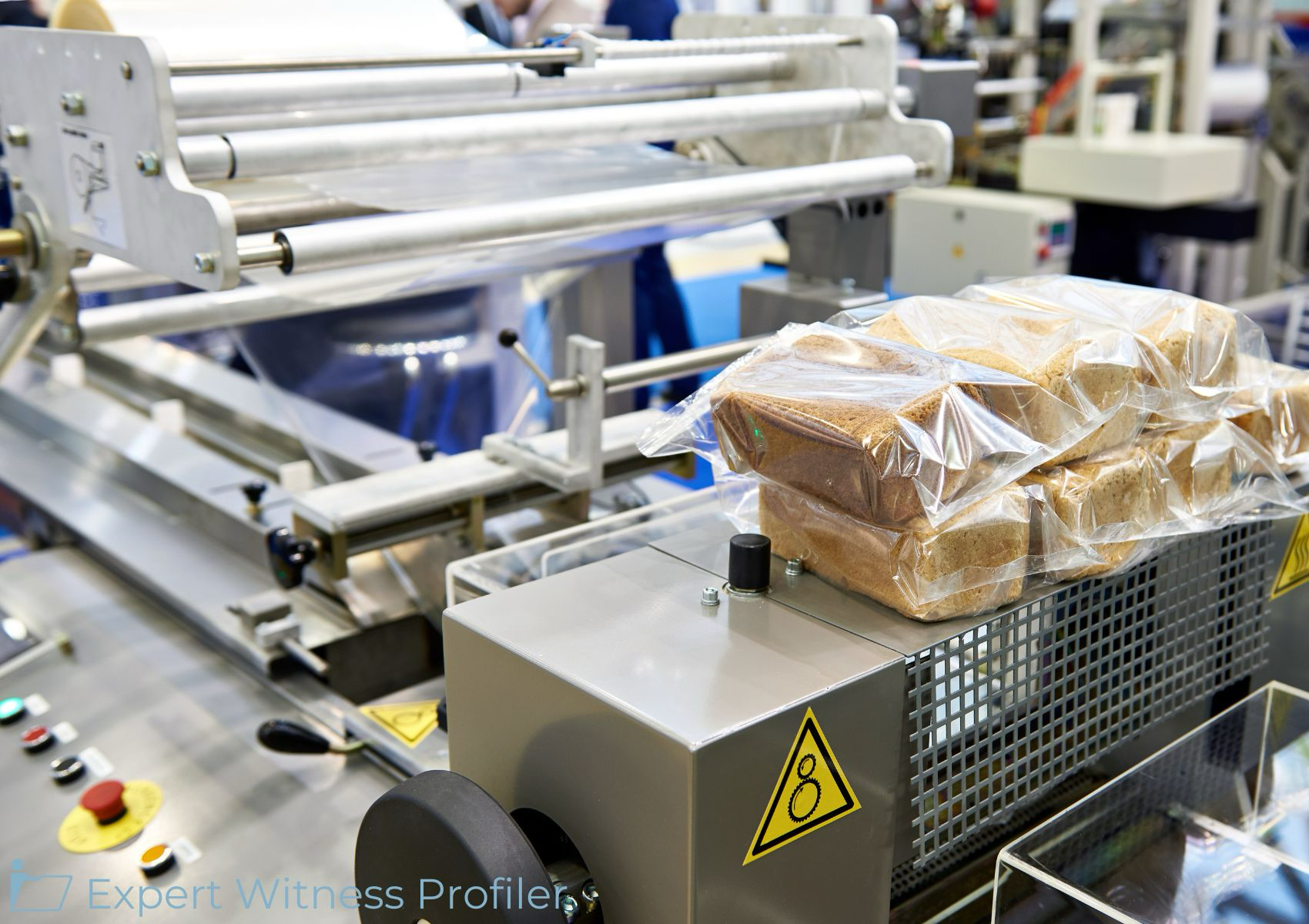
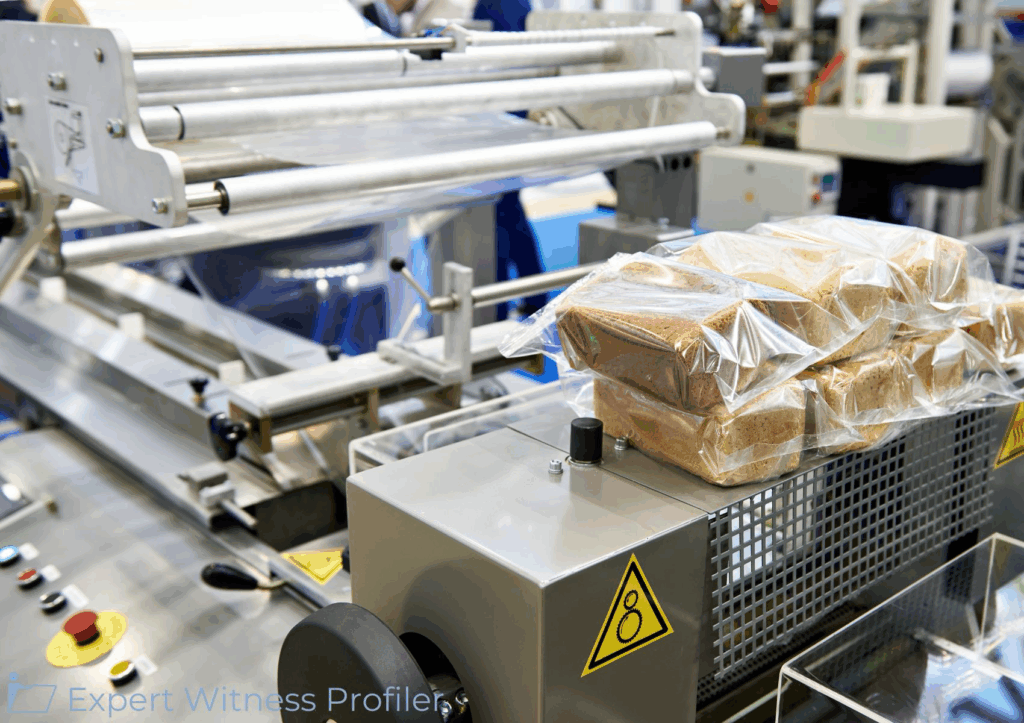
    This case arises out of Delta’s delayed donut wrapping system. In late 2021, Bon Appetit Danish, Inc. and Bon Appetit Specialty Snacks, LLC (collectively, “Bon Appetit”) and Delta Systems and Automation, LLC’s (“Delta”) entered into a set of three contracts for Delta to manufacture packaging systems for Bon Appetit’s baked goods.

    But the donut packaging system failed to launch. After further testing failed to resolve the performance issue, Bon Appetit terminated all three contacts on April 14, 2023.

    Bon Appetit sued Delta over a contract dispute involving Overwrapping Systems, claiming $6,214,505 in labor costs as direct damages resulting from Delta’s alleged breach. Bon Appetit’s expert, Joseph Wheat, testified that these labor costs were directly caused by Delta’s failure to deliver properly functioning systems.

    Delta countered, arguing that the labor costs were consequential damages, barred by the Limitation of Liability provision, because they stemmed from Bon Appetit’s internal plan to use the Overwrapping Systems.

    Delta moved to exclude Wheat’s testimony, asserting that the labor costs were derivative losses arising from circumstances that are particular to the contract or to the parties.

    Additionally, Bon Appetit sought to introduce Lyle Rogalla as an expert to testify about the norms, customs, and practices, of the baked goods overwrapping industry. 

    Delta opposed, arguing that Rogalla was unqualified to testify specifically about donut overwrapping systems and that his opinions were unreliable under Rule 702.

    Accounting Expert Witness

    Joseph Wheat, CPA/ABV, CFF, is a Senior Vice President at J.S. Held, a global consulting firm specializing in a wide variety of forensic analysis.

    A Certified Public Accountant licensed to practice in California since 1993, Wheat has over 20 years of experience testifying as an expert witness on economic damages issues in both federal and state court matters.

    Wheat has performed numerous business valuation related to marital
    dissolutions, tax and estate matters and partnership disputes.

    Get the full story on challenges to Joseph Wheat’s expert opinions and testimony with an in-depth Challenge Study.  

    Packaging Expert Witness

    Lyle Rogalla has led the development of advanced packaging and food processing equipment, delivering innovative, high-value solutions that optimize production processes and reduce costs for clients ranging from small businesses to Fortune 100 companies.

    His portfolio is enriched by 29 patents, encompassing both utility and design, for industrial and commercial applications. He has collaborated with over 100 machine manufacturers to deliver extensive automation and equipment solutions tailored to the clients’ specific needs.

    Want to know more about the challenges Lyle Rogalla has faced? Get the full details with our Challenge Study report.

    Discussion by the Court

    A. Motion to Exclude Damages Opinions of Joseph Wheat

    The Court considered Delta’s motion to exclude the opinion of Bon Appetit’s expert, Wheat, who attributed $6,214,505 in labor costs to Delta’s alleged breach of contract.

    The core issue was whether these costs were direct damages, which may be recoverable, or consequential damages, barred by the the Limitation of Liability provision. Direct damages (also called general damages) flow “directly and necessarily from a breach of contract, or that are a natural result of a breach.”

    Consequential damages (also called special damages) are “secondary or derivative losses arising from circumstances that are particular to the contract or to the parties.”

    In this case, Bon Appetit’s labor costs are considered consequential damages since they stem from Bon Appetit’s unique plan to use the Overwrapping Systems to streamline production and eliminate certain employee positions, a point Bon Appetit will argue through Wheat’s evidence of the system’s added efficiency.

    The Court excluded Wheat’s opinion concerning Bon Appetit’s labor costs pertaining to consequential damages.

    B. Motion to Exclude Expert Opinions of Lyle Rogalla

    Delta moved to exclude the opinion of Bon Appetit’s expert, Rogalla, arguing that he lacked the necessary qualifications to opine on donut overwrapping systems and that his methodology was unreliable under Daubert and Rule 702 due to an alleged lack of supporting facts or data.

    The Court disagreed. It found that Rogalla was qualified to testify based on his decades of experience with “solutions for complex automation and packaging needs . . . with emphasis in the food industry,” including “packaging and process automation, the preparation of specifications for the machines and the goods handled by the machines, testing, and modifying the machines and specifications to address both process quality and efficiency.”

    Insofar as the Donut System diverged from Rogalla’s experience with other food packaging systems, the Court held that it concerned the weight of his testimony, not its admissibility. 

    The Court also found that Rogalla had relied on a sufficient factual basis, including the Complaint, contract documents, Delta’s website, and federal regulations. Challenges to the depth or nature of that evidence, the Court concluded, were issues of credibility and weight, appropriate for cross-examination, not grounds for exclusion.

    Held

    • The Court granted Delta’s Daubert motion to exclude Joseph Wheat’s opinions.
    • The Court denied Delta’s Daubert motion to exclude the testimony of Lyle Rogalla.

    Key Takeaways:

    • Not all foreseeable damages are direct damages, as consequential damages may be “foreseeable and proximately caused by the breach of a contract.” 
    • An expert might draw a conclusion from a set of observations based on extensive and specialized experience.

    Case Details:

    Case Caption: Bon Appetit Danish, Inc. v. Delta Sys. & Automation LLC
    Docket Number: 2:23cv04305
    Court Name: United States District Court for the Central District of California
    Order Date: March 17, 2025