Blog

  • Valuation Expert Witness’ Testimony About Neutral Third Party Appraisers Excluded

    Valuation Expert Witness’ Testimony About Neutral Third Party Appraisers Excluded

    McDonald’s Corporation (“Plaintiff”) filed this breach of contract action against Vanderbilt Atlantic Holdings LLC (“Defendant”). 

    The primary issue to be tried in this case is whether Vanderbilt failed to cooperate in the process set forth in an addendum to a lease between McDonald’s and Vanderbilt (the “Lease”) to evaluate the fair market rental value (“FMV”)—the basis to calculate McDonald’s rent—for the subject property (the “Property”).

    Vanderbilt’s appraiser, Tom Tener, estimated the FMV for the Property twice.

    Defendant retained Michael P. Hedden as an expert witness to testify about “(1) his professional background, experience and qualifications; (2) his review of Thomas Tener’s appraisal prepared on July 30, 2019 including Tener’s appraisal methods and techniques; and (3) the purpose and role of a neutral third-party appraiser.” 

    Plaintiff filed a motion to exclude his testimony on the basis that his expert opinion “is not based on sufficient facts or methodology” and lacked “independent analysis” to support testimony on the “Property’s highest and best use.” 

    Valuation Expert Witness

    Michael Hedden specializes in providing valuation, litigation support, and expert testimony services as a knowledgeable real estate professional in all aspects of market analysis and valuation of real property. He has experience in the appraisal of industrial, commercial, residential, and special purpose property including hospitality, hospital, and healthcare facilities. 

    Get the full story on challenges to Michael Hedden’s expert opinions and testimony with an in-depth Challenge Study. 

    Discussion by the Court

    Hedden’s Report

    Hedden was retained to conduct an appraisal review, as opposed to an independent appraisal. As the report noted, the scope of the work was to determine whether: (1) Tener’s report contained adequate and relevant data; (2) the appraisal methods and techniques used were appropriate given the language of the Lease; and (3) the analyses, opinions, and conclusions in the report were appropriate, credible, and reasonable for the intended use of the intended user within the context of the Lease.

    Therefore, Hedden concluded that Tener’s “analysis, opinions and conclusions” were “appropriate, credible and reasonable.”

    Uniform Standards of Professional Appraisal Practice (USPAP) Standard 3 requires an appraisal reviewer to “identify the problem to be solved, determine the scope of work necessary to solve the problem, and correctly complete research and analyses necessary to produce a credible appraisal review.” The Court held that just because Hedden “did no independent research” does not mean he did not comply with USPAP standards or conduct an acceptable appraisal review. 

    The Court held that Plaintiff’s other bases for exclusion similarly are unavailing. Plaintiff’s comparison of Hedden’s appraisal review with that of Plaintiff’s expert is insufficient to exclude Hedden’s testimony. After all, the scope of their respective work appears to have been different as Hedden conducted a quality appraisal review, whereas Aaron conducted a more quantitative review. Moreover, Hedden’s consideration of Tener’s competency and experience is not improper, and does not reflect a rubber stamp of Tener’s report. Indeed, such a consideration would seem to be relevant in an appraisal review. 

    Hedden’s Opinion on the “Highest and Best Use” of the Property

    Plaintiff sought to preclude Hedden’s testimony that Tener “correctly concluded” that “the highest and best use required valuing the Property based on the construction of a new building consistent with the Property’s zoning which allowed for 39,000 square feet.” Plaintiff contended that this opinion is outside the scope of an appraisal review, and Hedden did not perform the analysis necessary to reach that opinion independently.

    The Court held the scope of Hedden’s appraisal review included determining whether “the appraisal methods and techniques used in the Report are appropriate given the language in the lease” and “the analyses, opinions and conclusions in the Report are appropriate, credible, and reasonable.” In other words, his opinion that Tener “correctly concluded” how to consider the highest and best use was an opinion of the quality, not value, of Tener’s appraisal.

    Hedden’s Expert Testimony About Neutral Third Party Appraisers

    Plaintiff sought to preclude Hedden’s testimony about the purpose and role of a neutral third party appraiser because such information was not included in the expert report and the topic is a matter of contract interpretation. 

    As an initial matter, the Court doubts that this testimony would aid the Court in any finding of fact. Moreover, as the Court previously stated, “the role of the third appraiser . . . is a matter of contract interpretation.” Further, this topic was not within the scope of Hedden’s appraisal review and was not discussed in the report.

    Held

    The Plaintiff’s motion to exclude the testimony of Hedden is denied in part and granted in part.

    Key Takeaway:

    Hedden, for the most part, complied with the USPAP standards but his testimony about the purpose and role of a neutral third party appraiser was excluded because the Court previously stated that the role of the third appraiser is a matter of contract interpretation.

    Case Details:

    Case Caption: McDonald’s Corporation V. Vanderbilt Atlantic Holdings Llc
    Docket Number: 1:19cv6471
    Court: United States District Court, New York Eastern
    Order Date: September 30, 2024
  • Fraud Examination Expert Witness’ Testimony About the Effect of Misappropriated Trade Secrets Excluded

    Fraud Examination Expert Witness’ Testimony About the Effect of Misappropriated Trade Secrets Excluded

    This case stems from a trade secret dispute between University of Mississippi Medical Center (“UMMC”) and Defendant Dr. Spencer Sullivan, a former employee of UMMC. 

    The Court has resolved the issue of liability through its Order granting default judgment in favor of Plaintiff. The injury pleaded by UMMC is the loss of certain specific former UMMC hemophilia patients who transferred their medical treatment, including pharmacy services, to Mississippi Center for Advanced Medicine (“MCAM”) as a result of Defendants’ use of UMMC’s trade secrets. As it stands, it is conclusively established that MCAM’s misappropriation of UMMC’s trade secrets proximately caused those patients to leave UMMC for MCAM, and UMMC must now prove the amount of damages that naturally flow from those patients. The parties agree that the scope of damages is the only issue left to be tried.

    Plaintiff specifically moves to exclude “all of Justin Blok‘s opinions and testimony that are based on the rejected causation standard and that ignore the effect of the default judgment and other irrelevant opinions that touch upon liability.” 

    Fraud Examination Expert Witness

    Justin Blok has testified in a variety of litigation matters involving patent, trademark, and copyright infringement, theft of trade secrets, breach of contract, business valuation, bankruptcy, fraud, business interruption, personal injury, wrongful death, and wrongful termination. He has testified on
    behalf of both Plaintiffs and Defendants in the analysis and determination of economic damages, including lost profits, reasonable royalties, price erosion, unjust enrichment, diminution of value and insolvency analyses, valuation, and pre- and post-judgment interest.

    Want to know more about the challenges Justin Blok has faced? Get the full details with our Challenge Study report. 

    Discussion by the Court

     UMMC argued that portions of Blok’s report assumed Defendants were liable but did not correctly reflect the finding of liability established by this Court’s Order granting default judgment.

    Defendants contended Blok’s relevant testimony included “whether misappropriated trade secrets were legally available after a certain date, whether trade secrets were involved in certain patient interactions, the effect (if any) trade secrets had on Defendant MCAM’s pharmacy operations, and the like.” Defendants also stated that “Blok’s damages calculations are based, in part, on when MCAM legally obtained access to the trade secret information through uView or patient release forms.” Accordingly, Defendants argued that the Court should not preclude Blok from testifying as to the point at which Plaintiff’s damages no longer naturally flow from Defendant’s liability.

    UMMC’s reply emphasized that it did not seek to exclude Blok’s entire testimony but only the portions unrelated to damages. Plaintiff specifically referenced areas including whether the misappropriated trade secrets were legally available after a certain date, whether trade secrets were involved in certain patient interactions, and the effect trade secrets had on Defendant MCAM’s pharmacy operations.

    UMMC argued that each of these categories relate to causation for liability and not damages calculations. Plaintiff instead submitted that the current relevant areas include testimony relating to “alleged overstatement of MCAM’s gross profits, no analysis of MCAM’s actual reported operating profits, no analysis of MCAM’s clinic revenues or costs, or no analysis of certain pharmacy costs.”

    The Court held that while Defendants can still present evidence relevant to the appropriate damages calculation period, Defendants have not shown how the challenged areas of Blok’s testimony will help the jury determine the available damages in this matter. 

    Held

    The Court granted Plaintiff’s motion to exclude the challenged areas of Justin Blok’s testimony.

    Key Takeaway:

    Blok provided testimony relating to “whether misappropriated trade secrets were legally available after a certain date, whether trade secrets were involved in certain patient interactions, the effect (if any) trade secrets had on Defendant MCAM’s pharmacy operations, and the like.” However, the current relevant areas include testimony relating to “alleged overstatement of MCAM’s gross profits, no analysis of MCAM’s actual reported operating profits, no analysis of MCAM’s clinic revenues or costs, or no analysis of certain pharmacy costs.

    Case Details:

    Case Caption: The University Of Mississippi Medical Center V. Sullivan Et Al
    Docket Number: 3:19cv459
    Court: United States District Court for the Southern District of Mississippi, Northern Division
    Order Date: September 9, 2024
  • Retirement Plan Expert Witness’ State of Mind Opinions Excluded

    Retirement Plan Expert Witness’ State of Mind Opinions Excluded

    In 2016, Defendants Signode Industrial Group, LLC, and Illinois Tool Works, Inc. unlawfully terminated promised healthcare benefits for Plaintiffs, a class of retirees and their dependents. On March 26, 2019, this Court enjoined Defendants to reinstate Plaintiffs’ healthcare benefits that were in effect before January 1, 2016. Defendants implemented a new healthcare benefits plan effective January 1, 2020, but Plaintiffs contend that the new plan is deficient. In other words, Plaintiffs alleged that the 2020 Plan does not “reinstate, restore, and replicate” the 2002 Plan.

    Plaintiffs hired a healthcare consultant, Stuart Wohl to assess how the 2020 Plan compares to the 2002 Plan. Defendants filed a motion to exclude Wohl’s report and testimony. Defendants argued that the Wohl Report must be excluded because Wohl’s opinions allegedly “are not supported by appropriate citations and/or corresponding explanations,” are offered “about topics he does not understand,” and are “simply Wohl’s own speculation about retirees’ state of mind.”

    The parties did not dispute that Wohl is qualified as an expert to offer testimony on healthcare plans.

    Retirement Plan Expert Witness

    Stuart I. Wohl is a Senior Vice President and Senior Benefits Consultant for Segal, a human resource and benefits consulting firm hired by Plaintiffs. Wohl is a licensed Life and Health Insurance Consultant in multiple states with more than thirty years of healthcare consulting experience, specializing in retirement healthcare. 

    Want to know more about the challenges Stuart Wohl has faced? Get the full details with our Challenge Study report. 

    Discussion by the Court

    The Wohl Report provides Wohl’s opinions with respect to the material differences between the 2002 Plan and the 2020 Plan, along with additional opinions related to the sufficiency of the 2020 Plan in restoring the retirees’ healthcare.

    Wohl first concluded in the Wohl Report that the 2020 Plan “is and will be understood by the retirees as being materially different from the [2002 Plan]” until it was discontinued in January 2016.  He also concluded that Defendants’ 2020 Plan “overcharges retirees and discourages retirees from participating in” that Plan. Wohl stated that Defendants’ proposed remedies to rectify the period between 2016 and 2019 when the retirees had no healthcare “imposes unfair burdens on the retirees.”

    Wohl Report appears to be based on Wohl’s speculations supported by his own expertise

    The Court held that the Wohl Report frequently makes declarations that begin with “in my opinion,” and then provides Wohl’s professional opinion on a certain matter related to the Plans, without citations or further explanations for that opinion. For instance, the Wohl Report assesses that the 2020 Plan provides different coverage for ambulances, chiropractic care, nursing, and vision but fails to cite to either Plan in support of that assessment.

    In other words, the Wohl Report does not sufficiently connect Wohl’s expertise to the opinions presented in the Report.

    Wohl Report improperly contains references to retirees’ states of mind

    State of mind opinions are not proper expert testimony when the expert provides no basis or foundation for making those opinions. The Court observed that Wohl makes these conclusions about the retirees’ state of mind without providing any evidence that he spoke to any of the retirees.

    Wohl Report contains legal conclusions about remedies

    Certain sections of the Wohl Report contain inadmissible legal conclusions about what remedies Wohl believes are available and adequate in this case. The remedies available in this action are a disputed issue in this case that are the subject of one of Plaintiffs’ pending motions. The Court held that it is outside the scope of appropriate expert testimony for the Wohl Report to make legal conclusions about remedies.

    Held

    The Court granted the Defendants’ motion to exclude the report and testimony of Stuart Wohl.

    Key Takeaways:

    • Because Wohl had no foundation to make state of mind opinions, they constitute inadmissible witness testimony.
    • Wohl summarizes and opines over various elements of the Plans without explaining how his experience yields his conclusions and without citing sufficient evidence to substantiate his opinions. Because the Court’s gatekeeping function “requires more than simply ‘taking the expert’s word for it,’ ” the opinions and conclusions about the Plans in the Wohl Report are not sufficiently reliable to be admissible.
    • Rule 704 of the Federal Rules of Evidence permits expert witnesses to testify as to the ultimate issue in an action, but it does not authorize those opinions to be legal conclusions that will determine the outcome of the case. Wohl Report contains inadmissible legal conclusions about what remedies Wohl believes are available and adequate in this case.

    Because the Report is based on unsupported opinions, inappropriate state
    of mind opinions, and legal conclusions, it is unreliable and not helpful to the Court.

    Case Details:

    Case Caption: Stone Et Al V. Signode Industrial Group Llc Et Al
    Docket Number: 1:17cv5360
    Court: United States District Court, Illinois Northern
    Order Date: September 30, 2024
  • Neurology and Pain Management Expert Witness’ Opinion Regarding Vascular issues Being a Potential Causal Factor Admitted

    Neurology and Pain Management Expert Witness’ Opinion Regarding Vascular issues Being a Potential Causal Factor Admitted

    This maritime negligence case arose from an accident involving Joseph Sylvester that occurred on September 23, 2021. In 2021, Talos operated the South Marsh Island 130 (“SMI 130”) field, located in the Gulf of Mexico on the Outer Continental Shelf. Sylvester, employed as a crane mechanic by Gulf Crane Services, Inc. (“GCS”), was assigned to work for Talos on its offshore production platforms in the SMI 130 field between April and October 2021. On the day of the accident, Sylvester claimed he sustained personal injuries at approximately 9:30 a.m. while being transferred in a personnel basket from the M/V Miss Peggy Ann (“the vessel”) to Talos’s SMI 130 platform.

    He explained that when the crane operator, Brian Spears, lifted him in the basket, the basket swung rapidly, causing it and Sylvester to slam violently into a Connex box on the vessel’s deck. Sylvester contended that the negligent operation of the SMI 130 platform crane by Spears caused or contributed to his injuries.

    Extent of his injuries

    As a result of the incident, Sylvester sustained serious injuries, including damage to his hip, back, and legs. He suffered severe pain and swelling in his hip, thigh, and leg and received a diagnosis of a blood clot. In October 2021, he was diagnosed with deep vein thrombosis (“DVT”) and underwent a surgical procedure to remove the blood clots. He was placed on two powerful blood thinners to prevent the recurrence of clots. Despite these surgeries and ongoing medication, his leg pain worsened. In February 2023, an ultrasound revealed new blood clots in his left leg, leading to swelling and severe pain.

    Defendants retained Chad Domangue as an expert in neurology and pain management. At their request, Domangue conducted a physical examination of Sylvester, reviewed his medical records, and determined the cause of his severe leg pain which continued despite receiving extensive treatment. Following his examination, Domangue expressed the medical opinion that all of Sylvester’s symptoms were related to his vascular abnormalities and not his lumbar spine. However, Plaintiffs contended that this statement, along with others, exceeded the scope of Domangue’s expertise.

    Neurology and Pain Management Expert Witness

    Dr. Chad M. Domangue, M.D. has exhaustive training in identifying and administering treatment for conditions that trigger severe and chronic pain and decreased functionality as an Interventional Neurologist and Pain Management Specialist. 

    He is double board-certified in Neurology and Pain Management and is board eligible for Clinical Neurophysiology. These distinct credentials allow Domangue to assess and furnish his opinion as both a pain specialist and a neurologist. It displays a tangible demonstration of his deep commitment to providing the best possible care for his patients.

    Want to know more about the challenges Chad M. Domangue has faced? Get the full details with our Challenge Study report.

    Discussion by the Court

    In this case, Plaintiffs raised several arguments under Daubert and Rule 702 regarding the reliability of the vascular opinions provided by Domangue. They asserted that his opinions were unreliable for several reasons: (1) they lacked specialized knowledge that would assist the trier of fact in understanding the evidence; (2) they were not based on sufficient facts or data; (3) they were unsupported by reliable principles and methodology; and (4) there was no evidence to support the reliability of his opinions.

    In response, Defendants contended that Plaintiffs misunderstood the fields of neurology and pain management and the methodology employed by Domangue in forming his opinions. Physicians specializing in neurology and pain management frequently create differential diagnoses to assess whether a patient’s vascular conditions contribute to their pain or other symptoms.

    Vascular Issues as a Potential Causal Factor for Sylvester’s Prolonged Pain

    As the Court examined the arguments, it determined that Domangue’s opinion regarding vascular issues as a potential causal factor for Sylvester’s prolonged pain was appropriate. It was reasonable for Domangue, as an attending physician, to consider a vascular abnormality as explanations for Sylvester’s persistent symptoms and swelling.

    Qualifications

    Despite Plaintiffs’ claims that Domangue lacked the qualifications to opine on vascular issues and had no factual support for his opinions, Defendants argued that he was well-equipped to evaluate the impact of vascular conditions on his patients. The Court supported this view, noting Domangue’s extensive training. Domangue participated in an internship program at the Medical Center of South Carolina, Charleston, South Carolina. The first year of the program was internal medicine, which included training in vascular issues. Additionally, from 2005 to 2007, Domangue was a resident in the neurology department at the University of Virginia, where he participated in and was trained in the stroke program. In this program, he received specific training in the diagnosis and care of vascular conditions.

    Reliable Methodology

    Domangue’s report demonstrated his thorough evaluation of Sylvester’s case. He reviewed medical records, including imaging studies and narrative records, and conducted a physical examination. From this, he arrived at a differential diagnosis, which Defendants argued is a reliable methodology. A differential diagnosis involves a systematic process where medical practitioners identify the most likely cause of a patient’s symptoms and then evaluate all the possible causes of the condition based on the history of the patient’s symptoms, his medical records as well as physical examination and laboratory testing results.

    In this case, Domangue explained that, as a neurologist and pain management specialist, he was tasked with evaluating how the presence and effect of  vascular conditions might contribute to Sylvester’s complaints of pain and physical limitations. He did not propose treatments for Sylvester’s blood clots; instead, he diagnosed the worsening venous issues as the source of the pain. After starting with a physical examination, medical history, and imaging studies, Domangue ruled out lumbar injuries as a cause of Sylvester’s symptoms. He therefore ruled in vascular issues as a potential cause of Sylvester’s clotting.

    Held

    The Court denied the Plaintiffs’ motion to exclude the opinions of Chad Domangue.

    Key Takeaway:

    The Court concluded that the arguments against the admissibility of certain medical opinions lacked sufficient grounds for exclusion. It emphasized the importance of evaluating the methodologies used in forming medical opinions, particularly the ones consisting of a differential diagnosis, which followed a patient-specific process of elimination in order to identity the “most likely” cause of a set of signs and symptoms from a list of possible causes. The Court acknowledged that challenges to these opinions would be better addressed through cross-examination instead of exclusion.

    Case Details:

    Case Caption: Sylvester vs. Talos Energy Offshore, LLC
    Docket Number: 6:22cv5192
    Court: United States District Court for the Western District of Louisiana, Lafayette Division
    Order Date: September 25, 2024
  • Safety Expert Witness’ Testimony on Deficient Inspections Limited

    Safety Expert Witness’ Testimony on Deficient Inspections Limited

    Plaintiff Bailey Aldrich slipped and fell from a single step landing at a United States post office, injuring her foot. Aldrich testified that as a result of her fall, all of her weight landed on her right foot, and she broke three bones in the top of her right foot close to her ankle. She then landed on her bottom and was in immense pain. Aldrich believed that the condition that caused her fall was created by trucks running into the back of the landing.

    Plaintiff’s liability expert, William Marletta, testified that the inspections performed by the United States Postal Service were deficient and that “anybody inspecting this should have been able to pick up that there were problems.” He added that there are issues that are not found or cited in inspections that could still be considered dangerous or defective conditions.

    Defendant challenged Marletta’s opinions on several bases: that they (1) form inadmissible legal conclusions; (2) are not based on reliable principles and methods; and (3) are based on facts not in the record that are speculative and do not assist the trier of fact. 

    Safety Expert Witness

    William Marletta is an internationally recognized safety professional with many professional honors including an “Award of Merit” from The American Society of Testing and Materials (ASTM) for his contributions to the development of standards, and was a world recipient of the American Society of Safety Engineers (ASSE) Safety Professional of The Year.

    Discover more cases with William Marletta as an expert witness by ordering his comprehensive Expert Witness Profile report.

    Discussin by the Court

    Marletta’s Opinions Form Inadmissible Legal Conclusions In Part

    In one of his opinions, Marletta claimed that Defendant was “negligent in failing to properly maintain, repair, and/or replace the defective condition, or provide adequate warnings in accordance with The New York City Building Code, as well as good and accepted safe practice.”

    The Court held that the word “negligent” impermissibly embraced a legal conclusion. However, the Court accepted Plaintiff’s suggested revision of the opinion to: “the owner(s) of the property and its agent (“Defendants”) failed to properly maintain, repair, and/or replace the defective condition, or provide adequate warnings.”

    Marletta concluded that the loading dock “became a means of egress when [Plaintiff] was instructed to enter the accident area.” Marletta opined that there were “dangerous slopes that forward pitched the curb as a ramp.” Whether the loading dock was a means of egress and whether it was a ramp are questions of law to be decided by the Court because these are both legal terms used in the Building Code. Accordingly, the Court excluded these opinions.

    Marletta interpreted various codes and statutes, including iterations of the Building Code and American Disabilities Act. Defendant argued that the applicability and interpretation of various codes and statutes are matters of law for the Court to decide.

    The Court held that Marletta’s opinions provide information on standards and deviations from them. He cites code and statute violations as part of his overall analysis regarding Defendant’s alleged failure to maintain the step. Defendant has not identified any viable basis to exclude these opinions.

    Whether the opinions are applicable to the instant matter, however, depends on if the Court determines that the loading dock is a means of egress and the landing is a ramp, which the Court lacks sufficient information to do at this juncture.

    Marletta’s Opinions Are Based on Sufficient Facts

    Marletta relied on the following materials when forming his expert opinions: (1) photographs of the accident area; (2) inspection and maintenance problem reports; (3) Plaintiff’s deposition testimony; (4) depositions from Post Office employees; (5) various other litigation materials provided to him by Plaintiff’s counsel; and (6) an onsite inspection on November 15, 2022. 

    Lack of Visual Cues

    Marletta concluded that a lack of visual cues was the proximate cause of Plaintiff’s accident. Defendant claimed that Marletta’s opinion should not be persuasive, because, for example, Plaintiff was not looking down at the time of the accident. The Court refrained from excluding this opinion because Defendant had not pointed to any reason why the materials Marletta relied upon were insufficient. 

    When Marletta concluded that the “excessive height of the single-step riser was a proximate cause” of Plaintiff’s injury, the Court held that Defendant’s criticisms go to the weight, not the admissibility, of the proffered testimony.

    Untested Conjecture

    Defendant took issue with Marletta’s statement that the landing was a “smooth, hard surface” and that when a “smooth, hard surface is combined with water or a foreign substance left laying on its surface, conditions are ripe for a slip and fall accident.”  Defendant argued that Marletta’s testimony that “it would not surprise [him]” if there were water or a foreign substance on the landing is “untested conjecture.” Marletta cannot testify as to unsupported beliefs about whether there was water or a foreign surface on the landing. But the Court, at this juncture, will not exclude the opinion that when a smooth, hard surface is combined with water or a foreign substance, conditions are ripe for an accident. 

    Location of the Accident

    When Defendant pressed for exclusion because Marletta was unable to identify with certainty the location of the accident, the Court held that Marletta identified generally where Plaintiff’s accident occurred; it is not entirely uncertain where Plaintiff fell.  The Court, as finder of fact at trial, will determine how much weight to assign to the fact that Marletta determined the average roughness of the landing.

    Similarly, Marletta noted that the “loading dock and curb had worn metal, excessive slopes, garbage and filth, an excessive riser, and more.” Although Defendant argued that there is no evidence that these conditions existed or contributed to the accident, the Court will determine what weight, if any, to assign this opinion at trial.

    Marletta’s statements are not connected to the facts of the case

    Marletta opined that conditions “contrary to our expectation” can contribute to a slip and fall. He concluded that the “normal cone of vision of the pedestrian” makes hazards on walking surfaces difficult to distinguish. Marletta also concluded that surface changes are “difficult to distinguish due to the to view perspective of the pedestrian.” The Court held that  Defendant’s conclusory arguments that Marletta’s statements are not connected to the facts of the case fail to establish that these opinions were not based upon reliable data and methodology or will not assist the Court as the finder of fact.

    The Court also saw no reason to exclude Marletta’s opinion that that “these departures from codes, rules, regulations and good and accepted safe practice were the proximate cause(s) of the accident.”

    Defendant’s Other Arguments to Exclude Marletta’s Expert Testimony Are Unavailing

    Marletta opined that “there was a failure to adequately train employees in safe practices that prohibited pedestrians from entering into dangerous areas.”  Defendant’s only argument was that this testimony did not raise any material issue of fact, which the Court held was not a basis to exclude the testimony.

    Defendant also quibbles with Marletta’s statement that additional warning signs should have been posted in the area of the accident. Defendant argued that the landing was painted in yellow, therefore providing a warning and that Plaintiff was aware of the step. The Court, once again, held that Defendant did not point to any basis to exclude this opinion. 

    Held

    The Court granted in part and denied in part the Defendant’s motion to exclude William Marletta’s testimony.

    Key Takeaways: 

    • Any gaps or inconsistencies in Marletta’s report go to the weight of the evidence, not its admissibility, as Marletta’s report is based on sufficient facts and data.
    • When an expert offers an opinion relevant to applying a legal standard, the expert’s role is limited to describing sound professional standards and identifying departures from them.

    Case Details:

    Case Caption: Aldrich V. The United States Of America Et Al
    Docket Number: 1:22cv5297
    Court: United States District Court, New York Southern
    Order Date: September 26, 2024
  • Opposing Experts’ Testimony On Fire Origin and Cause Investigation Partly Excluded

    Opposing Experts’ Testimony On Fire Origin and Cause Investigation Partly Excluded

    This matter arises from a July 30, 2022, lightning strike in Water Valley, Mississippi, which caused a fire and ultimately the destruction of a warehouse and its contents, including automotive components owned by the Plaintiff Kodaco and stored in the warehouse.

    Kodaco claims “approximately $3,500,000.00 worth of business property” was stored at the subject warehouse, which was owned and operated by the Defendant Warehouse 72, at the time the warehouse burned. The Plaintiff alleged claims against the Defendants for breach of contract, negligence, breach of bailment, and negligent misrepresentation. 

    The parties have filed competing motions seeking to exclude or limit the testimony of experts in the areas of fire origin and cause investigation and fire protection engineering— the Plaintiff seeks to exclude or limit certain opinions of Neil Wu‘s testimony and the Defendants seek to exclude testimony expected to be offered by Phillip Keena. Both motions sought primarily to ensure that the opposing expert witness does not offer impermissible legal conclusions.

    The Plaintiff objected to certain testimony and conclusions in Wu’s deposition and expert report that the Plaintiff characterized as impermissible legal conclusions. The Defendants have agreed that “Wu does not intend to offer any ‘legal opinions’ and Defendants do not intend to elicit such testimony” at trial.

    The Defendants argued that Keena’s proffered testimony and conclusions veer into the realm of legal conclusions; they further argued that his testimony did not go far enough into the standards a reasonably prudent warehouser would have implemented under similar circumstances as those existing in this case. As is the case with the Defendants’ expert, the Plaintiff conceded that Keena will not offer legal conclusions at trial.

    Fire Investigation Expert Witnesses

    Neil Wu is a Principal at SRE and the founder of the firm. He holds a Bachelor of Science and a Master of Science degree in Fire Protection Engineering, both from the University of Maryland. He is a registered professional engineer in 14 states, including the District of Columbia. Wu is a member of the International Association of Arson Investigators (IAAI), National Association of Fire Investigators (NAFI), National Fire Protection Association (NFPA), Society of Fire Protection Engineers (SFPE), and has served on multiple technical committees.

    Want to know more about the challenges Neil Wu has faced? Get the full details with our Challenge Study report. 

    Philip Keena holds two degrees relevant to the issue at hand, an associate degree in Fire Administration and a bachelor’s degree in Fire Protection and Safety Engineering Technology. The International Association of Arson Investigators (IAAI) has also certified him as a fire investigator, and he has been a firefighter for thirty-one years. He currently works for Rimkus, a forensic engineering company.

    Get the full story on challenges to Philip Keena’s expert opinions and testimony with an in-depth Challenge Study. 

    Discussion by the Court

    First, the Court holds that the concessions each party has made regarding their expert’s testimony largely renders the competing motions to exclude as moot. Both experts are highly qualified and the Court finds their knowledge will help the trier of fact to understand the evidence or to determine a fact in issue in this case, and that their testimony satisfies both Rule 702 and Daubert v. Merrell Dow Pharmaceuticals, Inc., 509 U.S. 579, 113 S. Ct. 2786, 125 L. Ed. 2d 469 (1993). Moreover, any arguments for exclusion of testimony, particularly in light of the parties’ concessions, go to the “weight to be assigned that opinion rather than its admissibility and should be left for the jury’s consideration.”

    Further, the Court is confident that it can protect against the possibility of objectionable expert testimony at trial without resorting to a blanket ban on all testimony by either side’s expert witness. 

    Finally, and most crucially given the parties’ primary objections, the Court notes it is axiomatic that “experts cannot ‘render conclusions of law’ or provide opinions on legal issues.” Accordingly, neither Wu nor Keena will be permitted to offer legal conclusions at trial and counsel will not seek to elicit any such testimony. The Court does note, however, that while experts cannot offer conclusions of law, “an opinion is not objectionable just because it embraces an ultimate issue.” 

    The parties may offer timely objections to any such testimony at trial. The Court therefore granted each party’s motion to exclude to the extent each motion seeks to prohibit testimony that constitutes a legal conclusion; to the extent that either motion seeks further limitations on testimony, that request is denied at the present juncture. The parties may offer timely objections at trial to any testimony they deem objectionable.

    Held

    The parties’ competing motions to exclude expert testimony of Defendant’s expert Neil Wu and Plaintiff’s expert Philip Keena is granted in part.

    Key Takeaway:

    Ideally, testimony and conclusions should not veer into the realm of legal conclusions. The Court does note, however, that while experts cannot offer conclusions of law, “an opinion is not objectionable just because it embraces an ultimate issue.” 

    Case Details:

    Case Caption: Kodaco Co., Ltd. V. Valley Tool, Inc. Et Al
    Docket Number: 3:23cv211
    Court: United States District Court, Mississippi Northern
    Order Date: September 23, 2024
  • Mechanical Engineering Expert Witness’ Product Identification Opinion Excluded

    Mechanical Engineering Expert Witness’ Product Identification Opinion Excluded

    This case arises from a boating accident at Lake Powell on July 29, 2018. Plaintiff, while aboard a Moomba Mondo ski boat purchased from Rocky Mountain Boat Company (ROMOBOCO), was injured when a carabiner (the Subject Carabiner) suddenly failed and struck her in the head. Plaintiff survived, but she allegedly suffers from permanent disabilities due to the accident. Unfortunately for all parties, shortly after the accident, the rope and carabiner at issue were disposed of by another passenger on the boat.

    On July 20, 2020, Plaintiff filed suit against ROMOBOCO, the seller of the Moomba, and later amended the complaint to add two companies believed to be involved in the manufacturing and/or distribution of the Subject Carabiner, Attwood Corporation and Land ‘N’ Sea Distributing, Inc.

    Attwood and LNS filed a motion to strike Plaintiff’s expert, Dr. Adam Aleksander, contending his product identification opinion is unreliable.

    Aleksander concluded that the carabiner clip that struck Plaintiff (the “Subject Carabiner Clip”) is “one and the same product” as an anchor line and rope product sold by Defendant Attwood Corporation (the “Attwood 11723-7”) and that “there are no significant differences between” the Attwood 11723-7 product and the “device in the incident injury.”

    Mechanical Engineering Expert Witness

    Adam Aleksander holds Mechanical Engineering degrees from San Jose State University (B.S.) and the University of Colorado (M.E), and an Industrial Engineering degree from Texas A&M University (Ph.D.).

    He is experienced in investigation techniques, reconstruction, photogrammetry, and reconstruction of incidents that involve property loss, injuries and fatalities. Aleksander’s PhD training is in Human Factors Engineering and Safety Engineering.

    Get the full story on challenges to Adam Aleksander’s expert opinions and testimony with an in-depth Challenge Study. 

    Discussion by the Court

    Aleksander was not in a Position to Differentiate between the Defendant’s Product and its Competitors

    Aleksander came to his product identification opinion based on a comparison of a photograph of the Attwood 11723-7 and a photograph taken by the National Park Service (“NPS”) of the the Subject Carabiner Clip. However, he also identified key differences between the Subject Carabiner and the Attwood 11723-7.

    His opinion is not that he thinks the Subject Carabiner is the Attwood product to the exclusion of other products. Similar products made by other manufacturers constitutes an obvious alternative explanation. While it is not necessary to rule out every possible alternative, it is necessary to account for obvious alternatives. In his deposition, Aleksander testified that he did not compare any other product with the NPS photographs.

    The Court, therefore, finds that Aleksander’s opinion is not based on sufficient facts, because he failed to consider any alternative product that could have been the Subject Carabiner.

    Aleksander did not use a Physical Exemplar of the Attwood 11723-7 to Reach his Conclusions

    Attwood and LNS argued that Aleksander’s opinions are not based on a reliable application of his methodology to the facts, because he did not use a physical exemplar of the Attwood 11723-7 to reach his conclusions. Instead, he digitally inverted the photograph of the Attwood 11723-7 to match the orientation of NPS photograph.

    The reliability of the application of this methodology is questionable; however, the Court need not address it because, as explained above, the failure to compare the photograph to other potential products makes the product identification opinion unreliable.

    Finally, all disclosures under Rule 26 have to be in writing, signed, and served. However, the Court did not consider the supplemental report because it is not related to Aleksander’s product identification opinion.

    Held

    The Court granted Attwood and LNS’ motion to strike Plaintiff’s expert, Dr. Adam Aleksander.

    Key Takeaway:

    Aleksander failed to consider any alternative product that could have been the Subject Carabiner. Similar products made by other manufacturers constitutes an obvious alternative explanation. While it is not necessary to rule out every possible alternative, it is necessary to account for obvious alternatives. In his deposition, Aleksander testified that he did not compare any other product with the NPS photographs.

    Case Details:

    Case Caption: Marandola V. Pueblo Suzuki, Inc. Et Al
    Docket Number: 1:20cv2113
    Court: United States District Court, Colorado
    Order Date: September 26, 2024
  • James E. Lewis, Transportation Safety Expert Witness Stands Vindicated; Judge Confirms Exclusion was Procedural and Unfortunate

    James E. Lewis, Transportation Safety Expert Witness Stands Vindicated; Judge Confirms Exclusion was Procedural and Unfortunate

    James E. Lewis, a seasoned transportation safety expert, faced an unfortunate twist in his professional journey. Despite his extensive experience and deep insight into the trucking industry, he found himself disqualified from providing testimony in a significant personal injury case—not due to his lack of expertise, but because of an unnoticed procedural misstep. In the case of Rodney Bibbs v. Molson Coors, Lewis had been retained to testify on the safety of load securement, a critical factor in the accident. However, after the Plaintiff’s attorney withdrew, a motion was filed to strike Lewis’ testimony, a motion he was unaware of. 

    This article explores the misfortune that led to his disqualification and the steps Lewis took to clear his name. More importantly, it serves as a cautionary tale for expert witnesses on the importance of tracking their cases. Had it not been for a blog post on this very website, Lewis might never have known about the exclusion.  

    Background of the Case 

    The case that led to James E. Lewis’ disqualification stemmed from a tragic tractor-trailer accident involving Rodney Bibbs, an independent contractor truck driver. Bibbs had been hired to transport a pre-loaded trailer of beer from Molson Coors’ Shenandoah Brewery in Virginia to a distributor in Ohio. During his journey, while driving through West Virginia, the load allegedly shifted, causing Bibbs to lose control of the truck, leading to a serious accident. Bibbs claimed that the load had been improperly packed and secured by Molson Coors, resulting in his injuries and significant damage to the truck. 

    In the aftermath, Bibbs filed a lawsuit against Molson Coors, alleging negligence in the packing and loading of the beer pallets. Central to his case was the assertion that the company had failed to properly secure the load, which led to the accident. With load securement being a key factor, the Plaintiff needed expert testimony to substantiate these claims. That’s where James E. Lewis, a transportation safety expert with experience in Department of Transportation (DOT) compliance, was brought in to serve as the Plaintiff’s sole liability expert. 

    Initially, Lewis was disclosed as an expert under Federal Rules of Civil Procedure 26(a)(2), allowing Bibbs to put forth expert testimony about the alleged improper load securement. However, procedural delays in the case, coupled with the withdrawal of Bibbs’ legal counsel, resulted in Lewis being unaware of Molson Coors’ motion to exclude his testimony. Despite his extensive experience and background in transportation safety, Lewis’ testimony was challenged on the grounds that his qualifications and methodology did not align with the specific issue of load packing at a brewery. Unopposed due to the procedural lapse, Molson Coors successfully argued for the exclusion of Lewis’ testimony. 

    The Disqualification: A Procedural Setback 

    James E. Lewis’ disqualification from the Bibbs v. Molson Coors case was not due to a lack of expertise, but rather the result of unfortunate procedural circumstances. After the Plaintiff’s attorney withdrew from the case, a motion was filed by Molson Coors to exclude Lewis’ testimony. Due to the absence of opposition—because the attorney had left the case and the pro se Plaintiff did not respond to the motion, the Court had little choice but to strike his testimony.  

    Lewis concluded that—based on his industry experience—Defendant’s workers poorly wrapped the pallets of beer at issue, negligently loaded Plaintiff’s trailer, and therefore “increaseed the probability and magnitude of the potential harm to the victim of the crash.”

    Although Lewis had significant experience in transportation safety and held a master’s degree in education, Molson Coors argued that his subjective industry experience could not be the sole basis for his conclusion.

    The Court subsequently granted summary judgment in favor of Molson Coors, dismissing the case with prejudice. 

    Lewis discovered his exclusion not through the Court or the attorney directly, but from another opposing counsel who asked him about it after reading our blog.  Our blog post detailed the Court’s decision to strike his testimony and highlighted the reasons behind it. Realizing what had happened, Lewis was able to spring into action.  

    The Motion for Reconsideration: A Step Toward Vindication 

    James E. Lewis filed a motion for reconsideration, seeking to correct the Court’s prior ruling. This was his chance to clarify the situation and ensure that the Court recognized his expertise, despite the unfortunate circumstances surrounding the motion to strike. 

    In his motion, Lewis argued that his testimony should not have been excluded, particularly because the disqualification had nothing to do with the merits of his qualifications. Instead, it was the result of a procedural misstep. 

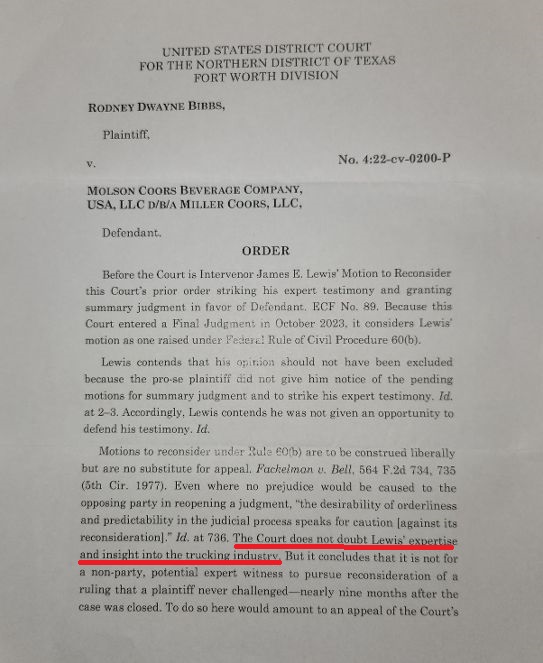
    The Court, in its response, acknowledged Lewis’ expertise and insight into the trucking industry. Judge Pittman specifically stated that the Court did not doubt Lewis’ qualifications. This was an important moment of vindication for Lewis, as it confirmed that his exclusion was not due to any shortcomings in his professional abilities. 

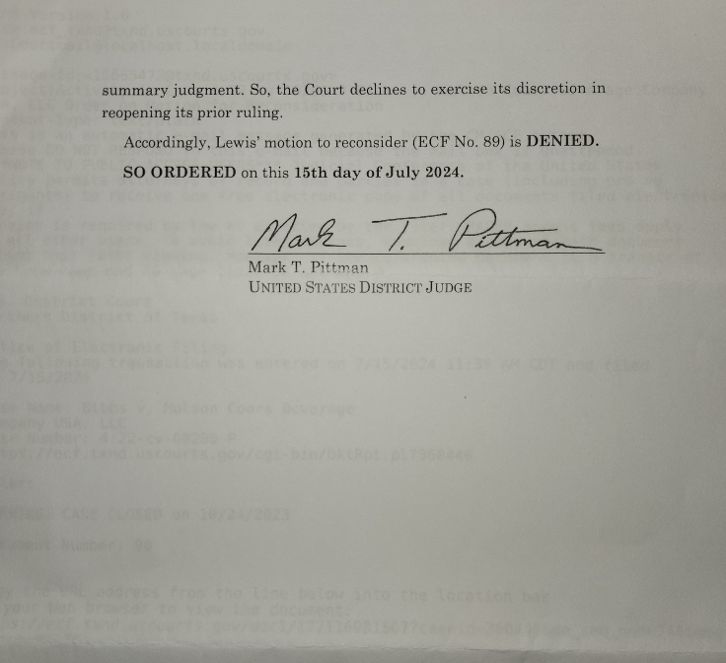
    However, the judge ultimately denied the motion to reconsider, noting that nearly nine months had passed since the case was closed. Despite the Court’s recognition of Lewis’ expertise, the procedural rules did not allow for the case to be reopened. Nevertheless, the written acknowledgment from the Court provided a crucial document that cleared Lewis’ name, proving that the exclusion was not a reflection of his professional capabilities. 

    While Lewis was unable to reverse the ruling, his effort ensured that his reputation remained intact, and the Court’s clarification helped to restore his professional standing. 

    Lessons for Expert Witnesses: Why Tracking Your Cases Matters 

    James E. Lewis’ experience serves as a cautionary tale for expert witnesses everywhere. His disqualification didn’t come from a lack of knowledge or expertise, but from a procedural error that could have been avoided if he had been aware of the motion in time. This incident highlights the critical importance of tracking the cases you’re involved in, even after you’ve submitted your expert report or given your testimony. 

    Many experts think their role ends after they provide testimony or submit their report, but cases are living processes. Motions are filed, decisions are made, and developments happen, sometimes months after the expert has been retained. Keeping a close eye on these developments is vital to protecting your reputation and ensuring your involvement doesn’t get lost in the shuffle. 

    So, what can experts do to stay on top of their cases? Regular communication with the legal team is a start, but it’s also important to set up alerts or follow case-monitoring tools. And of course, keeping an eye on industry blogs like ours can provide key updates that you might not get elsewhere. Staying informed ensures that you remain an active participant in your cases, even when things seem quiet. 

  • Neonatology Expert Witness is Not Qualified to Provide Opinions Regarding the Standard of Care for Obstetrics

    Neonatology Expert Witness is Not Qualified to Provide Opinions Regarding the Standard of Care for Obstetrics

    This matter arises out of a medical malpractice action filed by Plaintiffs Tyler Grenier, individually, and Jenna Grenier, individually and as next friend of J.A.G., a minor, (collectively “Plaintiffs”) against Defendant United States of America (“Defendant”) for alleged medical negligence at Tripler Army Medical Center (“Tripler”) related to the medical care by Defendant’s employees for prenatal care and labor of Plaintiff Jenna Grenier (“Jenna”), and the subsequent delivery of J.A.G.

    Severe physical injuries sustained by Jenna Grenier and J.A.G. are alleged as well as the negligent infliction of emotional distress to Plaintiff Tyler Grenier (“Tyler”) and Jenna; Plaintiffs’ loss of filial consortium; and Tyler’s loss of spousal consortium.

    Plaintiffs sought to strike the testimony of Defendant’s expert witness, Thomas Wiswell, M.D., in its entirety because he is a neonatologist and is not qualified to render opinions regarding causation of the injuries sustained by the Minor Plaintiff nor the standard of care surrounding his delivery at birth. 

    Neonatology Expert Witness

    Dr. Thomas E. Wiswell is a neonatologist in Honolulu, Hawaii. He graduated from the United States Military Academy at West Point, N.Y., in 1973 and subsequently attended medical school at the University of Pennsylvania in Philadelphia, graduating in 1977. Dr. Wiswell completed his pediatric residency and neonatology fellowship at Tripler Army Medical Center in Honolulu, Hawaii. He held active medical practitioner licenses from the states of Hawaii and Maryland and was certified by the American Board of Pediatrics.

    Want to know more about the challenges Thomas Wiswell has faced? Get the full details with our Challenge Study report

    Discussion by the Court

    Wiswell reviewed the Complaint filed in the instant action, Tripler records for Jenna and the Minor Plaintiff, various medical records from medical facilities for the Minor Plaintiff, Plaintiffs’ expert reports, the deposition transcripts for Jenna and Tyler as well as those for various individuals involved in Jenna’s labor and the delivery of the Minor Plaintiff.

    Wiswell lists 17 opinions regarding the instant matter. The Court excluded about ten of his opinions because Wiswell does not present qualifications in the specific medical practice areas to render opinions regarding the standard of care for obstetrics, and labor and delivery, certain opinions are generalized and overly broad, and he did not provide any methodology or principles supporting his conclusions. For example, he opined that “none of the Tripler Army Medical Center providers breached the standard of care” and went on to state that “J.A.G.’s medical problems were not caused by negligence by any TAMC providers.”

    Seven of his opinions are not excluded because Wiswell is qualified as a pediatrician and neonatologist to opine on the standard of care for newborn infants and children.

    Held

    The Court granted in part and denied in part Plaintiffs’ motion to strike the testimony of Thomas Wiswell.

    Key Takeaway:

    As a pediatrician and neonatologist, Wiswell was allowed to opine on the standard of care for newborn infants and children. However, Wiswell does not present qualifications in the specific medical practice areas to render opinions regarding the standard of care for obstetrics, and labor and delivery. To add to that, certain opinions provided by him are generalized and overly broad, and he did not provide any methodology or principles supporting his conclusions.

    Please refer to the blogs previously published about this case:

    Case Details:

    Case Caption: Grenier Et Al V. United States Of America
    Docket Number: 1:22cv396
    Court Name: United States District Court for the District of Hawaii
    Order Date: September 25, 2024
  • Fire Investigation Expert Witness’ Legal Conclusions About the Parties’ Responsibilities under Contracts Excluded

    Fire Investigation Expert Witness’ Legal Conclusions About the Parties’ Responsibilities under Contracts Excluded

    On the evening of July 30, 2022, lightning struck WareHouse’s property at 121 Industrial Park Drive causing a fire at the warehouse. 

    Shilla Industrial Co., Ltd. (“Plaintiff”) is a South Korean corporation that manufactures automobile parts and maintains suppliers in Mississippi and other southern states. Shilla alleges “approximately $5,000,000.00 worth of business property” was stored at WareHouse 72’s Water Valley property when a lightning strike caused it to burn down.

    WareHouse 72, LLC (“WareHouse”) is a domestic warehousing entity created under Mississippi law by Sasha Hyde (26%), Frank Hyde, Jr. (24%), Michelle Washington (26%), and Cayce Washington (24%).

    The parties signed a Warehouse Agreement and it included a clause under a section entitled “Insurance,” which stated, “Warehouse 72 does not cover damage in the event of an act of God while in our possession. Tornado, wind, Hurricane, Flooding, Fire from lightning strike, Earthquake etc.” 

    Plaintiff pursued claims under contract, tort, and common law against six Defendants.

    Shilla retained Phillip Keena—a retired firefighter—to offer opinions regarding (1) the origin and cause of the fire, and (2) the applicability of certain codes.

    Defendants contended that Keena’s offered report went beyond those opinions, however, into the realms of legal conclusions and judgments regarding parties’ responsibilities under contracts and other writings.

    Defendant sought to exclude Keena, to ensure Keena does not provide impermissible legal conclusions.

    Fire Investigation Expert Witness

    Philip Keena holds two degrees relevant to the issue at hand, an associate degree in Fire Administration and a bachelor’s degree in Fire Protection and Safety Engineering Technology. The International Association of Arson Investigators (IAAI) has also certified him as a fire investigator, and he has been a firefighter for thirty-one years. He currently works for Rimkus, a forensic engineering company.

    Get the full story on challenges to Philip Keena’s expert opinions and testimony with an in-depth Challenge Study. 

    Discussion by the Court

    The Court finds his knowledge will be helpful to the trier of fact to understand the evidence or to determine a fact in issue in this case, and his testimony satisfies both Rule 702 and Daubert V. Merrell Dow Pharmaceuticals, 509 U.S. 579 (1993). Accordingly, the Court finds Plaintiff’s expert is qualified to testify as to the matters outlined in his amended expert report, and any arguments for exclusion of testimony, go to the “weight to be assigned that opinion rather than its admissibility and should be left for the jury’s consideration.”

    However, Keena will not be permitted to offer legal conclusions at trial and counsel will not seek to elicit any such testimony. The Court does note, however, that while experts cannot offer conclusions of law, “an opinion is not objectionable just because it embraces an ultimate issue.”

    The Court thus granted Defendants’ motion to exclude to the extent it sought to prohibit testimony constituting a legal conclusion. 

    Held

    The Court granted in part and denied in part the Defendants’ motion to exclude the Plaintiff’s expert, Phillip Keena.

    Key Takeaway:

    The Court also notes it is axiomatic that “experts cannot ‘render conclusions of law’ or provide opinions on legal issues.” Keena will not be permitted to offer legal conclusions at trial and counsel will not seek to elicit any such testimony. The Court does note, however, that while experts cannot offer conclusions of law, “an opinion is not objectionable just because it embraces an ultimate issue.”

    In conclusion, the Court is confident it can protect against the possibility of objectionable expert testimony at trial without resorting to a blanket ban on all expert testimony. 

    Case Details:

    Case Caption: Shilla Industrial Co., Ltd. V. Warehouse 72, L.L.C. Et Al
    Docket Number: 3:23cv138
    Court: United States District Court, Mississippi Northern
    Order Date: September 23, 2024